
Giant cell arteritis & polymyalgia
Rheumatica
Dr Doha Rasheedy Ali
Assistant professor of Geriatric medicine
ASU
GCA
Case 1
A 70-year-old male, previously in good health, presented with a two-
month history of pain in the shoulder joints, upper back and chest,
which was aggravated by motion. He had early morning stiffness with
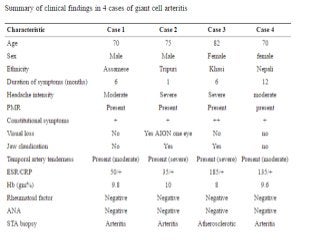
constitutional symptoms. Laboratory tests were as tabulated. A
possibility of polymyalgia rheumatic (PMR) was considered and
response to low dose steroid was gratifying. He discontinued drugs
after one month and remained well for the next five months. At that
stage, he had recurrence with additional complaint of left-sided
headache. The left superficial temporal artery was tender and
thickened. A possibility of PMR with GCA was considered. A left STA
biopsy was performed, which confirmed the diagnosis. Steroids were
administered at an oral dose of 50 mg per day and tapered gradually,
with excellent clinical response over a follow up period of one year.
Case 2
A 75-year-old male presented with headache of six weeks' duration.
Pain was predominantly over the right hemicranium, with the
maximum being over the right temple. Pain was excruciating in
intensity. There was severe allodynia over the area. There was jaw
claudication. Constitutional symptoms were present. About two
weeks after the onset of headache, he developed blurred vision in
the right eye; an ophthalmological examination revealed anterior
ischemic optic neuropathy (AION). Examination and salient
laboratory findings are as tabulated in Table 1. Diagnosis of GCA was
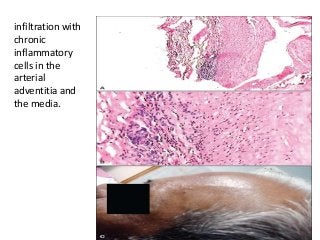
confirmed with STA biopsy [Figure 1]. He was treated with
intravenous methyl prednisolone, in a dose of 1 gm/day for three
days, followed by oral steroid in tapering doses. His headache and
constitutional symptoms improved rapidly. However, visual acuity
remained unchanged. He had recurrence of mild headache, three
months after he stopped the steroids by himself, and improved with
re- institution of steroid.
infiltration with
chronic
inflammatory
cells in the
arterial
adventitia and
the media.
Case 3
• An 83-year-old lady, complained of insidious onset
generalized weakness of six months' duration, with
multifocal ill-defined body pains, loss of appetite, loss of
weight and prostration to a bed bound state. Two months
prior to presentation, she had additional complaints of
severe, distressing headache, which was maximal over the
left temple. She avoided solids due to jaw claudication. She
was admitted to a nursing home, where the physician
started Anti tubercular therapy (ATT), on suspicion of
tuberculosis. The clinical and salient laboratory findings are
tabulated. The STA biopsy failed to demonstrate
inflammation, and the patient refused a repeat biopsy.
Therapeutic trial with oral steroids at 1 mg/kg was
instituted, which caused complete relief of headache and
jaw claudication and partial improvement in the systemic
symptoms. At six months, she was reported by attendants to
be free of the headache, but house-bound due to weakness.
Case 4
A 70-year-old lady, with a well controlled hypertension,
presented with a history of headache, arthralgias and
malaise of one year duration. Headache was global, with
maximum intensity over the left temple. She had been on
various migraine prophylaxes and analgesics, without
relief. She had associated pain and stiffness in multiple
large and small joints, with marked early morning
stiffness. She was depressed and slept poorly. A diagnosis
of PMR with GCA was made. Symptoms improved within
72 hours of starting oral steroid at 1 mg/kg/day. She had
a relapse of the same symptoms, after a year of stopping
the therapy on her own. Re-treatment was successful
Case 5
• A 68-year-old man presented to our department
complaining
• acute-onset diplopia
• low-grade fever during the past 3 days.
• He suffered from mild headache and scalp
tenderness for the last 3 months, for which he was
prescribed venlafaxine by his family doctor without
significant improvement.
• His past medical history was remarkable for
heterozygous beta-thalassemia, kidney stone
disease and duodenal ulcer.
• He was not taking any medications apart from
venlafaxine. He had quit smoking 30 years ago and
did not consume alcohol. His family history was
unremarkable.
• Physical examination of the heart, respiratory
system and abdomen was normal. There were no
palpable lymph nodes or signs of arthritis. His
peripheral pulses were normal, apart from the left
temporal artery that was hard and tender on
palpation.
• On neurological examination, his pupils were equal
and round, reactive to light and accommodation,
without blepharoptosis, but ophthalmoparesis
• with decreased abduction in the left eye was
observed. Additionally, impaired hearing of the
right ear was noted. Examination of the remaining
cranial nerves was normal. Sensation, reflexes and
motor function were intact.
Laboratory tests
1. mild anemia compatible with heterozygous
beta-thalassemia.
2. moderately high inflammation markers [ESR: 44
mm/h, CRP: 41.8 mg/L (normal values <5 mg/L)].
3. Kidney and liver function tests were within
normal range, and antinuclear and
antineutrophil cytoplasmic antibodies were
negative
• A computed tomography (CT) scan of the brain was
performed, which was normal.
• Examination of the cerebrospinal fluid revealed a
protein level of 0.046 g/dL with no cells.
• Magnetic resonance imaging (MRI) of the brain was
normal,
• Ultrasound imaging of the carotid and the
vertebrobasilar system revealed mild stenoses (up to
15 %).
• Computed tomographies of the thorax and the
abdomen with intravenous contrast agent were also
performed without any abnormal findings.
• A biopsy of the left temporal artery was performed
due to a high suspicion of GCA. While the pathology
report was pending, the patient received
intravenous methylprednisolone, 1 g daily for 3
days.
• His headache and diplopia subsided significantly,
and he was discharged with instructions for oral
corticosteroid treatment, with an initial total dose of
48 mg of methylprednisolone daily.
• Histological examination disclosed lymphocytic
infiltration of the intima, segmentally extending to
the media, with perivascular inflammatory infiltrates
in the smaller branches. The findings were
attributed to GCA, despite the absence of typical
giant cells.
• At follow-up, 1 month later, while the patient was still
receiving 48 mg methylprednisolone daily, diplopia
persisted only when gazing extremely to the left,
whereas the hearing defect was restored. However, the
patient reported hoarseness, and an
otorhinolaryngologic examination was ordered. The
latter indicated paresis of the superior and recurrent
laryngeal nerve, causing partial paresis of the right
vocal cord. Cyclophosphamide (CYC) was added to the
treatment (50 mg daily, gradually increased to 150 mg
daily), with subsequent improvement. No further
increase was made in corticosteroid dosage
• One year after the initial diagnosis, the patient
remains in remission, with diplopia persisting
only in extreme left gaze. CYC was
discontinued 3 months after initiation because
of a severe reactivation of herpes zoster, and
the patient is now under gradual tapering of
corticosteroids, with a current dosage of 12
mg methylprednisolone daily
GCA, Temporal Arteritis
• chronic, systemic, inflammatory vasculitis
affecting mainly large- and medium-sized
vessels.
• Sites :
1. Extra-crainial braches of carotid artery (Temporal,
ophthalmic)
2. Other large arteries( subclavian axillary)
3. Thoracic aorta (17 folds risk of aneurysm) occur
after 5 years of disease onset
• Epidemiology:
1. The most common type of systemic vasculitis
2. Women : men= 3:1
3. PMR: GCA= 2:1
4. Age > 50
5. Rare in black African
Both GCA and PMR are associated with HLA DRB 0401
Common presentations
1. Acute or gradual onset
2. Constitutional symptoms 80%
3. New onset or new type headache 70%
4. Temporal artery tender non pulseless 50%
5. Jaw claudication 50% specific
6. PMR 50%
7. ESR> 50 in 80%
8. Visual impairment 20%
9. Arthritis 10%
10. Neuropathy 10% (PN, MN)
• This disease commonly affects elderly people
who present with headache of recent onset,
decreased pulses and tenderness of temporal
arteries upon palpation, scalp tenderness, jaw
claudication and vision impairment.
• Systemic symptoms such as fever, night sweats,
fatigue and weight loss are also frequent
manifestations.
• while proximal motor weakness in the setting of
coexisting polymyalgia rheumatica is common
but more pain and stiffness than weakness
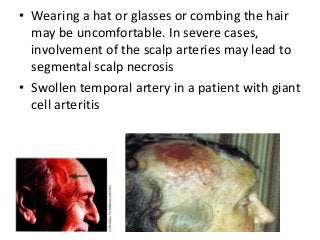
• Wearing a hat or glasses or combing the hair
may be uncomfortable. In severe cases,
involvement of the scalp arteries may lead to
segmental scalp necrosis
• Swollen temporal artery in a patient with giant
cell arteritis
Less common presentations
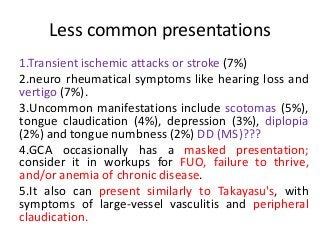
1.Transient ischemic attacks or stroke (7%)
2.neuro rheumatical symptoms like hearing loss and
vertigo (7%).
3.Uncommon manifestations include scotomas (5%),
tongue claudication (4%), depression (3%), diplopia
(2%) and tongue numbness (2%) DD (MS)???
4.GCA occasionally has a masked presentation;
consider it in workups for FUO, failure to thrive,
and/or anemia of chronic disease.
5.It also can present similarly to Takayasu's, with
symptoms of large-vessel vasculitis and peripheral
claudication.
Complications
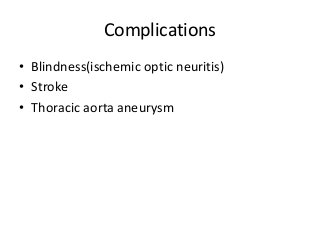
• Blindness(ischemic optic neuritis)
• Stroke
• Thoracic aorta aneurysm
Pathophysiology
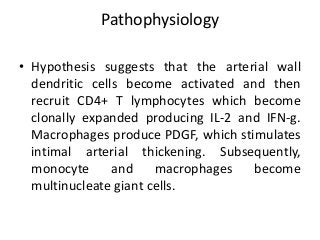
• Hypothesis suggests that the arterial wall
dendritic cells become activated and then
recruit CD4+ T lymphocytes which become
clonally expanded producing IL-2 and IFN-g.
Macrophages produce PDGF, which stimulates
intimal arterial thickening. Subsequently,
monocyte and macrophages become
multinucleate giant cells.
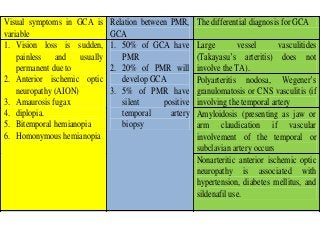
Visual symptoms in GCA is
variable
Relation between PMR,
GCA
The differential diagnosis for GCA
1. Vision loss is sudden,
painless and usually
permanent due to
2. Anterior ischemic optic
neuropathy (AION)
3. Amaurosis fugax
4. diplopia.
5. Bitemporal hemianopia
6. Homonymous hemianopia
1. 50% of GCA have
PMR
2. 20% of PMR will
develop GCA
3. 5% of PMR have
silent positive
temporal artery
biopsy
Large vessel vasculitides
(Takayasu’s arteritis) does not
involve the TA).
Polyarteritis nodosa, Wegener’s
granulomatosis or CNS vasculitis (if
involving the temporal artery
Amyloidosis (presenting as jaw or
arm claudication if vascular
involvement of the temporal or
subclavian artery occurs
Nonarteritic anterior ischemic optic
neuropathy is associated with
hypertension, diabetes mellitus, and
sildenafil use.
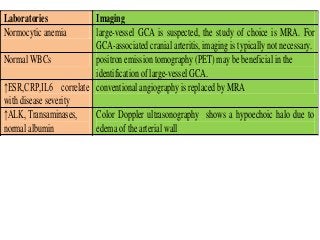
Laboratories Imaging
Normocytic anemia large-vessel GCA is suspected, the study of choice is MRA. For
GCA-associated cranial arteritis, imaging is typically not necessary.
Normal WBCs positron emission tomography (PET) may be beneficial in the
identification of large-vessel GCA.
↑ESR,CRP,IL6 correlate
with disease severity
conventional angiography is replaced by MRA
↑ALK, Transaminases,
normal albumin
Color Doppler ultrasonography shows a hypoechoic halo due to
edema of the arterial wall
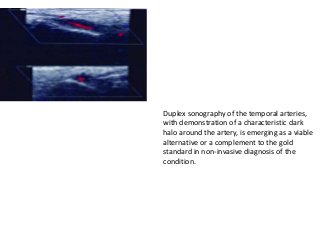
Duplex sonography of the temporal arteries,
with demonstration of a characteristic dark
halo around the artery, is emerging as a viable
alternative or a complement to the gold
standard in non-invasive diagnosis of the
condition.
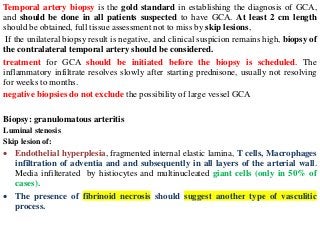
Temporal artery biopsy is the gold standard in establishing the diagnosis of GCA,
and should be done in all patients suspected to have GCA. At least 2 cm length
should be obtained, full tissue assessment not to miss by skip lesions,
If the unilateral biopsy result is negative, and clinical suspicion remains high, biopsy of
the contralateral temporal artery should be considered.
treatment for GCA should be initiated before the biopsy is scheduled. The
inflammatory infiltrate resolves slowly after starting prednisone, usually not resolving
for weeks to months.
negative biopsies do not exclude the possibility of large vessel GCA
Biopsy: granulomatous arteritis
Luminal stenosis
Skip lesion of:
 Endothelial hyperplesia, fragmented internal elastic lamina, T cells, Macrophages
infiltration of adventia and and subsequently in all layers of the arterial wall.
Media infilterated by histiocytes and multinucleated giant cells (only in 50% of
cases).
 The presence of fibrinoid necrosis should suggest another type of vasculitic
process.
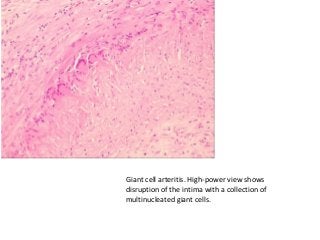
Giant cell arteritis. High-power view shows
disruption of the intima with a collection of
multinucleated giant cells.
TREATMENT OF GCA
Steroids
1. GCA typically responds rapidly and completely to steroids in doses of 40-60 mg
per day. Start as soon as the diagnosis is suspected.
2. There is no justification for withholding treatment pending biopsy, as histopathology
does not show significant change within the first two weeks of steroid institution.
3. Patients with visual symptoms associated with GCA should be treated with
intravenous pulse methylprednisolone therapy (1 g daily for 3 days) prior to
initiating therapy with prednisone
4. Patients should be maintained on the starting dose of glucocorticoids for at least 2 to
4 weeks or whenever disease activity resolves
5. After symptomatic improvement, steroids are continued in tapering doses, guided
by symptoms and ESR for maintenance levels. To reach 20 mg/day at 2 months of
therapy. Below 10 mg very slow tapering 1mg each month. The duration of therapy
is typically prolonged up to two years, Some may need life-long low-dose
glucocorticoid therapy for suppressing GCA disease activity
• The patient with GCA may take a week or longer to experience substantial relief but
PMR usually relieved symptoms in one to 2days
Aspirin:
• Daily low-dose (e.g., 81 mg) may prevent cranial ischemic
events such as stroke, TIA and blindness, and should be
considered if there is no contraindication.
Methotrexate:
• The use of adjunctive MTX lowers the risk of relapse and
cumulative corticosteroid dose, although the benefit is very
modest. MTX for the treatment of GCA and PMR is Not
standard, it is worth considering for some patients.
Follow up: clinical, Following ESR and CRP , IL-6 may prove
to be a more reliable measure of disease activity than ESR,
screen for thoracic aortic aneurysm
Conclusion
• New onset headache in an elderly patient should
prompt a detailed assessment for the possibility of
GCA (amongst other possibilities). PMR symptoms
and STA abnormalities, especially with elevated ESR,
are definite red flags. The gold standard diagnostic
tool - STA biopsy - is a safe out-patient procedure
and should be employed wherever the clinical
possibility exists
• 1- A 58-year-old woman presents with a 2-
week history of fatigue, anorexia, fevers, and
bilateral pain and stiffness in the shoulder and
hip girdles. These symptoms are worse at
night. Upon awakening in the morning, she
feels as if she has a bad flu. She reports
difficulty getting out of bed in the morning
due to stiffness. Her wrists and finger joints
are also painful and swollen.
2 weeks not enough for Diagnosing
PMR
• 2- A 72-year-old woman presents to her primary care
physician with weakness in her arms, stiffness in her
shoulder and hip girdles, and generalized fatigue.
• During the patient’s last visit, she complained of a 2-
month history of morning stiffness lasting over an hour in
her shoulders and hips. She remembered the day and time
that the symptoms started. She also described difficulty
fastening her bra and combing her hair in the mornings.
Over the-counter acetaminophen and ibuprofen led to
minimal improvement. She also reported more fatigue and
muscular pains since her husband died 4 months prior.
Previously active in her church and the local senior citizens
group, her fatigue has limited her ability to participate as
she once did. She has had no appetite and is unable to eat
well. It was recommended that she seek a grievance
counselor/ psychologist to address her recent spousal loss.
• She presents now with a more intense feeling of weakness in
her arms, stiffness in her shoulder and hip girdles, generalized
fatigue, and swelling of her hands with complaints that she
cannot remove her rings over the past 4 months. Her hands
have become puffy and she cannot make a tight fist. She has
been having great difficulty getting out of bed in the morning
and on 2 occasions her daughter had to come over to help her
get out of bed and stand up. On further questioning, she has
been having trouble concentrating and being able to do the
crossword puzzle every morning. Her lack of appetite has
persisted, eating very small portions only once or twice a day.
She has difficulty sleeping. She is compliant in taking
medication for hypertension, type 2 diabetes, and osteoporosis.
She lives alone in a senior living community. She denies
headaches, visual problems, jaw claudication, or problems
swallowing. No symptoms of dry eyes or mouth, chest pain,
shortness of breath, palpitations, heartburn, nausea, vomiting,
diarrhea, or any new rashes are revealed by the patient.
• Physical Examination
• Physical examination reveals a weight of 145 lb with a height of 70 in
and body mass index of 22 kg/m2 . She has lost 5 lb in the past 6
months. Vital signs are blood pressure, 120/90 mm Hg; heart rate, 68
bpm and regular; respirations, 18 breaths/min; and temperature, 99.1°F.
• Head examination reveals mild scleral pallor and tenderness in her
occipital scalp and neck. No temporal scalp tenderness is appreciated.
Temporal artery pulses are 2+, and no bruits are heard. She has several
tender points in her neck, trapezius area, intercostal spaces, and
superior gluteal areas.
• Musculoskeletal examination reveals bilateral swollen hands. There is no
sign of synovitis or tenderness on palpation of any of the metacarpal-
phalangeal, proximal interphalangeal, or distal interphalangeal joints.
She is unable to fully flex her fingers to form a fist.
• Raising her arms overhead causes great discomfort, and it is difficult to
maintain her arms in that position. She cannot extend her arms behind
her back because of soreness. Lower extremities are mildly weak (4+) on
flexion of thigh muscle groups, while all deep tendon reflexes are intact.
She has no rashes on her face, eyelids, hands, or torso.
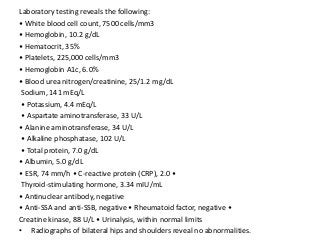
Laboratory testing reveals the following:
• White blood cell count, 7500 cells/mm3
• Hemoglobin, 10.2 g/dL
• Hematocrit, 35%
• Platelets, 225,000 cells/mm3
• Hemoglobin A1c, 6.0%
• Blood urea nitrogen/creatinine, 25/1.2 mg/dL
Sodium, 141 mEq/L
• Potassium, 4.4 mEq/L
• Aspartate aminotransferase, 33 U/L
• Alanine aminotransferase, 34 U/L
• Alkaline phosphatase, 102 U/L
• Total protein, 7.0 g/dL
• Albumin, 5.0 g/dL
• ESR, 74 mm/h • C-reactive protein (CRP), 2.0 •
Thyroid-stimulating hormone, 3.34 mIU/mL
• Antinuclear antibody, negative
• Anti-SSA and anti-SSB, negative • Rheumatoid factor, negative •
Creatine kinase, 88 U/L • Urinalysis, within normal limits
• Radiographs of bilateral hips and shoulders reveal no abnormalities.
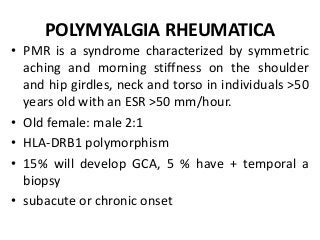
POLYMYALGIA RHEUMATICA
• PMR is a syndrome characterized by symmetric
aching and morning stiffness on the shoulder
and hip girdles, neck and torso in individuals >50
years old with an ESR >50 mm/hour.
• Old female: male 2:1
• HLA-DRB1 polymorphism
• 15% will develop GCA, 5 % have + temporal a
biopsy
• subacute or chronic onset
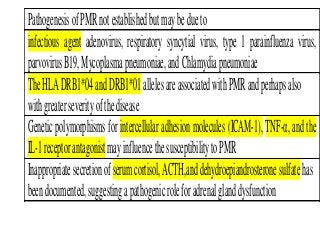
PathogenesisofPMRnotestablishedbutmaybedueto
infectious agent adenovirus, respiratory syncytial virus, type 1 parainfluenza virus,
parvovirusB19,Mycoplasmapneumoniae,andChlamydiapneumoniae
TheHLADRB1*04andDRB1*01allelesareassociatedwithPMRandperhapsalso
withgreaterseverityofthedisease
Geneticpolymorphismsfor intercellular adhesion molecules(ICAM-1),TNF-α,andthe
IL-1receptorantagonistmayinfluencethesusceptibilitytoPMR
Inappropriatesecretionofserumcortisol,ACTH,anddehydroepiandrosteronesulfatehas
beendocumented,suggestingapathogenicroleforadrenalglanddysfunction
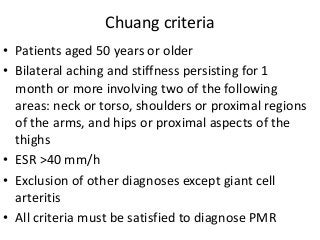
Chuang criteria
• Patients aged 50 years or older
• Bilateral aching and stiffness persisting for 1
month or more involving two of the following
areas: neck or torso, shoulders or proximal regions
of the arms, and hips or proximal aspects of the
thighs
• ESR >40 mm/h
• Exclusion of other diagnoses except giant cell
arteritis
• All criteria must be satisfied to diagnose PMR
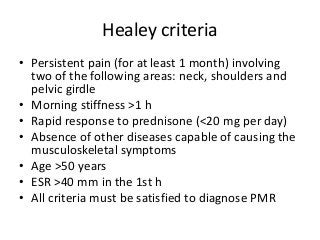
Healey criteria
• Persistent pain (for at least 1 month) involving
two of the following areas: neck, shoulders and
pelvic girdle
• Morning stiffness >1 h
• Rapid response to prednisone (<20 mg per day)
• Absence of other diseases capable of causing the
musculoskeletal symptoms
• Age >50 years
• ESR >40 mm in the 1st h
• All criteria must be satisfied to diagnose PMR
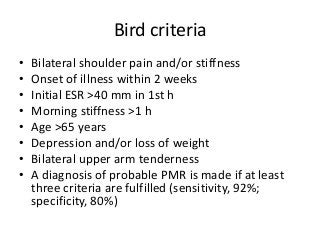
Bird criteria
• Bilateral shoulder pain and/or stiffness
• Onset of illness within 2 weeks
• Initial ESR >40 mm in 1st h
• Morning stiffness >1 h
• Age >65 years
• Depression and/or loss of weight
• Bilateral upper arm tenderness
• A diagnosis of probable PMR is made if at least
three criteria are fulfilled (sensitivity, 92%;
specificity, 80%)
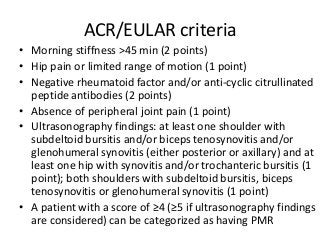
ACR/EULAR criteria
• Morning stiffness >45 min (2 points)
• Hip pain or limited range of motion (1 point)
• Negative rheumatoid factor and/or anti-cyclic citrullinated
peptide antibodies (2 points)
• Absence of peripheral joint pain (1 point)
• Ultrasonography findings: at least one shoulder with
subdeltoid bursitis and/or biceps tenosynovitis and/or
glenohumeral synovitis (either posterior or axillary) and at
least one hip with synovitis and/or trochanteric bursitis (1
point); both shoulders with subdeltoid bursitis, biceps
tenosynovitis or glenohumeral synovitis (1 point)
• A patient with a score of ≥4 (≥5 if ultrasonography findings
are considered) can be categorized as having PMR
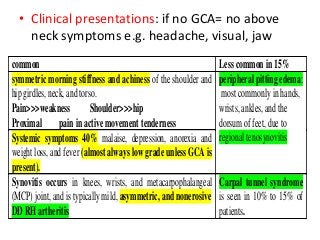
• Clinical presentations: if no GCA= no above
neck symptoms e.g. headache, visual, jaw
common Less common in 15%
symmetric morning stiffness and achiness of the shoulder and
hip girdles, neck, and torso.
Pain>>>weakness Shoulder>>>hip
Proximal pain in active movement tenderness
peripheral pitting edema:
most commonlyin hands,
wrists, ankles, and the
dorsum of feet, dueto
regional tenosynovitisSystemic symptoms 40% malaise, depression, anorexia and
weight loss, and fever (almost always low gradeunless GCA is
present).
Synovitis occurs in knees, wrists, and metacarpophalangeal
(MCP) joint, and is typicallymild, asymmetric, and nonerosive
DDRH artheritis
Carpal tunnel syndrome
is seen in 10% to 15% of
patients.
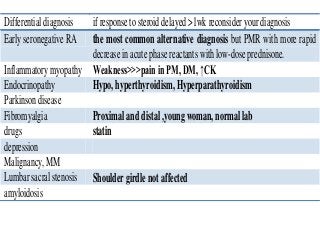
Differentialdiagnosis ifresponsetosteroiddelayed>1wk reconsider yourdiagnosis
EarlyseronegativeRA the most common alternative diagnosis but PMR with more rapid
decreaseinacutephasereactantswithlow-doseprednisone.
Inflammatorymyopathy Weakness>>>pain in PM,DM,↑CK
Endocrinopathy Hypo,hyperthyroidism, Hyperparathyroidism
Parkinsondisease
Fibromyalgia Proximaland distal,youngwoman,normallab
drugs statin
depression
Malignancy,MM
Lumbarsacralstenosis Shouldergirdlenotaffected
amyloidosis
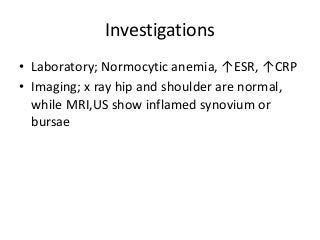
Investigations
• Laboratory; Normocytic anemia, ↑ESR, ↑CRP
• Imaging; x ray hip and shoulder are normal,
while MRI,US show inflamed synovium or
bursae
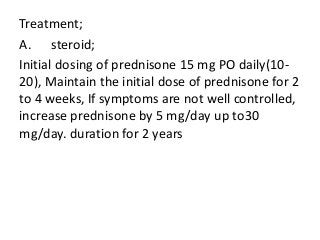
Treatment;
A. steroid;
Initial dosing of prednisone 15 mg PO daily(10-
20), Maintain the initial dose of prednisone for 2
to 4 weeks, If symptoms are not well controlled,
increase prednisone by 5 mg/day up to30
mg/day. duration for 2 years
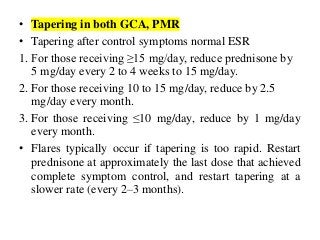
• Tapering in both GCA, PMR
• Tapering after control symptoms normal ESR
1. For those receiving ≥15 mg/day, reduce prednisone by
5 mg/day every 2 to 4 weeks to 15 mg/day.
2. For those receiving 10 to 15 mg/day, reduce by 2.5
mg/day every month.
3. For those receiving ≤10 mg/day, reduce by 1 mg/day
every month.
• Flares typically occur if tapering is too rapid. Restart
prednisone at approximately the last dose that achieved
complete symptom control, and restart tapering at a
slower rate (every 2–3 months).
• B. Nonsteroidal antiinflammatory drugs;
NSAIDs may be effective in pain relief but
won’t stop inflammation, never give without
steroid
Follow up:
• Those with PMR should be continuously
monitored for symptoms of GCA.
• ESR, CRP correlate with disease activity
• Think of PMR in the older patient with a history
of profound morning stiffness, bilateral shoulder
girdle and hip aching, and hand swelling
(mimicking R A).
• PMR pain is out of proportion to exam findings.
PMR presents with aching and stiffness, not
weakness-in contrast to myositis, which generally
presents with weakness, not pain! In addition,
PMR is distinguished from polymyositis by the
absence of both objective weakness and elevated
muscle enzymes. CK is normal in PMR even
though the muscle aches and the patient feels
stiff.
THANK YOU

Giant cell arteritis,polymyalgia rheumatica

  • 1.
    Giant cell arteritis& polymyalgia Rheumatica Dr Doha Rasheedy Ali Assistant professor of Geriatric medicine ASU
  • 2.
  • 3.
    Case 1 A 70-year-oldmale, previously in good health, presented with a two- month history of pain in the shoulder joints, upper back and chest, which was aggravated by motion. He had early morning stiffness with constitutional symptoms. Laboratory tests were as tabulated. A possibility of polymyalgia rheumatic (PMR) was considered and response to low dose steroid was gratifying. He discontinued drugs after one month and remained well for the next five months. At that stage, he had recurrence with additional complaint of left-sided headache. The left superficial temporal artery was tender and thickened. A possibility of PMR with GCA was considered. A left STA biopsy was performed, which confirmed the diagnosis. Steroids were administered at an oral dose of 50 mg per day and tapered gradually, with excellent clinical response over a follow up period of one year.
  • 4.
    Case 2 A 75-year-oldmale presented with headache of six weeks' duration. Pain was predominantly over the right hemicranium, with the maximum being over the right temple. Pain was excruciating in intensity. There was severe allodynia over the area. There was jaw claudication. Constitutional symptoms were present. About two weeks after the onset of headache, he developed blurred vision in the right eye; an ophthalmological examination revealed anterior ischemic optic neuropathy (AION). Examination and salient laboratory findings are as tabulated in Table 1. Diagnosis of GCA was confirmed with STA biopsy [Figure 1]. He was treated with intravenous methyl prednisolone, in a dose of 1 gm/day for three days, followed by oral steroid in tapering doses. His headache and constitutional symptoms improved rapidly. However, visual acuity remained unchanged. He had recurrence of mild headache, three months after he stopped the steroids by himself, and improved with re- institution of steroid.
  • 5.
    infiltration with chronic inflammatory cells inthe arterial adventitia and the media.
  • 7.
    Case 3 • An83-year-old lady, complained of insidious onset generalized weakness of six months' duration, with multifocal ill-defined body pains, loss of appetite, loss of weight and prostration to a bed bound state. Two months prior to presentation, she had additional complaints of severe, distressing headache, which was maximal over the left temple. She avoided solids due to jaw claudication. She was admitted to a nursing home, where the physician started Anti tubercular therapy (ATT), on suspicion of tuberculosis. The clinical and salient laboratory findings are tabulated. The STA biopsy failed to demonstrate inflammation, and the patient refused a repeat biopsy. Therapeutic trial with oral steroids at 1 mg/kg was instituted, which caused complete relief of headache and jaw claudication and partial improvement in the systemic symptoms. At six months, she was reported by attendants to be free of the headache, but house-bound due to weakness.
  • 8.
    Case 4 A 70-year-oldlady, with a well controlled hypertension, presented with a history of headache, arthralgias and malaise of one year duration. Headache was global, with maximum intensity over the left temple. She had been on various migraine prophylaxes and analgesics, without relief. She had associated pain and stiffness in multiple large and small joints, with marked early morning stiffness. She was depressed and slept poorly. A diagnosis of PMR with GCA was made. Symptoms improved within 72 hours of starting oral steroid at 1 mg/kg/day. She had a relapse of the same symptoms, after a year of stopping the therapy on her own. Re-treatment was successful
  • 9.
    Case 5 • A68-year-old man presented to our department complaining • acute-onset diplopia • low-grade fever during the past 3 days. • He suffered from mild headache and scalp tenderness for the last 3 months, for which he was prescribed venlafaxine by his family doctor without significant improvement. • His past medical history was remarkable for heterozygous beta-thalassemia, kidney stone disease and duodenal ulcer.
  • 10.
    • He wasnot taking any medications apart from venlafaxine. He had quit smoking 30 years ago and did not consume alcohol. His family history was unremarkable. • Physical examination of the heart, respiratory system and abdomen was normal. There were no palpable lymph nodes or signs of arthritis. His peripheral pulses were normal, apart from the left temporal artery that was hard and tender on palpation.
  • 11.
    • On neurologicalexamination, his pupils were equal and round, reactive to light and accommodation, without blepharoptosis, but ophthalmoparesis • with decreased abduction in the left eye was observed. Additionally, impaired hearing of the right ear was noted. Examination of the remaining cranial nerves was normal. Sensation, reflexes and motor function were intact.
  • 12.
    Laboratory tests 1. mildanemia compatible with heterozygous beta-thalassemia. 2. moderately high inflammation markers [ESR: 44 mm/h, CRP: 41.8 mg/L (normal values <5 mg/L)]. 3. Kidney and liver function tests were within normal range, and antinuclear and antineutrophil cytoplasmic antibodies were negative
  • 13.
    • A computedtomography (CT) scan of the brain was performed, which was normal. • Examination of the cerebrospinal fluid revealed a protein level of 0.046 g/dL with no cells. • Magnetic resonance imaging (MRI) of the brain was normal, • Ultrasound imaging of the carotid and the vertebrobasilar system revealed mild stenoses (up to 15 %). • Computed tomographies of the thorax and the abdomen with intravenous contrast agent were also performed without any abnormal findings.
  • 14.
    • A biopsyof the left temporal artery was performed due to a high suspicion of GCA. While the pathology report was pending, the patient received intravenous methylprednisolone, 1 g daily for 3 days. • His headache and diplopia subsided significantly, and he was discharged with instructions for oral corticosteroid treatment, with an initial total dose of 48 mg of methylprednisolone daily. • Histological examination disclosed lymphocytic infiltration of the intima, segmentally extending to the media, with perivascular inflammatory infiltrates in the smaller branches. The findings were attributed to GCA, despite the absence of typical giant cells.
  • 15.
    • At follow-up,1 month later, while the patient was still receiving 48 mg methylprednisolone daily, diplopia persisted only when gazing extremely to the left, whereas the hearing defect was restored. However, the patient reported hoarseness, and an otorhinolaryngologic examination was ordered. The latter indicated paresis of the superior and recurrent laryngeal nerve, causing partial paresis of the right vocal cord. Cyclophosphamide (CYC) was added to the treatment (50 mg daily, gradually increased to 150 mg daily), with subsequent improvement. No further increase was made in corticosteroid dosage
  • 16.
    • One yearafter the initial diagnosis, the patient remains in remission, with diplopia persisting only in extreme left gaze. CYC was discontinued 3 months after initiation because of a severe reactivation of herpes zoster, and the patient is now under gradual tapering of corticosteroids, with a current dosage of 12 mg methylprednisolone daily
  • 17.
    GCA, Temporal Arteritis •chronic, systemic, inflammatory vasculitis affecting mainly large- and medium-sized vessels. • Sites : 1. Extra-crainial braches of carotid artery (Temporal, ophthalmic) 2. Other large arteries( subclavian axillary) 3. Thoracic aorta (17 folds risk of aneurysm) occur after 5 years of disease onset
  • 18.
    • Epidemiology: 1. Themost common type of systemic vasculitis 2. Women : men= 3:1 3. PMR: GCA= 2:1 4. Age > 50 5. Rare in black African Both GCA and PMR are associated with HLA DRB 0401
  • 19.
    Common presentations 1. Acuteor gradual onset 2. Constitutional symptoms 80% 3. New onset or new type headache 70% 4. Temporal artery tender non pulseless 50% 5. Jaw claudication 50% specific 6. PMR 50% 7. ESR> 50 in 80% 8. Visual impairment 20% 9. Arthritis 10% 10. Neuropathy 10% (PN, MN)
  • 20.
    • This diseasecommonly affects elderly people who present with headache of recent onset, decreased pulses and tenderness of temporal arteries upon palpation, scalp tenderness, jaw claudication and vision impairment. • Systemic symptoms such as fever, night sweats, fatigue and weight loss are also frequent manifestations. • while proximal motor weakness in the setting of coexisting polymyalgia rheumatica is common but more pain and stiffness than weakness
  • 21.
    • Wearing ahat or glasses or combing the hair may be uncomfortable. In severe cases, involvement of the scalp arteries may lead to segmental scalp necrosis • Swollen temporal artery in a patient with giant cell arteritis
  • 22.
    Less common presentations 1.Transientischemic attacks or stroke (7%) 2.neuro rheumatical symptoms like hearing loss and vertigo (7%). 3.Uncommon manifestations include scotomas (5%), tongue claudication (4%), depression (3%), diplopia (2%) and tongue numbness (2%) DD (MS)??? 4.GCA occasionally has a masked presentation; consider it in workups for FUO, failure to thrive, and/or anemia of chronic disease. 5.It also can present similarly to Takayasu's, with symptoms of large-vessel vasculitis and peripheral claudication.
  • 23.
    Complications • Blindness(ischemic opticneuritis) • Stroke • Thoracic aorta aneurysm
  • 24.
    Pathophysiology • Hypothesis suggeststhat the arterial wall dendritic cells become activated and then recruit CD4+ T lymphocytes which become clonally expanded producing IL-2 and IFN-g. Macrophages produce PDGF, which stimulates intimal arterial thickening. Subsequently, monocyte and macrophages become multinucleate giant cells.
  • 25.
    Visual symptoms inGCA is variable Relation between PMR, GCA The differential diagnosis for GCA 1. Vision loss is sudden, painless and usually permanent due to 2. Anterior ischemic optic neuropathy (AION) 3. Amaurosis fugax 4. diplopia. 5. Bitemporal hemianopia 6. Homonymous hemianopia 1. 50% of GCA have PMR 2. 20% of PMR will develop GCA 3. 5% of PMR have silent positive temporal artery biopsy Large vessel vasculitides (Takayasu’s arteritis) does not involve the TA). Polyarteritis nodosa, Wegener’s granulomatosis or CNS vasculitis (if involving the temporal artery Amyloidosis (presenting as jaw or arm claudication if vascular involvement of the temporal or subclavian artery occurs Nonarteritic anterior ischemic optic neuropathy is associated with hypertension, diabetes mellitus, and sildenafil use.
  • 26.
    Laboratories Imaging Normocytic anemialarge-vessel GCA is suspected, the study of choice is MRA. For GCA-associated cranial arteritis, imaging is typically not necessary. Normal WBCs positron emission tomography (PET) may be beneficial in the identification of large-vessel GCA. ↑ESR,CRP,IL6 correlate with disease severity conventional angiography is replaced by MRA ↑ALK, Transaminases, normal albumin Color Doppler ultrasonography shows a hypoechoic halo due to edema of the arterial wall
  • 27.
    Duplex sonography ofthe temporal arteries, with demonstration of a characteristic dark halo around the artery, is emerging as a viable alternative or a complement to the gold standard in non-invasive diagnosis of the condition.
  • 28.
    Temporal artery biopsyis the gold standard in establishing the diagnosis of GCA, and should be done in all patients suspected to have GCA. At least 2 cm length should be obtained, full tissue assessment not to miss by skip lesions, If the unilateral biopsy result is negative, and clinical suspicion remains high, biopsy of the contralateral temporal artery should be considered. treatment for GCA should be initiated before the biopsy is scheduled. The inflammatory infiltrate resolves slowly after starting prednisone, usually not resolving for weeks to months. negative biopsies do not exclude the possibility of large vessel GCA Biopsy: granulomatous arteritis Luminal stenosis Skip lesion of:  Endothelial hyperplesia, fragmented internal elastic lamina, T cells, Macrophages infiltration of adventia and and subsequently in all layers of the arterial wall. Media infilterated by histiocytes and multinucleated giant cells (only in 50% of cases).  The presence of fibrinoid necrosis should suggest another type of vasculitic process.
  • 29.
    Giant cell arteritis.High-power view shows disruption of the intima with a collection of multinucleated giant cells.
  • 30.
  • 31.
    Steroids 1. GCA typicallyresponds rapidly and completely to steroids in doses of 40-60 mg per day. Start as soon as the diagnosis is suspected. 2. There is no justification for withholding treatment pending biopsy, as histopathology does not show significant change within the first two weeks of steroid institution. 3. Patients with visual symptoms associated with GCA should be treated with intravenous pulse methylprednisolone therapy (1 g daily for 3 days) prior to initiating therapy with prednisone 4. Patients should be maintained on the starting dose of glucocorticoids for at least 2 to 4 weeks or whenever disease activity resolves 5. After symptomatic improvement, steroids are continued in tapering doses, guided by symptoms and ESR for maintenance levels. To reach 20 mg/day at 2 months of therapy. Below 10 mg very slow tapering 1mg each month. The duration of therapy is typically prolonged up to two years, Some may need life-long low-dose glucocorticoid therapy for suppressing GCA disease activity • The patient with GCA may take a week or longer to experience substantial relief but PMR usually relieved symptoms in one to 2days
  • 32.
    Aspirin: • Daily low-dose(e.g., 81 mg) may prevent cranial ischemic events such as stroke, TIA and blindness, and should be considered if there is no contraindication. Methotrexate: • The use of adjunctive MTX lowers the risk of relapse and cumulative corticosteroid dose, although the benefit is very modest. MTX for the treatment of GCA and PMR is Not standard, it is worth considering for some patients. Follow up: clinical, Following ESR and CRP , IL-6 may prove to be a more reliable measure of disease activity than ESR, screen for thoracic aortic aneurysm
  • 33.
    Conclusion • New onsetheadache in an elderly patient should prompt a detailed assessment for the possibility of GCA (amongst other possibilities). PMR symptoms and STA abnormalities, especially with elevated ESR, are definite red flags. The gold standard diagnostic tool - STA biopsy - is a safe out-patient procedure and should be employed wherever the clinical possibility exists
  • 34.
    • 1- A58-year-old woman presents with a 2- week history of fatigue, anorexia, fevers, and bilateral pain and stiffness in the shoulder and hip girdles. These symptoms are worse at night. Upon awakening in the morning, she feels as if she has a bad flu. She reports difficulty getting out of bed in the morning due to stiffness. Her wrists and finger joints are also painful and swollen. 2 weeks not enough for Diagnosing PMR
  • 35.
    • 2- A72-year-old woman presents to her primary care physician with weakness in her arms, stiffness in her shoulder and hip girdles, and generalized fatigue. • During the patient’s last visit, she complained of a 2- month history of morning stiffness lasting over an hour in her shoulders and hips. She remembered the day and time that the symptoms started. She also described difficulty fastening her bra and combing her hair in the mornings. Over the-counter acetaminophen and ibuprofen led to minimal improvement. She also reported more fatigue and muscular pains since her husband died 4 months prior. Previously active in her church and the local senior citizens group, her fatigue has limited her ability to participate as she once did. She has had no appetite and is unable to eat well. It was recommended that she seek a grievance counselor/ psychologist to address her recent spousal loss.
  • 36.
    • She presentsnow with a more intense feeling of weakness in her arms, stiffness in her shoulder and hip girdles, generalized fatigue, and swelling of her hands with complaints that she cannot remove her rings over the past 4 months. Her hands have become puffy and she cannot make a tight fist. She has been having great difficulty getting out of bed in the morning and on 2 occasions her daughter had to come over to help her get out of bed and stand up. On further questioning, she has been having trouble concentrating and being able to do the crossword puzzle every morning. Her lack of appetite has persisted, eating very small portions only once or twice a day. She has difficulty sleeping. She is compliant in taking medication for hypertension, type 2 diabetes, and osteoporosis. She lives alone in a senior living community. She denies headaches, visual problems, jaw claudication, or problems swallowing. No symptoms of dry eyes or mouth, chest pain, shortness of breath, palpitations, heartburn, nausea, vomiting, diarrhea, or any new rashes are revealed by the patient.
  • 37.
    • Physical Examination •Physical examination reveals a weight of 145 lb with a height of 70 in and body mass index of 22 kg/m2 . She has lost 5 lb in the past 6 months. Vital signs are blood pressure, 120/90 mm Hg; heart rate, 68 bpm and regular; respirations, 18 breaths/min; and temperature, 99.1°F. • Head examination reveals mild scleral pallor and tenderness in her occipital scalp and neck. No temporal scalp tenderness is appreciated. Temporal artery pulses are 2+, and no bruits are heard. She has several tender points in her neck, trapezius area, intercostal spaces, and superior gluteal areas. • Musculoskeletal examination reveals bilateral swollen hands. There is no sign of synovitis or tenderness on palpation of any of the metacarpal- phalangeal, proximal interphalangeal, or distal interphalangeal joints. She is unable to fully flex her fingers to form a fist. • Raising her arms overhead causes great discomfort, and it is difficult to maintain her arms in that position. She cannot extend her arms behind her back because of soreness. Lower extremities are mildly weak (4+) on flexion of thigh muscle groups, while all deep tendon reflexes are intact. She has no rashes on her face, eyelids, hands, or torso.
  • 38.
    Laboratory testing revealsthe following: • White blood cell count, 7500 cells/mm3 • Hemoglobin, 10.2 g/dL • Hematocrit, 35% • Platelets, 225,000 cells/mm3 • Hemoglobin A1c, 6.0% • Blood urea nitrogen/creatinine, 25/1.2 mg/dL Sodium, 141 mEq/L • Potassium, 4.4 mEq/L • Aspartate aminotransferase, 33 U/L • Alanine aminotransferase, 34 U/L • Alkaline phosphatase, 102 U/L • Total protein, 7.0 g/dL • Albumin, 5.0 g/dL • ESR, 74 mm/h • C-reactive protein (CRP), 2.0 • Thyroid-stimulating hormone, 3.34 mIU/mL • Antinuclear antibody, negative • Anti-SSA and anti-SSB, negative • Rheumatoid factor, negative • Creatine kinase, 88 U/L • Urinalysis, within normal limits • Radiographs of bilateral hips and shoulders reveal no abnormalities.
  • 39.
  • 40.
    POLYMYALGIA RHEUMATICA • PMRis a syndrome characterized by symmetric aching and morning stiffness on the shoulder and hip girdles, neck and torso in individuals >50 years old with an ESR >50 mm/hour. • Old female: male 2:1 • HLA-DRB1 polymorphism • 15% will develop GCA, 5 % have + temporal a biopsy • subacute or chronic onset
  • 41.
    PathogenesisofPMRnotestablishedbutmaybedueto infectious agent adenovirus,respiratory syncytial virus, type 1 parainfluenza virus, parvovirusB19,Mycoplasmapneumoniae,andChlamydiapneumoniae TheHLADRB1*04andDRB1*01allelesareassociatedwithPMRandperhapsalso withgreaterseverityofthedisease Geneticpolymorphismsfor intercellular adhesion molecules(ICAM-1),TNF-α,andthe IL-1receptorantagonistmayinfluencethesusceptibilitytoPMR Inappropriatesecretionofserumcortisol,ACTH,anddehydroepiandrosteronesulfatehas beendocumented,suggestingapathogenicroleforadrenalglanddysfunction
  • 42.
    Chuang criteria • Patientsaged 50 years or older • Bilateral aching and stiffness persisting for 1 month or more involving two of the following areas: neck or torso, shoulders or proximal regions of the arms, and hips or proximal aspects of the thighs • ESR >40 mm/h • Exclusion of other diagnoses except giant cell arteritis • All criteria must be satisfied to diagnose PMR
  • 43.
    Healey criteria • Persistentpain (for at least 1 month) involving two of the following areas: neck, shoulders and pelvic girdle • Morning stiffness >1 h • Rapid response to prednisone (<20 mg per day) • Absence of other diseases capable of causing the musculoskeletal symptoms • Age >50 years • ESR >40 mm in the 1st h • All criteria must be satisfied to diagnose PMR
  • 44.
    Bird criteria • Bilateralshoulder pain and/or stiffness • Onset of illness within 2 weeks • Initial ESR >40 mm in 1st h • Morning stiffness >1 h • Age >65 years • Depression and/or loss of weight • Bilateral upper arm tenderness • A diagnosis of probable PMR is made if at least three criteria are fulfilled (sensitivity, 92%; specificity, 80%)
  • 45.
    ACR/EULAR criteria • Morningstiffness >45 min (2 points) • Hip pain or limited range of motion (1 point) • Negative rheumatoid factor and/or anti-cyclic citrullinated peptide antibodies (2 points) • Absence of peripheral joint pain (1 point) • Ultrasonography findings: at least one shoulder with subdeltoid bursitis and/or biceps tenosynovitis and/or glenohumeral synovitis (either posterior or axillary) and at least one hip with synovitis and/or trochanteric bursitis (1 point); both shoulders with subdeltoid bursitis, biceps tenosynovitis or glenohumeral synovitis (1 point) • A patient with a score of ≥4 (≥5 if ultrasonography findings are considered) can be categorized as having PMR
  • 46.
    • Clinical presentations:if no GCA= no above neck symptoms e.g. headache, visual, jaw common Less common in 15% symmetric morning stiffness and achiness of the shoulder and hip girdles, neck, and torso. Pain>>>weakness Shoulder>>>hip Proximal pain in active movement tenderness peripheral pitting edema: most commonlyin hands, wrists, ankles, and the dorsum of feet, dueto regional tenosynovitisSystemic symptoms 40% malaise, depression, anorexia and weight loss, and fever (almost always low gradeunless GCA is present). Synovitis occurs in knees, wrists, and metacarpophalangeal (MCP) joint, and is typicallymild, asymmetric, and nonerosive DDRH artheritis Carpal tunnel syndrome is seen in 10% to 15% of patients.
  • 47.
    Differentialdiagnosis ifresponsetosteroiddelayed>1wk reconsideryourdiagnosis EarlyseronegativeRA the most common alternative diagnosis but PMR with more rapid decreaseinacutephasereactantswithlow-doseprednisone. Inflammatorymyopathy Weakness>>>pain in PM,DM,↑CK Endocrinopathy Hypo,hyperthyroidism, Hyperparathyroidism Parkinsondisease Fibromyalgia Proximaland distal,youngwoman,normallab drugs statin depression Malignancy,MM Lumbarsacralstenosis Shouldergirdlenotaffected amyloidosis
  • 48.
    Investigations • Laboratory; Normocyticanemia, ↑ESR, ↑CRP • Imaging; x ray hip and shoulder are normal, while MRI,US show inflamed synovium or bursae
  • 49.
    Treatment; A. steroid; Initial dosingof prednisone 15 mg PO daily(10- 20), Maintain the initial dose of prednisone for 2 to 4 weeks, If symptoms are not well controlled, increase prednisone by 5 mg/day up to30 mg/day. duration for 2 years
  • 50.
    • Tapering inboth GCA, PMR • Tapering after control symptoms normal ESR 1. For those receiving ≥15 mg/day, reduce prednisone by 5 mg/day every 2 to 4 weeks to 15 mg/day. 2. For those receiving 10 to 15 mg/day, reduce by 2.5 mg/day every month. 3. For those receiving ≤10 mg/day, reduce by 1 mg/day every month. • Flares typically occur if tapering is too rapid. Restart prednisone at approximately the last dose that achieved complete symptom control, and restart tapering at a slower rate (every 2–3 months).
  • 51.
    • B. Nonsteroidalantiinflammatory drugs; NSAIDs may be effective in pain relief but won’t stop inflammation, never give without steroid Follow up: • Those with PMR should be continuously monitored for symptoms of GCA. • ESR, CRP correlate with disease activity
  • 52.
    • Think ofPMR in the older patient with a history of profound morning stiffness, bilateral shoulder girdle and hip aching, and hand swelling (mimicking R A). • PMR pain is out of proportion to exam findings. PMR presents with aching and stiffness, not weakness-in contrast to myositis, which generally presents with weakness, not pain! In addition, PMR is distinguished from polymyositis by the absence of both objective weakness and elevated muscle enzymes. CK is normal in PMR even though the muscle aches and the patient feels stiff.
  • 53.

Editor's Notes

  • #14 and antibodies against acetylcholine receptors were negative.