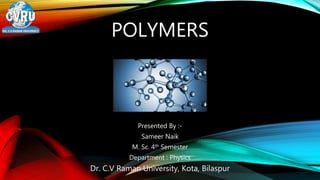
POLYMERS
Presented By :-
Sameer Naik
M. Sc. 4th Semester
Department : Physics
Dr. C.V Raman University, Kota, Bilaspur
SYNOPSIS
• Introduction
• Types of Polymer
• Classification of Polymer
• Characteristics of Polymer
• Application
• References
INTRODUCTION
• Polymers are very large molecules made when hundreds of monomers join
together to form long chains.
• The word POLYMER comes from the Greek words poly means many and mer
means parts.
• Polymer is used as a synonym for plastic.
• All plastics are polymers, but not all polymers are plastics.
TYPES OF POLYMER
1. Natural Polymer
2. Homopolymer
3. Copolymer
4. Thermoplastics
5. Thermosets
6. Long chain Polymer
NATURAL POLYMERS
• Definition : Natural polymer is a polymer that results from only raw materials that
are found in nature.
• Some of these natural polymers include DNA and RNA.
• Cotton, DNA, Wool, Wood, are some of the naturally occurring polymers.
HOMOPOLYMERS
• Homopolymers are synthesized from a single type of monomer.
• Homopolymers are consists of chains with identical bonding linkages to each
monomer unit.
• The usually implies that the polymer is made from all identical monomer molecules.
COPOLYMER
• When two or more different monomers together to polymerize their result is called
copolymer.
• This process is called as copolymerization.
• Types of Copolymer :
1) Statistical Copolymer
2) Alternating Copolymer
3) Block Copolymer
4) Graft Copolymer
THERMOPLASTIC
• A type of plastic that can be softened by heat, hardened by cooling, and then
softened by heat over and over again.
• Thermoplastic are not cross – linked polymer.
• Examples : Polyethylene, Nylon, Polyvinyl chloride.
THERMOSETS
• Thermoset having the property of becoming permanently hard and rigid when
heated.
• Thermoses are hard and rigid at room temperature and do not soften on heating.
• Examples : Epoxy resin, Phenolic resins, Unsaturated polyester resins.
LONG CHAIN POLYMERS
• A very long strand of repeating molecules linked together by primary bond.
• Polymer chains are orient themselves in lines as they enter a mold but may be
annealed so they can recoil.
CLASSIFICATION
OF POLYMER
Based on origin
of source
Natural Polymers
Semi synthetic
Synthetic
polymer
Based on
structure
Linear polymer
Branched chain
polymers
Cross linked
polymers
Based on
molecular forces
Elastomers
Fibres
Thermoplastics
Thermosetting
polymers
Based on mode
of polymerization
Addition
polymers
Condensation
polymers
BASED ON ORIGIN OF SOUCES
• Natural Polymer :- Polymers which are isolated from natural materials are called as
Natural Polymers. E.g. : Cotton, Milk, Wool, Rubber .
• Synthetic Polymer :- Polymers which are synthesized from low molecular weight
compounds ae called as Synthetic Polymer . E.g. : Polyethylene, nylon, terylene.
• Semisynthetic Polymer :- These polymers are mostly derived from naturally
occurring polymers by chemical modification. E.g. : Rayon
BASED ON STRUCTURE
• Linear Polymer : Molecules form long
chains without branches.
• Branched Polymer : Molecules having
branch points that connect 3 or more
segments.
• Cross-Linked Polymer : It includes
interconnections between chains.
• Network Polymer : A cross linked
polymer that includes numerous
interconnections between chains.
BASED ON MODE OF
POLYMERISATION
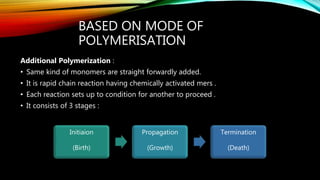
Additional Polymerization :
• Same kind of monomers are straight forwardly added.
• It is rapid chain reaction having chemically activated mers .
• Each reaction sets up to condition for another to proceed .
• It consists of 3 stages :
Initiaion
(Birth)
Propagation
(Growth)
Termination
(Death)
CONT…
CONDENSATION POLYMERIZATION :
• It involves a polymerization reaction between two monomers with the expulsion of a
simple product.
• It involves individual chemical reaction between reactive mer.
• By product is formed and condensed out.
• This reaction is slower than additional polymerization.
• Need reactive functional group.
CHARACTERISTICS OF POLYMER
• Low density.
• Low coefficient of friction.
• Good corrosion resistance.
• Poor tensile strength.
• Low mechanical properties.
• Poor temperature resistance.
• Can be produced transparent or different colour.
APPLICATION
• Medicine : Many biomaterials especially heart valve replacement and blood vessels
are made up of polymers like dacron, eflon.
• Consumer Science : Plastic containers of all shapes and sizes are light weigh and
economically less expensive than more traditional containers.
• Industry : Automobile parts, pipes, tanks, packing material, adhesives are all
polymer application used in industrial markets.
• Sports : Playground equipment, golf clubs, swimming pools and protective helmets
are produced from polymer.
REFERENCES
• Robinson J R and Lee V H : Controlled Drug Delivery – Fundamentals and
Applications : Marcel Dekker .
• Jain N K : Controlled and Novel Drug Delivery : CBS Publication .
POLYMER

POLYMER

  • 1.
    POLYMERS Presented By :- SameerNaik M. Sc. 4th Semester Department : Physics Dr. C.V Raman University, Kota, Bilaspur
  • 2.
    SYNOPSIS • Introduction • Typesof Polymer • Classification of Polymer • Characteristics of Polymer • Application • References
  • 3.
    INTRODUCTION • Polymers arevery large molecules made when hundreds of monomers join together to form long chains. • The word POLYMER comes from the Greek words poly means many and mer means parts. • Polymer is used as a synonym for plastic. • All plastics are polymers, but not all polymers are plastics.
  • 4.
    TYPES OF POLYMER 1.Natural Polymer 2. Homopolymer 3. Copolymer 4. Thermoplastics 5. Thermosets 6. Long chain Polymer
  • 5.
    NATURAL POLYMERS • Definition: Natural polymer is a polymer that results from only raw materials that are found in nature. • Some of these natural polymers include DNA and RNA. • Cotton, DNA, Wool, Wood, are some of the naturally occurring polymers.
  • 6.
    HOMOPOLYMERS • Homopolymers aresynthesized from a single type of monomer. • Homopolymers are consists of chains with identical bonding linkages to each monomer unit. • The usually implies that the polymer is made from all identical monomer molecules.
  • 7.
    COPOLYMER • When twoor more different monomers together to polymerize their result is called copolymer. • This process is called as copolymerization. • Types of Copolymer : 1) Statistical Copolymer 2) Alternating Copolymer 3) Block Copolymer 4) Graft Copolymer
  • 8.
    THERMOPLASTIC • A typeof plastic that can be softened by heat, hardened by cooling, and then softened by heat over and over again. • Thermoplastic are not cross – linked polymer. • Examples : Polyethylene, Nylon, Polyvinyl chloride.
  • 9.
    THERMOSETS • Thermoset havingthe property of becoming permanently hard and rigid when heated. • Thermoses are hard and rigid at room temperature and do not soften on heating. • Examples : Epoxy resin, Phenolic resins, Unsaturated polyester resins.
  • 10.
    LONG CHAIN POLYMERS •A very long strand of repeating molecules linked together by primary bond. • Polymer chains are orient themselves in lines as they enter a mold but may be annealed so they can recoil.
  • 11.
    CLASSIFICATION OF POLYMER Based onorigin of source Natural Polymers Semi synthetic Synthetic polymer Based on structure Linear polymer Branched chain polymers Cross linked polymers Based on molecular forces Elastomers Fibres Thermoplastics Thermosetting polymers Based on mode of polymerization Addition polymers Condensation polymers
  • 12.
    BASED ON ORIGINOF SOUCES • Natural Polymer :- Polymers which are isolated from natural materials are called as Natural Polymers. E.g. : Cotton, Milk, Wool, Rubber . • Synthetic Polymer :- Polymers which are synthesized from low molecular weight compounds ae called as Synthetic Polymer . E.g. : Polyethylene, nylon, terylene. • Semisynthetic Polymer :- These polymers are mostly derived from naturally occurring polymers by chemical modification. E.g. : Rayon
  • 13.
    BASED ON STRUCTURE •Linear Polymer : Molecules form long chains without branches. • Branched Polymer : Molecules having branch points that connect 3 or more segments. • Cross-Linked Polymer : It includes interconnections between chains. • Network Polymer : A cross linked polymer that includes numerous interconnections between chains.
  • 14.
    BASED ON MODEOF POLYMERISATION Additional Polymerization : • Same kind of monomers are straight forwardly added. • It is rapid chain reaction having chemically activated mers . • Each reaction sets up to condition for another to proceed . • It consists of 3 stages : Initiaion (Birth) Propagation (Growth) Termination (Death)
  • 15.
    CONT… CONDENSATION POLYMERIZATION : •It involves a polymerization reaction between two monomers with the expulsion of a simple product. • It involves individual chemical reaction between reactive mer. • By product is formed and condensed out. • This reaction is slower than additional polymerization. • Need reactive functional group.
  • 16.
    CHARACTERISTICS OF POLYMER •Low density. • Low coefficient of friction. • Good corrosion resistance. • Poor tensile strength. • Low mechanical properties. • Poor temperature resistance. • Can be produced transparent or different colour.
  • 17.
    APPLICATION • Medicine :Many biomaterials especially heart valve replacement and blood vessels are made up of polymers like dacron, eflon. • Consumer Science : Plastic containers of all shapes and sizes are light weigh and economically less expensive than more traditional containers. • Industry : Automobile parts, pipes, tanks, packing material, adhesives are all polymer application used in industrial markets. • Sports : Playground equipment, golf clubs, swimming pools and protective helmets are produced from polymer.
  • 18.
    REFERENCES • Robinson JR and Lee V H : Controlled Drug Delivery – Fundamentals and Applications : Marcel Dekker . • Jain N K : Controlled and Novel Drug Delivery : CBS Publication .