speciality polymer ppt.pptx ppt on speciality polymer
1.
Specialty Polymers in
TissueEngineering
Inthis presentation wewill explores the pivotal role of specialty polymers
in tissue engineering, a field dedicated to developing biological
substitutes for tissue restoration. We will delve into the properties,
types, and applications of these polymers, focusing on PLGA, PCL, and
Chitosan.
By understanding the importance of biocompatibility, biodegradability, and
mechanical strength, we can appreciate how these materials contribute to
creating functional tissues and improving patient outcomes.
by ANKIT KUMAR SINGH
2.
Introduction to Tissue
Engineering
Definitio
n
Tissueengineering is a field focused on
developing biological substitutes to
restore, maintain, or improve tissue
function. It combines biomaterials, cells,
and biological factors.
Goal
The primary goal is to create
functional tissues by mimicking the
natural extracellular matrix (ECM).
This involves engineering scaffolds
that support cell growth and
differentiation.
Why Polymers?
Polymers are essential for creating
these scaffolds due to their versatility,
biocompatibility, and ability to be
tailored to specific tissue
requirements. Specialty polymers
enhance these capabilities.
3.
Importance of Polymers
inTissue Engineering
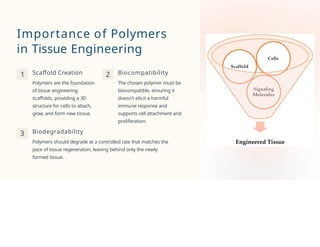
1 Scaffold Creation
Polymers are the foundation
of tissue engineering
scaffolds, providing a 3D
structure for cells to attach,
grow, and form new tissue.
2 Biocompatibility
The chosen polymer must be
biocompatible, ensuring it
doesn't elicit a harmful
immune response and
supports cell attachment and
proliferation.
3 Biodegradability
Polymers should degrade at a controlled rate that matches the
pace of tissue regeneration, leaving behind only the newly
formed tissue.
4.
Types of PolymersUsed in
Tissue Engineering
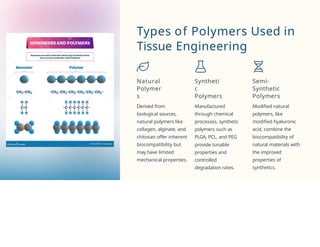
Natural
Polymer
s
Derived from
biological sources,
natural polymers like
collagen, alginate, and
chitosan offer inherent
biocompatibility but
may have limited
mechanical properties.
Syntheti
c
Polymers
Manufactured
through chemical
processes, synthetic
polymers such as
PLGA, PCL, and PEG
provide tunable
properties and
controlled
degradation rates.
Semi-
Synthetic
Polymers
Modified natural
polymers, like
modified hyaluronic
acid, combine the
biocompatibility of
natural materials with
the improved
properties of
synthetics.
5.
Key Properties of
Polymers
Mechanical
Strength
Polymersmust possess
adequate mechanical
strength to support cell
growth and provide
structural integrity during
tissue formation.
1
2
Porosity
Sufficient porosity is
necessary for nutrient and
oxygen diffusion, enabling
cells within the scaffold to
survive and function
properly.
3
Surface Chemistry
Surface chemistry plays a
crucial role in cell
adhesion and
proliferation, influencing
how cells interact with the
polymer scaffold.
4
Degradation Rate
The degradation rate must
be carefully matched to
the rate of tissue
regeneration to ensure
proper tissue remodeling
and integration.
6.
Focus on PLGA(poly(L-
lactide-co-glycolide))
Overview
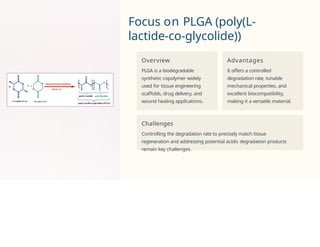
PLGA is a biodegradable
synthetic copolymer widely
used for tissue engineering
scaffolds, drug delivery, and
wound healing applications.
Advantages
It offers a controlled
degradation rate, tunable
mechanical properties, and
excellent biocompatibility,
making it a versatile material.
Challenges
Controlling the degradation rate to precisely match tissue
regeneration and addressing potential acidic degradation products
remain key challenges.
7.
PLGA Scaffold Design
1
2
3
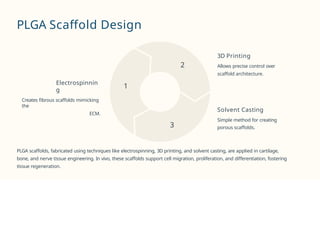
PLGAscaffolds, fabricated using techniques like electrospinning, 3D printing, and solvent casting, are applied in cartilage,
bone, and nerve tissue engineering. In vivo, these scaffolds support cell migration, proliferation, and differentiation, fostering
tissue regeneration.
Electrospinnin
g
Creates fibrous scaffolds mimicking
the
ECM.
3D Printing
Allows precise control over
scaffold architecture.
Solvent Casting
Simple method for creating
porous scaffolds.
8.
Focus on PCL
Slow
Degradation
PCLdegrades
slowly.
Excellent
Mechanical
PCL has excellent
mechanical properties
Bio
Compatibility
PCL is biocompatible.
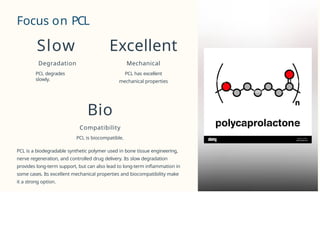
PCL is a biodegradable synthetic polymer used in bone tissue engineering,
nerve regeneration, and controlled drug delivery. Its slow degradation
provides long-term support, but can also lead to long-term inflammation in
some cases. Its excellent mechanical properties and biocompatibility make
it a strong option.
9.
PCL Scaffold Design
1Electrospinnin
g
2 3D
Printing
3 Porogen
Leaching
PCL is primarily used for bone and cartilage scaffolds due to its mechanical strength. It can be fabricated via electrospinning, 3D
printing, and porogen leaching. In vivo, PCL supports the formation of bone-like tissues and can be loaded with growth factors
for enhanced healing.
10.
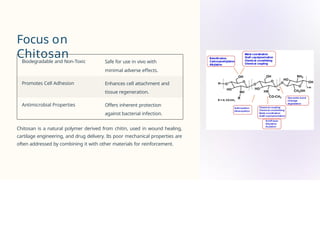
Focus on
Chitosan
Biodegradable andNon-Toxic Safe for use in vivo with
minimal adverse effects.
Promotes Cell Adhesion Enhances cell attachment and
tissue regeneration.
Antimicrobial Properties Offers inherent protection
against bacterial infection.
Chitosan is a natural polymer derived from chitin, used in wound healing,
cartilage engineering, and drug delivery. Its poor mechanical properties are
often addressed by combining it with other materials for reinforcement.
11.
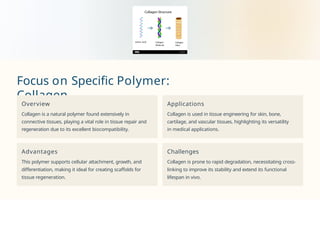
Focus on SpecificPolymer:
Collagen
Overview
Collagen is a natural polymer found extensively in
connective tissues, playing a vital role in tissue repair and
regeneration due to its excellent biocompatibility.
Applications
Collagen is used in tissue engineering for skin, bone,
cartilage, and vascular tissues, highlighting its versatility
in medical applications.
Advantages
This polymer supports cellular attachment, growth, and
differentiation, making it ideal for creating scaffolds for
tissue regeneration.
Challenges
Collagen is prone to rapid degradation, necessitating cross-
linking to improve its stability and extend its functional
lifespan in vivo.
12.
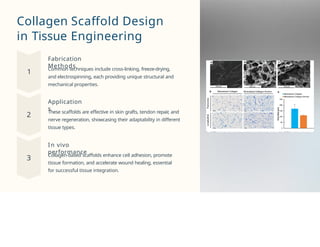
Collagen Scaffold Design
inTissue Engineering
1
Fabrication
Methods
Common techniques include cross-linking, freeze-drying,
and electrospinning, each providing unique structural and
mechanical properties.
2
Application
s
These scaffolds are effective in skin grafts, tendon repair
, and
nerve regeneration, showcasing their adaptability in different
tissue types.
3
In vivo
performance
Collagen-based scaffolds enhance cell adhesion, promote
tissue formation, and accelerate wound healing, essential
for successful tissue integration.
13.
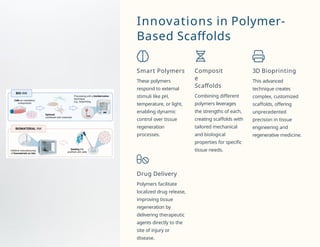
Innovations in Polymer-
BasedScaffolds
Smart Polymers
These polymers
respond to external
stimuli like pH,
temperature, or light,
enabling dynamic
control over tissue
regeneration
processes.
Composit
e
Scaffolds
Combining different
polymers leverages
the strengths of each,
creating scaffolds with
tailored mechanical
and biological
properties for specific
tissue needs.
3D Bioprinting
This advanced
technique creates
complex, customized
scaffolds, offering
unprecedented
precision in tissue
engineering and
regenerative medicine.
Drug Delivery
Polymers facilitate
localized drug release,
improving tissue
regeneration by
delivering therapeutic
agents directly to the
site of injury or
disease.
14.
Challenges and Future
Directions
Challenges
Balancingmechanical properties with biological
functionality. Controlling degradation rates for full tissue
integration.
Addressing ethical concerns about synthetic polymers and
their impact.
Future Directions
Developing smart polymers to enhance tissue
regeneration.
Creating biocompatible composites with enhanced
mechanical properties.
Expanding regenerative medicine applications to
complex tissues and organs.




![Natural and synthetic polymers in medicine ppt [Autosaved].pptx](https://cdn.slidesharecdn.com/ss_thumbnails/naturalandsyntheticpolymersinmedicinepptautosaved-220515192625-27c424c5-thumbnail.jpg?width=640&height=640&fit=bounds)


