
Polyglot Persistence
vs
Multi-Model Databases
Luca Garulli, Founder and CEO at OrientDB
Relational Databases are the
Most Successful Technology
Ever and Ruled for the Last 45
Years
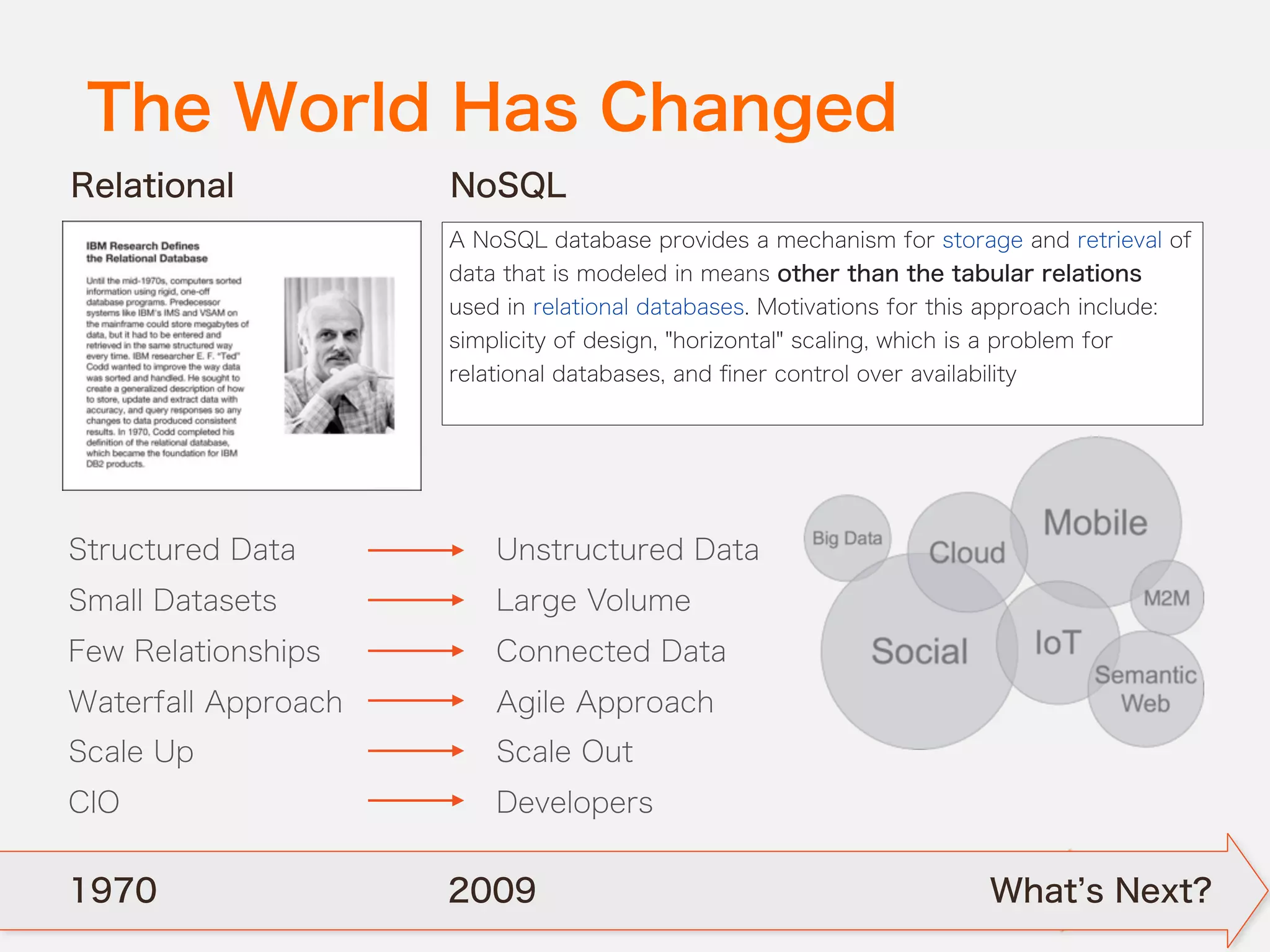
Structured Data
Small Datasets
Few Relationships
Waterfall Approach
Scale Up
CIO
The World Has Changed
Unstructured Data
Large Volume
Connected Data
Agile Approach
Scale Out
Developers
Relational NoSQL
1970 2009
A NoSQL database provides a mechanism for storage and retrieval of
data that is modeled in means other than the tabular relations
used in relational databases. Motivations for this approach include:
simplicity of design, "horizontal" scaling, which is a problem for
relational databases, and finer control over availability
What s Next?
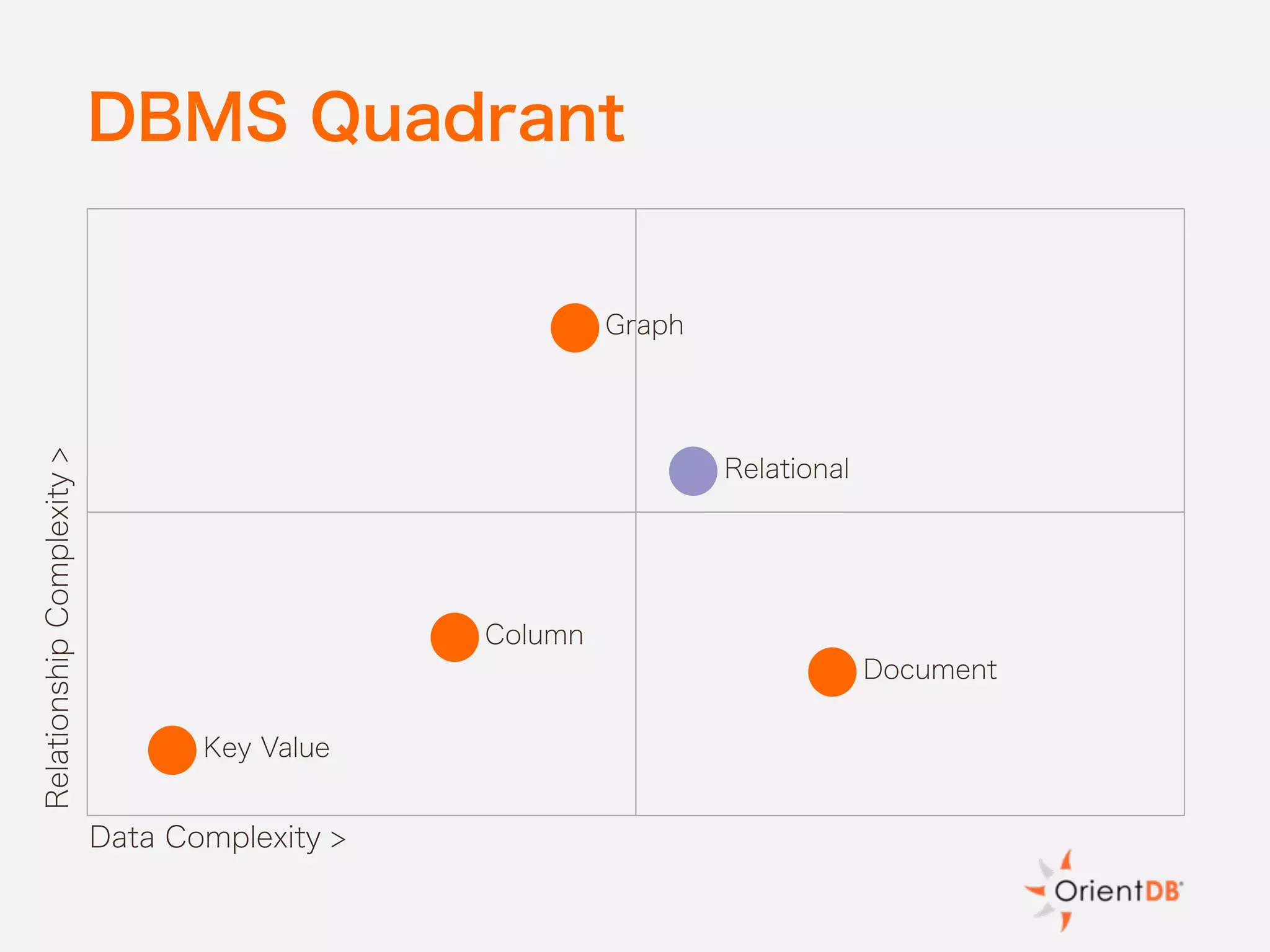
DBMS Quadrant
RelationshipComplexity>
Data Complexity >
Relational
Key Value
Column
Graph
Document
Polyglot Persistence
Polyglot Persistence is a fancy term to
describe that when storing data, it is best to use
multiple data storage technologies, chosen
based upon the way data is being used by
individual applications or components.
http://www.jamesserra.com/archive/2015/07/what-is-polyglot-persistence/
Multi-Model
A multi-model database is designed to support
multiple data models against a single, integrated
backend.
Multi-model databases are intended to offer the
data modeling advantages of polyglot
persistence without its disadvantages. Complexity,
in particular, is reduced.
https://en.wikipedia.org/wiki/Multi-model_database
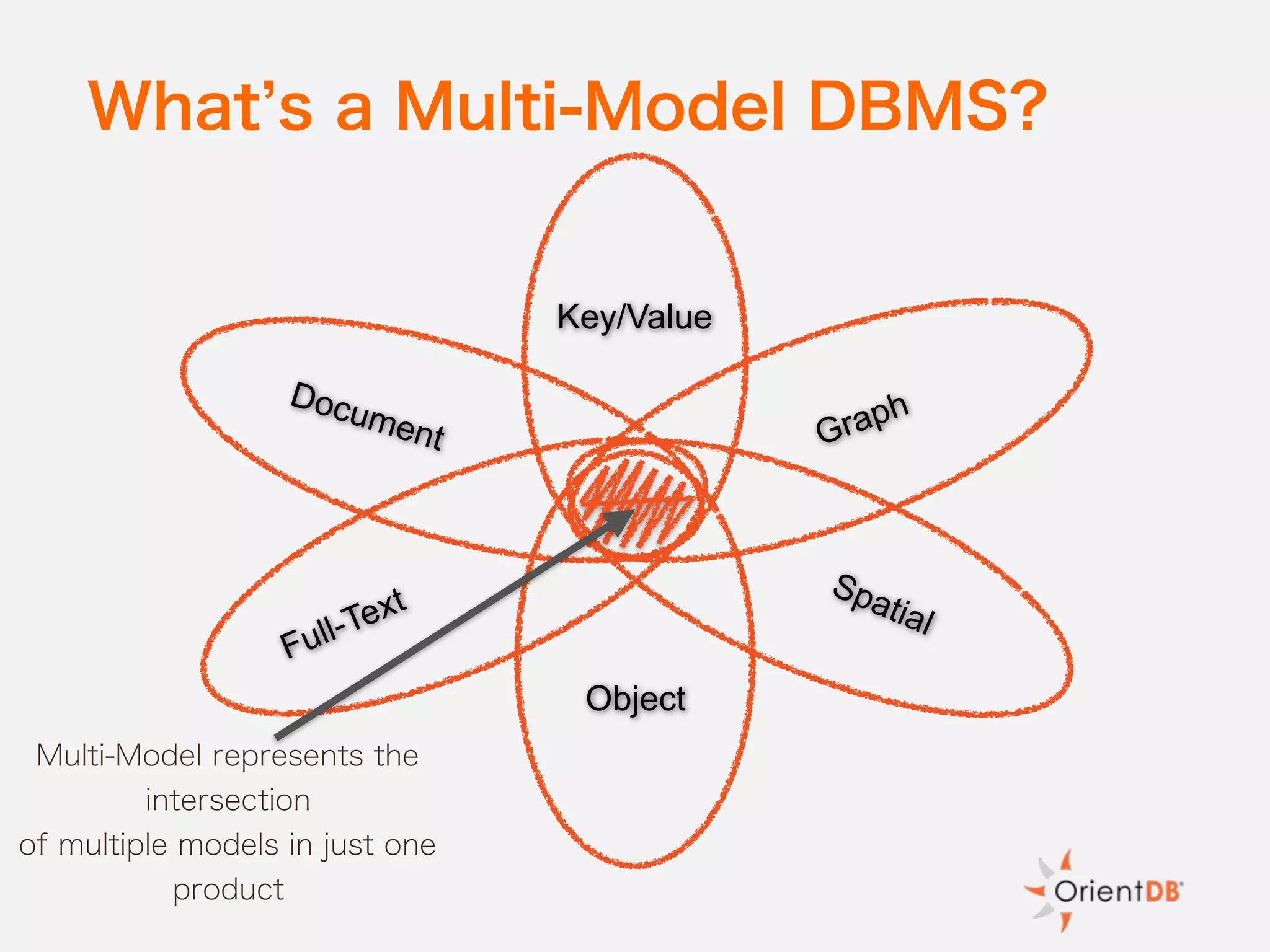
What s a Multi-Model DBMS?
GraphDocument
Object
Key/Value
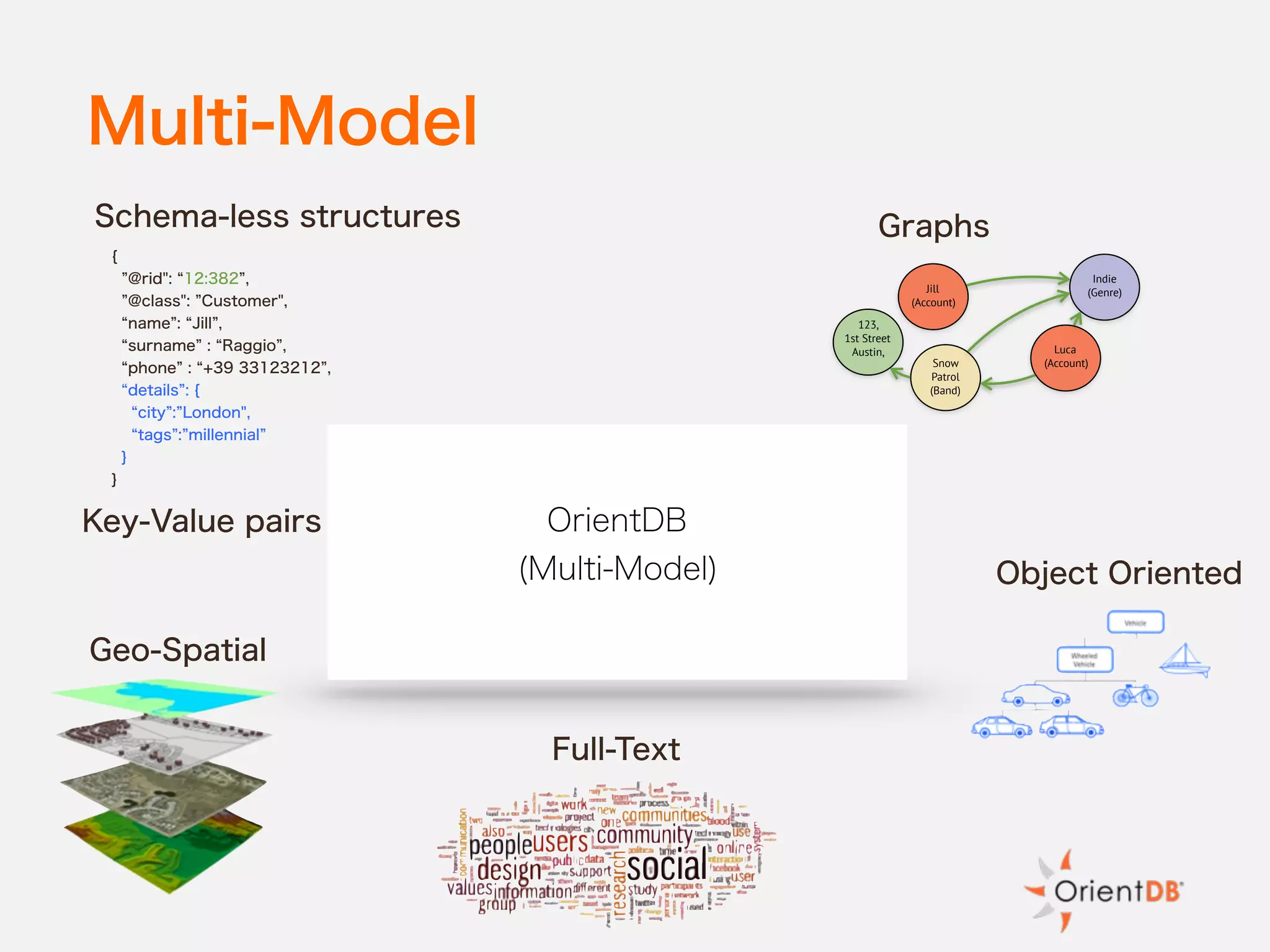
Multi-Model represents the
intersection
of multiple models in just one
product
Full-Text
Spatial
Multi-Model
Snow
Patrol
(Band)
Luca
(Account)
Indie
(Genre)
123,
1st Street
Austin,
Jill
(Account)
Graphs
{
@rid": 12:382 ,
@class": Customer",
name : Jill ,
surname : Raggio ,
phone : +39 33123212 ,
details : {
city : London",
tags : millennial
}
}
Schema-less structures
Object Oriented
Key-Value pairs
Geo-Spatial
Full-Text
OrientDB
(Multi-Model)
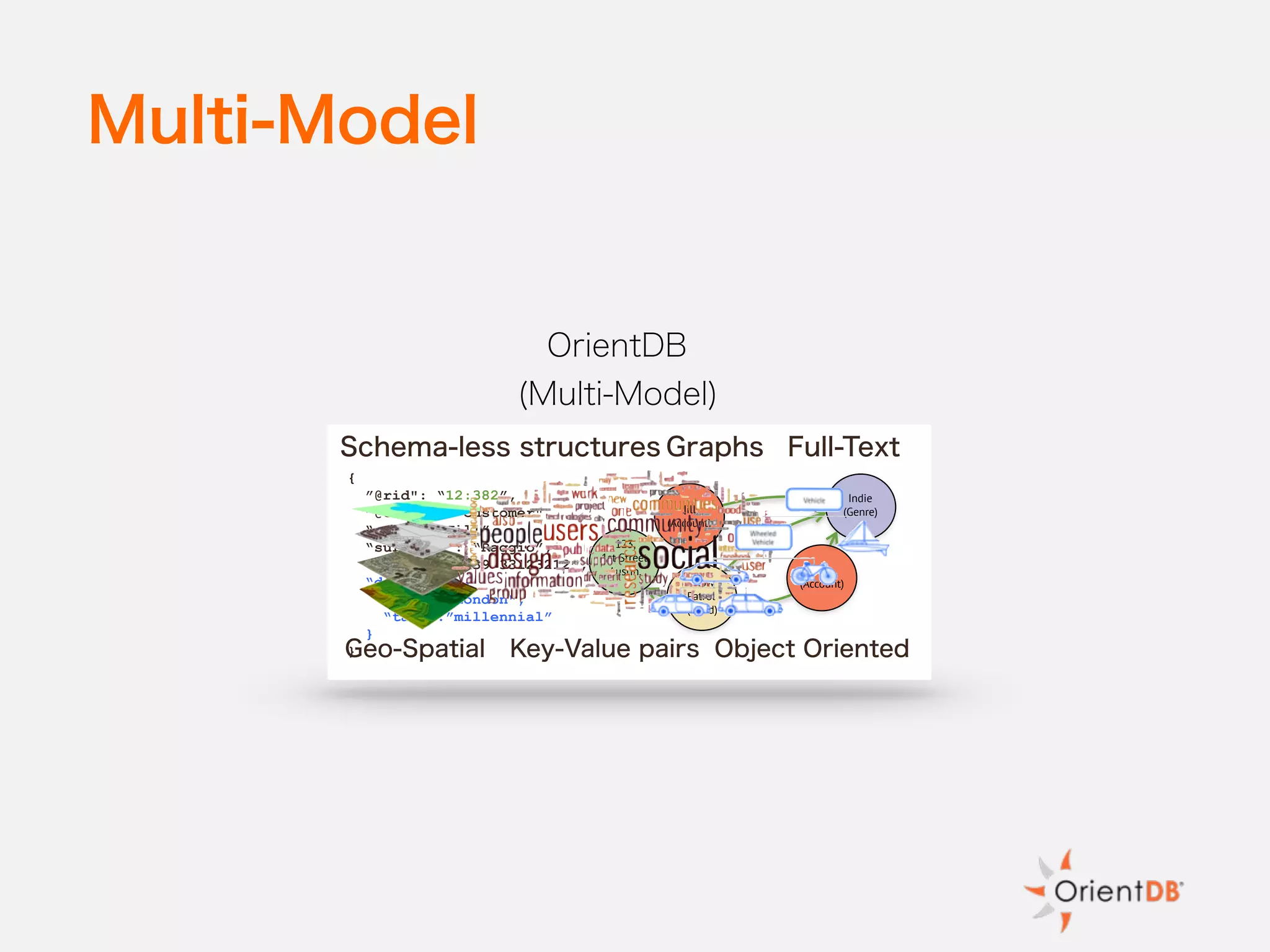
Multi-Model
Snow
Patrol
(Band)
Luca
(Account)
Indie
(Genre)
123,
1st Street
Austin,
Jill
(Account)
Graphs
{
”@rid": “12:382”,
”@class": ”Customer",
“name”: “Jill”,
“surname” : “Raggio”,
“phone” : “+39 33123212”,
“details”: {
“city”:”London",
“tags”:”millennial”
}
}
Schema-less structures
Object OrientedKey-Value pairsGeo-Spatial
Full-Text
OrientDB
(Multi-Model)
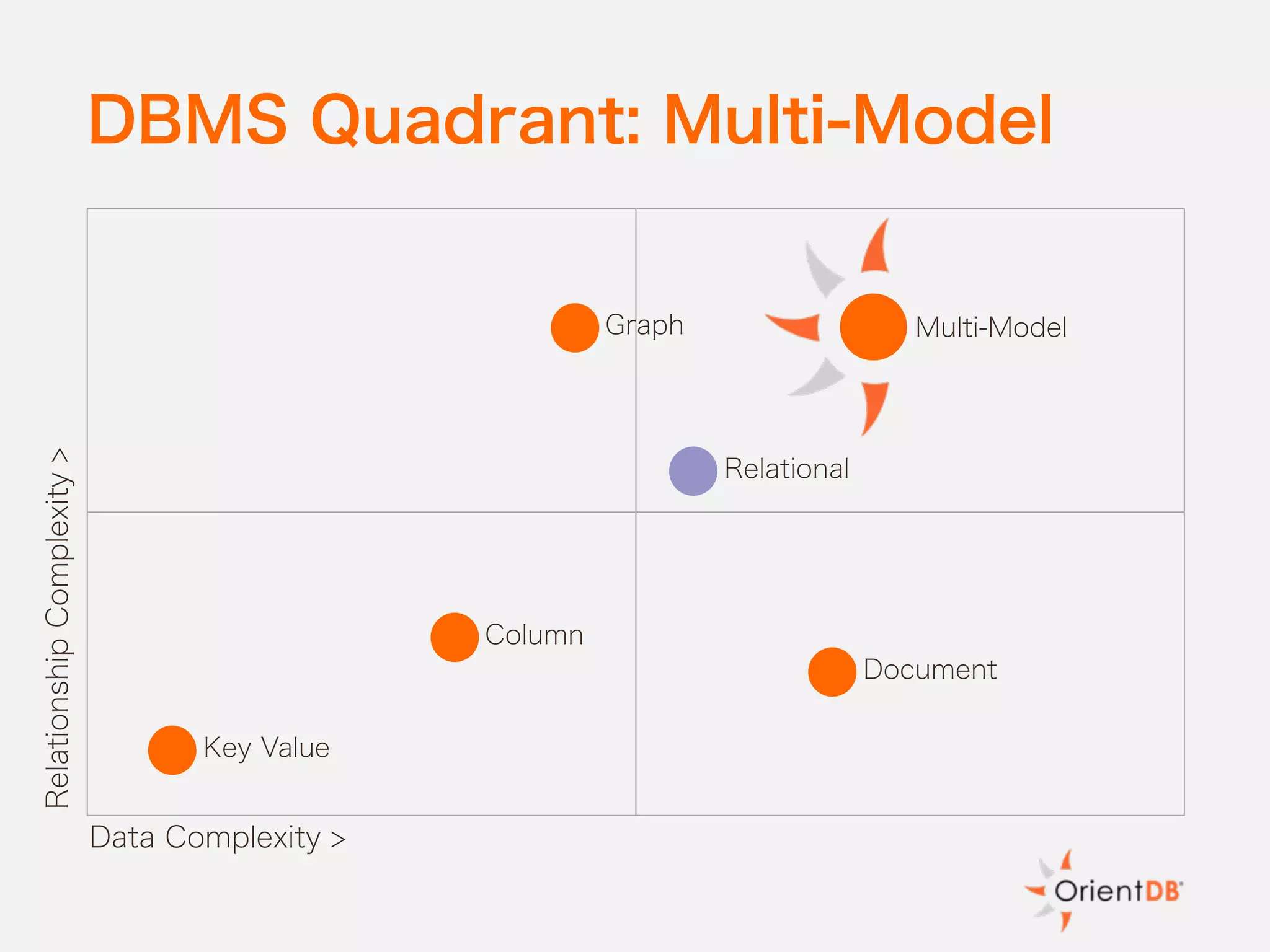
DBMS Quadrant: Multi-Model
RelationshipComplexity>
Data Complexity >
Relational
Key Value
Column
Graph
Document
Multi-Model
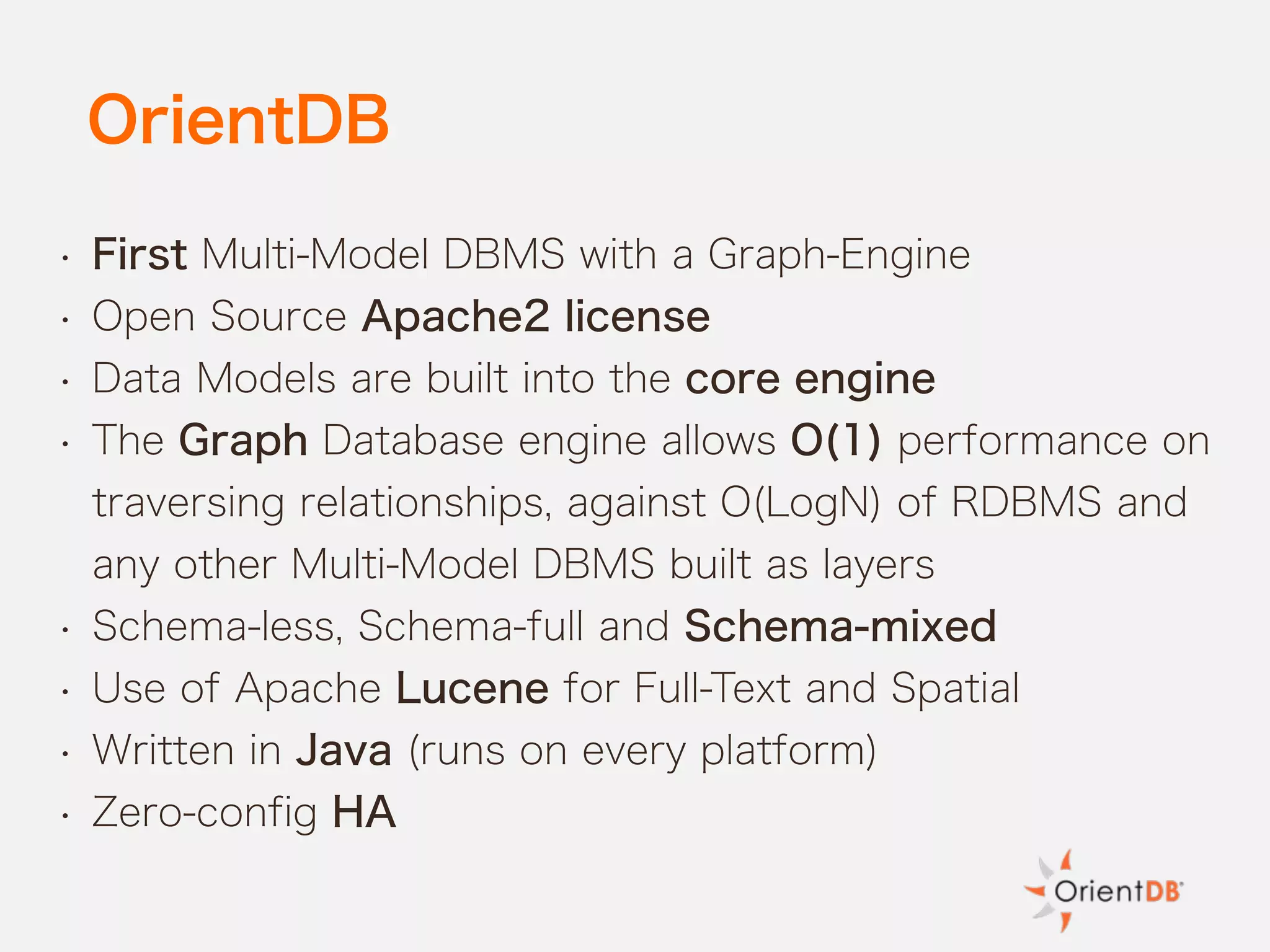
OrientDB
• First Multi-Model DBMS with a Graph-Engine
• Open Source Apache2 license
• Data Models are built into the core engine
• The Graph Database engine allows O(1) performance on
traversing relationships, against O(LogN) of RDBMS and
any other Multi-Model DBMS built as layers
• Schema-less, Schema-full and Schema-mixed
• Use of Apache Lucene for Full-Text and Spatial
• Written in Java (runs on every platform)
• Zero-config HA
Online Hotel Booking Application
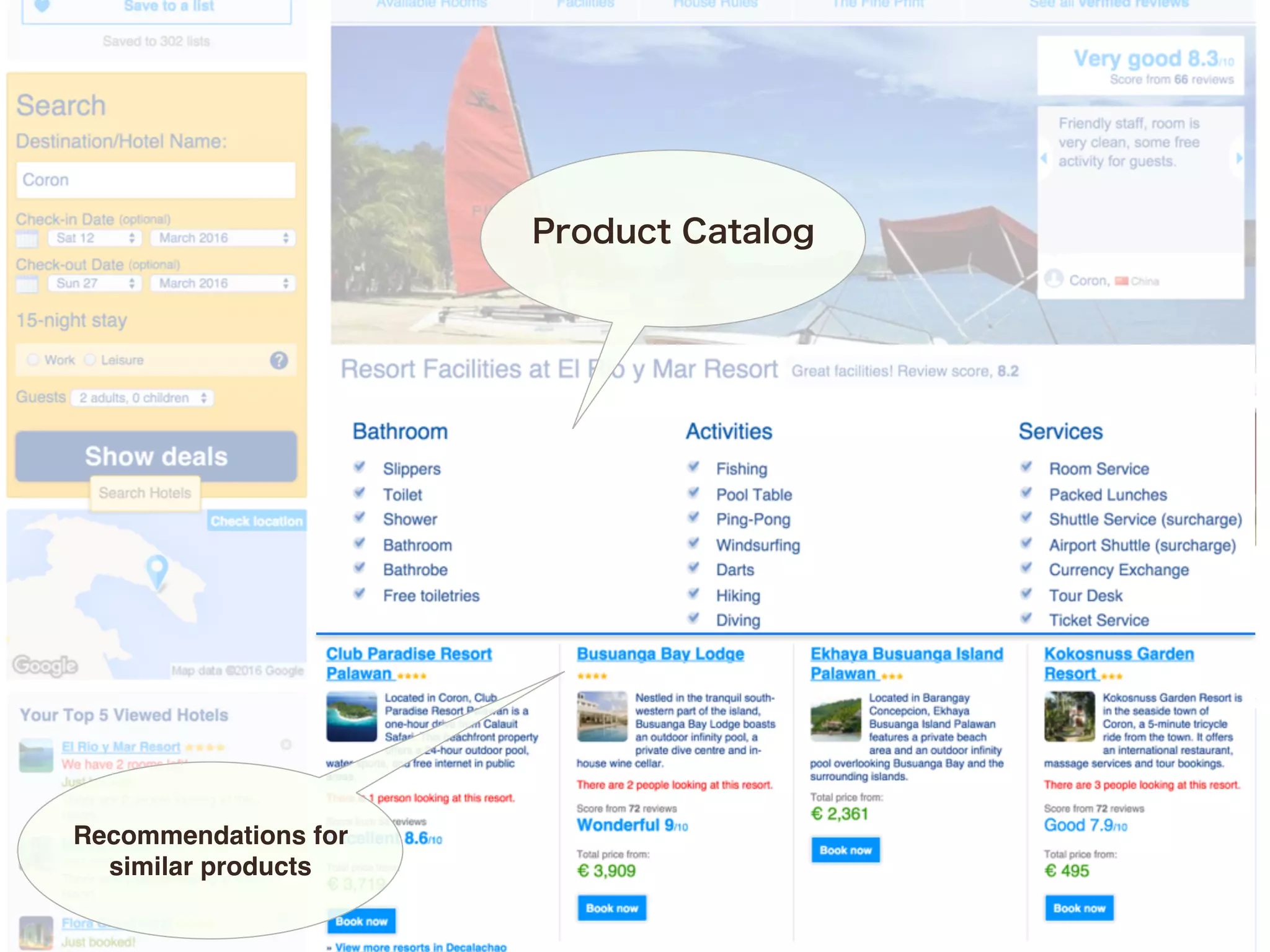
Product Catalog
Recommendations for
similar products
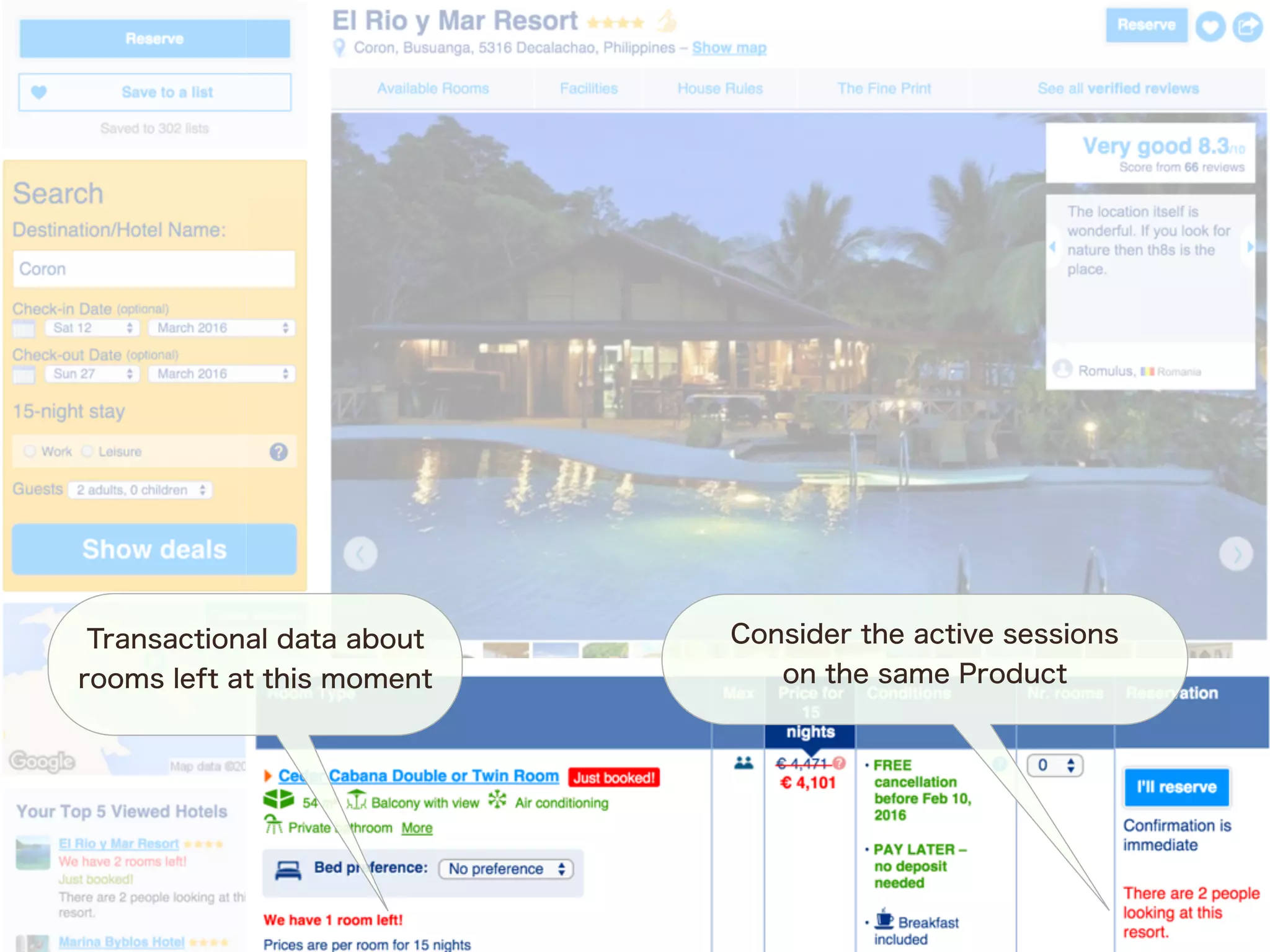
Transactional data about
rooms left at this moment
Consider the active sessions
on the same Product
The initial reaction of developers when
the CTO agrees to use
Polyglot Persistence
I can
use the
best tools for
my use cases! No limits
anymore! This is
Developer
FREEDOM!
No more
Tables?
Deployment
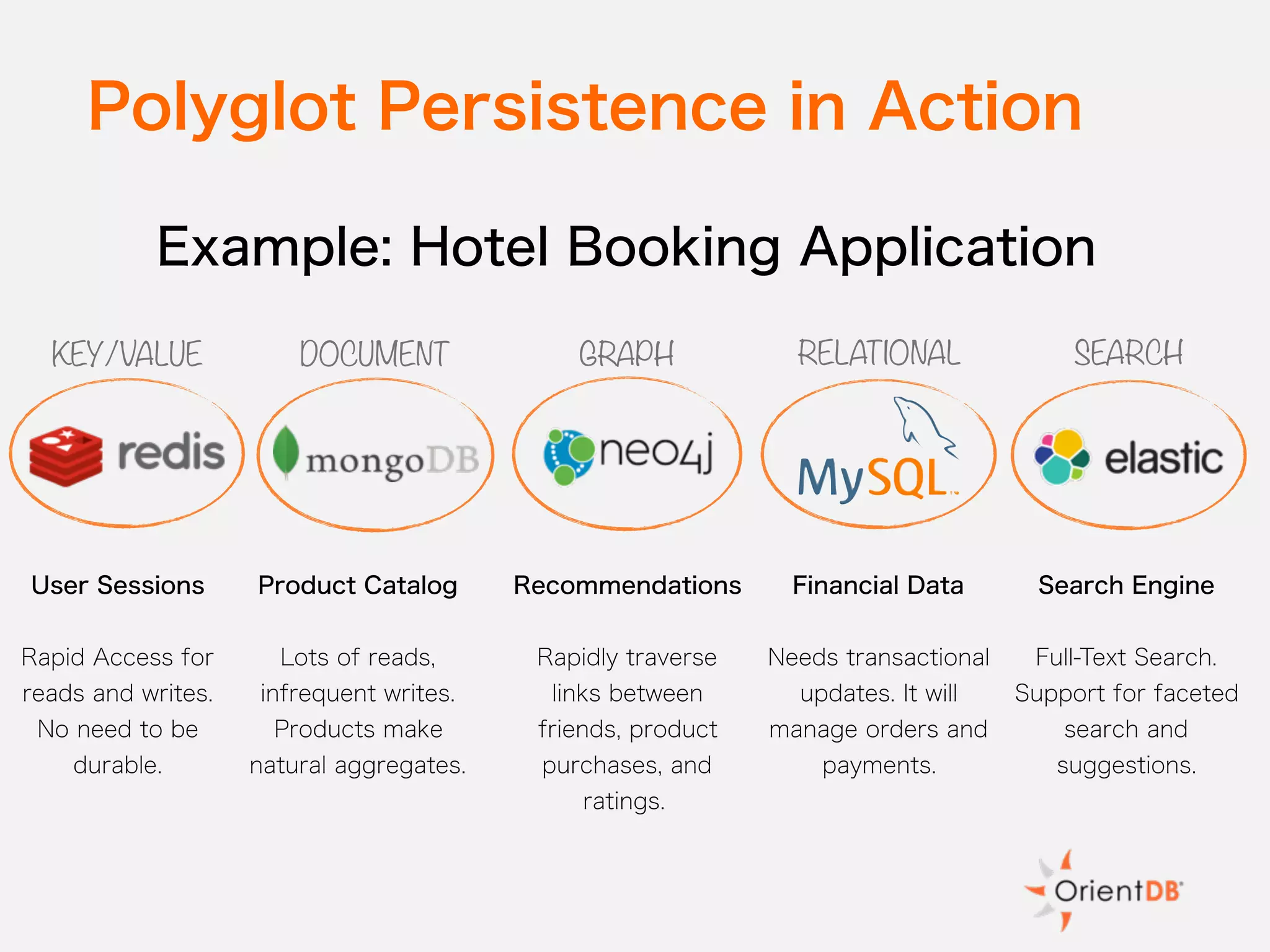
Polyglot Persistence in Action
DOCUMENTKEY/VALUE GRAPH RELATIONAL
User Sessions
Rapid Access for
reads and writes.
No need to be
durable.
Financial Data
Needs transactional
updates. It will
manage orders and
payments.
Recommendations
Rapidly traverse
links between
friends, product
purchases, and
ratings.
Product Catalog
Lots of reads,
infrequent writes.
Products make
natural aggregates.
Example: Hotel Booking Application
SEARCH
Search Engine
Full-Text Search.
Support for faceted
search and
suggestions.
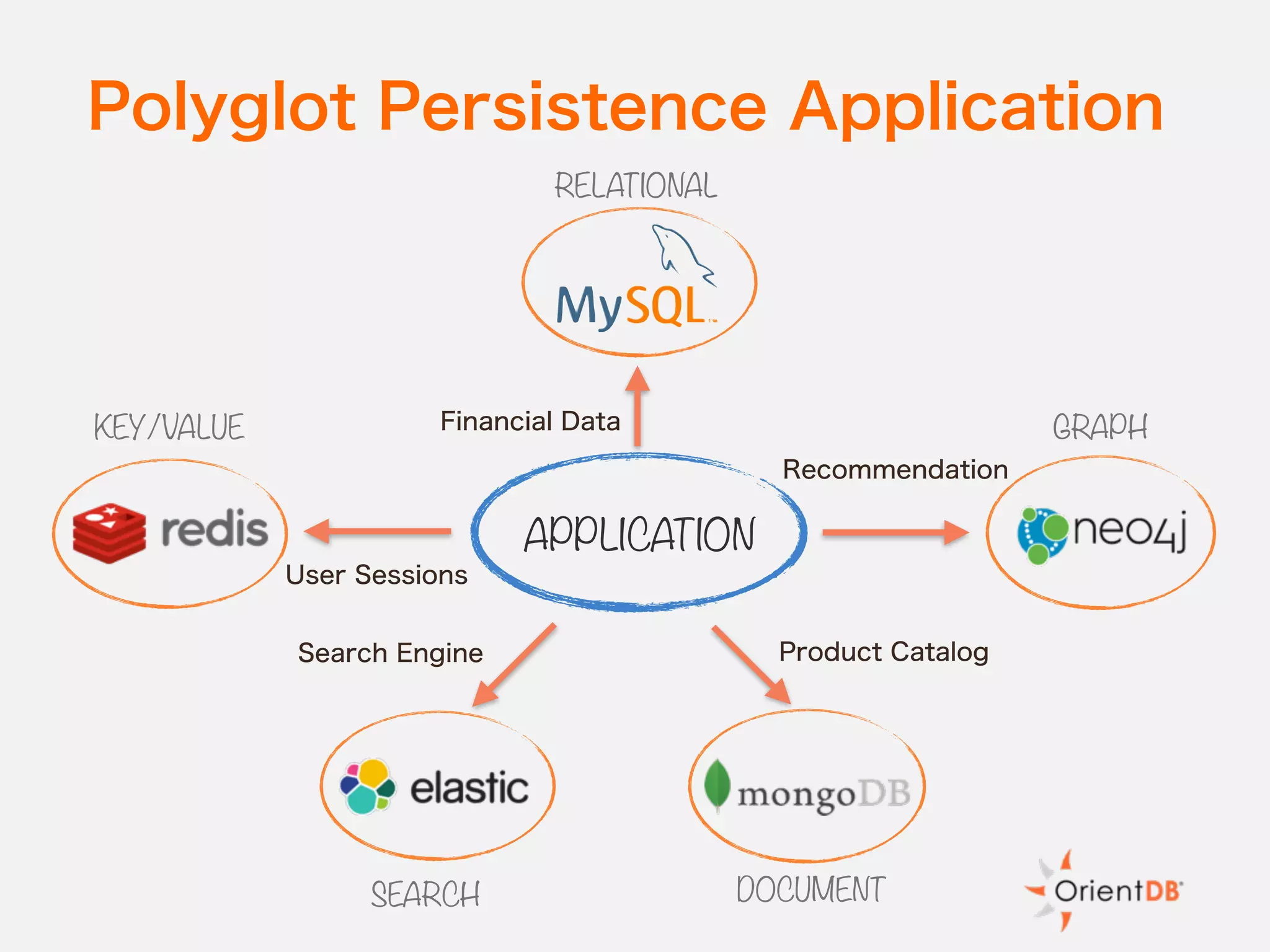
Polyglot Persistence Application
DOCUMENT
KEY/VALUE GRAPH
APPLICATION
RELATIONAL
User Sessions
Product Catalog
Recommendation
Financial Data
SEARCH
Search Engine
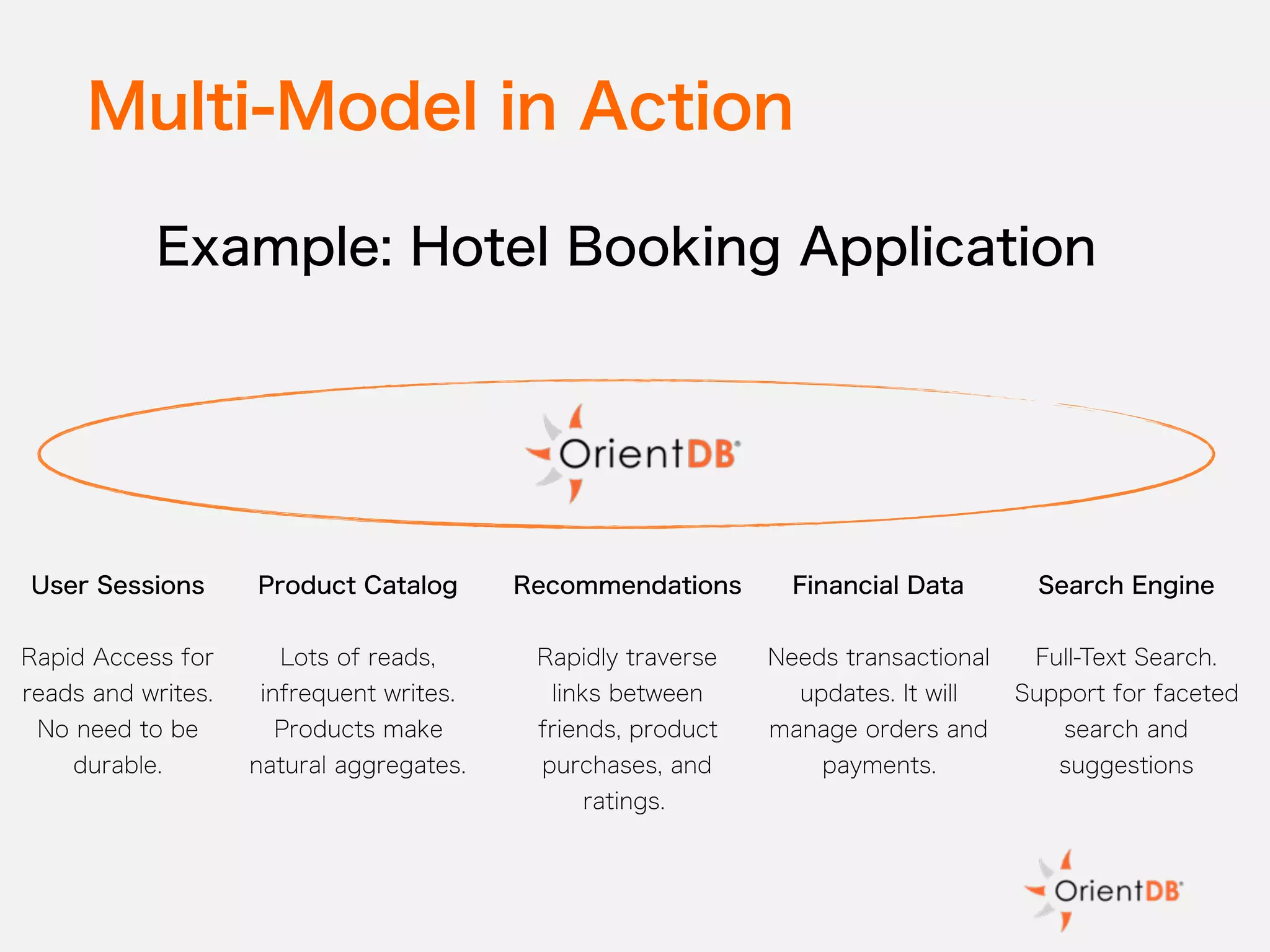
Multi-Model in Action
Example: Hotel Booking Application
User Sessions
Rapid Access for
reads and writes.
No need to be
durable.
Financial Data
Needs transactional
updates. It will
manage orders and
payments.
Recommendations
Rapidly traverse
links between
friends, product
purchases, and
ratings.
Product Catalog
Lots of reads,
infrequent writes.
Products make
natural aggregates.
Search Engine
Full-Text Search.
Support for faceted
search and
suggestions
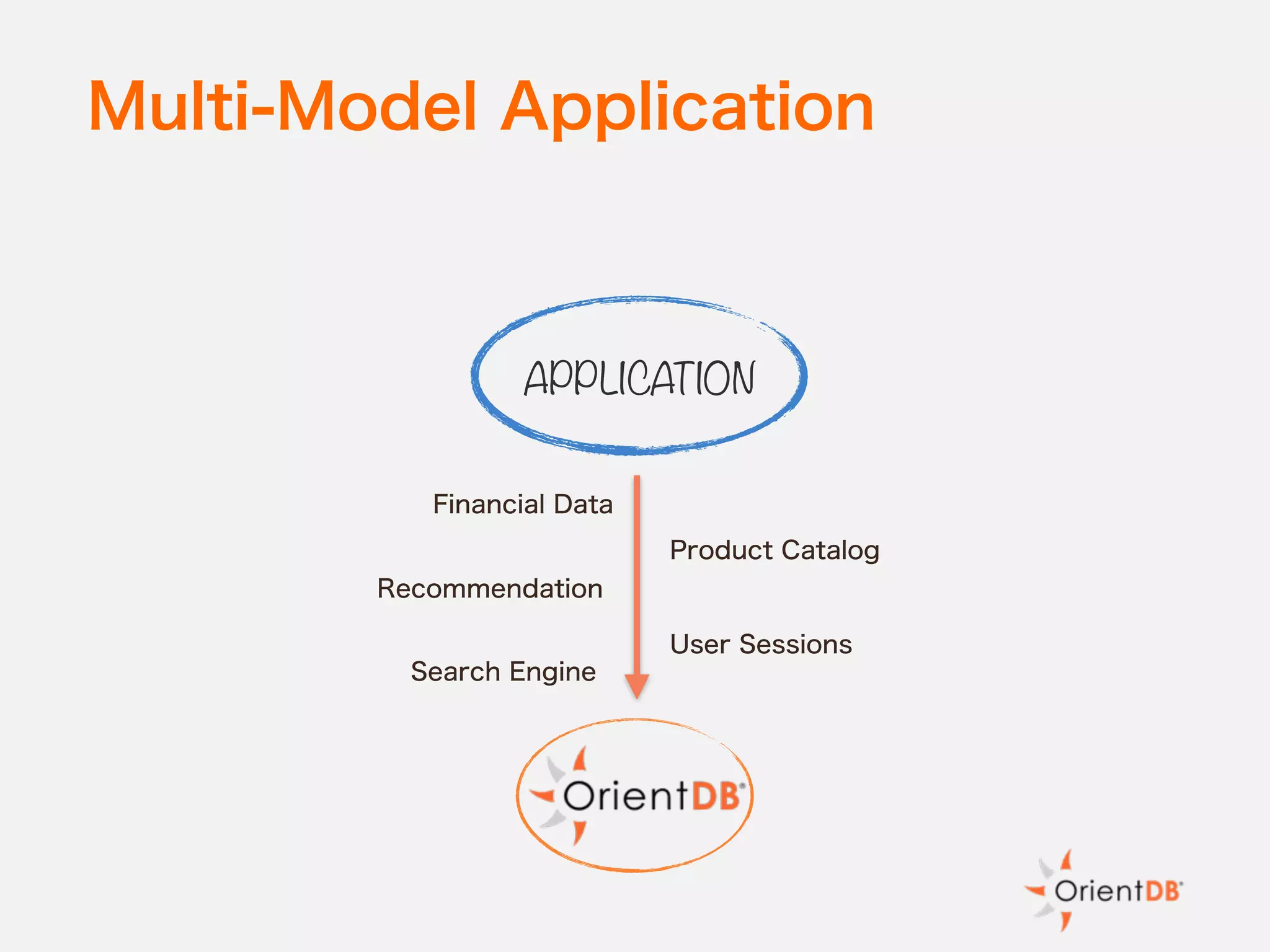
Multi-Model Application
APPLICATION
User Sessions
Product Catalog
Recommendation
Financial Data
Search Engine
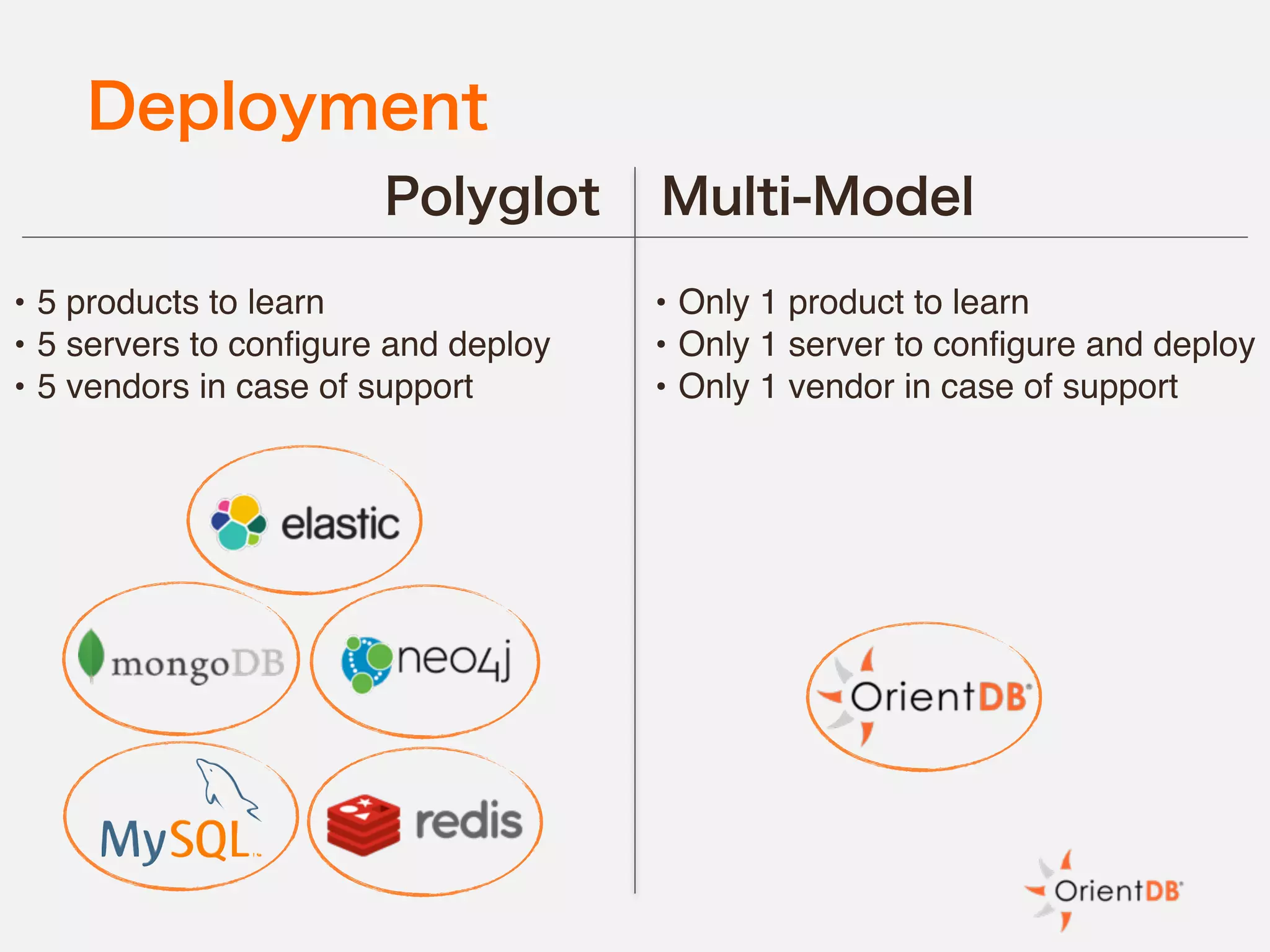
Deployment
Multi-ModelPolyglot
• Only 1 product to learn
• Only 1 server to configure and deploy
• Only 1 vendor in case of support
• 5 products to learn
• 5 servers to configure and deploy
• 5 vendors in case of support
Polyglot Deployment
• 5 PRODUCTS TO LEARN
No standard, all products are different. Even in the same category, they
have different APIs (ex. MongoDB and CouchDB). Every developer has to
learn multiple products or you should hire multiple developers with specific
skills for every product.
• 5 SERVERS TO CONFIGURE AND DEPLOY
Usually it’s a bad idea to put more databases on the same machine due to
the aggressive use of resources such as RAM and DISK.
• 5 VENDORS IN CASE OF SUPPORT
This means 5 contracts with 5 different vendors.
Domain design
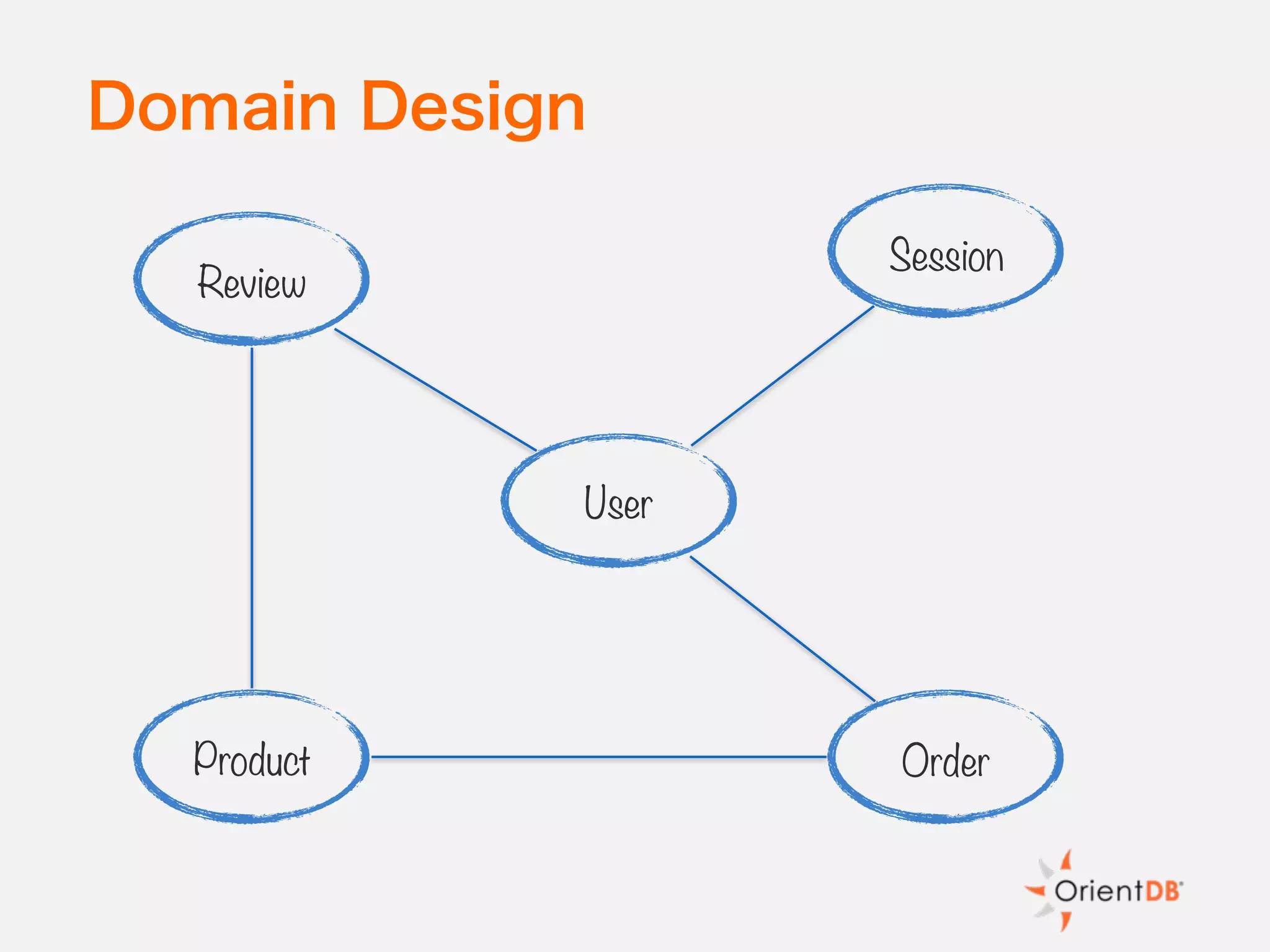
Domain Design
Product
User
Session
Order
Review
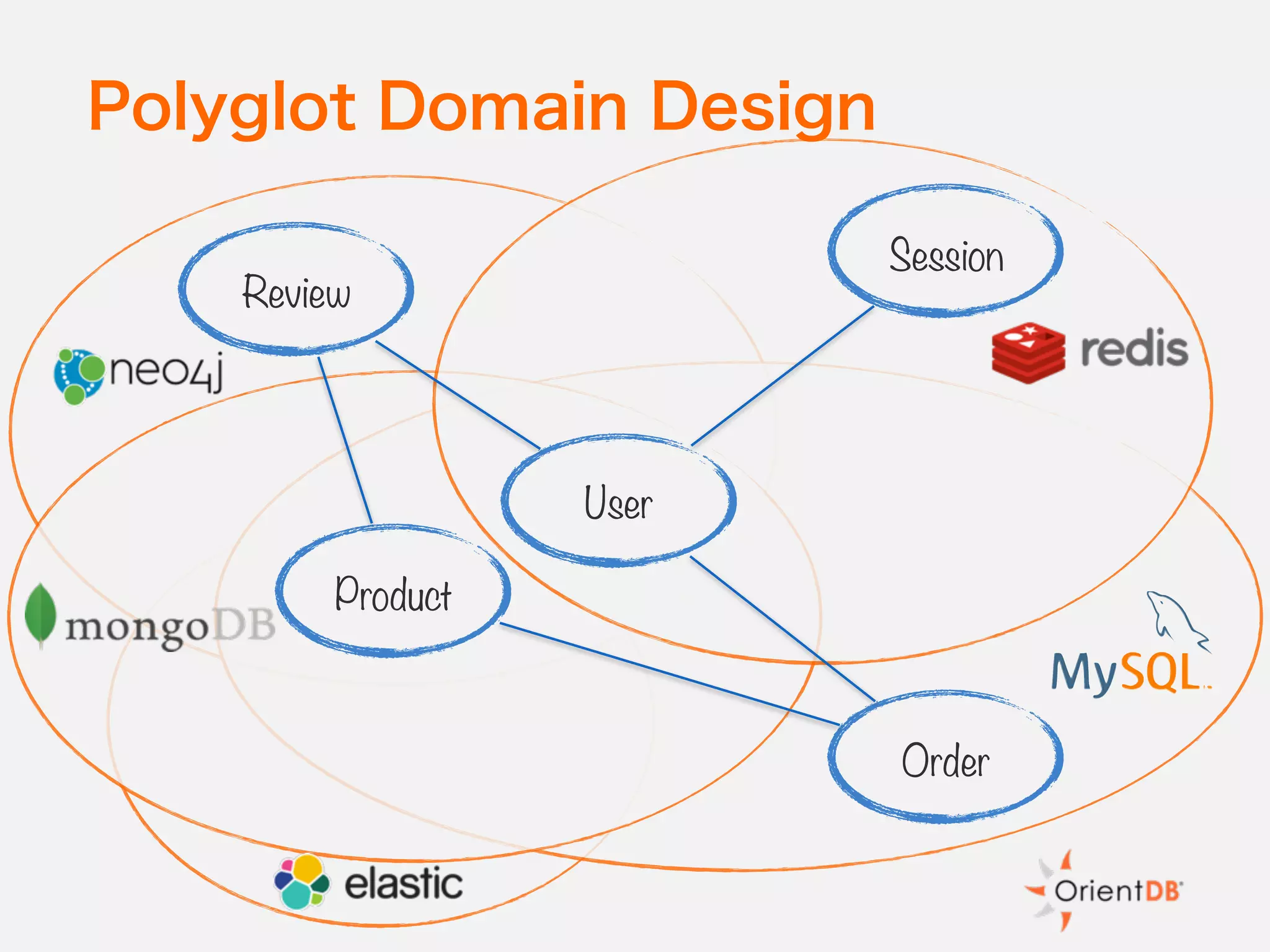
Polyglot Domain Design
Product
User
Session
Order
Review
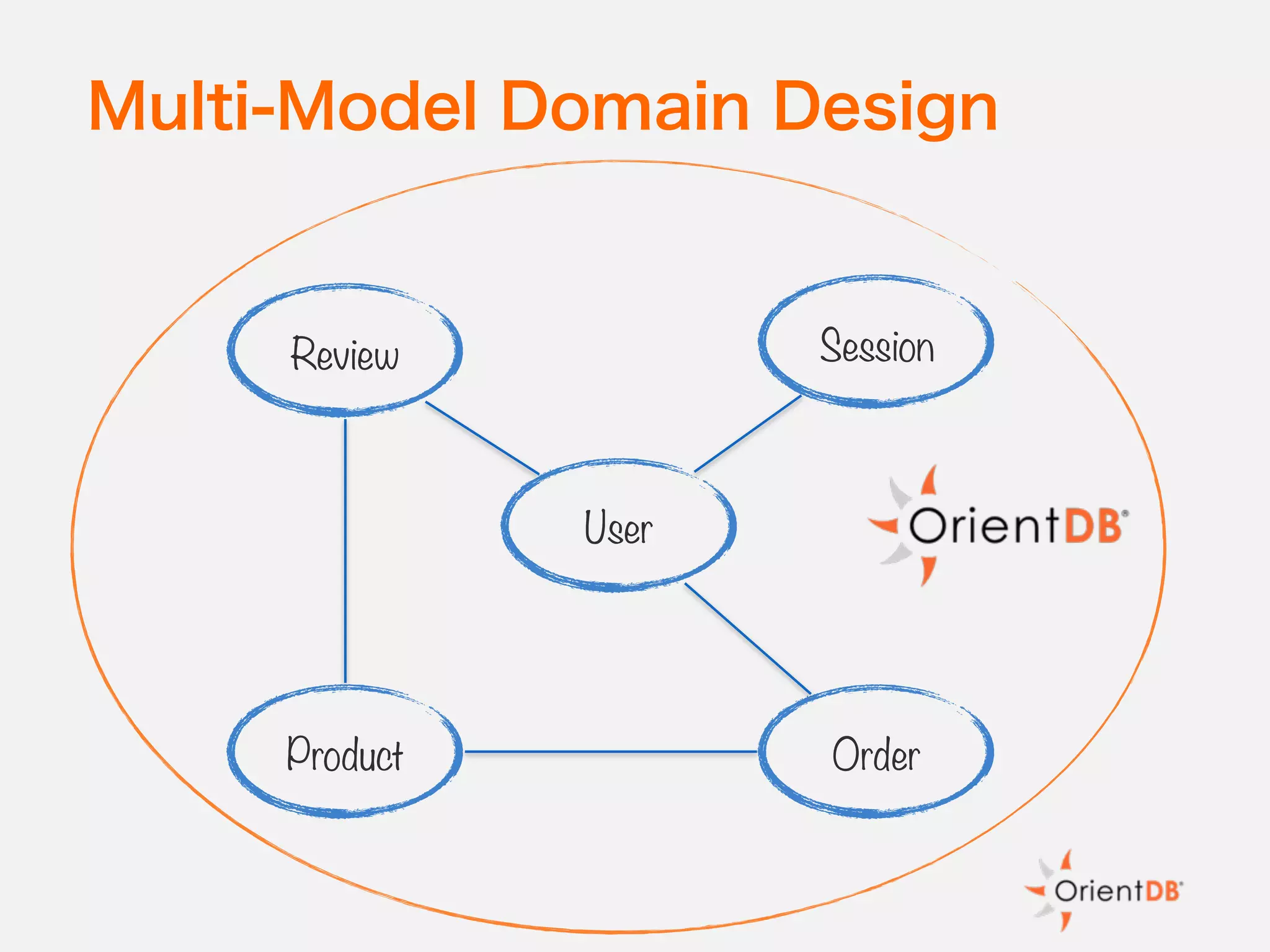
Multi-Model Domain Design
Product
User
Session
Order
Review
Domain Design
Multi-ModelPolyglot
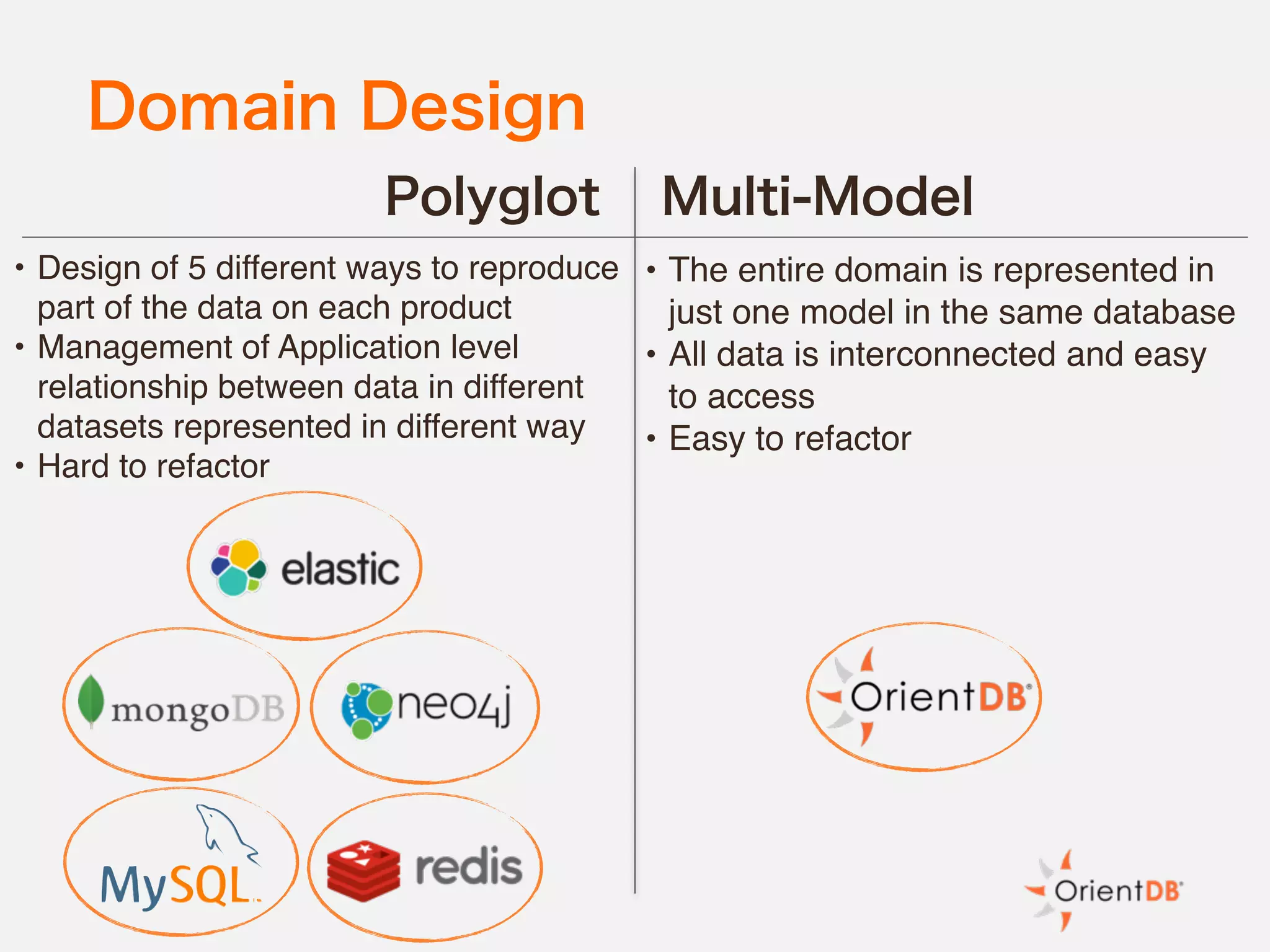
• The entire domain is represented in
just one model in the same database
• All data is interconnected and easy
to access
• Easy to refactor
• Design of 5 different ways to reproduce
part of the data on each product
• Management of Application level
relationship between data in different
datasets represented in different way
• Hard to refactor
Performance
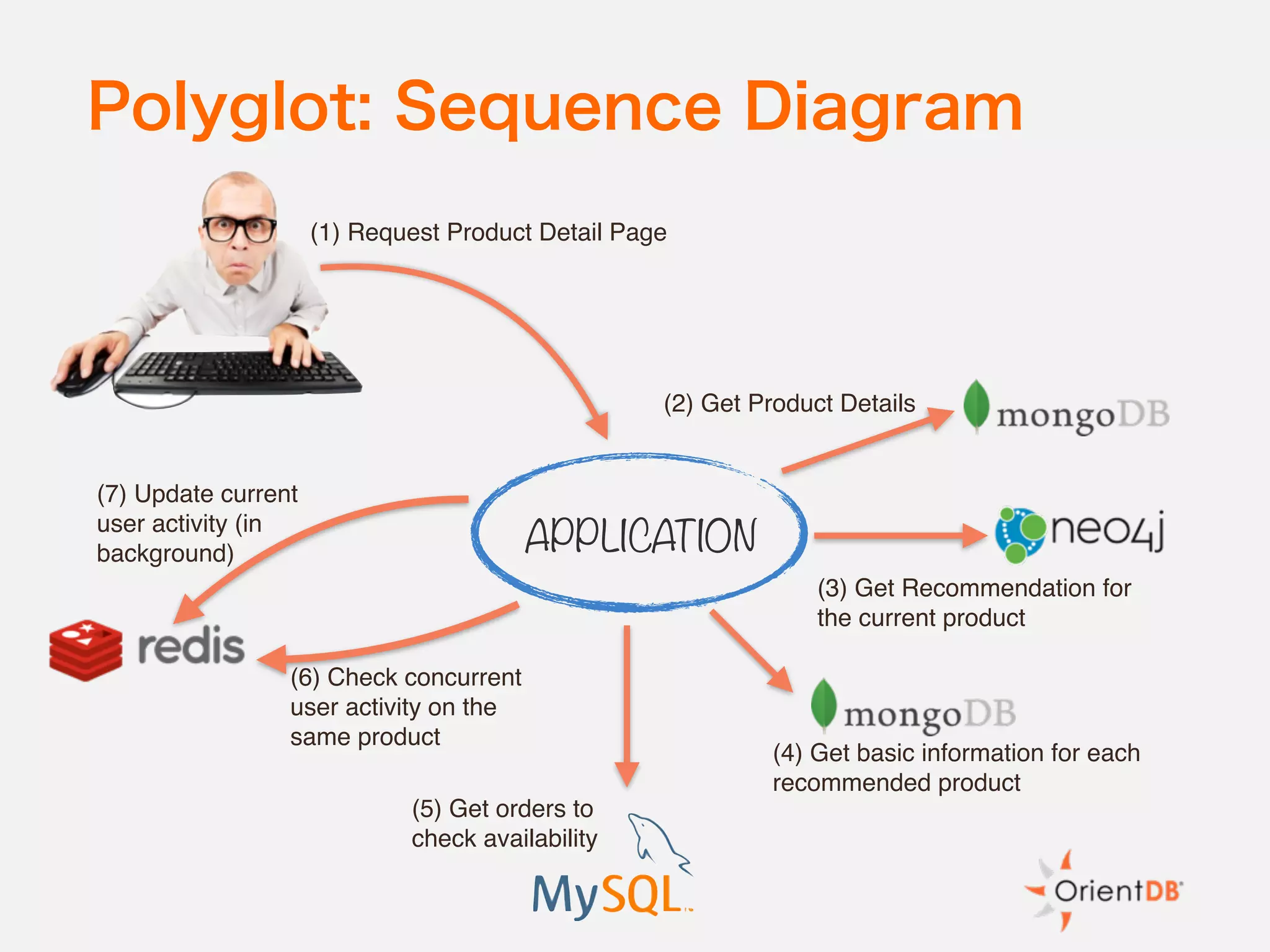
Polyglot: Sequence Diagram
APPLICATION
(2) Get Product Details
(3) Get Recommendation for
the current product
(5) Get orders to
check availability
(6) Check concurrent
user activity on the
same product
(7) Update current
user activity (in
background)
(4) Get basic information for each
recommended product
(1) Request Product Detail Page
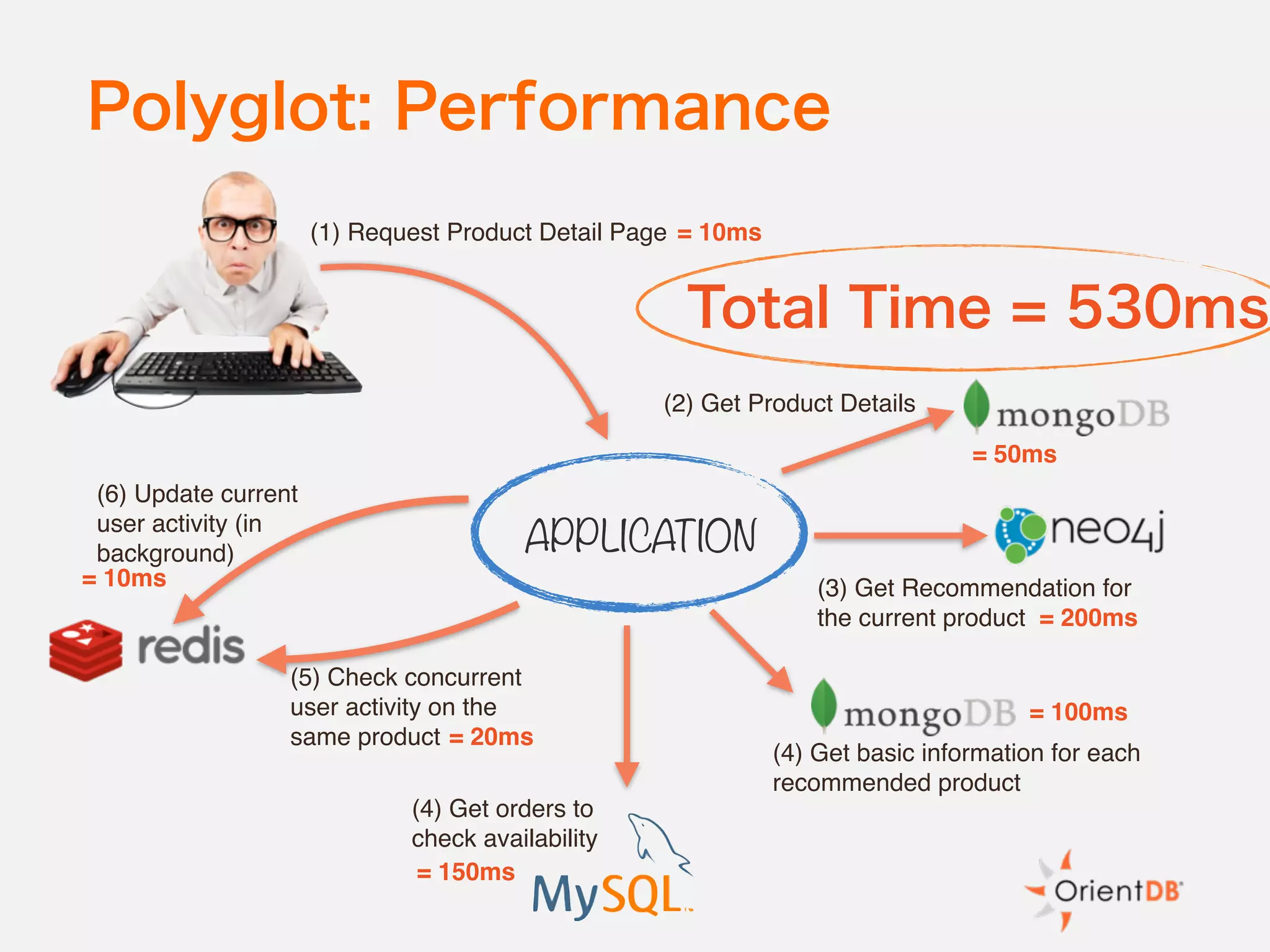
Polyglot: Performance
APPLICATION
(4) Get orders to
check availability
(1) Request Product Detail Page
(5) Check concurrent
user activity on the
same product
= 10ms
= 50ms
= 200ms
= 150ms
= 20ms
= 10ms
Total Time = 530ms
(6) Update current
user activity (in
background)
(2) Get Product Details
(3) Get Recommendation for
the current product
(4) Get basic information for each
recommended product
= 100ms
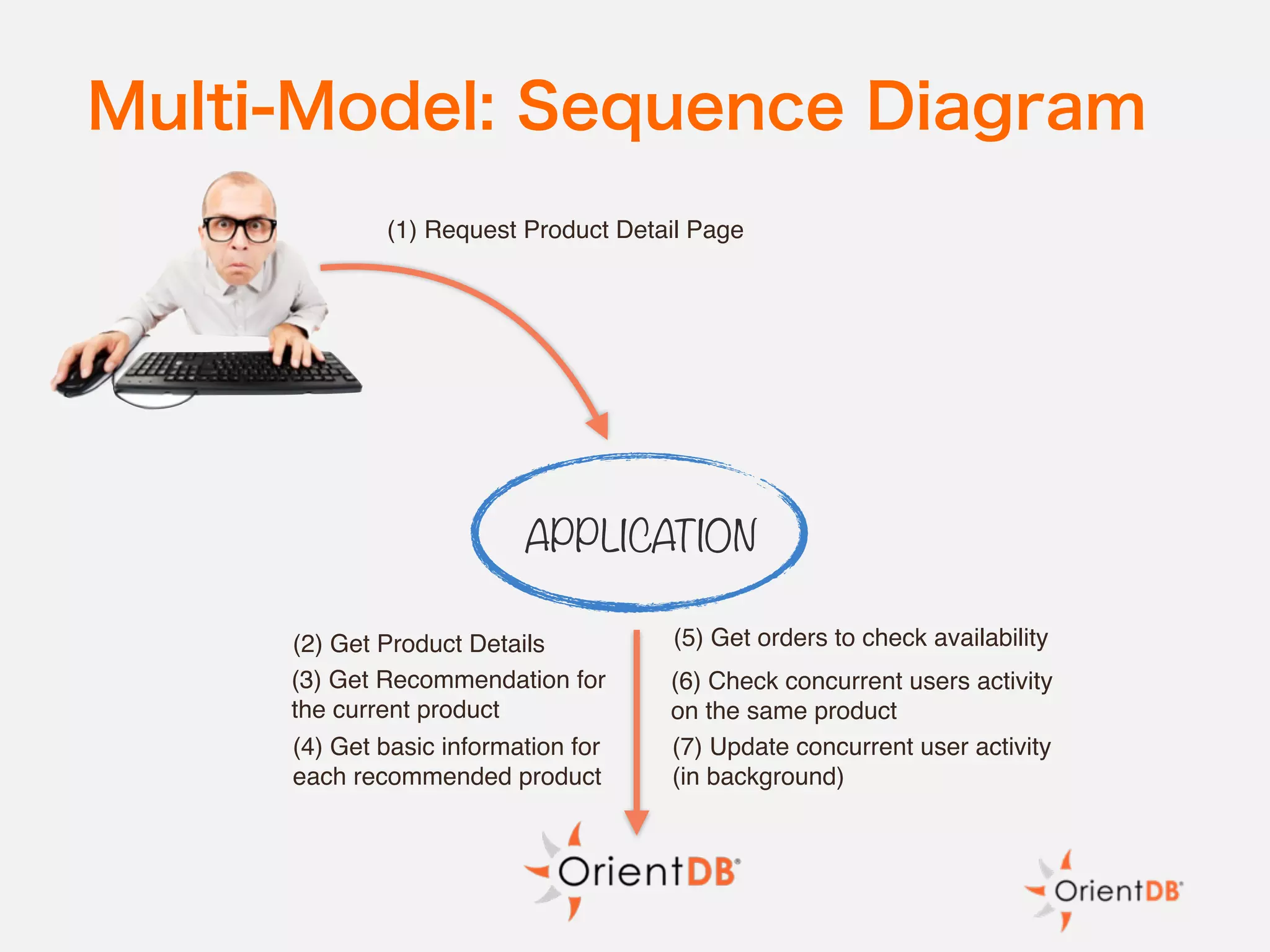
Multi-Model: Sequence Diagram
APPLICATION
(1) Request Product Detail Page
(2) Get Product Details
(3) Get Recommendation for
the current product
(5) Get orders to check availability
(7) Update concurrent user activity
(in background)
(6) Check concurrent users activity
on the same product
(4) Get basic information for
each recommended product
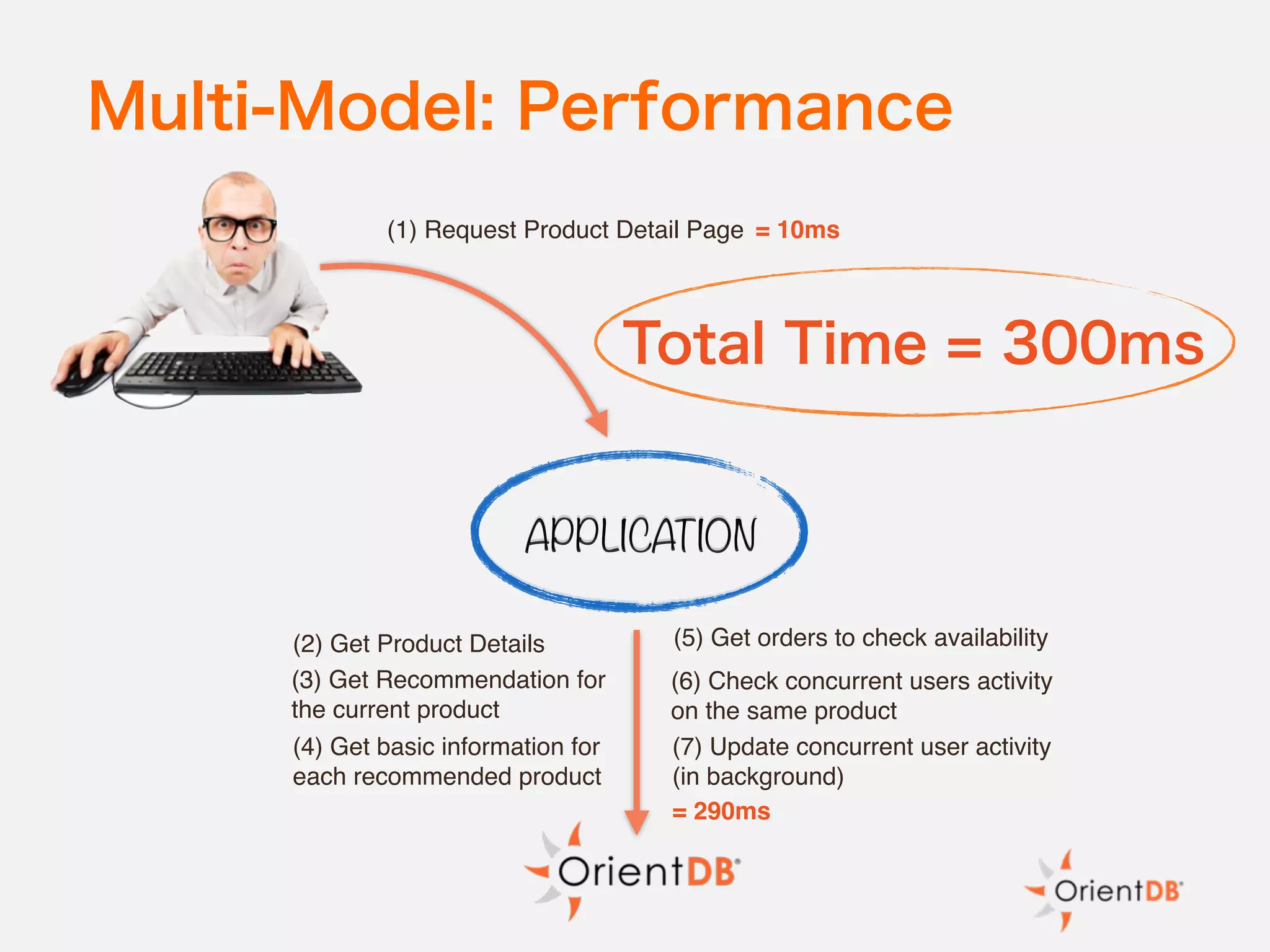
Multi-Model: Performance
APPLICATION
(1) Request Product Detail Page = 10ms
Total Time = 300ms
APPLICATION
= 290ms
(2) Get Product Details
(3) Get Recommendation for
the current product
(5) Get orders to check availability
(7) Update concurrent user activity
(in background)
(6) Check concurrent users activity
on the same product
(4) Get basic information for
each recommended product
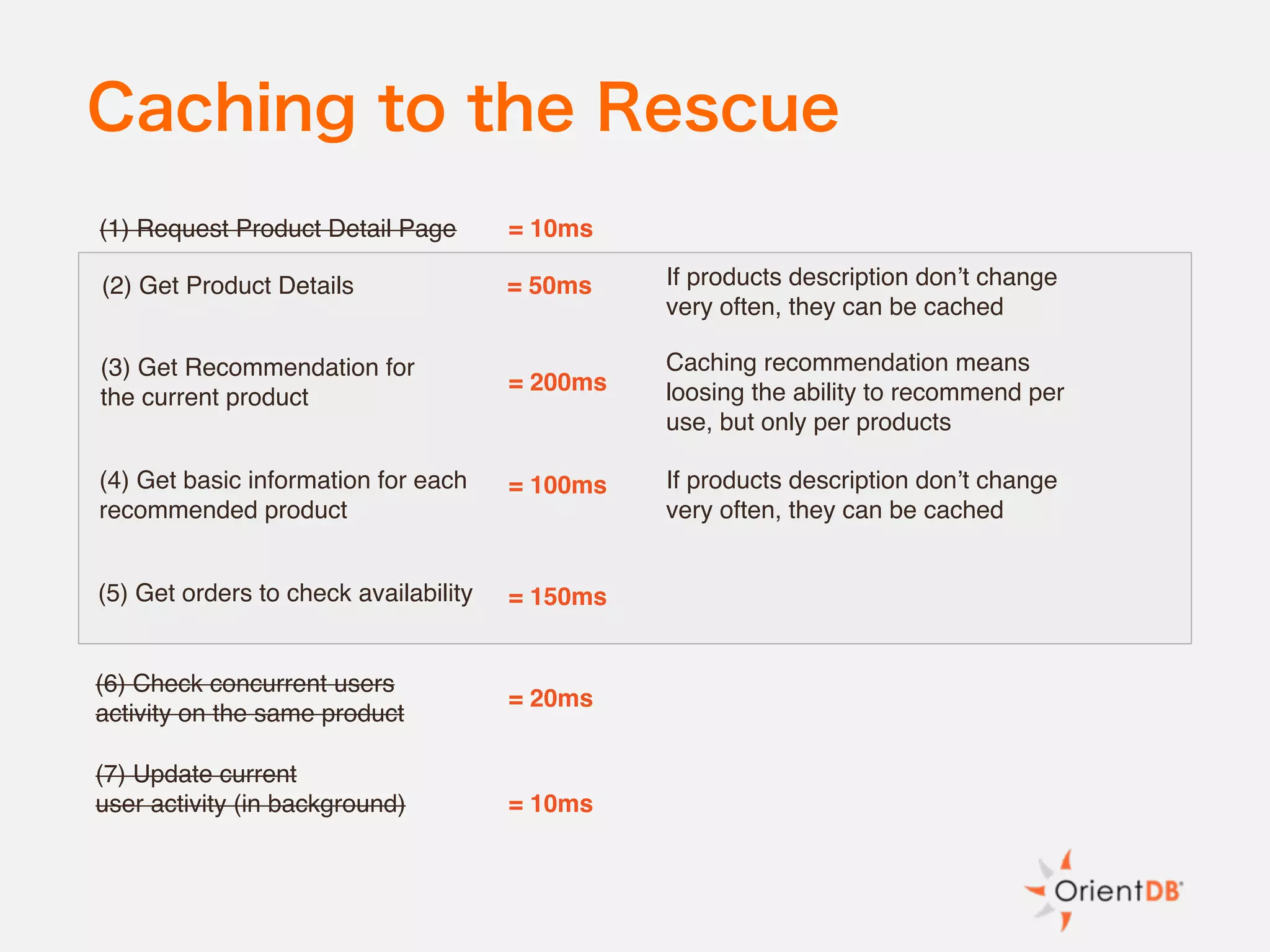
Caching to the Rescue
(2) Get Product Details
(3) Get Recommendation for
the current product
(4) Get basic information for each
recommended product
(1) Request Product Detail Page
(6) Check concurrent users
activity on the same product
= 200ms
(7) Update current
user activity (in background)
= 10ms
= 50ms
= 150ms
= 20ms
= 10ms
If products description don’t change
very often, they can be cached
Caching recommendation means
loosing the ability to recommend per
use, but only per products
(5) Get orders to check availability
= 100ms If products description don’t change
very often, they can be cached
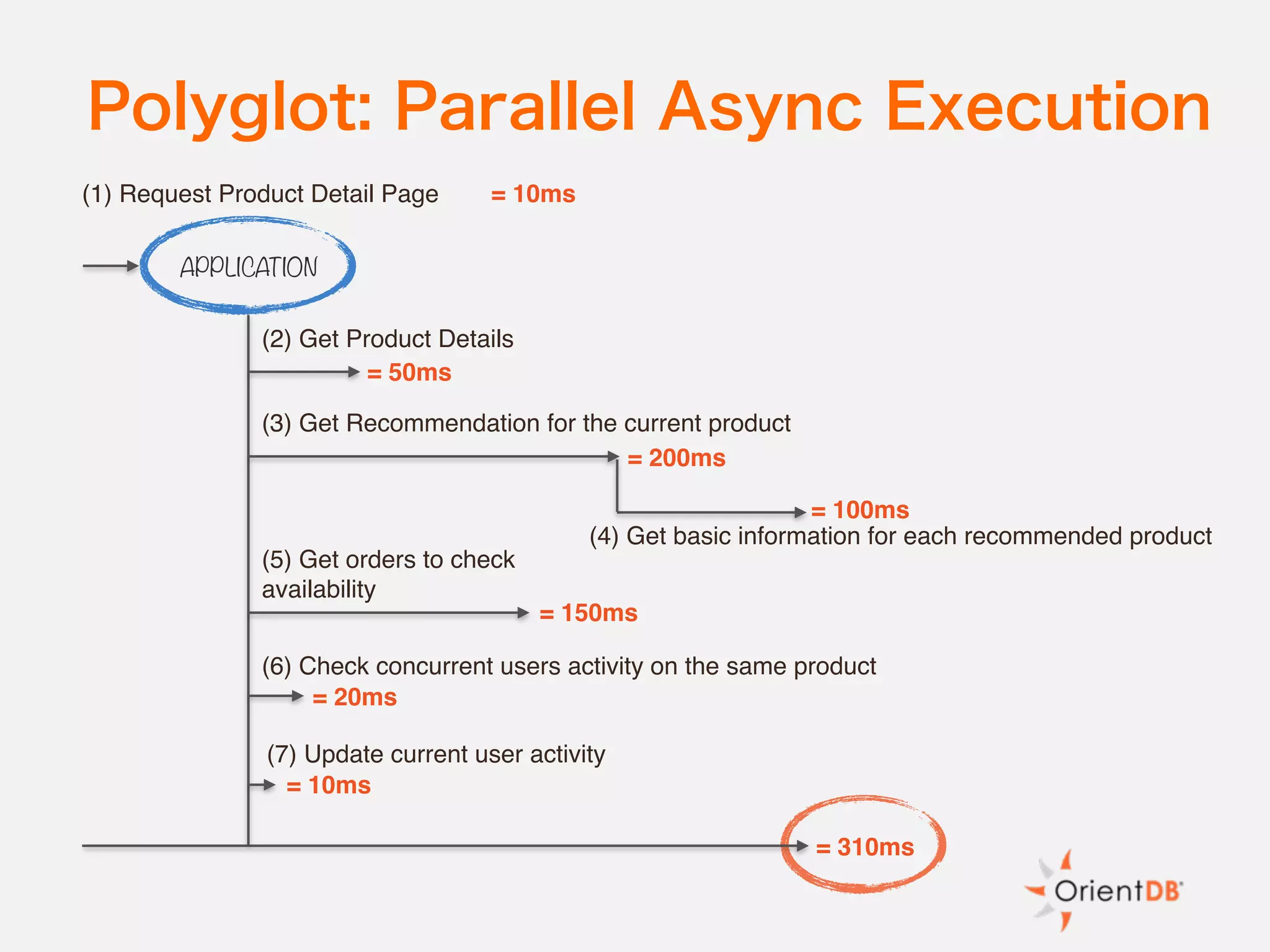
Polyglot: Parallel Async Execution
(2) Get Product Details
(3) Get Recommendation for the current product
(5) Get orders to check
availability
(1) Request Product Detail Page
(6) Check concurrent users activity on the same product
= 200ms
(7) Update current user activity
= 10ms
= 50ms
= 150ms
= 20ms
= 10ms
= 310ms
APPLICATION
(4) Get basic information for each recommended product
= 100ms
Performance
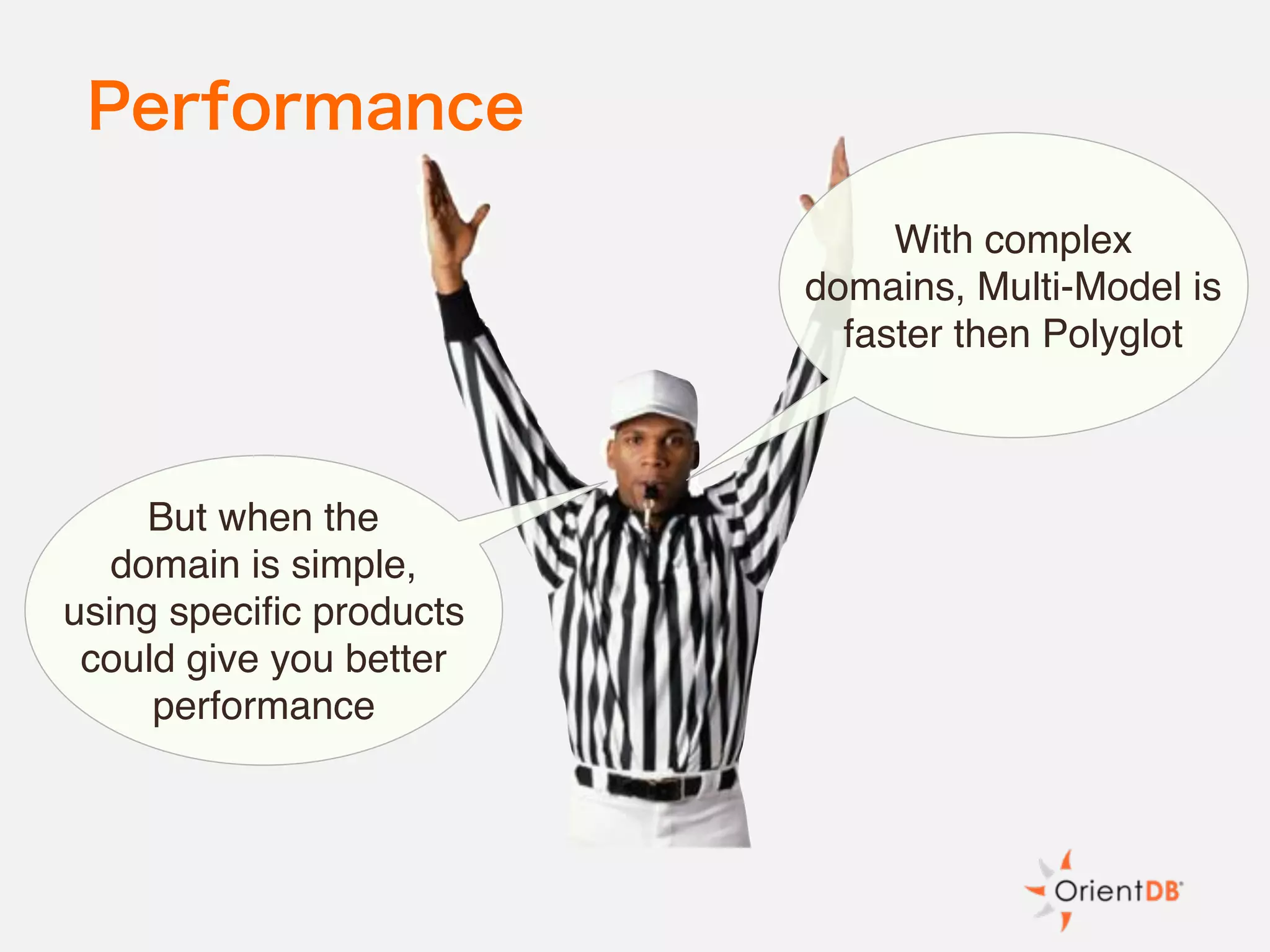
But when the
domain is simple,
using specific products
could give you better
performance
With complex
domains, Multi-Model is
faster then Polyglot
Performance continued...
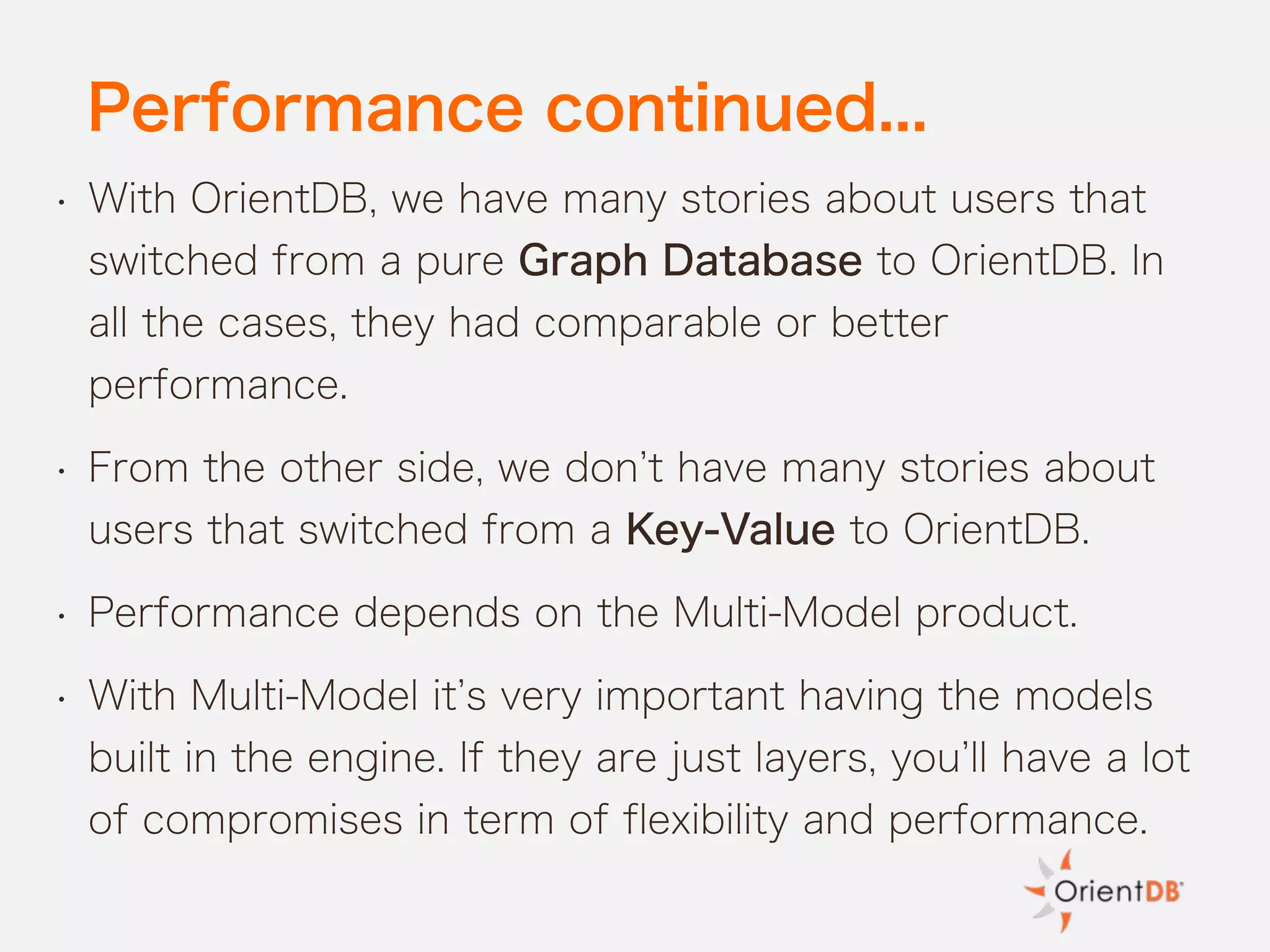
• With OrientDB, we have many stories about users that
switched from a pure Graph Database to OrientDB. In
all the cases, they had comparable or better
performance.
• From the other side, we don t have many stories about
users that switched from a Key-Value to OrientDB.
• Performance depends on the Multi-Model product.
• With Multi-Model it s very important having the models
built in the engine. If they are just layers, you ll have a lot
of compromises in term of flexibility and performance.
Features
Features
Multi-ModelPolyglot
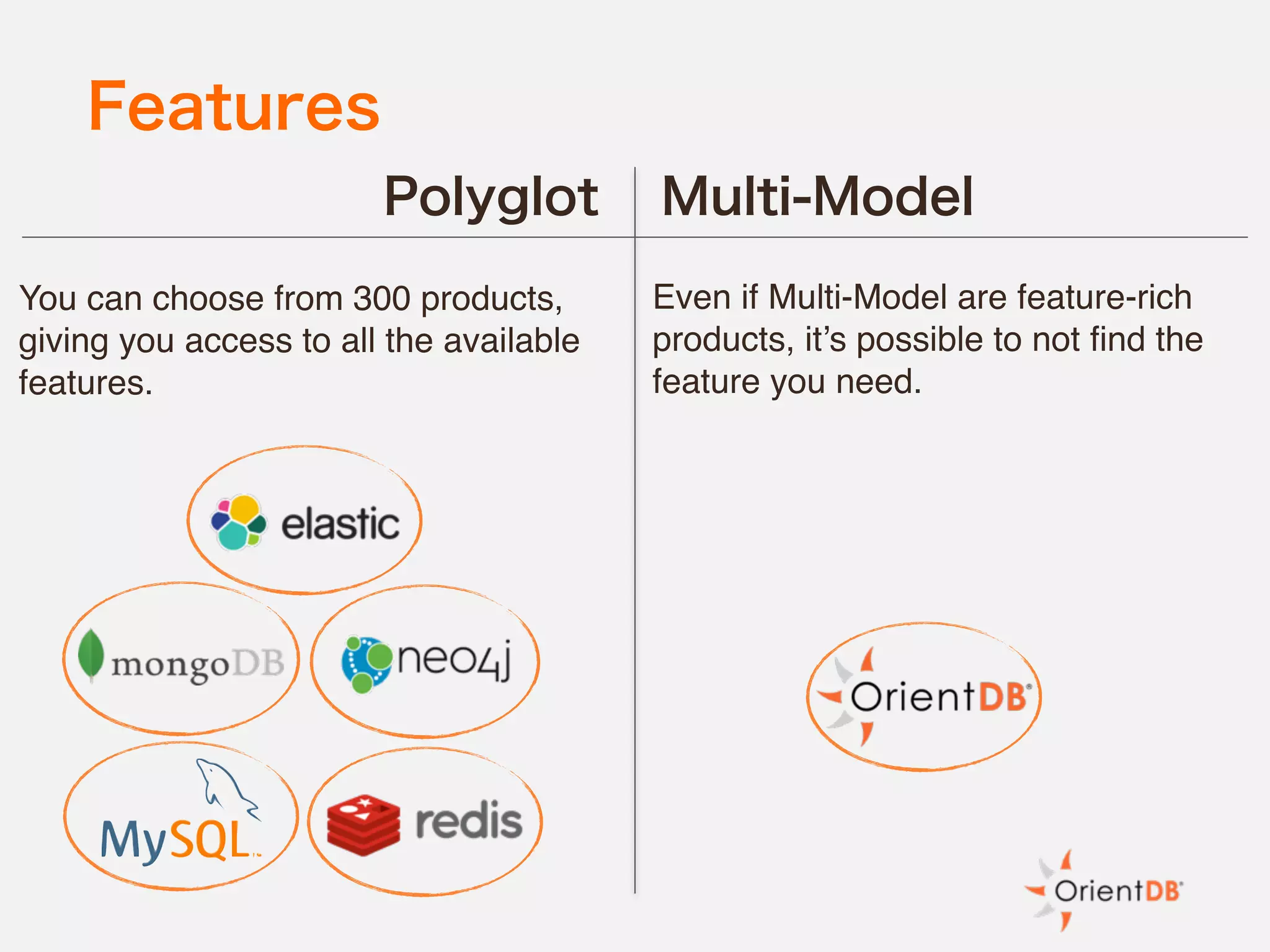
Even if Multi-Model are feature-rich
products, it’s possible to not find the
feature you need.
You can choose from 300 products,
giving you access to all the available
features.
Data
Synchronization
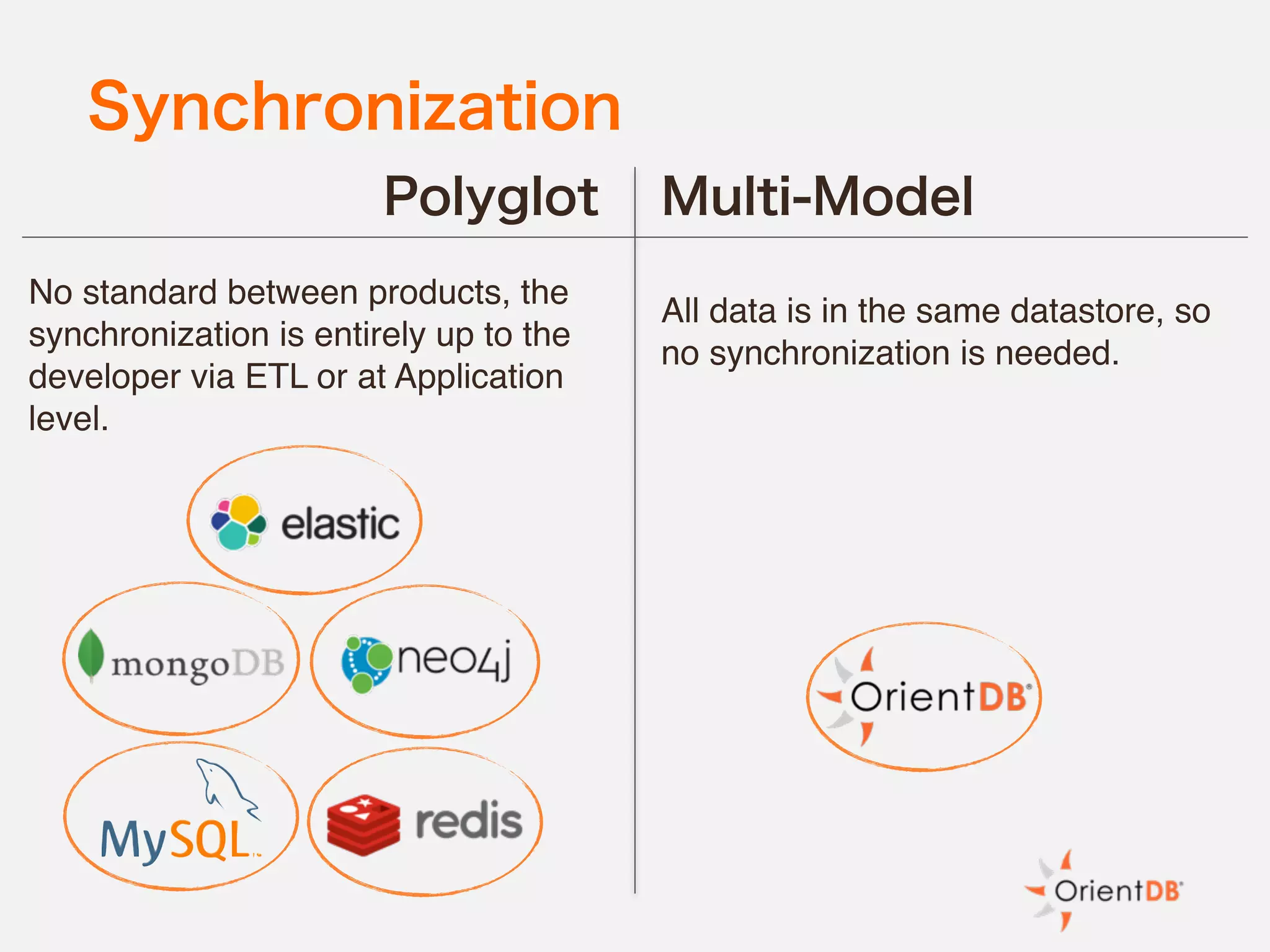
Synchronization
Multi-ModelPolyglot
No standard between products, the
synchronization is entirely up to the
developer via ETL or at Application
level.
All data is in the same datastore, so
no synchronization is needed.
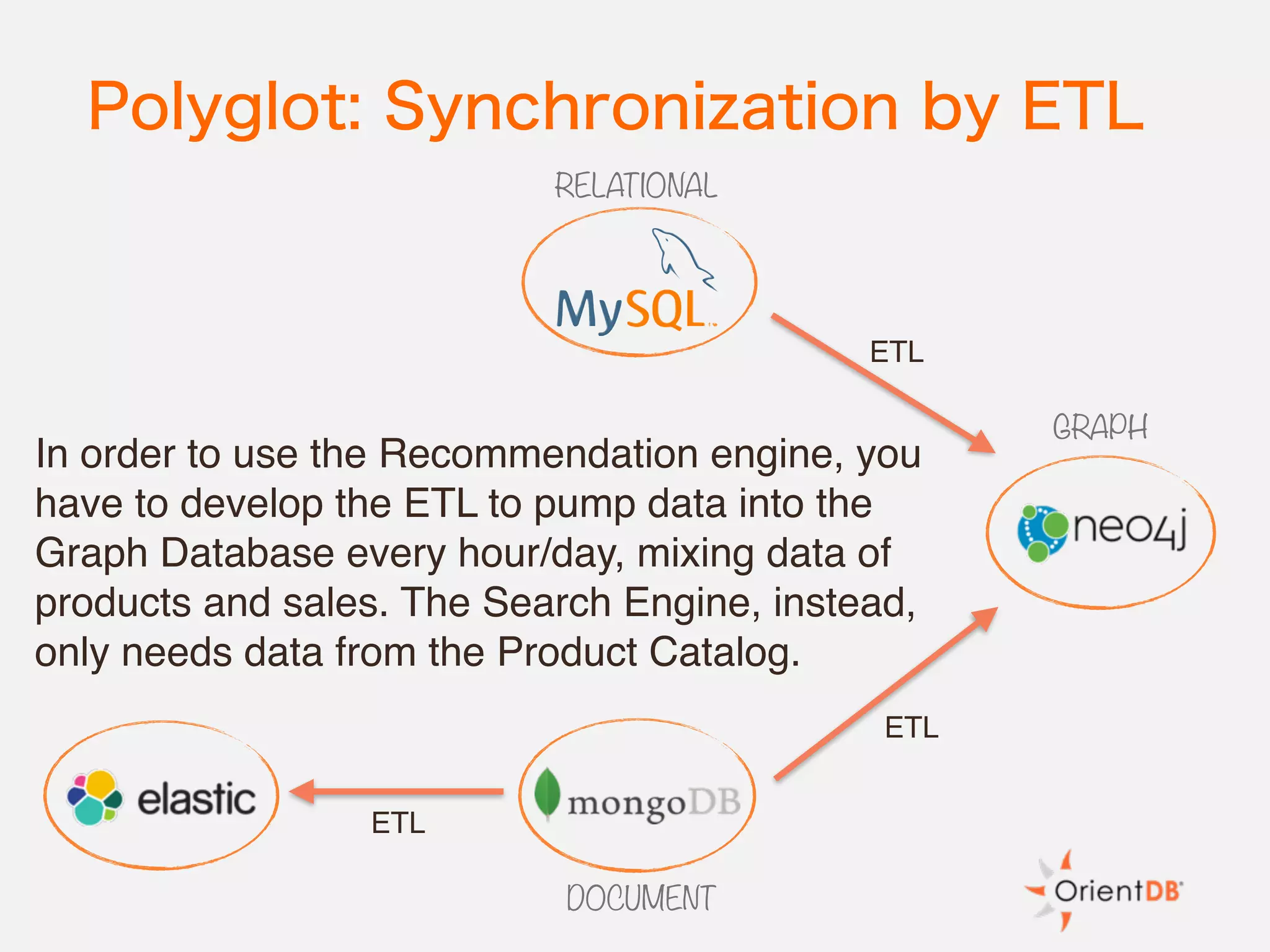
Polyglot: Synchronization by ETL
DOCUMENT
GRAPH
RELATIONAL
In order to use the Recommendation engine, you
have to develop the ETL to pump data into the
Graph Database every hour/day, mixing data of
products and sales. The Search Engine, instead,
only needs data from the Product Catalog.
ETL
ETL
ETL
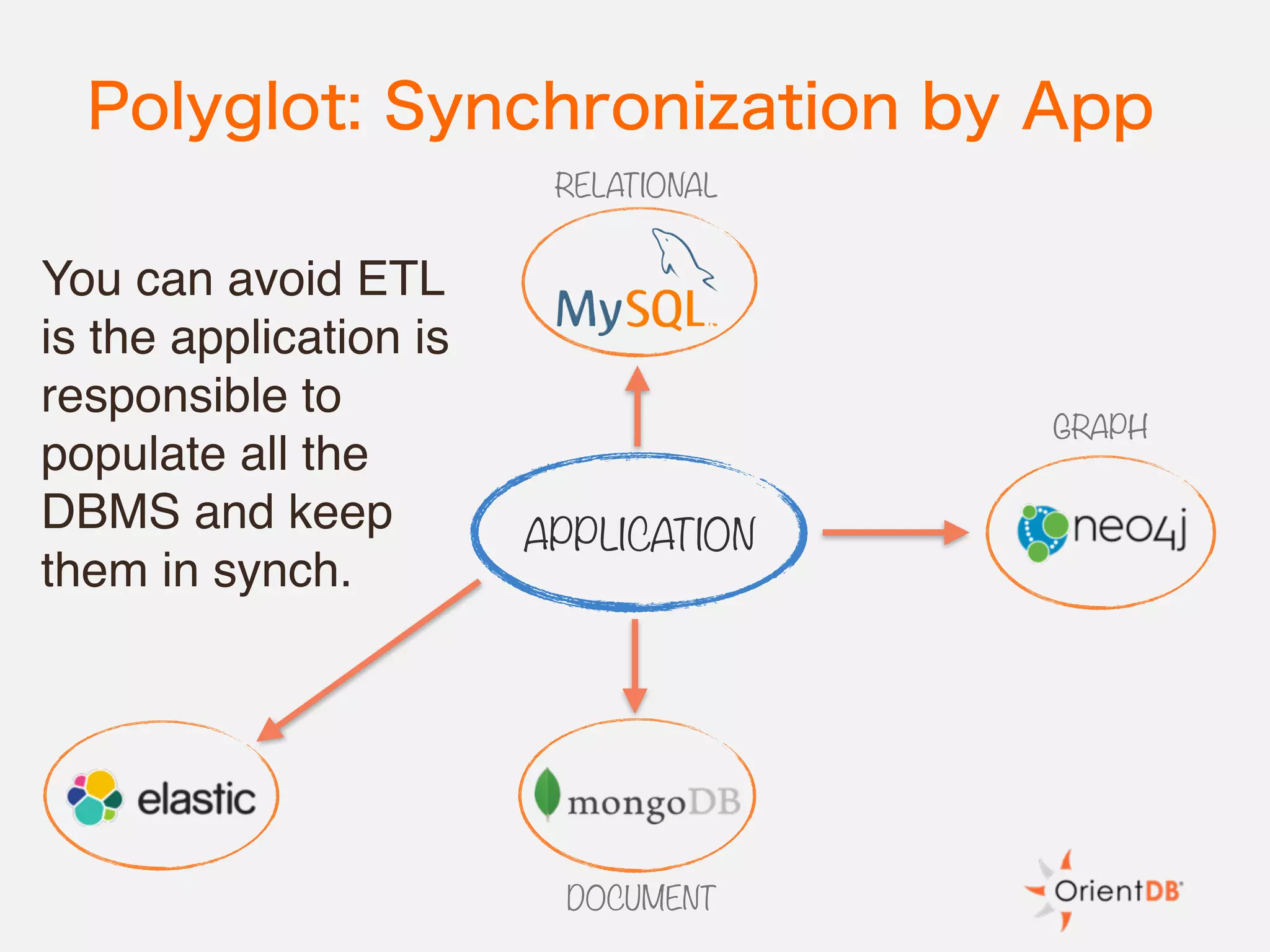
Polyglot: Synchronization by App
DOCUMENT
GRAPH
RELATIONAL
You can avoid ETL
is the application is
responsible to
populate all the
DBMS and keep
them in synch.
APPLICATION
Let s put everything
in
High Availability
(HA)
Polyglot Persistence
in
High Availability
(HA)
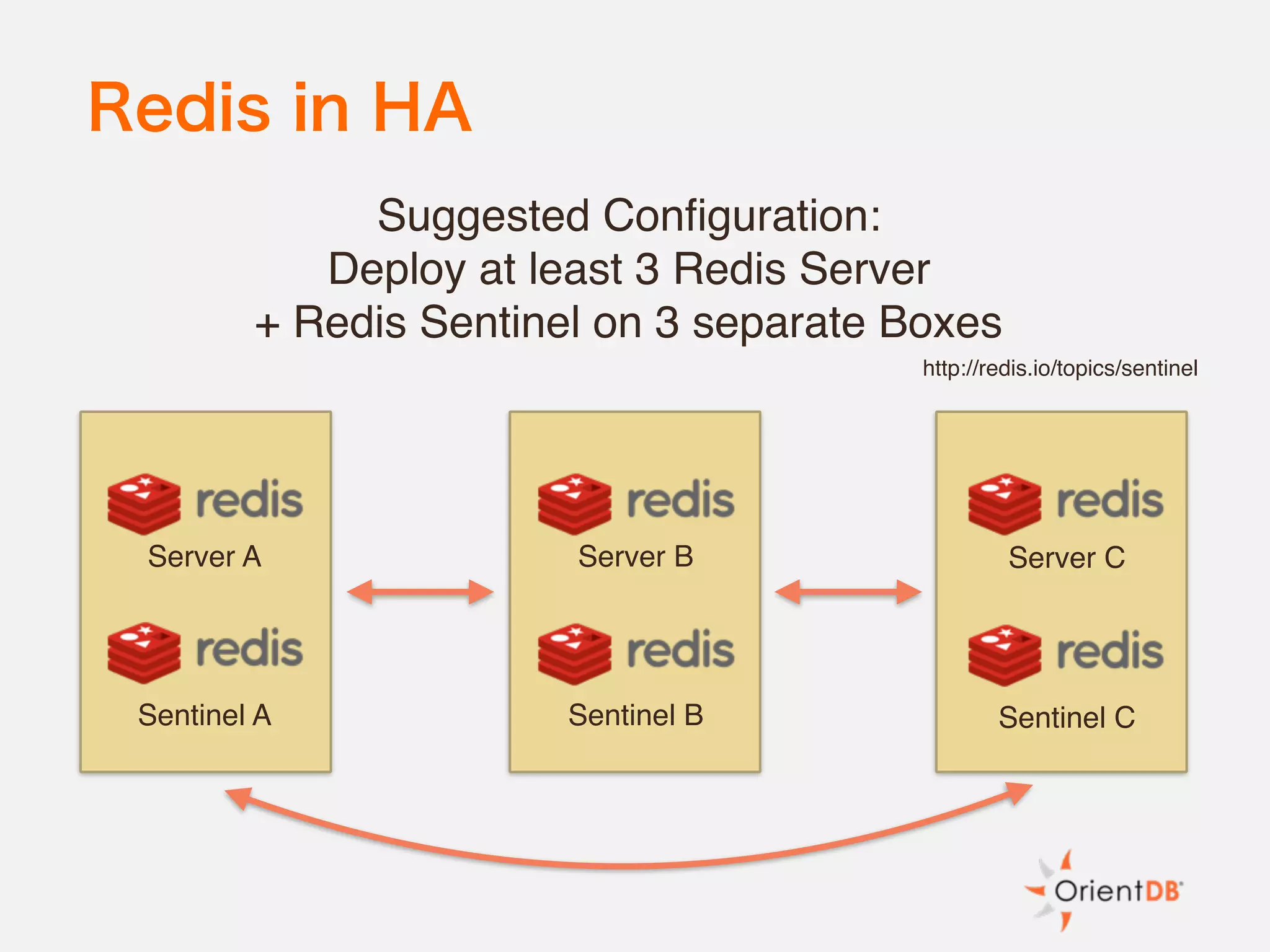
Redis in HA
Server A
Sentinel A
Server B
Sentinel B
Server C
Sentinel C
Suggested Configuration:
Deploy at least 3 Redis Server
+ Redis Sentinel on 3 separate Boxes
http://redis.io/topics/sentinel
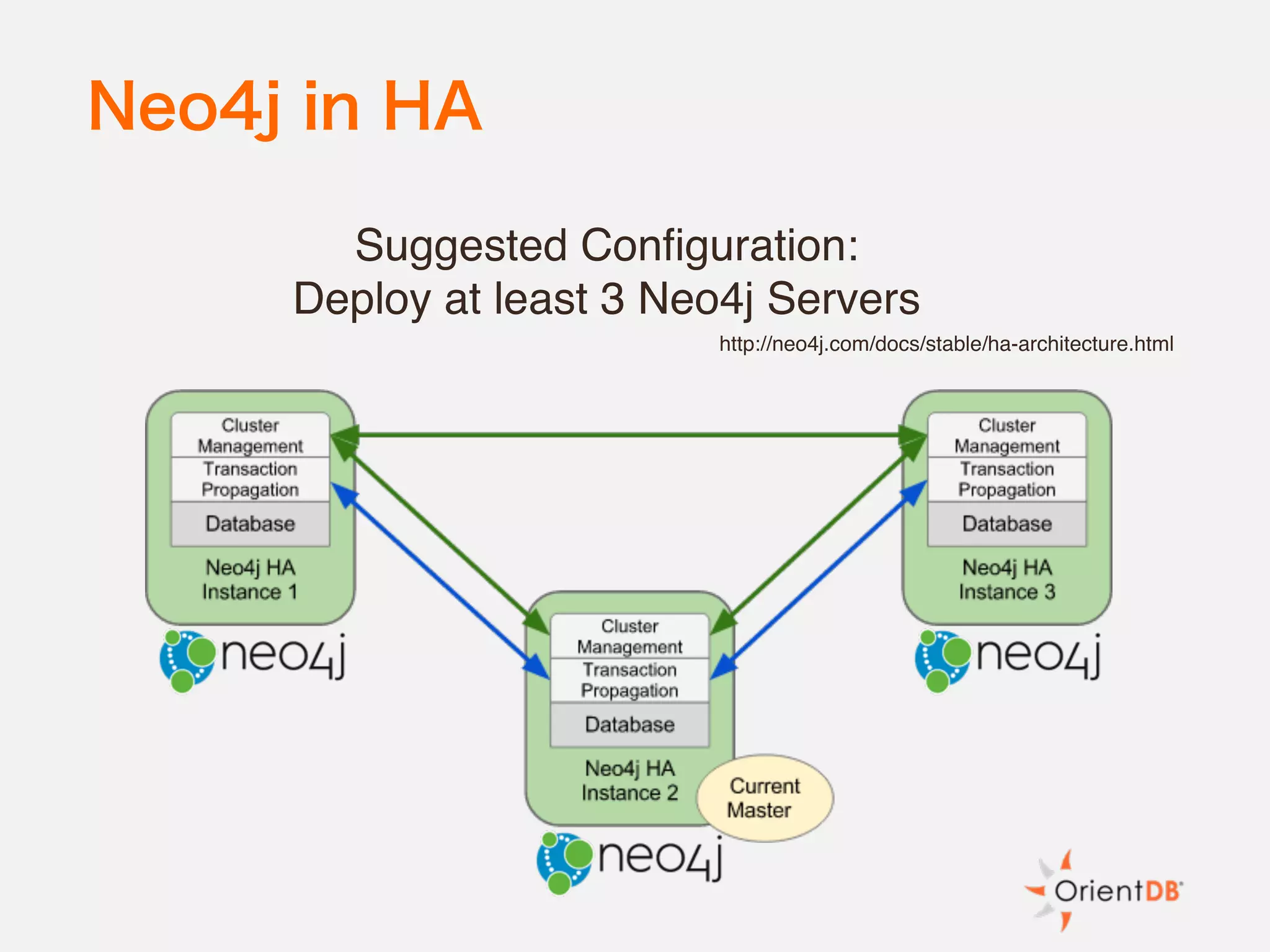
Neo4j in HA
Suggested Configuration:
Deploy at least 3 Neo4j Servers
http://neo4j.com/docs/stable/ha-architecture.html
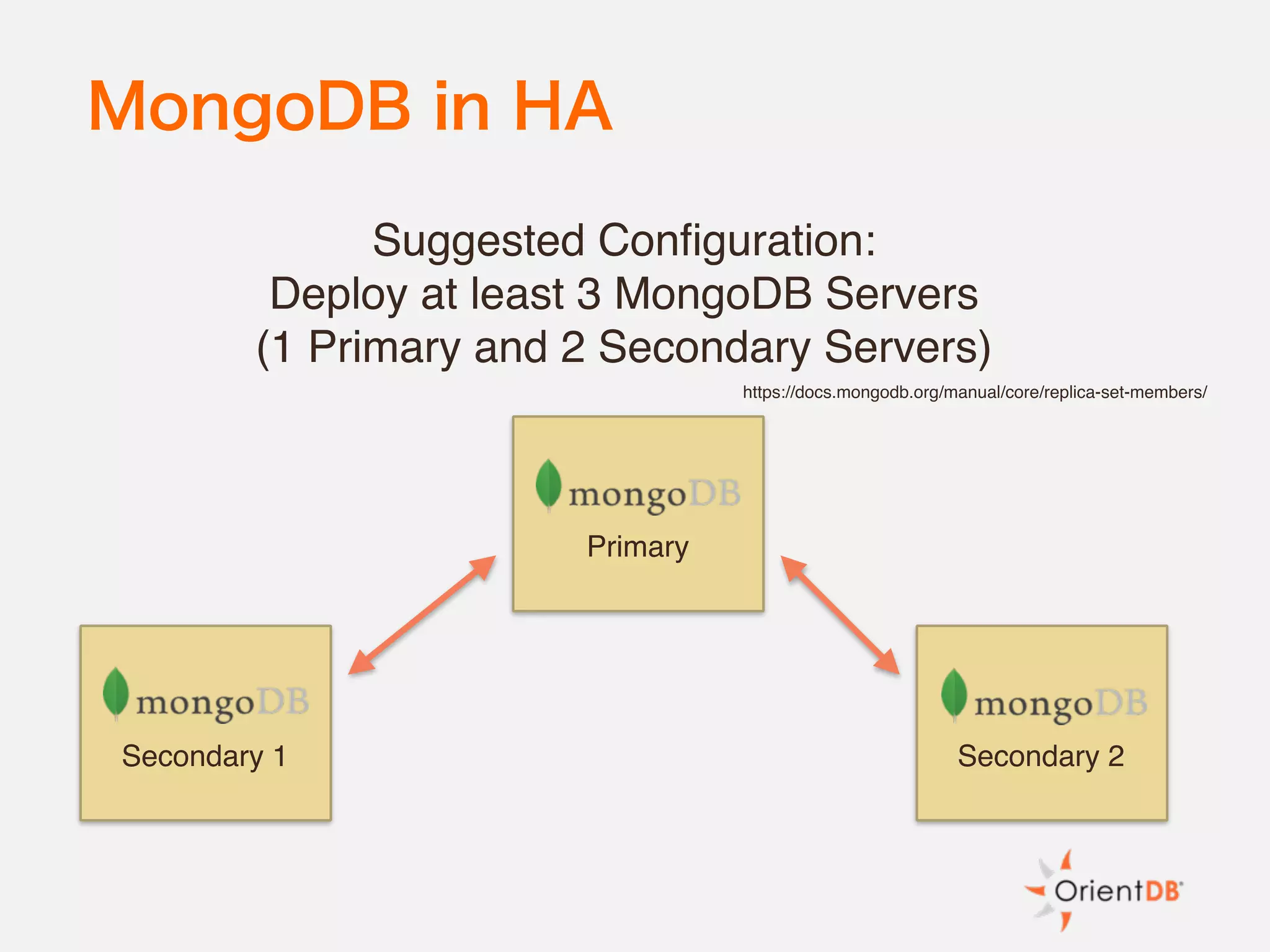
MongoDB in HA
Secondary 1
Suggested Configuration:
Deploy at least 3 MongoDB Servers
(1 Primary and 2 Secondary Servers)
Primary
Secondary 2
https://docs.mongodb.org/manual/core/replica-set-members/
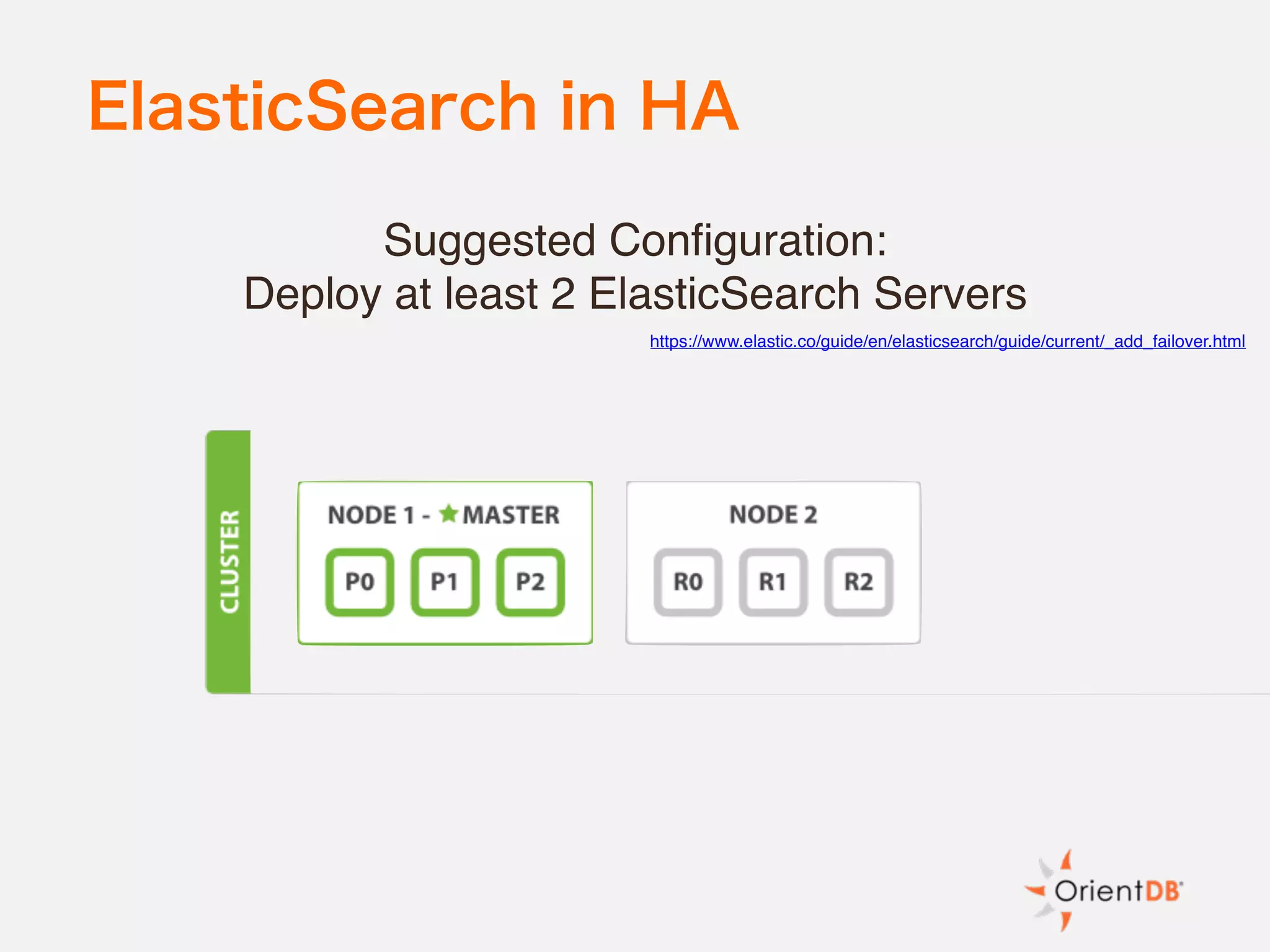
ElasticSearch in HA
Suggested Configuration:
Deploy at least 2 ElasticSearch Servers
https://www.elastic.co/guide/en/elasticsearch/guide/current/_add_failover.html
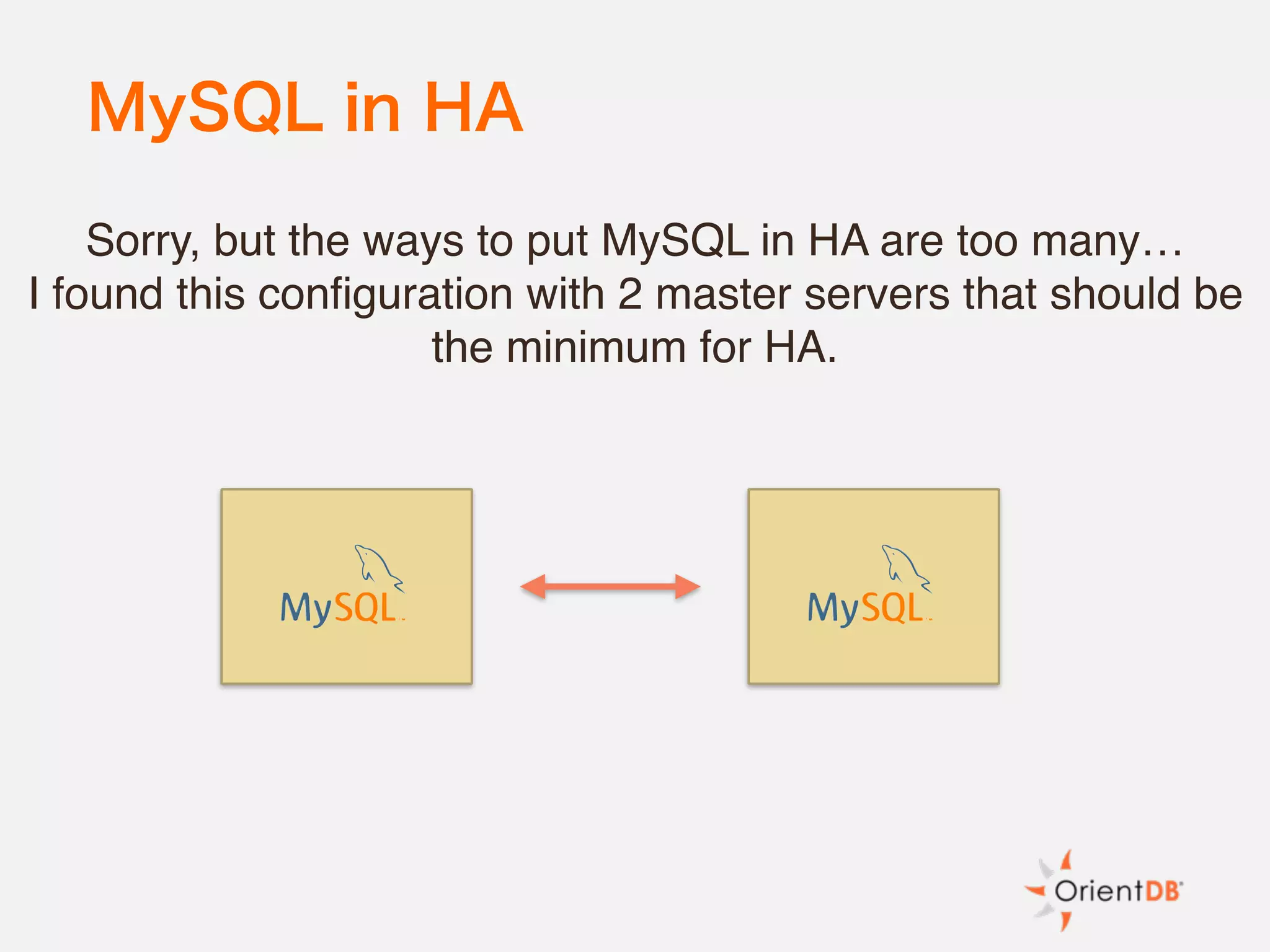
MySQL in HA
Sorry, but the ways to put MySQL in HA are too many…
I found this configuration with 2 master servers that should be
the minimum for HA.
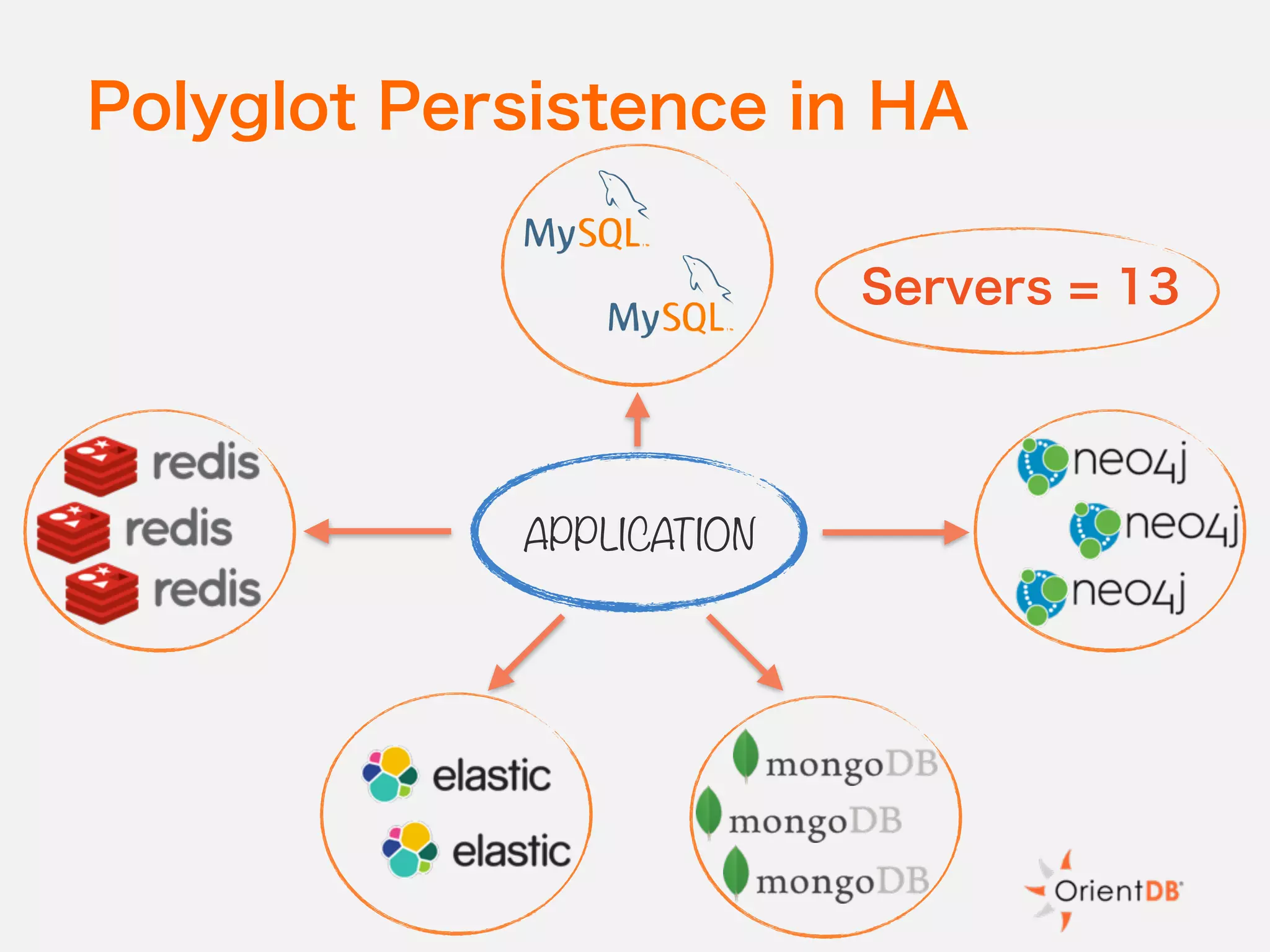
Polyglot Persistence in HA
APPLICATION
Servers = 13
The beauty of me
is that I’m very rich.
But this setup would cost
too much even for me!
You’re fired!!!
Multi-Model
in
High Availability
(HA)
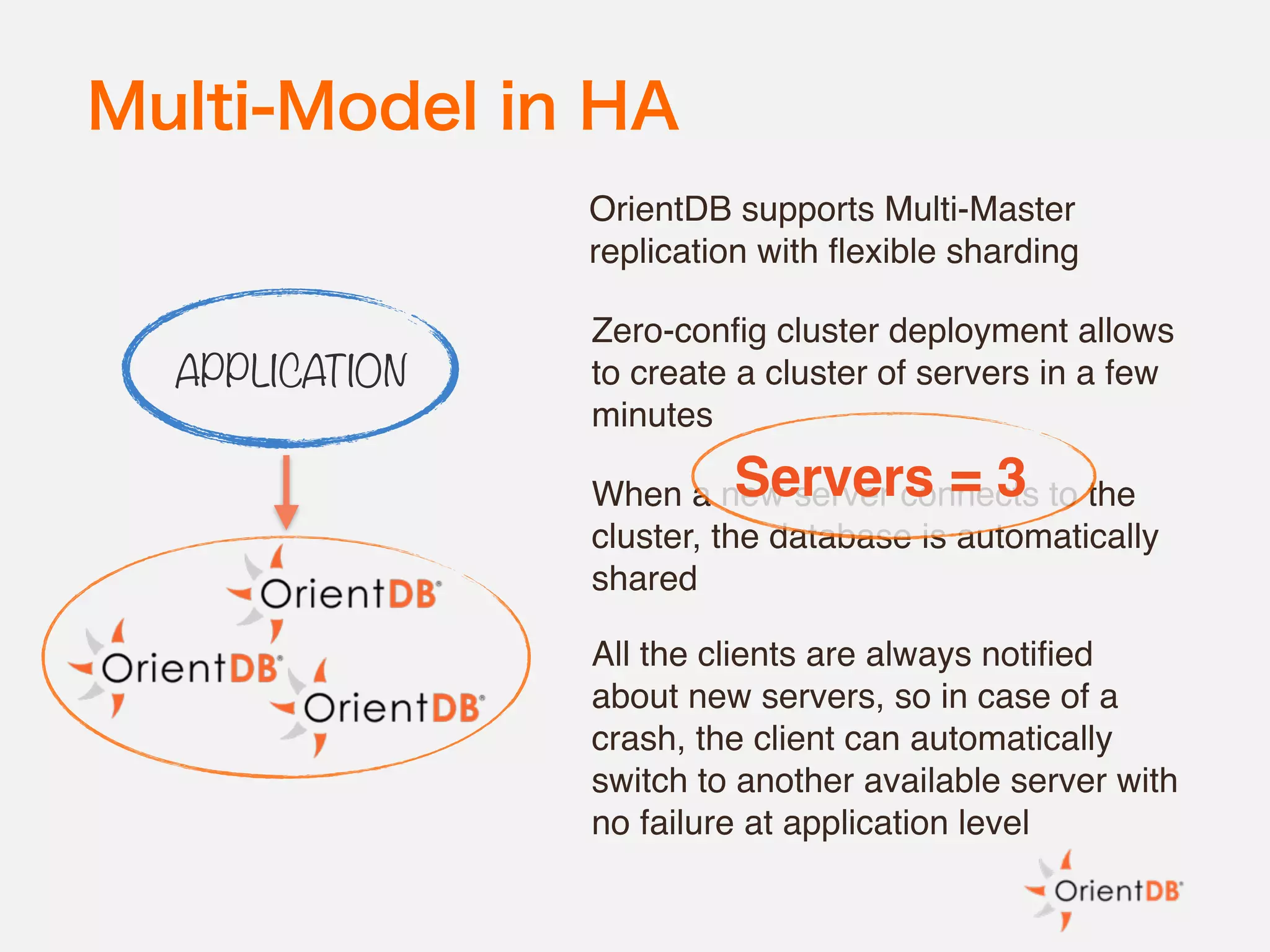
Multi-Model in HA
APPLICATION
OrientDB supports Multi-Master
replication with flexible sharding
Zero-config cluster deployment allows
to create a cluster of servers in a few
minutes
When a new server connects to the
cluster, the database is automatically
shared
All the clients are always notified
about new servers, so in case of a
crash, the client can automatically
switch to another available server with
no failure at application level
Servers = 3
Final score
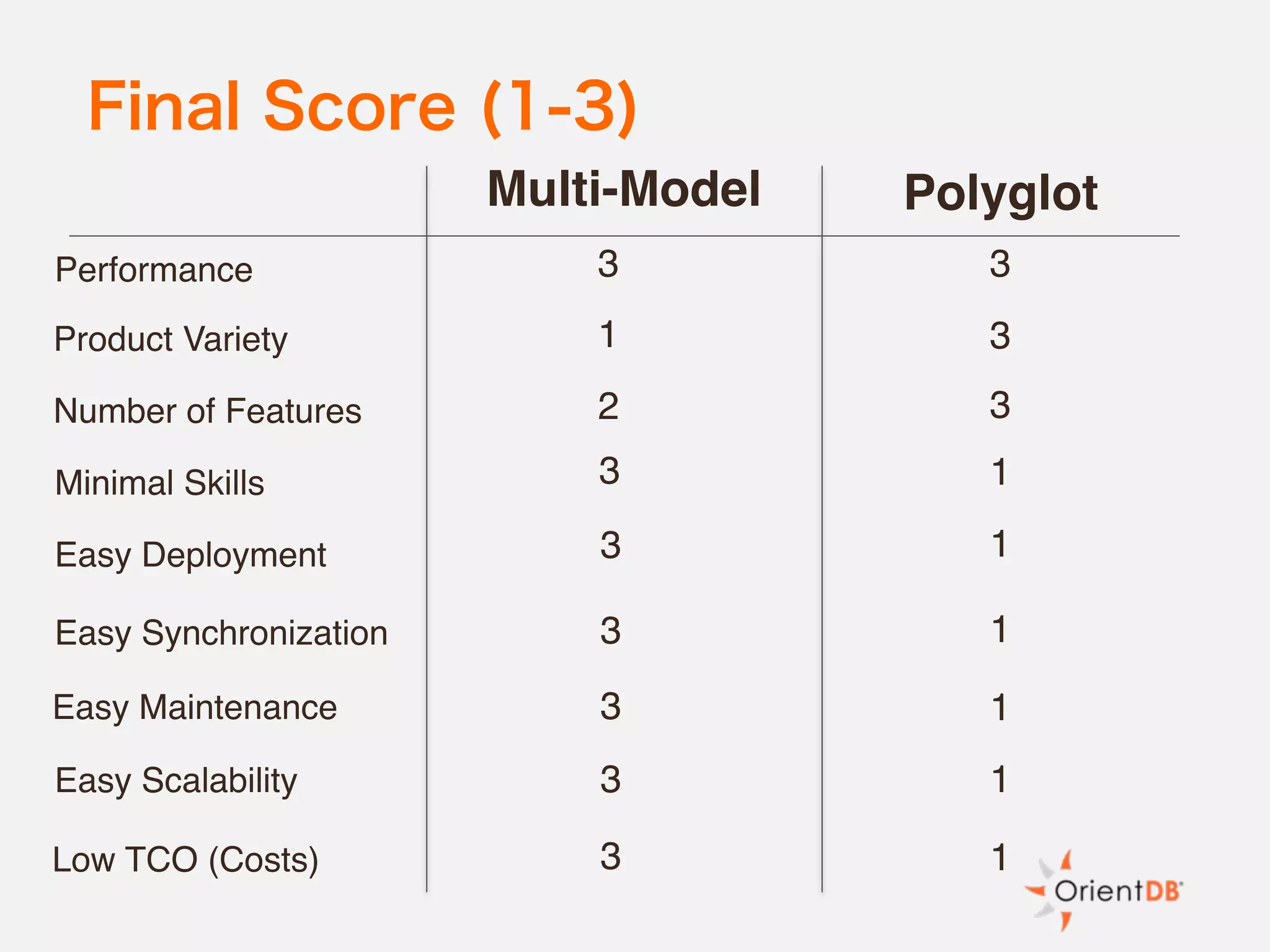
Final Score (1-3)
Multi-Model Polyglot
Low TCO (Costs)
Easy Maintenance
Easy Scalability
Performance
Easy Deployment
Minimal Skills
Product Variety
Easy Synchronization
Number of Features
3 3
1
1
1
3
3
3
3
3
3
3
2
1
1
1
3 1
Confidential
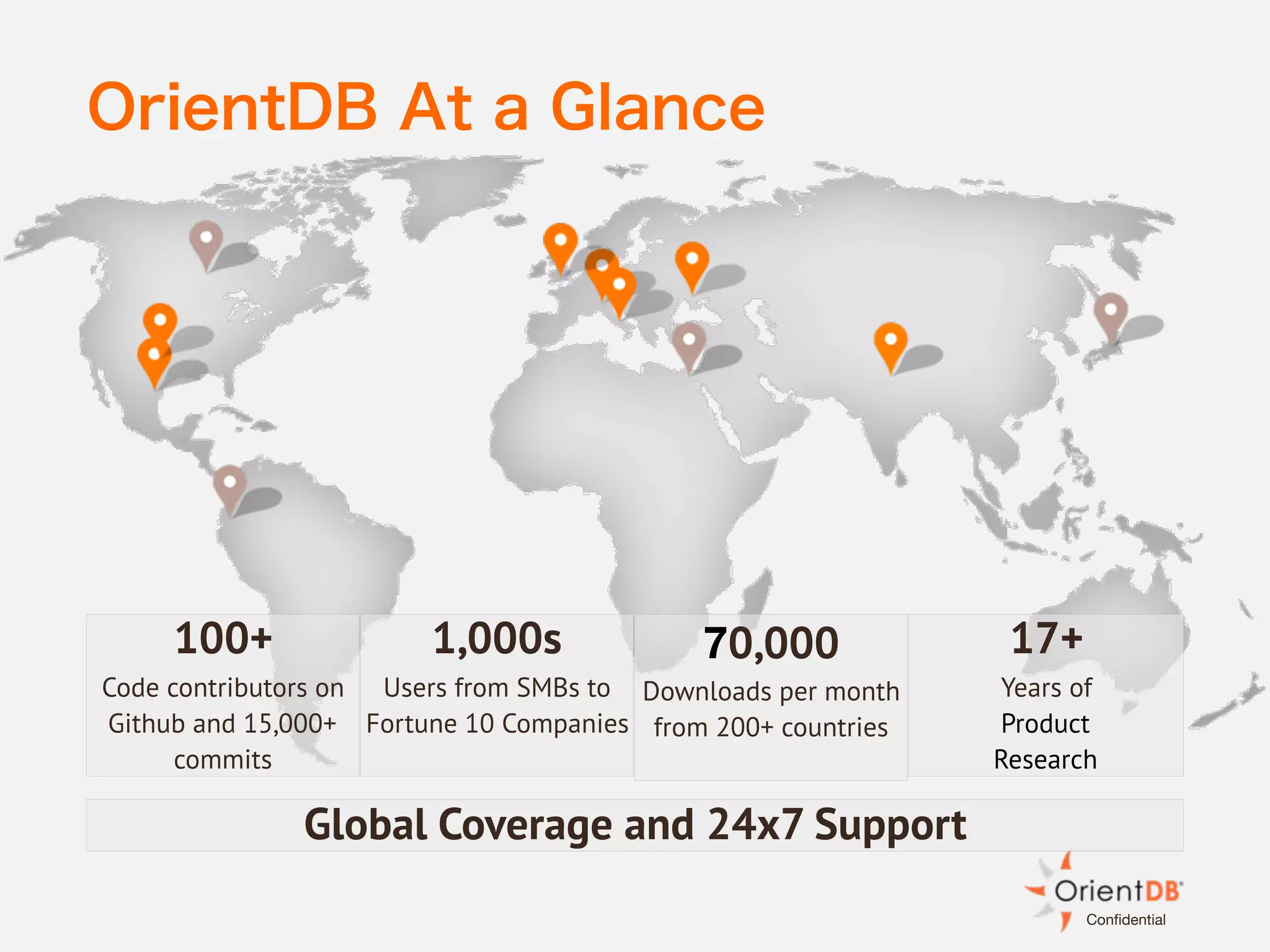
OrientDB At a Glance
70,000
Downloads per month
from 200+ countries
100+
Code contributors on
Github and 15,000+
commits
1,000s
Users from SMBs to
Fortune 10 Companies
17+
Years of
Product 

Research
Global Coverage and 24x7 Support
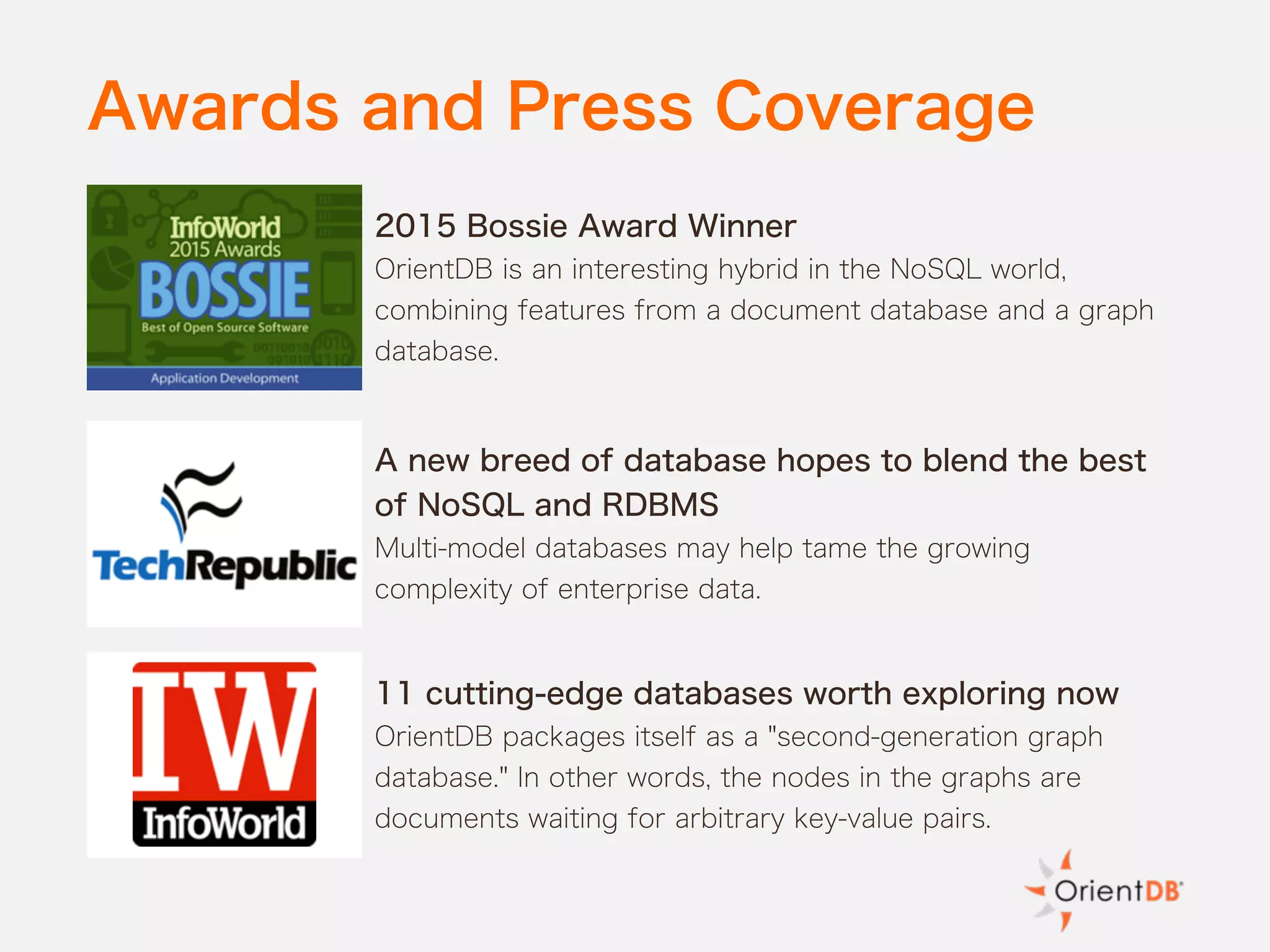
Awards and Press Coverage
2015 Bossie Award Winner
OrientDB is an interesting hybrid in the NoSQL world,
combining features from a document database and a graph
database.
A new breed of database hopes to blend the best
of NoSQL and RDBMS
Multi-model databases may help tame the growing
complexity of enterprise data.
11 cutting-edge databases worth exploring now
OrientDB packages itself as a "second-generation graph
database." In other words, the nodes in the graphs are
documents waiting for arbitrary key-value pairs.
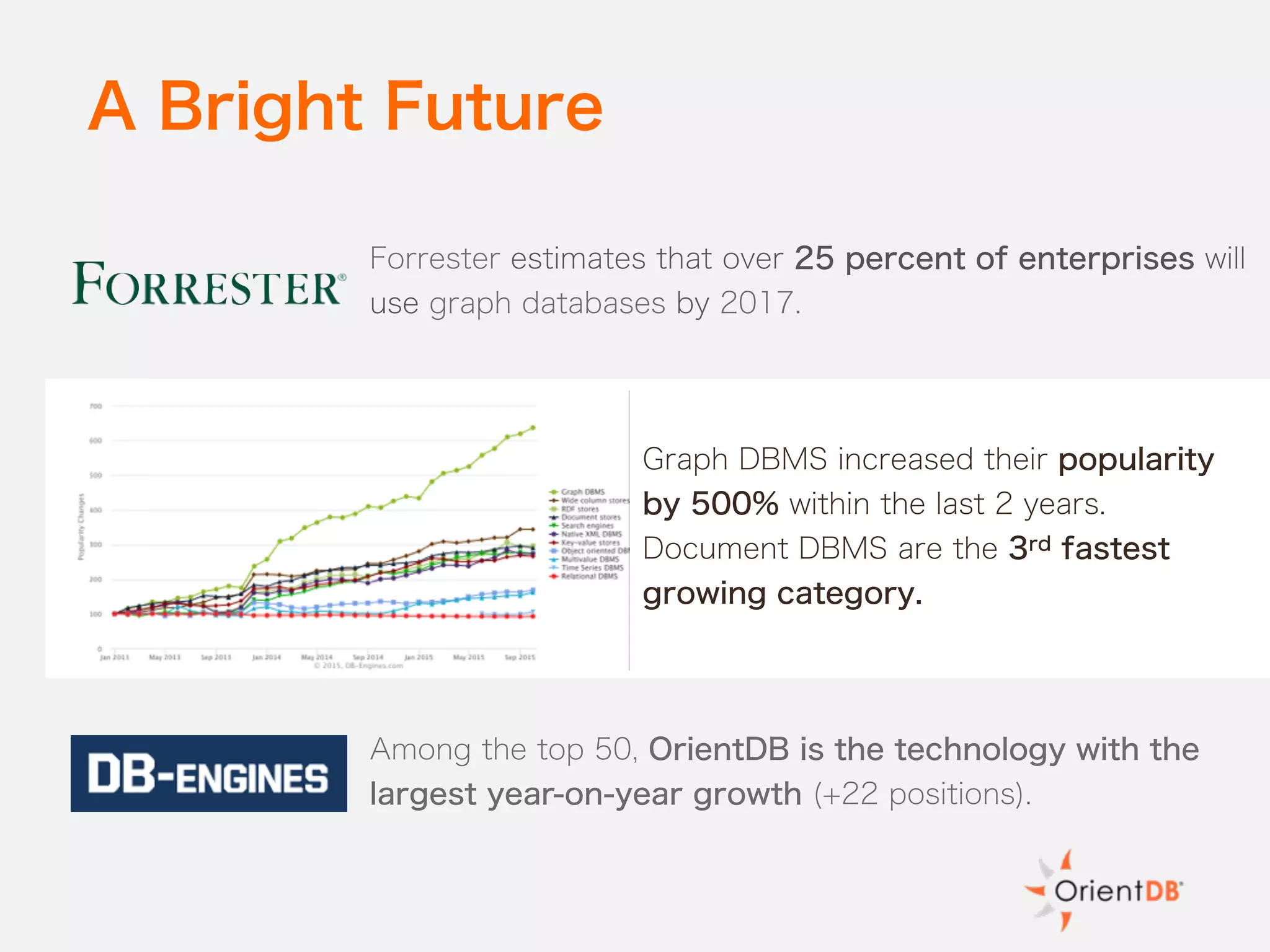
A Bright Future
Graph DBMS increased their popularity
by 500% within the last 2 years.
Document DBMS are the 3rd fastest
growing category.
Forrester estimates that over 25 percent of enterprises will
use graph databases by 2017.
Among the top 50, OrientDB is the technology with the
largest year-on-year growth (+22 positions).
Don t miss my presentation
Tomorrow, at GraphDay
10:00am:
Working Towards an
Unbreakable Graph Database
that Scales
Thank you!
@lgarulli
Join the community, visit orientdb.com

Polyglot Persistence vs Multi-Model Databases

  • 1.
    Polyglot Persistence vs Multi-Model Databases LucaGarulli, Founder and CEO at OrientDB
  • 2.
    Relational Databases arethe Most Successful Technology Ever and Ruled for the Last 45 Years
  • 3.
    Structured Data Small Datasets FewRelationships Waterfall Approach Scale Up CIO The World Has Changed Unstructured Data Large Volume Connected Data Agile Approach Scale Out Developers Relational NoSQL 1970 2009 A NoSQL database provides a mechanism for storage and retrieval of data that is modeled in means other than the tabular relations used in relational databases. Motivations for this approach include: simplicity of design, "horizontal" scaling, which is a problem for relational databases, and finer control over availability What s Next?
  • 4.
    DBMS Quadrant RelationshipComplexity> Data Complexity> Relational Key Value Column Graph Document
  • 5.
    Polyglot Persistence Polyglot Persistenceis a fancy term to describe that when storing data, it is best to use multiple data storage technologies, chosen based upon the way data is being used by individual applications or components. http://www.jamesserra.com/archive/2015/07/what-is-polyglot-persistence/
  • 7.
    Multi-Model A multi-model databaseis designed to support multiple data models against a single, integrated backend. Multi-model databases are intended to offer the data modeling advantages of polyglot persistence without its disadvantages. Complexity, in particular, is reduced. https://en.wikipedia.org/wiki/Multi-model_database
  • 8.
    What s aMulti-Model DBMS? GraphDocument Object Key/Value Multi-Model represents the intersection of multiple models in just one product Full-Text Spatial
  • 9.
    Multi-Model Snow Patrol (Band) Luca (Account) Indie (Genre) 123, 1st Street Austin, Jill (Account) Graphs { @rid": 12:382, @class": Customer", name : Jill , surname : Raggio , phone : +39 33123212 , details : { city : London", tags : millennial } } Schema-less structures Object Oriented Key-Value pairs Geo-Spatial Full-Text OrientDB (Multi-Model)
  • 10.
    Multi-Model Snow Patrol (Band) Luca (Account) Indie (Genre) 123, 1st Street Austin, Jill (Account) Graphs { ”@rid": “12:382”, ”@class":”Customer", “name”: “Jill”, “surname” : “Raggio”, “phone” : “+39 33123212”, “details”: { “city”:”London", “tags”:”millennial” } } Schema-less structures Object OrientedKey-Value pairsGeo-Spatial Full-Text OrientDB (Multi-Model)
  • 11.
    DBMS Quadrant: Multi-Model RelationshipComplexity> DataComplexity > Relational Key Value Column Graph Document Multi-Model
  • 12.
    OrientDB • First Multi-ModelDBMS with a Graph-Engine • Open Source Apache2 license • Data Models are built into the core engine • The Graph Database engine allows O(1) performance on traversing relationships, against O(LogN) of RDBMS and any other Multi-Model DBMS built as layers • Schema-less, Schema-full and Schema-mixed • Use of Apache Lucene for Full-Text and Spatial • Written in Java (runs on every platform) • Zero-config HA
  • 13.
  • 14.
  • 15.
    Transactional data about roomsleft at this moment Consider the active sessions on the same Product
  • 16.
    The initial reactionof developers when the CTO agrees to use Polyglot Persistence
  • 17.
    I can use the besttools for my use cases! No limits anymore! This is Developer FREEDOM! No more Tables?
  • 18.
  • 19.
    Polyglot Persistence inAction DOCUMENTKEY/VALUE GRAPH RELATIONAL User Sessions Rapid Access for reads and writes. No need to be durable. Financial Data Needs transactional updates. It will manage orders and payments. Recommendations Rapidly traverse links between friends, product purchases, and ratings. Product Catalog Lots of reads, infrequent writes. Products make natural aggregates. Example: Hotel Booking Application SEARCH Search Engine Full-Text Search. Support for faceted search and suggestions.
  • 20.
    Polyglot Persistence Application DOCUMENT KEY/VALUEGRAPH APPLICATION RELATIONAL User Sessions Product Catalog Recommendation Financial Data SEARCH Search Engine
  • 21.
    Multi-Model in Action Example:Hotel Booking Application User Sessions Rapid Access for reads and writes. No need to be durable. Financial Data Needs transactional updates. It will manage orders and payments. Recommendations Rapidly traverse links between friends, product purchases, and ratings. Product Catalog Lots of reads, infrequent writes. Products make natural aggregates. Search Engine Full-Text Search. Support for faceted search and suggestions
  • 22.
    Multi-Model Application APPLICATION User Sessions ProductCatalog Recommendation Financial Data Search Engine
  • 23.
    Deployment Multi-ModelPolyglot • Only 1product to learn • Only 1 server to configure and deploy • Only 1 vendor in case of support • 5 products to learn • 5 servers to configure and deploy • 5 vendors in case of support
  • 24.
    Polyglot Deployment • 5PRODUCTS TO LEARN No standard, all products are different. Even in the same category, they have different APIs (ex. MongoDB and CouchDB). Every developer has to learn multiple products or you should hire multiple developers with specific skills for every product. • 5 SERVERS TO CONFIGURE AND DEPLOY Usually it’s a bad idea to put more databases on the same machine due to the aggressive use of resources such as RAM and DISK. • 5 VENDORS IN CASE OF SUPPORT This means 5 contracts with 5 different vendors.
  • 25.
  • 26.
  • 27.
  • 28.
  • 29.
    Domain Design Multi-ModelPolyglot • Theentire domain is represented in just one model in the same database • All data is interconnected and easy to access • Easy to refactor • Design of 5 different ways to reproduce part of the data on each product • Management of Application level relationship between data in different datasets represented in different way • Hard to refactor
  • 30.
  • 31.
    Polyglot: Sequence Diagram APPLICATION (2)Get Product Details (3) Get Recommendation for the current product (5) Get orders to check availability (6) Check concurrent user activity on the same product (7) Update current user activity (in background) (4) Get basic information for each recommended product (1) Request Product Detail Page
  • 32.
    Polyglot: Performance APPLICATION (4) Getorders to check availability (1) Request Product Detail Page (5) Check concurrent user activity on the same product = 10ms = 50ms = 200ms = 150ms = 20ms = 10ms Total Time = 530ms (6) Update current user activity (in background) (2) Get Product Details (3) Get Recommendation for the current product (4) Get basic information for each recommended product = 100ms
  • 33.
    Multi-Model: Sequence Diagram APPLICATION (1)Request Product Detail Page (2) Get Product Details (3) Get Recommendation for the current product (5) Get orders to check availability (7) Update concurrent user activity (in background) (6) Check concurrent users activity on the same product (4) Get basic information for each recommended product
  • 34.
    Multi-Model: Performance APPLICATION (1) RequestProduct Detail Page = 10ms Total Time = 300ms APPLICATION = 290ms (2) Get Product Details (3) Get Recommendation for the current product (5) Get orders to check availability (7) Update concurrent user activity (in background) (6) Check concurrent users activity on the same product (4) Get basic information for each recommended product
  • 35.
    Caching to theRescue (2) Get Product Details (3) Get Recommendation for the current product (4) Get basic information for each recommended product (1) Request Product Detail Page (6) Check concurrent users activity on the same product = 200ms (7) Update current user activity (in background) = 10ms = 50ms = 150ms = 20ms = 10ms If products description don’t change very often, they can be cached Caching recommendation means loosing the ability to recommend per use, but only per products (5) Get orders to check availability = 100ms If products description don’t change very often, they can be cached
  • 36.
    Polyglot: Parallel AsyncExecution (2) Get Product Details (3) Get Recommendation for the current product (5) Get orders to check availability (1) Request Product Detail Page (6) Check concurrent users activity on the same product = 200ms (7) Update current user activity = 10ms = 50ms = 150ms = 20ms = 10ms = 310ms APPLICATION (4) Get basic information for each recommended product = 100ms
  • 37.
    Performance But when the domainis simple, using specific products could give you better performance With complex domains, Multi-Model is faster then Polyglot
  • 38.
    Performance continued... • WithOrientDB, we have many stories about users that switched from a pure Graph Database to OrientDB. In all the cases, they had comparable or better performance. • From the other side, we don t have many stories about users that switched from a Key-Value to OrientDB. • Performance depends on the Multi-Model product. • With Multi-Model it s very important having the models built in the engine. If they are just layers, you ll have a lot of compromises in term of flexibility and performance.
  • 39.
  • 40.
    Features Multi-ModelPolyglot Even if Multi-Modelare feature-rich products, it’s possible to not find the feature you need. You can choose from 300 products, giving you access to all the available features.
  • 41.
  • 42.
    Synchronization Multi-ModelPolyglot No standard betweenproducts, the synchronization is entirely up to the developer via ETL or at Application level. All data is in the same datastore, so no synchronization is needed.
  • 43.
    Polyglot: Synchronization byETL DOCUMENT GRAPH RELATIONAL In order to use the Recommendation engine, you have to develop the ETL to pump data into the Graph Database every hour/day, mixing data of products and sales. The Search Engine, instead, only needs data from the Product Catalog. ETL ETL ETL
  • 44.
    Polyglot: Synchronization byApp DOCUMENT GRAPH RELATIONAL You can avoid ETL is the application is responsible to populate all the DBMS and keep them in synch. APPLICATION
  • 45.
    Let s puteverything in High Availability (HA)
  • 46.
  • 47.
    Redis in HA ServerA Sentinel A Server B Sentinel B Server C Sentinel C Suggested Configuration: Deploy at least 3 Redis Server + Redis Sentinel on 3 separate Boxes http://redis.io/topics/sentinel
  • 48.
    Neo4j in HA SuggestedConfiguration: Deploy at least 3 Neo4j Servers http://neo4j.com/docs/stable/ha-architecture.html
  • 49.
    MongoDB in HA Secondary1 Suggested Configuration: Deploy at least 3 MongoDB Servers (1 Primary and 2 Secondary Servers) Primary Secondary 2 https://docs.mongodb.org/manual/core/replica-set-members/
  • 50.
    ElasticSearch in HA SuggestedConfiguration: Deploy at least 2 ElasticSearch Servers https://www.elastic.co/guide/en/elasticsearch/guide/current/_add_failover.html
  • 51.
    MySQL in HA Sorry,but the ways to put MySQL in HA are too many… I found this configuration with 2 master servers that should be the minimum for HA.
  • 52.
    Polyglot Persistence inHA APPLICATION Servers = 13
  • 53.
    The beauty ofme is that I’m very rich. But this setup would cost too much even for me! You’re fired!!!
  • 54.
  • 55.
    Multi-Model in HA APPLICATION OrientDBsupports Multi-Master replication with flexible sharding Zero-config cluster deployment allows to create a cluster of servers in a few minutes When a new server connects to the cluster, the database is automatically shared All the clients are always notified about new servers, so in case of a crash, the client can automatically switch to another available server with no failure at application level Servers = 3
  • 56.
  • 57.
    Final Score (1-3) Multi-ModelPolyglot Low TCO (Costs) Easy Maintenance Easy Scalability Performance Easy Deployment Minimal Skills Product Variety Easy Synchronization Number of Features 3 3 1 1 1 3 3 3 3 3 3 3 2 1 1 1 3 1
  • 58.
    Confidential OrientDB At aGlance 70,000 Downloads per month from 200+ countries 100+ Code contributors on Github and 15,000+ commits 1,000s Users from SMBs to Fortune 10 Companies 17+ Years of Product Research Global Coverage and 24x7 Support
  • 59.
    Awards and PressCoverage 2015 Bossie Award Winner OrientDB is an interesting hybrid in the NoSQL world, combining features from a document database and a graph database. A new breed of database hopes to blend the best of NoSQL and RDBMS Multi-model databases may help tame the growing complexity of enterprise data. 11 cutting-edge databases worth exploring now OrientDB packages itself as a "second-generation graph database." In other words, the nodes in the graphs are documents waiting for arbitrary key-value pairs.
  • 60.
    A Bright Future GraphDBMS increased their popularity by 500% within the last 2 years. Document DBMS are the 3rd fastest growing category. Forrester estimates that over 25 percent of enterprises will use graph databases by 2017. Among the top 50, OrientDB is the technology with the largest year-on-year growth (+22 positions).
  • 61.
    Don t missmy presentation Tomorrow, at GraphDay 10:00am: Working Towards an Unbreakable Graph Database that Scales
  • 62.
    Thank you! @lgarulli Join thecommunity, visit orientdb.com