Multi-model Data Management
Jiaheng Lu and Irena Holubová
University of Helsinki and Charles University, Prague
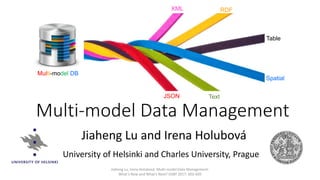
Table
RDFXML
Spatial
Text
Multi-model DB
JSON
Jiaheng Lu, Irena Holubová: Multi-model Data Management:
What's New and What's Next? EDBT 2017: 602-605
Outline
• Introduction to multi-model databases (25 minutes )
• Multi-model data storage (25 minutes)
• Multi-model data query languages (15 minutes)
• Multi-model query optimization (5 minutes)
• Multi-model database benchmarking (5 minutes)
• Open problems and challenges (10 minutes)
Jiaheng Lu, Irena Holubová: Multi-model Data Management:
What's New and What's Next? EDBT 2017: 602-605
Outline
• Introduction to multi-model databases
• Multi-model data storage
• Multi-model data query languages
• Multi-model query optimization
• Multi-model database benchmarking
• Open problems and challenges
Jiaheng Lu, Irena Holubová: Multi-model Data Management:
What's New and What's Next? EDBT 2017: 602-605
A grand challenge on Variety
• Big data: Volume, Variety, Velocity, Veracity
• Variety: tree data (XML, JSON), graph data (RDF, property graphs,
networks), tabular data (CSV), temporal and spatial data, text etc.
Photo downloaded from: https://blog.infodiagram.com/2014/04/visualizing-big-data-concepts-strong.html
Motivation: one application to include
multi-model data
Sales
Social
media
Customer
CatalogShopping-cart
An E-commence example with multi-model data
NoSQL database types
Photo downloaded from: http://www.vikramtakkar.com/2015/12/nosql-types-of-nosql-database-part-2.html
Jiaheng Lu, Irena Holubová: Multi-model Data Management:
What's New and What's Next? EDBT 2017: 602-605
Multiple NoSQL databases
Sales Social
media Customer
CatalogShopping-cart
MongoDB
MongoDBRedis
MongoDB
Neo4j
Jiaheng Lu, Irena Holubová: Multi-model Data Management:
What's New and What's Next? EDBT 2017: 602-605
Polyglot Persistence
• “One size cannot fit all”: use multiple databases for one application
• If you have structured data with some differences
• Use a document store
• If you have relations between entities and want to efficiently query
them
• Use a graph database
• If you manage the data structure yourself and do not need complex
queries
• Use a key-value store
Jiaheng Lu, Irena Holubová: Multi-model Data Management:
What's New and What's Next? EDBT 2017: 602-605
Pros and Cons of Polyglot Persistence
• Requires the company to hire
people to integrate different
databases
• Implementers need to learn
different databases
• Hard to handle inter-model
queries and transactions
• Handle multi-model data
• Help your apps to scale
well
• A rich experience to
manage multiple
databases
Multi-model DB
Tabular
RDFXML
Spatial
Text
Multi-model DB
JSON
• One unified database for multi-model data
Jiaheng Lu, Irena Holubová: Multi-model Data Management:
What's New and What's Next? EDBT 2017: 602-605
Multi-model databases
• A multi-model database is designed to support multiple data models
against a single, integrated backend.
• Document, graph, relational, and key-value models are examples of
data models that may be supported by a multi-model database.
Jiaheng Lu, Irena Holubová: Multi-model Data Management:
What's New and What's Next? EDBT 2017: 602-605
What is the difference between Multi-model
and Multi-modal
• Multi-model: graph, tree, relation, key-value,…
• Multi-modal: video, image, audio, eye gaze data, physiological
signals,…
Jiaheng Lu, Irena Holubová: Multi-model Data Management:
What's New and What's Next? EDBT 2017: 602-605
Three arguments on one DB engine for
multiple applications
• 1. One size cannot fit all
• 2. One size can fit all
• 3. One size fits a bunch
Jiaheng Lu, Irena Holubová: Multi-model Data Management:
What's New and What's Next? EDBT 2017: 602-605
One size cannot fit all
“SQL analytics, real-time decision support, and data warehouses
cannot be supported in one database engine.”
M. Stonebraker and U. Cetintemel. ”One Size Fits All”: An Idea Whose
Time Has Come and Gone (Abstract). In ICDE, 2005.
Jiaheng Lu, Irena Holubová: Multi-model Data Management:
What's New and What's Next? EDBT 2017: 602-605
One size can fit all
• OctopusDB suggests a unified, one size fits all data processing
architecture for OLTP, OLAP, streaming systems, and scan-oriented
database systems.
• Jens Dittrich, Alekh Jindal: Towards a One Size Fits All Database
Architecture. CIDR 2011: 195-198
Jiaheng Lu, Irena Holubová: Multi-model Data Management:
What's New and What's Next? EDBT 2017: 602-605
One size can fit all:
• All data is collected in a central log, i.e., all insert and update-
operations create logical log-entries in that log.
• Based on that log, define several types of optional storage views
• The query optimization, view maintenance, and index selection
problems suddenly become a single problem: storage view selection
Jiaheng Lu, Irena Holubová: Multi-model Data Management:
What's New and What's Next? EDBT 2017: 602-605
One size can fit a bunch: AsterixDB [1]
A parallel semi-structured data
management system with its own storage,
indexing, run-time, language, and query
optimizer, supporting JSON, CSV data
Support SQL++ [2] and AQL (AsterixDB
query language)
[1] AsterixDB: A Scalable, Open Source BDMS. PVLDB 7(14): 1905-1916 (2014)
[2] The SQL++ Query Language: Configurable, Unifying and Semi-structured ArXiv:1405.3631
One size can fit a bunch: AsterixDB
• AsterixDB’s data model is flexible
• Open: you can store objects there that have those fields as
well as any/all other fields that your data instances happen
to have at insertion time.
• Closed: you can choose to pre-define any or all of the fields
and types that objects to be stored in it will have
Jiaheng Lu, Irena Holubová: Multi-model Data Management:
What's New and What's Next? EDBT 2017: 602-605
A simple survey
How many of you agree that
1. One size cannot fit all ?
2. One size can fit all ?
3. One size fits a bunch ?
4. ???
Jiaheng Lu, Irena Holubová: Multi-model Data Management:
What's New and What's Next? EDBT 2017: 602-605
Multi-model databases:
One size fits multi-data-model
…
Jiaheng Lu, Irena Holubová: Multi-model Data Management:
What's New and What's Next? EDBT 2017: 602-605
Multi-model databases are not new !
• Can be traced to object-relational
database (ORDBMS)​
• ORDBMS framework allows users to plug
in their domain and/or application
specific data models as user defined
functions/types/indexes
Jiaheng Lu, Irena Holubová: Multi-model Data Management:
What's New and What's Next? EDBT 2017: 602-605
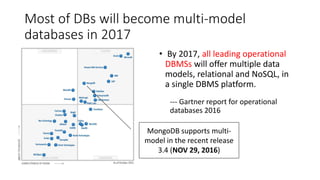
Most of DBs will become multi-model
databases in 2017
--- Gartner report for operational
databases 2016
MongoDB supports multi-
model in the recent release
3.4 (NOV 29, 2016)
• By 2017, all leading operational
DBMSs will offer multiple data
models, relational and NoSQL, in
a single DBMS platform.
Pros and Cons of multi-model databases
• A complex system
• Immature and developing
• Many challenges and open
problems
• Handle multi-model data
• One system implements fault
tolerance
• One system guarantees inter-
model data consistency
• Unified query language for
multi-model data
Jiaheng Lu, Irena Holubová: Multi-model Data Management:
What's New and What's Next? EDBT 2017: 602-605
Two examples of multi-model databases:
Jiaheng Lu, Irena Holubová: Multi-model Data Management:
What's New and What's Next? EDBT 2017: 602-605
• ArangoDB is a multi-model, open-source database with flexible data
models for documents, graphs, and key-values.
• They store all data as documents.
• Since vertices and edges of graphs are documents, this allows to mix
all three data models (key-value, JSON and graph)
Jiaheng Lu, Irena Holubová: Multi-model Data Management:
What's New and What's Next? EDBT 2017: 602-605
An example of multi-model data and query
knows
{"Order_no":"0c6df508",
“Orderlines": [
{ "Product_no":"2724f”
“Product_Name":“Toy",
"Price":66 },
{ "Product_no":“3424g”,
"Product_Name":“Book",
"Price":40 } ]
}
knows
Social network graph
"1" -- > "34e5e759"
Shopping-cart key-value pairs
Customer_ID  Order_no
Order JSON document
Customer relation"2"-- > "0c6df508"
Customer_ID Name Credit_limit
1 Mary 5,000
2 John 3,000
3 William 2,000
Mary
JohnAnne
An example of multi-model data and query
{"Order_no":"0c6df508",
“Orderlines": [
{ "Product_no":"2724f”
“Product_Name":“Toy",
"Price":66 },
{ "Product_no":“3424g”,
"Product_Name":“Book",
"Price":40 } ]
}
Customer_ID Name Credit_limit
1 Mary 5,000
2 John 3,000
3 Anne 2,000
"1" -- > "34e5e759"
"2"-- > "0c6df508"
Recommendation query:
Return all product_no which are ordered by a friend
of a customer whose credit_limit>3000
knows
knows
Mary
John
Tabular-graph join
Graph-key/value join
Key/value-JSON join
Anne
Let CustomerIDs =(FOR Customer IN Customers FILTER
Customer.CreditLimit > 3000 RETURN Customer.id)
Let FriendIDs=(FOR CustomerID in CustomerIDs FOR Friend IN
1..1 OUTBOUND CustomerID Knows return Friend.id)
For Friend in FriendIDs
For Order in 1..1 OUTBOUND Friend Customer2Order
Return Order.orderlines[*].Product_no
An example of multi-model query (ArangoDB)
Description: Return all products which are ordered by a friend of
a customer whose credit_limit>3000
Result: ["2724f", "3424g"]
Jiaheng Lu, Irena Holubová: Multi-model Data Management:
What's New and What's Next? EDBT 2017: 602-605
• Supporting graph, document, key/value and object models.
• The relationships are managed as in graph databases with direct connections
between records.
• It supports schema-less, schema-full and schema-hybrid modes.
• Query with SQL extended for graph traversal.
Jiaheng Lu, Irena Holubová: Multi-model Data Management:
What's New and What's Next? EDBT 2017: 602-605
Select expand(out("Knows").Orders.orderlines.Product_no)
from Customers where Credit_limit > 3000
Description: Return all products which are ordered by a friend of
a customer whose credit_limit>3000
Result: ["2724f", "3424g"]
Jiaheng Lu, Irena Holubová: Multi-model Data Management:
What's New and What's Next? EDBT 2017: 602-605
Outline
• Introduction to multi-model databases
• Multi-model data storage
• Multi-model data query languages
• Multi-model query optimization
• Multi-model database benchmarking
• Open problems and challenges
Jiaheng Lu, Irena Holubová: Multi-model Data Management:
What's New and What's Next? EDBT 2017: 602-605
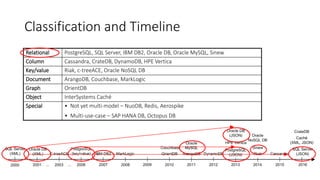
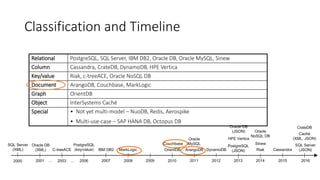
Classification and Timeline
Relational PostgreSQL, SQL Server, IBM DB2, Oracle DB, Oracle MySQL, Sinew
Column Cassandra, CrateDB, DynamoDB, HPE Vertica
Key/value Riak, c-treeACE, Oracle NoSQL DB
Document ArangoDB, Couchbase, MarkLogic
Graph OrientDB
Object InterSystems Caché
Special • Not yet multi-model – NuoDB, Redis, Aerospike
• Multi-use-case – SAP HANA DB, Octopus DB
Jiaheng Lu, Irena Holubová: Multi-model Data Management:
What's New and What's Next? EDBT 2017: 602-605
Classification and Timeline
Relational PostgreSQL, SQL Server, IBM DB2, Oracle DB, Oracle MySQL, Sinew
Column Cassandra, CrateDB, DynamoDB, HPE Vertica
Key/value Riak, c-treeACE, Oracle NoSQL DB
Document ArangoDB, Couchbase, MarkLogic
Graph OrientDB
Object InterSystems Caché
Special • Not yet multi-model – NuoDB, Redis, Aerospike
• Multi-use-case – SAP HANA DB, Octopus DB
Relational Multi-Model DBMSs
Storage
• Biggest set:
1. Most popular type of DBMSs
2. Extended to other models long before Big Data arrival
3. Relational model enables simple extension
• PostgreSQL
• Many NoSQL features: materialized views (data duplicities), master/slave replication
• Data types: XML, HSTORE (key/value pairs), JSON / JSONB (JSON)
• SQL Server
• Data types: XML, NVARCHAR (JSON)
• SQLXML (not SQL/XML)
• Function OPENJSON: JSON text  relational table
• Pre-defined schema and mapping rules / without a schema (a set of key/value pairs)
Relational Multi-Model DBMSs
Storage
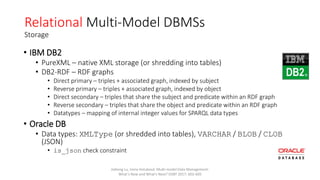
• IBM DB2
• PureXML – native XML storage (or shredding into tables)
• DB2-RDF – RDF graphs
• Direct primary – triples + associated graph, indexed by subject
• Reverse primary – triples + associated graph, indexed by object
• Direct secondary – triples that share the subject and predicate within an RDF graph
• Reverse secondary – triples that share the object and predicate within an RDF graph
• Datatypes – mapping of internal integer values for SPARQL data types
• Oracle DB
• Data types: XMLType (or shredded into tables), VARCHAR / BLOB / CLOB
(JSON)
• is_json check constraint
Jiaheng Lu, Irena Holubová: Multi-model Data Management:
What's New and What's Next? EDBT 2017: 602-605
Relational Multi-Model DBMSs
Storage
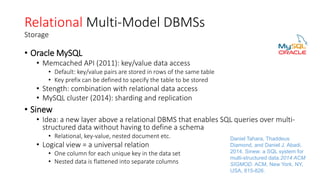
• Oracle MySQL
• Memcached API (2011): key/value data access
• Default: key/value pairs are stored in rows of the same table
• Key prefix can be defined to specify the table to be stored
• Stength: combination with relational data access
• MySQL cluster (2014): sharding and replication
• Sinew
• Idea: a new layer above a relational DBMS that enables SQL queries over multi-
structured data without having to define a schema
• Relational, key-value, nested document etc.
• Logical view = a universal relation
• One column for each unique key in the data set
• Nested data is flattened into separate columns
Daniel Tahara, Thaddeus
Diamond, and Daniel J. Abadi.
2014. Sinew: a SQL system for
multi-structured data.2014 ACM
SIGMOD. ACM, New York, NY,
USA, 815-826.
Relational Multi-Model DBMSs
Storage – PostgreSQL Example
CREATE TABLE customer (
id INTEGER PRIMARY KEY,
name VARCHAR(50),
address VARCHAR(50),
orders JSONB
);
INSERT INTO customer
VALUES (1, 'Mary', 'Prague',
'{"Order_no":"0c6df508",
"Orderlines":[
{"Product_no":"2724f", "Product_Name":"Toy", "Price":66 },
{"Product_no":"3424g", "Product_Name":"Book", "Price":40}]
}');
INSERT INTO customer
VALUES (2, 'John', 'Helsinki',
'{"Order_no":"0c6df511",
"Orderlines":[
{ "Product_no":"2454f", "Product_Name":"Computer", "Price":34
}]
}');
Relational Multi-Model DBMSs
Storage – PostgreSQL Example
SELECT json_build_object('id',id,'name',name,'orders',orders) FROM customer;
SELECT jsonb_each(orders) FROM customer;
SELECT jsonb_object_keys(orders) FROM customer;
Jiaheng Lu, Irena Holubová: Multi-model Data Management:
What's New and What's Next? EDBT 2017: 602-605
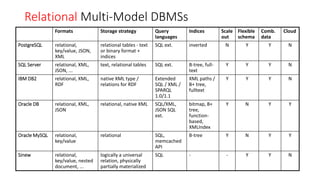
Relational Multi-Model DBMSs
Formats Storage strategy Query
languages
Indices Scale
out
Flexible
schema
Comb.
data
Cloud
PostgreSQL relational,
key/value, JSON,
XML
relational tables - text
or binary format +
indices
SQL ext. inverted N Y Y N
SQL Server relational, XML,
JSON, ...
text, relational tables SQL ext. B-tree, full-
text
Y Y Y N
IBM DB2 relational, XML,
RDF
native XML type /
relations for RDF
Extended
SQL / XML /
SPARQL
1.0/1.1
XML paths /
B+ tree,
fulltext
Y Y Y N
Oracle DB relational, XML,
JSON
relational, native XML SQL/XML,
JSON SQL
ext.
bitmap, B+
tree,
function-
based,
XMLIndex
Y N Y Y
Oracle MySQL relational,
key/value
relational SQL,
memcached
API
B-tree Y N Y Y
Sinew relational,
key/value, nested
document, ...
logically a universal
relation, physically
partially materialized
SQL - - Y Y N
Classification and Timeline
Relational PostgreSQL, SQL Server, IBM DB2, Oracle DB, Oracle MySQL, Sinew
Column Cassandra, CrateDB, DynamoDB, HPE Vertica
Key/value Riak, c-treeACE, Oracle NoSQL DB
Document ArangoDB, Couchbase, MarkLogic
Graph OrientDB
Object InterSystems Caché
Special • Not yet multi-model – NuoDB, Redis, Aerospike
• Multi-use-case – SAP HANA DB, Octopus DB
Column Multi-Model DBMSs
Storage
• Two meanings:
1. Column-oriented (columnar, column) DBMS stores data tables as columns rather than rows
• Not necessarily NoSQL, usually in analytics tools
2. Column (wide-column) DBMS = a NoSQL database which supports tables having distinct
numbers and types of columns
• Underlying storage strategy can be columnar, or any other
• Cassandra
• Column store with sparse tables
• SSTables (Sorted String Tables) – proposed in Google system Bigtable
• SQL-like query and manipulation language CQL
• Scalar data types (text, int), collections (list, set, map), tuples, and UDTs
• 2015: JSON format (schema of tables must be defined)
• Keys  column names
• JSON values  column values
Column Multi-Model DBMSs
Storage
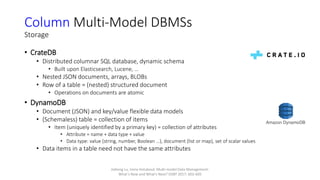
• CrateDB
• Distributed columnar SQL database, dynamic schema
• Built upon Elasticsearch, Lucene, …
• Nested JSON documents, arrays, BLOBs
• Row of a table = (nested) structured document
• Operations on documents are atomic
• DynamoDB
• Document (JSON) and key/value flexible data models
• (Schemaless) table = collection of items
• Item (uniquely identified by a primary key) = collection of attributes
• Attribute = name + data type + value
• Data type: value (string, number, Boolean …), document (list or map), set of scalar values
• Data items in a table need not have the same attributes
Jiaheng Lu, Irena Holubová: Multi-model Data Management:
What's New and What's Next? EDBT 2017: 602-605
Column Multi-Model DBMSs
Storage
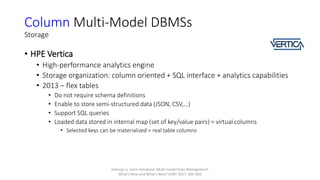
• HPE Vertica
• High-performance analytics engine
• Storage organization: column oriented + SQL interface + analytics capabilities
• 2013 – flex tables
• Do not require schema definitions
• Enable to store semi-structured data (JSON, CSV,…)
• Support SQL queries
• Loaded data stored in internal map (set of key/value pairs) = virtual columns
• Selected keys can be materialized = real table columns
Jiaheng Lu, Irena Holubová: Multi-model Data Management:
What's New and What's Next? EDBT 2017: 602-605
Column Multi-Model DBMSs
Storage – Cassandra Example
create keyspace myspace
WITH REPLICATION = { 'class' : 'SimpleStrategy', 'replication_factor' : 3 };
CREATE TYPE myspace.orderline (
product_no text,
product_name text,
price float
);
CREATE TYPE myspace.myorder (
order_no text,
orderlines list<frozen <orderline>>
);
CREATE TABLE myspace.customer (
id INT PRIMARY KEY,
name text,
address text,
orders list<frozen <myorder>>
);
Jiaheng Lu, Irena Holubová: Multi-model Data Management:
What's New and What's Next? EDBT 2017: 602-605
Column Multi-Model DBMSs
Storage – Cassandra Example
INSERT INTO myspace.customer JSON
' {"id":1,
"name":"Mary",
"address":"Prague",
"orders" : [
{ "order_no":"0c6df508",
"orderlines":[
{ "product_no" : "2724f",
"product_name" : "Toy",
"price" : 66 },
{ "product_no" : "3424g",
"product_name" :"Book",
"price" : 40 } ] } ]
}';
INSERT INTO myspace.customer JSON
' {"id":2,
"name":"John",
"address":"Helsinki",
"orders" : [
{ "order_no":"0c6df511",
"orderlines":[
{ "product_no" : "2454f",
"product_name" : "Computer",
"price" : 34 } ] } ]
}';
Jiaheng Lu, Irena Holubová: Multi-model Data Management:
What's New and What's Next? EDBT 2017: 602-605
Column Multi-Model DBMSs
Storage – Cassandra Example
CREATE TABLE myspace.users (
id text PRIMARY KEY,
age int,
country text
);
INSERT INTO myspace.users (id, age, state) VALUES ('Irena', 37, 'CZ');
SELECT JSON * FROM myspace.users;
[json]
-------------------------------------------
{"id": "Irena", "age": 37, "country": "CZ"}
Jiaheng Lu, Irena Holubová: Multi-model Data Management:
What's New and What's Next? EDBT 2017: 602-605
Column Multi-Model DBMSs
Formats Storage
strategy
Query
languages
Indices Scale
out
Flexible
schema
Comb.
data
Cloud
Cassandra text, user-
defined type
sparse tables SQL-like CQL inverted, B+
tree
Y N Y Y
CrateDB relational, JSON,
BLOB, arrays
columnar
store based on
Lucene and
Elasticsearch
SQL Lucene Y Y Y N
DynamoDB key/value,
document
(JSON)
column store simple API
(get / put /
update) +
simple
queries over
indices
hashing Y Y Y Y
HPE Vertica JSON, CSV flex tables +
map
SQL-like for
materialized
data
Y Y Y N
Jiaheng Lu, Irena Holubová: Multi-model Data Management:
What's New and What's Next? EDBT 2017: 602-605
Classification and Timeline
Relational PostgreSQL, SQL Server, IBM DB2, Oracle DB, Oracle MySQL, Sinew
Column Cassandra, CrateDB, DynamoDB, HPE Vertica
Key/value Riak, c-treeACE, Oracle NoSQL DB
Document ArangoDB, Couchbase, MarkLogic
Graph OrientDB
Object InterSystems Caché
Special • Not yet multi-model – NuoDB, Redis, Aerospike
• Multi-use-case – SAP HANA DB, Octopus DB
Key/Value Multi-Model DBMSs
Storage
• Riak
• 2009: classical key/value DBMS
• 2014: document store with querying capabilities
• Riak Data Types – conflict-free replicated data type
• Sets, maps (enable embedding), counters,…
• Riak Search – integration of Solr for indexing and querying
• Indices over particular fields of XML/JSON document, plain text, …
• c-treeACE
• No+SQL = both NoSQL and SQL in a single database
• Key/value store + support for relational and non-relational APIs
• Record-oriented Indexed Sequential Access Method (ISAM) structure
• Operations with records, their sets, or files in which they are stored
Key/Value Multi-Model DBMSs
Storage
• Oracle NoSQL DB
• Built upon the Oracle Berkeley DB
• Released in 2011
• Key/value store which supports table API = SQL (since 2014)
• Data can be modelled as:
• Relational tables
• JSON documents
• Key/value pairs
• Definition of tables must be provided
• Table and attribute names, data types, keys, indices, …
• Data types: scalar types, arrays, maps, records, child tables (nested subtables)
Jiaheng Lu, Irena Holubová: Multi-model Data Management:
What's New and What's Next? EDBT 2017: 602-605
Key/Value Multi-Model DBMSs
Storage – Oracle NoSQL DB Example
create table Customers (
id integer,
name string,
address string,
orders array (
record (
order_no string,
orderlines array (
record (
product_no string,
product_name string,
price integer ) ) )
),
primary key (id)
);
import -table Customers -file customer.json
customer.json:
{ "id":1,
"name":"Mary",
"address":"Prague",
"orders" : [
{ "order_no":"0c6df508",
"orderlines":[
{ "product_no" : "2724f",
"product_name" : "Toy",
"price" : 66 },
{ "product_no" : "3424g",
"product_name" :"Book",
"price" : 40 } ] } ]
}
{ "id":2,
"name":"John",
"address":"Helsinki",
"orders" : [
{"order_no":"0c6df511",
"orderlines":[
{ "product_no" : "2454f",
"product_name" : "Computer",
"price" : 34 } ] } ]
}
Key/Value Multi-Model DBMSs
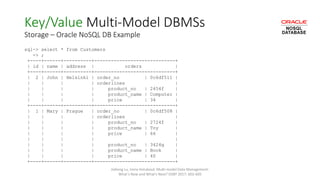
Storage – Oracle NoSQL DB Example
sql-> select * from Customers
-> ;
+----+------+----------+-----------------------------+
| id | name | address | orders |
+----+------+----------+-----------------------------+
| 2 | John | Helsinki | order_no | 0c6df511 |
| | | | orderlines |
| | | | product_no | 2454f |
| | | | product_name | Computer |
| | | | price | 34 |
+----+------+----------+-----------------------------+
| 1 | Mary | Prague | order_no | 0c6df508 |
| | | | orderlines |
| | | | product_no | 2724f |
| | | | product_name | Toy |
| | | | price | 66 |
| | | | |
| | | | product_no | 3424g |
| | | | product_name | Book |
| | | | price | 40 |
+----+------+----------+-----------------------------+
Jiaheng Lu, Irena Holubová: Multi-model Data Management:
What's New and What's Next? EDBT 2017: 602-605
Key/Value Multi-Model DBMSs
Formats Storage strategy Query
languages
Indices Scale
out
Flexible
schema
Comb.
data
Cloud
Riak key/value,
XML, JSON
key/value pairs
in buckets
Solr Solr Y N Y N
c-treeACE key/value +
SQL API
record-oriented
ISAM
SQL ISAM Y Y - N
Oracle
NoSQL DB
key/value,
(hierarchical)
table API
key/value SQL B-tree Y N Y N
Jiaheng Lu, Irena Holubová: Multi-model Data Management:
What's New and What's Next? EDBT 2017: 602-605
Classification and Timeline
Relational PostgreSQL, SQL Server, IBM DB2, Oracle DB, Oracle MySQL, Sinew
Column Cassandra, CrateDB, DynamoDB, HPE Vertica
Key/value Riak, c-treeACE, Oracle NoSQL DB
Document ArangoDB, Couchbase, MarkLogic
Graph OrientDB
Object InterSystems Caché
Special • Not yet multi-model – NuoDB, Redis, Aerospike
• Multi-use-case – SAP HANA DB, Octopus DB
Document Multi-Model DBMSs
Storage
• Document DB = key/value, where value is complex
• Multi-model extension is natural
• ArangoDB
• Denoted as native multi-model database
• Key/value, (JSON) documents and graph data
• Document collection – always a primary key attribute
• No secondary indices  simple key/value store
• Edge collection – two special attributes from and to
• Relations between documents
• Couchbase
• Key/value + (JSON) document
• No pre-defined schema
• SQL-based query language
• Memcached buckets – support caching of frequently-used data
• Reduce the number of queries
Jiaheng Lu, Irena Holubová: Multi-model Data Management:
What's New and What's Next? EDBT 2017: 602-605
Document Multi-Model DBMSs
Storage
• MarkLogic
• Originally XML
• Since 2008: JSON
• Currently: RDF, textual, binary data
• Models a JSON document similarly to an XML document = a tree
• Rooted at an auxiliary document node
• Nodes below: JSON objects, arrays, and text, number, Boolean, null values
 unified way to manage and index documents of both types
Document Multi-Model DBMSs
Storage – MarkLogic Example
{
"name": "Oliver",
"scores": [88, 67, 73],
"isActive": true,
"affiliation": null
}
Jiaheng Lu, Irena Holubová: Multi-model Data Management:
What's New and What's Next? EDBT 2017: 602-605
Document Multi-Model DBMSs
Storage – MarkLogic Example
JavaSript:
declareUpdate();
xdmp.documentInsert("/myJSON1.json",
{
"Order_no":"0c6df508",
"Orderlines":[
{ "Product_no":"2724f",
"Product_Name":"Toy",
"Price":66 },
{"Product_no":"3424g",
"Product_Name":"Book",
"Price":40}]
}
);
XQuery:
xdmp:document-insert("/myXML1.xml",
<product no="3424g">
<name>The King's Speech</name>
<author>Mark Logue</author>
<author>Peter Conradi</author>
</product>
);;
Jiaheng Lu, Irena Holubová: Multi-model Data Management:
What's New and What's Next? EDBT 2017: 602-605
Document Multi-Model DBMSs
Formats Storage strategy Query
languages
Indices Scale
out
Flexible
schema
Comb.
data
Cloud
ArangoDB key/value,
document, graph
document store
allowing references
SQL-like AQL mainly
hash
(eventuall
y unique
or sparse)
Y Y Y N
Couchbase key/value,
document,
distributed cache
document store +
append-only write
SQL-based
N1QL
B+tree,
B+trie
Y Y Y N
MarkLogic XML, JSON, RDF,
binary, text, ...
storing like
hierarchical XML data
XPath,
XQuery, SQL-
like
inverted
+ native
XML
Y Y Y N
Jiaheng Lu, Irena Holubová: Multi-model Data Management:
What's New and What's Next? EDBT 2017: 602-605
Classification and Timeline
Relational PostgreSQL, SQL Server, IBM DB2, Oracle DB, Oracle MySQL, Sinew
Column Cassandra, CrateDB, DynamoDB, HPE Vertica
Key/value Riak, c-treeACE, Oracle NoSQL DB
Document ArangoDB, Couchbase, MarkLogic
Graph OrientDB
Object InterSystems Caché
Special • Not yet multi-model – NuoDB, Redis, Aerospike
• Multi-use-case – SAP HANA DB, Octopus DB
Graph Multi-Model DBMSs
Storage
• OrientDB
• Data models: graph, document, key/value, object
• Element of storage = a record corresponding to document / BLOB / vertex / edge
• Having a unique ID
• Classes – contain and define records
• Schema-less / schema-full / schema-mixed
• Can inherit (all properties) from other classes
• Class properties are defined, further constrained or indexed
• Classes can have relationships:
• Referenced relationships – stored similarly to storing pointers between two objects in memory
• LINK, LINKSET, LINKLIST, LINKMAP
• Embedded relationships – stored within the record that embed
• EMBEDDED, EMBEDDEDSET, EMBEDDEDLIST. EMBEDDEDMAP
Formats Storage strategy Query
languages
Indices Scale
out
Flexible
schema
Comb.
data
Cloud
OrientDB graph, document,
key/value, object
key/value pairs +
object-oriented links
Gremlin,
SQL ext.
SB-tree, ext.
hashing,
Lucene
Y Y Y N
Graph Multi-Model DBMSs
Storage –OrientDB Example
Jiaheng Lu, Irena Holubová: Multi-model Data Management:
What's New and What's Next? EDBT 2017: 602-605
Graph Multi-Model DBMSs
Storage – OrientDB Example
CREATE CLASS orderline EXTENDS V
CREATE PROPERTY orderline.product_no STRING
CREATE PROPERTY orderline.product_name STRING
CREATE PROPERTY orderline.price FLOAT
CREATE CLASS order EXTENDS V
CREATE PROPERTY order.order_no STRING
CREATE PROPERTY order.orderlines EMBEDDEDLIST orderline
CREATE CLASS customer EXTENDS V
CREATE PROPERTY customer.id INTEGER
CREATE PROPERTY customer.name STRING
CREATE PROPERTY customer.address STRING
CREATE CLASS orders EXTENDS E
CREATE CLASS knows EXTENDS E
Jiaheng Lu, Irena Holubová: Multi-model Data Management:
What's New and What's Next? EDBT 2017: 602-605
Graph Multi-Model DBMSs
Storage – OrientDB Example
CREATE VERTEX order CONTENT {
"order_no":"0c6df508",
"orderlines":[
{ "@type":"d",
"@class":"orderline",
"product_no":"2724f",
"product_name":"Toy",
"price":66 },
{ "@type":"d",
"@class":"orderline",
"product_no":"3424g",
"product_name":"Book",
"price":40}]
}
CREATE VERTEX order CONTENT {
"order_no":"0c6df511",
"orderlines":[
{ "@type":"d",
"@class":"orderline",
"product_no":"2454f",
"product_name":"Computer",
"price":34 }]
}
CREATE VERTEX customer CONTENT {
"id" : 1,
"name" : "Mary",
"address" : "Prague"
}
CREATE VERTEX customer CONTENT {
"id" : 2,
"name" : "John",
"address" : "Helsinki"
}
Graph Multi-Model DBMSs
Storage – OrientDB Example
CREATE EDGE orders FROM
(SELECT FROM customer WHERE name = "Mary")
TO
(SELECT FROM order WHERE order_no = "0c6df508")
CREATE EDGE orders FROM
(SELECT FROM customer WHERE name = "John")
TO
(SELECT FROM order WHERE order_no = "0c6df511")
CREATE EDGE knows FROM
(SELECT FROM customer WHERE name = "Mary")
TO
(SELECT FROM customer WHERE name = "John")
Jiaheng Lu, Irena Holubová: Multi-model Data Management:
What's New and What's Next? EDBT 2017: 602-605
Classification and Timeline
Relational PostgreSQL, SQL Server, IBM DB2, Oracle DB, Oracle MySQL, Sinew
Column Cassandra, CrateDB, DynamoDB, HPE Vertica
Key/value Riak, c-treeACE, Oracle NoSQL DB
Document ArangoDB, Couchbase, MarkLogic
Graph OrientDB
Object InterSystems Caché
Special • Not yet multi-model – NuoDB, Redis, Aerospike
• Multi-use-case – SAP HANA DB, Octopus DB
Object Multi-Model DBMSs
Storage
• Object model = storing any kind of data  multi-model extension is
natural
• InterSystems Caché
• Stores data in sparse, multidimensional arrays
• Capable of carrying hierarchically structured data
• Access APIs: object (ODMG), SQL, direct manipulation of multidimensional
data structures
• Schemaless and schema-based storage strategy is available
• 2016: JSON, XML
Formats Storage strategy Query
languages
Indices Scale
out
Flexible
schema
Comb.
data
Cloud
Caché object, SQL or multi-
dimensional, document
(JSON, XML) API
multi-dimensional
arrays
SQL with
object
extensions
bitmap,
bitslice,
standard
Y Y - N
Not (yet) multi-model
• NuoDB – NewSQL cloud DBMS
• Data is stored in and managed through objects called Atoms
• Self-coordinating objects (data, indices or schemas)
• Atomicity, Consistency and Isolation are applied to Atom interaction
• Replacing the SQL front-end would have no impact
• Redis – NoSQL key/value DBMS
• Support for strings + a list of strings, an (un)ordered set of strings, a hash table, … + respective
operations
• Redis Modules – add-ons which extend Redis to cover most of the popular use cases
• Aerospike – NoSQL key/value DBMS
• Support for maps and lists in the value part that can nest
• 2012 - Aerospike acquired AlchemyDB
• Aim: to integrate its index, document store, graph database, and SQL functionality
Jiaheng Lu, Irena Holubová: Multi-model Data Management:
What's New and What's Next? EDBT 2017: 602-605
Outline
• Introduction to multi-model databases
• Multi-model data storage
• Multi-model data query languages
• Multi-model query optimization
• Multi-model database benchmarking
• Open problems and challenges
Jiaheng Lu, Irena Holubová: Multi-model Data Management:
What's New and What's Next? EDBT 2017: 602-605
Classification of Approaches
• Simple API
• Store, retrieve, delete data
• Typically key/value, but also other use cases
• DynamoDB – simple data access + querying over indices using comparison
operators
• SQL Extensions and SQL-Like Languages
• Most common
• PostgreSQL – SQL extension for JSON
• Cassandra – CQL = subset of SQL, lots of limitations
• OrientDB – Gremlin or SQL extended for graph traversal
• SQL Server – SQLXML + similar extension for JSON
• Not SQL/XML standard!
Jiaheng Lu, Irena Holubová: Multi-model Data Management:
What's New and What's Next? EDBT 2017: 602-605
Classification of Approaches
• IBM DB2 – SQL/XML + further extensions for XML
• Oracle DB – SQL/XML + further extensions for JSON
• ArangoDB – AQL = SQL-like + concept of loops
• InterSystems Caché – SQL + object concepts
• Instances of classes accessible as rows of tables
• Inheritance is “flattened”
• Couchbase – N1QL = SQL-like for JSON
• CrateDB – standard ANSI SQL 92 + usage of nested JSON attributes
Jiaheng Lu, Irena Holubová: Multi-model Data Management:
What's New and What's Next? EDBT 2017: 602-605
PostgreSQL relational Getting an array element by index, an object field by key, an object at a specified path,
containment of values/paths, top-level key-existence, deleting a key/value pair / a string
element / an array element with specified index /a field / an element with specified path,…
SQL Server relational JSON: export relational data in the JSON format, test JSON format of a text value,
JavaScript-like path queries,
SQLXML: SQL view of XML data + XML view of SQL relations
IBM DB2 relational SQL/XML + e.g. embedding SQL queries to XQuery expressions
Oracle DB relational SQL/XML + JSON extensions (JSON_VALUE, JSON_QUERY, JSON_EXISTS,…)
Couchbase document Classical clauses such as SELECT, FROM (multiple buckets), … for JSON
ArangoDB document key/value: insert, look-up, update
document: simple QBE, complex joins, functions, …
graph: traversals, shortest path searches
Oracle
NoSQL DB
key/value SQL-like, extended for nested data structures
c-treeACE key/value SQL-like language
Cassandra column SELECT, FROM, WHERE, ORDER BY, LIMIT with limitations
CrateDB column Standard ANSI SQL 92 + usage nested JSON attributes
OrientDB graph Classical joins not supported, the links are simply navigated using dot notation; main SQL
clauses + nested queries
Caché object SQL + object extensions (e.g. object references instead of joins)
SQL Extensions and SQL-Like Languages
PostgreSQL Example (relational)
{"Order_no":"0c6df508",
"Orderlines":[
{ "Product_no":"2724f",
"Product_Name":"Toy",
"Price":66 },
{"Product_no":"3424g",
"Product_Name":"Book",
"Price":40}]
}
SELECT name,
orders->>'Order_no' as Order_no,
orders#>'{Orderlines,1}'->>'Product_Name' as Product_Name
FROM customer
where orders->>'Order_no' <> '0c6df511';
SQL Extensions and SQL-Like Languages
Oracle NoSQL DB Example (key/value)
sql-> SELECT c.name, c.orders.order_no, c.orders.orderlines[0].product_name
-> FROM customers c
-> where c.orders.orderlines[0].price > 50;
+------+----------+--------------+
| name | order_no | product_name |
+------+----------+--------------+
| Mary | 0c6df508 | Toy |
+------+----------+--------------+
sql-> SELECT c.name, c.orders.order_no,
-> [c.orders.orderlines[$element.price >35]]
-> FROM customers c;
+------+----------+-------------------------+
| name | order_no | Column_3 |
+------+----------+-------------------------+
| Mary | 0c6df508 | product_no | 2724f |
| | | product_name | Toy |
| | | price | 66 |
| | | |
| | | product_no | 3424g |
| | | product_name | Book |
| | | price | 40 |
+------+----------+-------------------------+
| John | 0c6df511 | |
+------+----------+-------------------------+
sql-> select * from Customers
-> ;
+----+------+----------+-----------------------------+
| id | name | address | orders |
+----+------+----------+-----------------------------+
| 2 | John | Helsinki | order_no | 0c6df511 |
| | | | orderlines |
| | | | product_no | 2454f |
| | | | product_name | Computer |
| | | | price | 34 |
+----+------+----------+-----------------------------+
| 1 | Mary | Prague | order_no | 0c6df508 |
| | | | orderlines |
| | | | product_no | 2724f |
| | | | product_name | Toy |
| | | | price | 66 |
| | | | |
| | | | product_no | 3424g |
| | | | product_name | Book |
| | | | price | 40 |
+----+------+----------+-----------------------------+
Classification of Approaches
• SPARQL Query Extensions
• IBM DB2 - SPARQL 1.0 + subset of features from SPARQL 1.1
• SELECT, GROUP BY, HAVING, SUM, MAX, …
• Probably no extension for relational data
• But: RDF triples are stored in table  SQL queries can be used over them too
• XML Query Extensions
• MarkLogic – JSON can be accessed using XPath
• Tree representation like for XML
• Can be called from XQuery and JavaScript
• Full-text Search
• In general quite common
• Riak – Solr index + operations
• Wildcards, proximity search, range search, Boolean operators, grouping, …
Jiaheng Lu, Irena Holubová: Multi-model Data Management:
What's New and What's Next? EDBT 2017: 602-605
XML Query Extensions
MarkLogic Example
JavaSript:
declareUpdate();
xdmp.documentInsert("/myJSON1.json",
{
"Order_no":"0c6df508",
"Orderlines":[
{ "Product_no":"2724f",
"Product_Name":"Toy",
"Price":66 },
{"Product_no":"3424g",
"Product_Name":"Book",
"Price":40}]
}
);
XQuery:
xdmp:document-insert("/myXML1.xml",
<product no="3424g">
<name>The King's Speech</name>
<author>Mark Logue</author>
<author>Peter Conradi</author>
</product>
);
XQuery:
let $product := fn:doc("/myXML1.xml")/product
let $order := fn:doc("/myJSON1.json")[Orderlines/Product_no = $product/@no]
return $order/Order_no
Result: 0c6df508
Outline
• Introduction to multi-model databases
• Multi-model data storage
• Multi-model data query languages
• Multi-model query optimization
• Multi-model database benchmarking
• Open problems and challenges
Jiaheng Lu, Irena Holubová: Multi-model Data Management:
What's New and What's Next? EDBT 2017: 602-605
Classification of Approaches
• Inverted Index
• PostgreSQL – data in jsonb: GIN index = (key, posting list) pairs
• But also B-tree and hash index
• B-tree, B+ tree
• Cassandra
• Primary key = always indexed using inverted index (auxiliary table)
• Secondary index = memory mapped B+trees (range queries)
• SQL Server – no special index for JSON (B-tree or full-text indices)
• Couchbase – B+tree / B+trie (a hierarchical B+tree-based Trie) = a shallower tree hierarchy
• Oracle DB
• Shredded XML data = B+tree index
• To index fields of a JSON object = virtual columns need to be created for them first + B+tree index
• Oracle MySQL – mostly classical B-trees (spatial data R-trees)
• Oracle NoSQL DB – secondary indices = distributed, shard-local B-trees
• Indexing over simple, scalar as well as over non-scalar and nested data values
Jiaheng Lu, Irena Holubová: Multi-model Data Management:
What's New and What's Next? EDBT 2017: 602-605
Classification of Approaches
• Materialization
• HPE Vertica – flex table can be processed using SQL commands + custom views can be created
• SELECT invokes maplookup() function
• Promoting virtual columns to real columns improves query performance
• Hashing
• OrientDB
• SB trees – B-tree optimized for data insertions and range queries
• Extendible hashing – significantly faster
• ArangoDB
• Primary index – hash index for document _key attributes of all documents in a collection
• Edge index – hash index for _from and _to attributes
• User-defined indices – hash, unsorted (can be unique or sparse)  no range queries
• DynamoDB
• Primary key index: partition key (determine partition) + sort key (within partition)
• Secondary index: global (involving partition key) and local (within a partition)
Jiaheng Lu, Irena Holubová: Multi-model Data Management:
What's New and What's Next? EDBT 2017: 602-605
Classification of Approaches
• Bitmap
• InterSystems Caché – a series of highly compressed bitstrings to represent the
set of object IDs = indexed value
• Extended with bitslice index for numeric data fields used for a SUM, COUNT, or AVG
• Oracle DB – can be created for a value returned by json_exists
• Function based
• Oracle DB –indexes the function on a column = the product of the function
• Can be created for SQL function json_value
• For XML data deprecated
Jiaheng Lu, Irena Holubová: Multi-model Data Management:
What's New and What's Next? EDBT 2017: 602-605
Classification of Approaches
• Native XML
• MarkLogic
• Universal index – inverted index for each word (or phrase), XML element and JSON
property and their values
• Further optimized using hashing
• Index of parent-child relationships
• (User-specified) range indices – for efficient evaluation of range queries
• An array of document ids and values sorted by document ids + an array of values and
document ids sorted by values
• Path range index – to index JSON properties defined by an XPath expression
• DB2 – XML region index, XML column path index, XML index
• Oracle DB – XMLIndex = path index + order index + value index
• Position of each node is preserved using a variant of the ORDPATHS numbering schema
Jiaheng Lu, Irena Holubová: Multi-model Data Management:
What's New and What's Next? EDBT 2017: 602-605
Query Optimization – Inverted Index
PostgreSQL Example (GIN – Generalized Inverted Index)
• Two types:
• Default (jsonb_ops) - key-exists operators ?, ?& and ?| and path/value-
exists operator @>
• Independent index items for each key and value in the data
• Non-default (jsonb_path_ops) - indexing the @> operator only
• Index items only for each value in the data
• A hash of the value and the key(s) leading to it
• Example: {"foo": {"bar": "baz"}}
• Default: three index items representing foo, bar, and baz separately
• Containment query looks for rows containing all three of these items
• Non-default: single index item (hash) incorporating foo, bar, and baz
• Containment query searches for specific structure
Jiaheng Lu, Irena Holubová: Multi-model Data Management:
What's New and What's Next? EDBT 2017: 602-605
Outline
• Introduction to multi-model databases
• Multi-model data storage
• Multi-model data query languages
• Multi-model query optimization
• Multi-model database benchmarking
• Open problems and challenges
Jiaheng Lu, Irena Holubová: Multi-model Data Management:
What's New and What's Next? EDBT 2017: 602-605
Some Big data benchmarking initiatives
• HiBench, Yan Li et al., Intel
• Yahoo Cloud Serving Benchmark (YCSB), Brian Cooper et al., Yahoo!
• Berkeley Big Data Benchmark, Pavlo et al., AMPLab
• BigDataBench, Jianfeng Zhan, Chinese Academy of Sciences
• Bigframe
• LDCS graph and RDF benchmarking
• …...
Jiaheng Lu, Irena Holubová: Multi-model Data Management:
What's New and What's Next? EDBT 2017: 602-605
New challenges for multi-model databases
•Cross-model query processing
• Complex joins of cross-model data
•Cross-model transaction
• Transactions support cross-model
•Open schema data and model evolution
• Query data with varied schemas and models
Jiaheng Lu, Irena Holubová: Multi-model Data Management:
What's New and What's Next? EDBT 2017: 602-605
UniBench: A unified benchmark for multi-
model data
An E-commerce application involving multi-model data
J. Lu: Towards Benchmarking Multi-Model Databases. CIDR 2017
Jiaheng Lu, Irena Holubová: Multi-model Data Management:
What's New and What's Next? EDBT 2017: 602-605
Workloads
• Workload A: Data Insertion and reading
• Workload B: Cross-model query
• Workload C: Cross-model Transaction
Jiaheng Lu, Irena Holubová: Multi-model Data Management:
What's New and What's Next? EDBT 2017: 602-605
On-going work on multi-model benchmarking
• Flexible schema management
• Model evolution
• HTAP (Hybrid Transaction/Analytical Processing)
• The data and code (on-going update) can be downloaded at:
• http://udbms.cs.helsinki.fi/?projects/ubench
Jiaheng Lu, Irena Holubová: Multi-model Data Management:
What's New and What's Next? EDBT 2017: 602-605
Outline
• Introduction to multi-model databases
• Multi-model data storage
• Multi-model data query languages
• Multi-model query optimization
• Multi-model database benchmarking
• Open problems and challenges
Jiaheng Lu, Irena Holubová: Multi-model Data Management:
What's New and What's Next? EDBT 2017: 602-605
Six challenges
Open data model
Unified query language
Schema evolution and
model evolution
Multi-model index
structure
Multi-model main
memory structure
Multi-model
transactions
Multi-model databases
Jiaheng Lu, Irena Holubová: Multi-model Data Management:
What's New and What's Next? EDBT 2017: 602-605
Open data model
A flexible data model to accommodate multi-model data
Providing a convenient unique interface to handle data from different
sources
Relation
RDFXML
Spatial
TextJSON
Open data model
Unified query language
A new unified query language can query multi-model data
together
Unified data language
SPARQLXPath, XQuery
SQL
JSONiq
GeoSPARQL
Keyword
Multi-model query language
• SQL extension embedding data model specific languages
• ORACLE: SQL/XML, SQL/JSON, SQL/SPARQL
• Graph extension
• AQL ArangoDB language
• XQuery extension
• MarkLogic
• JSON extension
• MongoDB $graphLookup
Jiaheng Lu, Irena Holubová: Multi-model Data Management:
What's New and What's Next? EDBT 2017: 602-605
Model evolution
Relational table
(Legacy data)
JSON document
(New data)
Model mapping among
different models of data
Multi-model index structures
• Inter-model indexes to speedup the inter-model query processing
• A new index structure for graph, document and relational joins
A multi-model index
Multi-model main memory structure
• As the in-memory technology going forward, disk based index and data
storage model are constantly being challenged.
• Building up just-in-time multi-model data structure is a new challenge on
main memory multi-model database.
• For example, In-memory virtual column[1] --> In-memory virtual model
[1] Aurosish Mishra et al. Accelerating analytics with dynamic in-memory expressions. PVLDB,
9(13):1437–1448, 2016
Multi-model transaction
• How to process inter-model transactions ?
• Graph data and relational data may have different requirements on the
consistency models
An example of multi-model data hybrid consistency models
Some theoretical challenges on multi-model
databases
Serge Abiteboul et al: Research Directions for Principles of Data Management, Dagstuhl
Perspectives Workshop 16151 (2017)
• Schema language for multi-model data and schema extraction
• Multi-model query language: expressive power or higher complexity
of query language (involving logic, complexity and automata theories )
• Query evaluation and optimization on inter-model
Conclusion
Classification of multi-model data management
Jiaheng Lu, Irena Holubová: Multi-model Data Management:
What's New and What's Next? EDBT 2017: 602-605
Conclusion
• Multi-model database is not new
• Can be traced to ORDBMS
• A number of DBs can manage multiple models of data
• By 2017, most of leading operational DBs will support multi-models.
• Multi-model database is new and open
• New query language for multi-model data
• New query optimization and indexes
• Open data model and model evolution
• …
Jiaheng Lu, Irena Holubová: Multi-model Data Management:
What's New and What's Next? EDBT 2017: 602-605
• Slides and papers are available at:
• http://udbms.cs.helsinki.fi/?tutorials
• Open multi-model datasets
• http://udbms.cs.helsinki.fi/?datasets
• Multi-model database benchmark
• http://udbms.cs.helsinki.fi/?projects/ubench
Contact us:
jiahenglu@gmail.com
Jiaheng Lu, Irena Holubová: Multi-model Data Management:
What's New and What's Next? EDBT 2017: 602-605

Multi-model database

  • 1.
    Multi-model Data Management JiahengLu and Irena Holubová University of Helsinki and Charles University, Prague Table RDFXML Spatial Text Multi-model DB JSON Jiaheng Lu, Irena Holubová: Multi-model Data Management: What's New and What's Next? EDBT 2017: 602-605
  • 2.
    Outline • Introduction tomulti-model databases (25 minutes ) • Multi-model data storage (25 minutes) • Multi-model data query languages (15 minutes) • Multi-model query optimization (5 minutes) • Multi-model database benchmarking (5 minutes) • Open problems and challenges (10 minutes) Jiaheng Lu, Irena Holubová: Multi-model Data Management: What's New and What's Next? EDBT 2017: 602-605
  • 3.
    Outline • Introduction tomulti-model databases • Multi-model data storage • Multi-model data query languages • Multi-model query optimization • Multi-model database benchmarking • Open problems and challenges Jiaheng Lu, Irena Holubová: Multi-model Data Management: What's New and What's Next? EDBT 2017: 602-605
  • 4.
    A grand challengeon Variety • Big data: Volume, Variety, Velocity, Veracity • Variety: tree data (XML, JSON), graph data (RDF, property graphs, networks), tabular data (CSV), temporal and spatial data, text etc. Photo downloaded from: https://blog.infodiagram.com/2014/04/visualizing-big-data-concepts-strong.html
  • 5.
    Motivation: one applicationto include multi-model data Sales Social media Customer CatalogShopping-cart An E-commence example with multi-model data
  • 6.
    NoSQL database types Photodownloaded from: http://www.vikramtakkar.com/2015/12/nosql-types-of-nosql-database-part-2.html Jiaheng Lu, Irena Holubová: Multi-model Data Management: What's New and What's Next? EDBT 2017: 602-605
  • 7.
    Multiple NoSQL databases SalesSocial media Customer CatalogShopping-cart MongoDB MongoDBRedis MongoDB Neo4j Jiaheng Lu, Irena Holubová: Multi-model Data Management: What's New and What's Next? EDBT 2017: 602-605
  • 8.
    Polyglot Persistence • “Onesize cannot fit all”: use multiple databases for one application • If you have structured data with some differences • Use a document store • If you have relations between entities and want to efficiently query them • Use a graph database • If you manage the data structure yourself and do not need complex queries • Use a key-value store Jiaheng Lu, Irena Holubová: Multi-model Data Management: What's New and What's Next? EDBT 2017: 602-605
  • 9.
    Pros and Consof Polyglot Persistence • Requires the company to hire people to integrate different databases • Implementers need to learn different databases • Hard to handle inter-model queries and transactions • Handle multi-model data • Help your apps to scale well • A rich experience to manage multiple databases
  • 10.
    Multi-model DB Tabular RDFXML Spatial Text Multi-model DB JSON •One unified database for multi-model data Jiaheng Lu, Irena Holubová: Multi-model Data Management: What's New and What's Next? EDBT 2017: 602-605
  • 11.
    Multi-model databases • Amulti-model database is designed to support multiple data models against a single, integrated backend. • Document, graph, relational, and key-value models are examples of data models that may be supported by a multi-model database. Jiaheng Lu, Irena Holubová: Multi-model Data Management: What's New and What's Next? EDBT 2017: 602-605
  • 12.
    What is thedifference between Multi-model and Multi-modal • Multi-model: graph, tree, relation, key-value,… • Multi-modal: video, image, audio, eye gaze data, physiological signals,… Jiaheng Lu, Irena Holubová: Multi-model Data Management: What's New and What's Next? EDBT 2017: 602-605
  • 13.
    Three arguments onone DB engine for multiple applications • 1. One size cannot fit all • 2. One size can fit all • 3. One size fits a bunch Jiaheng Lu, Irena Holubová: Multi-model Data Management: What's New and What's Next? EDBT 2017: 602-605
  • 14.
    One size cannotfit all “SQL analytics, real-time decision support, and data warehouses cannot be supported in one database engine.” M. Stonebraker and U. Cetintemel. ”One Size Fits All”: An Idea Whose Time Has Come and Gone (Abstract). In ICDE, 2005. Jiaheng Lu, Irena Holubová: Multi-model Data Management: What's New and What's Next? EDBT 2017: 602-605
  • 15.
    One size canfit all • OctopusDB suggests a unified, one size fits all data processing architecture for OLTP, OLAP, streaming systems, and scan-oriented database systems. • Jens Dittrich, Alekh Jindal: Towards a One Size Fits All Database Architecture. CIDR 2011: 195-198 Jiaheng Lu, Irena Holubová: Multi-model Data Management: What's New and What's Next? EDBT 2017: 602-605
  • 16.
    One size canfit all: • All data is collected in a central log, i.e., all insert and update- operations create logical log-entries in that log. • Based on that log, define several types of optional storage views • The query optimization, view maintenance, and index selection problems suddenly become a single problem: storage view selection Jiaheng Lu, Irena Holubová: Multi-model Data Management: What's New and What's Next? EDBT 2017: 602-605
  • 17.
    One size canfit a bunch: AsterixDB [1] A parallel semi-structured data management system with its own storage, indexing, run-time, language, and query optimizer, supporting JSON, CSV data Support SQL++ [2] and AQL (AsterixDB query language) [1] AsterixDB: A Scalable, Open Source BDMS. PVLDB 7(14): 1905-1916 (2014) [2] The SQL++ Query Language: Configurable, Unifying and Semi-structured ArXiv:1405.3631
  • 18.
    One size canfit a bunch: AsterixDB • AsterixDB’s data model is flexible • Open: you can store objects there that have those fields as well as any/all other fields that your data instances happen to have at insertion time. • Closed: you can choose to pre-define any or all of the fields and types that objects to be stored in it will have Jiaheng Lu, Irena Holubová: Multi-model Data Management: What's New and What's Next? EDBT 2017: 602-605
  • 19.
    A simple survey Howmany of you agree that 1. One size cannot fit all ? 2. One size can fit all ? 3. One size fits a bunch ? 4. ??? Jiaheng Lu, Irena Holubová: Multi-model Data Management: What's New and What's Next? EDBT 2017: 602-605
  • 20.
    Multi-model databases: One sizefits multi-data-model … Jiaheng Lu, Irena Holubová: Multi-model Data Management: What's New and What's Next? EDBT 2017: 602-605
  • 21.
    Multi-model databases arenot new ! • Can be traced to object-relational database (ORDBMS)​ • ORDBMS framework allows users to plug in their domain and/or application specific data models as user defined functions/types/indexes Jiaheng Lu, Irena Holubová: Multi-model Data Management: What's New and What's Next? EDBT 2017: 602-605
  • 22.
    Most of DBswill become multi-model databases in 2017 --- Gartner report for operational databases 2016 MongoDB supports multi- model in the recent release 3.4 (NOV 29, 2016) • By 2017, all leading operational DBMSs will offer multiple data models, relational and NoSQL, in a single DBMS platform.
  • 23.
    Pros and Consof multi-model databases • A complex system • Immature and developing • Many challenges and open problems • Handle multi-model data • One system implements fault tolerance • One system guarantees inter- model data consistency • Unified query language for multi-model data Jiaheng Lu, Irena Holubová: Multi-model Data Management: What's New and What's Next? EDBT 2017: 602-605
  • 24.
    Two examples ofmulti-model databases: Jiaheng Lu, Irena Holubová: Multi-model Data Management: What's New and What's Next? EDBT 2017: 602-605
  • 25.
    • ArangoDB isa multi-model, open-source database with flexible data models for documents, graphs, and key-values. • They store all data as documents. • Since vertices and edges of graphs are documents, this allows to mix all three data models (key-value, JSON and graph) Jiaheng Lu, Irena Holubová: Multi-model Data Management: What's New and What's Next? EDBT 2017: 602-605
  • 26.
    An example ofmulti-model data and query knows {"Order_no":"0c6df508", “Orderlines": [ { "Product_no":"2724f” “Product_Name":“Toy", "Price":66 }, { "Product_no":“3424g”, "Product_Name":“Book", "Price":40 } ] } knows Social network graph "1" -- > "34e5e759" Shopping-cart key-value pairs Customer_ID  Order_no Order JSON document Customer relation"2"-- > "0c6df508" Customer_ID Name Credit_limit 1 Mary 5,000 2 John 3,000 3 William 2,000 Mary JohnAnne
  • 27.
    An example ofmulti-model data and query {"Order_no":"0c6df508", “Orderlines": [ { "Product_no":"2724f” “Product_Name":“Toy", "Price":66 }, { "Product_no":“3424g”, "Product_Name":“Book", "Price":40 } ] } Customer_ID Name Credit_limit 1 Mary 5,000 2 John 3,000 3 Anne 2,000 "1" -- > "34e5e759" "2"-- > "0c6df508" Recommendation query: Return all product_no which are ordered by a friend of a customer whose credit_limit>3000 knows knows Mary John Tabular-graph join Graph-key/value join Key/value-JSON join Anne
  • 28.
    Let CustomerIDs =(FORCustomer IN Customers FILTER Customer.CreditLimit > 3000 RETURN Customer.id) Let FriendIDs=(FOR CustomerID in CustomerIDs FOR Friend IN 1..1 OUTBOUND CustomerID Knows return Friend.id) For Friend in FriendIDs For Order in 1..1 OUTBOUND Friend Customer2Order Return Order.orderlines[*].Product_no An example of multi-model query (ArangoDB) Description: Return all products which are ordered by a friend of a customer whose credit_limit>3000 Result: ["2724f", "3424g"] Jiaheng Lu, Irena Holubová: Multi-model Data Management: What's New and What's Next? EDBT 2017: 602-605
  • 29.
    • Supporting graph,document, key/value and object models. • The relationships are managed as in graph databases with direct connections between records. • It supports schema-less, schema-full and schema-hybrid modes. • Query with SQL extended for graph traversal. Jiaheng Lu, Irena Holubová: Multi-model Data Management: What's New and What's Next? EDBT 2017: 602-605
  • 30.
    Select expand(out("Knows").Orders.orderlines.Product_no) from Customerswhere Credit_limit > 3000 Description: Return all products which are ordered by a friend of a customer whose credit_limit>3000 Result: ["2724f", "3424g"] Jiaheng Lu, Irena Holubová: Multi-model Data Management: What's New and What's Next? EDBT 2017: 602-605
  • 31.
    Outline • Introduction tomulti-model databases • Multi-model data storage • Multi-model data query languages • Multi-model query optimization • Multi-model database benchmarking • Open problems and challenges Jiaheng Lu, Irena Holubová: Multi-model Data Management: What's New and What's Next? EDBT 2017: 602-605
  • 32.
    Classification and Timeline RelationalPostgreSQL, SQL Server, IBM DB2, Oracle DB, Oracle MySQL, Sinew Column Cassandra, CrateDB, DynamoDB, HPE Vertica Key/value Riak, c-treeACE, Oracle NoSQL DB Document ArangoDB, Couchbase, MarkLogic Graph OrientDB Object InterSystems Caché Special • Not yet multi-model – NuoDB, Redis, Aerospike • Multi-use-case – SAP HANA DB, Octopus DB Jiaheng Lu, Irena Holubová: Multi-model Data Management: What's New and What's Next? EDBT 2017: 602-605
  • 33.
    Classification and Timeline RelationalPostgreSQL, SQL Server, IBM DB2, Oracle DB, Oracle MySQL, Sinew Column Cassandra, CrateDB, DynamoDB, HPE Vertica Key/value Riak, c-treeACE, Oracle NoSQL DB Document ArangoDB, Couchbase, MarkLogic Graph OrientDB Object InterSystems Caché Special • Not yet multi-model – NuoDB, Redis, Aerospike • Multi-use-case – SAP HANA DB, Octopus DB
  • 34.
    Relational Multi-Model DBMSs Storage •Biggest set: 1. Most popular type of DBMSs 2. Extended to other models long before Big Data arrival 3. Relational model enables simple extension • PostgreSQL • Many NoSQL features: materialized views (data duplicities), master/slave replication • Data types: XML, HSTORE (key/value pairs), JSON / JSONB (JSON) • SQL Server • Data types: XML, NVARCHAR (JSON) • SQLXML (not SQL/XML) • Function OPENJSON: JSON text  relational table • Pre-defined schema and mapping rules / without a schema (a set of key/value pairs)
  • 35.
    Relational Multi-Model DBMSs Storage •IBM DB2 • PureXML – native XML storage (or shredding into tables) • DB2-RDF – RDF graphs • Direct primary – triples + associated graph, indexed by subject • Reverse primary – triples + associated graph, indexed by object • Direct secondary – triples that share the subject and predicate within an RDF graph • Reverse secondary – triples that share the object and predicate within an RDF graph • Datatypes – mapping of internal integer values for SPARQL data types • Oracle DB • Data types: XMLType (or shredded into tables), VARCHAR / BLOB / CLOB (JSON) • is_json check constraint Jiaheng Lu, Irena Holubová: Multi-model Data Management: What's New and What's Next? EDBT 2017: 602-605
  • 36.
    Relational Multi-Model DBMSs Storage •Oracle MySQL • Memcached API (2011): key/value data access • Default: key/value pairs are stored in rows of the same table • Key prefix can be defined to specify the table to be stored • Stength: combination with relational data access • MySQL cluster (2014): sharding and replication • Sinew • Idea: a new layer above a relational DBMS that enables SQL queries over multi- structured data without having to define a schema • Relational, key-value, nested document etc. • Logical view = a universal relation • One column for each unique key in the data set • Nested data is flattened into separate columns Daniel Tahara, Thaddeus Diamond, and Daniel J. Abadi. 2014. Sinew: a SQL system for multi-structured data.2014 ACM SIGMOD. ACM, New York, NY, USA, 815-826.
  • 37.
    Relational Multi-Model DBMSs Storage– PostgreSQL Example CREATE TABLE customer ( id INTEGER PRIMARY KEY, name VARCHAR(50), address VARCHAR(50), orders JSONB ); INSERT INTO customer VALUES (1, 'Mary', 'Prague', '{"Order_no":"0c6df508", "Orderlines":[ {"Product_no":"2724f", "Product_Name":"Toy", "Price":66 }, {"Product_no":"3424g", "Product_Name":"Book", "Price":40}] }'); INSERT INTO customer VALUES (2, 'John', 'Helsinki', '{"Order_no":"0c6df511", "Orderlines":[ { "Product_no":"2454f", "Product_Name":"Computer", "Price":34 }] }');
  • 38.
    Relational Multi-Model DBMSs Storage– PostgreSQL Example SELECT json_build_object('id',id,'name',name,'orders',orders) FROM customer; SELECT jsonb_each(orders) FROM customer; SELECT jsonb_object_keys(orders) FROM customer; Jiaheng Lu, Irena Holubová: Multi-model Data Management: What's New and What's Next? EDBT 2017: 602-605
  • 39.
    Relational Multi-Model DBMSs FormatsStorage strategy Query languages Indices Scale out Flexible schema Comb. data Cloud PostgreSQL relational, key/value, JSON, XML relational tables - text or binary format + indices SQL ext. inverted N Y Y N SQL Server relational, XML, JSON, ... text, relational tables SQL ext. B-tree, full- text Y Y Y N IBM DB2 relational, XML, RDF native XML type / relations for RDF Extended SQL / XML / SPARQL 1.0/1.1 XML paths / B+ tree, fulltext Y Y Y N Oracle DB relational, XML, JSON relational, native XML SQL/XML, JSON SQL ext. bitmap, B+ tree, function- based, XMLIndex Y N Y Y Oracle MySQL relational, key/value relational SQL, memcached API B-tree Y N Y Y Sinew relational, key/value, nested document, ... logically a universal relation, physically partially materialized SQL - - Y Y N
  • 40.
    Classification and Timeline RelationalPostgreSQL, SQL Server, IBM DB2, Oracle DB, Oracle MySQL, Sinew Column Cassandra, CrateDB, DynamoDB, HPE Vertica Key/value Riak, c-treeACE, Oracle NoSQL DB Document ArangoDB, Couchbase, MarkLogic Graph OrientDB Object InterSystems Caché Special • Not yet multi-model – NuoDB, Redis, Aerospike • Multi-use-case – SAP HANA DB, Octopus DB
  • 41.
    Column Multi-Model DBMSs Storage •Two meanings: 1. Column-oriented (columnar, column) DBMS stores data tables as columns rather than rows • Not necessarily NoSQL, usually in analytics tools 2. Column (wide-column) DBMS = a NoSQL database which supports tables having distinct numbers and types of columns • Underlying storage strategy can be columnar, or any other • Cassandra • Column store with sparse tables • SSTables (Sorted String Tables) – proposed in Google system Bigtable • SQL-like query and manipulation language CQL • Scalar data types (text, int), collections (list, set, map), tuples, and UDTs • 2015: JSON format (schema of tables must be defined) • Keys  column names • JSON values  column values
  • 42.
    Column Multi-Model DBMSs Storage •CrateDB • Distributed columnar SQL database, dynamic schema • Built upon Elasticsearch, Lucene, … • Nested JSON documents, arrays, BLOBs • Row of a table = (nested) structured document • Operations on documents are atomic • DynamoDB • Document (JSON) and key/value flexible data models • (Schemaless) table = collection of items • Item (uniquely identified by a primary key) = collection of attributes • Attribute = name + data type + value • Data type: value (string, number, Boolean …), document (list or map), set of scalar values • Data items in a table need not have the same attributes Jiaheng Lu, Irena Holubová: Multi-model Data Management: What's New and What's Next? EDBT 2017: 602-605
  • 43.
    Column Multi-Model DBMSs Storage •HPE Vertica • High-performance analytics engine • Storage organization: column oriented + SQL interface + analytics capabilities • 2013 – flex tables • Do not require schema definitions • Enable to store semi-structured data (JSON, CSV,…) • Support SQL queries • Loaded data stored in internal map (set of key/value pairs) = virtual columns • Selected keys can be materialized = real table columns Jiaheng Lu, Irena Holubová: Multi-model Data Management: What's New and What's Next? EDBT 2017: 602-605
  • 44.
    Column Multi-Model DBMSs Storage– Cassandra Example create keyspace myspace WITH REPLICATION = { 'class' : 'SimpleStrategy', 'replication_factor' : 3 }; CREATE TYPE myspace.orderline ( product_no text, product_name text, price float ); CREATE TYPE myspace.myorder ( order_no text, orderlines list<frozen <orderline>> ); CREATE TABLE myspace.customer ( id INT PRIMARY KEY, name text, address text, orders list<frozen <myorder>> ); Jiaheng Lu, Irena Holubová: Multi-model Data Management: What's New and What's Next? EDBT 2017: 602-605
  • 45.
    Column Multi-Model DBMSs Storage– Cassandra Example INSERT INTO myspace.customer JSON ' {"id":1, "name":"Mary", "address":"Prague", "orders" : [ { "order_no":"0c6df508", "orderlines":[ { "product_no" : "2724f", "product_name" : "Toy", "price" : 66 }, { "product_no" : "3424g", "product_name" :"Book", "price" : 40 } ] } ] }'; INSERT INTO myspace.customer JSON ' {"id":2, "name":"John", "address":"Helsinki", "orders" : [ { "order_no":"0c6df511", "orderlines":[ { "product_no" : "2454f", "product_name" : "Computer", "price" : 34 } ] } ] }'; Jiaheng Lu, Irena Holubová: Multi-model Data Management: What's New and What's Next? EDBT 2017: 602-605
  • 46.
    Column Multi-Model DBMSs Storage– Cassandra Example CREATE TABLE myspace.users ( id text PRIMARY KEY, age int, country text ); INSERT INTO myspace.users (id, age, state) VALUES ('Irena', 37, 'CZ'); SELECT JSON * FROM myspace.users; [json] ------------------------------------------- {"id": "Irena", "age": 37, "country": "CZ"} Jiaheng Lu, Irena Holubová: Multi-model Data Management: What's New and What's Next? EDBT 2017: 602-605
  • 47.
    Column Multi-Model DBMSs FormatsStorage strategy Query languages Indices Scale out Flexible schema Comb. data Cloud Cassandra text, user- defined type sparse tables SQL-like CQL inverted, B+ tree Y N Y Y CrateDB relational, JSON, BLOB, arrays columnar store based on Lucene and Elasticsearch SQL Lucene Y Y Y N DynamoDB key/value, document (JSON) column store simple API (get / put / update) + simple queries over indices hashing Y Y Y Y HPE Vertica JSON, CSV flex tables + map SQL-like for materialized data Y Y Y N Jiaheng Lu, Irena Holubová: Multi-model Data Management: What's New and What's Next? EDBT 2017: 602-605
  • 48.
    Classification and Timeline RelationalPostgreSQL, SQL Server, IBM DB2, Oracle DB, Oracle MySQL, Sinew Column Cassandra, CrateDB, DynamoDB, HPE Vertica Key/value Riak, c-treeACE, Oracle NoSQL DB Document ArangoDB, Couchbase, MarkLogic Graph OrientDB Object InterSystems Caché Special • Not yet multi-model – NuoDB, Redis, Aerospike • Multi-use-case – SAP HANA DB, Octopus DB
  • 49.
    Key/Value Multi-Model DBMSs Storage •Riak • 2009: classical key/value DBMS • 2014: document store with querying capabilities • Riak Data Types – conflict-free replicated data type • Sets, maps (enable embedding), counters,… • Riak Search – integration of Solr for indexing and querying • Indices over particular fields of XML/JSON document, plain text, … • c-treeACE • No+SQL = both NoSQL and SQL in a single database • Key/value store + support for relational and non-relational APIs • Record-oriented Indexed Sequential Access Method (ISAM) structure • Operations with records, their sets, or files in which they are stored
  • 50.
    Key/Value Multi-Model DBMSs Storage •Oracle NoSQL DB • Built upon the Oracle Berkeley DB • Released in 2011 • Key/value store which supports table API = SQL (since 2014) • Data can be modelled as: • Relational tables • JSON documents • Key/value pairs • Definition of tables must be provided • Table and attribute names, data types, keys, indices, … • Data types: scalar types, arrays, maps, records, child tables (nested subtables) Jiaheng Lu, Irena Holubová: Multi-model Data Management: What's New and What's Next? EDBT 2017: 602-605
  • 51.
    Key/Value Multi-Model DBMSs Storage– Oracle NoSQL DB Example create table Customers ( id integer, name string, address string, orders array ( record ( order_no string, orderlines array ( record ( product_no string, product_name string, price integer ) ) ) ), primary key (id) ); import -table Customers -file customer.json customer.json: { "id":1, "name":"Mary", "address":"Prague", "orders" : [ { "order_no":"0c6df508", "orderlines":[ { "product_no" : "2724f", "product_name" : "Toy", "price" : 66 }, { "product_no" : "3424g", "product_name" :"Book", "price" : 40 } ] } ] } { "id":2, "name":"John", "address":"Helsinki", "orders" : [ {"order_no":"0c6df511", "orderlines":[ { "product_no" : "2454f", "product_name" : "Computer", "price" : 34 } ] } ] }
  • 52.
    Key/Value Multi-Model DBMSs Storage– Oracle NoSQL DB Example sql-> select * from Customers -> ; +----+------+----------+-----------------------------+ | id | name | address | orders | +----+------+----------+-----------------------------+ | 2 | John | Helsinki | order_no | 0c6df511 | | | | | orderlines | | | | | product_no | 2454f | | | | | product_name | Computer | | | | | price | 34 | +----+------+----------+-----------------------------+ | 1 | Mary | Prague | order_no | 0c6df508 | | | | | orderlines | | | | | product_no | 2724f | | | | | product_name | Toy | | | | | price | 66 | | | | | | | | | | product_no | 3424g | | | | | product_name | Book | | | | | price | 40 | +----+------+----------+-----------------------------+ Jiaheng Lu, Irena Holubová: Multi-model Data Management: What's New and What's Next? EDBT 2017: 602-605
  • 53.
    Key/Value Multi-Model DBMSs FormatsStorage strategy Query languages Indices Scale out Flexible schema Comb. data Cloud Riak key/value, XML, JSON key/value pairs in buckets Solr Solr Y N Y N c-treeACE key/value + SQL API record-oriented ISAM SQL ISAM Y Y - N Oracle NoSQL DB key/value, (hierarchical) table API key/value SQL B-tree Y N Y N Jiaheng Lu, Irena Holubová: Multi-model Data Management: What's New and What's Next? EDBT 2017: 602-605
  • 54.
    Classification and Timeline RelationalPostgreSQL, SQL Server, IBM DB2, Oracle DB, Oracle MySQL, Sinew Column Cassandra, CrateDB, DynamoDB, HPE Vertica Key/value Riak, c-treeACE, Oracle NoSQL DB Document ArangoDB, Couchbase, MarkLogic Graph OrientDB Object InterSystems Caché Special • Not yet multi-model – NuoDB, Redis, Aerospike • Multi-use-case – SAP HANA DB, Octopus DB
  • 55.
    Document Multi-Model DBMSs Storage •Document DB = key/value, where value is complex • Multi-model extension is natural • ArangoDB • Denoted as native multi-model database • Key/value, (JSON) documents and graph data • Document collection – always a primary key attribute • No secondary indices  simple key/value store • Edge collection – two special attributes from and to • Relations between documents • Couchbase • Key/value + (JSON) document • No pre-defined schema • SQL-based query language • Memcached buckets – support caching of frequently-used data • Reduce the number of queries Jiaheng Lu, Irena Holubová: Multi-model Data Management: What's New and What's Next? EDBT 2017: 602-605
  • 56.
    Document Multi-Model DBMSs Storage •MarkLogic • Originally XML • Since 2008: JSON • Currently: RDF, textual, binary data • Models a JSON document similarly to an XML document = a tree • Rooted at an auxiliary document node • Nodes below: JSON objects, arrays, and text, number, Boolean, null values  unified way to manage and index documents of both types
  • 57.
    Document Multi-Model DBMSs Storage– MarkLogic Example { "name": "Oliver", "scores": [88, 67, 73], "isActive": true, "affiliation": null } Jiaheng Lu, Irena Holubová: Multi-model Data Management: What's New and What's Next? EDBT 2017: 602-605
  • 58.
    Document Multi-Model DBMSs Storage– MarkLogic Example JavaSript: declareUpdate(); xdmp.documentInsert("/myJSON1.json", { "Order_no":"0c6df508", "Orderlines":[ { "Product_no":"2724f", "Product_Name":"Toy", "Price":66 }, {"Product_no":"3424g", "Product_Name":"Book", "Price":40}] } ); XQuery: xdmp:document-insert("/myXML1.xml", <product no="3424g"> <name>The King's Speech</name> <author>Mark Logue</author> <author>Peter Conradi</author> </product> );; Jiaheng Lu, Irena Holubová: Multi-model Data Management: What's New and What's Next? EDBT 2017: 602-605
  • 59.
    Document Multi-Model DBMSs FormatsStorage strategy Query languages Indices Scale out Flexible schema Comb. data Cloud ArangoDB key/value, document, graph document store allowing references SQL-like AQL mainly hash (eventuall y unique or sparse) Y Y Y N Couchbase key/value, document, distributed cache document store + append-only write SQL-based N1QL B+tree, B+trie Y Y Y N MarkLogic XML, JSON, RDF, binary, text, ... storing like hierarchical XML data XPath, XQuery, SQL- like inverted + native XML Y Y Y N Jiaheng Lu, Irena Holubová: Multi-model Data Management: What's New and What's Next? EDBT 2017: 602-605
  • 60.
    Classification and Timeline RelationalPostgreSQL, SQL Server, IBM DB2, Oracle DB, Oracle MySQL, Sinew Column Cassandra, CrateDB, DynamoDB, HPE Vertica Key/value Riak, c-treeACE, Oracle NoSQL DB Document ArangoDB, Couchbase, MarkLogic Graph OrientDB Object InterSystems Caché Special • Not yet multi-model – NuoDB, Redis, Aerospike • Multi-use-case – SAP HANA DB, Octopus DB
  • 61.
    Graph Multi-Model DBMSs Storage •OrientDB • Data models: graph, document, key/value, object • Element of storage = a record corresponding to document / BLOB / vertex / edge • Having a unique ID • Classes – contain and define records • Schema-less / schema-full / schema-mixed • Can inherit (all properties) from other classes • Class properties are defined, further constrained or indexed • Classes can have relationships: • Referenced relationships – stored similarly to storing pointers between two objects in memory • LINK, LINKSET, LINKLIST, LINKMAP • Embedded relationships – stored within the record that embed • EMBEDDED, EMBEDDEDSET, EMBEDDEDLIST. EMBEDDEDMAP Formats Storage strategy Query languages Indices Scale out Flexible schema Comb. data Cloud OrientDB graph, document, key/value, object key/value pairs + object-oriented links Gremlin, SQL ext. SB-tree, ext. hashing, Lucene Y Y Y N
  • 62.
    Graph Multi-Model DBMSs Storage–OrientDB Example Jiaheng Lu, Irena Holubová: Multi-model Data Management: What's New and What's Next? EDBT 2017: 602-605
  • 63.
    Graph Multi-Model DBMSs Storage– OrientDB Example CREATE CLASS orderline EXTENDS V CREATE PROPERTY orderline.product_no STRING CREATE PROPERTY orderline.product_name STRING CREATE PROPERTY orderline.price FLOAT CREATE CLASS order EXTENDS V CREATE PROPERTY order.order_no STRING CREATE PROPERTY order.orderlines EMBEDDEDLIST orderline CREATE CLASS customer EXTENDS V CREATE PROPERTY customer.id INTEGER CREATE PROPERTY customer.name STRING CREATE PROPERTY customer.address STRING CREATE CLASS orders EXTENDS E CREATE CLASS knows EXTENDS E Jiaheng Lu, Irena Holubová: Multi-model Data Management: What's New and What's Next? EDBT 2017: 602-605
  • 64.
    Graph Multi-Model DBMSs Storage– OrientDB Example CREATE VERTEX order CONTENT { "order_no":"0c6df508", "orderlines":[ { "@type":"d", "@class":"orderline", "product_no":"2724f", "product_name":"Toy", "price":66 }, { "@type":"d", "@class":"orderline", "product_no":"3424g", "product_name":"Book", "price":40}] } CREATE VERTEX order CONTENT { "order_no":"0c6df511", "orderlines":[ { "@type":"d", "@class":"orderline", "product_no":"2454f", "product_name":"Computer", "price":34 }] } CREATE VERTEX customer CONTENT { "id" : 1, "name" : "Mary", "address" : "Prague" } CREATE VERTEX customer CONTENT { "id" : 2, "name" : "John", "address" : "Helsinki" }
  • 65.
    Graph Multi-Model DBMSs Storage– OrientDB Example CREATE EDGE orders FROM (SELECT FROM customer WHERE name = "Mary") TO (SELECT FROM order WHERE order_no = "0c6df508") CREATE EDGE orders FROM (SELECT FROM customer WHERE name = "John") TO (SELECT FROM order WHERE order_no = "0c6df511") CREATE EDGE knows FROM (SELECT FROM customer WHERE name = "Mary") TO (SELECT FROM customer WHERE name = "John") Jiaheng Lu, Irena Holubová: Multi-model Data Management: What's New and What's Next? EDBT 2017: 602-605
  • 66.
    Classification and Timeline RelationalPostgreSQL, SQL Server, IBM DB2, Oracle DB, Oracle MySQL, Sinew Column Cassandra, CrateDB, DynamoDB, HPE Vertica Key/value Riak, c-treeACE, Oracle NoSQL DB Document ArangoDB, Couchbase, MarkLogic Graph OrientDB Object InterSystems Caché Special • Not yet multi-model – NuoDB, Redis, Aerospike • Multi-use-case – SAP HANA DB, Octopus DB
  • 67.
    Object Multi-Model DBMSs Storage •Object model = storing any kind of data  multi-model extension is natural • InterSystems Caché • Stores data in sparse, multidimensional arrays • Capable of carrying hierarchically structured data • Access APIs: object (ODMG), SQL, direct manipulation of multidimensional data structures • Schemaless and schema-based storage strategy is available • 2016: JSON, XML Formats Storage strategy Query languages Indices Scale out Flexible schema Comb. data Cloud Caché object, SQL or multi- dimensional, document (JSON, XML) API multi-dimensional arrays SQL with object extensions bitmap, bitslice, standard Y Y - N
  • 68.
    Not (yet) multi-model •NuoDB – NewSQL cloud DBMS • Data is stored in and managed through objects called Atoms • Self-coordinating objects (data, indices or schemas) • Atomicity, Consistency and Isolation are applied to Atom interaction • Replacing the SQL front-end would have no impact • Redis – NoSQL key/value DBMS • Support for strings + a list of strings, an (un)ordered set of strings, a hash table, … + respective operations • Redis Modules – add-ons which extend Redis to cover most of the popular use cases • Aerospike – NoSQL key/value DBMS • Support for maps and lists in the value part that can nest • 2012 - Aerospike acquired AlchemyDB • Aim: to integrate its index, document store, graph database, and SQL functionality Jiaheng Lu, Irena Holubová: Multi-model Data Management: What's New and What's Next? EDBT 2017: 602-605
  • 69.
    Outline • Introduction tomulti-model databases • Multi-model data storage • Multi-model data query languages • Multi-model query optimization • Multi-model database benchmarking • Open problems and challenges Jiaheng Lu, Irena Holubová: Multi-model Data Management: What's New and What's Next? EDBT 2017: 602-605
  • 70.
    Classification of Approaches •Simple API • Store, retrieve, delete data • Typically key/value, but also other use cases • DynamoDB – simple data access + querying over indices using comparison operators • SQL Extensions and SQL-Like Languages • Most common • PostgreSQL – SQL extension for JSON • Cassandra – CQL = subset of SQL, lots of limitations • OrientDB – Gremlin or SQL extended for graph traversal • SQL Server – SQLXML + similar extension for JSON • Not SQL/XML standard! Jiaheng Lu, Irena Holubová: Multi-model Data Management: What's New and What's Next? EDBT 2017: 602-605
  • 71.
    Classification of Approaches •IBM DB2 – SQL/XML + further extensions for XML • Oracle DB – SQL/XML + further extensions for JSON • ArangoDB – AQL = SQL-like + concept of loops • InterSystems Caché – SQL + object concepts • Instances of classes accessible as rows of tables • Inheritance is “flattened” • Couchbase – N1QL = SQL-like for JSON • CrateDB – standard ANSI SQL 92 + usage of nested JSON attributes Jiaheng Lu, Irena Holubová: Multi-model Data Management: What's New and What's Next? EDBT 2017: 602-605
  • 72.
    PostgreSQL relational Gettingan array element by index, an object field by key, an object at a specified path, containment of values/paths, top-level key-existence, deleting a key/value pair / a string element / an array element with specified index /a field / an element with specified path,… SQL Server relational JSON: export relational data in the JSON format, test JSON format of a text value, JavaScript-like path queries, SQLXML: SQL view of XML data + XML view of SQL relations IBM DB2 relational SQL/XML + e.g. embedding SQL queries to XQuery expressions Oracle DB relational SQL/XML + JSON extensions (JSON_VALUE, JSON_QUERY, JSON_EXISTS,…) Couchbase document Classical clauses such as SELECT, FROM (multiple buckets), … for JSON ArangoDB document key/value: insert, look-up, update document: simple QBE, complex joins, functions, … graph: traversals, shortest path searches Oracle NoSQL DB key/value SQL-like, extended for nested data structures c-treeACE key/value SQL-like language Cassandra column SELECT, FROM, WHERE, ORDER BY, LIMIT with limitations CrateDB column Standard ANSI SQL 92 + usage nested JSON attributes OrientDB graph Classical joins not supported, the links are simply navigated using dot notation; main SQL clauses + nested queries Caché object SQL + object extensions (e.g. object references instead of joins)
  • 73.
    SQL Extensions andSQL-Like Languages PostgreSQL Example (relational) {"Order_no":"0c6df508", "Orderlines":[ { "Product_no":"2724f", "Product_Name":"Toy", "Price":66 }, {"Product_no":"3424g", "Product_Name":"Book", "Price":40}] } SELECT name, orders->>'Order_no' as Order_no, orders#>'{Orderlines,1}'->>'Product_Name' as Product_Name FROM customer where orders->>'Order_no' <> '0c6df511';
  • 74.
    SQL Extensions andSQL-Like Languages Oracle NoSQL DB Example (key/value) sql-> SELECT c.name, c.orders.order_no, c.orders.orderlines[0].product_name -> FROM customers c -> where c.orders.orderlines[0].price > 50; +------+----------+--------------+ | name | order_no | product_name | +------+----------+--------------+ | Mary | 0c6df508 | Toy | +------+----------+--------------+ sql-> SELECT c.name, c.orders.order_no, -> [c.orders.orderlines[$element.price >35]] -> FROM customers c; +------+----------+-------------------------+ | name | order_no | Column_3 | +------+----------+-------------------------+ | Mary | 0c6df508 | product_no | 2724f | | | | product_name | Toy | | | | price | 66 | | | | | | | | product_no | 3424g | | | | product_name | Book | | | | price | 40 | +------+----------+-------------------------+ | John | 0c6df511 | | +------+----------+-------------------------+ sql-> select * from Customers -> ; +----+------+----------+-----------------------------+ | id | name | address | orders | +----+------+----------+-----------------------------+ | 2 | John | Helsinki | order_no | 0c6df511 | | | | | orderlines | | | | | product_no | 2454f | | | | | product_name | Computer | | | | | price | 34 | +----+------+----------+-----------------------------+ | 1 | Mary | Prague | order_no | 0c6df508 | | | | | orderlines | | | | | product_no | 2724f | | | | | product_name | Toy | | | | | price | 66 | | | | | | | | | | product_no | 3424g | | | | | product_name | Book | | | | | price | 40 | +----+------+----------+-----------------------------+
  • 75.
    Classification of Approaches •SPARQL Query Extensions • IBM DB2 - SPARQL 1.0 + subset of features from SPARQL 1.1 • SELECT, GROUP BY, HAVING, SUM, MAX, … • Probably no extension for relational data • But: RDF triples are stored in table  SQL queries can be used over them too • XML Query Extensions • MarkLogic – JSON can be accessed using XPath • Tree representation like for XML • Can be called from XQuery and JavaScript • Full-text Search • In general quite common • Riak – Solr index + operations • Wildcards, proximity search, range search, Boolean operators, grouping, … Jiaheng Lu, Irena Holubová: Multi-model Data Management: What's New and What's Next? EDBT 2017: 602-605
  • 76.
    XML Query Extensions MarkLogicExample JavaSript: declareUpdate(); xdmp.documentInsert("/myJSON1.json", { "Order_no":"0c6df508", "Orderlines":[ { "Product_no":"2724f", "Product_Name":"Toy", "Price":66 }, {"Product_no":"3424g", "Product_Name":"Book", "Price":40}] } ); XQuery: xdmp:document-insert("/myXML1.xml", <product no="3424g"> <name>The King's Speech</name> <author>Mark Logue</author> <author>Peter Conradi</author> </product> ); XQuery: let $product := fn:doc("/myXML1.xml")/product let $order := fn:doc("/myJSON1.json")[Orderlines/Product_no = $product/@no] return $order/Order_no Result: 0c6df508
  • 77.
    Outline • Introduction tomulti-model databases • Multi-model data storage • Multi-model data query languages • Multi-model query optimization • Multi-model database benchmarking • Open problems and challenges Jiaheng Lu, Irena Holubová: Multi-model Data Management: What's New and What's Next? EDBT 2017: 602-605
  • 78.
    Classification of Approaches •Inverted Index • PostgreSQL – data in jsonb: GIN index = (key, posting list) pairs • But also B-tree and hash index • B-tree, B+ tree • Cassandra • Primary key = always indexed using inverted index (auxiliary table) • Secondary index = memory mapped B+trees (range queries) • SQL Server – no special index for JSON (B-tree or full-text indices) • Couchbase – B+tree / B+trie (a hierarchical B+tree-based Trie) = a shallower tree hierarchy • Oracle DB • Shredded XML data = B+tree index • To index fields of a JSON object = virtual columns need to be created for them first + B+tree index • Oracle MySQL – mostly classical B-trees (spatial data R-trees) • Oracle NoSQL DB – secondary indices = distributed, shard-local B-trees • Indexing over simple, scalar as well as over non-scalar and nested data values Jiaheng Lu, Irena Holubová: Multi-model Data Management: What's New and What's Next? EDBT 2017: 602-605
  • 79.
    Classification of Approaches •Materialization • HPE Vertica – flex table can be processed using SQL commands + custom views can be created • SELECT invokes maplookup() function • Promoting virtual columns to real columns improves query performance • Hashing • OrientDB • SB trees – B-tree optimized for data insertions and range queries • Extendible hashing – significantly faster • ArangoDB • Primary index – hash index for document _key attributes of all documents in a collection • Edge index – hash index for _from and _to attributes • User-defined indices – hash, unsorted (can be unique or sparse)  no range queries • DynamoDB • Primary key index: partition key (determine partition) + sort key (within partition) • Secondary index: global (involving partition key) and local (within a partition) Jiaheng Lu, Irena Holubová: Multi-model Data Management: What's New and What's Next? EDBT 2017: 602-605
  • 80.
    Classification of Approaches •Bitmap • InterSystems Caché – a series of highly compressed bitstrings to represent the set of object IDs = indexed value • Extended with bitslice index for numeric data fields used for a SUM, COUNT, or AVG • Oracle DB – can be created for a value returned by json_exists • Function based • Oracle DB –indexes the function on a column = the product of the function • Can be created for SQL function json_value • For XML data deprecated Jiaheng Lu, Irena Holubová: Multi-model Data Management: What's New and What's Next? EDBT 2017: 602-605
  • 81.
    Classification of Approaches •Native XML • MarkLogic • Universal index – inverted index for each word (or phrase), XML element and JSON property and their values • Further optimized using hashing • Index of parent-child relationships • (User-specified) range indices – for efficient evaluation of range queries • An array of document ids and values sorted by document ids + an array of values and document ids sorted by values • Path range index – to index JSON properties defined by an XPath expression • DB2 – XML region index, XML column path index, XML index • Oracle DB – XMLIndex = path index + order index + value index • Position of each node is preserved using a variant of the ORDPATHS numbering schema Jiaheng Lu, Irena Holubová: Multi-model Data Management: What's New and What's Next? EDBT 2017: 602-605
  • 82.
    Query Optimization –Inverted Index PostgreSQL Example (GIN – Generalized Inverted Index) • Two types: • Default (jsonb_ops) - key-exists operators ?, ?& and ?| and path/value- exists operator @> • Independent index items for each key and value in the data • Non-default (jsonb_path_ops) - indexing the @> operator only • Index items only for each value in the data • A hash of the value and the key(s) leading to it • Example: {"foo": {"bar": "baz"}} • Default: three index items representing foo, bar, and baz separately • Containment query looks for rows containing all three of these items • Non-default: single index item (hash) incorporating foo, bar, and baz • Containment query searches for specific structure Jiaheng Lu, Irena Holubová: Multi-model Data Management: What's New and What's Next? EDBT 2017: 602-605
  • 83.
    Outline • Introduction tomulti-model databases • Multi-model data storage • Multi-model data query languages • Multi-model query optimization • Multi-model database benchmarking • Open problems and challenges Jiaheng Lu, Irena Holubová: Multi-model Data Management: What's New and What's Next? EDBT 2017: 602-605
  • 84.
    Some Big databenchmarking initiatives • HiBench, Yan Li et al., Intel • Yahoo Cloud Serving Benchmark (YCSB), Brian Cooper et al., Yahoo! • Berkeley Big Data Benchmark, Pavlo et al., AMPLab • BigDataBench, Jianfeng Zhan, Chinese Academy of Sciences • Bigframe • LDCS graph and RDF benchmarking • …... Jiaheng Lu, Irena Holubová: Multi-model Data Management: What's New and What's Next? EDBT 2017: 602-605
  • 85.
    New challenges formulti-model databases •Cross-model query processing • Complex joins of cross-model data •Cross-model transaction • Transactions support cross-model •Open schema data and model evolution • Query data with varied schemas and models Jiaheng Lu, Irena Holubová: Multi-model Data Management: What's New and What's Next? EDBT 2017: 602-605
  • 86.
    UniBench: A unifiedbenchmark for multi- model data An E-commerce application involving multi-model data J. Lu: Towards Benchmarking Multi-Model Databases. CIDR 2017 Jiaheng Lu, Irena Holubová: Multi-model Data Management: What's New and What's Next? EDBT 2017: 602-605
  • 87.
    Workloads • Workload A:Data Insertion and reading • Workload B: Cross-model query • Workload C: Cross-model Transaction Jiaheng Lu, Irena Holubová: Multi-model Data Management: What's New and What's Next? EDBT 2017: 602-605
  • 88.
    On-going work onmulti-model benchmarking • Flexible schema management • Model evolution • HTAP (Hybrid Transaction/Analytical Processing) • The data and code (on-going update) can be downloaded at: • http://udbms.cs.helsinki.fi/?projects/ubench Jiaheng Lu, Irena Holubová: Multi-model Data Management: What's New and What's Next? EDBT 2017: 602-605
  • 89.
    Outline • Introduction tomulti-model databases • Multi-model data storage • Multi-model data query languages • Multi-model query optimization • Multi-model database benchmarking • Open problems and challenges Jiaheng Lu, Irena Holubová: Multi-model Data Management: What's New and What's Next? EDBT 2017: 602-605
  • 90.
    Six challenges Open datamodel Unified query language Schema evolution and model evolution Multi-model index structure Multi-model main memory structure Multi-model transactions Multi-model databases Jiaheng Lu, Irena Holubová: Multi-model Data Management: What's New and What's Next? EDBT 2017: 602-605
  • 91.
    Open data model Aflexible data model to accommodate multi-model data Providing a convenient unique interface to handle data from different sources Relation RDFXML Spatial TextJSON Open data model
  • 92.
    Unified query language Anew unified query language can query multi-model data together Unified data language SPARQLXPath, XQuery SQL JSONiq GeoSPARQL Keyword
  • 93.
    Multi-model query language •SQL extension embedding data model specific languages • ORACLE: SQL/XML, SQL/JSON, SQL/SPARQL • Graph extension • AQL ArangoDB language • XQuery extension • MarkLogic • JSON extension • MongoDB $graphLookup Jiaheng Lu, Irena Holubová: Multi-model Data Management: What's New and What's Next? EDBT 2017: 602-605
  • 94.
    Model evolution Relational table (Legacydata) JSON document (New data) Model mapping among different models of data
  • 95.
    Multi-model index structures •Inter-model indexes to speedup the inter-model query processing • A new index structure for graph, document and relational joins A multi-model index
  • 96.
    Multi-model main memorystructure • As the in-memory technology going forward, disk based index and data storage model are constantly being challenged. • Building up just-in-time multi-model data structure is a new challenge on main memory multi-model database. • For example, In-memory virtual column[1] --> In-memory virtual model [1] Aurosish Mishra et al. Accelerating analytics with dynamic in-memory expressions. PVLDB, 9(13):1437–1448, 2016
  • 97.
    Multi-model transaction • Howto process inter-model transactions ? • Graph data and relational data may have different requirements on the consistency models An example of multi-model data hybrid consistency models
  • 98.
    Some theoretical challengeson multi-model databases Serge Abiteboul et al: Research Directions for Principles of Data Management, Dagstuhl Perspectives Workshop 16151 (2017) • Schema language for multi-model data and schema extraction • Multi-model query language: expressive power or higher complexity of query language (involving logic, complexity and automata theories ) • Query evaluation and optimization on inter-model
  • 99.
    Conclusion Classification of multi-modeldata management Jiaheng Lu, Irena Holubová: Multi-model Data Management: What's New and What's Next? EDBT 2017: 602-605
  • 100.
    Conclusion • Multi-model databaseis not new • Can be traced to ORDBMS • A number of DBs can manage multiple models of data • By 2017, most of leading operational DBs will support multi-models. • Multi-model database is new and open • New query language for multi-model data • New query optimization and indexes • Open data model and model evolution • … Jiaheng Lu, Irena Holubová: Multi-model Data Management: What's New and What's Next? EDBT 2017: 602-605
  • 101.
    • Slides andpapers are available at: • http://udbms.cs.helsinki.fi/?tutorials • Open multi-model datasets • http://udbms.cs.helsinki.fi/?datasets • Multi-model database benchmark • http://udbms.cs.helsinki.fi/?projects/ubench Contact us: jiahenglu@gmail.com Jiaheng Lu, Irena Holubová: Multi-model Data Management: What's New and What's Next? EDBT 2017: 602-605