Switching from the
                          Relational to the
                            Graph model
Luca Garulli –
Founder and CEO @NuvolaBase Ltd
Author of OrientDB Doc/Graph DB
                                                                    Nov 29th 2012 in Riga, Latvia
(c) Luca Garulli   Licensed under a Creative Commons Attribution-NoDerivs 3.0 Unported License     Page 1
                                                                                                 www.orientechnologies.com
Agenda
                                                   12:30


  “Switching from the Relational to the Graph model”


                                              13:30
                                           Lunch time!


(c) Luca Garulli   Licensed under a Creative Commons Attribution-NoDerivs 3.0 Unported License   Page 2
Agenda
                                                   12:30                          You’re here!

  “Switching from the Relational to the Graph model”


                                              13:30
                                           Lunch time!


(c) Luca Garulli   Licensed under a Creative Commons Attribution-NoDerivs 3.0 Unported License   Page 3
One of the main resistances of
RDBMS users to pass to a NoSQL product
          are related to the
      complexity of the model:

            Ok, NoSQL products are super for
                  BigData and BigScale
                         but...
(c) Luca Garulli   Licensed under a Creative Commons Attribution-NoDerivs 3.0 Unported License   Page 4
...what about the model?


(c) Luca Garulli   Licensed under a Creative Commons Attribution-NoDerivs 3.0 Unported License   Page 5
What is the NoSQL answer
         about managing complex domains?


                      Key-Value stores ?
                        Column-Based ?
                     Document database ?
                       Graph database !
(c) Luca Garulli   Licensed under a Creative Commons Attribution-NoDerivs 3.0 Unported License   Page 6
CAUTION!
               This presentation will not use a
                   social like domain with
                   the classic paradigm of
                       friend-of-friendN
                 where the graph databases
                 are already widely used...
(c) Luca Garulli   Licensed under a Creative Commons Attribution-NoDerivs 3.0 Unported License   Page 7
...But rather we will explore how
   to think «graphically» with one of the
        most common domains in the
              enterprise world:

                   The old-classic CRM* domain

                    * today in 99% of the cases a RDBMS is used


(c) Luca Garulli      Licensed under a Creative Commons Attribution-NoDerivs 3.0 Unported License   Page 8
Every developer knows
 the Relational Model,
  but who knows the
      Graph one?
(c) Luca Garulli   Licensed under a Creative Commons Attribution-NoDerivs 3.0 Unported License   Page 9
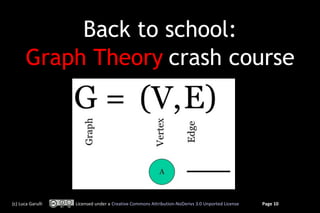
Back to school:
       Graph Theory crash course


(c) Luca Garulli   Licensed under a Creative Commons Attribution-NoDerivs 3.0 Unported License   Page 10
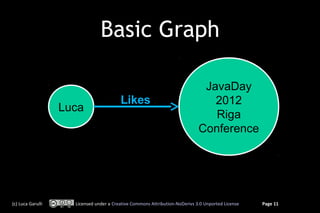
Basic Graph

                                                                              JavaDay
                                                                              JavaDay
                                         Likes                                  2012
                                                                                2012
                   Luca
                   Luca
                                                                                Riga
                                                                                 Riga
                                                                             Conference
                                                                             Conference


(c) Luca Garulli     Licensed under a Creative Commons Attribution-NoDerivs 3.0 Unported License   Page 11
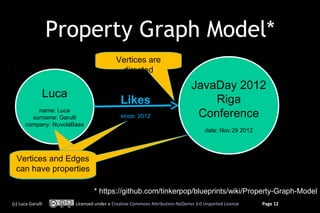
Property Graph Model*
                                         Vertices are
                                          directed
                                                                            JavaDay 2012
                                                                            JavaDay 2012
               Luca
               Luca                                                             Riga
                                           Likes                                 Riga
            name: Luca
             name: Luca
          surname: Garulli
           surname: Garulli                since: 2012                       Conference
                                                                              Conference
       company: NuvolaBase
        company: NuvolaBase
                                                                                  date: Nov 29 2012
                                                                                   date: Nov 29 2012


 Vertices and Edges
 can have properties

                               * https://github.com/tinkerpop/blueprints/wiki/Property-Graph-Model
(c) Luca Garulli       Licensed under a Creative Commons Attribution-NoDerivs 3.0 Unported License     Page 12
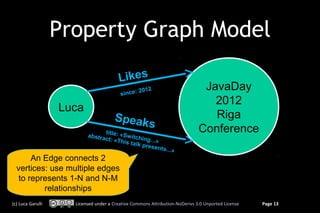
Property Graph Model
                                        Likes
                                         since:
                                                2012                          JavaDay
                                                                              JavaDay
                                                                                2012
                                                                                2012
                   Luca
                   Luca
                                      Speak                                     Riga
                                                                                 Riga
                                            s                                Conference
                                ti
                          abstra tle: «Switch
                                                                             Conference
                                ct: «Th       in
                                       is talk g...»
                                              presen
                                                     ts...»
       An Edge connects 2
  vertices: use multiple edges
   to represents 1-N and N-M
          relationships
(c) Luca Garulli     Licensed under a Creative Commons Attribution-NoDerivs 3.0 Unported License   Page 13
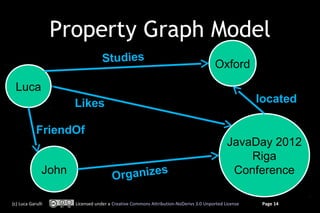
Property Graph Model
                                  Studies                                             Oxford
                                                                                      Oxford
 Luca
 Luca
                      Likes                                                                         located

            FriendOf
                                                                                           JavaDay 2012
                                                                                           JavaDay 2012
                                                                                               Riga
                                                                                                Riga
               John
               John                   Organizes                                             Conference
                                                                                             Conference

(c) Luca Garulli      Licensed under a Creative Commons Attribution-NoDerivs 3.0 Unported License    Page 14
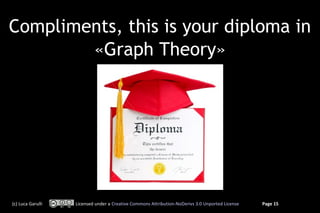
Compliments, this is your diploma in
        «Graph Theory»


(c) Luca Garulli   Licensed under a Creative Commons Attribution-NoDerivs 3.0 Unported License   Page 15
Now go back
       to our domain:
          the CRM
(c) Luca Garulli   Licensed under a Creative Commons Attribution-NoDerivs 3.0 Unported License   Page 16
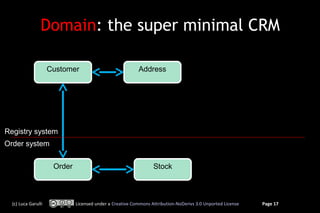
Domain: the super minimal CRM

                     Customer
                     Customer                             Address
                                                          Address


Registry system
Order system


                      Order
                      Order                                      Stock
                                                                 Stock


  (c) Luca Garulli            Licensed under a Creative Commons Attribution-NoDerivs 3.0 Unported License   Page 17
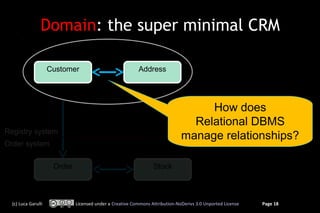
Domain: the super minimal CRM

                     Customer
                     Customer                             Address
                                                          Address


                                                                                   How does
                                                                                Relational DBMS
Registry system
                                                                              manage relationships?
Order system


                      Order
                      Order                                      Stock
                                                                 Stock


  (c) Luca Garulli            Licensed under a Creative Commons Attribution-NoDerivs 3.0 Unported License   Page 18
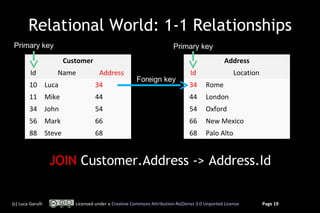
Relational World: 1-1 Relationships
Primary key                                                         Primary key
                     Customer                                                               Address
         Id         Name          Address                                   Id                  Location
                                                   Foreign key
         10 Luca                34                                          34     Rome
         11 Mike                44                                          44     London
         34 John                54                                          54     Oxford
         56 Mark                66                                          66     New Mexico
         88 Steve               68                                          68     Palo Alto


                   JOIN Customer.Address -> Address.Id


(c) Luca Garulli        Licensed under a Creative Commons Attribution-NoDerivs 3.0 Unported License        Page 19
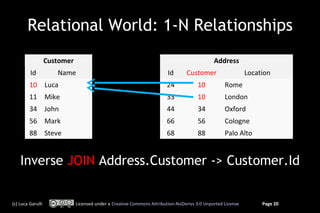
Relational World: 1-N Relationships
                   Customer                                                                  Address
         Id           Name                                              Id      Customer                    Location
         10 Luca                                                       24             10          Rome
         11 Mike                                                       33             10          London
         34 John                                                       44             34          Oxford
         56 Mark                                                       66             56          Cologne
         88 Steve                                                      68             88          Palo Alto


    Inverse JOIN Address.Customer -> Customer.Id


(c) Luca Garulli              Licensed under a Creative Commons Attribution-NoDerivs 3.0 Unported License        Page 20
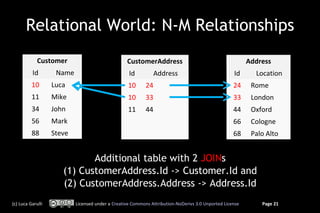
Relational World: N-M Relationships
             Customer                             CustomerAddress                                        Address
          Id        Name                           Id           Address                            Id      Location
          10       Luca                            10      24                                      24     Rome
          11       Mike                            10      33                                      33     London
          34       John                            11      44                                      44     Oxford
          56       Mark                                                                            66     Cologne
          88       Steve                                                                           68     Palo Alto


                             Additional table with 2 JOINs
                      (1) CustomerAddress.Id -> Customer.Id and
                      (2) CustomerAddress.Address -> Address.Id
(c) Luca Garulli           Licensed under a Creative Commons Attribution-NoDerivs 3.0 Unported License       Page 21
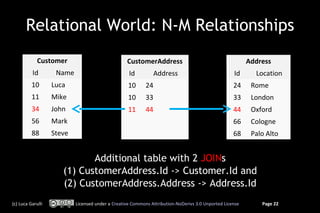
Relational World: N-M Relationships
             Customer                             CustomerAddress                                        Address
          Id        Name                           Id           Address                            Id      Location
          10       Luca                            10      24                                      24     Rome
          11       Mike                            10      33                                      33     London
          34       John                            11      44                                      44     Oxford
          56       Mark                                                                            66     Cologne
          88       Steve                                                                           68     Palo Alto


                             Additional table with 2 JOINs
                      (1) CustomerAddress.Id -> Customer.Id and
                      (2) CustomerAddress.Address -> Address.Id
(c) Luca Garulli           Licensed under a Creative Commons Attribution-NoDerivs 3.0 Unported License       Page 22
What’s wrong with the
                     Relational Model?


(c) Luca Garulli     Licensed under a Creative Commons Attribution-NoDerivs 3.0 Unported License   Page 23
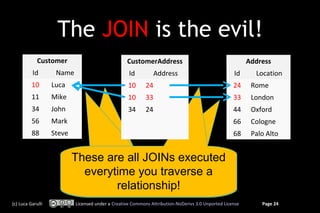
The JOIN is the evil!
             Customer                             CustomerAddress                                        Address
          Id        Name                           Id           Address                            Id      Location
          10       Luca                            10      24                                      24     Rome
          11       Mike                            10      33                                      33     London
          34       John                            34      24                                      44     Oxford
          56       Mark                                                                            66     Cologne
          88       Steve                                                                           68     Palo Alto


                           These are all JOINs executed
                             everytime you traverse a
                                   relationship!
                                    relationship
(c) Luca Garulli           Licensed under a Creative Commons Attribution-NoDerivs 3.0 Unported License       Page 24
A JOIN means searching for a key in
                  another table

   The first rule to improve performance
           is indexing all the keys

Index speeds up searches, but slows down
       insert, updates and deletes
 (c) Luca Garulli   Licensed under a Creative Commons Attribution-NoDerivs 3.0 Unported License   Page 25
So in the best case a JOIN is a lookup
                into an index

                   This is done per single join!

If you traverse hundreds of relationships
    you’re executing hundreds of JOINs

(c) Luca Garulli     Licensed under a Creative Commons Attribution-NoDerivs 3.0 Unported License   Page 26
Index Lookup
            is it really that fast?

(c) Luca Garulli   Licensed under a Creative Commons Attribution-NoDerivs 3.0 Unported License   Page 27
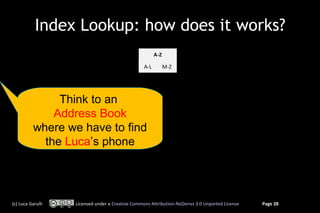
Index Lookup: how does it works?
                                                        A-Z

                                                  A-L         M-Z


                Think to an
               Address Book
           where we have to find
             the Luca’s phone
                  number


(c) Luca Garulli   Licensed under a Creative Commons Attribution-NoDerivs 3.0 Unported License   Page 28
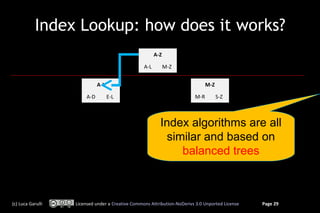
Index Lookup: how does it works?
                                                        A-Z

                                                  A-L         M-Z


                              A-L                                              M-Z

                        A-D         E-L                                  M-R         S-Z


                                                          Index algorithms are all
                                                           similar and based on
                                                              balanced trees


(c) Luca Garulli   Licensed under a Creative Commons Attribution-NoDerivs 3.0 Unported License   Page 29
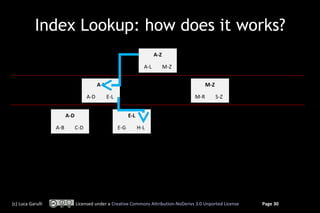
Index Lookup: how does it works?
                                                                           A-Z

                                                                     A-L         M-Z


                                           A-L                                               M-Z

                                     A-D         E-L                                   M-R         S-Z


                         A-D                                 E-L

                   A-B         C-D                     E-G         H-L


(c) Luca Garulli               Licensed under a Creative Commons Attribution-NoDerivs 3.0 Unported License   Page 30
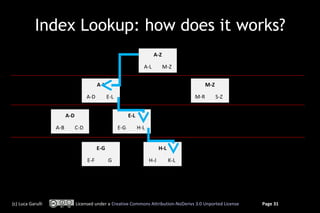
Index Lookup: how does it works?
                                                                           A-Z

                                                                     A-L         M-Z


                                           A-L                                                   M-Z

                                     A-D         E-L                                       M-R         S-Z


                         A-D                                 E-L

                   A-B         C-D                     E-G         H-L


                                           E-G                                 H-L

                                     E-F         G                       H-J         K-L


(c) Luca Garulli               Licensed under a Creative Commons Attribution-NoDerivs 3.0 Unported License   Page 31
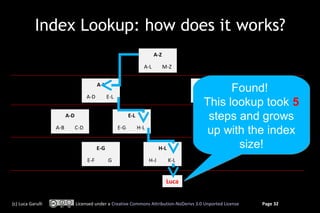
Index Lookup: how does it works?
                                                                           A-Z

                                                                     A-L         M-Z


                                           A-L                                               M-Z
                                                                                                    Found!
                                     A-D         E-L                                       M-R  S-Z
                                                                                              This lookup took 5
                         A-D                                 E-L                               steps and grows
                   A-B         C-D                     E-G         H-L
                                                                                               up with the index
                                           E-G                                 H-L                   size!
                                     E-F         G                       H-J         K-L


                                                                                  Luca


(c) Luca Garulli               Licensed under a Creative Commons Attribution-NoDerivs 3.0 Unported License   Page 32
An index lookup is executed
                          for each JOIN

  Querying more tables can easily
produce millions of JOINs/Lookups!

      Here the rule: more entries
   = more lookup steps = slower JOIN
(c) Luca Garulli      Licensed under a Creative Commons Attribution-NoDerivs 3.0 Unported License   Page 33
Oh! This is why
 performance of my database
       drops down when
      it becomes bigger,
          and bigger,
          and bigger!
(c) Luca Garulli   Licensed under a Creative Commons Attribution-NoDerivs 3.0 Unported License   Page 34
Is there a better way to
               manage relationships?


(c) Luca Garulli   Licensed under a Creative Commons Attribution-NoDerivs 3.0 Unported License   Page 35
“A graph database is any
                storage system
                 that provides
            index-free adjacency”
                                                                    - Marko Rodriguez

(c) Luca Garulli   Licensed under a Creative Commons Attribution-NoDerivs 3.0 Unported License   Page 36
How does GraphDB manage
      index-free relationships?


(c) Luca Garulli   Licensed under a Creative Commons Attribution-NoDerivs 3.0 Unported License   Page 37
an Open Source (Apache licensed)
            document-graph NoSQL dbms
(c) Luca Garulli   Licensed under a Creative Commons Attribution-NoDerivs 3.0 Unported License   Page 38
Ø config
          download, unzip, run!
       cut & paste the db directory
(c) Luca Garulli   Licensed under a Creative Commons Attribution-NoDerivs 3.0 Unported License   Page 39
150,000        records per second
                   (flat records, no index, on commodity hw)


(c) Luca Garulli     Licensed under a Creative Commons Attribution-NoDerivs 3.0 Unported License   Page 40
Schema-less
 schema is not mandatory, relaxed model,
collect heterogeneous documents all together


(c) Luca Garulli   Licensed under a Creative Commons Attribution-NoDerivs 3.0 Unported License   Page 41
Schema-full
schema with        constraints on fields and validation rules

                    Customer.age > 17
                 Customer.address not null
             Customer.surname is mandatory
  Customer.email matches 'b[A-Z0-9._%+-]+@[A-Z0-9.-]+.[A-Z]{2,4}b'


(c) Luca Garulli   Licensed under a Creative Commons Attribution-NoDerivs 3.0 Unported License   Page 42
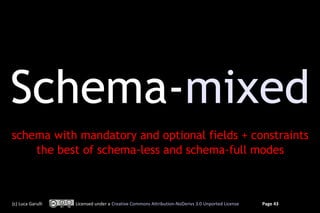
Schema-mixed
schema with mandatory and optional fields + constraints
    the best of schema-less and schema-full modes


(c) Luca Garulli   Licensed under a Creative Commons Attribution-NoDerivs 3.0 Unported License   Page 43
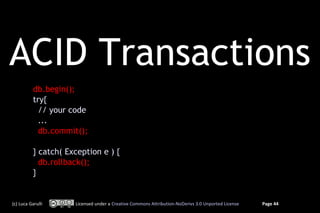
ACID Transactions
           db.begin();
           try{
             // your code
             ...
             db.commit();

           } catch( Exception e ) {
             db.rollback();
           }


(c) Luca Garulli      Licensed under a Creative Commons Attribution-NoDerivs 3.0 Unported License   Page 44
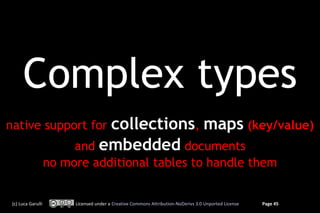
Complex types
native support for            collections, maps (key/value)
                         and embedded documents
                    no more additional tables to handle them


 (c) Luca Garulli        Licensed under a Creative Commons Attribution-NoDerivs 3.0 Unported License   Page 45
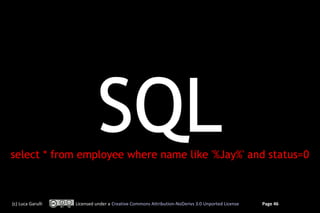
SQL
select * from employee where name like '%Jay%' and status=0


(c) Luca Garulli   Licensed under a Creative Commons Attribution-NoDerivs 3.0 Unported License   Page 46
runs
                    Java
                   everywhere is available JRE1.6+
                                                                                       ®
                        robust engine
(c) Luca Garulli     Licensed under a Creative Commons Attribution-NoDerivs 3.0 Unported License   Page 47
Language bindings
                              Java as native

               JRuby, PHP, C, C++, Scala, .NET,
                    Ruby, Clojure, Node.js,
                 Python, Javascript and more!

(c) Luca Garulli   Licensed under a Creative Commons Attribution-NoDerivs 3.0 Unported License   Page 48
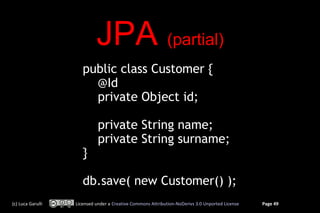
JPA (partial)
                      public class Customer {
                        @Id
                        private Object id;

                             private String name;
                             private String surname;
                      }

                      db.save( new Customer() );
(c) Luca Garulli   Licensed under a Creative Commons Attribution-NoDerivs 3.0 Unported License   Page 49
Born for the Internet
     Supports natively HTTP/RESTful protocol
        Documents are transferred in JSON


(c) Luca Garulli     Licensed under a Creative Commons Attribution-NoDerivs 3.0 Unported License   Page 50
MVRB-Tree                                                             index

         the best of B+Tree and RB-Tree
       fast on browsing, low insertion cost
               it's a new algorithm!

(c) Luca Garulli    Licensed under a Creative Commons Attribution-NoDerivs 3.0 Unported License   Page 51
Security
    users and roles, encrypted passwords
             fine grain privileges
       (similar to what RDBMSs offer)

(c) Luca Garulli   Licensed under a Creative Commons Attribution-NoDerivs 3.0 Unported License   Page 52
Cache
                   You can avoid using 3°party caches
                            like Memcached

                            2 Levels of cache:
                   Level1: Database level, 1 per thread
                     Level2: Storage level, 1 per JVM
(c) Luca Garulli       Licensed under a Creative Commons Attribution-NoDerivs 3.0 Unported License   Page 53
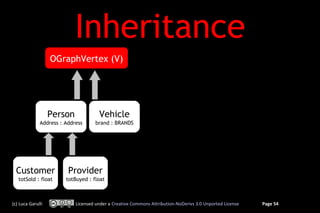
Inheritance
                   OGraphVertex (V)


                   Person             Vehicle
              Address : Address      brand : BRANDS


  Customer               Provider
   totSold : float      totBuyed : float


(c) Luca Garulli            Licensed under a Creative Commons Attribution-NoDerivs 3.0 Unported License   Page 54
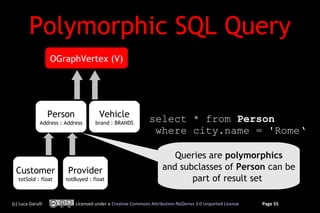
Polymorphic SQL Query
                   OGraphVertex (V)


                   Person             Vehicle
              Address : Address      brand : BRANDS
                                                             select * from Person
                                                              where city.name = 'Rome‘

                                                                      Queries are polymorphics
  Customer               Provider                                  and subclasses of Person can be
   totSold : float      totBuyed : float                                  part of result set

(c) Luca Garulli            Licensed under a Creative Commons Attribution-NoDerivs 3.0 Unported License   Page 55
Let’s go back
                   to the Graph Stuff

             How does OrientDB
            manage relationships?
(c) Luca Garulli    Licensed under a Creative Commons Attribution-NoDerivs 3.0 Unported License   Page 56
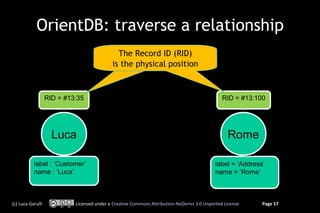
OrientDB: traverse a relationship
                                             The Record ID (RID)
                                           is the physical position


                   RID = #13:35
                   RID = #13:35                                                               RID = #13:100
                                                                                              RID = #13:100


                     Luca
                     Luca                                                                       Rome
                                                                                                Rome

           label : :‘Customer’
            label ‘Customer’                                                               label = ‘Address’
                                                                                            label = ‘Address’
           name : :‘Luca’
            name ‘Luca’                                                                    name = ‘Rome’
                                                                                            name = ‘Rome’


(c) Luca Garulli           Licensed under a Creative Commons Attribution-NoDerivs 3.0 Unported License     Page 57
OrientDB: traverse a relationship
                                          The Edge’s RID is saved
                                          inside both vertices, as
                                               «out» and «in»

                   RID = #13:35
                   RID = #13:35                                                               RID = #13:100
                                                                                              RID = #13:100
                                                    RID = #14:54
                                                    RID = #14:54


                                                       Lives
                     Luca
                     Luca                                                                       Rome
                                                                                                Rome
                                                out: [#13:35]
                                                 out: [#13:35]
                                                in: [#13:100]
                                                 in: [#13:100]
           out ::[#14:54]                       Label : :‘Lives’
                                                 Label ‘Lives’                             in: [#14:54]
            out [#14:54]                                                                    in: [#14:54]
           label : :‘Customer’
            label ‘Customer’                                                               label = ‘Address’
                                                                                            label = ‘Address’
           name : :‘Luca’
            name ‘Luca’                                                                    name = ‘Rome’
                                                                                            name = ‘Rome’


(c) Luca Garulli           Licensed under a Creative Commons Attribution-NoDerivs 3.0 Unported License     Page 58
OrientDB: traverse a relationship


                   RID = #13:35
                   RID = #13:35                                                               RID = #13:100
                                                                                              RID = #13:100
                                                    RID = #14:54
                                                    RID = #14:54


                                                       Lives
                     Luca
                     Luca                                                                       Rome
                                                                                                Rome
                                                out: [#13:35]
                                                 out: [#13:35]
                                                in: [#13:100]
                                                 in: [#13:100]
           out ::[#14:54]                       Label : :‘Lives’
                                                 Label ‘Lives’                             in: [#14:54]
            out [#14:54]                                                                    in: [#14:54]
           label : :‘Customer’
            label ‘Customer’                                                               label = ‘Address’
                                                                                            label = ‘Address’
           name : :‘Luca’
            name ‘Luca’                                                                    name = ‘Rome’
                                                                                            name = ‘Rome’


(c) Luca Garulli           Licensed under a Creative Commons Attribution-NoDerivs 3.0 Unported License     Page 59
OrientDB: traverse a relationship


                   RID = #13:35
                   RID = #13:35                                                               RID = #13:100
                                                                                              RID = #13:100
                                                    RID = #14:54
                                                    RID = #14:54


                                                       Lives
                     Luca
                     Luca                                                                       Rome
                                                                                                Rome
                                                out: [#13:35]
                                                 out: [#13:35]
                                                in: [#13:100]
                                                 in: [#13:100]
           out ::[#14:54]                       Label : :‘Lives’
                                                 Label ‘Lives’                             in: [#14:54]
            out [#14:54]                                                                    in: [#14:54]
           label : :‘Customer’
            label ‘Customer’                                                               label = ‘Address’
                                                                                            label = ‘Address’
           name : :‘Luca’
            name ‘Luca’                                                                    name = ‘Rome’
                                                                                            name = ‘Rome’


(c) Luca Garulli           Licensed under a Creative Commons Attribution-NoDerivs 3.0 Unported License     Page 60
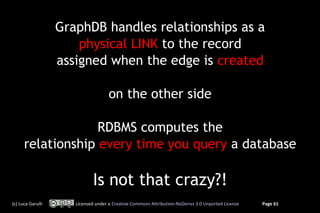
GraphDB handles relationships as a
                       physical LINK to the record
                   assigned when the edge is created

                                     on the other side

                   RDBMS computes the
      relationship every time you query a database

                             Is not that crazy?!
(c) Luca Garulli      Licensed under a Creative Commons Attribution-NoDerivs 3.0 Unported License   Page 61
This means jumping from a
                   O(log N) algorithm to a near O(1)

              traversing cost is not more affected
                       by database size!

                    This is huge in the BigData age

(c) Luca Garulli       Licensed under a Creative Commons Attribution-NoDerivs 3.0 Unported License   Page 62
OrientDB in the Blueprints micro-benchmark,
           on common hw, with a hot cache,
                       traverses 29,6 Millions
             of records in less than 5 seconds

   about 6 Millions of nodes traversed per sec!
                   Do not try this at home
                       with a RDBMS*!


                                          *unless you live in the Google’s server farm
(c) Luca Garulli       Licensed under a Creative Commons Attribution-NoDerivs 3.0 Unported License   Page 63
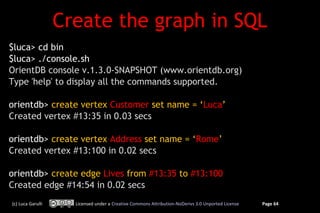
Create the graph in SQL
$luca> cd bin
$luca> ./console.sh
OrientDB console v.1.3.0-SNAPSHOT (www.orientdb.org)
Type 'help' to display all the commands supported.

orientdb> create vertex Customer set name = ‘Luca’
Created vertex #13:35 in 0.03 secs

orientdb> create vertex Address set name = ‘Rome’
Created vertex #13:100 in 0.02 secs

orientdb> create edge Lives from #13:35 to #13:100
Created edge #14:54 in 0.02 secs
(c) Luca Garulli     Licensed under a Creative Commons Attribution-NoDerivs 3.0 Unported License   Page 64
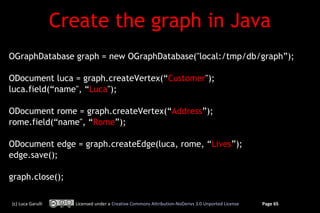
Create the graph in Java
OGraphDatabase graph = new OGraphDatabase("local:/tmp/db/graph”);

ODocument luca = graph.createVertex(“Customer");
luca.field(“name", “Luca");

ODocument rome = graph.createVertex(“Address”);
rome.field(“name", “Rome”);

ODocument edge = graph.createEdge(luca, rome, “Lives”);
edge.save();

graph.close();

(c) Luca Garulli     Licensed under a Creative Commons Attribution-NoDerivs 3.0 Unported License   Page 65
Query the graph in SQL

orientdb> select in.out from Address where name = ‘Rome’
---+------+---------|--------------------+--------------------+--------+
  #| RID |@class    |label               |out                 |in      |
---+------+---------+--------------------+--------------------+--------+
  0| 13:35|Customer |Luca                |[#14:54]            |        |
---+------+---------+--------------------+--------------------+--------+
1 item(s) found. Query executed in 0.007 sec(s).


                                                                                Incoming vertices


(c) Luca Garulli     Licensed under a Creative Commons Attribution-NoDerivs 3.0 Unported License   Page 66
More on query power
orientdb> select sum( out.in[@class=‘Order’].total ) from Customer
                 where name = ‘Luca’


orientdb> traverse Customer.out, Friend.in from Customer
                               while $depth <= 7


orientdb> select from (
            traverse Customer.out, Friend.in from Customer
                               while $depth <= 7
           ) where @class=‘Customer’ and city.name = ‘Riga’

(c) Luca Garulli    Licensed under a Creative Commons Attribution-NoDerivs 3.0 Unported License   Page 67
Query vs traversal

Once you’ve a well connected database
 in the form of a Super Graph you can
 cross records instead of query them!

           All you need is some root vertices
                where to start traversing
(c) Luca Garulli   Licensed under a Creative Commons Attribution-NoDerivs 3.0 Unported License   Page 68
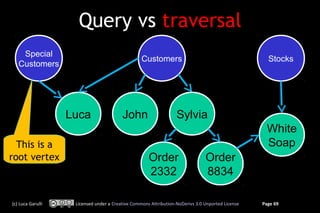
Query vs traversal
    Special
     Special
                                                  Customers
                                                  Customers                                         Stocks
                                                                                                    Stocks
   Customers
   Customers


                   Luca
                   Luca                  John
                                         John                     Sylvia
                                                                  Sylvia
                                                                                                   White
                                                                                                   White
  This is a                                                                                        Soap
                                                                                                   Soap
root vertex                                          Order
                                                     Order                     Order
                                                                               Order
                                                     2332
                                                     2332                      8834
                                                                               8834

(c) Luca Garulli    Licensed under a Creative Commons Attribution-NoDerivs 3.0 Unported License   Page 69
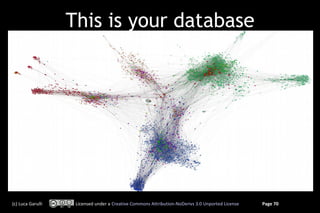
This is your database


(c) Luca Garulli    Licensed under a Creative Commons Attribution-NoDerivs 3.0 Unported License   Page 70
Get last customer bought Whisky
  select last(out.in[@class=‘Order’].out.in[@class=‘Customer’]) from Stock
     where name = ‘Whisky’


(c) Luca Garulli   Licensed under a Creative Commons Attribution-NoDerivs 3.0 Unported License   Page 71
Get it’s country


                                                  select out.in[@class=‘city’] from #34:22
                   Riga, Latvia


(c) Luca Garulli    Licensed under a Creative Commons Attribution-NoDerivs 3.0 Unported License   Page 72
Get orders from that country


     select in.out[@class=‘Customer’] from #55:12


(c) Luca Garulli   Licensed under a Creative Commons Attribution-NoDerivs 3.0 Unported License   Page 73
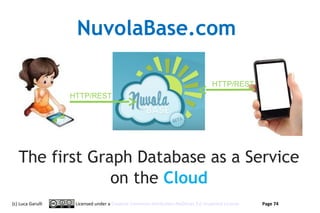
NuvolaBase.com

                                                                                  HTTP/REST
                   HTTP/REST


   The first Graph Database as a Service
                on the Cloud
(c) Luca Garulli    Licensed under a Creative Commons Attribution-NoDerivs 3.0 Unported License   Page 74
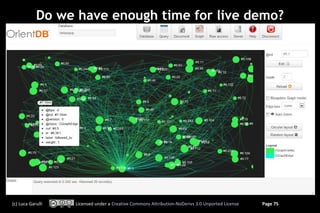
Do we have enough time for live demo?


(c) Luca Garulli   Licensed under a Creative Commons Attribution-NoDerivs 3.0 Unported License   Page 75
Questions & (maybe) Answers
                                    Luca Garulli
                                                                          CEO at

           Document-Graph NoSQL
             Open Source project
                                                                                      Ltd, London UK

                   www.twitter.com/lgarulli
                                                                             Conclusion as last ->
(c) Luca Garulli    Licensed under a Creative Commons Attribution-NoDerivs 3.0 Unported License   Page 76
Summary
           1)JOIN is heavy, specially on large databases

                       2)GraphDB uses LINK as
                      direct pointers to records:
                   times from O(log)N to near O(1)
                        = ready for the BigData

      3) GraphDB has a query language specialized to
                  traverse relationships
(c) Luca Garulli    Licensed under a Creative Commons Attribution-NoDerivs 3.0 Unported License   Page 77
Let’s move like a
     Spider
   on the web


 (c) Luca Garulli   Licensed under a Creative Commons Attribution-NoDerivs 3.0 Unported License   Page 78

Switching from Relational to the Graph model v1.3

  • 1.
    Switching from the Relational to the Graph model Luca Garulli – Founder and CEO @NuvolaBase Ltd Author of OrientDB Doc/Graph DB Nov 29th 2012 in Riga, Latvia (c) Luca Garulli Licensed under a Creative Commons Attribution-NoDerivs 3.0 Unported License Page 1 www.orientechnologies.com
  • 2.
    Agenda 12:30 “Switching from the Relational to the Graph model” 13:30 Lunch time! (c) Luca Garulli Licensed under a Creative Commons Attribution-NoDerivs 3.0 Unported License Page 2
  • 3.
    Agenda 12:30 You’re here! “Switching from the Relational to the Graph model” 13:30 Lunch time! (c) Luca Garulli Licensed under a Creative Commons Attribution-NoDerivs 3.0 Unported License Page 3
  • 4.
    One of themain resistances of RDBMS users to pass to a NoSQL product are related to the complexity of the model: Ok, NoSQL products are super for BigData and BigScale but... (c) Luca Garulli Licensed under a Creative Commons Attribution-NoDerivs 3.0 Unported License Page 4
  • 5.
    ...what about themodel? (c) Luca Garulli Licensed under a Creative Commons Attribution-NoDerivs 3.0 Unported License Page 5
  • 6.
    What is theNoSQL answer about managing complex domains? Key-Value stores ? Column-Based ? Document database ? Graph database ! (c) Luca Garulli Licensed under a Creative Commons Attribution-NoDerivs 3.0 Unported License Page 6
  • 7.
    CAUTION! This presentation will not use a social like domain with the classic paradigm of friend-of-friendN where the graph databases are already widely used... (c) Luca Garulli Licensed under a Creative Commons Attribution-NoDerivs 3.0 Unported License Page 7
  • 8.
    ...But rather wewill explore how to think «graphically» with one of the most common domains in the enterprise world: The old-classic CRM* domain * today in 99% of the cases a RDBMS is used (c) Luca Garulli Licensed under a Creative Commons Attribution-NoDerivs 3.0 Unported License Page 8
  • 9.
    Every developer knows the Relational Model, but who knows the Graph one? (c) Luca Garulli Licensed under a Creative Commons Attribution-NoDerivs 3.0 Unported License Page 9
  • 10.
    Back to school: Graph Theory crash course (c) Luca Garulli Licensed under a Creative Commons Attribution-NoDerivs 3.0 Unported License Page 10
  • 11.
    Basic Graph JavaDay JavaDay Likes 2012 2012 Luca Luca Riga Riga Conference Conference (c) Luca Garulli Licensed under a Creative Commons Attribution-NoDerivs 3.0 Unported License Page 11
  • 12.
    Property Graph Model* Vertices are directed JavaDay 2012 JavaDay 2012 Luca Luca Riga Likes Riga name: Luca name: Luca surname: Garulli surname: Garulli since: 2012 Conference Conference company: NuvolaBase company: NuvolaBase date: Nov 29 2012 date: Nov 29 2012 Vertices and Edges can have properties * https://github.com/tinkerpop/blueprints/wiki/Property-Graph-Model (c) Luca Garulli Licensed under a Creative Commons Attribution-NoDerivs 3.0 Unported License Page 12
  • 13.
    Property Graph Model Likes since: 2012 JavaDay JavaDay 2012 2012 Luca Luca Speak Riga Riga s Conference ti abstra tle: «Switch Conference ct: «Th in is talk g...» presen ts...» An Edge connects 2 vertices: use multiple edges to represents 1-N and N-M relationships (c) Luca Garulli Licensed under a Creative Commons Attribution-NoDerivs 3.0 Unported License Page 13
  • 14.
    Property Graph Model Studies Oxford Oxford Luca Luca Likes located FriendOf JavaDay 2012 JavaDay 2012 Riga Riga John John Organizes Conference Conference (c) Luca Garulli Licensed under a Creative Commons Attribution-NoDerivs 3.0 Unported License Page 14
  • 15.
    Compliments, this isyour diploma in «Graph Theory» (c) Luca Garulli Licensed under a Creative Commons Attribution-NoDerivs 3.0 Unported License Page 15
  • 16.
    Now go back to our domain: the CRM (c) Luca Garulli Licensed under a Creative Commons Attribution-NoDerivs 3.0 Unported License Page 16
  • 17.
    Domain: the superminimal CRM Customer Customer Address Address Registry system Order system Order Order Stock Stock (c) Luca Garulli Licensed under a Creative Commons Attribution-NoDerivs 3.0 Unported License Page 17
  • 18.
    Domain: the superminimal CRM Customer Customer Address Address How does Relational DBMS Registry system manage relationships? Order system Order Order Stock Stock (c) Luca Garulli Licensed under a Creative Commons Attribution-NoDerivs 3.0 Unported License Page 18
  • 19.
    Relational World: 1-1Relationships Primary key Primary key Customer Address Id Name Address Id Location Foreign key 10 Luca 34 34 Rome 11 Mike 44 44 London 34 John 54 54 Oxford 56 Mark 66 66 New Mexico 88 Steve 68 68 Palo Alto JOIN Customer.Address -> Address.Id (c) Luca Garulli Licensed under a Creative Commons Attribution-NoDerivs 3.0 Unported License Page 19
  • 20.
    Relational World: 1-NRelationships Customer Address Id Name Id Customer Location 10 Luca 24 10 Rome 11 Mike 33 10 London 34 John 44 34 Oxford 56 Mark 66 56 Cologne 88 Steve 68 88 Palo Alto Inverse JOIN Address.Customer -> Customer.Id (c) Luca Garulli Licensed under a Creative Commons Attribution-NoDerivs 3.0 Unported License Page 20
  • 21.
    Relational World: N-MRelationships Customer CustomerAddress Address Id Name Id Address Id Location 10 Luca 10 24 24 Rome 11 Mike 10 33 33 London 34 John 11 44 44 Oxford 56 Mark 66 Cologne 88 Steve 68 Palo Alto Additional table with 2 JOINs (1) CustomerAddress.Id -> Customer.Id and (2) CustomerAddress.Address -> Address.Id (c) Luca Garulli Licensed under a Creative Commons Attribution-NoDerivs 3.0 Unported License Page 21
  • 22.
    Relational World: N-MRelationships Customer CustomerAddress Address Id Name Id Address Id Location 10 Luca 10 24 24 Rome 11 Mike 10 33 33 London 34 John 11 44 44 Oxford 56 Mark 66 Cologne 88 Steve 68 Palo Alto Additional table with 2 JOINs (1) CustomerAddress.Id -> Customer.Id and (2) CustomerAddress.Address -> Address.Id (c) Luca Garulli Licensed under a Creative Commons Attribution-NoDerivs 3.0 Unported License Page 22
  • 23.
    What’s wrong withthe Relational Model? (c) Luca Garulli Licensed under a Creative Commons Attribution-NoDerivs 3.0 Unported License Page 23
  • 24.
    The JOIN isthe evil! Customer CustomerAddress Address Id Name Id Address Id Location 10 Luca 10 24 24 Rome 11 Mike 10 33 33 London 34 John 34 24 44 Oxford 56 Mark 66 Cologne 88 Steve 68 Palo Alto These are all JOINs executed everytime you traverse a relationship! relationship (c) Luca Garulli Licensed under a Creative Commons Attribution-NoDerivs 3.0 Unported License Page 24
  • 25.
    A JOIN meanssearching for a key in another table The first rule to improve performance is indexing all the keys Index speeds up searches, but slows down insert, updates and deletes (c) Luca Garulli Licensed under a Creative Commons Attribution-NoDerivs 3.0 Unported License Page 25
  • 26.
    So in thebest case a JOIN is a lookup into an index This is done per single join! If you traverse hundreds of relationships you’re executing hundreds of JOINs (c) Luca Garulli Licensed under a Creative Commons Attribution-NoDerivs 3.0 Unported License Page 26
  • 27.
    Index Lookup is it really that fast? (c) Luca Garulli Licensed under a Creative Commons Attribution-NoDerivs 3.0 Unported License Page 27
  • 28.
    Index Lookup: howdoes it works? A-Z A-L M-Z Think to an Address Book where we have to find the Luca’s phone number (c) Luca Garulli Licensed under a Creative Commons Attribution-NoDerivs 3.0 Unported License Page 28
  • 29.
    Index Lookup: howdoes it works? A-Z A-L M-Z A-L M-Z A-D E-L M-R S-Z Index algorithms are all similar and based on balanced trees (c) Luca Garulli Licensed under a Creative Commons Attribution-NoDerivs 3.0 Unported License Page 29
  • 30.
    Index Lookup: howdoes it works? A-Z A-L M-Z A-L M-Z A-D E-L M-R S-Z A-D E-L A-B C-D E-G H-L (c) Luca Garulli Licensed under a Creative Commons Attribution-NoDerivs 3.0 Unported License Page 30
  • 31.
    Index Lookup: howdoes it works? A-Z A-L M-Z A-L M-Z A-D E-L M-R S-Z A-D E-L A-B C-D E-G H-L E-G H-L E-F G H-J K-L (c) Luca Garulli Licensed under a Creative Commons Attribution-NoDerivs 3.0 Unported License Page 31
  • 32.
    Index Lookup: howdoes it works? A-Z A-L M-Z A-L M-Z Found! A-D E-L M-R S-Z This lookup took 5 A-D E-L steps and grows A-B C-D E-G H-L up with the index E-G H-L size! E-F G H-J K-L Luca (c) Luca Garulli Licensed under a Creative Commons Attribution-NoDerivs 3.0 Unported License Page 32
  • 33.
    An index lookupis executed for each JOIN Querying more tables can easily produce millions of JOINs/Lookups! Here the rule: more entries = more lookup steps = slower JOIN (c) Luca Garulli Licensed under a Creative Commons Attribution-NoDerivs 3.0 Unported License Page 33
  • 34.
    Oh! This iswhy performance of my database drops down when it becomes bigger, and bigger, and bigger! (c) Luca Garulli Licensed under a Creative Commons Attribution-NoDerivs 3.0 Unported License Page 34
  • 35.
    Is there abetter way to manage relationships? (c) Luca Garulli Licensed under a Creative Commons Attribution-NoDerivs 3.0 Unported License Page 35
  • 36.
    “A graph databaseis any storage system that provides index-free adjacency” - Marko Rodriguez (c) Luca Garulli Licensed under a Creative Commons Attribution-NoDerivs 3.0 Unported License Page 36
  • 37.
    How does GraphDBmanage index-free relationships? (c) Luca Garulli Licensed under a Creative Commons Attribution-NoDerivs 3.0 Unported License Page 37
  • 38.
    an Open Source(Apache licensed) document-graph NoSQL dbms (c) Luca Garulli Licensed under a Creative Commons Attribution-NoDerivs 3.0 Unported License Page 38
  • 39.
    Ø config download, unzip, run! cut & paste the db directory (c) Luca Garulli Licensed under a Creative Commons Attribution-NoDerivs 3.0 Unported License Page 39
  • 40.
    150,000 records per second (flat records, no index, on commodity hw) (c) Luca Garulli Licensed under a Creative Commons Attribution-NoDerivs 3.0 Unported License Page 40
  • 41.
    Schema-less schema isnot mandatory, relaxed model, collect heterogeneous documents all together (c) Luca Garulli Licensed under a Creative Commons Attribution-NoDerivs 3.0 Unported License Page 41
  • 42.
    Schema-full schema with constraints on fields and validation rules Customer.age > 17 Customer.address not null Customer.surname is mandatory Customer.email matches 'b[A-Z0-9._%+-]+@[A-Z0-9.-]+.[A-Z]{2,4}b' (c) Luca Garulli Licensed under a Creative Commons Attribution-NoDerivs 3.0 Unported License Page 42
  • 43.
    Schema-mixed schema with mandatoryand optional fields + constraints the best of schema-less and schema-full modes (c) Luca Garulli Licensed under a Creative Commons Attribution-NoDerivs 3.0 Unported License Page 43
  • 44.
    ACID Transactions db.begin(); try{ // your code ... db.commit(); } catch( Exception e ) { db.rollback(); } (c) Luca Garulli Licensed under a Creative Commons Attribution-NoDerivs 3.0 Unported License Page 44
  • 45.
    Complex types native supportfor collections, maps (key/value) and embedded documents no more additional tables to handle them (c) Luca Garulli Licensed under a Creative Commons Attribution-NoDerivs 3.0 Unported License Page 45
  • 46.
    SQL select * fromemployee where name like '%Jay%' and status=0 (c) Luca Garulli Licensed under a Creative Commons Attribution-NoDerivs 3.0 Unported License Page 46
  • 47.
    runs Java everywhere is available JRE1.6+ ® robust engine (c) Luca Garulli Licensed under a Creative Commons Attribution-NoDerivs 3.0 Unported License Page 47
  • 48.
    Language bindings Java as native JRuby, PHP, C, C++, Scala, .NET, Ruby, Clojure, Node.js, Python, Javascript and more! (c) Luca Garulli Licensed under a Creative Commons Attribution-NoDerivs 3.0 Unported License Page 48
  • 49.
    JPA (partial) public class Customer { @Id private Object id; private String name; private String surname; } db.save( new Customer() ); (c) Luca Garulli Licensed under a Creative Commons Attribution-NoDerivs 3.0 Unported License Page 49
  • 50.
    Born for theInternet Supports natively HTTP/RESTful protocol Documents are transferred in JSON (c) Luca Garulli Licensed under a Creative Commons Attribution-NoDerivs 3.0 Unported License Page 50
  • 51.
    MVRB-Tree index the best of B+Tree and RB-Tree fast on browsing, low insertion cost it's a new algorithm! (c) Luca Garulli Licensed under a Creative Commons Attribution-NoDerivs 3.0 Unported License Page 51
  • 52.
    Security users and roles, encrypted passwords fine grain privileges (similar to what RDBMSs offer) (c) Luca Garulli Licensed under a Creative Commons Attribution-NoDerivs 3.0 Unported License Page 52
  • 53.
    Cache You can avoid using 3°party caches like Memcached 2 Levels of cache: Level1: Database level, 1 per thread Level2: Storage level, 1 per JVM (c) Luca Garulli Licensed under a Creative Commons Attribution-NoDerivs 3.0 Unported License Page 53
  • 54.
    Inheritance OGraphVertex (V) Person Vehicle Address : Address brand : BRANDS Customer Provider totSold : float totBuyed : float (c) Luca Garulli Licensed under a Creative Commons Attribution-NoDerivs 3.0 Unported License Page 54
  • 55.
    Polymorphic SQL Query OGraphVertex (V) Person Vehicle Address : Address brand : BRANDS select * from Person where city.name = 'Rome‘ Queries are polymorphics Customer Provider and subclasses of Person can be totSold : float totBuyed : float part of result set (c) Luca Garulli Licensed under a Creative Commons Attribution-NoDerivs 3.0 Unported License Page 55
  • 56.
    Let’s go back to the Graph Stuff How does OrientDB manage relationships? (c) Luca Garulli Licensed under a Creative Commons Attribution-NoDerivs 3.0 Unported License Page 56
  • 57.
    OrientDB: traverse arelationship The Record ID (RID) is the physical position RID = #13:35 RID = #13:35 RID = #13:100 RID = #13:100 Luca Luca Rome Rome label : :‘Customer’ label ‘Customer’ label = ‘Address’ label = ‘Address’ name : :‘Luca’ name ‘Luca’ name = ‘Rome’ name = ‘Rome’ (c) Luca Garulli Licensed under a Creative Commons Attribution-NoDerivs 3.0 Unported License Page 57
  • 58.
    OrientDB: traverse arelationship The Edge’s RID is saved inside both vertices, as «out» and «in» RID = #13:35 RID = #13:35 RID = #13:100 RID = #13:100 RID = #14:54 RID = #14:54 Lives Luca Luca Rome Rome out: [#13:35] out: [#13:35] in: [#13:100] in: [#13:100] out ::[#14:54] Label : :‘Lives’ Label ‘Lives’ in: [#14:54] out [#14:54] in: [#14:54] label : :‘Customer’ label ‘Customer’ label = ‘Address’ label = ‘Address’ name : :‘Luca’ name ‘Luca’ name = ‘Rome’ name = ‘Rome’ (c) Luca Garulli Licensed under a Creative Commons Attribution-NoDerivs 3.0 Unported License Page 58
  • 59.
    OrientDB: traverse arelationship RID = #13:35 RID = #13:35 RID = #13:100 RID = #13:100 RID = #14:54 RID = #14:54 Lives Luca Luca Rome Rome out: [#13:35] out: [#13:35] in: [#13:100] in: [#13:100] out ::[#14:54] Label : :‘Lives’ Label ‘Lives’ in: [#14:54] out [#14:54] in: [#14:54] label : :‘Customer’ label ‘Customer’ label = ‘Address’ label = ‘Address’ name : :‘Luca’ name ‘Luca’ name = ‘Rome’ name = ‘Rome’ (c) Luca Garulli Licensed under a Creative Commons Attribution-NoDerivs 3.0 Unported License Page 59
  • 60.
    OrientDB: traverse arelationship RID = #13:35 RID = #13:35 RID = #13:100 RID = #13:100 RID = #14:54 RID = #14:54 Lives Luca Luca Rome Rome out: [#13:35] out: [#13:35] in: [#13:100] in: [#13:100] out ::[#14:54] Label : :‘Lives’ Label ‘Lives’ in: [#14:54] out [#14:54] in: [#14:54] label : :‘Customer’ label ‘Customer’ label = ‘Address’ label = ‘Address’ name : :‘Luca’ name ‘Luca’ name = ‘Rome’ name = ‘Rome’ (c) Luca Garulli Licensed under a Creative Commons Attribution-NoDerivs 3.0 Unported License Page 60
  • 61.
    GraphDB handles relationshipsas a physical LINK to the record assigned when the edge is created on the other side RDBMS computes the relationship every time you query a database Is not that crazy?! (c) Luca Garulli Licensed under a Creative Commons Attribution-NoDerivs 3.0 Unported License Page 61
  • 62.
    This means jumpingfrom a O(log N) algorithm to a near O(1) traversing cost is not more affected by database size! This is huge in the BigData age (c) Luca Garulli Licensed under a Creative Commons Attribution-NoDerivs 3.0 Unported License Page 62
  • 63.
    OrientDB in theBlueprints micro-benchmark, on common hw, with a hot cache, traverses 29,6 Millions of records in less than 5 seconds about 6 Millions of nodes traversed per sec! Do not try this at home with a RDBMS*! *unless you live in the Google’s server farm (c) Luca Garulli Licensed under a Creative Commons Attribution-NoDerivs 3.0 Unported License Page 63
  • 64.
    Create the graphin SQL $luca> cd bin $luca> ./console.sh OrientDB console v.1.3.0-SNAPSHOT (www.orientdb.org) Type 'help' to display all the commands supported. orientdb> create vertex Customer set name = ‘Luca’ Created vertex #13:35 in 0.03 secs orientdb> create vertex Address set name = ‘Rome’ Created vertex #13:100 in 0.02 secs orientdb> create edge Lives from #13:35 to #13:100 Created edge #14:54 in 0.02 secs (c) Luca Garulli Licensed under a Creative Commons Attribution-NoDerivs 3.0 Unported License Page 64
  • 65.
    Create the graphin Java OGraphDatabase graph = new OGraphDatabase("local:/tmp/db/graph”); ODocument luca = graph.createVertex(“Customer"); luca.field(“name", “Luca"); ODocument rome = graph.createVertex(“Address”); rome.field(“name", “Rome”); ODocument edge = graph.createEdge(luca, rome, “Lives”); edge.save(); graph.close(); (c) Luca Garulli Licensed under a Creative Commons Attribution-NoDerivs 3.0 Unported License Page 65
  • 66.
    Query the graphin SQL orientdb> select in.out from Address where name = ‘Rome’ ---+------+---------|--------------------+--------------------+--------+ #| RID |@class |label |out |in | ---+------+---------+--------------------+--------------------+--------+ 0| 13:35|Customer |Luca |[#14:54] | | ---+------+---------+--------------------+--------------------+--------+ 1 item(s) found. Query executed in 0.007 sec(s). Incoming vertices (c) Luca Garulli Licensed under a Creative Commons Attribution-NoDerivs 3.0 Unported License Page 66
  • 67.
    More on querypower orientdb> select sum( out.in[@class=‘Order’].total ) from Customer where name = ‘Luca’ orientdb> traverse Customer.out, Friend.in from Customer while $depth <= 7 orientdb> select from ( traverse Customer.out, Friend.in from Customer while $depth <= 7 ) where @class=‘Customer’ and city.name = ‘Riga’ (c) Luca Garulli Licensed under a Creative Commons Attribution-NoDerivs 3.0 Unported License Page 67
  • 68.
    Query vs traversal Onceyou’ve a well connected database in the form of a Super Graph you can cross records instead of query them! All you need is some root vertices where to start traversing (c) Luca Garulli Licensed under a Creative Commons Attribution-NoDerivs 3.0 Unported License Page 68
  • 69.
    Query vs traversal Special Special Customers Customers Stocks Stocks Customers Customers Luca Luca John John Sylvia Sylvia White White This is a Soap Soap root vertex Order Order Order Order 2332 2332 8834 8834 (c) Luca Garulli Licensed under a Creative Commons Attribution-NoDerivs 3.0 Unported License Page 69
  • 70.
    This is yourdatabase (c) Luca Garulli Licensed under a Creative Commons Attribution-NoDerivs 3.0 Unported License Page 70
  • 71.
    Get last customerbought Whisky select last(out.in[@class=‘Order’].out.in[@class=‘Customer’]) from Stock where name = ‘Whisky’ (c) Luca Garulli Licensed under a Creative Commons Attribution-NoDerivs 3.0 Unported License Page 71
  • 72.
    Get it’s country select out.in[@class=‘city’] from #34:22 Riga, Latvia (c) Luca Garulli Licensed under a Creative Commons Attribution-NoDerivs 3.0 Unported License Page 72
  • 73.
    Get orders fromthat country select in.out[@class=‘Customer’] from #55:12 (c) Luca Garulli Licensed under a Creative Commons Attribution-NoDerivs 3.0 Unported License Page 73
  • 74.
    NuvolaBase.com HTTP/REST HTTP/REST The first Graph Database as a Service on the Cloud (c) Luca Garulli Licensed under a Creative Commons Attribution-NoDerivs 3.0 Unported License Page 74
  • 75.
    Do we haveenough time for live demo? (c) Luca Garulli Licensed under a Creative Commons Attribution-NoDerivs 3.0 Unported License Page 75
  • 76.
    Questions & (maybe)Answers Luca Garulli CEO at Document-Graph NoSQL Open Source project Ltd, London UK www.twitter.com/lgarulli Conclusion as last -> (c) Luca Garulli Licensed under a Creative Commons Attribution-NoDerivs 3.0 Unported License Page 76
  • 77.
    Summary 1)JOIN is heavy, specially on large databases 2)GraphDB uses LINK as direct pointers to records: times from O(log)N to near O(1) = ready for the BigData 3) GraphDB has a query language specialized to traverse relationships (c) Luca Garulli Licensed under a Creative Commons Attribution-NoDerivs 3.0 Unported License Page 77
  • 78.
    Let’s move likea Spider on the web (c) Luca Garulli Licensed under a Creative Commons Attribution-NoDerivs 3.0 Unported License Page 78