Qualitative inheritance (Monogenic Inheritance).
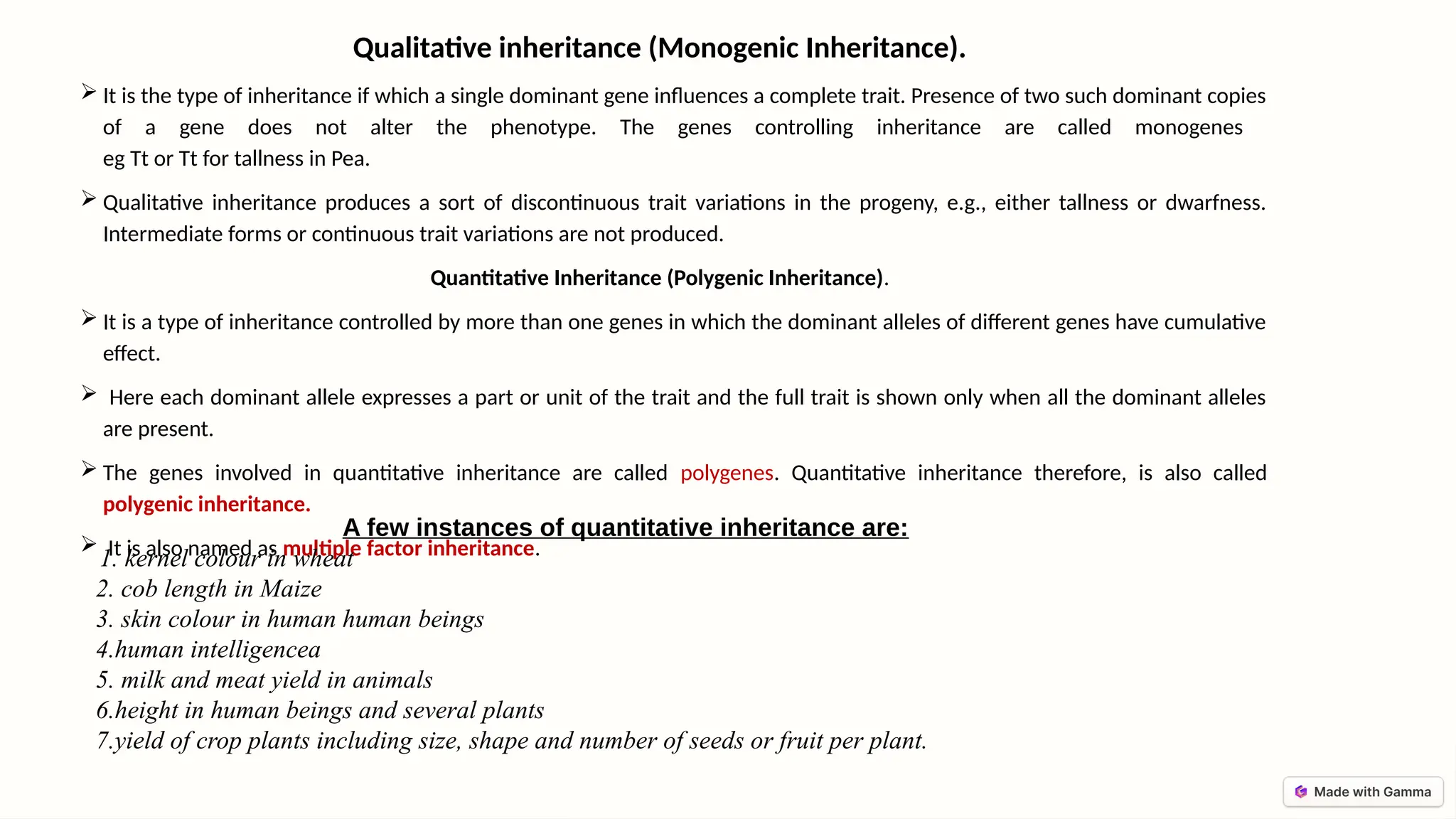
 It is the type of inheritance if which a single dominant gene influences a complete trait. Presence of two such dominant copies
of a gene does not alter the phenotype. The genes controlling inheritance are called monogenes
eg Tt or Tt for tallness in Pea.
 Qualitative inheritance produces a sort of discontinuous trait variations in the progeny, e.g., either tallness or dwarfness.
Intermediate forms or continuous trait variations are not produced.
Quantitative Inheritance (Polygenic Inheritance).
 It is a type of inheritance controlled by more than one genes in which the dominant alleles of different genes have cumulative
effect.
 Here each dominant allele expresses a part or unit of the trait and the full trait is shown only when all the dominant alleles
are present.
 The genes involved in quantitative inheritance are called polygenes. Quantitative inheritance therefore, is also called
polygenic inheritance.
 It is also named as multiple factor inheritance.
A few instances of quantitative inheritance are:
1. kernel colour in wheat
2. cob length in Maize
3. skin colour in human human beings
4.human intelligencea
5. milk and meat yield in animals
6.height in human beings and several plants
7.yield of crop plants including size, shape and number of seeds or fruit per plant.
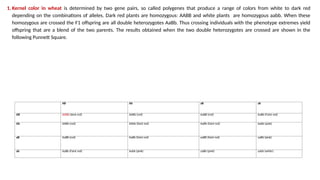
1. Kernel color in wheat is determined by two gene pairs, so called polygenes that produce a range of colors from white to dark red
depending on the combinations of alleles. Dark red plants are homozygous: AABB and white plants are homozygous aabb. When these
homozygous are crossed the F1 offspring are all double heterozygotes AaBb. Thus crossing individuals with the phenotype extremes yield
offspring that are a blend of the two parents. The results obtained when the two double heterozygotes are crossed are shown in the
following Punnett Square.
AB Ab aB ab
AB AABB (dark red) AABb (red) AaBB (red) AaBb (Faint red)
Ab AABb (red) AAbb (faint red) AaBb (faint red) Aabb (pink)
aB AaBB (red) AaBb (faint red) aaBB (faint red) aaBb (pink)
ab AaBb (Faint red) Aabb (pink) aaBb (pink) aabb (white)
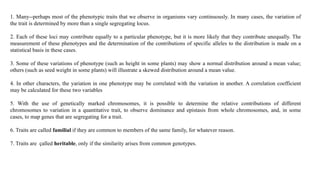
1. Many--perhaps most of the phenotypic traits that we observe in organisms vary continuously. In many cases, the variation of
the trait is determined by more than a single segregating locus.
2. Each of these loci may contribute equally to a particular phenotype, but it is more likely that they contribute unequally. The
measurement of these phenotypes and the determination of the contributions of specific alleles to the distribution is made on a
statistical basis in these cases.
3. Some of these variations of phenotype (such as height in some plants) may show a normal distribution around a mean value;
others (such as seed weight in some plants) will illustrate a skewed distribution around a mean value.
4. In other characters, the yariation in one phenotype may be correlated with the variation in another. A correlation coefficient
may be calculated for these two variables
5. With the use of genetically marked chromosomes, it is possible to determine the relative contributions of different
chromosomes to variation in a quantitative trait, to observe dominance and epistasis from whole chromosomes, and, in some
cases, to map genes that are segregating for a trait.
6. Traits are called familial if they are common to members of the same family, for whatever reason.
7. Traits are çalled heritable, only if the similarity arises from common genotypes.
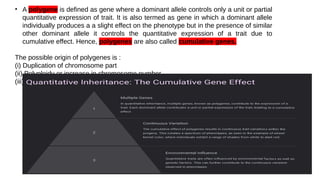
• A polygene is defined as gene where a dominant allele controls only a unit or partial
quantitative expression of trait. It is also termed as gene in which a dominant allele
individually produces a a slight effect on the phenotype but in the presence of similar
other dominant allele it controls the quantitative expression of a trait due to
cumulative effect. Hence, polygenes are also called cumulative genes.
The possible origin of polygenes is :
(i) Duplication of chromosome part
(ii) Polyploidy or increase in chromosome number
(iii) Mutations producing genes having similar effect
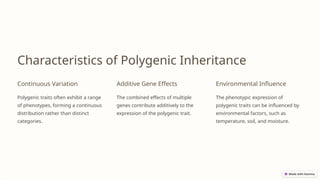
Characteristics of Polygenic Inheritance
Continuous Variation
Polygenic traits often exhibit a range
of phenotypes, forming a continuous
distribution rather than distinct
categories.
Additive Gene Effects
The combined effects of multiple
genes contribute additively to the
expression of the polygenic trait.
Environmental Influence
The phenotypic expression of
polygenic traits can be influenced by
environmental factors, such as
temperature, soil, and moisture.
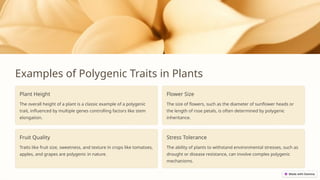
Examples of Polygenic Traits in Plants
Plant Height
The overall height of a plant is a classic example of a polygenic
trait, influenced by multiple genes controlling factors like stem
elongation.
Flower Size
The size of flowers, such as the diameter of sunflower heads or
the length of rose petals, is often determined by polygenic
inheritance.
Fruit Quality
Traits like fruit size, sweetness, and texture in crops like tomatoes,
apples, and grapes are polygenic in nature.
Stress Tolerance
The ability of plants to withstand environmental stresses, such as
drought or disease resistance, can involve complex polygenic
mechanisms.
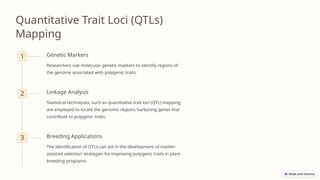
Quantitative Trait Loci (QTLs)
Mapping
1 Genetic Markers
Researchers use molecular genetic markers to identify regions of
the genome associated with polygenic traits.
2 Linkage Analysis
Statistical techniques, such as quantitative trait loci (QTL) mapping,
are employed to locate the genomic regions harboring genes that
contribute to polygenic traits.
3 Breeding Applications
The identification of QTLs can aid in the development of marker-
assisted selection strategies for improving polygenic traits in plant
breeding programs.
Genetic Factors Influencing Polygenic
Traits
Multiple Genes
The expression of polygenic traits is influenced by the combined effects of numerous genes,
each with a small contribution.
Allelic Variations
Variations in the alleles of the genes involved can lead to differences in the phenotypic
expression of the polygenic trait.
Environmental Factors
The final expression of a polygenic trait can be significantly influenced by environmental
conditions, such as climate, soil, and management practices.
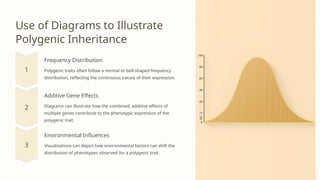
Use of Diagrams to Illustrate
Polygenic Inheritance
Frequency Distribution
Polygenic traits often follow a normal or bell-shaped frequency
distribution, reflecting the continuous nature of their expression.
Additive Gene Effects
Diagrams can illustrate how the combined, additive effects of
multiple genes contribute to the phenotypic expression of the
polygenic trait.
Environmental Influences
Visualizations can depict how environmental factors can shift the
distribution of phenotypes observed for a polygenic trait.
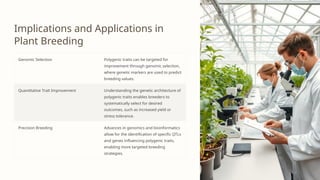
Implications and Applications in
Plant Breeding
Genomic Selection Polygenic traits can be targeted for
improvement through genomic selection,
where genetic markers are used to predict
breeding values.
Quantitative Trait Improvement Understanding the genetic architecture of
polygenic traits enables breeders to
systematically select for desired
outcomes, such as increased yield or
stress tolerance.
Precision Breeding Advances in genomics and bioinformatics
allow for the identification of specific QTLs
and genes influencing polygenic traits,
enabling more targeted breeding
strategies.
Polygenic Inheritance in Plants (genetics) .pptx

Polygenic Inheritance in Plants (genetics) .pptx

  • 1.
    Qualitative inheritance (MonogenicInheritance).  It is the type of inheritance if which a single dominant gene influences a complete trait. Presence of two such dominant copies of a gene does not alter the phenotype. The genes controlling inheritance are called monogenes eg Tt or Tt for tallness in Pea.  Qualitative inheritance produces a sort of discontinuous trait variations in the progeny, e.g., either tallness or dwarfness. Intermediate forms or continuous trait variations are not produced. Quantitative Inheritance (Polygenic Inheritance).  It is a type of inheritance controlled by more than one genes in which the dominant alleles of different genes have cumulative effect.  Here each dominant allele expresses a part or unit of the trait and the full trait is shown only when all the dominant alleles are present.  The genes involved in quantitative inheritance are called polygenes. Quantitative inheritance therefore, is also called polygenic inheritance.  It is also named as multiple factor inheritance. A few instances of quantitative inheritance are: 1. kernel colour in wheat 2. cob length in Maize 3. skin colour in human human beings 4.human intelligencea 5. milk and meat yield in animals 6.height in human beings and several plants 7.yield of crop plants including size, shape and number of seeds or fruit per plant.
  • 2.
    1. Kernel colorin wheat is determined by two gene pairs, so called polygenes that produce a range of colors from white to dark red depending on the combinations of alleles. Dark red plants are homozygous: AABB and white plants are homozygous aabb. When these homozygous are crossed the F1 offspring are all double heterozygotes AaBb. Thus crossing individuals with the phenotype extremes yield offspring that are a blend of the two parents. The results obtained when the two double heterozygotes are crossed are shown in the following Punnett Square. AB Ab aB ab AB AABB (dark red) AABb (red) AaBB (red) AaBb (Faint red) Ab AABb (red) AAbb (faint red) AaBb (faint red) Aabb (pink) aB AaBB (red) AaBb (faint red) aaBB (faint red) aaBb (pink) ab AaBb (Faint red) Aabb (pink) aaBb (pink) aabb (white)
  • 3.
    1. Many--perhaps mostof the phenotypic traits that we observe in organisms vary continuously. In many cases, the variation of the trait is determined by more than a single segregating locus. 2. Each of these loci may contribute equally to a particular phenotype, but it is more likely that they contribute unequally. The measurement of these phenotypes and the determination of the contributions of specific alleles to the distribution is made on a statistical basis in these cases. 3. Some of these variations of phenotype (such as height in some plants) may show a normal distribution around a mean value; others (such as seed weight in some plants) will illustrate a skewed distribution around a mean value. 4. In other characters, the yariation in one phenotype may be correlated with the variation in another. A correlation coefficient may be calculated for these two variables 5. With the use of genetically marked chromosomes, it is possible to determine the relative contributions of different chromosomes to variation in a quantitative trait, to observe dominance and epistasis from whole chromosomes, and, in some cases, to map genes that are segregating for a trait. 6. Traits are called familial if they are common to members of the same family, for whatever reason. 7. Traits are çalled heritable, only if the similarity arises from common genotypes.
  • 4.
    • A polygeneis defined as gene where a dominant allele controls only a unit or partial quantitative expression of trait. It is also termed as gene in which a dominant allele individually produces a a slight effect on the phenotype but in the presence of similar other dominant allele it controls the quantitative expression of a trait due to cumulative effect. Hence, polygenes are also called cumulative genes. The possible origin of polygenes is : (i) Duplication of chromosome part (ii) Polyploidy or increase in chromosome number (iii) Mutations producing genes having similar effect
  • 5.
    Characteristics of PolygenicInheritance Continuous Variation Polygenic traits often exhibit a range of phenotypes, forming a continuous distribution rather than distinct categories. Additive Gene Effects The combined effects of multiple genes contribute additively to the expression of the polygenic trait. Environmental Influence The phenotypic expression of polygenic traits can be influenced by environmental factors, such as temperature, soil, and moisture.
  • 6.
    Examples of PolygenicTraits in Plants Plant Height The overall height of a plant is a classic example of a polygenic trait, influenced by multiple genes controlling factors like stem elongation. Flower Size The size of flowers, such as the diameter of sunflower heads or the length of rose petals, is often determined by polygenic inheritance. Fruit Quality Traits like fruit size, sweetness, and texture in crops like tomatoes, apples, and grapes are polygenic in nature. Stress Tolerance The ability of plants to withstand environmental stresses, such as drought or disease resistance, can involve complex polygenic mechanisms.
  • 7.
    Quantitative Trait Loci(QTLs) Mapping 1 Genetic Markers Researchers use molecular genetic markers to identify regions of the genome associated with polygenic traits. 2 Linkage Analysis Statistical techniques, such as quantitative trait loci (QTL) mapping, are employed to locate the genomic regions harboring genes that contribute to polygenic traits. 3 Breeding Applications The identification of QTLs can aid in the development of marker- assisted selection strategies for improving polygenic traits in plant breeding programs.
  • 8.
    Genetic Factors InfluencingPolygenic Traits Multiple Genes The expression of polygenic traits is influenced by the combined effects of numerous genes, each with a small contribution. Allelic Variations Variations in the alleles of the genes involved can lead to differences in the phenotypic expression of the polygenic trait. Environmental Factors The final expression of a polygenic trait can be significantly influenced by environmental conditions, such as climate, soil, and management practices.
  • 9.
    Use of Diagramsto Illustrate Polygenic Inheritance Frequency Distribution Polygenic traits often follow a normal or bell-shaped frequency distribution, reflecting the continuous nature of their expression. Additive Gene Effects Diagrams can illustrate how the combined, additive effects of multiple genes contribute to the phenotypic expression of the polygenic trait. Environmental Influences Visualizations can depict how environmental factors can shift the distribution of phenotypes observed for a polygenic trait.
  • 10.
    Implications and Applicationsin Plant Breeding Genomic Selection Polygenic traits can be targeted for improvement through genomic selection, where genetic markers are used to predict breeding values. Quantitative Trait Improvement Understanding the genetic architecture of polygenic traits enables breeders to systematically select for desired outcomes, such as increased yield or stress tolerance. Precision Breeding Advances in genomics and bioinformatics allow for the identification of specific QTLs and genes influencing polygenic traits, enabling more targeted breeding strategies.