Polygenic Inheritance
or
Quantitative Inheritance
Dr. Rashmi Nagesh
Definition
• Polygenic inheritance is defined as some phenotypic character
determined by more than one gene.
• Polygenic inheritance is commonly known as quantitative inheritance
and multiple gene inheritance.
• Height, skin pigmentation, eye color, hair color, and milk and egg
production are phenotypic characteristics present in plants and
animals.
• Many traits and phenotypic characters are inherited by many alleles
present in different loci, known as polygenic inheritance.
• It is the type of inheritance controlled by more than one gene where
the dominant alleles have a commutative effect, with each dominant
allele expressing a part or unit of the trait.
• The combined effect of many genes shows a significant effect, but a
single gene has little effect on the phenotype.
• The full trait is shown if all dominant alleles are present in it.
Characteristics of polygenic inheritance
• Each gene has a too-small effect, which is why it is difficult to detect,
but their combined effect is significant and easy to detect.
• Each allele has an additive or cumulative effect.
• The equal effect is produced by multiple genes.
• One phenotypic character or particular trait is controlled by more
than one gene. All such genes are non-allelic.
• It is difficult to predict phenotype due to the complex pattern of
polygenic inheritance.
• Polygenic inheritance is occurred by the continuous variation of the
phenotype of a trait.
• Environmental factors and the combined effect of many genes
produced continuous variation.
• Each gene has a certain amount of effect, and the more the number
of dominant genes, more the pronounced its characteristics. The trait
becomes much more pronounced due to the addition of several
alleles.
• Polygenic inheritance is also called cumulative inheritance because
the phenotype depends upon the number of dominant alleles
present.
Polygenic Inheritance in human
The skin color of human
• It is controlled by around 60 loci.
• Human skin color is regulated by three pairs of genes.
• When a negro black (AA BB CC) phenotype is crossed with pure white
(aa bb cc) phenotype, an intermediate phenotype (Aa Bb Cc) is
produced.
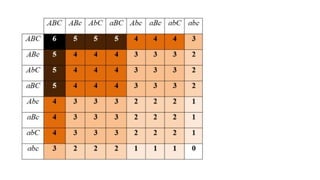
• In the F2 generation, (Aa Bb Cc× Aa Bb Cc) will produce different skin
colors (i.e., very dark to light). Skin color depends upon melanin
pigment. A negro black (with all dominant alleles (AA BB CC) would
have the highest amount of melanin, and pure white color (aa bb cc)
has a negligible amount of melanin.
• The ratio of skin color is following: 1:6:15:20:15:6:1.
• The skin color ranges from negro black (AABBCC) in 1/64 individuals
very dark brown in 6/64 individuals, dark brown in 15/64 individuals,
intermediate brown (AaBbCc) in 20/64 individuals, light brown in
15/64 individuals, very light brown in 6/64 individuals and pure white
(aabbcc) in 1/64 individuals.
Polygenic Inheritance in plants
Kernel color of the wheat
• Nilsson-Ehle (1908) gave the first experimental evidence of the kernel
color of wheat.
• kernel color of wheat is determined by 3 independently assorted pairs
of alleles.
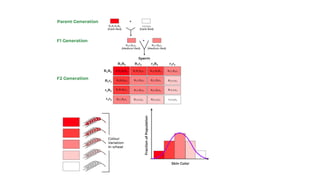
• The dark red wheat kernel has 3 dominant alleles AA BB CC and the
white kernel have recessive alleles i.e. aa bb cc. These alleles crossed
in the F1 generation produce intermediated red color have (Aa Bb Cc).
• In the F2 generation, 1 white and 63 red with varying shades are
produced.
Quantitative Inheritance - Polygenic Inheritance.pptx

Quantitative Inheritance - Polygenic Inheritance.pptx

  • 1.
  • 2.
    Definition • Polygenic inheritanceis defined as some phenotypic character determined by more than one gene. • Polygenic inheritance is commonly known as quantitative inheritance and multiple gene inheritance. • Height, skin pigmentation, eye color, hair color, and milk and egg production are phenotypic characteristics present in plants and animals. • Many traits and phenotypic characters are inherited by many alleles present in different loci, known as polygenic inheritance.
  • 3.
    • It isthe type of inheritance controlled by more than one gene where the dominant alleles have a commutative effect, with each dominant allele expressing a part or unit of the trait. • The combined effect of many genes shows a significant effect, but a single gene has little effect on the phenotype. • The full trait is shown if all dominant alleles are present in it.
  • 4.
    Characteristics of polygenicinheritance • Each gene has a too-small effect, which is why it is difficult to detect, but their combined effect is significant and easy to detect. • Each allele has an additive or cumulative effect. • The equal effect is produced by multiple genes. • One phenotypic character or particular trait is controlled by more than one gene. All such genes are non-allelic. • It is difficult to predict phenotype due to the complex pattern of polygenic inheritance. • Polygenic inheritance is occurred by the continuous variation of the phenotype of a trait.
  • 5.
    • Environmental factorsand the combined effect of many genes produced continuous variation. • Each gene has a certain amount of effect, and the more the number of dominant genes, more the pronounced its characteristics. The trait becomes much more pronounced due to the addition of several alleles. • Polygenic inheritance is also called cumulative inheritance because the phenotype depends upon the number of dominant alleles present.
  • 6.
    Polygenic Inheritance inhuman The skin color of human • It is controlled by around 60 loci. • Human skin color is regulated by three pairs of genes. • When a negro black (AA BB CC) phenotype is crossed with pure white (aa bb cc) phenotype, an intermediate phenotype (Aa Bb Cc) is produced.
  • 7.
    • In theF2 generation, (Aa Bb Cc× Aa Bb Cc) will produce different skin colors (i.e., very dark to light). Skin color depends upon melanin pigment. A negro black (with all dominant alleles (AA BB CC) would have the highest amount of melanin, and pure white color (aa bb cc) has a negligible amount of melanin. • The ratio of skin color is following: 1:6:15:20:15:6:1. • The skin color ranges from negro black (AABBCC) in 1/64 individuals very dark brown in 6/64 individuals, dark brown in 15/64 individuals, intermediate brown (AaBbCc) in 20/64 individuals, light brown in 15/64 individuals, very light brown in 6/64 individuals and pure white (aabbcc) in 1/64 individuals.
  • 9.
    Polygenic Inheritance inplants Kernel color of the wheat • Nilsson-Ehle (1908) gave the first experimental evidence of the kernel color of wheat. • kernel color of wheat is determined by 3 independently assorted pairs of alleles. • The dark red wheat kernel has 3 dominant alleles AA BB CC and the white kernel have recessive alleles i.e. aa bb cc. These alleles crossed in the F1 generation produce intermediated red color have (Aa Bb Cc). • In the F2 generation, 1 white and 63 red with varying shades are produced.