Presented By- 
Niteesh Mittal
Other Environmental Issues 
Conservation of resources 
Energy Issue 
Over population 
Intensive farming and intensive agriculture 
Land degradation 
Environmental degradation 
Ocean deoxygenation 
Sustainable development 
Environmental pollution
Pollution 
Pollution is the introduction of contaminants into a natural 
environment that causes instability, disorder, harm or discomfort 
to the ecosystem i.e. physical systems or living organisms. 
Pollution can take the form of chemical substances or energy, 
such as noise, heat, or light. 
Pollution is the introduction of a waste into the atmosphere 
making it impossible for the life on earth possible to sustain 
The dangerous effects of pollution are a result of undesirable 
changes in the physical, chemical and biological characteristics 
of air, land and water. 
The agents or substances that causes pollution are known as 
pollutants (biodegradable and non-biodegradable).
Contributors of Pollution 
 Chemical and Nuclear Plants 
 Industrial factories 
 Oil refineries 
 Human sewage 
 Oil and antifreeze leaking 
from cars 
 Mining 
 Over covered Landfills 
 Deforestation 
 Construction Debris 
 High population density
Major forms of Pollution 
Air Pollution 
Water Pollution 
Noise Pollution 
Soil Pollution 
Light Pollution 
Radioactive 
Pollution 
Thermal Pollution 
Visual Pollution 
Littering
Air Pollution 
Air pollution is the 
introduction of 
chemicals, particulate 
matter, or biological 
materials that cause 
harm or discomfort to 
humans or other living 
organisms, or cause 
damage to the natural 
environment or built 
environment, into the 
atmosphere.
Sources & Effects of Air Pollution 
 Tobacco smoke: heart atacks and cancer 
 Decomposing garbage and open sewers: breeding ground for flies, 
mosquitoes, germs and other haarmul bactereia. 
 Piosonous gases: respiratory diseases 
 Acid rain 
 Mining activities: lung and respiratory diseases 
 Carbon monoxide and lead: effects brain and organs like kidney 
 Ozone depletion effect: skin cancer and effects plant life 
 Burning fuel and oil rigs: cancer 
 Green house effect: global warming, melt polar ice and submerge coastal 
areas 
 Automobile exhaust: harmful to human health 
 Asthma, Asbestosis are also effects of air pollution
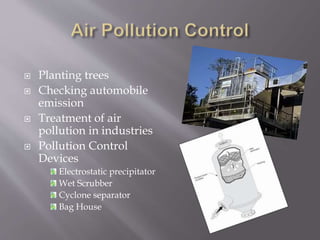
 Planting trees 
 Checking automobile 
emission 
 Treatment of air 
pollution in industries 
 Pollution Control 
Devices 
Electrostatic precipitator 
Wet Scrubber 
Cyclone separator 
Bag House
Water Pollution 
 Water pollution is the contamination 
of water bodies (e.g. lakes, rivers, 
oceans and groundwater). Water 
pollution occurs when pollutants are 
discharged directly or indirectly into 
water bodies without adequate 
treatment to remove harmful 
compounds. 
 Sources of Water Pollution 
 Point Source: due to a single, well 
identified starting place like oil 
spill, drain, etc 
 Non-point Source: if pollution 
comes from many sources which 
cannot be identified such as acid 
rain, farmer’s field.
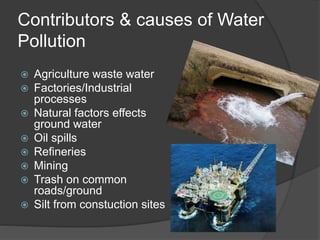
Contributors & causes of Water 
Pollution 
 Agriculture waste water 
 Factories/Industrial 
processes 
 Natural factors effects 
ground water 
 Oil spills 
 Refineries 
 Mining 
 Trash on common 
roads/ground 
 Silt from constuction sites
EFFECTS 
Water pollution has 
damaged the food chain 
Contaminated drinking water 
causes cholera, typhoid, 
poor blood pressure, 
vomiting, and damage to 
nervous system 
Pollution in water alter 
overall chemistry of water, 
causing a lot of changes in 
temperature which adversely 
effects the marine life and 
destroys it.
Control 
 Imposing laws to combat water pollution 
 Care of existing trees and planting new 
ones to promote penetration of water 
into soil 
 Supplementary nutrients in agriculture 
 Domestic sewage 
 Being conscious over selves and 
educating younger ones 
 Waste water treatment
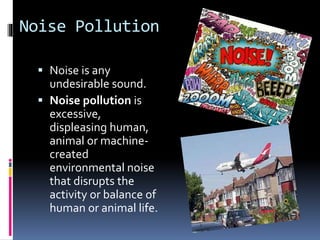
Noise Pollution 
 Noise is any 
undesirable sound. 
 Noise pollution is 
excessive, 
displeasing human, 
animal or machine-created 
environmental noise 
that disrupts the 
activity or balance of 
human or animal life.
Effects 
 Noise health effects are both 
health and behavioral in nature. 
The unwanted sound is called 
noise. This unwanted sound can 
damage physiological and 
psychological health. Noise 
pollution can cause annoyance 
and aggression, hypertension, 
high stress levels, hearing loss, 
sleep disturbances, and other 
harmful effects 
 An impact of noise on animal life 
is the reduction of usable habitat 
that noisy areas may cause, 
which in the case of endangered 
species may be part of the path 
to extinction
Control 
• Source Control: Include 
source modification such as 
acoustic treatment to 
machine surfaces, design 
changes, limiting the 
operational timings 
• Transmission Path 
Intervention: Containing the 
sources inside a sound 
insulating enclosure, 
construction of noise barrier 
• Receptor Control: protection 
on receiver’s side.
SOLID WASTE MANAGEMENT 
• Solid Waste can be defined as-’Any 
garbage, refuse, sludge from a 
waste treatment plant, or air 
pollution control facility and other 
discarded material, including solid, 
semi solid, liquid or contained 
gaseous material resulting from 
industrial, commercial, mining, and 
agricultural operations.’ 
• Waste management is the 
collection, transport, processing, 
recycling or disposal and monitoring 
of waste materials.
Elements of Waste Management 
1. Generation Rate: Used to evaluate reuse, recycle feasibility, 
processing and disposal requirements. 
2. On site handling, storage and processing: Onsite preparation 
of waste for reuse, recycle, etc. 
3. Collection: Physical gathering of waste. 
4. Transfer and transport: Bulk transport to a processing, recovery 
or disposal facility. 
5. Processing and recovery: recovery of waste as raw material or 
energy or preparation of waste for disposal. 
6. Disposal: Ultimate fate of non-reusable and non-recyclable 
waste.
Methods of Disposal 
I. Recycling : 
Recycling refers to the widespread 
collection and reuse of everyday 
waste materials such as empty 
containers. 
Recycling is processing used materials 
(waste) into new products to prevent 
waste of potentially useful materials, 
reduce the consumption of fresh raw 
materials, reduce energy usage, 
reduce air pollution and water 
pollution (from landfilling) by 
reducing the need for "conventional" 
waste disposal, and lower greenhouse 
gas emission.
II. Landfill : 
A landfill site (also known as dump 
or rubbish dump), is a site for the 
disposal of waste materials by 
burial and is the oldest form of 
waste treatment. Historically, 
landfills have been the most 
common methods of organized 
waste disposal and remain so in 
many places around the world. 
Gases are produced in landfills 
due to the anaerobic digestion by 
microbes on any organic matter. 
This gas can be collected and 
flared off or used to generate 
electricity in a gas fired power 
plant.
II. Incineration: 
Incineration is a waste 
treatment process that 
involves the combustion of 
organic substances contained 
in waste materials. 
Incineration and other high 
temperature waste treatment 
systems are described as 
"thermal treatment". 
Incineration of waste materials 
converts the waste into ash, 
flue gas, and heat and reduces 
the volume of solid waste to 
20-30 percent. Incineration 
significantly reduces the 
necessary volume for disposal 
incineration plant in 
Vienna
Land Pollution 
• Land pollution is the degradation 
of Earth's land surfaces often 
caused by human activities and 
their misuse of land resources. It 
occurs when waste is not disposed 
properly. Health hazard disposal of 
urban and industrial wastes, 
exploitation of minerals, and 
improper use of soil by inadequate 
agricultural practices are a few 
factors.
• Causes : 
 Haphazard use of fertilizers 
 Use of pesticides, insecticides, and herbicides 
Damping of solid waste 
Deforestation 
 Mining 
• Effects of soil pollutants: 
 Synthetic fertilizer: destroys the microbial plant life in soil, 
effecting nitrogen fixation 
 Pesticides: take many years to degrade and remains as toxic in 
soil, also enter marine environment 
 Industrial effluents: increase toxicity level in the soil 
 Urban waste: garbage, hospital waste, plastic bags
Waste Water Treatment 
Natural Water when comes in contact with foreign matters during either 
industrial process or domestic use, becomes polluted and is termed as waste 
water. 
The removal of excessively accumulated matters from the waste water is known 
as treatment. 
Waste water 
Domestic 
Industrial 
Pollutants 
Organic (diaries, distilleries, paper 
manufacturing units, oil refineries) 
Inorganic (Cement, steel, alkali manufacturing 
units)
Types of Waste water treatment 
1. Chemical Treatment 
a) Primary Treatment 
b) Secondary Treatment 
c) Tertiary Treatment 
2. Biological Treatment
Chemical Treatment 
1. Primary Treatment: It involves screening out of large objects like cans, 
rags, sticks, plastic packets etc. carried in the sewage stream. 
Suspended matter are allowed to settle in the primary sedimentation 
tank. Some chemicals like alum and lime are often added to Industrial 
waste for coagulation. The sedimented water is further led to another 
joining chamber for secondary treatment. 
2. Secondary Treatment: The whole contents are thoroughly aerated in 
order to bring down the BOD(bio-chemical oxygen demand) load from 
400ppm to 30ppm and then finally to 0ppm. 
3. Tertiary Treatment: It involves the treatment of water containing 
phosphate and nitrogen. It includes processes like: 
 Coagulation 
 Filtration 
 Membrane separation process, etc
 Industries generate a lot of 
wastes which spoil our 
ecosystem. 
 Industries causes all types of 
pollution like soil pollution, 
water pollution, air pollution, 
etc. 
 Industrial pollution control 
mainly includes steps to 
reduce present and future air 
pollution control, product or 
waste heat recovery by:
 Adhering to the government 
regulations. 
 Creating green zones in factories. 
 Identify and select right type device 
or system, it could be a stand alone 
or fully engineered complete 
packaged for pollution control. 
 The best method for any type of 
waste treatment is to recycle or to 
recover the pollutants from the waste. 
It ensures conservation of 
environmental resources, reduces 
the cost of production, creates 
opportunity for employment, besides 
considerable eliminating the load of 
pollution.
Chemical Pollution 
 Chemical Pollution is caused due to 
contamination of the environment due to 
chemicals byproduct. 
 It may originate from industrial areas as well as 
fromanywhere where there are people. 
 Its major effect is on marine or soil composition. 
 Various chemical waste are: 
 Industrial Chemical waste 
 Oil 
 Sewage disposal in water
Government Initiatives for 
Environment 
• The government is not just the protector of the environment 
but also has a major responsibility for sustaining 
environmental conscience. 
• In India, the Ministry of Environment and Forest is the 
main nodal agency for generating environmental 
consciousness and making and implementing schemes for 
environmental protection. 
• The government’s policy focuses to check land and water 
degradation through waste land management and restoration 
of river water quality programs. 
• The policy also focuses to provide for conservation of natural 
resources by declaration of reserved forests, biosphere reserve 
and protection of endangered species. 
• It also makes laws and acts for environment protection and 
strictly implementing them.
Pollutioni 110430044156-phpapp02

Pollutioni 110430044156-phpapp02

  • 1.
  • 2.
    Other Environmental Issues Conservation of resources Energy Issue Over population Intensive farming and intensive agriculture Land degradation Environmental degradation Ocean deoxygenation Sustainable development Environmental pollution
  • 3.
    Pollution Pollution isthe introduction of contaminants into a natural environment that causes instability, disorder, harm or discomfort to the ecosystem i.e. physical systems or living organisms. Pollution can take the form of chemical substances or energy, such as noise, heat, or light. Pollution is the introduction of a waste into the atmosphere making it impossible for the life on earth possible to sustain The dangerous effects of pollution are a result of undesirable changes in the physical, chemical and biological characteristics of air, land and water. The agents or substances that causes pollution are known as pollutants (biodegradable and non-biodegradable).
  • 4.
    Contributors of Pollution  Chemical and Nuclear Plants  Industrial factories  Oil refineries  Human sewage  Oil and antifreeze leaking from cars  Mining  Over covered Landfills  Deforestation  Construction Debris  High population density
  • 5.
    Major forms ofPollution Air Pollution Water Pollution Noise Pollution Soil Pollution Light Pollution Radioactive Pollution Thermal Pollution Visual Pollution Littering
  • 7.
    Air Pollution Airpollution is the introduction of chemicals, particulate matter, or biological materials that cause harm or discomfort to humans or other living organisms, or cause damage to the natural environment or built environment, into the atmosphere.
  • 8.
    Sources & Effectsof Air Pollution  Tobacco smoke: heart atacks and cancer  Decomposing garbage and open sewers: breeding ground for flies, mosquitoes, germs and other haarmul bactereia.  Piosonous gases: respiratory diseases  Acid rain  Mining activities: lung and respiratory diseases  Carbon monoxide and lead: effects brain and organs like kidney  Ozone depletion effect: skin cancer and effects plant life  Burning fuel and oil rigs: cancer  Green house effect: global warming, melt polar ice and submerge coastal areas  Automobile exhaust: harmful to human health  Asthma, Asbestosis are also effects of air pollution
  • 9.
     Planting trees  Checking automobile emission  Treatment of air pollution in industries  Pollution Control Devices Electrostatic precipitator Wet Scrubber Cyclone separator Bag House
  • 10.
    Water Pollution Water pollution is the contamination of water bodies (e.g. lakes, rivers, oceans and groundwater). Water pollution occurs when pollutants are discharged directly or indirectly into water bodies without adequate treatment to remove harmful compounds.  Sources of Water Pollution  Point Source: due to a single, well identified starting place like oil spill, drain, etc  Non-point Source: if pollution comes from many sources which cannot be identified such as acid rain, farmer’s field.
  • 11.
    Contributors & causesof Water Pollution  Agriculture waste water  Factories/Industrial processes  Natural factors effects ground water  Oil spills  Refineries  Mining  Trash on common roads/ground  Silt from constuction sites
  • 12.
    EFFECTS Water pollutionhas damaged the food chain Contaminated drinking water causes cholera, typhoid, poor blood pressure, vomiting, and damage to nervous system Pollution in water alter overall chemistry of water, causing a lot of changes in temperature which adversely effects the marine life and destroys it.
  • 13.
    Control  Imposinglaws to combat water pollution  Care of existing trees and planting new ones to promote penetration of water into soil  Supplementary nutrients in agriculture  Domestic sewage  Being conscious over selves and educating younger ones  Waste water treatment
  • 14.
    Noise Pollution Noise is any undesirable sound.  Noise pollution is excessive, displeasing human, animal or machine-created environmental noise that disrupts the activity or balance of human or animal life.
  • 15.
    Effects  Noisehealth effects are both health and behavioral in nature. The unwanted sound is called noise. This unwanted sound can damage physiological and psychological health. Noise pollution can cause annoyance and aggression, hypertension, high stress levels, hearing loss, sleep disturbances, and other harmful effects  An impact of noise on animal life is the reduction of usable habitat that noisy areas may cause, which in the case of endangered species may be part of the path to extinction
  • 16.
    Control • SourceControl: Include source modification such as acoustic treatment to machine surfaces, design changes, limiting the operational timings • Transmission Path Intervention: Containing the sources inside a sound insulating enclosure, construction of noise barrier • Receptor Control: protection on receiver’s side.
  • 17.
    SOLID WASTE MANAGEMENT • Solid Waste can be defined as-’Any garbage, refuse, sludge from a waste treatment plant, or air pollution control facility and other discarded material, including solid, semi solid, liquid or contained gaseous material resulting from industrial, commercial, mining, and agricultural operations.’ • Waste management is the collection, transport, processing, recycling or disposal and monitoring of waste materials.
  • 18.
    Elements of WasteManagement 1. Generation Rate: Used to evaluate reuse, recycle feasibility, processing and disposal requirements. 2. On site handling, storage and processing: Onsite preparation of waste for reuse, recycle, etc. 3. Collection: Physical gathering of waste. 4. Transfer and transport: Bulk transport to a processing, recovery or disposal facility. 5. Processing and recovery: recovery of waste as raw material or energy or preparation of waste for disposal. 6. Disposal: Ultimate fate of non-reusable and non-recyclable waste.
  • 19.
    Methods of Disposal I. Recycling : Recycling refers to the widespread collection and reuse of everyday waste materials such as empty containers. Recycling is processing used materials (waste) into new products to prevent waste of potentially useful materials, reduce the consumption of fresh raw materials, reduce energy usage, reduce air pollution and water pollution (from landfilling) by reducing the need for "conventional" waste disposal, and lower greenhouse gas emission.
  • 20.
    II. Landfill : A landfill site (also known as dump or rubbish dump), is a site for the disposal of waste materials by burial and is the oldest form of waste treatment. Historically, landfills have been the most common methods of organized waste disposal and remain so in many places around the world. Gases are produced in landfills due to the anaerobic digestion by microbes on any organic matter. This gas can be collected and flared off or used to generate electricity in a gas fired power plant.
  • 21.
    II. Incineration: Incinerationis a waste treatment process that involves the combustion of organic substances contained in waste materials. Incineration and other high temperature waste treatment systems are described as "thermal treatment". Incineration of waste materials converts the waste into ash, flue gas, and heat and reduces the volume of solid waste to 20-30 percent. Incineration significantly reduces the necessary volume for disposal incineration plant in Vienna
  • 22.
    Land Pollution •Land pollution is the degradation of Earth's land surfaces often caused by human activities and their misuse of land resources. It occurs when waste is not disposed properly. Health hazard disposal of urban and industrial wastes, exploitation of minerals, and improper use of soil by inadequate agricultural practices are a few factors.
  • 23.
    • Causes :  Haphazard use of fertilizers  Use of pesticides, insecticides, and herbicides Damping of solid waste Deforestation  Mining • Effects of soil pollutants:  Synthetic fertilizer: destroys the microbial plant life in soil, effecting nitrogen fixation  Pesticides: take many years to degrade and remains as toxic in soil, also enter marine environment  Industrial effluents: increase toxicity level in the soil  Urban waste: garbage, hospital waste, plastic bags
  • 24.
    Waste Water Treatment Natural Water when comes in contact with foreign matters during either industrial process or domestic use, becomes polluted and is termed as waste water. The removal of excessively accumulated matters from the waste water is known as treatment. Waste water Domestic Industrial Pollutants Organic (diaries, distilleries, paper manufacturing units, oil refineries) Inorganic (Cement, steel, alkali manufacturing units)
  • 25.
    Types of Wastewater treatment 1. Chemical Treatment a) Primary Treatment b) Secondary Treatment c) Tertiary Treatment 2. Biological Treatment
  • 26.
    Chemical Treatment 1.Primary Treatment: It involves screening out of large objects like cans, rags, sticks, plastic packets etc. carried in the sewage stream. Suspended matter are allowed to settle in the primary sedimentation tank. Some chemicals like alum and lime are often added to Industrial waste for coagulation. The sedimented water is further led to another joining chamber for secondary treatment. 2. Secondary Treatment: The whole contents are thoroughly aerated in order to bring down the BOD(bio-chemical oxygen demand) load from 400ppm to 30ppm and then finally to 0ppm. 3. Tertiary Treatment: It involves the treatment of water containing phosphate and nitrogen. It includes processes like:  Coagulation  Filtration  Membrane separation process, etc
  • 27.
     Industries generatea lot of wastes which spoil our ecosystem.  Industries causes all types of pollution like soil pollution, water pollution, air pollution, etc.  Industrial pollution control mainly includes steps to reduce present and future air pollution control, product or waste heat recovery by:
  • 28.
     Adhering tothe government regulations.  Creating green zones in factories.  Identify and select right type device or system, it could be a stand alone or fully engineered complete packaged for pollution control.  The best method for any type of waste treatment is to recycle or to recover the pollutants from the waste. It ensures conservation of environmental resources, reduces the cost of production, creates opportunity for employment, besides considerable eliminating the load of pollution.
  • 29.
    Chemical Pollution Chemical Pollution is caused due to contamination of the environment due to chemicals byproduct.  It may originate from industrial areas as well as fromanywhere where there are people.  Its major effect is on marine or soil composition.  Various chemical waste are:  Industrial Chemical waste  Oil  Sewage disposal in water
  • 30.
    Government Initiatives for Environment • The government is not just the protector of the environment but also has a major responsibility for sustaining environmental conscience. • In India, the Ministry of Environment and Forest is the main nodal agency for generating environmental consciousness and making and implementing schemes for environmental protection. • The government’s policy focuses to check land and water degradation through waste land management and restoration of river water quality programs. • The policy also focuses to provide for conservation of natural resources by declaration of reserved forests, biosphere reserve and protection of endangered species. • It also makes laws and acts for environment protection and strictly implementing them.