Environmental
Degradation:
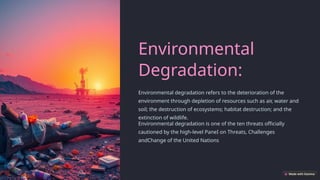
Environmental degradation refers to the deterioration of the
environment through depletion of resources such as air, water and
soil; the destruction of ecosystems; habitat destruction; and the
extinction of wildlife.
Environmental degradation is one of the ten threats officially
cautioned by the high-level PaneI on Threats, Challenges
andChange of the United Nations
EFFECTS OF ENVIONMENTAL DEGRADATION
❑ Air pollution
❑ Water pollution
❑ Land pollution
❑ Deforestation
❑ Loss of biodiversity
CAUSES OF ENVIONMENTAL DEGRADATION
❑ DEFORESTATION-Global warming Global climate change Reduce net oxygen level Biosphere instability
❑ ❑ ❑ ❑
Effects water cycle POLLUTION OVER POPPULATION NATURAL CAUSES
❑ ❑ ❑
OVER POPULATION Results excess demand over food, clothes, shelter Result excess demand over land Reduce
❑ ❑ ❑
forest resource
3,POLLUTION- Water Land SOIL
❑ ❑ ❑
4. NATURAL CAUSES- Earthquakes Tidal waves Storm Wildfire Floods Land sliding
❑ ❑ ❑ ❑ ❑ ❑
PREVENTIVE MEASURES
➢ FOLLOW 3Rs-REDUCE REUSE RECYCLE
GREEEN TRANSPORTATION
CONSERVE WATER
USE RENEWABLE ENERGY
REDUCE AIR &WATER POLLUTION
PROTECT ECOSYSTEM
PROMOTE SUSTAINABLE FARMING
EDUCATE
VOLUNTEER
SHOP WISELY
PLANT A TREE
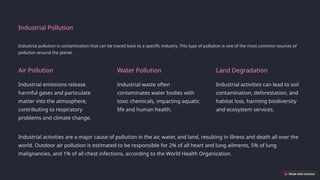
Industrial Pollution
Industrial pollution is contamination that can be traced back to a specific industry. This type of pollution is one of the most common sources of
pollution around the planet.
Air Pollution
Industrial emissions release
harmful gases and particulate
matter into the atmosphere,
contributing to respiratory
problems and climate change.
Water Pollution
Industrial waste often
contaminates water bodies with
toxic chemicals, impacting aquatic
life and human health.
Land Degradation
Industrial activities can lead to soil
contamination, deforestation, and
habitat loss, harming biodiversity
and ecosystem services.
Industrial activities are a major cause of pollution in the air, water, and land, resulting in illness and death all over the
world. Outdoor air pollution is estimated to be responsible for 2% of all heart and lung ailments, 5% of lung
malignancies, and 1% of all chest infections, according to the World Health Organization.
Industrial Pollution is caused by a variety of
activities, including:
∙ Burning coal
∙ Burning fossil fuels like oil, natural gas, and petroleum
∙ Chemical solvents(benzene,toluene,xylene,butyle acetate) used in dyeing and tanning industries
∙ Untreated gas and liquid waste being released into the environment
∙ Improper disposal of radioactive material
Causes of Industrial Pollution
1. Lack of Policies to Control Pollution Lack of effective policies and poor enforcement drive allowed many industries to bypass laws made
by the pollution control board, which resulted in mass-scale pollution that affected the lives of many people.
2. Unplanned Industrial Growth In most industrial townships, unplanned growth took place wherein those companies flouted rules and
norms and polluted the environment with both air and water pollution.
3. Use of Outdated Technologies Most industries still rely on old technologies to produce products that generate a large amount of waste.
To avoid high cost and expenditure, many companies still make use of traditional technologies to produce high-end products.
4. Presence of a Large Number of Small Scale Industries- Many small scale industries and factories that don’t have enough capital and rely
on government grants to run their day-to-day businesses often escape environment regulations and release a large number of toxic
gases in the atmosphere
5. Inefficient Waste Disposal- Water pollution and soil pollution are often caused directly due to inefficiency in the disposal of waste. Long
term exposure to polluted air and water causes chronic health problems, making the issue of industrial pollution into a severe one. It
also lowers the air quality in surrounding areas, which causes many respiratory disorders.
6. Leaching of Resources From Our Natural World -Industries do require a large amount of raw material to make them into finished
products. This requires the extraction of minerals from beneath the earth. The extracted minerals can cause soil pollution when spilled
on the earth. Leaks from vessels can cause oil spills that may prove harmful to marine life.
7. Natural Resource Use- Raw material is a must for industries, which often requires them even pulling out underground elements. One of
the most common forms of leaching from natural resources is fracking for oil. When industries extract minerals, the process causes soil
pollution and also causes oil leaks and spills that are harmful and even deadly to people and animals.
WASTE MANAGEMENT
According to Ecolife dictionary waste management is defined as “The concept of waste management involves the
collection, removal, processing, and disposal of materials considered waste. Waste materials can be solid, gaseous,
liquid, or even hazardous and are generally generated through human activity”.
TYPES OF WASTE -Wastes are classified into three types. They are basis of physical state, basis of biodegradability and
basis of effects on human health.
On the basis of physical state, it is further classified into Solid, liquid and gaseous.
On the basis of bio-degradability, it is further classified into biodegradable and non-biodegradable (metals, plastics,
paper and glasses).
On the basis of effects on human health, it is classified into hazardous (dangerous) and non-hazardous (nondangerous).
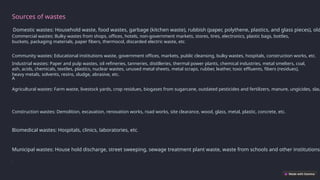
Sources of wastes
Domestic wastes: Household waste, food wastes, garbage (kitchen waste), rubbish (paper, polythene, plastics, and glass pieces), old
Community wastes: Educational institutions waste, government offices, markets, public cleansing, bulky wastes, hospitals, construction works, etc.
Commercial wastes: Bulky wastes from shops, offices, hotels, non-government markets, stores, tires, electronics, plastic bags, bottles,
buckets, packaging materials, paper fibers, thermocol, discarded electric waste, etc.
Industrial wastes: Paper and pulp wastes, oil refineries, tanneries, distilleries, thermal power plants, chemical industries, metal smelters, coal,
ash, acids, chemicals, textiles, plastics, nuclear wastes, unused metal sheets, metal scraps, rubber, leather, toxic effluents, fibers (residues),
heavy metals, solvents, resins, sludge, abrasive, etc.
A
Agricultural wastes: Farm waste, livestock yards, crop residues, biogases from sugarcane, outdated pesticides and fertilizers, manure, ungicides, slau
Construction wastes: Demolition, excavation, renovation works, road works, site clearance, wood, glass, metal, plastic, concrete, etc.
Municipal wastes: House hold discharge, street sweeping, sewage treatment plant waste, waste from schools and other institutions,
Biomedical wastes: Hospitals, clinics, laboratories, etc.
.
Mining wastes: Waste rock, tailings, mine water, chemicals and others, etc
Health-care wastes: Infectious waste, pathological waste, sharps waste, chemical waste, pharmaceutical waste,
cytotoxic waste, general waste, etc.(Syringes, needles, disposal scalpels and blades, expired, unused and
contaminated drugs and vaccines, swabs, bandages, gloves, disposable medical devices, urine bags, sanitary
napkins, napkins, diapers, human tissues, organs or fluids, body parts, contaminated animal carcasses,
disinfectants, sterility, heavy metals, broken thermometers, batteries, chemicals, etc.)
.
Radioactive wastes: Nuclear explosions, nuclear testing, use of radioactive substances in medical and scientific
research, products contaminated by radionuclide’s including radioactive diagnostic material or radio
therapeutic materials, etc.
Electronic wastes: Discarded electronic devices like computer, TV, music systems, transistors, tape recorders,
mobile phones, computer cabinets, mother boards, CDs, cassettes, moue, wires, cords, switches, chargers,
batteries, circuits, etc
Waste Management Techniques
According to the deposition and type of waste, different techniques are used for waste management. They may vary from person to
person, place to place, time to time and nation to nation. They are:
∙ Composting
Landfilling
Incineration-Burning the wastes at high temperature is called as Incineration.
∙ Bioremediation-Process of using microbes and bacteria for removing the impurities, pollutants and poisons from soil, water and
other environments is called as bioremediation. Energy power generation plants emit radioactive wastes which is the major threat to
the human population. To reduce these wastes, bioremediation strategy is used.
∙ Waste-to-energy
Waste-to-energy is the process of creating energy in the form of electricity or heat from the primary treatment of waste.
Remote Sensing & GIS remote sensing is the art of obtaining information-about objects or areas from a distance,
typically from aircraft or satellites. In Coimbatore landfill sites, 75% of municipal solid waste was dumped without treatment and it was
found out by using vector data and remote sensing (RS).
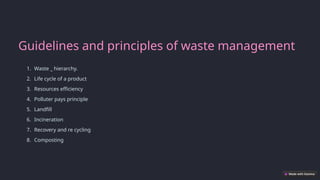
Guidelines and principles of waste management
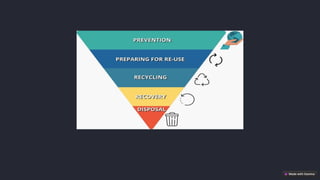
1. Waste _ hierarchy.
2. Life cycle of a product
3. Resources efficiency
4. Polluter pays principle
5. Landfill
6. Incineration
7. Recovery and re cycling
8. Composting
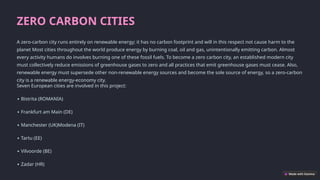
ZERO CARBON CITIES
A zero-carbon city runs entirely on renewable energy; it has no carbon footprint and will in this respect not cause harm to the
planet Most cities throughout the world produce energy by burning coal, oil and gas, unintentionally emitting carbon. Almost
every activity humans do involves burning one of these fossil fuels. To become a zero carbon city, an established modern city
must collectively reduce emissions of greenhouse gases to zero and all practices that emit greenhouse gases must cease. Also,
renewable energy must supersede other non-renewable energy sources and become the sole source of energy, so a zero-carbon
city is a renewable energy-economy city.
Seven European cities are involved in this project:
∙ Bistrita (ROMANIA)
∙ Frankfurt am Main (DE)
∙ Manchester (UK)Modena (IT)
∙ Tartu (EE)
∙ Vilvoorde (BE)
∙ Zadar (HR)
What Is ISO 14000?
ISO 14000 is a set of rules and standards created to help companies reduce industrial waste and environmental damage. It’s a
framework for better environmental impact management, but it’s not required. Companies can get ISO 14000 certified, but it’s
an optional certification. The ISO 14000 series of standards was introduced in 1996 by the International Organization for
Standardization (ISO) and most recently revised in 2015 (ISO is not an acronym; it derives from the ancient Greek word ísos,
meaning equal or equivalent.)
The key standards included in ISO 14000:
∙ ISO 14001: Specification of Environmental Management Systems
∙ ISO 14004: Guideline Standard
∙ ISO 14010 – ISO 14015: Environmental Auditing and Related Activities ISO 14020 – ISO 14024: Environmental Labeling
∙
∙ ISO 14031 and ISO 14032: Environmental Performance Evaluation
∙ ISO 14040 – ISO 14043: Life Cycle Assessment
∙ ISO 14050: Terms and Definitions
Benefits of ISO 14000 Certification
ISO 14000 certification can be achieved by having an accredited auditor verify that all the requirements are met, or a
company may self-declare. Obtaining the ISO 14000 certification can be considered a sign of a commitment to the
environment, which can be used as a marketing tool for companies. It may also help companies meet certain
environmental regulations.
The other benefits include being able to sell products to companies that use ISO 14000– certified suppliers.
Companies and customers may also pay more for products that are considered environmentally friendly. On the cost
side, meeting the ISO 14000 standards can help reduce costs, as it encourages the efficient use of resources and
limiting waste. This may lead to finding ways to recycle products or new uses for previously disposed of byproducts.
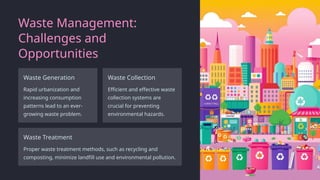
Waste Management:
Challenges and
Opportunities
Waste Generation
Rapid urbanization and
increasing consumption
patterns lead to an ever-
growing waste problem.
Waste Collection
Efficient and effective waste
collection systems are
crucial for preventing
environmental hazards.
Waste Treatment
Proper waste treatment methods, such as recycling and
composting, minimize landfill use and environmental pollution.
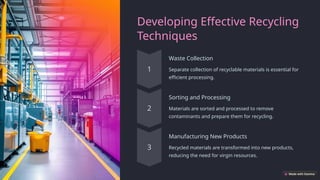
Developing Effective Recycling
Techniques
Waste Collection
Separate collection of recyclable materials is essential for
efficient processing.
Sorting and Processing
Materials are sorted and processed to remove
contaminants and prepare them for recycling.
Manufacturing New Products
Recycled materials are transformed into new products,
reducing the need for virgin resources.
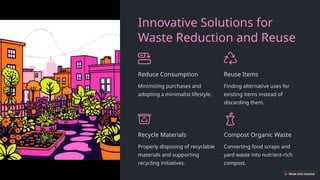
Innovative Solutions for
Waste Reduction and Reuse
Reduce Consumption
Minimizing purchases and
adopting a minimalist lifestyle.
Reuse Items
Finding alternative uses for
existing items instead of
discarding them.
Recycle Materials
Properly disposing of recyclable
materials and supporting
recycling initiatives.
Compost Organic Waste
Converting food scraps and
yard waste into nutrient-rich
compost.
Addressing the Growing Issue of Electronic Waste
1 E-waste Composition
E-waste contains valuable
materials like gold, silver, and
copper, but also hazardous
substances.
2 Environmental Impacts
Improper disposal of e-waste
can lead to soil and water
contamination and health
risks.
3 Sustainable Solutions
Promoting e-waste recycling,
responsible manufacturing,
and extended producer
responsibility.
Importance of Sustainable Waste
Management Practices
1 Resource Conservation
Sustainable waste management reduces the demand for virgin resources and
minimizes resource depletion.
2 Pollution Prevention
Proper waste treatment and disposal methods prevent environmental
pollution and protect ecosystems.
3 Climate Change Mitigation
Recycling and composting reduce greenhouse gas emissions associated with
waste disposal.
4 Public Health
Sustainable waste management practices contribute to public health by
minimizing exposure to hazardous materials.
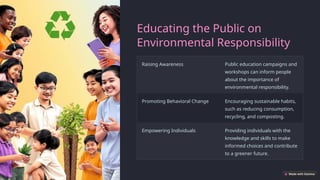
Educating the Public on
Environmental Responsibility
Raising Awareness Public education campaigns and
workshops can inform people
about the importance of
environmental responsibility.
Promoting Behavioral Change Encouraging sustainable habits,
such as reducing consumption,
recycling, and composting.
Empowering Individuals Providing individuals with the
knowledge and skills to make
informed choices and contribute
to a greener future.
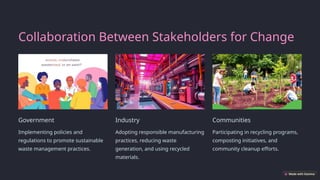
Collaboration Between Stakeholders for Change
Government
Implementing policies and
regulations to promote sustainable
waste management practices.
Industry
Adopting responsible manufacturing
practices, reducing waste
generation, and using recycled
materials.
Communities
Participating in recycling programs,
composting initiatives, and
community cleanup efforts.
Conclusion and Call to
Action
Environmental degradation poses a significant threat to the planet
and its inhabitants. By adopting sustainable waste management
practices, educating the public, and fostering collaboration among
stakeholders, we can work towards a cleaner, healthier, and more
sustainable future.

Environmental-Degradation module 2 evm sem1.pptx

  • 1.
    Environmental Degradation: Environmental degradation refersto the deterioration of the environment through depletion of resources such as air, water and soil; the destruction of ecosystems; habitat destruction; and the extinction of wildlife. Environmental degradation is one of the ten threats officially cautioned by the high-level PaneI on Threats, Challenges andChange of the United Nations
  • 2.
    EFFECTS OF ENVIONMENTALDEGRADATION ❑ Air pollution ❑ Water pollution ❑ Land pollution ❑ Deforestation ❑ Loss of biodiversity
  • 3.
    CAUSES OF ENVIONMENTALDEGRADATION ❑ DEFORESTATION-Global warming Global climate change Reduce net oxygen level Biosphere instability ❑ ❑ ❑ ❑ Effects water cycle POLLUTION OVER POPPULATION NATURAL CAUSES ❑ ❑ ❑ OVER POPULATION Results excess demand over food, clothes, shelter Result excess demand over land Reduce ❑ ❑ ❑ forest resource 3,POLLUTION- Water Land SOIL ❑ ❑ ❑ 4. NATURAL CAUSES- Earthquakes Tidal waves Storm Wildfire Floods Land sliding ❑ ❑ ❑ ❑ ❑ ❑
  • 4.
    PREVENTIVE MEASURES ➢ FOLLOW3Rs-REDUCE REUSE RECYCLE GREEEN TRANSPORTATION CONSERVE WATER USE RENEWABLE ENERGY REDUCE AIR &WATER POLLUTION PROTECT ECOSYSTEM PROMOTE SUSTAINABLE FARMING EDUCATE VOLUNTEER SHOP WISELY PLANT A TREE
  • 5.
    Industrial Pollution Industrial pollutionis contamination that can be traced back to a specific industry. This type of pollution is one of the most common sources of pollution around the planet. Air Pollution Industrial emissions release harmful gases and particulate matter into the atmosphere, contributing to respiratory problems and climate change. Water Pollution Industrial waste often contaminates water bodies with toxic chemicals, impacting aquatic life and human health. Land Degradation Industrial activities can lead to soil contamination, deforestation, and habitat loss, harming biodiversity and ecosystem services. Industrial activities are a major cause of pollution in the air, water, and land, resulting in illness and death all over the world. Outdoor air pollution is estimated to be responsible for 2% of all heart and lung ailments, 5% of lung malignancies, and 1% of all chest infections, according to the World Health Organization.
  • 6.
    Industrial Pollution iscaused by a variety of activities, including: ∙ Burning coal ∙ Burning fossil fuels like oil, natural gas, and petroleum ∙ Chemical solvents(benzene,toluene,xylene,butyle acetate) used in dyeing and tanning industries ∙ Untreated gas and liquid waste being released into the environment ∙ Improper disposal of radioactive material
  • 7.
    Causes of IndustrialPollution 1. Lack of Policies to Control Pollution Lack of effective policies and poor enforcement drive allowed many industries to bypass laws made by the pollution control board, which resulted in mass-scale pollution that affected the lives of many people. 2. Unplanned Industrial Growth In most industrial townships, unplanned growth took place wherein those companies flouted rules and norms and polluted the environment with both air and water pollution. 3. Use of Outdated Technologies Most industries still rely on old technologies to produce products that generate a large amount of waste. To avoid high cost and expenditure, many companies still make use of traditional technologies to produce high-end products. 4. Presence of a Large Number of Small Scale Industries- Many small scale industries and factories that don’t have enough capital and rely on government grants to run their day-to-day businesses often escape environment regulations and release a large number of toxic gases in the atmosphere 5. Inefficient Waste Disposal- Water pollution and soil pollution are often caused directly due to inefficiency in the disposal of waste. Long term exposure to polluted air and water causes chronic health problems, making the issue of industrial pollution into a severe one. It also lowers the air quality in surrounding areas, which causes many respiratory disorders. 6. Leaching of Resources From Our Natural World -Industries do require a large amount of raw material to make them into finished products. This requires the extraction of minerals from beneath the earth. The extracted minerals can cause soil pollution when spilled on the earth. Leaks from vessels can cause oil spills that may prove harmful to marine life. 7. Natural Resource Use- Raw material is a must for industries, which often requires them even pulling out underground elements. One of the most common forms of leaching from natural resources is fracking for oil. When industries extract minerals, the process causes soil pollution and also causes oil leaks and spills that are harmful and even deadly to people and animals.
  • 8.
    WASTE MANAGEMENT According toEcolife dictionary waste management is defined as “The concept of waste management involves the collection, removal, processing, and disposal of materials considered waste. Waste materials can be solid, gaseous, liquid, or even hazardous and are generally generated through human activity”. TYPES OF WASTE -Wastes are classified into three types. They are basis of physical state, basis of biodegradability and basis of effects on human health. On the basis of physical state, it is further classified into Solid, liquid and gaseous. On the basis of bio-degradability, it is further classified into biodegradable and non-biodegradable (metals, plastics, paper and glasses). On the basis of effects on human health, it is classified into hazardous (dangerous) and non-hazardous (nondangerous).
  • 9.
    Sources of wastes Domesticwastes: Household waste, food wastes, garbage (kitchen waste), rubbish (paper, polythene, plastics, and glass pieces), old Community wastes: Educational institutions waste, government offices, markets, public cleansing, bulky wastes, hospitals, construction works, etc. Commercial wastes: Bulky wastes from shops, offices, hotels, non-government markets, stores, tires, electronics, plastic bags, bottles, buckets, packaging materials, paper fibers, thermocol, discarded electric waste, etc. Industrial wastes: Paper and pulp wastes, oil refineries, tanneries, distilleries, thermal power plants, chemical industries, metal smelters, coal, ash, acids, chemicals, textiles, plastics, nuclear wastes, unused metal sheets, metal scraps, rubber, leather, toxic effluents, fibers (residues), heavy metals, solvents, resins, sludge, abrasive, etc. A Agricultural wastes: Farm waste, livestock yards, crop residues, biogases from sugarcane, outdated pesticides and fertilizers, manure, ungicides, slau Construction wastes: Demolition, excavation, renovation works, road works, site clearance, wood, glass, metal, plastic, concrete, etc. Municipal wastes: House hold discharge, street sweeping, sewage treatment plant waste, waste from schools and other institutions, Biomedical wastes: Hospitals, clinics, laboratories, etc. .
  • 10.
    Mining wastes: Wasterock, tailings, mine water, chemicals and others, etc Health-care wastes: Infectious waste, pathological waste, sharps waste, chemical waste, pharmaceutical waste, cytotoxic waste, general waste, etc.(Syringes, needles, disposal scalpels and blades, expired, unused and contaminated drugs and vaccines, swabs, bandages, gloves, disposable medical devices, urine bags, sanitary napkins, napkins, diapers, human tissues, organs or fluids, body parts, contaminated animal carcasses, disinfectants, sterility, heavy metals, broken thermometers, batteries, chemicals, etc.) . Radioactive wastes: Nuclear explosions, nuclear testing, use of radioactive substances in medical and scientific research, products contaminated by radionuclide’s including radioactive diagnostic material or radio therapeutic materials, etc. Electronic wastes: Discarded electronic devices like computer, TV, music systems, transistors, tape recorders, mobile phones, computer cabinets, mother boards, CDs, cassettes, moue, wires, cords, switches, chargers, batteries, circuits, etc
  • 11.
    Waste Management Techniques Accordingto the deposition and type of waste, different techniques are used for waste management. They may vary from person to person, place to place, time to time and nation to nation. They are: ∙ Composting Landfilling Incineration-Burning the wastes at high temperature is called as Incineration. ∙ Bioremediation-Process of using microbes and bacteria for removing the impurities, pollutants and poisons from soil, water and other environments is called as bioremediation. Energy power generation plants emit radioactive wastes which is the major threat to the human population. To reduce these wastes, bioremediation strategy is used. ∙ Waste-to-energy Waste-to-energy is the process of creating energy in the form of electricity or heat from the primary treatment of waste. Remote Sensing & GIS remote sensing is the art of obtaining information-about objects or areas from a distance, typically from aircraft or satellites. In Coimbatore landfill sites, 75% of municipal solid waste was dumped without treatment and it was found out by using vector data and remote sensing (RS).
  • 12.
    Guidelines and principlesof waste management 1. Waste _ hierarchy. 2. Life cycle of a product 3. Resources efficiency 4. Polluter pays principle 5. Landfill 6. Incineration 7. Recovery and re cycling 8. Composting
  • 14.
    ZERO CARBON CITIES Azero-carbon city runs entirely on renewable energy; it has no carbon footprint and will in this respect not cause harm to the planet Most cities throughout the world produce energy by burning coal, oil and gas, unintentionally emitting carbon. Almost every activity humans do involves burning one of these fossil fuels. To become a zero carbon city, an established modern city must collectively reduce emissions of greenhouse gases to zero and all practices that emit greenhouse gases must cease. Also, renewable energy must supersede other non-renewable energy sources and become the sole source of energy, so a zero-carbon city is a renewable energy-economy city. Seven European cities are involved in this project: ∙ Bistrita (ROMANIA) ∙ Frankfurt am Main (DE) ∙ Manchester (UK)Modena (IT) ∙ Tartu (EE) ∙ Vilvoorde (BE) ∙ Zadar (HR)
  • 15.
    What Is ISO14000? ISO 14000 is a set of rules and standards created to help companies reduce industrial waste and environmental damage. It’s a framework for better environmental impact management, but it’s not required. Companies can get ISO 14000 certified, but it’s an optional certification. The ISO 14000 series of standards was introduced in 1996 by the International Organization for Standardization (ISO) and most recently revised in 2015 (ISO is not an acronym; it derives from the ancient Greek word ísos, meaning equal or equivalent.) The key standards included in ISO 14000: ∙ ISO 14001: Specification of Environmental Management Systems ∙ ISO 14004: Guideline Standard ∙ ISO 14010 – ISO 14015: Environmental Auditing and Related Activities ISO 14020 – ISO 14024: Environmental Labeling ∙ ∙ ISO 14031 and ISO 14032: Environmental Performance Evaluation ∙ ISO 14040 – ISO 14043: Life Cycle Assessment ∙ ISO 14050: Terms and Definitions
  • 16.
    Benefits of ISO14000 Certification ISO 14000 certification can be achieved by having an accredited auditor verify that all the requirements are met, or a company may self-declare. Obtaining the ISO 14000 certification can be considered a sign of a commitment to the environment, which can be used as a marketing tool for companies. It may also help companies meet certain environmental regulations. The other benefits include being able to sell products to companies that use ISO 14000– certified suppliers. Companies and customers may also pay more for products that are considered environmentally friendly. On the cost side, meeting the ISO 14000 standards can help reduce costs, as it encourages the efficient use of resources and limiting waste. This may lead to finding ways to recycle products or new uses for previously disposed of byproducts.
  • 17.
    Waste Management: Challenges and Opportunities WasteGeneration Rapid urbanization and increasing consumption patterns lead to an ever- growing waste problem. Waste Collection Efficient and effective waste collection systems are crucial for preventing environmental hazards. Waste Treatment Proper waste treatment methods, such as recycling and composting, minimize landfill use and environmental pollution.
  • 18.
    Developing Effective Recycling Techniques WasteCollection Separate collection of recyclable materials is essential for efficient processing. Sorting and Processing Materials are sorted and processed to remove contaminants and prepare them for recycling. Manufacturing New Products Recycled materials are transformed into new products, reducing the need for virgin resources.
  • 19.
    Innovative Solutions for WasteReduction and Reuse Reduce Consumption Minimizing purchases and adopting a minimalist lifestyle. Reuse Items Finding alternative uses for existing items instead of discarding them. Recycle Materials Properly disposing of recyclable materials and supporting recycling initiatives. Compost Organic Waste Converting food scraps and yard waste into nutrient-rich compost.
  • 20.
    Addressing the GrowingIssue of Electronic Waste 1 E-waste Composition E-waste contains valuable materials like gold, silver, and copper, but also hazardous substances. 2 Environmental Impacts Improper disposal of e-waste can lead to soil and water contamination and health risks. 3 Sustainable Solutions Promoting e-waste recycling, responsible manufacturing, and extended producer responsibility.
  • 21.
    Importance of SustainableWaste Management Practices 1 Resource Conservation Sustainable waste management reduces the demand for virgin resources and minimizes resource depletion. 2 Pollution Prevention Proper waste treatment and disposal methods prevent environmental pollution and protect ecosystems. 3 Climate Change Mitigation Recycling and composting reduce greenhouse gas emissions associated with waste disposal. 4 Public Health Sustainable waste management practices contribute to public health by minimizing exposure to hazardous materials.
  • 22.
    Educating the Publicon Environmental Responsibility Raising Awareness Public education campaigns and workshops can inform people about the importance of environmental responsibility. Promoting Behavioral Change Encouraging sustainable habits, such as reducing consumption, recycling, and composting. Empowering Individuals Providing individuals with the knowledge and skills to make informed choices and contribute to a greener future.
  • 23.
    Collaboration Between Stakeholdersfor Change Government Implementing policies and regulations to promote sustainable waste management practices. Industry Adopting responsible manufacturing practices, reducing waste generation, and using recycled materials. Communities Participating in recycling programs, composting initiatives, and community cleanup efforts.
  • 24.
    Conclusion and Callto Action Environmental degradation poses a significant threat to the planet and its inhabitants. By adopting sustainable waste management practices, educating the public, and fostering collaboration among stakeholders, we can work towards a cleaner, healthier, and more sustainable future.