POLLINATION-TYPES, CONTRIVANCES,
SIGNIFICANCE & ADAPTATION
By
Dr. N. Sannigrahi,
Associate Professor,
Department of Botany,
Nistarini College, Purulia, 723101(W.B) India
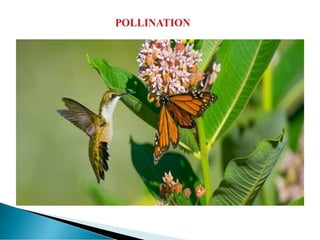
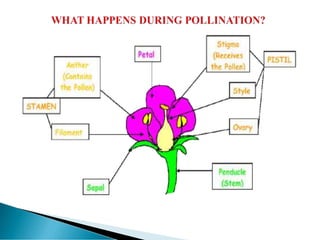
 Pollination is a critical step in the sexual reproduction of flowering plants.
It is defined as the transfer of pollen (the male gametes) from the anthers of
one flower, to the stigma of another flower. The pollen grain then grows a
tube, down through the style, to reach the ovary of the flower. Here, the
male gamete fertilizes an ovule, producing an embryo which grows into a
seed or nut.
 This growing seed is often protected by the development of a soft
nutritious fruit. For this process to work, pollen needs to be moved between
flowers to ensure what is termed ‘cross-pollination’, and this means that
something needs to transport the pollen. In some crops, such as wheat and
maize, the pollen is transported by the wind.
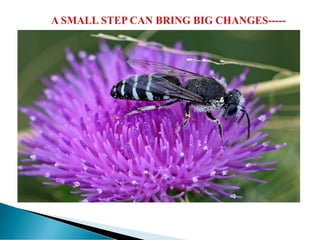
 In the majority of crops however, the pollen is transported by insects. Often
these are insects specifically adapted to visit flowers to feed on their nectar
(a sugary food source produced by the flower) or pollen. In doing this, the
insect picks up pollen from one flower and then, on visiting another flower
of the same species, deposits this pollen and effects fertilization






Pollination of two types basically-
SELF POLLINATION AND CROSS POLLINATION
Self Pollination or Homogamy or Autogamy-




CROSS POLLINATION





CONTRIVANCES
1.
2.
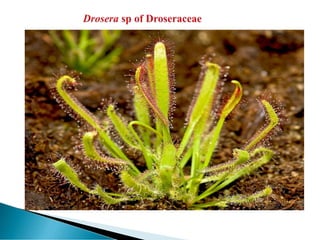
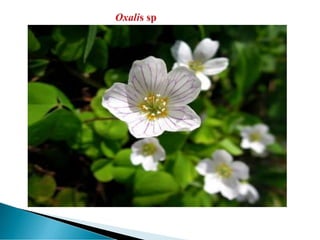
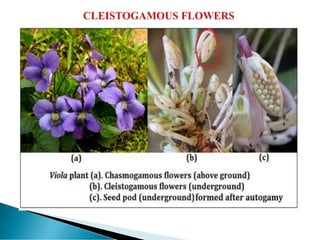
Obligate or Habitual cleistgamy
Facultative or Pseudo- cleistogamy
i.
ii.
iii.
iv.
v.
The pollen grains (microspores) are transferred from an anther of one flower
to stigma of another flower borne on different plants of same or different
species is called cross pollination.
It may be two types-
XENOGAMY- Between two different plants of same species,
HYBRIDISM- Between two different species
There are several devices to ensure cross pollination as stated below.
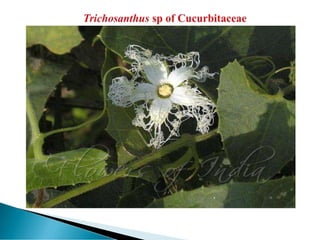
1. DICLINY OR UNISEXUALITY:
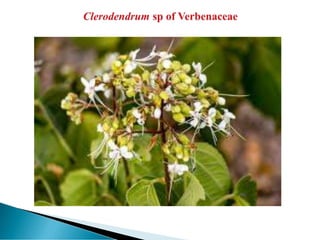
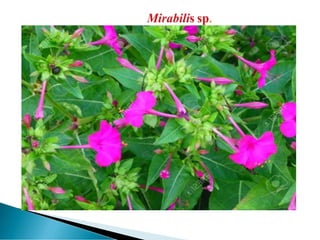
2. DICHOGAMY: The stamens and carpel do not mature at the same time
of bisexual flower and hindered self pollination. it is of two types-
PROTANDRY OR PROTERANDRY-The anthers mature earlier than the
carpel giving no opportunity to undergo self pollination. e.g. Leonaurus sp of
Lamiaceae, Helianthus sp of Asteraceae, Hibiscus sp of Malvaceae.
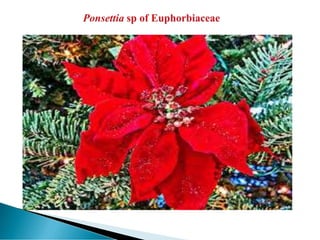
PROTOGYNY OR PROTEROGYNY-Here, Carpel mature earlier then than
the anther. Magnolia grandiflora of Magnoliaceae, Poinsettia pulcherrima
of Euphorbiaceae. Due to the reverse situation of protandry, the two opposite
gametes do not come contact to each other.
3. SELF STERILITY OR INCOMPATIBILITY: The pollen grains does
not germinate on the stigma of the same flowers due to genetic
incompatibility.e.g Solanum tuberosum of Solanaceae, Passiflora sp. of
Passifloraceae, Some members of Rosaceae etc.
4. HERKOGAMY: Due to some physical barrier between anther and style,
the self pollination becomes impossible. In some members of Asclepiadaceae,
the pollen grains aggregated to form pollinium hinders to undergo pollination,
so, pollination becomes insect dependent; in Gloriosa superba, the extrose
anthers, the pollens become out of reach of its own stigma.
5. HETEROMORPHISM: In some plants, flowers are of either dimorphic
or trimorophic where the anthers and stigma are at different levels; where
anthers are different types called heteroanthy and styles are of different
lengths called heterostyly. Thus, cross pollination becomes obvious in this
condition.
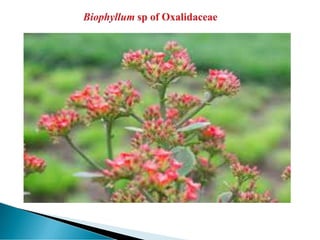
a. Dimorphism-In Primula sp of Primulaceae, one type having long stamen
and a short style and other having short stamen and long style, Biophyllum of
Oxalidaceae & Polygonum of Polygonaceae. As a consequence, the self
pollination is hindered although have enough chance to undergo self
pollination.
b. Trimorphism
So, the contrivances offer desirable adaptations for the easy accessibility of
pollen grains to the stigma to enjoy desired biological requirements for the
sake of pollination.
Self Pollination: Advantages:
 It is sure method of pollination without any external agents.
More economical due to less wastage of pollen,
Pure line progeny can be maintained by avoiding undesired traits.
Self-pollination helps to maintain parental characters or purity of the
species.
The plant does not need to depend on the pollinating agents.
No need of producing a large number of pollen grains.
Flowers do not need to develop devices for attracting insect pollinators.
It ensures seed production.
Less chance of failure of pollination.
It is easiest method
DISADVANTAGES:
i. Progeny shows less vigour due inbreeding depression,
ii. No possibility of introduction of new characters,
iii. Undesirable characters or weak can not be eliminated,
iv. No benefit in natural selection and evolution,
v. The seeds are in smaller quantities.
vi. New plant varieties cannot be created. Because the endosperm is so
little, the seeds produced are feeble.
vii. The immunity of the offspring decreases if new characteristics are not
introduced.
viii. Disease resistant capacity is least.
ADVANTAGES:
i. Offspring show hybrid vigour,
ii. More viable and resistant to diseases,
iii. Possibility to get new characters due to out breeding,
iv. Seeds are abundant and good quality,
v. The children are healthier.
vi. Seeds are produced in greater quantities and are more viable.
vii. The seeds develop and germinate properly, resulting in healthier plants.
viii. Cross-pollination between two different varieties of the same species,
or even two species, results in new varieties.
ix. Undesirable characters can be eliminated and helps in evolution.
DISADVANTAGES:
I. Chance of the failure of pollination due to distance barrier,
II. Pollination depends on the external agencies,
III. More wastage of pollen and less economic,
IV. May introduce undesirable traits.
V. Pollen grains are being wasted in more significant quantities.
VI. Because of the distance barrier, pollination may fail.
VII. Cross-pollination has the potential to introduce undesirable traits.
VIII. It is uneconomical for plants to create huge, scented, nectar-filled
flowers to attract insects.
IX. Pollination is not always sure .
 The transfer of microspores (pollen grains) from anther to the receptive
spot of the stigma is essentially needed for subsequent stages of
reproduction irrespective of its nature, either self pollination or cross
pollination.
 The different type of agents are required for the same especially it is cross
pollination where the pollen grains may have to travel a little bit distance.
 The agents depends upon the nature of the plants as well as the
morphological features of the pollen grains.
 The agents may be of two types- biotic and abiotic .
 The biotic agents may be insects (Entomophilies), birds (Ornithophily),
animals (Zoophily), bat (Chiropteriphily), snails (Malacophily) etc.
 The abiotic agents may be air (Anemophily) or water (Hydrophily).
 The different types of pollination by different agents need different types of
adaptation for easy accessibility.
 ANEMOPHILY (POLLINATION BY AIR/ WIND) ADAPTATION
 Flowers- inconspicuous, usually not brightly colored or scented
 Petals are either small and green or absent
 Male flowers are more numerous than female
 Anther are versatile so that they swing freely by air currents
 Pollen grains are smooth walled, relatively light, small and dry so they can
be easily blown away by wind.
 In grasses, pollen grains are relatively heavy and hence are not suitable for
transport by wind. To overcome this problem, the male flowers are borne in
the upper part of the inflorescence and the female in the lower part.
 Examples; Most cereals and palms, Member of Salicaceae (Poplar,
willow), Betulaceae (Alder, hazel, birch), Fagaceae (Oak, beech),
Ulmaceae (Elm), Urticaceae (Urtica) etc.
 ENTOMOPHILOUS FOWER:
 Most frequent in Angiosperms, Small amount of pollen grains.
 Pollens are sticky with a rough surface so they may easily stick to insect limbs.
 Special relationship between flowers and insects (Coevolved during evolution)
 Insects visit flowers to secure food in the from of pollen sap and nectar, to
deposit their eggs and for shelter etc
 ADAPTATION
 Insect pollinated flowers are made attractive to insects in many ways
Conspicuous Flowers: Large and brightly colored
 Aggregation of small flowers forming inflorescences as capitula.
 Petals: Most common
 Sepals in Mussaenda
 Bracts in Bougainvillea ,Spathe of the inflorescence in Musa , Insects see only
UV wavelengths ,Bee –blue color , Butterflies – Red , Flies – brown and purple
 SCENT
 In some species scent is more specific then color.
 Flies seem to be attracted by the nauseous odor produce by certain flowers
like Rafflesia sp..
 Certain flower emit a strong scent during night and are found to be
pollinated by night flying moths. For Example – Nyctanthes, Cestrum and
Ampelopsis .
 Nectar glands are situated in different positions of flowers secreting as
sugary fluid called nectar. Nectar is the most valuable thing for which
insects visit flowers. Bees collect nectar and elaborate it into commercial
honey.
 Nectar glands are located on the thalamus, on the outside of sepals, at the
bases of sepals, petals, carpel and even in the septa within ovaries. Nectar
is often concealed within corolla tube or spur so that insects have to do
much searching for this and thereby get thoroughly dusted with pollens.
 Edible sap Some flowers do not have nectaries but secrete an edible sap.
For example- Orchis sp, Hyacinthus sp, Anagallis sp., Verbascum sp. and
Erythraea sp. They secrete juice and sticky substances which cause pollens
to stick to the body of insect.
 Edible pollen
 Some flower produce numerous pollen.
 They are eaten by insects and some pollens are stick to the body for
pollination.
 Examples: Clematis, Anemone and Salix
 Special mechanisms Bi-fid stigmas of Bignonia close the two flaps on
being touched by insects. If not pollinated, they open again Pistil of
Centaurea sp. of Asteraceae bends and exposes the stigma on touched by
insect
 Pollination takes place with the help of water is called hydrophily.
 Two types- Hypohydrogamy and Epihydrogamy
 HYPOHYDROGAMY
 When the pollination takes place inside the water , it is called
hypohydrogamy as found in Najas sp (Hydrocharitaceae) , Ceratophyllum
sp. (Ceratophyllaceae).
 EPIHYDROGAMY
 Here the pollination takes place on the water surface as in Vallisneria sp.
 The flowers are borne under water,
 The pistillate flowers are brought to the surface by their long stalk and
form a cup like depression,
 The male flowers get detached from the parent plant and float on the
surface of water and get lodged on the depression, pollination occurs,
 After pollination, the elongated stalk of the pistillate flowers undergoes
spiral coiling and comes under water.
 When the pollination takes place with the help of other animals like slugs,
snails, squirrels etc. , it is called malacophily.
 During the visits, the slugs help in pollination.
 Likewise, snails and squirrels also pollinate some aroid flowers,
 The pollination is not frequent due to some issues,
 The snail species, Lamellexis gracilis pollinates Volvulopsis nummularium
belongs to morning glory/sweet family, Convolvulaceae generally practice
it.
 When the pollination takes place with the help of birds, it is called
ornithophily.
 The ornithophilous flowers are very large , showy,
 These secrete profuse nectar within them,
 Some birds get attracted with the showy nectar and visit the flowers,
 Some common plants like Bigonia capreolata of Bignoniaceae, Strelitzia
reginae of Musaceae, Butea monosperma of Fabaceae , Bombyx ceiba of
Bombacaceae etc. shows ornithophilous nature.
 The flowers of these plants are large, stout enough so that bats can hold on
to the flowers.
 (ii) Flowers produce nectar to attract.
 (iii) Flowers have a large number of stamens to produce a required large
quantity of pollen grains.
 These plants generally show this pollen transfer mechanisms with the help
of bats called chiropteriphily.
 The flowers like Bombyx ceiba of Bombacaceae, Anthocephalous cadamba
of Rubiaceae generally shows the behaviors of pollen tranasfer mechanism.
 REFERENCES:
1. Different WebPages for study materials and content,
2. Google for images for better illustrations,
3. A Textbook of Botany, VolI.II- Bhattacharya, Hait, Ghosh,
4. Different images used only for the sake of lucidity.
 Disclaimer
 This presentation has been developed to enrich the online free study
materials for academic fraternity without any financial interests. The
presenter always takes the happiness to reach the unreached

Pollination-Types, Contrivances and Adaptations.pdf

  • 1.
    POLLINATION-TYPES, CONTRIVANCES, SIGNIFICANCE &ADAPTATION By Dr. N. Sannigrahi, Associate Professor, Department of Botany, Nistarini College, Purulia, 723101(W.B) India
  • 3.
     Pollination isa critical step in the sexual reproduction of flowering plants. It is defined as the transfer of pollen (the male gametes) from the anthers of one flower, to the stigma of another flower. The pollen grain then grows a tube, down through the style, to reach the ovary of the flower. Here, the male gamete fertilizes an ovule, producing an embryo which grows into a seed or nut.  This growing seed is often protected by the development of a soft nutritious fruit. For this process to work, pollen needs to be moved between flowers to ensure what is termed ‘cross-pollination’, and this means that something needs to transport the pollen. In some crops, such as wheat and maize, the pollen is transported by the wind.  In the majority of crops however, the pollen is transported by insects. Often these are insects specifically adapted to visit flowers to feed on their nectar (a sugary food source produced by the flower) or pollen. In doing this, the insect picks up pollen from one flower and then, on visiting another flower of the same species, deposits this pollen and effects fertilization
  • 5.
  • 6.
    Pollination of twotypes basically- SELF POLLINATION AND CROSS POLLINATION Self Pollination or Homogamy or Autogamy-    
  • 7.
  • 9.
    CONTRIVANCES 1. 2. Obligate or Habitualcleistgamy Facultative or Pseudo- cleistogamy
  • 13.
  • 16.
    The pollen grains(microspores) are transferred from an anther of one flower to stigma of another flower borne on different plants of same or different species is called cross pollination. It may be two types- XENOGAMY- Between two different plants of same species, HYBRIDISM- Between two different species There are several devices to ensure cross pollination as stated below. 1. DICLINY OR UNISEXUALITY:
  • 18.
    2. DICHOGAMY: Thestamens and carpel do not mature at the same time of bisexual flower and hindered self pollination. it is of two types- PROTANDRY OR PROTERANDRY-The anthers mature earlier than the carpel giving no opportunity to undergo self pollination. e.g. Leonaurus sp of Lamiaceae, Helianthus sp of Asteraceae, Hibiscus sp of Malvaceae. PROTOGYNY OR PROTEROGYNY-Here, Carpel mature earlier then than the anther. Magnolia grandiflora of Magnoliaceae, Poinsettia pulcherrima of Euphorbiaceae. Due to the reverse situation of protandry, the two opposite gametes do not come contact to each other. 3. SELF STERILITY OR INCOMPATIBILITY: The pollen grains does not germinate on the stigma of the same flowers due to genetic incompatibility.e.g Solanum tuberosum of Solanaceae, Passiflora sp. of Passifloraceae, Some members of Rosaceae etc.
  • 20.
    4. HERKOGAMY: Dueto some physical barrier between anther and style, the self pollination becomes impossible. In some members of Asclepiadaceae, the pollen grains aggregated to form pollinium hinders to undergo pollination, so, pollination becomes insect dependent; in Gloriosa superba, the extrose anthers, the pollens become out of reach of its own stigma. 5. HETEROMORPHISM: In some plants, flowers are of either dimorphic or trimorophic where the anthers and stigma are at different levels; where anthers are different types called heteroanthy and styles are of different lengths called heterostyly. Thus, cross pollination becomes obvious in this condition. a. Dimorphism-In Primula sp of Primulaceae, one type having long stamen and a short style and other having short stamen and long style, Biophyllum of Oxalidaceae & Polygonum of Polygonaceae. As a consequence, the self pollination is hindered although have enough chance to undergo self pollination.
  • 22.
    b. Trimorphism So, thecontrivances offer desirable adaptations for the easy accessibility of pollen grains to the stigma to enjoy desired biological requirements for the sake of pollination.
  • 24.
    Self Pollination: Advantages: It is sure method of pollination without any external agents. More economical due to less wastage of pollen, Pure line progeny can be maintained by avoiding undesired traits. Self-pollination helps to maintain parental characters or purity of the species. The plant does not need to depend on the pollinating agents. No need of producing a large number of pollen grains. Flowers do not need to develop devices for attracting insect pollinators. It ensures seed production. Less chance of failure of pollination. It is easiest method
  • 25.
    DISADVANTAGES: i. Progeny showsless vigour due inbreeding depression, ii. No possibility of introduction of new characters, iii. Undesirable characters or weak can not be eliminated, iv. No benefit in natural selection and evolution, v. The seeds are in smaller quantities. vi. New plant varieties cannot be created. Because the endosperm is so little, the seeds produced are feeble. vii. The immunity of the offspring decreases if new characteristics are not introduced. viii. Disease resistant capacity is least.
  • 26.
    ADVANTAGES: i. Offspring showhybrid vigour, ii. More viable and resistant to diseases, iii. Possibility to get new characters due to out breeding, iv. Seeds are abundant and good quality, v. The children are healthier. vi. Seeds are produced in greater quantities and are more viable. vii. The seeds develop and germinate properly, resulting in healthier plants. viii. Cross-pollination between two different varieties of the same species, or even two species, results in new varieties. ix. Undesirable characters can be eliminated and helps in evolution.
  • 27.
    DISADVANTAGES: I. Chance ofthe failure of pollination due to distance barrier, II. Pollination depends on the external agencies, III. More wastage of pollen and less economic, IV. May introduce undesirable traits. V. Pollen grains are being wasted in more significant quantities. VI. Because of the distance barrier, pollination may fail. VII. Cross-pollination has the potential to introduce undesirable traits. VIII. It is uneconomical for plants to create huge, scented, nectar-filled flowers to attract insects. IX. Pollination is not always sure .
  • 28.
     The transferof microspores (pollen grains) from anther to the receptive spot of the stigma is essentially needed for subsequent stages of reproduction irrespective of its nature, either self pollination or cross pollination.  The different type of agents are required for the same especially it is cross pollination where the pollen grains may have to travel a little bit distance.  The agents depends upon the nature of the plants as well as the morphological features of the pollen grains.  The agents may be of two types- biotic and abiotic .  The biotic agents may be insects (Entomophilies), birds (Ornithophily), animals (Zoophily), bat (Chiropteriphily), snails (Malacophily) etc.  The abiotic agents may be air (Anemophily) or water (Hydrophily).  The different types of pollination by different agents need different types of adaptation for easy accessibility.
  • 29.
     ANEMOPHILY (POLLINATIONBY AIR/ WIND) ADAPTATION  Flowers- inconspicuous, usually not brightly colored or scented  Petals are either small and green or absent  Male flowers are more numerous than female  Anther are versatile so that they swing freely by air currents  Pollen grains are smooth walled, relatively light, small and dry so they can be easily blown away by wind.  In grasses, pollen grains are relatively heavy and hence are not suitable for transport by wind. To overcome this problem, the male flowers are borne in the upper part of the inflorescence and the female in the lower part.  Examples; Most cereals and palms, Member of Salicaceae (Poplar, willow), Betulaceae (Alder, hazel, birch), Fagaceae (Oak, beech), Ulmaceae (Elm), Urticaceae (Urtica) etc.
  • 30.
     ENTOMOPHILOUS FOWER: Most frequent in Angiosperms, Small amount of pollen grains.  Pollens are sticky with a rough surface so they may easily stick to insect limbs.  Special relationship between flowers and insects (Coevolved during evolution)  Insects visit flowers to secure food in the from of pollen sap and nectar, to deposit their eggs and for shelter etc  ADAPTATION  Insect pollinated flowers are made attractive to insects in many ways Conspicuous Flowers: Large and brightly colored  Aggregation of small flowers forming inflorescences as capitula.  Petals: Most common  Sepals in Mussaenda  Bracts in Bougainvillea ,Spathe of the inflorescence in Musa , Insects see only UV wavelengths ,Bee –blue color , Butterflies – Red , Flies – brown and purple
  • 31.
     SCENT  Insome species scent is more specific then color.  Flies seem to be attracted by the nauseous odor produce by certain flowers like Rafflesia sp..  Certain flower emit a strong scent during night and are found to be pollinated by night flying moths. For Example – Nyctanthes, Cestrum and Ampelopsis .  Nectar glands are situated in different positions of flowers secreting as sugary fluid called nectar. Nectar is the most valuable thing for which insects visit flowers. Bees collect nectar and elaborate it into commercial honey.  Nectar glands are located on the thalamus, on the outside of sepals, at the bases of sepals, petals, carpel and even in the septa within ovaries. Nectar is often concealed within corolla tube or spur so that insects have to do much searching for this and thereby get thoroughly dusted with pollens.
  • 32.
     Edible sapSome flowers do not have nectaries but secrete an edible sap. For example- Orchis sp, Hyacinthus sp, Anagallis sp., Verbascum sp. and Erythraea sp. They secrete juice and sticky substances which cause pollens to stick to the body of insect.  Edible pollen  Some flower produce numerous pollen.  They are eaten by insects and some pollens are stick to the body for pollination.  Examples: Clematis, Anemone and Salix  Special mechanisms Bi-fid stigmas of Bignonia close the two flaps on being touched by insects. If not pollinated, they open again Pistil of Centaurea sp. of Asteraceae bends and exposes the stigma on touched by insect
  • 33.
     Pollination takesplace with the help of water is called hydrophily.  Two types- Hypohydrogamy and Epihydrogamy  HYPOHYDROGAMY  When the pollination takes place inside the water , it is called hypohydrogamy as found in Najas sp (Hydrocharitaceae) , Ceratophyllum sp. (Ceratophyllaceae).  EPIHYDROGAMY  Here the pollination takes place on the water surface as in Vallisneria sp.  The flowers are borne under water,  The pistillate flowers are brought to the surface by their long stalk and form a cup like depression,  The male flowers get detached from the parent plant and float on the surface of water and get lodged on the depression, pollination occurs,  After pollination, the elongated stalk of the pistillate flowers undergoes spiral coiling and comes under water.
  • 34.
     When thepollination takes place with the help of other animals like slugs, snails, squirrels etc. , it is called malacophily.  During the visits, the slugs help in pollination.  Likewise, snails and squirrels also pollinate some aroid flowers,  The pollination is not frequent due to some issues,  The snail species, Lamellexis gracilis pollinates Volvulopsis nummularium belongs to morning glory/sweet family, Convolvulaceae generally practice it.
  • 35.
     When thepollination takes place with the help of birds, it is called ornithophily.  The ornithophilous flowers are very large , showy,  These secrete profuse nectar within them,  Some birds get attracted with the showy nectar and visit the flowers,  Some common plants like Bigonia capreolata of Bignoniaceae, Strelitzia reginae of Musaceae, Butea monosperma of Fabaceae , Bombyx ceiba of Bombacaceae etc. shows ornithophilous nature.
  • 36.
     The flowersof these plants are large, stout enough so that bats can hold on to the flowers.  (ii) Flowers produce nectar to attract.  (iii) Flowers have a large number of stamens to produce a required large quantity of pollen grains.  These plants generally show this pollen transfer mechanisms with the help of bats called chiropteriphily.  The flowers like Bombyx ceiba of Bombacaceae, Anthocephalous cadamba of Rubiaceae generally shows the behaviors of pollen tranasfer mechanism.
  • 38.
     REFERENCES: 1. DifferentWebPages for study materials and content, 2. Google for images for better illustrations, 3. A Textbook of Botany, VolI.II- Bhattacharya, Hait, Ghosh, 4. Different images used only for the sake of lucidity.  Disclaimer  This presentation has been developed to enrich the online free study materials for academic fraternity without any financial interests. The presenter always takes the happiness to reach the unreached