ANTHESIS AND POLLINATION
Dr. K. Vanangamudi
Formerly Dean (Agriculture), AC & RI, Coimbatore
Dean, Adhiparasakthi Agricultural College, Kalavai
Professor & Head (Seed Science & Technology)
Tamil Nadu Agricultural University,
Coimbatore 641 003
Contact: 9894904745
Mail: vanangamudi.tnau@gmail.com
Website: https://trinityculturalacademy.com/
YouTube: https://youtube.com/channel/UCWGv08j5jaZ-nkvz46HrBVw
1. INTRODUCTION
The flowering goes through a phase of vegetative growth producing more stems and leaves and a flowering phase
where they produce the organs for sexual reproduction.
Types of flowering
First flowering When the plant shows the first blooming after attaining the reproductive phase.
50% flowering When the 50 % of the plants come to flowering that is called as 50 % flowering.
2. ANTHESIS
Anthesis is the period during which a flower is fully open and functional, in terms of pollen maturation and
dispersal. It may also refer to the onset of that period. Flowers with diurnal anthesis generally have brightly
coloured flowers to attract diurnal insects, such as butterflies. Flowers with nocturnal anthesis generally have
white or less colourful flowers, that contrast more strongly with the night. These flowers typically attract nocturnal
insects including many moth species.
2.1. Types
Dichogamy: Describes the case in which the stamens and pistil of a flower mature at different times, thereby
preventing autogamous self-pollination. There are two types of dichogamy.
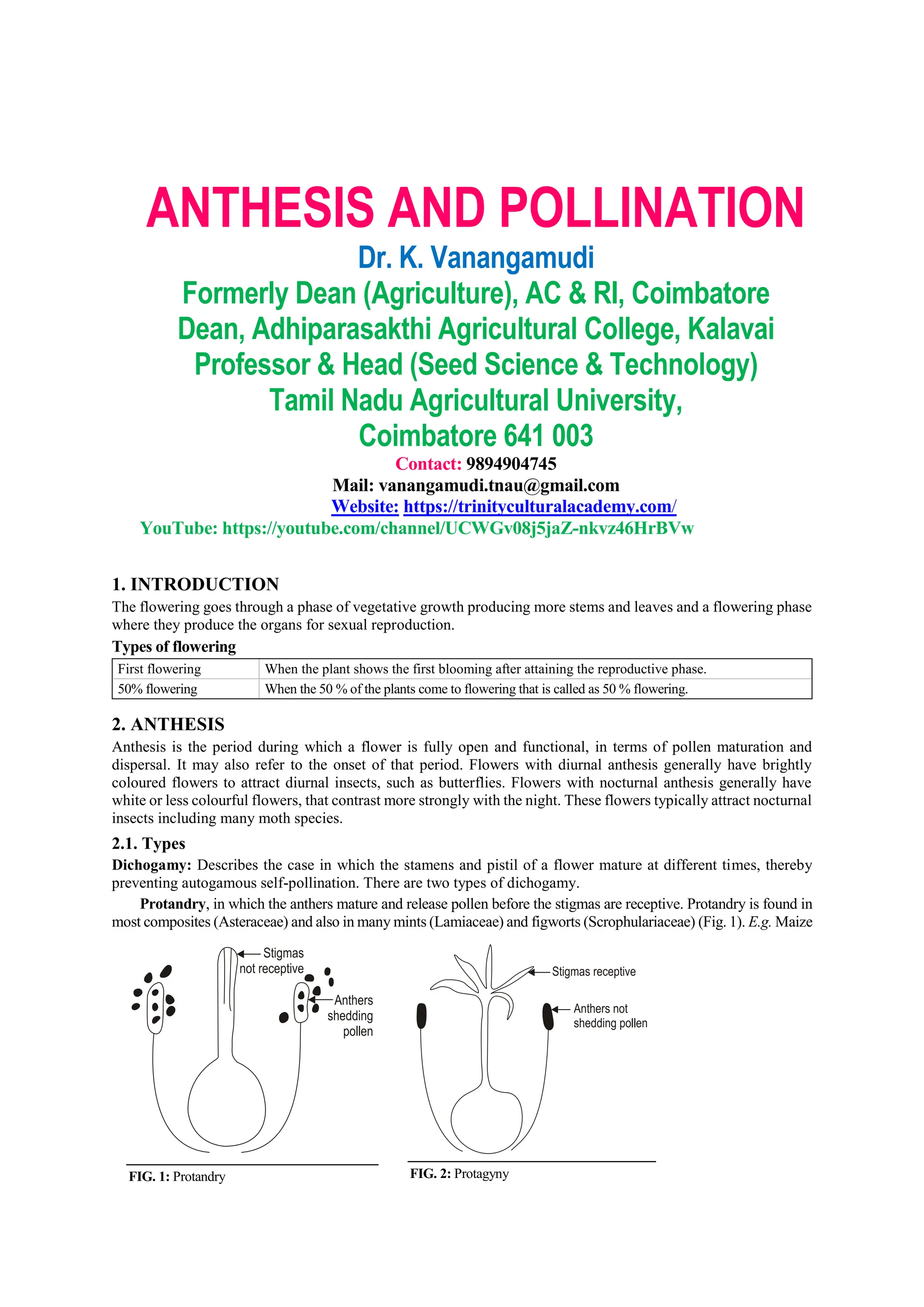
Protandry, in which the anthers mature and release pollen before the stigmas are receptive. Protandry is found in
most composites (Asteraceae) and also in many mints (Lamiaceae) and figworts (Scrophulariaceae) (Fig. 1). E.g. Maize
FIG. 1: Protandry FIG. 2: Protagyny
Protogyny in which the stigmas become receptive before pollen release. Protogyny is very pronounced in a number
of families commonly regarded as primitive, for example, water lilies (Nymphaeaceae) and magnolias (Magnoliaceae).
Very common plants that demonstrate protogyny are the plantains (Plantaginaceae) (Fig. 2). E.g. Pearlmillet
3. POLLINATION
The process by which plant pollen is transferred from the male reproductive organs to the female reproductive
organs to form seeds.
3.1. Self pollination (Autogamy)
The pollen grains can be carried from an anther to the stigma of the same flower is known as self pollination
(or)
The transfer ofpollen froma male reproductive structure (an anther or male cone) to a female reproductive structure
(a stigma or female cone) of the same plant or of the same flower
(or)
Fertilization by transfer of pollen from the anthers to the stigma of the same flower.
Examples: Peanuts, Soybeans, orchids, peas, tomatoes, lettuce, peas, snap beans, soybeans, lima beans, barley,
wheat, oats and cowpeas.
3.1.1. Mechanism facilitating self pollination
Bisexuality or hermaphroditism: The presence of both reproductive organs in a flower is called bisexuality and
flower is said to be bisexual. It is only in bisexual flowers that self-pollination can take place.
It means presence of male and female reproductive organs in the same flower. A hermaphrodite flower is a
characteristic feature of self pollinated plants.
Homogamy: It simply means that both the sex organ mature at the same time, e.g., Mirabilis.
(or)
In this kind of mechanism, anthers and stigma of a flower mature at the same time. It is very important for
occurrence of self pollination. In some species, stigmas become receptive and elongate through staminal columns.
Cleistogamy: In cleistogamous flowers, the pollens are shed within the closed flowers so that self-pollination is
obligatory. Cleistogamy is seen in the underground flowers of Commelina benghalensis, Oxalis, Pisum, Arachis, Viola
tricolor (Fig. 3).
FIG. 3: Cleistogamy
(or)
In this case, flowers never open. This prevents foreign pollens to reach the stigma of flower with cleistogamy
mechanism. Hence, facilitates self-pollination.
Examples: Some varieties of wheat, barley, oat, some grasses, bengal gram, horse gram have cleistogamy.
Chasmogamy: A flower which is chasmogamous, opens and exposes the stamens and styles (the male and female
parts of the flower) to the environment.
(or)
The production of flowers that open to expose the reproductive organs. This allows cross pollination, but does not
preclude self pollination.
In chasmogamy, flowers remain close still self-pollination occurs, once it over, they open. No doubt, this opening
could allow some cross-pollination too.
Examples: Rice, wheat, barley, oat.
Hidden stamen and stigma: In this mechanism, some kind of the floral organs (as keel in case of legumes) do the
job to hide or cover the reproductive organs (stamens and stigmas) to avoid cross-pollination.
Examples: Legumes like pea, redgram, blackgram, greengram soybean etc.
Anther position: Here, stigmas remain densely and closely surrounded by anthers. This much close position of
anthers promotes self pollination, though cross pollination may occur too as flowers are open.
Examples: Tomato, brinjal etc.
3.1.2. Genetic consequences of self pollination
Self pollination causes rapid increase in homozygosity, there is no incorporation of variation. Inbreeding
depression is not observed in case of self pollinated species, but they may exhibit considerable heterosis.
3.1.3. Examples of self pollinated crops
Group Member
Legumes Pea, redgram, cowpea, soybean, blackgram, greengram, lentil, khesari, rajma, sunhemp, guar
Cereals and millets Wheat, rice, barley, oat, ragi
Vegetables Potato, tomato, brinjal, chilli, okra, lettuce
Forage crops Wheat grass, burr clover, subterranean clover, velvet bean
Oilseeds Groundnut, sesamum, linseed
Fruit trees Apricot, peach, citrus
Fibre crops Jute (often cross pollinated)
3.2. Cross pollination (Allogamy)
Fertilization by transfer of pollen from the anthers of one flower to the stigma of another.
(or)
The transfer of pollen from the male reproductive organ (an anther or a male cone) of one plant to the female
reproductive organ (a stigma or a female cone) of another plant.
Examples: Maize, bajra, apple, pear, plum, cherry, grapes, cucurbits, cole vegetables.
3.2.1. Types
Depending upon the agents, cross pollination is different types namely abiotic and biotic agents for pollination.
Abiotic agents includes wind and water. Biotic agents are animals.
Hydrophily: The pollination brought about by the mediation of water is called hydrophily. This is seen in aquatic
plants particularly the submerged ones.
Examples: Vallisneria, hydrilla, water hyacinth etc.
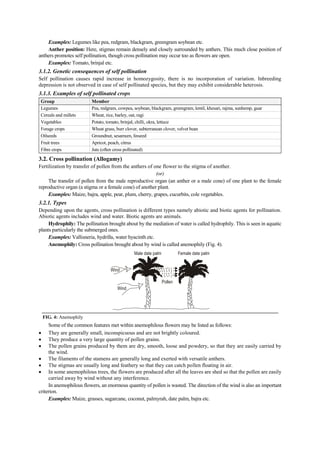
Anemophily: Cross pollination brought about by wind is called anemophily (Fig. 4).
FIG. 4: Anemophily
Some of the common features met within anemophilous flowers may be listed as follows:
 They are generally small, inconspicuous and are not brightly coloured.
 They produce a very large quantity of pollen grains.
 The pollen grains produced by them are dry, smooth, loose and powdery, so that they are easily carried by
the wind.
 The filaments of the stamens are generally long and exerted with versatile anthers.
 The stigmas are usually long and feathery so that they can catch pollen floating in air.
 In some anemophilous trees, the flowers are produced after all the leaves are shed so that the pollen are easily
carried away by wind without any interference.
In anemophilous flowers, an enormous quantity of pollen is wasted. The direction of the wind is also an important
criterion.
Examples: Maize, grasses, sugarcane, coconut, palmyrah, date palm, bajra etc.
Entomophily: Cross pollination brought about by the agency of insects is called entomophily. Entomophilous
flowers develop several types of modifications to attract insects. In addition to some remarkable adaptations in some
flowers, the main adaptations are colour, nectar and scent.
Examples: Sunflower, maize, bajra.
Colour: The petals are brightly coloured to attract insects. But in some plants the flowers are very small and
inconspicuous. In such flowers, other parts may become prominent and brightly coloured. In mussaenda, the flowers
are small, but one of the sepals becomes brightly coloured. In bougainvillea, the bracts become brightly coloured. In the
spadix inflorescence, very often the spathe becomes brightly coloured.
Nectar: Nectar is a sweet juice secreted by glands called nectaries. They are generally situated at the base of one
of the floral whorls. When insects like bees visits flowers to collect nectar, cross pollination is brought about.
Scent: Many of the flowers emit sweet smell to attract insects. It is an excellent adaptation especially in nocturnal
flowers. Because of scent, even in the absence of light, insects can reach the flowers. e.g., Cestrum (night queen). Bees
and butterflies are attracted by sweet smell. But, the inflorescence in amorphophallus emits a stinking smell. Some flies
are attracted to this smell.
The pollen grains and nectar also serve as an excellent source of food. Sometimes the insects visit flowers in search
of shelter, to get protection from sunlight, rain and enemies.
Special adaptations: There are a very large number of excellent special adaptations in flowers for entomophily,
many such adaptations are seen in orchids, ficus, snapdragon, salvia, etc.
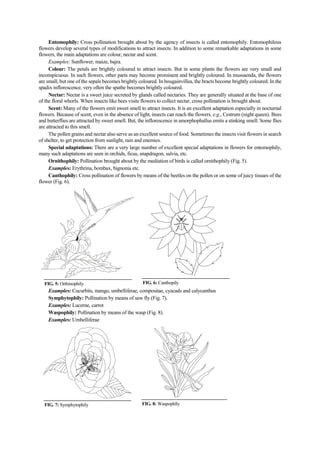
Ornithophily: Pollination brought about by the mediation of birds is called ornithophily (Fig. 5).
Examples: Erythrina, bombax, bignonia etc.
Canthophily: Cross pollination of flowers by means of the beetles on the pollen or on some of juicy tissues of the
flower (Fig. 6).
FIG. 5: Orthinophily FIG. 6: Canthopily
Examples: Cucurbits, mango, umbelliferae, compositae, cyacads and calycanthus
Symphytophily: Pollination by means of saw fly (Fig. 7).
Examples: Lucerne, carrot
Waspophily: Pollination by means of the wasp (Fig. 8).
Examples: Umbelliferae
FIG. 7: Symphytophily FIG. 8: Waspophlly
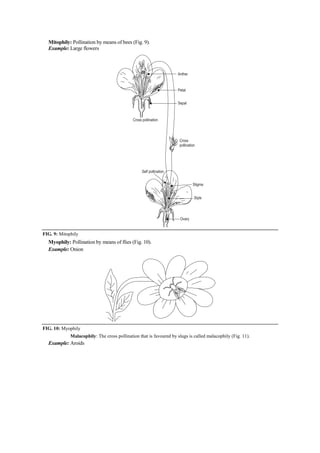
Mitophily: Pollination by means of bees (Fig. 9).
Example: Large flowers
FIG. 9: Mitophily
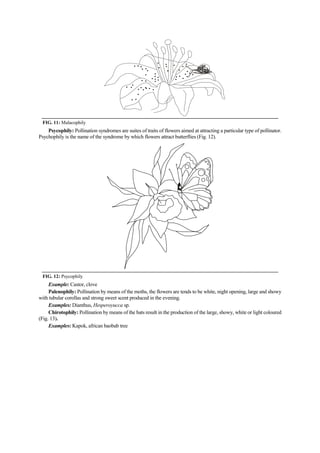
Myophily: Pollination by means of flies (Fig. 10).
Example: Onion
FIG. 10: Myophily
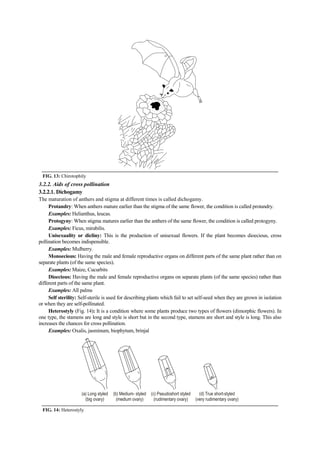
Malacophily: The cross pollination that is favoured by slugs is called malacophily (Fig. 11).
Example: Aroids
FIG. 11: Malacophily
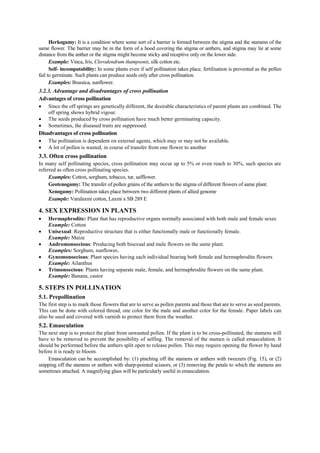
Psycophily: Pollination syndromes are suites of traits of flowers aimed at attracting a particular type of pollinator.
Psychophily is the name of the syndrome by which flowers attract butterflies (Fig. 12).
FIG. 12: Psycophily
Example: Castor, clove
Palenophily: Pollination by means of the moths, the flowers are tends to be white, night opening, large and showy
with tubular corollas and strong sweet scent produced in the evening.
Examples: Dianthus, Hesperoyucca sp.
Chirotophily: Pollination by means of the bats result in the production of the large, showy, white or light coloured
(Fig. 13).
Examples: Kapok, african baobab tree
FIG. 13: Chirotophily
3.2.2. Aids of cross pollination
3.2.2.1. Dichogamy
The maturation of anthers and stigma at different times is called dichogamy.
Protandry: When anthers mature earlier than the stigma of the same flower, the condition is called protandry.
Examples: Helianthus, leucas.
Protogyny: When stigma matures earlier than the anthers of the same flower, the condition is called protogyny.
Examples: Ficus, mirabilis.
Unisexuality or dicliny: This is the production of unisexual flowers. If the plant becomes dioecious, cross
pollination becomes indispensible.
Examples: Mulberry.
Monoecious: Having the male and female reproductive organs on different parts of the same plant rather than on
separate plants (of the same species).
Examples: Maize, Cucurbits
Dioecious: Having the male and female reproductive organs on separate plants (of the same species) rather than
different parts of the same plant.
Examples: All palms
Self sterility: Self-sterile is used for describing plants which fail to set self-seed when they are grown in isolation
or when they are self-pollinated.
Heterostyly (Fig. 14): It is a condition where some plants produce two types of flowers (dimorphic flowers). In
one type, the stamens are long and style is short but in the second type, stamens are short and style is long. This also
increases the chances for cross pollination.
Examples: Oxalis, jasminum, biophytum, brinjal
FIG. 14: Heterostyly
Herkogamy: It is a condition where some sort of a barrier is formed between the stigma and the stamens of the
same flower. The barrier may be in the form of a hood covering the stigma or anthers, and stigma may lie at some
distance from the anther or the stigma might become sticky and receptive only on the lower side.
Example: Vinca, Iris, Clerodendrum thampsonii, silk cotton etc.
Self- incompatability: In some plants even if self pollination takes place, fertilisation is prevented as the pollen
fail to germinate. Such plants can produce seeds only after cross pollination.
Examples: Brassica, sunflower.
3.2.3. Advantage and disadvantages of cross pollination
Advantages of cross pollination
 Since the off springs are genetically different, the desirable characteristics of parent plants are combined. The
off spring shows hybrid vigour.
 The seeds produced by cross pollination have much better germinating capacity.
 Sometimes, the diseased traits are suppressed.
Disadvantages of cross pollination
 The pollination is dependent on external agents, which may or may not be available.
 A lot of pollen is wasted, in course of transfer from one flower to another
3.3. Often cross pollination
In many self pollinating species, cross pollination may occur up to 5% or even reach to 30%, such species are
referred as often cross pollinating species.
Examples: Cotton, sorghum, tobacco, tur, safflower.
Geotenogamy: The transfer of pollen grains of the anthers to the stigma of different flowers of same plant.
Xenogamy: Pollination takes place between two different plants of allied genome
Example: Varalaxmi cotton, Laxmi x SB 289 E
4. SEX EXPRESSION IN PLANTS
 Hermaphrodite: Plant that has reproductive organs normally associated with both male and female sexes
Example: Cotton
 Unisexual: Reproductive structure that is either functionally male or functionally female.
Example: Maize
 Andromonoecious: Producing both bisexual and male flowers on the same plant.
Examples: Sorghum, sunflower.
 Gynomonoecious: Plant species having each individual bearing both female and hermaphrodite flowers
Example: Ailanthus
 Trimonoecious: Plants having separate male, female, and hermaphrodite flowers on the same plant.
Example: Banana, castor
5. STEPS IN POLLINATION
5.1. Prepollination
The first step is to mark those flowers that are to serve as pollen parents and those that are to serve as seed parents.
This can be done with colored thread, one color for the male and another color for the female. Paper labels can
also be used and covered with varnish to protect them from the weather.
5.2. Emasculation
The next step is to protect the plant from unwanted pollen. If the plant is to be cross-pollinated, the stamens will
have to be removed to prevent the possibility of selfing. The removal of the stamen is called emasculation. It
should be performed before the anthers split open to release pollen. This may require opening the flower by hand
before it is ready to bloom.
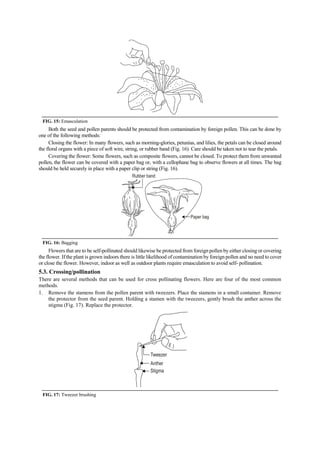
Emasculation can be accomplished by: (1) pinching off the stamens or anthers with tweezers (Fig. 15), or (2)
snipping off the stamens or anthers with sharp-pointed scissors, or (3) removing the petals to which the stamens are
sometimes attached. A magnifying glass will be particularly useful in emasculation.
FIG. 15: Emasculation
Both the seed and pollen parents should be protected from contamination by foreign pollen. This can be done by
one of the following methods:
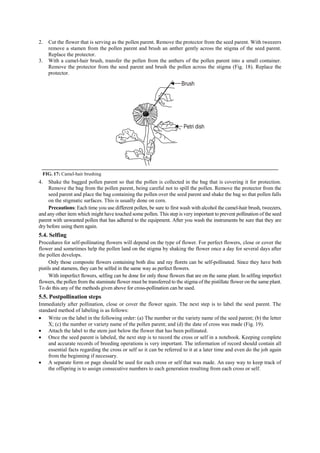
Closing the flower: In many flowers, such as morning-glories, petunias, and lilies, the petals can be closed around
the floral organs with a piece of soft wire, string, or rubber band (Fig. 16). Care should be taken not to tear the petals.
Covering the flower: Some flowers, such as composite flowers, cannot be closed. To protect them from unwanted
pollen, the flower can be covered with a paper bag or, with a cellophane bag to observe flowers at all times. The bag
should be held securely in place with a paper clip or string (Fig. 16).
FIG. 16: Bagging
Flowers that are to be self-pollinated should likewise be protected from foreign pollen by either closing or covering
the flower. If the plant is grown indoors there is little likelihood of contamination by foreign pollen and no need to cover
or close the flower. However, indoor as well as outdoor plants require emasculation to avoid self- pollination.
5.3. Crossing/pollination
There are several methods that can be used for cross pollinating flowers. Here are four of the most common
methods.
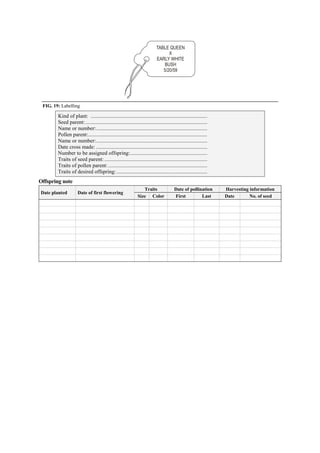
1. Remove the stamens from the pollen parent with tweezers. Place the stamens in a small container. Remove
the protector from the seed parent. Holding a stamen with the tweezers, gently brush the anther across the
stigma (Fig. 17). Replace the protector.
FIG. 17: Tweezer brushing
2. Cut the flower that is serving as the pollen parent. Remove the protector from the seed parent. With tweezers
remove a stamen from the pollen parent and brush an anther gently across the stigma of the seed parent.
Replace the protector.
3. With a camel-hair brush, transfer the pollen from the anthers of the pollen parent into a small container.
Remove the protector from the seed parent and brush the pollen across the stigma (Fig. 18). Replace the
protector.
FIG. 17: Camel-hair brushing
4. Shake the bagged pollen parent so that the pollen is collected in the bag that is covering it for protection.
Remove the bag from the pollen parent, being careful not to spill the pollen. Remove the protector from the
seed parent and place the bag containing the pollen over the seed parent and shake the bag so that pollen falls
on the stigmatic surfaces. This is usually done on corn.
Precautions: Each time you use different pollen, be sure to first wash with alcohol the camel-hair brush, tweezers,
and any other item which might have touched some pollen. This step is very important to prevent pollination of the seed
parent with unwanted pollen that has adhered to the equipment. After you wash the instruments be sure that they are
dry before using them again.
5.4. Selfing
Procedures for self-pollinating flowers will depend on the type of flower. For perfect flowers, close or cover the
flower and sometimes help the pollen land on the stigma by shaking the flower once a day for several days after
the pollen develops.
Only those composite flowers containing both disc and ray florets can be self-pollinated. Since they have both
pistils and stamens, they can be selfed in the same way as perfect flowers.
With imperfect flowers, selfing can be done for only those flowers that are on the same plant. In selfing imperfect
flowers, the pollen from the staminate flower must be transferred to the stigma of the pistillate flower on the same plant.
To do this any of the methods given above for cross-pollination can be used.
5.5. Postpollination steps
Immediately after pollination, close or cover the flower again. The next step is to label the seed parent. The
standard method of labeling is as follows:
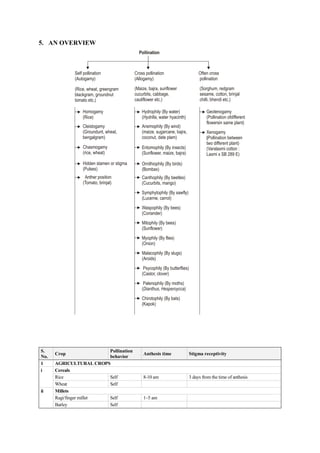
 Write on the label in the following order: (a) The number or the variety name of the seed parent; (b) the letter
X; (c) the number or variety name of the pollen parent; and (d) the date of cross was made (Fig. 19).
 Attach the label to the stem just below the flower that has been pollinated.
 Once the seed parent is labeled, the next step is to record the cross or self in a notebook. Keeping complete
and accurate records of breeding operations is very important. The information of record should contain all
essential facts regarding the cross or self so it can be referred to it at a later time and even do the job again
from the beginning if necessary.
 A separate form or page should be used for each cross or self that was made. An easy way to keep track of
the offspring is to assign consecutive numbers to each generation resulting from each cross or self.
FIG. 19: Labelling
Kind of plant: ......................................................................................
Seed parent:..........................................................................................
Name or number:..................................................................................
Pollen parent:........................................................................................
Name or number:..................................................................................
Date cross made: ..................................................................................
Number to be assigned offspring:.........................................................
Traits of seed parent:............................................................................
Traits of pollen parent: .........................................................................
Traits of desired offspring:...................................................................
Offspring note
Date planted Date of first flowering
Traits Date of pollination Harvesting information
Size Color First Last Date No. of seed
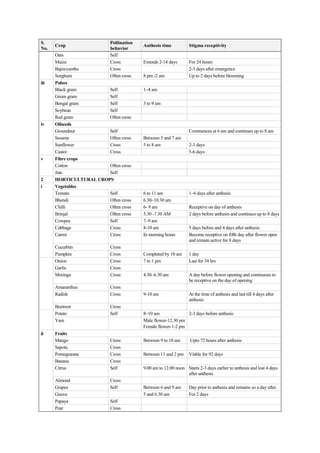
5. AN OVERVIEW
S.
No.
Crop
Pollination
behavior
Anthesis time Stigma receptivity
1 AGRICULTURAL CROPS
i Cereals
Rice Self 8-10 am 3 days from the time of anthesis
Wheat Self
ii Millets
Ragi/finger millet Self 1–5 am
Barley Self
S.
No.
Crop
Pollination
behavior
Anthesis time Stigma receptivity
Oats Self
Maize Cross Extends 2-14 days For 24 hours
Bajra/cumbu Cross 2-3 days after emergence
Sorghum Often cross 8 pm -2 am Up to 2 days before blooming
iii Pulses
Black gram Self 1–4 am
Green gram Self
Bengal gram Self 3 to 9 am
Soybean Self
Red gram Often cross
iv Oilseeds
Groundnut Self Commences at 6 am and continues up to 8 am
Sesame Often cross Between 5 and 7 am
Sunflower Cross 5 to 8 am 2-3 days
Castor Cross 5-6 days
v Fibre crops
Cotton Often cross
Jute Self
2 HORTICULTURAL CROPS
i Vegetables
Tomato Self 6 to 11 am 1–6 days after anthesis
Bhendi Often cross 6.30–10.30 am
Chilli Often cross 6- 9 am Receptive on day of anthesis
Brinjal Often cross 5.30 -7.30 AM 2 days before anthesis and continues up to 8 days
Cowpea Self 7–9 am
Cabbage Cross 8-10 am 5 days before and 4 days after anthesis
Carrot Cross In morning hours Become receptive on fifth day after flower open
and remain active for 8 days
Cucurbits Cross
Pumpkin Cross Completed by 10 am 1 day
Onion Cross 7 to 1 pm Last for 34 hrs
Garlic Cross
Moringa Cross 4.30–6.30 am A day before flower opening and continuous to
be receptive on the day of opening
Amaranthus Cross
Radish Cross 9-10 am At the time of anthesis and last till 4 days after
anthesis
Beetroot Cross
Potato Self 8–10 am 2-3 days before anthesis
Yam Male flower-12.30 pm
Female flower-1-2 pm
ii Fruits
Mango Cross Between 9 to 10 am Upto 72 hours after anthesis
Sapota Cross
Pomegranate Cross Between 11 and 2 pm Viable for 92 days
Banana Cross
Citrus Self 9.00 am to 12.00 noon Starts 2-3 days earlier to anthesis and lost 4 days
after anthesis
Almond Cross
Grapes Self Between 6 and 9 am Day prior to anthesis and remains so a day after
Guava 5 and 6.30 am For 2 days
Papaya Self
Pear Cross
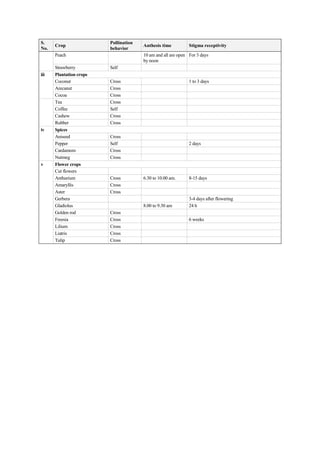
S.
No.
Crop
Pollination
behavior
Anthesis time Stigma receptivity
Peach 10 am and all are open
by noon
For 3 days
Strawberry Self
iii Plantation crops
Coconut Cross 1 to 3 days
Arecanut Cross
Cocoa Cross
Tea Cross
Coffee Self
Cashew Cross
Rubber Cross
iv Spices
Aniseed Cross
Pepper Self 2 days
Cardamom Cross
Nutmeg Cross
v Flower crops
Cut flowers
Anthurium Cross 6.30 to 10.00 am. 8-15 days
Amaryllis Cross
Aster Cross
Gerbera 3-4 days after flowering
Gladiolus 8.00 to 9.30 am 24 h
Golden rod Cross
Freesia Cross 6 weeks
Lilium Cross
Liatris Cross
Tulip Cross

Anthesis and Pollination in crop plants.pdf

  • 1.
    ANTHESIS AND POLLINATION Dr.K. Vanangamudi Formerly Dean (Agriculture), AC & RI, Coimbatore Dean, Adhiparasakthi Agricultural College, Kalavai Professor & Head (Seed Science & Technology) Tamil Nadu Agricultural University, Coimbatore 641 003 Contact: 9894904745 Mail: vanangamudi.tnau@gmail.com Website: https://trinityculturalacademy.com/ YouTube: https://youtube.com/channel/UCWGv08j5jaZ-nkvz46HrBVw 1. INTRODUCTION The flowering goes through a phase of vegetative growth producing more stems and leaves and a flowering phase where they produce the organs for sexual reproduction. Types of flowering First flowering When the plant shows the first blooming after attaining the reproductive phase. 50% flowering When the 50 % of the plants come to flowering that is called as 50 % flowering. 2. ANTHESIS Anthesis is the period during which a flower is fully open and functional, in terms of pollen maturation and dispersal. It may also refer to the onset of that period. Flowers with diurnal anthesis generally have brightly coloured flowers to attract diurnal insects, such as butterflies. Flowers with nocturnal anthesis generally have white or less colourful flowers, that contrast more strongly with the night. These flowers typically attract nocturnal insects including many moth species. 2.1. Types Dichogamy: Describes the case in which the stamens and pistil of a flower mature at different times, thereby preventing autogamous self-pollination. There are two types of dichogamy. Protandry, in which the anthers mature and release pollen before the stigmas are receptive. Protandry is found in most composites (Asteraceae) and also in many mints (Lamiaceae) and figworts (Scrophulariaceae) (Fig. 1). E.g. Maize FIG. 1: Protandry FIG. 2: Protagyny
  • 2.
    Protogyny in whichthe stigmas become receptive before pollen release. Protogyny is very pronounced in a number of families commonly regarded as primitive, for example, water lilies (Nymphaeaceae) and magnolias (Magnoliaceae). Very common plants that demonstrate protogyny are the plantains (Plantaginaceae) (Fig. 2). E.g. Pearlmillet 3. POLLINATION The process by which plant pollen is transferred from the male reproductive organs to the female reproductive organs to form seeds. 3.1. Self pollination (Autogamy) The pollen grains can be carried from an anther to the stigma of the same flower is known as self pollination (or) The transfer ofpollen froma male reproductive structure (an anther or male cone) to a female reproductive structure (a stigma or female cone) of the same plant or of the same flower (or) Fertilization by transfer of pollen from the anthers to the stigma of the same flower. Examples: Peanuts, Soybeans, orchids, peas, tomatoes, lettuce, peas, snap beans, soybeans, lima beans, barley, wheat, oats and cowpeas. 3.1.1. Mechanism facilitating self pollination Bisexuality or hermaphroditism: The presence of both reproductive organs in a flower is called bisexuality and flower is said to be bisexual. It is only in bisexual flowers that self-pollination can take place. It means presence of male and female reproductive organs in the same flower. A hermaphrodite flower is a characteristic feature of self pollinated plants. Homogamy: It simply means that both the sex organ mature at the same time, e.g., Mirabilis. (or) In this kind of mechanism, anthers and stigma of a flower mature at the same time. It is very important for occurrence of self pollination. In some species, stigmas become receptive and elongate through staminal columns. Cleistogamy: In cleistogamous flowers, the pollens are shed within the closed flowers so that self-pollination is obligatory. Cleistogamy is seen in the underground flowers of Commelina benghalensis, Oxalis, Pisum, Arachis, Viola tricolor (Fig. 3). FIG. 3: Cleistogamy (or) In this case, flowers never open. This prevents foreign pollens to reach the stigma of flower with cleistogamy mechanism. Hence, facilitates self-pollination. Examples: Some varieties of wheat, barley, oat, some grasses, bengal gram, horse gram have cleistogamy. Chasmogamy: A flower which is chasmogamous, opens and exposes the stamens and styles (the male and female parts of the flower) to the environment. (or) The production of flowers that open to expose the reproductive organs. This allows cross pollination, but does not preclude self pollination. In chasmogamy, flowers remain close still self-pollination occurs, once it over, they open. No doubt, this opening could allow some cross-pollination too. Examples: Rice, wheat, barley, oat. Hidden stamen and stigma: In this mechanism, some kind of the floral organs (as keel in case of legumes) do the job to hide or cover the reproductive organs (stamens and stigmas) to avoid cross-pollination.
  • 3.
    Examples: Legumes likepea, redgram, blackgram, greengram soybean etc. Anther position: Here, stigmas remain densely and closely surrounded by anthers. This much close position of anthers promotes self pollination, though cross pollination may occur too as flowers are open. Examples: Tomato, brinjal etc. 3.1.2. Genetic consequences of self pollination Self pollination causes rapid increase in homozygosity, there is no incorporation of variation. Inbreeding depression is not observed in case of self pollinated species, but they may exhibit considerable heterosis. 3.1.3. Examples of self pollinated crops Group Member Legumes Pea, redgram, cowpea, soybean, blackgram, greengram, lentil, khesari, rajma, sunhemp, guar Cereals and millets Wheat, rice, barley, oat, ragi Vegetables Potato, tomato, brinjal, chilli, okra, lettuce Forage crops Wheat grass, burr clover, subterranean clover, velvet bean Oilseeds Groundnut, sesamum, linseed Fruit trees Apricot, peach, citrus Fibre crops Jute (often cross pollinated) 3.2. Cross pollination (Allogamy) Fertilization by transfer of pollen from the anthers of one flower to the stigma of another. (or) The transfer of pollen from the male reproductive organ (an anther or a male cone) of one plant to the female reproductive organ (a stigma or a female cone) of another plant. Examples: Maize, bajra, apple, pear, plum, cherry, grapes, cucurbits, cole vegetables. 3.2.1. Types Depending upon the agents, cross pollination is different types namely abiotic and biotic agents for pollination. Abiotic agents includes wind and water. Biotic agents are animals. Hydrophily: The pollination brought about by the mediation of water is called hydrophily. This is seen in aquatic plants particularly the submerged ones. Examples: Vallisneria, hydrilla, water hyacinth etc. Anemophily: Cross pollination brought about by wind is called anemophily (Fig. 4). FIG. 4: Anemophily Some of the common features met within anemophilous flowers may be listed as follows:  They are generally small, inconspicuous and are not brightly coloured.  They produce a very large quantity of pollen grains.  The pollen grains produced by them are dry, smooth, loose and powdery, so that they are easily carried by the wind.  The filaments of the stamens are generally long and exerted with versatile anthers.  The stigmas are usually long and feathery so that they can catch pollen floating in air.  In some anemophilous trees, the flowers are produced after all the leaves are shed so that the pollen are easily carried away by wind without any interference. In anemophilous flowers, an enormous quantity of pollen is wasted. The direction of the wind is also an important criterion. Examples: Maize, grasses, sugarcane, coconut, palmyrah, date palm, bajra etc.
  • 4.
    Entomophily: Cross pollinationbrought about by the agency of insects is called entomophily. Entomophilous flowers develop several types of modifications to attract insects. In addition to some remarkable adaptations in some flowers, the main adaptations are colour, nectar and scent. Examples: Sunflower, maize, bajra. Colour: The petals are brightly coloured to attract insects. But in some plants the flowers are very small and inconspicuous. In such flowers, other parts may become prominent and brightly coloured. In mussaenda, the flowers are small, but one of the sepals becomes brightly coloured. In bougainvillea, the bracts become brightly coloured. In the spadix inflorescence, very often the spathe becomes brightly coloured. Nectar: Nectar is a sweet juice secreted by glands called nectaries. They are generally situated at the base of one of the floral whorls. When insects like bees visits flowers to collect nectar, cross pollination is brought about. Scent: Many of the flowers emit sweet smell to attract insects. It is an excellent adaptation especially in nocturnal flowers. Because of scent, even in the absence of light, insects can reach the flowers. e.g., Cestrum (night queen). Bees and butterflies are attracted by sweet smell. But, the inflorescence in amorphophallus emits a stinking smell. Some flies are attracted to this smell. The pollen grains and nectar also serve as an excellent source of food. Sometimes the insects visit flowers in search of shelter, to get protection from sunlight, rain and enemies. Special adaptations: There are a very large number of excellent special adaptations in flowers for entomophily, many such adaptations are seen in orchids, ficus, snapdragon, salvia, etc. Ornithophily: Pollination brought about by the mediation of birds is called ornithophily (Fig. 5). Examples: Erythrina, bombax, bignonia etc. Canthophily: Cross pollination of flowers by means of the beetles on the pollen or on some of juicy tissues of the flower (Fig. 6). FIG. 5: Orthinophily FIG. 6: Canthopily Examples: Cucurbits, mango, umbelliferae, compositae, cyacads and calycanthus Symphytophily: Pollination by means of saw fly (Fig. 7). Examples: Lucerne, carrot Waspophily: Pollination by means of the wasp (Fig. 8). Examples: Umbelliferae FIG. 7: Symphytophily FIG. 8: Waspophlly
  • 5.
    Mitophily: Pollination bymeans of bees (Fig. 9). Example: Large flowers FIG. 9: Mitophily Myophily: Pollination by means of flies (Fig. 10). Example: Onion FIG. 10: Myophily Malacophily: The cross pollination that is favoured by slugs is called malacophily (Fig. 11). Example: Aroids
  • 6.
    FIG. 11: Malacophily Psycophily:Pollination syndromes are suites of traits of flowers aimed at attracting a particular type of pollinator. Psychophily is the name of the syndrome by which flowers attract butterflies (Fig. 12). FIG. 12: Psycophily Example: Castor, clove Palenophily: Pollination by means of the moths, the flowers are tends to be white, night opening, large and showy with tubular corollas and strong sweet scent produced in the evening. Examples: Dianthus, Hesperoyucca sp. Chirotophily: Pollination by means of the bats result in the production of the large, showy, white or light coloured (Fig. 13). Examples: Kapok, african baobab tree
  • 7.
    FIG. 13: Chirotophily 3.2.2.Aids of cross pollination 3.2.2.1. Dichogamy The maturation of anthers and stigma at different times is called dichogamy. Protandry: When anthers mature earlier than the stigma of the same flower, the condition is called protandry. Examples: Helianthus, leucas. Protogyny: When stigma matures earlier than the anthers of the same flower, the condition is called protogyny. Examples: Ficus, mirabilis. Unisexuality or dicliny: This is the production of unisexual flowers. If the plant becomes dioecious, cross pollination becomes indispensible. Examples: Mulberry. Monoecious: Having the male and female reproductive organs on different parts of the same plant rather than on separate plants (of the same species). Examples: Maize, Cucurbits Dioecious: Having the male and female reproductive organs on separate plants (of the same species) rather than different parts of the same plant. Examples: All palms Self sterility: Self-sterile is used for describing plants which fail to set self-seed when they are grown in isolation or when they are self-pollinated. Heterostyly (Fig. 14): It is a condition where some plants produce two types of flowers (dimorphic flowers). In one type, the stamens are long and style is short but in the second type, stamens are short and style is long. This also increases the chances for cross pollination. Examples: Oxalis, jasminum, biophytum, brinjal FIG. 14: Heterostyly
  • 8.
    Herkogamy: It isa condition where some sort of a barrier is formed between the stigma and the stamens of the same flower. The barrier may be in the form of a hood covering the stigma or anthers, and stigma may lie at some distance from the anther or the stigma might become sticky and receptive only on the lower side. Example: Vinca, Iris, Clerodendrum thampsonii, silk cotton etc. Self- incompatability: In some plants even if self pollination takes place, fertilisation is prevented as the pollen fail to germinate. Such plants can produce seeds only after cross pollination. Examples: Brassica, sunflower. 3.2.3. Advantage and disadvantages of cross pollination Advantages of cross pollination  Since the off springs are genetically different, the desirable characteristics of parent plants are combined. The off spring shows hybrid vigour.  The seeds produced by cross pollination have much better germinating capacity.  Sometimes, the diseased traits are suppressed. Disadvantages of cross pollination  The pollination is dependent on external agents, which may or may not be available.  A lot of pollen is wasted, in course of transfer from one flower to another 3.3. Often cross pollination In many self pollinating species, cross pollination may occur up to 5% or even reach to 30%, such species are referred as often cross pollinating species. Examples: Cotton, sorghum, tobacco, tur, safflower. Geotenogamy: The transfer of pollen grains of the anthers to the stigma of different flowers of same plant. Xenogamy: Pollination takes place between two different plants of allied genome Example: Varalaxmi cotton, Laxmi x SB 289 E 4. SEX EXPRESSION IN PLANTS  Hermaphrodite: Plant that has reproductive organs normally associated with both male and female sexes Example: Cotton  Unisexual: Reproductive structure that is either functionally male or functionally female. Example: Maize  Andromonoecious: Producing both bisexual and male flowers on the same plant. Examples: Sorghum, sunflower.  Gynomonoecious: Plant species having each individual bearing both female and hermaphrodite flowers Example: Ailanthus  Trimonoecious: Plants having separate male, female, and hermaphrodite flowers on the same plant. Example: Banana, castor 5. STEPS IN POLLINATION 5.1. Prepollination The first step is to mark those flowers that are to serve as pollen parents and those that are to serve as seed parents. This can be done with colored thread, one color for the male and another color for the female. Paper labels can also be used and covered with varnish to protect them from the weather. 5.2. Emasculation The next step is to protect the plant from unwanted pollen. If the plant is to be cross-pollinated, the stamens will have to be removed to prevent the possibility of selfing. The removal of the stamen is called emasculation. It should be performed before the anthers split open to release pollen. This may require opening the flower by hand before it is ready to bloom. Emasculation can be accomplished by: (1) pinching off the stamens or anthers with tweezers (Fig. 15), or (2) snipping off the stamens or anthers with sharp-pointed scissors, or (3) removing the petals to which the stamens are sometimes attached. A magnifying glass will be particularly useful in emasculation.
  • 9.
    FIG. 15: Emasculation Boththe seed and pollen parents should be protected from contamination by foreign pollen. This can be done by one of the following methods: Closing the flower: In many flowers, such as morning-glories, petunias, and lilies, the petals can be closed around the floral organs with a piece of soft wire, string, or rubber band (Fig. 16). Care should be taken not to tear the petals. Covering the flower: Some flowers, such as composite flowers, cannot be closed. To protect them from unwanted pollen, the flower can be covered with a paper bag or, with a cellophane bag to observe flowers at all times. The bag should be held securely in place with a paper clip or string (Fig. 16). FIG. 16: Bagging Flowers that are to be self-pollinated should likewise be protected from foreign pollen by either closing or covering the flower. If the plant is grown indoors there is little likelihood of contamination by foreign pollen and no need to cover or close the flower. However, indoor as well as outdoor plants require emasculation to avoid self- pollination. 5.3. Crossing/pollination There are several methods that can be used for cross pollinating flowers. Here are four of the most common methods. 1. Remove the stamens from the pollen parent with tweezers. Place the stamens in a small container. Remove the protector from the seed parent. Holding a stamen with the tweezers, gently brush the anther across the stigma (Fig. 17). Replace the protector. FIG. 17: Tweezer brushing
  • 10.
    2. Cut theflower that is serving as the pollen parent. Remove the protector from the seed parent. With tweezers remove a stamen from the pollen parent and brush an anther gently across the stigma of the seed parent. Replace the protector. 3. With a camel-hair brush, transfer the pollen from the anthers of the pollen parent into a small container. Remove the protector from the seed parent and brush the pollen across the stigma (Fig. 18). Replace the protector. FIG. 17: Camel-hair brushing 4. Shake the bagged pollen parent so that the pollen is collected in the bag that is covering it for protection. Remove the bag from the pollen parent, being careful not to spill the pollen. Remove the protector from the seed parent and place the bag containing the pollen over the seed parent and shake the bag so that pollen falls on the stigmatic surfaces. This is usually done on corn. Precautions: Each time you use different pollen, be sure to first wash with alcohol the camel-hair brush, tweezers, and any other item which might have touched some pollen. This step is very important to prevent pollination of the seed parent with unwanted pollen that has adhered to the equipment. After you wash the instruments be sure that they are dry before using them again. 5.4. Selfing Procedures for self-pollinating flowers will depend on the type of flower. For perfect flowers, close or cover the flower and sometimes help the pollen land on the stigma by shaking the flower once a day for several days after the pollen develops. Only those composite flowers containing both disc and ray florets can be self-pollinated. Since they have both pistils and stamens, they can be selfed in the same way as perfect flowers. With imperfect flowers, selfing can be done for only those flowers that are on the same plant. In selfing imperfect flowers, the pollen from the staminate flower must be transferred to the stigma of the pistillate flower on the same plant. To do this any of the methods given above for cross-pollination can be used. 5.5. Postpollination steps Immediately after pollination, close or cover the flower again. The next step is to label the seed parent. The standard method of labeling is as follows:  Write on the label in the following order: (a) The number or the variety name of the seed parent; (b) the letter X; (c) the number or variety name of the pollen parent; and (d) the date of cross was made (Fig. 19).  Attach the label to the stem just below the flower that has been pollinated.  Once the seed parent is labeled, the next step is to record the cross or self in a notebook. Keeping complete and accurate records of breeding operations is very important. The information of record should contain all essential facts regarding the cross or self so it can be referred to it at a later time and even do the job again from the beginning if necessary.  A separate form or page should be used for each cross or self that was made. An easy way to keep track of the offspring is to assign consecutive numbers to each generation resulting from each cross or self.
  • 11.
    FIG. 19: Labelling Kindof plant: ...................................................................................... Seed parent:.......................................................................................... Name or number:.................................................................................. Pollen parent:........................................................................................ Name or number:.................................................................................. Date cross made: .................................................................................. Number to be assigned offspring:......................................................... Traits of seed parent:............................................................................ Traits of pollen parent: ......................................................................... Traits of desired offspring:................................................................... Offspring note Date planted Date of first flowering Traits Date of pollination Harvesting information Size Color First Last Date No. of seed
  • 12.
    5. AN OVERVIEW S. No. Crop Pollination behavior Anthesistime Stigma receptivity 1 AGRICULTURAL CROPS i Cereals Rice Self 8-10 am 3 days from the time of anthesis Wheat Self ii Millets Ragi/finger millet Self 1–5 am Barley Self
  • 13.
    S. No. Crop Pollination behavior Anthesis time Stigmareceptivity Oats Self Maize Cross Extends 2-14 days For 24 hours Bajra/cumbu Cross 2-3 days after emergence Sorghum Often cross 8 pm -2 am Up to 2 days before blooming iii Pulses Black gram Self 1–4 am Green gram Self Bengal gram Self 3 to 9 am Soybean Self Red gram Often cross iv Oilseeds Groundnut Self Commences at 6 am and continues up to 8 am Sesame Often cross Between 5 and 7 am Sunflower Cross 5 to 8 am 2-3 days Castor Cross 5-6 days v Fibre crops Cotton Often cross Jute Self 2 HORTICULTURAL CROPS i Vegetables Tomato Self 6 to 11 am 1–6 days after anthesis Bhendi Often cross 6.30–10.30 am Chilli Often cross 6- 9 am Receptive on day of anthesis Brinjal Often cross 5.30 -7.30 AM 2 days before anthesis and continues up to 8 days Cowpea Self 7–9 am Cabbage Cross 8-10 am 5 days before and 4 days after anthesis Carrot Cross In morning hours Become receptive on fifth day after flower open and remain active for 8 days Cucurbits Cross Pumpkin Cross Completed by 10 am 1 day Onion Cross 7 to 1 pm Last for 34 hrs Garlic Cross Moringa Cross 4.30–6.30 am A day before flower opening and continuous to be receptive on the day of opening Amaranthus Cross Radish Cross 9-10 am At the time of anthesis and last till 4 days after anthesis Beetroot Cross Potato Self 8–10 am 2-3 days before anthesis Yam Male flower-12.30 pm Female flower-1-2 pm ii Fruits Mango Cross Between 9 to 10 am Upto 72 hours after anthesis Sapota Cross Pomegranate Cross Between 11 and 2 pm Viable for 92 days Banana Cross Citrus Self 9.00 am to 12.00 noon Starts 2-3 days earlier to anthesis and lost 4 days after anthesis Almond Cross Grapes Self Between 6 and 9 am Day prior to anthesis and remains so a day after Guava 5 and 6.30 am For 2 days Papaya Self Pear Cross
  • 14.
    S. No. Crop Pollination behavior Anthesis time Stigmareceptivity Peach 10 am and all are open by noon For 3 days Strawberry Self iii Plantation crops Coconut Cross 1 to 3 days Arecanut Cross Cocoa Cross Tea Cross Coffee Self Cashew Cross Rubber Cross iv Spices Aniseed Cross Pepper Self 2 days Cardamom Cross Nutmeg Cross v Flower crops Cut flowers Anthurium Cross 6.30 to 10.00 am. 8-15 days Amaryllis Cross Aster Cross Gerbera 3-4 days after flowering Gladiolus 8.00 to 9.30 am 24 h Golden rod Cross Freesia Cross 6 weeks Lilium Cross Liatris Cross Tulip Cross