Democracy and Media
What is Democracy?
...............................
Is media crucial in a democratic society? Why?
................................
It is because democracy presumes ‘an open
state in which people are allowed to
participate in decision-making, and are given
access to the media, and other information
networks through which advocacy occurs’
(Hauser cited in Cooper 1991: 42).
The questions are:
1. Do we really participate
The Failure of Democratic System
Why those incidents happen?
The Failure of Democratic System

1.   The failure of democratic system
2.   The absent of choices
3.   Manufacture of consent
4.   Pseudo events
5.   The limitation of objectivity
The Failure of Democratic System
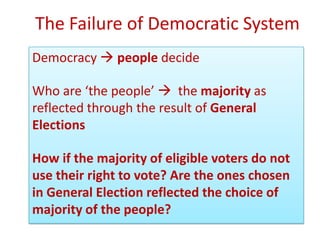
Democracy  people decide

Who are ‘the people’  the majority as
reflected through the result of General
Elections

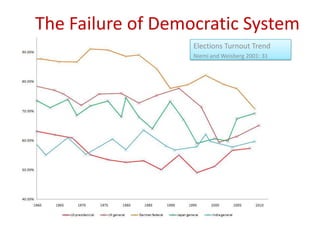
How if the majority of eligible voters do not
use their right to vote? Are the ones chosen
in General Election reflected the choice of
majority of the people?
The Failure of Democratic System
                   Elections Turnout Trend
                   Niemi and Weisberg 2001: 31
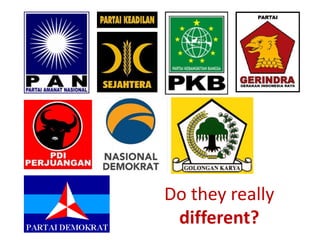
Do they really
 different?
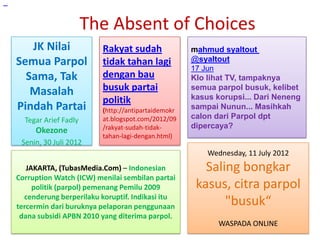
The Absent of Choices
   JK Nilai              Rakyat sudah               mahmud syaltout
Semua Parpol             tidak tahan lagi           @syaltout
                                                    17 Jun
  Sama, Tak              dengan bau                 Klo lihat TV, tampaknya
   Masalah               busuk partai               semua parpol busuk, kelibet
                         politik                    kasus korupsi... Dari Neneng
Pindah Partai            (http://antipartaidemokr   sampai Nunun... Masihkah
  Tegar Arief Fadly      at.blogspot.com/2012/09    calon dari Parpol dpt
                         /rakyat-sudah-tidak-       dipercaya?
     Okezone
                         tahan-lagi-dengan.html)
 Senin, 30 Juli 2012
                                                        Wednesday, 11 July 2012
   JAKARTA, (TubasMedia.Com) – Indonesian              Saling bongkar
Corruption Watch (ICW) menilai sembilan partai
     politik (parpol) pemenang Pemilu 2009           kasus, citra parpol
  cenderung berperilaku koruptif. Indikasi itu
tercermin dari buruknya pelaporan penggunaan               "busuk“
 dana subsidi APBN 2010 yang diterima parpol.
                                                             WASPADA ONLINE
The Absent of Choices
A further limitation on democracy is the absence of genuine choice or pluralism.
 Many parties, however they are hardly different
        “ Even in Britain, where the Labour and Conservative parties have traditionally
        been distinct ideologically, the 1990s saw a coming together of agendas and q
        policies on many social, economic and foreign policy matters. In the 1997 general
        election, ‘New Labour’ unashamedly adopted many of what had previously been
        viewed (including by most members of the Labour Party itself) as right-wing
        Conservative policies, such as privatisation of the air traffic control system. In
        doing so, New Labour proclaimed itself at the ‘radical centre’ of British politics,
        emulating the Clinton administration’s 1996 re-election strategy of ideological
        ‘triangulation’ (Morris,1997 cited in McNair 2003: 24).


Triangulation in the US, like Labour’s radical centrism, meant taking what was
popular and common-sensical from the freemarket right (such as the reduction of
‘big government’), while adhering to the core social democratic values of social
justice and equality of opportunity.
Manufacture of Consent
Despite the failure of democratic system and the absent of
choices, there are also media-related downfall, namely the
manufacture of consent (Walter Lippmann1954: 245).

Remember: The legitimacy of liberal democratic government
is founded on the consent of the governed (the people).

The problem is that the consent of the governed is not the
original consent of the people, but the manufactured one.
Who manufacture people’s consent?
 Mostly Media
Manufacture of Consent

Politicians combined the techniques of
social psychology with the immense reach of
mass media.

Persuasion or Manipulation?
To inform or to direct?
Pseudo-Events
Pseudo-events (coined by Daniel Boorstin in 1962)  the increasing
tendency of news and journalistic media to cover ‘unreal’, unauthentic
‘happenings’.


(Unauthentic events which deliberately created/managed in
order to convey a certain message and/or to reach a specific
goal)

This tendency, he argued, was associated with the rise from the
nineteenth century onwards of the popular press and a correspondingly
dramatic increase in the demand for news material. ‘As the costs of
printing and then broadcasting increased, it became financially necessary
to keep the presses always at work and the TV screen always busy.
Pressures towards the making of pseudo-events became ever stronger.
Newsgathering turned into news making’ (Boorstin 1962: 14).
Pseudo-Events
“In a democratic society . . . freedom of speech and of the press
and of broadcasting includes freedom to create pseudo-events.
Competing politicians, newsmen and news media contest in this
creation. They vie with each other in offering
attractive, ‘informative’ accounts and images of the world. They are
free to speculate on the facts, to bring new facts into being, to
demand answers to their own contrived questions. Our ‘free
market of ideas’ is a place where people are confronted by
competing pseudo-events and are allowed to judge among them.
When we speak of ‘informing’ the people this is what we really
mean.” (Boorstin 1962: 35)

Triggers:
1) The lazyness of reporters  Talking news
2) The realm of media capitalism
The Limitation of Objectivity
A further criticism of the media’s democratic role focuses on the
professional journalistic ethic of objectivity. This ethic developed
with the mass media in the late nineteenth and early twentieth
centuries, and has been assailed ever since as fundamentally
unattainable (McNair 2003).

For a variety of reasons, it is argued, the media’s political reportage
is biased and flawed – subjective, as opposed to objective; partisan,
rather than impartial. As Lippmann put it in 1922, “every
newspaper when it reaches the reader is the
result of a whole series of selections as to what items shall be
printed, in what position they shall be printed, how much space
each shall occupy, what emphasis each should have. There are no
objective standards here. There are conventions” (1954: 354).
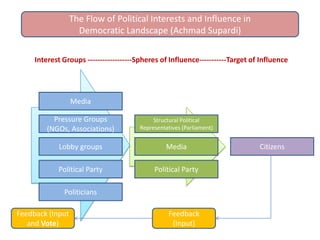
The Flow of Political Interests and Influence in
                    Democratic Landscape (Achmad Supardi)

     Interest Groups ------------------Spheres of Influence-----------Target of Influence


                  Media

           Pressure Groups                  Structural Political
         (NGOs, Associations)          Representatives (Parliament)


             Lobby groups                        Media                         Citizens

            Political Party                 Political Party

              Politicians

Feedback (Input                                  Feedback
   and Vote)                                      (Input)
cccc

Lippmann 1954

McNair 2003

Niemi, Richard G. and Herbert F. Weisberg. eds. Controversies in Voting
Behavior. Washington, D.C: CQ Press, 2001.
Print media

Radio

TV

Online media
What trigger the emergence of individual
broadcasters?

What are the impacts of individual
broadcasters for political campaign?

What are the effects of individual
broadcasters for government/policy-
makers, media, industry, and interest groups?
The Failure of Democratic System

Colin Seymour-Ure  Television has become an
‘integral part of the environment within which
political life takes place’ (1989: 308)


As a really powerful actor, can media do their role in
a balance to the rights allocated to them in a
democratic society?  The need to observe both
‘the democracy” and “the media”

Media and the Manufacture of consent

  • 2.
    Democracy and Media Whatis Democracy? ............................... Is media crucial in a democratic society? Why? ................................ It is because democracy presumes ‘an open state in which people are allowed to participate in decision-making, and are given access to the media, and other information networks through which advocacy occurs’ (Hauser cited in Cooper 1991: 42).
  • 3.
    The questions are: 1.Do we really participate
  • 4.
    The Failure ofDemocratic System Why those incidents happen?
  • 5.
    The Failure ofDemocratic System 1. The failure of democratic system 2. The absent of choices 3. Manufacture of consent 4. Pseudo events 5. The limitation of objectivity
  • 6.
    The Failure ofDemocratic System Democracy  people decide Who are ‘the people’  the majority as reflected through the result of General Elections How if the majority of eligible voters do not use their right to vote? Are the ones chosen in General Election reflected the choice of majority of the people?
  • 7.
    The Failure ofDemocratic System Elections Turnout Trend Niemi and Weisberg 2001: 31
  • 8.
    Do they really different?
  • 9.
    The Absent ofChoices JK Nilai Rakyat sudah mahmud syaltout Semua Parpol tidak tahan lagi @syaltout 17 Jun Sama, Tak dengan bau Klo lihat TV, tampaknya Masalah busuk partai semua parpol busuk, kelibet politik kasus korupsi... Dari Neneng Pindah Partai (http://antipartaidemokr sampai Nunun... Masihkah Tegar Arief Fadly at.blogspot.com/2012/09 calon dari Parpol dpt /rakyat-sudah-tidak- dipercaya? Okezone tahan-lagi-dengan.html) Senin, 30 Juli 2012 Wednesday, 11 July 2012 JAKARTA, (TubasMedia.Com) – Indonesian Saling bongkar Corruption Watch (ICW) menilai sembilan partai politik (parpol) pemenang Pemilu 2009 kasus, citra parpol cenderung berperilaku koruptif. Indikasi itu tercermin dari buruknya pelaporan penggunaan "busuk“ dana subsidi APBN 2010 yang diterima parpol. WASPADA ONLINE
  • 10.
    The Absent ofChoices A further limitation on democracy is the absence of genuine choice or pluralism.  Many parties, however they are hardly different “ Even in Britain, where the Labour and Conservative parties have traditionally been distinct ideologically, the 1990s saw a coming together of agendas and q policies on many social, economic and foreign policy matters. In the 1997 general election, ‘New Labour’ unashamedly adopted many of what had previously been viewed (including by most members of the Labour Party itself) as right-wing Conservative policies, such as privatisation of the air traffic control system. In doing so, New Labour proclaimed itself at the ‘radical centre’ of British politics, emulating the Clinton administration’s 1996 re-election strategy of ideological ‘triangulation’ (Morris,1997 cited in McNair 2003: 24). Triangulation in the US, like Labour’s radical centrism, meant taking what was popular and common-sensical from the freemarket right (such as the reduction of ‘big government’), while adhering to the core social democratic values of social justice and equality of opportunity.
  • 11.
    Manufacture of Consent Despitethe failure of democratic system and the absent of choices, there are also media-related downfall, namely the manufacture of consent (Walter Lippmann1954: 245). Remember: The legitimacy of liberal democratic government is founded on the consent of the governed (the people). The problem is that the consent of the governed is not the original consent of the people, but the manufactured one. Who manufacture people’s consent?  Mostly Media
  • 12.
    Manufacture of Consent Politicianscombined the techniques of social psychology with the immense reach of mass media. Persuasion or Manipulation? To inform or to direct?
  • 13.
    Pseudo-Events Pseudo-events (coined byDaniel Boorstin in 1962)  the increasing tendency of news and journalistic media to cover ‘unreal’, unauthentic ‘happenings’. (Unauthentic events which deliberately created/managed in order to convey a certain message and/or to reach a specific goal) This tendency, he argued, was associated with the rise from the nineteenth century onwards of the popular press and a correspondingly dramatic increase in the demand for news material. ‘As the costs of printing and then broadcasting increased, it became financially necessary to keep the presses always at work and the TV screen always busy. Pressures towards the making of pseudo-events became ever stronger. Newsgathering turned into news making’ (Boorstin 1962: 14).
  • 14.
    Pseudo-Events “In a democraticsociety . . . freedom of speech and of the press and of broadcasting includes freedom to create pseudo-events. Competing politicians, newsmen and news media contest in this creation. They vie with each other in offering attractive, ‘informative’ accounts and images of the world. They are free to speculate on the facts, to bring new facts into being, to demand answers to their own contrived questions. Our ‘free market of ideas’ is a place where people are confronted by competing pseudo-events and are allowed to judge among them. When we speak of ‘informing’ the people this is what we really mean.” (Boorstin 1962: 35) Triggers: 1) The lazyness of reporters  Talking news 2) The realm of media capitalism
  • 15.
    The Limitation ofObjectivity A further criticism of the media’s democratic role focuses on the professional journalistic ethic of objectivity. This ethic developed with the mass media in the late nineteenth and early twentieth centuries, and has been assailed ever since as fundamentally unattainable (McNair 2003). For a variety of reasons, it is argued, the media’s political reportage is biased and flawed – subjective, as opposed to objective; partisan, rather than impartial. As Lippmann put it in 1922, “every newspaper when it reaches the reader is the result of a whole series of selections as to what items shall be printed, in what position they shall be printed, how much space each shall occupy, what emphasis each should have. There are no objective standards here. There are conventions” (1954: 354).
  • 16.
    The Flow ofPolitical Interests and Influence in Democratic Landscape (Achmad Supardi) Interest Groups ------------------Spheres of Influence-----------Target of Influence Media Pressure Groups Structural Political (NGOs, Associations) Representatives (Parliament) Lobby groups Media Citizens Political Party Political Party Politicians Feedback (Input Feedback and Vote) (Input)
  • 17.
    cccc Lippmann 1954 McNair 2003 Niemi,Richard G. and Herbert F. Weisberg. eds. Controversies in Voting Behavior. Washington, D.C: CQ Press, 2001.
  • 18.
  • 19.
    What trigger theemergence of individual broadcasters? What are the impacts of individual broadcasters for political campaign? What are the effects of individual broadcasters for government/policy- makers, media, industry, and interest groups?
  • 20.
    The Failure ofDemocratic System Colin Seymour-Ure  Television has become an ‘integral part of the environment within which political life takes place’ (1989: 308) As a really powerful actor, can media do their role in a balance to the rights allocated to them in a democratic society?  The need to observe both ‘the democracy” and “the media”