CLASS ROOM
TEACHING
P R E S E N T E D T O
M R S . M A H A L A K S H M I M S C ( N )
T U T O R
M M M C O N
P R E S E N T E D B Y
C L I N C Y S P E R C I Y A
M S C ( N ) I Y E A R
M M M C O N
Any guess ??
Introduction
• Poliomyelitis often called Polio or infantile paralysis is an acute, viral, infectious disease
spread from person to person, primarily via the fecal-oral route.
• The term “Poliomyelitis” derives from the ancient Greek word Polio’s means “grey” and
myelos meaning “marrow” referring to the grey matter of the spinal cord. The suffix itis
denotes inflammation, i.e. inflammation of the spinal cord’s grey matter.
• A severe infection can extend into the brain stream and even higher center resulting in Polio
encephalitis and apnea.
Causative Agent
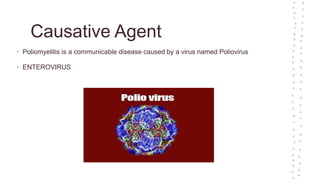
• Poliomyelitis is a communicable disease caused by a virus named Poliovirus
• ENTEROVIRUS
MODE OF TRANSMISSION
• Poliovirus is transmitted by the fecal-oral route through ingestion. Inhalation or entry
through conjunctiva of droplets of respiratory secretions may also be possible modes of
entry in close contacts of patients in early stage of disease.
• The virus multiplies initially in the epithelial cells of the alimentary canal and the lymphatic
tissues. It then spreads to the lymph nodes and enters the blood stream.
• After further multiplication in the reticulo-endothelial system, the virus enters the blood
stream again and it is carried to the spinal cord and brain.
• Incubation Period: The time from being infected with the virus to developing symptoms of
disease ranges from 5-35 days(average 7-14 days)
DIFFERENT TYPES
• In about 1% of cases, the virus enters the central nervous system, preferentially
infecting and destroying motor neurons leading to muscle weakness and acute
flaccid paralysis. Depending on the nerves involved , Poliomyelitis can be
classified as follows
1) Spinal Polio: It is the most common form characterised by asymmetric paralysis
that most often involves the legs.
2) Bulbar Polio: This leads to weakness of muscles innervated by cranial nerves.
3) Bulbospinal Polio: It is a combination of bulbar and spinal paralysis.
RISK FACTOR
• AGE: infant and elderly
• Living with an infected person
• Compromised immune system
• Lack of immunization against polio
• Travelling to an area that has experienced a polio break
CLINICAL FEATURES
Inapparent / asymptomatic (90 – 95%)
• 95 % of the cases
• Virus stays in the intestinal tract and does not attack the nerves
• Virus shed in the stools so infected individual is still able to infect others
Apparent / symptomatic ( 5 – 10%)
• Abortive polio
• Non paralytic aseptic meningitis
• Paralytic poliomyelitis
• Polio encephalitis
ABORTIVE POLIO
4 – 8 % , does not lead to paralysis
Minor illness
Symptoms
 Low grade fever
 Sore throat
 Vomiting
 Abdominal pain
 Loss of appetite
 Malaise
NON – PARALYTIC ASEPTIC MENINGITS
• Occurs in 1- 2 % of polio infection
Symptoms:
Headache
Nausea
Vomitting
Pain and stiffness of neck, back and legs
Complete recovery after 2- 10 days of symptoms
PARALYTIC POLIOMYELITIS
0.5 – 1 %
Minor – same as abortive polio
Major – muscle pain, spasm and return of fever
It is of three types
• Spinal paralytic poliomyelitis
• Bulbar poliomyelitis
• Bulbo-spinal poliomyelitis
SPINAL PARALYTIC POLIOMYELITIS
• 79 – 80 %
• Attacks motor neurons in the spinal cord and causes paralysis
• Affects muscles of legs , arms and trunk
• Severe cases – quadriplegia , paralysis of trunk, abdominal and
thoracic muscles.
Bulbar poliomyelitis
• Affects neurons responsible for sight, vision, taste, swallowing and breathing
• 2% of paralytic polio
• Life threatening
• Affects cranial nerve function
• Primarily inhibits ability to breath, speak and swallow effectively
• Facial asymmetry present
Symptoms
• Nasal twang and hoarseness of voice
• Nasal regurgitation
• Dyspnea
• Dysphagia
• Child refuses to feed
• Secretion accumulation
• Shallow and irregular respiration
• Dusky and mottoled skin
• Restless, confused and comatose
BULBO SPINAL POLIOMYELITIS
• 19% of paralytic cases
• Affects extremities and cranial nerves
• Leads to severe respiratory involvement
• Combination of spinal paralytic and bulbar polio
Polio encephalitis
• Occurs in rare cases
• Causes inflammation of grey matter of brain
• Autonomic dysfunction is common and it has a high mortality
Signs and symptoms
• Agitation
• Confusion
• Stupor
• Coma
• Irritability
• delirium
Diagnosis and Tests
• The health care provider may find:-
Abnormal reflexes, Back stiffness, Difficulty in lifting the head or legs when lying
flat or the back stiff neck, trouble bending the neck.
• Tests includes
Cultures of throat washing, stools or spinal fluid, spinal tap and examination of
the spinal fluid (CSF exam.) using PCR. Test for levels of antibodies to the Polio virus.
Treatment
• Symptomatic and supportive
The goal of the treatment is to control symptoms
Treatment may includes
Hospitalization (may be required for those individuals who develop paralytic
poliomyelitis)
If the respiratory in involved , long term ventilation is necessary
Catheterization – antibiotic
Moist heat application
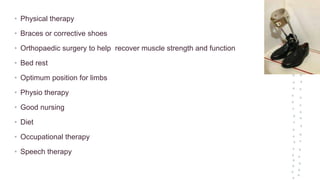
• Physical therapy
• Braces or corrective shoes
• Orthopaedic surgery to help recover muscle strength and function
• Bed rest
• Optimum position for limbs
• Physio therapy
• Good nursing
• Diet
• Occupational therapy
• Speech therapy
Complication
• Myocarditis
• Hypertension
• Pulmonary edema
• Pneumonia
• Urinary tract infections
• Compression neuropathy
• Scoliosis
• Osteoporosis
• Bone fracture
• Skeletal deformities
NURSING MANAGEMENT
• NURSING DIAGNOSIS
Imbalanced nutrition
Ineffective thermoregulation
Inefffectice airway clearance
Ineffective breathing pattern
Acute pain
Impaired physical mobility
PROGNOSIS
• Non paralytic cases complete recovery
• Paralytic polio – permanent weakness in 2/3rd cases
• Worse – older children, sudden onset of illness with high fever
Post polio syndrome
Affects about 25 – 50% of the polio survivors
Prevention
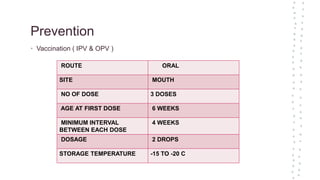
• Vaccination ( IPV & OPV )
ROUTE ORAL
SITE MOUTH
NO OF DOSE 3 DOSES
AGE AT FIRST DOSE 6 WEEKS
MINIMUM INTERVAL
BETWEEN EACH DOSE
4 WEEKS
DOSAGE 2 DROPS
STORAGE TEMPERATURE -15 TO -20 C
??
ANY QUESTIONS??
THANK YOU!!!

Poliomyelitis - Child Health Nursing

  • 1.
    CLASS ROOM TEACHING P RE S E N T E D T O M R S . M A H A L A K S H M I M S C ( N ) T U T O R M M M C O N P R E S E N T E D B Y C L I N C Y S P E R C I Y A M S C ( N ) I Y E A R M M M C O N
  • 2.
  • 3.
    Introduction • Poliomyelitis oftencalled Polio or infantile paralysis is an acute, viral, infectious disease spread from person to person, primarily via the fecal-oral route. • The term “Poliomyelitis” derives from the ancient Greek word Polio’s means “grey” and myelos meaning “marrow” referring to the grey matter of the spinal cord. The suffix itis denotes inflammation, i.e. inflammation of the spinal cord’s grey matter. • A severe infection can extend into the brain stream and even higher center resulting in Polio encephalitis and apnea.
  • 4.
    Causative Agent • Poliomyelitisis a communicable disease caused by a virus named Poliovirus • ENTEROVIRUS
  • 5.
    MODE OF TRANSMISSION •Poliovirus is transmitted by the fecal-oral route through ingestion. Inhalation or entry through conjunctiva of droplets of respiratory secretions may also be possible modes of entry in close contacts of patients in early stage of disease. • The virus multiplies initially in the epithelial cells of the alimentary canal and the lymphatic tissues. It then spreads to the lymph nodes and enters the blood stream. • After further multiplication in the reticulo-endothelial system, the virus enters the blood stream again and it is carried to the spinal cord and brain. • Incubation Period: The time from being infected with the virus to developing symptoms of disease ranges from 5-35 days(average 7-14 days)
  • 6.
    DIFFERENT TYPES • Inabout 1% of cases, the virus enters the central nervous system, preferentially infecting and destroying motor neurons leading to muscle weakness and acute flaccid paralysis. Depending on the nerves involved , Poliomyelitis can be classified as follows 1) Spinal Polio: It is the most common form characterised by asymmetric paralysis that most often involves the legs. 2) Bulbar Polio: This leads to weakness of muscles innervated by cranial nerves. 3) Bulbospinal Polio: It is a combination of bulbar and spinal paralysis.
  • 7.
    RISK FACTOR • AGE:infant and elderly • Living with an infected person • Compromised immune system • Lack of immunization against polio • Travelling to an area that has experienced a polio break
  • 8.
    CLINICAL FEATURES Inapparent /asymptomatic (90 – 95%) • 95 % of the cases • Virus stays in the intestinal tract and does not attack the nerves • Virus shed in the stools so infected individual is still able to infect others Apparent / symptomatic ( 5 – 10%) • Abortive polio • Non paralytic aseptic meningitis • Paralytic poliomyelitis • Polio encephalitis
  • 9.
    ABORTIVE POLIO 4 –8 % , does not lead to paralysis Minor illness Symptoms  Low grade fever  Sore throat  Vomiting  Abdominal pain  Loss of appetite  Malaise
  • 10.
    NON – PARALYTICASEPTIC MENINGITS • Occurs in 1- 2 % of polio infection Symptoms: Headache Nausea Vomitting Pain and stiffness of neck, back and legs Complete recovery after 2- 10 days of symptoms
  • 11.
    PARALYTIC POLIOMYELITIS 0.5 –1 % Minor – same as abortive polio Major – muscle pain, spasm and return of fever It is of three types • Spinal paralytic poliomyelitis • Bulbar poliomyelitis • Bulbo-spinal poliomyelitis
  • 12.
    SPINAL PARALYTIC POLIOMYELITIS •79 – 80 % • Attacks motor neurons in the spinal cord and causes paralysis • Affects muscles of legs , arms and trunk • Severe cases – quadriplegia , paralysis of trunk, abdominal and thoracic muscles.
  • 13.
    Bulbar poliomyelitis • Affectsneurons responsible for sight, vision, taste, swallowing and breathing • 2% of paralytic polio • Life threatening • Affects cranial nerve function • Primarily inhibits ability to breath, speak and swallow effectively • Facial asymmetry present
  • 14.
    Symptoms • Nasal twangand hoarseness of voice • Nasal regurgitation • Dyspnea • Dysphagia • Child refuses to feed • Secretion accumulation • Shallow and irregular respiration • Dusky and mottoled skin • Restless, confused and comatose
  • 15.
    BULBO SPINAL POLIOMYELITIS •19% of paralytic cases • Affects extremities and cranial nerves • Leads to severe respiratory involvement • Combination of spinal paralytic and bulbar polio
  • 16.
    Polio encephalitis • Occursin rare cases • Causes inflammation of grey matter of brain • Autonomic dysfunction is common and it has a high mortality Signs and symptoms • Agitation • Confusion • Stupor • Coma • Irritability • delirium
  • 17.
    Diagnosis and Tests •The health care provider may find:- Abnormal reflexes, Back stiffness, Difficulty in lifting the head or legs when lying flat or the back stiff neck, trouble bending the neck. • Tests includes Cultures of throat washing, stools or spinal fluid, spinal tap and examination of the spinal fluid (CSF exam.) using PCR. Test for levels of antibodies to the Polio virus.
  • 18.
    Treatment • Symptomatic andsupportive The goal of the treatment is to control symptoms Treatment may includes Hospitalization (may be required for those individuals who develop paralytic poliomyelitis) If the respiratory in involved , long term ventilation is necessary Catheterization – antibiotic Moist heat application
  • 19.
    • Physical therapy •Braces or corrective shoes • Orthopaedic surgery to help recover muscle strength and function • Bed rest • Optimum position for limbs • Physio therapy • Good nursing • Diet • Occupational therapy • Speech therapy
  • 20.
    Complication • Myocarditis • Hypertension •Pulmonary edema • Pneumonia • Urinary tract infections • Compression neuropathy • Scoliosis • Osteoporosis • Bone fracture • Skeletal deformities
  • 21.
    NURSING MANAGEMENT • NURSINGDIAGNOSIS Imbalanced nutrition Ineffective thermoregulation Inefffectice airway clearance Ineffective breathing pattern Acute pain Impaired physical mobility
  • 22.
    PROGNOSIS • Non paralyticcases complete recovery • Paralytic polio – permanent weakness in 2/3rd cases • Worse – older children, sudden onset of illness with high fever Post polio syndrome Affects about 25 – 50% of the polio survivors
  • 23.
    Prevention • Vaccination (IPV & OPV ) ROUTE ORAL SITE MOUTH NO OF DOSE 3 DOSES AGE AT FIRST DOSE 6 WEEKS MINIMUM INTERVAL BETWEEN EACH DOSE 4 WEEKS DOSAGE 2 DROPS STORAGE TEMPERATURE -15 TO -20 C
  • 24.
  • 25.
  • 26.