Public Policy What is domestic public policy? What are the steps in policy creation? How do we know the policy is working?
Public Policy Overview Definition: Public plans or course of action that concerns internal issues of national importance, such as poverty, crime, and the environment. (Schmidt et. al, 485). Stated most simply, public policy is the sum of government activities, whether acting directly or through agents, as it has an influence on the life of citizens (Guy Peters)
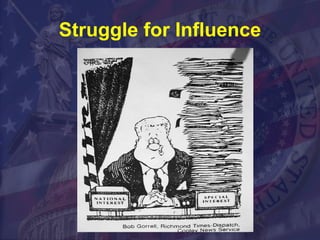
Struggle for Influence
Theories Pluralist- Interest groups compete and balance each other Elite Theory-  Interest groups are dominated by elites Institutionalist- Interest, Ideas, and Institutions Role and interaction of interests Source of ideas and when and how they enter the policy process Role of various institutions
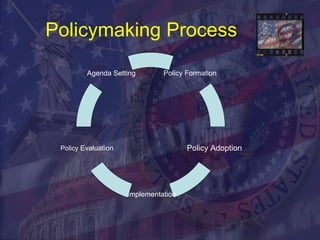
Policymaking Process   Policy Formation Implementation Policy   Evaluation Agenda Setting Policy   Adoption
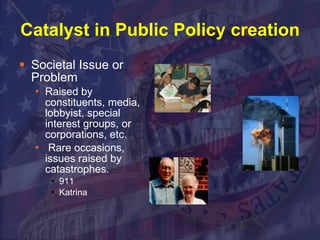
Catalyst in Public Policy creation Societal Issue or Problem Raised by constituents, media, lobbyist, special interest groups, or corporations, etc.  Rare occasions, issues raised by catastrophes. 911 Katrina
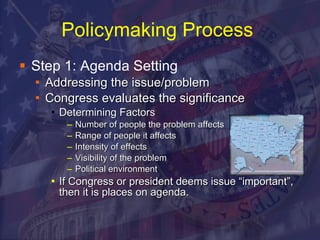
Policymaking Process   Step 1:  Agenda Setting  Addressing the issue/problem Congress evaluates the significance Determining Factors Number of people the problem affects Range of people it affects  Intensity of effects  Visibility of the problem  Political environment If Congress or president deems issue “important”, then it is places on agenda.
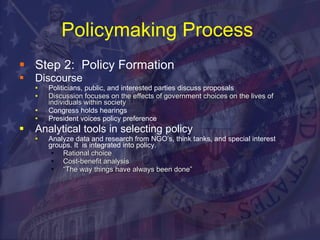
Policymaking Process   Step 2:  Policy Formation Discourse Politicians, public, and interested parties discuss proposals Discussion focuses on the effects of government choices on the lives of individuals within society  Congress holds hearings  President voices policy preference Analytical tools in selecting policy Analyze data and research from NGO’s, think tanks, and special interest groups. It  is integrated into policy. Rational choice Cost-benefit analysis “ The way things have always been done”
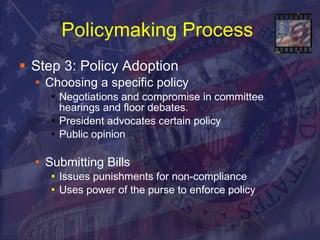
Policymaking Process   Step 3: Policy Adoption Choosing a specific policy Negotiations and compromise in committee hearings and floor debates.  President advocates certain policy  Public opinion Submitting Bills Issues punishments for non-compliance Uses power of the purse to enforce policy
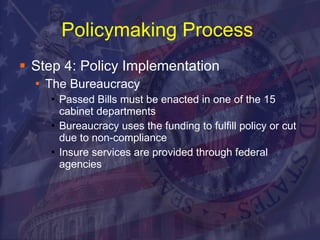
Policymaking Process   Step 4: Policy Implementation The Bureaucracy Passed Bills must be enacted in one of the 15 cabinet departments Bureaucracy uses the funding to fulfill policy or cut due to non-compliance Insure services are provided through federal agencies
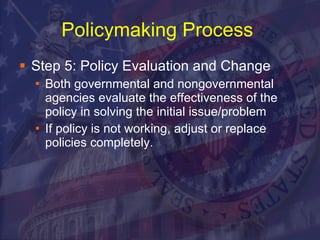
Policymaking Process   Step 5: Policy Evaluation and Change Both governmental and nongovernmental agencies evaluate the effectiveness of the policy in solving the initial issue/problem If policy is not working, adjust or replace policies completely.
Quiz Read the NYT article and new revelation on 911, then answer the question below. Is this issue important enough to place on the agenda?

Policy Creation

  • 1.
    Public Policy Whatis domestic public policy? What are the steps in policy creation? How do we know the policy is working?
  • 2.
    Public Policy OverviewDefinition: Public plans or course of action that concerns internal issues of national importance, such as poverty, crime, and the environment. (Schmidt et. al, 485). Stated most simply, public policy is the sum of government activities, whether acting directly or through agents, as it has an influence on the life of citizens (Guy Peters)
  • 3.
  • 4.
    Theories Pluralist- Interestgroups compete and balance each other Elite Theory- Interest groups are dominated by elites Institutionalist- Interest, Ideas, and Institutions Role and interaction of interests Source of ideas and when and how they enter the policy process Role of various institutions
  • 5.
    Policymaking Process Policy Formation Implementation Policy Evaluation Agenda Setting Policy Adoption
  • 6.
    Catalyst in PublicPolicy creation Societal Issue or Problem Raised by constituents, media, lobbyist, special interest groups, or corporations, etc. Rare occasions, issues raised by catastrophes. 911 Katrina
  • 7.
    Policymaking Process Step 1: Agenda Setting Addressing the issue/problem Congress evaluates the significance Determining Factors Number of people the problem affects Range of people it affects Intensity of effects Visibility of the problem Political environment If Congress or president deems issue “important”, then it is places on agenda.
  • 8.
    Policymaking Process Step 2: Policy Formation Discourse Politicians, public, and interested parties discuss proposals Discussion focuses on the effects of government choices on the lives of individuals within society Congress holds hearings President voices policy preference Analytical tools in selecting policy Analyze data and research from NGO’s, think tanks, and special interest groups. It is integrated into policy. Rational choice Cost-benefit analysis “ The way things have always been done”
  • 9.
    Policymaking Process Step 3: Policy Adoption Choosing a specific policy Negotiations and compromise in committee hearings and floor debates. President advocates certain policy Public opinion Submitting Bills Issues punishments for non-compliance Uses power of the purse to enforce policy
  • 10.
    Policymaking Process Step 4: Policy Implementation The Bureaucracy Passed Bills must be enacted in one of the 15 cabinet departments Bureaucracy uses the funding to fulfill policy or cut due to non-compliance Insure services are provided through federal agencies
  • 11.
    Policymaking Process Step 5: Policy Evaluation and Change Both governmental and nongovernmental agencies evaluate the effectiveness of the policy in solving the initial issue/problem If policy is not working, adjust or replace policies completely.
  • 12.
    Quiz Read theNYT article and new revelation on 911, then answer the question below. Is this issue important enough to place on the agenda?