© 2011 Cengage Learning. All rights reserved.
Chapter 16
Organizational Culture
LearningOutcomes
1. Identify the three levels of culture and the roles they play in an organization.
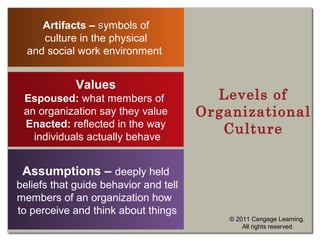
2. Evaluate the four functions of culture within an organization.
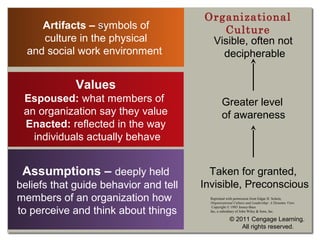
3. Explain the relationship between organizational culture and performance.
4. Describe five ways leaders reinforce organizational culture.
5. Describe the three stages of organizational socialization and the ways
culture is communicated in each step.
6. Discuss how managers assess their organization’s culture.
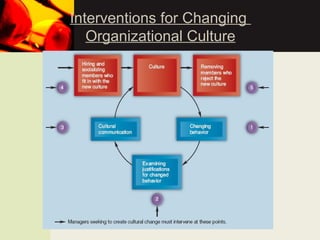
7. Explain actions managers can take to change organizational culture.
8. Identify the challenges organizations face developing positive, cohesive
cultures.
ORGANIZATIONAL
CULTURE
• a system of shared assumptions,
values, and beliefs, which governs
how people behave in organizations.
© 2011 Cengage Learning. All rights reserved.
Organizational (Corporate)
Culture
a pattern of basic assumptions that are
considered valid and that are taught to new
members as the way to perceive, think, and
feel in the organization
Learning Objective
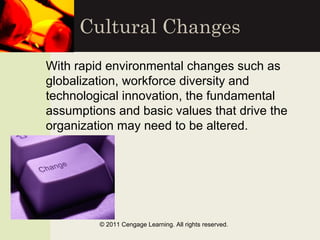
Identify the three levels of culture
and the roles they play in an
organization.
© 2011 Cengage Learning. All rights reserved.
1
Levels of
Organizational
Culture
Artifacts – ssymbols of
culture in the physical
and social work environment
Values
Espoused: what members of
an organization say they value
Enacted: reflected in the way
individuals actually behave
Assumptions – deeply held
beliefs that guide behavior and tell
members of an organization how
to perceive and think about things
© 2011 Cengage Learning.
All rights reserved.
Artifacts – ssymbols of
culture in the physical
and social work environment
Values
Espoused: what members of
an organization say they value
Enacted: reflected in the way
individuals actually behave
Assumptions – deeply held
beliefs that guide behavior and tell
members of an organization how
to perceive and think about things
© 2011 Cengage Learning.
All rights reserved.
Reprinted with permission from Edgar H. Schein,
Organizational Culture and Leadership: A Dynamic View.
Copyright © 1985 Jossey-Bass
Inc, a subsidiary of John Wiley & Sons, Inc.
Organizational
Culture
Visible, often not
decipherable
Greater level
of awareness
Taken for granted,
Invisible, Preconscious
© 2011 Cengage Learning. All rights reserved.
Beyond the Book:
Identifying Norms
This exercise asks you to identify campus norms at your university. Every
organization or group has a set of norms that help determine individuals’ behavior.
A norm is an unwritten rule for behavior in a group. When a norm is not followed,
negative feedback is given. It may include negative comments, stares,
harassment, and exclusion.
1. As a group, brainstorm all the norms you can think of in the following areas:
Dress Classroom behavior; Studying; Weekend activities; Living arrangements;
Campus activities; Dating; Relationships with faculty; Eating on campus versus off
campus; Transportation
2. How did you initially get this information?
3. What happens to students who don’t follow these norms?
4. What values can be inferred from these norms?
Learning Objective
Evaluate the four functions of
culture within an organization.
© 2011 Cengage Learning. All rights reserved.
2
© 2011 Cengage Learning. All rights reserved.
Functions of Organizational
Culture
• Culture provides a sense of identity to members
and increases their commitment to the
organization
• Culture is a sense-making device
for organization members
• Culture reinforces the values
of the organization
• Culture serves as a control
mechanism for shaping
behavior
Learning Objective
Explain the relationship between
organizational culture and
performance.
© 2011 Cengage Learning. All rights reserved.
3
© 2011 Cengage Learning. All rights reserved.
Theories on the relationship
between organizational culture
and performance
Strong Culture Perspective
Fit Perspective
Adaptive Perspective
© 2011 Cengage Learning. All rights reserved.
Strong Culture
an organizational culture with a
consensus on the values that drive
the company and with an intensity that
is recognizable even to outsiders
© 2011 Cengage Learning. All rights reserved.
BECAUSE
• They are characterized by goal
alignment
• They create a high level of motivation
because of shared values by the
members
• They provide control without the
oppressive effects of bureaucracy
Strong Cultures Facilitate Performance
© 2011 Cengage Learning. All rights reserved.
Fit Perspective
a culture is good only if it fits the
industry or the firm’s strategy
© 2011 Cengage Learning. All rights reserved.
Three particular industry
characteristics affect culture:
1.Competitive environment
2.Customer requirements
3.Societal expectations
Fit Perspective
© 2011 Cengage Learning. All rights reserved.
Adaptive Culture
an organizational culture that
encourages confidence and risk taking
among employees, has leadership that
produces change, and focuses on the
changing needs of customers
Learning Objective
Describe five ways leaders
reinforce organizational culture.
© 2011 Cengage Learning. All rights reserved.
4
© 2011 Cengage Learning. All rights reserved.
Most Important Elements
in Managing Culture
• What leaders pay attention to
• How leaders react to crises
• How leaders behave
• How leaders allocate rewards
• How leaders hire and fire individuals
Learning Objective
Describe the three stages of
organizational socialization and
the way culture is communicated
in each step.
© 2011 Cengage Learning. All rights reserved.
5
© 2011 Cengage Learning. All rights reserved.
Organizational
Socialization
the process by which newcomers are
transformed from outsiders to
participating, effective members of
the organization
Organizational Socialization
Process
© 2011 Cengage Learning. All rights reserved.
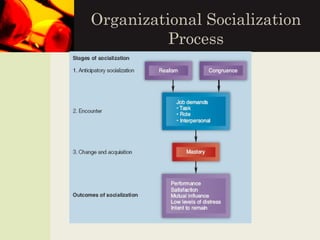
1. [Anticipatory Socialization] – all of
the learning that takes place prior to the
newcomer’s first day on the job
2. [Encounter] – newcomer learns the
tasks associated with the job, clarifies
roles, and establishes new relationships
at work
3. [Change and Acquisition] – newcomer
begins to master the demands of the job
[Socialization Process]
Outcomes of
Socialization
Newcomers who are successfully
socialized should exhibit:
– Good performance
– High job satisfaction
– Intention to stay with organization
– Low levels of distress symptoms
– High level of orgnaizational commitment
© 2011 Cengage Learning. All rights reserved.
Kilmann-Saxton Culture-Gap Survey
Focuses on what actually happens in the
organization and the expectations of others
Two underlying dimensions
– technical/human and
time.
© 2011 Cengage Learning. All rights reserved.
Triangulation
the use of multiple methods to
measure organizational culture
Learning Objective
Explain actions managers can take
to change organizational culture.
7
Cultural Changes
© 2011 Cengage Learning. All rights reserved.
With rapid environmental changes such as
globalization, workforce diversity and
technological innovation, the fundamental
assumptions and basic values that drive the
organization may need to be altered.
Why is Change Difficult?
© 2011 Cengage Learning. All rights reserved.
• Assumptions are often
unconscious
• Culture is deeply ingrained and
behavioral norms and rewards
are well learned
Interventions for Changing
Organizational Culture
Learning Objective
Identify the challenges
organizations face developing
positive, cohesive cultures.
8
• Merger or Acquisition
• Developing a global organizational culture
• Developing an ethical organizational culture
• Developing a culture of empowerment and
quality
Challenges to Developing Positive, Cohesive
Culture
Characteristics of
Organizational Culture
• Innovation (Risk Orientation) -
Companies with cultures that place a high
value on innovation encourage their
employees to take risks and innovate in
the performance of their jobs. Companies
with cultures that place a low value on
innovation expect their employees to do
their jobs the same way that they have
been trained to do them, without looking
for ways to improve their performance.
© 2011 Cengage Learning. All rights reserved.
• Attention to Detail (Precision
Orientation) - This characteristic of
organizational culture dictates the degree
to which employees are expected to be
accurate in their work. A culture that
places a high value on attention to detail
expects their employees to perform their
work with precision. A culture that places
a low value on this characteristic does
not.
© 2011 Cengage Learning. All rights reserved.
• Emphasis on Outcome (Achievement
Orientation) - Companies that focus on
results, but not on how the results are
achieved, place a high emphasis on this
value of organizational culture. A
company that instructs its sales force to
do whatever it takes to get sales orders
has a culture that places a high value on
the emphasis on outcome characteristic.
• Emphasis on People (Fairness
Orientation) - Companies that place a
high value on this characteristic of
organizational culture place a great deal
of importance on how their decisions will
affect the people in their organizations.
For these companies, it is important to
treat their employees with respect and
dignity.
• Teamwork (Collaboration
Orientation) - Companies that
organize work activities around
teams instead of individuals place a
high value on this characteristic of
organizational culture. People who
work for these types of companies
tend to have a positive relationship
with their coworkers and managers.
• Aggressiveness (Competitive
Orientation) - This characteristic of
organizational culture dictates whether
group members are expected to be
assertive or easygoing when dealing with
companies they compete with in the
marketplace. Companies with an
aggressive culture place a high value on
competitiveness and outperforming the
competition at all costs.
• Stability (Rule Orientation) - A
company whose culture places a
high value on stability are rule-
oriented, predictable, and
bureaucratic in nature. These types
of companies typically provide
consistent and predictable levels of
output and operate best in non-
changing market conditions.
© 2011 Cengage Learning. All rights reserved.
Rendition
Characteristics of Organizational Culture

Organizational culture presentation

  • 1.
    © 2011 CengageLearning. All rights reserved. Chapter 16 Organizational Culture LearningOutcomes 1. Identify the three levels of culture and the roles they play in an organization. 2. Evaluate the four functions of culture within an organization. 3. Explain the relationship between organizational culture and performance. 4. Describe five ways leaders reinforce organizational culture. 5. Describe the three stages of organizational socialization and the ways culture is communicated in each step. 6. Discuss how managers assess their organization’s culture. 7. Explain actions managers can take to change organizational culture. 8. Identify the challenges organizations face developing positive, cohesive cultures.
  • 2.
    ORGANIZATIONAL CULTURE • a systemof shared assumptions, values, and beliefs, which governs how people behave in organizations. © 2011 Cengage Learning. All rights reserved.
  • 3.
    © 2011 CengageLearning. All rights reserved. Organizational (Corporate) Culture a pattern of basic assumptions that are considered valid and that are taught to new members as the way to perceive, think, and feel in the organization
  • 4.
    Learning Objective Identify thethree levels of culture and the roles they play in an organization. © 2011 Cengage Learning. All rights reserved. 1
  • 5.
    Levels of Organizational Culture Artifacts –ssymbols of culture in the physical and social work environment Values Espoused: what members of an organization say they value Enacted: reflected in the way individuals actually behave Assumptions – deeply held beliefs that guide behavior and tell members of an organization how to perceive and think about things © 2011 Cengage Learning. All rights reserved.
  • 6.
    Artifacts – ssymbolsof culture in the physical and social work environment Values Espoused: what members of an organization say they value Enacted: reflected in the way individuals actually behave Assumptions – deeply held beliefs that guide behavior and tell members of an organization how to perceive and think about things © 2011 Cengage Learning. All rights reserved. Reprinted with permission from Edgar H. Schein, Organizational Culture and Leadership: A Dynamic View. Copyright © 1985 Jossey-Bass Inc, a subsidiary of John Wiley & Sons, Inc. Organizational Culture Visible, often not decipherable Greater level of awareness Taken for granted, Invisible, Preconscious
  • 7.
    © 2011 CengageLearning. All rights reserved. Beyond the Book: Identifying Norms This exercise asks you to identify campus norms at your university. Every organization or group has a set of norms that help determine individuals’ behavior. A norm is an unwritten rule for behavior in a group. When a norm is not followed, negative feedback is given. It may include negative comments, stares, harassment, and exclusion. 1. As a group, brainstorm all the norms you can think of in the following areas: Dress Classroom behavior; Studying; Weekend activities; Living arrangements; Campus activities; Dating; Relationships with faculty; Eating on campus versus off campus; Transportation 2. How did you initially get this information? 3. What happens to students who don’t follow these norms? 4. What values can be inferred from these norms?
  • 8.
    Learning Objective Evaluate thefour functions of culture within an organization. © 2011 Cengage Learning. All rights reserved. 2
  • 9.
    © 2011 CengageLearning. All rights reserved. Functions of Organizational Culture • Culture provides a sense of identity to members and increases their commitment to the organization • Culture is a sense-making device for organization members • Culture reinforces the values of the organization • Culture serves as a control mechanism for shaping behavior
  • 10.
    Learning Objective Explain therelationship between organizational culture and performance. © 2011 Cengage Learning. All rights reserved. 3
  • 11.
    © 2011 CengageLearning. All rights reserved. Theories on the relationship between organizational culture and performance Strong Culture Perspective Fit Perspective Adaptive Perspective
  • 12.
    © 2011 CengageLearning. All rights reserved. Strong Culture an organizational culture with a consensus on the values that drive the company and with an intensity that is recognizable even to outsiders
  • 13.
    © 2011 CengageLearning. All rights reserved. BECAUSE • They are characterized by goal alignment • They create a high level of motivation because of shared values by the members • They provide control without the oppressive effects of bureaucracy Strong Cultures Facilitate Performance
  • 14.
    © 2011 CengageLearning. All rights reserved. Fit Perspective a culture is good only if it fits the industry or the firm’s strategy
  • 15.
    © 2011 CengageLearning. All rights reserved. Three particular industry characteristics affect culture: 1.Competitive environment 2.Customer requirements 3.Societal expectations Fit Perspective
  • 16.
    © 2011 CengageLearning. All rights reserved. Adaptive Culture an organizational culture that encourages confidence and risk taking among employees, has leadership that produces change, and focuses on the changing needs of customers
  • 17.
    Learning Objective Describe fiveways leaders reinforce organizational culture. © 2011 Cengage Learning. All rights reserved. 4
  • 18.
    © 2011 CengageLearning. All rights reserved. Most Important Elements in Managing Culture • What leaders pay attention to • How leaders react to crises • How leaders behave • How leaders allocate rewards • How leaders hire and fire individuals
  • 19.
    Learning Objective Describe thethree stages of organizational socialization and the way culture is communicated in each step. © 2011 Cengage Learning. All rights reserved. 5
  • 20.
    © 2011 CengageLearning. All rights reserved. Organizational Socialization the process by which newcomers are transformed from outsiders to participating, effective members of the organization
  • 21.
  • 22.
    © 2011 CengageLearning. All rights reserved. 1. [Anticipatory Socialization] – all of the learning that takes place prior to the newcomer’s first day on the job 2. [Encounter] – newcomer learns the tasks associated with the job, clarifies roles, and establishes new relationships at work 3. [Change and Acquisition] – newcomer begins to master the demands of the job [Socialization Process]
  • 23.
    Outcomes of Socialization Newcomers whoare successfully socialized should exhibit: – Good performance – High job satisfaction – Intention to stay with organization – Low levels of distress symptoms – High level of orgnaizational commitment © 2011 Cengage Learning. All rights reserved.
  • 24.
    © 2011 CengageLearning. All rights reserved. Kilmann-Saxton Culture-Gap Survey Focuses on what actually happens in the organization and the expectations of others Two underlying dimensions – technical/human and time.
  • 25.
    © 2011 CengageLearning. All rights reserved. Triangulation the use of multiple methods to measure organizational culture
  • 26.
    Learning Objective Explain actionsmanagers can take to change organizational culture. 7
  • 27.
    Cultural Changes © 2011Cengage Learning. All rights reserved. With rapid environmental changes such as globalization, workforce diversity and technological innovation, the fundamental assumptions and basic values that drive the organization may need to be altered.
  • 28.
    Why is ChangeDifficult? © 2011 Cengage Learning. All rights reserved. • Assumptions are often unconscious • Culture is deeply ingrained and behavioral norms and rewards are well learned
  • 29.
  • 30.
    Learning Objective Identify thechallenges organizations face developing positive, cohesive cultures. 8
  • 31.
    • Merger orAcquisition • Developing a global organizational culture • Developing an ethical organizational culture • Developing a culture of empowerment and quality Challenges to Developing Positive, Cohesive Culture
  • 32.
    Characteristics of Organizational Culture •Innovation (Risk Orientation) - Companies with cultures that place a high value on innovation encourage their employees to take risks and innovate in the performance of their jobs. Companies with cultures that place a low value on innovation expect their employees to do their jobs the same way that they have been trained to do them, without looking for ways to improve their performance. © 2011 Cengage Learning. All rights reserved.
  • 33.
    • Attention toDetail (Precision Orientation) - This characteristic of organizational culture dictates the degree to which employees are expected to be accurate in their work. A culture that places a high value on attention to detail expects their employees to perform their work with precision. A culture that places a low value on this characteristic does not. © 2011 Cengage Learning. All rights reserved.
  • 34.
    • Emphasis onOutcome (Achievement Orientation) - Companies that focus on results, but not on how the results are achieved, place a high emphasis on this value of organizational culture. A company that instructs its sales force to do whatever it takes to get sales orders has a culture that places a high value on the emphasis on outcome characteristic.
  • 35.
    • Emphasis onPeople (Fairness Orientation) - Companies that place a high value on this characteristic of organizational culture place a great deal of importance on how their decisions will affect the people in their organizations. For these companies, it is important to treat their employees with respect and dignity.
  • 36.
    • Teamwork (Collaboration Orientation)- Companies that organize work activities around teams instead of individuals place a high value on this characteristic of organizational culture. People who work for these types of companies tend to have a positive relationship with their coworkers and managers.
  • 37.
    • Aggressiveness (Competitive Orientation)- This characteristic of organizational culture dictates whether group members are expected to be assertive or easygoing when dealing with companies they compete with in the marketplace. Companies with an aggressive culture place a high value on competitiveness and outperforming the competition at all costs.
  • 38.
    • Stability (RuleOrientation) - A company whose culture places a high value on stability are rule- oriented, predictable, and bureaucratic in nature. These types of companies typically provide consistent and predictable levels of output and operate best in non- changing market conditions.
  • 39.
    © 2011 CengageLearning. All rights reserved. Rendition Characteristics of Organizational Culture

Editor's Notes

  • #8 SOURCE: Dorothy Marcic, “Identifying Behavioral Norms.” Organizational Behavior: Experiences and Cases (St. Paul, MN: West Publishing, 1989). Reprinted by permission.
  • #40 U.S. government operatives haul Anwar El-Ibrahimi (Omar Metwally) off his flight from Cape Town, South Africa, after it arrives in Washington, D.C. He is a suspected terrorist whom the government sends to North Africa for torture and interrogation. CIA analyst Douglas Freeman (Jake Gyllenhaal) reacts negatively to the torture techniques and urges El-Ibrahimi’s release. This scene opens with a night shot of the Washington Monument. It follows Kahlid’s (Moa Khouas) discussion with Hamadi (Hassam Ghancy), the leader of a terrorist group. Congressional aide Alan Smith (Peter Sarsgaard) says in a voice-over, “She called you?” referring to Corrine Whitman (Meryl Streep), head of U.S. intelligence. She authorized the extraordinary rendition of El-Ibrahimi. Alan Smith, earlier in the film, pressed her for El-Ibrahimi’s release and his return to the United States. This scene does not explicitly discuss organizational structure, but you can infer several aspects of structure from the scene.