Organization Development and Change
Thomas G. Cummings
Christopher G. Worley
Diagnosing Groups and Jobs
Cummings & Worley, 8e
(c)2005 Thomson/South-Western
6-2
Learning Objectives
for Chapter Six
• To clarify the concepts of group and job
level diagnosis
• To define diagnosis and to explain how the
diagnostic process discovers the underlying
causes of problems at the group and job
level of analysis
• To present an open systems diagnostic
model for group and job levels
Cummings & Worley, 8e
(c)2005 Thomson/South-Western
6-3
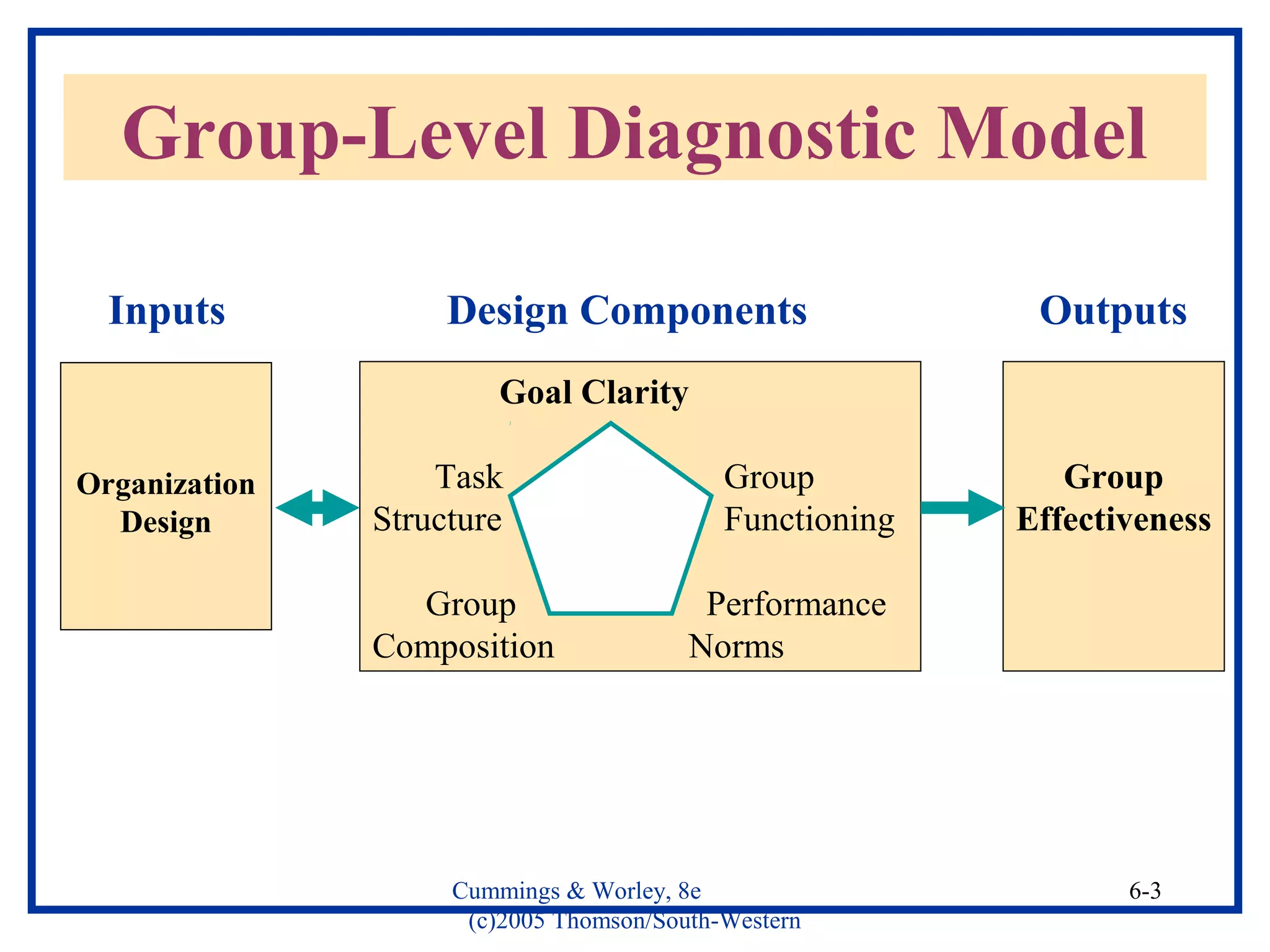
Goal Clarity
Task Group
Structure Functioning
Group Performance
Composition Norms
Group-Level Diagnostic Model
Inputs Design Components Outputs
Organization
Design
Group
Effectiveness
Cummings & Worley, 8e
(c)2005 Thomson/South-Western
6-4
Group-Level Design Components
• Goal Clarity
– extent to which group understands its objectives
• Task Structure
– the way the group’s work is designed
• Team Functioning
– the quality of group dynamics among members
• Group Composition
– the characteristics of group members
• Performance Norms
– the unwritten rules that govern behavior
Cummings & Worley, 8e
(c)2005 Thomson/South-Western
6-5
Group-Level Outputs
• Product or Service Quality
• Productivity
– e.g., cost/member, number of decisions
• Team Cohesiveness
– e.g., commitment to group and organization
• Work Satisfaction
Cummings & Worley, 8e
(c)2005 Thomson/South-Western
6-6
Skill Variety
Task
Identity Autonomy
Task Feedback
Significance about Results
Individual-Level Diagnostic Model
Inputs Design Components Outputs
Organization
Design
Group
Design
Personal
Traits
Individual
Effectiveness
Cummings & Worley, 8e
(c)2005 Thomson/South-Western
6-7
Individual-Level Design Components
• Skill Variety
– The range of activities and abilities required for
task completion
• Task Identity
– The ability to see a “whole” piece of work
• Task Significance
– The impact of work on others
• Autonomy
– The amount of freedom and discretion
• Feedback about Results
– Knowledge of task performance outcomes
Cummings & Worley, 8e
(c)2005 Thomson/South-Western
6-8
Individual-Level Outputs
• Performance
– e.g., cost/unit, service/product quality
• Absenteeism
• Job Satisfaction
– e.g., internal motivation
• Personal Development
– e.g., growth in skills, knowledge, and self

Oc 6440 diagnosing groups and jobs

  • 1.
    Organization Development andChange Thomas G. Cummings Christopher G. Worley Diagnosing Groups and Jobs
  • 2.
    Cummings & Worley,8e (c)2005 Thomson/South-Western 6-2 Learning Objectives for Chapter Six • To clarify the concepts of group and job level diagnosis • To define diagnosis and to explain how the diagnostic process discovers the underlying causes of problems at the group and job level of analysis • To present an open systems diagnostic model for group and job levels
  • 3.
    Cummings & Worley,8e (c)2005 Thomson/South-Western 6-3 Goal Clarity Task Group Structure Functioning Group Performance Composition Norms Group-Level Diagnostic Model Inputs Design Components Outputs Organization Design Group Effectiveness
  • 4.
    Cummings & Worley,8e (c)2005 Thomson/South-Western 6-4 Group-Level Design Components • Goal Clarity – extent to which group understands its objectives • Task Structure – the way the group’s work is designed • Team Functioning – the quality of group dynamics among members • Group Composition – the characteristics of group members • Performance Norms – the unwritten rules that govern behavior
  • 5.
    Cummings & Worley,8e (c)2005 Thomson/South-Western 6-5 Group-Level Outputs • Product or Service Quality • Productivity – e.g., cost/member, number of decisions • Team Cohesiveness – e.g., commitment to group and organization • Work Satisfaction
  • 6.
    Cummings & Worley,8e (c)2005 Thomson/South-Western 6-6 Skill Variety Task Identity Autonomy Task Feedback Significance about Results Individual-Level Diagnostic Model Inputs Design Components Outputs Organization Design Group Design Personal Traits Individual Effectiveness
  • 7.
    Cummings & Worley,8e (c)2005 Thomson/South-Western 6-7 Individual-Level Design Components • Skill Variety – The range of activities and abilities required for task completion • Task Identity – The ability to see a “whole” piece of work • Task Significance – The impact of work on others • Autonomy – The amount of freedom and discretion • Feedback about Results – Knowledge of task performance outcomes
  • 8.
    Cummings & Worley,8e (c)2005 Thomson/South-Western 6-8 Individual-Level Outputs • Performance – e.g., cost/unit, service/product quality • Absenteeism • Job Satisfaction – e.g., internal motivation • Personal Development – e.g., growth in skills, knowledge, and self