
OPERATIONAL EXCELLENCE SERIES
CONTINUOUS IMPROVEMENT
DEPLOYMENT
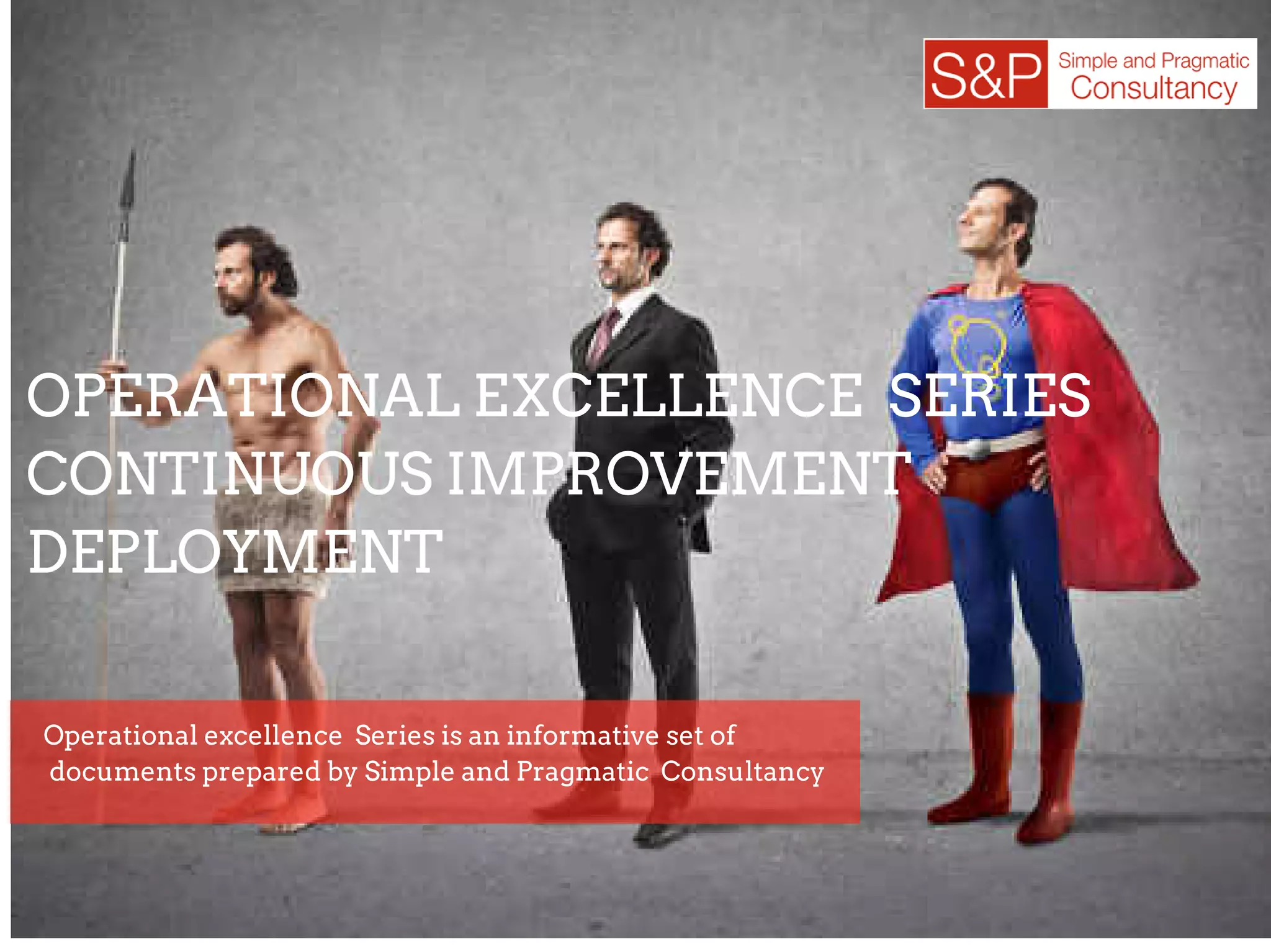
Operational excellence Series is an informative set of
documents prepared by Simple and Pragmatic Consultancy
CONTINUOUS IMPROVEMENT
DEPLOYMENT
In the previous chapter of
our OPEX approach, we
emphasized the
importance of continuous
improvement. In this
chapter we will go deeper
in CI and study how to
deploy it successfully.
The deployment of continuous improvement is a
significant step that organizations can take to become
more competitive.
To ensure the long­term sustainability of CI,
companies need to analyze and accept its
strengths and weaknesses and properly
utilize chosen methods, principles,
concepts and tools.
EFFICIENCY & EFFECTIVENESS
AND FLEXIBILITY
The deployment of continuous improvement is a significant
step that organizations can take to become more
competitive.
To ensure the long­term sustainability of CI,
companies need to analyze and accept its
strengths and weaknesses and properly
utilize chosen methods, principles,
concepts and tools.
INITIAL
CONDITIONS
REVIEW
Before any CI deployment, initial conditions like company culture,
sector of activity, challengers/leaders,business results, competitors,
customers as well as previous deployment fails and success,
managers vision & involvements should be identified.
Then deployment method should be choosen in order to :
Transform vision in strategy and strategy in long terms goals,
Conduct change management, with strong management support,
Succeed in enterprise transformation and process improvement,
Problem solving& cost reduction.
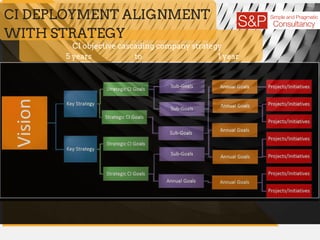
CI DEPLOYMENT ALIGNMENT
WITH STRATEGY
CI objective cascading company strategy
5 years to 1 year
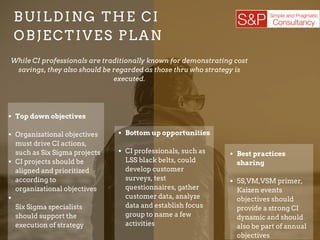
BUILDING THE CI
OBJECTIVES PLAN
Top down objectives
Organizational objectives
must drive CI actions,
such as Six Sigma projects
CI projects should be
aligned and prioritized
according to
organizational objectives
Six Sigma specialists
should support the
execution of strategy
Bottom up opportunities
CI professionals, such as
LSS black belts, could
develop customer
surveys, test
questionnaires, gather
customer data, analyze
data and establish focus
group to name a few
activities
Best practices
sharing
5S,VM,VSM primer,
Kaizen events
objectives should
provide a strong CI
dynamic and should
also be part of annual
objectives
While CI professionals are traditionally known for demonstrating cost
savings, they also should be regarded as those thru who strategy is
executed.
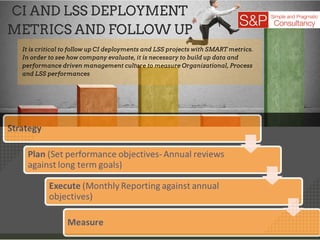
CI AND LSS DEPLOYMENT
METRICS AND FOLLOW UP
It is critical to follow up CI deployments and LSS projects with SMART metrics.
In order to see how company evaluate, it is necessary to build up data and
performance driven management culture to measure Organizational, Process
and LSS performances
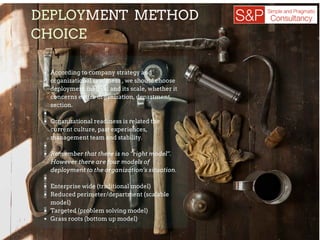
DEPLOYMENT METHOD
CHOICE
According to company strategy and
organizational readiness , we should choose
deployment method and its scale, whether it
concerns entire organization, department,
section.
Organizational readiness is related the
current culture, past experiences,
management team and stability.
Remember that there is no “right model”.
However there are four models of
deployment to the organization’s situation.
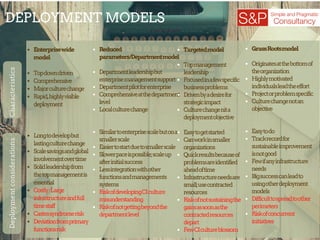
Enterprise wide (traditional model)
Reduced perimeter/department (scalable
model)
Targeted (problem solving model)
Grass roots (bottom up model)
DEPLOYMENT MODELSDEPLOYMENT MODELS
Enterprisewide
model
Topdowndriven
Comprehensive
Majorculturechange
Rapid,highlyvisible
deployment
Longtodevelopbut
lastingculturechange
Scalesavingsandglobal
involvementovertime
Solidleadershipfrom
thetopmanagementis
essential
Costly:Large
infrastructureandfull
timestaff
Castessyndromerisk
Deviationfromprimary
functionsrisk
Reduced
parameters/Departmentmodel
Departmentleadershipbut
enterprisemanagementsupport
Departmentpilotforenterprise
Comprehensiveatthedepartment
level
Localculturechange
Similartoenterprisescalebutona
smallerscale
Easiertostartduetosmallerscale
Slowerpaceispossible;scaleup
afterinitialsuccess
Lessintegrationwithother
functionsandmanagements
systems
RiskofdevelopingCIculture
misunderstanding
Riskofnotgettingbeyondthe
departmentlevel
Targetedmodel
Topmanagement
leadership
Focusedinafewspecific
businessproblems
Drivenbyadesirefor
strategicimpact
Culturechangenita
deploymentobjective
Easytogetstarted
Canworkinsmaller
organizations
Quickresultsbecauseof
problemsareidentified
aheadoftime
Infrastructureneedsare
small;usecontracted
resources
Riskofnotsustainingthe
gainsassoonasthe
contractedresources
depart
FewCIcultureblossom
GrassRootsmodel
Originatesatthebottomof
theorganization
Highlymotivated
individualsleadtheeffort
Projectorproblemspecific
Culturechangenotan
objective
Easytodo
Trackrecordfor
sustainableimprovement
isnotgood
Fewifanyinfrastructure
needs
Bigsuccesscanleadto
usingotherdeployment
models
Difficulttospreadtoother
perimeters
Riskofconcurrent
initiatives
DeploymentconsiderationsCharacteristics
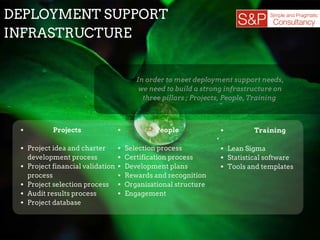
DEPLOYMENT SUPPORT
INFRASTRUCTURE
In order to meet deployment support needs,
we need to build a strong infrastructure on
three pillars ; Projects, People, Training
Projects
Project idea and charter
development process
Project financial validation
process
Project selection process
Audit results process
Project database
People
Selection process
Certification process
Development plans
Rewards and recognition
Organizational structure
Engagement
Training
Lean Sigma
Statistical software
Tools and templates
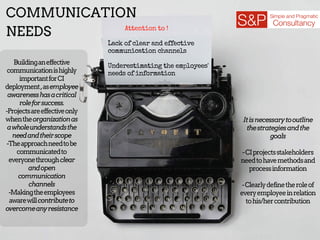
COMMUNICATION
NEEDS
Buildinganeffective
communicationishighly
importantforCI
deployment,asemployee
awarenesshasacritical
roleforsuccess.
­Projectsareeffectiveonly
whentheorganizationas
awholeunderstandsthe
needandtheirscope
­Theapproachneedtobe
communicatedto
everyonethroughclear
andopen
communication
channels
­Makingtheemployees
awarewillcontributeto
overcomeanyresistance
Itisnecessarytooutline
thestrategiesandthe
goals
­CIprojectsstakeholders
needtohavemethodsand
processinformation
­Clearlydefinetheroleof
everyemployeeinrelation
tohis/hercontribution
Attention to !
Lack of clear and effective
communication channels
Underestimating the employees'
needs of information
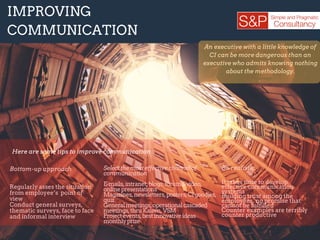
Bottom­up approach
Regularly asses the situation
from employee’s point of
view
Conduct general surveys,
thematic surveys, face to face
and informal interview
IMPROVING
COMMUNICATION
An executive with a little knowledge of
CI can be more dangerous than an
executive who admits knowing nothing
about the methodology.
.
Selectthemosteffectivechannelof
communication
E­mails,intranet,blogs,forums,video,
onlinepresentations
Magazines,newsletters,posters,CIgoodies,
quiz
Generalmeetings,operationalcascaded
meetings,thruKaizen,VSM
Projectevents,bestinnovativeideas
monthlyprize
Be realistic
It takes time to develop
effective communication
systems
Building trust among the
employees, no promise that
cannot be fulfilled
Counter examples are terribly
counter productive
Here are some tips to improve communication :
GOVERNANCE &
STAKEHOLDERS ROLES
Who should run the CI organizations and what do they need?
The leader of a CI organization have to be familiar with the tools and
methodologies.
They should be able to look at big picture and orchestrate activities that get the
right people involved doing the right things.
They, also are able to ask right questions and motivate people so that projects are
completed in timely fashion .
The CI steering must be tied to company steering thru steering committee in
which they select candidates and projects as well as validate charters.
OPERATIONAL
INVOLVEMENT
Hardest part to mobilize..
Whether is the IT,
marketing or any other
department, resistance
will be tougher in some
areas.
Reasons may be
organizational, cultural
or individual. Therefore,
CEO and/or sponsors
should be challenged on
these issue in order to
define the appropriate
CI strategy and lever
barriers without letting
unhealable scars.
Bottom-up improvement
source
Suggestion, Kaizen inputs
R&D product breakthrough
IT or IS breakthrough
Innovation sharing and
distribution
Appropriate process should
be set to share field
innovation inside the entity
and promote it to other
entities.
KPI& DEPLOYMENT
MATURITY ASSESSMENTHardest part to mobilize..
Choosing SMART KPIs covering the
global CI deployment progress is crucial
KPIs should be ;
Specific­ Clear statement of what KPI
exactly measure
Measurable­ It must be easy to compare
the actual value to objective
Achievable­ It must be accepted
Relevant­ The KPI must give more
insight in the performance
Time phased­ Value expressed in time
Remember !
Most KPIs provide after­the­
event information, these KPIs
are “lagging” as they are not
preventive
When KPIs only measure
process steps, we can become
too reliant on them and fail to
spot the potential risks
WHAT TO DO FIRST ?
When an organization
begins a CI deployment,
what should be the first
step ?
Kaizen events to
demonstrate the impact
of quick process
improvement?
Or Six Sigma projects,
using DMAIC or DFSS
roadmap, with a deep
dive into sophisticated
statistics?
Ideally, we should start with a LSS maturity assessment, – a self – evaluation of where the
organization stands. Knowing where the organizations needs to be in the future
Leaders know the current state of their business its strengths, weakness and
improvement opportunities.
LSS MATURITY ASSESSMENT
A lean six sigma maturity assessment can
follow a three phase approach;
Assess,
Analyze,
Address short and log term actions
Scorecards and radar charts can be used for LSS maturity self assessment
Scorecards can be completed by CI leaders and operational leaders.
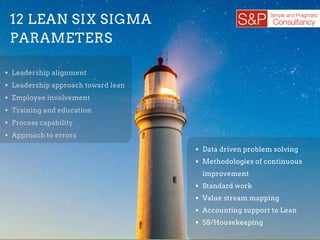
They usually address 12 LSS parameters
12 LEAN SIX SIGMA
PARAMETERS
Leadership alignment
Leadership approach toward lean
Employee involvement
Training and education
Process capability
Approach to errors
Data driven problem solving
Methodologies of continuous
improvement
Standard work
Value stream mapping
Accounting support to Lean
5S/Housekeeping
S&P is a common initiative of Leannovative and Performance Club
consultancy companies. Our aim is to simplify things for
professionals and for our clients. For more information about our
projects and for support please contact us via e-mail through:
edursun@leannovative.com
tansu@kariyer-kulubu.com
Additional contact details and our web page will be available soon.

Operational Excellence Series III Continues Improvement Deployement