Forms of Government
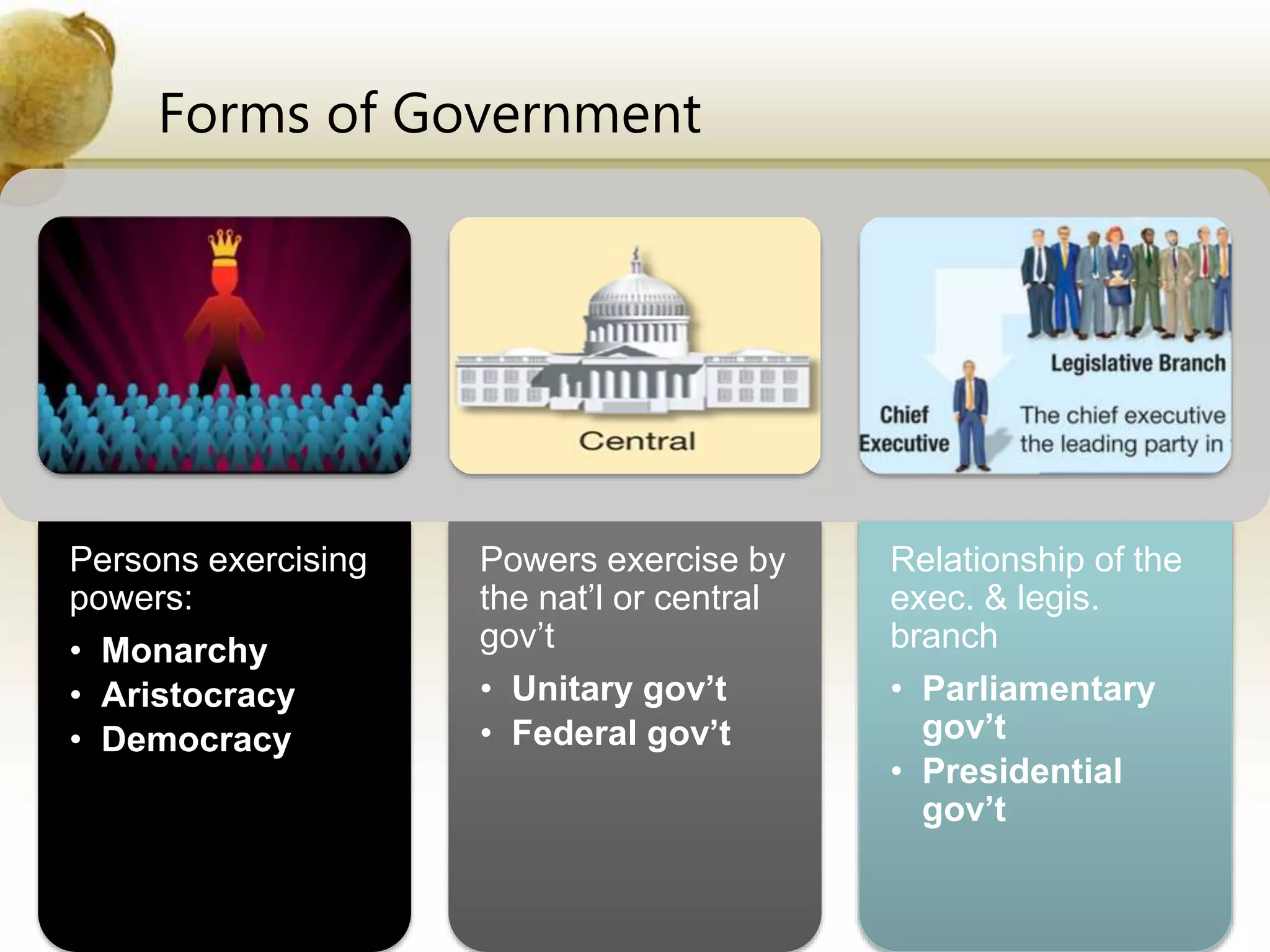
Persons exercising
powers:
• Monarchy
• Aristocracy
• Democracy
Powers exercise by
the nat’l or central
gov’t
• Unitary gov’t
• Federal gov’t
Relationship of the
exec. & legis.
branch
• Parliamentary
gov’t
• Presidential
gov’t
BASED NUMBER OF PERSONS
EXERCISING POWERS
Monarchy
One in which the supreme and final authority is
in the hands of a single person without regard
to the source of his election or the nature or
duration of his tenure.
Monarchy
Absolute monarchy
One in which the ruler
rules by divine right
The monarch exercises
ultimate governing
authority as head of
state and head of
government
Limited monarchy
One in which the ruler
rules in accordance with
a constitution
A form of government in
which a monarch acts as
head of state
Example Monarch Countries
Absolute
Monarchy
Kingdom of
Saudi Arabia
Brunei
Darussalam
Limited
Monarchy
United Kingdom
The Netherlands
Spain
Aristocracy
- One in which political power is
exercised by a few privileged class
- A state characterized by the rule of
nobility, elite, or privileged upper class
Democracy
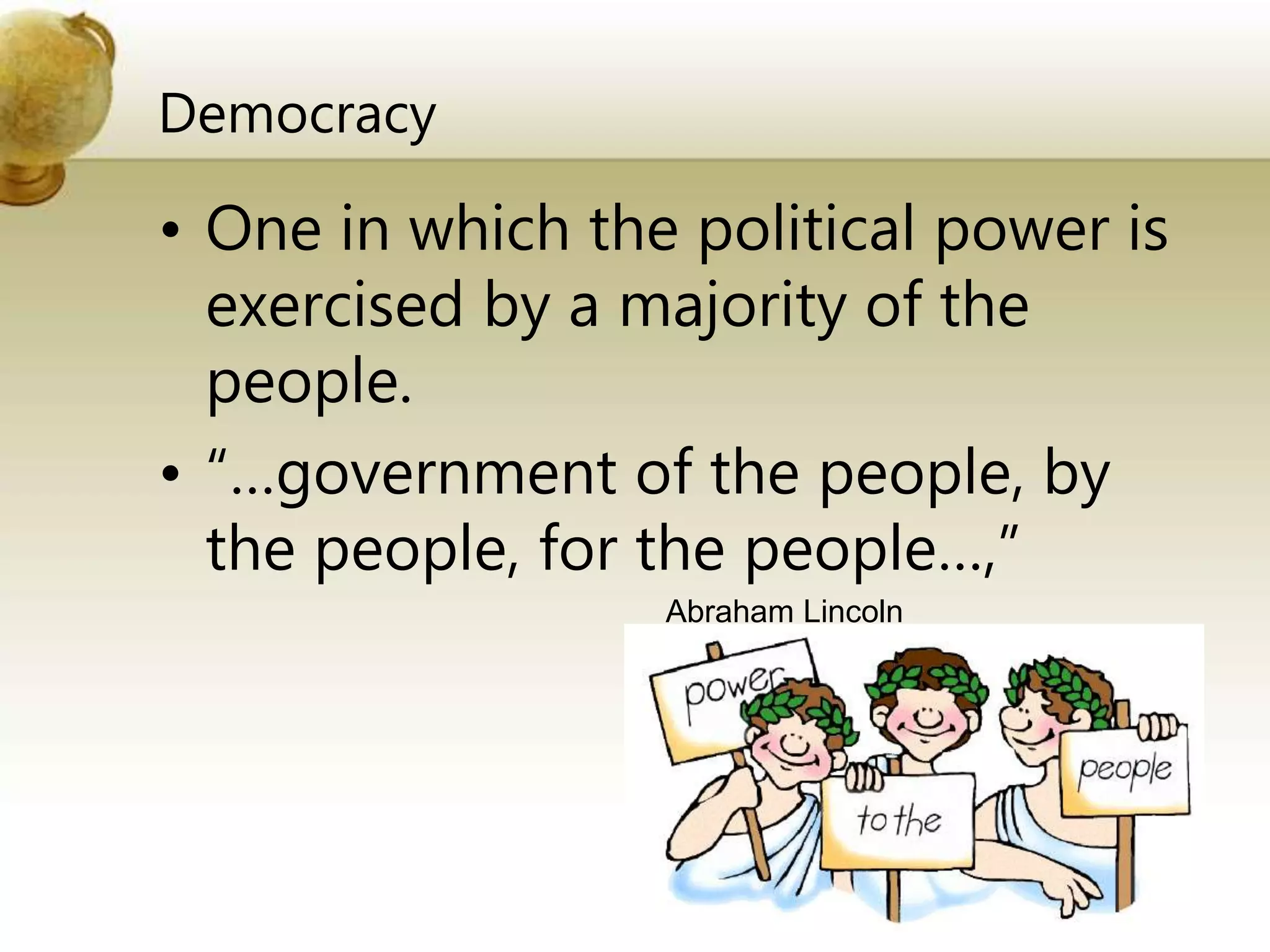
• One in which the political power is
exercised by a majority of the
people.
• “…government of the people, by
the people, for the people…,”
Abraham Lincoln
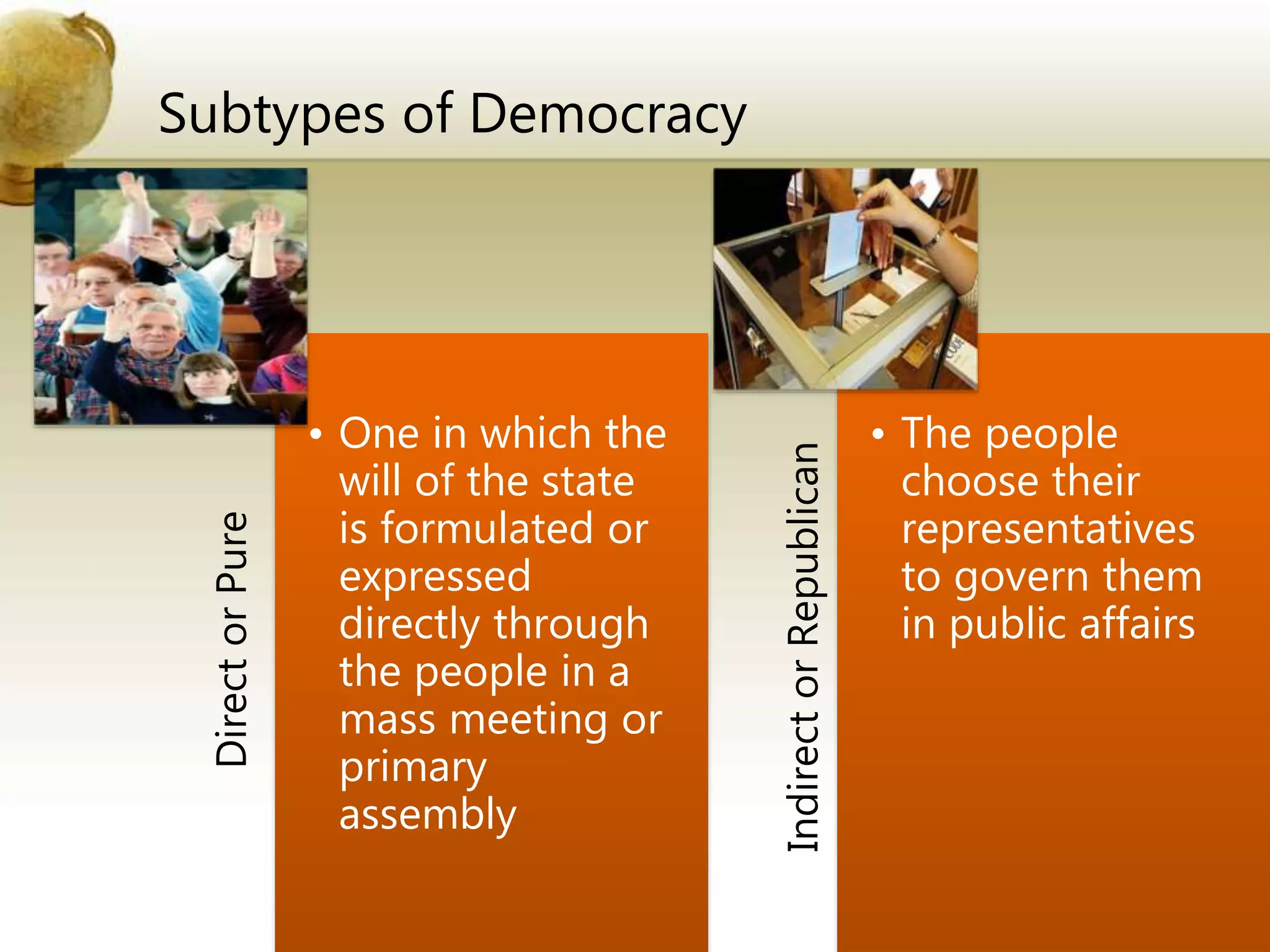
Subtypes of Democracy
DirectorPure
• One in which the
will of the state
is formulated or
expressed
directly through
the people in a
mass meeting or
primary
assembly IndirectorRepublican
• The people
choose their
representatives
to govern them
in public affairs
BASED ON POWERS EXERCISED BY THE
CENTRAL OR NATIONAL
GOVERNMENT:
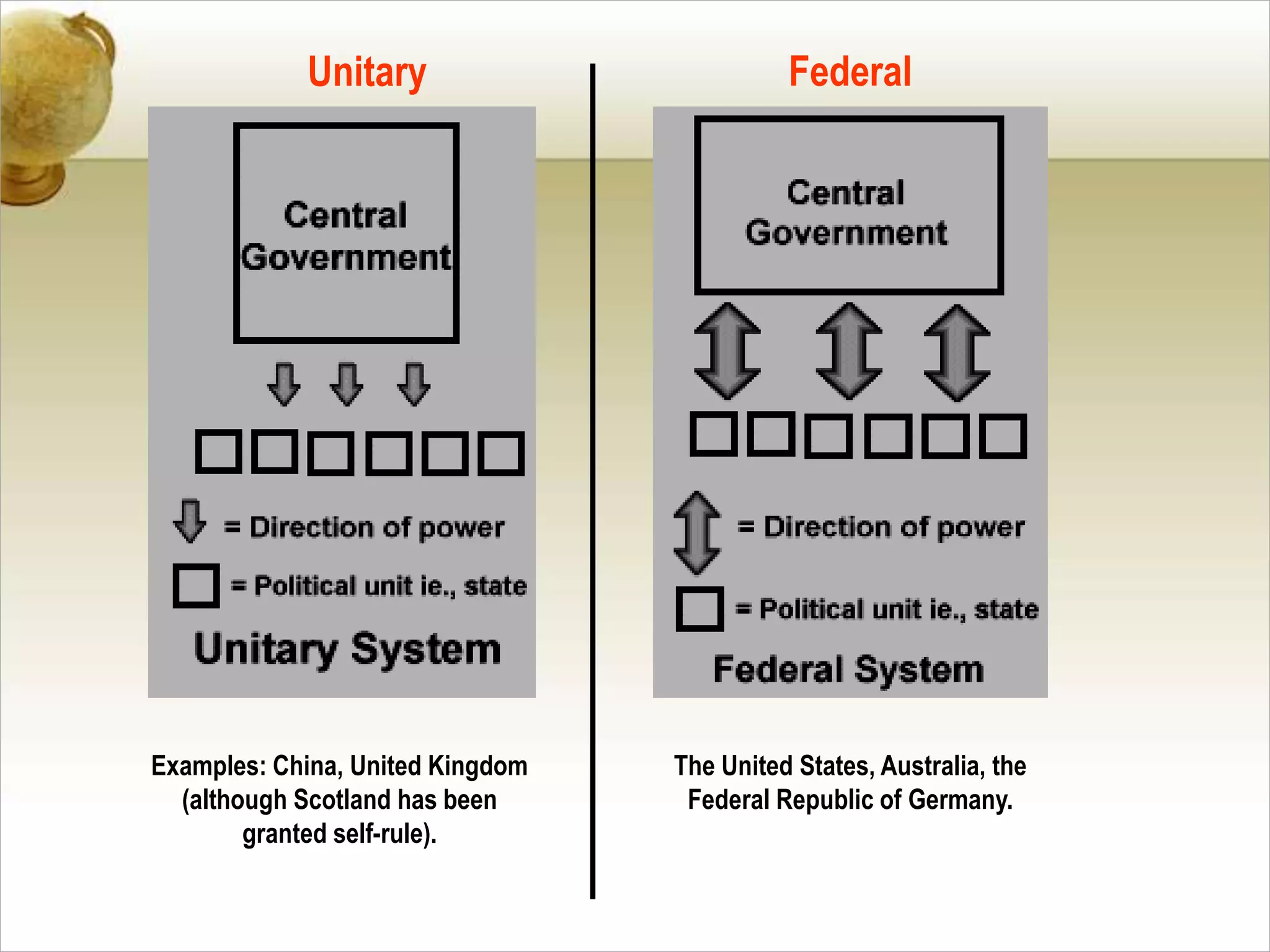
Unitary government
Unitary government
The control of
the national
and local
affairs is
exercised by
the central or
national
government.
Federal Government
Federal Government
The powers of
government are
divided between
the national
affairs and the
local
government,
each supreme
within its own
sphere.
Unitary Federal
Examples: China, United Kingdom
(although Scotland has been
granted self-rule).
The United States, Australia, the
Federal Republic of Germany.
BASED ON THE RELATIONSHIP
BETWEEN THE EXECUTIVE AND THE
LEGISLATIVE BRANCHES
Parliamentary government
The legislature
chooses the
head of the
government,
which is part of
the legislature
and under its
control.
Presidential government
Based on the
principle of
separation of
powers among
the Executive, the
Legislature, and
the Judiciary. The
President is
directly elected
by the people
Parliamentary Government
Presidential Government
State of Brazil
Brazil is a constitutional republic of 26 states and one federal district. Each
state has its own governments, with powers in all matters not specifically
reserved for the Union.
The executive power is vested in the same head of the state and
government, directly elected with non-renewable 5-year term and
limited authority. He is assisted by his cabinet members.
Legislative power is exercised by a bicameral National Congress, the
Chamber of Deputies and the Senate. The Congress has the power to
rule in all matters that are under the jurisdiction of the union. The
Chamber of Deputies is composed of representatives of the states and
elected every four years by direct universal suffrage and secret ballot in
proportion to the population of each state. On the other hand, the
Senate is formed by representatives of the states, who shall serve for a
term of eight years.
The 26 states have autonomous laws and constitutions within the
provisions of the constitution.
Pol sc2   3forms of government

Pol sc2 3forms of government

  • 2.
    Forms of Government Personsexercising powers: • Monarchy • Aristocracy • Democracy Powers exercise by the nat’l or central gov’t • Unitary gov’t • Federal gov’t Relationship of the exec. & legis. branch • Parliamentary gov’t • Presidential gov’t
  • 3.
    BASED NUMBER OFPERSONS EXERCISING POWERS
  • 4.
    Monarchy One in whichthe supreme and final authority is in the hands of a single person without regard to the source of his election or the nature or duration of his tenure.
  • 5.
    Monarchy Absolute monarchy One inwhich the ruler rules by divine right The monarch exercises ultimate governing authority as head of state and head of government Limited monarchy One in which the ruler rules in accordance with a constitution A form of government in which a monarch acts as head of state
  • 6.
    Example Monarch Countries Absolute Monarchy Kingdomof Saudi Arabia Brunei Darussalam Limited Monarchy United Kingdom The Netherlands Spain
  • 7.
    Aristocracy - One inwhich political power is exercised by a few privileged class - A state characterized by the rule of nobility, elite, or privileged upper class
  • 8.
    Democracy • One inwhich the political power is exercised by a majority of the people. • “…government of the people, by the people, for the people…,” Abraham Lincoln
  • 9.
    Subtypes of Democracy DirectorPure •One in which the will of the state is formulated or expressed directly through the people in a mass meeting or primary assembly IndirectorRepublican • The people choose their representatives to govern them in public affairs
  • 10.
    BASED ON POWERSEXERCISED BY THE CENTRAL OR NATIONAL GOVERNMENT:
  • 11.
    Unitary government Unitary government Thecontrol of the national and local affairs is exercised by the central or national government.
  • 12.
    Federal Government Federal Government Thepowers of government are divided between the national affairs and the local government, each supreme within its own sphere.
  • 13.
    Unitary Federal Examples: China,United Kingdom (although Scotland has been granted self-rule). The United States, Australia, the Federal Republic of Germany.
  • 14.
    BASED ON THERELATIONSHIP BETWEEN THE EXECUTIVE AND THE LEGISLATIVE BRANCHES
  • 15.
    Parliamentary government Parliamentary government Thelegislature chooses the head of the government, which is part of the legislature and under its control.
  • 16.
    Presidential government Presidential government Basedon the principle of separation of powers among the Executive, the Legislature, and the Judiciary. The President is directly elected by the people
  • 17.
  • 18.
  • 19.
    State of Brazil Brazilis a constitutional republic of 26 states and one federal district. Each state has its own governments, with powers in all matters not specifically reserved for the Union. The executive power is vested in the same head of the state and government, directly elected with non-renewable 5-year term and limited authority. He is assisted by his cabinet members. Legislative power is exercised by a bicameral National Congress, the Chamber of Deputies and the Senate. The Congress has the power to rule in all matters that are under the jurisdiction of the union. The Chamber of Deputies is composed of representatives of the states and elected every four years by direct universal suffrage and secret ballot in proportion to the population of each state. On the other hand, the Senate is formed by representatives of the states, who shall serve for a term of eight years. The 26 states have autonomous laws and constitutions within the provisions of the constitution.

Editor's Notes

  • #7 NOTE TO TEACHERS: The current Prime Minister as of Jan. 2009 is Gordon Brown, while Queen Elizabeth II is the monarch.
  • #19 NOTE TO TEACHERS: The United States is the main example of a presidential government in the world, and most presidential governments are found in the western hemisphere.