Decentralization and Local
Governance
Topic Outline
• Levels of the Philippine Local Government
• Autonomous Region
• Province
• City and Municipality
• Barangay
• Decentralization
• Definition
• Effect in governance
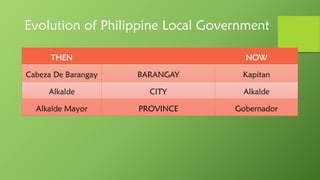
Evolution of Philippine Local Government
THEN NOW
Cabeza De Barangay BARANGAY Kapitan
Alkalde CITY Alkalde
Alkalde Mayor PROVINCE Gobernador
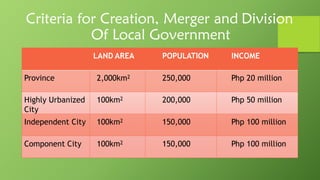
Criteria for Creation, Merger and Division
Of Local Government
LAND AREA POPULATION INCOME
Province 2,000km2 250,000 Php 20 million
Highly Urbanized
City
100km2 200,000 Php 50 million
Independent City 100km2 150,000 Php 100 million
Component City 100km2 150,000 Php 100 million
Local Government
• It pertains to the activity by which local officials, both
elected and appointed, implement the goals and manage
the resources of the local government unit
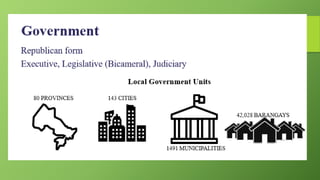
Levels of the Philippine Local
Government Unit
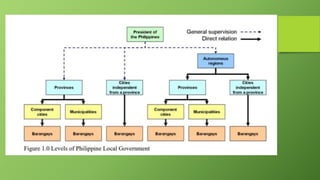
• Provinces and independent cities; component
cities and municipalities; and barangays – these
are the 3 partitions in the Philippine Local
Government or what is commonly known as the
Local Government Unit.
Levels of the Philippine Local
Government Unit
• Local government units are institutional units
whose fiscal, legislative and executive authority
extends over the smallest geographical areas
distinguished for administrative and political
purposes.
Levels of the Philippine Local
Government Unit
• Provinces and independent cities are
systematized into national government regions
but those are administrative regions and not
separately administered areas with their own
elected governments.
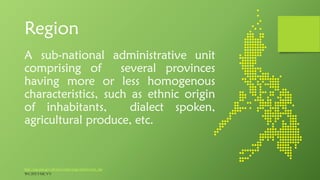
Region
A sub-national administrative unit
comprising of several provinces
having more or less homogenous
characteristics, such as ethnic origin
of inhabitants, dialect spoken,
agricultural produce, etc.
http://nap.psa.gov.ph/activestats/psgc/articles/con_lgu
WCJFEVMCVV
Autonomous Region
• Autonomous regions have more powers than other
local governments.
• The constitution limits the creation of
autonomous regions to Muslim Mindanao and the
Cordilleras but only one autonomous region
exists: the Autonomous Region in Muslim
Mindanao (ARMM).
Autonomous Region
• In 2001, a plebiscite in the ARMM confirmed the
previous composition of the autonomous region
and added Basilan (except for the city of Isabela)
and Marawi City in Lanao del Sur.
Autonomous Region
• An autonomous region is governed by the regional
governor and a legislature such as the ARMM
Regional Legislative Assembly.
Province
The largest unit in the political structure of the
Philippines. It consists, in varying numbers, of
municipalities and, in some cases, of component
cities. Its functions and duties in relation to its
component cities and municipalities are generally
coordinative and supervisory.
Sanguniang Panlalawigan
http://nap.psa.gov.ph/activestats/psgc/articles/con_lgu
WCJFEVMCVV
Province
• Outside the lone autonomous region, the provinces
are the highest-level local government.
• The provinces are organized into component cities
and municipalities.
• A province is governed by the governor and a
legislature known as the Sangguniang Panlalawigan.
City
http://nap.psa.gov.ph/activestats/psgc/articles/con_lgu
WCJFEVMCVV
There are three classes of cities in the
Philippines: the highly urbanized, the
independent component cities which
are independent of the province, and
the component cities which are part
of the provinces where they are
located and subject to their
administrative supervision.
Sanguniang Panlungsod
Municipality
Is a political corporate body which is
endowed with the facilities of a municipal
corporation, exercised by and through the
municipal government in conformity with
law. It is a subsidiary of the province
which consists of a number of barangays
within its territorial boundaries, one of
which is the seat of government found at
the town proper (poblacion).
Sanguniang Bayan
http://nap.psa.gov.ph/activestats/psgc/articles/con_lgu
WCJFEVMCVV
Cities and Municipalities
• Municipal government in the Philippines is
separated into three – independent cities,
component cities, and municipalities (most of
the time referred to as towns).
• Most cities in the country are "independent
cities".
Cities and Municipalities
• Most cities in the country are "independent
cities".
• These cities are not ruled by a province, even
though like Iloilo City, the provincial capital could
be in the city.
Cities and Municipalities
• Municipalities are always a part of a province
except for Pateros which was separated from
Rizal to form Metro Manila.
• Cities and municipalities are governed by mayors
and legislatures, which are called the
Sangguniang Panlungsod in cities and the
Sangguniang Bayan in municipalities.
Barangay
The smallest political unit into which cities and
municipalities in the Philippines are divided. It is
the basic unit of the Philippine political system.
It consists of less than 1,000 inhabitants residing
within the territorial limit of a city or
municipality and administered by a set of
elective officials, headed by a barangay
chairman (punong barangay).
• Sanguniang Barangay
• Sanguniang Kabataan
http://nap.psa.gov.ph/activestats/psgc/articles/con_lgu
WCJFEVMCVV
Barangays
• Barangays are the division of every city and
municipality in the country. It is the smallest of
the Local Government Units, and can be even
more divided into sitios and puroks but those
divisions do not have leaders elected in formal
elections held by the national government.
Barangays
• A barangay's executive is the barangay captain or
Punong Bantay and its administration is the
Sangguniang Barangay, consists of barangay
captain, the barangay kagawads (barangay
councilors), and the SK chairman.
Barangays
• The SK chairman also leads a separate assembly
for youth, the Sangguniang Kabataan or SK.
Legislature
• The ones who review the ordinances and
resolutions enacted by the legislatures below.
Aside from regular and ex-officio members, the
legislatures above the barangay level also have
three sectoral representatives, one each from
women, agricultural or industrial workers, and
other sectors.
Aims of the Local Government Code 1991
Purpose: transform LGUs into self-reliant
communities and active partners in nation
building by giving them more powers,
authority, responsibilities and resources
• Hopes to achieve economic development
at the regional and local levels by giving
LCE more freedom in carrying out their
programs that are suitable in their areas
(RA7160)
Agricultural extension Community based forestry Field health and hospital services
Public works School building program Social welfare services
Tourism Telecommunications Housing
Others like investment support
Devolved functions to LGUs
Decentralization Push
Post-Marcos Dictatorship/ People Power
Revolution Local Autonomy
• “self-governing”
• The granting of more powers, authority,
responsibilities and resources by the national
government to local government units in order to
be self-reliant and active partners
DECENTRALIZATION
• transfer of power and authority from central institution to
lower or local levels of a government system
• According to Raul P
. De Guzman, generally refers to the
systematic and rational dispersal of power, authority and
responsibility from the center to the periphery, from top to
lower levels, or from national to local governments
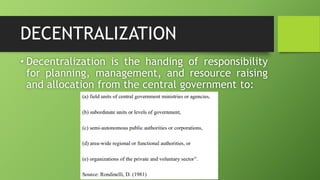
DECENTRALIZATION
• Decentralization is the handing of responsibility
for planning, management, and resource raising
and allocation from the central government to:
Decentralization reforms focus
on:
• The relationships between three major sectors of
governance, namely, the public sector, the
private sector, and the voluntary sector; and
• Within the public sector, decentralization focuses
on the structure and processes of decision making
and on resource and responsibility allocation
among different levels of government.
Factors helps to explain the differences between
various forms of administrative decentralization
• Production efficiency, that is the cost and quality
of services delivered
• Allocative efficiency, that is, the extent to which
the services delivered reflect local demand
• ‘Who delivers’ vs. ‘who pays’ for the services
which should be provided
Forms of decentralization
• Deconcentration: primary objective may be
improving the production efficiency of the
administration with an improvement in the impact of
the services delivered as a second priority.
• Introducing administrative and cultural changes
within the existing unitary structures, shifting
responsibility, decision-making authority and
resources for front-line operations only to the
managers of local units.
Forms of decentralization
• Delegation: separating the production or delivery
from the financing of a specific public service,
introducing a modification of the existing
structure of the public.
• Delegation can be used by any level of
government, and does not administration.
Forms of decentralization
• Partnership: a higher degree of decentralization,
can be aimed at by transferring the responsibility
for planning and delivery of services to CSOs.
Forms of decentralization
• If the central government is willing to give up a
direct hand in policy formulation and control it
may attempt to achieve the objectives of both
production and allocative efficiency by
transferring the ownership and/or control of the
public service’s assets to the private sector. In
this case, decentralization takes the form of
privatization.
Forms of decentralization
• Privatization also implies that the services are
allocated through the market system with the
consumer paying for the service being delivered
but government may still subsidize or tax certain
services to achieve its objectives
Decentralization and Governance
• Decentralization is about governance.
• Governance: ‘the complex of institutions and
organizations which regulate the life of society
• Governance: the act of governing’, that is to the way
institutions are established (for example how laws are
proposed and enacted) and to the way organizations
behave, manage their affairs and govern people
Governance
• It encompasses rules (formal and customary law,
regulations internal to organizations, moral
imperatives, contractual obligations, etc.) and
social aggregations (the family, church,
municipality, professional associations, political
parties, banks, commercial enterprises,
cooperatives, courts of law, government,
parliament).
Governance
• goals of society as stability, growth, equity,
justice, efficiency and the practice of those who
run the organizations
Decentralization and democratization
• Decentralization of the public administration, by
changing the assignment of responsibilities and
resources among different levels and agents of
government may be closely associated with the
process of political democratization.
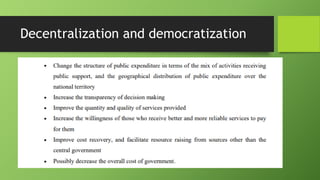
Decentralization and democratization
References
• Local Government Units in the Philippines;
• https://en.wikipedia.org/wiki/Local_government_in_the_P
hilippines
• Local Government Units in the Philippines;
http://www.chanrobles.com/legal1localgovernmentsmunici
palities.html#.XUruj_ZuK3A

Decentralization and local governance

  • 1.
  • 2.
    Topic Outline • Levelsof the Philippine Local Government • Autonomous Region • Province • City and Municipality • Barangay • Decentralization • Definition • Effect in governance
  • 4.
    Evolution of PhilippineLocal Government THEN NOW Cabeza De Barangay BARANGAY Kapitan Alkalde CITY Alkalde Alkalde Mayor PROVINCE Gobernador
  • 5.
    Criteria for Creation,Merger and Division Of Local Government LAND AREA POPULATION INCOME Province 2,000km2 250,000 Php 20 million Highly Urbanized City 100km2 200,000 Php 50 million Independent City 100km2 150,000 Php 100 million Component City 100km2 150,000 Php 100 million
  • 6.
    Local Government • Itpertains to the activity by which local officials, both elected and appointed, implement the goals and manage the resources of the local government unit
  • 7.
    Levels of thePhilippine Local Government Unit • Provinces and independent cities; component cities and municipalities; and barangays – these are the 3 partitions in the Philippine Local Government or what is commonly known as the Local Government Unit.
  • 8.
    Levels of thePhilippine Local Government Unit • Local government units are institutional units whose fiscal, legislative and executive authority extends over the smallest geographical areas distinguished for administrative and political purposes.
  • 9.
    Levels of thePhilippine Local Government Unit • Provinces and independent cities are systematized into national government regions but those are administrative regions and not separately administered areas with their own elected governments.
  • 11.
    Region A sub-national administrativeunit comprising of several provinces having more or less homogenous characteristics, such as ethnic origin of inhabitants, dialect spoken, agricultural produce, etc. http://nap.psa.gov.ph/activestats/psgc/articles/con_lgu WCJFEVMCVV
  • 12.
    Autonomous Region • Autonomousregions have more powers than other local governments. • The constitution limits the creation of autonomous regions to Muslim Mindanao and the Cordilleras but only one autonomous region exists: the Autonomous Region in Muslim Mindanao (ARMM).
  • 13.
    Autonomous Region • In2001, a plebiscite in the ARMM confirmed the previous composition of the autonomous region and added Basilan (except for the city of Isabela) and Marawi City in Lanao del Sur.
  • 14.
    Autonomous Region • Anautonomous region is governed by the regional governor and a legislature such as the ARMM Regional Legislative Assembly.
  • 15.
    Province The largest unitin the political structure of the Philippines. It consists, in varying numbers, of municipalities and, in some cases, of component cities. Its functions and duties in relation to its component cities and municipalities are generally coordinative and supervisory. Sanguniang Panlalawigan http://nap.psa.gov.ph/activestats/psgc/articles/con_lgu WCJFEVMCVV
  • 16.
    Province • Outside thelone autonomous region, the provinces are the highest-level local government. • The provinces are organized into component cities and municipalities. • A province is governed by the governor and a legislature known as the Sangguniang Panlalawigan.
  • 17.
    City http://nap.psa.gov.ph/activestats/psgc/articles/con_lgu WCJFEVMCVV There are threeclasses of cities in the Philippines: the highly urbanized, the independent component cities which are independent of the province, and the component cities which are part of the provinces where they are located and subject to their administrative supervision. Sanguniang Panlungsod
  • 18.
    Municipality Is a politicalcorporate body which is endowed with the facilities of a municipal corporation, exercised by and through the municipal government in conformity with law. It is a subsidiary of the province which consists of a number of barangays within its territorial boundaries, one of which is the seat of government found at the town proper (poblacion). Sanguniang Bayan http://nap.psa.gov.ph/activestats/psgc/articles/con_lgu WCJFEVMCVV
  • 19.
    Cities and Municipalities •Municipal government in the Philippines is separated into three – independent cities, component cities, and municipalities (most of the time referred to as towns). • Most cities in the country are "independent cities".
  • 20.
    Cities and Municipalities •Most cities in the country are "independent cities". • These cities are not ruled by a province, even though like Iloilo City, the provincial capital could be in the city.
  • 21.
    Cities and Municipalities •Municipalities are always a part of a province except for Pateros which was separated from Rizal to form Metro Manila. • Cities and municipalities are governed by mayors and legislatures, which are called the Sangguniang Panlungsod in cities and the Sangguniang Bayan in municipalities.
  • 22.
    Barangay The smallest politicalunit into which cities and municipalities in the Philippines are divided. It is the basic unit of the Philippine political system. It consists of less than 1,000 inhabitants residing within the territorial limit of a city or municipality and administered by a set of elective officials, headed by a barangay chairman (punong barangay). • Sanguniang Barangay • Sanguniang Kabataan http://nap.psa.gov.ph/activestats/psgc/articles/con_lgu WCJFEVMCVV
  • 23.
    Barangays • Barangays arethe division of every city and municipality in the country. It is the smallest of the Local Government Units, and can be even more divided into sitios and puroks but those divisions do not have leaders elected in formal elections held by the national government.
  • 24.
    Barangays • A barangay'sexecutive is the barangay captain or Punong Bantay and its administration is the Sangguniang Barangay, consists of barangay captain, the barangay kagawads (barangay councilors), and the SK chairman.
  • 25.
    Barangays • The SKchairman also leads a separate assembly for youth, the Sangguniang Kabataan or SK.
  • 26.
    Legislature • The oneswho review the ordinances and resolutions enacted by the legislatures below. Aside from regular and ex-officio members, the legislatures above the barangay level also have three sectoral representatives, one each from women, agricultural or industrial workers, and other sectors.
  • 27.
    Aims of theLocal Government Code 1991 Purpose: transform LGUs into self-reliant communities and active partners in nation building by giving them more powers, authority, responsibilities and resources • Hopes to achieve economic development at the regional and local levels by giving LCE more freedom in carrying out their programs that are suitable in their areas (RA7160)
  • 28.
    Agricultural extension Communitybased forestry Field health and hospital services Public works School building program Social welfare services Tourism Telecommunications Housing Others like investment support Devolved functions to LGUs
  • 29.
    Decentralization Push Post-Marcos Dictatorship/People Power Revolution Local Autonomy • “self-governing” • The granting of more powers, authority, responsibilities and resources by the national government to local government units in order to be self-reliant and active partners
  • 30.
    DECENTRALIZATION • transfer ofpower and authority from central institution to lower or local levels of a government system • According to Raul P . De Guzman, generally refers to the systematic and rational dispersal of power, authority and responsibility from the center to the periphery, from top to lower levels, or from national to local governments
  • 31.
    DECENTRALIZATION • Decentralization isthe handing of responsibility for planning, management, and resource raising and allocation from the central government to:
  • 32.
    Decentralization reforms focus on: •The relationships between three major sectors of governance, namely, the public sector, the private sector, and the voluntary sector; and • Within the public sector, decentralization focuses on the structure and processes of decision making and on resource and responsibility allocation among different levels of government.
  • 33.
    Factors helps toexplain the differences between various forms of administrative decentralization • Production efficiency, that is the cost and quality of services delivered • Allocative efficiency, that is, the extent to which the services delivered reflect local demand • ‘Who delivers’ vs. ‘who pays’ for the services which should be provided
  • 34.
    Forms of decentralization •Deconcentration: primary objective may be improving the production efficiency of the administration with an improvement in the impact of the services delivered as a second priority. • Introducing administrative and cultural changes within the existing unitary structures, shifting responsibility, decision-making authority and resources for front-line operations only to the managers of local units.
  • 35.
    Forms of decentralization •Delegation: separating the production or delivery from the financing of a specific public service, introducing a modification of the existing structure of the public. • Delegation can be used by any level of government, and does not administration.
  • 36.
    Forms of decentralization •Partnership: a higher degree of decentralization, can be aimed at by transferring the responsibility for planning and delivery of services to CSOs.
  • 37.
    Forms of decentralization •If the central government is willing to give up a direct hand in policy formulation and control it may attempt to achieve the objectives of both production and allocative efficiency by transferring the ownership and/or control of the public service’s assets to the private sector. In this case, decentralization takes the form of privatization.
  • 38.
    Forms of decentralization •Privatization also implies that the services are allocated through the market system with the consumer paying for the service being delivered but government may still subsidize or tax certain services to achieve its objectives
  • 40.
    Decentralization and Governance •Decentralization is about governance. • Governance: ‘the complex of institutions and organizations which regulate the life of society • Governance: the act of governing’, that is to the way institutions are established (for example how laws are proposed and enacted) and to the way organizations behave, manage their affairs and govern people
  • 41.
    Governance • It encompassesrules (formal and customary law, regulations internal to organizations, moral imperatives, contractual obligations, etc.) and social aggregations (the family, church, municipality, professional associations, political parties, banks, commercial enterprises, cooperatives, courts of law, government, parliament).
  • 42.
    Governance • goals ofsociety as stability, growth, equity, justice, efficiency and the practice of those who run the organizations
  • 43.
    Decentralization and democratization •Decentralization of the public administration, by changing the assignment of responsibilities and resources among different levels and agents of government may be closely associated with the process of political democratization.
  • 44.
  • 46.
    References • Local GovernmentUnits in the Philippines; • https://en.wikipedia.org/wiki/Local_government_in_the_P hilippines • Local Government Units in the Philippines; http://www.chanrobles.com/legal1localgovernmentsmunici palities.html#.XUruj_ZuK3A