Australian Politics
Doni Panorama
Prihan Dewi Aprilla
Siti Nursaripah
Politics of Australia


The politics of Australia take place
within the framework of a federal
constitutional parliamentary
democracy and constitutional
monarchy.
Australia's Political System


Australia's system of government is
based on the liberal democratic
tradition, which includes religious
tolerance and freedom of speech and
association. It's institutions and
practices reflect British and North
American models but are uniquely
Australian.
The Australian political
system consists of:
1.
2.
3.
4.

5.
6.
7.

The Parliamentary System
The Commonwealth Parliament
Governor-General
The Senate
The House Of Representatives
Executive Government
Federal Judicature
The Constitution


The Australian Constitution sets out
the rules and responsibilities of
government and outlines the powers
of its three branches - legislative,
executive and judicial.
Australia's Constitutional
Monarchy


Australia is known as a constitutional
monarchy. This means it is a country
that has a queen or king as its head of
state whose powers are limited by a
Constitution. Australia's head of state
is Queen Elizabeth II.
The Governor General and
State Governors




Under the Constitution, the GovernorGeneral's powers and duties include
summoning, proroguing and dissolving
Parliament, assenting to Bills, appointing
Ministers, setting up Departments of
State and appointing judges.
By convention, however, the GovernorGeneral acts only on the advice of
Ministers in virtually all matters and the
appointee to the office is selected on the
advice of the Government.
The Commonwealth or
National Government
The National Parliament is bicameral,
having two chambers: the House of
Representatives (Lower House) and
the Senate (Upper House).
 Both are responsible for national laws,
such as: trade, taxation, immigration,
citizenship, social security, industrial
relations
and
foreign
affairs.
Legislation has to be approved by
both houses before it can become law.

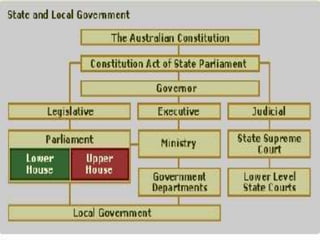
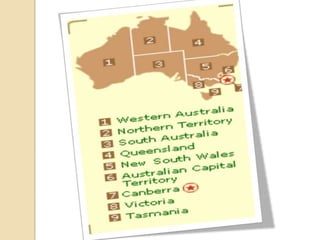
State and Territory
Governments
State and Territory Governments are
responsible for those powers not
administered by the Commonwealth
Government.
 State and Territory governments are
responsible for matters which include:
public health, education, roads, public
land use, police, fire and ambulance
services and local government within
their own States or Territories.

Local government


Local government responsibilities
typically include town planning,
supervision of building codes, local
roads, water, sewerage and drainage,
waste and sanitary services, and
community recreational facilities
Relations between levels of
Government
The Commonwealth and State
Governments co-operate in many
areas where States and Territories are
formally
responsible,
such
as
education, transport, health and law
enforcement.
 Income tax is levied federally, and
debate between the levels of
governments about access to revenue
is a perennial feature of Australian
politics.

australian politics
australian politics
australian politics

australian politics

  • 1.
    Australian Politics Doni Panorama PrihanDewi Aprilla Siti Nursaripah
  • 2.
    Politics of Australia  Thepolitics of Australia take place within the framework of a federal constitutional parliamentary democracy and constitutional monarchy.
  • 3.
    Australia's Political System  Australia'ssystem of government is based on the liberal democratic tradition, which includes religious tolerance and freedom of speech and association. It's institutions and practices reflect British and North American models but are uniquely Australian.
  • 4.
    The Australian political systemconsists of: 1. 2. 3. 4. 5. 6. 7. The Parliamentary System The Commonwealth Parliament Governor-General The Senate The House Of Representatives Executive Government Federal Judicature
  • 5.
    The Constitution  The AustralianConstitution sets out the rules and responsibilities of government and outlines the powers of its three branches - legislative, executive and judicial.
  • 6.
    Australia's Constitutional Monarchy  Australia isknown as a constitutional monarchy. This means it is a country that has a queen or king as its head of state whose powers are limited by a Constitution. Australia's head of state is Queen Elizabeth II.
  • 7.
    The Governor Generaland State Governors   Under the Constitution, the GovernorGeneral's powers and duties include summoning, proroguing and dissolving Parliament, assenting to Bills, appointing Ministers, setting up Departments of State and appointing judges. By convention, however, the GovernorGeneral acts only on the advice of Ministers in virtually all matters and the appointee to the office is selected on the advice of the Government.
  • 8.
    The Commonwealth or NationalGovernment The National Parliament is bicameral, having two chambers: the House of Representatives (Lower House) and the Senate (Upper House).  Both are responsible for national laws, such as: trade, taxation, immigration, citizenship, social security, industrial relations and foreign affairs. Legislation has to be approved by both houses before it can become law. 
  • 9.
    State and Territory Governments Stateand Territory Governments are responsible for those powers not administered by the Commonwealth Government.  State and Territory governments are responsible for matters which include: public health, education, roads, public land use, police, fire and ambulance services and local government within their own States or Territories. 
  • 10.
    Local government  Local governmentresponsibilities typically include town planning, supervision of building codes, local roads, water, sewerage and drainage, waste and sanitary services, and community recreational facilities
  • 11.
    Relations between levelsof Government The Commonwealth and State Governments co-operate in many areas where States and Territories are formally responsible, such as education, transport, health and law enforcement.  Income tax is levied federally, and debate between the levels of governments about access to revenue is a perennial feature of Australian politics. 