T HE  L EGISLATIVE  D EPARTMENT
Overview Congress : the  Legislative Branch  of government in the  Philippines Purpose ,  functions  and  structure  of Congress Constitutional mandates  with respect to Congress
The Legislative Branch From the Latin  lex, legis   meaning  law The legislative branch broadly deals with the  making ,  deliberation over ,  enactment ,  amendment  and  repealing  of laws
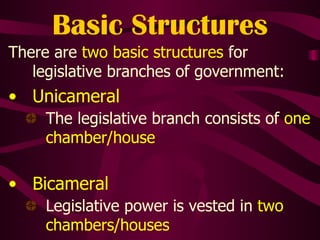
Basic Structures There are  two basic structures  for legislative branches of government: Unicameral The legislative branch consists of  one chamber/house Bicameral Legislative power is vested in  two chambers/houses
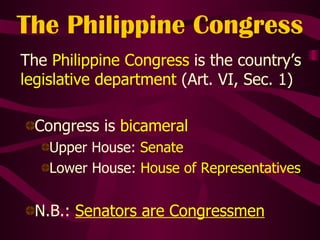
The Philippine Congress The  Philippine Congress  is the country’s  legislative department  (Art. VI, Sec. 1) Congress is  bicameral Upper House:  Senate Lower House:  House of Representatives N.B.:  Senators are Congressmen
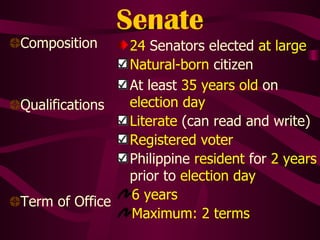
Senate Composition Qualifications Term of Office 24  Senators elected  at large Natural-born  citizen At least  35 years old  on  election day Literate  (can read and write) Registered voter Philippine  resident  for  2 years  prior to  election day 6 years  Maximum: 2 terms
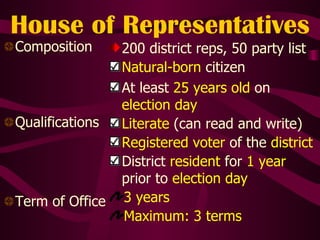
House of Representatives 200 district reps, 50 party list Natural-born  citizen At least  25 years old  on  election day Literate  (can read and write) Registered voter  of the  district District  resident  for  1 year  prior to  election day 3 years  Maximum: 3 terms Composition Qualifications Term of Office
In Case of Vacancy… Vacancy  can be filled through  regular election Special elections  can be called for the purpose of filling the vacancy In either circumstance, the one elected merely  sits  for the  unexpired term
Parliamentary Privileges Congressmen have  two parliamentary privileges  while Congress is  in session : Privilege from  arrest Immunity  from  offenses  punishable by not more than  six years imprisonment Privilege of  speech  and  debate Immunity  from  libel  and  slander
Transparency Elected Congressmen must: Fully  disclose  their  financial  and  business interests Disclose  potential  conflicts of interests  that arise in the course of  legislation Keep from  any  other office  or  employment  (appointed or otherwise),  forfeit  his/her  seat  to do so
Structure and Dynamics Senate President  and  House Speaker  elected by  majority vote Other officers ,  procedures  and the  discipline of its members  is at the  discretion  of each house Quorum:  Majority Each House maintains a  journal  and  record  of proceedings Neither House can  adjourn  without the other’s  consent  while in session
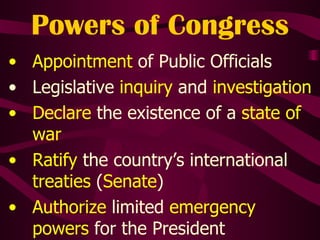
Powers of Congress Appointment  of Public Officials Legislative  inquiry  and  investigation Declare  the existence of a  state of war Ratify  the country’s international  treaties  ( Senate ) Authorize  limited  emergency powers  for the President
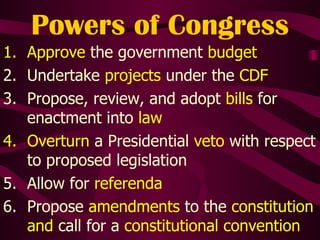
Powers of Congress Approve  the government  budget Undertake  projects  under the  CDF Propose, review, and adopt  bills  for enactment into  law Overturn  a Presidential  veto  with respect to proposed legislation Allow for  referenda Propose  amendments  to the  constitution and  call for a  constitutional convention
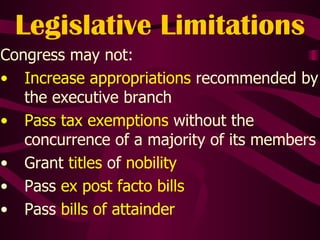
Legislative Limitations Congress may not: Increase appropriations  recommended by the executive branch Pass tax exemptions  without the concurrence of a majority of its members Grant  titles  of  nobility Pass  ex post facto bills Pass  bills of attainder
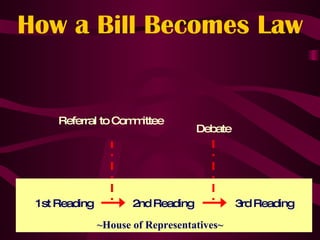
How a Bill Becomes Law ~House of Representatives~ 1st Reading 2nd Reading 3rd Reading Debate Referral to Committee
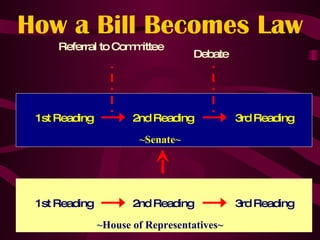
How a Bill Becomes Law Debate Referral to Committee ~House of Representatives~ 1st Reading 2nd Reading 3rd Reading ~Senate~ 1st Reading 2nd Reading 3rd Reading
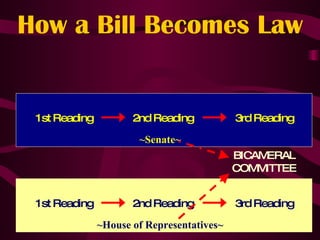
How a Bill Becomes Law ~House of Representatives~ 1st Reading 2nd Reading 3rd Reading ~Senate~ 1st Reading 2nd Reading 3rd Reading BICAMERAL COMMITTEE
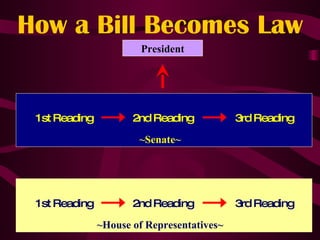
How a Bill Becomes Law ~House of Representatives~ 1st Reading 2nd Reading 3rd Reading ~Senate~ 1st Reading 2nd Reading 3rd Reading President
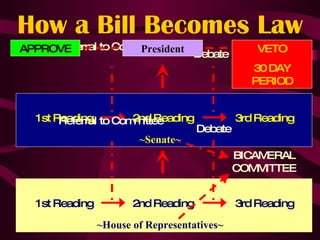
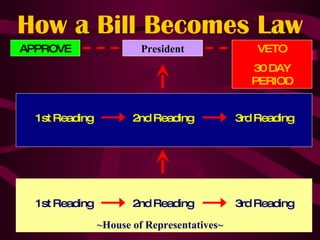
How a Bill Becomes Law ~House of Representatives~ 1st Reading 2nd Reading 3rd Reading 1st Reading 2nd Reading 3rd Reading President APPROVE VETO 30 DAY PERIOD
-end-

The Philippine Legislature

  • 1.
    T HE L EGISLATIVE D EPARTMENT
  • 2.
    Overview Congress :the Legislative Branch of government in the Philippines Purpose , functions and structure of Congress Constitutional mandates with respect to Congress
  • 3.
    The Legislative BranchFrom the Latin lex, legis meaning law The legislative branch broadly deals with the making , deliberation over , enactment , amendment and repealing of laws
  • 4.
    Basic Structures Thereare two basic structures for legislative branches of government: Unicameral The legislative branch consists of one chamber/house Bicameral Legislative power is vested in two chambers/houses
  • 5.
    The Philippine CongressThe Philippine Congress is the country’s legislative department (Art. VI, Sec. 1) Congress is bicameral Upper House: Senate Lower House: House of Representatives N.B.: Senators are Congressmen
  • 6.
    Senate Composition QualificationsTerm of Office 24 Senators elected at large Natural-born citizen At least 35 years old on election day Literate (can read and write) Registered voter Philippine resident for 2 years prior to election day 6 years Maximum: 2 terms
  • 7.
    House of Representatives200 district reps, 50 party list Natural-born citizen At least 25 years old on election day Literate (can read and write) Registered voter of the district District resident for 1 year prior to election day 3 years Maximum: 3 terms Composition Qualifications Term of Office
  • 8.
    In Case ofVacancy… Vacancy can be filled through regular election Special elections can be called for the purpose of filling the vacancy In either circumstance, the one elected merely sits for the unexpired term
  • 9.
    Parliamentary Privileges Congressmenhave two parliamentary privileges while Congress is in session : Privilege from arrest Immunity from offenses punishable by not more than six years imprisonment Privilege of speech and debate Immunity from libel and slander
  • 10.
    Transparency Elected Congressmenmust: Fully disclose their financial and business interests Disclose potential conflicts of interests that arise in the course of legislation Keep from any other office or employment (appointed or otherwise), forfeit his/her seat to do so
  • 11.
    Structure and DynamicsSenate President and House Speaker elected by majority vote Other officers , procedures and the discipline of its members is at the discretion of each house Quorum: Majority Each House maintains a journal and record of proceedings Neither House can adjourn without the other’s consent while in session
  • 12.
    Powers of CongressAppointment of Public Officials Legislative inquiry and investigation Declare the existence of a state of war Ratify the country’s international treaties ( Senate ) Authorize limited emergency powers for the President
  • 13.
    Powers of CongressApprove the government budget Undertake projects under the CDF Propose, review, and adopt bills for enactment into law Overturn a Presidential veto with respect to proposed legislation Allow for referenda Propose amendments to the constitution and call for a constitutional convention
  • 14.
    Legislative Limitations Congressmay not: Increase appropriations recommended by the executive branch Pass tax exemptions without the concurrence of a majority of its members Grant titles of nobility Pass ex post facto bills Pass bills of attainder
  • 15.
    How a BillBecomes Law ~House of Representatives~ 1st Reading 2nd Reading 3rd Reading Debate Referral to Committee
  • 16.
    How a BillBecomes Law Debate Referral to Committee ~House of Representatives~ 1st Reading 2nd Reading 3rd Reading ~Senate~ 1st Reading 2nd Reading 3rd Reading
  • 17.
    How a BillBecomes Law ~House of Representatives~ 1st Reading 2nd Reading 3rd Reading ~Senate~ 1st Reading 2nd Reading 3rd Reading BICAMERAL COMMITTEE
  • 18.
    How a BillBecomes Law ~House of Representatives~ 1st Reading 2nd Reading 3rd Reading ~Senate~ 1st Reading 2nd Reading 3rd Reading President
  • 19.
    How a BillBecomes Law ~House of Representatives~ 1st Reading 2nd Reading 3rd Reading 1st Reading 2nd Reading 3rd Reading President APPROVE VETO 30 DAY PERIOD
  • 20.

Editor's Notes

  • #2 Learning Objectives: 1.) To become familiar with the Philippine Congress as the legislative department of the Philippine government. 2.) To be able to identify the structure, function, powers and constituency of the Philippine Congress as stipulated in Article VI of the 1987 Philippine Constitution 3.) To understand key political concepts related to governance, especially with respect to legislative branches of government
  • #6 When we say Congress, we refer to both houses of the legislative branch of government in the Philippines. Congressmen in the Upper House are called Senators Congressmen in the Lower House are called Representatives
  • #7 Article VI, Sections 2-4. Many of these stipulations reaffirm Article II, Section 26. Note on Composition: Election at large = nationwide Age requirement on election day: stipulated so as to avoid ambiguity. It is important to remember that Ninoy Aquino ran into problems when he ran for Senator precisely because of the age requirement. Note on term of office: if a Senator resigns mid-term, it does not entitle him to say that his term was interrupted (i.e. it is still taken against his full term). This means that a Senator on his second term cannot resign before his term ends and claim that he is entitled to run for the same seat again
  • #8 Article VI, Sections 5-7 Legislative Districts (Art VI, Sec. 3) Based on size and contiguity of territory “ Uniform and progressive ratio” Population of 250,000 = 1 Representative Party List: To incorporate sectoral groups (civil society) Party list reps need not fulfill the residency requirement Party list groups: Labor, peasant, urban poor, youth, indigenous cultural communities, women, etc. No religious groups Youth groups are exempt from the age requirement
  • #9 Article VI, Section 9 Regular election: Example was May 11, 2001. The seat vacated by Guingona (?) had to be filled. Unexpired term Whoever is elected merely completes the term that was prematurely vacated. In a sense, therefore, this allows such persons to skirt the prohibitions as far as terms of office are concerned.
  • #10 Article VI, Section 11 These privileges are important to allow Congressmen to fulfill their functions without undue harassment. Note: the basic limitations are: 1.) In the case of immunity from arrest, congressmen are only immune so long as the offense in question is punishable by a prison sentence of six years or less. 2.) Immunity in both cases are guaranteed only while Congress is in session 3.) Immunity applies (especially with respect to the privilege of speech and debate) only when the Congressman is acting de officio
  • #11 Article VI, Sections 12-13
  • #12 Article VI, Section 16 Quorum: Minimum number of people for a meeting to be valid and binding. For Congress, majority is the basis, not majority of all members. The difference is that the former is more flexible (i.e. members who are out of the country or momentarily indisposed are not counted for quorum) A smaller number may meet to work out matters on a day-to-day basis
  • #13 1.) Article VI, Sections 17-19 (esp. 18) 2.) Investigations in aid of legislation: Article VI, Section 21 3.) Declaration of the existence of war and emergency powers: Article VI, Section 23 4.) Treaties: Article VII, Section 21 (The Executive Branch) 5.) Emergency Powers: Article VI, Section 23
  • #14 6.) Article VI, Sec. 24-5 7.) and 8.) Article VI, Sec. 27 9.) Article VI, Sec. 32 10.) Article XVII, Sections 1-2
  • #15 1.) Article VI, Sec. 25 2.) Article VI, Sec. 28 (4) 3.) Article VI, Sec. 31 4.) and 5.) Article III, Sec. 22
  • #16 Article VI, Sec. 27
  • #17 Article VI, Sec. 27
  • #18 Article VI, Sec. 27
  • #19 Article VI, Sec. 27
  • #20 Article VI, Sec. 27