The Philippine Government
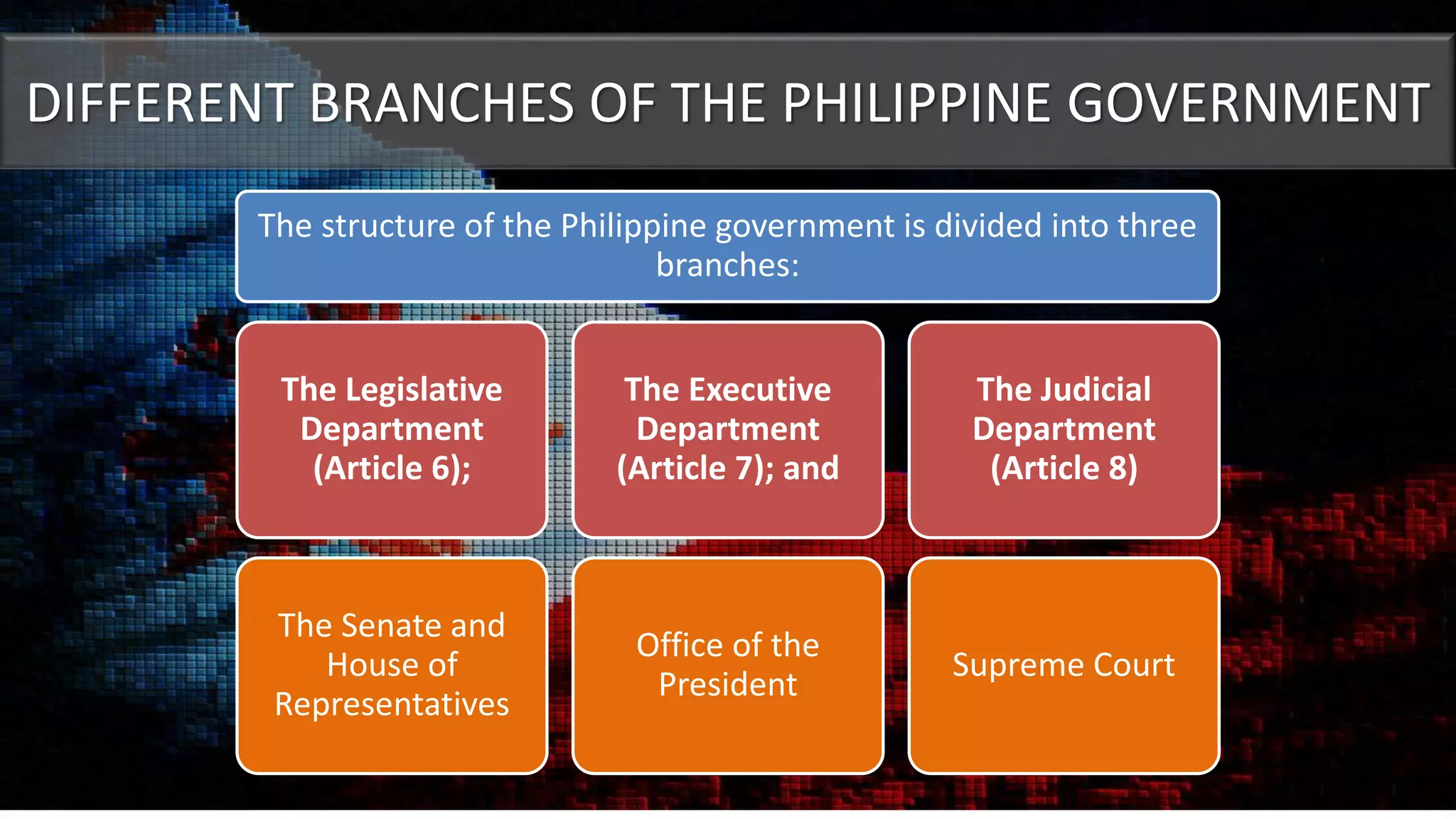
DIFFERENT BRANCHES OF THE PHILIPPINE GOVERNMENT
The structure of the Philippine government is divided into three
branches:
The Legislative
Department
(Article 6);
The Senate and
House of
Representatives
The Executive
Department
(Article 7); and
Office of the
President
The Judicial
Department
(Article 8)
Supreme Court
THE PRINCIPLE OF SEPARATION OF POWERS
• Under the principle of co-equal and coordinate powers
among the three (3) branches, the officers entrusted
with each of these powers are not permitted to
encroach upon the powers confided to the others.
PRINCIPLE OF CHECKS AND BALANCES
• The three co-equal departments are established by the
constitution in as balanced positions as possible.
• To maintain this balance or to restore it if upset, each
department is given certain powers with which to check
the others.
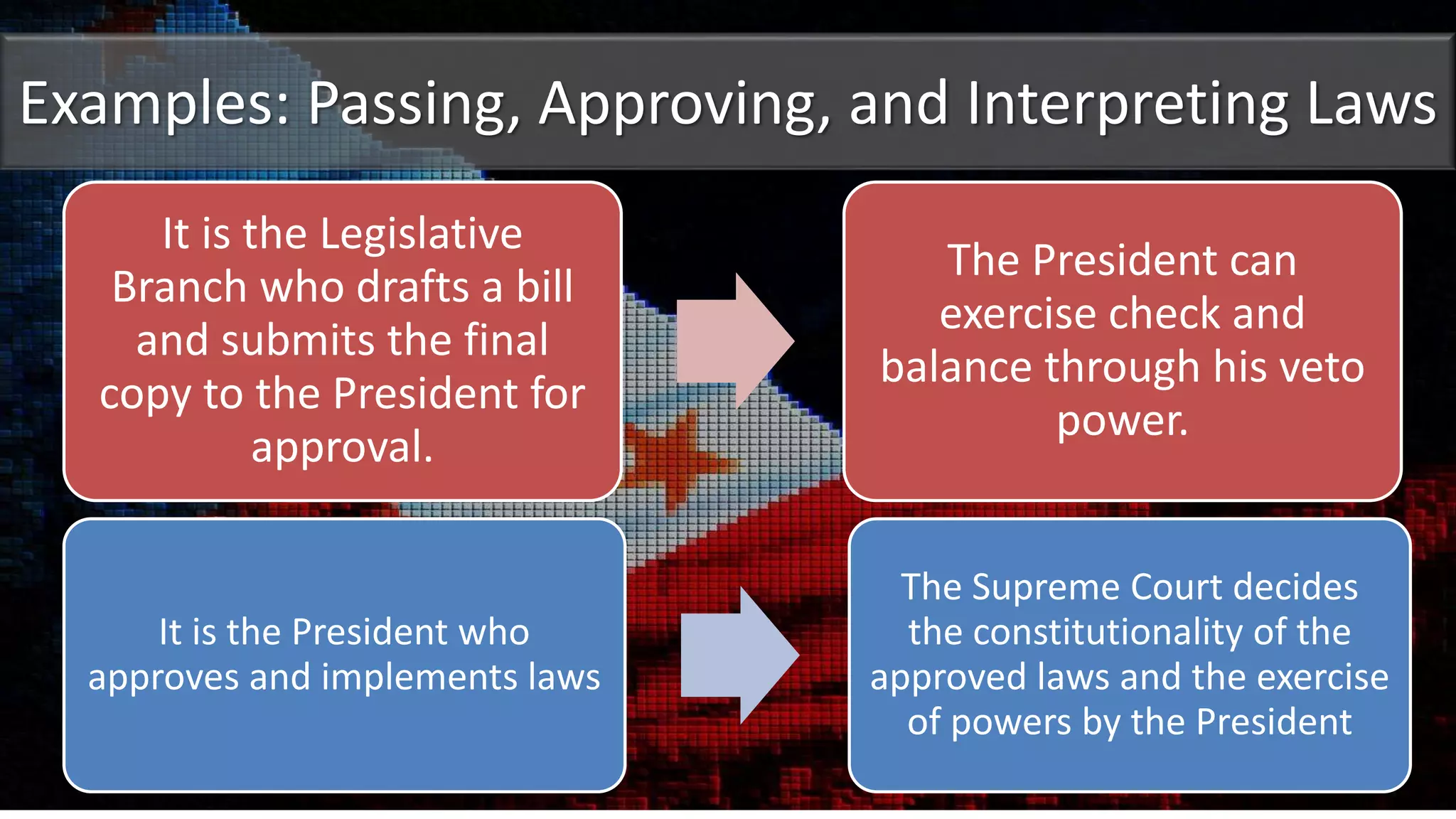
Examples: Passing, Approving, and Interpreting Laws
It is the Legislative
Branch who drafts a bill
and submits the final
copy to the President for
approval.
The President can
exercise check and
balance through his veto
power.
It is the President who
approves and implements laws
The Supreme Court decides
the constitutionality of the
approved laws and the exercise
of powers by the President
Point out what branch exercises checks and balances and
what branch is being checked.
• The farmers in Eastern Visayas rallied to the government on
March 14, 2014 that the subsidy for them must be released
for the agricultural sector in that region had been badly
affected by the Yolanda Typhoon. But according to
Department of Agriculture’s submitted report, it had already
distributed last February 15, 2014 the Php50 million budget
to the farmers of that region. As a response, the Senate
conducted an investigation to resolve the issue and
compelled the officials of DA to appear in the Senate for
questioning.
Point out what branch exercises checks and balances and
what branch is being checked.
• After lengthy debates and consultations about the
Reproductive Health Bill, the Legislative branch finally
submitted a copy to the President and he gave his
approval. However, the Supreme Court declared the
unconstitutionality of eight provisions in the
Reproductive Health Law and requested the legislative
branch for the amendment of such provisions.
Functions of the Three Branches of the Government
LEGISLATIVE BRANCH (Article 6)
• THE POWER TO ENACT LAWS
– The power to choose who shall become President in
case of tie (Section 4, par.4)
– The power to impose death penalty (Art. 3, Sec 19)
– The power to act as a constituent assembly (Art. XVII,
section 1)
– The power to declare the existence of war (Section 23)
– The power to impeach (Art. XI, Sec. 2)
IMPEACHMENT
• Defined as a method of national inquest into the
conduct of public men.
• PURPOSE OF IMPEACHMENT
• To protect the people from official delinquencies or
malfeasances.
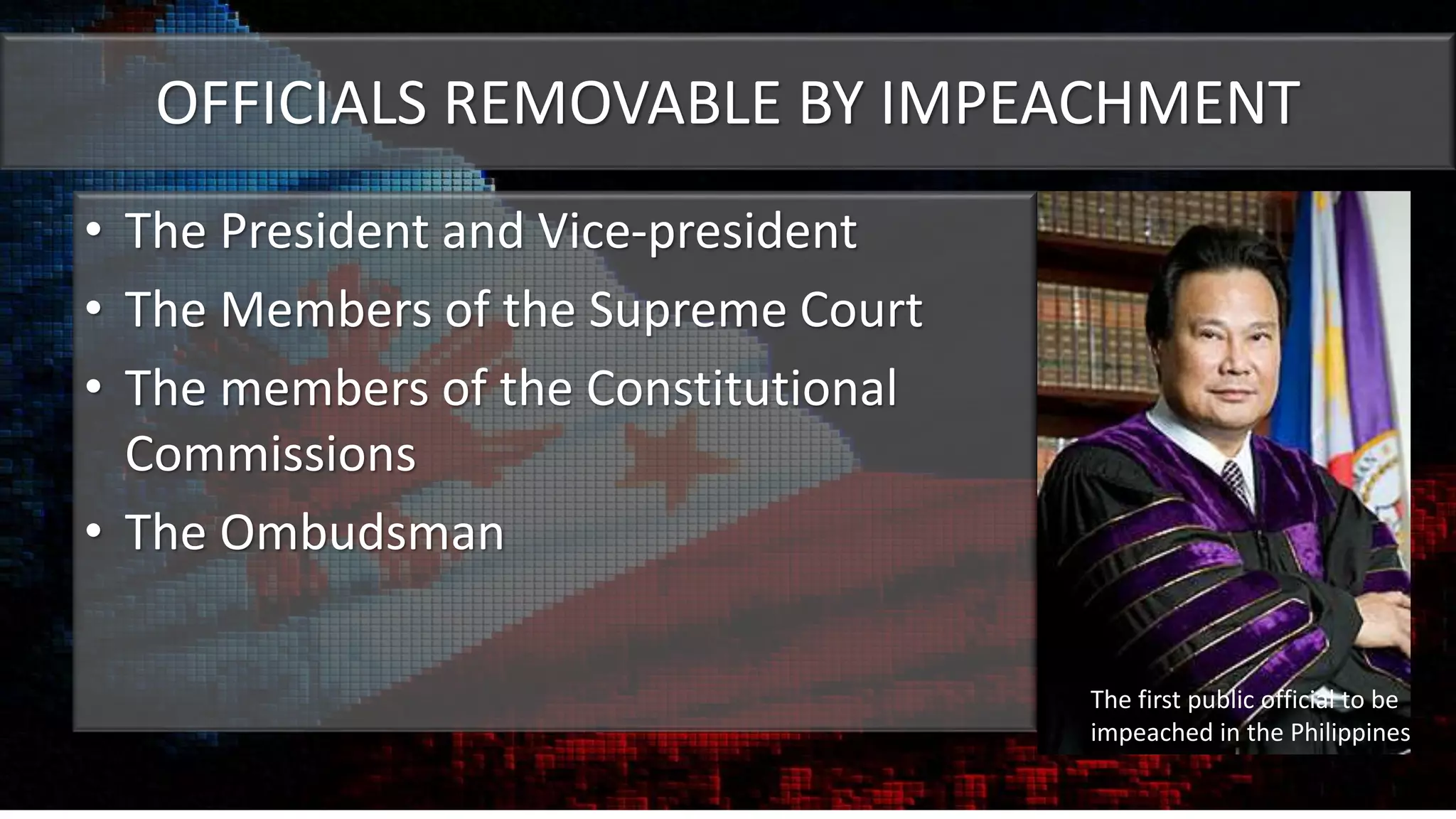
OFFICIALS REMOVABLE BY IMPEACHMENT
• The President and Vice-president
• The Members of the Supreme Court
• The members of the Constitutional
Commissions
• The Ombudsman
The first public official to be
impeached in the Philippines
GROUNDS FOR IMPEACHMENTS
• Culpable violation of the Constitution
• Treason
• Bribery
• Graft and Corruption
• Betrayal of Public Trust
• Other High Crimes
THE EXECUTIVE BRANCH - President (Article 7)
• THE POWER TO IMPLEMENT LAWS
• Administrative Power and control over the agencies of the
governments(Section 17)
• The power to appoint government officials (Section 16)
• The power to commute sentence, grant pardon, reprieve and
amnesty (Section 19)
• The power to declare martial law (Section 18)
• The power to veto a law
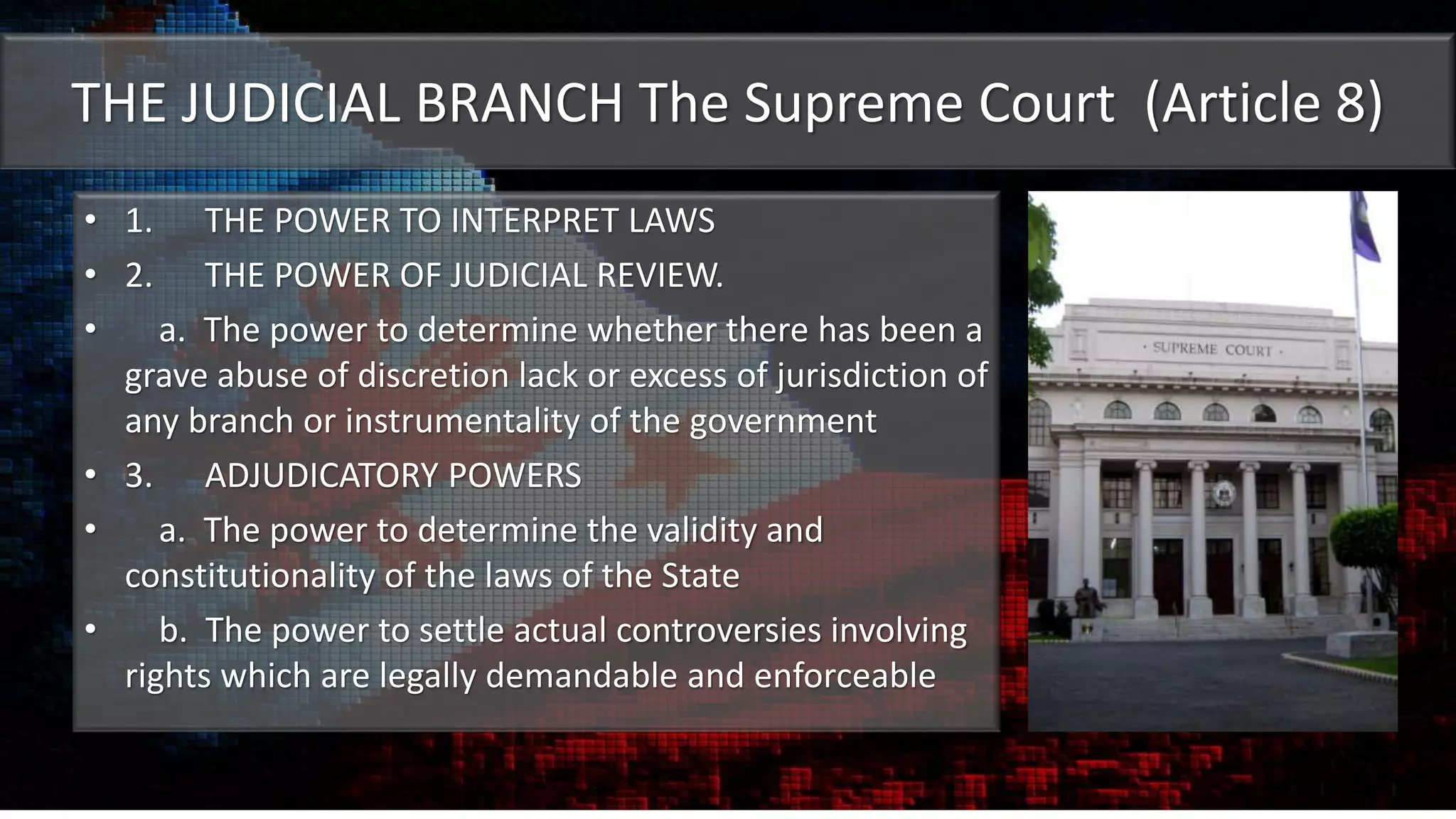
THE JUDICIAL BRANCH The Supreme Court (Article 8)
• 1. THE POWER TO INTERPRET LAWS
• 2. THE POWER OF JUDICIAL REVIEW.
• a. The power to determine whether there has been a
grave abuse of discretion lack or excess of jurisdiction of
any branch or instrumentality of the government
• 3. ADJUDICATORY POWERS
• a. The power to determine the validity and
constitutionality of the laws of the State
• b. The power to settle actual controversies involving
rights which are legally demandable and enforceable
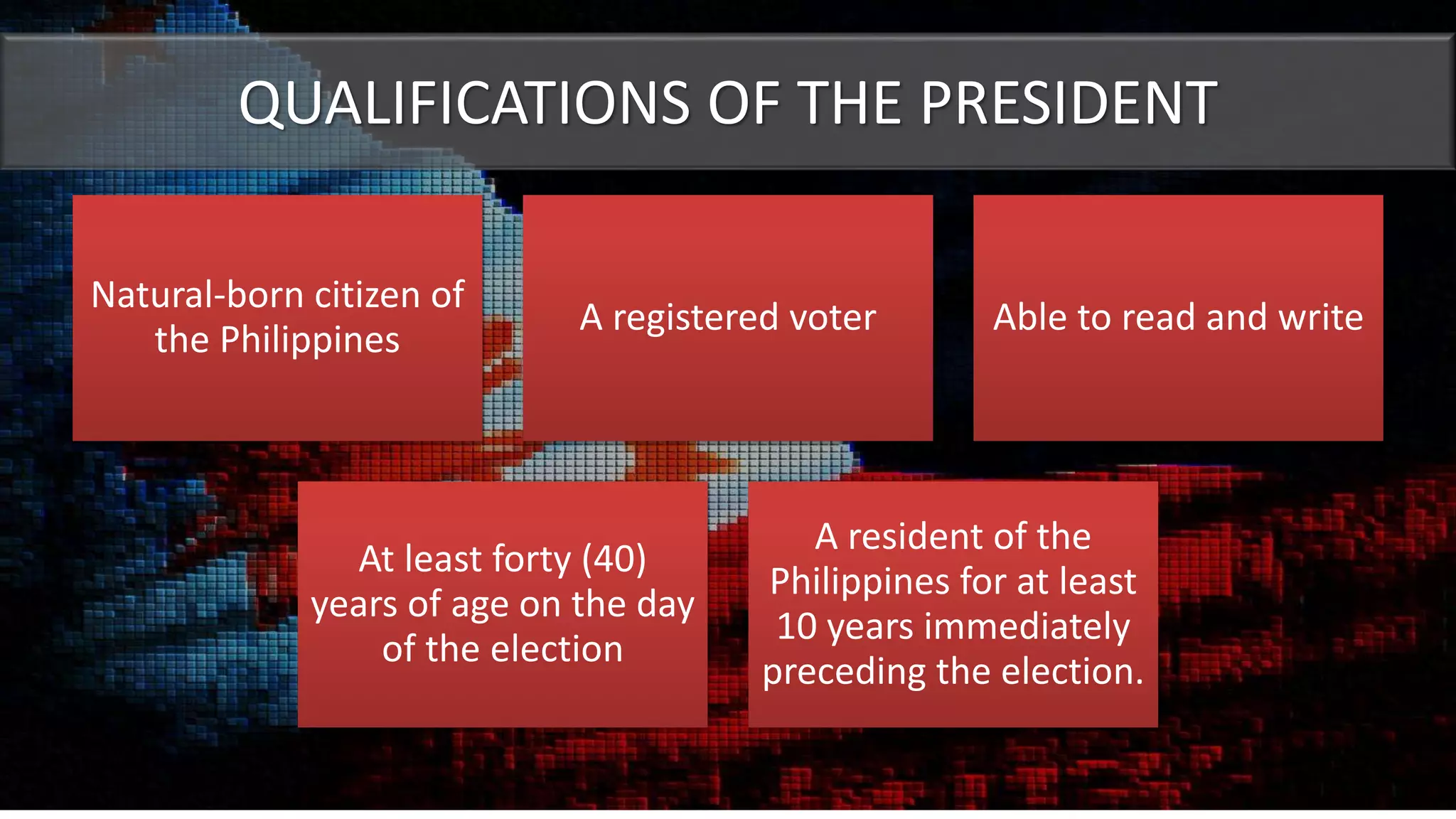
QUALIFICATIONS OF THE PRESIDENT
Natural-born citizen of
the Philippines
A registered voter Able to read and write
At least forty (40)
years of age on the day
of the election
A resident of the
Philippines for at least
10 years immediately
preceding the election.
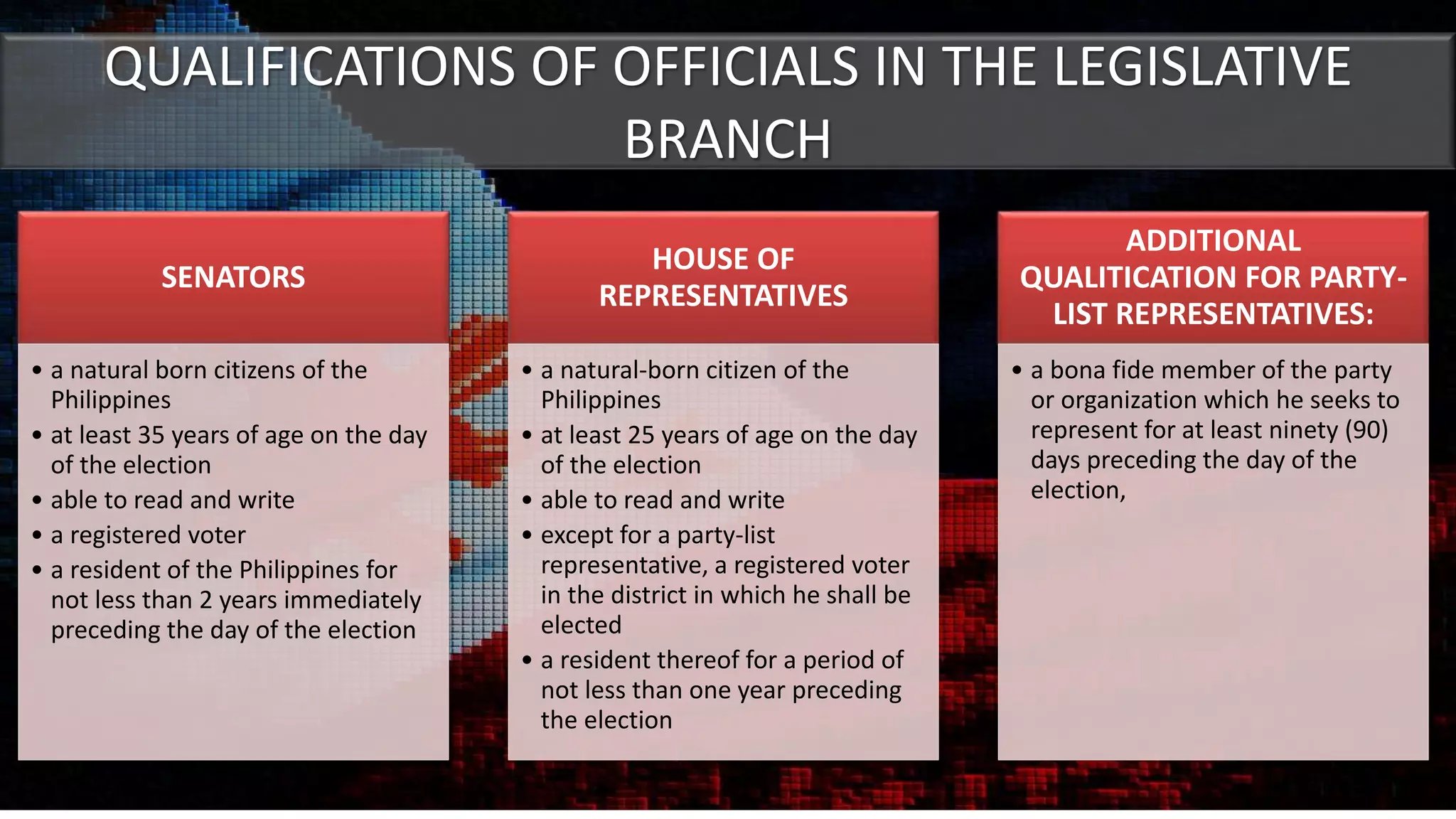
QUALIFICATIONS OF OFFICIALS IN THE LEGISLATIVE
BRANCH
SENATORS
• a natural born citizens of the
Philippines
• at least 35 years of age on the day
of the election
• able to read and write
• a registered voter
• a resident of the Philippines for
not less than 2 years immediately
preceding the day of the election
HOUSE OF
REPRESENTATIVES
• a natural-born citizen of the
Philippines
• at least 25 years of age on the day
of the election
• able to read and write
• except for a party-list
representative, a registered voter
in the district in which he shall be
elected
• a resident thereof for a period of
not less than one year preceding
the election
ADDITIONAL
QUALITICATION FOR PARTY-
LIST REPRESENTATIVES:
• a bona fide member of the party
or organization which he seeks to
represent for at least ninety (90)
days preceding the day of the
election,
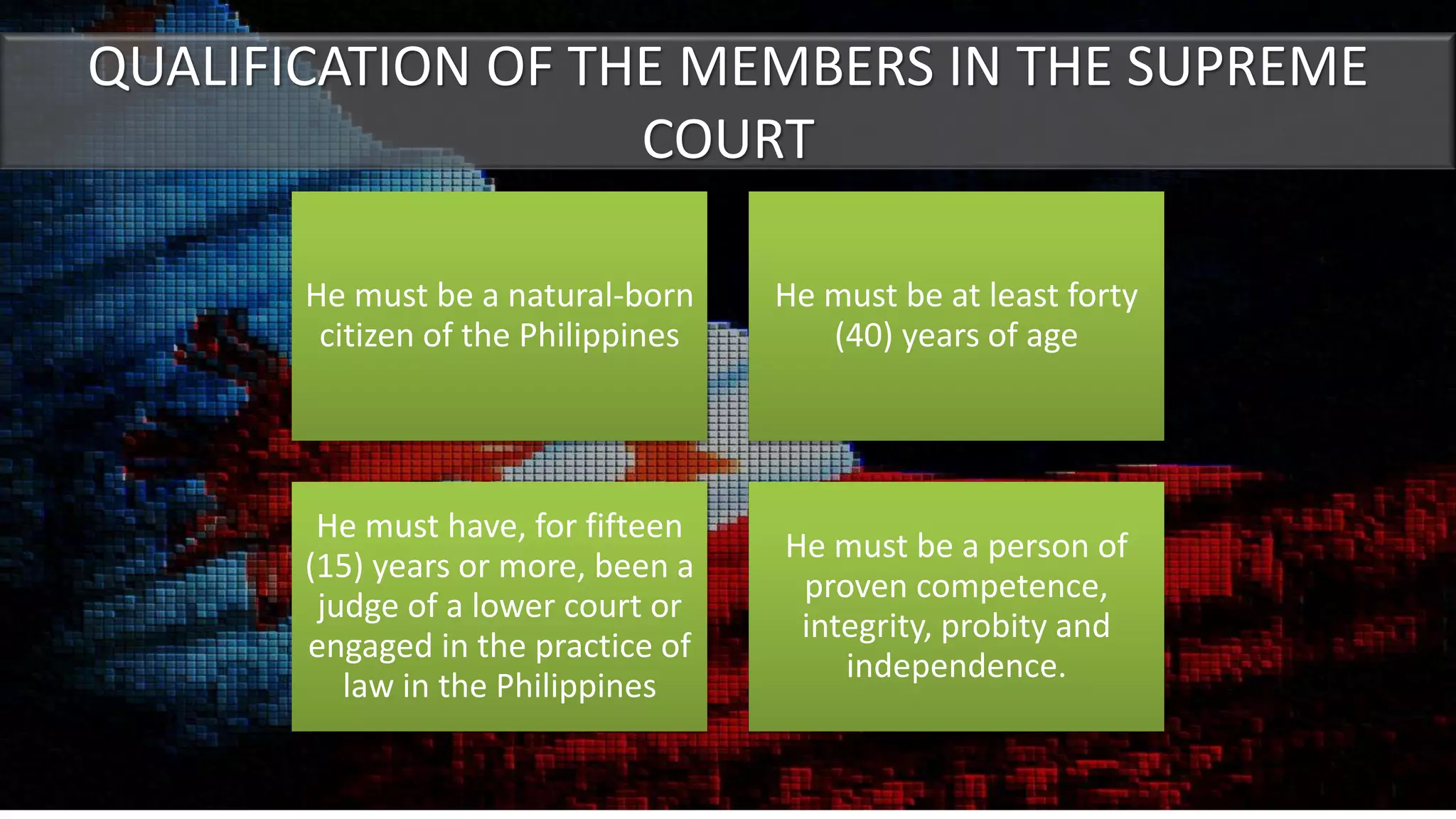
QUALIFICATION OF THE MEMBERS IN THE SUPREME
COURT
He must be a natural-born
citizen of the Philippines
He must be at least forty
(40) years of age
He must have, for fifteen
(15) years or more, been a
judge of a lower court or
engaged in the practice of
law in the Philippines
He must be a person of
proven competence,
integrity, probity and
independence.
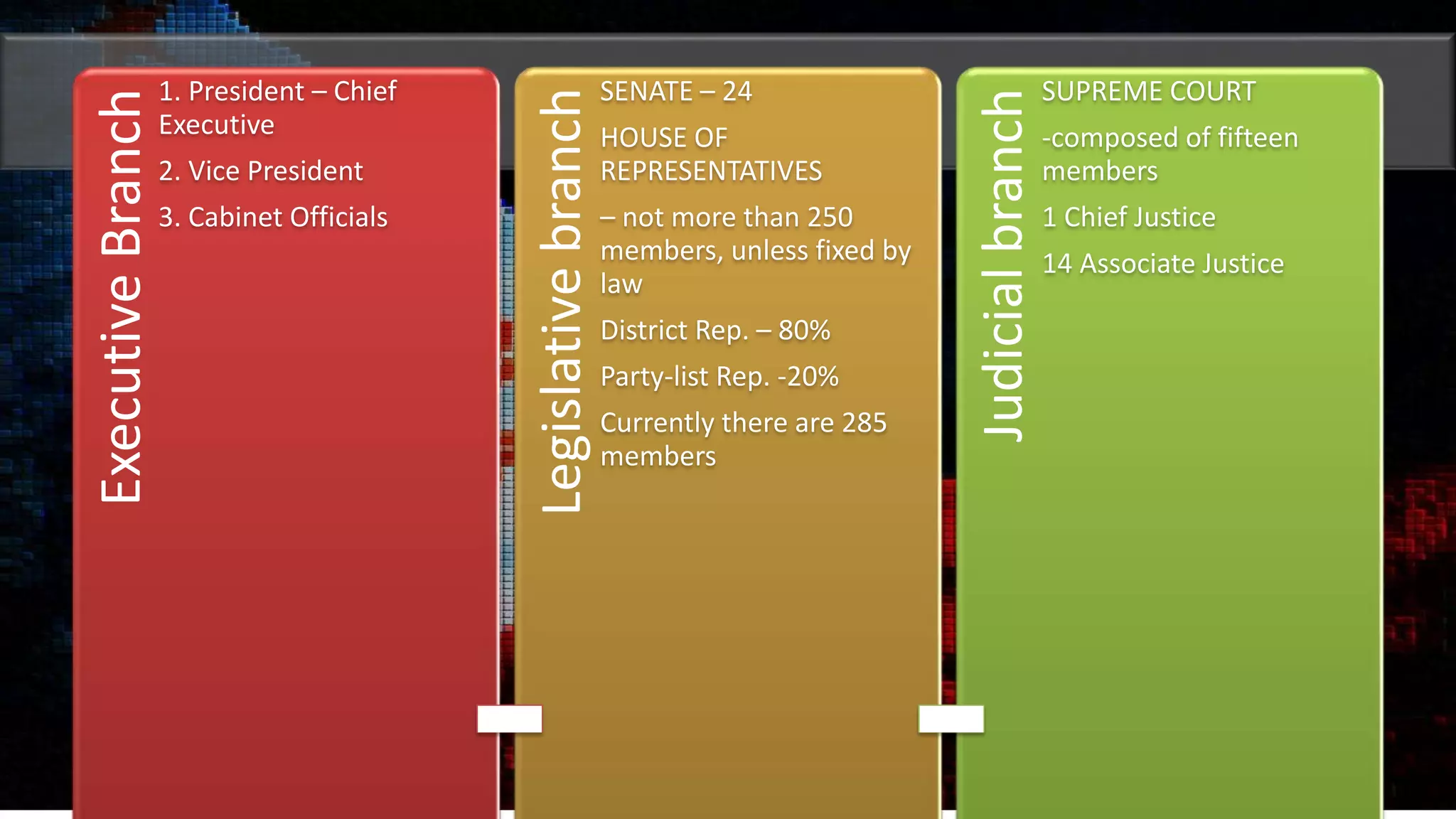
COMPOSITIONExecutiveBranch
1. President – Chief
Executive
2. Vice President
3. Cabinet Officials
Legislativebranch
SENATE – 24
HOUSE OF
REPRESENTATIVES
– not more than 250
members, unless fixed by
law
District Rep. – 80%
Party-list Rep. -20%
Currently there are 285
members
Judicialbranch
SUPREME COURT
-composed of fifteen
members
1 Chief Justice
14 Associate Justice
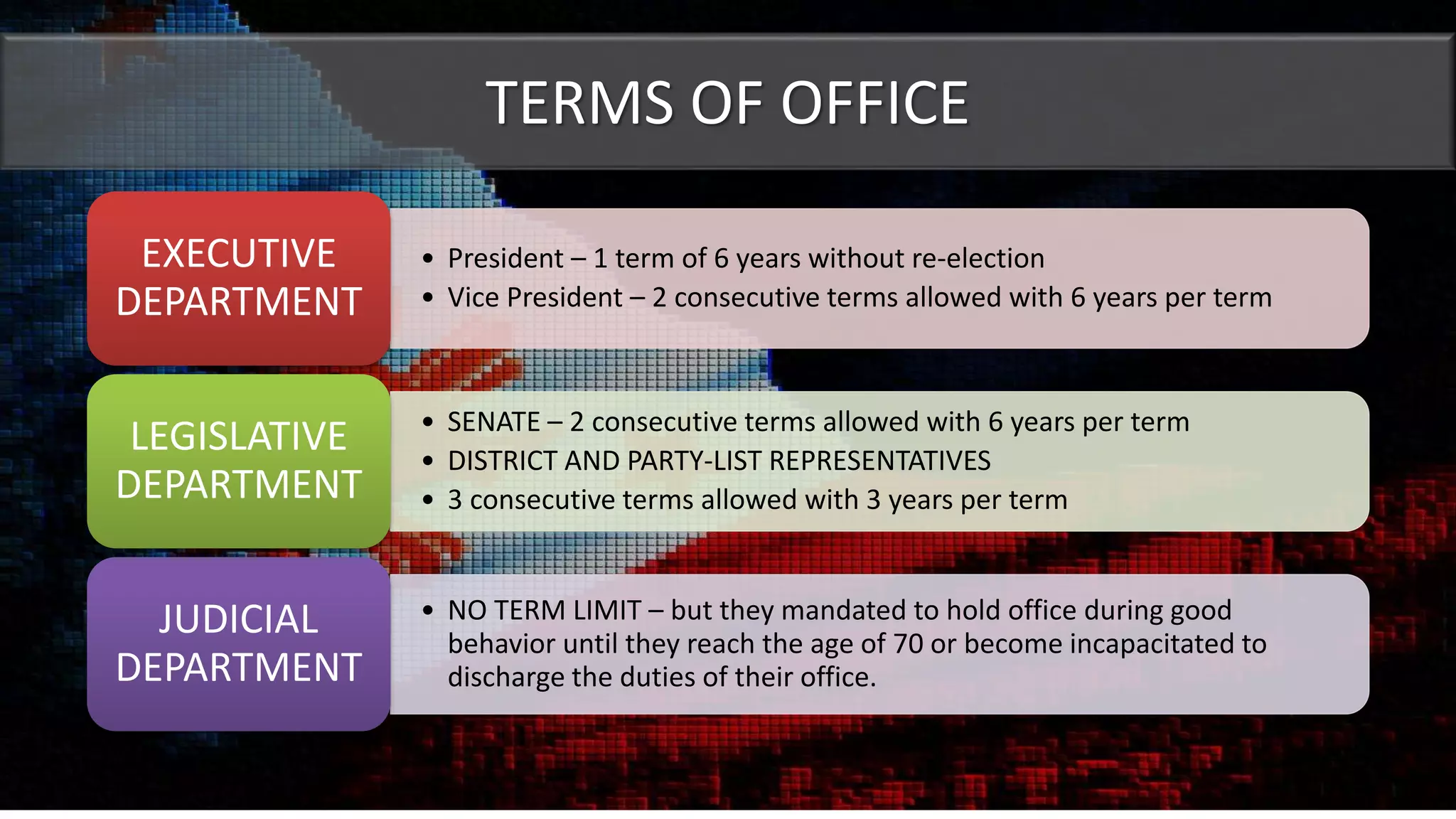
TERMS OF OFFICE
• President – 1 term of 6 years without re-election
• Vice President – 2 consecutive terms allowed with 6 years per term
EXECUTIVE
DEPARTMENT
• SENATE – 2 consecutive terms allowed with 6 years per term
• DISTRICT AND PARTY-LIST REPRESENTATIVES
• 3 consecutive terms allowed with 3 years per term
LEGISLATIVE
DEPARTMENT
• NO TERM LIMIT – but they mandated to hold office during good
behavior until they reach the age of 70 or become incapacitated to
discharge the duties of their office.
JUDICIAL
DEPARTMENT
END

Polsc2 10 branches of the goverment

  • 1.
  • 2.
    DIFFERENT BRANCHES OFTHE PHILIPPINE GOVERNMENT The structure of the Philippine government is divided into three branches: The Legislative Department (Article 6); The Senate and House of Representatives The Executive Department (Article 7); and Office of the President The Judicial Department (Article 8) Supreme Court
  • 3.
    THE PRINCIPLE OFSEPARATION OF POWERS • Under the principle of co-equal and coordinate powers among the three (3) branches, the officers entrusted with each of these powers are not permitted to encroach upon the powers confided to the others.
  • 4.
    PRINCIPLE OF CHECKSAND BALANCES • The three co-equal departments are established by the constitution in as balanced positions as possible. • To maintain this balance or to restore it if upset, each department is given certain powers with which to check the others.
  • 5.
    Examples: Passing, Approving,and Interpreting Laws It is the Legislative Branch who drafts a bill and submits the final copy to the President for approval. The President can exercise check and balance through his veto power. It is the President who approves and implements laws The Supreme Court decides the constitutionality of the approved laws and the exercise of powers by the President
  • 6.
    Point out whatbranch exercises checks and balances and what branch is being checked. • The farmers in Eastern Visayas rallied to the government on March 14, 2014 that the subsidy for them must be released for the agricultural sector in that region had been badly affected by the Yolanda Typhoon. But according to Department of Agriculture’s submitted report, it had already distributed last February 15, 2014 the Php50 million budget to the farmers of that region. As a response, the Senate conducted an investigation to resolve the issue and compelled the officials of DA to appear in the Senate for questioning.
  • 7.
    Point out whatbranch exercises checks and balances and what branch is being checked. • After lengthy debates and consultations about the Reproductive Health Bill, the Legislative branch finally submitted a copy to the President and he gave his approval. However, the Supreme Court declared the unconstitutionality of eight provisions in the Reproductive Health Law and requested the legislative branch for the amendment of such provisions.
  • 8.
    Functions of theThree Branches of the Government
  • 9.
    LEGISLATIVE BRANCH (Article6) • THE POWER TO ENACT LAWS – The power to choose who shall become President in case of tie (Section 4, par.4) – The power to impose death penalty (Art. 3, Sec 19) – The power to act as a constituent assembly (Art. XVII, section 1) – The power to declare the existence of war (Section 23) – The power to impeach (Art. XI, Sec. 2)
  • 10.
    IMPEACHMENT • Defined asa method of national inquest into the conduct of public men. • PURPOSE OF IMPEACHMENT • To protect the people from official delinquencies or malfeasances.
  • 11.
    OFFICIALS REMOVABLE BYIMPEACHMENT • The President and Vice-president • The Members of the Supreme Court • The members of the Constitutional Commissions • The Ombudsman The first public official to be impeached in the Philippines
  • 12.
    GROUNDS FOR IMPEACHMENTS •Culpable violation of the Constitution • Treason • Bribery • Graft and Corruption • Betrayal of Public Trust • Other High Crimes
  • 13.
    THE EXECUTIVE BRANCH- President (Article 7) • THE POWER TO IMPLEMENT LAWS • Administrative Power and control over the agencies of the governments(Section 17) • The power to appoint government officials (Section 16) • The power to commute sentence, grant pardon, reprieve and amnesty (Section 19) • The power to declare martial law (Section 18) • The power to veto a law
  • 14.
    THE JUDICIAL BRANCHThe Supreme Court (Article 8) • 1. THE POWER TO INTERPRET LAWS • 2. THE POWER OF JUDICIAL REVIEW. • a. The power to determine whether there has been a grave abuse of discretion lack or excess of jurisdiction of any branch or instrumentality of the government • 3. ADJUDICATORY POWERS • a. The power to determine the validity and constitutionality of the laws of the State • b. The power to settle actual controversies involving rights which are legally demandable and enforceable
  • 15.
    QUALIFICATIONS OF THEPRESIDENT Natural-born citizen of the Philippines A registered voter Able to read and write At least forty (40) years of age on the day of the election A resident of the Philippines for at least 10 years immediately preceding the election.
  • 16.
    QUALIFICATIONS OF OFFICIALSIN THE LEGISLATIVE BRANCH SENATORS • a natural born citizens of the Philippines • at least 35 years of age on the day of the election • able to read and write • a registered voter • a resident of the Philippines for not less than 2 years immediately preceding the day of the election HOUSE OF REPRESENTATIVES • a natural-born citizen of the Philippines • at least 25 years of age on the day of the election • able to read and write • except for a party-list representative, a registered voter in the district in which he shall be elected • a resident thereof for a period of not less than one year preceding the election ADDITIONAL QUALITICATION FOR PARTY- LIST REPRESENTATIVES: • a bona fide member of the party or organization which he seeks to represent for at least ninety (90) days preceding the day of the election,
  • 17.
    QUALIFICATION OF THEMEMBERS IN THE SUPREME COURT He must be a natural-born citizen of the Philippines He must be at least forty (40) years of age He must have, for fifteen (15) years or more, been a judge of a lower court or engaged in the practice of law in the Philippines He must be a person of proven competence, integrity, probity and independence.
  • 18.
    COMPOSITIONExecutiveBranch 1. President –Chief Executive 2. Vice President 3. Cabinet Officials Legislativebranch SENATE – 24 HOUSE OF REPRESENTATIVES – not more than 250 members, unless fixed by law District Rep. – 80% Party-list Rep. -20% Currently there are 285 members Judicialbranch SUPREME COURT -composed of fifteen members 1 Chief Justice 14 Associate Justice
  • 19.
    TERMS OF OFFICE •President – 1 term of 6 years without re-election • Vice President – 2 consecutive terms allowed with 6 years per term EXECUTIVE DEPARTMENT • SENATE – 2 consecutive terms allowed with 6 years per term • DISTRICT AND PARTY-LIST REPRESENTATIVES • 3 consecutive terms allowed with 3 years per term LEGISLATIVE DEPARTMENT • NO TERM LIMIT – but they mandated to hold office during good behavior until they reach the age of 70 or become incapacitated to discharge the duties of their office. JUDICIAL DEPARTMENT
  • 20.