Lesson 2 – Forms of
   Government
Forms of Government – Essential Questions

•   How can we classify governments?

•   How are systems of government defined in terms of who can
    participate?

•   How is power distributed within a state?

•   How are governments defined by the relationship between the
    legislative and executive branches?
Classifying Governments
     Governments can be classified by three different standards:

(1) Who can participate in the governing process.
(2) The geographic distribution of the governmental
  power within the state.
(3) The relationship between the legislative
    (lawmaking) and the executive (law-executing)
  branches of the government.
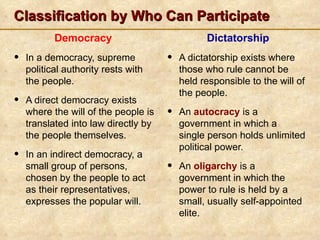
Classification by Who Can Participate
           Democracy                            Dictatorship
•   In a democracy, supreme           •   A dictatorship exists where
    political authority rests with        those who rule cannot be
    the people.                           held responsible to the will of
                                          the people.
•   A direct democracy exists
    where the will of the people is   •   An autocracy is a
    translated into law directly by       government in which a
    the people themselves.                single person holds unlimited
                                          political power.
•   In an indirect democracy, a
    small group of persons,           •   An oligarchy is a
    chosen by the people to act           government in which the
    as their representatives,             power to rule is held by a
    expresses the popular will.           small, usually self-appointed
                                          elite.
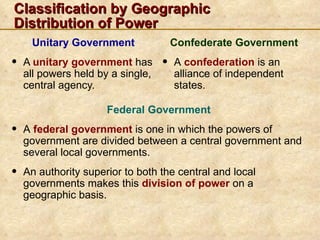
Classification by Geographic
Distribution of Power
     Unitary Government                Confederate Government
•   A unitary government has       •   A confederation is an
    all powers held by a single,       alliance of independent
    central agency.                    states.

                      Federal Government
•   A federal government is one in which the powers of
    government are divided between a central government and
    several local governments.
•   An authority superior to both the central and local
    governments makes this division of power on a
    geographic basis.
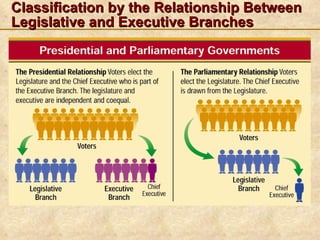
Classification by the Relationship Between
Legislative and Executive Branches
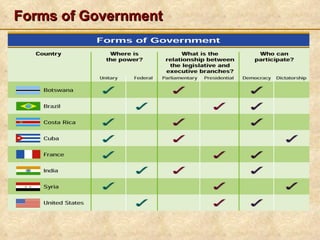
Forms of Government
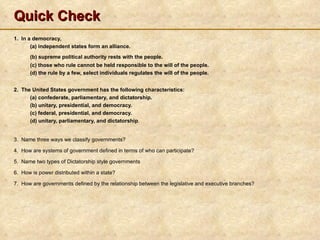
Quick Check
1. In a democracy,
       (a) independent states form an alliance.
      (b) supreme political authority rests with the people.
      (c) those who rule cannot be held responsible to the will of the people.
      (d) the rule by a few, select individuals regulates the will of the people.


2. The United States government has the following characteristics:
      (a) confederate, parliamentary, and dictatorship.
      (b) unitary, presidential, and democracy.
      (c) federal, presidential, and democracy.
      (d) unitary, parliamentary, and dictatorship.


3. Name three ways we classify governments?

4. How are systems of government defined in terms of who can participate?

5. Name two types of Dictatorship style governments

6. How is power distributed within a state?

7. How are governments defined by the relationship between the legislative and executive branches?

Convert to slide

  • 1.
    Lesson 2 –Forms of Government
  • 2.
    Forms of Government– Essential Questions • How can we classify governments? • How are systems of government defined in terms of who can participate? • How is power distributed within a state? • How are governments defined by the relationship between the legislative and executive branches?
  • 3.
    Classifying Governments Governments can be classified by three different standards: (1) Who can participate in the governing process. (2) The geographic distribution of the governmental power within the state. (3) The relationship between the legislative (lawmaking) and the executive (law-executing) branches of the government.
  • 4.
    Classification by WhoCan Participate Democracy Dictatorship • In a democracy, supreme • A dictatorship exists where political authority rests with those who rule cannot be the people. held responsible to the will of the people. • A direct democracy exists where the will of the people is • An autocracy is a translated into law directly by government in which a the people themselves. single person holds unlimited political power. • In an indirect democracy, a small group of persons, • An oligarchy is a chosen by the people to act government in which the as their representatives, power to rule is held by a expresses the popular will. small, usually self-appointed elite.
  • 5.
    Classification by Geographic Distributionof Power Unitary Government Confederate Government • A unitary government has • A confederation is an all powers held by a single, alliance of independent central agency. states. Federal Government • A federal government is one in which the powers of government are divided between a central government and several local governments. • An authority superior to both the central and local governments makes this division of power on a geographic basis.
  • 6.
    Classification by theRelationship Between Legislative and Executive Branches
  • 7.
  • 8.
    Quick Check 1. Ina democracy, (a) independent states form an alliance. (b) supreme political authority rests with the people. (c) those who rule cannot be held responsible to the will of the people. (d) the rule by a few, select individuals regulates the will of the people. 2. The United States government has the following characteristics: (a) confederate, parliamentary, and dictatorship. (b) unitary, presidential, and democracy. (c) federal, presidential, and democracy. (d) unitary, parliamentary, and dictatorship. 3. Name three ways we classify governments? 4. How are systems of government defined in terms of who can participate? 5. Name two types of Dictatorship style governments 6. How is power distributed within a state? 7. How are governments defined by the relationship between the legislative and executive branches?