ARTICLE 4
CITIZENSHIP
• Citizen is a person with full membership in
the body politic upon which rests the primary
responsibility of organizing and controlling the
nation. As such, a citizen enjoys full civil and
political rights and is accorded protection
inside and outside the territory of the state.
• Citizenship is the status of being a member of
a body politic, owing allegiance to and entitled
to reciprocal protection from its government.
• Nationality is a membership in any class or
form of political community.
CITIZENSHIP
It is a membership
in a political
community with all
its concomitant
rights and
responsibilities.
TWO METHODS OF
ACQUIRING
CITIZENSHIP
1. JUS SANGUINIS
2. JUS SOLI
Those
Citizens of
the
Philippines
at the time
of adoption
of this
Constitution
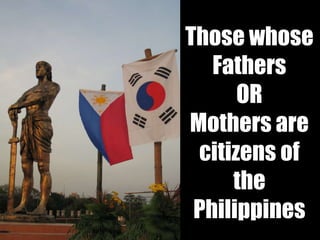
Those whose
Fathers
OR
Mothers are
citizens of
the
Philippines
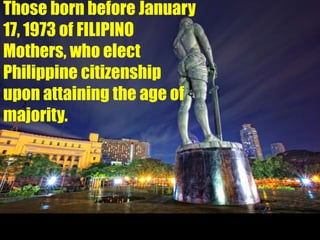
Those born before January
17, 1973 of FILIPINO
Mothers, who elect
Philippine citizenship
upon attaining the age of
majority.
Those who
are
naturalized
in
accordance
with law.
• SUFFRAGE – is not a natural right of the citizens
but merely a privilege to be given or withheld by
the lawmaking power subject to constitutional
limitations.
• SCOPE OF SUFFRAGE
– ELECTION – it is the expression of the sovereign power
of the people
– PLEBISCITE a vote of the people expressing their
choice for or against a proposed law or enactment
submitted to them
– REFERENDUM – the power of the electorate to
approve or reject a legislation through an election
called for that purpose
• REFERENDUM ON STATUTE
• REFERENDUM ON LOCAL LAW
• INITIATIVE – the power of the people to propose
amendment to the constitution or to propose
and enact legislations through an election called
for that purpose.
TYPES OF INITIATIVE
A) INITIATIVE FOR THE CONSTITUTION
B) INITIATION ON STATUTE
C) INITIATIVE ON LOCAL LEGISLATION
RECALL – the method by which a public officer may be
removed from office during his tenure or before the
expiration of his term by a vote of the people after
registration of a petition signed by a required
percentage of the qualified voters.

ARTICLE 4 CITIZENSHIP AND ARTICLE 5 SUFFRAGE

  • 1.
  • 2.
    • Citizen isa person with full membership in the body politic upon which rests the primary responsibility of organizing and controlling the nation. As such, a citizen enjoys full civil and political rights and is accorded protection inside and outside the territory of the state. • Citizenship is the status of being a member of a body politic, owing allegiance to and entitled to reciprocal protection from its government. • Nationality is a membership in any class or form of political community.
  • 3.
    CITIZENSHIP It is amembership in a political community with all its concomitant rights and responsibilities.
  • 4.
    TWO METHODS OF ACQUIRING CITIZENSHIP 1.JUS SANGUINIS 2. JUS SOLI
  • 5.
    Those Citizens of the Philippines at thetime of adoption of this Constitution
  • 6.
  • 7.
    Those born beforeJanuary 17, 1973 of FILIPINO Mothers, who elect Philippine citizenship upon attaining the age of majority.
  • 8.
  • 9.
    • SUFFRAGE –is not a natural right of the citizens but merely a privilege to be given or withheld by the lawmaking power subject to constitutional limitations. • SCOPE OF SUFFRAGE – ELECTION – it is the expression of the sovereign power of the people – PLEBISCITE a vote of the people expressing their choice for or against a proposed law or enactment submitted to them – REFERENDUM – the power of the electorate to approve or reject a legislation through an election called for that purpose • REFERENDUM ON STATUTE • REFERENDUM ON LOCAL LAW
  • 10.
    • INITIATIVE –the power of the people to propose amendment to the constitution or to propose and enact legislations through an election called for that purpose. TYPES OF INITIATIVE A) INITIATIVE FOR THE CONSTITUTION B) INITIATION ON STATUTE C) INITIATIVE ON LOCAL LEGISLATION RECALL – the method by which a public officer may be removed from office during his tenure or before the expiration of his term by a vote of the people after registration of a petition signed by a required percentage of the qualified voters.