
Forms Of Government 
Major Forms Of Government : 
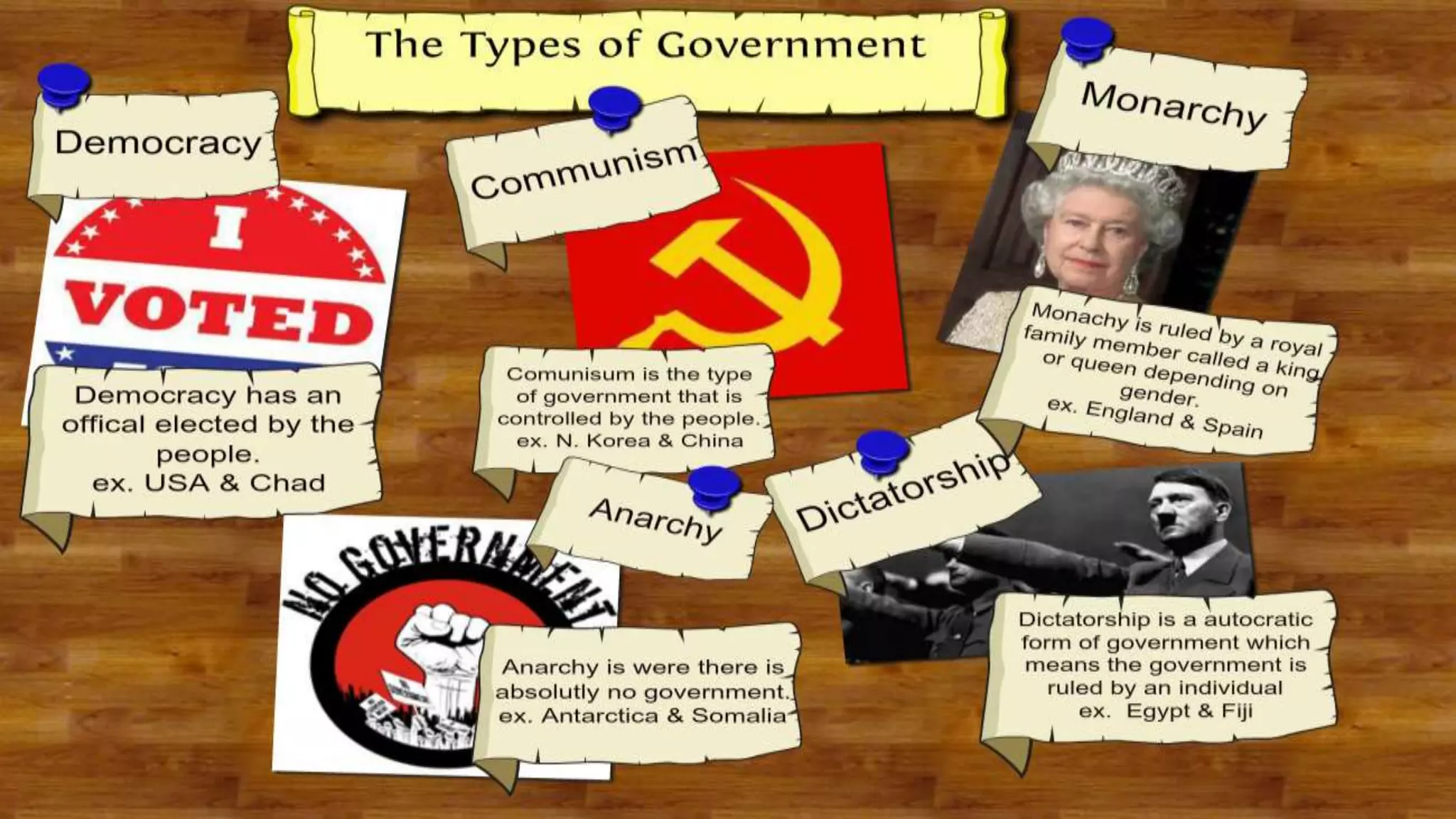
 Monarchy: A monarchy consists of rule by a king or queen. There are 
no large monarchies today. The United Kingdom, which has a queen, is 
really a republic because the queen has virtually no political power. 
 Aristocracy: An aristocracy is rule by the aristocrats. Aristocrats 
are typically wealthy, educated people. Today, typically, the term 
"aristocracy" is used negatively to accuse a republic of being 
dominated by rich people, such as saying, "The United States has 
become an aristocracy."
 Republic: A literal democracy is impossible in a political system 
containing more than a few people. All "democracies" are really 
republics. In a republic, the people elect representatives to make and 
enforce laws. 
 Dictatorship: A dictatorship consists of rule by one person or a 
group of people. The dictator may be one person, such as Castro in 
Cuba or Hitler in Germany, or a group of people, such as the 
Communist Party in China. 
 Democracy: The word "democracy" literally means "rule by the 
people." In a democracy, the people govern. The government is 
elected by the people. Everyone who is eligible to vote has a chance 
to have their say over who runs the country.
 Democratic Republic: Usually, a "democratic republic" is not a 
democratic neither is a republic. 
 A government that officially calls itself a "democratic republic" is 
usually a dictatorship. Communist dictatorships have been especially 
prone to use this term. For example, the official name of North 
Vietnam was "The Democratic Republic of Vietnam." China uses a 
variant, "The People's Republic of China."
Unitary And Federal 
 In the unitary system all the powers of government are concentrated 
in a single set of authorities, so that the entire force of the 
government can be brought to bear upon the problem of 
administration. Now-a-days unitary government is seen in United 
Kingdom, Japan, Belgium, Holland, France and Italy. 
Advantages : 
 Strong government. 
 Uniformity of law and administration. 
 Single citizenship. 
 Less expensive.
Disadvantages: 
 The central government becomes overburdened with work. 
 Not suited to a state of large size. 
 Apprehension of the central government becoming despotic. 
Federal : 
 A federal government is a system of government in which powers are divided 
and distributed between the national government and constituent units 
(states, provinces, republics, regions or cantons). Like- Venezuela, Mexico, 
Argentina, India and Pakistan. 
Advantages : 
 Division of powers between the centre and states leads to administrative 
efficiency. 
 Good for economic and cultural progress.
 Distribution of powers checks the despotism of the central 
government. 
Disadvantages : 
 Lack of uniformity in administration. 
 Constitution, being rigid, cannot be adjusted to the fast changing conditions. 
 Distribution of powers leads to many conflicts. 
Confederation : 
 Federations should not be confused with confederations which are 
essentially alliances between several sovereign states to agree to 
adopt certain similar procedures and policies. The European Union is 
at the moment a confederation. If it set up a central executive with 
some sovereign powers over member states, it would become a 
federation.
Parliamentary and Presidential 
 Based on the relationship between the executive and the legislature modern 
governments are classified into parliamentary and presidential governments. 
 Parliamentary government: is that form of government in which the real 
executive, consisting of the Council of Ministers headed by the Prime 
Minister is collectively responsible for all it’s acts before the 
legislature.(India And U.K) 
Advantages : 
 Harmony Between Legislature and Executive. 
 Executive works as a responsible Executive. 
 Executive cannot be come despotic.
Disadvantages : 
 Executive is weak because its tenure is not fixed. 
 Minister’s are not appointed on merit. 
 Executive Dominates the legislature. 
Presidential : 
 When there is a separation of powers between the legislature and the 
executive and the latter is not responsible before the former, the 
executive is termed as presidential executive and the system of 
government is called Presidential system. 
 In such a system, the head of the state (President) is also the head of 
government and he is his own Prime Minister.(U.S.A) 
Advantages : 
 Stability of government.
 Strong Government. 
 Executive is free from aggressive party politics. 
 Minister’s are experts. 
Disadvantages: 
 A single person (President) enjoy very powerful position. 
 President can use his powers in an arbitrary way. 
 Executive cannot be easily changed.
Unicameral And Bicameral Legislature 
 Unicameral: stands for a legislature with a single house. Most of the 
states, usually small states, have unicameral legislature.(Zimbabwe, 
Turkey, Portugal) 
 In India, some states of the Union have bicameral legislature whereas 
other have unicameral legislature.( Uttar Prades, Maharashtra, Bihar, 
Karnataka, Jammu and Kashmir, Andhra Pradesh have bicameral 
legislature.) 
 Bicameral: stands for legislature with two houses. A large numbers of 
modern legislature, particularly big states, have bicameral 
legislature.(Canada, Germany, U.S.A and India )
Arguments in favor of Unicameral legislature: 
 Two chambers confuse public opinion. 
 Second Chamber is either mischievous or superfluous. 
 Delay in legislation. 
 Increased expenditure. 
Arguments in Favor of Bicameral legislature: 
 Second chamber lessen the burden of first chamber. 
 Second chamber is essential for preventing hasty and ill-considered 
legislation. 
 Two houses better represents public opinion. 
 Essential for a federation.
Political Science - Types of Goverment

Political Science - Types of Goverment

  • 2.
    Forms Of Government Major Forms Of Government :  Monarchy: A monarchy consists of rule by a king or queen. There are no large monarchies today. The United Kingdom, which has a queen, is really a republic because the queen has virtually no political power.  Aristocracy: An aristocracy is rule by the aristocrats. Aristocrats are typically wealthy, educated people. Today, typically, the term "aristocracy" is used negatively to accuse a republic of being dominated by rich people, such as saying, "The United States has become an aristocracy."
  • 3.
     Republic: Aliteral democracy is impossible in a political system containing more than a few people. All "democracies" are really republics. In a republic, the people elect representatives to make and enforce laws.  Dictatorship: A dictatorship consists of rule by one person or a group of people. The dictator may be one person, such as Castro in Cuba or Hitler in Germany, or a group of people, such as the Communist Party in China.  Democracy: The word "democracy" literally means "rule by the people." In a democracy, the people govern. The government is elected by the people. Everyone who is eligible to vote has a chance to have their say over who runs the country.
  • 4.
     Democratic Republic:Usually, a "democratic republic" is not a democratic neither is a republic.  A government that officially calls itself a "democratic republic" is usually a dictatorship. Communist dictatorships have been especially prone to use this term. For example, the official name of North Vietnam was "The Democratic Republic of Vietnam." China uses a variant, "The People's Republic of China."
  • 5.
    Unitary And Federal  In the unitary system all the powers of government are concentrated in a single set of authorities, so that the entire force of the government can be brought to bear upon the problem of administration. Now-a-days unitary government is seen in United Kingdom, Japan, Belgium, Holland, France and Italy. Advantages :  Strong government.  Uniformity of law and administration.  Single citizenship.  Less expensive.
  • 6.
    Disadvantages:  Thecentral government becomes overburdened with work.  Not suited to a state of large size.  Apprehension of the central government becoming despotic. Federal :  A federal government is a system of government in which powers are divided and distributed between the national government and constituent units (states, provinces, republics, regions or cantons). Like- Venezuela, Mexico, Argentina, India and Pakistan. Advantages :  Division of powers between the centre and states leads to administrative efficiency.  Good for economic and cultural progress.
  • 7.
     Distribution ofpowers checks the despotism of the central government. Disadvantages :  Lack of uniformity in administration.  Constitution, being rigid, cannot be adjusted to the fast changing conditions.  Distribution of powers leads to many conflicts. Confederation :  Federations should not be confused with confederations which are essentially alliances between several sovereign states to agree to adopt certain similar procedures and policies. The European Union is at the moment a confederation. If it set up a central executive with some sovereign powers over member states, it would become a federation.
  • 8.
    Parliamentary and Presidential  Based on the relationship between the executive and the legislature modern governments are classified into parliamentary and presidential governments.  Parliamentary government: is that form of government in which the real executive, consisting of the Council of Ministers headed by the Prime Minister is collectively responsible for all it’s acts before the legislature.(India And U.K) Advantages :  Harmony Between Legislature and Executive.  Executive works as a responsible Executive.  Executive cannot be come despotic.
  • 9.
    Disadvantages : Executive is weak because its tenure is not fixed.  Minister’s are not appointed on merit.  Executive Dominates the legislature. Presidential :  When there is a separation of powers between the legislature and the executive and the latter is not responsible before the former, the executive is termed as presidential executive and the system of government is called Presidential system.  In such a system, the head of the state (President) is also the head of government and he is his own Prime Minister.(U.S.A) Advantages :  Stability of government.
  • 10.
     Strong Government.  Executive is free from aggressive party politics.  Minister’s are experts. Disadvantages:  A single person (President) enjoy very powerful position.  President can use his powers in an arbitrary way.  Executive cannot be easily changed.
  • 11.
    Unicameral And BicameralLegislature  Unicameral: stands for a legislature with a single house. Most of the states, usually small states, have unicameral legislature.(Zimbabwe, Turkey, Portugal)  In India, some states of the Union have bicameral legislature whereas other have unicameral legislature.( Uttar Prades, Maharashtra, Bihar, Karnataka, Jammu and Kashmir, Andhra Pradesh have bicameral legislature.)  Bicameral: stands for legislature with two houses. A large numbers of modern legislature, particularly big states, have bicameral legislature.(Canada, Germany, U.S.A and India )
  • 12.
    Arguments in favorof Unicameral legislature:  Two chambers confuse public opinion.  Second Chamber is either mischievous or superfluous.  Delay in legislation.  Increased expenditure. Arguments in Favor of Bicameral legislature:  Second chamber lessen the burden of first chamber.  Second chamber is essential for preventing hasty and ill-considered legislation.  Two houses better represents public opinion.  Essential for a federation.