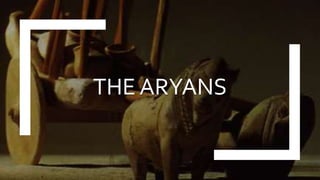
THE ARYANS
Aryans
■ From South-Central Asia
– Iran
– Seaborne invaders of Greece
– Kassites who invaded and conquered Sumer
– Hindu Kush
■ Spoke early form of Sanskrit
■ Preliterate, preurban, seminomadic tender of cattle, sheep and goats
■ Lived in part from hunting, from plough agriculture of wheat and barley,
and from raiding more highly developed agricultural settlements and
trade center routes
Vedic period culture (1000-500 BCE)
■ Combination of Aryan, Harappan, and other
indigenous Indian strains
■ Sanskrit is the oldest written language among the
ancestors of modern European languages
Aryan Domination
■ Acquired not only metal-tipped weapons but a
light, fast war chariot with spoked wheels drawn
by two or more horses
■ Glorified war and made a disproportionate military
impact on a more peaceful Indian population
■ Vedas and epics portray Aryans as godlike
■ Became ruling class
Aryan Domination
■ Arya
– Noble or pure in Sanskrit
■ Introduction of caste system
■ Aryans brought with them their male and warlike
gods and their male-dominated culture
■ Aryan-speaking group dominated the north of India
while the south were dominated by the Dravidians
Vedic culture
■ Vedas and the epics are concerned with romantic
adventure involving gods and demons or with
philosophical and religious matters rather than
with accounts of worldly events or daily life
■ India became the home of the most advanced
knowledge and practice of medicine; of
mathematics, including the numbering system;
and of iron and steel metalworking
■ Ayurveda, Indian medicine
– Ayur - longevity
– Veda - knowledge
MAURYAN INDIA
The invasion of Alexander the Great
■ Alexander encountered and defeated some of the states in
the Indus Valley and Punjab
■ Defeated Porus, king of West Punjab who have his large
army and his battalions of war elephants but gave back his
kingdom
■ Encouraged his 10,000 Greeks and Macedonian soldiers to
take Indian wives
■ Received a lot of Indian princes, one is the first Indian
emperor named Chandragupta Maurya
The Maurya Dynasty
■ The time of ruthless power politics
■ Established the city Pataliputra
– Home to famous library and university
■ Complete with secret service to spy on potential
dissidents, suspected criminals, and corrupt or
ineffective officials
■ Pataliputra was surrounded by a huge wall with 570
towers and 64 gates
Kushans and Greeks
■ Kushans adopted and promoted Buddhism
– Became Indianized
■ Greeks sought for spices, precious stones,
incense, brasswork, fine cotton textiles, ivory,
peacocks, monkeys, and even larger wild animals
Women in India
■ Early Indian Society, especially the southern India, were
matriarchal
■ Aryans were clearly patriarchal
■ Women were subjects to their parents, husbands, and male
relatives
■ Have control over property
■ Freest women were the courtesans
– High-class prostitutes
■ Hereditary dancers never marry, devoted to god

Anthro31 the aryans

  • 1.
  • 2.
    Aryans ■ From South-CentralAsia – Iran – Seaborne invaders of Greece – Kassites who invaded and conquered Sumer – Hindu Kush ■ Spoke early form of Sanskrit ■ Preliterate, preurban, seminomadic tender of cattle, sheep and goats ■ Lived in part from hunting, from plough agriculture of wheat and barley, and from raiding more highly developed agricultural settlements and trade center routes
  • 3.
    Vedic period culture(1000-500 BCE) ■ Combination of Aryan, Harappan, and other indigenous Indian strains ■ Sanskrit is the oldest written language among the ancestors of modern European languages
  • 4.
    Aryan Domination ■ Acquirednot only metal-tipped weapons but a light, fast war chariot with spoked wheels drawn by two or more horses ■ Glorified war and made a disproportionate military impact on a more peaceful Indian population ■ Vedas and epics portray Aryans as godlike ■ Became ruling class
  • 5.
    Aryan Domination ■ Arya –Noble or pure in Sanskrit ■ Introduction of caste system ■ Aryans brought with them their male and warlike gods and their male-dominated culture ■ Aryan-speaking group dominated the north of India while the south were dominated by the Dravidians
  • 6.
    Vedic culture ■ Vedasand the epics are concerned with romantic adventure involving gods and demons or with philosophical and religious matters rather than with accounts of worldly events or daily life
  • 7.
    ■ India becamethe home of the most advanced knowledge and practice of medicine; of mathematics, including the numbering system; and of iron and steel metalworking ■ Ayurveda, Indian medicine – Ayur - longevity – Veda - knowledge
  • 8.
  • 9.
    The invasion ofAlexander the Great ■ Alexander encountered and defeated some of the states in the Indus Valley and Punjab ■ Defeated Porus, king of West Punjab who have his large army and his battalions of war elephants but gave back his kingdom ■ Encouraged his 10,000 Greeks and Macedonian soldiers to take Indian wives ■ Received a lot of Indian princes, one is the first Indian emperor named Chandragupta Maurya
  • 10.
    The Maurya Dynasty ■The time of ruthless power politics ■ Established the city Pataliputra – Home to famous library and university ■ Complete with secret service to spy on potential dissidents, suspected criminals, and corrupt or ineffective officials ■ Pataliputra was surrounded by a huge wall with 570 towers and 64 gates
  • 11.
    Kushans and Greeks ■Kushans adopted and promoted Buddhism – Became Indianized ■ Greeks sought for spices, precious stones, incense, brasswork, fine cotton textiles, ivory, peacocks, monkeys, and even larger wild animals
  • 12.
    Women in India ■Early Indian Society, especially the southern India, were matriarchal ■ Aryans were clearly patriarchal ■ Women were subjects to their parents, husbands, and male relatives ■ Have control over property ■ Freest women were the courtesans – High-class prostitutes ■ Hereditary dancers never marry, devoted to god