Discrete and Continuous
Probability Models
Akshay Kr Mishra-100106039
Sharda University, 4th yr ;ME
Probability Distribution?
• A probability distribution is a mathematical
model that relates the value of the variable
with the probability of occurrence of that value
in the population.
• There are 2 types of probability Distribution-
1. Continuous Probability Distribution
2. Discrete Probability Distribution.
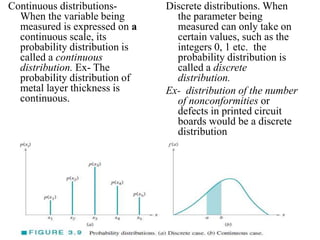
Continuous distributions-
When the variable being
measured is expressed on a
continuous scale, its
probability distribution is
called a continuous
distribution. Ex- The
probability distribution of
metal layer thickness is
continuous.
Discrete distributions. When
the parameter being
measured can only take on
certain values, such as the
integers 0, 1 etc. the
probability distribution is
called a discrete
distribution.
Ex- distribution of the number
of nonconformities or
defects in printed circuit
boards would be a discrete
distribution
Some Imp. Terms
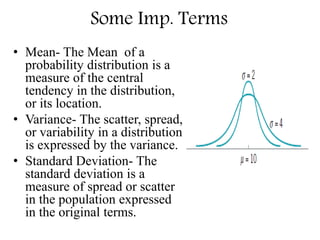
• Mean- The Mean of a
probability distribution is a
measure of the central
tendency in the distribution,
or its location.
• Variance- The scatter, spread,
or variability in a distribution
is expressed by the variance.
• Standard Deviation- The
standard deviation is a
measure of spread or scatter
in the population expressed
in the original terms.
Types Of Discrete Distribution
• Hyper geometric Distribution- An
appropriate probability model for selecting a
random sample of n items without replacement
from a lot of N items of which D are
nonconforming or defective.
• In these applications, x usually is the class of
interest and then that x is the hyper geometric
random variable.
• Binomial Distribution- Lets consider a process
of ‘n’ independent trials.
• When the outcome of each trial is either a
“success” or a “failure,” the trials are called
Bernoulli trials.
• If the probability of “success” on any trial—say,
p—is constant, then the number of “successes” x
in n Bernoulli trials has the binomial
distribution.
• The binomial distribution is used frequently in
quality engineering.
• It is the appropriate probability model for
sampling from an infinitely large population,
where p represents the fraction of defective or
nonconforming items in the population.
• In these applications, x usually represents the
number of nonconforming items found in a
random sample of n items.
Poisson’s Distribution
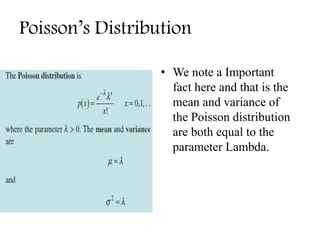
• We note a Important
fact here and that is the
mean and variance of
the Poisson distribution
are both equal to the
parameter Lambda.
• A typical application of the Poisson distribution in
quality control is as a model of the number of defects
or nonconformities that occur in a unit of product.
• In fact, any random phenomenon that occurs on a per
unit (or per unit area, per unit volume, per unit time,
etc.) basis is often well approximated by the Poisson
distribution.
• It is possible to derive the Poisson distribution as a
limiting form of the binomial distribution.
• That is, in a binomial distribution with parameters n
and p, if we let n approach infinity and p approach zero
in such a way that np = lambda is a constant, then the
Poisson distribution results.
Types of Continuous Distribution
• Lognormal Distribution-
• The lifetime of a product that degrades over time is
often modelled by a lognormal random variable. For
example-the lifetime of a semiconductor laser.
• However, because the lognormal distribution is
derived from a simple exponential function of a
normal random variable, it is easy to understand and
easy to evaluate probabilities.
• Normal Distribution- The normal distribution
is probably the most important distribution in
both the theory and application of statistics.
• If x is a normal random variable, then the
probability distribution of x is defined as
follows.
• The normal distribution is used so much that we
frequently employ a special notation, to
imply that x is normally distributed with mean and
variance.
• The visual appearance of the normal distribution is
a symmetric, unimodal or bell-shaped curve.
Area Under Normal Distribution.
• The Normal Distribution has many useful properties and
one which has found its world wide use is the “Central
Limit Theorem”.
• Central Limit Theorem- The central limit theorem implies
that the sum of n independently distributed random
variables is approximately normal, regardless of the
distributions of the individual variables.
• The approximation improves as n increases.
• Exponential Distribution-
Area Under the Exponential Distribution
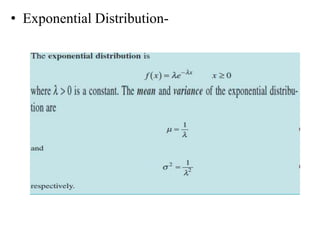
The exponential distribution is widely used in the field of reliability
engineering as a model of the time to failure of a component or
system.
In these applications, the parameter is called the failure rate of the
system, and the mean of the distribution is called the
mean time to failure.
THANK YOU!!!
:D

Discrete and continuous probability models

  • 1.
    Discrete and Continuous ProbabilityModels Akshay Kr Mishra-100106039 Sharda University, 4th yr ;ME
  • 2.
    Probability Distribution? • Aprobability distribution is a mathematical model that relates the value of the variable with the probability of occurrence of that value in the population. • There are 2 types of probability Distribution- 1. Continuous Probability Distribution 2. Discrete Probability Distribution.
  • 3.
    Continuous distributions- When thevariable being measured is expressed on a continuous scale, its probability distribution is called a continuous distribution. Ex- The probability distribution of metal layer thickness is continuous. Discrete distributions. When the parameter being measured can only take on certain values, such as the integers 0, 1 etc. the probability distribution is called a discrete distribution. Ex- distribution of the number of nonconformities or defects in printed circuit boards would be a discrete distribution
  • 4.
    Some Imp. Terms •Mean- The Mean of a probability distribution is a measure of the central tendency in the distribution, or its location. • Variance- The scatter, spread, or variability in a distribution is expressed by the variance. • Standard Deviation- The standard deviation is a measure of spread or scatter in the population expressed in the original terms.
  • 5.
    Types Of DiscreteDistribution • Hyper geometric Distribution- An appropriate probability model for selecting a random sample of n items without replacement from a lot of N items of which D are nonconforming or defective. • In these applications, x usually is the class of interest and then that x is the hyper geometric random variable.
  • 7.
    • Binomial Distribution-Lets consider a process of ‘n’ independent trials. • When the outcome of each trial is either a “success” or a “failure,” the trials are called Bernoulli trials. • If the probability of “success” on any trial—say, p—is constant, then the number of “successes” x in n Bernoulli trials has the binomial distribution.
  • 9.
    • The binomialdistribution is used frequently in quality engineering. • It is the appropriate probability model for sampling from an infinitely large population, where p represents the fraction of defective or nonconforming items in the population. • In these applications, x usually represents the number of nonconforming items found in a random sample of n items.
  • 10.
    Poisson’s Distribution • Wenote a Important fact here and that is the mean and variance of the Poisson distribution are both equal to the parameter Lambda.
  • 11.
    • A typicalapplication of the Poisson distribution in quality control is as a model of the number of defects or nonconformities that occur in a unit of product. • In fact, any random phenomenon that occurs on a per unit (or per unit area, per unit volume, per unit time, etc.) basis is often well approximated by the Poisson distribution. • It is possible to derive the Poisson distribution as a limiting form of the binomial distribution. • That is, in a binomial distribution with parameters n and p, if we let n approach infinity and p approach zero in such a way that np = lambda is a constant, then the Poisson distribution results.
  • 12.
    Types of ContinuousDistribution • Lognormal Distribution-
  • 13.
    • The lifetimeof a product that degrades over time is often modelled by a lognormal random variable. For example-the lifetime of a semiconductor laser. • However, because the lognormal distribution is derived from a simple exponential function of a normal random variable, it is easy to understand and easy to evaluate probabilities.
  • 14.
    • Normal Distribution-The normal distribution is probably the most important distribution in both the theory and application of statistics. • If x is a normal random variable, then the probability distribution of x is defined as follows.
  • 15.
    • The normaldistribution is used so much that we frequently employ a special notation, to imply that x is normally distributed with mean and variance. • The visual appearance of the normal distribution is a symmetric, unimodal or bell-shaped curve. Area Under Normal Distribution.
  • 16.
    • The NormalDistribution has many useful properties and one which has found its world wide use is the “Central Limit Theorem”. • Central Limit Theorem- The central limit theorem implies that the sum of n independently distributed random variables is approximately normal, regardless of the distributions of the individual variables. • The approximation improves as n increases.
  • 17.
  • 18.
    Area Under theExponential Distribution The exponential distribution is widely used in the field of reliability engineering as a model of the time to failure of a component or system. In these applications, the parameter is called the failure rate of the system, and the mean of the distribution is called the mean time to failure.
  • 19.