PNEUMONIA
FOR C-I STUDENTS
PNEUMONIA
DEFINITION
• Pneumonia is an infection of the pulmonary par
enchyma.
• To the pathologist, pneumonia is an infection of t
he alveoli ,distal airways, and interstitium of the l
ung that is manifested by increased weight of th
e lungs, replacement of normal lung’s spongines
s by consolidation ,and alveoli filled with white bl
ood cells ,red blood cells and fibrin .
• To the clinician, pneumonia is a constellation of
symptoms and signs in combination with at least
one opacity on CXR.
Epidemiology
• Between 5 and 10 million cases of infectious pne
umonia occur annually in the United States and r
esult in more than 1 million hospitalizations.
• Pneumonia is a leading cause of death worldwid
e, the sixth leading cause of death in the United
States, and the most common lethal infectious di
sease.
CLASSIFICATION
• ETIOLOGIC
1.Infections 2.Inhala
tion of gastric contents 3.Immunological reactio
ns 4.Inhalation of other toxic substanc
es
• ANATOMIC
1.Lobar or segmental : process is confined to th
ese division of the lung
2.Bronchopneumonia : small areas of the lung al
veoli and lobule around small terminal bronchi ar
e affected
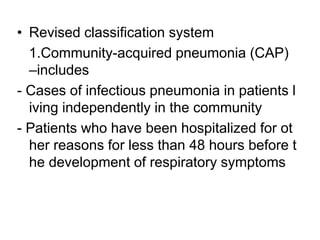
• Revised classification system
1.Community-acquired pneumonia (CAP)
–includes
- Cases of infectious pneumonia in patients l
iving independently in the community
- Patients who have been hospitalized for ot
her reasons for less than 48 hours before t
he development of respiratory symptoms
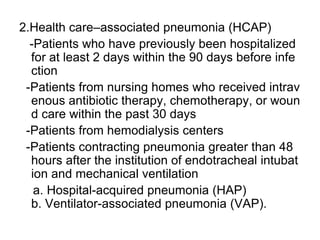
2.Health care–associated pneumonia (HCAP)
-Patients who have previously been hospitalized
for at least 2 days within the 90 days before infe
ction
-Patients from nursing homes who received intrav
enous antibiotic therapy, chemotherapy, or woun
d care within the past 30 days
-Patients from hemodialysis centers
-Patients contracting pneumonia greater than 48
hours after the institution of endotracheal intubat
ion and mechanical ventilation
a. Hospital-acquired pneumonia (HAP)
b. Ventilator-associated pneumonia (VAP).
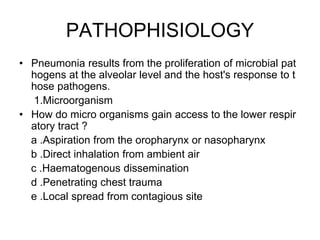
PATHOPHISIOLOGY
• Pneumonia results from the proliferation of microbial pat
hogens at the alveolar level and the host's response to t
hose pathogens.
1.Microorganism
• How do micro organisms gain access to the lower respir
atory tract ?
a .Aspiration from the oropharynx or nasopharynx
b .Direct inhalation from ambient air
c .Haematogenous dissemination
d .Penetrating chest trauma
e .Local spread from contagious site
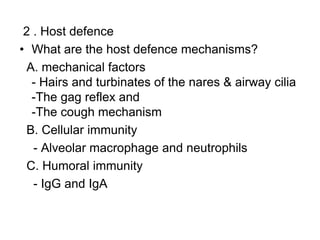
2 . Host defence
• What are the host defence mechanisms?
A. mechanical factors
- Hairs and turbinates of the nares & airway cilia
-The gag reflex and
-The cough mechanism
B. Cellular immunity
- Alveolar macrophage and neutrophils
C. Humoral immunity
- IgG and IgA
PATHOLOGY
• Classic pneumonia evolves through a series of p
athologic changes.
A. Congestion or Edema
B. Red hepatization
C. Gray hepatization
D. Resolution
* This pattern has been described best for pneum
ococcal pneumonia and may not apply to pneum
onias of all etiologies, especially viral or Pneumo
cystis pneumonia.
CLINICAL MANIFESTATION
-Cough that is either non-productive or prod
uctive of mucoid, purulent, or blood-tinged
sputum
-Fever
-Pleuritic chest pain
-Shortness of breath
-Gastrointestinal symptoms (20%)
-Other symptoms may include fatigue, head
ache, myalgias, and arthralgias.
PHYSICAL FINDINGS
• Findings on physical examination vary with
the degree of pulmonary consolidation and
the presence or absence of a significant pl
eural effusion.
-Increased respiratory rate and use of ac
cessory muscles of respiration -In
creased or decreased tactile fremitus -
Relative or stony dullness -
Crackles, bronchial breath sounds
INVESTIGATION
• Clinical diagnosis
-Chest radiography
• Etiologic diagnosis
-Gram stain and culture of sputum
-Blood culture
-Antigen tests
-PCR
-Serology
-Bronchoscopy
DIFFERENTIAL DIAGNOSIS
• Acute bronchitis
• Acute exacerbations of chronic bronchitis,
• Heart failure
• Pulmonary embolism
COMPLICATIONS
• Respiratory failure
• Shock and multiorgan failure
• Exacerbation of comorbid illnesses
• Metastatic infection (e.g., brain abscess or
endocarditis)
• Lung abscess
• Complicated pleural effusion (Empyema)
MANAGEMENT
• The principles of treatments are
1.To treat non complicated pneumonia as
outpatient and complicated pneumonia an
d severely ill patients as inpatients
2.To kill the organism with appropriate anti
biotics
3.To recognize and treat complications
Criteria for hospitalization
• Age >65
• Co morbidity
• Leukopenia (<5000/ul) not attributable to a known conditi
ons
• S.aures ,G-ve bacilli, anaerobes suspected causes of p
neumonia
• Suppurative complications
• Failure of PO treatment
• RR >30’ ,PR >120’ ,SBP<90/mmhg
• Po2 < 60mmhg , acute alteration in mental status
• Multiple lobe involvement
FOLLOW UP
• Fever and leukocytosis usually resolve wit
hin 2 and 4 days, respectively .
• Physical findings may persist longer.
• Chest radiographic abnormalities are slow
est to resolve and may require 4–12 week
s to clear.
Failure to improve
• Noninfectious conditions
• Correct diagnosis but that a different patho
gen
• The pathogen may be resistant to the drug
selected
• Wrong drug or the correct drug at the wron
g dose or frequency of administration
• Nosocomial superinfections
Suppurative Lung diseases
• Lung Abscess
• Bronchectasis
• Empyema
LUNG ABCESS
• Is defined as pulmonary parenchymal necrosis and cavit
ation resulting from infection.
Conditions that predispose to lung abscess
• any cause of aspiration or decreased ciliary action
reduced levels of consciousness
alcoholism
seizure disorders
general anesthesia
cerebrovascular accidents
drug addiction
• Periodontal disease, gingivitis, sinus infecti
on, and bronchiectasis
• septic pulmonary embolism
• Bronchial obstruction – neoplasm , foreign
bodies
• Lung infarction
• Fluid-filled cysts or bullae
• Pulmonary contusion
MICROBIOLOGY
• Anaerobic bacteria ( most common )-strept
occoci, H.influenza
• Aerobic or facultative bacteria - S. aureus,
Klebsiella pneumoniae, Nocardia sp., and
gram-negative organisms
• Fungi
• parasites
CLINICAL MANIFESTATION
• Clinical course
-acute presentations - aerobic bacteria
-evolve over an extended period of time -
anaerobic infection
• Presentation
-Asymptomatic
-Symptomatic - cough, copious foul smelli
ng purulent sputum production, pleuritic ch
est pain, fever, and hemoptysis
PHYSICAL EXAMINATION
• Unrevealing
• Fetid breath and poor dentition
• Dullness to percussion
• Reduced breath sounds or criptation
• Clubbing or hypertrophic pulmonary osteo
arthropathy
INVESTIGATION
• Chest radiograph - cavity with an air-fluid level, with or wi
thout surrounding infiltrate
-Lung abscess occur commonly in dependent segment
s of the lung
.The posterior segments of the upper lobes and
.The superior segments of the lower lobes
• CT of the chest - to define the size and location of the ab
scess
• Gram stain and culture of sputum
• Blood culture
• Pleural fluid cultures
• Bronchoscopy
complications
• Empyema, with or without bronchopleural f
istula
• Massive hemoptysis
• Septicemia
MANAGEMENT
The principles of treatments are
1.To kill the organism with appropriate antibiotics
- Clindamycin (150 mg–300 mg every 6 h) 4-8wks
- Metronidazole 400mg tid plus penicillin
2. To drain the pus -Postural
-Bronchoscopical
3.Surgical resection of affected segment
Indications
-refractory hemoptysis
-inadequate response to medical therapy
-Empyema or bronchopleural fistula
-the need for a tissue diagnosis when there is concern fo
r a noninfectious etiology (lung ca).
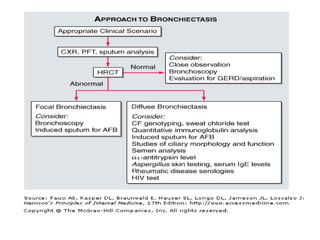
BRONCHECTASIS
• is an abnormal and permanent dilatation of
bronchi.
• It may be either focal, involving airways su
pplying a limited region of pulmonary pare
nchyma, or diffuse, involving airways in a
more widespread distribution .
PATHOLOGY
• Three different patterns of bronchiectasis
have been described
1. Cylindrical bronchiectasis
2. Varicose bronchiectasis
3. Saccular (cystic) bronchiectasis
PATHOGENESIS
• Bronchiectasis is a consequence of inflammation
and destruction of the structural components of t
he bronchial wall.
• The induction of bronchiectasis requires several
factors:
(1) an infectious insult
(2) airway obstruction
(3) reduced clearance of mucus and other mate
rial from the airways
(4) a defect in host defense
CLINICAL MANIFESTATION
• Persistent or recurrent cough and purulent
sputum production
• Hemoptysis
• Asymptomatic or nonproductive cough ("dr
y" bronchiectasis )
• Systemic symptoms (fatigue, weight loss,
myalgias,fever)
• Dyspnea or wheezing
PHYSICAL EXAMINATION
• Crackles, rhonchi, and wheezes
• Clubbing
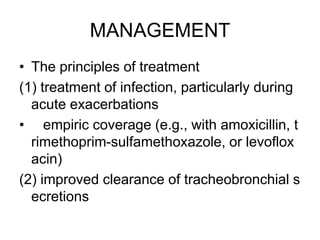
MANAGEMENT
• The principles of treatment
(1) treatment of infection, particularly during
acute exacerbations
• empiric coverage (e.g., with amoxicillin, t
rimethoprim-sulfamethoxazole, or levoflox
acin)
(2) improved clearance of tracheobronchial s
ecretions
(3) reduction of inflammation; and
(4) treatment of an identifiable underlying pr
oblem
Empyema
• Is defined as grossly purulent pleural effusion.
• Causes
Extension of infection from infected lung (
pnemonia,lung abcess)
Subphrenic abcess
Chest trauma
Esophageal perforation
Iatrogenic
MANAGEMENT
• Principles of treatment
1.Removal of pus – chest tube drainage
2.Antibiotic
3.Decortication

pneumonia for C-1.pptx

  • 1.
  • 2.
    PNEUMONIA DEFINITION • Pneumonia isan infection of the pulmonary par enchyma. • To the pathologist, pneumonia is an infection of t he alveoli ,distal airways, and interstitium of the l ung that is manifested by increased weight of th e lungs, replacement of normal lung’s spongines s by consolidation ,and alveoli filled with white bl ood cells ,red blood cells and fibrin .
  • 3.
    • To theclinician, pneumonia is a constellation of symptoms and signs in combination with at least one opacity on CXR. Epidemiology • Between 5 and 10 million cases of infectious pne umonia occur annually in the United States and r esult in more than 1 million hospitalizations. • Pneumonia is a leading cause of death worldwid e, the sixth leading cause of death in the United States, and the most common lethal infectious di sease.
  • 4.
    CLASSIFICATION • ETIOLOGIC 1.Infections 2.Inhala tionof gastric contents 3.Immunological reactio ns 4.Inhalation of other toxic substanc es • ANATOMIC 1.Lobar or segmental : process is confined to th ese division of the lung 2.Bronchopneumonia : small areas of the lung al veoli and lobule around small terminal bronchi ar e affected
  • 5.
    • Revised classificationsystem 1.Community-acquired pneumonia (CAP) –includes - Cases of infectious pneumonia in patients l iving independently in the community - Patients who have been hospitalized for ot her reasons for less than 48 hours before t he development of respiratory symptoms
  • 6.
    2.Health care–associated pneumonia(HCAP) -Patients who have previously been hospitalized for at least 2 days within the 90 days before infe ction -Patients from nursing homes who received intrav enous antibiotic therapy, chemotherapy, or woun d care within the past 30 days -Patients from hemodialysis centers -Patients contracting pneumonia greater than 48 hours after the institution of endotracheal intubat ion and mechanical ventilation a. Hospital-acquired pneumonia (HAP) b. Ventilator-associated pneumonia (VAP).
  • 7.
    PATHOPHISIOLOGY • Pneumonia resultsfrom the proliferation of microbial pat hogens at the alveolar level and the host's response to t hose pathogens. 1.Microorganism • How do micro organisms gain access to the lower respir atory tract ? a .Aspiration from the oropharynx or nasopharynx b .Direct inhalation from ambient air c .Haematogenous dissemination d .Penetrating chest trauma e .Local spread from contagious site
  • 8.
    2 . Hostdefence • What are the host defence mechanisms? A. mechanical factors - Hairs and turbinates of the nares & airway cilia -The gag reflex and -The cough mechanism B. Cellular immunity - Alveolar macrophage and neutrophils C. Humoral immunity - IgG and IgA
  • 9.
    PATHOLOGY • Classic pneumoniaevolves through a series of p athologic changes. A. Congestion or Edema B. Red hepatization C. Gray hepatization D. Resolution * This pattern has been described best for pneum ococcal pneumonia and may not apply to pneum onias of all etiologies, especially viral or Pneumo cystis pneumonia.
  • 10.
    CLINICAL MANIFESTATION -Cough thatis either non-productive or prod uctive of mucoid, purulent, or blood-tinged sputum -Fever -Pleuritic chest pain -Shortness of breath -Gastrointestinal symptoms (20%) -Other symptoms may include fatigue, head ache, myalgias, and arthralgias.
  • 11.
    PHYSICAL FINDINGS • Findingson physical examination vary with the degree of pulmonary consolidation and the presence or absence of a significant pl eural effusion. -Increased respiratory rate and use of ac cessory muscles of respiration -In creased or decreased tactile fremitus - Relative or stony dullness - Crackles, bronchial breath sounds
  • 12.
    INVESTIGATION • Clinical diagnosis -Chestradiography • Etiologic diagnosis -Gram stain and culture of sputum -Blood culture -Antigen tests -PCR -Serology -Bronchoscopy
  • 13.
    DIFFERENTIAL DIAGNOSIS • Acutebronchitis • Acute exacerbations of chronic bronchitis, • Heart failure • Pulmonary embolism
  • 14.
    COMPLICATIONS • Respiratory failure •Shock and multiorgan failure • Exacerbation of comorbid illnesses • Metastatic infection (e.g., brain abscess or endocarditis) • Lung abscess • Complicated pleural effusion (Empyema)
  • 15.
    MANAGEMENT • The principlesof treatments are 1.To treat non complicated pneumonia as outpatient and complicated pneumonia an d severely ill patients as inpatients 2.To kill the organism with appropriate anti biotics 3.To recognize and treat complications
  • 16.
    Criteria for hospitalization •Age >65 • Co morbidity • Leukopenia (<5000/ul) not attributable to a known conditi ons • S.aures ,G-ve bacilli, anaerobes suspected causes of p neumonia • Suppurative complications • Failure of PO treatment • RR >30’ ,PR >120’ ,SBP<90/mmhg • Po2 < 60mmhg , acute alteration in mental status • Multiple lobe involvement
  • 17.
    FOLLOW UP • Feverand leukocytosis usually resolve wit hin 2 and 4 days, respectively . • Physical findings may persist longer. • Chest radiographic abnormalities are slow est to resolve and may require 4–12 week s to clear.
  • 18.
    Failure to improve •Noninfectious conditions • Correct diagnosis but that a different patho gen • The pathogen may be resistant to the drug selected • Wrong drug or the correct drug at the wron g dose or frequency of administration • Nosocomial superinfections
  • 19.
    Suppurative Lung diseases •Lung Abscess • Bronchectasis • Empyema
  • 20.
    LUNG ABCESS • Isdefined as pulmonary parenchymal necrosis and cavit ation resulting from infection. Conditions that predispose to lung abscess • any cause of aspiration or decreased ciliary action reduced levels of consciousness alcoholism seizure disorders general anesthesia cerebrovascular accidents drug addiction
  • 21.
    • Periodontal disease,gingivitis, sinus infecti on, and bronchiectasis • septic pulmonary embolism • Bronchial obstruction – neoplasm , foreign bodies • Lung infarction • Fluid-filled cysts or bullae • Pulmonary contusion
  • 22.
    MICROBIOLOGY • Anaerobic bacteria( most common )-strept occoci, H.influenza • Aerobic or facultative bacteria - S. aureus, Klebsiella pneumoniae, Nocardia sp., and gram-negative organisms • Fungi • parasites
  • 23.
    CLINICAL MANIFESTATION • Clinicalcourse -acute presentations - aerobic bacteria -evolve over an extended period of time - anaerobic infection • Presentation -Asymptomatic -Symptomatic - cough, copious foul smelli ng purulent sputum production, pleuritic ch est pain, fever, and hemoptysis
  • 24.
    PHYSICAL EXAMINATION • Unrevealing •Fetid breath and poor dentition • Dullness to percussion • Reduced breath sounds or criptation • Clubbing or hypertrophic pulmonary osteo arthropathy
  • 25.
    INVESTIGATION • Chest radiograph- cavity with an air-fluid level, with or wi thout surrounding infiltrate -Lung abscess occur commonly in dependent segment s of the lung .The posterior segments of the upper lobes and .The superior segments of the lower lobes • CT of the chest - to define the size and location of the ab scess • Gram stain and culture of sputum • Blood culture • Pleural fluid cultures • Bronchoscopy
  • 26.
    complications • Empyema, withor without bronchopleural f istula • Massive hemoptysis • Septicemia
  • 27.
    MANAGEMENT The principles oftreatments are 1.To kill the organism with appropriate antibiotics - Clindamycin (150 mg–300 mg every 6 h) 4-8wks - Metronidazole 400mg tid plus penicillin 2. To drain the pus -Postural -Bronchoscopical 3.Surgical resection of affected segment Indications -refractory hemoptysis -inadequate response to medical therapy -Empyema or bronchopleural fistula -the need for a tissue diagnosis when there is concern fo r a noninfectious etiology (lung ca).
  • 28.
    BRONCHECTASIS • is anabnormal and permanent dilatation of bronchi. • It may be either focal, involving airways su pplying a limited region of pulmonary pare nchyma, or diffuse, involving airways in a more widespread distribution .
  • 29.
    PATHOLOGY • Three differentpatterns of bronchiectasis have been described 1. Cylindrical bronchiectasis 2. Varicose bronchiectasis 3. Saccular (cystic) bronchiectasis
  • 30.
    PATHOGENESIS • Bronchiectasis isa consequence of inflammation and destruction of the structural components of t he bronchial wall. • The induction of bronchiectasis requires several factors: (1) an infectious insult (2) airway obstruction (3) reduced clearance of mucus and other mate rial from the airways (4) a defect in host defense
  • 31.
    CLINICAL MANIFESTATION • Persistentor recurrent cough and purulent sputum production • Hemoptysis • Asymptomatic or nonproductive cough ("dr y" bronchiectasis ) • Systemic symptoms (fatigue, weight loss, myalgias,fever) • Dyspnea or wheezing
  • 32.
    PHYSICAL EXAMINATION • Crackles,rhonchi, and wheezes • Clubbing
  • 34.
    MANAGEMENT • The principlesof treatment (1) treatment of infection, particularly during acute exacerbations • empiric coverage (e.g., with amoxicillin, t rimethoprim-sulfamethoxazole, or levoflox acin) (2) improved clearance of tracheobronchial s ecretions
  • 35.
    (3) reduction ofinflammation; and (4) treatment of an identifiable underlying pr oblem
  • 36.
    Empyema • Is definedas grossly purulent pleural effusion. • Causes Extension of infection from infected lung ( pnemonia,lung abcess) Subphrenic abcess Chest trauma Esophageal perforation Iatrogenic
  • 37.
    MANAGEMENT • Principles oftreatment 1.Removal of pus – chest tube drainage 2.Antibiotic 3.Decortication