“Find the key to yourself
and every door in the world
is open to you”
Mother..

Know your Strengths, Weakness, Interests etc..
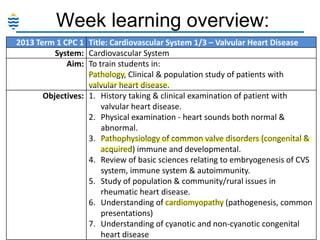
Week learning overview:
2013 Term 1 CPC 1 Title: Cardiovascular System 1/3 – Valvular Heart Disease
System: Cardiovascular System
Aim: To train students in:
Pathology, Clinical & population study of patients with
valvular heart disease.
Objectives: 1. History taking & clinical examination of patient with
valvular heart disease.
2. Physical examination - heart sounds both normal &
abnormal.
3. Pathophysiology of common valve disorders (congenital &
acquired) immune and developmental.
4. Review of basic sciences relating to embryogenesis of CVS
system, immune system & autoimmunity.
5. Study of population & community/rural issues in
rheumatic heart disease.
6. Understanding of cardiomyopathy (pathogenesis, common
presentations)
7. Understanding of cyanotic and non-cyanotic congenital
heart disease
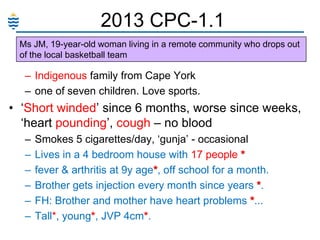
2013 CPC-1.1
Ms JM, 19-year-old woman living in a remote community who drops out
of the local basketball team

– Indigenous family from Cape York
– one of seven children. Love sports.

• ‗Short winded‘ since 6 months, worse since weeks,
‗heart pounding‘, cough – no blood
–
–
–
–
–
–

Smokes 5 cigarettes/day, ‗gunja‘ - occasional
Lives in a 4 bedroom house with 17 people *
fever & arthritis at 9y age*, off school for a month.
Brother gets injection every month since years *.
FH: Brother and mother have heart problems *...
Tall*, young*, JVP 4cm*.
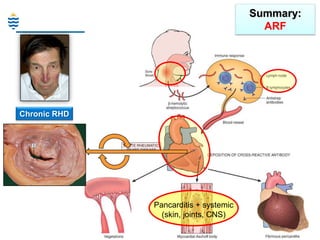
Summary:
ARF

Chronic RHD

Pancarditis + systemic
(skin, joints, CNS)
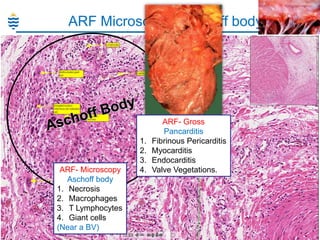
ARF Microscopy: Aschoff body.

ARF- Microscopy
Aschoff body
1. Necrosis
2. Macrophages
3. T Lymphocytes
4. Giant cells
(Near a BV)

1.
2.
3.
4.

ARF- Gross
Pancarditis
Fibrinous Pericarditis
Myocarditis
Endocarditis
Valve Vegetations.
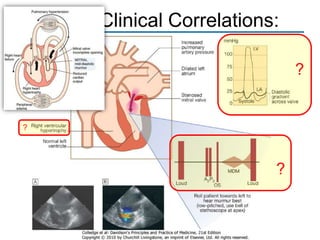
RHD: Clinical Correlations:
?

?

?
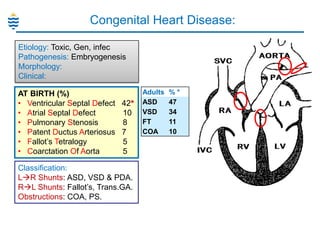
Congenital Heart Disease:
Etiology: Toxic, Gen, infec
Pathogenesis: Embryogenesis
Morphology:
Clinical:
AT BIRTH (%)
• Ventricular Septal Defect
• Atrial Septal Defect
• Pulmonary Stenosis
• Patent Ductus Arteriosus
• Fallot‘s Tetralogy
• Coarctation Of Aorta

42*
10
8
7
5
5

Classification:
LR Shunts: ASD, VSD & PDA.
RL Shunts: Fallot‘s, Trans.GA.
Obstructions: COA, PS.

Adults
ASD
VSD
FT
COA

%*
47
34
11
10
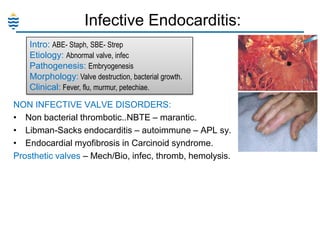
Infective Endocarditis:
Intro: ABE- Staph, SBE- Strep
Etiology: Abnormal valve, infec
Pathogenesis: Embryogenesis
Morphology: Valve destruction, bacterial growth.
Clinical: Fever, flu, murmur, petechiae.
NON INFECTIVE VALVE DISORDERS:
• Non bacterial thrombotic..NBTE – marantic.
• Libman-Sacks endocarditis – autoimmune – APL sy.
• Endocardial myofibrosis in Carcinoid syndrome.
Prosthetic valves – Mech/Bio, infec, thromb, hemolysis.
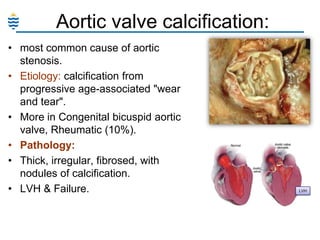
Aortic valve calcification:
• most common cause of aortic
stenosis.
• Etiology: calcification from
progressive age-associated "wear
and tear".
• More in Congenital bicuspid aortic
valve, Rheumatic (10%).
• Pathology:
• Thick, irregular, fibrosed, with
nodules of calcification.
• LVH & Failure.

LVH
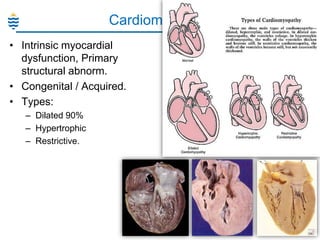
Cardiomyopathy:
• Intrinsic myocardial
dysfunction, Primary
structural abnorm.
• Congenital / Acquired.
• Types:
– Dilated 90%
– Hypertrophic
– Restrictive.

10
“Some people grumble that
roses have thorns; I am grateful
that thorns have roses.”
-- Alphonse Karr

Look for good in others, no one is without faults & every one
has some good quality!
CPC12: Week overview:
2013 Term 1 CPC 2 Title: Cardiovascular System 2/4 – IHD
System: Cardiovascular System
Aim: To train students in:
Basic Pathology, clinical skills & population study
of patients with ischaemic heart disease.
Objectives: 1. History taking & clinical examination of
patient with Acute Coronary Syndrome (ACS).
2. Pathophysiology of ischaemic heart disease.
3. Review of Basic sciences relating to CVS –
Anatomy, Physiology.
4. Study of Population & community/rural issues
in life style associated diseases.
CPC13-1.2 – Chest pain.
Mrs. J.B 45 year old Aboriginal woman Presents for an urgent visit complaining of
SOB, ‗oppressive feeling‘ in her chest

• While climbing steps* 15-20min, Pale, unwell, no pain now.
Burning sensation in her neck.
• Similar episodes - 2y, more frequent now. Centre of
sternum, no radiation*
• ↑Exertion, stress - ↓rest*
• HPTN 15y, Dyslipidemia 8y, GORD 7y,
• P/H: Chest pain, weak heart, no blocks.
• F/H: Smoker, 1pack/day 25y, IHD, DM2,
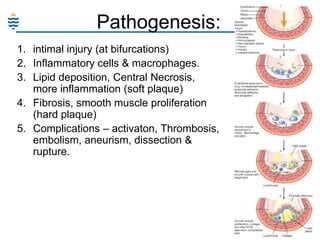
Pathogenesis:
1. intimal injury (at bifurcations)
2. Inflammatory cells & macrophages.
3. Lipid deposition, Central Necrosis,
more inflammation (soft plaque)
4. Fibrosis, smooth muscle proliferation
(hard plaque)
5. Complications – activaton, Thrombosis,
embolism, aneurism, dissection &
rupture.
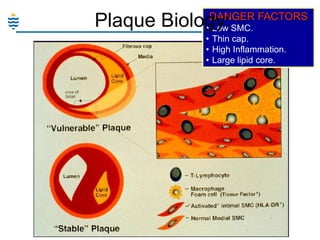
DANGER FACTORS

Plaque Biology:SMC.
• Low

• Thin cap.
• High Inflammation.
• Large lipid core.
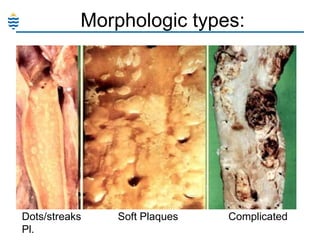
Morphologic types:

Dots/streaks
Pl.

Soft Plaques

Complicated
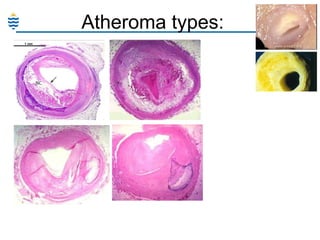
Atheroma types:
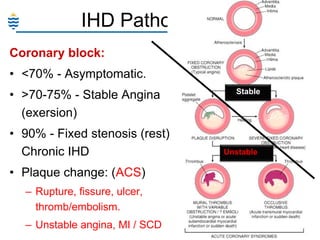
IHD Pathogenesis:
Coronary block:
• <70% - Asymptomatic.
• >70-75% - Stable Angina
(exersion)

• 90% - Fixed stenosis (rest)
Chronic IHD
• Plaque change: (ACS)
– Rupture, fissure, ulcer,
thromb/embolism.
– Unstable angina, MI / SCD

Stable

Unstable
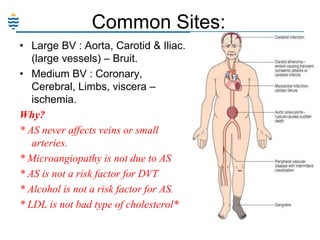
Common Sites:
• Large BV : Aorta, Carotid & Iliac.
(large vessels) – Bruit.
• Medium BV : Coronary,
Cerebral, Limbs, viscera –
ischemia.
Why?
* AS never affects veins or small
arteries.
* Microangiopathy is not due to AS
* AS is not a risk factor for DVT
* Alcohol is not a risk factor for AS.
* LDL is not bad type of cholesterol*
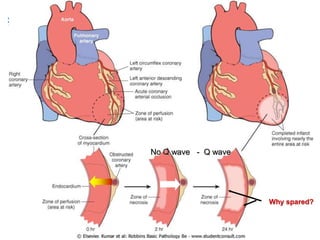
No Q wave - Q wave

Why spared?
What is important in this world
is not where we are, but in
which direction we are
moving.
-- Oliver Wendell Holmes, Jr.
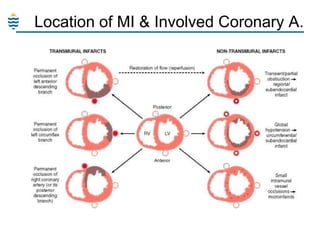
Location of MI & Involved Coronary A.
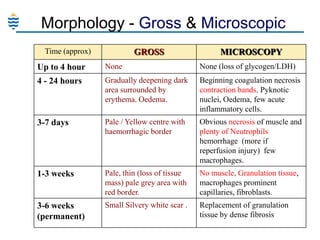
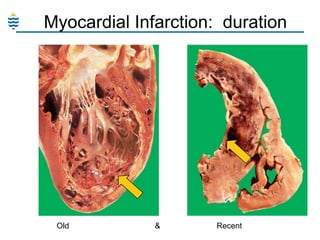
Morphology - Gross & Microscopic
Time (approx)

GROSS

MICROSCOPY

Up to 4 hour

None

None (loss of glycogen/LDH)

4 - 24 hours

Gradually deepening dark
area surrounded by
erythema. Oedema.

Beginning coagulation necrosis
contraction bands. Pyknotic
nuclei, Oedema, few acute
inflammatory cells.

3-7 days

Pale / Yellow centre with
haemorrhagic border

Obvious necrosis of muscle and
plenty of Neutrophils
hemorrhage (more if
reperfusion injury) few
macrophages.

1-3 weeks

Pale, thin (loss of tissue
mass) pale grey area with
red border.

No muscle, Granulation tissue,
macrophages prominent
capillaries, fibroblasts.

3-6 weeks
(permanent)

Small Silvery white scar .

Replacement of granulation
tissue by dense fibrosis
Myocardial Infarction: duration

Old

&

Recent
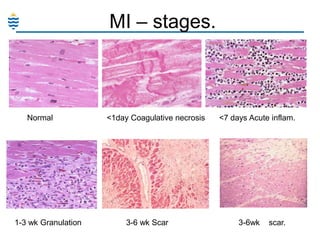
MI – stages.

Normal

1-3 wk Granulation

<1day Coagulative necrosis

3-6 wk Scar

<7 days Acute inflam.

3-6wk

scar.
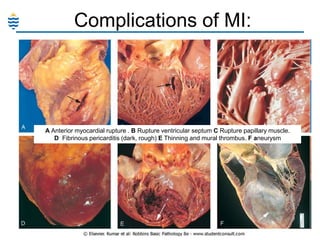
Complications of MI:

A Anterior myocardial rupture . B Rupture ventricular septum C Rupture papillary muscle.
D Fibrinous pericarditis (dark, rough) E Thinning and mural thrombus. F aneurysm
“Be like a postage stamp”
Stick to one thing until you get there...!
- Josh Billings…
2013 Term 1 Title: Cardiovascular 3/4 - PVD
CPC 3
System: Cardiovascular System, Skin
Aim: To train students in :
Clinical, Pathology & population study of patients with arterial +
venous disorders + skin lesions.
Objectives: 1. History taking & clinical examination of patients with peripheral
vascular disease
2. Clinical examination of peripheral circulation.
3. Clinical examination of skin & skin lesions.
4. Pathophysiology of common arterial and venous disorders.
Atherosclerosis & Deep vein thrombosis.
5. Pathophysiology of common skin disorders Infection,
inflammation & malignancy. (Review MB3-TIN)
6. Pathophysiology of Ischemia, infarction, and necrosis. (Review
MB3-TIN)
7. Review of Basic sciences relating to structure and function of
blood vessels. Fluid balance and dynamics of micro capillary
circulation & Pathophysiology of oedema formation.
8. Epidemiology of lifestyle diseases, population & community/rural
issues in life style disorders specifically atherosclerosis.
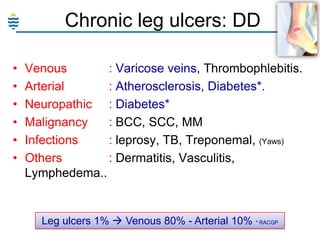
Chronic leg ulcers: DD
•
•
•
•
•
•

Venous
: Varicose veins, Thrombophlebitis.
Arterial
: Atherosclerosis, Diabetes*.
Neuropathic : Diabetes*
Malignancy
: BCC, SCC, MM
Infections
: leprosy, TB, Treponemal, (Yaws)
Others
: Dermatitis, Vasculitis,
Lymphedema..

Leg ulcers 1%  Venous 80% - Arterial 10% * RACGP
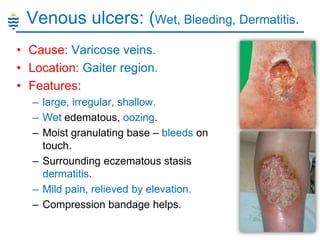
Venous ulcers: (Wet, Bleeding, Dermatitis.
• Cause: Varicose veins.
• Location: Gaiter region.
• Features:
– large, irregular, shallow.
– Wet edematous, oozing.
– Moist granulating base – bleeds on
touch.
– Surrounding eczematous stasis
dermatitis.
– Mild pain, relieved by elevation.
– Compression bandage helps.
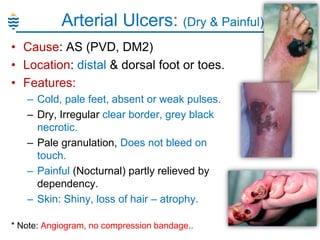
Arterial Ulcers: (Dry & Painful)
• Cause: AS (PVD, DM2)
• Location: distal & dorsal foot or toes.
• Features:
– Cold, pale feet, absent or weak pulses.
– Dry, Irregular clear border, grey black
necrotic.
– Pale granulation, Does not bleed on
touch.
– Painful (Nocturnal) partly relieved by
dependency.
– Skin: Shiny, loss of hair – atrophy.
* Note: Angiogram, no compression bandage..
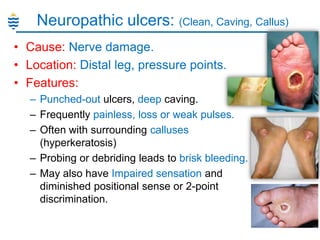
Neuropathic ulcers: (Clean, Caving, Callus)
• Cause: Nerve damage.
• Location: Distal leg, pressure points.
• Features:
– Punched-out ulcers, deep caving.
– Frequently painless, loss or weak pulses.
– Often with surrounding calluses
(hyperkeratosis)
– Probing or debriding leads to brisk bleeding.
– May also have Impaired sensation and
diminished positional sense or 2-point
discrimination.
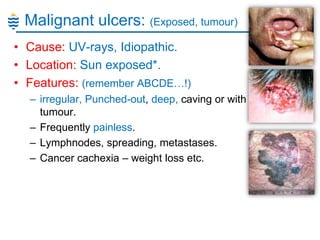
Malignant ulcers: (Exposed, tumour)
• Cause: UV-rays, Idiopathic.
• Location: Sun exposed*.
• Features: (remember ABCDE…!)
– irregular, Punched-out, deep, caving or with
tumour.
– Frequently painless.
– Lymphnodes, spreading, metastases.
– Cancer cachexia – weight loss etc.
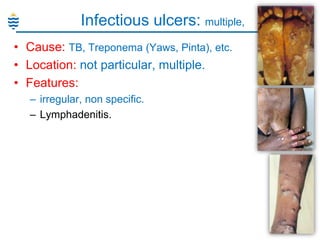
Infectious ulcers: multiple,
• Cause: TB, Treponema (Yaws, Pinta), etc.
• Location: not particular, multiple.
• Features:
– irregular, non specific.
– Lymphadenitis.
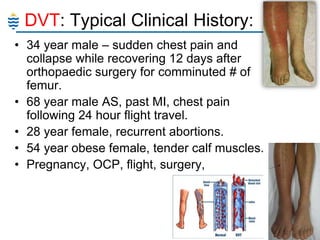
DVT: Typical Clinical History:
• 34 year male – sudden chest pain and
collapse while recovering 12 days after
orthopaedic surgery for comminuted # of
femur.
• 68 year male AS, past MI, chest pain
following 24 hour flight travel.
• 28 year female, recurrent abortions.
• 54 year obese female, tender calf muscles.
• Pregnancy, OCP, flight, surgery,
Risk Factors for DVT
• Virchow‘s triad: (Flow– Blood - Vessel)
– Stasis, Hypercoagulability & BV injury.

• Stasis (flow)
– Immobilization, paralysis, in-patients, heart failure.

• Hypercoagulability (Blood):
–
–
–
–

Congenital: AT III, Protein-C/S deficiency, F V Leiden
Acquired: Lupus & anti cardiolipin anticoagulants,
Drugs, Oral contraceptives, Hyperhomocysteinemia.
Hyperviscosity – Polycythemia, paraproteins.

• Tissue damage (Vessel):
– Surgery, Trauma, MI, Stroke, Malignancy, Phlebitis.
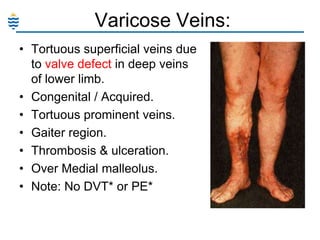
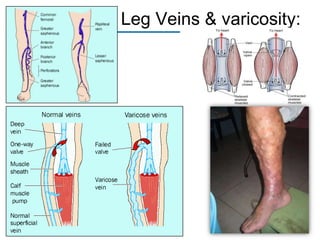
Varicose Veins:
• Tortuous superficial veins due
to valve defect in deep veins
of lower limb.
• Congenital / Acquired.
• Tortuous prominent veins.
• Gaiter region.
• Thrombosis & ulceration.
• Over Medial malleolus.
• Note: No DVT* or PE*
Leg Veins & varicosity:
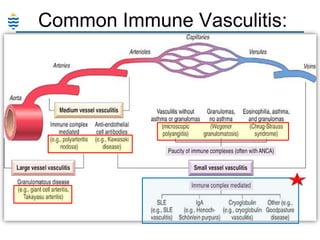
Common Immune Vasculitis:
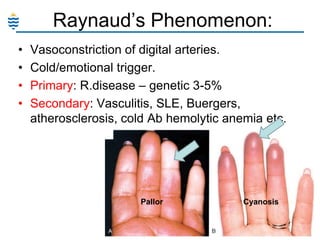
Raynaud‘s Phenomenon:
•
•
•
•

Vasoconstriction of digital arteries.
Cold/emotional trigger.
Primary: R.disease – genetic 3-5%
Secondary: Vasculitis, SLE, Buergers,
atherosclerosis, cold Ab hemolytic anemia etc.

Pallor

Cyanosis
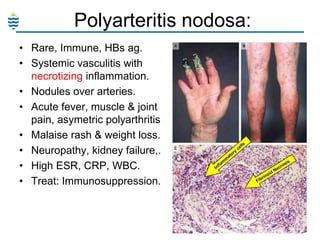
Polyarteritis nodosa:
• Rare, Immune, HBs ag.
• Systemic vasculitis with
necrotizing inflammation.
• Nodules over arteries.
• Acute fever, muscle & joint
pain, asymetric polyarthritis
• Malaise rash & weight loss.
• Neuropathy, kidney failure,.
• High ESR, CRP, WBC.
• Treat: Immunosuppression.
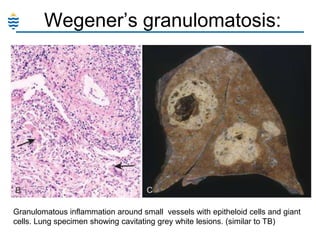
Wegener‘s granulomatosis:

Granulomatous inflammation around small vessels with epitheloid cells and giant
cells. Lung specimen showing cavitating grey white lesions. (similar to TB)
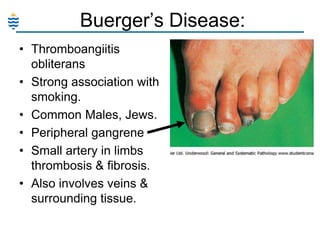
Buerger‘s Disease:
• Thromboangiitis
obliterans
• Strong association with
smoking.
• Common Males, Jews.
• Peripheral gangrene
• Small artery in limbs
thrombosis & fibrosis.
• Also involves veins &
surrounding tissue.
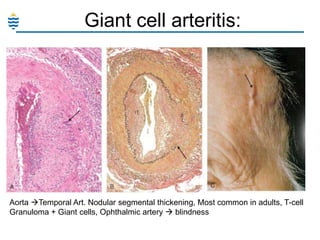
Giant cell arteritis:

Aorta Temporal Art. Nodular segmental thickening, Most common in adults, T-cell
Granuloma + Giant cells, Ophthalmic artery  blindness
That person who declares that there
is always something wrong is
always doing something to make
things wrong.
— Christian Larson
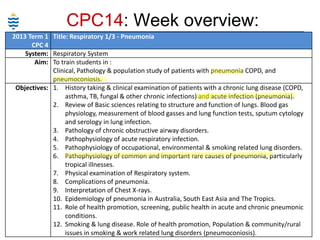
CPC14: Week overview:
2013 Term 1 Title: Respiratory 1/3 - Pneumonia
CPC 4
System: Respiratory System
Aim: To train students in :
Clinical, Pathology & population study of patients with pneumonia COPD, and
pneumoconiosis.
Objectives: 1. History taking & clinical examination of patients with a chronic lung disease (COPD,
asthma, TB, fungal & other chronic infections) and acute infection (pneumonia).
2. Review of Basic sciences relating to structure and function of lungs. Blood gas
physiology, measurement of blood gasses and lung function tests, sputum cytology
and serology in lung infection.
3. Pathology of chronic obstructive airway disorders.
4. Pathophysiology of acute respiratory infection.
5. Pathophysiology of occupational, environmental & smoking related lung disorders.
6. Pathophysiology of common and important rare causes of pneumonia, particularly
tropical illnesses.
7. Physical examination of Respiratory system.
8. Complications of pneumonia.
9. Interpretation of Chest X-rays.
10. Epidemiology of pneumonia in Australia, South East Asia and The Tropics.
11. Role of health promotion, screening, public health in acute and chronic pneumonic
conditions.
12. Smoking & lung disease. Role of health promotion, Population & community/rural
issues in smoking & work related lung disorders (pneumoconiosis).
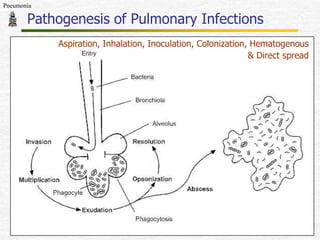
Pneumonia

Pathogenesis of Pulmonary Infections
Aspiration, Inhalation, Inoculation, Colonization, Hematogenous
& Direct spread

47
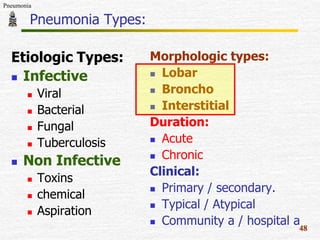
Pneumonia

Pneumonia Types:
Etiologic Types:
 Infective








Viral
Bacterial
Fungal
Tuberculosis

Non Infective





Toxins
chemical
Aspiration

Morphologic types:
 Lobar
 Broncho
 Interstitial
Duration:
 Acute
 Chronic
Clinical:
 Primary / secondary.
 Typical / Atypical
 Community a / hospital a
48
Pneumonia

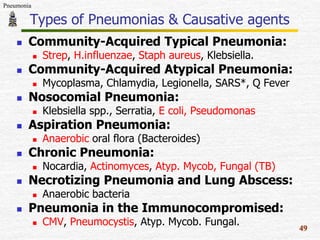
Types of Pneumonias & Causative agents


Community-Acquired Typical Pneumonia:




Community-Acquired Atypical Pneumonia:




Nocardia, Actinomyces, Atyp. Mycob, Fungal (TB)

Necrotizing Pneumonia and Lung Abscess:




Anaerobic oral flora (Bacteroides)

Chronic Pneumonia:




Klebsiella spp., Serratia, E coli, Pseudomonas

Aspiration Pneumonia:




Mycoplasma, Chlamydia, Legionella, SARS*, Q Fever

Nosocomial Pneumonia:




Strep, H.influenzae, Staph aureus, Klebsiella.

Anaerobic bacteria

Pneumonia in the Immunocompromised:


CMV, Pneumocystis, Atyp. Mycob. Fungal.

49
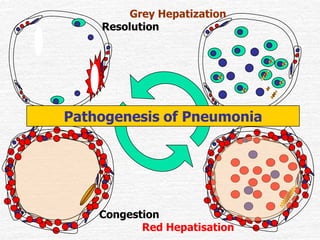
Grey Hepatization
Resolution

Pathogenesis of Pneumonia

Congestion
Red Hepatisation
Pneumonia

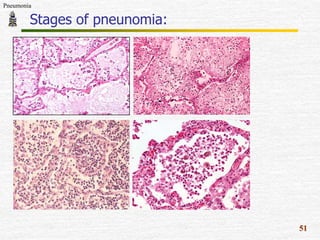
Stages of pneunomia:

51
Pneumonia

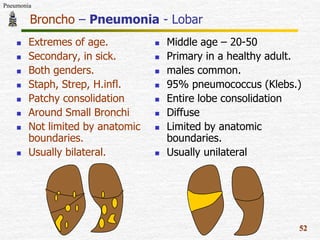
Broncho – Pneumonia - Lobar










Extremes of age.
Secondary, in sick.
Both genders.
Staph, Strep, H.infl.
Patchy consolidation
Around Small Bronchi
Not limited by anatomic
boundaries.
Usually bilateral.











Middle age – 20-50
Primary in a healthy adult.
males common.
95% pneumococcus (Klebs.)
Entire lobe consolidation
Diffuse
Limited by anatomic
boundaries.
Usually unilateral

52
Pneumonia

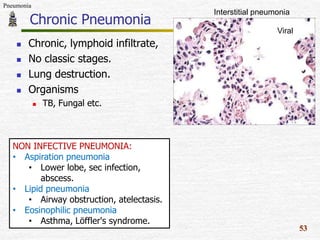
Chronic Pneumonia

Interstitial pneumonia
Viral






Chronic, lymphoid infiltrate,
No classic stages.
Lung destruction.
Organisms


TB, Fungal etc.

NON INFECTIVE PNEUMONIA:
• Aspiration pneumonia
• Lower lobe, sec infection,
abscess.
• Lipid pneumonia
• Airway obstruction, atelectasis.
• Eosinophilic pneumonia
• Asthma, Löffler's syndrome.

53
The ability to concentrate and to use your
time well is everything if you want to
succeed in business, or anywhere else for
that matter!
-- Lee Iacocca
CPC15: Week overview:
2013 Term 1 CPC 5 Title: Respiratory 2/2 - Asthma & COPD
System: Respiratory System
Aim: To train students in :
Clinical, Pathology and Population studies of patients with
Upper Airway Disease Processes. Asthma, Chronic Cough,
Emphysema, COPD, Chronic Bronchitis and Acute
Bronchitis. [Epiglottitis, Croup]
Objectives: 1. History taking & clinical examination of patients with
obstructive airway disease, upper airway disease.
2. Physical examination of Respiratory system.
3. Review of Basic sciences relating to structure and
function of lungs. Blood gas physiology, measurement
of blood gasses and lung function tests,
4. Pathophysiology of acute upper airway injury.
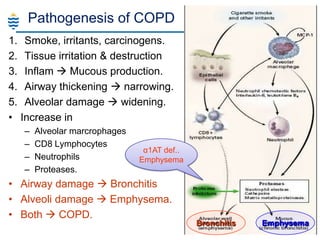
Pathogenesis of COPD
1. Smoke, irritants, carcinogens.
2. Tissue irritation & destruction
3. Inflam  Mucous production.
4. Airway thickening  narrowing.
5. Alveolar damage  widening.
• Increase in
–
–
–
–

Alveolar marcrophages
CD8 Lymphocytes
Neutrophils
Proteases.

α1AT def..
Emphysema

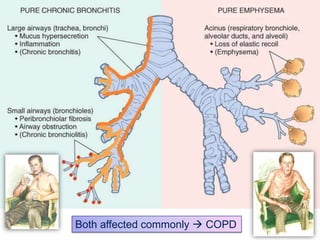
• Airway damage  Bronchitis
• Alveoli damage  Emphysema.
• Both  COPD.

Bronchitis

Emphysema
Both affected commonly  COPD
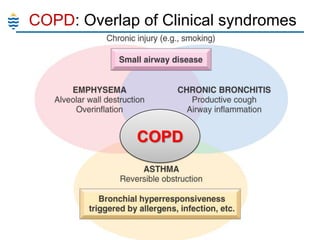
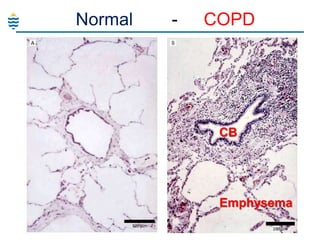
COPD: Overlap of Clinical syndromes

COPD
Normal

-

COPD

CB

Emphysema
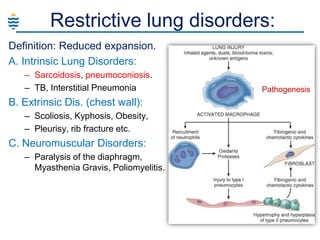
Restrictive lung disorders:
Definition: Reduced expansion.
A. Intrinsic Lung Disorders:
– Sarcoidosis, pneumoconiosis.
– TB, Interstitial Pneumonia

B. Extrinsic Dis. (chest wall):
– Scoliosis, Kyphosis, Obesity,
– Pleurisy, rib fracture etc.

C. Neuromuscular Disorders:
– Paralysis of the diaphragm,
Myasthenia Gravis, Poliomyelitis.

Pathogenesis
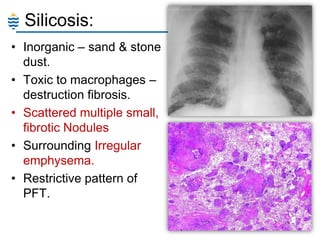
Silicosis:
• Inorganic – sand & stone
dust.
• Toxic to macrophages –
destruction fibrosis.
• Scattered multiple small,
fibrotic Nodules
• Surrounding Irregular
emphysema.
• Restrictive pattern of
PFT.
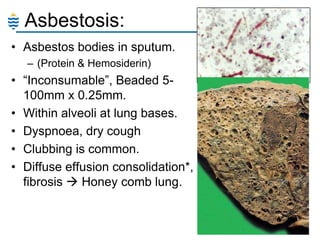
Asbestosis:
• Asbestos bodies in sputum.
– (Protein & Hemosiderin)

• ―Inconsumable‖, Beaded 5100mm x 0.25mm.
• Within alveoli at lung bases.
• Dyspnoea, dry cough
• Clubbing is common.
• Diffuse effusion consolidation*,
fibrosis  Honey comb lung.
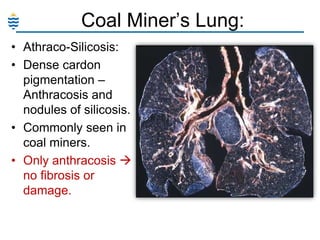
Coal Miner‘s Lung:
• Athraco-Silicosis:
• Dense cardon
pigmentation –
Anthracosis and
nodules of silicosis.
• Commonly seen in
coal miners.
• Only anthracosis 
no fibrosis or
damage.
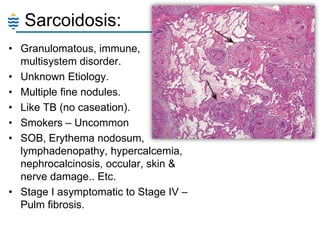
Sarcoidosis:
• Granulomatous, immune,
multisystem disorder.
• Unknown Etiology.
• Multiple fine nodules.
• Like TB (no caseation).
• Smokers – Uncommon
• SOB, Erythema nodosum,
lymphadenopathy, hypercalcemia,
nephrocalcinosis, occular, skin &
nerve damage.. Etc.
• Stage I asymptomatic to Stage IV –
Pulm fibrosis.
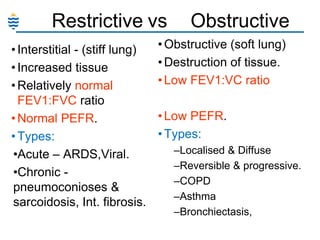
Restrictive vs
• Interstitial - (stiff lung)

• Increased tissue
• Relatively normal
FEV1:FVC ratio
• Normal PEFR.
• Types:
•Acute – ARDS,Viral.
•Chronic pneumoconioses &
sarcoidosis, Int. fibrosis.

Obstructive

• Obstructive (soft lung)
• Destruction of tissue.
• Low FEV1:VC ratio
• Low PEFR.
• Types:
–Localised & Diffuse
–Reversible & progressive.
–COPD
–Asthma
–Bronchiectasis,
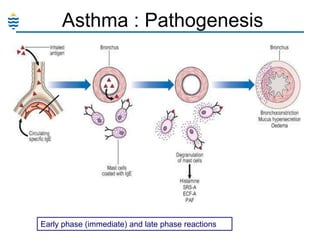
Asthma : Pathogenesis

Early phase (immediate) and late phase reactions
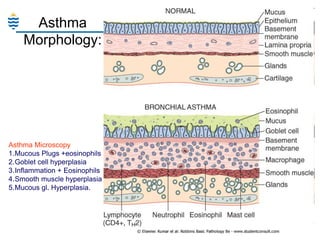
Asthma
Morphology:

Asthma Microscopy
1.Mucous Plugs +eosinophils
2.Goblet cell hyperplasia
3.Inflammation + Eosinophils
4.Smooth muscle hyperplasia
5.Mucous gl. Hyperplasia.
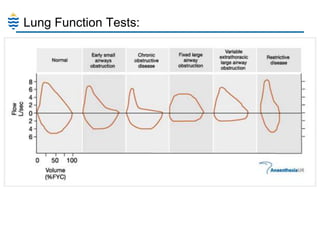
Lung Function Tests:
Whether you think that you can
or that you can't,
you are usually right…!
– Henry Ford
CPC16: Week overview:
2013 Term 1 CPC 6 Respiratory 3/3 – Lung cancer
System: Respiratory System
Aim: To train students in:
Clinical, pathological & population study of patients with lung
cancer & smoking related lung diseases.
Objectives: 1. History taking & clinical examination of patients for chronic lung
disease & smoking (COPD, cancer etc)
2. Physical examination of patient with respiratory symptoms.
3. Pathophysiology of smoking related lung diseases.
4. Pathophysiology of lung cancers.
5. Review of basic sciences relating to structure and function of
lungs. Blood gas physiology, measurement of blood gases and
lung function tests.
6. Pathophysiology of environmental & smoking related cancer
development (carcinogenesis, chemical, radiation, viral etc.)
7. Epidemiology of smoking related disorders in Australia.
8. Role of health promotion, population & community/rural issues
in smoking & work related lung disorders (pneumoconiosis).
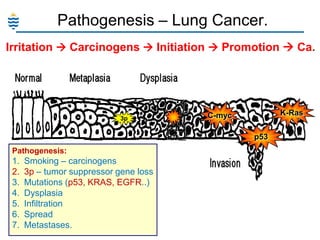
Pathogenesis – Lung Cancer.
Irritation  Carcinogens  Initiation  Promotion  Ca.

3p

K-Ras

C-myc
p53

Pathogenesis:

1.
2.
3.
4.
5.
6.
7.

Smoking – carcinogens
3p – tumor suppressor gene loss
Mutations (p53, KRAS, EGFR..)
Dysplasia
Infiltration
Spread
Metastases.
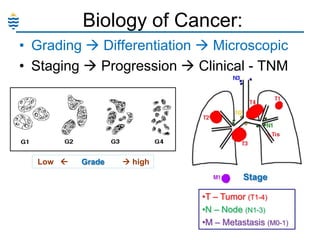
Biology of Cancer:
• Grading  Differentiation  Microscopic
• Staging  Progression  Clinical - TNM

Low 

Grade

 high

Stage
•T – Tumor (T1-4)
•N – Node (N1-3)
•M – Metastasis (M0-1)
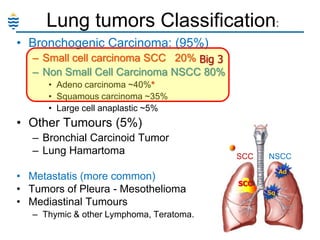
Lung tumors Classification:
• Bronchogenic Carcinoma: (95%)
– Small cell carcinoma SCC 20% Big 3
– Non Small Cell Carcinoma NSCC 80%
• Adeno carcinoma ~40%*
• Squamous carcinoma ~35%
• Large cell anaplastic ~5%

• Other Tumours (5%)
– Bronchial Carcinoid Tumor
– Lung Hamartoma
• Metastatis (more common)
• Tumors of Pleura - Mesothelioma
• Mediastinal Tumours
– Thymic & other Lymphoma, Teratoma.

SCC

NSCC
Ad

SCC
Sq
SCC

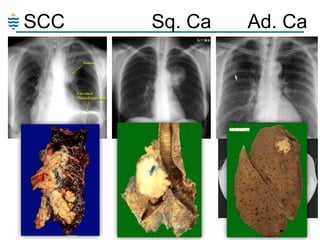
Sq. Ca

Ad. Ca
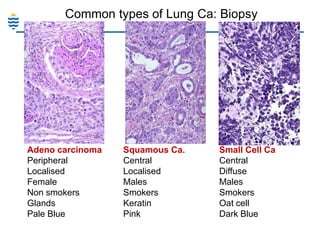
Common types of Lung Ca: Biopsy

Adeno carcinoma
Peripheral
Localised
Female
Non smokers
Glands
Pale Blue

Squamous Ca.
Central
Localised
Males
Smokers
Keratin
Pink

Small Cell Ca
Central
Diffuse
Males
Smokers
Oat cell
Dark Blue
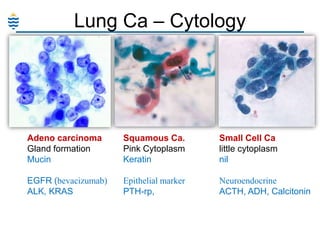
Lung Ca – Cytology

Adeno carcinoma
Gland formation
Mucin

Squamous Ca.
Pink Cytoplasm
Keratin

Small Cell Ca
little cytoplasm
nil

EGFR (bevacizumab)
ALK, KRAS

Epithelial marker
PTH-rp,

Neuroendocrine
ACTH, ADH, Calcitonin
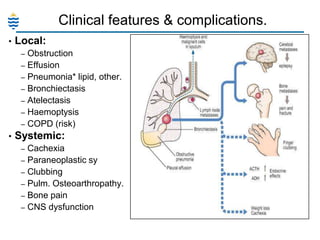
Clinical features & complications.
•

Local:
–

Obstruction
– Effusion
– Pneumonia* lipid, other.
– Bronchiectasis
– Atelectasis
– Haemoptysis
– COPD (risk)
•

Systemic:
–

Cachexia
– Paraneoplastic sy
– Clubbing
– Pulm. Osteoarthropathy.
– Bone pain
– CNS dysfunction
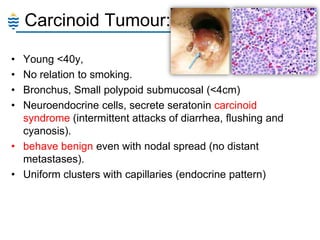
Carcinoid Tumour:
•
•
•
•

Young <40y,
No relation to smoking.
Bronchus, Small polypoid submucosal (<4cm)
Neuroendocrine cells, secrete seratonin carcinoid
syndrome (intermittent attacks of diarrhea, flushing and
cyanosis).
• behave benign even with nodal spread (no distant
metastases).
• Uniform clusters with capillaries (endocrine pattern)
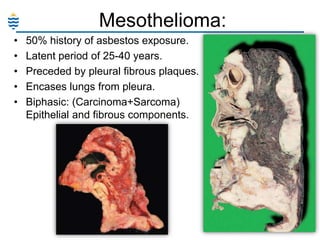
Mesothelioma:
•
•
•
•
•

50% history of asbestos exposure.
Latent period of 25-40 years.
Preceded by pleural fibrous plaques.
Encases lungs from pleura.
Biphasic: (Carcinoma+Sarcoma)
Epithelial and fibrous components.
―A good scare is worth more to
a man than good advice."
- Edgar Watson Howe - Country Town Sayings (1911)

That‘s why we have….

Exams!
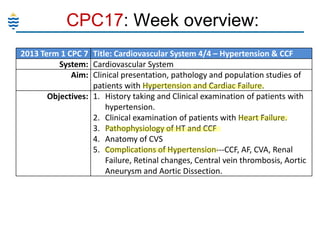
CPC17: Week overview:
2013 Term 1 CPC 7 Title: Cardiovascular System 4/4 – Hypertension & CCF
System: Cardiovascular System
Aim: Clinical presentation, pathology and population studies of
patients with Hypertension and Cardiac Failure.
Objectives: 1. History taking and Clinical examination of patients with
hypertension.
2. Clinical examination of patients with Heart Failure.
3. Pathophysiology of HT and CCF
4. Anatomy of CVS
5. Complications of Hypertension---CCF, AF, CVA, Renal
Failure, Retinal changes, Central vein thrombosis, Aortic
Aneurysm and Aortic Dissection.
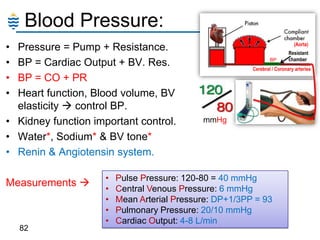
Blood Pressure:
•
•
•
•

Pressure = Pump + Resistance.
BP = Cardiac Output + BV. Res.
BP = CO + PR
Heart function, Blood volume, BV
elasticity  control BP.
• Kidney function important control.
• Water*, Sodium* & BV tone*
• Renin & Angiotensin system.

Measurements 

82

•
•
•
•
•

(Aorta)
BP

Resistant
chamber

Cerebral / Coronary arteries

mmHg

Pulse Pressure: 120-80 = 40 mmHg
Central Venous Pressure: 6 mmHg
Mean Arterial Pressure: DP+1/3PP = 93
Pulmonary Pressure: 20/10 mmHg
Cardiac Output: 4-8 L/min
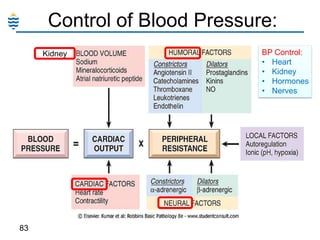
Control of Blood Pressure:
Kidney

83

BP Control:
• Heart
• Kidney
• Hormones
• Nerves
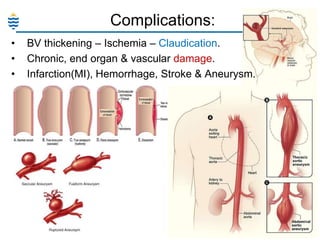
Complications:
•
•
•

BV thickening – Ischemia – Claudication.
Chronic, end organ & vascular damage.
Infarction(MI), Hemorrhage, Stroke & Aneurysm.
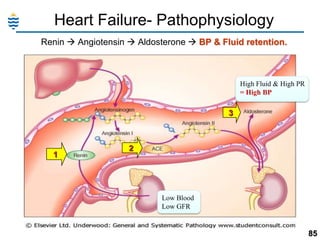
Heart Failure- Pathophysiology
Renin  Angiotensin  Aldosterone  BP & Fluid retention.

High Fluid & High PR
= High BP

3

1

2

Low Blood
Low GFR

85
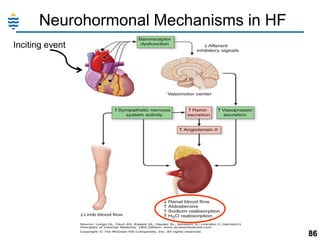
Neurohormonal Mechanisms in HF
Inciting event

86
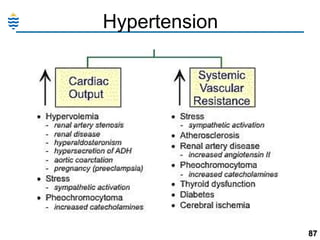
Hypertension

87
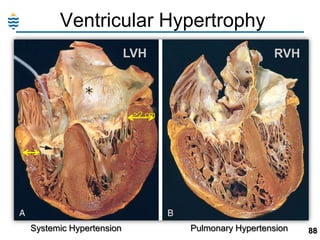
Ventricular Hypertrophy
LVH

RVH

>2 cm

Systemic Hypertension

Pulmonary Hypertension

88
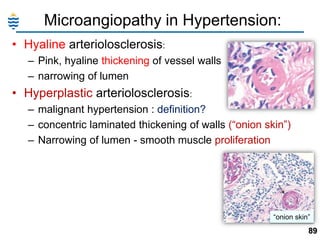
Microangiopathy in Hypertension:
• Hyaline arteriolosclerosis:
– Pink, hyaline thickening of vessel walls
– narrowing of lumen

• Hyperplastic arteriolosclerosis:
– malignant hypertension : definition?
– concentric laminated thickening of walls (―onion skin‖)
– Narrowing of lumen - smooth muscle proliferation

―onion skin‖

89
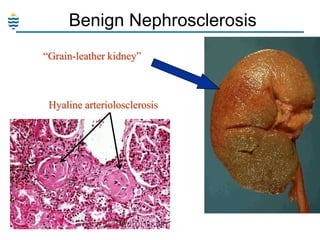
Benign Nephrosclerosis
“Grain-leather kidney”

Hyaline arteriolosclerosis
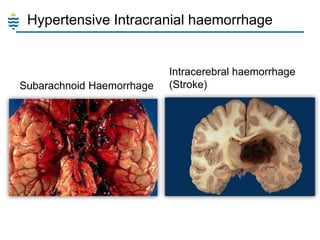
Hypertensive Intracranial haemorrhage

Subarachnoid Haemorrhage

Intracerebral haemorrhage
(Stroke)
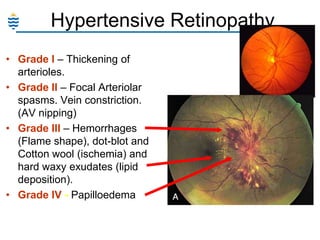
Hypertensive Retinopathy
• Grade I – Thickening of
arterioles.
• Grade II – Focal Arteriolar
spasms. Vein constriction.
(AV nipping)
• Grade III – Hemorrhages
(Flame shape), dot-blot and
Cotton wool (ischemia) and
hard waxy exudates (lipid
deposition).
• Grade IV - Papilloedema
“Intelligence plus character, that is the goal
of true education”
- Martin Luther King Jr.
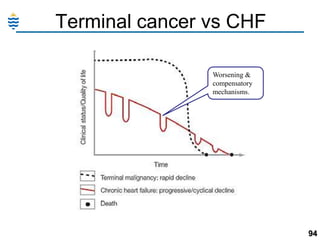
Terminal cancer vs CHF
Worsening &
compensatory
mechanisms.

94
Compensatory Mechanisms:
• Frank-Starling mechanism:
– More stretch – more contraction.

• Neurohumoral activation:
– Vaso constrictors – norepinephrine
– Renin-Angiotensin system.
– Atrial Natriuretic Peptide – (opposite effect)

• Compensatory Hypertrophy of Heart:
– Pathologic Hypertrophy:
• concentric, pressure, high mortality.

– Physiologic Hypertrophy
• Eccentric, Volume, more BV, e.g. exercise.

95
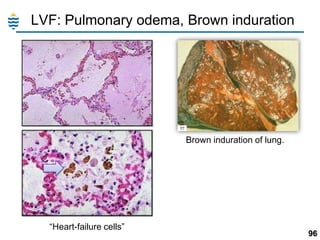
LVF: Pulmonary odema, Brown induration

Brown induration of lung.

―Heart-failure cells‖

96
“To educate a person in the mind but not in
morals is to educate a menace to society.”
-Theodore Roosevelt
What am I doing? - Where am I going?
(Where I want to be in 5 years?)

“Identifying your Goal is like identifying the
North Star, you fix your compass on it and then
use it as the means of getting back on track when
you tend to stray”
-- Marshall Dimock
Wish you all Success,
Health, & Happiness
in life.
Need help for exams?
You can still contact me..

Pathology Review-Term1

  • 1.
    “Find the keyto yourself and every door in the world is open to you” Mother.. Know your Strengths, Weakness, Interests etc..
  • 2.
    Week learning overview: 2013Term 1 CPC 1 Title: Cardiovascular System 1/3 – Valvular Heart Disease System: Cardiovascular System Aim: To train students in: Pathology, Clinical & population study of patients with valvular heart disease. Objectives: 1. History taking & clinical examination of patient with valvular heart disease. 2. Physical examination - heart sounds both normal & abnormal. 3. Pathophysiology of common valve disorders (congenital & acquired) immune and developmental. 4. Review of basic sciences relating to embryogenesis of CVS system, immune system & autoimmunity. 5. Study of population & community/rural issues in rheumatic heart disease. 6. Understanding of cardiomyopathy (pathogenesis, common presentations) 7. Understanding of cyanotic and non-cyanotic congenital heart disease
  • 3.
    2013 CPC-1.1 Ms JM,19-year-old woman living in a remote community who drops out of the local basketball team – Indigenous family from Cape York – one of seven children. Love sports. • ‗Short winded‘ since 6 months, worse since weeks, ‗heart pounding‘, cough – no blood – – – – – – Smokes 5 cigarettes/day, ‗gunja‘ - occasional Lives in a 4 bedroom house with 17 people * fever & arthritis at 9y age*, off school for a month. Brother gets injection every month since years *. FH: Brother and mother have heart problems *... Tall*, young*, JVP 4cm*.
  • 4.
    Summary: ARF Chronic RHD Pancarditis +systemic (skin, joints, CNS)
  • 5.
    ARF Microscopy: Aschoffbody. ARF- Microscopy Aschoff body 1. Necrosis 2. Macrophages 3. T Lymphocytes 4. Giant cells (Near a BV) 1. 2. 3. 4. ARF- Gross Pancarditis Fibrinous Pericarditis Myocarditis Endocarditis Valve Vegetations.
  • 6.
  • 7.
    Congenital Heart Disease: Etiology:Toxic, Gen, infec Pathogenesis: Embryogenesis Morphology: Clinical: AT BIRTH (%) • Ventricular Septal Defect • Atrial Septal Defect • Pulmonary Stenosis • Patent Ductus Arteriosus • Fallot‘s Tetralogy • Coarctation Of Aorta 42* 10 8 7 5 5 Classification: LR Shunts: ASD, VSD & PDA. RL Shunts: Fallot‘s, Trans.GA. Obstructions: COA, PS. Adults ASD VSD FT COA %* 47 34 11 10
  • 8.
    Infective Endocarditis: Intro: ABE-Staph, SBE- Strep Etiology: Abnormal valve, infec Pathogenesis: Embryogenesis Morphology: Valve destruction, bacterial growth. Clinical: Fever, flu, murmur, petechiae. NON INFECTIVE VALVE DISORDERS: • Non bacterial thrombotic..NBTE – marantic. • Libman-Sacks endocarditis – autoimmune – APL sy. • Endocardial myofibrosis in Carcinoid syndrome. Prosthetic valves – Mech/Bio, infec, thromb, hemolysis.
  • 9.
    Aortic valve calcification: •most common cause of aortic stenosis. • Etiology: calcification from progressive age-associated "wear and tear". • More in Congenital bicuspid aortic valve, Rheumatic (10%). • Pathology: • Thick, irregular, fibrosed, with nodules of calcification. • LVH & Failure. LVH
  • 10.
    Cardiomyopathy: • Intrinsic myocardial dysfunction,Primary structural abnorm. • Congenital / Acquired. • Types: – Dilated 90% – Hypertrophic – Restrictive. 10
  • 11.
    “Some people grumblethat roses have thorns; I am grateful that thorns have roses.” -- Alphonse Karr Look for good in others, no one is without faults & every one has some good quality!
  • 12.
    CPC12: Week overview: 2013Term 1 CPC 2 Title: Cardiovascular System 2/4 – IHD System: Cardiovascular System Aim: To train students in: Basic Pathology, clinical skills & population study of patients with ischaemic heart disease. Objectives: 1. History taking & clinical examination of patient with Acute Coronary Syndrome (ACS). 2. Pathophysiology of ischaemic heart disease. 3. Review of Basic sciences relating to CVS – Anatomy, Physiology. 4. Study of Population & community/rural issues in life style associated diseases.
  • 13.
    CPC13-1.2 – Chestpain. Mrs. J.B 45 year old Aboriginal woman Presents for an urgent visit complaining of SOB, ‗oppressive feeling‘ in her chest • While climbing steps* 15-20min, Pale, unwell, no pain now. Burning sensation in her neck. • Similar episodes - 2y, more frequent now. Centre of sternum, no radiation* • ↑Exertion, stress - ↓rest* • HPTN 15y, Dyslipidemia 8y, GORD 7y, • P/H: Chest pain, weak heart, no blocks. • F/H: Smoker, 1pack/day 25y, IHD, DM2,
  • 14.
    Pathogenesis: 1. intimal injury(at bifurcations) 2. Inflammatory cells & macrophages. 3. Lipid deposition, Central Necrosis, more inflammation (soft plaque) 4. Fibrosis, smooth muscle proliferation (hard plaque) 5. Complications – activaton, Thrombosis, embolism, aneurism, dissection & rupture.
  • 15.
    DANGER FACTORS Plaque Biology:SMC. •Low • Thin cap. • High Inflammation. • Large lipid core.
  • 16.
  • 17.
  • 18.
    IHD Pathogenesis: Coronary block: •<70% - Asymptomatic. • >70-75% - Stable Angina (exersion) • 90% - Fixed stenosis (rest) Chronic IHD • Plaque change: (ACS) – Rupture, fissure, ulcer, thromb/embolism. – Unstable angina, MI / SCD Stable Unstable
  • 19.
    Common Sites: • LargeBV : Aorta, Carotid & Iliac. (large vessels) – Bruit. • Medium BV : Coronary, Cerebral, Limbs, viscera – ischemia. Why? * AS never affects veins or small arteries. * Microangiopathy is not due to AS * AS is not a risk factor for DVT * Alcohol is not a risk factor for AS. * LDL is not bad type of cholesterol*
  • 20.
    No Q wave- Q wave Why spared?
  • 21.
    What is importantin this world is not where we are, but in which direction we are moving. -- Oliver Wendell Holmes, Jr.
  • 22.
    Location of MI& Involved Coronary A.
  • 23.
    Morphology - Gross& Microscopic Time (approx) GROSS MICROSCOPY Up to 4 hour None None (loss of glycogen/LDH) 4 - 24 hours Gradually deepening dark area surrounded by erythema. Oedema. Beginning coagulation necrosis contraction bands. Pyknotic nuclei, Oedema, few acute inflammatory cells. 3-7 days Pale / Yellow centre with haemorrhagic border Obvious necrosis of muscle and plenty of Neutrophils hemorrhage (more if reperfusion injury) few macrophages. 1-3 weeks Pale, thin (loss of tissue mass) pale grey area with red border. No muscle, Granulation tissue, macrophages prominent capillaries, fibroblasts. 3-6 weeks (permanent) Small Silvery white scar . Replacement of granulation tissue by dense fibrosis
  • 24.
  • 25.
    MI – stages. Normal 1-3wk Granulation <1day Coagulative necrosis 3-6 wk Scar <7 days Acute inflam. 3-6wk scar.
  • 26.
    Complications of MI: AAnterior myocardial rupture . B Rupture ventricular septum C Rupture papillary muscle. D Fibrinous pericarditis (dark, rough) E Thinning and mural thrombus. F aneurysm
  • 27.
    “Be like apostage stamp” Stick to one thing until you get there...! - Josh Billings…
  • 28.
    2013 Term 1Title: Cardiovascular 3/4 - PVD CPC 3 System: Cardiovascular System, Skin Aim: To train students in : Clinical, Pathology & population study of patients with arterial + venous disorders + skin lesions. Objectives: 1. History taking & clinical examination of patients with peripheral vascular disease 2. Clinical examination of peripheral circulation. 3. Clinical examination of skin & skin lesions. 4. Pathophysiology of common arterial and venous disorders. Atherosclerosis & Deep vein thrombosis. 5. Pathophysiology of common skin disorders Infection, inflammation & malignancy. (Review MB3-TIN) 6. Pathophysiology of Ischemia, infarction, and necrosis. (Review MB3-TIN) 7. Review of Basic sciences relating to structure and function of blood vessels. Fluid balance and dynamics of micro capillary circulation & Pathophysiology of oedema formation. 8. Epidemiology of lifestyle diseases, population & community/rural issues in life style disorders specifically atherosclerosis.
  • 29.
    Chronic leg ulcers:DD • • • • • • Venous : Varicose veins, Thrombophlebitis. Arterial : Atherosclerosis, Diabetes*. Neuropathic : Diabetes* Malignancy : BCC, SCC, MM Infections : leprosy, TB, Treponemal, (Yaws) Others : Dermatitis, Vasculitis, Lymphedema.. Leg ulcers 1%  Venous 80% - Arterial 10% * RACGP
  • 30.
    Venous ulcers: (Wet,Bleeding, Dermatitis. • Cause: Varicose veins. • Location: Gaiter region. • Features: – large, irregular, shallow. – Wet edematous, oozing. – Moist granulating base – bleeds on touch. – Surrounding eczematous stasis dermatitis. – Mild pain, relieved by elevation. – Compression bandage helps.
  • 31.
    Arterial Ulcers: (Dry& Painful) • Cause: AS (PVD, DM2) • Location: distal & dorsal foot or toes. • Features: – Cold, pale feet, absent or weak pulses. – Dry, Irregular clear border, grey black necrotic. – Pale granulation, Does not bleed on touch. – Painful (Nocturnal) partly relieved by dependency. – Skin: Shiny, loss of hair – atrophy. * Note: Angiogram, no compression bandage..
  • 32.
    Neuropathic ulcers: (Clean,Caving, Callus) • Cause: Nerve damage. • Location: Distal leg, pressure points. • Features: – Punched-out ulcers, deep caving. – Frequently painless, loss or weak pulses. – Often with surrounding calluses (hyperkeratosis) – Probing or debriding leads to brisk bleeding. – May also have Impaired sensation and diminished positional sense or 2-point discrimination.
  • 33.
    Malignant ulcers: (Exposed,tumour) • Cause: UV-rays, Idiopathic. • Location: Sun exposed*. • Features: (remember ABCDE…!) – irregular, Punched-out, deep, caving or with tumour. – Frequently painless. – Lymphnodes, spreading, metastases. – Cancer cachexia – weight loss etc.
  • 34.
    Infectious ulcers: multiple, •Cause: TB, Treponema (Yaws, Pinta), etc. • Location: not particular, multiple. • Features: – irregular, non specific. – Lymphadenitis.
  • 35.
    DVT: Typical ClinicalHistory: • 34 year male – sudden chest pain and collapse while recovering 12 days after orthopaedic surgery for comminuted # of femur. • 68 year male AS, past MI, chest pain following 24 hour flight travel. • 28 year female, recurrent abortions. • 54 year obese female, tender calf muscles. • Pregnancy, OCP, flight, surgery,
  • 36.
    Risk Factors forDVT • Virchow‘s triad: (Flow– Blood - Vessel) – Stasis, Hypercoagulability & BV injury. • Stasis (flow) – Immobilization, paralysis, in-patients, heart failure. • Hypercoagulability (Blood): – – – – Congenital: AT III, Protein-C/S deficiency, F V Leiden Acquired: Lupus & anti cardiolipin anticoagulants, Drugs, Oral contraceptives, Hyperhomocysteinemia. Hyperviscosity – Polycythemia, paraproteins. • Tissue damage (Vessel): – Surgery, Trauma, MI, Stroke, Malignancy, Phlebitis.
  • 37.
    Varicose Veins: • Tortuoussuperficial veins due to valve defect in deep veins of lower limb. • Congenital / Acquired. • Tortuous prominent veins. • Gaiter region. • Thrombosis & ulceration. • Over Medial malleolus. • Note: No DVT* or PE*
  • 38.
    Leg Veins &varicosity:
  • 39.
  • 40.
    Raynaud‘s Phenomenon: • • • • Vasoconstriction ofdigital arteries. Cold/emotional trigger. Primary: R.disease – genetic 3-5% Secondary: Vasculitis, SLE, Buergers, atherosclerosis, cold Ab hemolytic anemia etc. Pallor Cyanosis
  • 41.
    Polyarteritis nodosa: • Rare,Immune, HBs ag. • Systemic vasculitis with necrotizing inflammation. • Nodules over arteries. • Acute fever, muscle & joint pain, asymetric polyarthritis • Malaise rash & weight loss. • Neuropathy, kidney failure,. • High ESR, CRP, WBC. • Treat: Immunosuppression.
  • 42.
    Wegener‘s granulomatosis: Granulomatous inflammationaround small vessels with epitheloid cells and giant cells. Lung specimen showing cavitating grey white lesions. (similar to TB)
  • 43.
    Buerger‘s Disease: • Thromboangiitis obliterans •Strong association with smoking. • Common Males, Jews. • Peripheral gangrene • Small artery in limbs thrombosis & fibrosis. • Also involves veins & surrounding tissue.
  • 44.
    Giant cell arteritis: AortaTemporal Art. Nodular segmental thickening, Most common in adults, T-cell Granuloma + Giant cells, Ophthalmic artery  blindness
  • 45.
    That person whodeclares that there is always something wrong is always doing something to make things wrong. — Christian Larson
  • 46.
    CPC14: Week overview: 2013Term 1 Title: Respiratory 1/3 - Pneumonia CPC 4 System: Respiratory System Aim: To train students in : Clinical, Pathology & population study of patients with pneumonia COPD, and pneumoconiosis. Objectives: 1. History taking & clinical examination of patients with a chronic lung disease (COPD, asthma, TB, fungal & other chronic infections) and acute infection (pneumonia). 2. Review of Basic sciences relating to structure and function of lungs. Blood gas physiology, measurement of blood gasses and lung function tests, sputum cytology and serology in lung infection. 3. Pathology of chronic obstructive airway disorders. 4. Pathophysiology of acute respiratory infection. 5. Pathophysiology of occupational, environmental & smoking related lung disorders. 6. Pathophysiology of common and important rare causes of pneumonia, particularly tropical illnesses. 7. Physical examination of Respiratory system. 8. Complications of pneumonia. 9. Interpretation of Chest X-rays. 10. Epidemiology of pneumonia in Australia, South East Asia and The Tropics. 11. Role of health promotion, screening, public health in acute and chronic pneumonic conditions. 12. Smoking & lung disease. Role of health promotion, Population & community/rural issues in smoking & work related lung disorders (pneumoconiosis).
  • 47.
    Pneumonia Pathogenesis of PulmonaryInfections Aspiration, Inhalation, Inoculation, Colonization, Hematogenous & Direct spread 47
  • 48.
    Pneumonia Pneumonia Types: Etiologic Types: Infective      Viral Bacterial Fungal Tuberculosis Non Infective    Toxins chemical Aspiration Morphologic types:  Lobar  Broncho  Interstitial Duration:  Acute  Chronic Clinical:  Primary / secondary.  Typical / Atypical  Community a / hospital a 48
  • 49.
    Pneumonia Types of Pneumonias& Causative agents  Community-Acquired Typical Pneumonia:   Community-Acquired Atypical Pneumonia:   Nocardia, Actinomyces, Atyp. Mycob, Fungal (TB) Necrotizing Pneumonia and Lung Abscess:   Anaerobic oral flora (Bacteroides) Chronic Pneumonia:   Klebsiella spp., Serratia, E coli, Pseudomonas Aspiration Pneumonia:   Mycoplasma, Chlamydia, Legionella, SARS*, Q Fever Nosocomial Pneumonia:   Strep, H.influenzae, Staph aureus, Klebsiella. Anaerobic bacteria Pneumonia in the Immunocompromised:  CMV, Pneumocystis, Atyp. Mycob. Fungal. 49
  • 50.
    Grey Hepatization Resolution Pathogenesis ofPneumonia Congestion Red Hepatisation
  • 51.
  • 52.
    Pneumonia Broncho – Pneumonia- Lobar         Extremes of age. Secondary, in sick. Both genders. Staph, Strep, H.infl. Patchy consolidation Around Small Bronchi Not limited by anatomic boundaries. Usually bilateral.         Middle age – 20-50 Primary in a healthy adult. males common. 95% pneumococcus (Klebs.) Entire lobe consolidation Diffuse Limited by anatomic boundaries. Usually unilateral 52
  • 53.
    Pneumonia Chronic Pneumonia Interstitial pneumonia Viral     Chronic,lymphoid infiltrate, No classic stages. Lung destruction. Organisms  TB, Fungal etc. NON INFECTIVE PNEUMONIA: • Aspiration pneumonia • Lower lobe, sec infection, abscess. • Lipid pneumonia • Airway obstruction, atelectasis. • Eosinophilic pneumonia • Asthma, Löffler's syndrome. 53
  • 54.
    The ability toconcentrate and to use your time well is everything if you want to succeed in business, or anywhere else for that matter! -- Lee Iacocca
  • 55.
    CPC15: Week overview: 2013Term 1 CPC 5 Title: Respiratory 2/2 - Asthma & COPD System: Respiratory System Aim: To train students in : Clinical, Pathology and Population studies of patients with Upper Airway Disease Processes. Asthma, Chronic Cough, Emphysema, COPD, Chronic Bronchitis and Acute Bronchitis. [Epiglottitis, Croup] Objectives: 1. History taking & clinical examination of patients with obstructive airway disease, upper airway disease. 2. Physical examination of Respiratory system. 3. Review of Basic sciences relating to structure and function of lungs. Blood gas physiology, measurement of blood gasses and lung function tests, 4. Pathophysiology of acute upper airway injury.
  • 56.
    Pathogenesis of COPD 1.Smoke, irritants, carcinogens. 2. Tissue irritation & destruction 3. Inflam  Mucous production. 4. Airway thickening  narrowing. 5. Alveolar damage  widening. • Increase in – – – – Alveolar marcrophages CD8 Lymphocytes Neutrophils Proteases. α1AT def.. Emphysema • Airway damage  Bronchitis • Alveoli damage  Emphysema. • Both  COPD. Bronchitis Emphysema
  • 57.
  • 58.
    COPD: Overlap ofClinical syndromes COPD
  • 59.
  • 60.
    Restrictive lung disorders: Definition:Reduced expansion. A. Intrinsic Lung Disorders: – Sarcoidosis, pneumoconiosis. – TB, Interstitial Pneumonia B. Extrinsic Dis. (chest wall): – Scoliosis, Kyphosis, Obesity, – Pleurisy, rib fracture etc. C. Neuromuscular Disorders: – Paralysis of the diaphragm, Myasthenia Gravis, Poliomyelitis. Pathogenesis
  • 61.
    Silicosis: • Inorganic –sand & stone dust. • Toxic to macrophages – destruction fibrosis. • Scattered multiple small, fibrotic Nodules • Surrounding Irregular emphysema. • Restrictive pattern of PFT.
  • 62.
    Asbestosis: • Asbestos bodiesin sputum. – (Protein & Hemosiderin) • ―Inconsumable‖, Beaded 5100mm x 0.25mm. • Within alveoli at lung bases. • Dyspnoea, dry cough • Clubbing is common. • Diffuse effusion consolidation*, fibrosis  Honey comb lung.
  • 63.
    Coal Miner‘s Lung: •Athraco-Silicosis: • Dense cardon pigmentation – Anthracosis and nodules of silicosis. • Commonly seen in coal miners. • Only anthracosis  no fibrosis or damage.
  • 64.
    Sarcoidosis: • Granulomatous, immune, multisystemdisorder. • Unknown Etiology. • Multiple fine nodules. • Like TB (no caseation). • Smokers – Uncommon • SOB, Erythema nodosum, lymphadenopathy, hypercalcemia, nephrocalcinosis, occular, skin & nerve damage.. Etc. • Stage I asymptomatic to Stage IV – Pulm fibrosis.
  • 65.
    Restrictive vs • Interstitial- (stiff lung) • Increased tissue • Relatively normal FEV1:FVC ratio • Normal PEFR. • Types: •Acute – ARDS,Viral. •Chronic pneumoconioses & sarcoidosis, Int. fibrosis. Obstructive • Obstructive (soft lung) • Destruction of tissue. • Low FEV1:VC ratio • Low PEFR. • Types: –Localised & Diffuse –Reversible & progressive. –COPD –Asthma –Bronchiectasis,
  • 66.
    Asthma : Pathogenesis Earlyphase (immediate) and late phase reactions
  • 67.
    Asthma Morphology: Asthma Microscopy 1.Mucous Plugs+eosinophils 2.Goblet cell hyperplasia 3.Inflammation + Eosinophils 4.Smooth muscle hyperplasia 5.Mucous gl. Hyperplasia.
  • 68.
  • 69.
    Whether you thinkthat you can or that you can't, you are usually right…! – Henry Ford
  • 70.
    CPC16: Week overview: 2013Term 1 CPC 6 Respiratory 3/3 – Lung cancer System: Respiratory System Aim: To train students in: Clinical, pathological & population study of patients with lung cancer & smoking related lung diseases. Objectives: 1. History taking & clinical examination of patients for chronic lung disease & smoking (COPD, cancer etc) 2. Physical examination of patient with respiratory symptoms. 3. Pathophysiology of smoking related lung diseases. 4. Pathophysiology of lung cancers. 5. Review of basic sciences relating to structure and function of lungs. Blood gas physiology, measurement of blood gases and lung function tests. 6. Pathophysiology of environmental & smoking related cancer development (carcinogenesis, chemical, radiation, viral etc.) 7. Epidemiology of smoking related disorders in Australia. 8. Role of health promotion, population & community/rural issues in smoking & work related lung disorders (pneumoconiosis).
  • 71.
    Pathogenesis – LungCancer. Irritation  Carcinogens  Initiation  Promotion  Ca. 3p K-Ras C-myc p53 Pathogenesis: 1. 2. 3. 4. 5. 6. 7. Smoking – carcinogens 3p – tumor suppressor gene loss Mutations (p53, KRAS, EGFR..) Dysplasia Infiltration Spread Metastases.
  • 72.
    Biology of Cancer: •Grading  Differentiation  Microscopic • Staging  Progression  Clinical - TNM Low  Grade  high Stage •T – Tumor (T1-4) •N – Node (N1-3) •M – Metastasis (M0-1)
  • 73.
    Lung tumors Classification: •Bronchogenic Carcinoma: (95%) – Small cell carcinoma SCC 20% Big 3 – Non Small Cell Carcinoma NSCC 80% • Adeno carcinoma ~40%* • Squamous carcinoma ~35% • Large cell anaplastic ~5% • Other Tumours (5%) – Bronchial Carcinoid Tumor – Lung Hamartoma • Metastatis (more common) • Tumors of Pleura - Mesothelioma • Mediastinal Tumours – Thymic & other Lymphoma, Teratoma. SCC NSCC Ad SCC Sq
  • 74.
  • 75.
    Common types ofLung Ca: Biopsy Adeno carcinoma Peripheral Localised Female Non smokers Glands Pale Blue Squamous Ca. Central Localised Males Smokers Keratin Pink Small Cell Ca Central Diffuse Males Smokers Oat cell Dark Blue
  • 76.
    Lung Ca –Cytology Adeno carcinoma Gland formation Mucin Squamous Ca. Pink Cytoplasm Keratin Small Cell Ca little cytoplasm nil EGFR (bevacizumab) ALK, KRAS Epithelial marker PTH-rp, Neuroendocrine ACTH, ADH, Calcitonin
  • 77.
    Clinical features &complications. • Local: – Obstruction – Effusion – Pneumonia* lipid, other. – Bronchiectasis – Atelectasis – Haemoptysis – COPD (risk) • Systemic: – Cachexia – Paraneoplastic sy – Clubbing – Pulm. Osteoarthropathy. – Bone pain – CNS dysfunction
  • 78.
    Carcinoid Tumour: • • • • Young <40y, Norelation to smoking. Bronchus, Small polypoid submucosal (<4cm) Neuroendocrine cells, secrete seratonin carcinoid syndrome (intermittent attacks of diarrhea, flushing and cyanosis). • behave benign even with nodal spread (no distant metastases). • Uniform clusters with capillaries (endocrine pattern)
  • 79.
    Mesothelioma: • • • • • 50% history ofasbestos exposure. Latent period of 25-40 years. Preceded by pleural fibrous plaques. Encases lungs from pleura. Biphasic: (Carcinoma+Sarcoma) Epithelial and fibrous components.
  • 80.
    ―A good scareis worth more to a man than good advice." - Edgar Watson Howe - Country Town Sayings (1911) That‘s why we have…. Exams!
  • 81.
    CPC17: Week overview: 2013Term 1 CPC 7 Title: Cardiovascular System 4/4 – Hypertension & CCF System: Cardiovascular System Aim: Clinical presentation, pathology and population studies of patients with Hypertension and Cardiac Failure. Objectives: 1. History taking and Clinical examination of patients with hypertension. 2. Clinical examination of patients with Heart Failure. 3. Pathophysiology of HT and CCF 4. Anatomy of CVS 5. Complications of Hypertension---CCF, AF, CVA, Renal Failure, Retinal changes, Central vein thrombosis, Aortic Aneurysm and Aortic Dissection.
  • 82.
    Blood Pressure: • • • • Pressure =Pump + Resistance. BP = Cardiac Output + BV. Res. BP = CO + PR Heart function, Blood volume, BV elasticity  control BP. • Kidney function important control. • Water*, Sodium* & BV tone* • Renin & Angiotensin system. Measurements  82 • • • • • (Aorta) BP Resistant chamber Cerebral / Coronary arteries mmHg Pulse Pressure: 120-80 = 40 mmHg Central Venous Pressure: 6 mmHg Mean Arterial Pressure: DP+1/3PP = 93 Pulmonary Pressure: 20/10 mmHg Cardiac Output: 4-8 L/min
  • 83.
    Control of BloodPressure: Kidney 83 BP Control: • Heart • Kidney • Hormones • Nerves
  • 84.
    Complications: • • • BV thickening –Ischemia – Claudication. Chronic, end organ & vascular damage. Infarction(MI), Hemorrhage, Stroke & Aneurysm.
  • 85.
    Heart Failure- Pathophysiology Renin Angiotensin  Aldosterone  BP & Fluid retention. High Fluid & High PR = High BP 3 1 2 Low Blood Low GFR 85
  • 86.
    Neurohormonal Mechanisms inHF Inciting event 86
  • 87.
  • 88.
    Ventricular Hypertrophy LVH RVH >2 cm SystemicHypertension Pulmonary Hypertension 88
  • 89.
    Microangiopathy in Hypertension: •Hyaline arteriolosclerosis: – Pink, hyaline thickening of vessel walls – narrowing of lumen • Hyperplastic arteriolosclerosis: – malignant hypertension : definition? – concentric laminated thickening of walls (―onion skin‖) – Narrowing of lumen - smooth muscle proliferation ―onion skin‖ 89
  • 90.
  • 91.
    Hypertensive Intracranial haemorrhage SubarachnoidHaemorrhage Intracerebral haemorrhage (Stroke)
  • 92.
    Hypertensive Retinopathy • GradeI – Thickening of arterioles. • Grade II – Focal Arteriolar spasms. Vein constriction. (AV nipping) • Grade III – Hemorrhages (Flame shape), dot-blot and Cotton wool (ischemia) and hard waxy exudates (lipid deposition). • Grade IV - Papilloedema
  • 93.
    “Intelligence plus character,that is the goal of true education” - Martin Luther King Jr.
  • 94.
    Terminal cancer vsCHF Worsening & compensatory mechanisms. 94
  • 95.
    Compensatory Mechanisms: • Frank-Starlingmechanism: – More stretch – more contraction. • Neurohumoral activation: – Vaso constrictors – norepinephrine – Renin-Angiotensin system. – Atrial Natriuretic Peptide – (opposite effect) • Compensatory Hypertrophy of Heart: – Pathologic Hypertrophy: • concentric, pressure, high mortality. – Physiologic Hypertrophy • Eccentric, Volume, more BV, e.g. exercise. 95
  • 96.
    LVF: Pulmonary odema,Brown induration Brown induration of lung. ―Heart-failure cells‖ 96
  • 97.
    “To educate aperson in the mind but not in morals is to educate a menace to society.” -Theodore Roosevelt
  • 98.
    What am Idoing? - Where am I going? (Where I want to be in 5 years?) “Identifying your Goal is like identifying the North Star, you fix your compass on it and then use it as the means of getting back on track when you tend to stray” -- Marshall Dimock
  • 99.
    Wish you allSuccess, Health, & Happiness in life. Need help for exams? You can still contact me..