Principles of Project Management Jim Cassidy PMP NASA Headquarters
Project Management Terms Project Management Institute ® World wide organization sponsoring project management as a studied discipline >500,000 members http://www.pmi.org/Pages/default.aspx Project Management Professional - PMP ® Education and experience levels required Application and subsequent permission required 200 multiple choice questions on 4 hour test Project Management Body of Knowledge® Currently on 4th edition, 2008 See next slide
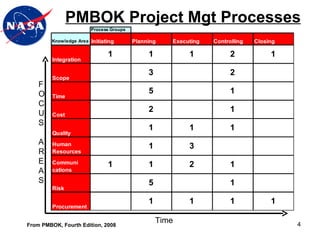
The globally accepted standard of project management knowledge Five process groups: Initiating, Planning, Executing, Controlling, and Closeout Nine knowledge areas: Integration, Scope, Time, Cost, Quality, Human Resources, Communications, Risk, Procurement Forty two project management processes that fit into the 5X9 process groups and knowledge areas Project Management Body of Knowledge - PMBOK ®
PMBOK Project Mgt Processes From PMBOK , Fourth Edition, 2008 Time F O C U S A R E A S
The Project Management Institute’s   definition of a project is: “ A project is a temporary endeavor to create a unique product or service.” A project exists in a finite time, has a discrete deliverable, and a definable end point Projects have a deliverable and will end, programs will continue on A project team will be disbanded or recycled You may be working a series of time sequenced projects within the overall program Definition of Project
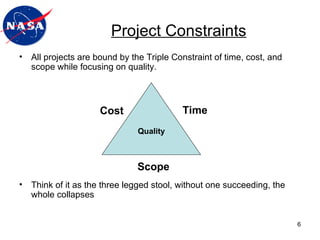
All projects are bound by the Triple Constraint of time, cost, and scope while focusing on quality. Think of it as the three legged stool, without one succeeding, the whole collapses Project Constraints Cost Quality Time Scope
Stakeholders & Customers Ensure you have the stakeholders and customers best interest at all times Are the stakeholders and customers one and the same?  If not, are they in ‘lock-sync’ together in their needs and wants?  If they are not in agreement, what can you do about it? How long has this project been under consideration and planning?  How is its current health?  Is it a good fit for you?
Requirements Definition Requirements Definition – specific questions needing answers: What are the objectives of the project and are they clearly articulated? What are the future objectives that the project will produce? Is there a specific cost constraint driven by a cost-benefits study? What FUNCTIONAL requirements need to be addressed? Describe them in plain language Enhance and strengthen understanding with flow charts and graphics What TECHNICAL requirements will satisfy these functional requirements? Technical requirements flow from functional requirements Technical requirements are written for the project technical staff Ensure that the deliverable will meet or exceed the answers to these questions
Requirements Definition State requirements explicitly and have customers sign off on it Assume and be prepared that requirements will be misinterpreted Recognize and plan on there being changes to the requirements and hence the overall project.  Then monitor changes and manage them Include visual aids with the requirements Graphics Flow charts Wiring diagrams Flip charts Educate both the project staff and customers regarding problems of interpretation and specifying requirements
A project charter documents the business needs, customer needs, and provides details about the new product, service, or result of the project’s outcome and can include: ROM budget or budget limitations High level requirements Identify and list constraints What are, if any, the interrelated projects Who are the customers and stakeholders? How do you define the project deliverable? What is/are the acceptance criteria for the deliverable? How will you know when you are complete? What are the external limitations that are imposed on this project? What cost benefit selection criteria created the need for this project? What are the legal limitations of this project? Project Charter
Project Plan Always prepare and use the best project plan possible Defines your project for: Relationship to program goals Stakeholders identity Customer buy-in Staff and team members Details the hand-off to operations and maintenance Reference to the balance of project documents: Scope/SOW, risk management plan, configuration control and change process, time sequenced budget and cost limitations, others
Work Breakdown Structure Work Breakdown Structure, WBS The essential, absolutely necessary method of working with a project Breaks the project into (usually) its functional pieces Smallest WBS’s are the actionable items, the deliverables Anything above the last WBS are steps along the way A WBS is not the same as a staffing chart The essential tool for: Building a schedule: Performing time sequenced and precursor events Determines critical path Determines slack areas Performing a cost estimate Laying in a baseline for Earned Value Management Visualizing work packages
Schedule Analysis and Control Schedule analysis and control Slack/reserve/float, know where it is and jealously guard it Critical path Managing and selling reserve Crashing and fast tracking Methodologies that can shorten schedule duration Will cost the project to employ and often introduces inefficiencies
Scope Verification & Management Scope verification and management Prevent scope creep and ‘gold plating’ Should always be WBS oriented When completed and signed of by Stakeholders, it is THE output of scope definition Signed and finalized it becomes a living document and central to configuration control and change boards Configuration control  Changes will occur and need to be controlled and managed Configuration Control Board (CCB) management Process to nominate and sponsor changes Process to approve and baseline changes
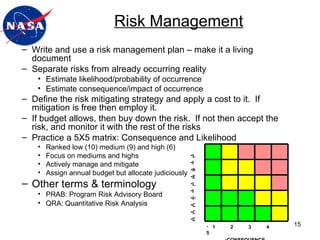
Risk Management Write and use a risk management plan – make it a living document Separate risks from already occurring reality Estimate likelihood/probability of occurrence Estimate consequence/impact of occurrence Define the risk mitigating strategy and apply a cost to it.  If mitigation is free then employ it. If budget allows, then buy down the risk.  If not then accept the risk, and monitor it with the rest of the risks Practice a 5X5 matrix: Consequence and Likelihood Ranked low (10) medium (9) and high (6) Focus on mediums and highs Actively manage and mitigate Assign annual budget but allocate judiciously Other terms & terminology PRAB: Program Risk Advisory Board QRA: Quantitative Risk Analysis 1  2  3  4  5 CONSEQUENCE L I K E L I H O O D
Earned Value Management Earned value management – one of the most effective tools a project manager can use Excellent tool for measuring performance Good source of telling you: How efficient/inefficient have you been in the past Excellent predictor of cost and schedule impacts What your Estimate at Completion will be (something very good to know) Terms and terminology Variances – favorable is positive; unfavorable is negative CV: cost variance SV: schedule variance VAC: variance at completion Performance indices: Favorable is >1.0; unfavorable is < 1.0 CPI: cost performance index SPI: schedule performance index Estimate at completion: EAC can be calculated a number of different ways
Exercise Fictitious company: Acme Spacecraft Builders Risk management/mitigation for power distribution system: accepted at $40K Track the changes/effects on the scope and configuration documents Track the changes/effects on budget as funds are allocated to buy down and mitigate the risk Track the effects on schedule and critical path
Project Management Proverbs At the heart of every large project is a small project trying to get out.  What you don't know hurts you. The bitterness of poor quality lasts long after the sweetness of making a date is forgotten.  A little risk management saves a lot of fan cleaning. The more you plan the luckier you get. Everyone asks for a strong project manger - when they get them they don't want them. Fast - cheap - good - you can have any two.  Anything that can be changed will be changed until there is no time left to change anything.  There is no such thing as scope creep, only scope gallop.  Activity is not achievement.  The road to a ruined project is paved with good intentions.

Cassidy.jim

  • 1.
    Principles of ProjectManagement Jim Cassidy PMP NASA Headquarters
  • 2.
    Project Management TermsProject Management Institute ® World wide organization sponsoring project management as a studied discipline >500,000 members http://www.pmi.org/Pages/default.aspx Project Management Professional - PMP ® Education and experience levels required Application and subsequent permission required 200 multiple choice questions on 4 hour test Project Management Body of Knowledge® Currently on 4th edition, 2008 See next slide
  • 3.
    The globally acceptedstandard of project management knowledge Five process groups: Initiating, Planning, Executing, Controlling, and Closeout Nine knowledge areas: Integration, Scope, Time, Cost, Quality, Human Resources, Communications, Risk, Procurement Forty two project management processes that fit into the 5X9 process groups and knowledge areas Project Management Body of Knowledge - PMBOK ®
  • 4.
    PMBOK Project MgtProcesses From PMBOK , Fourth Edition, 2008 Time F O C U S A R E A S
  • 5.
    The Project ManagementInstitute’s definition of a project is: “ A project is a temporary endeavor to create a unique product or service.” A project exists in a finite time, has a discrete deliverable, and a definable end point Projects have a deliverable and will end, programs will continue on A project team will be disbanded or recycled You may be working a series of time sequenced projects within the overall program Definition of Project
  • 6.
    All projects arebound by the Triple Constraint of time, cost, and scope while focusing on quality. Think of it as the three legged stool, without one succeeding, the whole collapses Project Constraints Cost Quality Time Scope
  • 7.
    Stakeholders & CustomersEnsure you have the stakeholders and customers best interest at all times Are the stakeholders and customers one and the same? If not, are they in ‘lock-sync’ together in their needs and wants? If they are not in agreement, what can you do about it? How long has this project been under consideration and planning? How is its current health? Is it a good fit for you?
  • 8.
    Requirements Definition RequirementsDefinition – specific questions needing answers: What are the objectives of the project and are they clearly articulated? What are the future objectives that the project will produce? Is there a specific cost constraint driven by a cost-benefits study? What FUNCTIONAL requirements need to be addressed? Describe them in plain language Enhance and strengthen understanding with flow charts and graphics What TECHNICAL requirements will satisfy these functional requirements? Technical requirements flow from functional requirements Technical requirements are written for the project technical staff Ensure that the deliverable will meet or exceed the answers to these questions
  • 9.
    Requirements Definition Staterequirements explicitly and have customers sign off on it Assume and be prepared that requirements will be misinterpreted Recognize and plan on there being changes to the requirements and hence the overall project. Then monitor changes and manage them Include visual aids with the requirements Graphics Flow charts Wiring diagrams Flip charts Educate both the project staff and customers regarding problems of interpretation and specifying requirements
  • 10.
    A project charterdocuments the business needs, customer needs, and provides details about the new product, service, or result of the project’s outcome and can include: ROM budget or budget limitations High level requirements Identify and list constraints What are, if any, the interrelated projects Who are the customers and stakeholders? How do you define the project deliverable? What is/are the acceptance criteria for the deliverable? How will you know when you are complete? What are the external limitations that are imposed on this project? What cost benefit selection criteria created the need for this project? What are the legal limitations of this project? Project Charter
  • 11.
    Project Plan Alwaysprepare and use the best project plan possible Defines your project for: Relationship to program goals Stakeholders identity Customer buy-in Staff and team members Details the hand-off to operations and maintenance Reference to the balance of project documents: Scope/SOW, risk management plan, configuration control and change process, time sequenced budget and cost limitations, others
  • 12.
    Work Breakdown StructureWork Breakdown Structure, WBS The essential, absolutely necessary method of working with a project Breaks the project into (usually) its functional pieces Smallest WBS’s are the actionable items, the deliverables Anything above the last WBS are steps along the way A WBS is not the same as a staffing chart The essential tool for: Building a schedule: Performing time sequenced and precursor events Determines critical path Determines slack areas Performing a cost estimate Laying in a baseline for Earned Value Management Visualizing work packages
  • 13.
    Schedule Analysis andControl Schedule analysis and control Slack/reserve/float, know where it is and jealously guard it Critical path Managing and selling reserve Crashing and fast tracking Methodologies that can shorten schedule duration Will cost the project to employ and often introduces inefficiencies
  • 14.
    Scope Verification &Management Scope verification and management Prevent scope creep and ‘gold plating’ Should always be WBS oriented When completed and signed of by Stakeholders, it is THE output of scope definition Signed and finalized it becomes a living document and central to configuration control and change boards Configuration control Changes will occur and need to be controlled and managed Configuration Control Board (CCB) management Process to nominate and sponsor changes Process to approve and baseline changes
  • 15.
    Risk Management Writeand use a risk management plan – make it a living document Separate risks from already occurring reality Estimate likelihood/probability of occurrence Estimate consequence/impact of occurrence Define the risk mitigating strategy and apply a cost to it. If mitigation is free then employ it. If budget allows, then buy down the risk. If not then accept the risk, and monitor it with the rest of the risks Practice a 5X5 matrix: Consequence and Likelihood Ranked low (10) medium (9) and high (6) Focus on mediums and highs Actively manage and mitigate Assign annual budget but allocate judiciously Other terms & terminology PRAB: Program Risk Advisory Board QRA: Quantitative Risk Analysis 1 2 3 4 5 CONSEQUENCE L I K E L I H O O D
  • 16.
    Earned Value ManagementEarned value management – one of the most effective tools a project manager can use Excellent tool for measuring performance Good source of telling you: How efficient/inefficient have you been in the past Excellent predictor of cost and schedule impacts What your Estimate at Completion will be (something very good to know) Terms and terminology Variances – favorable is positive; unfavorable is negative CV: cost variance SV: schedule variance VAC: variance at completion Performance indices: Favorable is >1.0; unfavorable is < 1.0 CPI: cost performance index SPI: schedule performance index Estimate at completion: EAC can be calculated a number of different ways
  • 17.
    Exercise Fictitious company:Acme Spacecraft Builders Risk management/mitigation for power distribution system: accepted at $40K Track the changes/effects on the scope and configuration documents Track the changes/effects on budget as funds are allocated to buy down and mitigate the risk Track the effects on schedule and critical path
  • 18.
    Project Management ProverbsAt the heart of every large project is a small project trying to get out. What you don't know hurts you. The bitterness of poor quality lasts long after the sweetness of making a date is forgotten. A little risk management saves a lot of fan cleaning. The more you plan the luckier you get. Everyone asks for a strong project manger - when they get them they don't want them. Fast - cheap - good - you can have any two. Anything that can be changed will be changed until there is no time left to change anything. There is no such thing as scope creep, only scope gallop. Activity is not achievement. The road to a ruined project is paved with good intentions.

Editor's Notes

  • #3 Founded in 1969 and has experienced phenomenal growth through the 1990’s and into this decade. Credited as an outgrowth of WW2 projects. D-Day invasion Lend lease program and convoy logistics Southern Pacific campaigns Manhattan project and atomic weapons uranium and plutonium PMP has rapidly become a worldwide recognized certification promoted by many corporations and often a key to advancement. Close to 260,000 PMP’s world wide PMBOK is the key to the kingdom and the major PMI success
  • #5 Initiating 2 Planning 21 Executing 7 Controlling 12 Closing 2 Should come as no surprise that planning is the highest quantity group – analogy of paint job. Short cuts i.e. avoid them if possible. Knowing you are avoiding processes and steps is usually the up front planning Not even knowing you should do something is usually in closing
  • #6 You may be juggling numerous projects within your job, or you might be dedicated to a specific project. The key word here is temporary. Programs are most often defined as a collection of projects. Projects can stand alone, or be a means to a definable program deliverable.
  • #7 The Triple Constraint is an often cited concept in projects. A NASA term, better - faster - cheaper is often replied with the quip, “Pick two of them.”
  • #8 Are your stakeholders the funding unit, the “holder of the budget.” Are the customers likely to want or have a definite need for the deliverable. Or, is the deliverable at the whim of the stakeholder and the customer possibly hostile. Has this project just literally taken of the drawing board and rushed into reality? Or perhaps, has it been “knocked around” for a while now? If you are the PM or a member of the tea, is it a good fit for you? Or are you a reluctant participant? If so, then do something about it.
  • #9 PLEASE spend time on these questions and answer them to the best of your knowledge. Can this project be done within the cost constraints of the budget? Or is there empirical evidence that it is cost constrained or mission impossible. Be prepared with flow charts and diagrams as they are always a better representation of functional deliverable and requirements than words. Is there adequate functional requirements? Is the actual Statement of Work readable and a value added document.
  • #10 PLEASE have customers and stakeholders sign off on requirements documents. Be prepared in advance to correct misinterpretations and erroneous assumptions from yourself, the team, stakeholders, and customers. Once there is agreement all around then document it and monitor and manage the changes. Visual aids ARE A MUST! Articulate and educate the PM staff and others on specifying and potentially changing requirements documents. Remember configuration management.
  • #11 The earlier you are part of or the PM on a project, the more this process will aid in the life cycle of the project. Constraints – there are always constraints – internal or external. Interrelated projects – none, some, or many. Does IFMP come to mind? Please know the customers and the stake holders and identify pitfalls. What is the deliverable? Know it inside and out. Know when you are finished and what the approach is to that. External limitations, possibly legal, or possibly they are actually restraints and not constraints. What is your legal position if any regarding staff, policies, approaches, etc.
  • #12 Do not fall into the trap of “I don’t need no stinking project plan.” Or perhaps you think your project is too small. Ha-Ha You will define yourself, the stakeholders, customers, and what you expect of your staff. Every project has a “hand off” to something, somebody, or some process that will own it (O&amp;M). Know what this and plan for it. The project plan is the “tie-in” to all other documents.
  • #13 The bigger the project and more complex, the more a WBS becomes a necessity. The WBS is the basic building block for a project. A functional staffing chart IS NOT A WBS. Absolutely necessary for a cost estimate, time sequenced schedule, and Earned Value Management.