CHAPTER 2
PROJECT LIFE CYCLE AND ORGANIZATION


           Ahmad H. Maharma
                PMP®
PROJECT LIFE CYCLE AND ORGANIZATION


•   Projects and project management take place in an environment
    that is broader than that of the project itself.

•   Understanding this broader context helps ensure that work is
    carried out in alignment with the goals of the enterprise and
    managed in accordance with the established practice
    methodologies of the organization.

•   This chapter describes the basic structure of a p j
             p                                        project as well as
    other important high-level considerations including how projects
    impact ongoing operational work, the influence of stakeholders
    beyond the immediate project team, and how organizational
    structure affects the way the project is staffed, managed, and
    executed.
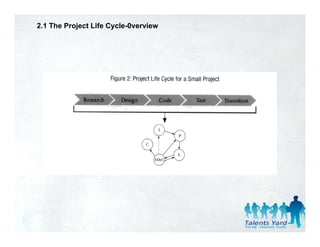
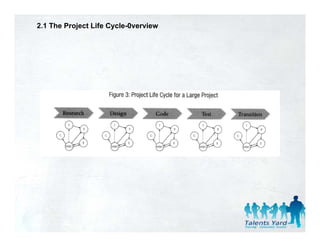
2.1 The Project Life Cycle-0verview


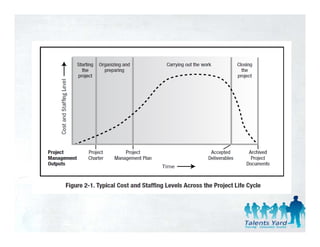
•A project life cycle is a collection of generally sequential and
sometimes overlapping project phases whose name and number are
determined by the management and control needs of the organization
or organizations involved in the project, the nature of the project itself,
and its area of application.

•While every project has a definite start and a definite end, the
specific deliverables and activities that take place in between will vary
widely with the p j
     y          project.

•The life cycle provides the basic framework for managing the project,
regardless of the specific work involved.
2.1 The Project Life Cycle-0verview
2.1.2 Product vs. Project Life Cycle Relationships


The product life cycle consists of generally sequential, non-overlapping
product phases determined by the manufacturing and control need of the
organization.

The last product life cycle phase for a product is generally the product's
retirement. Generally, a project life cycle is contained within one or
more product life cycles.

Care should be taken to distinguish the project life cycle from the product
life cycle.

All projects have a purpose or objective, but in those cases where the
objective is a service or result, there may be a life cycle for the service or
result, not a product life cycle.
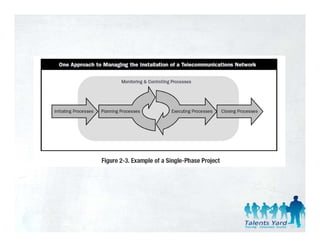
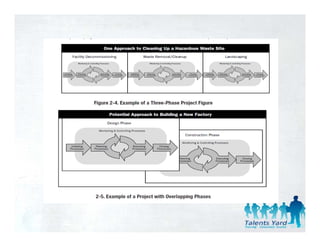
2.1.3 Project Phases


•Project phases are divisions within a project where extra control is
needed to effectively manage the completion of a major deliverable .

• Project phases are typically completed sequentially, but can overlap in
some project situations.

•The high level nature of project phases makes them an element of the
project life cycle.

• A project phase is not a project management process group. Regardless
of the number of phases comprising a project, all phases have similar
characteristics:
Project Phases


When phases are sequential, the close of a phase ends with some form of
transfer or handoff of the work product produced as the phase deliverable.
This phase end represents a natural point to reassess the effort underway
and to change or terminate the project if necessary.

These points are referred to as phase exits, milestones, phase gates,
decision gates stage gates, or kill points The work has a distinct focus that
           gates,      gates        points.
differs from any other phase.

This often involves different organizations and different skill sets. The
primary d li
  i      deliverable or objective of the phase requires an extra d
                 bl      bj i      f h h            i              degree of
                                                                           f
control to be successfully achieved..
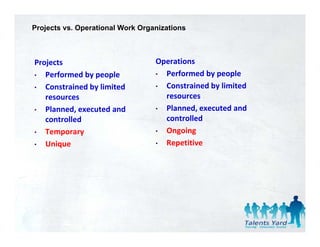
Projects vs. Operational Work Organizations


Projects                          Operations
• Performed by people
   Performed by people            • Performed by people
                                                yp p
• Constrained by limited          • Constrained by limited 
   resources                        resources
• Planned executed and
   Planned, executed and          • Planned executed and
                                    Planned, executed and 
   controlled                       controlled
• Temporary                       • Ongoing

• Unique                          • Repetitive
STAKEHOLDERS
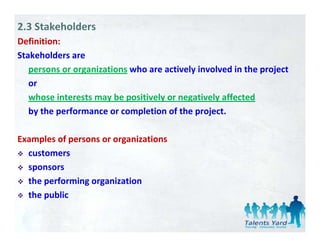
2.3 Stakeholders
Definition:
Stakeholders are 
   persons or organizations who are actively involved in the project 
   or 
   whose interests may be positively or negatively affected
   by the performance or completion of the project. 
   b h       f                l i     f h       j

Examples of persons or organizations
Examples of persons or organizations
  customers
  sponsors
   p
  the performing organization
  the public
2.3 Stakeholders
  Exert influence on the project, its deliverables, and the project 
                         p j ,                    ,         p j
  team members. 

  The project management team must 
      identify both internal and external stakeholders
      in order to determine the 
      in order to determine the
      project requirements and expectations of all parties involved. 

  Furthermore, the project manager must 
  manage the influence of the various stakeholders 
  in relation to the project requirements to ensure a successful 
  outcome. 
2.3 Stakeholders
Concepts:
     p
  Project Team [Members]

  Project Management Team

  Operations Management
        i

  Functional Managers
  Functional Managers
2.3 Stakeholders
Stakeholders Responsibility and Authority:
                p         y             y

  Varying levels when participating on a project 

  Change over the course of the project life cycle. 

  RANGE from occasional contributions to full project sponsorship

  Caution! Can have an adverse IMPACT on the project objectives.
2.3 Stakeholders
Stakeholder Identification:

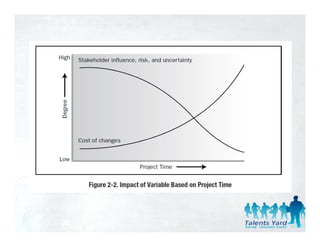
  Stakeholder identification is a continuous process 

  It can be difficult. 

  Identifying stakeholders and understanding their relative degree of 
  influence on a project is critical. Failure to do so can extend the 
  influence on a project is critical. Failure to do so can extend the
  timeline and raise costs substantially. 

  Impact of late recognition of a stakeholder
ORGANIZATIONAL INFLUENCES ON 
      PROJECT MANAGEMENT
      PROJECT MANAGEMENT
ORGANIZATIONAL CULTURES AND STYLES
2.4 Organizational Influences on Project Management
  The organizational culture, style, and structure influence how 
        g                   , y ,
  projects are performed. 

  A project manager should understand these as they affect a project. 

  An organization’s 
  An organization’s
      degree of project management maturity and 
      its project management systems
      its project management systems
  can also influence the project. 

  When a project involves more than one organizations, the project 
  will be influenced all of them. 

  The organizational culture is an enterprise environmental factor.
2.4 Organizational Influences on Project Management
Cultures and styles may have a strong influence on a project’s ability 
               y      y             g                p j             y
  to meet its objectives. 

Cultures and styles are typically known as “cultural norms” 

The “norms” include [Or What do the cultural norms include?]
The “norms” include [Or What do the cultural norms include?]
  a common knowledge regarding how to approach getting the work 
  done, 
  what means are considered acceptable for getting the work done, 
  and 
  who is influential in facilitating the work getting done.
  The project manager must know which individuals in the 
  organization are the decision makers and work with them to 
  organization are the decision makers and work with them to
  influence project success.
2.4 Organizational Influences on Project Management
Most organizations have developed unique cultures that manifest in 
       g                       p       q
 numerous ways including, but not limited to: 
  • Shared visions, values, norms, beliefs, and expectations,
  • Policies, methods, and procedures,
  • View of authority relationships, and
  • Work ethic and work hours.
  • Work ethic and work hours

 Detailed study of  organizational culture is beyond the scope of this
 Detailed study of ‘organizational culture’ is beyond the scope of this 
                                course. 
ORGANIZATIONAL INFLUENCES ON 
   PROJECT MANAGEMENT
   PROJECT MANAGEMENT
 ORGANIZATIONAL STRUCTURE
2.4 Organizational Influences on Project Management

Organizational structure is an enterprise environmental factor

Why it is important to by understood?
It affect the availability of resources and influence how projects are 
conducted. 
conducted

What are the different types of structures?
What are the different types of structures?
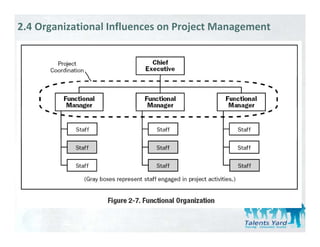
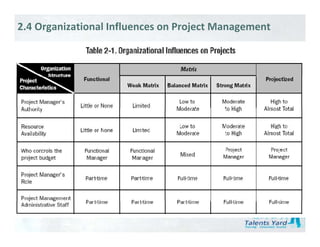
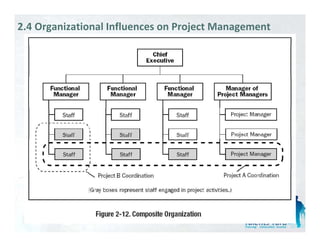
Organizational structures range from functional to projectized, with a 
variety of matrix structures between them. 
  Functional Structure
  Matrix Structures [Weak, Balanced, and Strong]
  Projectized Structure
  P j i dS
2.4 Organizational Influences on Project Management
Functional Organization: Key Points
             g             y
  Each employee has one clear superior [Unity of Command]
  Employees are grouped by specialty [Finance, HR, Marketing etc]
  Each department will do its project work independent of other 
  department. 
2.4 Organizational Influences on Project Management
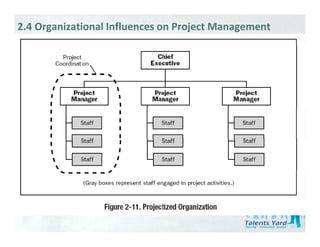
Projectized Organization: Key Points
   j          g             y
  Team members are co‐located

  Most of the organization’s resources are involved in project work

  Project Managers have great deal of independence and authority
     j             h          d l fi d       d       d    h i

  Projectized organizations often have organizational units called 
  Projectized organizations often have organizational units called
  departments, but these groups either report directly to the project 
  manager or provide support services to the various projects. 
2.4 Organizational Influences on Project Management
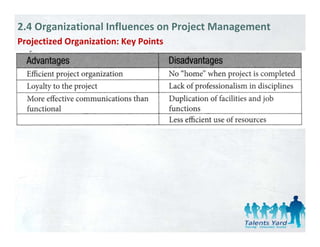
Projectized Organization: Key Points
   j          g             y
2.4 Organizational Influences on Project Management
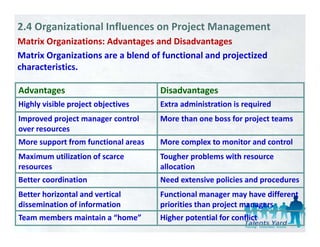
Matrix Organizations: Advantages and Disadvantages
         g                    g                   g
Matrix Organizations are a blend of functional and projectized 
characteristics. 

Advantages                           Disadvantages
Highly visible project objectives
  g y          p j       j           Extra administration is required
                                                               q
Improved project manager control     More than one boss for project teams
over resources
More support from functional areas
             f    f    i   l         More complex to monitor and control
                                              l         i      d       l
Maximum utilization of scarce        Tougher problems with resource 
resources                            allocation
Better coordination                  Need extensive policies and procedures
Better horizontal and vertical       Functional manager may have different 
dissemination of information
                f f                  priorities than project managers
Team members maintain a “home”       Higher potential for conflict
2.4 Organizational Influences on Project Management
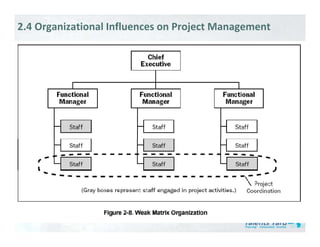
Weak Matrix Organization: Key Points
              g             y
 Maintain many of the characteristics of a functional organization

  Project Manager’s role is more of a coordinator or expediter than 
  that of a true project manager.
2.4 Organizational Influences on Project Management
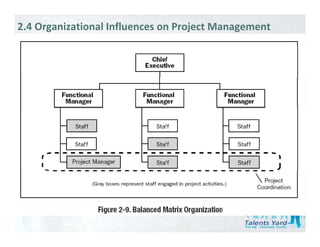
Balanced Matrix Organization: Key Points
                   g             y
  Balanced Matrix organization recognizes the need for a project 
  manager. But it does not provide the project manager with the full 
  authority over the project and project funding. 
     th it       th     j t d       j t f di
2.4 Organizational Influences on Project Management
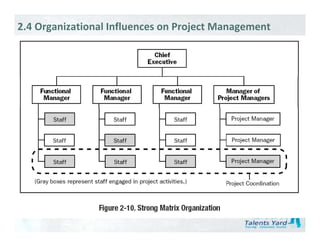
Strong Matrix Organization: Key Points
     g          g             y

  Have many of the characteristics of the projectized organization

  Can have a full‐time project managers with considerable authority

  Can have full‐time project administrative staff
2.4 Organizational Influences on Project Management
Project Expeditor 
   j      p

  Act primarily as staff assistant and communication coordinator 

  Cannot personally make or enforce decision 
2.4 Organizational Influences on Project Management
Project Coordinator 
   j

  Has some power make decision, some authority 

  Report to a high level manager
2.4 Organizational Influences on Project Management
ORGANIZATIONAL INFLUENCES ON 
    PROJECT MANAGEMENT
    PROJECT MANAGEMENT
ORGANIZATIONAL PROCESS ASSETS
2.4 Organizational Influences on Project Management
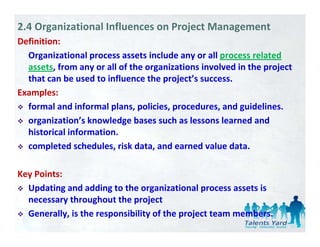
Definition: 
  Organizational process assets include any or all process related 
  assets, from any or all of the organizations involved in the project 
  that can be used to influence the project’s success. 
  th t       b    d t i fl       th      j t’
Examples: 
  formal and informal plans, policies, procedures, and guidelines. 
  formal and informal plans policies procedures and guidelines
  organization’s knowledge bases such as lessons learned and 
  historical information. 
  completed schedules, risk data, and earned value data. 

Key Points:
  Updating and adding to the organizational process assets is 
  necessary throughout the project 
  necessary throughout the project
  Generally, is the responsibility of the project team members. 
2.4 Organizational Influences on Project Management
Categorization: 
    g
Organizational process assets may be grouped into two categories: 

1. Processes and Procedures 
                     >> for conducting work

2. Corporate Knowledge Base 
                    >> for storing and retrieving information 
                    >> for storing and retrieving information
2.4 Organizational Influences on Project Management
Processes and Procedures
  Organizational standard processes such as 
        standards
        policies [safety and health, ethics, and project management] 
        standard product and project life cycles 
        quality policies and procedures [
            li     li i    d       d     [process audits, improvement 
                                                     di i
        targets, checklists, and standardized process definitions for 
                      g
        use in the organization]]

  Standardized guidelines, work instructions, proposal evaluation  
 criteria, and performance measurement criteria

 Templates [risk, work breakdown structure, project schedule 
 Templates [risk work breakdown structure project schedule
 network diagram, and contract templates]
2.4 Organizational Influences on Project Management
Processes and Procedures
  Guidelines and criteria for tailoring the organization’s set of 
  standard processes to satisfy the specific needs of the project;
  Organization communication requirements 
  Project closure guidelines or requirements 
  Financial controls procedures 
  Financial controls procedures
  Issue and defect management procedures
  Change control procedures
  Change control procedures
  Risk control procedures
  Procedures for prioritizing, approving, and issuing work 
  authorizations.
2.4 Organizational Influences on Project Management
Corporate Knowledge Base
    p              g
  Process measurement databases used to collect and make available 
 measurement data on processes and products,
  Project files
  Historical information and lessons learned knowledge bases
  Issue and defect management databases
  Issue and defect management databases
  Configuration management knowledge bases 
  Financial databases
  Financial databases
For more information do not hesitate to contact me.


Ahmad H. Maharma ‐ PMP®

Ramallah, Palestine 
Phone: + (972) (2) 2968644
Phone: + (972) (2) 2968644
Mobile: + (972) (599) 001155
E‐Mail: ahmad.maharma@gmail.com

Pmbok 4th edition chapter 2 - Project Life cycle and Organization