PM DeepDive

The Framework
     - Niraj Agarwal


                       May 2011
                         Slide 1
Agenda
 Business Enterprises – Project, Programs & Operations
 Project Management
 Project Manager
 Project Phases
 Project Life Cycle
 Stakeholders
 Organizational Structures


                                                          May 2011
                                                            Slide 2
Business Enterprises


• Projects—Unique and Temporary. Project Product details are
elaborated progressively.
• Operations—Ongoing and Repetitive. Product details are fully known
before starting the product creation. Example: auto-parts
manufacturing .
• Programs—Combination of both above. They are a series (in a
sequence, one after another) of related but separate Projects and have
ingredients of ongoing operations. Example: Publishing of a weekly
magazine.


                                                                   May 2011
                                                                     Slide 3
Project


• Temporary endeavor undertaken to create a unique product , service or
result.
• Has a definite beginning and end and interrelated activities
• Projects are unique – characteristics are progressively elaborated
  - Progressively: proceeding in steps
  - Elaborated: worked with care and detail
• Scope of project should remain constant even as characteristics are
“progressively elaborated”. For example, the project scope or the product
will be broadly described early in the project and made more explicit and
detailed as the project team develops a better and more complete
understanding of the objectives and deliverables.
• The driving forces that create the stimuli for a project are typically
referred to as problems, opportunities, or business requirements.

                                                                           May 2011
                                                                             Slide 4
Project vs. Operations


Projects                            Operations
• Unique                            • Repeated
• Finite duration-temporary         • Ongoing
• Objective oriented                • Operation oriented
• Require cross-functional skills   • Require functional skills
• Value measured                    • Volume measured


                                                           May 2011
                                                             Slide 5
Programs


• Programs are groups of projects managed in a coordinated way to
obtain benefits not available from managing the projects individually
• Most programs have elements of ongoing operations
  - Series of repetitive or cyclical undertakings
• Projects are often divided into “subprojects” for more manageability
  - Often contracted out to external organizations


                                                                   May 2011
                                                                     Slide 6
Project Management


The application of knowledge, skills, tools and techniques to project
activities in order to meet or exceed stakeholder needs and expectations
from a defined project – balancing the following:
• Scope, time, cost, and quality
• Stakeholders’ expectations
• Requirements (needs) vs. unidentified requirements (expectations)


                                                                   May 2011
                                                                     Slide 7
Project Management
Goals

• Enhance the probability of project success
• Focus on objective - Scope, Time, Cost, Quality
• Effective response to rapid changes
• Manage utilization of resources effectively
• Address stakeholders interests
• Minimize and Manage Risks effectively
• Achieve project goals
• Document Lessons Learnt
• Create re-usable data and information for future use
• Fulfill Stakeholders expectations
• Accomplish Customer Satisfaction!

                                                         May 2011
                                                           Slide 8
Project Manager


• The individual responsible for managing a project and achieving
project goals, requirements and customer satisfaction.
• He/She is in charge of the project and has to direct and coordinate
project effort and has to make all necessary decisions for ensuring
project success.
• He/She has to consistently produce key deliverables.
• As far as the project is concerned, the buck stops at him or her!


                                                                      May 2011
                                                                        Slide 9
Project Management Skills


• General Business Management (consistently producing results
  expected by stakeholders)
• Leading (establishing direction, aligning resources, motivating)
• Communicating (clear, unambiguous, and complete)
• Negotiating (conferring with others to reach an agreement)
• Problem Solving (definition and decision making)
  - Distinguish causes and symptoms
  - Identify viable solutions
• Influencing Organization (understanding power and politics)


                                                                     May 2011
                                                                      Slide 10
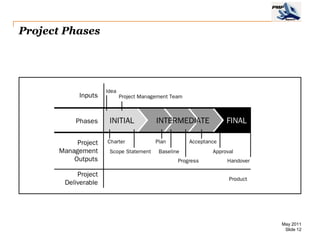
Project Phases


• Project Phases are marked by the completion of a deliverable which is
a tangible, verifiable, measurable work product or output.
• Deliverables from one phase are usually reviewed for completeness
and accuracy and approved before work starts on the next phase.
Phase-end reviews are also called phase exits, phase gates, or kill points
• Set of defined work procedures to establish management control
• Generally in sequential logic, designed to ensure proper definition of
  the product
• Generally a project life-cycle consists of four phases :
     ◦ Concept, Design, Execution/Implementation, Finish or closeout


                                                                     May 2011
                                                                      Slide 11
Project Phases


                 May 2011
                  Slide 12
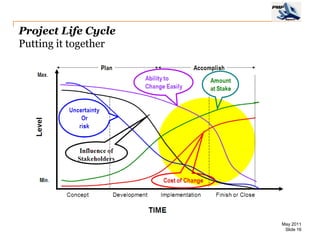
Project Life Cycle


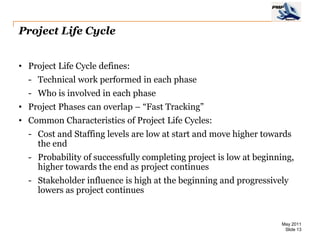
• Project Life Cycle defines:
  - Technical work performed in each phase
  - Who is involved in each phase
• Project Phases can overlap – “Fast Tracking”
• Common Characteristics of Project Life Cycles:
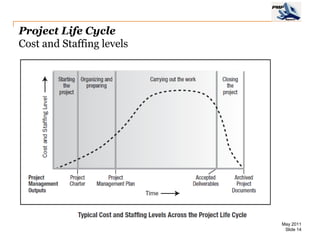
  - Cost and Staffing levels are low at start and move higher towards
    the end
  - Probability of successfully completing project is low at beginning,
    higher towards the end as project continues
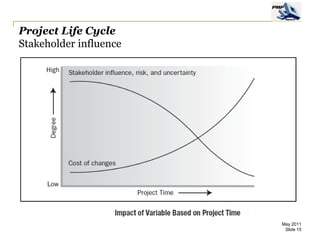
  - Stakeholder influence is high at the beginning and progressively
    lowers as project continues


                                                                   May 2011
                                                                    Slide 13
Project Life Cycle
Cost and Staffing levels


                           May 2011
                            Slide 14
Project Life Cycle
Stakeholder influence


                        May 2011
                         Slide 15
Project Life Cycle
Putting it together


                      May 2011
                       Slide 16
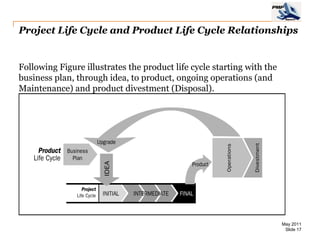
Project Life Cycle and Product Life Cycle Relationships


Following Figure illustrates the product life cycle starting with the
business plan, through idea, to product, ongoing operations (and
Maintenance) and product divestment (Disposal).


                                                                        May 2011
                                                                         Slide 17
Stakeholders


Individuals or Organizations that are directly or indirectly involved
• Positively or Negatively impacted by the outcome of the Project
• Can influence project effort or the outcome of the project effort
• Often have conflicting expectations and objectives
• In general, differences should be resolved in favor of the customer –
  individual(s) or organization(s) that will use the outcome of the
  project
• Stakeholder management is a proactive task
  - Project Mangers must determine all stakeholders and incorporate
    their needs into the project


                                                                        May 2011
                                                                         Slide 18
Organizational Structures


The organization’s structure often constrains the availability of
resources for the project.


• Functional
• Projectized
• Matrix


                                                            May 2011
                                                             Slide 19
Organizational Structures
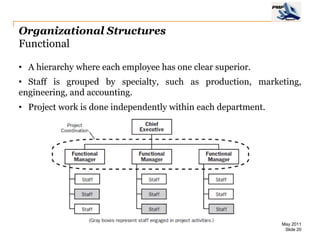
Functional

• A hierarchy where each employee has one clear superior.
• Staff is grouped by specialty, such as production, marketing,
engineering, and accounting.
• Project work is done independently within each department.


                                                               May 2011
                                                                Slide 20
Organizational Structures
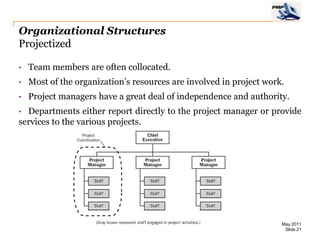
Projectized

•   Team members are often collocated.
•   Most of the organization’s resources are involved in project work.
•   Project managers have a great deal of independence and authority.
• Departments either report directly to the project manager or provide
services to the various projects.


                                                                     May 2011
                                                                      Slide 21
Organizational Structures
Matrix

Maintains the functional (vertical) lines of authority while establishing
a relatively permanent horizontal structure to interact with all
functional units supporting the projects.


• Weak matrix
• Balanced matrix
• Strong matrix


                                                                     May 2011
                                                                      Slide 22
Organizational Structures
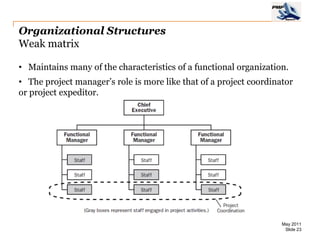
Weak matrix

• Maintains many of the characteristics of a functional organization.
• The project manager’s role is more like that of a project coordinator
or project expeditor.


                                                                    May 2011
                                                                     Slide 23
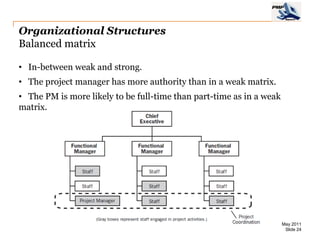
Organizational Structures
Balanced matrix

• In-between weak and strong.
• The project manager has more authority than in a weak matrix.
• The PM is more likely to be full-time than part-time as in a weak
matrix.


                                                                      May 2011
                                                                       Slide 24
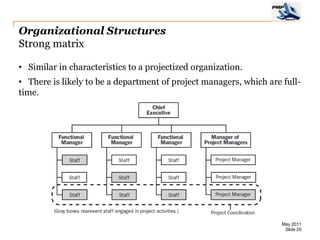
Organizational Structures
Strong matrix

• Similar in characteristics to a projectized organization.
• There is likely to be a department of project managers, which are full-
time.


                                                                    May 2011
                                                                     Slide 25
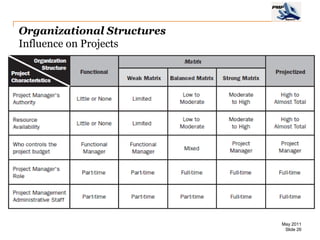
Organizational Structures
Influence on Projects


                            May 2011
                             Slide 26
Pop Quiz
Question 1

What is the definition of a project? Choose two.
A. A group of interrelated activities that create a unique benefit to the
organization
B. Through the use of project management techniques, which are
repeatable processes, a series of actions that are performed to produce
the same result multiple times
C. A temporary endeavor undertaken to create a unique product,
service, or result
D. A process used to generate profit, improve market share, or adhere
to legal requirements
E. A time - constrained endeavor with assigned resources responsible
for meeting the goals of the project according to the quality standards

                                                                      May 2011
                                                                       Slide 27
Pop Quiz
Question 2

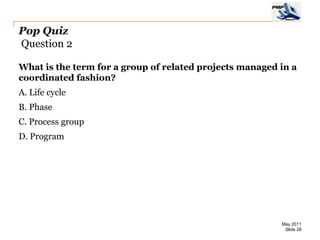
What is the term for a group of related projects managed in a
coordinated fashion?
A. Life cycle
B. Phase
C. Process group
D. Program


                                                         May 2011
                                                          Slide 28
Pop Quiz
Question 3

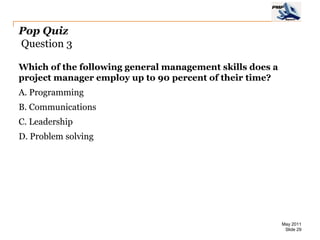
Which of the following general management skills does a
project manager employ up to 90 percent of their time?
A. Programming
B. Communications
C. Leadership
D. Problem solving


                                                          May 2011
                                                           Slide 29
Pop Quiz
Question 4

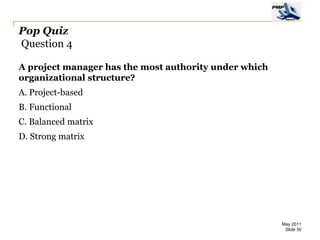
A project manager has the most authority under which
organizational structure?
A. Project-based
B. Functional
C. Balanced matrix
D. Strong matrix


                                                       May 2011
                                                        Slide 30
Pop Quiz
Question 5

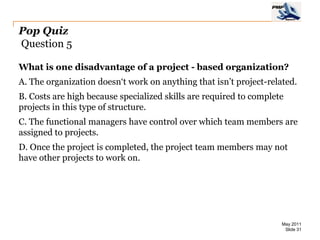
What is one disadvantage of a project - based organization?
A. The organization doesn‘t work on anything that isn’t project-related.
B. Costs are high because specialized skills are required to complete
projects in this type of structure.
C. The functional managers have control over which team members are
assigned to projects.
D. Once the project is completed, the project team members may not
have other projects to work on.


                                                                    May 2011
                                                                     Slide 31
Thank You!

Pm deep dive the framework

  • 1.
    PM DeepDive The Framework - Niraj Agarwal May 2011 Slide 1
  • 2.
    Agenda  Business Enterprises– Project, Programs & Operations  Project Management  Project Manager  Project Phases  Project Life Cycle  Stakeholders  Organizational Structures May 2011 Slide 2
  • 3.
    Business Enterprises • Projects—Uniqueand Temporary. Project Product details are elaborated progressively. • Operations—Ongoing and Repetitive. Product details are fully known before starting the product creation. Example: auto-parts manufacturing . • Programs—Combination of both above. They are a series (in a sequence, one after another) of related but separate Projects and have ingredients of ongoing operations. Example: Publishing of a weekly magazine. May 2011 Slide 3
  • 4.
    Project • Temporary endeavorundertaken to create a unique product , service or result. • Has a definite beginning and end and interrelated activities • Projects are unique – characteristics are progressively elaborated - Progressively: proceeding in steps - Elaborated: worked with care and detail • Scope of project should remain constant even as characteristics are “progressively elaborated”. For example, the project scope or the product will be broadly described early in the project and made more explicit and detailed as the project team develops a better and more complete understanding of the objectives and deliverables. • The driving forces that create the stimuli for a project are typically referred to as problems, opportunities, or business requirements. May 2011 Slide 4
  • 5.
    Project vs. Operations Projects Operations • Unique • Repeated • Finite duration-temporary • Ongoing • Objective oriented • Operation oriented • Require cross-functional skills • Require functional skills • Value measured • Volume measured May 2011 Slide 5
  • 6.
    Programs • Programs aregroups of projects managed in a coordinated way to obtain benefits not available from managing the projects individually • Most programs have elements of ongoing operations - Series of repetitive or cyclical undertakings • Projects are often divided into “subprojects” for more manageability - Often contracted out to external organizations May 2011 Slide 6
  • 7.
    Project Management The applicationof knowledge, skills, tools and techniques to project activities in order to meet or exceed stakeholder needs and expectations from a defined project – balancing the following: • Scope, time, cost, and quality • Stakeholders’ expectations • Requirements (needs) vs. unidentified requirements (expectations) May 2011 Slide 7
  • 8.
    Project Management Goals • Enhancethe probability of project success • Focus on objective - Scope, Time, Cost, Quality • Effective response to rapid changes • Manage utilization of resources effectively • Address stakeholders interests • Minimize and Manage Risks effectively • Achieve project goals • Document Lessons Learnt • Create re-usable data and information for future use • Fulfill Stakeholders expectations • Accomplish Customer Satisfaction! May 2011 Slide 8
  • 9.
    Project Manager • Theindividual responsible for managing a project and achieving project goals, requirements and customer satisfaction. • He/She is in charge of the project and has to direct and coordinate project effort and has to make all necessary decisions for ensuring project success. • He/She has to consistently produce key deliverables. • As far as the project is concerned, the buck stops at him or her! May 2011 Slide 9
  • 10.
    Project Management Skills •General Business Management (consistently producing results expected by stakeholders) • Leading (establishing direction, aligning resources, motivating) • Communicating (clear, unambiguous, and complete) • Negotiating (conferring with others to reach an agreement) • Problem Solving (definition and decision making) - Distinguish causes and symptoms - Identify viable solutions • Influencing Organization (understanding power and politics) May 2011 Slide 10
  • 11.
    Project Phases • ProjectPhases are marked by the completion of a deliverable which is a tangible, verifiable, measurable work product or output. • Deliverables from one phase are usually reviewed for completeness and accuracy and approved before work starts on the next phase. Phase-end reviews are also called phase exits, phase gates, or kill points • Set of defined work procedures to establish management control • Generally in sequential logic, designed to ensure proper definition of the product • Generally a project life-cycle consists of four phases : ◦ Concept, Design, Execution/Implementation, Finish or closeout May 2011 Slide 11
  • 12.
    Project Phases May 2011 Slide 12
  • 13.
    Project Life Cycle •Project Life Cycle defines: - Technical work performed in each phase - Who is involved in each phase • Project Phases can overlap – “Fast Tracking” • Common Characteristics of Project Life Cycles: - Cost and Staffing levels are low at start and move higher towards the end - Probability of successfully completing project is low at beginning, higher towards the end as project continues - Stakeholder influence is high at the beginning and progressively lowers as project continues May 2011 Slide 13
  • 14.
    Project Life Cycle Costand Staffing levels May 2011 Slide 14
  • 15.
    Project Life Cycle Stakeholderinfluence May 2011 Slide 15
  • 16.
    Project Life Cycle Puttingit together May 2011 Slide 16
  • 17.
    Project Life Cycleand Product Life Cycle Relationships Following Figure illustrates the product life cycle starting with the business plan, through idea, to product, ongoing operations (and Maintenance) and product divestment (Disposal). May 2011 Slide 17
  • 18.
    Stakeholders Individuals or Organizationsthat are directly or indirectly involved • Positively or Negatively impacted by the outcome of the Project • Can influence project effort or the outcome of the project effort • Often have conflicting expectations and objectives • In general, differences should be resolved in favor of the customer – individual(s) or organization(s) that will use the outcome of the project • Stakeholder management is a proactive task - Project Mangers must determine all stakeholders and incorporate their needs into the project May 2011 Slide 18
  • 19.
    Organizational Structures The organization’sstructure often constrains the availability of resources for the project. • Functional • Projectized • Matrix May 2011 Slide 19
  • 20.
    Organizational Structures Functional • Ahierarchy where each employee has one clear superior. • Staff is grouped by specialty, such as production, marketing, engineering, and accounting. • Project work is done independently within each department. May 2011 Slide 20
  • 21.
    Organizational Structures Projectized • Team members are often collocated. • Most of the organization’s resources are involved in project work. • Project managers have a great deal of independence and authority. • Departments either report directly to the project manager or provide services to the various projects. May 2011 Slide 21
  • 22.
    Organizational Structures Matrix Maintains thefunctional (vertical) lines of authority while establishing a relatively permanent horizontal structure to interact with all functional units supporting the projects. • Weak matrix • Balanced matrix • Strong matrix May 2011 Slide 22
  • 23.
    Organizational Structures Weak matrix •Maintains many of the characteristics of a functional organization. • The project manager’s role is more like that of a project coordinator or project expeditor. May 2011 Slide 23
  • 24.
    Organizational Structures Balanced matrix •In-between weak and strong. • The project manager has more authority than in a weak matrix. • The PM is more likely to be full-time than part-time as in a weak matrix. May 2011 Slide 24
  • 25.
    Organizational Structures Strong matrix •Similar in characteristics to a projectized organization. • There is likely to be a department of project managers, which are full- time. May 2011 Slide 25
  • 26.
    Organizational Structures Influence onProjects May 2011 Slide 26
  • 27.
    Pop Quiz Question 1 Whatis the definition of a project? Choose two. A. A group of interrelated activities that create a unique benefit to the organization B. Through the use of project management techniques, which are repeatable processes, a series of actions that are performed to produce the same result multiple times C. A temporary endeavor undertaken to create a unique product, service, or result D. A process used to generate profit, improve market share, or adhere to legal requirements E. A time - constrained endeavor with assigned resources responsible for meeting the goals of the project according to the quality standards May 2011 Slide 27
  • 28.
    Pop Quiz Question 2 Whatis the term for a group of related projects managed in a coordinated fashion? A. Life cycle B. Phase C. Process group D. Program May 2011 Slide 28
  • 29.
    Pop Quiz Question 3 Whichof the following general management skills does a project manager employ up to 90 percent of their time? A. Programming B. Communications C. Leadership D. Problem solving May 2011 Slide 29
  • 30.
    Pop Quiz Question 4 Aproject manager has the most authority under which organizational structure? A. Project-based B. Functional C. Balanced matrix D. Strong matrix May 2011 Slide 30
  • 31.
    Pop Quiz Question 5 Whatis one disadvantage of a project - based organization? A. The organization doesn‘t work on anything that isn’t project-related. B. Costs are high because specialized skills are required to complete projects in this type of structure. C. The functional managers have control over which team members are assigned to projects. D. Once the project is completed, the project team members may not have other projects to work on. May 2011 Slide 31
  • 32.