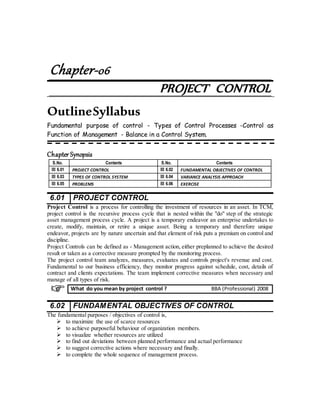
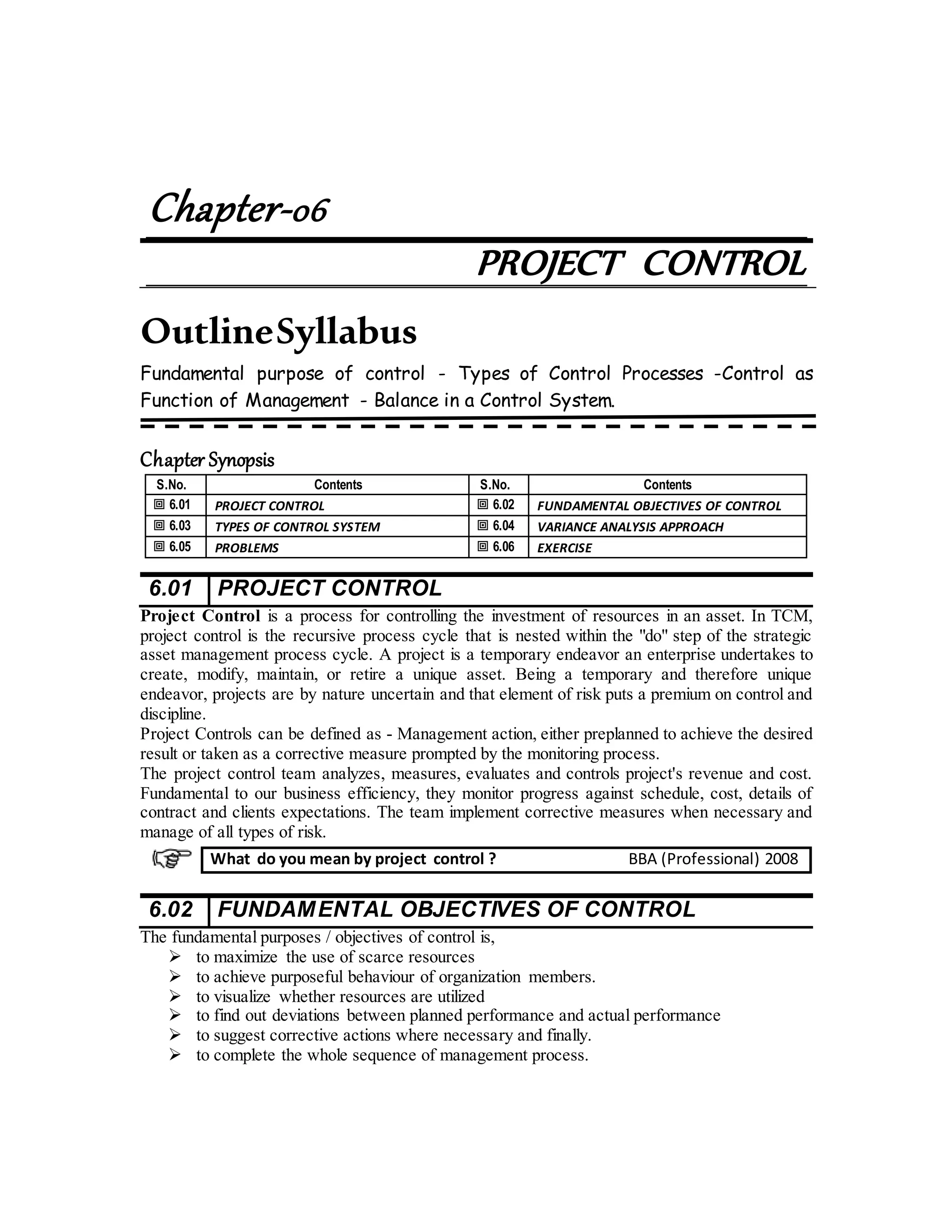
Chapter-06
PROJECT CONTROL
OutlineSyllabus
Fundamental purpose of control - Types of Control Processes -Control as
Function of Management - Balance in a Control System.
Chapter Synopsis
S.No. Contents S.No. Contents
 6.01 PROJECT CONTROL  6.02 FUNDAMENTAL OBJECTIVES OF CONTROL
 6.03 TYPES OF CONTROL SYSTEM  6.04 VARIANCE ANALYSIS APPROACH
 6.05 PROBLEMS  6.06 EXERCISE
6.01 PROJECT CONTROL
Project Control is a process for controlling the investment of resources in an asset. In TCM,
project control is the recursive process cycle that is nested within the "do" step of the strategic
asset management process cycle. A project is a temporary endeavor an enterprise undertakes to
create, modify, maintain, or retire a unique asset. Being a temporary and therefore unique
endeavor, projects are by nature uncertain and that element of risk puts a premium on control and
discipline.
Project Controls can be defined as - Management action, either preplanned to achieve the desired
result or taken as a corrective measure prompted by the monitoring process.
The project control team analyzes, measures, evaluates and controls project's revenue and cost.
Fundamental to our business efficiency, they monitor progress against schedule, cost, details of
contract and clients expectations. The team implement corrective measures when necessary and
manage of all types of risk.
6.02 FUNDAMENTAL OBJECTIVES OF CONTROL
The fundamental purposes / objectives of control is,
 to maximize the use of scarce resources
 to achieve purposeful behaviour of organization members.
 to visualize whether resources are utilized
 to find out deviations between planned performance and actual performance
 to suggest corrective actions where necessary and finally.
 to complete the whole sequence of management process.
What do you mean by project control ? BBA (Professional) 2008
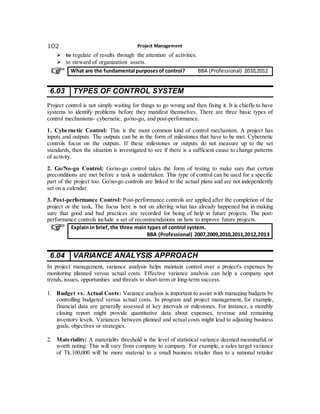
Project Management102
 to regulate of results through the attention of activities.
 to steward of organization assets.
6.03 TYPES OF CONTROL SYSTEM
Project control is not simply waiting for things to go wrong and then fixing it. It is chiefly to have
systems to identify problems before they manifest themselves. There are three basic types of
control mechanisms- cybernetic, go/no-go, and post-performance.
1. Cybernetic Control: This is the most common kind of control mechanism. A project has
inputs and outputs. The outputs can be in the form of milestones that have to be met. Cybernetic
controls focus on the outputs. If these milestones or outputs do not measure up to the set
standards, then the situation is investigated to see if there is a sufficient cause to change patterns
of activity.
2. Go/No-go Control: Go/no-go control takes the form of testing to make sure that certain
preconditions are met before a task is undertaken. This type of control can be used for a specific
part of the project too. Go/no-go controls are linked to the actual plans and are not independently
set on a calendar.
3. Post-performance Control: Post-performance controls are applied after the completion of the
project or the task, The focus here is not on altering what has already happened but in making
sure that good and bad practices are recorded for being of help in future projects. The post-
performance controls include a set of recommendations on how to improve future projects.
Explain in brief, the three main types of control system.
BBA (Professional) 2007,2009,2010,2011,2012,2013
6.04 VARIANCE ANALYSIS APPROACH
In project management, variance analysis helps maintain control over a project's expenses by
monitoring planned versus actual costs. Effective variance analysis can help a company spot
trends, issues, opportunities and threats to short-term or long-term success.
1. Budget vs. Actual Costs: Variance analysis is important to assist with managing budgets by
controlling budgeted versus actual costs. In program and project management, for example,
financial data are generally assessed at key intervals or milestones. For instance, a monthly
closing report might provide quantitative data about expenses, revenue and remaining
inventory levels. Variances between planned and actual costs might lead to adjusting business
goals, objectives or strategies.
2. Materiality: A materiality threshold is the level of statistical variance deemed meaningful, or
worth noting. This will vary from company to company. For example, a sales target variance
of Tk.100,000 will be more material to a small business retailer than to a national retailer
What are the fundamental purposesof control? BBA (Professional) 2010,2012
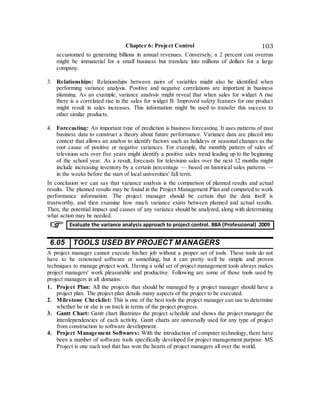
Chapter 6: Project Control 103
accustomed to generating billions in annual revenues. Conversely, a 2 percent cost overrun
might be immaterial for a small business but translate into millions of dollars for a large
company.
3. Relationships: Relationships between pairs of variables might also be identified when
performing variance analysis. Positive and negative correlations are important in business
planning. As an example, variance analysis might reveal that when sales for widget A rise
there is a correlated rise in the sales for widget B. Improved safety features for one product
might result in sales increases. This information might be used to transfer this success to
other similar products.
4. Forecasting: An important type of prediction is business forecasting. It uses patterns of past
business data to construct a theory about future performance. Variance data are placed into
context that allows an analyst to identify factors such as holidays or seasonal changes as the
root cause of positive or negative variances. For example, the monthly pattern of sales of
television sets over five years might identify a positive sales trend leading up to the beginning
of the school year. As a result, forecasts for television sales over the next 12 months might
include increasing inventory by a certain percentage — based on historical sales patterns —
in the weeks before the start of local universities' fall term.
In conclusion we can say that variance analysis is the comparison of planned results and actual
results. The planned results may be found in the Project Management Plan and compared to work
performance information. The project manager should be certain that the data itself is
trustworthy, and then examine how much variance exists between planned and actual results.
Then, the potential impact and causes of any variance should be analyzed, along with determining
what action may be needed.
6.05 TOOLS USED BY PROJECT MANAGERS
A project manager cannot execute his/her job without a proper set of tools. These tools do not
have to be renowned software or something, but it can pretty well be simple and proven
techniques to manage project work. Having a solid set of project management tools always makes
project managers' work pleasurable and productive. Following are some of those tools used by
project managers in all domains:
1. Project Plan: All the projects that should be managed by a project manager should have a
project plan. The project plan details many aspects of the project to be executed.
2. Milestone Checklist: This is one of the best tools the project manager can use to determine
whether he or she is on track in terms of the project progress.
3. Gantt Chart: Gantt chart illustrates the project schedule and shows the project manager the
interdependencies of each activity. Gantt charts are universally used for any type of project
from construction to software development.
4. Project Management Softwares: With the introduction of computer technology, there have
been a number of software tools specifically developed for project management purpose. MS
Project is one such tool that has won the hearts of project managers all over the world.
Evaluate the variance analysis approach to project control. BBA (Professional) 2009
Project Management104
5. Project Reviews: A comprehensive project review mechanism is a great tool for project
management. More mature companies tend to have more strict and comprehensive project
reviews as opposed to basic ones done by smaller organizations.
6. Delivery Reviews: Delivery reviews make sure that the deliveries made by the project team
meet the customer requirements and adhere to the general guidelines of quality.
7. Score Cards: When it comes to performance of the project team, a scorecard is the way of
tracking it. Every project manager is responsible of accessing the performance of the team
members and reporting it to the upper management and HR.
6.06 CHARACTERISTICS OF A GOOD CONTROL SYSTEM
Effective control systems have certain characteristics. For a control system to be effective, it must
be:
1. Accurate: Information on performance must be accurate. Evaluating the accuracy of the
information they receive is one of the most important control tasks that managers face.
2. Timely: Information must be collected, routed, and evaluated quickly if action is to be taken
in time to produce improvements.
3. Objective and Comprehensible: The information in a control system should be
understandable and be seen as objective by the individuals who use it. A difficult-to
understand control system will cause unnecessary mistakes and confusion or frustration
among employees.
4. Focused on Strategic Control Points: The control system should be focused on those areas
where deviations from the standards are most likely to take place or where deviations would
lead to the greatest harm.
5. Economically Realistic: The cost of implementing a control system should be less than, or at
most equal to, the benefits derived from the control system.
6. Organizational Realistic: The control system has to be compatible with organizational
realities and all standards for performance must be realistic.
7. Coordinated with the Organization's Work Flow: Control information needs to be
coordinated with the flow of work through the organization for two reasons: (1) each step in
the work process may affect the success or failure of the entire operation, (2) the control
information must get to all the people who need to receive it.
8. Flexible: Controls must have flexibility built into them so that the organizations can react
quickly to overcome adverse changes or to take advantage of new opportunities.
9. Prescriptive and Operational: Control systems ought to indicate, upon the detection of the
deviation from standards, what corrective action should be taken.
10. Accepted by Organization Members: For a control system to be accepted by organization
members, the controls must be related to meaningful and accepted goals.
These characteristics can be applied to controls at all levels of the organization.
6.07 CYBERNETIC CONTROL SYSTEM
What tools are available to the project manager to use in controlling a project?
BBA (Professional) 2014
Identify some characteristics of a good control system. BBA (Professional) 2014
Chapter 6: Project Control 105
The term cybernetics comes from the ancient Greek word kybernetikos (“good at
steering”), referring to the art of the helmsman. Cybernetics, control theory as it is
applied to complex systems. Cybernetics is associated with models in which a monitor
compares what is happening to a system at various sampling times with some standard of
what should be happening, and a controller adjusts the system’s behaviour accordingly.
6.08 PROBLEMS
BBA (Professional) 2009,2013MODIFIED
Problem 1. A project has begun on 1st January, 2009 and was expected to be completed by 31st
December,2009.The project is being reviewed on 30th September, 2009 when the following
information has been developed:-
Taka
Budgeted cost for work scheduled (BCWS):
Budgeted cost for work performed (BCWP):
Actual cost of work performed (ACWP):
Budgeted cost for total work (BCTW):
Additional cost for completion (ACC):
6,00,000
5,50,000
5,80,000
10,00,000
5,00,000
Determine the following:
(i) Cost variance;
(ii) Schedule variance in cost terms;
(iii) Cost performance index;
(iv)Schedule performance index;
(v) Estimated cost performance index.
Solution:
(i) Cost variance = BCWP - ACWP
= Tk. 5,50,000- Tk.5,80,000
= Tk. - 30,000
(ii) Schedule variance in cost terms = BCWP – BCWS
= Tk. 5,50,000- Tk.6,00,000
= Tk. - 50,000
(iii) Cost performance index =
BCWP
ACWP
=
5,50,000
5,80,000
=0.9482
(iv)Schedule performance index =
BCWP
BCWS
=
5,50,000
6,00,000
= 0.9166
Describe a cybernetic control system. BBA (Professional) 2014
Project Management106
(v) Estimated cost performance index =
BCTW
ACWP−ACC
=
10,00,000
5,80,000+5,00,000
=0.9259
BBA (Professional) 2010 MODIFIED
Problem 2. A project was begun on 1st January 2010 and was expected to be completed by 30th
September 2010.The project is being reviewed on 30th June 2010 when the following information
has been developed:
Taka
Budgeted Cost for Work Scheduled (BCWS)
Budgeted Cost for Work Performed (BCWP)
Actual Cost for Work Performed (ACWP)
Budgeted Cost for Total Work (BCTW)
Additional Cost for Completion (ACC)
1,500,000
1,400,000
1,600,000
2,500,000
1,200,000
Find out the following:
(i) Cost variance;
(ii) Schedule variance in cost terms;
(iii) Cost performance index;
(iv) Schedule performance index;
(v) Estimated cost performance index.
Solution:
(i) Cost variance = BCWP - ACWP
= Tk. 1,400,000 - Tk. 1,600,000
= Tk. - 200,000
(ii) Schedule variance in cost terms = BCWP – BCWS
= Tk. 1,400,000 - Tk. 1,500,000
= Tk. - 100,000
(iii) Cost performance index =
BCWP
ACWP
=
Tk.1,400,000
Tk.1,600,000
= 0.875
(iv)Schedule performance index =
BCWP
BCWS
=
1,400,000
1,500,000
= 0.933
(v) Estimated cost performance index =
BCTW
ACWP−ACC
Chapter 6: Project Control 107
=
2,500,000
1,600,000+1,200,000
=0.893

Pm chapter 6

  • 1.
    Chapter-06 PROJECT CONTROL OutlineSyllabus Fundamental purposeof control - Types of Control Processes -Control as Function of Management - Balance in a Control System. Chapter Synopsis S.No. Contents S.No. Contents  6.01 PROJECT CONTROL  6.02 FUNDAMENTAL OBJECTIVES OF CONTROL  6.03 TYPES OF CONTROL SYSTEM  6.04 VARIANCE ANALYSIS APPROACH  6.05 PROBLEMS  6.06 EXERCISE 6.01 PROJECT CONTROL Project Control is a process for controlling the investment of resources in an asset. In TCM, project control is the recursive process cycle that is nested within the "do" step of the strategic asset management process cycle. A project is a temporary endeavor an enterprise undertakes to create, modify, maintain, or retire a unique asset. Being a temporary and therefore unique endeavor, projects are by nature uncertain and that element of risk puts a premium on control and discipline. Project Controls can be defined as - Management action, either preplanned to achieve the desired result or taken as a corrective measure prompted by the monitoring process. The project control team analyzes, measures, evaluates and controls project's revenue and cost. Fundamental to our business efficiency, they monitor progress against schedule, cost, details of contract and clients expectations. The team implement corrective measures when necessary and manage of all types of risk. 6.02 FUNDAMENTAL OBJECTIVES OF CONTROL The fundamental purposes / objectives of control is,  to maximize the use of scarce resources  to achieve purposeful behaviour of organization members.  to visualize whether resources are utilized  to find out deviations between planned performance and actual performance  to suggest corrective actions where necessary and finally.  to complete the whole sequence of management process. What do you mean by project control ? BBA (Professional) 2008
  • 2.
    Project Management102  toregulate of results through the attention of activities.  to steward of organization assets. 6.03 TYPES OF CONTROL SYSTEM Project control is not simply waiting for things to go wrong and then fixing it. It is chiefly to have systems to identify problems before they manifest themselves. There are three basic types of control mechanisms- cybernetic, go/no-go, and post-performance. 1. Cybernetic Control: This is the most common kind of control mechanism. A project has inputs and outputs. The outputs can be in the form of milestones that have to be met. Cybernetic controls focus on the outputs. If these milestones or outputs do not measure up to the set standards, then the situation is investigated to see if there is a sufficient cause to change patterns of activity. 2. Go/No-go Control: Go/no-go control takes the form of testing to make sure that certain preconditions are met before a task is undertaken. This type of control can be used for a specific part of the project too. Go/no-go controls are linked to the actual plans and are not independently set on a calendar. 3. Post-performance Control: Post-performance controls are applied after the completion of the project or the task, The focus here is not on altering what has already happened but in making sure that good and bad practices are recorded for being of help in future projects. The post- performance controls include a set of recommendations on how to improve future projects. Explain in brief, the three main types of control system. BBA (Professional) 2007,2009,2010,2011,2012,2013 6.04 VARIANCE ANALYSIS APPROACH In project management, variance analysis helps maintain control over a project's expenses by monitoring planned versus actual costs. Effective variance analysis can help a company spot trends, issues, opportunities and threats to short-term or long-term success. 1. Budget vs. Actual Costs: Variance analysis is important to assist with managing budgets by controlling budgeted versus actual costs. In program and project management, for example, financial data are generally assessed at key intervals or milestones. For instance, a monthly closing report might provide quantitative data about expenses, revenue and remaining inventory levels. Variances between planned and actual costs might lead to adjusting business goals, objectives or strategies. 2. Materiality: A materiality threshold is the level of statistical variance deemed meaningful, or worth noting. This will vary from company to company. For example, a sales target variance of Tk.100,000 will be more material to a small business retailer than to a national retailer What are the fundamental purposesof control? BBA (Professional) 2010,2012
  • 3.
    Chapter 6: ProjectControl 103 accustomed to generating billions in annual revenues. Conversely, a 2 percent cost overrun might be immaterial for a small business but translate into millions of dollars for a large company. 3. Relationships: Relationships between pairs of variables might also be identified when performing variance analysis. Positive and negative correlations are important in business planning. As an example, variance analysis might reveal that when sales for widget A rise there is a correlated rise in the sales for widget B. Improved safety features for one product might result in sales increases. This information might be used to transfer this success to other similar products. 4. Forecasting: An important type of prediction is business forecasting. It uses patterns of past business data to construct a theory about future performance. Variance data are placed into context that allows an analyst to identify factors such as holidays or seasonal changes as the root cause of positive or negative variances. For example, the monthly pattern of sales of television sets over five years might identify a positive sales trend leading up to the beginning of the school year. As a result, forecasts for television sales over the next 12 months might include increasing inventory by a certain percentage — based on historical sales patterns — in the weeks before the start of local universities' fall term. In conclusion we can say that variance analysis is the comparison of planned results and actual results. The planned results may be found in the Project Management Plan and compared to work performance information. The project manager should be certain that the data itself is trustworthy, and then examine how much variance exists between planned and actual results. Then, the potential impact and causes of any variance should be analyzed, along with determining what action may be needed. 6.05 TOOLS USED BY PROJECT MANAGERS A project manager cannot execute his/her job without a proper set of tools. These tools do not have to be renowned software or something, but it can pretty well be simple and proven techniques to manage project work. Having a solid set of project management tools always makes project managers' work pleasurable and productive. Following are some of those tools used by project managers in all domains: 1. Project Plan: All the projects that should be managed by a project manager should have a project plan. The project plan details many aspects of the project to be executed. 2. Milestone Checklist: This is one of the best tools the project manager can use to determine whether he or she is on track in terms of the project progress. 3. Gantt Chart: Gantt chart illustrates the project schedule and shows the project manager the interdependencies of each activity. Gantt charts are universally used for any type of project from construction to software development. 4. Project Management Softwares: With the introduction of computer technology, there have been a number of software tools specifically developed for project management purpose. MS Project is one such tool that has won the hearts of project managers all over the world. Evaluate the variance analysis approach to project control. BBA (Professional) 2009
  • 4.
    Project Management104 5. ProjectReviews: A comprehensive project review mechanism is a great tool for project management. More mature companies tend to have more strict and comprehensive project reviews as opposed to basic ones done by smaller organizations. 6. Delivery Reviews: Delivery reviews make sure that the deliveries made by the project team meet the customer requirements and adhere to the general guidelines of quality. 7. Score Cards: When it comes to performance of the project team, a scorecard is the way of tracking it. Every project manager is responsible of accessing the performance of the team members and reporting it to the upper management and HR. 6.06 CHARACTERISTICS OF A GOOD CONTROL SYSTEM Effective control systems have certain characteristics. For a control system to be effective, it must be: 1. Accurate: Information on performance must be accurate. Evaluating the accuracy of the information they receive is one of the most important control tasks that managers face. 2. Timely: Information must be collected, routed, and evaluated quickly if action is to be taken in time to produce improvements. 3. Objective and Comprehensible: The information in a control system should be understandable and be seen as objective by the individuals who use it. A difficult-to understand control system will cause unnecessary mistakes and confusion or frustration among employees. 4. Focused on Strategic Control Points: The control system should be focused on those areas where deviations from the standards are most likely to take place or where deviations would lead to the greatest harm. 5. Economically Realistic: The cost of implementing a control system should be less than, or at most equal to, the benefits derived from the control system. 6. Organizational Realistic: The control system has to be compatible with organizational realities and all standards for performance must be realistic. 7. Coordinated with the Organization's Work Flow: Control information needs to be coordinated with the flow of work through the organization for two reasons: (1) each step in the work process may affect the success or failure of the entire operation, (2) the control information must get to all the people who need to receive it. 8. Flexible: Controls must have flexibility built into them so that the organizations can react quickly to overcome adverse changes or to take advantage of new opportunities. 9. Prescriptive and Operational: Control systems ought to indicate, upon the detection of the deviation from standards, what corrective action should be taken. 10. Accepted by Organization Members: For a control system to be accepted by organization members, the controls must be related to meaningful and accepted goals. These characteristics can be applied to controls at all levels of the organization. 6.07 CYBERNETIC CONTROL SYSTEM What tools are available to the project manager to use in controlling a project? BBA (Professional) 2014 Identify some characteristics of a good control system. BBA (Professional) 2014
  • 5.
    Chapter 6: ProjectControl 105 The term cybernetics comes from the ancient Greek word kybernetikos (“good at steering”), referring to the art of the helmsman. Cybernetics, control theory as it is applied to complex systems. Cybernetics is associated with models in which a monitor compares what is happening to a system at various sampling times with some standard of what should be happening, and a controller adjusts the system’s behaviour accordingly. 6.08 PROBLEMS BBA (Professional) 2009,2013MODIFIED Problem 1. A project has begun on 1st January, 2009 and was expected to be completed by 31st December,2009.The project is being reviewed on 30th September, 2009 when the following information has been developed:- Taka Budgeted cost for work scheduled (BCWS): Budgeted cost for work performed (BCWP): Actual cost of work performed (ACWP): Budgeted cost for total work (BCTW): Additional cost for completion (ACC): 6,00,000 5,50,000 5,80,000 10,00,000 5,00,000 Determine the following: (i) Cost variance; (ii) Schedule variance in cost terms; (iii) Cost performance index; (iv)Schedule performance index; (v) Estimated cost performance index. Solution: (i) Cost variance = BCWP - ACWP = Tk. 5,50,000- Tk.5,80,000 = Tk. - 30,000 (ii) Schedule variance in cost terms = BCWP – BCWS = Tk. 5,50,000- Tk.6,00,000 = Tk. - 50,000 (iii) Cost performance index = BCWP ACWP = 5,50,000 5,80,000 =0.9482 (iv)Schedule performance index = BCWP BCWS = 5,50,000 6,00,000 = 0.9166 Describe a cybernetic control system. BBA (Professional) 2014
  • 6.
    Project Management106 (v) Estimatedcost performance index = BCTW ACWP−ACC = 10,00,000 5,80,000+5,00,000 =0.9259 BBA (Professional) 2010 MODIFIED Problem 2. A project was begun on 1st January 2010 and was expected to be completed by 30th September 2010.The project is being reviewed on 30th June 2010 when the following information has been developed: Taka Budgeted Cost for Work Scheduled (BCWS) Budgeted Cost for Work Performed (BCWP) Actual Cost for Work Performed (ACWP) Budgeted Cost for Total Work (BCTW) Additional Cost for Completion (ACC) 1,500,000 1,400,000 1,600,000 2,500,000 1,200,000 Find out the following: (i) Cost variance; (ii) Schedule variance in cost terms; (iii) Cost performance index; (iv) Schedule performance index; (v) Estimated cost performance index. Solution: (i) Cost variance = BCWP - ACWP = Tk. 1,400,000 - Tk. 1,600,000 = Tk. - 200,000 (ii) Schedule variance in cost terms = BCWP – BCWS = Tk. 1,400,000 - Tk. 1,500,000 = Tk. - 100,000 (iii) Cost performance index = BCWP ACWP = Tk.1,400,000 Tk.1,600,000 = 0.875 (iv)Schedule performance index = BCWP BCWS = 1,400,000 1,500,000 = 0.933 (v) Estimated cost performance index = BCTW ACWP−ACC
  • 7.
    Chapter 6: ProjectControl 107 = 2,500,000 1,600,000+1,200,000 =0.893