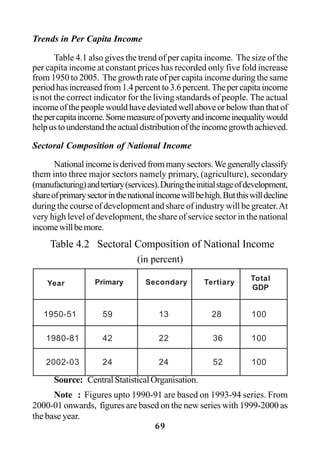
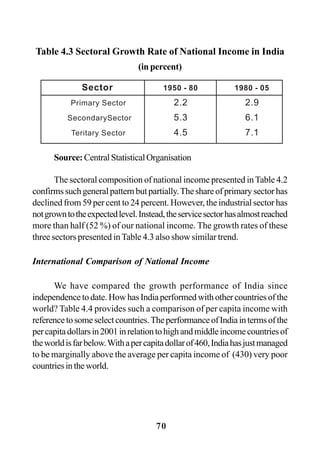
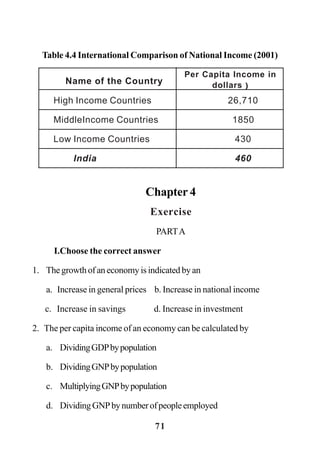
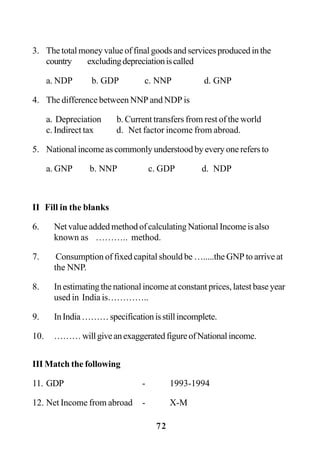
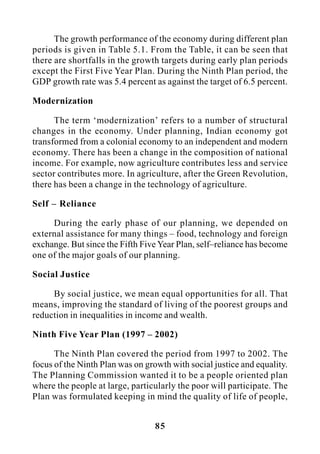
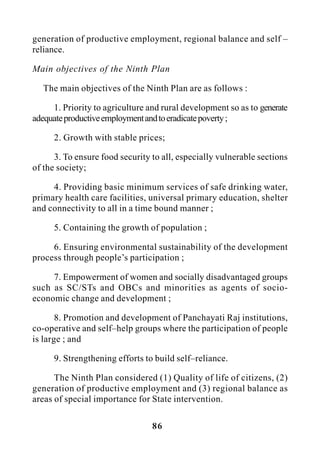
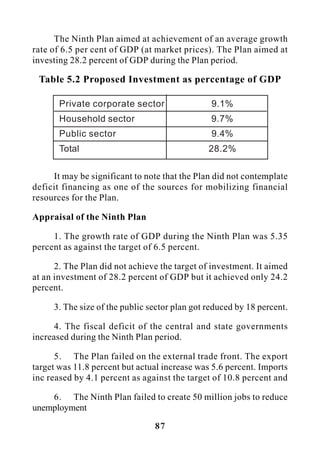
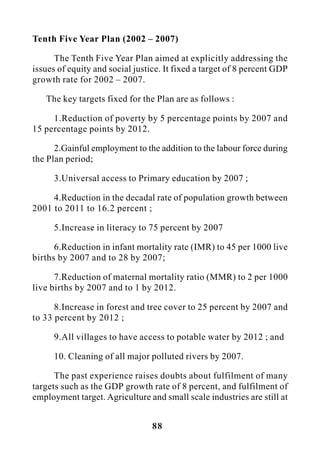
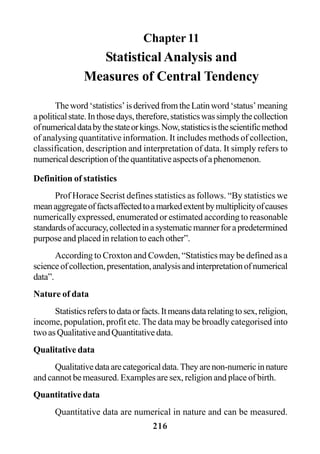
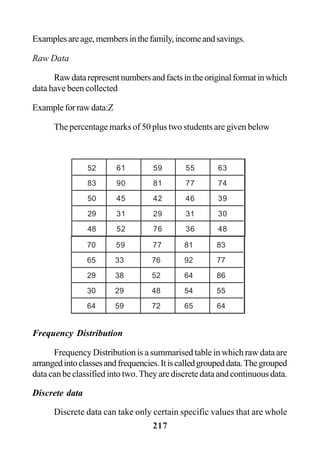
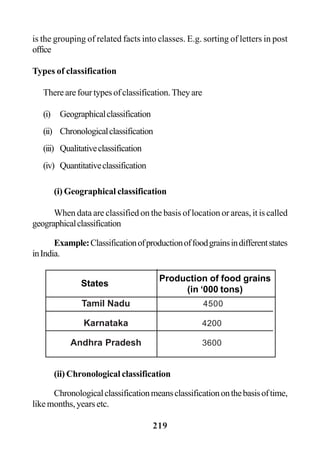
Indian Economy
Higher Secondary – First Year
Prepared as per the recommendation of the
Textbook Development Committee, this new textbook is
prepared according to the syllabus published in 2003-04
Untouchability is a sin
Untouchability is a crime
Untouchability is inhuman
TamilNadu
Textbook Corporation
College Road, Chennai – 600 006
©GovernmentofTamilNadu
First Edition - 2007
Chairperson
Dr. K. Jothi Sivagnanam
Reader
DepartmentofEconomics
UniversityofMadras
Chennai 600 005
Reviewers
M. R. Gopal
Headmaster
ThanthaiPeriyarGovernment
Hr.Sec.School,Puzhuthivakkam,
Chennai 600 091
V. Rajasekaran
PGAssistant(Economics)
The Hindu Hr Sec. School
Triplicane,Chennai600005
P. Neelavathy
PGAssistant(Economics)
GovernmentModelHr.Sec.School
Saidapet, Chennai 600 015
P.Asokan
ReaderinEconomics
ThiagarajarCollege
Madurai 625 009
Dr. S. Mumtaj Begum
ReaderinEconomics
Lady Doak College
Madurai 625 002
M. Singari,
AssistantHeadmaster
Presidency Girls Hr.Sec. School
Egmore,
Chennai 600 008
S. Rajendran
SeniorLecturerDTERT
CollegeRoad
Chennai 600 006
S. R. Kennedy
PGAssistant(Economics)
CSI Kellet Hr.Sec. School
Triplicane,Chennai600005
Price : Rs.
This book has been prepared by the Directorate of School Education
onbehalfoftheGovernmentofTamilNadu
This book has been printed on 60 GSM Paper
Printed by Offset at :
Authors
Foreword
Academics, parents and the educational media have represented
to the Government of Tamil Nadu to reform the Plus one and Plus two
textbooks, which were introduced in the academic year 2005-06. Our
beloved Chief Minister, who has always been evincing keen interest in
educational development, immediately constituted a “Text Book
DevelopmentCommittee”undertheChairmanshipoftheViceChairman,
StatePlanningCommission,GovernmentofTamilNadu.
The Text Book Development Committee solicited opinion from
Teachers, Lecturers and Professors from Higher Secondary Schools,
CollegesandUniversities,Chairpersonsandauthorsoftextbooks.After
perusing the opinions, theText Book Development Committee decided
not to change the syllabi, but recommended suitable changes in the text
books.
In particular, it was proposed to rewrite the economics textbook,
and accepting this proposal, this Textbook is rewritten by experienced
andefficientteachers.
We are pleased to place on record our sincere gratitude to our
belovedChiefMinister.OurthanksareduetoHon’bleMinisterforSchool
Education, Secretary and Director, Department of School Education,
GovernmentofTamilNadufortheirvaluablesupportandsuggestions.
We thank Teachers, Lecturers and Professors from Higher
SecondarySchools,CollegesandUniversities,Chairpersons,Reviewers
andAuthors of textbooks, non-teaching staff of Education Department
and State Planning Commission for their help at various stages in this
endeavour.
Wewishthestudentstolearnandperformwellintheexaminations.
Prof M. Naganathan
Chairman
TextBookDevelopmentCommittee
GovernmentofTamilNadu
iii
Preface
Anearnestattempthasbeenmadeinthisbooktopresentthebasic
issues of Indian Economy in a lucid form, without sacrificing the basic
tenets and without overburdening the student with an array of tables and
numbersanditispreparedinaccordancewiththesyllabusprescribedfor
standard XI.
Thechairperson,thereviewersandtheauthorsacknowledgewith
gratitude the confidence reposed in them by Dr. M. Naganathan, Vice-
Chairman, State Planning Commission and Chairman, Textbook
Development Committee. Posterity will be indebted to him for his deep
perceptionofcurriculumandsyllabusfromabroadersociologicalangle.
TheCommitteewishestothankDr.R.Srinivasan,Full-timeMember
of the State Planning Commission, for his abiding interest in the project,
andfortheencouragementandsupporthehasgivenduringthecourseof
writing the book, for his helpful comments and suggestions and for his
unfailingcourtesy.
TheCommitteealsowishestothank ThiruThangamThennarasu,
Hon’ble Minister for School Education, Thiru M. Kutralingam, I.A.S.,
Secretary, School Education, Thiru R. Kannan, Director of School
Education,Dr.R.Palanisami,thethenJointDirectorofSchoolEducation
andThiruG.Arivoli,the JointDirectorofSchoolEducationandallother
competentauthorities.
The Committee is grateful to Dr.V. Loganathan, chairperson for
preparing Economic Theory textbook for standard XII, for his help at
everystageincompletingthebook.
The Committee wishes to thank Thiru Valavan for vetting the
translatedversionofthetextbookinTamilandtoThiruBalasundaramof
the State Planning Commission and Thiru N.Balamurugan for helping
theCommitteeintypesettingandprintingthemanuscript.
iv
TheCommitteewishestothankThiruM.Paramasivam,Librarian,
StatePlanningCommissionforprovidingallfacilitiesduringtheworkshop.
TheChairmanwishestoplaceonrecordhisdeepappreciationof
the Reviewers and authors of the book for their excellent cooperation
and good team work with perfect understanding.
TheCommitteecravestheindulgenceofthereadersfortheerrors
thatmighthavecreptininadvertently.
Suggestionsforimprovementarewelcome.
Chairperson, Reviewers and Authors
v
Contents
Page no.
1 Economic Growth and Development 1
2 Population 17
3 Poverty and Unemployment 40
4 National Income 56
5 Economic Planning 75
6 Agriculture 93
7 Industrial Sector 121
8 Banking 145
9 Foreign Trade 166
10 Human Resource Development 197
vi
Contents
Page no.
11 StatisticalAnalysis and
Measures of Central Tendency 216
12 Measures of Variability 252
vii
1
Chapter I
Economic Growth and Development
Introduction
In this chapter, we shall study in outline the evolution of economic
thought, the nature and meaning of the concepts of economic growth
and development, the basic characteristics of underdeveloped countries
(UDCs), the role of government in economic development and Rostow’s
stages of economic growth.
Evolution of Economic Thought
The history of economic thought deals with the origin and
developmentofeconomicideasandtheirinterrelations.Wefindeconomic
ideas in the writings of ancient Hebrews, Indians, Greeks, Romans and
the scholars of middle ages. In the words of Prof. Bell, “economic thought
is a study of heritage left by writers on economic subjects over a period
of about 2500 years ; and it freely draws upon all phases of human
knowledge”. If we study ancient economic thought, we can have a proper
understanding of the growth of economic theories and institutions.
The Hebrew Economic Thought
The Hebrews had one of the ancient civilizations of the world.
The period dates back to 2500 B.C. The Hebrews never studied
economic problems separately. In their writings, they gave top priority
for religion and ethics.And they gave importance to agriculture. However,
the Hebrews had definite ideas on subjects such as usury (interest), just
price, property rights and monopoly.
The Hebrew thought was against lending of money on interest to
fellow Hebrews. But they could lend money to strangers and get interest.
2
In those days, as money was borrowed by the poor for consumption
purposes, they thought that it was unethical to charge high rates of interest.
We may note that the Hebrew thought on interest is similar to the ancient
Indian thought an interest. The Hebrews had many laws against false
weights and adulteration. They wanted businessmen to charge a just price
and they imposed ceiling on the profit margin. The Hebrews realized the
dignity of labour. The Hebrew civilization was a rural and agrarian
civilization. One of their proverbs is : “He that tilleth the soil shall have
plenty of bread”. The Hebrews did not cultivate the land every seventh
year. They left it fallow. The object was to conserve the fertility of the
soil.Another interesting feature of the Hebrew thought was the ‘Jubilee
year’. The jubilee year was the 50th
year.According to Jubilee year, the
land sold to someone was to revert to its owner in the 50th
year. Money
was used during the Hebrew Period. There are references to different
kinds of money in the Old Testament.
The Sabbath : The Sabbath was the weekly day of rest, relaxation
and good living. In the words of Spiegel, “ the institution of the weekend
was a social invention that has no parallel in the civilizations of Greece,
Rome or other ancient cultures”. In short, we find that religion, ethics,
law, economics and philosophy were all bound together. Though the
economic ideas of ancient Hebrews appear primitive to a modern
economist, we should remember that they had a profound influence on
men’s minds.
Greek thought, Roman law and Christian religion form the basis of
European culture.
Economic Thought in Ancient India
Life, work and thought in ancient India was not based on a negation
of life. It was not based on otherworldliness.As Pandit Jawaharlal Nehru
put it, “There is no idolatry in them, no temples for the gods. The vitality
and affirmation of life pervading them are extraordinary”.
The caste system was an important institution in ancient India. But we
have to keep in mind that in the beginning, the basis of caste was
profession and not birth. It was only during the latter period that the
3
caste system became rigid and led to many abuses. The joint family was
anotherimportantinstitutioninancientIndia.Agriculturewasanimportant
occupation in ancient India and it was held in high esteem and monarchy
was the most popular form of Government. There was a certain amount
of decentralization. For example, village assemblies enjoyed a
measurement of autonomy; interest rates were regulated and regulations
were there against false weights and measures. Kautilya’s Arthasastra
gives details of the political, social, economic and military organizations
of the past. Thiruvalluvar’s Thirukkural is a book of ethics and it deals
with Dharma or Aram (ethics), Artha or Porul (Polity) and Kama or
Inbam (Love). Valluvar’s economic ideas are found mostly in the second
part of the Thirukkural, the Porutpal or the part dealing with wealth. By
Porutpal, Valluvar meant all that kautilya meant by Arthasastra.
Valluvar considered freedom from hunger a fundamental freedom. He
was against begging. He considered industry as real wealth and labour
as the greatest resource.According to Thiruvalluvar, agriculture is the
most fundamental activity. He tells that the ploughmen alone live as the
freemen of the soil, the rest are mere slaves that follow on their toil.
(Kural 1032). For Valluvar, good ethics is good economics.
Medieval Economic Thought : The period from 476 A.D, which
marked the fall of the Roman empire to 1453A.D., the year in which the
Turks captured Constantinople is generally regarded as the MiddleAges.
The society of the MiddleAges was a feudal society. People in middle
ages lived in a natural economy. Men lived largely in small and self-
sufficient units. The Church, the Bible and Aristotle exercised a great
influence on the life and thought of MiddleAges.
Mercantilism
The economic ideas and policies which were followed by European
governments from the 15th
century until the second half of the 18th
century
may be described as mercantilism. The mercantilists thought that the
wealth of a nation could be increased by trade.And they wanted to have
more wealth by increasing the stock of gold and silver.
4
After feudalism came to an end, strong nation states emerged in
England, France, Germany and Spain.And each country considered the
other country as its potential rival. So the mercantilists regulated the
economic activity of the State in order to create a strong and powerful
State. Mercantilism was only economic means for the creation of a strong
State.
If a country has mines, it can get gold and silver. Otherwise, it can get
gold and silver only by means of trade. They wanted favourable balance
of trade. That is, exports should be more than imports. As Alexander
Gray put it, “it was thus a primary principle of the typical mercantilist to
maximizeexportswhileminimizingimports”.
According to mercantilists, trade was the most important occupation.
Industry and manufacture were ranked second in importance. And
agriculture was considered the least important occupation.
The State played a very important and powerful role during
mercantilism. It encouraged exports and discouraged imports by a number
of policies. Sometimes it is said that mercantilists confused money with
wealth. But Keynes praised them saying that more money would promote
business expansion. If each country wanted maximum exports and almost
zero imports, then who would import ? In short, mercantilism was a
“policy of power”.
The Physiocrats
The physiocrats developed a body of economic theory in the 18th
century in France. Adam Smith, who is regarded as the Father of
Economics was greatly influenced by the physiocrats. The term
‘physiocracy’ means ‘Rule of Nature’. Physiocracy was essentially a
revolt by the French against mercantilism.
The physiocrats developed the concept of natural order.According
to them, the natural order is an ideal order given by God. They believed
that individual interests were identical with the interests of the society.
They advocated laissez–faire. It means “let things alone, let them take
5
their own course”.According to this policy, the State will have a minimum
role to play. The main functions of government is to protect life, liberty
and property. And they believed that agriculture was a productive
occupation. It alone produced “net product”.And they considered other
occupations as sterile. Quesnay, chief representative of physiocratic
school explained how circulation of wealth took place in an economy in
his“TableauEconomique” (TheEconomicTable)amongdifferentclasses
: the productive class (farmers); the proprietory class; and the sterile
class (all those engaged in non-agricultural occupations, e.g., merchants,
domestic servants).
The physiocrats were great believers in the institution of private
property. And they favoured free trade.
The classical school
Adam Smith, David Ricardo, T.R.Malthus and J.S. Mill are the
leading economists of the classical school. Like the physiocrats, the
classical economists believed in laissez faire, and market economy based
on free trade.
Adam smith was interested in the nature and causes of the wealth of
nations. We can call him the first development economist. Ricardo was
interested in the problems of distribution. Malthus,who gave the theory
of population was interested in finding out why some countries were
prosperous at one time and why they were poor at other times. In other
words, he was interested in studying the prosperity and the poverty of
nations. J.S. Mill believed in individualism as well as socialism. He
advocated socialist reforms in distribution as the laws of distribution were
different from the laws of production.
The historical school
The historical school was dominant in Germany during the second
half of the 19th
century. It was a revolt against the classical school. While
the classical economists believed that the laws of economics were of
6
universal application, the economists of the historical school argued that
the laws of economics were relative. Thus, while the classical economists
advocated free trade, the historical school advocated protection for new
industries through tariffs.
Marxism
Karl Marx (1818-1883) was the founder of scientific socialism. He
was a great critic of the capitalist system which was exploitative in nature
and predicted that capitalism would give way to socialism.According to
Marx, “all history is a history of class struggle”. The teachings of
Marx resulted in the birth of a socialist State in Russia and China. Planning
which is the gift of former Soviet Russia to the world is based on socialist
philosophy.
The Marginal Revolution
The Marginal Revolution that took place in the latter half of the
19th
century is important for theory, especially the theory relating to value.
Today, we speak of human development.And man is brought to
the centre stage. It wasAlfred Marshall who pointed out that economics
was on one side a study of wealth and on the other and more important
side a part of the study of man.
The Institutional school
The institutional school is a 20th
century phenomenon and it is of
American origin. It emphasizes the role of institutions in economic life.
The term “institutions” includes customs, social habits, laws, ways of
living and modes of thinking. For example, slavery is an institution. We
celebrate certain days as festivals. That is also an institution.
J.A. Schumpeter (1883-1993) considered economic life mainly as a
process of change and development. According to him, innovating
entrepreneurs play a key role in the process of economic development.
7
The Keynesian Revolution
J.M. Keynes is considered the Father of New Economics. During
the 1920s and 1930s, when the capitalist countries were affected by the
Great Depression marked by bad trade and mass unemployment, Keynes
suggested a greater role for government and a bold fiscal policy to tide
over the crisis. The New Deal policy ofAmerica was greatly influenced
by Keynesian policy.
Since 1950s, economic thought has focused on growth and
development.
Economic Growth and Development
Economic growth has been defined byArthur Lewis as “the growth
of output per head of population”.
In other words, economic growth refers to an increase in per capita
national income. It may be noted that the subject matter is growth and
notdistribution.Forexample,duringtheIndustrialRevolutionintheU.K.,
therewaseconomicgrowth.Buttherewasnoimprovementinthestandard
of living of the working classes because they were exploited and made
to work for long hours at low wages.
According toArthur Lewis, economic growth is conditioned by (1)
economic activity, (2) increasing knowledge and (3) increasing capital.
In other words, these three factors are labour, technical improvements
and capital. We may add land or resources to the list.
Economic growth and economic development have received a lot of
attention in the 20th
century. In an economy there must be balanced
economic growth of all sectors – agriculture, manufacturing industry and
the service sector. Only then, economic growth will benefit all sectors of
the population. Not only that, economic welfare depends not only on the
growth of output but on the way it is distributed among different factors
of production in the form of rent, wages, interest and profits.
8
In the past, economic growth and economic development were used
more or less with the same meaning. For example, they used rate of
growth of income per capita or per capita GNP as index of economic
development.And they wanted to see whether the rate of growth of per
capita income was greater than the rate of growth of population. We
have to note one more thing. The wellbeing of population depends on
the rate of growth of ‘real’per capita GNP. Real per capita GNP refers
to the monetary growth of GNP per capita minus the rate of inflation.
In general terms, we may say if there is decline in poverty,
unemployment, and inequality, there is economic development in the
country. Otherwise, even if per capita income doubled, we cannot say
there is economic development. So when we say there is development,
there must be improvement in the quality of life. That means, people
must have higher incomes, better education, better health care and
nutrition, less poverty and more equality of opportunity. So according to
Michael P. Todaro and Stephen C. Smith, “development must be
conceived of as a multidimensional process involving major changes in
social structures, popular attitudes and national institutions, as well as
the acceleration of economic growth, the reduction of inequality, and the
eradication of poverty”.
Characteristics of underdeveloped countries
The terms “underdeveloped”, “less developed”, “backward”, and
“poor” and “developing” are generally used to refer to low income
countries. The countries which have low standard of living because of
their low per capita incomes are known as underdeveloped countries.
Countries are classified into developed and underdeveloped countries
according to their per capita income. For example, in 1949, high income
countries with 18% of world population enjoyed 67% of world income,
whereas low income countries which had 67% of world population got
only 15% of world income. The rich countries include United States,
Canada, Western Europe and Australia. The poor counties cover most
ofAsia,Africa, south eastern Europe and LatinAmerica.And there were
middle income countries with a population of 15% which got 18% of
9
worldincome.TheyconsistedofcountriessuchasArgentina,SouthAfrica,
Israel and former soviet Russia. The poor countries are collectively
referred to as the Third World.
Even in 1973, theThirdWorld with 77 percent of the world population
subsisted on only 22 per cent of the world income. Even the meagre
income is maldistributed within these countries and the bulk of the
population live in abject poverty. According to Meier and Baldwin, an
underdeveloped country has six basic economic characteristics. They
are : (1) it is primary producing ; 2) it faces population pressures ; 3) it
hasunderdevelopednaturalresources;4)ithasaneconomicallybackward
population ; 5) it is capital deficient and 6) it is foreign trade oriented.
1) Primary production: The UDCs produce mostly raw materials
andfoodstuffs.Amajorityofthepopulationwillbeengagedinagriculture.
Some poor countries depend upon non – agricultural primary production
(eg. minerals like tin, copper, aluminium and petroleum).And agricultural
productivity is low. So rural incomes are low. There is pressure of
population on land.
2) Population pressures: Generally, there is over – population in
many poor countries. Population pressures take many forms. First, for
example, they have rural underemployment. This is sometimes referred
to as disguised unemployment. That is, there will be more number of
people working on the farm that what is really necessary. The marginal
productivity of the extra hands will be almost zero. Second, high birth
rates create a large number of dependent children and lastly falling death
rates with high birth rates will bring about a large increase in population.
3) Underemployment: Natural resources in poor countries are
underdeveloped. They are unutilized, underutilized or misutilized.
4) Economic Backwardness : The economic backwardness of the
populationinthepoorcountriesisreflectedinlowlabourefficiency,factor
immobility, lack of entrepreneurship, economic ignorance and so on.The
population is ruled by customs and traditions. And people are not
10
“economically motivated”. The tax system is marked by inefficiency in
collection and there is tax evasion. The governments in these countries
are generally “weak, incompetent and corrupt”.
5) Capital Deficiency : Capital deficiency is an important
characteristic of poor countries. Capital formation or investment is low
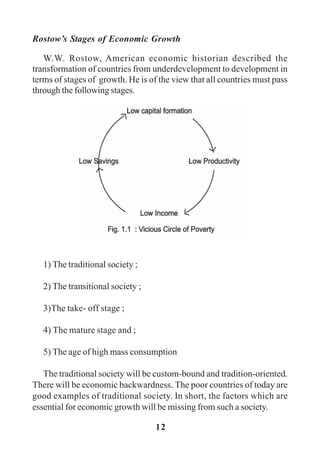
in these countries.According to Ragnar Nurkse, low capital formation is
oneofthebasiccausesofpovertyinthesecountries.Lowcapitalformation
leads to low productivity. Low productivity results in low incomes and
low incomes result in low savings and low savings lead to low capital
formation. Thus, it forms a vicious circle of poverty.
6) Foreign Trade Orientation : Some of the poor countries depend
heavily upon foreign trade. For example, in 1952, cotton contributed
about 90 percent of foreign exchange earnings of Egypt.Arisk involved
here is if there is some serious economic problem in the importing nation,
the country which depends on export of one or two commodities will be
affected badly.And in the early stages of development, UDCs depended
upon imports.
India as UDC : India, has most of the typical characteristics of an
underdeveloped country. Nearly 65 to 70 percent of its population
depends upon agriculture.And agricultural productivity is low.There are
population pressures. There is underdevelopment of natural resources
and economic backwardness. Until recently, there was capital deficiency.
That is why, we had to borrow heavily from foreign countries and
international institutions like I.M.F. andWorld Bank. So we may describe
India as a typical underdeveloped country. Nowadays, they call it a
developing economy.
Role of the State in Economic Development
The State plays an important role in the economic development of
nations. Japan, after 1870 and soviet Russia after world war I are good
examples. But the economic development of the U.K. and the U.S.A.
took place under a system of market economy and laissez faire policy.
11
For underdeveloped countries, laissez faire policy is a luxury. The State
has to play the role of an entrepreneur in the underdeveloped countries.
Nowadays, it is agreed that the governments in these countries have to
play a dominant role in implementing plans for economic government. In
fact, government is regarded as a factor of production in poor countries.
For example, India is a mixed economy with a public sector and private
sector. Until recently, the public sector played a major role in economic
planning.
Through Five Year Plans, the State has been making attempts to
achieve the goals of increasing economic growth, rapid industrialization,
expansion of employment opportunities and reduction of inequalities of
income and wealth.
The government plays a very big role in the field of social services
like education and health. Investment in education and health promote
human capital formation, which is as important as physical capital
formation. Education and health increase productivity of labour.
These are the days of globalization, liberalization and privatization.
Weinviteforeigninvestmentonalarge–scale.Buttheywantgoodphysical
infrastructure like good transportation, postal and telecommunications,
power facilities, and water supply. All these things are referred to as
social overhead capital. The government has to make huge investment in
these things. Not only that, there is shortage of entrepreneurs in these
countries. So the government has to encourage them.
There is shortage of foreign exchange in UDCs. The government has
to take steps such as promotion of exports, making investment attractive
for foreigners through fiscal measures.
If development is left to market forces, there will be not be balanced
regional development. So the government formulates policies and
programmes in such a way that there is a balanced regional development.
And the State has to regulate and control monopolies. Thus, the State
has to play a dominant role in economic development.
12
Rostow’s Stages of Economic Growth
W.W. Rostow, American economic historian described the
transformation of countries from underdevelopment to development in
terms of stages of growth. He is of the view that all countries must pass
through the following stages.
1) The traditional society ;
2) The transitional society ;
3)The take- off stage ;
4) The mature stage and ;
5) The age of high mass consumption
The traditional society will be custom-bound and tradition-oriented.
There will be economic backwardness. The poor countries of today are
good examples of traditional society. In short, the factors which are
essential for economic growth will be missing from such a society.
13
In the transitional society, the conditions for take-off stage will be
established. During this stage, the force of customs and traditions will
become less ; there will be economic motivation, and there will be
improvements in physical and social infrastructure. When once an
economy attains the take–off stage, there will be self – sustaining growth.
The take-off stage refers to a situation where an economy transforms
itself from a predominantly agricultural to a predominantly industrial
society. For an economy to attain the take-off stage, it must make an
annual investment equal to 20 – 25 percent of GDP mobilized from its
own savings. The take-off stage was made possible in some countries
by leading sectors like railways and defence. After the take- off stage,
when the economy attains self sustaining growth, it enters the mature
stage.Duringthisstage,thegovernmenthastomakesomebasicdecisions.
As there will be abundant resources and goods, it has to divide whether
it has to use them for strengthening the nation into a strong and powerful
state militarily or to use the resources for improving the welfare of the
people. The final stage is the age of high mass consumption. During this
period, people will consume all kinds of goods especially durable goods
like cars on a mass scale.
Rostow’s stages of economic growth are only broadly true.All nations
have not gone through the order in which he has described the stages.
Chapter 1
Exercise
PART A
1. Choose the correct answer
1. The Sabbath (weak end) was introduced by A. Hebrews B. Greeks
C. Romans D. Indians
14
2. The author ofArthasastra isA. Thiruvalluvar B. Kautilya C.
Jawaharlal Nehru D. Mahatma Gandhi
3. The Mecantilists gave utmost importance toA.Agriculture B.
Manufacturing industry C. Trade D. Imports.
4. The physiocrats considered only the following as productive
occupationA. Manufacturing industry B.Agriculture C. Service
sector D. Soldiers.
5. The father of New Economics isA.Adam Smith B. Marshall C.
Karl Marx D. J.M. Keynes
II. Fill in the blanks
6. The economic ideas of Thiruvalluvar are found in the ………. Part
of Thirukkural
7. The Mercantilists believed in maximum ………. and minimum
imports
8. The physiocrats belonged to ……..
9. The classical economists believed in …………… policy.
10. The author of stages of growth theory is ……………
III. Match the Following
11. Historical school a) Karl Marx
12. ScientificSocialism b) U.S.A
13. InstitutionalSchool c) Germany
14. Low capital formation d) Value Theory
15. Marginal School e) Underdeveloped country
15
IV.Answer each one of the questions in a word or two
16. What is the basis of European culture ?
17. Didmercantilismencouragesexportsorimports?
18. Who was the author of Tableau Economique ?
19. Was Ricardo interested in the problems of production or
distribution?
20. Whatistheannualinvestmentthatmustbemadeforaneconomy
to take off ?
Part B
Write very short answers
21. Why did the physiocrats give importance to agriculture ?
22. What are the forms of population pressures ?
23. Explain the concept “economic development”
24. Write a note on take-off stage.
25. What is vicious circle of poverty ?
PART C
Write short answers
26. Write a note on Hebrew economic thought.
27. What is net product ?
28. Why is Keynes considered the father of new economics ?
29. What are the main ideas of leading classical economists ?
30. Why is India considered an underdeveloped economy ?
16
PART D
31. Discuss the mercantilist thought.
32. What are the essential ideas of the physiocrats ?
33. Explain the role of the State in economic development
34. What are the basic characteristics of underdeveloped countries ?
35. Describe Rostow’s stages of economic growth.
17
Chapter 2
Population
The study of human resources is important from the point of view of
economicwelfare.Itisparticularlyimportantbecausehumanbeingsarenot
only instruments of production but also ends in themselves. A study of
population is necessary as it is an important determinant of economic
development
Meaning of Population
The term population refers to the whole number of people or
inhabitantsinacountryorregion.
Factorsdeterminingpopulationgrowth
Thebasicfactorsdeterminingpopulationgrowthare
1. Birthrate
2. Death rate
3. Migration
a.Out-migration(Emigration)
b.In-migration(Immigration)
Birth Rate
Birthratehasapositiveinfluenceongrowthofpopulation.Higherthe
birthrate,higherwillbethegrowthofpopulation.
Thebirthratedependsonthefollowingfactors:
i)theageofmarriage
ii)therapidityofchildbirth
18
iii)socialcustomsandbeliefsand
iv)Illiteracyandignoranceofcontrollingbirths.
Earlymarriage,higherchildbirth,higherthespreadofsocialcustoms
andbeliefs(likesonpreferencetodothereligiousfunctions)andhigherthe
rateofilliteracyandignoranceofbirthcontrollingmeasures,higherwillbe
the birth rate and population growth.
Social awareness and spread of education among the people can
help to increase the mean age of marriage, increase the knowledge about
familyplanningmethodsandfamilywelfaremeasurestocontrolbirths,reduce
the rapidity of child birth and thereby reduce the birth rate.
Death Rate
Lower the death rate, higher will be the population growth and vice
versa. High death rates may be due to hunger, starvation, malnutrition,
epidemics,lackofpropermedicalandsanitaryfacilities.Ontheotherhand,
lowdeathratesmaybetheresultofbetterdiet,puredrinkingwater,improved
hospital facilities, control of epidemics and contagious diseases and better
sanitation.
Migration
Out-migrationwillreducepopulationgrowthwhilein-migrationwill
increasethepopulationgrowth.
Migration is not an important factor contributing to the population
growthduetotherestrictionsimposedbydifferentcountries.Thus,thetwo
major causes for the variations in population are birth rate and death rate.
Population and Economic Development
Population growth can be both a stimulant as well as an obstacle to
economicdevelopment.
19
Population as a stimulant to economic development
1. In a backward economy, population growth results in increase in
supplyoflabour.Thisinturnresultsintheavailabilityofcheaplabourinthe
economy.Therefore,underagiventechnologywiththeavailabilityofcapital,
production can be increased by increasing the labour use.
2. Population growth results in increased demand for products.
Increaseddemandresultsinincreasedproduction,employmentandincome
intheeconomy.Asaresult,theeconomywilldevelop.
3. Due to population growth, the supply of goods and services
increases. Increased supply results in increased production, which in turn
resultsinspecialisation.Specialisationwillinducetechnologicalimprovements.
4.Increaseddemandandincreasedsupplyofproductsresultinscarcity
ofresources,whichinducetechnologicalimprovements.
PopulationExplosion
Populationexplosionmeansthealarmingandrapidrateofincrease
inpopulation.
Causes of Population Explosion
1. High Birth Rate
High Birth rate is a major cause responsible for the rapid growth of
population. In India, although the birth rate has declined from 45.8 per
thousand during the period 1891-1900 to about 25.8 per thousand in 2001,
itisstillconsideredtobesubstantiallyhigh.Thisshowsthatthebirthratehas
not come down considerably in spite of the increase in the widespread
propagandaoffamilyplanning,familywelfareprogrammesandpopulation
educationcampaigns.
20
2. Low Death Rate
Thephenomenalfallinthedeathrateinrecentyearsisanotherimportant
factor that has contributed to the rapid increase in population. The death
rate in India is about 8.5 per thousand in 2001. Due to advancement in
medical science, dreadful and chronic diseases such a small pox, cholera,
plague, typhoid are no longer dreaded. Better facilities for sanitation and
cleanliness, provision of pre-natal and post-natal care has reduced infant
mortalityrate.
3. Early Marriage
The practice of early marriage is another important reason for the
rapid increase in population in India. The mean age of marriage for girls is
about 18 years, which is low, compared to the other countries of the world,
whichisabout23to25years.Thisresultsinalongerspanforreproductive
activityandtheincreaseinthenumberofchildren.
4. Social and Religious reasons
InIndia,everypersonhastomarrybecausemarriageisacompulsory
institutionaspersocialnorms.Injointfamilysystem,nobodyfeelsindividual
responsibility and everybody has access to equal level of consumption.
Therefore, people do not hesitate to increase the size of the family. Most of
the people think that at least one male child should be born in the family. In
theexpectationofgettingamalechild,theygoonincreasingthefamilysize.
5. Poverty
Povertyisanothercausewhichcontributestotheincreaseinpopulation.
Children are source for income of the family. The children at a very young
age help their parents in work, instead of going to school and thus prove to
be an asset for the family. Every additional child will become an earning
memberandthussupplementthefamilyincome.
21
6. Standard of living
People whose standard of living is low tend to have more children
because an additional child is considered as an asset rather than a liability.
Sinceamajorityofthepopulationisuneducated,theyareunabletounderstand
theneedforfamilyplanning.Theyareunawarethatasmallersizeoffamily
willhelpthemenjoyabetterstandardofliving.
7. Illiteracy
Amajorpartofthepopulation(about60%)inIndiaiseitherilliterate
or has the minimum education. This leads them to accept minimal work in
which they cannot even support themselves. Unemployment and under-
employment further lead to poverty. Moreover due to the prevalence of
higher rate of illiteracy, there is widespread ignorance in the form of social
customsandbeliefslikeearlymarriageandpreferenceforamalechild.Asa
result,thereishighrateofpopulationgrowthinthecountry.
Population Explosion as an obstacle to Economic Development
Indiaisfacingthesituationofpopulationexplosion.Althoughweneed
morelaboursupplyforoureconomicdevelopment,itisalsotruethatifour
population keeps on rising, the process of economic development will be
affected.TherisingpopulationinIndiaaffectseconomicdevelopmentinthe
followingways:
(1) Food Shortage
IfthepopulationofIndiagoesonrisingandthereisnoproportionate
increase in agricultural production, the country will face a serious food
problem.
(2) Burden of unproductive Consumers
The greater the increase in population, the greater is the number of
children and old persons. Children and old persons consume without their
22
making any contribution to output. The increasing number of children and
old people increase the burden in terms of more requirements of nutrition,
medicalcare,publichealthandeducationthatgounattendedtoalargeextent.
(3) Reduction in National and Per Capita Income
Thefastgrowingpopulationretardstheaveragegrowthrateofnational
income and per capita income. This is because whatever is added to the
nationalincomeisconsumedbyever-increasingpopulation.
(4) Low savings and investment
The most serious consequences of a rapid increase in population is
that it reduces the capacity to save and invest. The national income and per
capitaincomeinIndiaisverylowtoleaveanymarginforthepeopletosave.
Further, there will be a fall in effective demand as the people’s purchasing
powerislow.Rapidpopulationgrowththusmakesitdifficulttoincreasethe
rateofsavingswhichdeterminesthepossibilityofachievinghigherproductivity
andincomesinacountry.
(5) Reduction in Capital Formation
Capitalformationisveryessentialfortheeconomicdevelopmentofa
country, particularly for a developing country like India. Capital formation
depends upon saving and investment. This is not possible when there is a
rapid growth of population, which results in more unemployment and
underemployment. Thus, the fast-growing population affects the capital
formationinthecountryadversely.
(6).UnemploymentandUnderemployment
Risingpopulationaggravatestheproblemofunemployment.Thelabour
forcealsoincreaseswiththeincreaseinpopulation;andthisincreasedlabour
forceisnotfullyabsorbedduetolackofemploymentopportunities.Therefore,
there are more unemployed and underemployed people.
23
(7) Loss of Women’s Labour
Rapidandfrequentchildbirthsmakealargenumberofwomenunable
to take part in productive activity for longer periods. This is a waste of
human resource, and it retards economic development.
(8) Low Labour efficiency
Theincreasingpopulationadverselyaffectsthenationalincomeand
thepercapitaincome.Duetothis,thepeoplehavealowstandardofliving,
whichmakesthemlessefficient.Thishinderstherapiddevelopmentofthe
country.
(9) More Expenditure on Social Welfare Programmes
A rise in population increases the number of children. This would
demandmoresocialexpenditureonmedicalcare,publichealth,familywelfare,
educationandhousing,etc.
(10)Agricultural Backwardness
The increase in population has led to uneconomic holdings through
subdivisionandfragmentationoflandholdingsinIndia. Thesizeofholding
issosmallthatmechanisedfarmingisnotpossible.Althoughsomesuccessful
efforts towards development of agriculture have been made under the Five
Year Plans, agricultural production still far short of the requirements of the
populationandtheagro-industriesinthecountry.
(11) Underdeveloped Industries
The rapid growth of population adversely affects industrial
development. This is the reason why neither the cottage and small-scale
industriesnorlarge-scaleindustriescoulddevelopadequatelyinthecountry.
Both big and small industries require adequate capital, whereas the rate of
capitalformationislowinIndia.PublicinvestmentinIndiaisinsufficientfor
theindustrialdevelopmentofthecountry.
24
(12) Financial Burden on Government
Rapid increase in population is a financial strain to the government.
Theresourceshavetobespentonlaunchingpovertyalleviationprogrammes
andsocialwelfareschemes.Thisincludesprovisionofgooddrinkingwater,
housing,sanitary,healthandmedicalfacilitiesinordertoincreasethestandard
of living of the people. If the population is controlled, then the government
canspendonmoreproductivepurposeswhichwouldincreasethenational
andpercapitaincomeandtherebyraisethestandardoflivingofthepeople.
Alltheseabovementionedfactorsemphasisetheurgencyofchecking
the population growth in India. The rapid rate of population growth affects
theeconomicprogressofthecountryadversely.Thatiswhy,itissometimes
said that in India we have to run and run to remain in the same place.
Steps to check rapid growth of population
(1) Couple Protection Rate (CPR)
CPR should be increased, which means the percentage of couples
usingbirthcontrolorfamilyplanningmethodsshouldgoup.
(2) Infant Mortality rate (IMR)
IMR must be reduced further because when infants die in lesser
numbers,thereisanincentivetoadoptsmallfamilynormbythepeople.
(3) Industrialisation of the country
Theburdenofpopulationonlandmustbereduced.Cottageandsmall
scaleindustriesmustbedevelopedinvillagestoprovideemploymenttothe
maximum number of people. This leads to increase in standard of living
which acts as a check on population growth.
(4) Increase in Female Literacy Rate and Education
The educated people have a better and more responsible outlook
towards the size of their families. They can understand the advantages of a
25
small family and adopt family planning methods to reduce the family size.
Thiswillhelpinreducingthebirthrate.
(5) Late Marriages
Latemarriagesmustbeencouraged.Atthesametime,earlymarriages
mustbestrictlychecked.Theminimumageofmarriageforboysat21years
andforgirlsat18yearsshouldbestrictlyfollowedinreallife.
(6) Legal Steps
Strict laws must be made and enforced to check early marriages and
polygamy.
(7)FamilyPlanning
Thisisthemostimportantmeasuretochecktherapidgrowthofpopulation.
FamilyPlanningmeanslimitingthesizeofthefamily.TheFamilyPlanning
Campaignshouldbeanationalmovement.Educationaboutfamilyplanning
mustbemadecommon.Peoplemustmemadeawareofthedifferentmethods
ofbirthcontrol.
Theories of Population
Malthusian Theory of Population
The Malthusian theory of population is the most well-known theory on
population in economics. Malthus pointed out that an accelerated increase
in poplation would outweigh the increase in food production. This would
have an adverse impact on the development of an economy.This theory is
explainedinthefollowingpropositions:
1.Therateofgrowthofpopulationislimitedbytheavailabilityofthe
meansofsubsistencei.e.food.Ifthemeansofsubsistenceincrease,population
also increases unless it checked.
2. Population increases at a faster rate than food production. In other
26
words,whilepopulationincreasesinageometricprogression,foodproduction
increasesinanarithmeticprogression.
3. The preventive and positive checks are the two measures to keep
thepopulationonthelevelwiththeavailablemeansofsubsistence.
Thefirstpropositionstatesthatthesizeofpopulationisdeterminedby
the availability of food production. In other words, greater production can
sustain a larger population. If food production does not increase to match
the rate of growth of population, it will lead to poverty. The want of food
wouldresultindeathsandtherebyautomaticallylimitthepopulation.Ifthe
foodproductionincreases,thepeoplewilltendtoincreasetheirfamilysize.
Thiswillleadtomoredemandforfood,sotheavailabilityoffoodperperson
willdiminish.Thiswillleadtoalowerstandardofliving.
The second proposition states that population would increase at a
geometrical progression i.e. in the ratio of 2, 4, 8, 16, 32, etc., but food
productionwouldincreaseatanarithmeticalprogressioni.e.intheorderof
2, 4, 6, 8, 10, etc. If population increases there will be a burden on land,
whichislimited;asaresulttherewillbediminishingreturns.Thiswillleadto
a decrease in the output per worker and a corresponding decrease in the
availabilityoffoodperperson.Theimbalancebetweenthepopulationgrowth
andfoodsupplywouldleadtoabaresubsistenceofliving,miseryandpoverty.
Thisimbalanceiscorrectedbytwochecksnamelypreventivechecks
and positive checks.
Preventive checks are those checks applied by man to reduce the
population. The preventive checks include late marriage, self-restraint and
othersimilarmeasuresappliedbypeopletolimitthefamily.
Positive checks affect population growth by increasing death rate.
Thepositivechecksonpopulationaremanyandincludeeverycauseeither
fromviceormiserywhichhelpstoshortenthelifespan.Commondiseases,
plagues,wars,faminesunwholesomeoccupations,excesslabour,exposure
totheseasons,extremepoverty,badnursingofchildrenareafewexamples
forpositivechecks.
27
Malthus thus recommended that the preventive checks can be used
by mankind to avoid misery or else the positive checks would come into
operation.As a result, there will be a balance between population and food
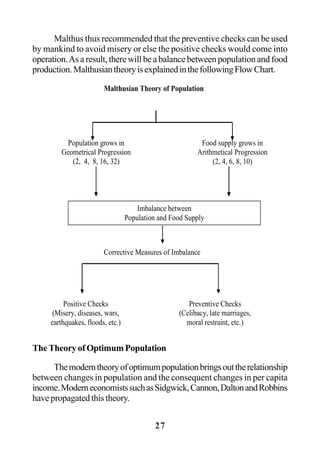
production.MalthusiantheoryisexplainedinthefollowingFlowChart.
The Theory of Optimum Population
Themoderntheoryofoptimumpopulationbringsouttherelationship
between changes in population and the consequent changes in per capita
income.ModerneconomistssuchasSidgwick,Cannon,DaltonandRobbins
have propagated this theory.
Population grows in
Geometrical Progression
(2, 4, 8, 16, 32)
Food supply grows in
Arithmetical Progression
(2, 4, 6, 8, 10)
Imbalance between
Population and Food Supply
Corrective Measures of Imbalance
Positive Checks
(Misery, diseases, wars,
earthquakes, floods, etc.)
Preventive Checks
(Celibacy, late marriages,
moral restraint, etc.)
Malthusian Theory of Population
28
Optimumpopulationmeanstheidealpopulationrelativetothenatural
resources,stockofcapitalequipmentandstateoftechnology.Therewillbe
an ideal size of population at which per capita output (or real income per
head)willbethehighest.
In other words, optimum population is that level of population at
which per capita output is the highest. A country is said to be
underpopulatedifthepopulationislessthentheoptimumandoverpopulated
ifthepopulationismorethantheoptimum.
Illustration
Letusassumethattheavailabilityofnaturalresources,capitalequipment
andstateoftechnologyremainfixedinacountry.Thepopulationisassumed
tobesmallrelativetotheseresources.Whenpopulationincreases,thelabour
forceinacountryalsoincreases.Asadditionallabouriscombinedwithfixed
amounts of these resources, the per capita output will initially rise due to
greaterofspecialisationandmoreefficientuseofnaturalandcapitalresources
available.Aspopulationincreases,apointwillbereachedwhencapitaland
naturalresourceswillbefullyexploitedandoutputwillbethehighest.
Thus, the level of population at which the per capita output is the
highest is known as optimum population. Beyond this point, if the
population increases, the country will become overpopulated and the per
capita output will start decreasing because there are more women/men in
relationtonaturalresourcesintheeconomy.
Thus, the given amount of capital and natural resources have to be
shared among a larger number of workers resulting in smaller amount of
equipment, materials and natural resources available per person to work
with.Thus, theaverageproductivitydeclines.Withthefallintheoutputper
head, per capita income and standard of living of the people also decline.
Overpopulationleadstoalowstandardofliving,disguisedunemployment
and food shortage.
Both underpopulation and overpopulation have shortcomings. It is
optimum population with the highest per capita output which is best suited
29
foracountry.ThisisexplainedinFigure2.1.
Inthefigure,sizeofpopulationismeasuredontheX-axisandoutput
per capita on theY-axis. It is clear that as population increases, output per
capitaalsoincreasestillOM.AtOPlevelofpopulation,outputpercapitais
thehighestandisequaltoMP.IfpopulationincreasesbeyondthelevelOP,
thenpercapitaoutputwillfall.ThereforeOPistheoptimum
Figure 2.1
TheoryofOptimumPopulation
population. If the actual population is less than OP, a country is said to
be underpopulated and if it is more then OP, it is overpopulated.
Thefollowingformulameasureswhetherpopulationatapointoftimeis
optimumornot
M = A-O
O
30
Where
M = Maladjustmentinlevelofoutput
A = Actualpopulation
O = Optimumpopulation
If‘M’iszero,thenthetotalpopulationisequaltooptimumpopulation
If‘M’ispositive,thetotalpopulationismorethentheoptimumpopulation.
If‘M’isnegative,thetotalpopulationislessthentheoptimumpopulation
The Theory of Demographic Transition
Thedemographictransitionbringsouttherelationshipbetweenfertility
andmotility,i.e.betweenthebirthrateandthedeathrate.Birthraterefersto
the number of births occurring per 1000 in a year. Death rate refers to the
number of deaths occurring per 1000 in a year. This theory explains the
changes in these rates as a consequence of economic development. This
theory points out that there are three distinct stages of population growth.
Stage I: High Birth Rate and Death Rate
In the first stage, the country is backward and less developed.
Agriculturewillbethemainoccupationofthepeopleandprimitivemodeof
cultivationwillbeused.Thestandardoflivingofthepeoplewillbelow.This
stage is characterised by high birth rate and high death rate. The high death
rate is due to poor diets, improper sanitation and lack of proper medical
facilities.Birthrateishighonaccountofwidespreadilliteracy,ignoranceof
family planning techniques, early marriages, social beliefs, customs and
attitudes of the people. In this stage, the rate of growth of population is not
high since high birth rate is offset by the high death rate and the population
growthstagnates.
31
Stage II: High Birth Rate and Low Death Rate
As a country advances, it might result in increase in industrial activity,
creatingmoreemploymentopportunities.Thiswillraisethenationalandper
capitaincomeofthepeople,therebyincreasingtheirstandardofliving.The
economyreachesthesecondstageofhighbirthrateandlowdeathrate.The
advancementinscienceandtechnologywillresultintheavailabilityofbetter
medicalfacilities.
Theeradicationofmanyepidemicsanddangerousdiseasesandbettersanitary
conditions reduce the incidence of disease and death. The birth rate still
remainshighduetotheresistancetochange,andthelongestablishedcustoms
and beliefs. Thus there is an imbalance between high birth rate and low
death rate resulting in high population growth, and the country witnesses
populationexplosion.
Figure 2.2
The DemographicTransition
32
Stage III: Low Birth Rate and Death Rate
Economicdevelopmentleadstochangeinthestructureoftheeconomy
from an agrarian to a partially industrialised one. With the increase in
industrialisation, people migrate from rural to urban areas, and there is a
change in the attitude of the people. With the spread of education, people
prefersmallfamiliesinordertoincreasethestandardofliving.Thusthebirth
rate is reduced.
Implementationofbettermedicalfacilities,controlofdiseaseandpublic
sanitation result in low death rate. During this third stage of low birth and
deathrates,thegrowthofpopulationtendstobestable.Almostallcountries
havepassedthroughthesethreestages(demographictransition)ofpopulation
growth.ThethreestagesofdemographictransitionareshowninFigure2.2.
Census
The term ‘Census’ can be defined as the process of collecting,
compiling,evaluating,analysingandpublishingthedemographiceconomic
andsocialdatarelatingtoallpersonsinacountryorawell-delimitedpartof
a country at a specified time.
CensusofpopulationinIndiawastakenin1872andthenin1881.From
then onwards, the census is taken once in 10 years. The latest census was
taken in 2001. Census is very important to know (1) the rate of growth of
population(2)thechangesinthedistributionofthepopulation.
Census is useful for economic planning, and for implementing welfare
schemes and measures.
The Use of Population Census
The population census provides comprehensive details of India’s
populationcharacteristics.Thedetailsrecordedinthepopulationcensusare
asfollows:
a. TotalPopulation
33
b. SexComposition
c. RuralversusUrbanpopulation
d. AgeComposition
e. DensityofPopulation
f. LiteracyRate
g. Urbanisation
h. OccupationalPattern
Characteristics of Indian Population
India accounts for about 2.4 percent of the total world area but has to
supportabout16.84percentoftheworldpopulation.Thepopulationinour
country has been growing very rapidly from 238.5 million in 1901 to 1027
million in 2001. Thus during one century i.e. 100 years , the population of
Indiahasincreasedbynearly788.5millionpeople.Thisorderofincreaseis
reallyalarmingandthreateningtothewholedevelopmentprocessinIndia.
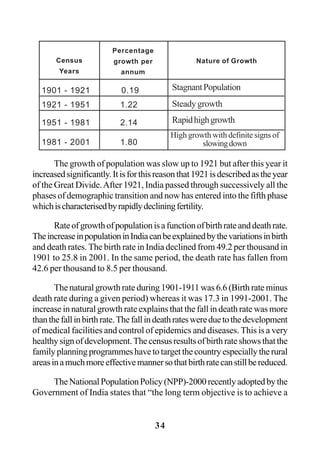
Table 2.1 Characteristics of Indian Population
India’spopulationgrowthcanbestudiedfromthefollowingtable:
PopulationgrowthinIndia
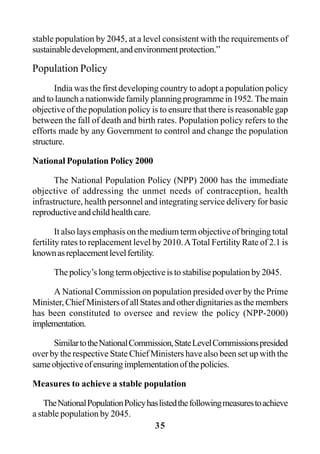
India’s population growth during the twentieth century can be
classifiedintofourdistinctphasesasfollows.
Population in 2001
(in million)
1027 531 495 927 933 267 324 65.38 75.85 54.16
Sex Ratio
(Females per
1000 Males)
Population
Density
(Per Sq.k.m.)
Literacy Rate
(2001)
Persons Males Females 1991 2001 1991 2001 Persons Males Females
34
The growth of population was slow up to 1921 but after this year it
increasedsignificantly.Itisforthisreasonthat1921isdescribedastheyear
of the Great Divide.After 1921, India passed through successively all the
phases of demographic transition and now has entered into the fifth phase
whichischaracterisedbyrapidlydecliningfertility.
Rateofgrowthofpopulationisafunctionofbirthrateanddeathrate.
TheincreaseinpopulationinIndiacanbeexplainedbythevariationsinbirth
and death rates. The birth rate in India declined from 49.2 per thousand in
1901 to 25.8 in 2001. In the same period, the death rate has fallen from
42.6 per thousand to 8.5 per thousand.
The natural growth rate during 1901-1911 was 6.6 (Birth rate minus
death rate during a given period) whereas it was 17.3 in 1991-2001. The
increase in natural growth rate explains that the fall in death rate was more
thanthefallinbirthrate.Thefallindeathrateswereduetothedevelopment
of medical facilities and control of epidemics and diseases. This is a very
healthysignofdevelopment.Thecensusresultsofbirthrateshowsthatthe
familyplanningprogrammeshavetotargetthecountryespeciallytherural
areasinamuchmoreeffectivemannersothatbirthratecanstillbereduced.
TheNationalPopulationPolicy(NPP)-2000recentlyadoptedbythe
Government of India states that “the long term objective is to achieve a
1901 - 1921 0.19
1921 - 1951 1.22
1951 - 1981 2.14
1981 - 2001 1.80
Census
Years
Percentage
growth per
annum
Nature of Growth
StagnantPopulation
Steadygrowth
Rapidhighgrowth
High growth with definite signs of
slowingdown
35
stable population by 2045, at a level consistent with the requirements of
sustainabledevelopment,andenvironmentprotection.”
Population Policy
India was the first developing country to adopt a population policy
and to launch a nationwide family planning programme in 1952. The main
objective of the population policy is to ensure that there is reasonable gap
between the fall of death and birth rates. Population policy refers to the
efforts made by any Government to control and change the population
structure.
National Population Policy 2000
The National Population Policy (NPP) 2000 has the immediate
objective of addressing the unmet needs of contraception, health
infrastructure, health personnel and integrating service delivery for basic
reproductiveandchildhealthcare.
It also lays emphasis on the medium term objective of bringing total
fertility rates to replacement level by 2010.ATotal Fertility Rate of 2.1 is
knownasreplacementlevelfertility.
Thepolicy’slongtermobjectiveistostabilisepopulationby2045.
A National Commission on population presided over by the Prime
Minister, Chief Ministers of all States and other dignitaries as the members
has been constituted to oversee and review the policy (NPP-2000)
implementation.
SimilartotheNationalCommission,StateLevelCommissionspresided
over by the respective State Chief Ministers have also been set up with the
sameobjectiveofensuringimplementationofthepolicies.
Measures to achieve a stable population
TheNationalPopulationPolicyhaslistedthefollowingmeasurestoachieve
a stable population by 2045.
36
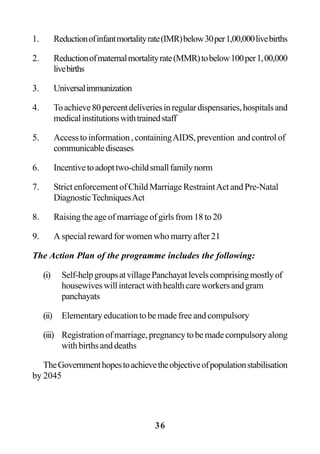
1. Reductionofinfantmortalityrate(IMR)below30per1,00,000livebirths
2. Reductionofmaternalmortalityrate(MMR)tobelow100per1,00,000
livebirths
3. Universalimmunization
4. Toachieve80percentdeliveriesinregulardispensaries,hospitalsand
medicalinstitutionswithtrainedstaff
5. Accesstoinformation,containingAIDS,prevention andcontrolof
communicablediseases
6. Incentivetoadopttwo-childsmallfamilynorm
7. Strict enforcement of Child Marriage RestraintAct and Pre-Natal
DiagnosticTechniquesAct
8. Raising the age of marriage of girls from 18 to 20
9. A special reward for women who marry after 21
The Action Plan of the programme includes the following:
(i) Self-helpgroupsatvillagePanchayatlevelscomprisingmostlyof
housewiveswillinteractwithhealthcareworkersandgram
panchayats
(ii) Elementary education to be made free and compulsory
(iii) Registrationofmarriage,pregnancytobemadecompulsoryalong
withbirthsanddeaths
TheGovernmenthopestoachievetheobjectiveofpopulationstabilisation
by 2045
37
Chapter 2
Exercise
PART A
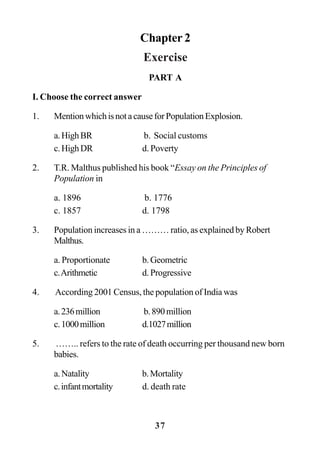
I. Choose the correct answer
1. MentionwhichisnotacauseforPopulationExplosion.
a.HighBR b. Social customs
c.HighDR d. Poverty
2. T.R. Malthus published his book “Essay on the Principles of
Population in
a. 1896 b. 1776
c. 1857 d. 1798
3. Population increases in a ……… ratio, as explained by Robert
Malthus.
a. Proportionate b.Geometric
c.Arithmetic d. Progressive
4. According 2001 Census, the population of India was
a.236million b.890million
c.1000million d.1027million
5. …….. refers to the rate of death occurring per thousand new born
babies.
a.Natality b.Mortality
c.infantmortality d. death rate
38
II Fill in the blanks
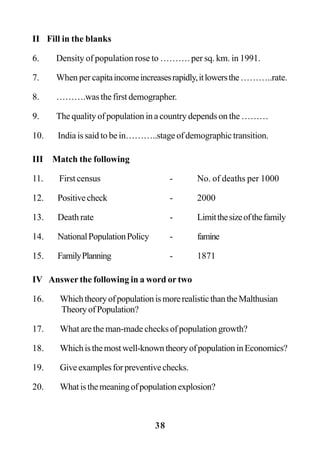
6. Density of population rose to ………. per sq. km. in 1991.
7. When per capitaincomeincreasesrapidly,itlowersthe………..rate.
8. ……….was the first demographer.
9. The quality of population in a country depends on the ………
10. India is said to be in………..stage of demographic transition.
III Match the following
11. First census - No. of deaths per 1000
12. Positivecheck - 2000
13. Death rate - Limitthesizeofthefamily
14. NationalPopulationPolicy - famine
15. FamilyPlanning - 1871
IV Answer the following in a word or two
16. WhichtheoryofpopulationismorerealisticthantheMalthusian
TheoryofPopulation?
17. What are the man-made checks of population growth?
18. Whichisthemostwell-knowntheoryofpopulationinEconomics?
19. Giveexamplesforpreventivechecks.
20. Whatisthemeaningofpopulationexplosion?
39
PART B
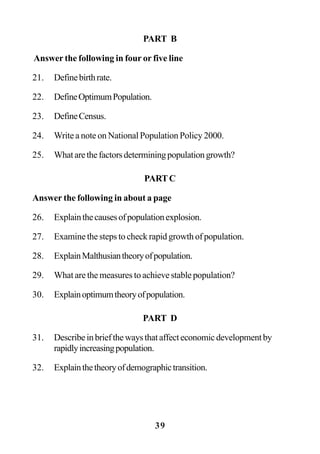
Answer the following in four or five line
21. Definebirthrate.
22. DefineOptimumPopulation.
23. DefineCensus.
24. Write a note on National Population Policy 2000.
25. Whatarethefactorsdeterminingpopulationgrowth?
PARTC
Answer the following in about a page
26. Explainthecausesofpopulationexplosion.
27. Examine the steps to check rapid growth of population.
28. ExplainMalthusiantheoryofpopulation.
29. What are the measures to achieve stable population?
30. Explainoptimumtheoryofpopulation.
PART D
31. Describeinbriefthewaysthataffecteconomicdevelopmentby
rapidlyincreasingpopulation.
32. Explainthetheoryofdemographictransition.
40
Chapter 3
Poverty and Unemployment
Introduction
Twomajorproblems thatthedevelopingcountriesoftheworldface
are mass poverty and mass unemployment. They are interconnected.
People are poor because they do not have income. That is because they
are unemployed. There are also cases where people are employed and
poor. For centuries, the problem of poverty is there in India. Reducing
poverty is one of the major goals of planning in India. We must have
knowledge about the poor and their precise social and economic
circumstances. Only then the government can adopt effective policies for
removingpoverty.
Definitions of Poverty
Poverty has been defined in a number of ways. The World Bank
(1990) has defined poverty as “the inability to attain a minimal standard
of living”.
In the words of Dandekar (1981) “want of adequate income,
howsoever defined is poverty…” Thus, lack of adequate income to buy
the basic goods for subsistence living is an important element in the
definitionsofpoverty.
Types of poverty
Absolute poverty and Relative poverty
When people do not have adequate food, clothing and shelter, we
say they are in absolute poverty.
Relativepovertyreferstodifferencesinincomeamongdifferentclasses
of people or people within the same group or among people of different
countries. If we divide the population of a country into different class
41
intervals based on income and if we compare say, the top 20 percent of
population with thebottom20percentof population, thenwecansay we
are studying about relative poverty.
Temporary or chronic poverty
In countries like India, when there is poor rainfall, the crops fail
andthefarmers temporarilyenterintoapovertysample. Butwhentheyare
poor for long, then we call it chronic or structural poverty. For example,
when agriculturists in many poor countries are dependent upon rain and
when agriculture is marked by low productivity, we say farmers are in
chronic poverty.
3. Primary Poverty and Secondary Poverty
Rowntree (1901) made a distinction between primary poverty and
secondarypoverty. Primarypovertyrefersto “families whose totalearnings
areinsufficient toobtain theminimumnecessitiesforthemaintenance of
merely physical efficiency”. “Secondary poverty refers to a condition in
whichearnings wouldbe sufficient for themaintenance formerelyphysical
efficiency were itnotthatsomeportionofitisabsorbedbyotherexpenditure,
either useful or wasteful such as drink, gambling and inefficient
housekeeping.” Rowntree said that secondary poverty prevented many
more people from meeting what he called “human needs standard” than
did primary poverty (that is, inadequate incomes).
4. Rural Poverty and Urban Poverty
A majority of the people in rural areas are poor because they do not
ownassets like landandtheyworkas agricultural labourers; their wages
are low and they get work only for a few months in a year. The urban
poor, on the other hand, work for long hours but they get low incomes.
They are employed mostly in the unorganized or informal sector. They
are “sub-employed”. Sub-employed are those 1) who work part- time
but want full - time work; 2) family heads working full time who do not
earnenough tobringtheirfamilies overthepovertylineand3)discouraged
workers who no longer seek work.
42
Other Dimensions of Poverty
In addition to the income based or economic view of poverty,
there are other dimensions of poverty. For example, one can think of
being housing poor, healthcare poor, education poor, poor in the
possession of desirable physical or mental attributes.
Characteristics of Poor Households
Generally, households with lowest income per person tend to be
large, with many children or economically dependent members. Over a
typical year, the poor spend nearly all their income on consumption of
onesortor anotherand halfofthis consumptionis likely tobeinthe form
offood. Naturally therelative prices of food staples (foodgrains,dhalls,
oil, vegetables) are crucial to their welfare. Poor households generally
invest in education for boys than for girls. The poor play little part in
politics.Inonesense theyare disenfranchised.Ofcourse, there aresome
exceptional cases. Crime, ill-health and lack of access to the poor are
considered other correlates of poverty.
Inmanycountries,povertyis correlated with casteand race. The
scheduled caste and tribal people in India and the Blacks in the USA are
classic examples.
The extent of poverty in a country depend mainly on two factors:
(1)theaverage levelofnationalincomeand (2)thedegreeofinequalityin
its distribution.
Poverty Line
PovertyLinereferstotheminimumincome,consumption,or,more
generally access to goods and services below which individuals are
considered to be poor.The poverty line is the expenditure level at which a
minimumcalorieintake andindispensablenon-food purchases areassured.
43
Itmaybenotedthatevenamongthepoor,therearedifferencesinthe
degrees of poverty. So the focus of the government policies should be on
the poorest of the poor.
Nutrition based poverty lines are used in many countries.
Poverty in India
Dandekar and Rath estimated the value of the diet with 2,250 calories
as the desired minimum level of consumption. While the Planning
Commission accepted Rs.20/- per capita per month (i.e. Rs.240/- p.a.),
Dandekar and Rath suggested a lower minimum for rural population
(Rs.180/- per capita p.a.) and a higher minimum (Rs.270/- per capita p.a.)
for urban population at 1960-61 prices. At 1968-69 prices, the
corresponding figures for the rural and urban population was Rs.324/-
and Rs.486/- respectively. On this basis, they estimated that 40 percent of
the rural population and about 50 percent of the urban population were
below the poverty line.
According to P.D.Ojha, the percentage of those below the poverty line
in rural sector increased from 52 percent in 1960-61 to 70 percent in 1967-
68.
B.S.Minhas by taking per capita annual consumption expenditure of
Rs.240/- as the barest minimum concluded that nearly half of the rural
population (50.6 percent) was living below the poverty line in 1968.
P.K.Bardhan’sstudy concludedthat thepercentage ofruralpopulation
belowthepovertyline increasedfrom38 percentin1960-61to54percent
in 1968-69.
Montek SinghAhluwalia’s study of rural poverty (1977) arrived at the
conclusionthattheruralpovertydeclined initiallyfrom 50percentinmid
– 1950s to around 40 percent in 1960-61, but increased to 56.5 percent
in1967-68. Whenever agricultural performancewasgood, rural poverty
declined andwheneveritwaspoor, itrose. Itmaybenotedthat Ahluwalia
used an expenditure level of Rs.15/- in 1960-61 prices for rural areas and
44
Rs.20/- per person per month for urban areas.Ahluwalia accepted that
thislevelofexpenditure representsanextremelylowlevelofliving.
TheSeventhFinance Commissionused aconcept called “theaugmented
poverty line”. In it, along with private consumer expenditure per capita,
public expenditure on (1) health and family planning; (2) water supply
and sanitation; (3) education; (4) administration of police, jails and courts;
(5) roads; and (6) social welfare were taken into account. According to
theestimateofSeventhFinanceCommission, 52percentof thepopulation
was below the povertyline.Italsosaid that this percentage (52percent)
was applicable to urban as well as rural areas.
The Planning Commission estimated the poverty line by taking
Rs.49.1 and Rs.56.6 per capita monthly expenditure for rural and urban
areas respectively. The World Bank estimated for India that in 1988,
39.6percentofthepopulationwasbelow povertyline. Thepercentagefor
rural areas was 41.7 percent and urban areas 39.6 percent.
According to the Planning Commission, the incidence of poverty
for all-India declined form 54.9 percent in 1973-74 to 39.3 percent in
1987-88. For the same years, rural poverty declined from 56.4 percent to
39.1percentandurbanpovertydeclined from49.2percent to40.1percent.
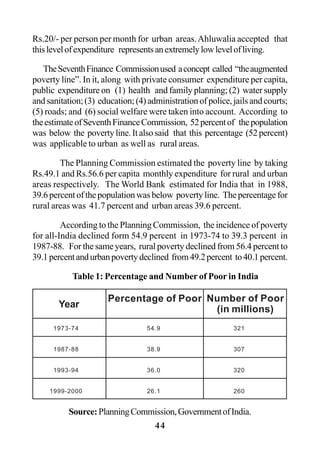
Table 1: Percentage and Number of Poor in India
Source:PlanningCommission,GovernmentofIndia.
Year
Percentage of Poor Number of Poor
(in millions)
1973-74 54.9 321
1987-88 38.9 307
1993-94 36.0 320
1999-2000 26.1 260
45
AtpresentasperGovernmentofIndia,povertylinefortheurbanareasis
Rs. 296 per month and for rural areas Rs. 276 per month. That is people
who earn less than Rs. 10 per day is considered to be below the poverty
line.As per GOI, this amount will buy food equivalent to 2200 calories per
day, medically enough, to prevent death.At this level of earning, even in a
poorcountrylikeIndia,survivalonRs.10perdayisanightmare.Thegreater
developmentaltragedyinIndiaisthatabout260millionpeoplearestillliving
without even Rs. 10 per day.
Causes of Poverty in India
The main causes of rural poverty in India are as follows :
1. Unemployment and underemployment: Even during the year in
whichtherearegoodrains, agricultural labourers donotgetworkthroughout
the year.
2. Population pressures : Because of population pressure, there are
many dependents per every earning member. And there is the problem of
disguised unemployment. On a farm, there may be work for only four
persons. But six or seven persons may be there on the farm. The marginal
productivity of the extra persons is almost zero.
3. Indian agriculture is marked by low productivity. So majority of
those engaged in agriculture are poor.
4. Amajority of people in rural areas do not have enough assets,
especiallyland. The mainreasonforthis istheconcentrationoflandinthe
handsof afewfamilies.
The regional variations in the incidence of poverty are also high. For
example, in1987-88, 58percentofthepoorpeopleinIndiawereliving in
five states, namely, Uttar Pradesh, Bihar, Maharashtra, West Bengal and
Madhya Pradesh.
Manyworkersinurbanareas suffered from sub-employment.Theyare
the working poor. And migration of people from rural to urban areas is
also one of the causes of urban poverty.
46
Poverty alleviation programmes
Theproblemofpovertyeradicationisoneofprovidingemployment
and raising the productivity of low level of employment. The following
measures have been taken by the government to remove poverty from the
country.
1. Land Reforms
Land reforms legislation has been passed by the state governments,
which aim at improving the economic conditions of agricultural landless
labourers. For instance, with the abolition of the Zamindari system, the
exploitation associated with the system has been removed.Tenancy Laws
have been passed in most of the states for protecting the interests of the
tenantsandhelpingthemtoacquirepossessionoverthelandstheycultivate.
Everystatehaspassedthenecessarylegislationfixingceilingonagricultural
holdingsbywhichthemaximumamountoflandwhichapersoncanholdhas
beenfixedbylaw.Thesurpluslandsthusacquiredweretobedistributedto
thelandlesslabourersandsmallpeasants.
2. Jawahar Gram Samridhi Yojana (JGSY)
ItwasintroducedinApril1999asasuccessortoJawaharRozgarYojana
on a cost sharing basis of 75 : 25 between the Union and States.
3. National Social Assistance Programme (NSAP)
ItwaslaunchedonAugust15,1995toprovidesocialassistancebenefits
to poor households affected by old age, death of primary bread winner or
need for maternity care.
4. Employment Assurance Scheme (EAS)
It was started on October 2, 1993 in 1778 backward blocks in drought
prone, desert, tribal and hill areas. It was expanded to cover all the 5,488
rural blocks of the country. It gave wage employment to the rural poor. In
47
September2001,itwasmergedintonewSampoornaGraminRozgarYojana
alongwithJawaharGramSamridhiYojana.
5. Pradhan Mantri Gramodaya Yojana (PMGY)
It was introduced in the Budget for 2000-2001 with an allocation of Rs.
5,000crore.Itsfocusisonhealth,primaryeducation,drinkingwater,housing
and rural roads.
Common Property Rights in grazing lands, wastelands, forests and
water resources were made available to the rural people in the past. They
have been cancelled in the recent past due to commercialisation and
privatisationoftheseruralcommunityresourcesinthecountry.
6. Swarna Jayanti Shahari Rozgar Yojana (SJSRY)
Urban self-employment and urban wage-employment are the two
special schemes under it. It substituted in December 1997 various
programmes operated earlier for urban poverty alleviation. It is funded on
75: 25 basis between the Union and the States. The expenditure under this
scheme was only Rs. 45.5 crore at the revised stage. It was Rs. 39.21 crore
in 2001-02 and an allocation of Rs. 105 crore was provided for 2002-03
(Economic Survey, 2002-03, p.217).
7. Integrated Rural Development Programme (IRDP)
The concept of an Integrated Rural Development Programme was
firstproposedinthecentralbudgetfor1976-77,andabeginningwasmade
in this regard. This programme was intended to assist rural population to
derive economic benefits from the development of assets of each area.
The programme with some modifications was introduced on an
expanded scale in 1978-79, beginning with 2,300 blocks, of which 2000
wereundercommoncoveragewithSFDA,DPAPandCADP,withanother
300 blocks added up during 1979-80. Its coverage was extended to all the
blocks of the country since October 2, 1980.
48
Besides the smaller and marginal farmers, this programme was more
specific in regard to agricultural workers and landless labourers, and
additionallybroughtwithinitspurviewruralartisansalso.Theprogramme
emphasisedthefamilyratherthantheindividualapproachintheidentification
ofthebeneficiaries.
Unemployment
Meaning of Full Employment
Fullemploymentreferstoasituationinwhichalltheworkerswhoare
capable of working and willing to work get an employment at reasonable
wages. It does not imply that all adults have jobs.
Meaning of unemployment
Unemploymentreferstoasituationinwhichtheworkerswhoarecapable
ofworkingandwillingtoworkdonotgetemployment.
Unemployment Estimates
Apersonworking8hoursadayfor73daysoftheyearisregardedas
employed on a standard person year basis. The following are the three
estimates of unemployment generated in the 27th
round of NSS (National
SampleSurvey).
1. Usual Principal Status unemployment: It is measured as
number of persons who remained unemployed for a major part of the year.
Thismeasureismoreappropriatetothoseinsearchofregularemployment
e.g., educated and skilled persons who may not accept casual work. This is
also referred to as ‘open unemployment’.
2. Weekly Status unemployment: It refers to the number of persons
who did not find even an hour of work during the survey week.
3. Daily Status unemployment: It refers to the number of persons
who did not find work on a day or some days during the survey week.
49
Causes of Unemployment
1. High Population growth:The galloping increase in population of
ourcountryduringthelastdecadehasfurtheraggravatedtheunemployment
probleminthecountry.Duetorapidlyincreasingpopulationofthecountry,
a dangerous situation has arisen in which the magnitude of unemployment
goesonincreasingduringeachplanperiod.
2. Insufficient Rate of Economic Progress: Although India is a
developing country, the rate of growth is inadequate to absorb the entire
labourforceinthecountry.Theopportunitiesofemploymentarenotsufficient
to absorb the additions in the labour force of the country, which are taking
placeasresultoftherapidlyincreasingpopulationinIndia.
3. Absence of employment opportunities in activities other than
agriculture:As enough other employment opportunities are not available,
agricultureistheprincipalareaofemploymentinourcountry.Thus,pressure
on land is high, as about 2/3 of the labour force is engaged in agriculture.
Landisthusovercrowdedandalargepartoftheworkforceisunderemployed
andsufferfromdisguisedunemployment.
4. Seasonal Employment: Agriculture in India offers seasonal
employment;thusagriculturallabourremainsidleduringtheoff-season.
5. Joint Family System: Existence of joint family system in India
promotesdisguisedunemployment.Usuallythemembersofafamilywork
on their family farms or do family business. There are more workers on a
familyfarmthanwhatwouldbeneededonthem.
6. Increasing turnout of students from Indian Universities:
Duringthelastdecade,educatedunemploymenthasincreasedduetorapid
turnout of graduates by the Indian universities. Moreover, in the Indian
educational system, more emphasis is placed on engineering and other
TechnicalsubjectsratherthanonArtssubjects.Butthereisunemployment
amongst technical graduates as well. There is a lack of proper vocational
educationinthecountry.
50
7. Slow Developing of Industries: Industrialization is not rapid in
ourcountryandindustriallabourfindsfewjobopportunities.Theagricultural
surplus labour force is not absorbed by the industrial sector.This leads to
disguisedunemploymentinagriculture.
Measures to Solve Unemployment Problem in India
Aclose reading of the Five-Year Plans reveals that in every Five-
YearsPlan,employmentexpansionhasbeenemphasisedasanobjectiveof
development. Despite all the plan pronouncements, the backlog of
unemployment has increased. This is because each Plan was not even able
to absorb the new entrants in the labour force.
The following measures have been suggested for solving the
unemploymentprobleminourcountry:
1. A Change in the pattern of investment
The planning process in the initial stages gave importance to an
investment-allocation pattern with a high capital-labour ratio. Therefore, a
shift in the emphasis to mass consumer goods industries would generate
more employment to absorb the unemployed labour force. Moreover,
increase in the supply of such goods may help arrest the rising price-level
and increase the economic welfare of the people. This is the wage-goods
modelofdevelopmentsuggestedbyVakilandBrahmanand.
2. Encouragement to small enterprises as against big enterprises
Theemploymentobjectiveandtheoutputobjectivecanbeachieved,
if greater investment is directed to small enterprises rather than to large
enterprises. Now that the Government wants to undertake decentralised
developmentwithemphasisonsmall-scaleenterprises,itwouldbedesirable
toreorientcredit,licensing,rawmaterialallocationandotherpoliciesinsuch
amannerthatbothemploymentandoutputareenlargedsimultaneously.
51
3. Problem of Choice of technique
Itwouldbebettertoswitchovertointermediatetechnologiestillthe
process of industrialisation gets such a powerful momentum that the new
entrantstolabourforcecanbeabsorbed.Duringtheperiodofrapidgrowth
in the labour force, it would be advisable to adjust the choice of techniques
consistentwiththeemploymentobjective.Intermediatetechnologywould
be more suited to Indian conditions.
4. EncouragementofNewGrowthCentresinSmallTownsandRural
Areas
Experienceofplanninghasrevealedthattheovercrowdedmetropolitan
centres have received a large share of investment. Therefore, the smaller
towns should be developed as new growth centres for the future. The
establishment of small industrial complexes can increase employment
opportunitiesandprovideflexibilitytotheeconomy.
5. Subsidies on the Basis of Employment
Allschemesofsubsidiesandincentivestolargeandsmallindustries
have helped output maximisation and greater use of capital resources. The
patternofsubsidesshouldbealtered.Creationofmoreemploymentshould
betreatedasthebasisforthegrantofsubsidesandincentives.Thiswillshift
theentirestructureofgovernmentsupportfromthelarge-scaleproducerto
the small-scale producer as this is more consistent with the objective of
employmentgenerationandachievingequalityandsocialjustice.
6. Reorientation of Educational Policy
One great defect of our educational system is that it leads one to take
up the professional degree only.The high degree of unemployment among
the educated signifies the urgent need to reorient our educational system to
greater employment opportunities. Education system should be more
diversified.Itshouldhavemoreshorttermvocationalcoursesthatwillcater
to the local employment needs. Development of quality education is a
prerequisiteforthedevelopmentofanationasitistheremedyforallproblems
52
includingtheproblemofunemploymentinthecountry.Hence,ahighpriority
needs to be accorded for education in public expenditure.
7. Underemployment in RuralAreas
N.S.S. data have revealed the existence of a high degree of
underemployment in India. The total number of underemployed persons
availableandwillingtotakeupadditionalworkisestimatedtobemorethan
two crores. It is necessary to organise the Rural works Programme. Failure
ofimplementationofRuralWorksProgrammeunderlinestherelativelylow
importance given to the rural sector to provide additional employment to
millionsoflandlesslabourersandsmallandmarginalfarmers.Urgentaction
isneededinthisdirectionsothatworkopportunitiesgrowintheruralareas.
Thiswillraisethelevelofincomeandemploymentinruralareasandreduction
inpovertylevels..
Chapter 3
Exercise
PARTA
I Choose the correct answer
1. Basic needs like food, clothing and shelter are …………..needs.
a.Physical b. Social c. Psychological d. Cultural
2. Whenapersonlivesbelowtheminimumsubsistencelevel,heissaid
to live in poverty.
a.Absolute b. Relative c.Abstract d. Non
3. Allpovertyalleviationprogrammesimplementedsofarhavelessor
no effect due to
a.Unemployment b.Jointfamilysystem
c.inequality d.corruption
53
4. ThePlanningCommissionofIndiadefinedpovertyonthebasisof
a. Income b.Consumption
c. Calorie intake of food d.Employment
5. Agriculturegivesriseto………..unemployment.
a.cyclical b. stru.
c. seasonal d.professional
II Fill in the blanks
6. Poverty is of ……….. types.
7. Indiapresentlysuffersfrom…………..unemploymentwhichexists
inopenanddisguisedforms.
8. Our planning was not at all ……………..
9. Many workers in urban areas suffered from ………….
10. ExistenceofjointfamilysysteminIndiapromotes…………
III Match the following
11. Employmentassurancescheme -April 1999
12. Disguisedunemployment - Engineering
13. Jawahargramsamridhiyojana - Rural works programme
14. IndianEducationalSystem - lowproductivityemployment
15. Underemployment - 199
54
IV Answer the following in a word or two
16. WhatisthemajorgoalofplanninginIndia?
17. WhatwasthebasisonwhichPlanningCommissiondefinedpoverty
lineinruralareas?
18. What is the main reason for poverty in India?
19. What is the prerequisite for the development of a nation?
20. How many underemployed persons are there in India?
PART B
Answer the following in four or five lines
21. Whyunemploymentamongeducatedpeopleisincreasing?
22. Name the 5 states in India where 58% of the poor people live?
23. DefinePoverty.
24. DefinePovertyline.
25. Defineunemployment.
PART C
Answer the following questions in about a page
26. DistinguishbetweenRuralandUrbanpoverty.
27. Whataretheestimatesofunemployment?
28. What are the causes of poverty in India?
55
29. Whatarethecausesofunemployment?
30. ExaminetheextentofpovertyinIndia?
PART D
31. Describethevariousmeasurestakentosolveunemployment
probleminIndia?
32. Brieflyexplaintheprogramsimplementedtoalleviatepoverty.
56
Chapter 4
National Income
Some countries are rich, some are poor and yet some others are in-
between.Howdowemeasuretheperformanceofaneconomy?Performance
of an economy is related to the level of production (of goods and services)
ortotaleconomicactivity.Measuresofnationalincomeandoutputareused
in economics to estimate the total value of production in an economy. The
standardmeasuresofincomeandoutputareGrossNationalProduct(GNP),
Gross Domestic Product (GDP), Gross National Income (GNI), Net
National Product (NNP), and Net National Income (NNI). In India, the
CentralStatisticalOrganisationhasbeenestimatingthenationalincome.
Youmeasureyouracademicperformanceinrelationtootherstudents
bythepercentageofthemarksscoredbyyou.Similarlyacountry’seconomic
performance has been measured by indicators of national income such as
GDPor GNP. Further, measuring national income is essential for various
purposes that include projection about the future course of the economy,
assistinggovernmentasthebasistodesign(orredesign)suitabledevelopment
policies, helping firms in forecasting future demand for their products and
facilitatinginternationalcomparison.
National income per person or per capita income is often used as an
indicator of people’s standard of living or welfare. However, many
development economists have criticized that GNP as a measure of welfare
hasmanylimitations.Theyarguedthathumanwell-beingdoesnotdepend
on national income alone.As measures of GNPexclude poverty, literacy,
public health, gender equity, and many human issues of well-being, they
developedothermeasuresofwelfaresuchastheHumanDevelopmentIndex
(HDI).
Some rich countries in terms of national income are poor in human
development. Similarly, poor countries in terms national income have
performedwellinhumandevelopment.InthecaseofIndia,thoughtheGDP
57
is growing faster, its performance in terms of HDI is far below than that of
manycountries.
Definitions of National Income
Nationalincomeisameasureofthetotalvalueofthegoodsandservices
(output)producedbyaneconomyoveraperiodoftime(normallyayear).It
isalsoameasureoftheincomeflownfromproduction,and/orthesumtotal
ofallthespendinginvolvedfortheproductionofoutput.Thefollowingare
someofthenotabledefinitions.
AlfredMarshal:
“Thelabourandcapitalofthecountryactingonitsnaturalresources
produce annually a certain net aggregate of commodities, material and
immaterial,includingservicesofallkinds…Thisisthenetannualincomeor
revenueofthecountry,orthenationaldividend.”
IrvingFisher:
“Thenationaldividendorincomeconsistssolelyofservicesasreceived
by ultimate consumers, whether from their material or from their human
environment.”
NationalIncomeCommitteeofIndia,:
“Nationalincomeestimatemeasuresthevolumeofcommoditiesand
servicesturnedoutduringagivenperiodcountedwithoutduplication.”
PaulA.Samuelson:
“ Gross national product (GNP) is the most comprehensive measure
of a nation’s total output of goods and services. It is the sum of the dollar
(money)valueofconsumption,grossinvestment,governmentpurchaseof
goods and services and net exports”.
Though there are some variations among these definitions, the basic
ideaisveryclear–nationalincomeissimplytheincomeofthewholenation.
The basic concepts will help to understand it more precisely.
58
Basic Concepts
Gross National Product
GrossNationalProduct(GNP)isthetotalvalueofoutput(goodsand
services) produced and income received in a year by domestic residents of
a country. It includes profits earned from capital invested abroad.
Gros s Domestic Product
Gross Domestic Product (GDP) is the total value of output (goods
and services) produced by the factors of production located within the
country’s boundary in a year.The factors of production may be owned by
anyone–citizensorforeigners.
GNP – Net income earned from abroad = GDP
Thus,GDPmeasuresincomefromwhereitisearnedratherthanwho
owns the factors of production.
Net National Product
Net National Product (NNP) is arrived at by making some
adjustment, with regard to depreciation, in GNP.As noted above, GNPis
thetotalvalueofoutputproducedandincomereceivedinayearbydomestic
residents of a country. Over this one year period, the available plant and
machinery(capital)willwearandtearandgetcondemned.Suchdeclinein
thecapitalassetsduetowearandtearismeasuredas‘capitaldepreciation’.
NNPis arrived at by deducting value of such depreciation from GNP.
That is GNP – Depreciation = NNP
Net Domestic Product
Net domestic product (NDP) is also arrived from GDP by making
adjustment with regard to depreciation in the same way described above.
59
(NDPiscalculatedbydeductingdepreciationfromGDP).
GDP – Depreciation = NDP
Per Capita Income
Per capita income (or) output per person is an indicator to show
the living standards of people in a country. If real PCI increases, it is
considered to be an improvement in the overall living standard of people.
PCI is arrived at by dividing the GDP by the size of population. It is also
arrivedbymakingsomeadjustmentwithGDP.
GDP and GNP
While GDPindicates productive capacity of an economy, GNPis a
crudeindicatorforlivingstandard.Thesignificanceofthedistinctionbetween
GNPandGDPdependsonthenatureofaparticulareconomy.Forinstance,
if a country has more non-resident inflows and produces a considerable
portionofitsoutputbymultinationalcorporations(i.e.withthehelpofexternal
factors of production), its GNP will be higher than GDP. Otherwise the
distinctionwillbenegligible.
Manycountrieshaveforeignfirms.InthecaseofUSFordMotorsin
Chennai,theincomefromthecarfactorywouldbecountedasIndianGDP
andnotasUSGDP.ButtheamountofprofitthecompanysendstoUSwill
be added to their GNP. Similarly, our GNPcan be arrived by adding to our
GDPthenetfactorincomereceiptsfromabroadforthefactorinputsowned
by Indians. That is, the non-resident Indians income will be added to GDP
to arrive at our GNP.
GDP =
PCI
Total number of people in a country
60
NI at Current Prices and Constant Prices
The concepts of national income discussed above can be measured
eitherat‘currentprice’orat‘constantprice’.Themeasurebasedoncurrent
price uses the ongoing market prices to compute the value of output. It is
quitepossiblethatthecurrentpricemayalwaysbehigherthanrealvaluedue
to many factors like taxes and inflation (or rising prices). Hence, national
income arrived at ‘current price’ includes such influences as inflation and
taxes.
With inflation as a common feature in almost all the economies, it is
necessarytomeasurethenationalincomeafterdeductinganysuchincrease
in the value of any output or income. National income at ‘constant price’
measuresthenationalincomeaftermakingnecessaryadjustmenttoeliminate
theeffectofinflation.Thusitisbasedonunchangedpriceofoutput. Asthe
national income at ‘constant price’ is computed based on the real worth of
thepurchasingpowerofincome,itisalsocalledas‘realnationalincome’or
nationalincomein‘real’terms.
Need for the Study of National Income
A national income measure serves various purposes regarding
economy, production, trade, consumption, policy formulation, etc. The
followingaresomesuchneeds.
1.Tomeasurethesizeoftheeconomyandlevelofcountry’seconomic
performance.
2. To trace the trend or speed of the economic growth in relation to
previous year(s) as well as to other countries.
3.To know the structure and composition of the national income in
termsofvarioussectorsandtheperiodicalvariationsinthem.
4. To make projection about the future development trend of the
economy.
61
5. To help government formulate suitable development plans and
policies to increase growth rates.
6. To fix various development targets for different sectors of the
economy on the basis of the earlier performance.
7.Tohelpbusinessfirmsinforecastingfuturedemandfortheirproducts.
8.Tomakeinternationalcomparisonofpeople’slivingstandards.
Circular Flow of Income
Beforediscussingthecalculationofnationalincome,abriefintroduction
ofthecircularflowofincomewouldbehelpful. Thecircularflowofincome
isexplainedwithasimplestmodelconsistingbusiness(firmsorproducers)
and public (households or consumers). The public own the productive
resources(i.e.factorsofproductionnamelyland,labourandcapital).Business
sector or producers employ the factors of production to produce the goods
and services. Such goods and services are bought by the public.
Thus public own the factors of production and provide them to
producers. The producers employ the factor inputs to produce output of
goods and services, which is bought by the consumers (public). For the
employmentoffactorservices,thepublicreceivethefactorincomenamely
rent (for land), wages (for labour) and interest (for capital). This income
flowsbackfromthepublictothebusinesssectorasconsumptionexpenditure
to buy the goods and services.
Thus, the flow chart consist two segments – real flow and money
flow.As the outer flow in Figure 4.1 shows the flow of input (factors viz.
land, labour, capital and organisation) and output (goods and services),
they represent the real economy (or real flow). The inner flow shows the
money received as factor income (rent, wage, interest, and profit) and it
goes to the producer as consumption expenditure (commodity price) to
buythegoodsandservices.Asthisflowchartinvolvesonlyincomereceived
62
andexpendituremadeintermsofmoney,itrepresentsthemoneyeconomy
(ormoneyflow).
Figure 4. 1 Circular Flow of Two Sectors
Themostimportantpointtobenotedforthecomputationofnational
incomeisthatincome(Y)receivedisequaltotheconsumptionexpenditure
(C) made by the consumers, i.e.Y=C.
This simple circular flow model is explained without the other
components of national income namely savings or investment (I), public
expenditure by government (G) and expenditure on net exports (X-M). If
weincludealltheabovecomponentsofnationalincomeY=Cwillbecome
Y = C + I + G + (X-M)
Positive checks
Payment for Factor Services
(Rent, Wages, Interest and Profit)
Supply of Factors of Production
(Land, Labour, Capital & Organisation)
Households
Supply of Commodities
(Goods and Services)
Payment for Commodities
(Commodity Price)
Firms
63
Thus national income is the aggregate summation of income or
expendituremadethroughthesefourcomponents,consumers(C),investors
(I), government (G) and foreign trade (Exports [X] – Imports [M] )
Methods of Calculating National Income
There are three different methods of calculating national income.
Theyare
1. Product or Output Method
2. Income Method
3. Expenditure Method
As noted above, GDPis the measure of an economy’s total output. It
is also used as a measure of total income and total expenditure in that
economy.Figure4.1clearlyshowsthatfactorincomesreceivedbythepublic
is being spent to buy the output of goods and services produced.
Hence, income is equal to expenditure and expenditure is equal to
the value of output produced in the economy.
Income = expenditure = output
Y = E = O
The model can further be extended by adding the other components
ofnationalincomenamelyinvestment(I),government(G),andforeigntrade
(X-M).Intheextendedmodel,savingsofpublic,taxesandimportpayments
willbedeductedfromtheincome.Hence,theyarecalledleakagesfromthe
circularflow.Similarly,investmentexpenditure,governmentexpenditureand
netexpenditureontradewillbeaddedintothecircularflow.Theseadditions
arecalledinjections.However,afteraggregatingallleakages(outflow)and
injections (inflow) in any one year, the total income components of the
64
economywillbeequivalenttothetotalexpenditureortotaloutput.Therefore,
all the three methods are supposed to give same results.
Output or Product Method
Intheoutputorproductmethod,themeasuresofGDParecalculated
by adding the total value of the output (of goods and services) produced by
all activities during any time period, such as a year.The major challenge of
thismethodistheproblemofdouble-counting.
Theoutputofmanybusinessesistheinputsofsomeotherbusinesses.
Forexample,theoutputofthetyreindustryistheinputofracingbikeindustry.
Countingthefinaloutputofbothindustrieswillresultindouble-countingof
the value of tyre. This problem can be avoided by including only the value
addedateachstageofproductionorbyaddingonlythefinalvalueofoutput
produced.
Income Method
In the income method, the measures of GDP are calculated
byaddingalltheincomeearnedbyvariousfactorsofproductionwhichare
engagedintheproductionofoutput.Thevariousincomesincludedtocompute
thegrossnationalincomeare:
Wages and salaries
Incomeofself-employed
Profitsanddividendsofbusinesscorporations
Interest
Rent
Surplusofgovernmententerprises
Net flow of income from abroad
65
All of them are known as factor incomes and they are paid in return
for the inputs engaged in some productive process which have resulted in
correspondingoutput.Thesumofalltheseincomes(orfactorprices)provide
usthemeasureofnationalincome.
Expenditure Method
In the expenditure method, the measures of GDP are
calculatedbyaddingalltheexpendituresmadeintheeconomy.Theessential
componentsofexpenditureare:
C = consumptionexpenditures
I = domesticinvestment
G = governmentexpenditures
X = exports of goods and services
M = imports of goods and services
NR = net income receipts from assets abroad
The sum of all these aggregate expenditure provides us the measure
ofnationalincome.
GDP = E = C + I + G + (X-M)
whereEisaggregateexpenditure.
Alltheabovethreemethodsmustyieldthesameresultsbecausethe
total expenditures on output must by definition be equal to the value of the
outputproducedwhichmustbeequaltothetotalincomepaidtothefactors
that produced these goods and services. However, in practice, there will be
minor differences between these results due to changes in inventory levels
and timing discrepancies. The following are some of the national income
identities.
66
NNP = GNP - Depreciation
NNI = NNP -Indirect taxes
PI = NNI - Retained earnings, corporate taxes and interest
on public debt
PDI = PI - Personal taxes.
Where, GNP – Gross National Product
NNP - Net National Product
NNI - Net National Income
PI - Personal Income
PDI - Personal Disposable Income
Problems in calculating National Income
Themeasurementofnationalincomeencountersmanyproblems.The
problem of double-counting has already bee noted. Though there are some
corrective measures, it is difficult to eliminate double-counting altogether.
And there are many such problems and the following are some of them.
Black Money
Incountrieswherelevelofillegalactivities,illegalbusinessesandthe
levelofcorruptionareveryhigh,thecirculationofblackmoneyissohigh,it
has created a ‘parallel economy’. It means unreported economy which is
equivalenttothesizeofofficiallyestimatedsizeoftheeconomy.GDPdoes
not take into account the ‘parallel economy’ as the transactions of black
money are not registered. In India, black money is all-pervasive, affecting
not only the economy but also the society at large. The black economy as
percentage of GDP is estimated to have grown from about 3 percent in the
mid-fifties to 40 per cent by 1995-96.
67
Non-Monetization
In most of the rural economy, considerable portion of transactions
occurs informally and they are called as non-monetized economy. The
presenceofsuchnon-monetaryeconomyindevelopingcountrieskeepsthe
GDPestimatesatlowerlevelthantheactual.
Growing Service Sector
In recent years, the service sector is growing faster than that of the
agriculturalandindustrialsectors.Manynewserviceslikebusinessprocess
outsourcing (BPO) have come up. However, value addition in legal
consultancy,healthservices,financialandbusinessservicesandtheservice
sector as a whole is not based on accurate reporting and hence under-
estimatedinnationalincomemeasures.
Household Services
Thenationalincomeanalysisignoresdomesticwork,andhousekeeping
and social services. Most of such valuable work rendered by our women at
homedoesnotenterournationalaccounting.
Social Services
It ignores volunteer and unpaid social services. For example, the
wonderfulservicesofMotherTeresaisinvaluableformillionsofpoor,destitute,
orphans and the diseased but at the same time not included in our GDP.
Environmental Cost
National income estimation does not distinguish between
environmental-friendlyandenvironmental-hazardousindustries.Thecostof
pollutingindustriesisnotincludedintheestimate.
National Income Series in India
Afterindependence,aregularnationalaccountssystemwasinitiated
inthemid-sixties.Indiansystemofnationalaccountstatistics(NAS)follows
68
theUnitedNation’s(UN)systemofnationalaccounts(1968).Basedonthe
NationalIncomeCommittee’srecommendation(1954),theCentralStatistical
Organisation(CSO)hasbeenmakingcontinuouseffortstoimprovethequality
of these statistics. Shifting the base year to revise the series is one such
effort.
The CSO revised its national accounts series by shifting the base
year to 1970-71. With improved data base and extended coverage, the
CSO revised its series again by shifting the base year to 1980-81, and then
to 1993-94. Recently CSO has revised its series within six year period by
shifting the base to 1999-2000.
Trends in National Income
Asnotedalready,nationalincomeisaroughindicatortomeasurethe
economic growth performance of a country. The outcome of India’s
developmenteffortcanbeseen,tosomeextent,intermsofthesize,growth
andthecompositionofournationalincome.
Table 4.1 Growth of National Income in India
( in percent)
Source: Computed from Central Statistical Organisation.
Table 4.1 provides the trend of the GDPgrowth from the year 1950
to2005.Thesizeofthenationalincomeatconstantpriceshasincreasedby
about15percentduringthisperiod.Thegrowthrateofnationalincomehas
increased from 3.5 percent during 1950-80 to 5.6 percent during 1980-
2005.
Sector 1950-1980 1980-2005
GDP Total 3.5 5.6
GDP Per capita 1.4 3.6
69
Trends in Per Capita Income
Table 4.1 also gives the trend of per capita income. The size of the
per capita income at constant prices has recorded only five fold increase
from 1950 to 2005. The growth rate of per capita income during the same
periodhasincreasedfrom1.4percentto3.6percent.Thepercapitaincome
is not the correct indicator for the living standards of people. The actual
incomeofthepeoplewouldhavedeviatedwellaboveorbelowthanthatof
thepercapitaincome.Somemeasureofpovertyandincomeinequalitywould
helpustounderstandtheactualdistributionoftheincomegrowthachieved.
Sectoral Composition of National Income
Nationalincomeisderivedfrommanysectors.Wegenerallyclassify
them into three major sectors namely primary, (agriculture), secondary
(manufacturing)andtertiary(services).Duringtheinitialstageofdevelopment,
shareofprimarysectorinthenationalincomewillbehigh.Butthiswilldecline
during the course of development and share of industry will be greater.At
very high level of development, the share of service sector in the national
incomewillbemore.
Table 4.2 Sectoral Composition of National Income
(in percent)
Source: Central Statistical Organisation.
Note : Figures upto 1990-91 are based on 1993-94 series. From
2000-01 onwards, figures are based on the new series with 1999-2000 as
the base year.
1950-51 59 13 28 100
1980-81 42 22 36 100
2002-03 24 24 52 100
Year Primary Secondary Tertiary
Total
GDP
70
Table 4.3 Sectoral Growth Rate of National Income in India
(in percent)
Source:CentralStatisticalOrganisation
The sectoral composition of national income presented inTable 4.2
confirmssuchgeneralpatternbutpartially.Theshareofprimarysectorhas
declined from 59 per cent to 24 percent. However, the industrial sector has
notgrowntotheexpectedlevel.Instead,theservicesectorhasalmostreached
more than half (52 %) of our national income. The growth rates of these
three sectors presented inTable 4.3 also show similar trend.
International Comparison of National Income
We have compared the growth performance of India since
independencetodate.HowhasIndiaperformedwithothercountriesofthe
world? Table 4.4 provides such a comparison of per capita income with
referencetosomeselectcountries.TheperformanceofIndiaintermsofthe
percapitadollarsin2001inrelationtohighandmiddleincomecountriesof
theworldisfarbelow.Withapercapitadollarof460,Indiahasjustmanaged
to be marginally above the average per capita income of (430) very poor
countriesintheworld.
Sector 1950 - 80 1980 - 05
Primary Sector 2.2 2.9
SecondarySector 5.3 6.1
Teritary Sector 4.5 7.1
71
Table 4.4 International Comparison of National Income (2001)
Chapter 4
Exercise
PARTA
I.Choose the correct answer
1. The growth of an economy is indicated by an
a. Increase in general prices b. Increase in national income
c. Increase in savings d. Increase in investment
2. The per capita income of an economy can be calculated by
a. DividingGDPbypopulation
b. DividingGNPbypopulation
c. MultiplyingGNPbypopulation
d. DividingGNPbynumberofpeopleemployed
Name of the Country
High Income Countries 26,710
MiddleIncome Countries 1850
Low Income Countries 430
India 460
Per Capita Income in
dollars )))))
72
3. The total money value of final goods and services produced in the
country excludingdepreciationiscalled
a. NDP b. GDP c. NNP d. GNP
4. The difference between NNP and NDP is
a. Depreciation b. Current transfers from rest of the world
c. Indirect tax d. Net factor income from abroad.
5. National income as commonly understood by every one refers to
a. GNP b. NNP c. GDP d. NDP
II Fill in the blanks
6. Net value added method of calculating National Income is also
known as ……….. method.
7. Consumption of fixed capital should be ….....the GNP to arrive at
the NNP.
8. Inestimatingthenationalincomeatconstantprices,latestbaseyear
used in India is…………..
9. InIndia………specificationisstillincomplete.
10. ………willgiveanexaggeratedfigureofNationalincome.
III Match the following
11. GDP - 1993-1994
12. Net Income from abroad - X-M
73
13. GNP –Depreciation - Personalincome-personaltaxes
14. CSO ‘s latest series - NNP
15. PDI - Foreigntradeexcluded
IVAnswerin one or two words
16. WhatisobtainedbydividingtheNationalincomebytotal
population?
17. Whatisthemethodofestimateofnationalincomefromthe
distributionside iscalled?
18. How many methods are there to compute national income?
19. What should be added to the three sector economy to make it to
form four sector economy?
20. Giveformulaforpercapitaincome.
PART B
Answer the following in four or five lines
21. Definenationalincome.
22. Whatistheindicatorofacountry’seconomicdevelopment?
23. What does national income at constant prices mean?
24. MentionthenamesofnationalincomeseriesinIndia.
25. Write a note on double counting?
74
PART C
Answer the following questions in about a page
26. Explainthebasicconceptsofnationalincome.
27. Distinguishbetweennationalincomeatcurrentandconstantprices.
28. Whydowestudynationalincome?
29. Explain the trend in national income from 1950 to 2005.
30. Explainthesectoralcompositionofnationalincome.
PART D
31. Examinethemethodsofcalculatingnationalincome.
32. Describetheproblemsincalculatingthenationalincome.
75
Chapter 5
Economic Planning
Meaning and Need for Planning
The 20th
century was an era of planning. Almost every
country had some sort of planning. In socialist countries, planning is
almost a religion. Even in countries like the U.S.A. and the U.K.
with a capitalistic system, they have partial planning. The 19th
century
State was a Laissez faire state. It followed a policy of non –
intervention in economic affairs. But the modern State is a Welfare
State. The two World Wars, the Great Depression of 1930s and the
success of planning in former Soviet Russia have underlined the need
for planning. Planning is a gift of former Soviet Russia to the world.
For, it was the first country to practise economic planning on a
national scale.
According to Lionel Robbins, “strictly speaking, all economic
life involves planning…. To plan is to act with a purpose, to choose
and choice is the essence of economic activity”.
In the words of Barbara Wootten, “Planning may be defined
as the conscious and deliberate choice of economic priorities by
some public authorities”.
Many economists today agree that planning is an organized,
conscious and continuous attempt to select the basic available
alternatives to achieve specific goals. Planning involves the
economizing of scarce resources.
Most of the underdeveloped countries of the world became
independent only fifty or sixty years back and most of them were
poor at that time. So it became the main business of the Governments
of the newly emergent nations to provide food, clothing and shelter
to their people. For that, first of all, they had to increase their national
76
income. Since most of them were agricultural countries, they had to
evolve some programmes for agricultural development. Not only that,
they had to industrialize their economies. And they had to provide
more jobs to their people. That means, they had to do something for
expanding employment opportunities. Further, as most of them were
wedded to some kind of socialism, they had to reduce inequalities
of income and wealth. All these things, the poor countries attempted
to do by means of economic planning.
Laissez faire policy is a luxury for modern governments. So
they have economic plans. In the developed nations of the world,
they plan for economic stability. But in the underdeveloped nations,
they plan for economic growth and development.
Another main reason for the emergence of planning in
underdeveloped countries is the failure of the market mechanism.
The capitalist economy is basically a market economy and price
mechanism works through the market system. The price system is a
basic institution of capitalism. The allocation of resources and
distribution of rewards are done through the price system. All
decisions of the businessmen, farmers, industrialists and so on are
guided by the profit motive. If the market is perfect, price system is
good. But if there is monopoly and other types of imperfect
competition, the market system fails. And it calls for government
intervention by way of planning.
The dispute between planning and Laissez faire is essentially
about efficiency. The case against Laissez faire rests on the following
grounds:
1. Under Laissez faire, income is not fairly distributed. As a
consequence, less important and less urgent goods are produced
for the wealthy people while the poor lack basic goods like
education, health, housing, good food and ordinary comforts. Under
such a situation, the State can control economic activity by means of
planning and reduce inequalities of income and wealth.
77
2. The market economy is a victim of trade cycles. And there
will be alternating periods of prosperity and depression. And during
depression, there will be bad trade, falling prices and mass
unemployment. So there is need for state intervention. By means of
proper planning, the State can control trade cycles as they did in the
case of former Soviet Russia.
During the latter half of the 20th
century, planning was popular
in many underdeveloped countries, in addition to former Soviet
Russia and Eastern European countries. It does not mean that they
believed in complete central planning. The central issue in planning
is not whether there shall be planning but what form it shall take.
The debate, in fact, centered on whether the State shall operate
through the price system or by getting rid of it.
Problems of Planning in backward countries
Planning is much more necessary and much more difficult to
execute in backward than in advanced countries. First of all,
“planning requires a strong, competent and incorrupt administration”
(Arthur Lewis). But most of the economically backward nations have
weak, incompetent and corrupt administration. Further, they have
democratic planning. So they cannot do things in a quick manner as
was done in former Soviet Russia. They have to go slow. And
agriculture is the main stay of their economies. Since agriculture
depends upon natural factors which are uncertain, there is a lot of
uncertainty about their agricultural programmes. Over–population and
low capital formation are some other important problems of planning
in underdeveloped nations.
Characteristics of Economic Planning
In a planned economy, major economic decisions such as what
and how much is to be produced, when and where it is to be
produced and to whom it is to be allocated will be determined by a
central authority such as the State, through the Planning Commission.
78
And the Government will have the powers of implementation. Before
the Plan is drawn up, a detailed survey of all available resources –
physical resources, financial resources and human resources – has
to be made. For example, in the former Soviet Russia, after the
Revolution in 1917, there was War Communism between 1918 –
1921. And there was New Economic Policy (NEP) from 1921 to
1924. And from 1924, the Government made a detailed survey of
all available resources and only in 1928, it implemented its First Five
Year Plan. After the survey of resources, the objectives of planning
will be determined. For example, one of the long term objectives of
Soviet Planning was that Soviet Russia should catch up with the
production levels of the leading capitalist nation of the world, namely
U.S.A., in steel, coal and electricity. Keeping in mind, the objectives
of the Five Year Plan, the physical targets will be fixed. And ways
and means of mobilising financial resources will be explored. The
Plan will also spell out the details in which the fruits of planning will
be distributed in a fair and just manner.
The nature of planning is determined by the type of economic
system – capitalism, socialism, mixed economy - in which it is
practised.
There will be partial planning in a capitalist economy, (e.g.,
U.K.) but a socialist economy is a totally planned economy (e.g.,
Former Soviet Russia). In a mixed economy like India, both public
sector and private sector play important roles in economic planning.
Usually, the period of a Plan is five years. The Plan has to be
drawn in advance. It is done by the Planning Commission in India. A
plan will be of a definite size and it will fix the targets for the Plan
period and it will also indicate the ways by which the financial
resources are to be mobilized for the Plan.
The first step in drawing up a Plan is to determine a growth
target for an economy over the Plan period. The planners then divide
the economy into a number of sectors such as agriculture, industry
79
and service sector. The planners will fix the physical targets for the
sectors and also decide how much investment must be made in each
sector to achieve the targets. Then they will decide the right type of
investment projects and production techniques. As the UDCs are
poor, labour-intensive techniques will expand employment
opportunities. But some heavy industries like steel have to be capital
– intensive. The success or failure of a Plan depends upon the choices
that are made.
Types of Planning
1. Centralized Planning : In a socialist economy (eg. Former
Soviet Russia), there was centralized planning; it was planning by
direction. In a socialist state, most of the means of production are
owned by the State. All basic economic decisions such as whether
priority is to be given for industrialization or for development of
agriculture ; if it is decided to give importance to industrialisation,
whether to give importance to basic and heavy industries or for
consumer goods industries will be made by the central authority.
2. Planning by Inducement : In a democracy, Planning is done
by inducement. For example, ours is a mixed economy where there
is a public sector and a private sector. The government has to
persuade the industries in the private sector to fulfil the goals of the
Plan through inducements such as tax concessions and by providing
incentives.
3. Indicative planning – In this type of planning, the
government invites representatives of industry, and business and
discuss with them in advance what it proposes to do in the Plan
under question and indicates to them its priorities and goals. Then
the Plan is formulated after detailed discussions with varied interests.
Planning in France is a good example of indicative planning. After
we embraced liberalization and privatization policies in 1991, even
Indian planning, in a way, has become indicative planning.
80
Economic plans can also be divided into midterm plans,
shorterm plans and perspective plans. Our Five Year Plans are in
fact, midterm plans. Short term plans are Annual Plans. During the
period of implementation, Five Year Plans operated by dividing them
into Annual Plans. Perspective Plans are long term plans and the
period ranges from 20 to 25 years. The Five Year Plans are formulated
by taking into account the long term objectives of the Perspective
Plan.
Rolling Plan : Unlike the Five Year Plan with fixed targets, in
the case of the rolling plan, at the end of each year, targets will be
fixed by adding one more year to the Plan. That is, without fixed
targets for all the five years, depending upon the performance of the
Plan in the current year, targets will be fixed for one more year. Like
this, it will go on a continuous basis. That is the idea behind the
rolling plan.
A great advantage of centralized planning is that plans can be
implemented with great speed and targets and goals can be achieved.
For example, by means of planning, former Soviet Russia transformed
its economy, which was predominantly agricultural into a
predominantly industrial nation, within a short span of 12 years. But
a demerit of centralized planning is that as the State enjoys a
considerable degree of monopoly, in the absence of competition, it
is rather difficult to test the productive efficiency of state owned
units. Under planning by inducement (democratic planning), though
there is a good deal of freedom for people, because of the procedures
and delays associated with the democratic process and because of
Parliamentary democracy, there will be a lot of delay in the
implementation of programmes and economic growth will be slow.
Evolution and Objectives of Planning in India
The National Planning Commission was set up in India in 1950.
A major function of the Planning Commission was to “formulate a
plan for the most effective and balanced utilization of the country’s
81
resources”. The Planning Commission formulated the First Five Year
Plan for the period (1951–56). Since then, we completed nine Five
Year Plans and we are now in the midst of Tenth Five Year Plan
(2002–2007).
Objectives of Planning in India
The central objective of planning in India is to raise the standard
of living of the people. Our Five Year Plans aim at increasing output.
At the same time, they aim at reducing inequalities of income and
wealth and providing equal opportunities for all. Growth with social
justice is our basic goal.
The major objectives of developmental planning in India may
be listed as follows:
1.To raise the national income. This is known as Growth
Objective ;
2.To increase investment to a certain level within a given time ;
3.To reduce inequalities in the distribution of income and wealth
and to reduce concentration of economic power over resources ;
4.To expand employment opportunities ; and
5.To remove bottlenecks in agriculture, manufacturing industry
(especially capital goods) and the balance of payments. In the
agricultural sector, the main objective was increasing agricultural
productivity and attaining self–sufficiency in foodgrains. In the
industrial sector, the emphasis was on basic and heavy industries. In
the foreign trade sector, the emphasis was on having a ‘viable balance
of payments position’. The strategy adopted in Indian Planning is
often referred to as ‘Mahalanobis strategy’. In this strategy, emphasis
was laid on rapid industrialization with priority for basic and heavy
industries.
82
Though achieving regional balance is mentioned in our plans,
we have not succeeded much in reducing regional imbalances. In
agriculture, there are surplus states and deficit states, with reference
to foodgrains. In manufacturing industry, there are advanced regions
and backward regions. Not only that, industrial growth is
concentrated in and around Mumbai, Kolkata and Chennai.
Our Five Year Plans pay attention to the problems of poverty
and unemployment. The average Indian is among the poorest of the
world. So, our Plans want to remove poverty and improve the lot of
the common man and the weaker sections like SC/STs, OBCs,
women and children. The standard of living depends upon per capita
consumption and per capita consumption depends upon per capita
income. And this in turn depends upon employment. So our plans
have looked at employment as an integral part of the problem of the
removal of poverty.
In the rural sector, there is concentration of land in the hands
of a few persons even today. In spite of our land reform programmes,
nearly 50 percent of agricultural land is owned by 10 percent of the
population. And Green Revolution has helped largely big landlords.
Even the ownership of industrial assets is concentrated. Of course,
the basic causes of poverty in India are low agricultural productivity
and rapid growth of population resulting in low savings and disguised
unemployment.
The Government has not succeeded much in solving the
problems of rural unemployment and underemployment by giving
support to cottage and small scale industries.
There is an urban bias in Indian Planning. Agriculture did not
receive enough funds in the past. But we cannot say the planners
have neglected agriculture.
India began the process of planned economic development five
decades back. The First Five Year (1951-56) stated that the purpose
of planning in India was to initiate “ a process of development which
will raise living standards and open out to the people new
83
opportunities for a richer and more varied life”. The Second Five
Year Plan (1956-61) aimed at rapid industrialization with particular
emphasis on the development of basic and heavy industries. It was
during the Second Plan period, the Government embraced the goal
of democratic socialism. The Third Five Year Plan aimed at self –
reliant and self – generating economy. After the Third Plan, we had
a “Plan Holiday”. The Fourth Plan did not commence immediately
after the Third Plan. We had three Annual Plans (1966-69). The
Fourth Five Year Plan (1969 – 74) had two basic objectives:1.
Growth with stability, and 2. Progressive achievement of self-
reliance.
The Fifth Plan (1974-79) focused on growth with social justice.
The slogan during the period was Garibi Hatao (Removal of
Poverty). So, the two main objectives of the Fifth Plan were removal
of poverty and attainment of self–reliance. When Janata Party was
in power at Centre, it formulated the Sixth Plan (1978 – 83). But
when the Congress came back to power, it discarded it and
formulated a new sixth Five Year Plan (1980 – 85). It aimed at a
direct attack on poverty by creating conditions for an expanding
economy. The Seventh Five Year Plan (1985-90) emphasized on
accelerating agricultural growth in foodgrains production, increasing
employment opportunities and raising productivity in all sectors.
When the final version of the Eighth plan (1992 – 97) was formulated,
there were major changes in our economic policy marked by
liberalization, privatization and globalization. The Eighth Plan 1992
– 97 reflected these changes and aimed at accelerating economic
growth and improving the quality of life of the common man.
The main objectives of Planning in India may be grouped under
four heads: Growth, modernization, self–reliance and social
justice.
Growth
In the first 30 years of planning, the trend rate of growth
of national income was 3.5 percent. Eminent economist Raj Krishna
called it the Hindu rate of growth. Agricultural production increased
84
at an average rate of 2.7 percent and industrial production at 6.1
percent. And per capita income increased at the trend rate of 1.3
percent. Though these rates appear rather small, we must remember
that throughout the British period, for almost a century, there was
stagnation in the Indian economy. For example, in the undivided India
from 1901 – 46, the trend growth rate of the national income was
only 1.2 percent. So one of the achievements of planning in Indian
economy is that it has overcome stagnation and we have had a slow
but steady economic growth.
Table 5.1Growth Rates of National Income
(in percentage)
Sources : Various Five Year Plans and Tenth Plan (2002 –
2007) Approach paper.
1. First Plan 2.1 3.6
2. Second Plan 4.5 4.0
3. Third Plan 5.6 2.2
4. Fourth Plan 5.7 3.3
5. Fifth Plan 4.4 5.2
6. Sixth Plan 5.2 5.2
7. Seventh Plan 5.0 5.8
8. Eighth Plan 5.6 6.7
9. Ninth Plan 6.5 5.4
10. Tenth Plan 8.0 –
S.No. Plan Target Actuals
85
The growth performance of the economy during different plan
periods is given in Table 5.1. From the Table, it can be seen that
there are shortfalls in the growth targets during early plan periods
except the First Five Year Plan. During the Ninth Plan period, the
GDP growth rate was 5.4 percent as against the target of 6.5 percent.
Modernization
The term ‘modernization’ refers to a number of structural
changes in the economy. Under planning, Indian economy got
transformed from a colonial economy to an independent and modern
economy. There has been a change in the composition of national
income. For example, now agriculture contributes less and service
sector contributes more. In agriculture, after the Green Revolution,
there has been a change in the technology of agriculture.
Self – Reliance
During the early phase of our planning, we depended on
external assistance for many things – food, technology and foreign
exchange. But since the Fifth Five Year Plan, self–reliance has become
one of the major goals of our planning.
Social Justice
By social justice, we mean equal opportunities for all. That
means, improving the standard of living of the poorest groups and
reduction in inequalities in income and wealth.
Ninth Five Year Plan (1997 – 2002)
The Ninth Plan covered the period from 1997 to 2002. The
focus of the Ninth Plan was on growth with social justice and equality.
The Planning Commission wanted it to be a people oriented plan
where the people at large, particularly the poor will participate. The
Plan was formulated keeping in mind the quality of life of people,
86
generation of productive employment, regional balance and self –
reliance.
Main objectives of the Ninth Plan
The main objectives of the Ninth Plan are as follows :
1. Priority to agriculture and rural development so as to generate
adequateproductiveemploymentandtoeradicatepoverty;
2. Growth with stable prices;
3. To ensure food security to all, especially vulnerable sections
of the society;
4. Providing basic minimum services of safe drinking water,
primary health care facilities, universal primary education, shelter
and connectivity to all in a time bound manner ;
5. Containing the growth of population ;
6. Ensuring environmental sustainability of the development
process through people’s participation ;
7. Empowerment of women and socially disadvantaged groups
such as SC/STs and OBCs and minorities as agents of socio-
economic change and development ;
8. Promotion and development of Panchayati Raj institutions,
co-operative and self–help groups where the participation of people
is large ; and
9. Strengthening efforts to build self–reliance.
The Ninth Plan considered (1) Quality of life of citizens, (2)
generation of productive employment and (3) regional balance as
areas of special importance for State intervention.
87
The Ninth Plan aimed at achievement of an average growth
rate of 6.5 per cent of GDP (at market prices). The Plan aimed at
investing 28.2 percent of GDP during the Plan period.
Table 5.2 Proposed Investment as percentage of GDP
It may be significant to note that the Plan did not contemplate
deficit financing as one of the sources for mobilizing financial
resources for the Plan.
Appraisal of the Ninth Plan
1. The growth rate of GDP during the Ninth Plan was 5.35
percent as against the target of 6.5 percent.
2. The Plan did not achieve the target of investment. It aimed
at an investment of 28.2 percent of GDP but it achieved only 24.2
percent.
3. The size of the public sector plan got reduced by 18 percent.
4. The fiscal deficit of the central and state governments
increased during the Ninth Plan period.
5. The Plan failed on the external trade front. The export
target was 11.8 percent but actual increase was 5.6 percent. Imports
inc reased by 4.1 percent as against the target of 10.8 percent and
6. The Ninth Plan failed to create 50 million jobs to reduce
unemployment
Private corporate sector 9.1%
Household sector 9.7%
Public sector 9.4%
Total 28.2%
88
Tenth Five Year Plan (2002 – 2007)
The Tenth Five Year Plan aimed at explicitly addressing the
issues of equity and social justice. It fixed a target of 8 percent GDP
growth rate for 2002 – 2007.
The key targets fixed for the Plan are as follows :
1.Reduction of poverty by 5 percentage points by 2007 and
15 percentage points by 2012.
2.Gainful employment to the addition to the labour force during
the Plan period;
3.Universal access to Primary education by 2007 ;
4.Reduction in the decadal rate of population growth between
2001 to 2011 to 16.2 percent ;
5.Increase in literacy to 75 percent by 2007
6.Reduction in infant mortality rate (IMR) to 45 per 1000 live
births by 2007 and to 28 by 2007;
7.Reduction of maternal mortality ratio (MMR) to 2 per 1000
live births by 2007 and to 1 by 2012.
8.Increase in forest and tree cover to 25 percent by 2007 and
to 33 percent by 2012 ;
9.All villages to have access to potable water by 2012 ; and
10. Cleaning of all major polluted rivers by 2007.
The past experience raises doubts about fulfilment of many
targets such as the GDP growth rate of 8 percent, and fulfilment of
employment target. Agriculture and small scale industries are still at
89
a low priority level. And there is too much of faith in the private
sector.
Conclusion
So far, we implemented nine Five Year Plans and we are
in the last year of the Tenth Plan. Growth with stability will be a real
challenge for the government and the people. And we have not yet
solved the problem of unemployment. Though we have reduced
poverty to a certain extent, a lot has to be done in the area. An
encouraging feature is since the Fifth Five Year Plan, employment
schemes have been integrated into poverty alleviation programmes.
Unless we contain the growth of population, it would be rather
difficult to achieve the goals of economic planning in India.
Furthermore, we have to increase our savings, investment and
exports. Above all, the administrative machinery must become strong,
competent and incorrupt to make our economic planning a success.
Since the introduction of economic reforms in 1991, there has been
a qualitative change in our planning. In due course, it may become
indicative planning.
Chapter 5
Exercise
PARTA
I. Choose the correct answer
1. The first country to introduce Five Year Plan was
a) U.K. b) U.S.A. c) Former Soviet Russia d) France
90
2. PlanninginIndiais
a) Centralizedplanning
b) Democraticplanning
c) PartialPlanning
d) Indicativeplanning
3. Perspective Plan covers a period of
a) 5 years b) 10 years
c) 20 to 25 years d) 15 years
4. ThefirstFiveYearPlanofIndiawaslaunchedin
a) 1947 b) 1951
c) 1956 d) 1961
5. TherewasplanholidayinIndiafrom
a) 1966 – 69 b) 1961 – 63
c) 1980 – 84 d) 2002 – 2004
II. Fill in the blanks
6. In Soviet Russia they had _______________planning
7. Market Economy is a victim of _____________ cycles
8. The planning strategy in India has been described as _____
strategy.
9. Former Soviet Russia launched its First FiveYear Plan in ______
10. During the Second Plan period, India adopted democratic ______
91
III. Match the Following
A B
11. IndustrialdevelopmentinU.K. a)IndianFiveYearPlans
12. Increasingstandardofliving b)LaissezFairePolicy
13. SecondFiveYearPlan c) Garibi Hatao (Removal of
poverty)
14. FifthFiveYearPlan d)EquityandsocialJustice
15. TenthFiveYearPlan e) Rapidindustrialization
IV.Answer each one of the questions in a word or two
16. Who was the Prime Minister of India when the First FiveYear Plan
waslaunched?
17. What was the policy followed during the 19th
century ?
18. What is the body that draws FiveYear plans in India ?
19. What is the period of theTenth FiveYear Plan ?
20. Who gave the name “Hindu rate of growth” ?
PART B
Answer for each question should be about four or five lines
21. DefinePlanning.
22. Whatisthemainproblemofplanninginunderdevelopedcountries?
23. Whatisarollingplan?
92
24. ExplaintheconceptofIndicativeplanning?
25. WhatisMahalanobisstrategy?
PART C
Answer for each question should be about a page
26. Whataretheproblemsofplanninginunderdevelopedcountries?
27. What are the major objectives of planning in India ?
28. What are the key objectives of theTenth Plan ?
29. Discuss the case against Laissez Faire.
30. Explaintheneedforeconomicplanning.
PART D
Answer for each question should be about three pages
31. Discusstheproblemsofplanninginbackwardcountries.
32. Describethecharacteristicsofeconomicplanning.
33. Explainthevarioustypesofplanning.
34. DiscusstheobjectivesandachievementsofplanningofIndia.
35. ExplaintheobjectivesandachievementsoftheNinthFiveYearPlan
93
Chapter 6
Agriculture
Role ofAgriculture in Economic Development
Agriculture occupies a very important place in the economic life our
country. It is the backbone of our economic system. Agriculture has been
themajorsourceoflivelihoodintheIndianeconomy. Indiaisprimarilyan
agriculturalcountry. Thefortunesoftheeconomyare,evennow,dependent
onthecourseofagriculturalproduction.Theimportanceofagricultureinthe
nationaleconomycanbebestexplainedbyconsideringtheroleofagriculture
underthefollowingheads.
1. Contribution to National Income
Agriculturecontributesevennowamajorshareofthenationalincome
inIndia. Thedistributionofnationalincomebyindustrialoriginfortheperiod
1950-51to1979-80showsthattheshareofvariousagriculturalcommodities,
animal husbandry and ancillary activities has always been more than 40
percent. As a matter of fact, during the fifties, it contributed around half of
thenationaloutput. Duringeightiesandnineties,afurtherfallinthisproportion
took place. During 2002-03, it stood at about 25 percent.
2. Major source of Livelihood
Themainsourceoflivelihoodisagriculture. Sixoutofeverytenpersons
inIndiadependuponagriculture.InindustriallyadvancedcountrieslikeU.K.,
U.S.A., etc, the number of people dependent on agriculture is very low as
compared to India. Over the years 1921-2001, the size of labour force
dependent on agriculture had more than doubled. The sector is plagued by
evilssuchasunderemployment,disguisedunemploymentandlowproductivity
employment.
94
3. Provider of Employment
Agriculture provides employment and work to an overwhelming
majority of the Indian masses. In villages, about seventy per cent of the
people earn their livelihood from cultivation and allied agro-industries. In
absolute terms, agriculture provided employment to 97 million persons in
1995; the number of people working on land (cultivators and agricultural
labourers)increasedto235million.
4. Industrial development
Agricultureprovidesrawmaterialstotheindustries. CottonandJute
textile industries, sugar, vanaspathi and plantations – all these depend on
agriculture. Many of our small scale and cottage industries like handloom
weavings, rice husking, coir, khadi etc., depend upon agriculture for their
rawmaterials. Therearemanyotherindustries,whichdependonagriculture
inanindirectmanner.
5. InternationalTrade
Indianagricultureplaysanimportantroleinthecountry’sinternational
trade. Themainexportedagriculturalcommoditiesaretea,oilcakes,fruits
andvegetables,spices,tobacco,cotton,coffee,sugar,rawwoolandvegetable
oils.Agriculturecontributestoasizeablepartofexportsanditisanimportant
segmentofimportsoftheeconomy. Theagriculturalsectorisanetearnerof
foreignexchange.
6. Capital Formation and Investment
The major part of production assets of the country is in the form of
agriculturalassetslikeland,irrigationfacilities,tractors,agricultureimplements,
ploughs, pump sets and storages. Since agriculture contributes about 25
percent of the national income, this sector is the primary source of savings
andhencecapitalformationfortheeconomy.
7. Food and Fodder
InIndia,agriculturemeetsalmosttheentirefoodrequirementsofthe
people. Agriculturealsoprovidesfoddertosustainlivestockwhosenumber
runs to several crores.
95
8.EconomicPlanning
AgricultureisthebackboneoftheIndianeconomyandprosperityof
agriculture can also largely stand for the prosperity of the Indian economy.
Importanceofagricultureinthenationaleconomyisindicatedbymanyfacts.
For example, agriculture is the main support for India’s transport system,
sincerailwaysandroadwayssecurebulkoftheirbusinessfromthemovement
ofgoods.Internaltradeismostlyinagriculturalproducts.Agriculturalgrowth
has direct impact on poverty eradication.
9. International Ranking
Atthegloballevel,Indianagriculturehasrankedincertaincommodities.
Inthecaseofgroundnuts,Indiastandsfirstintheworld,forriceproduction
it ranks second and in the case of tobacco it occupies third rank in the
world.
ThesignificanceofIndiaarisesalsofromthefactthatthedevelopment
in agriculture is an essential condition for the development of the national
economy. According to Ragnar Nurkse, surplus population in agriculture
shouldberemovedandusedinnewlystartedindustriesandpublicworksin
rural areas. By doing so, agricultural productivity will be increased on the
onehandandontheother,newindustrialunitswouldbesetupwiththeuse
of surplus labour. Agriculture is not only the largest and most important
sectoroftheIndianeconomy,butalsothemostbackwardone. Thegrowth
of agriculture, therefore, is of vital importance for the growth of the entire
economy.
ContributionofAgriculturetoEconomicGrowth
Simon Kuznets identifies four possible types of contribution that the
agriculturalsectoriscapableofmakingforoveralleconomicdevelopment.
Theseare:
1.Productcontributioni.e.,makingavailablefoodandrawmaterials.
2.Market contribution i.e., providing the market for producer goods
and consumer goods produced in the non-agricultural sector.
96
3.Factor contribution i.e., making available labour and capital to the
non-agriculturalsectorand
4.ForeignExchangecontribution.
Relationship betweenAgricultural and non-agricultural sector
During the process of development, inter-dependence between
agricultureandindustryhasbecomestrongerthroughthe
1.Productionlinkages
2.Demandlinkagesand
3.Savingsandinvestmentlinkages.
Production Linkages
Productionlinkagesarisefromtheinterdependenceofagricultureand
industry for productive inputs i.e., supply of agricultural materials such as
cotton,jute,sugarcaneetc.,toagro-basedindustriesandsupplyoffertilizes,
machineryandelectricitybyindustrytoagricultureoverthelastfivedecades.
Theselinkageshavegotfurtherstrengthenedwithagriculture’sdependence
onindustryreflectingthe modernizationofagriculturalsector.
2. Demand linkages
There are strong demand linkages between the two sectors. The
impact of incomes and industrialization on the demand for food and
agriculturalrawmaterialsisgenerallyrecognized.
3. Savings and Investment linkages
Equally significant is the impact of rural income on industrial
consumption goods, i.e., clothing, footwear, sugar, edible oils, TV sets,
washingmachines,refrigerators,motorbikes,etc. Arecentstudyconcludes;
“Ruralbazaaroutbuysurbanmarket”.
97
ComponentsofAgriculturalGrowth
Anincreaseinagriculturalproductioncanresultfromanincreasein
areaundercultivation(horizontalexpansion)and/orfromanincreaseinthe
productivity (vertical expansion). Productivity has two aspects to it, viz.,
landproductivityandlabourproductivity.
ProductivityofIndianAgriculture
India with its sizable agricultural sector has to face a number of
problems.Lowproductionandlowproductivityareatthecoreofagricultural
problem In India. The productivity of agriculture is relatively low in India
compared to other countries with comparable natural environment. There
havebeensomeimprovementsinrecentyears.Butconditionsinagriculture
have not changed much. It will be useful to analyze the factors responsible
for the backwardness of are agriculture. The factors are classified into
1.Demographicfactors
2. General factors
3.Institutionalfactorsand
4.Technologiesfactors
1. Demographic factors
The most important demographic factor responsible for low yield in
agricultureistheincreasingpressureofpopulationonland.Withpopulation
growth rates being what they are, an increasing addition to the labour force
could be expected to be absorbed in the industrial sector of the economy.
But the rate of growth in the industrial sector has been far from adequate.
Consequently, the increasing population has fallen back on land for its
livelihood,withtheresultthatthepopulationpressurehascreatedanumber
of problems like fragmentation and subdivision of holdings; the supply of
improved practices and services has always fallen short of requirements. It
hascreatedconditionsofunemploymentanddisguisedunemployment.All
98
these evils, taken together have been responsible for low productivity in
agriculture.
2. General Factors
a) Excess or surplus labour inAgriculture
The main cause for the low agricultural labour productivity is the
overcrowding in agriculture. There are many people who depend on
agriculture.As population increases, the pressure on land also increases,
because natural increase is not absorbed by the industrial sector.
b) Discouraging Rural climate
The farmers of India generally are poor, ignorant, superstitious,
conservative,andilliterateandboundbyoutmodedcustomsandinstitutions
suchasthecastesystemandthejointfamilysystem.Superstitionandbelief
infactarethecurses,whichkeepthefarmersfullysatisfiedwiththeirprimitive
system of cultivation. Except for a small group of farmers, who adopted
quickly modern techniques of production, vast majority of farmers are not
motivatedbyconsiderationsofeconomicprogress.
c) Inadequate non-farm services
Indianagriculturehassufferedbecauseoftheinadequacyofnon-farm
services such as provision of finance, marketing etc.All these facilities are
inadequate in India. Marketing system is defective and costly. Modern
warehousing is inadequate and indigenous. Storing methods are defective
andcostly.Moderncreditfacilitiesarestillpoorlydevelopedforthefarmers.
Farmersstilldependonmoneylendersfortheirday-to-dayrequirements.
3. Institutional factors
a) Size of holdings
TheaveragesizeofholdingsinIndiaisverylow.About80percentof
the land holdings are less than 2 acres. Not only agriculture holdings are
99
small but they are fragmented too. In certain parts of the country, plots of
landhavebecomesosmallthatitisimpossibletomoveevenordinaryplough.
Sincetheaverageagriculturalholdingsaretoosmall,noscientificcultivation
with improved implements, seeds etc. are possible. Small size of holdings
lead to great waste of time, labour and cattle power, difficulty in proper
utilization of irrigation facilities, quarrels and consequent litigation among
farmers, wastage of crops in the absence of fencing etc.
a) Defective land tenure structure
ThelandtenuresysteminIndiahasbeendepressinganddisincentive
ridden.Ithasbuiltinfeaturestosupportstagnation.Themainfeatureshave
beenthepresenceofintermediaries;exploitativeowner-tenantrelationship;
smallandfragmentedholdings;andtheheavyandeverincreasingpressure
ofpopulationonland.
4. Technological factors
a) Poor inputs and techniques
Themethodandtechniquesofcultivationhavebeenoldandinefficient.
Itresultsinhighcostandlowproductivity.Thesemethodshavenotundergone
anychangeforcenturies.Theinvestmentinagricultureintheformofmanures
and fertilizers, improved seeds, irrigation, tools and implements and other
types of assets has been miserably low.
b) Inadequate irrigation facilities
One of the basic causes for the weakness of Indian agriculture has
been that most of the farmers throughout the country have to depend upon
rainfallandveryfewofthemcanavailthefacilitiesofartificialirrigation.
c) Indebtedness of the farmers
It is said that the farmers in India are born in debt, live in debt, die in
debt and bequeath debt. The causes of their indebtedness are many such as
100
hereditarydebt,litigation,wantofsupplementaryincomesandwastefulsocial
expenditure.
d) Inadequate Research
Benefitofresearchanddevelopmenthasnotreachedallthefarmers.
Extensionisconfinedtoafewindividualsandthemodernpatternoffarming
is yet to take roots in the countryside.
e) Remedial measures
The above causes of low agricultural productivity also suggest their
own remedies. Following remedial measures should be taken in order to
solvevariousproblemsofIndianagriculture.
1. Co-operativejointfarmingshouldbelaunchedonanationalscale
2. Check on the population growth
3. Arrangementsforbettermanures
4. Use of better seeds
5. Alternativearrangementsforirrigationfacilities.
6. Improvementsinagriculturalcredit
7. Reclamation of waste lands
8. Consolidationofholdings
9. Useofnewimplements
10. Soilconservationandintensivecultivation
11. Improvementinmarketingsystem
12. Encouragementtoagriculturalresearchandplantprotection.
101
Itisourresponsibilitytodoallwithinourmeanstoimproveagriculture
inIndia.Thefutureofourruralpopulation,solutionoffoodandfoodproblems
andindustrialdevelopmentofourcountrydependupon agricultureonly.
Agricul.tural Crops and Cropping Pattern
Withtheintroductionofeconomicplanningin1950-51andwiththe
advent of Green Revolution after 1965, there was a steady increase in area
under cultivation and a steady rise in average yield per hectare (or) rise in
agricultural productivity.As a result, general production of all agricultural
crops recorded a rising trend.
India’smajorfoodcropsarerice,wheat,maize,cerealsandpulses.
The major cash crops are sugarcane, jute, cotton, tea, coffee, groundnut
and other oil seeds. In the pre-green revolution period, i.e. 1949-65,
foodgrainsproductionincreasedfrom55milliontonnesto89milliontonnes.
It was accounted for 3.2% of annual rate of growth. In the post-green
revolutionperiod,i.e.1965-2001,theproductionoffoodgrainshasincreased
from89milliontonnesto195.9milliontonnes.Buttheannualrateofgrowth
was only 2.2%.
Cropping Pattern in India
Croppingpatternmeanstheproportionofareaunderdifferentcrops
atapointoftime.Inotherwords,itmeansaratioofdifferentcropscultivated
at a particular time.Achange in cropping pattern implies a change in the
proportion of area under different crops.
Table: 6.1 Nature of crop distribution since 1951
The table indicates the share of different categories of crops in the
total area sown.
Factors affecting cropping pattern
Natural Factors: Natural factors include the type of land, climate,
rainfall and average temperature etc. These are the most important factors
102
affectingcroppingpatternbecausetheroleofNatureismoreimportantthan
maninagriculture.
Size of Holdings: If the size of holding is small, farmers will prefer
food grains and if the size of holding is sufficiently large, they may choose
commercialcrops.
Price of Agricultural Products: Farmers like to produce the crops,
whichmayyieldmaximumprofittothem.
Availability of Agricultural Inputs: If the farmers have inputs of
high quality, they may go in for commercial crops. For this purpose, they
requireagriculturalimplements,fertilizers,chemicals,highyieldingseedsand
irrigationfacilities.
Social Factors: Social customs and attitude of farmers towards new
technologyanddevelopmentalsoaffectcroppingpatternofacountry.Ifthe
farmersarewillingtoacceptnewtechnologyanddevelopment,theywillbe
induced to go for commercial crops.
Government Policy: Government may also affect cropping pattern
ofthecountrybygivingincentivestosomeparticularcrops.
Knowledge about Cropping Pattern: If the farmers were aware of
theimprovementstheycanbringintheircroppingpattern,theywouldliketo
changeit.
Crops 1950-51 1980-81 2000-01
100 100 100
74 80 75
a) All Crops
b) Foodgrains
c) Non-foodgrains
(or)
cash crops
26 20 25
103
CropInsuranceScheme:Cropinsuranceschemehelpsindiversifying
cropping pattern of a country. This scheme helps farmers in adopting the
crops,whichinvolverisks.
GovernmentEfforts: Governmentcanalsohelpinthediversification
ofcroppingpatternbyadoptingfollowingmeasures–(i)Todistributehigh
yielding variety seeds through government agencies, ii)Tomake chemical
fertilizersavailableatconcessionalratesiii)Toprovidethefacilitiesofstorage
andtransportationregardingagriculturalproducts,iv)tomakethemarketing
system of agricultural products effective so that the farmers may get fair
price for their products.
AgriculturalHolding
Agriculturalholdingisthemaindeterminantofthequantity,quality
andstructureofagriculturalproduction.Agriculturalholdingmeansthesize
of land owned and cultivated by a farmer. It may be defined on the basis of
ownership,(agriculturalholdingmeansthesizeoflandownedbyafarmer)
and on the basis of cultivation.Agricultural holding means the size of land
cultivatedbyafarmerataparticulartime.
Consolidation of holdings
Amajorcauseoflowagriculturalproductivityisthefragmentation
and sub-division of holdings which has resulted in uneconomic holdings.
Besides the tenancy system and the ownership pattern, the programme of
land reforms covers the task of consolidating the scattered holdings of the
small farmers so as to make them compact units in one place.
Land Reforms
Landreformsrefertoallkindsofpolicy-inducedchangesrelatingto
theownership,tenancyandmanagementofland.
104
Objectives of land reforms in India
InIndiathelandreformprogrammehasbeenoneofthemajorpolicies
forruraldevelopment.Themajorobjectivesoflandreformsareasfollows:
i)Restructuring of agrarian relation to achieve egalitarian social
structure.
ii) Eliminationofexploitationinlandrelations
iii) Actualizationofthegoalof‘landtothetiller’
iv) Improvementofsocio-economicconditionsoftheruralpoorby
wideningtheirlandbase.
v) Increasingagriculturalproductionandproductivity
vi) Facilitatinglandbaseddevelopmentofruralpoor
vii) Infusionofagreatermeasureofequalityinlocalinstitutions.
Land reform measures in India
The land reforms programme in India has been done through three
differentmethods:
i)Voluntary adoption facilitated by incentives provided by the State
throughmeasureslikeco-operativefarmingandconsolidationofholdings.
ii)Voluntary adoption supplemented by statutory compulsion made
possible by the enactment of legislation as in the case of consolidation of
holdings.
105
iii) Compulsion exercised through different legislative measures, as
withtheabolitionofintermediaries’,tenancyreforms,ceilingsonholdings
etc.
Agricultural marketing
Agricultural marketing means the economic process under which
agricultural goods are exchanged. Process of agricultural marketing
determinesthevalueofagricultureproductsintermsofmoneyanddelivers
themtotheirfinalconsumer.
Importance of agricultural marketing
Agriculturalmarketingisaspecificpartofmarketing.Itisrelatedto
agriculturalproductsonly.Itisthebaseofmostoftheeconomicactivitiesof
a country. It brings marketable surplus to the market for sale. Farmers will
keep a portion of their produce for self-consumption and cattle and the
remainingportionsareleftforsale.Higherlevelofmarketablesurplusleads
togreatereconomicdevelopment.Theimportanceofagriculturalmarketing
isasfollows:
1) Providesrawmaterialsforindustries.
2) Providesfoodgrainsfortheentirepopulationandfodderforcattle.
3) Provides a base for expansion of internal market of a country.
4) Helpsintheexpansionofinternationalmarketalsowhenmarketable
surplus found in excess of the demand of a country, fetches a
considerableamountofforeignexchange.
At present, most of the farmers sell their produce through village
level markets, fairs, mandies; co-operative societies and government also
purchasesagriculturalproducedirectfromfarmers.
106
Marketable Surplus
Marketable surplus may be defined as the residual of produce left
with the producer after meeting his requirements for family consumption,
farmneedsetc.Italsomeanstheportionofproduceleftforsale.Marketable
surplus,whichisgenuineandnotartificialorforced,isthefountainsourceof
notonlyagriculturaldevelopmentbutalsoofoveralleconomicdevelopment.
It is the real surplus generated by agricultural sector. It can be measured
thus:
(Oldstocks+Currentoutput)–(Consumption+waste+inventories
for next season)
Marketablesurplusisreferredtoas‘grosssurplus’fromagriculture,
whilemarketedsurplusisreferredtoas‘netsurplus’fromagriculture.
Determinants of marketable surplus
The various variables that determine marketable surplus are I) size
ofholdingii)productionofcropiii)sizeoffamilyandiv)non-farmincome.
Inadditiontothis,thequantityofmarketablesurpluswillalsodependonan
efficientmarketingsystem.
Importance of marketable surplus
Risingmarketablesurplusesaretherealsurpluses,whichdetermine
therealincome,realsavings,realcapitalformationandrealinvestmentand
havegreatimportanceinraisingthewelfareininflationfreeeconomies.Fall
intherealmarketablesurplusesinlessdevelopedeconomies,raisetheprices
of not only foodstuffs but also of other wage goods and invariably the real
levelsoflivingofworkingclassmaygodown.
Food Problem in India
Food, clothing and shelter are the basic necessities of a person.
Amongthese,foodisthefirstmostimportantnecessity.Noonecansurvive
without sufficient food. It is a prime duty of every government to provide
107
sufficient food to all the people of a State. If a government fails to provide
sufficient and nourishing food to her people, she fails on all the economic
social and political fronts. Therefore, sufficient food should be provided to
all the people of a State. Production of foodgrains should be sufficient to
meet their demand. If the production is less than demand, the country will
havetoimportfoodgrainswhichwillcreatetheproblemofadversebalance
of trade and balance of payments.
In India, food problem is a chronic problem. It dates back to 1937,
the time of separation of Burma from India and 1947, the time of partition.
Unemploymenthasfurtheraggravatedtheproblem.
Nature of food problem in India
India is the second most populated country of the world. Being so,
food requirements of the country are increasing day by day. Food problem
in India covers four important aspects.
1. QuantitativeAspects
Quantitative aspects of food problem are related to the demand and
supply of food grains. Production of foodgrains has been less than their
demandforalongperiod.Thoughinthelastfewyears,domesticproduction
of food grains has increased considerably, yet the country has to import
foodgrainsinlargequantitiesfromtimetotime.
2.QualitativeAspects
Qualitative aspect of food problem is related to nutritive elements in
food. Proteins, vitamins, minerals, carbohydrates etc. are the important
elementsofabalanceddietbuttheseelementsarenotavailableinsufficient
quantitiestomostoftheIndianpeople.Accordingtoexperts,apersonshould
get 3,000 calories per day but on an average 2100 calories are available to
thepeopleinIndia.Mostimportantreasonofthissituationisthepovertyof
most of the people in India.
108
3. DistributiveAspects
Distributive aspects of food problem are related to the system of
marketingofagriculturalproducts.Duetodefectivesystemofdistribution,
most of the persons do not get foodgrains in sufficient quantities, at right
time,andatfairprices.Anti-socialelementscreateartificialshortageofthese
products in market and sell them at unreasonable prices. Most important
reasonforthissituationisadministrativesluggishness.
4. EconomicAspects
Economic aspects of food problem are related to purchasing power
ofpeople.NationalincomeandpercapitaincomeofIndiaareverylow.The
result is that most of the people in India are not in a position to afford the
purchaseofnourishingfoodgrainsinsufficientquantities.
Causes of food problem in India
Important causes of food problem in India are as follows:
i) Rapidgrowthofpopulation.
ii) Lowagriculturalproductivity.
iii) Naturalcalamities.
iv) Developmentofcommercialcrops.
v) Changesintheconsumptionpattern.
vi) Increase in income demand for food.
vii) Economicdevelopmentandurbanisation.
viii) Hoardingandblack–marketing.
109
Food policy of Government of India
Soonafterindependence,thegovernmenttooktheproblemofshortage
of food grains seriously. Several important measures have been taken by
government to solve this problem. These measures may be enumerated as
follows:
Increase in Production of Foodgrains
Agriculturaldevelopmenthasbeenaccordedtoppriorityinalmostall
the FiveYear Plans. Several programmes have been launched to increase
agricultural production and productivity such as intensive farming, multi –
cropprogramme,developmentofhighyieldingvarietiesofseeds,intensive
use of fertilizers.As a result of these efforts, production of foodgrains has
increased from 50.8 million tonnes in 1950-51 to 192.4 million tonnes in
1997-98.
Import of Foodgrains
Tomeettheshortageoffoodgrains,thegovernmenthasbeenimporting
food grains from time to time. 48 lakh tonnes of food grains were imported
in 1951 which increased to 103 lakh tonnes in 1966. During 4 years
1991,1992,1995 and 1996, the imports have been almost nil.
Procurement of foodgrains
Governmentadoptedthesystemofprocurementoffoodgrains.Under
the system, government procures foodgrains from market every year. For
thispurpose,procurementpricesorminimumsupportpricesareannounced
by government every year for all the important foodgrains and all the
governmentpurchasesaremadeattheseprices.Ithelpsinprotectingfarmers
againstthemalpracticesoftradersandcommissionagents.
Public Distribution of Food grains
Government adopted public distribution system to ensure fair
distributionoffoodgrainsatcontrolledprices.Underthesystem,fairprice
110
shops are opened. Each such shop is envisaged to serve a population of
about 2000.As on 31st
March, 1998, there were about 4.50 lakh fair price
shops (Ration shops) in the country.These shops supply rice, wheat, sugar,
edible oils and kerosene to people in certain quantity at controlled prices.
Buffer Stock Scheme
Governmentstartedaschemeofmaintainingbufferstockofimportant
food grains to ensure their regular supply throughout the year.Whenever
thereisariseintheirprices,governmentreleasesthemfrombufferstockto
stabiliseprices.Bufferstockoperationsarenormalthesedaysandtheyhave
become a normal part of the food policy of Government of India.
Establishment of Specific Institutions
Anumberofspecificinstitutionshavebeenestablishedbygovernment
to promote agricultural production and productivity and to ensure regular
supplyandfairdistributionoffoodgrains.Importantinstitutionsare:National
Seeds Corporation, Agro-industries Corporation, Agricultural Prices
Commission, Food Corporation of India, Fertilizer Corporation of India,
etc.
Agricultural Research & Development
Government is taking serious steps to promote agricultural research
anddevelopment.AnumberofagriculturaluniversitiesandIndianCouncilof
AgriculturalResearch(ICAR)havebeenestablishedtoundertakeresearch
activities.
Public Distribution System (PDS)
Publicdistributionsystemmeanstheregulatedandcontrolled
distributionofessentialgoodsamongpeople.Underthesystem,essential
consumer goods are provided to people at fair prices through government
agencies.
111
Main Constituents of Public Distribution System
Fair Price Shops or Ration Shops
Public distribution system ensures supply of essential commodities
through a network of fair price shops.At present, there are about 4.50 lakh
fairpriceshopsinIndia,outofwhichabout3.60lakhshopsareoperatingin
rural areas and 0.90 lakh shops are operating in urban areas. Each shop is
envisaged to serve a population of about 2000.
Consumers Co-operative Stores
Consumerco-operativesplayanimportantroleinthesupplyofquality
goods at reasonable rates to common people. There is a three-tier structure
ofconsumerco-operativesocietiesinIndia.Theyareprimaryconsumerco-
operative societies, central consumer co-operative stores and state level
consumerfederations.Morethan50,000villagelevelsocietiesareengaged
inthedistributionofconsumergoodsinruralareas.
Shops selling Cloth at Controlled Prices
These shops sell cloth at controlled prices to consumers on the basis
oftheirrationcards.Morethan66,000shopsaresellingsuchcloththroughout
thecountry.
Super Bazaars
Super bazaars are the bazaars which provide all the goods of daily
needsatcontrolledprices.Thesemarketsenabletheconsumerstocomplete
theirpurchasesfromoneplace.Thesebazaarsareworkinginalmostallthe
majorcitiesofIndia.
Kerosene Retailers
Insomestates,keroseneisdistributedthroughfairpriceshopswhileinother
states, specific retailers have been licensed for the purpose.
112
Commodities of Distribution
Sixkeyessentialcommoditiesviz.,wheat,rice,sugar,importededible
oils, kerosene and soft coke are distributed to consumers through public
distribution system. Besides, state governments are empowered to include
otheressentialgoodsinthesystem.
Responsibility of Supply of Commodities
Different institutions have been assigned the responsibility of
procurement,allocationanddistributionofdifferentgoodsasunder:
i) Food Corporation of India for wheat, rice and other food grains,
ii) Indian Oil Corporation and Ministry of Petroleum for Kerosene,
iii) Coal India Limited for soft coke,
iv) NationalTextilesCorporation,and
v) StateTrading Corporation for imported edible oils.
Agricultural Price Policy
Agriculturalpricepolicymeansapolicytodetermine,regulateand
controlthepricesofagriculturalproducts.Importantobjectivesofagricultural
price policy are: (i).To determine, regulate and control agricultural prices;
(ii).Topreventviolentfluctuationsinagriculturalprices;(iii)Toprovidefair
pricesforagriculturalproductstothefarmers;(iv)Toprovidequalitygoods
tohouseholdsatreasonableprices;(v)Tomaintainanappropriaterelationship
and balance between the prices of foodgrains and non-foodgrains; (vi)To
integrate prices between various states.
113
Price Policies of the Government
1. Minimum support prices
Aminimumsupportpricesisdeclaredbygovernment,normallyatthe
beginningofsowingseasonforeveryimportantagriculturalcommodity.These
prices are a long term guarantee to farmers that the prices of these products
will not be allowed to fall below a certain level. These prices assure the
farmers and encourage them to carry on and to expand their production.
Theyputtheirbesteffortstogetmaximumproduction.Ifthepricesfallbelow
minimumsupportprices,governmentwillbuytheentiremarketablesurplus
at procurement prices.
2. Procurement Prices
These are the prices which are declared by government, generally at
the time of harvest of crops. These are the prices at which the government
buys agricultural products from farmers. These prices serve two important
objectives:
(i) To provide guarantee to the farmers that the prices of these
products will not be allowed to fall below a certain level. If
marketpricesfallbelowthislevel,thefarmerscanselltheir
productstogovernment.
(ii) Itenablesgovernmenttoprocuretheseproductsformaintaining
publicdistributionsystemandbufferstocks.Thesepricesare
announcedbygovernmentontherecommendationsof
CommissionforAgriculturalCostsandPrices(CACP).These
prices are widely used by government for the procurement of
wheatandrice.Procurementpricesaregenerallyhigherthan
minimumsupportprices.
3. Issue Prices
Issue prices are the prices at which food grains are allocated and
supplied by Food Corporation of India (FCI) to the states and union
114
territories.Thesepricesmeettherequirementsofpublicdistributionsystem.
Prices of goods to be supplied through fair price shops directly depend
upon issue prices. Issue prices are normally less than market prices and
higherthanprocurementprices.
4. Retail Prices
Public distribution system is carried on through the network of fair
priceshops(rationshops).Theseshopssupplyessentialconsumergoodsto
households at the prices fixed by government. These prices are known as
retailprices.Retailpricesarehigherthanissuepricessothattheexpensesof
public distribution system may be recovered and the licensees may get a
certainmargin.
5. Buffer Stock Operations
Bufferstockoperationsrefertobuyingandsellingoffoodstocksby
government.Theseoperationsservetwoimportantpurposes:
(i) Toregulateandcontrolpricefluctuationswithinareasonablelimit.
(ii) Toenablegovernmenttoprocurefoodstockssothatregularsupply
of these stocks may be ensured throughout the year as well as
throughout the country. These operations are carried on by Food
CorporationofIndia(FCI).Wheneverthereisafallinthepricesof
food stocks, FCI starts buying them at procurement prices and
whenever there is a rise in these prices, FCI starts selling. Thus,
bufferstockoperationsplayanimportantroleinstabilizingagricultural
prices.
Agricultural Productivity
Agriculturalproductivityistheratioofagriculturalinputsandoutput.
Itindicatestheefficiencywithwhichtheinputshavebeenutilized.Itindicates
how much production has been obtained from a given amount of inputs. It
can be measured as:
115
TotalProduction
AgriculturalProductivity = ———————————
Amount of Inputs Employed
TotalProduction
ProductivityofLand = ———————————
Area of Land
TotalProduction
ProductivityofLabour = ———————————
No of Workers Employed
TotalProduction
ProductivityofCapital = ————————————
TotalCapitalEmployed
Trends ofAgricultural Productivity in India
1. Productivity of Land
ProductivityoflandinIndiaisverylowincomparisontothatof
average productivity of land in other countries. It has been made clear in
followingtwotables:
116
Table6.2revealsthatthoughproductivityoflandisimprovingandis
morethandoublethanthatatthebeginningofplanningera,stillitcannotbe
regarded as satisfactory.When we look at the productivity of land of other
countriesofworld(seeTable6.3),wefindthatIndialagsfarbehind.Average
production per hectare in India is much below the world average in all the
crops. We are far behind the productivity of agricultural lands in both the
developed and developing countries of the world.
2. Productivity perWorker
Agriculturalproductivityperworkerisverylowwhencomparedwith
the productivity per worker in industrial and other sectors.According to an
estimate,productivityperworkerinthefieldofagricultureisonlyone-third
when compared with that of large industries and one-half when compared
withthatofsmallindustries.Inthisregard,inagriculturethepartplayedby
Natureismoreimportantthanthepartplayedbyman.Secondly,investment
ofcapitalperworkerinagricultureismuchlessthanthatofinindustry.
Table 6.2 Yield per Hectare of Major Crops (k.g./hectare)
Crops 1950-51 1970-71 1990-91 2003-04
Food grains 522 872 380 1731
Cereals 542 949 1571 1987
Pulses 441 524 578 637
Rice 668 4423 740 2077
Wheat 663 1307 2281 2713
Oil seeds 481 579 771 1067
117
Table 6. 3
International Comparison ofYield of Selected commodities
(k.g per hectare)
Source: Economic Survey, 2005-06
Commodity Country
Rice
Wheat
Ground nut
Thailand 2597
India 2915
Egypt 9135
U.S.A 7372
Bangladesh 2164
India 2770
China 3885
U.K 8043
China 2986
Argentina 2329
Brazil 2043
India 794
118
Chapter 6
Exercise
PARTA
I. Choose the correct answer
1. Nearly 64% of labour force in India is engaged in
a. Agriculture b. Industry
c. Service sector d. Foreign trade
2. Agriculturalproductivitycanbemeasuredintermsof
a.consumptionoffertilizer b.Irrigationalfacilities
c. Landandlabour productivity d.Mechanization
3. Nearly 20% of the cultivated area is irrigated by
a.Tubewells b. Storage canals
c. Perennial canals d. Tanks
4. ThecontributionofagriculturalsectortotheGDPhasdeclinedto
a. 29.7% b. 56.1%
c.27.9% d. 26%
5. Greenrevolutionincreasedthefoodgrainsproductionespeciallyin
a. Rice and sugarcane b. Rice and wheat
c. Wheat and sugarcane d. Ragi and rice
119
II. Fill in the Blanks
6. ……………has been the major source of livelihood in the Indian
Economy.
7. Agricultureprovides……….totheIndustries.
8. ...meanstheproportionofareaunderdifferentcropsatapointoftime.
9. ………….means the size of land owned and cultivated by a farmer
ataparticulartime.
10. …………meanstheeconomicprocessunderwhichagricultural
goods are exchanged.
III Match the following
11. Sub-divisionandfragmentation - NewAgriculturalprice
policy
12. Suddenincreaseinproduction - Declineofjointfamily
per acre of land system
13. Zamindarisystem - Greenrevolution
14. Disguisedunemployment - Britishperiod
15. 1986 - Agriculture
VAnswerthe following in a word ortwo
16. What is the yield per hectare called?
17. Whatarethewaysinwhichagriculturalproductivitycanbemeasured?
18. Iscapital-output-ratiosmallinagriculture?
19. Giveexamplefornaturalfactorsaffectingcroppingpattern?
120
20. Is crop insurance scheme essential for the farmers?
PART B
Answer the following in four or five lines
21. Whatisthecontributionofagriculturetoeconomicgrowth?
22. Whatarethecomponentsofagriculturalgrowth?
23. List out the factors responsible for the backwardness of agriculture.
24. Definecroppingpattern.
25. Defineagriculturalholding.
PART C
Answerthefollowingquestionsinaboutapage
26. Explaintherelationshipbetweentheagriculturalandnon-agricultural
sectors.
27. Examinetheremedialmeasurestosolvethevariousproblemsof
Indianagriculture.
28. Describethefactorsaffectingcroppingpattern.
29. ExplaintheobjectivesandmeasuresoflandreformsinIndia.
30. Discusstheimportanceofagriculturalmarketing.?
PART D
31 Expressindetailtheroleofagricultureineconomicdevelopment.
32. Discuss the factors responsible for the backwardness in
agriculture.
33. Describe in detail the factors affecting the cropping pattern.
121
Chapter 7
Industrial Sector
Need for Industrialisation
The need for and role of industrial sector have been fully recognized
bythedevelopmentthinkingallovertheworld.Industrialsectorthroughits
forward and backward linkages with other sectors plays a very important
role in achieving rapid growth and development. Most modern and rich
countrieshavewelldevelopedindustrialsectorthroughtheirearlyindustrial
revolution.
Industrializationmeanswidespreaddevelopmentofmanufacturingvast
quantities of goods, employing a large number of people, promoting
internationalmarket,characterizationofspecializedskill,science,technology,
increasing application of electrical, electronic, computer technologies to
enhanceproductivity.Absenceofsuchrigorousindustrializationisthemain
reason for the backwardness of many poor countries too.
Hence, the modern development strategies attach more emphasis to
rapidindustrializationtoachievefastergrowthandprogress.Thefollowing
are some of the important needs for the industrial sector.
Raising National Income
Vigorousindustrializationensuresasolidandsustainedbasetoincrease
the national income of an economy.Alarger share of national income of
industriallyadvancedeconomiescomesfromindustrialsector.
Employment Opportunities
Availability of surplus labour and unemployment are the major
challenges of development strategy. Industrialization uses the productive
resourcesoftheeconomyandexpandsemploymentopportunitieswhichin
turnwillimprovetheincomeandwell-beingofthepeople.
122
Higher Living Standard
Theincreasingnationalincomethroughindustrializationhelpstomeet
the demands of the people for industrial products. It is also expected to
improve the standard of living of the people by increasing their per capita
income.Thisispossibleonlythroughawelldesignedgrowthprocess.
Promoting Exports
Industriallyadvancedcountriesareabletoexportmoreandearnlarge
foreignexchange. Theincomeelasticityofindustrialgoodsisveryhighthan
thatoftheprimarygoods. Hence,exportscanbepromotedtoearnadequate
foreignexchangebyproducingadvancedindustrialgoods.
Capital Formation
Expandingemploymentopportunities,incomegenerationthroughrapid
industrialisationwillalsoleadtoincreasedsavingandcapitalformationinthe
economy. Thiswillhelptodiversifyandexpandtheindustrialbasefurther
throughhigherinvestment.
Technological Progress
Industrialsectorwillalsopromotetechnologicalprogressthroughits
course of development and expansion. The technological advancements
andtheirdynamiccontentsprovidetherequiredelementstostrengthenthe
economy as a whole.
Patterns of Industrial Development
The pre-independent India, mostly characterised by backwardness,
did not have an organized industrial sector.The SecondWorld War made
smallbeginningintheindustrialdevelopment.Stilltheshareofindustriesin
thecountry’snationalincomewasrelativelysmall.
There had been a marked shift in the advancement of the industries
after the implementation of five year Plans in the independent India. The
123
significant role of industrialization as the major channel of rapid economic
growth and allround development has been recognized by the planners of
modernIndia.
Besides rapid growth and prosperity, the Indian strategy of
developmentplanning,inspiredbyeconomicnationalism,aimedatachieving
self-sufficiencyunderthedirectionofpublicsector. Italsoaimedtotranslate
the economic growth into improved standard of living of the masses.
Maximumproductionandfullemployment,andtheattainmentofeconomic
equalitywerethelongtermobjectivesdeclaredbytheFirstFivePearPlan.
The policies aimed at achieving economic growth with distributive
justice. Then the rapid development of industries and their diversification
are considered to be absolutely necessary for development.
Theexperienceofstatedominateddevelopmentplanningforaperiod
ofmorethanfivedecadeshasbroughtoutmanysignificantachievementsin
thegrowthandstructureofIndianindustries.
‘Growth with social justice’ has been the main objective of planning
since 1951. It has been defined to be inbuilt in the production process so
thatthemajorbeneficiariesofthedevelopmentplanningarethemajorityof
thepeopleandtherapidanddiversifiedindustrializationservestheneedsof
themassesbygeneratingadequateemploymentandincomedistribution.
Thenewpolicyenvironmentfocusedonamixedeconomyframework
wherethepublicsectorwillplayamajorroleinbuildingtheindustrialbase
of the economy with the objectives of accelerating growth, generating
employment, reducing regional disparities, checking concentration of
economicpowerandachievingself-reliance.
Significance of Public Sector
Thepatternofindustrialgrowthdependsontherelativerolesofprivate
andpublicsector.Publicsectormeansthepartoftheeconomythatispublicly
ownedasdistinctfromthoseownedbyprivateindividualsorfirms.Ithasa
numberofabsolutelyessentialfunctions.
124
Byemployingproductiveresources,thepublicsectorprovidesmost
of the public goods, like primary education, public health, drinking water,
social services, child nutrition, women and labour welfare, social security,
sanitation,povertyeradication,road,defence,etc.Allofthemwillfacilitate
the overall development of the economy and people.
Asprivatelyownedorganizationsorfirmswillnotprovidethesepublic
goods,thepublicsectorhastoassumesuchresponsibility.Thus,themixed
economy consisting both the private sector and public sector, has been the
featureofmanymodernstates.
The post-Independent Indian State assumed a greater role in the
reconstructionofthecountrythatincludesregulation,facilitationandwelfare
promotion.Tomeettheserequirements,theIndianStateadoptedthepublic
sector dominated, heavy industry based import substituting development
planningoverfivedecadessinceindependence.
Publicsectorisplayingasignificantroleintermsofitscontributionto
GDPinmanydevelopedaswellasdevelopingcountries.
Much of the developing world in the early 1950s adopted an inward
orientedstrategyofindustrializationguidedbytheobjectiveofself-reliance
andaphilosophyofeconomicnationalism. Thepromotionofpublicsector
throughdevelopmentplanningisbasicallyusedtodirecttheresourcestowards
optimumutilizationandequitabledistribution.
India too adopted similar development strategy of expanding public
sectortothecommandingheightsoftheeconomytomeettheconstitutional
obligation that “the material resources of the community are so distributed
as best to subserve the common good”.
SinceIndependence,publicsectorplayedanimportantroletobethe
principaldrivingforcebehindsteadygrowthofthefifties,sixtiesandseventies
and eighties. The contribution of the public sector to national income has
increased from 7.5% in 1950-51 to 24% in 1982-83.
125
The contribution of the public sector through its basic, heavy and
strategicindustriestotheeconomyanditsgrowthareverysignificant. The
roleandcontributionofthepublicsectorinthedevelopmentofmanysectors
like manufacturing industry, agriculture, and infrastructure and for the
developmentofthewholeprivatesectorisnoteworthy.Therapidgrowthof
publicsectorinvestmentinindustrieshasobviouslycreatedastrongdiversified
industrialbase.
Allsuchcontributionshavehelpedtheeconomyinmanyways.
It has promoted small scale and ancillary industries as a result of the
backward and forward linkages.
Ithaspromotedagro-basedindustriesandsupportedagriculturesector
byprovidingmanyinputslikefertilizer,power,etc.
It has created a sound infrastructural base to help the private sector.
Public sector has exerted a greater influence on the welfare of the
peoplethroughitsvastemploymentopportunities.
However, all these development rationale have been criticized since
ninetiesbytheproponentsofmarketeconomyandprivatesector. Stillpublic
sectorplaysmanycriticalroles.
Pattern of Industrial Growth
Thespecificpatternofindustrialgrowthcanalsobeseenthroughthe
usebasedclassificationofindustries.Thisclassificationconsistsoffourmajor
componentsviz.
1. Basic goods such as cement, chemicals, fertilizers, etc.
2.Capitalgoodssuchasmachineries,machinetools,andengineering
goods.
3. Consumer goods such as cycle, television, refrigerators, bikes, cars,
food articles, soft drinks, etc.
126
4. Intermediate goods such as paint, plywood, pipe & tube, ancillary
parts, etc.
Table 7.1 Pattern of Industrial Growth
Source : CSO
Table7.1indicatesthetrendsintheaverageannualgrowthratesofall
these four sectors. The pattern shows that the industrial growth was
consistentlyledbythegrowthofconsumergoodsindustries.Itsgrowthhas
increased from 6 per cent in eighties to 8 per cent during 2001-05.
Thegrowthrateofcapitalgoodsindustrieshasdeclinedfromitspeak
of9.4percentduringeightiesto5.4percentduringninetiesbeforemaking
a recovery to 8.6 per cent in recent years.
Thegrowthofbasicgoodsisdecliningsteadilysinceeighties.
Steel Industry
Steel industry, being the key industry, forms the base for almost all
otherindustries.Manufacturing,mining,construction,power,transportand
other infrastructures and service sectors are all using steel as their inputs.
1980-91 1992-2000 2001-05
Basic goods 7.4 5.9 4.6
Capital goods 9.4 5.4 8.6
Consumer goods 6.0 6.5 8.0
Intermediate goods 4.9 8.6 4.5
Average Annual Growth Rates
127
Thus the development of steel had a multiplier effect on almost all other
sectors of the economy. Hence, it is popularly called as ‘mother industry’.
Its critical role and importance in terms of its contribution to
industrialization, national income, employment generation, is noteworthy.
However,unremunerativeprices,inefficientmanagementpracticesofgiant
publicsector,mostlybybureaucratsratherthantechnocratsaresomeofthe
majorproblemsofthesteelindustry.
TheSteelAuthorityofIndia(SAIL)wasestablishedinmid-seventies
to extend support regarding raw materials and coordinate the development
ofmanysteelindustries.Theremovalofpriceanddistributioncontrolswere
thesignificantpolicyreformmadein1992.
The production of steel has increased more than about fifty seven
timessinceindependence.Ithasincreasedfrom.7milliontonsperannumin
1951 to 40 million tons in 2004-05.
Textiles
Textileindustryisoneoftheoldestaswellasthelargestindustriesin
India.Ithasspreadtoalmostallpartsofthecountry.Ithasbeenwellorganized
in terms of the labour employed and turnover of the output.
Textileindustryaccountsfor20percentofthetotalindustrialoutput.
Italsoemploys25millionpeople.ThefabricproducedduringtheFirstPlan
periodwas4775millionsquaremetres.Theindustryunderwentmanychanges
sincethen. Theproductionoffabricsin2004-05was45378millionsquare
metres.Thisisalmosttenfoldincreasesinceindependence.
Themajorproblemsoftheindustryarenon-availabilityofenoughraw
material(cotton),increasinginputcosts,lowprofitabilityofsmallmills,and
highcostofmodernisation.
Inrecentyears,budgetaryconcessions,rationalisationofdutystructure
and assistance under the Technology Upgradation Fund Scheme (TUFS)
startedpayingsomemarginaldividendsinthetextilesector.
128
Cement
Cement is one of the emerging major industries with greater
developmentpotential.Cement,beingthekeyrawmaterialoftheconstruction
industry,playsasignificantroleinthecountry’scurrentphaseofdevelopment.
The industry is almost self-sufficient in terms of raw materials, machinery,
technologyandincreasinglocaldemand.
India, with all such advantage, produces only 6 per cent of world
cement production. It has recorded an annual growth rate of 8.4 per cent
overthelasttwodecades.Cementindustryhasaninstalledcapacityof140.53
millionmetrictons(mmt) with120largeand365miniplants.Thecapacity
utilizationoflargeplantshasbeenveryhighat80percent.
The current policy reforms are expected to increase the capacity
utilisationfurther.Highinputcostsandpoorexportinfrastructurearesome
of the problems facing the industry.The Tenth Plan has fixed a production
target of 203 mmt and the estimated investment during 2002-07 would be
Rs. 17,600 crore.
Sugar
Sugarindustryisanimportantagro-basedindustry.Itscontributionto
the economy is manifold. This industry has been the source of rural
development through employment and income generation, and increased
transport and communication facilities. In addition, sugar industry also
providesinputforsomeotherindustry.Itisalsoearningfromabroadthrough
exports.
Indiahasemergedasthelargestsugarproducingcountryintheworld.
Itcontributes15percentoftheworldsugarproduction.However,theshare
of India’s sugar in the international trade is very meagre at 0.05 per cent.
Underutilizationofcapacity,unremunerativepricestosugarcanecultivators,
industrialsicknessandindustrialclosurearesomeofthemajorproblemsof
thesugarindustry.
129
Adequatesupportfromgovernment,banksandfinancialinstitutions
should come forward to provide enough relief to revive the sick units. The
Tenth Plan has estimated an investment of Rs. 1300 crore during 2002-07.
Industrial Policies
Duringthepre-independentperiodtheindustrialsectorwasverysmall
and the country did not have any significant industrial policy. After
independence, the first formal initiative towards industrialization was the
declarationoftheIndustrialPolicyResolutionof1948.
However,themorecomprehensive,concertedandrealplannedeffort
towards industrialization commenced from the era of First FiveYear Plan
(FFYP) 1951-1956. The major step towards industrialization has been
attributedtoIndustries(DevelopmentandRegulation)Act1951.
ThroughthisAct,theUnionGovernmentbroughtmanykeyandbasic
industriesunderitscontrol. Thesectorsofnationalimportancenamelyatomic
energy,armsandammunition,aircraft,shipbuilding,telephoneandtelegraph,
ironandsteel,coal,minerals,oilsetc.havebeenbroughtundertheexclusive
sphereofgovernment.
The Second Five Year Plan (SFYP) made a marked shift in the
industrialpolicyanddevelopmentofthecountry. Themainaimofthesecond
plan was to accelerate the growth of the economy through rapid
industrialization.
Thebasicframeworkanddirectionforsuchrapidindustrializationwas
laid down by the Industrial Policy Resolution of 1956 in tune with many
provisionsofthe1950’sConstitution.
Theresolutionof1956,havingdeclared“theadoptionofthesocialistic
patternofsocietyasthenationalobjective”urgedthatallindustriesofbasic
andstrategicimportanceorinthenatureofpublicutilityservicesshouldbe
inthepublicsectorforplannedandrapiddevelopment.Thus,theStatehas,
therefore, to assume direct responsibility for the future development of
industries.
130
Anotherstrategicdimensionofthe1956resolutionwasitsemphasis
on basic and heavy industries and capital goods industries to attain self-
reliance in important sectors. This strategy also believed that rapid
developmentwithinalimitedspanoftimeispossiblethroughthedevelopment
of capital goods industries rather then the consumer goods industries. The
Plan created a strong foundation for the future economic development and
provided support to the agriculture, village and small-scale industries and
infrastructures.
Public Sector Restructuring
The macro economic policy reforms launched from 1991 onwards
have restructured the public sector enterprises to a significant extent. The
newpolicyreformsareexpectedtoalterdrasticallythebasicparametersof
erstwhileIndianeconomicpoliciesthatwerefollowedsinceIndependence.
Thenationaleconomyhasbeenweanedawayfromregimeofstatecontrols
and towards a market dependent one. The process of macro economic
stabilization through which a planned economy is changed into a market
drivencompetitiveeconomyiscalledaseconomicpolicyreforms.
The process includes liberalization, privatization and globalization
(LPG). These new set of polices reduced the then dominant role of public
sector through various policy measures like new Industrial Policy 1991,
disinvestment,promotion of privateandforeigninvestment.
All these policy initiatives have restructured the Indian public sector
thoroughly. The employment generation, income distribution and welfare
objectives of public sector have been replaced by profit maximization
objectives.
Theperformanceofthesectorhasbeencriticizedonvariousgrounds;
particularlythequestionofefficiencyismeasuredintermsofprofitandnot
byemploymentandlabourwelfare. Thewelfareorientedpricingpolicyhas
also been subjected to criticism.
131
New Industrial Policy 1991
TheNewIndustrialPolicydeclaredwasonJuly,1991withthemajor
aim of loosening the barriers to entry for private firms to encourage
competitionintheindustrialsector. Theindustrialpolicyactedtoconsolidate
theearliergainsandtobuildfurtherbycorrectingthedistortionsthatmight
havecreptintheIndustrialstructuredevelopedintheearlierdecades.Italso
aims to sustain growth in the productivity and gainful employment and to
attaininternationalcompetitiveness.
Thespecificreformsrelatedtotherestructuringofpublicsector
enterprises are as follows.
(i) To encourage private participation in the economy.The areas of
industry reserved for the public sector has been considerably
reduced from 17 to 8. In particular, telecommunication, power,
air transport, petroleum, sectors were opened for private sector.
(ii) Thedisinvestmentofsharesofsomepublicsectorenterprisesin
ordertoraisetheresourcesandtoencourageprivateparticipation
in the public sector enterprises.
(iii) Public enterprises which are sick, will be referred to the Board of
IndustrialandFinancialReconstructionforrehabilitationor
reformulation.
(iv) Animprovementofperformanceandaccountabilityhastobe
ensuredthroughnewrulesandonlypotentiallyviablepublicsector
undertakings (PSUs) can be revived.
(v) Budgetarysupporttosickpublicsectorindustrieswillbereduced
drastically.
(vi) OnlypotentiallyviablePSUscanberevivedandotherswillbe
closed down.
132
In1998-99,anothertwosectorswereremovedfromtheexclusive
public sector domain and subsequently only 3 sectors have been left under
the public sector domain leaving the rest open for private and foreign
investments. ThustheIndustrialPolicyof1991hasdismantledtheindustrial
controls,regulationsinasignificantwaytorestructurethepublicsectorand
to promote private sector.
Disinvestment of Public Enterprises
Theprocessofindustrialrestructuringcontinuedinresponsetothe
new industrial policy of 1991. The new policy suggested the partial
disinvestmentofpublicsectorwithoutfixinganyceiling. Citingfiscalcrisisas
thereason,comprehensiveeffortshavebeeninitiatedsubsequentlytodisinvest
the equity of public sector undertakings to a greater extent. This is nothing
buttheoutrightprocessofprivatization. Therearethreemodelsviz.public
offer,strategicsaleandcrossholding. TheGovernmentannouncedin1998
to sell more than 51 percent in strategic sales and the new cap was fixed at
74% to 100%.
The objective of disinvestment is to mobilise enough resources by
wayofwithdrawingfromsomesectorinordertoinvestinpriorityareaslike
particularly social sectors. The mobilized resources are used to repay the
public debt of the government to pay for various VRS schemes, labour
retrenchmentandredeploymentschemesundertheexitpolicy.
The other objectives include the promotion of private sector,
enhancementofefficiencyandcompetition. In1991-92,overRs.30billion
wasraisedthroughthedisinvestmentofpublicsector. In1992-93,Rs.18.6
billion against a target of Rs.35 billion was raised. Until 2002-03, a huge
resourceofaroundRs.300billionwasraisedthroughthedisinvestmentpolicy.
Thoughthepolicyofdisinvestmentiscriticizedvehementlybytheleft
parties and trade unions, the government is moving towards further
disinvestmentofmanyPublicSectorenterprisesincludingthestrategicand
profitmakingenterprises.
133
LiberalizationandPrivatization
Liberalismmeanstheorderofthemarketorcapitalisteconomyrelying
predominantly on competition and private sector. It envisages freer trade,
fullconvertibilityandnon-discriminatorytariffs. Liberalisationpoliciesaim
at minimizing the roles and functions of the government in the economy to
promote private sector. It aims at more external capital inflows to finance
thecurrentaccountdeficit,toaugmentcapitalformationtogenerateexports
earningstoraiseefficiencyofcapitalusedinIndiatoimprovethequalityof
theproducts. InIndia,theformsofliberalisationpolicyinitiallyhavebeenon
generalliberalisationofcontrolsormarketisationandderegulationfollowed
byprivatization.
Privatization policy has been adopted as a part of the liberalisation.
Privatizationisdefinedastransferofownershipfrompublicsectortoprivate
sector. It is the process of reducing the role of State or public sector in the
economicactivitiesofacountry. Privatisationisexpectedtoensureefficiency
in the allocation of resources and promote faster growth.
In India, the process of intense privatization has been initiated since
1991. Thevariousmethodsthroughwhichithasbeenundertakenincludes
disinvestmentmeasures(i.e.settingthepublicownershiptoprivatesector),
deregulationanddelicensingmeasuresfortheentryofprivatesectorindustries
into the reserved public sector domains, surrendering the control and
managementofpublicsectorenterprises totheprivatesectorandbyhalting
anyfurtherpublicinvestmentanddiversification.
Thus, public sector restructuring refers mainly to disinvestment or
denationalization of existing public sector enterprises, liberalisation and
privatisationthroughderegulationanddelicensingultimatelylimitingtherole
ofpublicsectortosocialandeconomicinfrastructure.
TheEighthFiveYearPlan(1992-97)clearlyarguedthatconsiderable
restructuring was necessary to reach the new goals of public sector within
the framework of New Economic Policy. The new goal is ‘public sector
industryhasanimportantroleasanautonomous,competitiveandefficient
134
sector to provide essential infrastructure goods and services, development
of natural resources and areas of strategic concern’. The following are the
integratedstrategiesdevisedbytheEighthPlanforpublicsectorrestructuring:
1. Restructuringinvolvingmodernization,rationalisation,product-mix
changes,selectiveexitandprivatisation.
2. Increaseinautonomyandperformanceaccountabilitythroughthe
systemofMemorandumofUnderstanding(MOU)betweenthe
administrativeministriesandcentralpublicenterpriseslaunchedin
theSeventhPlan.
3. Changesinmanagementpracticesatspecificenterpriseslevelto
promoteefficiency,dynamicleadership,resourcefulnessand
innovation.
4. Amajoreffortbystategovernmentstopromotereformsinpublic
sector.
5. TechnologyupgradationthroughanintegratedR&Deffortand
importoftechnology.
6. Re-orientationofapproachinministriesandothergovernment
agenciesregardingliberalisationanddismantlingofregulations.
Environmental Hazards
Environmentalhazardshavebecomeamatterofveryseriousconcern
of humanity. The western societies, having been driven by the culture of
consumerism, increased their production rapidly to meet the accelerated
consumption.Thishasresultedinmountingwastagesandgreaterdamages
to the environment. The culture of rampant consumerism of theWest has
shiftedtotheEastaccompaniedbyvastnumberof‘useandthrow’products.
Further, the pressing developmental needs of the less developed
countrieslikeIndiahaveresultedinacriticaltrade-offbetweengrowthand
environment. The rich countries, after having done enough damage to the
135
environment, now wants to impose many restrictions on the industrial
development of less developed countries.At the same time they refuse to
transfer many environmental friendly technologies free of cost in order to
help the poor countries as well as to protect the environment.
After independence, India launched its heavy industry based
developmentstrategywhichhasresultedinthesettingupmanynewindustries,
upgradationandmodernizationofexistingindustries.Industrialisationand
theenvironmentallyunfriendlyGreenRevolutiontechnologyhaveinflicted
heavy damages to the environment. Further, deforestation and aquaculture
have also caused severe damages to our environment.
Many legislations and regulatory measures for the protection,
conservation and development of the environment have been introduced
both by the Union and State governments. Pollution control boards have
been set up at different levels of government to address the issues.
ThefollowingaresomeoftherecentpublicpolicyinitiativesinIndia
tocontrolenvironmentalpollution.
1. FormulationofNationalEnvironmentalPolicy
2. SettingupofNationalCleanDevelopmentMechanism(CDM)
Authority as per Kyoto Protocol.
3. Reengineeringenvironmentalclearanceprocess
4. RevisingtheCoastalRegulationZones(CRZ)
5. DevelopingaNationalChemicalManagementProfileforthe
country.
Inspiteofallsuchefforts,pollutingindustries,particularlymanylarge
scaleindustries,aquaculture,thermalandnuclearpowerplantshavebeena
significant source of air, water and land pollution on a large scale.At the
internationallevel,largescalebombardmentofcities,oilfieldsandcontinuous
wars like the one thatAmericans are waging against Iraq, frequent nuclear
136
tests conducted by big and small countries, etc are the major sources of
environmentaldamage.
IndustrialFinance
Finance is the backbone of industrial development. The financial
requirementofindustriesmaybefortheshorttermtomeet‘workingcapital’
requirements. Or it may be for a long term to meet the ‘fixed capital’
requirements.Tomeetsuchrequirements,theindustriesraisefinancefrom
different sources. In India, as in many other countries, industrial finance is
available under two broad sources viz. external and internal sources.
Internal Sources
Internalsourcesofindustrialfinanceconsistoffundsmobilizedfrom
ownsourcesasinthecaseofsmallscaleunits,paid-upcapitalintheformof
equity shares subscription as in the case of large units, own surpluses and
reservefundsofindustries.
External Sources
Externalsourcesofindustrialfinanceincluderaisingofborrowedfinance
from sources such as public deposits, equity capital, debenture issues and
availingloansfromcommercialbanksandotherfinancialinstitutions.
Financial Institutions
Theshorttermfinancialrequirementscanbemetfrominternalsources
likepublicdeposits,sharecapitalandcommercialbankloans.However,for
long term requirements, industries will approach specialized ‘financial
institutions’.Financialinstitutionsindevelopingcountriesarealsoreferredto
as development banks. This implies that their role must be development
orientedandnotmerelendingalone.Thus,theyarecapableofinducingthe
courseofdevelopmentthroughtheirpoliciesandprogrammes.Thefollowing
aresomeofthefinancialinstitutionsavailableatdifferentlevelsinIndia.
137
At National Level
1. Industrial Finance Corporation of India (IFCI)
2. IndustrialDevelopmentBankofIndia(IDBI)
3. Industrial Credit and Investment Corporation of India (ICICI)
4. IndustrialInvestmentBankofIndia(IIBI)
5. NationalSmallIndustriesCorporation(NSIC)
At State Level
1. TamilNaduIndustrialInvestmentCorporation(TIIC)
(First of its nature to be set up in India in 1949)
2. State Financial Corporations (SFC)
3. StateIndustrialDevelopmentCorporations(SIDC)
At Intermediate Level
1. UnitTrustofIndia(UTI)
2. Life Insurance Corporation of India (LIC)
3. General Insurance Corporation of India (GIC)
Role of Small Scale Industries in Economic Development
SmallScaleIndustries(SSIs)playanimportantroleintheeconomic
development of a country.Their role in terms of production, employment
generation,contributiontoexportsandfacilitatingequitabledistributionof
income is very critical. The small scale sector consists broadly of 1) the
traditionalcottageandhouseholdindustriesviz.,khadi&villageindustries,
138
handicrafts,handlooms,sericultureandcoirindustries;and2)modernsmall
scaleindustries.
The traditional village and cottage industries as distinguished from
modern small scale industries are mostly unorganised and located in rural
areas and semi-urban areas. They normally do not use power operated
machines/appliances and use relatively lower levels of investment and
technology.Buttheyprovidepart-timeemploymenttoaverylargenumber
of poorer sections of the society.They also supply some essential products
formassconsumptionandexports.
Themodernsmallscaleindustryismostlydefinedintermsofthesize
ofinvestmentandlabourforce.TheIndustries(Development&Regulation)
Act 1951 defines SSI having less than 50 workers with the aid of power or
less than 100 workers working without the aid of power. The more formal
definition is in terms of the fixed assets less than Rs. 35 lakh (1981). In
1991thelimitwasraisedtoRs.60-75lakh.TheNinthPlanfixedtheceiling
at Rs. 100 lakh and theTenth Plan increased to it to 50 corers in the case of
hi-tech and export oriented sectors.
Government is extending various steps to the SSI. In India, a unique
instrumentcalledreservationinthesenseoflegalbanonproductionbylarge
units introduced in 1970s was for the protection and promotion of SSI.
DuringNinthPlanperiod,SSIwasproducingabout8000itemsoutofwhich
812 items (15%) were reserved for protection in the small scale sector. In
addition,theSSIhasbeensupportedandencouragedbyvariousgovernment
policiesforinfrastructuresupport,technologyupgradation,preferentialaccess
to credit, preferential policy support, etc.
Overthelastfivedecadesthesmallscaleindustries(SSIs)haveemerged
asadynamicandvibrantsectoroftheIndianeconomybyhelpingtogenerate
morenewemploymentavenues,supplyingvarietyofproducts,contributing
toexportsfacilitatingequitabledistributionofincome,emergingasoutsourcing
designations.
139
The SSI sector has been able to achieve 1 to 2 percentage points
highergrowththanthegrowthachievedbythewholeindustriessector.There
were 3.4 million small scale industrial units in India that account for more
than40%ofthegrossvalueofoutputinthemanufacturingsectorandabout
35 % of total exports by the end of march 2002.
The following are some of the specific contributions of SSIs.
1. The contribution of SSIs to the manufacturing sector and GDP as
awholeissignificantintermsofitsshareintotalvalueadded.
2. SSIperformsaverysignificantroleingeneratingemployment
opportunitiesinasustainablemanner.
3. SSIcanplayaroleinmitigatingtheproblemofimbalanceinthe
balanceofpaymentaccountsthroughitsexportpromotion.
4. While the large scale industries are expected to increases the
inequitiesofincomeandconcentrationofwealth,SSIisexpected
tohelpwidespreadequaldistributionofincomeandwealth.
5. SSI may provide opportunities to a large number of capable and
potential entrepreneurs who are deprived of appropriate
opportunities.
6. It can help to release scarce capital towards productive use.
7. SSI can reap the benefits of lean production and can find new
cost-efficienttechniquesofleanproduction.
8. Assmallunitscanuseresourcesmoreefficientlytothefullcapacity
withoutanywastage,theymayhavehigherallocativeefficiency.
9. Astheelementofriskisminimuminsmallscalesectors,more
resources will be employed by large number of labour force.
140
Problems of Small Scale Industries
SSIsarefacingmanyproblems.Thefollowingaresomeoftheir
majorproblems.
a) Scarcityofinputs
b) Inadequatecapital
c) Marketing
d) Under-utilizationofcapacity
e) Highcostofproduction
Government Policy on SSI
1. HavingrealizedtheimportanceofsmallscaleindustriestotheIndian
econmy, the government has supported the SSI through various
policymeasuressinceindependence.
2. TheappointmentofKarveCommitteebythePlanningCommission
in 1955 was the first major effort towards the improvement of
smallscaleindustries.
3. During the second FiveYear, a Japanese team of experts studied
theorganisationofSSIsinIndiaandmademanyrecommendations
includingthesettingupofindustrialestatesinlargenumbersto
promotesmallscaleindustries.
4. Thepolicyofreservationofitemsformanufacturinginsmallscale
industries was introduced in 1967. This has received a statutory
bankingin1984.
5. A policy package for SSI has been announced in 1991 with the
primaryobjectivesofimpartingmoreutilityandgrowthimpetusto
SSIs.
141
6. TheTenth Plan announced a policy package on the basis of the
recommendationsmadebyS. P. Gupta’s Study Group. It includes
policiesregarding
a) enhancementofexcisedutyexemptionlimit
b) increaseinloanlimits
c) creditfacilities
d) enhancementofinvestmentlimit
Chapter 7
Exercise
PARTA
I Choose the correct answer
1. Theproductivecapacityofanationisrepresentedbytheprogressof
a.agriculture b.Infrastructure
c. Export d.Industries
2. Anation’srealstrengthisreflectedinits
a.agriculture b. Export
c. Import d.Industrialdevelopment
3. Theprocessofindustrializationistheessentialpre-requisitefor
a.Generatingemployment b.Inducinginvestment
c. Achievingeconomicdevelopment d. Increasing per capita income
142
4. Thenewindustrialpolicywasannouncedin
a.1980 b. 1984
c. 1991 d. 2001
5. Whichofthefollowingiscalledasanimportantagro-basedindustry
a. Steel b. Cement
c. Sugar d. Jute
II Fill in the blanks
6. .……….. is one of the oldest as well as the largest industries in
India.
7. The main aim of the ……….was to accelerate the growth of the
economy throughrapidindustrialization.
8. …………means the order of the market or capitalist economy
relyingpredominantlyoncompetitionandprivatesector.
9. …………is defined as transfer of ownership from public to private
sector.
10. …………playsanimportantroleintheeconomicdevelopment.
III Match the following
11. Disinvestmentprocess - Traditionalindustries
12. Cottageindustries - Privatization
13. Delicensing - Labourintensive
14. Smallscaleunits - Intermediategood
15. Cement - Industrialpolicyof1991.
143
IV Write in one word or two
16. Giveanexampleofacountrythatfollowsmixedeconomicsystem.
17. Giveanexampleforlargescaleindustry.
18. Is sugar industry an agro-based industry?
19. ExpandLPG.
20. What was the main aim of Second FiveYear Plan?
PART B
Answer the following in four or five lines
21. Defineindustrialization.
22. Definemixedeconomy.
23. DefinePrivatization.
24. Whatistheusebasedclassificationofindustry?
25. Defineliberalization.
PART C
Answer the following questions in about a page
26. Explainthesignificanceofpublicsector.
27. Explainthepositionofindustrializationunderpreandpost
independenceperiod.
28. Listouttheorganizationswhichprovideindustrialfinance.
29. Writeaboutthedisinvestmentofpublicenterprises.
144
30. ExplaintheintegratedstrategiesdevisedbytheEighthPlanfor
publicsectorrestructuring.
PART D
31. Explainvariouslargescaleindustriesandtheirperformance.
32. Examinetheneedsofindustrialsector.
33. Explaintheroleandimportanceofsmallscaleindustries.
34. Discusselaboratelythevariousaspectsofnewindustrialpolicyof1991.
35. Explainenvironmentalhazardsanditscausesandthemeasures
taken by the Government to overcome them.
145
Chapter 8
Banking
History of Banking
The name ‘bank’ is usually used in the sense of commercial bank.
Theword‘bank’seemstohaveoriginatedfromtheGermanicworld‘banck’
which means a joint stock fund or heap. It is possible that the word has also
been derived from the French word ‘banque’ and the Italian word ‘banco’.
The Italian word ‘banco’ refers to a bench at which the money changers or
mediaeval bankers used to change one kind of money into another and
transacttheirbankingbusiness.Thus,theearlybankingwasassociatedwith
thebusinessofmoneychanging.
ThefirstpublicbankinginstitutionwasTheBankofVenice,founded
in 1157.The Bank of Barcelona and the bank of Genoa were established in
1401and1407respectively.Thesearetherecognizedforerunnersofmodern
commercial banks. Exchange banking was developed after the installation
of the Bank ofAmsterdam in 1609 and Bank of Hamburg in 1690.
ThecreditforlayingthefoundationofmodernbankinginEngland
goestotheLombardsofItalywhohadmigratedtootherEuropeancountries
and England. The bankers of Lombardy developed the money lending
business in England. The Bank of England was established in 1694. The
developmentofjointstockcommercialbankingstartedfunctioningin1833.
Themodernbankingsystemactuallydevelopedonlyinthenineteenthcentury.
InIndia,thefirstmodernbank‘BankofBengal’wasestablishedin1806in
theBengalpresidency.
Development of banking habits
Before the Industrial Revolution, the size of business units was very
small.Aftersomeyears,therewasagreatincreaseinthesizeofthebusiness
units.Therefore,jointstockformsofbusinessorganisationswereestablished.
Suchformofbusinessorganisationwidenedthecircleofinvestors,byenabling
peoplewithsmallmeanstobecomeshareholdersofbigindustrialenterprises.
146
Still, some people did not want to undertake any kind of risk by investing
their money. Hence, an institution was created to mobilize funds on terms
acceptablebythepeople.Suchaninstitutioniscalled‘Bank’,whosebusiness
is to mobilize capital. And hence, banks are connecting link between the
people,whohavesurplusmoneyandthepeoplewhoareinneedofmoney.
Inadditiontothis,banksundertaketheriskarisingoutofthepossibledefault
oftheultimateborrower.
Theearlystagesofbanksincludedthreetypesofinstitutions
i) The merchant banker, who was primarily a trader. He accepted
customer’s money and kept it under safe custody.
ii) Themoneylender,wholenthissurplusmoneytotheneedypersons
onderivingsomeinterestpayment.
iii) Thegoldsmith,whoacceptedthevaluableslikegoldanddiamond
ofthecustomersandkeptitunderhissafecustody.Itwillbereturned
to the customer on demand and interest will be collected for that.
Modern banks retain all the characteristics of above three types of
institutions.Theadvancementofsocietyandeconomicthinking,specialization
andextendedmarketresultingfromIndustrialrevolutionpavedthewayfor
developingmoderncommercialbankingsystem.Theroleofbanksextended
from merely being institutions of ‘deposits and discounts’ to custodians of
nationalfinanceandtrusteesofthesurplusbalancesofthepublic. Themodern
banks have now become the lifeblood of our commercial and industrial
activities.
Definition of Banking
Onaccountofmultifariousactivitiesofmodernbanks,the‘Bank’or
‘Banking’hasbeendefinedbyseveraleconomistsasfollows:
Dr.L.HerberandL.Hartdefinethebanker,“asonewhointheordinary
course of business honours cheques drawn upon him by persons from and
forwhomhereceivesmoneyoncurrentaccounts”.
147
Chamber’s Twentieth century Dictionary defines a bank as an,
“institutionforthekeeping,lendingandexchangingetc.ofmoney”.
According to Crowther, “The banker’s business is to take the debts
of other people to offer his own in exchange, and thereby create money”.
Prof. Kent defines a bank as, “an organisation whose principal
operationsareconcernedwiththeaccumulationofthetemporarilyidlemoney
ofthegeneralpublicforthepurposeofadvancingtoothersforexpenditure”.
It is evident from the above definitions that a bank is an institution
whichacceptsdepositsfromthepublicandinturnadvancesloansbycreating
credit.
Role of Banks in economic development
Banksplayaveryusefulandcrucialroleintheeconomiclifeofevery
nation. They have control over a large part of the supply of money in
circulation,andtheycaninfluencethenatureandcharacterofproductionin
any country. In order to study the economic significance of banks, we have
toreviewthegeneralandimportantfunctionsofbanks.
1. Removing the deficiency of capital formation
Inanyeconomy,economicdevelopmentisnotpossibleunlessthereis
an adequate degree of capital accumulation (or) formation. Deficiency of
capital formation is the result of low saving made by the community.The
seriouscapitaldeficiencyindevelopingeconomiesisreflectedinsmallamount
of capital equipment per worker and the limited knowledge, training and
scientificadvance.Atthisjuncture,banksplayausefulrole.Banksstimulate
saving and investment to remove this deficiency.Asound banking system
mobilizes small savings of the community and makes them available for
investmentinproductiveenterprises.Theimportantimplicationsofthisactivity
include
148
i) Banksmobilisedepositsbyofferingattractiveratesofinterestand
thusconvertsavingsintoactivecapital.Otherwisethatamount
wouldhaveremainedidle.
ii) Banksdistributethesesavingsthroughloansamongproductive
enterpriseswhicharehelpfulinnationbuilding.
iii) Itfacilitatestheoptimumutilizationofthefinancialresourcesofthe
community.
2) Provision of finance and credit
Banks are very important sources of finance and credit for industry
and trade. It is observed that credit is the lubricant of all commerce and
trade.Hence,banksbecomenervecentersofalltradeactivitiesandtherefore
commerceandtradecouldfunctioninthepresenceofsoundbankingsystem.
The banks cover foreign trade transactions also. Big banks also
undertake foreign exchange business. They help in concluding deferred
payments,arrangementsbetweenthedomesticindustrialundertakingsand
foreign firms to enable the former import machinery and other essential
equipment.
3) Extension of the size of the market
Commercialbankershelpcommerceandindustryinyetanotherway.
Withthesoundbankingsystem,itispossibleforcommerceandindustryfor
extendingtheirfieldofoperation.Commercialbanksactasanintermediary
between buyers and the sellers. Goods are supplied on bank guarantees,
makingitviableforindustryandcommercetocultivateandlocatemarkets
for their products. The risks are undertaken by the bank. When the risks
have been set free by the banks, the industry can look forward to derive
economies of the large size of the market.
4) Act as an engine of balanced regional development
Commercialbankshelpinproperallocationoffundsamongdifferent
regions of the economy.The banks operate primarily for profits.When the
149
banks lend their funds for more productive uses, their profits will be
maximized. Introduction of branch banking makes it possible to choose
betweendifferentregions.Aregionwithgrowthpotentialattractsmorebank
funds. But in recent years, the approach of banks towards regional growth
hasbeenundergoingachange.Bankshelpcreateinfrastructureessentialfor
economic development. Thus banks are engines of balanced regional
developmentinthecountry.
5) Financing agriculture and allied activities
The commercial bank helps the farmers in extending credit for
agricultural development. Farmers require credit for various purposes like
making their produce, for the modernization and mechanization of their
agriculture,forprovidingirrigationfacilitiesandfordevelopingland.
Thebanksalsoextendtheirfinancialassistanceintheareasofanimal
husbanding,dairyfarming,sheepbreeding,poultryfarmingandhorticulture.
6) For improving the standard of living of the people
The standard of living of the people is estimated on the basis of the
consumptionpattern.Thebanksadvanceloanstoconsumersforthepurchase
of consumer durables and other immovable property, which will raise the
standardoflivingofthepeople.
Stimulating human capital formation, facilitating monetary policy
formulationanddevelopingentrepreneursaresomeoftheotherrolesplayed
bycommercialbanksintheeconomiclifeofeverynation.
Commercial Banks
A commercial bank is an institution that operates for profit. The
traditionalfunctionsofacommercialbankrelatetotheacceptanceofdeposits
from the public and provision of credit to different sectors of the economy.
However,withtheevolutionofmodernbankingandgrowthofbankingsystem
as an integral part of the national economy, there has been a perceptible
change in the attitude and outlook of the commercial banks. These banks
150
have started providing a host of banking services to their customers.
Nevertheless,thebasiccharacterofcommercialbankingremainsunchanged.
Intheearlydays,commercialbanksareorganizedasajointstockcompany
to earn profit. They cater to the needs of short-term, medium term credit
andprovidecapitaltobusinessmenandindustrialists.Intherecentdays,the
bankslendlongtermfundstobusinessmenandindustrialists.
Functions of Commercial Banks
The various functions performed by commercial banks can be
classifiedasfollows:
1.Accepting or attracting deposits
Commercialbanksacceptdepositsbymobilizingthesavingsofthe
people. These deposits can be of three forms.
a) Savings deposits: It is a kind of safety vault for the people with
idle cash. These deposits are kept under savings account. Deposits in this
account earn interest at nominal rates and the banks are entitled to release
deposits on demand by the deposit holder. In practice, the bank imposes a
limit on the number and amount of withdrawals during a period. Cheque
facilitiesarealsogiventothedepositholder.
b) Demand deposits: Demand deposits are kept under current
account.Thedepositorcanwithdrawthemoneyondemand.But,theaccount
holdershouldspecifytheamountandthenumberofwithdrawals.Banksdo
notpayanyinterestontheseaccounts.Onthecontrary,bankimposesservice
chargesonmaintainingtheseaccounts.
c)Fixeddeposits:Thesearealsoknownastimedeposits.Theamount
deposited cannot be withdrawn before the maturity period for which they
have contracted. These deposits carry interest at higher rates varying with
thelengthofthecontract.
151
2)Advancing of loans
Banks adopt several ways for granting loans and advances. These
operationstakedifferentforms.
a)Cashcredit:Thebanksanctionsloanstoindividualsorfirmsagainst
some collateral security. The loan money is credited in the account of the
borrower and he can withdraw the amount as and when it is required. The
ceilingoftheloanamountisdeterminedbythebankonthebasisofthestock
value of the borrower which in turn becomes Banker’s possession. The
borrower can withdraw the cash within or upto the credit limit. The bank
chargesinterestfortheamountwithdrawnonly.
b) Provision of overdraft facilities
The respectable and reliable customers enjoy these facilities. The
customercanissuechequesandoverdrawthemoneyintimesofneed,even
if there is no adequate balance in his account. The customer will pay the
interest to the bank for the amount overdrawn.
c) Discounting bills of exchange
This operation is done through discounting of commercial papers,
promissorynotesandbillsofexchange,usuallyforthreemonths.Thebanks
afterdeductinginterestchargesandcollectionchargesfromthefacevalueof
the bills, give the balance amount to the customer.When the exchange bill
matures, the banks collect the payment from the party.
3) Creation of money or credit
Every loan sanctioned by the banker creates a deposit. Because,
whenabanksanctionsloantoacustomer,anaccountisopenedinhisname
and the loan amount is credited into his account. The borrower withdraws
moneywhenevertheamountisrequired.Thecreationofsuchdepositsleads
152
to increase in the money stock of the economy and through its circulation
creates new money.
4) Other functions
Some of the other important functions performed by these banks
areasfollows:
a) Transfer of funds
In the complexity of trade and commerce in the modern days, the
transferoffundsfromoneplacetoanotherbecomesdifficult.Bankshelpin
eliminatingthisdifficultythroughtheuseofvariouscreditinstrumentslike
cheques, bank drafts and pay orders, traveller cheques, etc. This process is
called ‘clearing’anditisefficientlydonebybankoperations.
b)Agency functions
Commercialbanksareincreasinglyactingasfinancialagentsfortheir
clients.Theymakeallsortsofpaymentsonbehalfoftheirclientslikeinsurance
premium,pensionclaims,dividendclaimsorcapitaldemandsetc.Likewise,
theybuyandsellgold,silverandsecuritiesonbehalfoftheirclients.
c) General utility services
Acommercialbankperformsgeneralutilityservicessuchas
i) providingsafetylockersforthesafercustodyofvaluables
of the customers.
ii) Issuing of letter of credit to the customers.
iii) Under-writing loans to be raised by public bodies and
corporations.
iv) Compilingstatisticsandinformationrelatingtotrade,
commerceandindustry.
153
Thus,commercialbanksrendervaluableservicestothecommunity.
Developed banking system ensures industrial and economic progress. It
constitutes the lifeblood of an advanced economic society. In developing
countrieslikeIndia,commercialbankingmaybedescribedas‘development
banking’.Itplaysacriticaldevelopmentalroleinmakingtheirfundsavailable
totheprioritysectors,weakersectionsandemployment-orientedschemes.
Central Banks
The banking system of a country can work systematically in
coordinatedmanner,onlyifthereisanapexinstitutiontodirecttheactivities
of the banks. Such apex institution is popularly known as ‘central bank’.
Thecentralbankofthecountryisanautonomousinstitution,entrustedwith
powers of control and supervision. It controls the monetary and banking
system of the country. After World War II, the International Monetary
conferenceheldatBrusselsin1929recommendedthesettingupofacentral
bank in every country.The central bank of our country, known as Reserve
BankofIndiawassetupin1935.ThecentralbankofEngland calledBank
of England was established in 1694. It is known as the ‘mother of central
banks’, since it provides the fundamentals of the art of central banking.
ThecentralbankofFrancecalled‘BankofFrance’wasfoundedin
1800.TheUSAestablishedacentralbankingsystemintheformofFederal
Reserve Banks in 1914.
Definition of a central bank
Acentralbankhasbeendefinedintermsofitsfunctions.Thefollowing
aresomeofthedefinitionsgivenbyeconomists.
According to Smith, “the primary definition of central banking is a
banking system in which a single bank has either complete control or a
residuarymonopolyofnoteissue”.
H.A.Shawdefinesacentralbank,“asabankwhichcontrolscredit”.
InthewordsofHawtrey “acentralbankisthatwhichisthelenderof
the last resort”.
154
According to Samuelson, “a central bank is a bank of bankers. Its
duty is to control the monetary base and through control of high-powered
moneytocontrolthecommunity’ssupplyofmoney.
Distinction between central banks and commercial banks
The central bank is basically different from commercial banks in the
followingrespects.
1. Thecentralbankistheapexinstitutionofthemonetaryandbanking
systemofthecountry.Acommercialbankisonlyaconstituent
unit of the banking system and a subordinate to the central bank.
2. While the central bank possesses the monopoly of note-issue,
commercialbanksdonothavethisright.
3. Thecentralbankisnotaprofitmakinginstitution.Itsaimisto
promotethegeneraleconomicpolicyofthegovernment.But,the
primaryobjectiveofcommercialbanksistoearnprofitfortheir
shareholders.
4. Thecentralbankmaintainstheforeignexchangereservesofthe
country.Thecommercialbanksonlydealinforeignexchangeunder
the directions of the central bank.
5. The central bank is an organ of the government and acts as its
bankerandthefinancialadvisor,whereascommercialbanksact
as advisors and bankers to the general public only.
Functions of Central bank
Themainfunctionsofacentralbankarecommonallovertheworld.
But the scope and content of policy objectives may vary from country to
countryandfromperiodtoperioddependingontheeconomicsituationsof
the respective country. Generally all the central banks aim at achieving
economic stability along with a high growth rate and a favourable external
155
payment position through proper monetary management. The common
functions of central banks are discussed below.
1. Regulator of currency
The issue of paper money is the most important function of a central
bank. The central bank is the authority to issue currency for circulation,
whichisalegaltendermoney.Theissuedepartmentofthecentralbankhas
the responsibility to issue notes and coins to the commercial banks. The
central bank regulates the credit and currency according to the economic
situation of the country. In the methods of note issue, the central bank is
required to keep a certain amount or a fixed proportion of gold and foreign
securitiesagainstthetotalnotesissued.TheReserveBankofIndiaisrequired
to keep Rs.115 crore in gold and Rs.85 crore in foreign securities, but there
isnolimittotheissueofnotes.
Havingthemonopolyofnoteissue,centralbankgainsadvantagesas
i) Ensuringuniformityofthenotesissuedandapropercontrolover
the supply of money can be exercised.
ii) Bringstabilityinthemonetarysystemandcreatesconfidenceamong
thepublic.
iii) Governmentisabletoearnprofitsfromprintingcurrencies.
2. Banker,Agent andAdviser to the Government
The central bank of the country acts as the banker, fiscal agent and
advisor to the government.As a banker, it keeps the deposits of the central
and state governments and makes payments on behalf of governments. It
buys and sells foreign currencies on behalf of the government. It keeps the
stock of gold of the country.As a fiscal agent, the bank makes short-term
loans to the government for a period not exceeding 90 days. It floats loans
and advances to the State governments and local bodies. It manages the
entirepublicdebtonbehalfofthegovernment.Asanadviser,thebankgives
156
useful advice to the governments on important monetary and economic
problemslikedevaluation,foreignexchangepolicyandbudgetarypolicy.
3. Custodian of cash Reserves of commercial banks
Commercial banks are required to keep a certain percentage of cash
reserves with the central bank. On the basis of these reserves, the central
bank transfers funds from one bank to another to facilitate the clearing of
cheques.
4. Custodian and Management of Foreign Exchange reserves
The central bank keeps and manages the foreign exchange reserves
ofthecountry.Itfixestheexchangerateofthedomesticcurrencyintermsof
foreigncurrencies.Ifthereareanyfluctuationsintheforeignexchangerates,
itmayhavetobuyandsellforeigncurrenciesinordertominimizetheinstability
of exchange rates.
5. Lender of the last resort
By giving accommodation in the form of re-discounts and collateral
advances to commercial banks, bill brokers and their financial institutions,
the central bank acts as the lender of the last resort. The central bank lends
to such institutions in order to help them when they are faced with difficult
situationssoastosavethefinancialstructureofthecountryfromcollapse.
6. Clearing Function
Thecentralbankactsasa‘clearinghouse’forotherbanksandmutual
obligationsaresettledthroughtheclearingsystem.Sinceitholdscashreserves
of commercial banks, it is easier for the central bank to act as a ‘clearing
house’.
7. Controller of credit
Themostimportantfunctionofthecentralbankistocontrolthecredit
creation power of commercial banks in order to control inflationary and
157
deflationarypressureswithintheeconomy.Forthispurpose,thecentralbank
adoptsQuantitativemethodsandQualitative(selective)methods.Quantitative
methods aim at controlling the cost and quantity of credit by adopting i)
bankratepolicyii)openmarketoperationsiii)variationsinreserveratiosof
commercialbanks.Qualitativemethodscontroltheuseanddirectionofcredit.
It involves i) regulation of margin requirements ii) regulation of consumer
credit, iii) rationing of credit, iv) direct action by the central bank, and v)
moralsuasion
Besidestheabovefunctions,thecentralbankperformsmanyadditional
functions. It has to study all problems relating to i) credit, ii) fluctuations in
priceleveliii)fluctuationsinforeignexchangevalue.Ithastocollectmonetary
and financial statistics, conduct research and provide information. It has to
look after the matters relating to IMF and theWorld Bank.All together, the
centralbankisthefinancialandmonetaryguardianofthenation.
Methods of credit control employed by the central bank
Credit control is an important function of the central bank. Various
methods are employed by the central bank to control the creation of credit
by the commercial banks. The principal methods are classified under two
headsviz.QuantitativemethodsandQualitativemethods.Quantitativecredit
controlmethodsareusedtoexpandorcontractthetotalvolumeofcreditin
thebankingsystem.Forexample,thecentralbankofIndiabelievesthatthe
safe limit for bank credit is Rs.50, 000 crore. Suppose, at a particular time
the actual bank credit is Rs.75, 000 crore. Reserve Bank of India may now
use bank rate as a weapon to reduce the volume of credit by Rs.25,000
crore.As such the volume of bank credit is reduced in the country. On the
otherhand,Qualitativecreditcontrolmethodsareusedtocontrolandregulate
the flow of credit into particular industries or businesses depending on the
economicprioritiessetbythegovernment.SupposeRBIestimatesthatthe
inflationarypressureinIndiaisduetocommercialbanks’loantospeculators
andhoarderswhohavemanagedtocontrolthesupplyofinflation-sensitive
goods and thus have pushed up the price level. Now RBI may direct
commercial banks not to lend to speculators and hoarders. It is concluded
158
fromtheaboveanalysisthatQuantitativecontrolsareindirect,whileQualitative
controls are direct.
Quantitative or General Credit control methods
Theimportantgeneralmethodsofcreditcontrolareasfollows:
1) Bank Rate (or) Discount Rate Policy
The rate of interest of every central bank is known as ‘Bank Rate’. It
isotherwiseknownas‘discountrate’.Atthisratethecentralbankrediscounts
billsofexchangeandgovernmentsecuritiesheldbythecommercialbanks.
Whenthecashreservesofthecommercialbankstendtofallbelowthelegal
minimum,thebanksmayobtainadditionalcashfromthecentralbankeither
byrediscountingbillswiththecentralbankorbyborrowingfromthecentral
bankagainsteligiblesecurities.Thecentralbankchargesinterestrateforthis
service. The central bank controls credit by making variations in the bank
rate.Arise in the bank rate makes borrowing costly from the central bank.
Socommercialbanksborrowlessandinturntheyraisetheirlendingratesto
customers.Thisdiscouragesbusinessactivity.Therebythereiscontraction
of demand for goods and services and ultimately fall in the price level.
Thereforebankrateisraisedtocontrolinflation.Intheoppositecase,lowering
thebankrateoffsetsdeflationarytendencies.
2) Open Market Operations
Directbuyingandsellingofsecurities,bills,bondsofgovernmentas
wellasprivatefinancialinstitutionsbythecentralbank,onitsowninitiative,
is called open market operations. In periods of inflationary situation, the
centralbankwillsellinthemoneymarketfirstclassbills.Buyersofthisbill
say commercial banks make payments to the central bank. It reduces the
sizeofthecashreservesheldbythecommercialbankwiththecentralbank.
Some banks are forced to curtail lending. Thus, business activity based on
bank loans and which is responsible for boom conditions are curtailed. In
times of depression, the central bank will buy bills and securities from the
commercialbanks.Thecentralbankwillpaycashtothecommercialbanks
for such purchases. Hence, the cash reserves of the commercial banks are
159
increased. Thereby banks expand their loans resulting in the expansion of
investment,employment,productionandprices.Thuscentralbankthrough
its open market operations influences business activity and economic
conditionsofthecountry.
3. Variable Reserve Ratio
Every commercial bank is required by law to maintain a minimum
percentageofitstimeanddemanddepositswiththecentralBank.Theexcess
money remains with the commercial bank over and above these minimum
reserves is known as the excess reserves. Commercial banks create credit
only based on these excess reserves. Central bank may bring changes in
reserverequirements.Consequently,itwillaffecttheamountofreservesthat
commercialbankmustmaintainasdepositswiththecentralbankaswellas
theamountsavailableforlendingorinvesting.Forinstance,whenthecentral
bank fixes the reserve requirement as 10 percent, a commercial bank will
have to maintain a cash reserve of Rs.100 for every deposit of Rs.1000 and
henceitcanlendonlyuptoRs.900.Tocheckinflationthecentralbankmay
raisethecashreserveratiofrom10percentto15percent.Thiswillforcethe
commercialbankstodepositadditional5percentbyreducingtheiramount
available for lending. On the other hand, to check a deflation the central
bank may reduce the reserve ratio from 10 percent to 7 percent. This will
raisetheexcesscashwiththecommercialbanks;consequentlycreditwillbe
expanded.
Qualitative or selective credit control
Qualitativemethodsofcreditcontrolmeantheregulationandcontrol
ofthesupplyofcreditamongitspossibleusers.Theaimofsuchmethodsis
tochannelisetheflowofbankcreditfromspeculativeandotherundesirable
purposes to socially desirable and economically useful uses. Important
selectivecreditcontrolsaregivenbelow.
a) Margin Requirements
Theaimofthismethodistopreventexcessiveuseofcredittopurchase
securitiesbyspeculators.Thecentralbankfixesminimummarginrequirements
160
onloansforpurchasingsecurities.Supposethecentralbankfixesa30percent
as margin requirements, then for Rs.1000 worth of security, commercial
bank may keep Rs.300 as margin and the remaining Rs.700 may be used
for lending. If the central bank wants to curb speculative activities, it will
raisethemarginrequirements.Ontheotherhand,ifitwantstoexpandcredit,
itreducesthemarginrequirements.
b) Regulation of consumer credit
Underthisinstrument,thecentralbankregulatestheuseofbankcredit
by consumers in order to buy durable consumer goods in instalments. To
achievethis,itadoptstwodevicesi)Minimumdownpaymentii)Maximum
periods of repayment.
c) Rationing of Credit
Credit rationing is employed to control and regulate the purpose for
whichcreditisgrantedbythecommercialbanks.Creditrationingtakestwo
formsi)variableportfolioceilings,whereincentralbankfixesceilingonthe
aggregate portfolios of the commercial bank. They cannot advance loans
beyondthisceiling.ii)Variablecapitalassetsratiowhereinthecentralbank
fixes in relation to the capital of a commercial bank to its total assets.
d) DirectAction
Direct action refers to ‘directives’ of the central bank to enforce the
commercial banks to follow a particular policy. The central bank gives
directiontocommercialbanksinrespectofi)lendingpoliciesii)thepurpose
forwhichadvancesmaybemadeiii)themarginstobemaintainedinrespect
of secured loans.
e) Moral suasion
Moral suasion implies persuasion and request made by the central
bank to the commercial banks to follow the general monetary policy in the
contextofthecurrenteconomicsituation.
161
f)Publicity
Thecentralbankpublishesweeklyormonthlyorquarterlystatements
oftheassetsandliabilitiesofthecommercialbanksfortheinformationofthe
public. It also publishes statistical data relating to money supply, prices,
production, employment and of capital and money market etc.
Nationalisation of Banks
The Indian banking system passed through a series of crises and
henceitsgrowthwasveryslowduringthefirsthalfofthe20thcentury.But
after Independence, the Indian banking system recorded rapid progress.
Thiswasduetoplannedeconomicgrowth,increaseinmoneysupply,growth
of banking habit, setting up of the State Bank of India and its associate
banks in the 1950s, the control and guidance by the Reserve Bank of India
andaboveallnationalizationofthe14commercialbanksinJuly1969,and6
more banks in 1980 by the Government.
Priortonationalization, itwasbelievedbysomeeconomiststhatIndian
commercialbankingsystemdidnotplayitsroleintheplanneddevelopment
ofthenation.Thebankingsystemwascontrolledbytheleadingindustrialists
andbusinessmagnates.Theyusedpublicfundstobuildupprivateindustrial
empires. Small industrial and business units were consistently ignored.
Agriculturalcreditwasneverseriouslyconsidered.ThereforeGovernment
of India took over 14 commercial banks in July 1969 and 6 other banks in
April 1980.
ThecommercialbankingsectorinIndiahaswithinitsfoldthefollowing
banks.
a) The State Bank of India
b) The seven associated banks of State Bank of India.
c)TwentynationalizedBanks.
d)Indianjointstockcommercialbanks
162
e)ForeignbanksfunctioninginIndia
f)RegionalRuralBanks.
Performance of Nationalized Banks
Themostimportantbenefitofnationalizationofcommercialbanks
wastheachievementofhomogeneityandstrengthaswellascohesioninthe
banking structure of India, affording a better environment for effectively
implementingbankingandmonetarypoliciesofthegovernment.
Theworkingofthecommercialbanksafternationalizationshowthat
they have made a complete departure from the old conservative banking
practices and moving towards the objectives set forth in various fields of
theiroperations.Theyhavemadesignificantachievementsinthesphereof
‘branch expansion’, deposit mobilization, production-oriented financing,
extension of credit to neglected sectors and creating new vistas in banking.
Chapter 8
Exercise
PARTA
I Choose the correct answer
1. The first bank in India was established in
a. 1770 b. 1806
c. 1801 d. 1782
163
2. Minimumreservesystemrelates
a. Method of note issue
b. Commercial banks keep certain portion of their deposits with
the RBI.
c. Commercial banks should keep certain portions of their
deposits in cash
d. Customers are compelled to keep certain minimum balance with
their deposits
3. Separate the bank whose motive is not profit-making
a. Andhra bank b. Canara bank
c. IOB d. RBI
4. The 14 commercial banks were nationalized in the year
a. 1969 b. 1951
c. 1949 d. 1980
5. Theprimaryfunctionsofthecommercialbankis
a. making loans and advances
b.discountingbillsofexchange
c. accepting deposits
d.participatingintheinter-bankborrowing
164
II Fill in the blanks
6. EXIM Bank provides credit for ………….. trade.
7. RBI controls credit supply by changing bank rate or …………..
8. NABARDprovides……financetomediumandlongtermbasis.
9. The RBI was set up inApril……….
10. The amount of cash kept by commercial banks to meet the day to
day transactions is known as………
III Match the followings
11. Monopoly of note issue - commercialbanks
12. C R R - Officialminimumrate
13. Bank rate - Facilityofferedtobusinessmen
14. Overdraft - 3-15 percent of total deposits
15. Nationalisation - Reserve bank of India
IVAnswer the following in one or two
16. NamethefirstbankthatwasnationalizedinIndia.
17. Who operates the current account deposits?
18. WhichorganizationestablishedEXIMbank?
19. Whichorganizationiscalledthelenderoflastresort?
20. Can the commercial bank print and circulate currency notes?
165
PART B
Answer the following in four or five lines
21. What do you mean by a bank?
22. Write a note on commercial banks.
23. WhatisCentralBank?Giveexample?
24. What is Open market operations?
25. Whatismoralsuasion?
PARTC
Answer the following question in about a page
26. Explaintheroleofbanksineconomicdevelopment.
27. Distinguishbetweencentralbankandcommercialbank.
28. Givedefinitionsofcentralbankbyvariousmonetarytheorists.
29. ExplainvariousquantitativecreditcontrolmethodsofRBI.
30. Explain the different types of loans and advances made by the
commercial banks.
PART -D
31. Describethefunctionsofcommercialbanks.
32. Examinethefunctionsofcentralbank.
166
Chapter 9
Foreign Trade
Globalization
The term “Globalization” means the integration of the economy of
each country with the world economy.The essence of globalization is the
increasingdegreeofopennessinrespectofinternationaltrade,international
investment and international finance. In other words, globalization is the
process of transformation of the world into a single integrated economic
unit. In a global economy, all the barriers on the flow of trade in goods and
servicesandinvestmentacrossthenationalfrontiersareremoved.
According to Guy Brainbant, the process of globalisation not only
includes opening up of world trade, development of advanced means of
communication,internationalisationoffinancialmarkets,growingimportance
ofMNC’s,populationmigrationsandmoregenerallyincreasedmobilityof
persons, goods, capital, data and ideas but also infections, diseases and
pollution.
Theprocessofglobalizationunderliefollowingtrends.
1) Spread of international trade.
2) Increasingmigrationofpeople.
3) Increasingflowofmoneyormeansofpayments.
4) Morecapitalflows.
5) Increasedflowoffinancecapital.
6) Emergenceofmoreandmoretransnationalcompaniesandmulti
nationalcompanies.
7) Increasingtradeoftechnologybetweendifferentcountries.
167
8) Rapidspreadofprint,electronicandcommunicationmedia.
9) Growthintradeandproductionofservicesofallkinds–including
education.
Liberalization
India opened up the economy during early 1991 following a major
crisisthatledbyaforeignexchangecrunchwithreserveswhichcouldhardly
finance inputs for two weeks in India. The crisis has dragged the economy
closetodefaultingonloans. Thecredit ratingofIndia hadgonedownand
non-resident Indians (NRIs) had started withdrawing their deposits in
foreign currency and the country was on the verge of default with regard
to the payments of short -term credits incurred from foreign financial
institutions.
Hence,drasticpolicymeasureswereintroducedonthedomesticand
external sectors to address all these issues.All these policy measures were
partly prompted by the immediate needs and partly by the demand of the
multilateralorganisationslikeWorldBankandInternationalMonetaryFund
(IMF). The liberalised policy regime rapidly pushed forward in favour of a
more open and market oriented economy.
Policy Measures of Liberalisation
Major policy measures have been launched as a part of the
liberalisation, privatisation and globalisation (LPG) programmes. The
governmentannouncedthedevaluationofrupeebyabout20%inJuly1991,
newindustrialpolicy,newtradepolicyin1991,andanewexportandimport
policywerealsoannounced. Othermeasuresfollowedarescrappingofthe
industriallicensingregime,reductioninthenumberofareasreservedforthe
public sector, amendment of the Monopolies and the Restrictive Trade
Practices Act, withdrawal of many governmental controls, start of the
privatisationprogramme,sharpreductionintariffrates,changeovertomarket
determinedexchangerates,manyfiscalandfinancialsectorreforms.Allthese
measureshavebeengroupedtogetherunder‘NewEconomicPolicy’(NEP).
168
Over the years there has been a steady liberalisation of the current
account transactions, more and more sectors opened up for foreign direct
investmentsandportfolioinvestmentsfacilitatingentryofforeigninvestorsin
telecom, roads, ports, airports, insurance and other major sectors.
Liberalisation,privatisationandglobalisationintheformofincreased
integration of India with the global economy through trade and investment
since early nineties are some of the major reasons for the high level of
economic growth in recent years. Despite this progress, unemployment,
poverty,inequalityandlowlevelofhumandevelopmentstillremainstobe
the most serious development challenges to be reckoned with.
Foreign Investment
Foreign investment plays a very important role in the new economic
policy (NEP) launched in India to encounter the economic crisis of ninety.
The main objective of NEP has been to achieve a higher level of economic
growth. The strategies that were adopted as the measures for the
developmentoftheeconomyweredevaluation,restrictivemonetarytarget,
minimizationofthephysicaldeficit,tradeliberalization,privatizationofindustrial
sectorsandopeningoftheeconomyforforeigninvestmentandcompetition.
Amongthemforeigninvestmentplaysamostvitalrole.Theinflowofforeign
investmentwasencouragedtobridgetheinvestmentgapparticularlyinthe
industrialsector.
Foreign investment was supposed to bring technology, marketing
enterprise,managerialtechniquesandnewpossibilitiesofimportpromotion.
For promoting foreign investment in high priority industries and advanced
technology,itwasdecidedtoprovideapprovalfordirectforeigninvestment
upto51%offoreignequity(earlier40%insuchindustries).Thischangewas
expected to make Indian policy on foreign investment more transparent.
Such a framework would make it easy for foreign companies to invest in
India.
TheNEP1991 canberegardedasminorrevolutionasfarasdecisions
concerning foreign investment and foreign technology agreements are
169
concerned. The various changes in the foreign investment policy can be
broadlyclassifiedintofourcategories.
1) Choice of Product:The number of products in which foreign
investmentisfreelypermittedhasbeensignificantlyincreased.
2) Choice of Market: The foreign investors are free now to compete
with the domestic producers in the Indian market.
3) ChoiceofOwnershipStructure:Inmostcases,theforeigninvestor
is free to own a majority share in equity.
4) Simplification of Procedures: Foreign direct investment (FDI)
flowsthroughthreedifferentroutes.
The first is with automatic approval by the Reserve Bank of India.
The second route for foreign direct investment is from multinational
companiesontheirIndianpartnerswhowanttoinvestinanindustryoutside
these 35 sub-sectors or when an FDI holding or more than 51% is sought,
permissionhastobetakenfromtheSecretariatofIndustrialapprovals(SIA)
or the Foreign Investment Promotion Board. (FIPB).
Thethirdrouteisinvestmentbynon-residentIndians.
Transfer of Technology
Technology is an important ingredient of the development mix.
Developing countries are generally characterized by technological
backwardness and a slow pace of technological progress. Transfer of
technology from the developed to the developing countries is a necessary
measure to speed up the pace of the economic development and
modernization process. The new economic policy has sown a seed for the
freeflowoftechnologytransferthroughliberalizationandglobalization.
170
Technology transfer has been taking place on a large scale through
licensingagreementsandjointventures.Themethodsoftechnologytransfer
are as follows.
1. TrainingorEmploymentofTechnicalExport
2. Contractsforsupplyofmachineryandequipmentand
3. Licensingagreements.
The appropriateness of the foreign technology to the physical,
economicandsocialconditionsofthedevelopingcountriesisanimportant
aspect to be considered in technology transfer.
Trade and Economic Development
Evolution of Trade from barter system to money economy
Trade is one of the key determinants of economic development.
Developmentoftradecanimproveacountry’sdevelopment.Tradeissimply
theexchangeofcommoditieswhichtakesplaceatdifferentlevels.Theearliest
formoftradewasprobablybarterinwhichonetypeofgoodwasexchanged
for another good. In the beginning of human existence, needs were simple
and every individual produced what he wanted. In course of time, people
settleddownindifferentoccupations. Whenspecializationemerged,trade
came into existence. Initially direct exchange of goods for goods known as
bartersystemoftradeprevailed.Forinstance,inabartereconomyaperson
whohadplentyoffoodbutnoclothesexchangedapartofhisfoodwiththe
person who had plenty of clothes but no food. In this method of direct
exchangeorbarter,thereweremanydifficultiesandinconveniences.
The main inconvenience of barter was the necessity for double
coincidence of wants. For example, a person has a cow and he wants to
exchange cow for rice.Another person who has rice does not want a cow
buthewantsahorse.Inthiscase,thetransactioncannottakeplace,because
thereisnodoublecoincidenceofwants.Thesimpleprocessofbartermight
haveworkedwellwhentransactionswerefewandsimple.Asthesystemof
exchangeprogressed, andwiththeadventofindustrialization,thedomestic
171
systemofproductiongaveplacetofactorysystem.Atthisjuncture,absence
ofdoublecoincidenceofwantsposedamajorprobleminthetransactionof
goods. Further there were other difficulties of barter system, which hinder
the trade practices. These are problems of store of value, standard of value
andmeasureofvalue.Becauseoftheinconvenientsystemofexchangeunder
barter system, man had to give up barter and had to invent an intermediate
commodity which makes the buying and selling of goods very easy. This
intermediatecommoditywouldhavetobefamiliar,easilyrecognizableand
generally acceptable to all people, since it had to serve as the medium of
exchange.Thismediumofexchangewasknownasmoney.
‘Moneyisoneofthemostfundamentalofallman’sinventions.Inthe
whole of man’s social existence, money is the essential invention. Money
acts a medium of exchange, a measure of value, a store of value and a
standard of deferred payments. Thus barter economy has given place to
moneyeconomy.
With the introduction of money, the process of direct exchange of
goodsforgoodswasgivenup. Anewsystemofexchangewasintroduced.
Under the new system, a person who has an article to exchange, sells it for
money and with the money he can purchase the commodities he wants.
The problem of expressing the value of each article in terms of all other is
solvedandthevaluewasexpressedintermsofasinglecommodity,money.
Theproblemarisingfromtheabsenceofdoublecoincidenceofwantsisalso
solved. Itisenoughifapersonisabletofindapurchaserforhisgoods.Itis
not necessary that person should possess what he requires. Money can be
conveniently stored and a person can save a part of his income for future
use. Thus money overcomes all the disadvantages of barter system of
exchange.
Before the introduction of paper money, any commodity that was
generally demanded was chosen by common consent as a medium of
exchange.Forexample,peoplelivingbysea-shorechoseshellsasmedium
ofexchange,incoldcountriespeopleusedskinsofanimalsandfur;intropical
countries, elephant tusks, plumage of birds and tiger teeth were used as
medium of exchange. With the progress of civilization and economic
development,metalslikegold,silver,andcoppercametobeusedasmoney.
172
Itwasfoundinconvenientaswellasdangeroustocarrygoldandsilvercoins
from place to place. In the 15th and 16th centuries, European merchants
adoptedthepracticeofcarryingproperreceiptsshowingtheirtitletometallic
money,whichtheyhadkeptwithwell-knowngoldsmithsforsafecustody.
In this way, paper money was introduced as a substitute for metallic
money.Thenthesystemofmonopolyofnoteissuebythecentralbankofthe
respective country was introduced.At present legal tender money consists
mainly of currency notes or paper money issued by the central bank.
Therefore, banking practices facilitate trade and development within the
countryaswellasamongcountriesthroughemploymentofmonetaryweapons
likeexchangerate.
It would be right to say that the present day trade dimensions would
nothavebeenpossiblewithoutmoney.
Need for International Trade
Thetypeoftradewithwhichmostpeoplearefamiliarisretailtrade,in
which shopkeepers sell goods to individual consumers for money. If it is
done on a large scale it is called wholesale trade, in which factories or
producerssellthegoodstowholesalers,whointurnsellthemtoshopkeepers
orretailers. Theexchangeofgoodsandservicesbetweendifferentregions
within a country is referred to as internal trade. Thus, international trade
refers to the trade or exchange of goods and services between two or more
countries.
No country can be completely self sufficient, and trade between
countries is therefore essential to ensure a supply of a country’s needs.
Moreover, it enables the people to enjoy those goods and services which
they cannot produce themselves or which they can produce at a relatively
highcost.
Thereisunequaldistributionofproductiveresourcesbythenatureon
the surface of the earth. Countries differ in respect of climatic conditions,
availabilityofcultivableland,forests,mines,mineralproducts,labour,capital
173
technologyandentrepreneurialskillsetc. Giventheirdiversities,nocountry
has the potential to produce all the commodities at the least cost.
Justasthereisdivisionoflabourinthecaseofindividuals,thecountries
alsoadoptthisprincipleattheinternationallevel. Eachoneofthemspecializes
in the production of only such commodities, which they can produce at
comparatively lower cost than the others. They export such products to
others and in return import those products in the production, of which they
havecomparativecostdisadvantage.Theexistenceofcostdifferencescreate
pricedifferentialamongthevariouscountries.
Theory of ComparativeAdvantage
The theory of comparative advantage just explains such advantages
of free trade. David Ricardo (The Principles of Political Economy and
Taxation 1817) shown that trade without barriers can be beneficial for two
countries if one is more efficient at producing goods or services needed by
theother.Whatmattersisnottheabsolutecostofproduction,butratherthe
ratio between how easily the two countries can produce different goods.
Thus, according to the theory of comparative advantage, if countries
specialize in producing what they are most efficient, then they can trade
these goods for those produced most efficiently by other country.
Theconceptofcomparativeadvantagecanbeillustratedwithatleast
two goods and two countries where each good could be produced with
scarce resources in each country. Suppose the two goods are food and
clothing,andthatthepriceoffoodwithincountry‘A’is0.50unitsofclothing
and the price of clothing is 2 units of food. The price of food in country ‘B’
is1.67unitsofclothingandthepriceofclothingis0.60unitsoffood.Then
wecansaythatcountry‘A’hasacomparativeadvantageinproducingfood
andcountry‘B’hasacomparativeadvantageinproducingclothing.Itfollows
thatinatradingrelationshipthecountry‘A’shouldallocateatleastsomeof
its scarce resources to producing food and country ‘B’ should allocate at
least some of its scarce resources to producing clothing, because this is the
174
mostefficientallocationofthescarceresourcesandallowsthepriceoffood
and clothing to be as low as possible.
Hence, the theory argued that free trade will benefit all due to
comparativeadvantage.
Contribution of foreign trade to economic development
Foreigntradehasworkedasan‘engineofgrowth’inthepast.Recently
the“outward-orientedgrowthstrategy”adoptedbytheNewlyIndustrializing
EconomiesofAsia,hasenabledmanycountriestoovercometheconstraints
of small resource-poor under-developed economies. Foreign trade
contributestoeconomicdevelopmentinanumberofwaysasfollows.
i) Itexploresmeansofprocuringimportsofcapitalgoods,which
initiatesthedevelopmentprocess.
ii) Itprovidesforflowoftechnology,itallowsanincreaseinfactor
productivity.
iii) Itgeneratespressurefordynamicchangethrough(i)competitive
pressurefromimports,(ii)pressureofcompetitionforexport
markets, and
(iii) a better allocation of resources.
iv) Exportsallowfullerutilizationofcapacity,increasedexploitation
of economies of scale, separation of production patterns from
domesticdemand,andincreasingfamiliaritywithabsorptionof
newtechnologies. These,inturn,helpincreasetheprofitabilityof
thedomesticbusinesswithoutanycorrespondingincreasesinprice.
v) Foreign trade increases worker’s welfare. It does so at least in
fourways:
(i)largerexportstranslateintohigherwages;
175
(ii) because workers are also consumers, trade brings
themimmediategainsthroughcheaperimports;
(iii) It enables most workers to become more productive as the
goods they produce increase in value;
(iv) tradeincreasestechnologytransfersfromindustrialnations
toUDCsandthetransferred technologyisbiasedinfavour
ofskilledlabour;
vi) Increased openness to trade has been strongly associated with
thereductionofpovertyinmostdevelopingcountries.
Inthetwenty-firstcentury,wecaneasilyidentifytheconditionsthat
arefavourablefordevelopingeconomiestotheconditionstoemploy
foreign trade as a factor in economic growth. They are as follows:
i) Increasingspreadtoglobalizationtranslatesintolargermovement
of goods and services across the nations.
ii) Continuingreallocationofmanufacturingactivitiesfromindustrial
economiestodevelopingeconomiesoffersampleopportunitiesto
expand trade not only in goods, but also in services, which are
becomingincreasinglytradable.
iii) Tradeisintertwinedwithanotherelementofglobalization:thespread
ofinternationalproductionnetworks.
iv) Growthoftradeisfirmlybuttressedbyinternationalinstitutionsof
longstanding. TheWTO,builtonthelegacyoftheGATT,aimsto
createacommercialenvironmentmoreconducivetothemultilateral
exchange of goods and services.
v) Inrecentyearstherehavebeensubstantialreductionsintradepolicy
andotherbarriersinhibitingdevelopingcountryparticipationinworld
trade. Lower barriers have contributed to a dramatic shift in the
pattern of developing country trade-away from dependence on
176
commodityexportstomuchgreaterrelianceonmanufacturesandservices.
Inaddition,exportstootherdevelopingcountrieshavebecomemuchmore
important.
International Monetary Fund (IMF)
Alandmarkinthehistoryofworldeconomicco-operationisthecreation
of the International Monetary Fund (IMF). The decision to start IMF was
takenatBrettonwoodsconferenceanditcommenceditsoperationinMarch
1947. According to theArticles ofAgreement of IMF, the objectives of
IMF are:
1) Topromoteinternationalmonetarycooperation
2) Topromotestabilityinforeignexchangerates;
3) Toeliminateexchangecontrol
4) Toestablishasystemofmultilateraltradeandpayments
5) Tosetrightthedisequilibriainthebalanceofpayments.
The following are the major functions of the IMF
1) Functionsasashorttermcreditinstitution.
2) Providesmachineryfortheorderlyadjustmentsofexchange
rates.
3) Actsasareservoirofthecurrenciesofallthemembercountries
fromwhichaborrowernationcanborrowthecurrencyofother
nations.
4) Functionsasasortoflendinginstitutioninforeignexchange.It
grantsloansforfinancingcurrenttransactionsonlyandnotcapital
transactions.
177
5) Italsoprovidesmachineryforalteringsometimestheparvalue
of the currency of a member country.
6) Italsoprovidesmachineryforinternationalconsultations.
7) ProvidestechnicalexpertstomembercountrieshavingBOP
difficultiesandotherproblems.
8) Conducts research studies and publishes them in IMF Staff
papers, Finance and development etc.
The structure of IMF
ThehighestauthorityofthefundistheBoardofGovernors.Itconsists
of Executive Board, a Managing Director, a council and staff with its
headquarters in Washington, U.S.A. There are ad hoc and standing
committees appointed by the Board of Governors and Executive Board.
TheBoardofGovernorsandtheExecutiveBoardaredecision-makingorgans
ofthefund.Thedecisionsarebindingonthefundanditsmembers.
Working of the Fund
ThecapitaloftheFundincludedquotasofmembercountries,amount
received from the sale of gold and loans from member countries. When a
country joins the fund it is assigned a quota that governs the size of its
subscription,itsvotingpoweranditsdrawingrights.Atthetimeofformation
ofthefundeachmemberhastopay25%ofitsquotaingold.Theremaining
75% was to be furnished in the country’s own currency.
Fundborrowing
The bulk of its financial resources comes from quota subscriptions,
besides,sellinggold,borrowingfromcentralbanksorprivateinstitutionsof
industrializedcountries.
178
Fundlending
Thefundgivesloanstomemberstorectifythetemporarydisequilibria
in BOP on current account. If a member has less currency with the Fund
than its quota the difference is calledreserve trench. It can draw up to 25%
onitsreservetrenchinterestfreebutpayablewithinaperiodof3to5years.
Amembercanfurtherdrawannuallyfromthebalancequotain4instalments
up to 100% of its quota from credit trenches
Other credit facilities
1) BufferstockFinancingFacility(BSFF)
2) ExtendedFundFacility(EFF)
3) SupplementaryFinancingFacility(SFF)
4) StructuralAdjustmentFacility(SAF)
5) EnhancedStructuralAdjustmentFacility(ESAF)
6) CompensatoryandcontingencyFinancingFacility(CCFF)
7) SystematicTransformationFacility(STF)
8) EmergencystructuralAdjustmentLoans(ESAL)
9) ContingencycreditLine(CCL)
IMFhasshownsufficientflexibilitytomoulditselfinkeepingwiththe
changinginternationaleconomicconditions.Theusefulnessandsuccessof
thefundliesinitsmembership,whichhasincreasedfrom44in1947to182
in 2000.
Trends in Foreign Trade
Foreign trade of a country is gaining importance with the goal of
achieving economic development and survival of the fittest with the
179
globalizationofthemarket.Foreigntradebecomesmoreandmoreimportant
for developing countries. Trends in foreign trade will indicate a country’s
development ratio.Aproper analysis of a country’s foreign trade can be
studiedthroughthefollowingcomponents:1.Volumeoftrade2.Composition
of trade and 3. Direction of trade.
Volume of trade
It refers to size of international transactions. Large numbers of
commoditiesareinvolvedininternationaltransactions.Volumeoftradecan
be measured by adding the money value of all commodities and hence it is
also called value of trade. The trends in the value of trade will identify the
basic forces at operation in the economy. However, it is necessary to find
thechangesinthevalueoftradeinrelationtoi)shareofexportsandimports
in Gross Domestic Product ii) Share of exports and imports in world trade.
TheshareofexportsandimportsinGDPreflectsthenatureoftradestrategies
adoptedinthecountry.TheratioofexportstoGDPmeanssupplycapability
of the economy in regard to exports. It can be called an average propensity
toexport.TheratioofimportstoGDPgivestheaveragepropensityofimports.
The share of exports in the world trade indicates the importance of
the country as a nation in the world economy. It reflects the market thrust
areas to be realized in the midst of competitors in the world market. The
changesinthevalueofexportsmaybecomparedtothechangesinthevalue
ofimports.Therelationshipbetweenthetwovariablesisknownastheterms
of trade (TT) i.e. the terms at which exports exchange for imports. If the
export value in terms of imports value shows an increase, the TT is said to
be favourable. It implies that for a given value of exports, the country can
importmore.TheunfavourableTTimpliesforagivenvalueofimports,the
country has to export more.
Volume of India’s foreign trade
The volume of India’s trade has been multiplied.The trade to GDP
180
ratio has gone up from 13 percent in 1980 to 20 percent at present. The
increase has been shared both by exports and imports.
The trends of exports
India’s total exports have increased by more than 300 times during
the last five decades, from Rs.606 crores in 1950-51 to over Rs.2, 91,582
crores in 2003-04. However the increase has not been uniform over the
years. Before 1965-66, India’s exports were slow. The total exports was
6.8percentoftheNNPin1950-51,fellto3.9percentin1965-66indicating
thatgrowthintheexportssectorlaggedbehindthegrowthinothersectorof
the economy. India’s share in the total world exports was 2.2 per cent in
1950-51, touched the low share to 1.1 percent in 1965.After 1965-66, in
ordertobringdomesticpricesintoalignmentwithexternalprices,theIndian
rupee was devalued.After devaluation, exports slowly picked up. In 1972-
73 a breakthrough change in exports occurred mainly due to substantial
growthintheexportsofsugar,ironandsteel,fruitsandvegetablesandfood
products.
Awelcomingtrendappearedin1986-87duetoliberalimportpolicy.
Duetothis,exportsincreasedatanannualaveragerateofmorethan25%in
rupee terms. The rising trend in exports turned down in 1996-97. Exports
witnessed a sharp upward trend in 1999-2000. In the year 2000-2001,
there was a 21% growth in exports. But a marked decline in world output,
andtradeandslackeningofglobaldemand,pushedthegrowthrateofexports
downwards.Again exports recorded 20.34% during 2002-03 mainly due
to rise in international commodity prices, recovery of the domestic
manufacturingsector,depreciationoftherupeeandtheintroductionofvarious
export promotion measures. The upward trend maintained itself in 2003-
04.
In short, India’s exports during the last three and a half decades have
shown a mixed trend whereas the rate of growth as measured in terms of
past performance or in terms of its share of national income shows an
appreciablerise.Butitpresentsapictureofpoorperformancewhenmeasured
in terms of the share in world exports.
181
Composition of Trade and Direction of Trade
Composition of trade means a study of the goods and services of
importsandexportsofacountry.Inotherwords,ittellsaboutthecommodities
ofimportsandthecommoditiesofexportsofacountry.Thereforeitindicates
the structure and level of economic development of a country. Developing
countriesexportrawmaterials,agriculturalproductsandintermediategoods;
developed countries export finished goods, machines, equipments and
technique.
Directionoftrademeansastudyofthecountriestowhomtheexports
are made and from whom the imports are made.
Composition of Imports of India
ImportsofIndiamaybedividedintothreepartsnamelycapitalgoods,
raw materials and consumer goods.
Imports of capital goods
Capital goods include metals, machines and equipments, appliances
andtransportequipments,andmeansofcommunications.Thesegoodsare
essential for industrial development of the country. Imports of these goods
amounted to Rs.356 crore in 1960-61 which increased to Rs.26, 532 crore
in 1997-98.
Imports of raw materials and intermediate goods
It includes the imports of cotton, jute, fertilizer, chemicals, crude oil
etc.Anumberofrawmaterialsandintermediategoodshavetobeimported
during the process of economic development. If amounted to Rs.527 crore
in 1960-61 which increased to Rs.13, 966 crore in 1985-86. Petroleum
productsincludecrudeoil,petrolandlubricatingoil.Importsoftheseproducts
haveeverbeenincreasing.In1960-61,importsoftheseproductsamounted
to Rs.69 crore which increased to Rs.30, 538 crore in 1997-98. Import of
petroleum products constitutes about 23 percent of our total imports.
Fertilizers are an important input for agriculture. Chemical products are an
182
importantinputforindustrialdevelopment.Theimportoftheseproductsis
continuouslyincreasinginIndia.In1960-61importoftheseitemsamounted
to Rs.88 crore only which increased to Rs.3755 crore in 1997-98.
Imports of consumer goods
Itincludestheimportoffoodgrains,electricalgoods,medicines,paper
etc., India faced an acute shortage of food grains till the end of Third Five
Year Plan.As a result, India had to import food grains in large quantities.
Importoffoodgrainsin1960-61was3748thousandtonnes(Rs.181crore).
In1997-98itwas1399thousandtones.NowIndiahasachievedself-reliance
infoodproduction.
Direction or sources of imports of India
SourcesofimportsofIndiahaveundergoneseveralimportantchanges
duringtheplanningperiod.Someimportantfactsareasfollows:
At the beginning of economic planning, we were importing from
selected countries only. Now the picture has changed.We import different
goods and services from different countries of the world.At present we get
our imports from almost all the countries of the world. For the purchase of
machines and equipments, we depend mainly on OECD (Organization for
Economic Cooperation and Development) countries and East European
countries.Forthesupplyoffoodgrainsandpetroleumproducts,wedepend
on OPEC (Oil Producing and Exporting Countries) countries. The OECD
countries supply largest part of our imports. In 1997-98 out of the total
imports of Rs.1,51,553 crore, the imports of Rs.75,593 crore were made
(49.9%)fromthesecountries.Otherimportantsuppliersofourimportsare
USA,Belgium,Germany,JapanandBritain.
Composition of exports of India
Exports of India may be divided into two parts I) Exports of
traditionalitemsandii)Exportsofnon-traditionalitems.
183
Exports of traditional items
It includes the exports of tea, coffee, jute, jute products, iron ore,
species,animalskin,cotton,fish,fishproducts,mineralproductsetc.Atthe
beginningoftheplanningera,theiritemscontributedabout80percentofout
totalexports.Gradually,thecontributionoftheseitemsisdecliningandthat
ofnon-traditionalitemsisincreasing.Atpresentthecontributionoftraditional
items is about 18.8% in our total exports.
Non-traditional items
Itincludestheexportofsugar,engineeringgoods,chemicals,ironand
steel electrical goods, leather products, gems and jewellery. There is a
significantchangeinthepatternofexportsofIndiaduringrecentyears.India
hasstartedtoexportanumberofnon-traditionalitemstoanumberofcountries
oftheworld.Contributionoftheseitemsisgraduallyincreasingintotalexports
of India and shows a declining trend during some years also. Some facts to
illustratethechangesaregivenbelow:
i)Agricultureandalliedproductswhichconstituted20.4percentof
total exports in 1996-97, decreased to 18.8 percent in 1999-2000. ii) Ores
and minerals which constituted 3.5 percent of total exports in 1996-97,
decreased to 3 percent in 1999-2000. iii) Manufactured good which
contributed 73.4 percent of total exports in 1996-97, increased to 75.7
percent in 1999-2000. iv) Crude and petroleum products constituted 1.4
percent of total exports in 1996-97 but decreased to 1.0 percent in 1999-
2000.v)Withregardtootheritemsofexportswhichconstituted1.2percent
in 1996-97 increased to 1.3 percent in 1999-2000.
Direction of exports of India
Duringtheplanningera,severalimportantchargeshavetakenplacein
the destination of exports of India. At present, we deal with about 180
184
countriesincludingmanydevelopedcountries.Ourmajorexportsaredirected
towardsthefollowingcountries:
1. OECDcountries(Belgium,FranceGermany,U.K.NorthAmerica,
Canada,USA,AustraliaandJapan).Ourexportswhichconstituted
53.5 percent of the total exports in 1990-91 increased to 55.7
percent in 1999-2000.
2. OPEC countries (Iran, Iraq, Kuwait, SaudiArabia etc.). Our
exports which constituted 5.6 percent of the total exports in 1990-
91 increased to 10.0 percent in 1999-2000.
3. Eastern Europe (GDR, Romania, Russia etc.). Our exports which
constituted 17.9 percent in 1990-91 decreased to 3.1 percent in
1999-2000.
4. Other LDC’s (Africa,Asia, LatinAmerica). Our exports
constitute 16.8 per cent in 1990-91, increased to 28.2 percent
in 1999-2000.
Tosumup,duringthelastfivedecades,significantchangeshave
been observed in the volume, composition and direction of India’s trade.
Most of these changes have been in consonance with the development
needs of the economy.
Balance of Trade and Balance of Payment
Meaning and definition of Balance of Payments
Balanceofpaymentsmeansasystematicrecordofalltheeconomic
transactionsofacountrywiththerestoftheworldduringagivenperiod,say
oneyear.Itthrowslightontheinternationaleconomicpositionofacountry.
Theinternationaleconomicperformanceofacountryisreflectedinitsbalance
of payments. Each country enters into economic transactions with other
countriesoftheworld.Asaresultofsuchtransactions,itreceivesandmakes
paymentstoothercounties.Sobalanceofpaymentsisastatementofaccounts
of these receipts and payments.
185
Benham defined Balance of payments as follows: “Balance of
Paymentsofacountryisarecordofitsmonetarytransactionsoveraperiod
with the rest of the world”
InthewordsofKindleberger,“thebalanceofpaymentsofacountry
isasystematicrecordofalleconomictransactionsbetweenitsresidentsand
residentsofforeigncountries”.
Composition of Balance of Payments
Balance of payments is a statement or an account, which records all
theforeignreceiptsandpaymentsofacountry.Itrecordsallthevisibleand
invisibleitems.Visibleitemsmeantheimportsandexportsofcommodities.
Invisible items mean the imports and exports of services and other foreign
transfers and transactions. BOPs is classified as balance of payments on
current account and capital account. The BOPs on current account records
the current position of the country in the transfer of goods, services and
merchandiseaswellasinvisibleitemssuchasdonations,unilateraltransfers
etc.
Balanceofpaymentsoncapitalaccountshowsthecountry’sfinancial
position in the international scenario, the extent of accumulated foreign
exchange reserves, foreign assets and liabilities and the impact of current
transactionsoninternationalfinancialpositions.
Balance of Trade
Balance of trade confines to trade in visible items only.Visible items
are those, which are physically exported and imported like merchandise,
gold, silver and other commodities. The invisible items are the services
mutuallyrenderedbyshipping,insuranceandbankingcompanies,payment
of interest and dividend, tourist spending and so on. The balance of trade
referstothedifferencebetweenphysicalimportsandexportsofvisibleitems
only for a given period, say, a year.
During a given period, exports and imports may be exactly equal.
Then, the balance of trade is said to be balanced. If the value of exports is
186
inexcessofthevalueofimports,thebalanceoftradeissaidtobefavourable.
If the value of imports is greater than the value of exports, the balance of
trade is said to be unfavourable.
AccommodatingandAutonomousCapital
If a country has a deficit in its current account balance, there will be
alwaysoffsettingtransactionsonthecapitalaccounttobringthebalanceof
paymentsintoequilibrium.Thismaybepossibleeitherthroughautonomous
capitalflowsorthroughaccommodatingcapitalflows.
The Role of the GeneralAgreement on Tariffs and Trade (GATT)
TheGeneralAgreementonTariffsandTrade(GATT)wasamultilateral
trade treaty between countries to regulate international trade and tariffs in
accordancewithspecificrules,normsorcodeofconduct.GATTwassetup
in1948inGenevatofollowtheobjectivesoffreetradeinordertoencourage
growth and development of all member countries. There are 117 member
nationsinGATT.TheprincipalpurposeofGATTwastoensurecompetition
in commodity trade through the removal of or reduction in trade barriers.
GATT served as an important international forum for carrying on
negotiationsontariffs.UnderGATT,membernationsmetatregularintervals
tonegotiateagreementstoreducequotas,tariffsandsuchotherrestrictions
on international trade. GATT became a permanent international trade
institutionforthemultilateralexpansionoftradeuntilitwasreplacedbyWorld
Trade Organisation (W.T.O) in 1995.
Objectives of GATT
1) Expansionofinternationaltrade;
2) Increase of world production by ensuring full employment in the
participatingnations.
3) Developmentandfullutilizationofworldresources;and
4) Revisingstandardoflivingoftheworldcommunityasawhole.
187
The rules adopted by GATTare based on the following
fundamentalprinciples:
1) Tradeshouldbeconductedinanon-discriminatoryway;
2) Theuseofquantitativerestrictionsshouldbecondemned;and
3) Disagreementsshouldberesolvedthroughconsultations.
Methods of achieving the objectives
TheGATTproposedtoachievetheobjectivesthroughthefollowing
methods:
1) Most favoured Nation clause
Theclauseisalsoknownaseliminationofdiscriminationclause.This
clause is to be adopted to avoid discrimination in international trade. The
clauseimpliesthateachcountryshallbetreatedasthemostfavourednation.
Anyparticulartradeconcessionofferedbyamembercountrytohertrading
partnershouldalsobeavailabletoallthemembersoftheGATTatthesame
time.
2) Quantitative restrictions on Imports
TheGATTrulesprohibitedtheuseofimportquotafixation.Butthree
importantexceptionswereallowedtothisrule:
a) Countries,whicharefacingbalanceofpaymentsdifficulties,mayuse
thedeviceofinputquotafixation.
b) Developing countries may resort to quota fixation but only under
procedure accepted by the GATT.
c) Quotasmaybeappliedtoagriculturalandfisheryproductsifdomestic
productionissubjecttoequallyrestrictivecontrols.
188
3) Tariff negotiations and Reduction of Tariff
The GATT recognized that tariffs are often an important obstacle to
internationaltrade.Hence,theGATTwouldencouragenegotiationsfortariff
reductiontobeconductedonareciprocalandmutuallyadvantageousbasis,
takingintoconsiderationthevaryingneedsofindividualcontractingparties.
TheUruguayRoundoftalks1993wasmostambitiousandcomplex.
Apart from the traditional tariff and non-tariff measures, new areas such as
TraderelatedIntellectualpropertyRights(TRIPS),TradeRelatedInvestment
Measures (TRIMS) and Trade in services were taken up for discussion.
Thereweredifferencesamongmemberscountriesinareassuchasagriculture,
textiles,TRIPSandanti-dumping. The Uruguay Round has enlarged
thescopeofGATTtoincludeservicesandagriculture.TheUruguayAgenda
wanted to remove all trade barriers.
WorldTradeOrganization(WTO)
SevenroundsofnegotiationsoccurredundertheGATTandtheeight
round known as ‘Uruguay Round’ started in 1989 and concluded in 1994
with the establishment of the World Trade Organization (WTO) in 1995.
The principles and agreements of GATTwere adopted for theWTO, along
withnewones.Thereare150membercountriesinWTOwhichwascharged
withadministeringandresolvingtradedisputesbetweenthemembers.Unlike
theGATT,theWTOhasasubstantialandeffectiveorganizationalstructure.
Pascal Lamy is the Director-General of the WTO since 2005 for a term of
fouryears.
The WTO aims for a trading system free of any discrimination and
with more freedom, that is, toward fewer trade barriers (tariffs and non-
tariffbarriers).Italsoaimsforatradingsystemwithgreatercompetitionbut
withmoreaccommodationforlessdevelopedcountries,givingthemmore
timetoadjust,greaterflexibility,andmoreprivileges.
Major Functions of WTO
1. AdministeringWTOtradeagreements.
189
2. Forumfortradenegotiations.
3. Handlingtradedisputes.
4. Monitoringnationaltradepolicies.
5. Technicalassistanceandtrainingfordevelopingcountries.
6. Cooperationwithotherinternationalorganizations.
AllmembersoftheWTOwillmeetonceintwoyearsintheMinisterial
Conferencewhichcanmakedecisionsonallmattersofthemultilateraltrade
agreements.TheFourthMinisterialConferenceheldatDoha,FifthatCancum
(Mexico) and the Sixth at Hong Kong. The Seventh round to discuss the
DohaDevelopmentAgendanegotiationsweresuspendedduetopersisting
disagreementsbetweendevelopedanddevelopingcountries.
International Bank for Reconstruction and Development (IBRD)
TheInternationalBankforReconstructionandDevelopment(IBRD)
better known as World Bank was set up in 1944. Since IMF was designed
toprovidetemporaryassistanceincorrectingbalanceofpaymentsdifficulties,
aninstitutionwasneededtoassistlong-terminvestmentpurposes.ThusIBRD
wasestablishedforpromotinglongterminvestmentloansonconcessional
terms.
Functions:
1) To assist in the reconstruction and development in the member
countriesbyprovidingcapitalsupport.
2) Topromoteprivateforeigninvestment.
3) Topromotegrowthofinternationaltradeinthelongrunandimprove
BalanceofPaymentsofmembercountries.
4) To arrange for loans through for small and large projects.
190
Membership and Organization
All the members of the IMF are members of IBRD. It had 182
membersin2000.LikeIMF,IBRDhasathree-tierstructurewithapresident,
Executive Directors and Board of Governors. The Board of Governors is
the supreme body. Every member country appoints one Governor and an
alternateGovernorforaperiodof5years.ThevotingpowerofeachGovernor
isrelatedtothefinancialcontributionofitsGovernment.
CapitalStructure
It was started with an authorized capital of $10 billion . In July 1992,
it has risen to $184.1 billion.
Funding strategy
TheIBRDseekstomaintainunutilizedaccesstofundsinthemarkets
in which it borrows. Its objective is to minimize the effective cost of those
funds to its borrowers. It is to provide an appropriate degree of maturity
transformationbetweenitsborrowingandlending.Maturitytransformation
refers to the Bank’s capacity to lend at longer maturities than it borrows.
SpecialAction Programme (SAP)
SpecialAction Programme (SAP) was started in 1983 to strengthen
IBRD’sabilitytoassistmembercountriesinadjustingtothecurrenteconomic
environment.
StructuralAdjustmentFacility(SAF)
TheStructuralAdjustmentFacilitywasintroducedin1985inorderto
reducethebalanceofpaymentsdeficitsofitsmemberswhilemaintainingor
regainingtheireconomicgrowth.
Conditions for lending
1.Anefficientregulatingmechanismforensuringtransparentpolicies
anddepoliticisedenvironment.
191
2.Adequateriskmanagement.
3.Provisionforlong-termfinance.
4. Increase in the share of the private sector in the country’s GDP.
B.ankborrowing
TheIBRDisacorporateinstitutionwhosecapitalissubscribedbyits
members.Itfinancesitslendingoperationsprimarilyfromitsownmedium
andlongtermborrowingin theinternationalcapitalmarketsandcurrency
swap agreement (CSA). The Bank also borrows under the discount note
programme. It has enabled two new borrowing instruments. Central Bank
Facility(CBF)borrowinginflatingratenotesismeanttohelpIBRDtomeet
someoftheobjectivesofitsfundingstrategy.
Lending activities
TheBanklendsmembercountriesinthefollowingways.
1) Bymarketingorparticipatinginloansoutofitsownfunds.
2) Bymakingorparticipatingindirectloansoutoffundsraisedinthe
market of a member.
3) Byguaranteeingloansmadebyprivateinvestors.
4) TheBankalsoprovidesfacilitiestomembercountriesthroughSAF
and SAP.
TheBankislayinggreateremphasisondevelopinghumanresources
suchaseducation,population,health,nutritionandenvironment.
InternationalFinanceCorporation(IFC)
The IFC was set up in July 1956, as an affiliate of theWorld Bank. It
wassetupwiththeobjectiveofassistingtheprivateenterprisesindeveloping
192
countriesbyprovidingthemriskcapital.TheIFCprovidesdebtandequity
finance to projects sponsored by the private sector developing countries.
Though IFC is affiliated to World Bank, it is a separate legal entity
with a separate fund and functions. Members of IBRD are eligible for its
membership.
Objectives
1) Inassociationwithprivateinvestors,toinvestinproductiveprivate
enterpriseswithoutgovernmentguaranteeofrepayment.
2) Itservesasaclearinghouse,tobringtogetherinvestmentopportunities,
privatecapitalandexperiencedmanagement.
3) Tohelpinstimulatingproductiveinvestmentofprivatecapitalbothat
home and abroad.
Industrial, agricultural, financial, and commercial and other private
enterprises are eligible for IFC financing. Their operations are productive
and contribute to the development of the economy. It does not follow a
policyofuniforminterestrateforitsinvestment.Itissubjecttonegotiation.
International DevelopmentAssociation (IDA)
IDA was set up in September 1960, as a subsidiary of the World
Bank.TheestablishmentofIDAwasanotherstepinthedirectionofincreasing
internationalliquidityintheworld.TheIDAwassetupparticularlytoprovide
financetolessdevelopedcountriesonasoftloanbasisie.ontermsimposing
lowerservicingchargeonloansthantheconventionalbankcharges.
Objectives
1) Topromoteeconomicdevelopment
2) Toincreaseproductivity
3) Toraisestandardoflivinginthemembercountries
193
4) FurtheringthedevelopmentalobjectivesoftheWorldBank
and supplementitsactivities.
5) To provide finance to the member countries to meet their
importantdevelopmentrequirements.IDAloanscan
beutilized tofinanceboth foreignexchangeandlocal
currency costs.
The Multinational Investment GuaranteeAgency (MIGA)
MIGAisthenewaffiliateoftheWorldBankfamilyandwasestablished
in 1988. It has an authorized capital of $ 1.08 billion.
Objectives
1) To encourage the flow of direct foreign investment into developing
membercountries.
2) Itprovidesinsurancecovertoinvestorsagainstpoliticalrisks.
3) Itinsuresonlynewinvestments.
4) Promotional and advising services are provided to increase the
attractivenessoftheinvestmentclimate.
MIGA’sguaranteeservesasacatalystformultinationalinvestments.
Chapter 9
Exercise
PARTA
I Choose the correct answer
1. Globalizationmeans
a.Integrationoftheeconomywithworldeconomy
194
b. Increasing degree of openness in respect of international trade
c. Process of transformation of the world in to a single economic unit.
d.All the above.
2. Technology transfer has been taking place on a large scale through
a.licensingagreementsandjointventures
b. choice of ownership structure
c.simplificationofprocedures
d. none
3. The maininconvenienceofbartersystemwas
a. transactions were many and complex
b. lack of double coincidence of wants
c.Theintermediatecommodityneednotbefamiliar
d. prevalence of domestic system
4. The decision to start IMF was taken at
a. Round-table conference b. Geneva conference
c. Bretton woods conference d. none
5. IBRD was set up in
a. 1983 b. 1844
c. 1948 d.1944
195
II Fill in the blanks
6. Thegoalofglobaleconomyis…………
7. TheSAPsfindtheirorigininthegrowthof……………….
8. ……………..isoneofthemostfundamentalinventionsofman..
9. ………… has worked as an “engine of growth” in the past.
10. The highest authority of the IMF is the ……………
III Match the following
11. OPEC Countries - a.Washington
12. IMF - b. Iran, Iraq, Kuwait
13. UruguayRound - c. Geneva
14. 182 members of IBRD - d. 1993
15. GATT - e. Year 2000
IV Answer in one or two words
16. Name four exports of India.
17. Name the record of a country’s monetary transactions.
18. When was SAP started?
19. Whichisthecatalystformultinationalinvestment?
20. What is SAF?
196
PART B
V Answer the following in four or five lines
21. What are the two classifications of NEP?
22. Name the three methods of technology transfer.
23. Whatarethefunctionsofmoney?
24. What is balance of payments?
25. What are the components of foreign trade?
PART C
VI Answer the following questions in about a page
26. WhataretheparametersofGlobalization?
27. Describetheevolutionofmoney.
28. What are the functions of IMF?
29. Differentiate the balance of trade from balance of payments.
30. What are the objectives of GATTand what are its methods of
achieving them?
PART D
31.ExplaintheroleofForeignTradeintheeconomicdevelopment.
32. Explain the components of India’s ForeignTrade.
33.WhatisIMF?Explainitsfunctions?
34.WhatisIBRD?Explainitsfunctioning.
197
Chapter 10
Human Resource Development
Introduction
In this chapter, we shall study about the concept of human
resource development. We shall also study about educational
development in India since 1951, and the concept of human capital.
Human Resource Development
The term ‘Human Resource Development’ (HRD) is used with
different meanings in different contexts. According to F.H. Harbison,
human resources are “the energies, skills, talent and knowledge of
people which are, or which potentially can or should be applied to
the production of goods or the rendering of useful services”.
In Human Resource Management, HRD is defined as
“organized learning activities arranged within an organization in order
to improve performance and / or personal growth for the purpose of
improving the job, the individual and/or organization”. According to
this definition, HRD includes the areas of training and development,
career development and organization development. But in this
chapter, we are using HRD in a broad way to mean human capital
development.
The most important indicators of HRD can be generally
classified into (1) those which measure a country’s stock of human
capital, and (2) those which measure the additions to this stock.
This is the rate of human capital formation over a specified period.
The stock of human capital indicates the level of HRD in a country,
whereas the rate of human capital formation indicates its rate of
improvement.
198
When we speak of human capital, what we mean is that an
individual by investing in the following categories can improve his
capabilities. They are (1) health facilities and services (2) on – the –
job training (including apprenticeship), (3) formal education, (4) study
programmes for adults (e.g., Non-formal education) and extension
programmes in agriculture and (5) migration of individuals and families
in search of jobs.
In the past, economists believed that the rate of economic
growth of nations could be increased only by increasing investment
in physical capital. But since 1960s they have realized that investment
in human capital is as important as investment in physical capital. Of
all the factors that increase human capital, education is considered
very important. We have now a separate branch known as economics
of education. Its birth was announced by Schultz in 1960 in his survey
on Human Capital Theory. Though economists like Adam Smith and
Marshall expressed opinions on the value of education, it is only
since the last five decades, economists have started applying the
tools of economics to study the economic importance of education.
Sometimes, it is asked whether education is consumption or
investment. We may note that it is no longer a major topic of
controversy. It is generally agreed that education is both consumption
and investment. Nowadays, economists treat it mostly as investment.
Harbison and Myers have given the following as human resource
indicators. They are :
1. Number of teachers (first and second levels) per 10,000
population ;
2. Engineers and scientists per 10,000 population ;
3. Physicians and dentists per 10,000 population.
199
4. Pupils enrolled at first – level (primary) education as a
percentage of the estimated population aged five to
fourteen inclusive ;
5. The adjusted school enrolment ratios for first and second
levels combined.
6. Pupils enrolled at second level (secondary) education,
as a percentage of the estimated population aged fifteen
to nineteen inclusive…. And
7. Enrolment in third – level (higher education) as a
percentage of the age group twenty to twenty four.
The first three indicators are used for measuring the stock of
human resources and the last four are measures of additions to the
stock.
The following two indicators tell us about the orientation of
higher education :
1. The percentage of students enrolled in scientific and technical
faculties in a recent year ; and
2. The percentage of students enrolled in the faculties of
humanities, fine arts and law in the same year.
Harbison and Myers constructed a simple composite index of
HRD by taking the arithmetic total of (1) enrolment at second level
of education as a percentage of the age group fifteen to nineteen,
adjusted for length of schooling, and (2) enrolment at the third level
of education as a percentage of the age group, multiplied by a weight
of 5. (They have given more weightage to higher education than
second – level education).
Based on the composite index of HRD, they classified countries
into 1) under-developed, 2) partially developed, 3) semi- advanced
200
and 4) advanced.
HRD and Economic Development
There is a close relationship between the indicators of HRD
and indicators of economic development.
The level of economic development can be studied by
making use of the following indicators.
1. Gross National Product (GNP) per capita in United States
dollars ;
2. percentage of the active population engaged in agricultural
occupation ;
3. public expenditures on education as a percentage of national
income ; and
4. the percentage of the total population in the age group five to
fourteen inclusive.
The findings of an important study by Harbison and Myers
reveal
1. There is a very high positive correlation between the composite
index of HRD and G.N.P. per capita in U.S. dollars; there is a
high negative correlation between the composite index and the
percentage of the active population engaged in agriculture
2. There are also high correlations between the adjusted second
level enrolment ratio and GNP and percentage engaged in
agriculture.
3. Correlations between the first level enrolment ratio and GNP
and percentage in agriculture are lower than the correlations
201
of either the composite index or the second level enrolment
ratio with GNP and percentage in agriculture.
This shows that an index based on higher levels of education
correlates more significantly with measures of economic development
than one based on the lowest level of education.
While evolving strategies for HRD, the government has to make
some basic choices.
1. It has to decide in formal education whether the emphasis
should be on quantity or quality.
2. In secondary and higher education, it has to decide whether
priority should be given to science and technology or law, arts
and humanities ;
3. It has to decide in skill development whether the reliance should
be placed on pre – employment formal training or in-service
training ;
4. It has to decide whether incentives should be provided by
manipulation of wages and salaries or should be left to market
prices; and
5. It has to consider the needs and desires of the individual and
needs of the State.
6. The choice between quantity and quality in educational
development can take many forms. Some countries have to
choose between education for all or high quality secondary
and university education for a smaller number of potential
leaders. There is also choice between educating fewer students
with better qualified teachers and large numbers with unqualified
teachers. In general, political and social pressures lead to
emphasis on quantity whereas rapid economic growth requires
high – level manpower. And there should be proper balance in
202
the development of education in science and technology and
law, arts and humanities in secondary and higher education.
The theories of human resource development, in a general way,
refer to educational planning. They can be divided into three
categories (1) manpower approach (2) social demand approach and
(3) rate of return approach.
1. Manpower Approach: The manpower approach to
educational planning assumes that manpower with different levels
and types of education is essential to attain a certain target growth
rate of GNP. Then, the target is divided into different sectoral
contributions to GNP. In a given year, the GNP is divided into
different sectors and manpower structure in each of the sectors is
analysed. Then the needed manpower with different levels and types
of education is estimated. Death, retirement and migration are taken
into account to estimate the necessary manpower. From the additional
manpower requirements, enrolment figures are worked out. But the
post – manpower forecasts proved that the estimates are far away
from actual requirements. Moreover, this approach to educational
planning does not say anything about the method of financing
education.
2. Social Demand Approach: Social demand approach for
education can be studied by making use of the social rate of return
analysis.
3. Rate of Return Approach: If we assume education as
investment, then we may look at it as individual investment and social
investment. Under conditions of perfect competition, individual
investment would be undertaken if the internal rate was greater than
the market rate of interest. But today education and health are largely
in the public sector. The social investment criterion is that resources
are to be allocated to levels of education and years of schooling so
as to equalize the marginal “social” rate of return on educational
investment (Mark Blaug). It may be noted that only pecuniary
203
(monetary) values are taken into account while calculating the social
rate of return. But the economic case for state education is generally
made on the ground that external or indirect benefits of education
exceed the direct personal benefits to those who are educated. But
non-pecuniary returns to education and externalities are usually left
out in the estimates of social rate of return. This is a limitation of this
approach.
Educational Development in India since 1951
Mass education was never a priority during the British, period.
The colonial rule transformed an intermediate literate society into a
predominantly illiterate society.
Ever since Independence, an educational explosion has taken
place in India. As J.B.G. Tilak put it “Today, the number of pupils in
India outnumber the total population of England, France, Canada,
and Norway taken together. Every sixth student in the world enrolled
at the primary level, every seventh in the secondary level and every
eighth in the tertiary level is an Indian”.
Before we launched our Five Year Plans, only about 1.2
percent of GNP was invested in education. But now the public
investment increased to about 3.5 percent of GNP.
Though the educational expansion in India is remarkable (see
Table 10.1 and 10.2 given at the end of the chapter), quantity, quality
and equity have become an elusive triangle of the Indian education
system.
The greatest failure of the Indian educational system relates to
the goal of universalisation of elementary education. At the secondary
level, vocationalization has not yielded the desired results. Courses
introduced in the vocational stream at the higher secondary level are
of nominal nature and they do not really help the students get jobs.
And it is only the upper and the middle classes who get the benefits
of the education system. Even after thirty years of independence, in
204
1978 it was found that “70 percent of the seats is secondary schools
and 80 per cent of the seats in higher education are taken up by the
top 30 percent of income groups”. There is no reason to believe that
the position has changed for the better. There is mismatch between
demand for and supply of manpower and growth in unemployment
and fall in the quality of education.
The Indian education system is marked by inequalities. There
are differences in the rates of literacy between rural and urban
population, between men and women, between backward and non-
backward castes, between states and between districts within a state.
One of the basic problems of educational sector is under –
investment. The data relating to allocation of financial resources
during the last fifty years confirms this point. Only during the First
Five Year Plan, priority was given to mass education. Elementary
education and adult education programmes received nearly three fifths
of the resources allocated for education. There was decline in
importance attached to them in subsequent plans.
We should have achieved the goal of universalization of primary
education by 1960, that is, within ten years from the commencement
of the Constitution. But, we are nowhere near the goal even today.
One of the secrets of the rapid economic development of Japan
is the emphasis it laid on primary and vocational education and the
allocation of huge financial resources to these sectors.
Child labour is one of the important reasons for not achieving
the goal of universlization of primary education. And majority of the
children drop out from schools because of this.
Educational progress in Tamil Nadu.
Tamil Nadu is an educationally progressive state in India. In
literacy, it is one of the three top states and it is next only to Kerala
and Maharashtra. The progress of education in Tamil Nadu in terms
205
of literacy is given in Table 10.2. The literacy rates for both males
and females are more than the national average. According to 2001
census, the overall literacy rate for Tamil Nadu was 73.47 as against
the national average of 65.38 percent.
Between 1991 and 2001, the percentage of enrolment at the
secondary level has increased from 13 percent to 59 percent.
There was a steady increase in educational expenditure in Tamil
Nadu from 1962-63 to 2000 – 2001. During the period, the
expenditure on education increased from Rs.26 crores to Rs.4949
crores. This is a remarkable increase.
The National Policy on Education (NPE) 1986 of the
Government of India gave first priority to Universal Primary
Education (UPE). The UPE goal aimed at achievement of Education
for All (EPA) covering only classes I and V.
The main factors which influenced steady increase in enrolment
of children in age group 6-11 years in Tamil Nadu are : (1) easy
accessibility of schools ; (2) awareness among parents about the
value of education ; 3) rising real per capita income ; (4)
implementation of Chief Minister’s Nutritious Noon Meal Scheme
and 5) a number of inducements and concessions offered by the
Government in the form of free supply of books, free bus passes
and so on.
Access to schools, in terms of distance, is a major factor that
has made Tamil Nadu one of the three top states in literacy level.
There is a primary school within a distance of one kilometre from
habitations (99 percent of habitations), upper primary school within
a distance of 3 kms (81 percent of habitations), secondary school
within a distance of 5 kms (78 percent of habitations) and higher
secondary school within a distance of 8 kms (76 percent of
habitations). This is a remarkable achievement when compared with
the all – India situation.
206
In recent years, there has been a decline in dropout rate. This
has been made possible by many factors such as Chief Minister’s
Nutritious Noon Meal scheme, free health check ups, free education
and other concessions like free bus passes, slates, books and
uniforms.
District Primary Education Programme (DPEP) : The DPEP
has been introduced with the object of achieving the goal of universal
primary education. It focuses on reducing gender disparities in
education.
Non-Formal Education and Adult Literacy : The measures
taken by the Government of Tamil Nadu under adult education
programme include :
1. Total Literacy campaign (TLC),
2. Post – Literacy campaign and
3. Continuing Education
All these measures come under Arivoli Iyakkam (Light of
Knowledge movement). In this movement, an adult is defined as one
in the age group 15-35.
Non - Formal Education (NFE) and Adult Literacy
In view of the high dropouts in the 6-14 age group, the
government has introduced non-formal education for the benefit of
working children, girls and those children who cannot attend full time
schools owing to many socio-economic conditions. Since1979, the
Government of India has been running the NFE scheme with the help
of state governments and voluntary agencies.
207
Secondary and Higher secondary Education :
There has been quantitative expansion of schools, students and
teachers at this level.
Permanent buildings, additional teachers, more of science
equipment, better laboratories and workshops and strengthening of
the vocational stream are some of the immediate needs of the second
level education. Tamil Nadu is a leading state in the implementation
of vocational courses. And the government has more or less
succeeded in increasing the enrolment of students in 16-18 age group
by offering higher secondary education in schools instead of pre-
university course in the colleges.
Arts and science colleges : The number of arts and science
colleges increased from 57 in 1960 – 61 to 444 in 2004-05.
Technical Education
So far as technical education is concerned, self – financing
colleges dominate the scene. More than 87 percent of the students
study in self-financing colleges. Though this goes against the equity
principle, the self-financing colleges grow in number. Only the non –
poor manage to find places in these colleges. These colleges do not
promote the goal of equal opportunities for all. Of late, self-financing
colleges are trying to make inroads into professional education (eg.
Medical colleges) also.
According to Weiner, “the State has a very positive, very
important role to play in the promotion of mass education, which
cannot and should not be left to private sector alone”.
Early childhood care and education programme in India
: It is an integrated approach to reduce malnutrition, and other related
diseases among disadvantaged children, expectant and nursing
mothers. The ICDS schemes focus on provision of services to
improve nutrition and health requirement of children from the date
208
of conception till the age of six years. These services are rendered
through child welfare centres known as anganwadis. They include
supplementary nutrition, non-formal pre-school education, health
check-up, immunization and health education.
Special Health Programme : The Government proposed to
implement from 1999 a special school health programme called
Vazhvoli Thittam (which literally means light of life Scheme, referring
to good health). Under the scheme, a field officer from the health
department will visit schools once in a week and examine the children.
If necessary he will take them to a Primary Health Centre for
treatment. To make this scheme effective, teachers are also trained
in the symptoms of the disease so that they can report to the medical
officers visiting the school. They can also teach subjects on health
education.
Economics of Health
Economics of Health is similar to economics of education
in many respects. Health expenditures are also investment in people
as educational expenditures. Quite often, expenditures on education
and health are joint expenditures made in the same person. Improved
health lengthens life expectancy of a person and this in turn raises
returns on investment in his education. Like education, health is
consumption as well as investment. Health improves the quality as
well as the quantity of labour. Health expenditures contribute to
economic growth by reducing mortality and morbidity. There is a
general consensus that health must be provided by the State
according to need and not according to ability to pay. This is called
“Communism in health”.
Human Development Index
Human development Index (HDI) is a holistic measure of
living levels. The human development Report (1977) describes human
development as follows : “ the process of widening people’s choices
209
and the level of well – being they achieve are at the core of the
notion of human development. But regardless of the level of
development, the three essential choices for people are to lead a
long and healthy life, to acquire knowledge and to have access to
the resources needed for a decent standard of living”. Human
development does not end here. People want to have political,
economic and social freedom, opportunities for being creative and
productive and enjoy self-respect and guaranteed human rights. It is
true that income is very important for people. But it is only a means
and human development is the end.
The first Human Development Report was published in 1990
by UNDP under the guidance of Muhabub–Ul–Haq, an eminent
economist from Pakistan.
Economic growth will contribute most to poverty reduction
when it expands the employment, increases productivity and wages
of poor people. And public resources must be directed to promoting
human development. Only when economic growth is labour-using
and employment-generating and when human skills and health
improve rapidly, economic growth will promote economic
development.
The HDI ranks all countries on a scale of O (lowest human
development) to I (highest human development) based on three goals
of development : longevity as measured by life expectancy at birth,
knowledge as measured by a weighted average of adult literacy (two
– thirds) and mean years of schooling (one – third), and standard of
living as measured by purchasing power Parity (PPP) of each
country’s currency to reflect cost of living. Using these three measures
of development, HDI ranks all countries into three groups. Low
human development (00.0 to 0.499), medium human development
(0.50 – 0.799), and high human development (0.80 to 1.0).
According to HDR 2004, (based on HDI for 2002), India found
place in Medium Human Development group.
210
One major advantage of HDI is that it tells that even countries
with a low level of income can achieve better human development
than countries with substantial incomes.
The HDI points out that there are greater disparities in income
than other indicators of development such as health and education
measures. So by development, we mean broad human development,
not just higher incomes. Some countries (oil-rich countries), it is said
experienced growth without development.
Gender Related Development Index
GDI adjusts the HDI to reflect the inequalities between
men and women. The three measures used related to (1) female life
expectancy, (2) female adult literacy and gross enrolment ratio and
(3) female per capita income.
Human poverty index (HPI)
The 1997 HDI introduced Human Poverty Index (HPI).
It measures deprivation in longevity, knowledge and a decent living
standard. If people are expected to die before the age of 40, if adult
illiteracy rate is high, and if health services are poor, access to safe
water is low and if the percentage of malnourished children under
five is high, then human poverty index will be high and the country
can be ranked as poor.
Based on the lines of HDI, HDI for various states of India
was constructed. The Planning Commission of India brought out
National Human Development Report in 2001. It provides statewise
as well as All – India Human Development Indices. Some states like
Tamil Nadu have also brought out Human Development Report.
211
YearsPrimary
Collegefor
General
Education
1950-51209.713.67.40.40.20.03
1970-71408.490.637.12.31.00.08
1990-91560.9151.579.84.90.90.18
2000-01*638.7206.3126.17.92.20.25
2003-04*712.2262.3146.09.42.80.30
*Provisional
Upper
Primary
High/Hr./Sec./
Inter/Pre.Jr./
Colleges
Table10.1
GrowthofRecognizedEducationalInstitutions
from1950–51to2003–2004(Numbersinthousands)
Universities
Collegesforprofessional
education(Engg.Tech.
Arch.Medical)
212
Year
MalesFemalesMalesTotalTotal
195124.957.9316.6731.7310.0620.86
197139.5218.7029.4851.7826.5639.46
199163.9039.4052.1074.9052.3063.70
200175.8554.1665.3882.3364.5573.47
(inpercent)
Females
IndiaTamilNadu
Table10.2
LiteracyRateinAll-IndiaandTamilNadu,1951–2001
Source:1.EducationDepartment,StatisticalWing,GovernmentofTamilNadu
2.CentreforMonitoringIndianEconomy,BasicStatisticsrelatingtoIndianEconomy,Vol
2,StatesSep.1992.
3.CensusofIndia2001.
213
Chapter 10
Exercise
PARTA
I. Choose the correct answer
1. Humancapitalcanbeincreasedbyinvestingin
a)education b)health c)migration d)all
2. The birth of economics of education was announced by
a)Marshall b) Karl Marx c)Schultz d) Keynes
3. Educationis
a)consumptiongood b) investment good c) none d) both
4. ThenumberofpupilsinIndiaoutnumberthetotalpopulationof
a)England,
b) France,
c) Canada and Norway,
d) all the countries put together
5. Alargepercentageofpersonswhoenjoyhighereducationbelongtothe
a)higherincomegroups b)middleincomegroups
c)lowerincomegroups d)allgroups
214
II. Fill in the blanks
6. The stock of human capital indicates the _________ of HRD in a
country.
7. Of all the factors that increase human capital, _________ is
consideredveryimportant.
8. There is close relationship between HRD and ______ development
9. ThegreatestfailureoftheIndianeducationsystemrelatestothe
goalofuniversalisationof_____________educaion
10. ______________ labour is one of the important reasons for not
achievingthegoalofuniversalisationofprimaryeducation
III.Match the following
11. Kerala a)reducinggenderdisparities
12. TamilNadu b)dominationintechnicaleducation
13. DPEP c) Special school health programme
14. Self-financingcolleges d) Educationallymostprogressivestate.
15. Vazhvoli Thittam e) Access to schools
IV.Answer each one of the questions in a word or two
16. When was the birth of Human capital theory announced ?
17. Is the correlation between the first level enrolment ratio and GNP
higherorlower?
18. DothetheoriesofHRDreferinageneralwaytoeducationalplanning?
19. DoyouagreethataneducationalexplosionhastakenplaceinIndia?
20. InwhichyeartheNationalPolicyonEducation(NPE)formulated?
215
PART B
Answer for each question should be about four or five lines
21. DefineHumanResourceDevelopment.
22. What do you mean by Human Capital ?
23. How is composite index of HRD constructed ?
24. WhatisHumanDevelopment?
25. ZHow is gender related development index constructed ?
PARTC
Answer for each question should be about a page
26. What according to Harbison and Myers are human resource
indicators?
27. Write a note on early Child Health Care Programme and Arivoli
Thittam.
28. Explain the concept of Human Poverty Index (HPI).
29. What are the basic choices to be made by Government while
evolvingHRDstrategies?
PART D
Answer for each question should be about three pages
30. DiscusstherelationshipbetweenHRDandeconomicdevelopment.
31. Describethedifferentapproachesofmanpowerplanning.
32. DescribetheeducationaldevelopmentinIndiasince1951.
33. DiscusseducationalprogressinTamilNadu.
34. DiscussthemeaningandimportanceofHumanDevelopmentIndex.
216
Chapter 11
Statistical Analysis and
Measures of Central Tendency
Theword‘statistics’isderivedfromtheLatinword‘status’meaning
apoliticalstate.Inthosedays,therefore,statisticswassimplythecollection
ofnumericaldatabythestateorkings.Now,statisticsisthescientificmethod
of analysing quantitative information. It includes methods of collection,
classification, description and interpretation of data. It simply refers to
numericaldescriptionofthequantitativeaspectsofaphenomenon.
Definition of statistics
Prof Horace Secrist defines statistics as follows. “By statistics we
meanaggregateoffactsaffectedtoamarkedextentbymultiplicityofcauses
numerically expressed, enumerated or estimated according to reasonable
standardsofaccuracy,collectedinasystematicmannerforapredetermined
purpose and placed in relation to each other”.
According to Croxton and Cowden, “Statistics may be defined as a
scienceofcollection,presentation,analysisandinterpretationofnumerical
data”.
Nature of data
Statisticsreferstodataorfacts.Itmeansdatarelatingtosex,religion,
income, population, profit etc. The data may be broadly categorised into
twoasQualitativeandQuantitativedata.
Qualitative data
Qualitativedataarecategoricaldata.Theyarenon-numericinnature
and cannot be measured. Examples are sex, religion and place of birth.
Quantitative data
Quantitative data are numerical in nature and can be measured.
217
Examplesareage,membersinthefamily,incomeandsavings.
Raw Data
Rawdatarepresentnumbersandfactsintheoriginalformatinwhich
data have been collected
Exampleforrawdata:Z
The percentage marks of 50 plus two students are given below
Frequency Distribution
Frequency Distribution is a summarised table in which raw data are
arrangedintoclassesandfrequencies.Itiscalledgroupeddata.Thegrouped
data can be classified into two. They are discrete data and continuous data.
Discrete data
Discrete data can take only certain specific values that are whole
52 61 59 55 63
83 90 81 77 74
50 45 42 46 39
29 31 29 31 30
48 52 76 36 48
70 59 77 81 83
65 33 76 92 77
29 38 52 64 86
30 29 48 54 55
64 59 72 65 64
218
numbers.Example:Numberofclassroomsinaschool,numberofstudents
inaclass.Discretenumberscannottakefractionalvalues.
Continuous data
Continuousdatacantakeanynumericalvaluewithinaspecificinterval
e.g.heightincentimetres;weightinkilograms;incomeinrupees.
Sources of Data
Therearetwobasicsourcesofcollectingthedata.Theyare(i)Primary
source and (ii) Secondary source. If the data are collected from primary
source, it is called primary data. The data collected from the secondary
sources are called the secondary data.
Primarydata
Datacollectedforthefirsttimeforaspecificpurposeiscalledprimary
data. They are original in character. They are collected by individuals or
institutionsorgovernmentforresearchpurposeorpolicydecisions.Example:
Datacollectedinapopulationcensusbytheofficeofthecensuscommissioner.
Secondary Data
These data are not originally collected. They are obtained from
publishedorunpublishedsources.Publishedsourcesarereportsandofficial
publications like annual reports of the bank, population census, Economic
survey of India; unpublished sources are the Government records, studies
madebyresearchinstitutions.Exampleforthesecondarydata:Censusdata
used by research scholars.
Thecensusdataareprimarytotheofficeofthecensuscommissioner
who collected it and for others it is a secondary data.
Classification of Data
Classificationistheprocessofarrangingthecollecteddataintoclasses
andtosubclassesaccordingtotheircommoncharacteristics.Classification
219
is the grouping of related facts into classes. E.g. sorting of letters in post
office
Types of classification
Therearefourtypesofclassification.Theyare
(i) Geographicalclassification
(ii) Chronologicalclassification
(iii) Qualitativeclassification
(iv) Quantitativeclassification
(i) Geographical classification
When data are classified on the basis of location or areas, it is called
geographicalclassification
Example:Classificationofproductionoffoodgrainsindifferentstates
inIndia.
(ii) Chronological classification
Chronologicalclassificationmeansclassificationonthebasisoftime,
like months, years etc.
Tamil Nadu 4500
Karnataka 4200
Andhra Pradesh 3600
Production of food grains
(in ‘000 tons)
States
220
Example: Profits of a company from 2001 to 2005.
Profits of a company from 2001 to 2005
(iii) Qualitative classification
In Qualitative classification, data are classified on the basis of some
attributes or quality such as sex, colour of hair, literacy and religion. In this
type of classification, the attribute under study cannot be measured. It can
only be found out whether it is present or absent in the units of study.
E.g. People under study can be classified as follows.
2001 72
2002 85
2003 92
2004 96
2005 95
Year
Profits
( in 000 Rupees)
Urban
Population
Village
Male Female Male Female
221
Quantitative classification
Quantitativeclassificationreferstotheclassificationofdataaccording
to some characteristics, which can be measured such as height, weight,
income,profitsetc.
Example: The students of a school may be classified according to
theweightasfollows
There are two types of quantitative classification of data. They are
(i)Discretefrequencydistribution
(ii)Continuousfrequencydistribution
In this type of classification there are two elements (i) variable (ii)
frequency
Variable
Variablereferstothecharacteristicthatvariesinmagnitudeorquantity.
E.g. weight of the students. Avariable may be discrete or continuous.
Weight (in kgs) No of Studemts
40-50 50
50-60 200
60-70 300
70-80 100
80-90 30
90-100 20
bkh¤j« 700
222
Discrete variable
A discrete variable can take only certain specific values that are whole
numbers(integers).E.g.NumberofchildreninafamilyorNumberofclass
rooms in a school.
Continuous variable
AContinuousvariablecantakeanynumericalvaluewithinaspecific
interval.
Example: the average weight of a particular class student is between
60 and 80 kgs.
Frequency
Frequency refers to the number of times each variable gets
repeated.
For example there are 50 students having weight of 60 kgs. Here 50
studentsisthefrequency.
Frequency distribution
Frequency distribution refers to data classified on the basis of some
variable that can be measured such as prices, weight, height, wages etc.
The following are the two examples of discrete and continuous
frequencydistribution
Discrete frequency distribution Continuous frequency distribution
Number of childrenNumberoffamilies Weight (kgs) Number of students
0 10 40-50 50
1 20 50-60 200
2 30 60-70 300
3 20 70-80 100
4 12 80-90 30
5 8 90-100 20
100 700
223
Thefollowingtechnicaltermsareimportantwhenacontinuousfrequency
distributionisformed
(i) Class limits: Class limits are the lowest and highest values that
can be included in a class. For example take the class 40-50. The lowest
value of the class is 40 and the highest value is 50. In this class there can be
no value lesser than 40 or more than 50. 40 is the lower class limit and 50 is
theupperclasslimit.
(ii)Classinterval:Thedifferencebetweentheupperandlowerlimit
ofaclassisknownasclassintervalofthatclass.Exampleintheclass40-50
the class interval is 10 (i.e. 50 minus 40).
(iii)Classfrequency: Thenumberofobservationscorrespondingto
a particular class is known as the frequency of that class
Example:
Intheaboveexample,50istheclassfrequency.Thismeansthat50
persons earn an income between Rs.1, 000 and Rs.2, 000.
(iv) Class mid-point: Mid point of a class is formed out as follows.
For example mid point of the class 1000 – 2000,
The mid-point = 1500
2
20001000
=
+
Income(Rs) No. of persons
1000 – 2000 50
Mid-point of a class =
Upperlimitoftheclass+lowerlimitoftheclass
2
224
Tabulation of Data
Atableisasystematicarrangementofstatisticaldataincolumnsand
rows. Rows are horizontal arrangements whereas the columns are vertical
ones.
Difference between classification and Tabulation
(i) Classificationistheprocessofgroupingthedataonthebasisofsome
common characteristics. Tabulation is the process of placing the
classifieddataincolumnsandrows.
(ii) Classification is the first step in tabulation.Tabulation process starts
onlyaftertheclassificationiscompleted.
(iii) Classificationisdoneforthepurposeoftabulationwhereastabulation
is done for the purpose of analysis of data.
Rules for tabulation
Theimportantrulesfortabulationaregivenbelow:
(i) Number:Tablemustbearrangedwithnumberinordertoidentifythe
table
(ii) Title:Tablemusthaveatitle.Thetitleshouldbeclear,briefandself-
explanatory. It should convey the content and purpose of the table.
(iii) Stubs and Captions: Stubs are the row headings and Captions are
column headings. Stubs and Captions should also be clear and brief.
(iv) Body of the table: The body of the table contains the numerical
information. This is the most important part of the table and should
containonlyrelevantinformation.Tableshouldnotbeoverloadedwith
details.
225
(v) Spacing: Proper space should be provided in between various data
presented in the table. It helps for easy identification of data. Proper
spacing gives good appearance for the table.
(vi) Total:Total must be given for each column and row.
(vii) Head note: It is a brief explanation of the information given in the
table. It is placed below the title in brackets
(viii) Footnotes:Ifanyitempresentedinthetableneedsfurtherexplanation,
it should be given at the end of the table.
(ix) Source: Source is an important requirement for the table. Source
indicatestheplaceorpersonfromwhomtheinformationiscollected.
Itgivesmoreauthenticityforthetable.
Thefollowingisaspecimenoftable
Format of a table
Table No.
Title: (Head note)
Stub Caption
Row Entries Body
Foot note :
Source:
226
Diagrams and Graphs
One of the most attractive ways in which statistical results may be
presentedisthroughdiagramsandgraphs.
Significance of Diagrams and Graphs
Diagramsandgraphsareextremelyusefulbecauseofthefollowingreasons:
1. They give a bird’s eye view of the entire data.Therefore the
informationpresentediseasilyunderstood.
2. They are attractive to the eye
3. Theyhaveagreatmemorisingeffect.
4. Theyfacilitatecomparisonofdata.
Difference between Diagrams and Graphs
1. Diagrams are prepared in a plain paper whereas graphs should be
prepared in graph paper.
2. A Graph represents mathematical relations between two variables.
But diagrams do not represent mathematical relationship. They help
forcomparisons.
3. Diagrams are more attractive to the eye. Therefore they are suitable
for publicity and propaganda. They are not so useful for research
analysiswhereasGraphsareverymuchusefulforresearchanalysis.
Types of Diagrams
Thefollowingsaretheimportanttypesofdiagrams
(i) Bardiagrams
(ii) Piechartorcirculardiagram
(iii) Pictogramsandcartograms
Bar diagrams
Bar diagrams are one-dimensional diagrams where the length is
227
considered and width is not considered. There are different types of bar
diagrams.
Theyare
(i) SimpleBardiagram
(ii) Sub-dividedbardiagram
(iii) Multiplebardiagram
(a) Simple Bar Diagram
A simple bar diagram is used to represent only one variable. For
example, the figures of sales, height, weight of students, production and
population. In simple bar, the height of the bar represents the magnitude of
thevariable.
Illustration 1: Simple Bar diagram
Simple Bar Diagram
1000
1500
2000
2500 2400
2200
0
500
1000
1500
2000
2500
3000
2001 2002 2003 2004 2005 2006
Year 2001 2002 2003 2004 2005 2006
No of
students in
college
1000 1500 2000 2500 2400 2200
230
Pie Diagrams
Pie diagram is used to represent the components of a variable. For
example Pie chart can show the household expenditure, which is divided
underdifferentheadslikefood,clothing,electricity,educationandrecreation.
The pie chart is called so, because the entire graph looks like pie and the
componentsresembleslicecutfrompie.
Steps to draw a pie chart
1. The different components of the variables are converted into
percentage form to draw a pie diagram. These percentages are
converted into corresponding degrees on the circle.
2. Draw a circle of appropriate size with a compass. The size of the
radius depends upon the available space and other factors of
presentation.
3. Measure the points on the circle representing the size of each sector
with the help of protractor.
4. Arrange the sectors according to the size
5. Differentshadesandproperlabelsmustbegiventodifferentsectors.
Illustration 4
Pie Chart
Food 60%
Rent 12%
Clothing 8%
Fuel 8%
Education 6%
Miscellaneous 6%
Total 100%
Itemsof
Expenditure
Amountin
percentage
231
Measures of Central Tendency
One of the important objectives of statistical analysis is to get one
singlevaluethatdescribesthecharacteristicsoftheentiredata.Suchavalue
is called central value or an average.
Thus a central value or an average is a single value that represents a
groupofvalues.Thatsinglevalue(theaverage)explainsthecharacteristics
oftheentiregroup.Astheaverageliesin-betweenthelargestandthesmallest
valueoftheseries,itiscalledcentralvalue.
Characteristics of a good average
1. Itshouldberigidlydefinedsothatthereisnoconfusionregarding
itsmeaning.
2. It should be easy to understand
3. It should be simple to compute
4. Itsdefinitionmustbeintheformofamathematicalformula.
5. It should be based on all the items of a series
6. It should not be influenced by a single item or a group of items
7. It should be capable of further algebraic treatment
8. Itshouldhavesamplingstability
Pie Chart
Food
Rent
Clothing
Fuel
Education
Miscellaneous
232
Simple Arithmetic Mean or Arithmetic Mean
It is the most common type and widely used measure of central
tendency.Arithmeticmeanofaseriesisequaltothetotalvalueofthevarious
itemsinaseriesdividedbythenumberofitems.Arithmeticmeanisdenoted
by X (X bar)
A.M. =
n
XXXX
X n++++
=
.....321
n
X∑=
=X Mean
∑ =X Sum of the variables (observations)
n = number of observations
Central Tendency
(Averages)
Mathematical Averages Averages of location
(Position)
Arithmetic Mean
Median ModeSimple Weighted
233
Calculations
I. Raw Data or individual observations
Illustration: 1
The marks of 10 students in a class are given below. CalculateArithmetic
mean.
Means: 40 45 60 65 60 50 45 30 50 55
Solution
n
X
X
∑=
= 500 / 10 = 50 marks
Discrete Series
Stepsinvolvedinthecalculationofmeanareasfollows
Steps
1. Multiplyeachsizeoftheitem(x)byitsfrequency(f)–(fx)
2. Add all the ∑= fxfx
3. Divide ∑ fx bythetotalfrequency∑f .Thiswillgive
Theformulais
where
= Arithmeticmean
= the sum of products( f & x)
= Total frequency.
234
Illustration: 2
Calculatemeanforthefollowingdata
Solution:
Calculationofmean
x 1 2 3 4 5 6 7 8 9 10
F 10 18 20 31 30 25 20 15 10 6
x f fx
1 10 10
2 18 36
3 20 60
4 31 124
5 30 150
6 25 150
7 20 140
8 15 120
9 10 90
10 6 60
Σ f=185 Σ fx=940
∑
∑=
f
fx
X
= 940 / 180
X = 5.22
235
Continuous Series
Thefollowingprocedureistobeadoptedforcalculatingarithmetic
meaninacontinuousseries
1. Find out the mid point of each group or class. The mid point is
calculatedasfollows.
Mid point is denoted by ‘m’.
2. Multiplythemidpointofeachclass(m)bythefrequency(f)of
that class – mf
3. Add up all the products – ()
4. isdividedbythetotalfrequency
Illustration: 3
Thedailyearnings(inrupees)ofemployeesworkingonadaily
basisinafirmare
Calculatetheaveragedailyearningsforallemployees.
2
Mid point of a class =
lowerlimit+upperlimit
Thus
∑
∑=
f
fm
X
Daily Earnings (Rs) 90-110 110-130 130-150 150-170 170-190 190-210 210-230
3 6 10 15 24 42 75
Numberof
employees
236
Solution
Thecalculationofaveragedailyearnings()foremployees
= 28540 / 150
= 190.27
Weighted Arithmetic Mean
Oneofthelimitationsofsimplearithmeticmeanisthatitgivesequal
importance to all the items of the distribution. In certain cases, the relative
importanceoftheitemsinthedistributionsisnotthesame.Insuchcases,it
isessentialtoallocateweightstotheitems.Weightageisanumberstanding
forrelativeimportanceoftheitems.
Weightedarithmeticmeaniscalculatedasfollows:
1.Eachitem(x)inthedistributionismultipliedbytheweights(w)given.
2. The sum of the products is found out – (wx)
3. The sum (wx) is divided by the total of weights ().
m fm
x
90-110 3 100 300
110-130 6 120 720
130-150 10 140 1400
150-170 15 160 2400
170-190 24 180 4320
190-210 42 200 8400
210-230 50 220 1100
Σf = 150 Σfm = 28540
x = Σfm / Σf = 28540/150 = 190.27
Daily earnings Number of
employees
f
237
Theformulatocalculateweightedarithmeticmeanis
Illustrations: 4
Calculateweightedarithmeticmeanpricepertonofthecoal
purchased
∑
∑=
w
wx
X w
Where wX = weighted arithmetic mean
wx = the product of items multiplied by its
corresponding weight
∑ w = sum of the weights.
Price per ton Tonnes purchased
4000 20
5000 30
6000 40
7000 35
8000 25
238
Solution
X = 9,15,00 / 150 = Rs 6100
Theweightedarithmeticmeanshouldbeusedwhentheimportanceof
all the items in the given data set is not equal.
Illustration: 5
Commentontheperformanceofthestudentsofthetwouniversities
givenbelowusingsimpleandweightedarithmeticaverage.
(x) (w) (wx)
4000 20 80,000
5000 30 1,50,000
6000 40 2,40,000
7000 35 2,45,000
8000 25 2,00,000
= 150 x=9,15,000
Price per ton Tonnespurchased Total
∑ w ∑ w
University Chennai Madurai
(‘00) (‘00)
MA 71 3 82 2
M.Com. 83 4 76 3
M.Sc. 66 3 60 7
B.A. 73 5 73 6
B.Sc. 65 3 65 3
B.Com. 74 2 76 7
Course of
study
Percentage
of pass
Numberof
students
Percentage
of pass
Numberof
students
239
Solution
Calculationofsimpleandweightedaverage
a) SimpleArithmetic Mean.
Chennai: 432 / 6 = 72; Madurai = 432/ 6 = 72
Arithmeticmeanisthesameforboththeuniversities.
b)WeightedArithmetic Mean:
xw = Σwx / Σw
Chennai: 1451 / 20 = 72.55
Madurai: 1977 /28 = 70.60
M.A. 71 3 213 82 2 164
M.Com. 83 4 332 76 3 228
M.Sc. 66 3 198 60 7 420
B.A. 73 5 365 73 6 438
B.Sc. 65 3 195 65 3 195
B.Com. 74 2 148 76 7 532
Σx=432 Σw=20 Σwx=1451 Σx=432 Σw=28 Σwx=1977
x w wx x w wx
MaduraiChennaiUnivetsity
Courses
X =
x
n
Σ
240
Chennai University is better than Madurai University because the
weighted mean for Chennai (72.55) is greater than the weighted mean for
Madurai (70.60)
Median
Median is the value of the middle item, which divides the series into
twoequalpartswhentheseriesisarrangedinascendingordescendingorder.
Thevaluesoftheitemsononesideofthemedianwillbeequaltoorlessthan
median and the values of the items on the other side will be equal to or
greaterthanmedian.
Eg: 2,3,5,5,5,10,15.
Intheaboveseries,5isthemedianwhichdividestheseriesintotwo
equal halves. The values left of median are less than or equal to 5 whereas
the values on the right of median are greater than or equal to 5 as the values
are arranged in an ascending order. Median is denoted by M.
Calculation of Median (M)
Individualseries
Steps
1.Arrange the data in ascending or descending order
2.Applytheformula
M = size of
th
N
⎟
⎠
⎞
⎜
⎝
⎛ +
2
1
item
Where N refers to the number of items in a series.
Illustration: 6
The following are the marks scored by 7 students; find out the
medianmarks
241
Solution
Arrange the data in ascending order
Median=sizeofitem
Size of = 4th
item
Size of 4th
item = 40
Therefore, Median marks = 40
Even Numbers
Tofindoutthemedianfromevennumbereditems,medianis
calculated by the average of the two middle values.
Illustration: 7
Findoutthemedianfromthefollowingdata
Solution:
Arrangingthedatainascendingorder,theserieswillbe
35, 40, 55, 60, 62, 65, 68, 70
Median=sizeofitem
Roll No. 1 2 3 4 5 6 7
Marks 40 30 18 55 60 25 45
Marks: 18 25 30 40 45 55 60
60 55 62 40 35 65 70 68
242
Discrete series
Steps
1.Arrange the data in ascending or descending order
2.Findthecumulativefrequencies
3.Applytheformula
Median=sizeofitem
Where N = - Total frequency
Illustration: 8
Locatethemedianfromthefollowing
Median=sizeof
th
N
⎟
⎠
⎞
⎜
⎝
⎛ +
2
1
item
Size of ⎟
⎠
⎞
⎜
⎝
⎛ +
2
18
= 4.5th
item
Size of 4.5th
item = 4th
item + 5th
item / 2
61
2
6260
=
+
Therefore Median marks = 61
243
Median=sizeof
th
N
⎟
⎠
⎞
⎜
⎝
⎛ +
2
1
item
Size of ⎟
⎠
⎞
⎜
⎝
⎛
2
110
= 55th
item
Size of 55th
item = 6.5
Therefore Median size of shoe = 6.5
Continuous series
Steps:
1. Find out the median by using N /2 where
Where N = ∑ f - Total frequency
2. Findouttheclassinwhichmedianlies(medianclass)
3. Applytheformula
Size of shoes Frequency Cumulativefrequency
5 10 10
5.5 18 28
6 22 40
6.5 25 65
7 20 85
7.5 15 100
8 10 110
244
Median = C
f
Cf
N
L ×
−
+ 2
Where
L=Lowerlimitofthemedianclass
F= frequency of Median class
Cf=Cumulativefrequencyoftheclassprecedingmedianclass
C = Class interval of median class.
Illustration: 9
CalculateMedianfromthefollowingtable:
Solution
0-20 20-40 40-60 60-80 80-100
10 24 36 20 10
Marks
Frequency
Marks Frequency Cumulative frequency
(x) (f) (cf)
0-20 10 10
20-40 34 44
40-60 36 80
60-80 20 100
80-100 10 110
245
Median = 46.1
Mode
Mode is the common item of a series. Mode is the most fashionable
ortypicalvalueofadistributionbecauseitisrepeatedthehighestnumberof
timesintheseries.Modeisdefinedasthevalueofthevariable,whichoccurs
mostfrequentlyinadistribution.Thusmodeisthesizeofthatitemwhichhas
the maximum frequency .A distribution may be unimodal or bimodal or
multimodal.
Unimodal : Thedistributionhasonlyonemode
Bimodal : Thedistributionhastwomodes
Multimodal : Thedistributionhasmorethantwomodes
Calculation of Mode:
Mode can be often found out by mere inspection in the case of
individualobservations.
Median = (N/2) = (110/2) = 55
M = L +
N/2 – cf
f
x c
M = 40 + (55-44)/36) x 20
= 40 + (11/36 x 20)
= 40 + 220/36
= 40 + 6.1
N
= 55,
2
L = 55, Cf = 44, f = 36, C = 20
246
Illustration: 10
10personshavethefollowingincome.
Rs 1000, 850, 650, 780, 1000, 980, 1000, 850, 700, 900
Calculate Mode.
Solution:
Arrange the data
650, 700, 780, 850, 850, 900, 980, 1000, 1000, 1000
1000 repeats three times. Therefore the mode salary is Rs 1000/-
Illustration: 11
Calculate Mode.
450, 400, 380, 370, 400, 420, 450, 340
Solution:
Arrange the data
340, 370, 380, 400, 400, 420, 450, 450
400 and 450 repeat two times.
Hence modes are 400 and 450. The distribution is Bimodal.
Mode for Grouped Data
For the grouped data, mode can be calculated by using the empirical
relationship between Mean, Median and Mode.
The formula is Mode = 3 Median – 2 Mean.
247
Illustration: 12
Foradistribution,arithmeticmeanis180andmedianis170.Calculate
Mode
Solution:
Mode = 3 Median – 2 Mean
= (3 x170) – (2x180)
= 510 – 360
= 150
Mode = 150.
Chapter 11
Exercise
PARTA
I Choose the correct answer
1. Statistics is a branch of
a. Commerce b.Economics
c.Mathematics d.Accountancy
2. The Latin word status represents
a.Logic b. Science
c.Economics d.Statistics
248
3. Thedataobtainedfrompublishedorunpublishedbysomeagency
arecalled
a. Primary data b. Secondary data
c.Statistics d.Information
4. The process of arranging the data into classes and subclasses
accordingtothecommoncharacteristics
a.Tabulation b.Classification
c.Distribution d.Arrangement
5. The most preferred diagram to represent the components of a
variable
a.Linediagram b. Bar diagram
c.Piediagram d.Pictogram
II Fill in the blanks
6. The data collected for the first time is called……………
7. …………. refers to the number of times each variable gets
repeated.
8. The difference between the upper and lower limit of a class is
known as…….
9. ……….isasystematicarrangementofstatisticaldataincolumns
and rows.
10. …………..is the common item of a series.
III Match the following
11 Median -
12. Mode - CentralValue
13. Primary - 3 Median - 2 Mean
XW =
Σ WX
Σ W
249
14. Average - Observation
15. WeightedArithmetic - size of (N+1)th
item
Mean 2
IVAnswer the following in a word or two
16. Whichisanimportantrequirementforatable?
17. GivetheformulaforMeanX.
18. WhatistheformulaforMedian?
19. Whatisthefirststepintabulation?
20. Whichisthediagramthatdescribesonlyonevariable?
PART B
Answer the following in four or five lines
21. Definestatistics.
22. What are the types of data?
23. Write a note on graphs and diagrams.
24. Whatarethetypesofclassification?
25. Write a note on pie diagram.
PARTC
Answer the following question in about a page
26. Distinguishbetweenclassificationandtabulation.
27. Explainrulesoftabulation.
250
28. Distinguishbetweengraphsanddiagrams.
29. Examine the characteristics of a good average.
30. Calculatethemeanforthefollowingdata.
X 1 2 3 4 5 6 7 8 9 10
F 10 18 20 31 30 25 20 15 10 5
PART D
31. Representthefollowingdatathroughasimplebardiagram.
32. ConstructaPiediagramwiththegivendatabelow:
2001 2002 2003 2004 2005 2006
1000 1500 2000 2500 2400 2200
Year
No. of students
inacollege
60% 12% 8% 8% 6% 6%Percentage
Itemsof
Expenditure
Food Rent Clothing Fuel Education Misc.
252
Chapter 12
Measures of Variability
Measuresofcentraltendency,discussedintheearlierchapter,measure
only one aspect of a distribution namely the average. Being a single and
crude indicator, the average may not reveal the complete picture.
Example 1:The average marks of two students (Anbu andArivu) in
fivesubjectsmaybeidentical.Buttheymaydifferinmanyways.Anbuhas
passedinallsubjectswithanaverageof60marks,whereasArivutoogotan
average of 60 marks but failed in one subject and got centum in another.
Thus,itisclearfromtheaboveillustrationthataverageisreliableonly
whenthesetofdataishomogeneous.Otherwise,theactualvaluewilldeviate
much from the average value. The extent of such deviation is measured by
dispersionormeasuresofvariability.
Thus, dispersion means the tendency of data values to deviate from
themeanvalues.Itisanimportantmeasureinstatisticalanalysis.Itreflects
the reliability of the average. Knowledge of dispersion is useful to contain
the dispersion and to improve the data values in the future.
Methods of Measuring Variability
Variabilitycanbemeasuredbydifferentmethods.Thefollowingare
some of the methods.
Subjects Tamil English Maths Science
68 65 55 60 52
60 30 100 59 51
History &
Geography
Average /
Mean
Marks
scored
byAnbu
Marks
scored
byArivu
300
5
= 60
300
5
= 60
253
1. Range
2. Inter-quartileRangeorQuartileDeviation
3. MeanDeviation
4. VarianceandStandardDeviation
Range
The simplest measure of variability is the range of the data. Range is
thenumericaldifferencebetweenthelargestandthesmallestvalue.Thus,in
thepercentageofmarksscoredbyArivu(inExample1),thehighestmarkis
100 percent and the lowest is 30 percent. For this data
Where L–largestvalue;
S-smallestvalue.
= 100 – 30
Range = 70
Example 2 : Find out the range for the marks scored byAnbu in five
subjects.
Anbus’sMarks: 68 65 55 60 52
Range = L - S
L - S = 68 – 52
Range = 16
Range = L – S
254
MeanDeviation(M.D.)
The mean deviation is defined as the average distance between the
mean and each point in the distribution. It is the arithmetic mean of the
deviationsofeachpointtothemean.Pointssmallerthanthemeanwillhave
negative signs and those which are larger than the mean will have positive
signs.
To measure the variation about the sample mean X (X bar), the
distancefromeachdatavalue(i.e.X-)hasbeencomputedandthendivided
by the total number of points (N). Thus,
Where
X = Actualdata
X = Mean
X -X = Deviationswithoutplussign
Σ = SignofSummation(oftheobservations)
n = numberofpoints(observations)
Example 3:Calculate mean deviation for the data given in the table.
X 4 6 8 10 22
Mean Deviation (M.D.) =
Σ x-x
n
255
To get the average, divide Σ ⎜X -X ⎜ by the total number of points
which is 5 for the above example. Hence,
Standard Deviation (S.D.)
Thevarianceandstandarddeviationarethemostwidelyusedmeasures
ofvariation.Varianceisthemoststablemeasureofvariabilityanditsderivative
is standard deviation. Variance also resembles mean deviation where the
negativesignsareremovedbytakingmodvalues.Anotherwayofremoving
negative sign is to square each of the deviations. For example we can use
Example3tocalculatevarianceandstandarddeviation.
Data of Points X – X X – X
X
4 -6 6
6 - 4 4
8 - 2 2
10 0 0
22 12 12
Σ (x-x) = 0 Σ x-x = 24
Mean Deviation (M.D.) =
Σ x-x
n
=
=
24
5
4.8
256
Now to find the average, divide Σ(x-x)2
by total number of points.
Thus,
Where
X = Actualdata
X = Mean
Σ(X -X)2
= SquaredDeviations
Σ = SignofSummation(oftheobservations)
n = numberofpoints(observations)
4 -6 36
6 -4 16
8 -2 4
10 0 0
22 12 144
Data
Points x-x (x-x)2
x
Σ (x-x) = 0Σ(x-x)2
=200
Σ(x-x)2
Variance (σ2
) =
n
257
Standarddeviationcanbederivedfromvariancesimplybytakingits
square root.
PercentileandQuartileDeviation (Q.D.)
Supposethatyouthinkthatyouhaveperformedbetterincomparison
with40studentsinaquizcontest.Onewaytomeasureyourperformanceis
to obtain the scores and demonstrate your ‘relative position’ among all the
40contestants.Tomeasureyourpositioninrelationwithalltheotherstudents,
somemeasuresofpositioncanbeused.Percentileisthewidelyusedmeasure
thatlocatesrelativepositions.
Quartiledeviationisthemostcommonlyusedmeasureofposition.It
is also known as semi-inter-quartile range.As the name indicates, it is the
mid-point of the difference between the third quartile (Q3
) and the first
Variance (σ2
) =
200
5
= 40
σσσσσ 2
= Σ (x-x)2
n
σσσσσ = √Σ (x-x)2
n
σσσσσ = √200
5
= √40
= 6.32
258
quartile (Q1
). Median discussed in the earlier chapter is second quartile (or
P50
) that divides the distribution into two equal halves. Quartile divides the
distributionintofourquarters.Hence,theproceduretocalculatethequartile
deviationissameasthatofmedian.
Q1
= First Quartile = 25th
percentile (P25
)
Q2
= Second Quartile = 50th
percentile (P50
) = Median
Q3
= Third Quartile = 75th
percentile (P75
)
Quartile Deviation (Q.D.) = ——————
Where
Q3
= Thirdquartile
Q1
= Firstquartile
P75
= 75th
percentile
P25
= 25th
percentile
Example 4 : The following table provides the quiz scores of forty
students scored against the maximum total of 20 marks. Calculate the 10th
percentile (P10
), 25th
percentile (P25
) and 50th
percentile (P50
) quartile
deviation, Q2,
.
2
Q3 —
Q1
or =
P75
P25
2
259
The value of 10th percentile (P10
) is naturally the value that exceeds
10percentofallthedatavalues.Tocomputethesemeasures,wecanarrange
thedatainascending(increasing)order.
Stundents Ordered Score
21 13
22 13
23 14
24 14
25 14
26 14
27 15
28 15
29 15
30 16
31 16
32 16
33 16
34 16
35 17
36 17
37 18
38 18
39 19
40 19
16 11 9 10 10 14 18 11
7 15 19 13 7 13 14 9
18 12 17 15 16 16 10 12
9 13 12 11 17 10 15 16
19 13 11 14 8 12 16 14
Stundents Ordered Score
1 7
2 7
3 8
4 9
5 9
6 9
7 10
8 10
9 10
10 10
11 11
12 11
13 11
14 11
15 12
16 12
17 12
18 12
19 13
20 13
260
To determine the position of the tenth percentile we use the following
formula.
where the required percentile is P = 10 and the total number of data
points is n = 40.
Thatisforthetenthpercentile,thepositionisdefinedas4asdetailed
below.
Suppose the result is not a counting number, it should be rounded up
tothenextcountingnumber. Thenthepercentileistheaverageofthenumber
in this position and the next highest value in the ordered set. Thus, 10th
percentile (P10
) is arrived as follows.
n x
p
100
n x
p
100
40 x(or)
10
100
= 4
(4th
value)+(5th
value)
10th percentile (P10
) =
2
8 + 9
2
=
= 8.5
261
Thus, the 10th percentile (P10
) is an average of two data points. 25th
percentile (P25
) and 50th
percentile (P50
) can also be calculated in similar
manner.
25th
percentile (P25
)
50th
percentile (P50
)
n x
p
100
40 x(or)
25
100
= 10
(20th
value) + (21th
value)
50th percentile (P50
) =
2
13 + 13
2
=
= 13
n x
p
100
40 x(or)
50
100
= 20
262
Ifyoucomputethemedianvalueitwillbethesame.Thus
50th
Percentile = Median = Q2
QuartileDeviation
Quartile deviation or inter quartile range can be estimated just like
byrange.
Todeterminethepositionofthethirdquartile(Q3
)thesameformula,
as in the case of percentile, can be used with minor changes.
where the required quartile is Q = 3 and the total number of data
points is n = 40.
That is for third quartile (Q3
) the position is defined as 30 as detailed
below.
=
Q3
–Q1
2
QuartileDeviation
n X
Q
4
(30th
value) + (31th
value)
Third Quartile (Q3
) =
2
16 + 16
2
=
= 16
40 X
3
4
= 30
263
Todeterminethethirdquartile(Q3
)thepositionisdefinedasdetailed
below.
Note that the value of P10
Yand Q1
are same.You can also calculate
the value of Q2
and compare it with the value of P50.
IndexNumbers
Meaning
An index number is a statistical tool used to measure changes over
timeandtointerpreteconomicfigures.Indexnumbersarevaluesexpressed
asapercentageofsinglebasefigures.Indexnumbersummariseschangesin
a group of related variables. The consumer price index (or cost of living
index)isoneofthepopularindexes.Itmeasurestherelativechangesinretail
prices paid by consumers over time.
Economists for long have constructed price and quantity index
numbers.Indexnumbershavenodistractingunits.Theyarestraightforward
andthecomputationissimple.Forinstance,cementproductioninthesecond
year is referred to as just 125, not 125 million metric tonnes.
Types of Index Numbers
Measuringchangesineconomicvariableandtheirinterpretationsneed
todifferentiatetheeffectsofinflationfromthereallevelofeconomicactivity.
40 x
1
4
= 10
(10th
value) + (11th
value)
First Quartile (Q1
) =
2
10 + 11
2
=
= 10.5
264
Index numbers are classified on the basis of the specific indicator whose
changetheymeasure.Themeasurementmaybeaboutanyoneofthefollowing
three:
Price - such as the market price of 1 metric ton of cement
or 1 square metre of fabrics;
Quantity- Suchasmillionmetrictonnesofcementor
millionsquaremetres offabrics;
Value - such as the market value of 1 metric ton of cement
or 1 square metre of fabrics;
Accordingly,indexnumbersareclassifiedintotheremajorthreetypes.
1. Price Index Numbers
2. QuantityIndexNumbers
3. ValueIndexNumbers
All the above three (Price, Quantity andValue) are interrelated and
therelationshipbetweenthemissimple.Quantitytimes priceequalsvalue.
Thatis
Price X Quantity =Value
Uses of Index Numbers
Indexnumber,beingaspecializedindicator,hasmanypracticalutilities.
Thefollowingaresometheiruses.
1. Indexnumbersareusefultostudythetrendofbusinessandeconomic
variable.
2. Economicandbusinesspolicyformulationswillbeeasierwiththehelp
ofindexnumbers.
265
3. Itcanbeusedtomeasurethepurchasingpowerofmoneyortoknow
therealvalueofmoney.
4. Measurement of inflation and cost of living are useful to know the
changesinthestandardoflivingofpeople.
5. As they measure the trend of price, output, inflation, trade and many
more variables they are considered as barometers of an economy.
Methods of Constructing Index Numbers
Allthemethodsofconstructingindexnumberscanbeclassifiedunder
twomaincategories.
1. Unw eighted Index Numbers
2. Weighted Index Numbers
Unweighted Index Numbers
Thisisthesimplestmethodofconstructingindexnumbers.Underthis
method, the index number is expressed as a percent of aggregate price of
the current year (Σ pt
) to the aggregate price of the base year (Σ p0
). Base
year is usually the first year and the current year is the year for which you
wouldliketoconstructtheindex.Theindexnumberiscalculatedsimplyby
dividing the current year pt
by the base year price p0
.
Where
Σ pt -
aggregate price of the current year
Σ p0
- aggregate price of the base year
P01
=
Σ p0
Σ pt
x 100
266
Thecomputationissimpleasshownintablebelow.
To construct index number for the year 2005 on the basis of the base
year 2000 from the data given above, get the aggregate prices.
36
= ————— X 100
25
= 144
2000 2005
Rice 15 20
Onion 10 16
Commodities
Price (in rupees)
Rice 15 20
Onion 10 16
Commodities
2000 2005
Base year ( p0
) Current year (pt
)
Price (in rupees)
Σ p0
= 25 Σ pt
= 36
P01
=
Σ p0
Σ pt
x 100
267
Weighted Index Numbers
The quantity of rice consumed by people will certainly be more than
that of carrot. Index numbers constructed above does not account for such
relativevariationinquantities.Whenweconstructindexnumbersforlarge
number of commodities, the relative variation in their quantity needs to be
accommodatedbyassigningsuitable‘weights’insuchwaythattheweights
assignedshouldreflecttherelativesignificanceofvariousitems.
There are three main methods to calculate weighted index numbers.
Theyarenamedaftertheeconomistswhohaveconstructedthemviz.Hermann
Paasche,EtienneLaspeyresandIrvingFisher.
1. Paascheindex
2. Laspeyre’sindex
3. Fisher’sIndex
The Paasche index is computed as
whiletheLaspeyre’sindexiscomputedas
and the Fisher’s index is computed as
PP
=
Σp0
qt
Σpt
qt
PL
=
Σp0
q0
Σpt
q0
PF
= PP
PL√
268
Pisthechangeinpricelevelorindexnumber.
p0
- the prices in the base year
q0
- quantities in the base year
pt
- the prices in the current year ‘t’
qt
- the quantities in the current year ‘t’
In the Paasche index, the current year quantities are used as weights.
In the Laspeyre’s index, base year quantities are used as weights.The third
index by Fisher, being calculated as the geometric mean of PP
and PL,
uses
the average of both the current and base years as weight.
Example1:Calculatethethreeweightedpriceindicesviz.Paasche’
index,Laspeyre’sindexandFisher’sindexfromthefollowingdata.
The table gives the same illustration as above. The only difference is
that the quantities of rice and carrot consumed are added for the respective
periods.
The three formulae for the construction of weighted index numbers
are as follows.
2000 2005
Rice 15 20 10 12
Onion 10 16 2 3
Items Price QuantityConsumed
2000 2005
269
Paascheindex
Laspeyre’sindex
Fisher’sindex
Toexpressintermsofpercentage,allfinalnumbersshouldbemultiplied
byhundred.
Paascheindex
PP
=
Σp0
qt
Σpt
qt
PL
=
Σp0
q0
Σpt
q0
Items
Price
(((((P)
Quantity
(((((Q)
Pt
qt
Po
qt
Pt
qo
Po
qo
2000
Po
2005
Pt
2000
qo
2000
qt
Rice 15 20 10 12 240 180 300 150
Onion 10 16 2 3 48 30 32 20
Σpt
qt
Σpo
qt
Σpt
qo
Σpo
qo
288 210 332 170
PP
=
Σp0
qt
Σpt
qt
x 100
PF
= PP
PL√
270
Laspeyre’sindex
Fisher’s index
= 137.14
P01
=
210
288
x 100
x 100P01
=
Σp0
q0
Σpt
q0
P01
=
170
332
x 100
= 195.29
PF
= PP
PL√
PF
= Σp0
qt
Σpt
qt
x 100
pt
q0
Σp0
q0
Σ
x
√
PF
= x 100x
√
288
210
332
170
= √1.3714 x 1.9529 x 100
271
Fisher’s index is just the geometric mean of the first two methods.
Hence, simply multiply the results of the first two methods (Paasche index
and Laspeyre’s index ) and take the square root to get Fisher’s index.
Time Series
Meaning
A time series is a sequence of numerical data points at successive
time. It is simply a sequence of numbers collected at regular intervals
overaperiodoftime.AnnualGDP,monthlywholesalepricelevel,weekly
share prices and daily temperature are some of the examples of time series
data.
Uses
Time series analysis are useful to examine how a given economic
variable changes over time or how it changes in relation to other variables
over a given time period. It is also used to predict future events based on
known past movement of a variable. Thus the two main uses of time series
analysis:(1)identifyingthenatureofthe(economic)variablerepresentedby
= 16365 x 100
√2.6782 x 100=
= 163.65
√137.14 x 195.29=
= 163.65
272
thesequenceofobservations,and(2)predicting(orforecasting)futurevalues
of the time series variable on the basis of the past.
Timeseriesanalysisidentifiesthenatureanddescribesthepatternofa
seriesofgivendataorvariable. Oncethenatureandpatternisexamined,it
canbeinterpreted.Theidentifiedpatterncanalsobeextrapolatedtopredict
futureevents.
ComponentsofTimeSeries
The time series patterns can be described in terms of four basic
components.
1.Trend component
2.Cyclicalcomponent
3. Seasonal component
4.Irregularcomponent
Trendcomponentisalongtermmovementinatimeseries.Itrepresents
a general systematic linear or nonlinear pattern that changes over time and
does not repeat.
Cyclicalcomponentmayalsohaveasimilarnature(likethatoftrend)
butitrepeatsitselfinsystematicintervalsovertime.
Seasonal component is that part of the movement which is assigned
to the effect of the seasons on the year.
Irregular component is such variation that cannot be predicted by
anymethod.Theyarecausedbyirregularchangesorerraticfluctuationsina
givenvariable.
273
Chapter 12
Exercise
PARTA
I Choose the correct answer
1. The average is reliable only when the set of data is
a. Discrete data b.homogeneous
c.heterogeneous d. raw data
2. Rangeisthenumericaldifferencebetweenthe
a. First and the Last value b.Mediumvalue
c. Largest and the Smallest value d.Smallvalue
3. Themoststablemeasureofvariabilityis
a.Variance b. Mean
c. Median d. Mode
4. Themostcommonlyusedmeasureofpositionis
a.Percentiles b.Deciles
c. Standard deviation d.Quartiledeviation
5. The statistical tool to measure changes over time is
a.Averages b.Indexnumber
c.Deviation d.Variance
274
II Fillintheblanks
6. ……….means the tendency of the data values to deviate from the
meanvalues.
7. Thesimplestmeasureofvariabilityisthe……….ofthedata.
8. FormulaforMeanDeviation……………
9. Standard Deviation can be derived from………….
10. Quartile deviation is also known as …………..
III Matchthefollowing
11. Variance - StandardDeviation
12. Σ(x-x)2 -
n -
13. QuartileDeviation - PF
= PP
PL
14. Fisher’sIndex - Q3 – Q1
2
15. Paasche Index -
IVAnswer the following in a word or two
16. What is the difference between Large and SmallValue?
17. What can be derived from variance?
18. Name the Popular Index.
19.WhichistheSpecializedIndicator?
20. Give the equation that interrelates the three types of Index Numbers.
Σ(x-x)2
n
Σpt
+ qt
PP
Σp0
+ q0
=
√
275
PART B
Answerthefollowinginfourorfivelines
21.Whatarethemethodsofmeasuringvariability?
22. What is mean deviation?
23. What is variance?
24. Name the three major types of Index Numbers.
25. What are the three main methods to calculate weighted index number?
PARTC
Answerthefollowingquestionsinaboutapage
26.ExplaintheMeanDeviation.
27. What is meant by Standard Deviation? Explain.
28.WhatisQuartileDeviation?Explain.
29. What is Index Number? Explain the types.
30. What are the uses of Index Number?
31.ExplainthemethodsofconstructingUnweightedIndexNumber.
PART D
32. Explainthemethodsofmeasuringvariability.
33. Find out P10, P25, Q2, Q3 for the following data.
276
16 11 9 10 10 14 18 11
7 15 19 13 7 13 14 9
18 12 17 15 16 16 10 12
9 13 12 11 17 10 15 16
19 13 11 14 8 12 16 14
34. What is an index Number? Explain its kinds and uses.
35. ExplainthemethodsofconstructingIndexNumber.
36. Construct the weighted Index Numbers in three methods, for the
followingdata.
2000 2005
Rice 15 20 10 12
Onion 10 16 2 3
Items Price QuantityConsumed
2000 2005
277
Answers to Exercises
Chapter 1
I
1. a
2. b
3. c
4. b
5. d
II
6. Porutpal
7. exports
8. France
9. Free Trade
10.W.W. Rostow
III
1. Germany
12.Karl Marx
13.U.S.A
14.Underdevelopedcountry
15.ValueTheory
IV
16.Greekthought
17.Exports
18.Quesnay
19.Distribution
20. 20-25%
278
Chapter 2
I
1.a
2.d
3.b
4.d
5.c
II
6.273
7.Fertility
8.T.R.Malthus
9.Levelofliteracy
10.Second
III
11.1871
12.famine
13.No.of deaths per 1000
14. 2000
15.Limitthesizeofthefamily
IV
16.Optimumtheory
17.Positive
18.Malthusiamtheoryofpopulation
19. Late Marriage
20.Rapidriseinpopulation
279
Chapter 3
I
1.a
2.a
3.c
4.c
5.c
II
6.Two
7.Structural
8.employmentoriented
9.Sub-employment
10.disguisedunemployment
III
11. 1993
12.lowproductivityemployment
13.April 1999
14.Engineering
15. Rural works programme
IV
16.Reducingpoverty
17. Rs.49.1% per capita
18.PopulationPressure
19.Qualityeducation
20. More than 2 crores
280
Chapter 4
I 1. b
2.b
3.a
4.d
5.b
II
6.Product method
7.deducted from
8.1993-94
9.Occupational
10.Doublecounting
III
11.Foreign trade excluded
12. X – M 13. NNP
14. 1993-1994
15. Personal taxes - Personal income
IV
16. Per Capita Income
17. Income method
18.Three
19. Foreign trade
20. GDP/ Total population
281
Chapter 5
I
1.c
2.b
3.c
4.b
5.a
II
6.Central
7. Trade or Business
8.Mahalanobis
9. 1928
10.Socialism
III
11.LaissezFairePolicy
12. Indian FiveYear Plans
13.RapidIndustrialization
14. Garibi Hatao
15.EquityandsocialJustice
IV
16. Jawaharlal Nehru
17.LaissezFairePolicy
18.ThePlanningCommission
19. 2002-2007
20.Rajkrishna
282
Chapter 6
I
1.a
2.c
3.d
4.a
5.b
II
6. Agriculture
7.Rawmaterials
8. Cropping Pattern
9. Agriculturalholding
10.AgriculturalMarketing
III
11.DeclineofJointfamilysystem
12.GreenRevolution
13.BritishPeriod
14.Agriculture
15.Newagriculturalpricepolicy
IV
16.LandProductivity
17.LabourProductivity
18.Yes
19.Climate
20.Yes
283
Chapter 7
I
1.d
2.d
3.c
4.c
5.c
II
6.TextileIndustry
7.II Plan
8.Liberalism
9.Privatisation
10.Industrialisation
III
11.Privatisation
12.TraditionalIndustries
13.Industrialpolicyof1991
14.Labourintensive
15. Intermediate good
IV
16. India
17.Steelindustry
18.Yes
19.Liberalisation,Privatization,Globalization
20.Industrialization
284
Chapter 8
I
1.a
2.a
3.d
4.a
5.c
II
6. Exports and Imports
7. C R R
8.Agriculture
9.1935
10. Liquid Cash
III
11.RBI
12.3 to 15% of total deposits
13.Officialminimumrate
14.Facilityofferedtobusinessmen
15.Commercialbanks
IV
16.Imperialbank
17.BusinessCommunity
18. RBI
19. RBI
20. No
285
Chapter 9
I
1.d
2.a
3.b
4.c
5.d
II
6.MarketMaximization
7.neo-liberalism
8. Money
9.Foreign trade
10. Board of Governors
III
11. Iran, Iraq, Kuwait
12.Washignton
13.1993
14.Year 2000
15.Geneva
IV
16. Coffee, Tea, Jute, Iron, Ore, Spices, Cotton, fish etc.
17. Balance of payments
18. 1983
19.MIGA
20.StructuralAdjustmentfacility
286
Chapter 10
I
1.d
2.c
3.d
4.d
5.a
II
6.level
7.education
8.Economic
9. primary
10.child
III
11.Educationallymostprogressivestate
12. access to schools
13.reducinggenderdisparities
14.dominationintechnicaleducation
15.specialschoolhealthprogramme
IV
16. 1960
17. lower
18.Yes
19.Yes
20. 1986
287
Chapter 11
I 1.c
2.d
3.b
4.b
5.c
II 6. Primary data
7.frequency
8.classinterval
9.Table
10.mode
III
11.
12. Central value
13. 3 Median – 2 Mean
14.Observation
15. size of N+1 th
item
2
IV 16. Source
17.
18. Median =
19.Classification
20.Simplebardiagram
ΣWX
Σ W
Σf x
n
Σ x
n
or
+ xL
2
N – cf
C
288
Chapter 12
I
1.b
2.c
3.a
4.d
5.b
II
6.Dispersion
7.Range
8. Σ X-X
N
9.Variance
10.Semi-interquartilerange
III
11. Σ (x -x)2
n
12.
Standard Deviation
13. Q3 – Q1
2
14. PF
= √Pp
PL
15. Pp
= Σ p t
qt
Σ po
qo
IV
16. Range
17. Standard deviation
18. Cost of Living Index / Consumer Price Index
19. Index Number
20. Price x Quantity =Value

Std11 econ-em

  • 1.
    Indian Economy Higher Secondary– First Year Prepared as per the recommendation of the Textbook Development Committee, this new textbook is prepared according to the syllabus published in 2003-04 Untouchability is a sin Untouchability is a crime Untouchability is inhuman TamilNadu Textbook Corporation College Road, Chennai – 600 006
  • 2.
    ©GovernmentofTamilNadu First Edition -2007 Chairperson Dr. K. Jothi Sivagnanam Reader DepartmentofEconomics UniversityofMadras Chennai 600 005 Reviewers M. R. Gopal Headmaster ThanthaiPeriyarGovernment Hr.Sec.School,Puzhuthivakkam, Chennai 600 091 V. Rajasekaran PGAssistant(Economics) The Hindu Hr Sec. School Triplicane,Chennai600005 P. Neelavathy PGAssistant(Economics) GovernmentModelHr.Sec.School Saidapet, Chennai 600 015 P.Asokan ReaderinEconomics ThiagarajarCollege Madurai 625 009 Dr. S. Mumtaj Begum ReaderinEconomics Lady Doak College Madurai 625 002 M. Singari, AssistantHeadmaster Presidency Girls Hr.Sec. School Egmore, Chennai 600 008 S. Rajendran SeniorLecturerDTERT CollegeRoad Chennai 600 006 S. R. Kennedy PGAssistant(Economics) CSI Kellet Hr.Sec. School Triplicane,Chennai600005 Price : Rs. This book has been prepared by the Directorate of School Education onbehalfoftheGovernmentofTamilNadu This book has been printed on 60 GSM Paper Printed by Offset at : Authors
  • 3.
    Foreword Academics, parents andthe educational media have represented to the Government of Tamil Nadu to reform the Plus one and Plus two textbooks, which were introduced in the academic year 2005-06. Our beloved Chief Minister, who has always been evincing keen interest in educational development, immediately constituted a “Text Book DevelopmentCommittee”undertheChairmanshipoftheViceChairman, StatePlanningCommission,GovernmentofTamilNadu. The Text Book Development Committee solicited opinion from Teachers, Lecturers and Professors from Higher Secondary Schools, CollegesandUniversities,Chairpersonsandauthorsoftextbooks.After perusing the opinions, theText Book Development Committee decided not to change the syllabi, but recommended suitable changes in the text books. In particular, it was proposed to rewrite the economics textbook, and accepting this proposal, this Textbook is rewritten by experienced andefficientteachers. We are pleased to place on record our sincere gratitude to our belovedChiefMinister.OurthanksareduetoHon’bleMinisterforSchool Education, Secretary and Director, Department of School Education, GovernmentofTamilNadufortheirvaluablesupportandsuggestions. We thank Teachers, Lecturers and Professors from Higher SecondarySchools,CollegesandUniversities,Chairpersons,Reviewers andAuthors of textbooks, non-teaching staff of Education Department and State Planning Commission for their help at various stages in this endeavour. Wewishthestudentstolearnandperformwellintheexaminations. Prof M. Naganathan Chairman TextBookDevelopmentCommittee GovernmentofTamilNadu iii
  • 4.
    Preface Anearnestattempthasbeenmadeinthisbooktopresentthebasic issues of IndianEconomy in a lucid form, without sacrificing the basic tenets and without overburdening the student with an array of tables and numbersanditispreparedinaccordancewiththesyllabusprescribedfor standard XI. Thechairperson,thereviewersandtheauthorsacknowledgewith gratitude the confidence reposed in them by Dr. M. Naganathan, Vice- Chairman, State Planning Commission and Chairman, Textbook Development Committee. Posterity will be indebted to him for his deep perceptionofcurriculumandsyllabusfromabroadersociologicalangle. TheCommitteewishestothankDr.R.Srinivasan,Full-timeMember of the State Planning Commission, for his abiding interest in the project, andfortheencouragementandsupporthehasgivenduringthecourseof writing the book, for his helpful comments and suggestions and for his unfailingcourtesy. TheCommitteealsowishestothank ThiruThangamThennarasu, Hon’ble Minister for School Education, Thiru M. Kutralingam, I.A.S., Secretary, School Education, Thiru R. Kannan, Director of School Education,Dr.R.Palanisami,thethenJointDirectorofSchoolEducation andThiruG.Arivoli,the JointDirectorofSchoolEducationandallother competentauthorities. The Committee is grateful to Dr.V. Loganathan, chairperson for preparing Economic Theory textbook for standard XII, for his help at everystageincompletingthebook. The Committee wishes to thank Thiru Valavan for vetting the translatedversionofthetextbookinTamilandtoThiruBalasundaramof the State Planning Commission and Thiru N.Balamurugan for helping theCommitteeintypesettingandprintingthemanuscript. iv
  • 5.
    TheCommitteewishestothankThiruM.Paramasivam,Librarian, StatePlanningCommissionforprovidingallfacilitiesduringtheworkshop. TheChairmanwishestoplaceonrecordhisdeepappreciationof the Reviewers andauthors of the book for their excellent cooperation and good team work with perfect understanding. TheCommitteecravestheindulgenceofthereadersfortheerrors thatmighthavecreptininadvertently. Suggestionsforimprovementarewelcome. Chairperson, Reviewers and Authors v
  • 6.
    Contents Page no. 1 EconomicGrowth and Development 1 2 Population 17 3 Poverty and Unemployment 40 4 National Income 56 5 Economic Planning 75 6 Agriculture 93 7 Industrial Sector 121 8 Banking 145 9 Foreign Trade 166 10 Human Resource Development 197 vi
  • 7.
    Contents Page no. 11 StatisticalAnalysisand Measures of Central Tendency 216 12 Measures of Variability 252 vii
  • 8.
    1 Chapter I Economic Growthand Development Introduction In this chapter, we shall study in outline the evolution of economic thought, the nature and meaning of the concepts of economic growth and development, the basic characteristics of underdeveloped countries (UDCs), the role of government in economic development and Rostow’s stages of economic growth. Evolution of Economic Thought The history of economic thought deals with the origin and developmentofeconomicideasandtheirinterrelations.Wefindeconomic ideas in the writings of ancient Hebrews, Indians, Greeks, Romans and the scholars of middle ages. In the words of Prof. Bell, “economic thought is a study of heritage left by writers on economic subjects over a period of about 2500 years ; and it freely draws upon all phases of human knowledge”. If we study ancient economic thought, we can have a proper understanding of the growth of economic theories and institutions. The Hebrew Economic Thought The Hebrews had one of the ancient civilizations of the world. The period dates back to 2500 B.C. The Hebrews never studied economic problems separately. In their writings, they gave top priority for religion and ethics.And they gave importance to agriculture. However, the Hebrews had definite ideas on subjects such as usury (interest), just price, property rights and monopoly. The Hebrew thought was against lending of money on interest to fellow Hebrews. But they could lend money to strangers and get interest.
  • 9.
    2 In those days,as money was borrowed by the poor for consumption purposes, they thought that it was unethical to charge high rates of interest. We may note that the Hebrew thought on interest is similar to the ancient Indian thought an interest. The Hebrews had many laws against false weights and adulteration. They wanted businessmen to charge a just price and they imposed ceiling on the profit margin. The Hebrews realized the dignity of labour. The Hebrew civilization was a rural and agrarian civilization. One of their proverbs is : “He that tilleth the soil shall have plenty of bread”. The Hebrews did not cultivate the land every seventh year. They left it fallow. The object was to conserve the fertility of the soil.Another interesting feature of the Hebrew thought was the ‘Jubilee year’. The jubilee year was the 50th year.According to Jubilee year, the land sold to someone was to revert to its owner in the 50th year. Money was used during the Hebrew Period. There are references to different kinds of money in the Old Testament. The Sabbath : The Sabbath was the weekly day of rest, relaxation and good living. In the words of Spiegel, “ the institution of the weekend was a social invention that has no parallel in the civilizations of Greece, Rome or other ancient cultures”. In short, we find that religion, ethics, law, economics and philosophy were all bound together. Though the economic ideas of ancient Hebrews appear primitive to a modern economist, we should remember that they had a profound influence on men’s minds. Greek thought, Roman law and Christian religion form the basis of European culture. Economic Thought in Ancient India Life, work and thought in ancient India was not based on a negation of life. It was not based on otherworldliness.As Pandit Jawaharlal Nehru put it, “There is no idolatry in them, no temples for the gods. The vitality and affirmation of life pervading them are extraordinary”. The caste system was an important institution in ancient India. But we have to keep in mind that in the beginning, the basis of caste was profession and not birth. It was only during the latter period that the
  • 10.
    3 caste system becamerigid and led to many abuses. The joint family was anotherimportantinstitutioninancientIndia.Agriculturewasanimportant occupation in ancient India and it was held in high esteem and monarchy was the most popular form of Government. There was a certain amount of decentralization. For example, village assemblies enjoyed a measurement of autonomy; interest rates were regulated and regulations were there against false weights and measures. Kautilya’s Arthasastra gives details of the political, social, economic and military organizations of the past. Thiruvalluvar’s Thirukkural is a book of ethics and it deals with Dharma or Aram (ethics), Artha or Porul (Polity) and Kama or Inbam (Love). Valluvar’s economic ideas are found mostly in the second part of the Thirukkural, the Porutpal or the part dealing with wealth. By Porutpal, Valluvar meant all that kautilya meant by Arthasastra. Valluvar considered freedom from hunger a fundamental freedom. He was against begging. He considered industry as real wealth and labour as the greatest resource.According to Thiruvalluvar, agriculture is the most fundamental activity. He tells that the ploughmen alone live as the freemen of the soil, the rest are mere slaves that follow on their toil. (Kural 1032). For Valluvar, good ethics is good economics. Medieval Economic Thought : The period from 476 A.D, which marked the fall of the Roman empire to 1453A.D., the year in which the Turks captured Constantinople is generally regarded as the MiddleAges. The society of the MiddleAges was a feudal society. People in middle ages lived in a natural economy. Men lived largely in small and self- sufficient units. The Church, the Bible and Aristotle exercised a great influence on the life and thought of MiddleAges. Mercantilism The economic ideas and policies which were followed by European governments from the 15th century until the second half of the 18th century may be described as mercantilism. The mercantilists thought that the wealth of a nation could be increased by trade.And they wanted to have more wealth by increasing the stock of gold and silver.
  • 11.
    4 After feudalism cameto an end, strong nation states emerged in England, France, Germany and Spain.And each country considered the other country as its potential rival. So the mercantilists regulated the economic activity of the State in order to create a strong and powerful State. Mercantilism was only economic means for the creation of a strong State. If a country has mines, it can get gold and silver. Otherwise, it can get gold and silver only by means of trade. They wanted favourable balance of trade. That is, exports should be more than imports. As Alexander Gray put it, “it was thus a primary principle of the typical mercantilist to maximizeexportswhileminimizingimports”. According to mercantilists, trade was the most important occupation. Industry and manufacture were ranked second in importance. And agriculture was considered the least important occupation. The State played a very important and powerful role during mercantilism. It encouraged exports and discouraged imports by a number of policies. Sometimes it is said that mercantilists confused money with wealth. But Keynes praised them saying that more money would promote business expansion. If each country wanted maximum exports and almost zero imports, then who would import ? In short, mercantilism was a “policy of power”. The Physiocrats The physiocrats developed a body of economic theory in the 18th century in France. Adam Smith, who is regarded as the Father of Economics was greatly influenced by the physiocrats. The term ‘physiocracy’ means ‘Rule of Nature’. Physiocracy was essentially a revolt by the French against mercantilism. The physiocrats developed the concept of natural order.According to them, the natural order is an ideal order given by God. They believed that individual interests were identical with the interests of the society. They advocated laissez–faire. It means “let things alone, let them take
  • 12.
    5 their own course”.Accordingto this policy, the State will have a minimum role to play. The main functions of government is to protect life, liberty and property. And they believed that agriculture was a productive occupation. It alone produced “net product”.And they considered other occupations as sterile. Quesnay, chief representative of physiocratic school explained how circulation of wealth took place in an economy in his“TableauEconomique” (TheEconomicTable)amongdifferentclasses : the productive class (farmers); the proprietory class; and the sterile class (all those engaged in non-agricultural occupations, e.g., merchants, domestic servants). The physiocrats were great believers in the institution of private property. And they favoured free trade. The classical school Adam Smith, David Ricardo, T.R.Malthus and J.S. Mill are the leading economists of the classical school. Like the physiocrats, the classical economists believed in laissez faire, and market economy based on free trade. Adam smith was interested in the nature and causes of the wealth of nations. We can call him the first development economist. Ricardo was interested in the problems of distribution. Malthus,who gave the theory of population was interested in finding out why some countries were prosperous at one time and why they were poor at other times. In other words, he was interested in studying the prosperity and the poverty of nations. J.S. Mill believed in individualism as well as socialism. He advocated socialist reforms in distribution as the laws of distribution were different from the laws of production. The historical school The historical school was dominant in Germany during the second half of the 19th century. It was a revolt against the classical school. While the classical economists believed that the laws of economics were of
  • 13.
    6 universal application, theeconomists of the historical school argued that the laws of economics were relative. Thus, while the classical economists advocated free trade, the historical school advocated protection for new industries through tariffs. Marxism Karl Marx (1818-1883) was the founder of scientific socialism. He was a great critic of the capitalist system which was exploitative in nature and predicted that capitalism would give way to socialism.According to Marx, “all history is a history of class struggle”. The teachings of Marx resulted in the birth of a socialist State in Russia and China. Planning which is the gift of former Soviet Russia to the world is based on socialist philosophy. The Marginal Revolution The Marginal Revolution that took place in the latter half of the 19th century is important for theory, especially the theory relating to value. Today, we speak of human development.And man is brought to the centre stage. It wasAlfred Marshall who pointed out that economics was on one side a study of wealth and on the other and more important side a part of the study of man. The Institutional school The institutional school is a 20th century phenomenon and it is of American origin. It emphasizes the role of institutions in economic life. The term “institutions” includes customs, social habits, laws, ways of living and modes of thinking. For example, slavery is an institution. We celebrate certain days as festivals. That is also an institution. J.A. Schumpeter (1883-1993) considered economic life mainly as a process of change and development. According to him, innovating entrepreneurs play a key role in the process of economic development.
  • 14.
    7 The Keynesian Revolution J.M.Keynes is considered the Father of New Economics. During the 1920s and 1930s, when the capitalist countries were affected by the Great Depression marked by bad trade and mass unemployment, Keynes suggested a greater role for government and a bold fiscal policy to tide over the crisis. The New Deal policy ofAmerica was greatly influenced by Keynesian policy. Since 1950s, economic thought has focused on growth and development. Economic Growth and Development Economic growth has been defined byArthur Lewis as “the growth of output per head of population”. In other words, economic growth refers to an increase in per capita national income. It may be noted that the subject matter is growth and notdistribution.Forexample,duringtheIndustrialRevolutionintheU.K., therewaseconomicgrowth.Buttherewasnoimprovementinthestandard of living of the working classes because they were exploited and made to work for long hours at low wages. According toArthur Lewis, economic growth is conditioned by (1) economic activity, (2) increasing knowledge and (3) increasing capital. In other words, these three factors are labour, technical improvements and capital. We may add land or resources to the list. Economic growth and economic development have received a lot of attention in the 20th century. In an economy there must be balanced economic growth of all sectors – agriculture, manufacturing industry and the service sector. Only then, economic growth will benefit all sectors of the population. Not only that, economic welfare depends not only on the growth of output but on the way it is distributed among different factors of production in the form of rent, wages, interest and profits.
  • 15.
    8 In the past,economic growth and economic development were used more or less with the same meaning. For example, they used rate of growth of income per capita or per capita GNP as index of economic development.And they wanted to see whether the rate of growth of per capita income was greater than the rate of growth of population. We have to note one more thing. The wellbeing of population depends on the rate of growth of ‘real’per capita GNP. Real per capita GNP refers to the monetary growth of GNP per capita minus the rate of inflation. In general terms, we may say if there is decline in poverty, unemployment, and inequality, there is economic development in the country. Otherwise, even if per capita income doubled, we cannot say there is economic development. So when we say there is development, there must be improvement in the quality of life. That means, people must have higher incomes, better education, better health care and nutrition, less poverty and more equality of opportunity. So according to Michael P. Todaro and Stephen C. Smith, “development must be conceived of as a multidimensional process involving major changes in social structures, popular attitudes and national institutions, as well as the acceleration of economic growth, the reduction of inequality, and the eradication of poverty”. Characteristics of underdeveloped countries The terms “underdeveloped”, “less developed”, “backward”, and “poor” and “developing” are generally used to refer to low income countries. The countries which have low standard of living because of their low per capita incomes are known as underdeveloped countries. Countries are classified into developed and underdeveloped countries according to their per capita income. For example, in 1949, high income countries with 18% of world population enjoyed 67% of world income, whereas low income countries which had 67% of world population got only 15% of world income. The rich countries include United States, Canada, Western Europe and Australia. The poor counties cover most ofAsia,Africa, south eastern Europe and LatinAmerica.And there were middle income countries with a population of 15% which got 18% of
  • 16.
    9 worldincome.TheyconsistedofcountriessuchasArgentina,SouthAfrica, Israel and formersoviet Russia. The poor countries are collectively referred to as the Third World. Even in 1973, theThirdWorld with 77 percent of the world population subsisted on only 22 per cent of the world income. Even the meagre income is maldistributed within these countries and the bulk of the population live in abject poverty. According to Meier and Baldwin, an underdeveloped country has six basic economic characteristics. They are : (1) it is primary producing ; 2) it faces population pressures ; 3) it hasunderdevelopednaturalresources;4)ithasaneconomicallybackward population ; 5) it is capital deficient and 6) it is foreign trade oriented. 1) Primary production: The UDCs produce mostly raw materials andfoodstuffs.Amajorityofthepopulationwillbeengagedinagriculture. Some poor countries depend upon non – agricultural primary production (eg. minerals like tin, copper, aluminium and petroleum).And agricultural productivity is low. So rural incomes are low. There is pressure of population on land. 2) Population pressures: Generally, there is over – population in many poor countries. Population pressures take many forms. First, for example, they have rural underemployment. This is sometimes referred to as disguised unemployment. That is, there will be more number of people working on the farm that what is really necessary. The marginal productivity of the extra hands will be almost zero. Second, high birth rates create a large number of dependent children and lastly falling death rates with high birth rates will bring about a large increase in population. 3) Underemployment: Natural resources in poor countries are underdeveloped. They are unutilized, underutilized or misutilized. 4) Economic Backwardness : The economic backwardness of the populationinthepoorcountriesisreflectedinlowlabourefficiency,factor immobility, lack of entrepreneurship, economic ignorance and so on.The population is ruled by customs and traditions. And people are not
  • 17.
    10 “economically motivated”. Thetax system is marked by inefficiency in collection and there is tax evasion. The governments in these countries are generally “weak, incompetent and corrupt”. 5) Capital Deficiency : Capital deficiency is an important characteristic of poor countries. Capital formation or investment is low in these countries.According to Ragnar Nurkse, low capital formation is oneofthebasiccausesofpovertyinthesecountries.Lowcapitalformation leads to low productivity. Low productivity results in low incomes and low incomes result in low savings and low savings lead to low capital formation. Thus, it forms a vicious circle of poverty. 6) Foreign Trade Orientation : Some of the poor countries depend heavily upon foreign trade. For example, in 1952, cotton contributed about 90 percent of foreign exchange earnings of Egypt.Arisk involved here is if there is some serious economic problem in the importing nation, the country which depends on export of one or two commodities will be affected badly.And in the early stages of development, UDCs depended upon imports. India as UDC : India, has most of the typical characteristics of an underdeveloped country. Nearly 65 to 70 percent of its population depends upon agriculture.And agricultural productivity is low.There are population pressures. There is underdevelopment of natural resources and economic backwardness. Until recently, there was capital deficiency. That is why, we had to borrow heavily from foreign countries and international institutions like I.M.F. andWorld Bank. So we may describe India as a typical underdeveloped country. Nowadays, they call it a developing economy. Role of the State in Economic Development The State plays an important role in the economic development of nations. Japan, after 1870 and soviet Russia after world war I are good examples. But the economic development of the U.K. and the U.S.A. took place under a system of market economy and laissez faire policy.
  • 18.
    11 For underdeveloped countries,laissez faire policy is a luxury. The State has to play the role of an entrepreneur in the underdeveloped countries. Nowadays, it is agreed that the governments in these countries have to play a dominant role in implementing plans for economic government. In fact, government is regarded as a factor of production in poor countries. For example, India is a mixed economy with a public sector and private sector. Until recently, the public sector played a major role in economic planning. Through Five Year Plans, the State has been making attempts to achieve the goals of increasing economic growth, rapid industrialization, expansion of employment opportunities and reduction of inequalities of income and wealth. The government plays a very big role in the field of social services like education and health. Investment in education and health promote human capital formation, which is as important as physical capital formation. Education and health increase productivity of labour. These are the days of globalization, liberalization and privatization. Weinviteforeigninvestmentonalarge–scale.Buttheywantgoodphysical infrastructure like good transportation, postal and telecommunications, power facilities, and water supply. All these things are referred to as social overhead capital. The government has to make huge investment in these things. Not only that, there is shortage of entrepreneurs in these countries. So the government has to encourage them. There is shortage of foreign exchange in UDCs. The government has to take steps such as promotion of exports, making investment attractive for foreigners through fiscal measures. If development is left to market forces, there will be not be balanced regional development. So the government formulates policies and programmes in such a way that there is a balanced regional development. And the State has to regulate and control monopolies. Thus, the State has to play a dominant role in economic development.
  • 19.
    12 Rostow’s Stages ofEconomic Growth W.W. Rostow, American economic historian described the transformation of countries from underdevelopment to development in terms of stages of growth. He is of the view that all countries must pass through the following stages. 1) The traditional society ; 2) The transitional society ; 3)The take- off stage ; 4) The mature stage and ; 5) The age of high mass consumption The traditional society will be custom-bound and tradition-oriented. There will be economic backwardness. The poor countries of today are good examples of traditional society. In short, the factors which are essential for economic growth will be missing from such a society.
  • 20.
    13 In the transitionalsociety, the conditions for take-off stage will be established. During this stage, the force of customs and traditions will become less ; there will be economic motivation, and there will be improvements in physical and social infrastructure. When once an economy attains the take–off stage, there will be self – sustaining growth. The take-off stage refers to a situation where an economy transforms itself from a predominantly agricultural to a predominantly industrial society. For an economy to attain the take-off stage, it must make an annual investment equal to 20 – 25 percent of GDP mobilized from its own savings. The take-off stage was made possible in some countries by leading sectors like railways and defence. After the take- off stage, when the economy attains self sustaining growth, it enters the mature stage.Duringthisstage,thegovernmenthastomakesomebasicdecisions. As there will be abundant resources and goods, it has to divide whether it has to use them for strengthening the nation into a strong and powerful state militarily or to use the resources for improving the welfare of the people. The final stage is the age of high mass consumption. During this period, people will consume all kinds of goods especially durable goods like cars on a mass scale. Rostow’s stages of economic growth are only broadly true.All nations have not gone through the order in which he has described the stages. Chapter 1 Exercise PART A 1. Choose the correct answer 1. The Sabbath (weak end) was introduced by A. Hebrews B. Greeks C. Romans D. Indians
  • 21.
    14 2. The authorofArthasastra isA. Thiruvalluvar B. Kautilya C. Jawaharlal Nehru D. Mahatma Gandhi 3. The Mecantilists gave utmost importance toA.Agriculture B. Manufacturing industry C. Trade D. Imports. 4. The physiocrats considered only the following as productive occupationA. Manufacturing industry B.Agriculture C. Service sector D. Soldiers. 5. The father of New Economics isA.Adam Smith B. Marshall C. Karl Marx D. J.M. Keynes II. Fill in the blanks 6. The economic ideas of Thiruvalluvar are found in the ………. Part of Thirukkural 7. The Mercantilists believed in maximum ………. and minimum imports 8. The physiocrats belonged to …….. 9. The classical economists believed in …………… policy. 10. The author of stages of growth theory is …………… III. Match the Following 11. Historical school a) Karl Marx 12. ScientificSocialism b) U.S.A 13. InstitutionalSchool c) Germany 14. Low capital formation d) Value Theory 15. Marginal School e) Underdeveloped country
  • 22.
    15 IV.Answer each oneof the questions in a word or two 16. What is the basis of European culture ? 17. Didmercantilismencouragesexportsorimports? 18. Who was the author of Tableau Economique ? 19. Was Ricardo interested in the problems of production or distribution? 20. Whatistheannualinvestmentthatmustbemadeforaneconomy to take off ? Part B Write very short answers 21. Why did the physiocrats give importance to agriculture ? 22. What are the forms of population pressures ? 23. Explain the concept “economic development” 24. Write a note on take-off stage. 25. What is vicious circle of poverty ? PART C Write short answers 26. Write a note on Hebrew economic thought. 27. What is net product ? 28. Why is Keynes considered the father of new economics ? 29. What are the main ideas of leading classical economists ? 30. Why is India considered an underdeveloped economy ?
  • 23.
    16 PART D 31. Discussthe mercantilist thought. 32. What are the essential ideas of the physiocrats ? 33. Explain the role of the State in economic development 34. What are the basic characteristics of underdeveloped countries ? 35. Describe Rostow’s stages of economic growth.
  • 24.
    17 Chapter 2 Population The studyof human resources is important from the point of view of economicwelfare.Itisparticularlyimportantbecausehumanbeingsarenot only instruments of production but also ends in themselves. A study of population is necessary as it is an important determinant of economic development Meaning of Population The term population refers to the whole number of people or inhabitantsinacountryorregion. Factorsdeterminingpopulationgrowth Thebasicfactorsdeterminingpopulationgrowthare 1. Birthrate 2. Death rate 3. Migration a.Out-migration(Emigration) b.In-migration(Immigration) Birth Rate Birthratehasapositiveinfluenceongrowthofpopulation.Higherthe birthrate,higherwillbethegrowthofpopulation. Thebirthratedependsonthefollowingfactors: i)theageofmarriage ii)therapidityofchildbirth
  • 25.
    18 iii)socialcustomsandbeliefsand iv)Illiteracyandignoranceofcontrollingbirths. Earlymarriage,higherchildbirth,higherthespreadofsocialcustoms andbeliefs(likesonpreferencetodothereligiousfunctions)andhigherthe rateofilliteracyandignoranceofbirthcontrollingmeasures,higherwillbe the birth rateand population growth. Social awareness and spread of education among the people can help to increase the mean age of marriage, increase the knowledge about familyplanningmethodsandfamilywelfaremeasurestocontrolbirths,reduce the rapidity of child birth and thereby reduce the birth rate. Death Rate Lower the death rate, higher will be the population growth and vice versa. High death rates may be due to hunger, starvation, malnutrition, epidemics,lackofpropermedicalandsanitaryfacilities.Ontheotherhand, lowdeathratesmaybetheresultofbetterdiet,puredrinkingwater,improved hospital facilities, control of epidemics and contagious diseases and better sanitation. Migration Out-migrationwillreducepopulationgrowthwhilein-migrationwill increasethepopulationgrowth. Migration is not an important factor contributing to the population growthduetotherestrictionsimposedbydifferentcountries.Thus,thetwo major causes for the variations in population are birth rate and death rate. Population and Economic Development Population growth can be both a stimulant as well as an obstacle to economicdevelopment.
  • 26.
    19 Population as astimulant to economic development 1. In a backward economy, population growth results in increase in supplyoflabour.Thisinturnresultsintheavailabilityofcheaplabourinthe economy.Therefore,underagiventechnologywiththeavailabilityofcapital, production can be increased by increasing the labour use. 2. Population growth results in increased demand for products. Increaseddemandresultsinincreasedproduction,employmentandincome intheeconomy.Asaresult,theeconomywilldevelop. 3. Due to population growth, the supply of goods and services increases. Increased supply results in increased production, which in turn resultsinspecialisation.Specialisationwillinducetechnologicalimprovements. 4.Increaseddemandandincreasedsupplyofproductsresultinscarcity ofresources,whichinducetechnologicalimprovements. PopulationExplosion Populationexplosionmeansthealarmingandrapidrateofincrease inpopulation. Causes of Population Explosion 1. High Birth Rate High Birth rate is a major cause responsible for the rapid growth of population. In India, although the birth rate has declined from 45.8 per thousand during the period 1891-1900 to about 25.8 per thousand in 2001, itisstillconsideredtobesubstantiallyhigh.Thisshowsthatthebirthratehas not come down considerably in spite of the increase in the widespread propagandaoffamilyplanning,familywelfareprogrammesandpopulation educationcampaigns.
  • 27.
    20 2. Low DeathRate Thephenomenalfallinthedeathrateinrecentyearsisanotherimportant factor that has contributed to the rapid increase in population. The death rate in India is about 8.5 per thousand in 2001. Due to advancement in medical science, dreadful and chronic diseases such a small pox, cholera, plague, typhoid are no longer dreaded. Better facilities for sanitation and cleanliness, provision of pre-natal and post-natal care has reduced infant mortalityrate. 3. Early Marriage The practice of early marriage is another important reason for the rapid increase in population in India. The mean age of marriage for girls is about 18 years, which is low, compared to the other countries of the world, whichisabout23to25years.Thisresultsinalongerspanforreproductive activityandtheincreaseinthenumberofchildren. 4. Social and Religious reasons InIndia,everypersonhastomarrybecausemarriageisacompulsory institutionaspersocialnorms.Injointfamilysystem,nobodyfeelsindividual responsibility and everybody has access to equal level of consumption. Therefore, people do not hesitate to increase the size of the family. Most of the people think that at least one male child should be born in the family. In theexpectationofgettingamalechild,theygoonincreasingthefamilysize. 5. Poverty Povertyisanothercausewhichcontributestotheincreaseinpopulation. Children are source for income of the family. The children at a very young age help their parents in work, instead of going to school and thus prove to be an asset for the family. Every additional child will become an earning memberandthussupplementthefamilyincome.
  • 28.
    21 6. Standard ofliving People whose standard of living is low tend to have more children because an additional child is considered as an asset rather than a liability. Sinceamajorityofthepopulationisuneducated,theyareunabletounderstand theneedforfamilyplanning.Theyareunawarethatasmallersizeoffamily willhelpthemenjoyabetterstandardofliving. 7. Illiteracy Amajorpartofthepopulation(about60%)inIndiaiseitherilliterate or has the minimum education. This leads them to accept minimal work in which they cannot even support themselves. Unemployment and under- employment further lead to poverty. Moreover due to the prevalence of higher rate of illiteracy, there is widespread ignorance in the form of social customsandbeliefslikeearlymarriageandpreferenceforamalechild.Asa result,thereishighrateofpopulationgrowthinthecountry. Population Explosion as an obstacle to Economic Development Indiaisfacingthesituationofpopulationexplosion.Althoughweneed morelaboursupplyforoureconomicdevelopment,itisalsotruethatifour population keeps on rising, the process of economic development will be affected.TherisingpopulationinIndiaaffectseconomicdevelopmentinthe followingways: (1) Food Shortage IfthepopulationofIndiagoesonrisingandthereisnoproportionate increase in agricultural production, the country will face a serious food problem. (2) Burden of unproductive Consumers The greater the increase in population, the greater is the number of children and old persons. Children and old persons consume without their
  • 29.
    22 making any contributionto output. The increasing number of children and old people increase the burden in terms of more requirements of nutrition, medicalcare,publichealthandeducationthatgounattendedtoalargeextent. (3) Reduction in National and Per Capita Income Thefastgrowingpopulationretardstheaveragegrowthrateofnational income and per capita income. This is because whatever is added to the nationalincomeisconsumedbyever-increasingpopulation. (4) Low savings and investment The most serious consequences of a rapid increase in population is that it reduces the capacity to save and invest. The national income and per capitaincomeinIndiaisverylowtoleaveanymarginforthepeopletosave. Further, there will be a fall in effective demand as the people’s purchasing powerislow.Rapidpopulationgrowththusmakesitdifficulttoincreasethe rateofsavingswhichdeterminesthepossibilityofachievinghigherproductivity andincomesinacountry. (5) Reduction in Capital Formation Capitalformationisveryessentialfortheeconomicdevelopmentofa country, particularly for a developing country like India. Capital formation depends upon saving and investment. This is not possible when there is a rapid growth of population, which results in more unemployment and underemployment. Thus, the fast-growing population affects the capital formationinthecountryadversely. (6).UnemploymentandUnderemployment Risingpopulationaggravatestheproblemofunemployment.Thelabour forcealsoincreaseswiththeincreaseinpopulation;andthisincreasedlabour forceisnotfullyabsorbedduetolackofemploymentopportunities.Therefore, there are more unemployed and underemployed people.
  • 30.
    23 (7) Loss ofWomen’s Labour Rapidandfrequentchildbirthsmakealargenumberofwomenunable to take part in productive activity for longer periods. This is a waste of human resource, and it retards economic development. (8) Low Labour efficiency Theincreasingpopulationadverselyaffectsthenationalincomeand thepercapitaincome.Duetothis,thepeoplehavealowstandardofliving, whichmakesthemlessefficient.Thishinderstherapiddevelopmentofthe country. (9) More Expenditure on Social Welfare Programmes A rise in population increases the number of children. This would demandmoresocialexpenditureonmedicalcare,publichealth,familywelfare, educationandhousing,etc. (10)Agricultural Backwardness The increase in population has led to uneconomic holdings through subdivisionandfragmentationoflandholdingsinIndia. Thesizeofholding issosmallthatmechanisedfarmingisnotpossible.Althoughsomesuccessful efforts towards development of agriculture have been made under the Five Year Plans, agricultural production still far short of the requirements of the populationandtheagro-industriesinthecountry. (11) Underdeveloped Industries The rapid growth of population adversely affects industrial development. This is the reason why neither the cottage and small-scale industriesnorlarge-scaleindustriescoulddevelopadequatelyinthecountry. Both big and small industries require adequate capital, whereas the rate of capitalformationislowinIndia.PublicinvestmentinIndiaisinsufficientfor theindustrialdevelopmentofthecountry.
  • 31.
    24 (12) Financial Burdenon Government Rapid increase in population is a financial strain to the government. Theresourceshavetobespentonlaunchingpovertyalleviationprogrammes andsocialwelfareschemes.Thisincludesprovisionofgooddrinkingwater, housing,sanitary,healthandmedicalfacilitiesinordertoincreasethestandard of living of the people. If the population is controlled, then the government canspendonmoreproductivepurposeswhichwouldincreasethenational andpercapitaincomeandtherebyraisethestandardoflivingofthepeople. Alltheseabovementionedfactorsemphasisetheurgencyofchecking the population growth in India. The rapid rate of population growth affects theeconomicprogressofthecountryadversely.Thatiswhy,itissometimes said that in India we have to run and run to remain in the same place. Steps to check rapid growth of population (1) Couple Protection Rate (CPR) CPR should be increased, which means the percentage of couples usingbirthcontrolorfamilyplanningmethodsshouldgoup. (2) Infant Mortality rate (IMR) IMR must be reduced further because when infants die in lesser numbers,thereisanincentivetoadoptsmallfamilynormbythepeople. (3) Industrialisation of the country Theburdenofpopulationonlandmustbereduced.Cottageandsmall scaleindustriesmustbedevelopedinvillagestoprovideemploymenttothe maximum number of people. This leads to increase in standard of living which acts as a check on population growth. (4) Increase in Female Literacy Rate and Education The educated people have a better and more responsible outlook towards the size of their families. They can understand the advantages of a
  • 32.
    25 small family andadopt family planning methods to reduce the family size. Thiswillhelpinreducingthebirthrate. (5) Late Marriages Latemarriagesmustbeencouraged.Atthesametime,earlymarriages mustbestrictlychecked.Theminimumageofmarriageforboysat21years andforgirlsat18yearsshouldbestrictlyfollowedinreallife. (6) Legal Steps Strict laws must be made and enforced to check early marriages and polygamy. (7)FamilyPlanning Thisisthemostimportantmeasuretochecktherapidgrowthofpopulation. FamilyPlanningmeanslimitingthesizeofthefamily.TheFamilyPlanning Campaignshouldbeanationalmovement.Educationaboutfamilyplanning mustbemadecommon.Peoplemustmemadeawareofthedifferentmethods ofbirthcontrol. Theories of Population Malthusian Theory of Population The Malthusian theory of population is the most well-known theory on population in economics. Malthus pointed out that an accelerated increase in poplation would outweigh the increase in food production. This would have an adverse impact on the development of an economy.This theory is explainedinthefollowingpropositions: 1.Therateofgrowthofpopulationislimitedbytheavailabilityofthe meansofsubsistencei.e.food.Ifthemeansofsubsistenceincrease,population also increases unless it checked. 2. Population increases at a faster rate than food production. In other
  • 33.
    26 words,whilepopulationincreasesinageometricprogression,foodproduction increasesinanarithmeticprogression. 3. The preventiveand positive checks are the two measures to keep thepopulationonthelevelwiththeavailablemeansofsubsistence. Thefirstpropositionstatesthatthesizeofpopulationisdeterminedby the availability of food production. In other words, greater production can sustain a larger population. If food production does not increase to match the rate of growth of population, it will lead to poverty. The want of food wouldresultindeathsandtherebyautomaticallylimitthepopulation.Ifthe foodproductionincreases,thepeoplewilltendtoincreasetheirfamilysize. Thiswillleadtomoredemandforfood,sotheavailabilityoffoodperperson willdiminish.Thiswillleadtoalowerstandardofliving. The second proposition states that population would increase at a geometrical progression i.e. in the ratio of 2, 4, 8, 16, 32, etc., but food productionwouldincreaseatanarithmeticalprogressioni.e.intheorderof 2, 4, 6, 8, 10, etc. If population increases there will be a burden on land, whichislimited;asaresulttherewillbediminishingreturns.Thiswillleadto a decrease in the output per worker and a corresponding decrease in the availabilityoffoodperperson.Theimbalancebetweenthepopulationgrowth andfoodsupplywouldleadtoabaresubsistenceofliving,miseryandpoverty. Thisimbalanceiscorrectedbytwochecksnamelypreventivechecks and positive checks. Preventive checks are those checks applied by man to reduce the population. The preventive checks include late marriage, self-restraint and othersimilarmeasuresappliedbypeopletolimitthefamily. Positive checks affect population growth by increasing death rate. Thepositivechecksonpopulationaremanyandincludeeverycauseeither fromviceormiserywhichhelpstoshortenthelifespan.Commondiseases, plagues,wars,faminesunwholesomeoccupations,excesslabour,exposure totheseasons,extremepoverty,badnursingofchildrenareafewexamples forpositivechecks.
  • 34.
    27 Malthus thus recommendedthat the preventive checks can be used by mankind to avoid misery or else the positive checks would come into operation.As a result, there will be a balance between population and food production.MalthusiantheoryisexplainedinthefollowingFlowChart. The Theory of Optimum Population Themoderntheoryofoptimumpopulationbringsouttherelationship between changes in population and the consequent changes in per capita income.ModerneconomistssuchasSidgwick,Cannon,DaltonandRobbins have propagated this theory. Population grows in Geometrical Progression (2, 4, 8, 16, 32) Food supply grows in Arithmetical Progression (2, 4, 6, 8, 10) Imbalance between Population and Food Supply Corrective Measures of Imbalance Positive Checks (Misery, diseases, wars, earthquakes, floods, etc.) Preventive Checks (Celibacy, late marriages, moral restraint, etc.) Malthusian Theory of Population
  • 35.
    28 Optimumpopulationmeanstheidealpopulationrelativetothenatural resources,stockofcapitalequipmentandstateoftechnology.Therewillbe an ideal sizeof population at which per capita output (or real income per head)willbethehighest. In other words, optimum population is that level of population at which per capita output is the highest. A country is said to be underpopulatedifthepopulationislessthentheoptimumandoverpopulated ifthepopulationismorethantheoptimum. Illustration Letusassumethattheavailabilityofnaturalresources,capitalequipment andstateoftechnologyremainfixedinacountry.Thepopulationisassumed tobesmallrelativetotheseresources.Whenpopulationincreases,thelabour forceinacountryalsoincreases.Asadditionallabouriscombinedwithfixed amounts of these resources, the per capita output will initially rise due to greaterofspecialisationandmoreefficientuseofnaturalandcapitalresources available.Aspopulationincreases,apointwillbereachedwhencapitaland naturalresourceswillbefullyexploitedandoutputwillbethehighest. Thus, the level of population at which the per capita output is the highest is known as optimum population. Beyond this point, if the population increases, the country will become overpopulated and the per capita output will start decreasing because there are more women/men in relationtonaturalresourcesintheeconomy. Thus, the given amount of capital and natural resources have to be shared among a larger number of workers resulting in smaller amount of equipment, materials and natural resources available per person to work with.Thus, theaverageproductivitydeclines.Withthefallintheoutputper head, per capita income and standard of living of the people also decline. Overpopulationleadstoalowstandardofliving,disguisedunemployment and food shortage. Both underpopulation and overpopulation have shortcomings. It is optimum population with the highest per capita output which is best suited
  • 36.
    29 foracountry.ThisisexplainedinFigure2.1. Inthefigure,sizeofpopulationismeasuredontheX-axisandoutput per capita ontheY-axis. It is clear that as population increases, output per capitaalsoincreasestillOM.AtOPlevelofpopulation,outputpercapitais thehighestandisequaltoMP.IfpopulationincreasesbeyondthelevelOP, thenpercapitaoutputwillfall.ThereforeOPistheoptimum Figure 2.1 TheoryofOptimumPopulation population. If the actual population is less than OP, a country is said to be underpopulated and if it is more then OP, it is overpopulated. Thefollowingformulameasureswhetherpopulationatapointoftimeis optimumornot M = A-O O
  • 37.
    30 Where M = Maladjustmentinlevelofoutput A= Actualpopulation O = Optimumpopulation If‘M’iszero,thenthetotalpopulationisequaltooptimumpopulation If‘M’ispositive,thetotalpopulationismorethentheoptimumpopulation. If‘M’isnegative,thetotalpopulationislessthentheoptimumpopulation The Theory of Demographic Transition Thedemographictransitionbringsouttherelationshipbetweenfertility andmotility,i.e.betweenthebirthrateandthedeathrate.Birthraterefersto the number of births occurring per 1000 in a year. Death rate refers to the number of deaths occurring per 1000 in a year. This theory explains the changes in these rates as a consequence of economic development. This theory points out that there are three distinct stages of population growth. Stage I: High Birth Rate and Death Rate In the first stage, the country is backward and less developed. Agriculturewillbethemainoccupationofthepeopleandprimitivemodeof cultivationwillbeused.Thestandardoflivingofthepeoplewillbelow.This stage is characterised by high birth rate and high death rate. The high death rate is due to poor diets, improper sanitation and lack of proper medical facilities.Birthrateishighonaccountofwidespreadilliteracy,ignoranceof family planning techniques, early marriages, social beliefs, customs and attitudes of the people. In this stage, the rate of growth of population is not high since high birth rate is offset by the high death rate and the population growthstagnates.
  • 38.
    31 Stage II: HighBirth Rate and Low Death Rate As a country advances, it might result in increase in industrial activity, creatingmoreemploymentopportunities.Thiswillraisethenationalandper capitaincomeofthepeople,therebyincreasingtheirstandardofliving.The economyreachesthesecondstageofhighbirthrateandlowdeathrate.The advancementinscienceandtechnologywillresultintheavailabilityofbetter medicalfacilities. Theeradicationofmanyepidemicsanddangerousdiseasesandbettersanitary conditions reduce the incidence of disease and death. The birth rate still remainshighduetotheresistancetochange,andthelongestablishedcustoms and beliefs. Thus there is an imbalance between high birth rate and low death rate resulting in high population growth, and the country witnesses populationexplosion. Figure 2.2 The DemographicTransition
  • 39.
    32 Stage III: LowBirth Rate and Death Rate Economicdevelopmentleadstochangeinthestructureoftheeconomy from an agrarian to a partially industrialised one. With the increase in industrialisation, people migrate from rural to urban areas, and there is a change in the attitude of the people. With the spread of education, people prefersmallfamiliesinordertoincreasethestandardofliving.Thusthebirth rate is reduced. Implementationofbettermedicalfacilities,controlofdiseaseandpublic sanitation result in low death rate. During this third stage of low birth and deathrates,thegrowthofpopulationtendstobestable.Almostallcountries havepassedthroughthesethreestages(demographictransition)ofpopulation growth.ThethreestagesofdemographictransitionareshowninFigure2.2. Census The term ‘Census’ can be defined as the process of collecting, compiling,evaluating,analysingandpublishingthedemographiceconomic andsocialdatarelatingtoallpersonsinacountryorawell-delimitedpartof a country at a specified time. CensusofpopulationinIndiawastakenin1872andthenin1881.From then onwards, the census is taken once in 10 years. The latest census was taken in 2001. Census is very important to know (1) the rate of growth of population(2)thechangesinthedistributionofthepopulation. Census is useful for economic planning, and for implementing welfare schemes and measures. The Use of Population Census The population census provides comprehensive details of India’s populationcharacteristics.Thedetailsrecordedinthepopulationcensusare asfollows: a. TotalPopulation
  • 40.
    33 b. SexComposition c. RuralversusUrbanpopulation d.AgeComposition e. DensityofPopulation f. LiteracyRate g. Urbanisation h. OccupationalPattern Characteristics of Indian Population India accounts for about 2.4 percent of the total world area but has to supportabout16.84percentoftheworldpopulation.Thepopulationinour country has been growing very rapidly from 238.5 million in 1901 to 1027 million in 2001. Thus during one century i.e. 100 years , the population of Indiahasincreasedbynearly788.5millionpeople.Thisorderofincreaseis reallyalarmingandthreateningtothewholedevelopmentprocessinIndia. Table 2.1 Characteristics of Indian Population India’spopulationgrowthcanbestudiedfromthefollowingtable: PopulationgrowthinIndia India’s population growth during the twentieth century can be classifiedintofourdistinctphasesasfollows. Population in 2001 (in million) 1027 531 495 927 933 267 324 65.38 75.85 54.16 Sex Ratio (Females per 1000 Males) Population Density (Per Sq.k.m.) Literacy Rate (2001) Persons Males Females 1991 2001 1991 2001 Persons Males Females
  • 41.
    34 The growth ofpopulation was slow up to 1921 but after this year it increasedsignificantly.Itisforthisreasonthat1921isdescribedastheyear of the Great Divide.After 1921, India passed through successively all the phases of demographic transition and now has entered into the fifth phase whichischaracterisedbyrapidlydecliningfertility. Rateofgrowthofpopulationisafunctionofbirthrateanddeathrate. TheincreaseinpopulationinIndiacanbeexplainedbythevariationsinbirth and death rates. The birth rate in India declined from 49.2 per thousand in 1901 to 25.8 in 2001. In the same period, the death rate has fallen from 42.6 per thousand to 8.5 per thousand. The natural growth rate during 1901-1911 was 6.6 (Birth rate minus death rate during a given period) whereas it was 17.3 in 1991-2001. The increase in natural growth rate explains that the fall in death rate was more thanthefallinbirthrate.Thefallindeathrateswereduetothedevelopment of medical facilities and control of epidemics and diseases. This is a very healthysignofdevelopment.Thecensusresultsofbirthrateshowsthatthe familyplanningprogrammeshavetotargetthecountryespeciallytherural areasinamuchmoreeffectivemannersothatbirthratecanstillbereduced. TheNationalPopulationPolicy(NPP)-2000recentlyadoptedbythe Government of India states that “the long term objective is to achieve a 1901 - 1921 0.19 1921 - 1951 1.22 1951 - 1981 2.14 1981 - 2001 1.80 Census Years Percentage growth per annum Nature of Growth StagnantPopulation Steadygrowth Rapidhighgrowth High growth with definite signs of slowingdown
  • 42.
    35 stable population by2045, at a level consistent with the requirements of sustainabledevelopment,andenvironmentprotection.” Population Policy India was the first developing country to adopt a population policy and to launch a nationwide family planning programme in 1952. The main objective of the population policy is to ensure that there is reasonable gap between the fall of death and birth rates. Population policy refers to the efforts made by any Government to control and change the population structure. National Population Policy 2000 The National Population Policy (NPP) 2000 has the immediate objective of addressing the unmet needs of contraception, health infrastructure, health personnel and integrating service delivery for basic reproductiveandchildhealthcare. It also lays emphasis on the medium term objective of bringing total fertility rates to replacement level by 2010.ATotal Fertility Rate of 2.1 is knownasreplacementlevelfertility. Thepolicy’slongtermobjectiveistostabilisepopulationby2045. A National Commission on population presided over by the Prime Minister, Chief Ministers of all States and other dignitaries as the members has been constituted to oversee and review the policy (NPP-2000) implementation. SimilartotheNationalCommission,StateLevelCommissionspresided over by the respective State Chief Ministers have also been set up with the sameobjectiveofensuringimplementationofthepolicies. Measures to achieve a stable population TheNationalPopulationPolicyhaslistedthefollowingmeasurestoachieve a stable population by 2045.
  • 43.
    36 1. Reductionofinfantmortalityrate(IMR)below30per1,00,000livebirths 2. Reductionofmaternalmortalityrate(MMR)tobelow100per1,00,000 livebirths 3.Universalimmunization 4. Toachieve80percentdeliveriesinregulardispensaries,hospitalsand medicalinstitutionswithtrainedstaff 5. Accesstoinformation,containingAIDS,prevention andcontrolof communicablediseases 6. Incentivetoadopttwo-childsmallfamilynorm 7. Strict enforcement of Child Marriage RestraintAct and Pre-Natal DiagnosticTechniquesAct 8. Raising the age of marriage of girls from 18 to 20 9. A special reward for women who marry after 21 The Action Plan of the programme includes the following: (i) Self-helpgroupsatvillagePanchayatlevelscomprisingmostlyof housewiveswillinteractwithhealthcareworkersandgram panchayats (ii) Elementary education to be made free and compulsory (iii) Registrationofmarriage,pregnancytobemadecompulsoryalong withbirthsanddeaths TheGovernmenthopestoachievetheobjectiveofpopulationstabilisation by 2045
  • 44.
    37 Chapter 2 Exercise PART A I.Choose the correct answer 1. MentionwhichisnotacauseforPopulationExplosion. a.HighBR b. Social customs c.HighDR d. Poverty 2. T.R. Malthus published his book “Essay on the Principles of Population in a. 1896 b. 1776 c. 1857 d. 1798 3. Population increases in a ……… ratio, as explained by Robert Malthus. a. Proportionate b.Geometric c.Arithmetic d. Progressive 4. According 2001 Census, the population of India was a.236million b.890million c.1000million d.1027million 5. …….. refers to the rate of death occurring per thousand new born babies. a.Natality b.Mortality c.infantmortality d. death rate
  • 45.
    38 II Fill inthe blanks 6. Density of population rose to ………. per sq. km. in 1991. 7. When per capitaincomeincreasesrapidly,itlowersthe………..rate. 8. ……….was the first demographer. 9. The quality of population in a country depends on the ……… 10. India is said to be in………..stage of demographic transition. III Match the following 11. First census - No. of deaths per 1000 12. Positivecheck - 2000 13. Death rate - Limitthesizeofthefamily 14. NationalPopulationPolicy - famine 15. FamilyPlanning - 1871 IV Answer the following in a word or two 16. WhichtheoryofpopulationismorerealisticthantheMalthusian TheoryofPopulation? 17. What are the man-made checks of population growth? 18. Whichisthemostwell-knowntheoryofpopulationinEconomics? 19. Giveexamplesforpreventivechecks. 20. Whatisthemeaningofpopulationexplosion?
  • 46.
    39 PART B Answer thefollowing in four or five line 21. Definebirthrate. 22. DefineOptimumPopulation. 23. DefineCensus. 24. Write a note on National Population Policy 2000. 25. Whatarethefactorsdeterminingpopulationgrowth? PARTC Answer the following in about a page 26. Explainthecausesofpopulationexplosion. 27. Examine the steps to check rapid growth of population. 28. ExplainMalthusiantheoryofpopulation. 29. What are the measures to achieve stable population? 30. Explainoptimumtheoryofpopulation. PART D 31. Describeinbriefthewaysthataffecteconomicdevelopmentby rapidlyincreasingpopulation. 32. Explainthetheoryofdemographictransition.
  • 47.
    40 Chapter 3 Poverty andUnemployment Introduction Twomajorproblems thatthedevelopingcountriesoftheworldface are mass poverty and mass unemployment. They are interconnected. People are poor because they do not have income. That is because they are unemployed. There are also cases where people are employed and poor. For centuries, the problem of poverty is there in India. Reducing poverty is one of the major goals of planning in India. We must have knowledge about the poor and their precise social and economic circumstances. Only then the government can adopt effective policies for removingpoverty. Definitions of Poverty Poverty has been defined in a number of ways. The World Bank (1990) has defined poverty as “the inability to attain a minimal standard of living”. In the words of Dandekar (1981) “want of adequate income, howsoever defined is poverty…” Thus, lack of adequate income to buy the basic goods for subsistence living is an important element in the definitionsofpoverty. Types of poverty Absolute poverty and Relative poverty When people do not have adequate food, clothing and shelter, we say they are in absolute poverty. Relativepovertyreferstodifferencesinincomeamongdifferentclasses of people or people within the same group or among people of different countries. If we divide the population of a country into different class
  • 48.
    41 intervals based onincome and if we compare say, the top 20 percent of population with thebottom20percentof population, thenwecansay we are studying about relative poverty. Temporary or chronic poverty In countries like India, when there is poor rainfall, the crops fail andthefarmers temporarilyenterintoapovertysample. Butwhentheyare poor for long, then we call it chronic or structural poverty. For example, when agriculturists in many poor countries are dependent upon rain and when agriculture is marked by low productivity, we say farmers are in chronic poverty. 3. Primary Poverty and Secondary Poverty Rowntree (1901) made a distinction between primary poverty and secondarypoverty. Primarypovertyrefersto “families whose totalearnings areinsufficient toobtain theminimumnecessitiesforthemaintenance of merely physical efficiency”. “Secondary poverty refers to a condition in whichearnings wouldbe sufficient for themaintenance formerelyphysical efficiency were itnotthatsomeportionofitisabsorbedbyotherexpenditure, either useful or wasteful such as drink, gambling and inefficient housekeeping.” Rowntree said that secondary poverty prevented many more people from meeting what he called “human needs standard” than did primary poverty (that is, inadequate incomes). 4. Rural Poverty and Urban Poverty A majority of the people in rural areas are poor because they do not ownassets like landandtheyworkas agricultural labourers; their wages are low and they get work only for a few months in a year. The urban poor, on the other hand, work for long hours but they get low incomes. They are employed mostly in the unorganized or informal sector. They are “sub-employed”. Sub-employed are those 1) who work part- time but want full - time work; 2) family heads working full time who do not earnenough tobringtheirfamilies overthepovertylineand3)discouraged workers who no longer seek work.
  • 49.
    42 Other Dimensions ofPoverty In addition to the income based or economic view of poverty, there are other dimensions of poverty. For example, one can think of being housing poor, healthcare poor, education poor, poor in the possession of desirable physical or mental attributes. Characteristics of Poor Households Generally, households with lowest income per person tend to be large, with many children or economically dependent members. Over a typical year, the poor spend nearly all their income on consumption of onesortor anotherand halfofthis consumptionis likely tobeinthe form offood. Naturally therelative prices of food staples (foodgrains,dhalls, oil, vegetables) are crucial to their welfare. Poor households generally invest in education for boys than for girls. The poor play little part in politics.Inonesense theyare disenfranchised.Ofcourse, there aresome exceptional cases. Crime, ill-health and lack of access to the poor are considered other correlates of poverty. Inmanycountries,povertyis correlated with casteand race. The scheduled caste and tribal people in India and the Blacks in the USA are classic examples. The extent of poverty in a country depend mainly on two factors: (1)theaverage levelofnationalincomeand (2)thedegreeofinequalityin its distribution. Poverty Line PovertyLinereferstotheminimumincome,consumption,or,more generally access to goods and services below which individuals are considered to be poor.The poverty line is the expenditure level at which a minimumcalorieintake andindispensablenon-food purchases areassured.
  • 50.
    43 Itmaybenotedthatevenamongthepoor,therearedifferencesinthe degrees of poverty.So the focus of the government policies should be on the poorest of the poor. Nutrition based poverty lines are used in many countries. Poverty in India Dandekar and Rath estimated the value of the diet with 2,250 calories as the desired minimum level of consumption. While the Planning Commission accepted Rs.20/- per capita per month (i.e. Rs.240/- p.a.), Dandekar and Rath suggested a lower minimum for rural population (Rs.180/- per capita p.a.) and a higher minimum (Rs.270/- per capita p.a.) for urban population at 1960-61 prices. At 1968-69 prices, the corresponding figures for the rural and urban population was Rs.324/- and Rs.486/- respectively. On this basis, they estimated that 40 percent of the rural population and about 50 percent of the urban population were below the poverty line. According to P.D.Ojha, the percentage of those below the poverty line in rural sector increased from 52 percent in 1960-61 to 70 percent in 1967- 68. B.S.Minhas by taking per capita annual consumption expenditure of Rs.240/- as the barest minimum concluded that nearly half of the rural population (50.6 percent) was living below the poverty line in 1968. P.K.Bardhan’sstudy concludedthat thepercentage ofruralpopulation belowthepovertyline increasedfrom38 percentin1960-61to54percent in 1968-69. Montek SinghAhluwalia’s study of rural poverty (1977) arrived at the conclusionthattheruralpovertydeclined initiallyfrom 50percentinmid – 1950s to around 40 percent in 1960-61, but increased to 56.5 percent in1967-68. Whenever agricultural performancewasgood, rural poverty declined andwheneveritwaspoor, itrose. Itmaybenotedthat Ahluwalia used an expenditure level of Rs.15/- in 1960-61 prices for rural areas and
  • 51.
    44 Rs.20/- per personper month for urban areas.Ahluwalia accepted that thislevelofexpenditure representsanextremelylowlevelofliving. TheSeventhFinance Commissionused aconcept called “theaugmented poverty line”. In it, along with private consumer expenditure per capita, public expenditure on (1) health and family planning; (2) water supply and sanitation; (3) education; (4) administration of police, jails and courts; (5) roads; and (6) social welfare were taken into account. According to theestimateofSeventhFinanceCommission, 52percentof thepopulation was below the povertyline.Italsosaid that this percentage (52percent) was applicable to urban as well as rural areas. The Planning Commission estimated the poverty line by taking Rs.49.1 and Rs.56.6 per capita monthly expenditure for rural and urban areas respectively. The World Bank estimated for India that in 1988, 39.6percentofthepopulationwasbelow povertyline. Thepercentagefor rural areas was 41.7 percent and urban areas 39.6 percent. According to the Planning Commission, the incidence of poverty for all-India declined form 54.9 percent in 1973-74 to 39.3 percent in 1987-88. For the same years, rural poverty declined from 56.4 percent to 39.1percentandurbanpovertydeclined from49.2percent to40.1percent. Table 1: Percentage and Number of Poor in India Source:PlanningCommission,GovernmentofIndia. Year Percentage of Poor Number of Poor (in millions) 1973-74 54.9 321 1987-88 38.9 307 1993-94 36.0 320 1999-2000 26.1 260
  • 52.
    45 AtpresentasperGovernmentofIndia,povertylinefortheurbanareasis Rs. 296 permonth and for rural areas Rs. 276 per month. That is people who earn less than Rs. 10 per day is considered to be below the poverty line.As per GOI, this amount will buy food equivalent to 2200 calories per day, medically enough, to prevent death.At this level of earning, even in a poorcountrylikeIndia,survivalonRs.10perdayisanightmare.Thegreater developmentaltragedyinIndiaisthatabout260millionpeoplearestillliving without even Rs. 10 per day. Causes of Poverty in India The main causes of rural poverty in India are as follows : 1. Unemployment and underemployment: Even during the year in whichtherearegoodrains, agricultural labourers donotgetworkthroughout the year. 2. Population pressures : Because of population pressure, there are many dependents per every earning member. And there is the problem of disguised unemployment. On a farm, there may be work for only four persons. But six or seven persons may be there on the farm. The marginal productivity of the extra persons is almost zero. 3. Indian agriculture is marked by low productivity. So majority of those engaged in agriculture are poor. 4. Amajority of people in rural areas do not have enough assets, especiallyland. The mainreasonforthis istheconcentrationoflandinthe handsof afewfamilies. The regional variations in the incidence of poverty are also high. For example, in1987-88, 58percentofthepoorpeopleinIndiawereliving in five states, namely, Uttar Pradesh, Bihar, Maharashtra, West Bengal and Madhya Pradesh. Manyworkersinurbanareas suffered from sub-employment.Theyare the working poor. And migration of people from rural to urban areas is also one of the causes of urban poverty.
  • 53.
    46 Poverty alleviation programmes Theproblemofpovertyeradicationisoneofprovidingemployment andraising the productivity of low level of employment. The following measures have been taken by the government to remove poverty from the country. 1. Land Reforms Land reforms legislation has been passed by the state governments, which aim at improving the economic conditions of agricultural landless labourers. For instance, with the abolition of the Zamindari system, the exploitation associated with the system has been removed.Tenancy Laws have been passed in most of the states for protecting the interests of the tenantsandhelpingthemtoacquirepossessionoverthelandstheycultivate. Everystatehaspassedthenecessarylegislationfixingceilingonagricultural holdingsbywhichthemaximumamountoflandwhichapersoncanholdhas beenfixedbylaw.Thesurpluslandsthusacquiredweretobedistributedto thelandlesslabourersandsmallpeasants. 2. Jawahar Gram Samridhi Yojana (JGSY) ItwasintroducedinApril1999asasuccessortoJawaharRozgarYojana on a cost sharing basis of 75 : 25 between the Union and States. 3. National Social Assistance Programme (NSAP) ItwaslaunchedonAugust15,1995toprovidesocialassistancebenefits to poor households affected by old age, death of primary bread winner or need for maternity care. 4. Employment Assurance Scheme (EAS) It was started on October 2, 1993 in 1778 backward blocks in drought prone, desert, tribal and hill areas. It was expanded to cover all the 5,488 rural blocks of the country. It gave wage employment to the rural poor. In
  • 54.
    47 September2001,itwasmergedintonewSampoornaGraminRozgarYojana alongwithJawaharGramSamridhiYojana. 5. Pradhan MantriGramodaya Yojana (PMGY) It was introduced in the Budget for 2000-2001 with an allocation of Rs. 5,000crore.Itsfocusisonhealth,primaryeducation,drinkingwater,housing and rural roads. Common Property Rights in grazing lands, wastelands, forests and water resources were made available to the rural people in the past. They have been cancelled in the recent past due to commercialisation and privatisationoftheseruralcommunityresourcesinthecountry. 6. Swarna Jayanti Shahari Rozgar Yojana (SJSRY) Urban self-employment and urban wage-employment are the two special schemes under it. It substituted in December 1997 various programmes operated earlier for urban poverty alleviation. It is funded on 75: 25 basis between the Union and the States. The expenditure under this scheme was only Rs. 45.5 crore at the revised stage. It was Rs. 39.21 crore in 2001-02 and an allocation of Rs. 105 crore was provided for 2002-03 (Economic Survey, 2002-03, p.217). 7. Integrated Rural Development Programme (IRDP) The concept of an Integrated Rural Development Programme was firstproposedinthecentralbudgetfor1976-77,andabeginningwasmade in this regard. This programme was intended to assist rural population to derive economic benefits from the development of assets of each area. The programme with some modifications was introduced on an expanded scale in 1978-79, beginning with 2,300 blocks, of which 2000 wereundercommoncoveragewithSFDA,DPAPandCADP,withanother 300 blocks added up during 1979-80. Its coverage was extended to all the blocks of the country since October 2, 1980.
  • 55.
    48 Besides the smallerand marginal farmers, this programme was more specific in regard to agricultural workers and landless labourers, and additionallybroughtwithinitspurviewruralartisansalso.Theprogramme emphasisedthefamilyratherthantheindividualapproachintheidentification ofthebeneficiaries. Unemployment Meaning of Full Employment Fullemploymentreferstoasituationinwhichalltheworkerswhoare capable of working and willing to work get an employment at reasonable wages. It does not imply that all adults have jobs. Meaning of unemployment Unemploymentreferstoasituationinwhichtheworkerswhoarecapable ofworkingandwillingtoworkdonotgetemployment. Unemployment Estimates Apersonworking8hoursadayfor73daysoftheyearisregardedas employed on a standard person year basis. The following are the three estimates of unemployment generated in the 27th round of NSS (National SampleSurvey). 1. Usual Principal Status unemployment: It is measured as number of persons who remained unemployed for a major part of the year. Thismeasureismoreappropriatetothoseinsearchofregularemployment e.g., educated and skilled persons who may not accept casual work. This is also referred to as ‘open unemployment’. 2. Weekly Status unemployment: It refers to the number of persons who did not find even an hour of work during the survey week. 3. Daily Status unemployment: It refers to the number of persons who did not find work on a day or some days during the survey week.
  • 56.
    49 Causes of Unemployment 1.High Population growth:The galloping increase in population of ourcountryduringthelastdecadehasfurtheraggravatedtheunemployment probleminthecountry.Duetorapidlyincreasingpopulationofthecountry, a dangerous situation has arisen in which the magnitude of unemployment goesonincreasingduringeachplanperiod. 2. Insufficient Rate of Economic Progress: Although India is a developing country, the rate of growth is inadequate to absorb the entire labourforceinthecountry.Theopportunitiesofemploymentarenotsufficient to absorb the additions in the labour force of the country, which are taking placeasresultoftherapidlyincreasingpopulationinIndia. 3. Absence of employment opportunities in activities other than agriculture:As enough other employment opportunities are not available, agricultureistheprincipalareaofemploymentinourcountry.Thus,pressure on land is high, as about 2/3 of the labour force is engaged in agriculture. Landisthusovercrowdedandalargepartoftheworkforceisunderemployed andsufferfromdisguisedunemployment. 4. Seasonal Employment: Agriculture in India offers seasonal employment;thusagriculturallabourremainsidleduringtheoff-season. 5. Joint Family System: Existence of joint family system in India promotesdisguisedunemployment.Usuallythemembersofafamilywork on their family farms or do family business. There are more workers on a familyfarmthanwhatwouldbeneededonthem. 6. Increasing turnout of students from Indian Universities: Duringthelastdecade,educatedunemploymenthasincreasedduetorapid turnout of graduates by the Indian universities. Moreover, in the Indian educational system, more emphasis is placed on engineering and other TechnicalsubjectsratherthanonArtssubjects.Butthereisunemployment amongst technical graduates as well. There is a lack of proper vocational educationinthecountry.
  • 57.
    50 7. Slow Developingof Industries: Industrialization is not rapid in ourcountryandindustriallabourfindsfewjobopportunities.Theagricultural surplus labour force is not absorbed by the industrial sector.This leads to disguisedunemploymentinagriculture. Measures to Solve Unemployment Problem in India Aclose reading of the Five-Year Plans reveals that in every Five- YearsPlan,employmentexpansionhasbeenemphasisedasanobjectiveof development. Despite all the plan pronouncements, the backlog of unemployment has increased. This is because each Plan was not even able to absorb the new entrants in the labour force. The following measures have been suggested for solving the unemploymentprobleminourcountry: 1. A Change in the pattern of investment The planning process in the initial stages gave importance to an investment-allocation pattern with a high capital-labour ratio. Therefore, a shift in the emphasis to mass consumer goods industries would generate more employment to absorb the unemployed labour force. Moreover, increase in the supply of such goods may help arrest the rising price-level and increase the economic welfare of the people. This is the wage-goods modelofdevelopmentsuggestedbyVakilandBrahmanand. 2. Encouragement to small enterprises as against big enterprises Theemploymentobjectiveandtheoutputobjectivecanbeachieved, if greater investment is directed to small enterprises rather than to large enterprises. Now that the Government wants to undertake decentralised developmentwithemphasisonsmall-scaleenterprises,itwouldbedesirable toreorientcredit,licensing,rawmaterialallocationandotherpoliciesinsuch amannerthatbothemploymentandoutputareenlargedsimultaneously.
  • 58.
    51 3. Problem ofChoice of technique Itwouldbebettertoswitchovertointermediatetechnologiestillthe process of industrialisation gets such a powerful momentum that the new entrantstolabourforcecanbeabsorbed.Duringtheperiodofrapidgrowth in the labour force, it would be advisable to adjust the choice of techniques consistentwiththeemploymentobjective.Intermediatetechnologywould be more suited to Indian conditions. 4. EncouragementofNewGrowthCentresinSmallTownsandRural Areas Experienceofplanninghasrevealedthattheovercrowdedmetropolitan centres have received a large share of investment. Therefore, the smaller towns should be developed as new growth centres for the future. The establishment of small industrial complexes can increase employment opportunitiesandprovideflexibilitytotheeconomy. 5. Subsidies on the Basis of Employment Allschemesofsubsidiesandincentivestolargeandsmallindustries have helped output maximisation and greater use of capital resources. The patternofsubsidesshouldbealtered.Creationofmoreemploymentshould betreatedasthebasisforthegrantofsubsidesandincentives.Thiswillshift theentirestructureofgovernmentsupportfromthelarge-scaleproducerto the small-scale producer as this is more consistent with the objective of employmentgenerationandachievingequalityandsocialjustice. 6. Reorientation of Educational Policy One great defect of our educational system is that it leads one to take up the professional degree only.The high degree of unemployment among the educated signifies the urgent need to reorient our educational system to greater employment opportunities. Education system should be more diversified.Itshouldhavemoreshorttermvocationalcoursesthatwillcater to the local employment needs. Development of quality education is a prerequisiteforthedevelopmentofanationasitistheremedyforallproblems
  • 59.
    52 includingtheproblemofunemploymentinthecountry.Hence,ahighpriority needs to beaccorded for education in public expenditure. 7. Underemployment in RuralAreas N.S.S. data have revealed the existence of a high degree of underemployment in India. The total number of underemployed persons availableandwillingtotakeupadditionalworkisestimatedtobemorethan two crores. It is necessary to organise the Rural works Programme. Failure ofimplementationofRuralWorksProgrammeunderlinestherelativelylow importance given to the rural sector to provide additional employment to millionsoflandlesslabourersandsmallandmarginalfarmers.Urgentaction isneededinthisdirectionsothatworkopportunitiesgrowintheruralareas. Thiswillraisethelevelofincomeandemploymentinruralareasandreduction inpovertylevels.. Chapter 3 Exercise PARTA I Choose the correct answer 1. Basic needs like food, clothing and shelter are …………..needs. a.Physical b. Social c. Psychological d. Cultural 2. Whenapersonlivesbelowtheminimumsubsistencelevel,heissaid to live in poverty. a.Absolute b. Relative c.Abstract d. Non 3. Allpovertyalleviationprogrammesimplementedsofarhavelessor no effect due to a.Unemployment b.Jointfamilysystem c.inequality d.corruption
  • 60.
    53 4. ThePlanningCommissionofIndiadefinedpovertyonthebasisof a. Incomeb.Consumption c. Calorie intake of food d.Employment 5. Agriculturegivesriseto………..unemployment. a.cyclical b. stru. c. seasonal d.professional II Fill in the blanks 6. Poverty is of ……….. types. 7. Indiapresentlysuffersfrom…………..unemploymentwhichexists inopenanddisguisedforms. 8. Our planning was not at all …………….. 9. Many workers in urban areas suffered from …………. 10. ExistenceofjointfamilysysteminIndiapromotes………… III Match the following 11. Employmentassurancescheme -April 1999 12. Disguisedunemployment - Engineering 13. Jawahargramsamridhiyojana - Rural works programme 14. IndianEducationalSystem - lowproductivityemployment 15. Underemployment - 199
  • 61.
    54 IV Answer thefollowing in a word or two 16. WhatisthemajorgoalofplanninginIndia? 17. WhatwasthebasisonwhichPlanningCommissiondefinedpoverty lineinruralareas? 18. What is the main reason for poverty in India? 19. What is the prerequisite for the development of a nation? 20. How many underemployed persons are there in India? PART B Answer the following in four or five lines 21. Whyunemploymentamongeducatedpeopleisincreasing? 22. Name the 5 states in India where 58% of the poor people live? 23. DefinePoverty. 24. DefinePovertyline. 25. Defineunemployment. PART C Answer the following questions in about a page 26. DistinguishbetweenRuralandUrbanpoverty. 27. Whataretheestimatesofunemployment? 28. What are the causes of poverty in India?
  • 62.
    55 29. Whatarethecausesofunemployment? 30. ExaminetheextentofpovertyinIndia? PARTD 31. Describethevariousmeasurestakentosolveunemployment probleminIndia? 32. Brieflyexplaintheprogramsimplementedtoalleviatepoverty.
  • 63.
    56 Chapter 4 National Income Somecountries are rich, some are poor and yet some others are in- between.Howdowemeasuretheperformanceofaneconomy?Performance of an economy is related to the level of production (of goods and services) ortotaleconomicactivity.Measuresofnationalincomeandoutputareused in economics to estimate the total value of production in an economy. The standardmeasuresofincomeandoutputareGrossNationalProduct(GNP), Gross Domestic Product (GDP), Gross National Income (GNI), Net National Product (NNP), and Net National Income (NNI). In India, the CentralStatisticalOrganisationhasbeenestimatingthenationalincome. Youmeasureyouracademicperformanceinrelationtootherstudents bythepercentageofthemarksscoredbyyou.Similarlyacountry’seconomic performance has been measured by indicators of national income such as GDPor GNP. Further, measuring national income is essential for various purposes that include projection about the future course of the economy, assistinggovernmentasthebasistodesign(orredesign)suitabledevelopment policies, helping firms in forecasting future demand for their products and facilitatinginternationalcomparison. National income per person or per capita income is often used as an indicator of people’s standard of living or welfare. However, many development economists have criticized that GNP as a measure of welfare hasmanylimitations.Theyarguedthathumanwell-beingdoesnotdepend on national income alone.As measures of GNPexclude poverty, literacy, public health, gender equity, and many human issues of well-being, they developedothermeasuresofwelfaresuchastheHumanDevelopmentIndex (HDI). Some rich countries in terms of national income are poor in human development. Similarly, poor countries in terms national income have performedwellinhumandevelopment.InthecaseofIndia,thoughtheGDP
  • 64.
    57 is growing faster,its performance in terms of HDI is far below than that of manycountries. Definitions of National Income Nationalincomeisameasureofthetotalvalueofthegoodsandservices (output)producedbyaneconomyoveraperiodoftime(normallyayear).It isalsoameasureoftheincomeflownfromproduction,and/orthesumtotal ofallthespendinginvolvedfortheproductionofoutput.Thefollowingare someofthenotabledefinitions. AlfredMarshal: “Thelabourandcapitalofthecountryactingonitsnaturalresources produce annually a certain net aggregate of commodities, material and immaterial,includingservicesofallkinds…Thisisthenetannualincomeor revenueofthecountry,orthenationaldividend.” IrvingFisher: “Thenationaldividendorincomeconsistssolelyofservicesasreceived by ultimate consumers, whether from their material or from their human environment.” NationalIncomeCommitteeofIndia,: “Nationalincomeestimatemeasuresthevolumeofcommoditiesand servicesturnedoutduringagivenperiodcountedwithoutduplication.” PaulA.Samuelson: “ Gross national product (GNP) is the most comprehensive measure of a nation’s total output of goods and services. It is the sum of the dollar (money)valueofconsumption,grossinvestment,governmentpurchaseof goods and services and net exports”. Though there are some variations among these definitions, the basic ideaisveryclear–nationalincomeissimplytheincomeofthewholenation. The basic concepts will help to understand it more precisely.
  • 65.
    58 Basic Concepts Gross NationalProduct GrossNationalProduct(GNP)isthetotalvalueofoutput(goodsand services) produced and income received in a year by domestic residents of a country. It includes profits earned from capital invested abroad. Gros s Domestic Product Gross Domestic Product (GDP) is the total value of output (goods and services) produced by the factors of production located within the country’s boundary in a year.The factors of production may be owned by anyone–citizensorforeigners. GNP – Net income earned from abroad = GDP Thus,GDPmeasuresincomefromwhereitisearnedratherthanwho owns the factors of production. Net National Product Net National Product (NNP) is arrived at by making some adjustment, with regard to depreciation, in GNP.As noted above, GNPis thetotalvalueofoutputproducedandincomereceivedinayearbydomestic residents of a country. Over this one year period, the available plant and machinery(capital)willwearandtearandgetcondemned.Suchdeclinein thecapitalassetsduetowearandtearismeasuredas‘capitaldepreciation’. NNPis arrived at by deducting value of such depreciation from GNP. That is GNP – Depreciation = NNP Net Domestic Product Net domestic product (NDP) is also arrived from GDP by making adjustment with regard to depreciation in the same way described above.
  • 66.
    59 (NDPiscalculatedbydeductingdepreciationfromGDP). GDP – Depreciation= NDP Per Capita Income Per capita income (or) output per person is an indicator to show the living standards of people in a country. If real PCI increases, it is considered to be an improvement in the overall living standard of people. PCI is arrived at by dividing the GDP by the size of population. It is also arrivedbymakingsomeadjustmentwithGDP. GDP and GNP While GDPindicates productive capacity of an economy, GNPis a crudeindicatorforlivingstandard.Thesignificanceofthedistinctionbetween GNPandGDPdependsonthenatureofaparticulareconomy.Forinstance, if a country has more non-resident inflows and produces a considerable portionofitsoutputbymultinationalcorporations(i.e.withthehelpofexternal factors of production), its GNP will be higher than GDP. Otherwise the distinctionwillbenegligible. Manycountrieshaveforeignfirms.InthecaseofUSFordMotorsin Chennai,theincomefromthecarfactorywouldbecountedasIndianGDP andnotasUSGDP.ButtheamountofprofitthecompanysendstoUSwill be added to their GNP. Similarly, our GNPcan be arrived by adding to our GDPthenetfactorincomereceiptsfromabroadforthefactorinputsowned by Indians. That is, the non-resident Indians income will be added to GDP to arrive at our GNP. GDP = PCI Total number of people in a country
  • 67.
    60 NI at CurrentPrices and Constant Prices The concepts of national income discussed above can be measured eitherat‘currentprice’orat‘constantprice’.Themeasurebasedoncurrent price uses the ongoing market prices to compute the value of output. It is quitepossiblethatthecurrentpricemayalwaysbehigherthanrealvaluedue to many factors like taxes and inflation (or rising prices). Hence, national income arrived at ‘current price’ includes such influences as inflation and taxes. With inflation as a common feature in almost all the economies, it is necessarytomeasurethenationalincomeafterdeductinganysuchincrease in the value of any output or income. National income at ‘constant price’ measuresthenationalincomeaftermakingnecessaryadjustmenttoeliminate theeffectofinflation.Thusitisbasedonunchangedpriceofoutput. Asthe national income at ‘constant price’ is computed based on the real worth of thepurchasingpowerofincome,itisalsocalledas‘realnationalincome’or nationalincomein‘real’terms. Need for the Study of National Income A national income measure serves various purposes regarding economy, production, trade, consumption, policy formulation, etc. The followingaresomesuchneeds. 1.Tomeasurethesizeoftheeconomyandlevelofcountry’seconomic performance. 2. To trace the trend or speed of the economic growth in relation to previous year(s) as well as to other countries. 3.To know the structure and composition of the national income in termsofvarioussectorsandtheperiodicalvariationsinthem. 4. To make projection about the future development trend of the economy.
  • 68.
    61 5. To helpgovernment formulate suitable development plans and policies to increase growth rates. 6. To fix various development targets for different sectors of the economy on the basis of the earlier performance. 7.Tohelpbusinessfirmsinforecastingfuturedemandfortheirproducts. 8.Tomakeinternationalcomparisonofpeople’slivingstandards. Circular Flow of Income Beforediscussingthecalculationofnationalincome,abriefintroduction ofthecircularflowofincomewouldbehelpful. Thecircularflowofincome isexplainedwithasimplestmodelconsistingbusiness(firmsorproducers) and public (households or consumers). The public own the productive resources(i.e.factorsofproductionnamelyland,labourandcapital).Business sector or producers employ the factors of production to produce the goods and services. Such goods and services are bought by the public. Thus public own the factors of production and provide them to producers. The producers employ the factor inputs to produce output of goods and services, which is bought by the consumers (public). For the employmentoffactorservices,thepublicreceivethefactorincomenamely rent (for land), wages (for labour) and interest (for capital). This income flowsbackfromthepublictothebusinesssectorasconsumptionexpenditure to buy the goods and services. Thus, the flow chart consist two segments – real flow and money flow.As the outer flow in Figure 4.1 shows the flow of input (factors viz. land, labour, capital and organisation) and output (goods and services), they represent the real economy (or real flow). The inner flow shows the money received as factor income (rent, wage, interest, and profit) and it goes to the producer as consumption expenditure (commodity price) to buythegoodsandservices.Asthisflowchartinvolvesonlyincomereceived
  • 69.
    62 andexpendituremadeintermsofmoney,itrepresentsthemoneyeconomy (ormoneyflow). Figure 4. 1Circular Flow of Two Sectors Themostimportantpointtobenotedforthecomputationofnational incomeisthatincome(Y)receivedisequaltotheconsumptionexpenditure (C) made by the consumers, i.e.Y=C. This simple circular flow model is explained without the other components of national income namely savings or investment (I), public expenditure by government (G) and expenditure on net exports (X-M). If weincludealltheabovecomponentsofnationalincomeY=Cwillbecome Y = C + I + G + (X-M) Positive checks Payment for Factor Services (Rent, Wages, Interest and Profit) Supply of Factors of Production (Land, Labour, Capital & Organisation) Households Supply of Commodities (Goods and Services) Payment for Commodities (Commodity Price) Firms
  • 70.
    63 Thus national incomeis the aggregate summation of income or expendituremadethroughthesefourcomponents,consumers(C),investors (I), government (G) and foreign trade (Exports [X] – Imports [M] ) Methods of Calculating National Income There are three different methods of calculating national income. Theyare 1. Product or Output Method 2. Income Method 3. Expenditure Method As noted above, GDPis the measure of an economy’s total output. It is also used as a measure of total income and total expenditure in that economy.Figure4.1clearlyshowsthatfactorincomesreceivedbythepublic is being spent to buy the output of goods and services produced. Hence, income is equal to expenditure and expenditure is equal to the value of output produced in the economy. Income = expenditure = output Y = E = O The model can further be extended by adding the other components ofnationalincomenamelyinvestment(I),government(G),andforeigntrade (X-M).Intheextendedmodel,savingsofpublic,taxesandimportpayments willbedeductedfromtheincome.Hence,theyarecalledleakagesfromthe circularflow.Similarly,investmentexpenditure,governmentexpenditureand netexpenditureontradewillbeaddedintothecircularflow.Theseadditions arecalledinjections.However,afteraggregatingallleakages(outflow)and injections (inflow) in any one year, the total income components of the
  • 71.
    64 economywillbeequivalenttothetotalexpenditureortotaloutput.Therefore, all the threemethods are supposed to give same results. Output or Product Method Intheoutputorproductmethod,themeasuresofGDParecalculated by adding the total value of the output (of goods and services) produced by all activities during any time period, such as a year.The major challenge of thismethodistheproblemofdouble-counting. Theoutputofmanybusinessesistheinputsofsomeotherbusinesses. Forexample,theoutputofthetyreindustryistheinputofracingbikeindustry. Countingthefinaloutputofbothindustrieswillresultindouble-countingof the value of tyre. This problem can be avoided by including only the value addedateachstageofproductionorbyaddingonlythefinalvalueofoutput produced. Income Method In the income method, the measures of GDP are calculated byaddingalltheincomeearnedbyvariousfactorsofproductionwhichare engagedintheproductionofoutput.Thevariousincomesincludedtocompute thegrossnationalincomeare: Wages and salaries Incomeofself-employed Profitsanddividendsofbusinesscorporations Interest Rent Surplusofgovernmententerprises Net flow of income from abroad
  • 72.
    65 All of themare known as factor incomes and they are paid in return for the inputs engaged in some productive process which have resulted in correspondingoutput.Thesumofalltheseincomes(orfactorprices)provide usthemeasureofnationalincome. Expenditure Method In the expenditure method, the measures of GDP are calculatedbyaddingalltheexpendituresmadeintheeconomy.Theessential componentsofexpenditureare: C = consumptionexpenditures I = domesticinvestment G = governmentexpenditures X = exports of goods and services M = imports of goods and services NR = net income receipts from assets abroad The sum of all these aggregate expenditure provides us the measure ofnationalincome. GDP = E = C + I + G + (X-M) whereEisaggregateexpenditure. Alltheabovethreemethodsmustyieldthesameresultsbecausethe total expenditures on output must by definition be equal to the value of the outputproducedwhichmustbeequaltothetotalincomepaidtothefactors that produced these goods and services. However, in practice, there will be minor differences between these results due to changes in inventory levels and timing discrepancies. The following are some of the national income identities.
  • 73.
    66 NNP = GNP- Depreciation NNI = NNP -Indirect taxes PI = NNI - Retained earnings, corporate taxes and interest on public debt PDI = PI - Personal taxes. Where, GNP – Gross National Product NNP - Net National Product NNI - Net National Income PI - Personal Income PDI - Personal Disposable Income Problems in calculating National Income Themeasurementofnationalincomeencountersmanyproblems.The problem of double-counting has already bee noted. Though there are some corrective measures, it is difficult to eliminate double-counting altogether. And there are many such problems and the following are some of them. Black Money Incountrieswherelevelofillegalactivities,illegalbusinessesandthe levelofcorruptionareveryhigh,thecirculationofblackmoneyissohigh,it has created a ‘parallel economy’. It means unreported economy which is equivalenttothesizeofofficiallyestimatedsizeoftheeconomy.GDPdoes not take into account the ‘parallel economy’ as the transactions of black money are not registered. In India, black money is all-pervasive, affecting not only the economy but also the society at large. The black economy as percentage of GDP is estimated to have grown from about 3 percent in the mid-fifties to 40 per cent by 1995-96.
  • 74.
    67 Non-Monetization In most ofthe rural economy, considerable portion of transactions occurs informally and they are called as non-monetized economy. The presenceofsuchnon-monetaryeconomyindevelopingcountrieskeepsthe GDPestimatesatlowerlevelthantheactual. Growing Service Sector In recent years, the service sector is growing faster than that of the agriculturalandindustrialsectors.Manynewserviceslikebusinessprocess outsourcing (BPO) have come up. However, value addition in legal consultancy,healthservices,financialandbusinessservicesandtheservice sector as a whole is not based on accurate reporting and hence under- estimatedinnationalincomemeasures. Household Services Thenationalincomeanalysisignoresdomesticwork,andhousekeeping and social services. Most of such valuable work rendered by our women at homedoesnotenterournationalaccounting. Social Services It ignores volunteer and unpaid social services. For example, the wonderfulservicesofMotherTeresaisinvaluableformillionsofpoor,destitute, orphans and the diseased but at the same time not included in our GDP. Environmental Cost National income estimation does not distinguish between environmental-friendlyandenvironmental-hazardousindustries.Thecostof pollutingindustriesisnotincludedintheestimate. National Income Series in India Afterindependence,aregularnationalaccountssystemwasinitiated inthemid-sixties.Indiansystemofnationalaccountstatistics(NAS)follows
  • 75.
    68 theUnitedNation’s(UN)systemofnationalaccounts(1968).Basedonthe NationalIncomeCommittee’srecommendation(1954),theCentralStatistical Organisation(CSO)hasbeenmakingcontinuouseffortstoimprovethequality of these statistics.Shifting the base year to revise the series is one such effort. The CSO revised its national accounts series by shifting the base year to 1970-71. With improved data base and extended coverage, the CSO revised its series again by shifting the base year to 1980-81, and then to 1993-94. Recently CSO has revised its series within six year period by shifting the base to 1999-2000. Trends in National Income Asnotedalready,nationalincomeisaroughindicatortomeasurethe economic growth performance of a country. The outcome of India’s developmenteffortcanbeseen,tosomeextent,intermsofthesize,growth andthecompositionofournationalincome. Table 4.1 Growth of National Income in India ( in percent) Source: Computed from Central Statistical Organisation. Table 4.1 provides the trend of the GDPgrowth from the year 1950 to2005.Thesizeofthenationalincomeatconstantpriceshasincreasedby about15percentduringthisperiod.Thegrowthrateofnationalincomehas increased from 3.5 percent during 1950-80 to 5.6 percent during 1980- 2005. Sector 1950-1980 1980-2005 GDP Total 3.5 5.6 GDP Per capita 1.4 3.6
  • 76.
    69 Trends in PerCapita Income Table 4.1 also gives the trend of per capita income. The size of the per capita income at constant prices has recorded only five fold increase from 1950 to 2005. The growth rate of per capita income during the same periodhasincreasedfrom1.4percentto3.6percent.Thepercapitaincome is not the correct indicator for the living standards of people. The actual incomeofthepeoplewouldhavedeviatedwellaboveorbelowthanthatof thepercapitaincome.Somemeasureofpovertyandincomeinequalitywould helpustounderstandtheactualdistributionoftheincomegrowthachieved. Sectoral Composition of National Income Nationalincomeisderivedfrommanysectors.Wegenerallyclassify them into three major sectors namely primary, (agriculture), secondary (manufacturing)andtertiary(services).Duringtheinitialstageofdevelopment, shareofprimarysectorinthenationalincomewillbehigh.Butthiswilldecline during the course of development and share of industry will be greater.At very high level of development, the share of service sector in the national incomewillbemore. Table 4.2 Sectoral Composition of National Income (in percent) Source: Central Statistical Organisation. Note : Figures upto 1990-91 are based on 1993-94 series. From 2000-01 onwards, figures are based on the new series with 1999-2000 as the base year. 1950-51 59 13 28 100 1980-81 42 22 36 100 2002-03 24 24 52 100 Year Primary Secondary Tertiary Total GDP
  • 77.
    70 Table 4.3 SectoralGrowth Rate of National Income in India (in percent) Source:CentralStatisticalOrganisation The sectoral composition of national income presented inTable 4.2 confirmssuchgeneralpatternbutpartially.Theshareofprimarysectorhas declined from 59 per cent to 24 percent. However, the industrial sector has notgrowntotheexpectedlevel.Instead,theservicesectorhasalmostreached more than half (52 %) of our national income. The growth rates of these three sectors presented inTable 4.3 also show similar trend. International Comparison of National Income We have compared the growth performance of India since independencetodate.HowhasIndiaperformedwithothercountriesofthe world? Table 4.4 provides such a comparison of per capita income with referencetosomeselectcountries.TheperformanceofIndiaintermsofthe percapitadollarsin2001inrelationtohighandmiddleincomecountriesof theworldisfarbelow.Withapercapitadollarof460,Indiahasjustmanaged to be marginally above the average per capita income of (430) very poor countriesintheworld. Sector 1950 - 80 1980 - 05 Primary Sector 2.2 2.9 SecondarySector 5.3 6.1 Teritary Sector 4.5 7.1
  • 78.
    71 Table 4.4 InternationalComparison of National Income (2001) Chapter 4 Exercise PARTA I.Choose the correct answer 1. The growth of an economy is indicated by an a. Increase in general prices b. Increase in national income c. Increase in savings d. Increase in investment 2. The per capita income of an economy can be calculated by a. DividingGDPbypopulation b. DividingGNPbypopulation c. MultiplyingGNPbypopulation d. DividingGNPbynumberofpeopleemployed Name of the Country High Income Countries 26,710 MiddleIncome Countries 1850 Low Income Countries 430 India 460 Per Capita Income in dollars )))))
  • 79.
    72 3. The totalmoney value of final goods and services produced in the country excludingdepreciationiscalled a. NDP b. GDP c. NNP d. GNP 4. The difference between NNP and NDP is a. Depreciation b. Current transfers from rest of the world c. Indirect tax d. Net factor income from abroad. 5. National income as commonly understood by every one refers to a. GNP b. NNP c. GDP d. NDP II Fill in the blanks 6. Net value added method of calculating National Income is also known as ……….. method. 7. Consumption of fixed capital should be ….....the GNP to arrive at the NNP. 8. Inestimatingthenationalincomeatconstantprices,latestbaseyear used in India is………….. 9. InIndia………specificationisstillincomplete. 10. ………willgiveanexaggeratedfigureofNationalincome. III Match the following 11. GDP - 1993-1994 12. Net Income from abroad - X-M
  • 80.
    73 13. GNP –Depreciation- Personalincome-personaltaxes 14. CSO ‘s latest series - NNP 15. PDI - Foreigntradeexcluded IVAnswerin one or two words 16. WhatisobtainedbydividingtheNationalincomebytotal population? 17. Whatisthemethodofestimateofnationalincomefromthe distributionside iscalled? 18. How many methods are there to compute national income? 19. What should be added to the three sector economy to make it to form four sector economy? 20. Giveformulaforpercapitaincome. PART B Answer the following in four or five lines 21. Definenationalincome. 22. Whatistheindicatorofacountry’seconomicdevelopment? 23. What does national income at constant prices mean? 24. MentionthenamesofnationalincomeseriesinIndia. 25. Write a note on double counting?
  • 81.
    74 PART C Answer thefollowing questions in about a page 26. Explainthebasicconceptsofnationalincome. 27. Distinguishbetweennationalincomeatcurrentandconstantprices. 28. Whydowestudynationalincome? 29. Explain the trend in national income from 1950 to 2005. 30. Explainthesectoralcompositionofnationalincome. PART D 31. Examinethemethodsofcalculatingnationalincome. 32. Describetheproblemsincalculatingthenationalincome.
  • 82.
    75 Chapter 5 Economic Planning Meaningand Need for Planning The 20th century was an era of planning. Almost every country had some sort of planning. In socialist countries, planning is almost a religion. Even in countries like the U.S.A. and the U.K. with a capitalistic system, they have partial planning. The 19th century State was a Laissez faire state. It followed a policy of non – intervention in economic affairs. But the modern State is a Welfare State. The two World Wars, the Great Depression of 1930s and the success of planning in former Soviet Russia have underlined the need for planning. Planning is a gift of former Soviet Russia to the world. For, it was the first country to practise economic planning on a national scale. According to Lionel Robbins, “strictly speaking, all economic life involves planning…. To plan is to act with a purpose, to choose and choice is the essence of economic activity”. In the words of Barbara Wootten, “Planning may be defined as the conscious and deliberate choice of economic priorities by some public authorities”. Many economists today agree that planning is an organized, conscious and continuous attempt to select the basic available alternatives to achieve specific goals. Planning involves the economizing of scarce resources. Most of the underdeveloped countries of the world became independent only fifty or sixty years back and most of them were poor at that time. So it became the main business of the Governments of the newly emergent nations to provide food, clothing and shelter to their people. For that, first of all, they had to increase their national
  • 83.
    76 income. Since mostof them were agricultural countries, they had to evolve some programmes for agricultural development. Not only that, they had to industrialize their economies. And they had to provide more jobs to their people. That means, they had to do something for expanding employment opportunities. Further, as most of them were wedded to some kind of socialism, they had to reduce inequalities of income and wealth. All these things, the poor countries attempted to do by means of economic planning. Laissez faire policy is a luxury for modern governments. So they have economic plans. In the developed nations of the world, they plan for economic stability. But in the underdeveloped nations, they plan for economic growth and development. Another main reason for the emergence of planning in underdeveloped countries is the failure of the market mechanism. The capitalist economy is basically a market economy and price mechanism works through the market system. The price system is a basic institution of capitalism. The allocation of resources and distribution of rewards are done through the price system. All decisions of the businessmen, farmers, industrialists and so on are guided by the profit motive. If the market is perfect, price system is good. But if there is monopoly and other types of imperfect competition, the market system fails. And it calls for government intervention by way of planning. The dispute between planning and Laissez faire is essentially about efficiency. The case against Laissez faire rests on the following grounds: 1. Under Laissez faire, income is not fairly distributed. As a consequence, less important and less urgent goods are produced for the wealthy people while the poor lack basic goods like education, health, housing, good food and ordinary comforts. Under such a situation, the State can control economic activity by means of planning and reduce inequalities of income and wealth.
  • 84.
    77 2. The marketeconomy is a victim of trade cycles. And there will be alternating periods of prosperity and depression. And during depression, there will be bad trade, falling prices and mass unemployment. So there is need for state intervention. By means of proper planning, the State can control trade cycles as they did in the case of former Soviet Russia. During the latter half of the 20th century, planning was popular in many underdeveloped countries, in addition to former Soviet Russia and Eastern European countries. It does not mean that they believed in complete central planning. The central issue in planning is not whether there shall be planning but what form it shall take. The debate, in fact, centered on whether the State shall operate through the price system or by getting rid of it. Problems of Planning in backward countries Planning is much more necessary and much more difficult to execute in backward than in advanced countries. First of all, “planning requires a strong, competent and incorrupt administration” (Arthur Lewis). But most of the economically backward nations have weak, incompetent and corrupt administration. Further, they have democratic planning. So they cannot do things in a quick manner as was done in former Soviet Russia. They have to go slow. And agriculture is the main stay of their economies. Since agriculture depends upon natural factors which are uncertain, there is a lot of uncertainty about their agricultural programmes. Over–population and low capital formation are some other important problems of planning in underdeveloped nations. Characteristics of Economic Planning In a planned economy, major economic decisions such as what and how much is to be produced, when and where it is to be produced and to whom it is to be allocated will be determined by a central authority such as the State, through the Planning Commission.
  • 85.
    78 And the Governmentwill have the powers of implementation. Before the Plan is drawn up, a detailed survey of all available resources – physical resources, financial resources and human resources – has to be made. For example, in the former Soviet Russia, after the Revolution in 1917, there was War Communism between 1918 – 1921. And there was New Economic Policy (NEP) from 1921 to 1924. And from 1924, the Government made a detailed survey of all available resources and only in 1928, it implemented its First Five Year Plan. After the survey of resources, the objectives of planning will be determined. For example, one of the long term objectives of Soviet Planning was that Soviet Russia should catch up with the production levels of the leading capitalist nation of the world, namely U.S.A., in steel, coal and electricity. Keeping in mind, the objectives of the Five Year Plan, the physical targets will be fixed. And ways and means of mobilising financial resources will be explored. The Plan will also spell out the details in which the fruits of planning will be distributed in a fair and just manner. The nature of planning is determined by the type of economic system – capitalism, socialism, mixed economy - in which it is practised. There will be partial planning in a capitalist economy, (e.g., U.K.) but a socialist economy is a totally planned economy (e.g., Former Soviet Russia). In a mixed economy like India, both public sector and private sector play important roles in economic planning. Usually, the period of a Plan is five years. The Plan has to be drawn in advance. It is done by the Planning Commission in India. A plan will be of a definite size and it will fix the targets for the Plan period and it will also indicate the ways by which the financial resources are to be mobilized for the Plan. The first step in drawing up a Plan is to determine a growth target for an economy over the Plan period. The planners then divide the economy into a number of sectors such as agriculture, industry
  • 86.
    79 and service sector.The planners will fix the physical targets for the sectors and also decide how much investment must be made in each sector to achieve the targets. Then they will decide the right type of investment projects and production techniques. As the UDCs are poor, labour-intensive techniques will expand employment opportunities. But some heavy industries like steel have to be capital – intensive. The success or failure of a Plan depends upon the choices that are made. Types of Planning 1. Centralized Planning : In a socialist economy (eg. Former Soviet Russia), there was centralized planning; it was planning by direction. In a socialist state, most of the means of production are owned by the State. All basic economic decisions such as whether priority is to be given for industrialization or for development of agriculture ; if it is decided to give importance to industrialisation, whether to give importance to basic and heavy industries or for consumer goods industries will be made by the central authority. 2. Planning by Inducement : In a democracy, Planning is done by inducement. For example, ours is a mixed economy where there is a public sector and a private sector. The government has to persuade the industries in the private sector to fulfil the goals of the Plan through inducements such as tax concessions and by providing incentives. 3. Indicative planning – In this type of planning, the government invites representatives of industry, and business and discuss with them in advance what it proposes to do in the Plan under question and indicates to them its priorities and goals. Then the Plan is formulated after detailed discussions with varied interests. Planning in France is a good example of indicative planning. After we embraced liberalization and privatization policies in 1991, even Indian planning, in a way, has become indicative planning.
  • 87.
    80 Economic plans canalso be divided into midterm plans, shorterm plans and perspective plans. Our Five Year Plans are in fact, midterm plans. Short term plans are Annual Plans. During the period of implementation, Five Year Plans operated by dividing them into Annual Plans. Perspective Plans are long term plans and the period ranges from 20 to 25 years. The Five Year Plans are formulated by taking into account the long term objectives of the Perspective Plan. Rolling Plan : Unlike the Five Year Plan with fixed targets, in the case of the rolling plan, at the end of each year, targets will be fixed by adding one more year to the Plan. That is, without fixed targets for all the five years, depending upon the performance of the Plan in the current year, targets will be fixed for one more year. Like this, it will go on a continuous basis. That is the idea behind the rolling plan. A great advantage of centralized planning is that plans can be implemented with great speed and targets and goals can be achieved. For example, by means of planning, former Soviet Russia transformed its economy, which was predominantly agricultural into a predominantly industrial nation, within a short span of 12 years. But a demerit of centralized planning is that as the State enjoys a considerable degree of monopoly, in the absence of competition, it is rather difficult to test the productive efficiency of state owned units. Under planning by inducement (democratic planning), though there is a good deal of freedom for people, because of the procedures and delays associated with the democratic process and because of Parliamentary democracy, there will be a lot of delay in the implementation of programmes and economic growth will be slow. Evolution and Objectives of Planning in India The National Planning Commission was set up in India in 1950. A major function of the Planning Commission was to “formulate a plan for the most effective and balanced utilization of the country’s
  • 88.
    81 resources”. The PlanningCommission formulated the First Five Year Plan for the period (1951–56). Since then, we completed nine Five Year Plans and we are now in the midst of Tenth Five Year Plan (2002–2007). Objectives of Planning in India The central objective of planning in India is to raise the standard of living of the people. Our Five Year Plans aim at increasing output. At the same time, they aim at reducing inequalities of income and wealth and providing equal opportunities for all. Growth with social justice is our basic goal. The major objectives of developmental planning in India may be listed as follows: 1.To raise the national income. This is known as Growth Objective ; 2.To increase investment to a certain level within a given time ; 3.To reduce inequalities in the distribution of income and wealth and to reduce concentration of economic power over resources ; 4.To expand employment opportunities ; and 5.To remove bottlenecks in agriculture, manufacturing industry (especially capital goods) and the balance of payments. In the agricultural sector, the main objective was increasing agricultural productivity and attaining self–sufficiency in foodgrains. In the industrial sector, the emphasis was on basic and heavy industries. In the foreign trade sector, the emphasis was on having a ‘viable balance of payments position’. The strategy adopted in Indian Planning is often referred to as ‘Mahalanobis strategy’. In this strategy, emphasis was laid on rapid industrialization with priority for basic and heavy industries.
  • 89.
    82 Though achieving regionalbalance is mentioned in our plans, we have not succeeded much in reducing regional imbalances. In agriculture, there are surplus states and deficit states, with reference to foodgrains. In manufacturing industry, there are advanced regions and backward regions. Not only that, industrial growth is concentrated in and around Mumbai, Kolkata and Chennai. Our Five Year Plans pay attention to the problems of poverty and unemployment. The average Indian is among the poorest of the world. So, our Plans want to remove poverty and improve the lot of the common man and the weaker sections like SC/STs, OBCs, women and children. The standard of living depends upon per capita consumption and per capita consumption depends upon per capita income. And this in turn depends upon employment. So our plans have looked at employment as an integral part of the problem of the removal of poverty. In the rural sector, there is concentration of land in the hands of a few persons even today. In spite of our land reform programmes, nearly 50 percent of agricultural land is owned by 10 percent of the population. And Green Revolution has helped largely big landlords. Even the ownership of industrial assets is concentrated. Of course, the basic causes of poverty in India are low agricultural productivity and rapid growth of population resulting in low savings and disguised unemployment. The Government has not succeeded much in solving the problems of rural unemployment and underemployment by giving support to cottage and small scale industries. There is an urban bias in Indian Planning. Agriculture did not receive enough funds in the past. But we cannot say the planners have neglected agriculture. India began the process of planned economic development five decades back. The First Five Year (1951-56) stated that the purpose of planning in India was to initiate “ a process of development which will raise living standards and open out to the people new
  • 90.
    83 opportunities for aricher and more varied life”. The Second Five Year Plan (1956-61) aimed at rapid industrialization with particular emphasis on the development of basic and heavy industries. It was during the Second Plan period, the Government embraced the goal of democratic socialism. The Third Five Year Plan aimed at self – reliant and self – generating economy. After the Third Plan, we had a “Plan Holiday”. The Fourth Plan did not commence immediately after the Third Plan. We had three Annual Plans (1966-69). The Fourth Five Year Plan (1969 – 74) had two basic objectives:1. Growth with stability, and 2. Progressive achievement of self- reliance. The Fifth Plan (1974-79) focused on growth with social justice. The slogan during the period was Garibi Hatao (Removal of Poverty). So, the two main objectives of the Fifth Plan were removal of poverty and attainment of self–reliance. When Janata Party was in power at Centre, it formulated the Sixth Plan (1978 – 83). But when the Congress came back to power, it discarded it and formulated a new sixth Five Year Plan (1980 – 85). It aimed at a direct attack on poverty by creating conditions for an expanding economy. The Seventh Five Year Plan (1985-90) emphasized on accelerating agricultural growth in foodgrains production, increasing employment opportunities and raising productivity in all sectors. When the final version of the Eighth plan (1992 – 97) was formulated, there were major changes in our economic policy marked by liberalization, privatization and globalization. The Eighth Plan 1992 – 97 reflected these changes and aimed at accelerating economic growth and improving the quality of life of the common man. The main objectives of Planning in India may be grouped under four heads: Growth, modernization, self–reliance and social justice. Growth In the first 30 years of planning, the trend rate of growth of national income was 3.5 percent. Eminent economist Raj Krishna called it the Hindu rate of growth. Agricultural production increased
  • 91.
    84 at an averagerate of 2.7 percent and industrial production at 6.1 percent. And per capita income increased at the trend rate of 1.3 percent. Though these rates appear rather small, we must remember that throughout the British period, for almost a century, there was stagnation in the Indian economy. For example, in the undivided India from 1901 – 46, the trend growth rate of the national income was only 1.2 percent. So one of the achievements of planning in Indian economy is that it has overcome stagnation and we have had a slow but steady economic growth. Table 5.1Growth Rates of National Income (in percentage) Sources : Various Five Year Plans and Tenth Plan (2002 – 2007) Approach paper. 1. First Plan 2.1 3.6 2. Second Plan 4.5 4.0 3. Third Plan 5.6 2.2 4. Fourth Plan 5.7 3.3 5. Fifth Plan 4.4 5.2 6. Sixth Plan 5.2 5.2 7. Seventh Plan 5.0 5.8 8. Eighth Plan 5.6 6.7 9. Ninth Plan 6.5 5.4 10. Tenth Plan 8.0 – S.No. Plan Target Actuals
  • 92.
    85 The growth performanceof the economy during different plan periods is given in Table 5.1. From the Table, it can be seen that there are shortfalls in the growth targets during early plan periods except the First Five Year Plan. During the Ninth Plan period, the GDP growth rate was 5.4 percent as against the target of 6.5 percent. Modernization The term ‘modernization’ refers to a number of structural changes in the economy. Under planning, Indian economy got transformed from a colonial economy to an independent and modern economy. There has been a change in the composition of national income. For example, now agriculture contributes less and service sector contributes more. In agriculture, after the Green Revolution, there has been a change in the technology of agriculture. Self – Reliance During the early phase of our planning, we depended on external assistance for many things – food, technology and foreign exchange. But since the Fifth Five Year Plan, self–reliance has become one of the major goals of our planning. Social Justice By social justice, we mean equal opportunities for all. That means, improving the standard of living of the poorest groups and reduction in inequalities in income and wealth. Ninth Five Year Plan (1997 – 2002) The Ninth Plan covered the period from 1997 to 2002. The focus of the Ninth Plan was on growth with social justice and equality. The Planning Commission wanted it to be a people oriented plan where the people at large, particularly the poor will participate. The Plan was formulated keeping in mind the quality of life of people,
  • 93.
    86 generation of productiveemployment, regional balance and self – reliance. Main objectives of the Ninth Plan The main objectives of the Ninth Plan are as follows : 1. Priority to agriculture and rural development so as to generate adequateproductiveemploymentandtoeradicatepoverty; 2. Growth with stable prices; 3. To ensure food security to all, especially vulnerable sections of the society; 4. Providing basic minimum services of safe drinking water, primary health care facilities, universal primary education, shelter and connectivity to all in a time bound manner ; 5. Containing the growth of population ; 6. Ensuring environmental sustainability of the development process through people’s participation ; 7. Empowerment of women and socially disadvantaged groups such as SC/STs and OBCs and minorities as agents of socio- economic change and development ; 8. Promotion and development of Panchayati Raj institutions, co-operative and self–help groups where the participation of people is large ; and 9. Strengthening efforts to build self–reliance. The Ninth Plan considered (1) Quality of life of citizens, (2) generation of productive employment and (3) regional balance as areas of special importance for State intervention.
  • 94.
    87 The Ninth Planaimed at achievement of an average growth rate of 6.5 per cent of GDP (at market prices). The Plan aimed at investing 28.2 percent of GDP during the Plan period. Table 5.2 Proposed Investment as percentage of GDP It may be significant to note that the Plan did not contemplate deficit financing as one of the sources for mobilizing financial resources for the Plan. Appraisal of the Ninth Plan 1. The growth rate of GDP during the Ninth Plan was 5.35 percent as against the target of 6.5 percent. 2. The Plan did not achieve the target of investment. It aimed at an investment of 28.2 percent of GDP but it achieved only 24.2 percent. 3. The size of the public sector plan got reduced by 18 percent. 4. The fiscal deficit of the central and state governments increased during the Ninth Plan period. 5. The Plan failed on the external trade front. The export target was 11.8 percent but actual increase was 5.6 percent. Imports inc reased by 4.1 percent as against the target of 10.8 percent and 6. The Ninth Plan failed to create 50 million jobs to reduce unemployment Private corporate sector 9.1% Household sector 9.7% Public sector 9.4% Total 28.2%
  • 95.
    88 Tenth Five YearPlan (2002 – 2007) The Tenth Five Year Plan aimed at explicitly addressing the issues of equity and social justice. It fixed a target of 8 percent GDP growth rate for 2002 – 2007. The key targets fixed for the Plan are as follows : 1.Reduction of poverty by 5 percentage points by 2007 and 15 percentage points by 2012. 2.Gainful employment to the addition to the labour force during the Plan period; 3.Universal access to Primary education by 2007 ; 4.Reduction in the decadal rate of population growth between 2001 to 2011 to 16.2 percent ; 5.Increase in literacy to 75 percent by 2007 6.Reduction in infant mortality rate (IMR) to 45 per 1000 live births by 2007 and to 28 by 2007; 7.Reduction of maternal mortality ratio (MMR) to 2 per 1000 live births by 2007 and to 1 by 2012. 8.Increase in forest and tree cover to 25 percent by 2007 and to 33 percent by 2012 ; 9.All villages to have access to potable water by 2012 ; and 10. Cleaning of all major polluted rivers by 2007. The past experience raises doubts about fulfilment of many targets such as the GDP growth rate of 8 percent, and fulfilment of employment target. Agriculture and small scale industries are still at
  • 96.
    89 a low prioritylevel. And there is too much of faith in the private sector. Conclusion So far, we implemented nine Five Year Plans and we are in the last year of the Tenth Plan. Growth with stability will be a real challenge for the government and the people. And we have not yet solved the problem of unemployment. Though we have reduced poverty to a certain extent, a lot has to be done in the area. An encouraging feature is since the Fifth Five Year Plan, employment schemes have been integrated into poverty alleviation programmes. Unless we contain the growth of population, it would be rather difficult to achieve the goals of economic planning in India. Furthermore, we have to increase our savings, investment and exports. Above all, the administrative machinery must become strong, competent and incorrupt to make our economic planning a success. Since the introduction of economic reforms in 1991, there has been a qualitative change in our planning. In due course, it may become indicative planning. Chapter 5 Exercise PARTA I. Choose the correct answer 1. The first country to introduce Five Year Plan was a) U.K. b) U.S.A. c) Former Soviet Russia d) France
  • 97.
    90 2. PlanninginIndiais a) Centralizedplanning b)Democraticplanning c) PartialPlanning d) Indicativeplanning 3. Perspective Plan covers a period of a) 5 years b) 10 years c) 20 to 25 years d) 15 years 4. ThefirstFiveYearPlanofIndiawaslaunchedin a) 1947 b) 1951 c) 1956 d) 1961 5. TherewasplanholidayinIndiafrom a) 1966 – 69 b) 1961 – 63 c) 1980 – 84 d) 2002 – 2004 II. Fill in the blanks 6. In Soviet Russia they had _______________planning 7. Market Economy is a victim of _____________ cycles 8. The planning strategy in India has been described as _____ strategy. 9. Former Soviet Russia launched its First FiveYear Plan in ______ 10. During the Second Plan period, India adopted democratic ______
  • 98.
    91 III. Match theFollowing A B 11. IndustrialdevelopmentinU.K. a)IndianFiveYearPlans 12. Increasingstandardofliving b)LaissezFairePolicy 13. SecondFiveYearPlan c) Garibi Hatao (Removal of poverty) 14. FifthFiveYearPlan d)EquityandsocialJustice 15. TenthFiveYearPlan e) Rapidindustrialization IV.Answer each one of the questions in a word or two 16. Who was the Prime Minister of India when the First FiveYear Plan waslaunched? 17. What was the policy followed during the 19th century ? 18. What is the body that draws FiveYear plans in India ? 19. What is the period of theTenth FiveYear Plan ? 20. Who gave the name “Hindu rate of growth” ? PART B Answer for each question should be about four or five lines 21. DefinePlanning. 22. Whatisthemainproblemofplanninginunderdevelopedcountries? 23. Whatisarollingplan?
  • 99.
    92 24. ExplaintheconceptofIndicativeplanning? 25. WhatisMahalanobisstrategy? PARTC Answer for each question should be about a page 26. Whataretheproblemsofplanninginunderdevelopedcountries? 27. What are the major objectives of planning in India ? 28. What are the key objectives of theTenth Plan ? 29. Discuss the case against Laissez Faire. 30. Explaintheneedforeconomicplanning. PART D Answer for each question should be about three pages 31. Discusstheproblemsofplanninginbackwardcountries. 32. Describethecharacteristicsofeconomicplanning. 33. Explainthevarioustypesofplanning. 34. DiscusstheobjectivesandachievementsofplanningofIndia. 35. ExplaintheobjectivesandachievementsoftheNinthFiveYearPlan
  • 100.
    93 Chapter 6 Agriculture Role ofAgriculturein Economic Development Agriculture occupies a very important place in the economic life our country. It is the backbone of our economic system. Agriculture has been themajorsourceoflivelihoodintheIndianeconomy. Indiaisprimarilyan agriculturalcountry. Thefortunesoftheeconomyare,evennow,dependent onthecourseofagriculturalproduction.Theimportanceofagricultureinthe nationaleconomycanbebestexplainedbyconsideringtheroleofagriculture underthefollowingheads. 1. Contribution to National Income Agriculturecontributesevennowamajorshareofthenationalincome inIndia. Thedistributionofnationalincomebyindustrialoriginfortheperiod 1950-51to1979-80showsthattheshareofvariousagriculturalcommodities, animal husbandry and ancillary activities has always been more than 40 percent. As a matter of fact, during the fifties, it contributed around half of thenationaloutput. Duringeightiesandnineties,afurtherfallinthisproportion took place. During 2002-03, it stood at about 25 percent. 2. Major source of Livelihood Themainsourceoflivelihoodisagriculture. Sixoutofeverytenpersons inIndiadependuponagriculture.InindustriallyadvancedcountrieslikeU.K., U.S.A., etc, the number of people dependent on agriculture is very low as compared to India. Over the years 1921-2001, the size of labour force dependent on agriculture had more than doubled. The sector is plagued by evilssuchasunderemployment,disguisedunemploymentandlowproductivity employment.
  • 101.
    94 3. Provider ofEmployment Agriculture provides employment and work to an overwhelming majority of the Indian masses. In villages, about seventy per cent of the people earn their livelihood from cultivation and allied agro-industries. In absolute terms, agriculture provided employment to 97 million persons in 1995; the number of people working on land (cultivators and agricultural labourers)increasedto235million. 4. Industrial development Agricultureprovidesrawmaterialstotheindustries. CottonandJute textile industries, sugar, vanaspathi and plantations – all these depend on agriculture. Many of our small scale and cottage industries like handloom weavings, rice husking, coir, khadi etc., depend upon agriculture for their rawmaterials. Therearemanyotherindustries,whichdependonagriculture inanindirectmanner. 5. InternationalTrade Indianagricultureplaysanimportantroleinthecountry’sinternational trade. Themainexportedagriculturalcommoditiesaretea,oilcakes,fruits andvegetables,spices,tobacco,cotton,coffee,sugar,rawwoolandvegetable oils.Agriculturecontributestoasizeablepartofexportsanditisanimportant segmentofimportsoftheeconomy. Theagriculturalsectorisanetearnerof foreignexchange. 6. Capital Formation and Investment The major part of production assets of the country is in the form of agriculturalassetslikeland,irrigationfacilities,tractors,agricultureimplements, ploughs, pump sets and storages. Since agriculture contributes about 25 percent of the national income, this sector is the primary source of savings andhencecapitalformationfortheeconomy. 7. Food and Fodder InIndia,agriculturemeetsalmosttheentirefoodrequirementsofthe people. Agriculturealsoprovidesfoddertosustainlivestockwhosenumber runs to several crores.
  • 102.
    95 8.EconomicPlanning AgricultureisthebackboneoftheIndianeconomyandprosperityof agriculture can alsolargely stand for the prosperity of the Indian economy. Importanceofagricultureinthenationaleconomyisindicatedbymanyfacts. For example, agriculture is the main support for India’s transport system, sincerailwaysandroadwayssecurebulkoftheirbusinessfromthemovement ofgoods.Internaltradeismostlyinagriculturalproducts.Agriculturalgrowth has direct impact on poverty eradication. 9. International Ranking Atthegloballevel,Indianagriculturehasrankedincertaincommodities. Inthecaseofgroundnuts,Indiastandsfirstintheworld,forriceproduction it ranks second and in the case of tobacco it occupies third rank in the world. ThesignificanceofIndiaarisesalsofromthefactthatthedevelopment in agriculture is an essential condition for the development of the national economy. According to Ragnar Nurkse, surplus population in agriculture shouldberemovedandusedinnewlystartedindustriesandpublicworksin rural areas. By doing so, agricultural productivity will be increased on the onehandandontheother,newindustrialunitswouldbesetupwiththeuse of surplus labour. Agriculture is not only the largest and most important sectoroftheIndianeconomy,butalsothemostbackwardone. Thegrowth of agriculture, therefore, is of vital importance for the growth of the entire economy. ContributionofAgriculturetoEconomicGrowth Simon Kuznets identifies four possible types of contribution that the agriculturalsectoriscapableofmakingforoveralleconomicdevelopment. Theseare: 1.Productcontributioni.e.,makingavailablefoodandrawmaterials. 2.Market contribution i.e., providing the market for producer goods and consumer goods produced in the non-agricultural sector.
  • 103.
    96 3.Factor contribution i.e.,making available labour and capital to the non-agriculturalsectorand 4.ForeignExchangecontribution. Relationship betweenAgricultural and non-agricultural sector During the process of development, inter-dependence between agricultureandindustryhasbecomestrongerthroughthe 1.Productionlinkages 2.Demandlinkagesand 3.Savingsandinvestmentlinkages. Production Linkages Productionlinkagesarisefromtheinterdependenceofagricultureand industry for productive inputs i.e., supply of agricultural materials such as cotton,jute,sugarcaneetc.,toagro-basedindustriesandsupplyoffertilizes, machineryandelectricitybyindustrytoagricultureoverthelastfivedecades. Theselinkageshavegotfurtherstrengthenedwithagriculture’sdependence onindustryreflectingthe modernizationofagriculturalsector. 2. Demand linkages There are strong demand linkages between the two sectors. The impact of incomes and industrialization on the demand for food and agriculturalrawmaterialsisgenerallyrecognized. 3. Savings and Investment linkages Equally significant is the impact of rural income on industrial consumption goods, i.e., clothing, footwear, sugar, edible oils, TV sets, washingmachines,refrigerators,motorbikes,etc. Arecentstudyconcludes; “Ruralbazaaroutbuysurbanmarket”.
  • 104.
    97 ComponentsofAgriculturalGrowth Anincreaseinagriculturalproductioncanresultfromanincreasein areaundercultivation(horizontalexpansion)and/orfromanincreaseinthe productivity (vertical expansion).Productivity has two aspects to it, viz., landproductivityandlabourproductivity. ProductivityofIndianAgriculture India with its sizable agricultural sector has to face a number of problems.Lowproductionandlowproductivityareatthecoreofagricultural problem In India. The productivity of agriculture is relatively low in India compared to other countries with comparable natural environment. There havebeensomeimprovementsinrecentyears.Butconditionsinagriculture have not changed much. It will be useful to analyze the factors responsible for the backwardness of are agriculture. The factors are classified into 1.Demographicfactors 2. General factors 3.Institutionalfactorsand 4.Technologiesfactors 1. Demographic factors The most important demographic factor responsible for low yield in agricultureistheincreasingpressureofpopulationonland.Withpopulation growth rates being what they are, an increasing addition to the labour force could be expected to be absorbed in the industrial sector of the economy. But the rate of growth in the industrial sector has been far from adequate. Consequently, the increasing population has fallen back on land for its livelihood,withtheresultthatthepopulationpressurehascreatedanumber of problems like fragmentation and subdivision of holdings; the supply of improved practices and services has always fallen short of requirements. It hascreatedconditionsofunemploymentanddisguisedunemployment.All
  • 105.
    98 these evils, takentogether have been responsible for low productivity in agriculture. 2. General Factors a) Excess or surplus labour inAgriculture The main cause for the low agricultural labour productivity is the overcrowding in agriculture. There are many people who depend on agriculture.As population increases, the pressure on land also increases, because natural increase is not absorbed by the industrial sector. b) Discouraging Rural climate The farmers of India generally are poor, ignorant, superstitious, conservative,andilliterateandboundbyoutmodedcustomsandinstitutions suchasthecastesystemandthejointfamilysystem.Superstitionandbelief infactarethecurses,whichkeepthefarmersfullysatisfiedwiththeirprimitive system of cultivation. Except for a small group of farmers, who adopted quickly modern techniques of production, vast majority of farmers are not motivatedbyconsiderationsofeconomicprogress. c) Inadequate non-farm services Indianagriculturehassufferedbecauseoftheinadequacyofnon-farm services such as provision of finance, marketing etc.All these facilities are inadequate in India. Marketing system is defective and costly. Modern warehousing is inadequate and indigenous. Storing methods are defective andcostly.Moderncreditfacilitiesarestillpoorlydevelopedforthefarmers. Farmersstilldependonmoneylendersfortheirday-to-dayrequirements. 3. Institutional factors a) Size of holdings TheaveragesizeofholdingsinIndiaisverylow.About80percentof the land holdings are less than 2 acres. Not only agriculture holdings are
  • 106.
    99 small but theyare fragmented too. In certain parts of the country, plots of landhavebecomesosmallthatitisimpossibletomoveevenordinaryplough. Sincetheaverageagriculturalholdingsaretoosmall,noscientificcultivation with improved implements, seeds etc. are possible. Small size of holdings lead to great waste of time, labour and cattle power, difficulty in proper utilization of irrigation facilities, quarrels and consequent litigation among farmers, wastage of crops in the absence of fencing etc. a) Defective land tenure structure ThelandtenuresysteminIndiahasbeendepressinganddisincentive ridden.Ithasbuiltinfeaturestosupportstagnation.Themainfeatureshave beenthepresenceofintermediaries;exploitativeowner-tenantrelationship; smallandfragmentedholdings;andtheheavyandeverincreasingpressure ofpopulationonland. 4. Technological factors a) Poor inputs and techniques Themethodandtechniquesofcultivationhavebeenoldandinefficient. Itresultsinhighcostandlowproductivity.Thesemethodshavenotundergone anychangeforcenturies.Theinvestmentinagricultureintheformofmanures and fertilizers, improved seeds, irrigation, tools and implements and other types of assets has been miserably low. b) Inadequate irrigation facilities One of the basic causes for the weakness of Indian agriculture has been that most of the farmers throughout the country have to depend upon rainfallandveryfewofthemcanavailthefacilitiesofartificialirrigation. c) Indebtedness of the farmers It is said that the farmers in India are born in debt, live in debt, die in debt and bequeath debt. The causes of their indebtedness are many such as
  • 107.
    100 hereditarydebt,litigation,wantofsupplementaryincomesandwastefulsocial expenditure. d) Inadequate Research Benefitofresearchanddevelopmenthasnotreachedallthefarmers. Extensionisconfinedtoafewindividualsandthemodernpatternoffarming isyet to take roots in the countryside. e) Remedial measures The above causes of low agricultural productivity also suggest their own remedies. Following remedial measures should be taken in order to solvevariousproblemsofIndianagriculture. 1. Co-operativejointfarmingshouldbelaunchedonanationalscale 2. Check on the population growth 3. Arrangementsforbettermanures 4. Use of better seeds 5. Alternativearrangementsforirrigationfacilities. 6. Improvementsinagriculturalcredit 7. Reclamation of waste lands 8. Consolidationofholdings 9. Useofnewimplements 10. Soilconservationandintensivecultivation 11. Improvementinmarketingsystem 12. Encouragementtoagriculturalresearchandplantprotection.
  • 108.
    101 Itisourresponsibilitytodoallwithinourmeanstoimproveagriculture inIndia.Thefutureofourruralpopulation,solutionoffoodandfoodproblems andindustrialdevelopmentofourcountrydependupon agricultureonly. Agricul.tural Cropsand Cropping Pattern Withtheintroductionofeconomicplanningin1950-51andwiththe advent of Green Revolution after 1965, there was a steady increase in area under cultivation and a steady rise in average yield per hectare (or) rise in agricultural productivity.As a result, general production of all agricultural crops recorded a rising trend. India’smajorfoodcropsarerice,wheat,maize,cerealsandpulses. The major cash crops are sugarcane, jute, cotton, tea, coffee, groundnut and other oil seeds. In the pre-green revolution period, i.e. 1949-65, foodgrainsproductionincreasedfrom55milliontonnesto89milliontonnes. It was accounted for 3.2% of annual rate of growth. In the post-green revolutionperiod,i.e.1965-2001,theproductionoffoodgrainshasincreased from89milliontonnesto195.9milliontonnes.Buttheannualrateofgrowth was only 2.2%. Cropping Pattern in India Croppingpatternmeanstheproportionofareaunderdifferentcrops atapointoftime.Inotherwords,itmeansaratioofdifferentcropscultivated at a particular time.Achange in cropping pattern implies a change in the proportion of area under different crops. Table: 6.1 Nature of crop distribution since 1951 The table indicates the share of different categories of crops in the total area sown. Factors affecting cropping pattern Natural Factors: Natural factors include the type of land, climate, rainfall and average temperature etc. These are the most important factors
  • 109.
    102 affectingcroppingpatternbecausetheroleofNatureismoreimportantthan maninagriculture. Size of Holdings:If the size of holding is small, farmers will prefer food grains and if the size of holding is sufficiently large, they may choose commercialcrops. Price of Agricultural Products: Farmers like to produce the crops, whichmayyieldmaximumprofittothem. Availability of Agricultural Inputs: If the farmers have inputs of high quality, they may go in for commercial crops. For this purpose, they requireagriculturalimplements,fertilizers,chemicals,highyieldingseedsand irrigationfacilities. Social Factors: Social customs and attitude of farmers towards new technologyanddevelopmentalsoaffectcroppingpatternofacountry.Ifthe farmersarewillingtoacceptnewtechnologyanddevelopment,theywillbe induced to go for commercial crops. Government Policy: Government may also affect cropping pattern ofthecountrybygivingincentivestosomeparticularcrops. Knowledge about Cropping Pattern: If the farmers were aware of theimprovementstheycanbringintheircroppingpattern,theywouldliketo changeit. Crops 1950-51 1980-81 2000-01 100 100 100 74 80 75 a) All Crops b) Foodgrains c) Non-foodgrains (or) cash crops 26 20 25
  • 110.
    103 CropInsuranceScheme:Cropinsuranceschemehelpsindiversifying cropping pattern ofa country. This scheme helps farmers in adopting the crops,whichinvolverisks. GovernmentEfforts: Governmentcanalsohelpinthediversification ofcroppingpatternbyadoptingfollowingmeasures–(i)Todistributehigh yielding variety seeds through government agencies, ii)Tomake chemical fertilizersavailableatconcessionalratesiii)Toprovidethefacilitiesofstorage andtransportationregardingagriculturalproducts,iv)tomakethemarketing system of agricultural products effective so that the farmers may get fair price for their products. AgriculturalHolding Agriculturalholdingisthemaindeterminantofthequantity,quality andstructureofagriculturalproduction.Agriculturalholdingmeansthesize of land owned and cultivated by a farmer. It may be defined on the basis of ownership,(agriculturalholdingmeansthesizeoflandownedbyafarmer) and on the basis of cultivation.Agricultural holding means the size of land cultivatedbyafarmerataparticulartime. Consolidation of holdings Amajorcauseoflowagriculturalproductivityisthefragmentation and sub-division of holdings which has resulted in uneconomic holdings. Besides the tenancy system and the ownership pattern, the programme of land reforms covers the task of consolidating the scattered holdings of the small farmers so as to make them compact units in one place. Land Reforms Landreformsrefertoallkindsofpolicy-inducedchangesrelatingto theownership,tenancyandmanagementofland.
  • 111.
    104 Objectives of landreforms in India InIndiathelandreformprogrammehasbeenoneofthemajorpolicies forruraldevelopment.Themajorobjectivesoflandreformsareasfollows: i)Restructuring of agrarian relation to achieve egalitarian social structure. ii) Eliminationofexploitationinlandrelations iii) Actualizationofthegoalof‘landtothetiller’ iv) Improvementofsocio-economicconditionsoftheruralpoorby wideningtheirlandbase. v) Increasingagriculturalproductionandproductivity vi) Facilitatinglandbaseddevelopmentofruralpoor vii) Infusionofagreatermeasureofequalityinlocalinstitutions. Land reform measures in India The land reforms programme in India has been done through three differentmethods: i)Voluntary adoption facilitated by incentives provided by the State throughmeasureslikeco-operativefarmingandconsolidationofholdings. ii)Voluntary adoption supplemented by statutory compulsion made possible by the enactment of legislation as in the case of consolidation of holdings.
  • 112.
    105 iii) Compulsion exercisedthrough different legislative measures, as withtheabolitionofintermediaries’,tenancyreforms,ceilingsonholdings etc. Agricultural marketing Agricultural marketing means the economic process under which agricultural goods are exchanged. Process of agricultural marketing determinesthevalueofagricultureproductsintermsofmoneyanddelivers themtotheirfinalconsumer. Importance of agricultural marketing Agriculturalmarketingisaspecificpartofmarketing.Itisrelatedto agriculturalproductsonly.Itisthebaseofmostoftheeconomicactivitiesof a country. It brings marketable surplus to the market for sale. Farmers will keep a portion of their produce for self-consumption and cattle and the remainingportionsareleftforsale.Higherlevelofmarketablesurplusleads togreatereconomicdevelopment.Theimportanceofagriculturalmarketing isasfollows: 1) Providesrawmaterialsforindustries. 2) Providesfoodgrainsfortheentirepopulationandfodderforcattle. 3) Provides a base for expansion of internal market of a country. 4) Helpsintheexpansionofinternationalmarketalsowhenmarketable surplus found in excess of the demand of a country, fetches a considerableamountofforeignexchange. At present, most of the farmers sell their produce through village level markets, fairs, mandies; co-operative societies and government also purchasesagriculturalproducedirectfromfarmers.
  • 113.
    106 Marketable Surplus Marketable surplusmay be defined as the residual of produce left with the producer after meeting his requirements for family consumption, farmneedsetc.Italsomeanstheportionofproduceleftforsale.Marketable surplus,whichisgenuineandnotartificialorforced,isthefountainsourceof notonlyagriculturaldevelopmentbutalsoofoveralleconomicdevelopment. It is the real surplus generated by agricultural sector. It can be measured thus: (Oldstocks+Currentoutput)–(Consumption+waste+inventories for next season) Marketablesurplusisreferredtoas‘grosssurplus’fromagriculture, whilemarketedsurplusisreferredtoas‘netsurplus’fromagriculture. Determinants of marketable surplus The various variables that determine marketable surplus are I) size ofholdingii)productionofcropiii)sizeoffamilyandiv)non-farmincome. Inadditiontothis,thequantityofmarketablesurpluswillalsodependonan efficientmarketingsystem. Importance of marketable surplus Risingmarketablesurplusesaretherealsurpluses,whichdetermine therealincome,realsavings,realcapitalformationandrealinvestmentand havegreatimportanceinraisingthewelfareininflationfreeeconomies.Fall intherealmarketablesurplusesinlessdevelopedeconomies,raisetheprices of not only foodstuffs but also of other wage goods and invariably the real levelsoflivingofworkingclassmaygodown. Food Problem in India Food, clothing and shelter are the basic necessities of a person. Amongthese,foodisthefirstmostimportantnecessity.Noonecansurvive without sufficient food. It is a prime duty of every government to provide
  • 114.
    107 sufficient food toall the people of a State. If a government fails to provide sufficient and nourishing food to her people, she fails on all the economic social and political fronts. Therefore, sufficient food should be provided to all the people of a State. Production of foodgrains should be sufficient to meet their demand. If the production is less than demand, the country will havetoimportfoodgrainswhichwillcreatetheproblemofadversebalance of trade and balance of payments. In India, food problem is a chronic problem. It dates back to 1937, the time of separation of Burma from India and 1947, the time of partition. Unemploymenthasfurtheraggravatedtheproblem. Nature of food problem in India India is the second most populated country of the world. Being so, food requirements of the country are increasing day by day. Food problem in India covers four important aspects. 1. QuantitativeAspects Quantitative aspects of food problem are related to the demand and supply of food grains. Production of foodgrains has been less than their demandforalongperiod.Thoughinthelastfewyears,domesticproduction of food grains has increased considerably, yet the country has to import foodgrainsinlargequantitiesfromtimetotime. 2.QualitativeAspects Qualitative aspect of food problem is related to nutritive elements in food. Proteins, vitamins, minerals, carbohydrates etc. are the important elementsofabalanceddietbuttheseelementsarenotavailableinsufficient quantitiestomostoftheIndianpeople.Accordingtoexperts,apersonshould get 3,000 calories per day but on an average 2100 calories are available to thepeopleinIndia.Mostimportantreasonofthissituationisthepovertyof most of the people in India.
  • 115.
    108 3. DistributiveAspects Distributive aspectsof food problem are related to the system of marketingofagriculturalproducts.Duetodefectivesystemofdistribution, most of the persons do not get foodgrains in sufficient quantities, at right time,andatfairprices.Anti-socialelementscreateartificialshortageofthese products in market and sell them at unreasonable prices. Most important reasonforthissituationisadministrativesluggishness. 4. EconomicAspects Economic aspects of food problem are related to purchasing power ofpeople.NationalincomeandpercapitaincomeofIndiaareverylow.The result is that most of the people in India are not in a position to afford the purchaseofnourishingfoodgrainsinsufficientquantities. Causes of food problem in India Important causes of food problem in India are as follows: i) Rapidgrowthofpopulation. ii) Lowagriculturalproductivity. iii) Naturalcalamities. iv) Developmentofcommercialcrops. v) Changesintheconsumptionpattern. vi) Increase in income demand for food. vii) Economicdevelopmentandurbanisation. viii) Hoardingandblack–marketing.
  • 116.
    109 Food policy ofGovernment of India Soonafterindependence,thegovernmenttooktheproblemofshortage of food grains seriously. Several important measures have been taken by government to solve this problem. These measures may be enumerated as follows: Increase in Production of Foodgrains Agriculturaldevelopmenthasbeenaccordedtoppriorityinalmostall the FiveYear Plans. Several programmes have been launched to increase agricultural production and productivity such as intensive farming, multi – cropprogramme,developmentofhighyieldingvarietiesofseeds,intensive use of fertilizers.As a result of these efforts, production of foodgrains has increased from 50.8 million tonnes in 1950-51 to 192.4 million tonnes in 1997-98. Import of Foodgrains Tomeettheshortageoffoodgrains,thegovernmenthasbeenimporting food grains from time to time. 48 lakh tonnes of food grains were imported in 1951 which increased to 103 lakh tonnes in 1966. During 4 years 1991,1992,1995 and 1996, the imports have been almost nil. Procurement of foodgrains Governmentadoptedthesystemofprocurementoffoodgrains.Under the system, government procures foodgrains from market every year. For thispurpose,procurementpricesorminimumsupportpricesareannounced by government every year for all the important foodgrains and all the governmentpurchasesaremadeattheseprices.Ithelpsinprotectingfarmers againstthemalpracticesoftradersandcommissionagents. Public Distribution of Food grains Government adopted public distribution system to ensure fair distributionoffoodgrainsatcontrolledprices.Underthesystem,fairprice
  • 117.
    110 shops are opened.Each such shop is envisaged to serve a population of about 2000.As on 31st March, 1998, there were about 4.50 lakh fair price shops (Ration shops) in the country.These shops supply rice, wheat, sugar, edible oils and kerosene to people in certain quantity at controlled prices. Buffer Stock Scheme Governmentstartedaschemeofmaintainingbufferstockofimportant food grains to ensure their regular supply throughout the year.Whenever thereisariseintheirprices,governmentreleasesthemfrombufferstockto stabiliseprices.Bufferstockoperationsarenormalthesedaysandtheyhave become a normal part of the food policy of Government of India. Establishment of Specific Institutions Anumberofspecificinstitutionshavebeenestablishedbygovernment to promote agricultural production and productivity and to ensure regular supplyandfairdistributionoffoodgrains.Importantinstitutionsare:National Seeds Corporation, Agro-industries Corporation, Agricultural Prices Commission, Food Corporation of India, Fertilizer Corporation of India, etc. Agricultural Research & Development Government is taking serious steps to promote agricultural research anddevelopment.AnumberofagriculturaluniversitiesandIndianCouncilof AgriculturalResearch(ICAR)havebeenestablishedtoundertakeresearch activities. Public Distribution System (PDS) Publicdistributionsystemmeanstheregulatedandcontrolled distributionofessentialgoodsamongpeople.Underthesystem,essential consumer goods are provided to people at fair prices through government agencies.
  • 118.
    111 Main Constituents ofPublic Distribution System Fair Price Shops or Ration Shops Public distribution system ensures supply of essential commodities through a network of fair price shops.At present, there are about 4.50 lakh fairpriceshopsinIndia,outofwhichabout3.60lakhshopsareoperatingin rural areas and 0.90 lakh shops are operating in urban areas. Each shop is envisaged to serve a population of about 2000. Consumers Co-operative Stores Consumerco-operativesplayanimportantroleinthesupplyofquality goods at reasonable rates to common people. There is a three-tier structure ofconsumerco-operativesocietiesinIndia.Theyareprimaryconsumerco- operative societies, central consumer co-operative stores and state level consumerfederations.Morethan50,000villagelevelsocietiesareengaged inthedistributionofconsumergoodsinruralareas. Shops selling Cloth at Controlled Prices These shops sell cloth at controlled prices to consumers on the basis oftheirrationcards.Morethan66,000shopsaresellingsuchcloththroughout thecountry. Super Bazaars Super bazaars are the bazaars which provide all the goods of daily needsatcontrolledprices.Thesemarketsenabletheconsumerstocomplete theirpurchasesfromoneplace.Thesebazaarsareworkinginalmostallthe majorcitiesofIndia. Kerosene Retailers Insomestates,keroseneisdistributedthroughfairpriceshopswhileinother states, specific retailers have been licensed for the purpose.
  • 119.
    112 Commodities of Distribution Sixkeyessentialcommoditiesviz.,wheat,rice,sugar,importededible oils,kerosene and soft coke are distributed to consumers through public distribution system. Besides, state governments are empowered to include otheressentialgoodsinthesystem. Responsibility of Supply of Commodities Different institutions have been assigned the responsibility of procurement,allocationanddistributionofdifferentgoodsasunder: i) Food Corporation of India for wheat, rice and other food grains, ii) Indian Oil Corporation and Ministry of Petroleum for Kerosene, iii) Coal India Limited for soft coke, iv) NationalTextilesCorporation,and v) StateTrading Corporation for imported edible oils. Agricultural Price Policy Agriculturalpricepolicymeansapolicytodetermine,regulateand controlthepricesofagriculturalproducts.Importantobjectivesofagricultural price policy are: (i).To determine, regulate and control agricultural prices; (ii).Topreventviolentfluctuationsinagriculturalprices;(iii)Toprovidefair pricesforagriculturalproductstothefarmers;(iv)Toprovidequalitygoods tohouseholdsatreasonableprices;(v)Tomaintainanappropriaterelationship and balance between the prices of foodgrains and non-foodgrains; (vi)To integrate prices between various states.
  • 120.
    113 Price Policies ofthe Government 1. Minimum support prices Aminimumsupportpricesisdeclaredbygovernment,normallyatthe beginningofsowingseasonforeveryimportantagriculturalcommodity.These prices are a long term guarantee to farmers that the prices of these products will not be allowed to fall below a certain level. These prices assure the farmers and encourage them to carry on and to expand their production. Theyputtheirbesteffortstogetmaximumproduction.Ifthepricesfallbelow minimumsupportprices,governmentwillbuytheentiremarketablesurplus at procurement prices. 2. Procurement Prices These are the prices which are declared by government, generally at the time of harvest of crops. These are the prices at which the government buys agricultural products from farmers. These prices serve two important objectives: (i) To provide guarantee to the farmers that the prices of these products will not be allowed to fall below a certain level. If marketpricesfallbelowthislevel,thefarmerscanselltheir productstogovernment. (ii) Itenablesgovernmenttoprocuretheseproductsformaintaining publicdistributionsystemandbufferstocks.Thesepricesare announcedbygovernmentontherecommendationsof CommissionforAgriculturalCostsandPrices(CACP).These prices are widely used by government for the procurement of wheatandrice.Procurementpricesaregenerallyhigherthan minimumsupportprices. 3. Issue Prices Issue prices are the prices at which food grains are allocated and supplied by Food Corporation of India (FCI) to the states and union
  • 121.
    114 territories.Thesepricesmeettherequirementsofpublicdistributionsystem. Prices of goodsto be supplied through fair price shops directly depend upon issue prices. Issue prices are normally less than market prices and higherthanprocurementprices. 4. Retail Prices Public distribution system is carried on through the network of fair priceshops(rationshops).Theseshopssupplyessentialconsumergoodsto households at the prices fixed by government. These prices are known as retailprices.Retailpricesarehigherthanissuepricessothattheexpensesof public distribution system may be recovered and the licensees may get a certainmargin. 5. Buffer Stock Operations Bufferstockoperationsrefertobuyingandsellingoffoodstocksby government.Theseoperationsservetwoimportantpurposes: (i) Toregulateandcontrolpricefluctuationswithinareasonablelimit. (ii) Toenablegovernmenttoprocurefoodstockssothatregularsupply of these stocks may be ensured throughout the year as well as throughout the country. These operations are carried on by Food CorporationofIndia(FCI).Wheneverthereisafallinthepricesof food stocks, FCI starts buying them at procurement prices and whenever there is a rise in these prices, FCI starts selling. Thus, bufferstockoperationsplayanimportantroleinstabilizingagricultural prices. Agricultural Productivity Agriculturalproductivityistheratioofagriculturalinputsandoutput. Itindicatestheefficiencywithwhichtheinputshavebeenutilized.Itindicates how much production has been obtained from a given amount of inputs. It can be measured as:
  • 122.
    115 TotalProduction AgriculturalProductivity = ——————————— Amountof Inputs Employed TotalProduction ProductivityofLand = ——————————— Area of Land TotalProduction ProductivityofLabour = ——————————— No of Workers Employed TotalProduction ProductivityofCapital = ———————————— TotalCapitalEmployed Trends ofAgricultural Productivity in India 1. Productivity of Land ProductivityoflandinIndiaisverylowincomparisontothatof average productivity of land in other countries. It has been made clear in followingtwotables:
  • 123.
    116 Table6.2revealsthatthoughproductivityoflandisimprovingandis morethandoublethanthatatthebeginningofplanningera,stillitcannotbe regarded as satisfactory.Whenwe look at the productivity of land of other countriesofworld(seeTable6.3),wefindthatIndialagsfarbehind.Average production per hectare in India is much below the world average in all the crops. We are far behind the productivity of agricultural lands in both the developed and developing countries of the world. 2. Productivity perWorker Agriculturalproductivityperworkerisverylowwhencomparedwith the productivity per worker in industrial and other sectors.According to an estimate,productivityperworkerinthefieldofagricultureisonlyone-third when compared with that of large industries and one-half when compared withthatofsmallindustries.Inthisregard,inagriculturethepartplayedby Natureismoreimportantthanthepartplayedbyman.Secondly,investment ofcapitalperworkerinagricultureismuchlessthanthatofinindustry. Table 6.2 Yield per Hectare of Major Crops (k.g./hectare) Crops 1950-51 1970-71 1990-91 2003-04 Food grains 522 872 380 1731 Cereals 542 949 1571 1987 Pulses 441 524 578 637 Rice 668 4423 740 2077 Wheat 663 1307 2281 2713 Oil seeds 481 579 771 1067
  • 124.
    117 Table 6. 3 InternationalComparison ofYield of Selected commodities (k.g per hectare) Source: Economic Survey, 2005-06 Commodity Country Rice Wheat Ground nut Thailand 2597 India 2915 Egypt 9135 U.S.A 7372 Bangladesh 2164 India 2770 China 3885 U.K 8043 China 2986 Argentina 2329 Brazil 2043 India 794
  • 125.
    118 Chapter 6 Exercise PARTA I. Choosethe correct answer 1. Nearly 64% of labour force in India is engaged in a. Agriculture b. Industry c. Service sector d. Foreign trade 2. Agriculturalproductivitycanbemeasuredintermsof a.consumptionoffertilizer b.Irrigationalfacilities c. Landandlabour productivity d.Mechanization 3. Nearly 20% of the cultivated area is irrigated by a.Tubewells b. Storage canals c. Perennial canals d. Tanks 4. ThecontributionofagriculturalsectortotheGDPhasdeclinedto a. 29.7% b. 56.1% c.27.9% d. 26% 5. Greenrevolutionincreasedthefoodgrainsproductionespeciallyin a. Rice and sugarcane b. Rice and wheat c. Wheat and sugarcane d. Ragi and rice
  • 126.
    119 II. Fill inthe Blanks 6. ……………has been the major source of livelihood in the Indian Economy. 7. Agricultureprovides……….totheIndustries. 8. ...meanstheproportionofareaunderdifferentcropsatapointoftime. 9. ………….means the size of land owned and cultivated by a farmer ataparticulartime. 10. …………meanstheeconomicprocessunderwhichagricultural goods are exchanged. III Match the following 11. Sub-divisionandfragmentation - NewAgriculturalprice policy 12. Suddenincreaseinproduction - Declineofjointfamily per acre of land system 13. Zamindarisystem - Greenrevolution 14. Disguisedunemployment - Britishperiod 15. 1986 - Agriculture VAnswerthe following in a word ortwo 16. What is the yield per hectare called? 17. Whatarethewaysinwhichagriculturalproductivitycanbemeasured? 18. Iscapital-output-ratiosmallinagriculture? 19. Giveexamplefornaturalfactorsaffectingcroppingpattern?
  • 127.
    120 20. Is cropinsurance scheme essential for the farmers? PART B Answer the following in four or five lines 21. Whatisthecontributionofagriculturetoeconomicgrowth? 22. Whatarethecomponentsofagriculturalgrowth? 23. List out the factors responsible for the backwardness of agriculture. 24. Definecroppingpattern. 25. Defineagriculturalholding. PART C Answerthefollowingquestionsinaboutapage 26. Explaintherelationshipbetweentheagriculturalandnon-agricultural sectors. 27. Examinetheremedialmeasurestosolvethevariousproblemsof Indianagriculture. 28. Describethefactorsaffectingcroppingpattern. 29. ExplaintheobjectivesandmeasuresoflandreformsinIndia. 30. Discusstheimportanceofagriculturalmarketing.? PART D 31 Expressindetailtheroleofagricultureineconomicdevelopment. 32. Discuss the factors responsible for the backwardness in agriculture. 33. Describe in detail the factors affecting the cropping pattern.
  • 128.
    121 Chapter 7 Industrial Sector Needfor Industrialisation The need for and role of industrial sector have been fully recognized bythedevelopmentthinkingallovertheworld.Industrialsectorthroughits forward and backward linkages with other sectors plays a very important role in achieving rapid growth and development. Most modern and rich countrieshavewelldevelopedindustrialsectorthroughtheirearlyindustrial revolution. Industrializationmeanswidespreaddevelopmentofmanufacturingvast quantities of goods, employing a large number of people, promoting internationalmarket,characterizationofspecializedskill,science,technology, increasing application of electrical, electronic, computer technologies to enhanceproductivity.Absenceofsuchrigorousindustrializationisthemain reason for the backwardness of many poor countries too. Hence, the modern development strategies attach more emphasis to rapidindustrializationtoachievefastergrowthandprogress.Thefollowing are some of the important needs for the industrial sector. Raising National Income Vigorousindustrializationensuresasolidandsustainedbasetoincrease the national income of an economy.Alarger share of national income of industriallyadvancedeconomiescomesfromindustrialsector. Employment Opportunities Availability of surplus labour and unemployment are the major challenges of development strategy. Industrialization uses the productive resourcesoftheeconomyandexpandsemploymentopportunitieswhichin turnwillimprovetheincomeandwell-beingofthepeople.
  • 129.
    122 Higher Living Standard Theincreasingnationalincomethroughindustrializationhelpstomeet thedemands of the people for industrial products. It is also expected to improve the standard of living of the people by increasing their per capita income.Thisispossibleonlythroughawelldesignedgrowthprocess. Promoting Exports Industriallyadvancedcountriesareabletoexportmoreandearnlarge foreignexchange. Theincomeelasticityofindustrialgoodsisveryhighthan thatoftheprimarygoods. Hence,exportscanbepromotedtoearnadequate foreignexchangebyproducingadvancedindustrialgoods. Capital Formation Expandingemploymentopportunities,incomegenerationthroughrapid industrialisationwillalsoleadtoincreasedsavingandcapitalformationinthe economy. Thiswillhelptodiversifyandexpandtheindustrialbasefurther throughhigherinvestment. Technological Progress Industrialsectorwillalsopromotetechnologicalprogressthroughits course of development and expansion. The technological advancements andtheirdynamiccontentsprovidetherequiredelementstostrengthenthe economy as a whole. Patterns of Industrial Development The pre-independent India, mostly characterised by backwardness, did not have an organized industrial sector.The SecondWorld War made smallbeginningintheindustrialdevelopment.Stilltheshareofindustriesin thecountry’snationalincomewasrelativelysmall. There had been a marked shift in the advancement of the industries after the implementation of five year Plans in the independent India. The
  • 130.
    123 significant role ofindustrialization as the major channel of rapid economic growth and allround development has been recognized by the planners of modernIndia. Besides rapid growth and prosperity, the Indian strategy of developmentplanning,inspiredbyeconomicnationalism,aimedatachieving self-sufficiencyunderthedirectionofpublicsector. Italsoaimedtotranslate the economic growth into improved standard of living of the masses. Maximumproductionandfullemployment,andtheattainmentofeconomic equalitywerethelongtermobjectivesdeclaredbytheFirstFivePearPlan. The policies aimed at achieving economic growth with distributive justice. Then the rapid development of industries and their diversification are considered to be absolutely necessary for development. Theexperienceofstatedominateddevelopmentplanningforaperiod ofmorethanfivedecadeshasbroughtoutmanysignificantachievementsin thegrowthandstructureofIndianindustries. ‘Growth with social justice’ has been the main objective of planning since 1951. It has been defined to be inbuilt in the production process so thatthemajorbeneficiariesofthedevelopmentplanningarethemajorityof thepeopleandtherapidanddiversifiedindustrializationservestheneedsof themassesbygeneratingadequateemploymentandincomedistribution. Thenewpolicyenvironmentfocusedonamixedeconomyframework wherethepublicsectorwillplayamajorroleinbuildingtheindustrialbase of the economy with the objectives of accelerating growth, generating employment, reducing regional disparities, checking concentration of economicpowerandachievingself-reliance. Significance of Public Sector Thepatternofindustrialgrowthdependsontherelativerolesofprivate andpublicsector.Publicsectormeansthepartoftheeconomythatispublicly ownedasdistinctfromthoseownedbyprivateindividualsorfirms.Ithasa numberofabsolutelyessentialfunctions.
  • 131.
    124 Byemployingproductiveresources,thepublicsectorprovidesmost of the publicgoods, like primary education, public health, drinking water, social services, child nutrition, women and labour welfare, social security, sanitation,povertyeradication,road,defence,etc.Allofthemwillfacilitate the overall development of the economy and people. Asprivatelyownedorganizationsorfirmswillnotprovidethesepublic goods,thepublicsectorhastoassumesuchresponsibility.Thus,themixed economy consisting both the private sector and public sector, has been the featureofmanymodernstates. The post-Independent Indian State assumed a greater role in the reconstructionofthecountrythatincludesregulation,facilitationandwelfare promotion.Tomeettheserequirements,theIndianStateadoptedthepublic sector dominated, heavy industry based import substituting development planningoverfivedecadessinceindependence. Publicsectorisplayingasignificantroleintermsofitscontributionto GDPinmanydevelopedaswellasdevelopingcountries. Much of the developing world in the early 1950s adopted an inward orientedstrategyofindustrializationguidedbytheobjectiveofself-reliance andaphilosophyofeconomicnationalism. Thepromotionofpublicsector throughdevelopmentplanningisbasicallyusedtodirecttheresourcestowards optimumutilizationandequitabledistribution. India too adopted similar development strategy of expanding public sectortothecommandingheightsoftheeconomytomeettheconstitutional obligation that “the material resources of the community are so distributed as best to subserve the common good”. SinceIndependence,publicsectorplayedanimportantroletobethe principaldrivingforcebehindsteadygrowthofthefifties,sixtiesandseventies and eighties. The contribution of the public sector to national income has increased from 7.5% in 1950-51 to 24% in 1982-83.
  • 132.
    125 The contribution ofthe public sector through its basic, heavy and strategicindustriestotheeconomyanditsgrowthareverysignificant. The roleandcontributionofthepublicsectorinthedevelopmentofmanysectors like manufacturing industry, agriculture, and infrastructure and for the developmentofthewholeprivatesectorisnoteworthy.Therapidgrowthof publicsectorinvestmentinindustrieshasobviouslycreatedastrongdiversified industrialbase. Allsuchcontributionshavehelpedtheeconomyinmanyways. It has promoted small scale and ancillary industries as a result of the backward and forward linkages. Ithaspromotedagro-basedindustriesandsupportedagriculturesector byprovidingmanyinputslikefertilizer,power,etc. It has created a sound infrastructural base to help the private sector. Public sector has exerted a greater influence on the welfare of the peoplethroughitsvastemploymentopportunities. However, all these development rationale have been criticized since ninetiesbytheproponentsofmarketeconomyandprivatesector. Stillpublic sectorplaysmanycriticalroles. Pattern of Industrial Growth Thespecificpatternofindustrialgrowthcanalsobeseenthroughthe usebasedclassificationofindustries.Thisclassificationconsistsoffourmajor componentsviz. 1. Basic goods such as cement, chemicals, fertilizers, etc. 2.Capitalgoodssuchasmachineries,machinetools,andengineering goods. 3. Consumer goods such as cycle, television, refrigerators, bikes, cars, food articles, soft drinks, etc.
  • 133.
    126 4. Intermediate goodssuch as paint, plywood, pipe & tube, ancillary parts, etc. Table 7.1 Pattern of Industrial Growth Source : CSO Table7.1indicatesthetrendsintheaverageannualgrowthratesofall these four sectors. The pattern shows that the industrial growth was consistentlyledbythegrowthofconsumergoodsindustries.Itsgrowthhas increased from 6 per cent in eighties to 8 per cent during 2001-05. Thegrowthrateofcapitalgoodsindustrieshasdeclinedfromitspeak of9.4percentduringeightiesto5.4percentduringninetiesbeforemaking a recovery to 8.6 per cent in recent years. Thegrowthofbasicgoodsisdecliningsteadilysinceeighties. Steel Industry Steel industry, being the key industry, forms the base for almost all otherindustries.Manufacturing,mining,construction,power,transportand other infrastructures and service sectors are all using steel as their inputs. 1980-91 1992-2000 2001-05 Basic goods 7.4 5.9 4.6 Capital goods 9.4 5.4 8.6 Consumer goods 6.0 6.5 8.0 Intermediate goods 4.9 8.6 4.5 Average Annual Growth Rates
  • 134.
    127 Thus the developmentof steel had a multiplier effect on almost all other sectors of the economy. Hence, it is popularly called as ‘mother industry’. Its critical role and importance in terms of its contribution to industrialization, national income, employment generation, is noteworthy. However,unremunerativeprices,inefficientmanagementpracticesofgiant publicsector,mostlybybureaucratsratherthantechnocratsaresomeofthe majorproblemsofthesteelindustry. TheSteelAuthorityofIndia(SAIL)wasestablishedinmid-seventies to extend support regarding raw materials and coordinate the development ofmanysteelindustries.Theremovalofpriceanddistributioncontrolswere thesignificantpolicyreformmadein1992. The production of steel has increased more than about fifty seven timessinceindependence.Ithasincreasedfrom.7milliontonsperannumin 1951 to 40 million tons in 2004-05. Textiles Textileindustryisoneoftheoldestaswellasthelargestindustriesin India.Ithasspreadtoalmostallpartsofthecountry.Ithasbeenwellorganized in terms of the labour employed and turnover of the output. Textileindustryaccountsfor20percentofthetotalindustrialoutput. Italsoemploys25millionpeople.ThefabricproducedduringtheFirstPlan periodwas4775millionsquaremetres.Theindustryunderwentmanychanges sincethen. Theproductionoffabricsin2004-05was45378millionsquare metres.Thisisalmosttenfoldincreasesinceindependence. Themajorproblemsoftheindustryarenon-availabilityofenoughraw material(cotton),increasinginputcosts,lowprofitabilityofsmallmills,and highcostofmodernisation. Inrecentyears,budgetaryconcessions,rationalisationofdutystructure and assistance under the Technology Upgradation Fund Scheme (TUFS) startedpayingsomemarginaldividendsinthetextilesector.
  • 135.
    128 Cement Cement is oneof the emerging major industries with greater developmentpotential.Cement,beingthekeyrawmaterialoftheconstruction industry,playsasignificantroleinthecountry’scurrentphaseofdevelopment. The industry is almost self-sufficient in terms of raw materials, machinery, technologyandincreasinglocaldemand. India, with all such advantage, produces only 6 per cent of world cement production. It has recorded an annual growth rate of 8.4 per cent overthelasttwodecades.Cementindustryhasaninstalledcapacityof140.53 millionmetrictons(mmt) with120largeand365miniplants.Thecapacity utilizationoflargeplantshasbeenveryhighat80percent. The current policy reforms are expected to increase the capacity utilisationfurther.Highinputcostsandpoorexportinfrastructurearesome of the problems facing the industry.The Tenth Plan has fixed a production target of 203 mmt and the estimated investment during 2002-07 would be Rs. 17,600 crore. Sugar Sugarindustryisanimportantagro-basedindustry.Itscontributionto the economy is manifold. This industry has been the source of rural development through employment and income generation, and increased transport and communication facilities. In addition, sugar industry also providesinputforsomeotherindustry.Itisalsoearningfromabroadthrough exports. Indiahasemergedasthelargestsugarproducingcountryintheworld. Itcontributes15percentoftheworldsugarproduction.However,theshare of India’s sugar in the international trade is very meagre at 0.05 per cent. Underutilizationofcapacity,unremunerativepricestosugarcanecultivators, industrialsicknessandindustrialclosurearesomeofthemajorproblemsof thesugarindustry.
  • 136.
    129 Adequatesupportfromgovernment,banksandfinancialinstitutions should come forwardto provide enough relief to revive the sick units. The Tenth Plan has estimated an investment of Rs. 1300 crore during 2002-07. Industrial Policies Duringthepre-independentperiodtheindustrialsectorwasverysmall and the country did not have any significant industrial policy. After independence, the first formal initiative towards industrialization was the declarationoftheIndustrialPolicyResolutionof1948. However,themorecomprehensive,concertedandrealplannedeffort towards industrialization commenced from the era of First FiveYear Plan (FFYP) 1951-1956. The major step towards industrialization has been attributedtoIndustries(DevelopmentandRegulation)Act1951. ThroughthisAct,theUnionGovernmentbroughtmanykeyandbasic industriesunderitscontrol. Thesectorsofnationalimportancenamelyatomic energy,armsandammunition,aircraft,shipbuilding,telephoneandtelegraph, ironandsteel,coal,minerals,oilsetc.havebeenbroughtundertheexclusive sphereofgovernment. The Second Five Year Plan (SFYP) made a marked shift in the industrialpolicyanddevelopmentofthecountry. Themainaimofthesecond plan was to accelerate the growth of the economy through rapid industrialization. Thebasicframeworkanddirectionforsuchrapidindustrializationwas laid down by the Industrial Policy Resolution of 1956 in tune with many provisionsofthe1950’sConstitution. Theresolutionof1956,havingdeclared“theadoptionofthesocialistic patternofsocietyasthenationalobjective”urgedthatallindustriesofbasic andstrategicimportanceorinthenatureofpublicutilityservicesshouldbe inthepublicsectorforplannedandrapiddevelopment.Thus,theStatehas, therefore, to assume direct responsibility for the future development of industries.
  • 137.
    130 Anotherstrategicdimensionofthe1956resolutionwasitsemphasis on basic andheavy industries and capital goods industries to attain self- reliance in important sectors. This strategy also believed that rapid developmentwithinalimitedspanoftimeispossiblethroughthedevelopment of capital goods industries rather then the consumer goods industries. The Plan created a strong foundation for the future economic development and provided support to the agriculture, village and small-scale industries and infrastructures. Public Sector Restructuring The macro economic policy reforms launched from 1991 onwards have restructured the public sector enterprises to a significant extent. The newpolicyreformsareexpectedtoalterdrasticallythebasicparametersof erstwhileIndianeconomicpoliciesthatwerefollowedsinceIndependence. Thenationaleconomyhasbeenweanedawayfromregimeofstatecontrols and towards a market dependent one. The process of macro economic stabilization through which a planned economy is changed into a market drivencompetitiveeconomyiscalledaseconomicpolicyreforms. The process includes liberalization, privatization and globalization (LPG). These new set of polices reduced the then dominant role of public sector through various policy measures like new Industrial Policy 1991, disinvestment,promotion of privateandforeigninvestment. All these policy initiatives have restructured the Indian public sector thoroughly. The employment generation, income distribution and welfare objectives of public sector have been replaced by profit maximization objectives. Theperformanceofthesectorhasbeencriticizedonvariousgrounds; particularlythequestionofefficiencyismeasuredintermsofprofitandnot byemploymentandlabourwelfare. Thewelfareorientedpricingpolicyhas also been subjected to criticism.
  • 138.
    131 New Industrial Policy1991 TheNewIndustrialPolicydeclaredwasonJuly,1991withthemajor aim of loosening the barriers to entry for private firms to encourage competitionintheindustrialsector. Theindustrialpolicyactedtoconsolidate theearliergainsandtobuildfurtherbycorrectingthedistortionsthatmight havecreptintheIndustrialstructuredevelopedintheearlierdecades.Italso aims to sustain growth in the productivity and gainful employment and to attaininternationalcompetitiveness. Thespecificreformsrelatedtotherestructuringofpublicsector enterprises are as follows. (i) To encourage private participation in the economy.The areas of industry reserved for the public sector has been considerably reduced from 17 to 8. In particular, telecommunication, power, air transport, petroleum, sectors were opened for private sector. (ii) Thedisinvestmentofsharesofsomepublicsectorenterprisesin ordertoraisetheresourcesandtoencourageprivateparticipation in the public sector enterprises. (iii) Public enterprises which are sick, will be referred to the Board of IndustrialandFinancialReconstructionforrehabilitationor reformulation. (iv) Animprovementofperformanceandaccountabilityhastobe ensuredthroughnewrulesandonlypotentiallyviablepublicsector undertakings (PSUs) can be revived. (v) Budgetarysupporttosickpublicsectorindustrieswillbereduced drastically. (vi) OnlypotentiallyviablePSUscanberevivedandotherswillbe closed down.
  • 139.
    132 In1998-99,anothertwosectorswereremovedfromtheexclusive public sector domainand subsequently only 3 sectors have been left under the public sector domain leaving the rest open for private and foreign investments. ThustheIndustrialPolicyof1991hasdismantledtheindustrial controls,regulationsinasignificantwaytorestructurethepublicsectorand to promote private sector. Disinvestment of Public Enterprises Theprocessofindustrialrestructuringcontinuedinresponsetothe new industrial policy of 1991. The new policy suggested the partial disinvestmentofpublicsectorwithoutfixinganyceiling. Citingfiscalcrisisas thereason,comprehensiveeffortshavebeeninitiatedsubsequentlytodisinvest the equity of public sector undertakings to a greater extent. This is nothing buttheoutrightprocessofprivatization. Therearethreemodelsviz.public offer,strategicsaleandcrossholding. TheGovernmentannouncedin1998 to sell more than 51 percent in strategic sales and the new cap was fixed at 74% to 100%. The objective of disinvestment is to mobilise enough resources by wayofwithdrawingfromsomesectorinordertoinvestinpriorityareaslike particularly social sectors. The mobilized resources are used to repay the public debt of the government to pay for various VRS schemes, labour retrenchmentandredeploymentschemesundertheexitpolicy. The other objectives include the promotion of private sector, enhancementofefficiencyandcompetition. In1991-92,overRs.30billion wasraisedthroughthedisinvestmentofpublicsector. In1992-93,Rs.18.6 billion against a target of Rs.35 billion was raised. Until 2002-03, a huge resourceofaroundRs.300billionwasraisedthroughthedisinvestmentpolicy. Thoughthepolicyofdisinvestmentiscriticizedvehementlybytheleft parties and trade unions, the government is moving towards further disinvestmentofmanyPublicSectorenterprisesincludingthestrategicand profitmakingenterprises.
  • 140.
    133 LiberalizationandPrivatization Liberalismmeanstheorderofthemarketorcapitalisteconomyrelying predominantly on competitionand private sector. It envisages freer trade, fullconvertibilityandnon-discriminatorytariffs. Liberalisationpoliciesaim at minimizing the roles and functions of the government in the economy to promote private sector. It aims at more external capital inflows to finance thecurrentaccountdeficit,toaugmentcapitalformationtogenerateexports earningstoraiseefficiencyofcapitalusedinIndiatoimprovethequalityof theproducts. InIndia,theformsofliberalisationpolicyinitiallyhavebeenon generalliberalisationofcontrolsormarketisationandderegulationfollowed byprivatization. Privatization policy has been adopted as a part of the liberalisation. Privatizationisdefinedastransferofownershipfrompublicsectortoprivate sector. It is the process of reducing the role of State or public sector in the economicactivitiesofacountry. Privatisationisexpectedtoensureefficiency in the allocation of resources and promote faster growth. In India, the process of intense privatization has been initiated since 1991. Thevariousmethodsthroughwhichithasbeenundertakenincludes disinvestmentmeasures(i.e.settingthepublicownershiptoprivatesector), deregulationanddelicensingmeasuresfortheentryofprivatesectorindustries into the reserved public sector domains, surrendering the control and managementofpublicsectorenterprises totheprivatesectorandbyhalting anyfurtherpublicinvestmentanddiversification. Thus, public sector restructuring refers mainly to disinvestment or denationalization of existing public sector enterprises, liberalisation and privatisationthroughderegulationanddelicensingultimatelylimitingtherole ofpublicsectortosocialandeconomicinfrastructure. TheEighthFiveYearPlan(1992-97)clearlyarguedthatconsiderable restructuring was necessary to reach the new goals of public sector within the framework of New Economic Policy. The new goal is ‘public sector industryhasanimportantroleasanautonomous,competitiveandefficient
  • 141.
    134 sector to provideessential infrastructure goods and services, development of natural resources and areas of strategic concern’. The following are the integratedstrategiesdevisedbytheEighthPlanforpublicsectorrestructuring: 1. Restructuringinvolvingmodernization,rationalisation,product-mix changes,selectiveexitandprivatisation. 2. Increaseinautonomyandperformanceaccountabilitythroughthe systemofMemorandumofUnderstanding(MOU)betweenthe administrativeministriesandcentralpublicenterpriseslaunchedin theSeventhPlan. 3. Changesinmanagementpracticesatspecificenterpriseslevelto promoteefficiency,dynamicleadership,resourcefulnessand innovation. 4. Amajoreffortbystategovernmentstopromotereformsinpublic sector. 5. TechnologyupgradationthroughanintegratedR&Deffortand importoftechnology. 6. Re-orientationofapproachinministriesandothergovernment agenciesregardingliberalisationanddismantlingofregulations. Environmental Hazards Environmentalhazardshavebecomeamatterofveryseriousconcern of humanity. The western societies, having been driven by the culture of consumerism, increased their production rapidly to meet the accelerated consumption.Thishasresultedinmountingwastagesandgreaterdamages to the environment. The culture of rampant consumerism of theWest has shiftedtotheEastaccompaniedbyvastnumberof‘useandthrow’products. Further, the pressing developmental needs of the less developed countrieslikeIndiahaveresultedinacriticaltrade-offbetweengrowthand environment. The rich countries, after having done enough damage to the
  • 142.
    135 environment, now wantsto impose many restrictions on the industrial development of less developed countries.At the same time they refuse to transfer many environmental friendly technologies free of cost in order to help the poor countries as well as to protect the environment. After independence, India launched its heavy industry based developmentstrategywhichhasresultedinthesettingupmanynewindustries, upgradationandmodernizationofexistingindustries.Industrialisationand theenvironmentallyunfriendlyGreenRevolutiontechnologyhaveinflicted heavy damages to the environment. Further, deforestation and aquaculture have also caused severe damages to our environment. Many legislations and regulatory measures for the protection, conservation and development of the environment have been introduced both by the Union and State governments. Pollution control boards have been set up at different levels of government to address the issues. ThefollowingaresomeoftherecentpublicpolicyinitiativesinIndia tocontrolenvironmentalpollution. 1. FormulationofNationalEnvironmentalPolicy 2. SettingupofNationalCleanDevelopmentMechanism(CDM) Authority as per Kyoto Protocol. 3. Reengineeringenvironmentalclearanceprocess 4. RevisingtheCoastalRegulationZones(CRZ) 5. DevelopingaNationalChemicalManagementProfileforthe country. Inspiteofallsuchefforts,pollutingindustries,particularlymanylarge scaleindustries,aquaculture,thermalandnuclearpowerplantshavebeena significant source of air, water and land pollution on a large scale.At the internationallevel,largescalebombardmentofcities,oilfieldsandcontinuous wars like the one thatAmericans are waging against Iraq, frequent nuclear
  • 143.
    136 tests conducted bybig and small countries, etc are the major sources of environmentaldamage. IndustrialFinance Finance is the backbone of industrial development. The financial requirementofindustriesmaybefortheshorttermtomeet‘workingcapital’ requirements. Or it may be for a long term to meet the ‘fixed capital’ requirements.Tomeetsuchrequirements,theindustriesraisefinancefrom different sources. In India, as in many other countries, industrial finance is available under two broad sources viz. external and internal sources. Internal Sources Internalsourcesofindustrialfinanceconsistoffundsmobilizedfrom ownsourcesasinthecaseofsmallscaleunits,paid-upcapitalintheformof equity shares subscription as in the case of large units, own surpluses and reservefundsofindustries. External Sources Externalsourcesofindustrialfinanceincluderaisingofborrowedfinance from sources such as public deposits, equity capital, debenture issues and availingloansfromcommercialbanksandotherfinancialinstitutions. Financial Institutions Theshorttermfinancialrequirementscanbemetfrominternalsources likepublicdeposits,sharecapitalandcommercialbankloans.However,for long term requirements, industries will approach specialized ‘financial institutions’.Financialinstitutionsindevelopingcountriesarealsoreferredto as development banks. This implies that their role must be development orientedandnotmerelendingalone.Thus,theyarecapableofinducingthe courseofdevelopmentthroughtheirpoliciesandprogrammes.Thefollowing aresomeofthefinancialinstitutionsavailableatdifferentlevelsinIndia.
  • 144.
    137 At National Level 1.Industrial Finance Corporation of India (IFCI) 2. IndustrialDevelopmentBankofIndia(IDBI) 3. Industrial Credit and Investment Corporation of India (ICICI) 4. IndustrialInvestmentBankofIndia(IIBI) 5. NationalSmallIndustriesCorporation(NSIC) At State Level 1. TamilNaduIndustrialInvestmentCorporation(TIIC) (First of its nature to be set up in India in 1949) 2. State Financial Corporations (SFC) 3. StateIndustrialDevelopmentCorporations(SIDC) At Intermediate Level 1. UnitTrustofIndia(UTI) 2. Life Insurance Corporation of India (LIC) 3. General Insurance Corporation of India (GIC) Role of Small Scale Industries in Economic Development SmallScaleIndustries(SSIs)playanimportantroleintheeconomic development of a country.Their role in terms of production, employment generation,contributiontoexportsandfacilitatingequitabledistributionof income is very critical. The small scale sector consists broadly of 1) the traditionalcottageandhouseholdindustriesviz.,khadi&villageindustries,
  • 145.
    138 handicrafts,handlooms,sericultureandcoirindustries;and2)modernsmall scaleindustries. The traditional villageand cottage industries as distinguished from modern small scale industries are mostly unorganised and located in rural areas and semi-urban areas. They normally do not use power operated machines/appliances and use relatively lower levels of investment and technology.Buttheyprovidepart-timeemploymenttoaverylargenumber of poorer sections of the society.They also supply some essential products formassconsumptionandexports. Themodernsmallscaleindustryismostlydefinedintermsofthesize ofinvestmentandlabourforce.TheIndustries(Development&Regulation) Act 1951 defines SSI having less than 50 workers with the aid of power or less than 100 workers working without the aid of power. The more formal definition is in terms of the fixed assets less than Rs. 35 lakh (1981). In 1991thelimitwasraisedtoRs.60-75lakh.TheNinthPlanfixedtheceiling at Rs. 100 lakh and theTenth Plan increased to it to 50 corers in the case of hi-tech and export oriented sectors. Government is extending various steps to the SSI. In India, a unique instrumentcalledreservationinthesenseoflegalbanonproductionbylarge units introduced in 1970s was for the protection and promotion of SSI. DuringNinthPlanperiod,SSIwasproducingabout8000itemsoutofwhich 812 items (15%) were reserved for protection in the small scale sector. In addition,theSSIhasbeensupportedandencouragedbyvariousgovernment policiesforinfrastructuresupport,technologyupgradation,preferentialaccess to credit, preferential policy support, etc. Overthelastfivedecadesthesmallscaleindustries(SSIs)haveemerged asadynamicandvibrantsectoroftheIndianeconomybyhelpingtogenerate morenewemploymentavenues,supplyingvarietyofproducts,contributing toexportsfacilitatingequitabledistributionofincome,emergingasoutsourcing designations.
  • 146.
    139 The SSI sectorhas been able to achieve 1 to 2 percentage points highergrowththanthegrowthachievedbythewholeindustriessector.There were 3.4 million small scale industrial units in India that account for more than40%ofthegrossvalueofoutputinthemanufacturingsectorandabout 35 % of total exports by the end of march 2002. The following are some of the specific contributions of SSIs. 1. The contribution of SSIs to the manufacturing sector and GDP as awholeissignificantintermsofitsshareintotalvalueadded. 2. SSIperformsaverysignificantroleingeneratingemployment opportunitiesinasustainablemanner. 3. SSIcanplayaroleinmitigatingtheproblemofimbalanceinthe balanceofpaymentaccountsthroughitsexportpromotion. 4. While the large scale industries are expected to increases the inequitiesofincomeandconcentrationofwealth,SSIisexpected tohelpwidespreadequaldistributionofincomeandwealth. 5. SSI may provide opportunities to a large number of capable and potential entrepreneurs who are deprived of appropriate opportunities. 6. It can help to release scarce capital towards productive use. 7. SSI can reap the benefits of lean production and can find new cost-efficienttechniquesofleanproduction. 8. Assmallunitscanuseresourcesmoreefficientlytothefullcapacity withoutanywastage,theymayhavehigherallocativeefficiency. 9. Astheelementofriskisminimuminsmallscalesectors,more resources will be employed by large number of labour force.
  • 147.
    140 Problems of SmallScale Industries SSIsarefacingmanyproblems.Thefollowingaresomeoftheir majorproblems. a) Scarcityofinputs b) Inadequatecapital c) Marketing d) Under-utilizationofcapacity e) Highcostofproduction Government Policy on SSI 1. HavingrealizedtheimportanceofsmallscaleindustriestotheIndian econmy, the government has supported the SSI through various policymeasuressinceindependence. 2. TheappointmentofKarveCommitteebythePlanningCommission in 1955 was the first major effort towards the improvement of smallscaleindustries. 3. During the second FiveYear, a Japanese team of experts studied theorganisationofSSIsinIndiaandmademanyrecommendations includingthesettingupofindustrialestatesinlargenumbersto promotesmallscaleindustries. 4. Thepolicyofreservationofitemsformanufacturinginsmallscale industries was introduced in 1967. This has received a statutory bankingin1984. 5. A policy package for SSI has been announced in 1991 with the primaryobjectivesofimpartingmoreutilityandgrowthimpetusto SSIs.
  • 148.
    141 6. TheTenth Planannounced a policy package on the basis of the recommendationsmadebyS. P. Gupta’s Study Group. It includes policiesregarding a) enhancementofexcisedutyexemptionlimit b) increaseinloanlimits c) creditfacilities d) enhancementofinvestmentlimit Chapter 7 Exercise PARTA I Choose the correct answer 1. Theproductivecapacityofanationisrepresentedbytheprogressof a.agriculture b.Infrastructure c. Export d.Industries 2. Anation’srealstrengthisreflectedinits a.agriculture b. Export c. Import d.Industrialdevelopment 3. Theprocessofindustrializationistheessentialpre-requisitefor a.Generatingemployment b.Inducinginvestment c. Achievingeconomicdevelopment d. Increasing per capita income
  • 149.
    142 4. Thenewindustrialpolicywasannouncedin a.1980 b.1984 c. 1991 d. 2001 5. Whichofthefollowingiscalledasanimportantagro-basedindustry a. Steel b. Cement c. Sugar d. Jute II Fill in the blanks 6. .……….. is one of the oldest as well as the largest industries in India. 7. The main aim of the ……….was to accelerate the growth of the economy throughrapidindustrialization. 8. …………means the order of the market or capitalist economy relyingpredominantlyoncompetitionandprivatesector. 9. …………is defined as transfer of ownership from public to private sector. 10. …………playsanimportantroleintheeconomicdevelopment. III Match the following 11. Disinvestmentprocess - Traditionalindustries 12. Cottageindustries - Privatization 13. Delicensing - Labourintensive 14. Smallscaleunits - Intermediategood 15. Cement - Industrialpolicyof1991.
  • 150.
    143 IV Write inone word or two 16. Giveanexampleofacountrythatfollowsmixedeconomicsystem. 17. Giveanexampleforlargescaleindustry. 18. Is sugar industry an agro-based industry? 19. ExpandLPG. 20. What was the main aim of Second FiveYear Plan? PART B Answer the following in four or five lines 21. Defineindustrialization. 22. Definemixedeconomy. 23. DefinePrivatization. 24. Whatistheusebasedclassificationofindustry? 25. Defineliberalization. PART C Answer the following questions in about a page 26. Explainthesignificanceofpublicsector. 27. Explainthepositionofindustrializationunderpreandpost independenceperiod. 28. Listouttheorganizationswhichprovideindustrialfinance. 29. Writeaboutthedisinvestmentofpublicenterprises.
  • 151.
    144 30. ExplaintheintegratedstrategiesdevisedbytheEighthPlanfor publicsectorrestructuring. PART D 31.Explainvariouslargescaleindustriesandtheirperformance. 32. Examinetheneedsofindustrialsector. 33. Explaintheroleandimportanceofsmallscaleindustries. 34. Discusselaboratelythevariousaspectsofnewindustrialpolicyof1991. 35. Explainenvironmentalhazardsanditscausesandthemeasures taken by the Government to overcome them.
  • 152.
    145 Chapter 8 Banking History ofBanking The name ‘bank’ is usually used in the sense of commercial bank. Theword‘bank’seemstohaveoriginatedfromtheGermanicworld‘banck’ which means a joint stock fund or heap. It is possible that the word has also been derived from the French word ‘banque’ and the Italian word ‘banco’. The Italian word ‘banco’ refers to a bench at which the money changers or mediaeval bankers used to change one kind of money into another and transacttheirbankingbusiness.Thus,theearlybankingwasassociatedwith thebusinessofmoneychanging. ThefirstpublicbankinginstitutionwasTheBankofVenice,founded in 1157.The Bank of Barcelona and the bank of Genoa were established in 1401and1407respectively.Thesearetherecognizedforerunnersofmodern commercial banks. Exchange banking was developed after the installation of the Bank ofAmsterdam in 1609 and Bank of Hamburg in 1690. ThecreditforlayingthefoundationofmodernbankinginEngland goestotheLombardsofItalywhohadmigratedtootherEuropeancountries and England. The bankers of Lombardy developed the money lending business in England. The Bank of England was established in 1694. The developmentofjointstockcommercialbankingstartedfunctioningin1833. Themodernbankingsystemactuallydevelopedonlyinthenineteenthcentury. InIndia,thefirstmodernbank‘BankofBengal’wasestablishedin1806in theBengalpresidency. Development of banking habits Before the Industrial Revolution, the size of business units was very small.Aftersomeyears,therewasagreatincreaseinthesizeofthebusiness units.Therefore,jointstockformsofbusinessorganisationswereestablished. Suchformofbusinessorganisationwidenedthecircleofinvestors,byenabling peoplewithsmallmeanstobecomeshareholdersofbigindustrialenterprises.
  • 153.
    146 Still, some peopledid not want to undertake any kind of risk by investing their money. Hence, an institution was created to mobilize funds on terms acceptablebythepeople.Suchaninstitutioniscalled‘Bank’,whosebusiness is to mobilize capital. And hence, banks are connecting link between the people,whohavesurplusmoneyandthepeoplewhoareinneedofmoney. Inadditiontothis,banksundertaketheriskarisingoutofthepossibledefault oftheultimateborrower. Theearlystagesofbanksincludedthreetypesofinstitutions i) The merchant banker, who was primarily a trader. He accepted customer’s money and kept it under safe custody. ii) Themoneylender,wholenthissurplusmoneytotheneedypersons onderivingsomeinterestpayment. iii) Thegoldsmith,whoacceptedthevaluableslikegoldanddiamond ofthecustomersandkeptitunderhissafecustody.Itwillbereturned to the customer on demand and interest will be collected for that. Modern banks retain all the characteristics of above three types of institutions.Theadvancementofsocietyandeconomicthinking,specialization andextendedmarketresultingfromIndustrialrevolutionpavedthewayfor developingmoderncommercialbankingsystem.Theroleofbanksextended from merely being institutions of ‘deposits and discounts’ to custodians of nationalfinanceandtrusteesofthesurplusbalancesofthepublic. Themodern banks have now become the lifeblood of our commercial and industrial activities. Definition of Banking Onaccountofmultifariousactivitiesofmodernbanks,the‘Bank’or ‘Banking’hasbeendefinedbyseveraleconomistsasfollows: Dr.L.HerberandL.Hartdefinethebanker,“asonewhointheordinary course of business honours cheques drawn upon him by persons from and forwhomhereceivesmoneyoncurrentaccounts”.
  • 154.
    147 Chamber’s Twentieth centuryDictionary defines a bank as an, “institutionforthekeeping,lendingandexchangingetc.ofmoney”. According to Crowther, “The banker’s business is to take the debts of other people to offer his own in exchange, and thereby create money”. Prof. Kent defines a bank as, “an organisation whose principal operationsareconcernedwiththeaccumulationofthetemporarilyidlemoney ofthegeneralpublicforthepurposeofadvancingtoothersforexpenditure”. It is evident from the above definitions that a bank is an institution whichacceptsdepositsfromthepublicandinturnadvancesloansbycreating credit. Role of Banks in economic development Banksplayaveryusefulandcrucialroleintheeconomiclifeofevery nation. They have control over a large part of the supply of money in circulation,andtheycaninfluencethenatureandcharacterofproductionin any country. In order to study the economic significance of banks, we have toreviewthegeneralandimportantfunctionsofbanks. 1. Removing the deficiency of capital formation Inanyeconomy,economicdevelopmentisnotpossibleunlessthereis an adequate degree of capital accumulation (or) formation. Deficiency of capital formation is the result of low saving made by the community.The seriouscapitaldeficiencyindevelopingeconomiesisreflectedinsmallamount of capital equipment per worker and the limited knowledge, training and scientificadvance.Atthisjuncture,banksplayausefulrole.Banksstimulate saving and investment to remove this deficiency.Asound banking system mobilizes small savings of the community and makes them available for investmentinproductiveenterprises.Theimportantimplicationsofthisactivity include
  • 155.
    148 i) Banksmobilisedepositsbyofferingattractiveratesofinterestand thusconvertsavingsintoactivecapital.Otherwisethatamount wouldhaveremainedidle. ii) Banksdistributethesesavingsthroughloansamongproductive enterpriseswhicharehelpfulinnationbuilding. iii)Itfacilitatestheoptimumutilizationofthefinancialresourcesofthe community. 2) Provision of finance and credit Banks are very important sources of finance and credit for industry and trade. It is observed that credit is the lubricant of all commerce and trade.Hence,banksbecomenervecentersofalltradeactivitiesandtherefore commerceandtradecouldfunctioninthepresenceofsoundbankingsystem. The banks cover foreign trade transactions also. Big banks also undertake foreign exchange business. They help in concluding deferred payments,arrangementsbetweenthedomesticindustrialundertakingsand foreign firms to enable the former import machinery and other essential equipment. 3) Extension of the size of the market Commercialbankershelpcommerceandindustryinyetanotherway. Withthesoundbankingsystem,itispossibleforcommerceandindustryfor extendingtheirfieldofoperation.Commercialbanksactasanintermediary between buyers and the sellers. Goods are supplied on bank guarantees, makingitviableforindustryandcommercetocultivateandlocatemarkets for their products. The risks are undertaken by the bank. When the risks have been set free by the banks, the industry can look forward to derive economies of the large size of the market. 4) Act as an engine of balanced regional development Commercialbankshelpinproperallocationoffundsamongdifferent regions of the economy.The banks operate primarily for profits.When the
  • 156.
    149 banks lend theirfunds for more productive uses, their profits will be maximized. Introduction of branch banking makes it possible to choose betweendifferentregions.Aregionwithgrowthpotentialattractsmorebank funds. But in recent years, the approach of banks towards regional growth hasbeenundergoingachange.Bankshelpcreateinfrastructureessentialfor economic development. Thus banks are engines of balanced regional developmentinthecountry. 5) Financing agriculture and allied activities The commercial bank helps the farmers in extending credit for agricultural development. Farmers require credit for various purposes like making their produce, for the modernization and mechanization of their agriculture,forprovidingirrigationfacilitiesandfordevelopingland. Thebanksalsoextendtheirfinancialassistanceintheareasofanimal husbanding,dairyfarming,sheepbreeding,poultryfarmingandhorticulture. 6) For improving the standard of living of the people The standard of living of the people is estimated on the basis of the consumptionpattern.Thebanksadvanceloanstoconsumersforthepurchase of consumer durables and other immovable property, which will raise the standardoflivingofthepeople. Stimulating human capital formation, facilitating monetary policy formulationanddevelopingentrepreneursaresomeoftheotherrolesplayed bycommercialbanksintheeconomiclifeofeverynation. Commercial Banks A commercial bank is an institution that operates for profit. The traditionalfunctionsofacommercialbankrelatetotheacceptanceofdeposits from the public and provision of credit to different sectors of the economy. However,withtheevolutionofmodernbankingandgrowthofbankingsystem as an integral part of the national economy, there has been a perceptible change in the attitude and outlook of the commercial banks. These banks
  • 157.
    150 have started providinga host of banking services to their customers. Nevertheless,thebasiccharacterofcommercialbankingremainsunchanged. Intheearlydays,commercialbanksareorganizedasajointstockcompany to earn profit. They cater to the needs of short-term, medium term credit andprovidecapitaltobusinessmenandindustrialists.Intherecentdays,the bankslendlongtermfundstobusinessmenandindustrialists. Functions of Commercial Banks The various functions performed by commercial banks can be classifiedasfollows: 1.Accepting or attracting deposits Commercialbanksacceptdepositsbymobilizingthesavingsofthe people. These deposits can be of three forms. a) Savings deposits: It is a kind of safety vault for the people with idle cash. These deposits are kept under savings account. Deposits in this account earn interest at nominal rates and the banks are entitled to release deposits on demand by the deposit holder. In practice, the bank imposes a limit on the number and amount of withdrawals during a period. Cheque facilitiesarealsogiventothedepositholder. b) Demand deposits: Demand deposits are kept under current account.Thedepositorcanwithdrawthemoneyondemand.But,theaccount holdershouldspecifytheamountandthenumberofwithdrawals.Banksdo notpayanyinterestontheseaccounts.Onthecontrary,bankimposesservice chargesonmaintainingtheseaccounts. c)Fixeddeposits:Thesearealsoknownastimedeposits.Theamount deposited cannot be withdrawn before the maturity period for which they have contracted. These deposits carry interest at higher rates varying with thelengthofthecontract.
  • 158.
    151 2)Advancing of loans Banksadopt several ways for granting loans and advances. These operationstakedifferentforms. a)Cashcredit:Thebanksanctionsloanstoindividualsorfirmsagainst some collateral security. The loan money is credited in the account of the borrower and he can withdraw the amount as and when it is required. The ceilingoftheloanamountisdeterminedbythebankonthebasisofthestock value of the borrower which in turn becomes Banker’s possession. The borrower can withdraw the cash within or upto the credit limit. The bank chargesinterestfortheamountwithdrawnonly. b) Provision of overdraft facilities The respectable and reliable customers enjoy these facilities. The customercanissuechequesandoverdrawthemoneyintimesofneed,even if there is no adequate balance in his account. The customer will pay the interest to the bank for the amount overdrawn. c) Discounting bills of exchange This operation is done through discounting of commercial papers, promissorynotesandbillsofexchange,usuallyforthreemonths.Thebanks afterdeductinginterestchargesandcollectionchargesfromthefacevalueof the bills, give the balance amount to the customer.When the exchange bill matures, the banks collect the payment from the party. 3) Creation of money or credit Every loan sanctioned by the banker creates a deposit. Because, whenabanksanctionsloantoacustomer,anaccountisopenedinhisname and the loan amount is credited into his account. The borrower withdraws moneywhenevertheamountisrequired.Thecreationofsuchdepositsleads
  • 159.
    152 to increase inthe money stock of the economy and through its circulation creates new money. 4) Other functions Some of the other important functions performed by these banks areasfollows: a) Transfer of funds In the complexity of trade and commerce in the modern days, the transferoffundsfromoneplacetoanotherbecomesdifficult.Bankshelpin eliminatingthisdifficultythroughtheuseofvariouscreditinstrumentslike cheques, bank drafts and pay orders, traveller cheques, etc. This process is called ‘clearing’anditisefficientlydonebybankoperations. b)Agency functions Commercialbanksareincreasinglyactingasfinancialagentsfortheir clients.Theymakeallsortsofpaymentsonbehalfoftheirclientslikeinsurance premium,pensionclaims,dividendclaimsorcapitaldemandsetc.Likewise, theybuyandsellgold,silverandsecuritiesonbehalfoftheirclients. c) General utility services Acommercialbankperformsgeneralutilityservicessuchas i) providingsafetylockersforthesafercustodyofvaluables of the customers. ii) Issuing of letter of credit to the customers. iii) Under-writing loans to be raised by public bodies and corporations. iv) Compilingstatisticsandinformationrelatingtotrade, commerceandindustry.
  • 160.
    153 Thus,commercialbanksrendervaluableservicestothecommunity. Developed banking systemensures industrial and economic progress. It constitutes the lifeblood of an advanced economic society. In developing countrieslikeIndia,commercialbankingmaybedescribedas‘development banking’.Itplaysacriticaldevelopmentalroleinmakingtheirfundsavailable totheprioritysectors,weakersectionsandemployment-orientedschemes. Central Banks The banking system of a country can work systematically in coordinatedmanner,onlyifthereisanapexinstitutiontodirecttheactivities of the banks. Such apex institution is popularly known as ‘central bank’. Thecentralbankofthecountryisanautonomousinstitution,entrustedwith powers of control and supervision. It controls the monetary and banking system of the country. After World War II, the International Monetary conferenceheldatBrusselsin1929recommendedthesettingupofacentral bank in every country.The central bank of our country, known as Reserve BankofIndiawassetupin1935.ThecentralbankofEngland calledBank of England was established in 1694. It is known as the ‘mother of central banks’, since it provides the fundamentals of the art of central banking. ThecentralbankofFrancecalled‘BankofFrance’wasfoundedin 1800.TheUSAestablishedacentralbankingsystemintheformofFederal Reserve Banks in 1914. Definition of a central bank Acentralbankhasbeendefinedintermsofitsfunctions.Thefollowing aresomeofthedefinitionsgivenbyeconomists. According to Smith, “the primary definition of central banking is a banking system in which a single bank has either complete control or a residuarymonopolyofnoteissue”. H.A.Shawdefinesacentralbank,“asabankwhichcontrolscredit”. InthewordsofHawtrey “acentralbankisthatwhichisthelenderof the last resort”.
  • 161.
    154 According to Samuelson,“a central bank is a bank of bankers. Its duty is to control the monetary base and through control of high-powered moneytocontrolthecommunity’ssupplyofmoney. Distinction between central banks and commercial banks The central bank is basically different from commercial banks in the followingrespects. 1. Thecentralbankistheapexinstitutionofthemonetaryandbanking systemofthecountry.Acommercialbankisonlyaconstituent unit of the banking system and a subordinate to the central bank. 2. While the central bank possesses the monopoly of note-issue, commercialbanksdonothavethisright. 3. Thecentralbankisnotaprofitmakinginstitution.Itsaimisto promotethegeneraleconomicpolicyofthegovernment.But,the primaryobjectiveofcommercialbanksistoearnprofitfortheir shareholders. 4. Thecentralbankmaintainstheforeignexchangereservesofthe country.Thecommercialbanksonlydealinforeignexchangeunder the directions of the central bank. 5. The central bank is an organ of the government and acts as its bankerandthefinancialadvisor,whereascommercialbanksact as advisors and bankers to the general public only. Functions of Central bank Themainfunctionsofacentralbankarecommonallovertheworld. But the scope and content of policy objectives may vary from country to countryandfromperiodtoperioddependingontheeconomicsituationsof the respective country. Generally all the central banks aim at achieving economic stability along with a high growth rate and a favourable external
  • 162.
    155 payment position throughproper monetary management. The common functions of central banks are discussed below. 1. Regulator of currency The issue of paper money is the most important function of a central bank. The central bank is the authority to issue currency for circulation, whichisalegaltendermoney.Theissuedepartmentofthecentralbankhas the responsibility to issue notes and coins to the commercial banks. The central bank regulates the credit and currency according to the economic situation of the country. In the methods of note issue, the central bank is required to keep a certain amount or a fixed proportion of gold and foreign securitiesagainstthetotalnotesissued.TheReserveBankofIndiaisrequired to keep Rs.115 crore in gold and Rs.85 crore in foreign securities, but there isnolimittotheissueofnotes. Havingthemonopolyofnoteissue,centralbankgainsadvantagesas i) Ensuringuniformityofthenotesissuedandapropercontrolover the supply of money can be exercised. ii) Bringstabilityinthemonetarysystemandcreatesconfidenceamong thepublic. iii) Governmentisabletoearnprofitsfromprintingcurrencies. 2. Banker,Agent andAdviser to the Government The central bank of the country acts as the banker, fiscal agent and advisor to the government.As a banker, it keeps the deposits of the central and state governments and makes payments on behalf of governments. It buys and sells foreign currencies on behalf of the government. It keeps the stock of gold of the country.As a fiscal agent, the bank makes short-term loans to the government for a period not exceeding 90 days. It floats loans and advances to the State governments and local bodies. It manages the entirepublicdebtonbehalfofthegovernment.Asanadviser,thebankgives
  • 163.
    156 useful advice tothe governments on important monetary and economic problemslikedevaluation,foreignexchangepolicyandbudgetarypolicy. 3. Custodian of cash Reserves of commercial banks Commercial banks are required to keep a certain percentage of cash reserves with the central bank. On the basis of these reserves, the central bank transfers funds from one bank to another to facilitate the clearing of cheques. 4. Custodian and Management of Foreign Exchange reserves The central bank keeps and manages the foreign exchange reserves ofthecountry.Itfixestheexchangerateofthedomesticcurrencyintermsof foreigncurrencies.Ifthereareanyfluctuationsintheforeignexchangerates, itmayhavetobuyandsellforeigncurrenciesinordertominimizetheinstability of exchange rates. 5. Lender of the last resort By giving accommodation in the form of re-discounts and collateral advances to commercial banks, bill brokers and their financial institutions, the central bank acts as the lender of the last resort. The central bank lends to such institutions in order to help them when they are faced with difficult situationssoastosavethefinancialstructureofthecountryfromcollapse. 6. Clearing Function Thecentralbankactsasa‘clearinghouse’forotherbanksandmutual obligationsaresettledthroughtheclearingsystem.Sinceitholdscashreserves of commercial banks, it is easier for the central bank to act as a ‘clearing house’. 7. Controller of credit Themostimportantfunctionofthecentralbankistocontrolthecredit creation power of commercial banks in order to control inflationary and
  • 164.
    157 deflationarypressureswithintheeconomy.Forthispurpose,thecentralbank adoptsQuantitativemethodsandQualitative(selective)methods.Quantitative methods aim atcontrolling the cost and quantity of credit by adopting i) bankratepolicyii)openmarketoperationsiii)variationsinreserveratiosof commercialbanks.Qualitativemethodscontroltheuseanddirectionofcredit. It involves i) regulation of margin requirements ii) regulation of consumer credit, iii) rationing of credit, iv) direct action by the central bank, and v) moralsuasion Besidestheabovefunctions,thecentralbankperformsmanyadditional functions. It has to study all problems relating to i) credit, ii) fluctuations in priceleveliii)fluctuationsinforeignexchangevalue.Ithastocollectmonetary and financial statistics, conduct research and provide information. It has to look after the matters relating to IMF and theWorld Bank.All together, the centralbankisthefinancialandmonetaryguardianofthenation. Methods of credit control employed by the central bank Credit control is an important function of the central bank. Various methods are employed by the central bank to control the creation of credit by the commercial banks. The principal methods are classified under two headsviz.QuantitativemethodsandQualitativemethods.Quantitativecredit controlmethodsareusedtoexpandorcontractthetotalvolumeofcreditin thebankingsystem.Forexample,thecentralbankofIndiabelievesthatthe safe limit for bank credit is Rs.50, 000 crore. Suppose, at a particular time the actual bank credit is Rs.75, 000 crore. Reserve Bank of India may now use bank rate as a weapon to reduce the volume of credit by Rs.25,000 crore.As such the volume of bank credit is reduced in the country. On the otherhand,Qualitativecreditcontrolmethodsareusedtocontrolandregulate the flow of credit into particular industries or businesses depending on the economicprioritiessetbythegovernment.SupposeRBIestimatesthatthe inflationarypressureinIndiaisduetocommercialbanks’loantospeculators andhoarderswhohavemanagedtocontrolthesupplyofinflation-sensitive goods and thus have pushed up the price level. Now RBI may direct commercial banks not to lend to speculators and hoarders. It is concluded
  • 165.
    158 fromtheaboveanalysisthatQuantitativecontrolsareindirect,whileQualitative controls are direct. Quantitativeor General Credit control methods Theimportantgeneralmethodsofcreditcontrolareasfollows: 1) Bank Rate (or) Discount Rate Policy The rate of interest of every central bank is known as ‘Bank Rate’. It isotherwiseknownas‘discountrate’.Atthisratethecentralbankrediscounts billsofexchangeandgovernmentsecuritiesheldbythecommercialbanks. Whenthecashreservesofthecommercialbankstendtofallbelowthelegal minimum,thebanksmayobtainadditionalcashfromthecentralbankeither byrediscountingbillswiththecentralbankorbyborrowingfromthecentral bankagainsteligiblesecurities.Thecentralbankchargesinterestrateforthis service. The central bank controls credit by making variations in the bank rate.Arise in the bank rate makes borrowing costly from the central bank. Socommercialbanksborrowlessandinturntheyraisetheirlendingratesto customers.Thisdiscouragesbusinessactivity.Therebythereiscontraction of demand for goods and services and ultimately fall in the price level. Thereforebankrateisraisedtocontrolinflation.Intheoppositecase,lowering thebankrateoffsetsdeflationarytendencies. 2) Open Market Operations Directbuyingandsellingofsecurities,bills,bondsofgovernmentas wellasprivatefinancialinstitutionsbythecentralbank,onitsowninitiative, is called open market operations. In periods of inflationary situation, the centralbankwillsellinthemoneymarketfirstclassbills.Buyersofthisbill say commercial banks make payments to the central bank. It reduces the sizeofthecashreservesheldbythecommercialbankwiththecentralbank. Some banks are forced to curtail lending. Thus, business activity based on bank loans and which is responsible for boom conditions are curtailed. In times of depression, the central bank will buy bills and securities from the commercialbanks.Thecentralbankwillpaycashtothecommercialbanks for such purchases. Hence, the cash reserves of the commercial banks are
  • 166.
    159 increased. Thereby banksexpand their loans resulting in the expansion of investment,employment,productionandprices.Thuscentralbankthrough its open market operations influences business activity and economic conditionsofthecountry. 3. Variable Reserve Ratio Every commercial bank is required by law to maintain a minimum percentageofitstimeanddemanddepositswiththecentralBank.Theexcess money remains with the commercial bank over and above these minimum reserves is known as the excess reserves. Commercial banks create credit only based on these excess reserves. Central bank may bring changes in reserverequirements.Consequently,itwillaffecttheamountofreservesthat commercialbankmustmaintainasdepositswiththecentralbankaswellas theamountsavailableforlendingorinvesting.Forinstance,whenthecentral bank fixes the reserve requirement as 10 percent, a commercial bank will have to maintain a cash reserve of Rs.100 for every deposit of Rs.1000 and henceitcanlendonlyuptoRs.900.Tocheckinflationthecentralbankmay raisethecashreserveratiofrom10percentto15percent.Thiswillforcethe commercialbankstodepositadditional5percentbyreducingtheiramount available for lending. On the other hand, to check a deflation the central bank may reduce the reserve ratio from 10 percent to 7 percent. This will raisetheexcesscashwiththecommercialbanks;consequentlycreditwillbe expanded. Qualitative or selective credit control Qualitativemethodsofcreditcontrolmeantheregulationandcontrol ofthesupplyofcreditamongitspossibleusers.Theaimofsuchmethodsis tochannelisetheflowofbankcreditfromspeculativeandotherundesirable purposes to socially desirable and economically useful uses. Important selectivecreditcontrolsaregivenbelow. a) Margin Requirements Theaimofthismethodistopreventexcessiveuseofcredittopurchase securitiesbyspeculators.Thecentralbankfixesminimummarginrequirements
  • 167.
    160 onloansforpurchasingsecurities.Supposethecentralbankfixesa30percent as margin requirements,then for Rs.1000 worth of security, commercial bank may keep Rs.300 as margin and the remaining Rs.700 may be used for lending. If the central bank wants to curb speculative activities, it will raisethemarginrequirements.Ontheotherhand,ifitwantstoexpandcredit, itreducesthemarginrequirements. b) Regulation of consumer credit Underthisinstrument,thecentralbankregulatestheuseofbankcredit by consumers in order to buy durable consumer goods in instalments. To achievethis,itadoptstwodevicesi)Minimumdownpaymentii)Maximum periods of repayment. c) Rationing of Credit Credit rationing is employed to control and regulate the purpose for whichcreditisgrantedbythecommercialbanks.Creditrationingtakestwo formsi)variableportfolioceilings,whereincentralbankfixesceilingonthe aggregate portfolios of the commercial bank. They cannot advance loans beyondthisceiling.ii)Variablecapitalassetsratiowhereinthecentralbank fixes in relation to the capital of a commercial bank to its total assets. d) DirectAction Direct action refers to ‘directives’ of the central bank to enforce the commercial banks to follow a particular policy. The central bank gives directiontocommercialbanksinrespectofi)lendingpoliciesii)thepurpose forwhichadvancesmaybemadeiii)themarginstobemaintainedinrespect of secured loans. e) Moral suasion Moral suasion implies persuasion and request made by the central bank to the commercial banks to follow the general monetary policy in the contextofthecurrenteconomicsituation.
  • 168.
    161 f)Publicity Thecentralbankpublishesweeklyormonthlyorquarterlystatements oftheassetsandliabilitiesofthecommercialbanksfortheinformationofthe public. It alsopublishes statistical data relating to money supply, prices, production, employment and of capital and money market etc. Nationalisation of Banks The Indian banking system passed through a series of crises and henceitsgrowthwasveryslowduringthefirsthalfofthe20thcentury.But after Independence, the Indian banking system recorded rapid progress. Thiswasduetoplannedeconomicgrowth,increaseinmoneysupply,growth of banking habit, setting up of the State Bank of India and its associate banks in the 1950s, the control and guidance by the Reserve Bank of India andaboveallnationalizationofthe14commercialbanksinJuly1969,and6 more banks in 1980 by the Government. Priortonationalization, itwasbelievedbysomeeconomiststhatIndian commercialbankingsystemdidnotplayitsroleintheplanneddevelopment ofthenation.Thebankingsystemwascontrolledbytheleadingindustrialists andbusinessmagnates.Theyusedpublicfundstobuildupprivateindustrial empires. Small industrial and business units were consistently ignored. Agriculturalcreditwasneverseriouslyconsidered.ThereforeGovernment of India took over 14 commercial banks in July 1969 and 6 other banks in April 1980. ThecommercialbankingsectorinIndiahaswithinitsfoldthefollowing banks. a) The State Bank of India b) The seven associated banks of State Bank of India. c)TwentynationalizedBanks. d)Indianjointstockcommercialbanks
  • 169.
    162 e)ForeignbanksfunctioninginIndia f)RegionalRuralBanks. Performance of NationalizedBanks Themostimportantbenefitofnationalizationofcommercialbanks wastheachievementofhomogeneityandstrengthaswellascohesioninthe banking structure of India, affording a better environment for effectively implementingbankingandmonetarypoliciesofthegovernment. Theworkingofthecommercialbanksafternationalizationshowthat they have made a complete departure from the old conservative banking practices and moving towards the objectives set forth in various fields of theiroperations.Theyhavemadesignificantachievementsinthesphereof ‘branch expansion’, deposit mobilization, production-oriented financing, extension of credit to neglected sectors and creating new vistas in banking. Chapter 8 Exercise PARTA I Choose the correct answer 1. The first bank in India was established in a. 1770 b. 1806 c. 1801 d. 1782
  • 170.
    163 2. Minimumreservesystemrelates a. Methodof note issue b. Commercial banks keep certain portion of their deposits with the RBI. c. Commercial banks should keep certain portions of their deposits in cash d. Customers are compelled to keep certain minimum balance with their deposits 3. Separate the bank whose motive is not profit-making a. Andhra bank b. Canara bank c. IOB d. RBI 4. The 14 commercial banks were nationalized in the year a. 1969 b. 1951 c. 1949 d. 1980 5. Theprimaryfunctionsofthecommercialbankis a. making loans and advances b.discountingbillsofexchange c. accepting deposits d.participatingintheinter-bankborrowing
  • 171.
    164 II Fill inthe blanks 6. EXIM Bank provides credit for ………….. trade. 7. RBI controls credit supply by changing bank rate or ………….. 8. NABARDprovides……financetomediumandlongtermbasis. 9. The RBI was set up inApril………. 10. The amount of cash kept by commercial banks to meet the day to day transactions is known as……… III Match the followings 11. Monopoly of note issue - commercialbanks 12. C R R - Officialminimumrate 13. Bank rate - Facilityofferedtobusinessmen 14. Overdraft - 3-15 percent of total deposits 15. Nationalisation - Reserve bank of India IVAnswer the following in one or two 16. NamethefirstbankthatwasnationalizedinIndia. 17. Who operates the current account deposits? 18. WhichorganizationestablishedEXIMbank? 19. Whichorganizationiscalledthelenderoflastresort? 20. Can the commercial bank print and circulate currency notes?
  • 172.
    165 PART B Answer thefollowing in four or five lines 21. What do you mean by a bank? 22. Write a note on commercial banks. 23. WhatisCentralBank?Giveexample? 24. What is Open market operations? 25. Whatismoralsuasion? PARTC Answer the following question in about a page 26. Explaintheroleofbanksineconomicdevelopment. 27. Distinguishbetweencentralbankandcommercialbank. 28. Givedefinitionsofcentralbankbyvariousmonetarytheorists. 29. ExplainvariousquantitativecreditcontrolmethodsofRBI. 30. Explain the different types of loans and advances made by the commercial banks. PART -D 31. Describethefunctionsofcommercialbanks. 32. Examinethefunctionsofcentralbank.
  • 173.
    166 Chapter 9 Foreign Trade Globalization Theterm “Globalization” means the integration of the economy of each country with the world economy.The essence of globalization is the increasingdegreeofopennessinrespectofinternationaltrade,international investment and international finance. In other words, globalization is the process of transformation of the world into a single integrated economic unit. In a global economy, all the barriers on the flow of trade in goods and servicesandinvestmentacrossthenationalfrontiersareremoved. According to Guy Brainbant, the process of globalisation not only includes opening up of world trade, development of advanced means of communication,internationalisationoffinancialmarkets,growingimportance ofMNC’s,populationmigrationsandmoregenerallyincreasedmobilityof persons, goods, capital, data and ideas but also infections, diseases and pollution. Theprocessofglobalizationunderliefollowingtrends. 1) Spread of international trade. 2) Increasingmigrationofpeople. 3) Increasingflowofmoneyormeansofpayments. 4) Morecapitalflows. 5) Increasedflowoffinancecapital. 6) Emergenceofmoreandmoretransnationalcompaniesandmulti nationalcompanies. 7) Increasingtradeoftechnologybetweendifferentcountries.
  • 174.
    167 8) Rapidspreadofprint,electronicandcommunicationmedia. 9) Growthintradeandproductionofservicesofallkinds–including education. Liberalization Indiaopened up the economy during early 1991 following a major crisisthatledbyaforeignexchangecrunchwithreserveswhichcouldhardly finance inputs for two weeks in India. The crisis has dragged the economy closetodefaultingonloans. Thecredit ratingofIndia hadgonedownand non-resident Indians (NRIs) had started withdrawing their deposits in foreign currency and the country was on the verge of default with regard to the payments of short -term credits incurred from foreign financial institutions. Hence,drasticpolicymeasureswereintroducedonthedomesticand external sectors to address all these issues.All these policy measures were partly prompted by the immediate needs and partly by the demand of the multilateralorganisationslikeWorldBankandInternationalMonetaryFund (IMF). The liberalised policy regime rapidly pushed forward in favour of a more open and market oriented economy. Policy Measures of Liberalisation Major policy measures have been launched as a part of the liberalisation, privatisation and globalisation (LPG) programmes. The governmentannouncedthedevaluationofrupeebyabout20%inJuly1991, newindustrialpolicy,newtradepolicyin1991,andanewexportandimport policywerealsoannounced. Othermeasuresfollowedarescrappingofthe industriallicensingregime,reductioninthenumberofareasreservedforthe public sector, amendment of the Monopolies and the Restrictive Trade Practices Act, withdrawal of many governmental controls, start of the privatisationprogramme,sharpreductionintariffrates,changeovertomarket determinedexchangerates,manyfiscalandfinancialsectorreforms.Allthese measureshavebeengroupedtogetherunder‘NewEconomicPolicy’(NEP).
  • 175.
    168 Over the yearsthere has been a steady liberalisation of the current account transactions, more and more sectors opened up for foreign direct investmentsandportfolioinvestmentsfacilitatingentryofforeigninvestorsin telecom, roads, ports, airports, insurance and other major sectors. Liberalisation,privatisationandglobalisationintheformofincreased integration of India with the global economy through trade and investment since early nineties are some of the major reasons for the high level of economic growth in recent years. Despite this progress, unemployment, poverty,inequalityandlowlevelofhumandevelopmentstillremainstobe the most serious development challenges to be reckoned with. Foreign Investment Foreign investment plays a very important role in the new economic policy (NEP) launched in India to encounter the economic crisis of ninety. The main objective of NEP has been to achieve a higher level of economic growth. The strategies that were adopted as the measures for the developmentoftheeconomyweredevaluation,restrictivemonetarytarget, minimizationofthephysicaldeficit,tradeliberalization,privatizationofindustrial sectorsandopeningoftheeconomyforforeigninvestmentandcompetition. Amongthemforeigninvestmentplaysamostvitalrole.Theinflowofforeign investmentwasencouragedtobridgetheinvestmentgapparticularlyinthe industrialsector. Foreign investment was supposed to bring technology, marketing enterprise,managerialtechniquesandnewpossibilitiesofimportpromotion. For promoting foreign investment in high priority industries and advanced technology,itwasdecidedtoprovideapprovalfordirectforeigninvestment upto51%offoreignequity(earlier40%insuchindustries).Thischangewas expected to make Indian policy on foreign investment more transparent. Such a framework would make it easy for foreign companies to invest in India. TheNEP1991 canberegardedasminorrevolutionasfarasdecisions concerning foreign investment and foreign technology agreements are
  • 176.
    169 concerned. The variouschanges in the foreign investment policy can be broadlyclassifiedintofourcategories. 1) Choice of Product:The number of products in which foreign investmentisfreelypermittedhasbeensignificantlyincreased. 2) Choice of Market: The foreign investors are free now to compete with the domestic producers in the Indian market. 3) ChoiceofOwnershipStructure:Inmostcases,theforeigninvestor is free to own a majority share in equity. 4) Simplification of Procedures: Foreign direct investment (FDI) flowsthroughthreedifferentroutes. The first is with automatic approval by the Reserve Bank of India. The second route for foreign direct investment is from multinational companiesontheirIndianpartnerswhowanttoinvestinanindustryoutside these 35 sub-sectors or when an FDI holding or more than 51% is sought, permissionhastobetakenfromtheSecretariatofIndustrialapprovals(SIA) or the Foreign Investment Promotion Board. (FIPB). Thethirdrouteisinvestmentbynon-residentIndians. Transfer of Technology Technology is an important ingredient of the development mix. Developing countries are generally characterized by technological backwardness and a slow pace of technological progress. Transfer of technology from the developed to the developing countries is a necessary measure to speed up the pace of the economic development and modernization process. The new economic policy has sown a seed for the freeflowoftechnologytransferthroughliberalizationandglobalization.
  • 177.
    170 Technology transfer hasbeen taking place on a large scale through licensingagreementsandjointventures.Themethodsoftechnologytransfer are as follows. 1. TrainingorEmploymentofTechnicalExport 2. Contractsforsupplyofmachineryandequipmentand 3. Licensingagreements. The appropriateness of the foreign technology to the physical, economicandsocialconditionsofthedevelopingcountriesisanimportant aspect to be considered in technology transfer. Trade and Economic Development Evolution of Trade from barter system to money economy Trade is one of the key determinants of economic development. Developmentoftradecanimproveacountry’sdevelopment.Tradeissimply theexchangeofcommoditieswhichtakesplaceatdifferentlevels.Theearliest formoftradewasprobablybarterinwhichonetypeofgoodwasexchanged for another good. In the beginning of human existence, needs were simple and every individual produced what he wanted. In course of time, people settleddownindifferentoccupations. Whenspecializationemerged,trade came into existence. Initially direct exchange of goods for goods known as bartersystemoftradeprevailed.Forinstance,inabartereconomyaperson whohadplentyoffoodbutnoclothesexchangedapartofhisfoodwiththe person who had plenty of clothes but no food. In this method of direct exchangeorbarter,thereweremanydifficultiesandinconveniences. The main inconvenience of barter was the necessity for double coincidence of wants. For example, a person has a cow and he wants to exchange cow for rice.Another person who has rice does not want a cow buthewantsahorse.Inthiscase,thetransactioncannottakeplace,because thereisnodoublecoincidenceofwants.Thesimpleprocessofbartermight haveworkedwellwhentransactionswerefewandsimple.Asthesystemof exchangeprogressed, andwiththeadventofindustrialization,thedomestic
  • 178.
    171 systemofproductiongaveplacetofactorysystem.Atthisjuncture,absence ofdoublecoincidenceofwantsposedamajorprobleminthetransactionof goods. Further therewere other difficulties of barter system, which hinder the trade practices. These are problems of store of value, standard of value andmeasureofvalue.Becauseoftheinconvenientsystemofexchangeunder barter system, man had to give up barter and had to invent an intermediate commodity which makes the buying and selling of goods very easy. This intermediatecommoditywouldhavetobefamiliar,easilyrecognizableand generally acceptable to all people, since it had to serve as the medium of exchange.Thismediumofexchangewasknownasmoney. ‘Moneyisoneofthemostfundamentalofallman’sinventions.Inthe whole of man’s social existence, money is the essential invention. Money acts a medium of exchange, a measure of value, a store of value and a standard of deferred payments. Thus barter economy has given place to moneyeconomy. With the introduction of money, the process of direct exchange of goodsforgoodswasgivenup. Anewsystemofexchangewasintroduced. Under the new system, a person who has an article to exchange, sells it for money and with the money he can purchase the commodities he wants. The problem of expressing the value of each article in terms of all other is solvedandthevaluewasexpressedintermsofasinglecommodity,money. Theproblemarisingfromtheabsenceofdoublecoincidenceofwantsisalso solved. Itisenoughifapersonisabletofindapurchaserforhisgoods.Itis not necessary that person should possess what he requires. Money can be conveniently stored and a person can save a part of his income for future use. Thus money overcomes all the disadvantages of barter system of exchange. Before the introduction of paper money, any commodity that was generally demanded was chosen by common consent as a medium of exchange.Forexample,peoplelivingbysea-shorechoseshellsasmedium ofexchange,incoldcountriespeopleusedskinsofanimalsandfur;intropical countries, elephant tusks, plumage of birds and tiger teeth were used as medium of exchange. With the progress of civilization and economic development,metalslikegold,silver,andcoppercametobeusedasmoney.
  • 179.
    172 Itwasfoundinconvenientaswellasdangeroustocarrygoldandsilvercoins from place toplace. In the 15th and 16th centuries, European merchants adoptedthepracticeofcarryingproperreceiptsshowingtheirtitletometallic money,whichtheyhadkeptwithwell-knowngoldsmithsforsafecustody. In this way, paper money was introduced as a substitute for metallic money.Thenthesystemofmonopolyofnoteissuebythecentralbankofthe respective country was introduced.At present legal tender money consists mainly of currency notes or paper money issued by the central bank. Therefore, banking practices facilitate trade and development within the countryaswellasamongcountriesthroughemploymentofmonetaryweapons likeexchangerate. It would be right to say that the present day trade dimensions would nothavebeenpossiblewithoutmoney. Need for International Trade Thetypeoftradewithwhichmostpeoplearefamiliarisretailtrade,in which shopkeepers sell goods to individual consumers for money. If it is done on a large scale it is called wholesale trade, in which factories or producerssellthegoodstowholesalers,whointurnsellthemtoshopkeepers orretailers. Theexchangeofgoodsandservicesbetweendifferentregions within a country is referred to as internal trade. Thus, international trade refers to the trade or exchange of goods and services between two or more countries. No country can be completely self sufficient, and trade between countries is therefore essential to ensure a supply of a country’s needs. Moreover, it enables the people to enjoy those goods and services which they cannot produce themselves or which they can produce at a relatively highcost. Thereisunequaldistributionofproductiveresourcesbythenatureon the surface of the earth. Countries differ in respect of climatic conditions, availabilityofcultivableland,forests,mines,mineralproducts,labour,capital
  • 180.
    173 technologyandentrepreneurialskillsetc. Giventheirdiversities,nocountry has thepotential to produce all the commodities at the least cost. Justasthereisdivisionoflabourinthecaseofindividuals,thecountries alsoadoptthisprincipleattheinternationallevel. Eachoneofthemspecializes in the production of only such commodities, which they can produce at comparatively lower cost than the others. They export such products to others and in return import those products in the production, of which they havecomparativecostdisadvantage.Theexistenceofcostdifferencescreate pricedifferentialamongthevariouscountries. Theory of ComparativeAdvantage The theory of comparative advantage just explains such advantages of free trade. David Ricardo (The Principles of Political Economy and Taxation 1817) shown that trade without barriers can be beneficial for two countries if one is more efficient at producing goods or services needed by theother.Whatmattersisnottheabsolutecostofproduction,butratherthe ratio between how easily the two countries can produce different goods. Thus, according to the theory of comparative advantage, if countries specialize in producing what they are most efficient, then they can trade these goods for those produced most efficiently by other country. Theconceptofcomparativeadvantagecanbeillustratedwithatleast two goods and two countries where each good could be produced with scarce resources in each country. Suppose the two goods are food and clothing,andthatthepriceoffoodwithincountry‘A’is0.50unitsofclothing and the price of clothing is 2 units of food. The price of food in country ‘B’ is1.67unitsofclothingandthepriceofclothingis0.60unitsoffood.Then wecansaythatcountry‘A’hasacomparativeadvantageinproducingfood andcountry‘B’hasacomparativeadvantageinproducingclothing.Itfollows thatinatradingrelationshipthecountry‘A’shouldallocateatleastsomeof its scarce resources to producing food and country ‘B’ should allocate at least some of its scarce resources to producing clothing, because this is the
  • 181.
    174 mostefficientallocationofthescarceresourcesandallowsthepriceoffood and clothing tobe as low as possible. Hence, the theory argued that free trade will benefit all due to comparativeadvantage. Contribution of foreign trade to economic development Foreigntradehasworkedasan‘engineofgrowth’inthepast.Recently the“outward-orientedgrowthstrategy”adoptedbytheNewlyIndustrializing EconomiesofAsia,hasenabledmanycountriestoovercometheconstraints of small resource-poor under-developed economies. Foreign trade contributestoeconomicdevelopmentinanumberofwaysasfollows. i) Itexploresmeansofprocuringimportsofcapitalgoods,which initiatesthedevelopmentprocess. ii) Itprovidesforflowoftechnology,itallowsanincreaseinfactor productivity. iii) Itgeneratespressurefordynamicchangethrough(i)competitive pressurefromimports,(ii)pressureofcompetitionforexport markets, and (iii) a better allocation of resources. iv) Exportsallowfullerutilizationofcapacity,increasedexploitation of economies of scale, separation of production patterns from domesticdemand,andincreasingfamiliaritywithabsorptionof newtechnologies. These,inturn,helpincreasetheprofitabilityof thedomesticbusinesswithoutanycorrespondingincreasesinprice. v) Foreign trade increases worker’s welfare. It does so at least in fourways: (i)largerexportstranslateintohigherwages;
  • 182.
    175 (ii) because workersare also consumers, trade brings themimmediategainsthroughcheaperimports; (iii) It enables most workers to become more productive as the goods they produce increase in value; (iv) tradeincreasestechnologytransfersfromindustrialnations toUDCsandthetransferred technologyisbiasedinfavour ofskilledlabour; vi) Increased openness to trade has been strongly associated with thereductionofpovertyinmostdevelopingcountries. Inthetwenty-firstcentury,wecaneasilyidentifytheconditionsthat arefavourablefordevelopingeconomiestotheconditionstoemploy foreign trade as a factor in economic growth. They are as follows: i) Increasingspreadtoglobalizationtranslatesintolargermovement of goods and services across the nations. ii) Continuingreallocationofmanufacturingactivitiesfromindustrial economiestodevelopingeconomiesoffersampleopportunitiesto expand trade not only in goods, but also in services, which are becomingincreasinglytradable. iii) Tradeisintertwinedwithanotherelementofglobalization:thespread ofinternationalproductionnetworks. iv) Growthoftradeisfirmlybuttressedbyinternationalinstitutionsof longstanding. TheWTO,builtonthelegacyoftheGATT,aimsto createacommercialenvironmentmoreconducivetothemultilateral exchange of goods and services. v) Inrecentyearstherehavebeensubstantialreductionsintradepolicy andotherbarriersinhibitingdevelopingcountryparticipationinworld trade. Lower barriers have contributed to a dramatic shift in the pattern of developing country trade-away from dependence on
  • 183.
    176 commodityexportstomuchgreaterrelianceonmanufacturesandservices. Inaddition,exportstootherdevelopingcountrieshavebecomemuchmore important. International Monetary Fund(IMF) Alandmarkinthehistoryofworldeconomicco-operationisthecreation of the International Monetary Fund (IMF). The decision to start IMF was takenatBrettonwoodsconferenceanditcommenceditsoperationinMarch 1947. According to theArticles ofAgreement of IMF, the objectives of IMF are: 1) Topromoteinternationalmonetarycooperation 2) Topromotestabilityinforeignexchangerates; 3) Toeliminateexchangecontrol 4) Toestablishasystemofmultilateraltradeandpayments 5) Tosetrightthedisequilibriainthebalanceofpayments. The following are the major functions of the IMF 1) Functionsasashorttermcreditinstitution. 2) Providesmachineryfortheorderlyadjustmentsofexchange rates. 3) Actsasareservoirofthecurrenciesofallthemembercountries fromwhichaborrowernationcanborrowthecurrencyofother nations. 4) Functionsasasortoflendinginstitutioninforeignexchange.It grantsloansforfinancingcurrenttransactionsonlyandnotcapital transactions.
  • 184.
    177 5) Italsoprovidesmachineryforalteringsometimestheparvalue of thecurrency of a member country. 6) Italsoprovidesmachineryforinternationalconsultations. 7) ProvidestechnicalexpertstomembercountrieshavingBOP difficultiesandotherproblems. 8) Conducts research studies and publishes them in IMF Staff papers, Finance and development etc. The structure of IMF ThehighestauthorityofthefundistheBoardofGovernors.Itconsists of Executive Board, a Managing Director, a council and staff with its headquarters in Washington, U.S.A. There are ad hoc and standing committees appointed by the Board of Governors and Executive Board. TheBoardofGovernorsandtheExecutiveBoardaredecision-makingorgans ofthefund.Thedecisionsarebindingonthefundanditsmembers. Working of the Fund ThecapitaloftheFundincludedquotasofmembercountries,amount received from the sale of gold and loans from member countries. When a country joins the fund it is assigned a quota that governs the size of its subscription,itsvotingpoweranditsdrawingrights.Atthetimeofformation ofthefundeachmemberhastopay25%ofitsquotaingold.Theremaining 75% was to be furnished in the country’s own currency. Fundborrowing The bulk of its financial resources comes from quota subscriptions, besides,sellinggold,borrowingfromcentralbanksorprivateinstitutionsof industrializedcountries.
  • 185.
    178 Fundlending Thefundgivesloanstomemberstorectifythetemporarydisequilibria in BOP oncurrent account. If a member has less currency with the Fund than its quota the difference is calledreserve trench. It can draw up to 25% onitsreservetrenchinterestfreebutpayablewithinaperiodof3to5years. Amembercanfurtherdrawannuallyfromthebalancequotain4instalments up to 100% of its quota from credit trenches Other credit facilities 1) BufferstockFinancingFacility(BSFF) 2) ExtendedFundFacility(EFF) 3) SupplementaryFinancingFacility(SFF) 4) StructuralAdjustmentFacility(SAF) 5) EnhancedStructuralAdjustmentFacility(ESAF) 6) CompensatoryandcontingencyFinancingFacility(CCFF) 7) SystematicTransformationFacility(STF) 8) EmergencystructuralAdjustmentLoans(ESAL) 9) ContingencycreditLine(CCL) IMFhasshownsufficientflexibilitytomoulditselfinkeepingwiththe changinginternationaleconomicconditions.Theusefulnessandsuccessof thefundliesinitsmembership,whichhasincreasedfrom44in1947to182 in 2000. Trends in Foreign Trade Foreign trade of a country is gaining importance with the goal of achieving economic development and survival of the fittest with the
  • 186.
    179 globalizationofthemarket.Foreigntradebecomesmoreandmoreimportant for developing countries.Trends in foreign trade will indicate a country’s development ratio.Aproper analysis of a country’s foreign trade can be studiedthroughthefollowingcomponents:1.Volumeoftrade2.Composition of trade and 3. Direction of trade. Volume of trade It refers to size of international transactions. Large numbers of commoditiesareinvolvedininternationaltransactions.Volumeoftradecan be measured by adding the money value of all commodities and hence it is also called value of trade. The trends in the value of trade will identify the basic forces at operation in the economy. However, it is necessary to find thechangesinthevalueoftradeinrelationtoi)shareofexportsandimports in Gross Domestic Product ii) Share of exports and imports in world trade. TheshareofexportsandimportsinGDPreflectsthenatureoftradestrategies adoptedinthecountry.TheratioofexportstoGDPmeanssupplycapability of the economy in regard to exports. It can be called an average propensity toexport.TheratioofimportstoGDPgivestheaveragepropensityofimports. The share of exports in the world trade indicates the importance of the country as a nation in the world economy. It reflects the market thrust areas to be realized in the midst of competitors in the world market. The changesinthevalueofexportsmaybecomparedtothechangesinthevalue ofimports.Therelationshipbetweenthetwovariablesisknownastheterms of trade (TT) i.e. the terms at which exports exchange for imports. If the export value in terms of imports value shows an increase, the TT is said to be favourable. It implies that for a given value of exports, the country can importmore.TheunfavourableTTimpliesforagivenvalueofimports,the country has to export more. Volume of India’s foreign trade The volume of India’s trade has been multiplied.The trade to GDP
  • 187.
    180 ratio has goneup from 13 percent in 1980 to 20 percent at present. The increase has been shared both by exports and imports. The trends of exports India’s total exports have increased by more than 300 times during the last five decades, from Rs.606 crores in 1950-51 to over Rs.2, 91,582 crores in 2003-04. However the increase has not been uniform over the years. Before 1965-66, India’s exports were slow. The total exports was 6.8percentoftheNNPin1950-51,fellto3.9percentin1965-66indicating thatgrowthintheexportssectorlaggedbehindthegrowthinothersectorof the economy. India’s share in the total world exports was 2.2 per cent in 1950-51, touched the low share to 1.1 percent in 1965.After 1965-66, in ordertobringdomesticpricesintoalignmentwithexternalprices,theIndian rupee was devalued.After devaluation, exports slowly picked up. In 1972- 73 a breakthrough change in exports occurred mainly due to substantial growthintheexportsofsugar,ironandsteel,fruitsandvegetablesandfood products. Awelcomingtrendappearedin1986-87duetoliberalimportpolicy. Duetothis,exportsincreasedatanannualaveragerateofmorethan25%in rupee terms. The rising trend in exports turned down in 1996-97. Exports witnessed a sharp upward trend in 1999-2000. In the year 2000-2001, there was a 21% growth in exports. But a marked decline in world output, andtradeandslackeningofglobaldemand,pushedthegrowthrateofexports downwards.Again exports recorded 20.34% during 2002-03 mainly due to rise in international commodity prices, recovery of the domestic manufacturingsector,depreciationoftherupeeandtheintroductionofvarious export promotion measures. The upward trend maintained itself in 2003- 04. In short, India’s exports during the last three and a half decades have shown a mixed trend whereas the rate of growth as measured in terms of past performance or in terms of its share of national income shows an appreciablerise.Butitpresentsapictureofpoorperformancewhenmeasured in terms of the share in world exports.
  • 188.
    181 Composition of Tradeand Direction of Trade Composition of trade means a study of the goods and services of importsandexportsofacountry.Inotherwords,ittellsaboutthecommodities ofimportsandthecommoditiesofexportsofacountry.Thereforeitindicates the structure and level of economic development of a country. Developing countriesexportrawmaterials,agriculturalproductsandintermediategoods; developed countries export finished goods, machines, equipments and technique. Directionoftrademeansastudyofthecountriestowhomtheexports are made and from whom the imports are made. Composition of Imports of India ImportsofIndiamaybedividedintothreepartsnamelycapitalgoods, raw materials and consumer goods. Imports of capital goods Capital goods include metals, machines and equipments, appliances andtransportequipments,andmeansofcommunications.Thesegoodsare essential for industrial development of the country. Imports of these goods amounted to Rs.356 crore in 1960-61 which increased to Rs.26, 532 crore in 1997-98. Imports of raw materials and intermediate goods It includes the imports of cotton, jute, fertilizer, chemicals, crude oil etc.Anumberofrawmaterialsandintermediategoodshavetobeimported during the process of economic development. If amounted to Rs.527 crore in 1960-61 which increased to Rs.13, 966 crore in 1985-86. Petroleum productsincludecrudeoil,petrolandlubricatingoil.Importsoftheseproducts haveeverbeenincreasing.In1960-61,importsoftheseproductsamounted to Rs.69 crore which increased to Rs.30, 538 crore in 1997-98. Import of petroleum products constitutes about 23 percent of our total imports. Fertilizers are an important input for agriculture. Chemical products are an
  • 189.
    182 importantinputforindustrialdevelopment.Theimportoftheseproductsis continuouslyincreasinginIndia.In1960-61importoftheseitemsamounted to Rs.88 croreonly which increased to Rs.3755 crore in 1997-98. Imports of consumer goods Itincludestheimportoffoodgrains,electricalgoods,medicines,paper etc., India faced an acute shortage of food grains till the end of Third Five Year Plan.As a result, India had to import food grains in large quantities. Importoffoodgrainsin1960-61was3748thousandtonnes(Rs.181crore). In1997-98itwas1399thousandtones.NowIndiahasachievedself-reliance infoodproduction. Direction or sources of imports of India SourcesofimportsofIndiahaveundergoneseveralimportantchanges duringtheplanningperiod.Someimportantfactsareasfollows: At the beginning of economic planning, we were importing from selected countries only. Now the picture has changed.We import different goods and services from different countries of the world.At present we get our imports from almost all the countries of the world. For the purchase of machines and equipments, we depend mainly on OECD (Organization for Economic Cooperation and Development) countries and East European countries.Forthesupplyoffoodgrainsandpetroleumproducts,wedepend on OPEC (Oil Producing and Exporting Countries) countries. The OECD countries supply largest part of our imports. In 1997-98 out of the total imports of Rs.1,51,553 crore, the imports of Rs.75,593 crore were made (49.9%)fromthesecountries.Otherimportantsuppliersofourimportsare USA,Belgium,Germany,JapanandBritain. Composition of exports of India Exports of India may be divided into two parts I) Exports of traditionalitemsandii)Exportsofnon-traditionalitems.
  • 190.
    183 Exports of traditionalitems It includes the exports of tea, coffee, jute, jute products, iron ore, species,animalskin,cotton,fish,fishproducts,mineralproductsetc.Atthe beginningoftheplanningera,theiritemscontributedabout80percentofout totalexports.Gradually,thecontributionoftheseitemsisdecliningandthat ofnon-traditionalitemsisincreasing.Atpresentthecontributionoftraditional items is about 18.8% in our total exports. Non-traditional items Itincludestheexportofsugar,engineeringgoods,chemicals,ironand steel electrical goods, leather products, gems and jewellery. There is a significantchangeinthepatternofexportsofIndiaduringrecentyears.India hasstartedtoexportanumberofnon-traditionalitemstoanumberofcountries oftheworld.Contributionoftheseitemsisgraduallyincreasingintotalexports of India and shows a declining trend during some years also. Some facts to illustratethechangesaregivenbelow: i)Agricultureandalliedproductswhichconstituted20.4percentof total exports in 1996-97, decreased to 18.8 percent in 1999-2000. ii) Ores and minerals which constituted 3.5 percent of total exports in 1996-97, decreased to 3 percent in 1999-2000. iii) Manufactured good which contributed 73.4 percent of total exports in 1996-97, increased to 75.7 percent in 1999-2000. iv) Crude and petroleum products constituted 1.4 percent of total exports in 1996-97 but decreased to 1.0 percent in 1999- 2000.v)Withregardtootheritemsofexportswhichconstituted1.2percent in 1996-97 increased to 1.3 percent in 1999-2000. Direction of exports of India Duringtheplanningera,severalimportantchargeshavetakenplacein the destination of exports of India. At present, we deal with about 180
  • 191.
    184 countriesincludingmanydevelopedcountries.Ourmajorexportsaredirected towardsthefollowingcountries: 1. OECDcountries(Belgium,FranceGermany,U.K.NorthAmerica, Canada,USA,AustraliaandJapan).Ourexportswhichconstituted 53.5 percentof the total exports in 1990-91 increased to 55.7 percent in 1999-2000. 2. OPEC countries (Iran, Iraq, Kuwait, SaudiArabia etc.). Our exports which constituted 5.6 percent of the total exports in 1990- 91 increased to 10.0 percent in 1999-2000. 3. Eastern Europe (GDR, Romania, Russia etc.). Our exports which constituted 17.9 percent in 1990-91 decreased to 3.1 percent in 1999-2000. 4. Other LDC’s (Africa,Asia, LatinAmerica). Our exports constitute 16.8 per cent in 1990-91, increased to 28.2 percent in 1999-2000. Tosumup,duringthelastfivedecades,significantchangeshave been observed in the volume, composition and direction of India’s trade. Most of these changes have been in consonance with the development needs of the economy. Balance of Trade and Balance of Payment Meaning and definition of Balance of Payments Balanceofpaymentsmeansasystematicrecordofalltheeconomic transactionsofacountrywiththerestoftheworldduringagivenperiod,say oneyear.Itthrowslightontheinternationaleconomicpositionofacountry. Theinternationaleconomicperformanceofacountryisreflectedinitsbalance of payments. Each country enters into economic transactions with other countriesoftheworld.Asaresultofsuchtransactions,itreceivesandmakes paymentstoothercounties.Sobalanceofpaymentsisastatementofaccounts of these receipts and payments.
  • 192.
    185 Benham defined Balanceof payments as follows: “Balance of Paymentsofacountryisarecordofitsmonetarytransactionsoveraperiod with the rest of the world” InthewordsofKindleberger,“thebalanceofpaymentsofacountry isasystematicrecordofalleconomictransactionsbetweenitsresidentsand residentsofforeigncountries”. Composition of Balance of Payments Balance of payments is a statement or an account, which records all theforeignreceiptsandpaymentsofacountry.Itrecordsallthevisibleand invisibleitems.Visibleitemsmeantheimportsandexportsofcommodities. Invisible items mean the imports and exports of services and other foreign transfers and transactions. BOPs is classified as balance of payments on current account and capital account. The BOPs on current account records the current position of the country in the transfer of goods, services and merchandiseaswellasinvisibleitemssuchasdonations,unilateraltransfers etc. Balanceofpaymentsoncapitalaccountshowsthecountry’sfinancial position in the international scenario, the extent of accumulated foreign exchange reserves, foreign assets and liabilities and the impact of current transactionsoninternationalfinancialpositions. Balance of Trade Balance of trade confines to trade in visible items only.Visible items are those, which are physically exported and imported like merchandise, gold, silver and other commodities. The invisible items are the services mutuallyrenderedbyshipping,insuranceandbankingcompanies,payment of interest and dividend, tourist spending and so on. The balance of trade referstothedifferencebetweenphysicalimportsandexportsofvisibleitems only for a given period, say, a year. During a given period, exports and imports may be exactly equal. Then, the balance of trade is said to be balanced. If the value of exports is
  • 193.
    186 inexcessofthevalueofimports,thebalanceoftradeissaidtobefavourable. If the valueof imports is greater than the value of exports, the balance of trade is said to be unfavourable. AccommodatingandAutonomousCapital If a country has a deficit in its current account balance, there will be alwaysoffsettingtransactionsonthecapitalaccounttobringthebalanceof paymentsintoequilibrium.Thismaybepossibleeitherthroughautonomous capitalflowsorthroughaccommodatingcapitalflows. The Role of the GeneralAgreement on Tariffs and Trade (GATT) TheGeneralAgreementonTariffsandTrade(GATT)wasamultilateral trade treaty between countries to regulate international trade and tariffs in accordancewithspecificrules,normsorcodeofconduct.GATTwassetup in1948inGenevatofollowtheobjectivesoffreetradeinordertoencourage growth and development of all member countries. There are 117 member nationsinGATT.TheprincipalpurposeofGATTwastoensurecompetition in commodity trade through the removal of or reduction in trade barriers. GATT served as an important international forum for carrying on negotiationsontariffs.UnderGATT,membernationsmetatregularintervals tonegotiateagreementstoreducequotas,tariffsandsuchotherrestrictions on international trade. GATT became a permanent international trade institutionforthemultilateralexpansionoftradeuntilitwasreplacedbyWorld Trade Organisation (W.T.O) in 1995. Objectives of GATT 1) Expansionofinternationaltrade; 2) Increase of world production by ensuring full employment in the participatingnations. 3) Developmentandfullutilizationofworldresources;and 4) Revisingstandardoflivingoftheworldcommunityasawhole.
  • 194.
    187 The rules adoptedby GATTare based on the following fundamentalprinciples: 1) Tradeshouldbeconductedinanon-discriminatoryway; 2) Theuseofquantitativerestrictionsshouldbecondemned;and 3) Disagreementsshouldberesolvedthroughconsultations. Methods of achieving the objectives TheGATTproposedtoachievetheobjectivesthroughthefollowing methods: 1) Most favoured Nation clause Theclauseisalsoknownaseliminationofdiscriminationclause.This clause is to be adopted to avoid discrimination in international trade. The clauseimpliesthateachcountryshallbetreatedasthemostfavourednation. Anyparticulartradeconcessionofferedbyamembercountrytohertrading partnershouldalsobeavailabletoallthemembersoftheGATTatthesame time. 2) Quantitative restrictions on Imports TheGATTrulesprohibitedtheuseofimportquotafixation.Butthree importantexceptionswereallowedtothisrule: a) Countries,whicharefacingbalanceofpaymentsdifficulties,mayuse thedeviceofinputquotafixation. b) Developing countries may resort to quota fixation but only under procedure accepted by the GATT. c) Quotasmaybeappliedtoagriculturalandfisheryproductsifdomestic productionissubjecttoequallyrestrictivecontrols.
  • 195.
    188 3) Tariff negotiationsand Reduction of Tariff The GATT recognized that tariffs are often an important obstacle to internationaltrade.Hence,theGATTwouldencouragenegotiationsfortariff reductiontobeconductedonareciprocalandmutuallyadvantageousbasis, takingintoconsiderationthevaryingneedsofindividualcontractingparties. TheUruguayRoundoftalks1993wasmostambitiousandcomplex. Apart from the traditional tariff and non-tariff measures, new areas such as TraderelatedIntellectualpropertyRights(TRIPS),TradeRelatedInvestment Measures (TRIMS) and Trade in services were taken up for discussion. Thereweredifferencesamongmemberscountriesinareassuchasagriculture, textiles,TRIPSandanti-dumping. The Uruguay Round has enlarged thescopeofGATTtoincludeservicesandagriculture.TheUruguayAgenda wanted to remove all trade barriers. WorldTradeOrganization(WTO) SevenroundsofnegotiationsoccurredundertheGATTandtheeight round known as ‘Uruguay Round’ started in 1989 and concluded in 1994 with the establishment of the World Trade Organization (WTO) in 1995. The principles and agreements of GATTwere adopted for theWTO, along withnewones.Thereare150membercountriesinWTOwhichwascharged withadministeringandresolvingtradedisputesbetweenthemembers.Unlike theGATT,theWTOhasasubstantialandeffectiveorganizationalstructure. Pascal Lamy is the Director-General of the WTO since 2005 for a term of fouryears. The WTO aims for a trading system free of any discrimination and with more freedom, that is, toward fewer trade barriers (tariffs and non- tariffbarriers).Italsoaimsforatradingsystemwithgreatercompetitionbut withmoreaccommodationforlessdevelopedcountries,givingthemmore timetoadjust,greaterflexibility,andmoreprivileges. Major Functions of WTO 1. AdministeringWTOtradeagreements.
  • 196.
    189 2. Forumfortradenegotiations. 3. Handlingtradedisputes. 4.Monitoringnationaltradepolicies. 5. Technicalassistanceandtrainingfordevelopingcountries. 6. Cooperationwithotherinternationalorganizations. AllmembersoftheWTOwillmeetonceintwoyearsintheMinisterial Conferencewhichcanmakedecisionsonallmattersofthemultilateraltrade agreements.TheFourthMinisterialConferenceheldatDoha,FifthatCancum (Mexico) and the Sixth at Hong Kong. The Seventh round to discuss the DohaDevelopmentAgendanegotiationsweresuspendedduetopersisting disagreementsbetweendevelopedanddevelopingcountries. International Bank for Reconstruction and Development (IBRD) TheInternationalBankforReconstructionandDevelopment(IBRD) better known as World Bank was set up in 1944. Since IMF was designed toprovidetemporaryassistanceincorrectingbalanceofpaymentsdifficulties, aninstitutionwasneededtoassistlong-terminvestmentpurposes.ThusIBRD wasestablishedforpromotinglongterminvestmentloansonconcessional terms. Functions: 1) To assist in the reconstruction and development in the member countriesbyprovidingcapitalsupport. 2) Topromoteprivateforeigninvestment. 3) Topromotegrowthofinternationaltradeinthelongrunandimprove BalanceofPaymentsofmembercountries. 4) To arrange for loans through for small and large projects.
  • 197.
    190 Membership and Organization Allthe members of the IMF are members of IBRD. It had 182 membersin2000.LikeIMF,IBRDhasathree-tierstructurewithapresident, Executive Directors and Board of Governors. The Board of Governors is the supreme body. Every member country appoints one Governor and an alternateGovernorforaperiodof5years.ThevotingpowerofeachGovernor isrelatedtothefinancialcontributionofitsGovernment. CapitalStructure It was started with an authorized capital of $10 billion . In July 1992, it has risen to $184.1 billion. Funding strategy TheIBRDseekstomaintainunutilizedaccesstofundsinthemarkets in which it borrows. Its objective is to minimize the effective cost of those funds to its borrowers. It is to provide an appropriate degree of maturity transformationbetweenitsborrowingandlending.Maturitytransformation refers to the Bank’s capacity to lend at longer maturities than it borrows. SpecialAction Programme (SAP) SpecialAction Programme (SAP) was started in 1983 to strengthen IBRD’sabilitytoassistmembercountriesinadjustingtothecurrenteconomic environment. StructuralAdjustmentFacility(SAF) TheStructuralAdjustmentFacilitywasintroducedin1985inorderto reducethebalanceofpaymentsdeficitsofitsmemberswhilemaintainingor regainingtheireconomicgrowth. Conditions for lending 1.Anefficientregulatingmechanismforensuringtransparentpolicies anddepoliticisedenvironment.
  • 198.
    191 2.Adequateriskmanagement. 3.Provisionforlong-termfinance. 4. Increase inthe share of the private sector in the country’s GDP. B.ankborrowing TheIBRDisacorporateinstitutionwhosecapitalissubscribedbyits members.Itfinancesitslendingoperationsprimarilyfromitsownmedium andlongtermborrowingin theinternationalcapitalmarketsandcurrency swap agreement (CSA). The Bank also borrows under the discount note programme. It has enabled two new borrowing instruments. Central Bank Facility(CBF)borrowinginflatingratenotesismeanttohelpIBRDtomeet someoftheobjectivesofitsfundingstrategy. Lending activities TheBanklendsmembercountriesinthefollowingways. 1) Bymarketingorparticipatinginloansoutofitsownfunds. 2) Bymakingorparticipatingindirectloansoutoffundsraisedinthe market of a member. 3) Byguaranteeingloansmadebyprivateinvestors. 4) TheBankalsoprovidesfacilitiestomembercountriesthroughSAF and SAP. TheBankislayinggreateremphasisondevelopinghumanresources suchaseducation,population,health,nutritionandenvironment. InternationalFinanceCorporation(IFC) The IFC was set up in July 1956, as an affiliate of theWorld Bank. It wassetupwiththeobjectiveofassistingtheprivateenterprisesindeveloping
  • 199.
    192 countriesbyprovidingthemriskcapital.TheIFCprovidesdebtandequity finance to projectssponsored by the private sector developing countries. Though IFC is affiliated to World Bank, it is a separate legal entity with a separate fund and functions. Members of IBRD are eligible for its membership. Objectives 1) Inassociationwithprivateinvestors,toinvestinproductiveprivate enterpriseswithoutgovernmentguaranteeofrepayment. 2) Itservesasaclearinghouse,tobringtogetherinvestmentopportunities, privatecapitalandexperiencedmanagement. 3) Tohelpinstimulatingproductiveinvestmentofprivatecapitalbothat home and abroad. Industrial, agricultural, financial, and commercial and other private enterprises are eligible for IFC financing. Their operations are productive and contribute to the development of the economy. It does not follow a policyofuniforminterestrateforitsinvestment.Itissubjecttonegotiation. International DevelopmentAssociation (IDA) IDA was set up in September 1960, as a subsidiary of the World Bank.TheestablishmentofIDAwasanotherstepinthedirectionofincreasing internationalliquidityintheworld.TheIDAwassetupparticularlytoprovide financetolessdevelopedcountriesonasoftloanbasisie.ontermsimposing lowerservicingchargeonloansthantheconventionalbankcharges. Objectives 1) Topromoteeconomicdevelopment 2) Toincreaseproductivity 3) Toraisestandardoflivinginthemembercountries
  • 200.
    193 4) FurtheringthedevelopmentalobjectivesoftheWorldBank and supplementitsactivities. 5)To provide finance to the member countries to meet their importantdevelopmentrequirements.IDAloanscan beutilized tofinanceboth foreignexchangeandlocal currency costs. The Multinational Investment GuaranteeAgency (MIGA) MIGAisthenewaffiliateoftheWorldBankfamilyandwasestablished in 1988. It has an authorized capital of $ 1.08 billion. Objectives 1) To encourage the flow of direct foreign investment into developing membercountries. 2) Itprovidesinsurancecovertoinvestorsagainstpoliticalrisks. 3) Itinsuresonlynewinvestments. 4) Promotional and advising services are provided to increase the attractivenessoftheinvestmentclimate. MIGA’sguaranteeservesasacatalystformultinationalinvestments. Chapter 9 Exercise PARTA I Choose the correct answer 1. Globalizationmeans a.Integrationoftheeconomywithworldeconomy
  • 201.
    194 b. Increasing degreeof openness in respect of international trade c. Process of transformation of the world in to a single economic unit. d.All the above. 2. Technology transfer has been taking place on a large scale through a.licensingagreementsandjointventures b. choice of ownership structure c.simplificationofprocedures d. none 3. The maininconvenienceofbartersystemwas a. transactions were many and complex b. lack of double coincidence of wants c.Theintermediatecommodityneednotbefamiliar d. prevalence of domestic system 4. The decision to start IMF was taken at a. Round-table conference b. Geneva conference c. Bretton woods conference d. none 5. IBRD was set up in a. 1983 b. 1844 c. 1948 d.1944
  • 202.
    195 II Fill inthe blanks 6. Thegoalofglobaleconomyis………… 7. TheSAPsfindtheirorigininthegrowthof………………. 8. ……………..isoneofthemostfundamentalinventionsofman.. 9. ………… has worked as an “engine of growth” in the past. 10. The highest authority of the IMF is the …………… III Match the following 11. OPEC Countries - a.Washington 12. IMF - b. Iran, Iraq, Kuwait 13. UruguayRound - c. Geneva 14. 182 members of IBRD - d. 1993 15. GATT - e. Year 2000 IV Answer in one or two words 16. Name four exports of India. 17. Name the record of a country’s monetary transactions. 18. When was SAP started? 19. Whichisthecatalystformultinationalinvestment? 20. What is SAF?
  • 203.
    196 PART B V Answerthe following in four or five lines 21. What are the two classifications of NEP? 22. Name the three methods of technology transfer. 23. Whatarethefunctionsofmoney? 24. What is balance of payments? 25. What are the components of foreign trade? PART C VI Answer the following questions in about a page 26. WhataretheparametersofGlobalization? 27. Describetheevolutionofmoney. 28. What are the functions of IMF? 29. Differentiate the balance of trade from balance of payments. 30. What are the objectives of GATTand what are its methods of achieving them? PART D 31.ExplaintheroleofForeignTradeintheeconomicdevelopment. 32. Explain the components of India’s ForeignTrade. 33.WhatisIMF?Explainitsfunctions? 34.WhatisIBRD?Explainitsfunctioning.
  • 204.
    197 Chapter 10 Human ResourceDevelopment Introduction In this chapter, we shall study about the concept of human resource development. We shall also study about educational development in India since 1951, and the concept of human capital. Human Resource Development The term ‘Human Resource Development’ (HRD) is used with different meanings in different contexts. According to F.H. Harbison, human resources are “the energies, skills, talent and knowledge of people which are, or which potentially can or should be applied to the production of goods or the rendering of useful services”. In Human Resource Management, HRD is defined as “organized learning activities arranged within an organization in order to improve performance and / or personal growth for the purpose of improving the job, the individual and/or organization”. According to this definition, HRD includes the areas of training and development, career development and organization development. But in this chapter, we are using HRD in a broad way to mean human capital development. The most important indicators of HRD can be generally classified into (1) those which measure a country’s stock of human capital, and (2) those which measure the additions to this stock. This is the rate of human capital formation over a specified period. The stock of human capital indicates the level of HRD in a country, whereas the rate of human capital formation indicates its rate of improvement.
  • 205.
    198 When we speakof human capital, what we mean is that an individual by investing in the following categories can improve his capabilities. They are (1) health facilities and services (2) on – the – job training (including apprenticeship), (3) formal education, (4) study programmes for adults (e.g., Non-formal education) and extension programmes in agriculture and (5) migration of individuals and families in search of jobs. In the past, economists believed that the rate of economic growth of nations could be increased only by increasing investment in physical capital. But since 1960s they have realized that investment in human capital is as important as investment in physical capital. Of all the factors that increase human capital, education is considered very important. We have now a separate branch known as economics of education. Its birth was announced by Schultz in 1960 in his survey on Human Capital Theory. Though economists like Adam Smith and Marshall expressed opinions on the value of education, it is only since the last five decades, economists have started applying the tools of economics to study the economic importance of education. Sometimes, it is asked whether education is consumption or investment. We may note that it is no longer a major topic of controversy. It is generally agreed that education is both consumption and investment. Nowadays, economists treat it mostly as investment. Harbison and Myers have given the following as human resource indicators. They are : 1. Number of teachers (first and second levels) per 10,000 population ; 2. Engineers and scientists per 10,000 population ; 3. Physicians and dentists per 10,000 population.
  • 206.
    199 4. Pupils enrolledat first – level (primary) education as a percentage of the estimated population aged five to fourteen inclusive ; 5. The adjusted school enrolment ratios for first and second levels combined. 6. Pupils enrolled at second level (secondary) education, as a percentage of the estimated population aged fifteen to nineteen inclusive…. And 7. Enrolment in third – level (higher education) as a percentage of the age group twenty to twenty four. The first three indicators are used for measuring the stock of human resources and the last four are measures of additions to the stock. The following two indicators tell us about the orientation of higher education : 1. The percentage of students enrolled in scientific and technical faculties in a recent year ; and 2. The percentage of students enrolled in the faculties of humanities, fine arts and law in the same year. Harbison and Myers constructed a simple composite index of HRD by taking the arithmetic total of (1) enrolment at second level of education as a percentage of the age group fifteen to nineteen, adjusted for length of schooling, and (2) enrolment at the third level of education as a percentage of the age group, multiplied by a weight of 5. (They have given more weightage to higher education than second – level education). Based on the composite index of HRD, they classified countries into 1) under-developed, 2) partially developed, 3) semi- advanced
  • 207.
    200 and 4) advanced. HRDand Economic Development There is a close relationship between the indicators of HRD and indicators of economic development. The level of economic development can be studied by making use of the following indicators. 1. Gross National Product (GNP) per capita in United States dollars ; 2. percentage of the active population engaged in agricultural occupation ; 3. public expenditures on education as a percentage of national income ; and 4. the percentage of the total population in the age group five to fourteen inclusive. The findings of an important study by Harbison and Myers reveal 1. There is a very high positive correlation between the composite index of HRD and G.N.P. per capita in U.S. dollars; there is a high negative correlation between the composite index and the percentage of the active population engaged in agriculture 2. There are also high correlations between the adjusted second level enrolment ratio and GNP and percentage engaged in agriculture. 3. Correlations between the first level enrolment ratio and GNP and percentage in agriculture are lower than the correlations
  • 208.
    201 of either thecomposite index or the second level enrolment ratio with GNP and percentage in agriculture. This shows that an index based on higher levels of education correlates more significantly with measures of economic development than one based on the lowest level of education. While evolving strategies for HRD, the government has to make some basic choices. 1. It has to decide in formal education whether the emphasis should be on quantity or quality. 2. In secondary and higher education, it has to decide whether priority should be given to science and technology or law, arts and humanities ; 3. It has to decide in skill development whether the reliance should be placed on pre – employment formal training or in-service training ; 4. It has to decide whether incentives should be provided by manipulation of wages and salaries or should be left to market prices; and 5. It has to consider the needs and desires of the individual and needs of the State. 6. The choice between quantity and quality in educational development can take many forms. Some countries have to choose between education for all or high quality secondary and university education for a smaller number of potential leaders. There is also choice between educating fewer students with better qualified teachers and large numbers with unqualified teachers. In general, political and social pressures lead to emphasis on quantity whereas rapid economic growth requires high – level manpower. And there should be proper balance in
  • 209.
    202 the development ofeducation in science and technology and law, arts and humanities in secondary and higher education. The theories of human resource development, in a general way, refer to educational planning. They can be divided into three categories (1) manpower approach (2) social demand approach and (3) rate of return approach. 1. Manpower Approach: The manpower approach to educational planning assumes that manpower with different levels and types of education is essential to attain a certain target growth rate of GNP. Then, the target is divided into different sectoral contributions to GNP. In a given year, the GNP is divided into different sectors and manpower structure in each of the sectors is analysed. Then the needed manpower with different levels and types of education is estimated. Death, retirement and migration are taken into account to estimate the necessary manpower. From the additional manpower requirements, enrolment figures are worked out. But the post – manpower forecasts proved that the estimates are far away from actual requirements. Moreover, this approach to educational planning does not say anything about the method of financing education. 2. Social Demand Approach: Social demand approach for education can be studied by making use of the social rate of return analysis. 3. Rate of Return Approach: If we assume education as investment, then we may look at it as individual investment and social investment. Under conditions of perfect competition, individual investment would be undertaken if the internal rate was greater than the market rate of interest. But today education and health are largely in the public sector. The social investment criterion is that resources are to be allocated to levels of education and years of schooling so as to equalize the marginal “social” rate of return on educational investment (Mark Blaug). It may be noted that only pecuniary
  • 210.
    203 (monetary) values aretaken into account while calculating the social rate of return. But the economic case for state education is generally made on the ground that external or indirect benefits of education exceed the direct personal benefits to those who are educated. But non-pecuniary returns to education and externalities are usually left out in the estimates of social rate of return. This is a limitation of this approach. Educational Development in India since 1951 Mass education was never a priority during the British, period. The colonial rule transformed an intermediate literate society into a predominantly illiterate society. Ever since Independence, an educational explosion has taken place in India. As J.B.G. Tilak put it “Today, the number of pupils in India outnumber the total population of England, France, Canada, and Norway taken together. Every sixth student in the world enrolled at the primary level, every seventh in the secondary level and every eighth in the tertiary level is an Indian”. Before we launched our Five Year Plans, only about 1.2 percent of GNP was invested in education. But now the public investment increased to about 3.5 percent of GNP. Though the educational expansion in India is remarkable (see Table 10.1 and 10.2 given at the end of the chapter), quantity, quality and equity have become an elusive triangle of the Indian education system. The greatest failure of the Indian educational system relates to the goal of universalisation of elementary education. At the secondary level, vocationalization has not yielded the desired results. Courses introduced in the vocational stream at the higher secondary level are of nominal nature and they do not really help the students get jobs. And it is only the upper and the middle classes who get the benefits of the education system. Even after thirty years of independence, in
  • 211.
    204 1978 it wasfound that “70 percent of the seats is secondary schools and 80 per cent of the seats in higher education are taken up by the top 30 percent of income groups”. There is no reason to believe that the position has changed for the better. There is mismatch between demand for and supply of manpower and growth in unemployment and fall in the quality of education. The Indian education system is marked by inequalities. There are differences in the rates of literacy between rural and urban population, between men and women, between backward and non- backward castes, between states and between districts within a state. One of the basic problems of educational sector is under – investment. The data relating to allocation of financial resources during the last fifty years confirms this point. Only during the First Five Year Plan, priority was given to mass education. Elementary education and adult education programmes received nearly three fifths of the resources allocated for education. There was decline in importance attached to them in subsequent plans. We should have achieved the goal of universalization of primary education by 1960, that is, within ten years from the commencement of the Constitution. But, we are nowhere near the goal even today. One of the secrets of the rapid economic development of Japan is the emphasis it laid on primary and vocational education and the allocation of huge financial resources to these sectors. Child labour is one of the important reasons for not achieving the goal of universlization of primary education. And majority of the children drop out from schools because of this. Educational progress in Tamil Nadu. Tamil Nadu is an educationally progressive state in India. In literacy, it is one of the three top states and it is next only to Kerala and Maharashtra. The progress of education in Tamil Nadu in terms
  • 212.
    205 of literacy isgiven in Table 10.2. The literacy rates for both males and females are more than the national average. According to 2001 census, the overall literacy rate for Tamil Nadu was 73.47 as against the national average of 65.38 percent. Between 1991 and 2001, the percentage of enrolment at the secondary level has increased from 13 percent to 59 percent. There was a steady increase in educational expenditure in Tamil Nadu from 1962-63 to 2000 – 2001. During the period, the expenditure on education increased from Rs.26 crores to Rs.4949 crores. This is a remarkable increase. The National Policy on Education (NPE) 1986 of the Government of India gave first priority to Universal Primary Education (UPE). The UPE goal aimed at achievement of Education for All (EPA) covering only classes I and V. The main factors which influenced steady increase in enrolment of children in age group 6-11 years in Tamil Nadu are : (1) easy accessibility of schools ; (2) awareness among parents about the value of education ; 3) rising real per capita income ; (4) implementation of Chief Minister’s Nutritious Noon Meal Scheme and 5) a number of inducements and concessions offered by the Government in the form of free supply of books, free bus passes and so on. Access to schools, in terms of distance, is a major factor that has made Tamil Nadu one of the three top states in literacy level. There is a primary school within a distance of one kilometre from habitations (99 percent of habitations), upper primary school within a distance of 3 kms (81 percent of habitations), secondary school within a distance of 5 kms (78 percent of habitations) and higher secondary school within a distance of 8 kms (76 percent of habitations). This is a remarkable achievement when compared with the all – India situation.
  • 213.
    206 In recent years,there has been a decline in dropout rate. This has been made possible by many factors such as Chief Minister’s Nutritious Noon Meal scheme, free health check ups, free education and other concessions like free bus passes, slates, books and uniforms. District Primary Education Programme (DPEP) : The DPEP has been introduced with the object of achieving the goal of universal primary education. It focuses on reducing gender disparities in education. Non-Formal Education and Adult Literacy : The measures taken by the Government of Tamil Nadu under adult education programme include : 1. Total Literacy campaign (TLC), 2. Post – Literacy campaign and 3. Continuing Education All these measures come under Arivoli Iyakkam (Light of Knowledge movement). In this movement, an adult is defined as one in the age group 15-35. Non - Formal Education (NFE) and Adult Literacy In view of the high dropouts in the 6-14 age group, the government has introduced non-formal education for the benefit of working children, girls and those children who cannot attend full time schools owing to many socio-economic conditions. Since1979, the Government of India has been running the NFE scheme with the help of state governments and voluntary agencies.
  • 214.
    207 Secondary and Highersecondary Education : There has been quantitative expansion of schools, students and teachers at this level. Permanent buildings, additional teachers, more of science equipment, better laboratories and workshops and strengthening of the vocational stream are some of the immediate needs of the second level education. Tamil Nadu is a leading state in the implementation of vocational courses. And the government has more or less succeeded in increasing the enrolment of students in 16-18 age group by offering higher secondary education in schools instead of pre- university course in the colleges. Arts and science colleges : The number of arts and science colleges increased from 57 in 1960 – 61 to 444 in 2004-05. Technical Education So far as technical education is concerned, self – financing colleges dominate the scene. More than 87 percent of the students study in self-financing colleges. Though this goes against the equity principle, the self-financing colleges grow in number. Only the non – poor manage to find places in these colleges. These colleges do not promote the goal of equal opportunities for all. Of late, self-financing colleges are trying to make inroads into professional education (eg. Medical colleges) also. According to Weiner, “the State has a very positive, very important role to play in the promotion of mass education, which cannot and should not be left to private sector alone”. Early childhood care and education programme in India : It is an integrated approach to reduce malnutrition, and other related diseases among disadvantaged children, expectant and nursing mothers. The ICDS schemes focus on provision of services to improve nutrition and health requirement of children from the date
  • 215.
    208 of conception tillthe age of six years. These services are rendered through child welfare centres known as anganwadis. They include supplementary nutrition, non-formal pre-school education, health check-up, immunization and health education. Special Health Programme : The Government proposed to implement from 1999 a special school health programme called Vazhvoli Thittam (which literally means light of life Scheme, referring to good health). Under the scheme, a field officer from the health department will visit schools once in a week and examine the children. If necessary he will take them to a Primary Health Centre for treatment. To make this scheme effective, teachers are also trained in the symptoms of the disease so that they can report to the medical officers visiting the school. They can also teach subjects on health education. Economics of Health Economics of Health is similar to economics of education in many respects. Health expenditures are also investment in people as educational expenditures. Quite often, expenditures on education and health are joint expenditures made in the same person. Improved health lengthens life expectancy of a person and this in turn raises returns on investment in his education. Like education, health is consumption as well as investment. Health improves the quality as well as the quantity of labour. Health expenditures contribute to economic growth by reducing mortality and morbidity. There is a general consensus that health must be provided by the State according to need and not according to ability to pay. This is called “Communism in health”. Human Development Index Human development Index (HDI) is a holistic measure of living levels. The human development Report (1977) describes human development as follows : “ the process of widening people’s choices
  • 216.
    209 and the levelof well – being they achieve are at the core of the notion of human development. But regardless of the level of development, the three essential choices for people are to lead a long and healthy life, to acquire knowledge and to have access to the resources needed for a decent standard of living”. Human development does not end here. People want to have political, economic and social freedom, opportunities for being creative and productive and enjoy self-respect and guaranteed human rights. It is true that income is very important for people. But it is only a means and human development is the end. The first Human Development Report was published in 1990 by UNDP under the guidance of Muhabub–Ul–Haq, an eminent economist from Pakistan. Economic growth will contribute most to poverty reduction when it expands the employment, increases productivity and wages of poor people. And public resources must be directed to promoting human development. Only when economic growth is labour-using and employment-generating and when human skills and health improve rapidly, economic growth will promote economic development. The HDI ranks all countries on a scale of O (lowest human development) to I (highest human development) based on three goals of development : longevity as measured by life expectancy at birth, knowledge as measured by a weighted average of adult literacy (two – thirds) and mean years of schooling (one – third), and standard of living as measured by purchasing power Parity (PPP) of each country’s currency to reflect cost of living. Using these three measures of development, HDI ranks all countries into three groups. Low human development (00.0 to 0.499), medium human development (0.50 – 0.799), and high human development (0.80 to 1.0). According to HDR 2004, (based on HDI for 2002), India found place in Medium Human Development group.
  • 217.
    210 One major advantageof HDI is that it tells that even countries with a low level of income can achieve better human development than countries with substantial incomes. The HDI points out that there are greater disparities in income than other indicators of development such as health and education measures. So by development, we mean broad human development, not just higher incomes. Some countries (oil-rich countries), it is said experienced growth without development. Gender Related Development Index GDI adjusts the HDI to reflect the inequalities between men and women. The three measures used related to (1) female life expectancy, (2) female adult literacy and gross enrolment ratio and (3) female per capita income. Human poverty index (HPI) The 1997 HDI introduced Human Poverty Index (HPI). It measures deprivation in longevity, knowledge and a decent living standard. If people are expected to die before the age of 40, if adult illiteracy rate is high, and if health services are poor, access to safe water is low and if the percentage of malnourished children under five is high, then human poverty index will be high and the country can be ranked as poor. Based on the lines of HDI, HDI for various states of India was constructed. The Planning Commission of India brought out National Human Development Report in 2001. It provides statewise as well as All – India Human Development Indices. Some states like Tamil Nadu have also brought out Human Development Report.
  • 218.
  • 219.
  • 220.
    213 Chapter 10 Exercise PARTA I. Choosethe correct answer 1. Humancapitalcanbeincreasedbyinvestingin a)education b)health c)migration d)all 2. The birth of economics of education was announced by a)Marshall b) Karl Marx c)Schultz d) Keynes 3. Educationis a)consumptiongood b) investment good c) none d) both 4. ThenumberofpupilsinIndiaoutnumberthetotalpopulationof a)England, b) France, c) Canada and Norway, d) all the countries put together 5. Alargepercentageofpersonswhoenjoyhighereducationbelongtothe a)higherincomegroups b)middleincomegroups c)lowerincomegroups d)allgroups
  • 221.
    214 II. Fill inthe blanks 6. The stock of human capital indicates the _________ of HRD in a country. 7. Of all the factors that increase human capital, _________ is consideredveryimportant. 8. There is close relationship between HRD and ______ development 9. ThegreatestfailureoftheIndianeducationsystemrelatestothe goalofuniversalisationof_____________educaion 10. ______________ labour is one of the important reasons for not achievingthegoalofuniversalisationofprimaryeducation III.Match the following 11. Kerala a)reducinggenderdisparities 12. TamilNadu b)dominationintechnicaleducation 13. DPEP c) Special school health programme 14. Self-financingcolleges d) Educationallymostprogressivestate. 15. Vazhvoli Thittam e) Access to schools IV.Answer each one of the questions in a word or two 16. When was the birth of Human capital theory announced ? 17. Is the correlation between the first level enrolment ratio and GNP higherorlower? 18. DothetheoriesofHRDreferinageneralwaytoeducationalplanning? 19. DoyouagreethataneducationalexplosionhastakenplaceinIndia? 20. InwhichyeartheNationalPolicyonEducation(NPE)formulated?
  • 222.
    215 PART B Answer foreach question should be about four or five lines 21. DefineHumanResourceDevelopment. 22. What do you mean by Human Capital ? 23. How is composite index of HRD constructed ? 24. WhatisHumanDevelopment? 25. ZHow is gender related development index constructed ? PARTC Answer for each question should be about a page 26. What according to Harbison and Myers are human resource indicators? 27. Write a note on early Child Health Care Programme and Arivoli Thittam. 28. Explain the concept of Human Poverty Index (HPI). 29. What are the basic choices to be made by Government while evolvingHRDstrategies? PART D Answer for each question should be about three pages 30. DiscusstherelationshipbetweenHRDandeconomicdevelopment. 31. Describethedifferentapproachesofmanpowerplanning. 32. DescribetheeducationaldevelopmentinIndiasince1951. 33. DiscusseducationalprogressinTamilNadu. 34. DiscussthemeaningandimportanceofHumanDevelopmentIndex.
  • 223.
    216 Chapter 11 Statistical Analysisand Measures of Central Tendency Theword‘statistics’isderivedfromtheLatinword‘status’meaning apoliticalstate.Inthosedays,therefore,statisticswassimplythecollection ofnumericaldatabythestateorkings.Now,statisticsisthescientificmethod of analysing quantitative information. It includes methods of collection, classification, description and interpretation of data. It simply refers to numericaldescriptionofthequantitativeaspectsofaphenomenon. Definition of statistics Prof Horace Secrist defines statistics as follows. “By statistics we meanaggregateoffactsaffectedtoamarkedextentbymultiplicityofcauses numerically expressed, enumerated or estimated according to reasonable standardsofaccuracy,collectedinasystematicmannerforapredetermined purpose and placed in relation to each other”. According to Croxton and Cowden, “Statistics may be defined as a scienceofcollection,presentation,analysisandinterpretationofnumerical data”. Nature of data Statisticsreferstodataorfacts.Itmeansdatarelatingtosex,religion, income, population, profit etc. The data may be broadly categorised into twoasQualitativeandQuantitativedata. Qualitative data Qualitativedataarecategoricaldata.Theyarenon-numericinnature and cannot be measured. Examples are sex, religion and place of birth. Quantitative data Quantitative data are numerical in nature and can be measured.
  • 224.
    217 Examplesareage,membersinthefamily,incomeandsavings. Raw Data Rawdatarepresentnumbersandfactsintheoriginalformatinwhich data havebeen collected Exampleforrawdata:Z The percentage marks of 50 plus two students are given below Frequency Distribution Frequency Distribution is a summarised table in which raw data are arrangedintoclassesandfrequencies.Itiscalledgroupeddata.Thegrouped data can be classified into two. They are discrete data and continuous data. Discrete data Discrete data can take only certain specific values that are whole 52 61 59 55 63 83 90 81 77 74 50 45 42 46 39 29 31 29 31 30 48 52 76 36 48 70 59 77 81 83 65 33 76 92 77 29 38 52 64 86 30 29 48 54 55 64 59 72 65 64
  • 225.
    218 numbers.Example:Numberofclassroomsinaschool,numberofstudents inaclass.Discretenumberscannottakefractionalvalues. Continuous data Continuousdatacantakeanynumericalvaluewithinaspecificinterval e.g.heightincentimetres;weightinkilograms;incomeinrupees. Sources ofData Therearetwobasicsourcesofcollectingthedata.Theyare(i)Primary source and (ii) Secondary source. If the data are collected from primary source, it is called primary data. The data collected from the secondary sources are called the secondary data. Primarydata Datacollectedforthefirsttimeforaspecificpurposeiscalledprimary data. They are original in character. They are collected by individuals or institutionsorgovernmentforresearchpurposeorpolicydecisions.Example: Datacollectedinapopulationcensusbytheofficeofthecensuscommissioner. Secondary Data These data are not originally collected. They are obtained from publishedorunpublishedsources.Publishedsourcesarereportsandofficial publications like annual reports of the bank, population census, Economic survey of India; unpublished sources are the Government records, studies madebyresearchinstitutions.Exampleforthesecondarydata:Censusdata used by research scholars. Thecensusdataareprimarytotheofficeofthecensuscommissioner who collected it and for others it is a secondary data. Classification of Data Classificationistheprocessofarrangingthecollecteddataintoclasses andtosubclassesaccordingtotheircommoncharacteristics.Classification
  • 226.
    219 is the groupingof related facts into classes. E.g. sorting of letters in post office Types of classification Therearefourtypesofclassification.Theyare (i) Geographicalclassification (ii) Chronologicalclassification (iii) Qualitativeclassification (iv) Quantitativeclassification (i) Geographical classification When data are classified on the basis of location or areas, it is called geographicalclassification Example:Classificationofproductionoffoodgrainsindifferentstates inIndia. (ii) Chronological classification Chronologicalclassificationmeansclassificationonthebasisoftime, like months, years etc. Tamil Nadu 4500 Karnataka 4200 Andhra Pradesh 3600 Production of food grains (in ‘000 tons) States
  • 227.
    220 Example: Profits ofa company from 2001 to 2005. Profits of a company from 2001 to 2005 (iii) Qualitative classification In Qualitative classification, data are classified on the basis of some attributes or quality such as sex, colour of hair, literacy and religion. In this type of classification, the attribute under study cannot be measured. It can only be found out whether it is present or absent in the units of study. E.g. People under study can be classified as follows. 2001 72 2002 85 2003 92 2004 96 2005 95 Year Profits ( in 000 Rupees) Urban Population Village Male Female Male Female
  • 228.
    221 Quantitative classification Quantitativeclassificationreferstotheclassificationofdataaccording to somecharacteristics, which can be measured such as height, weight, income,profitsetc. Example: The students of a school may be classified according to theweightasfollows There are two types of quantitative classification of data. They are (i)Discretefrequencydistribution (ii)Continuousfrequencydistribution In this type of classification there are two elements (i) variable (ii) frequency Variable Variablereferstothecharacteristicthatvariesinmagnitudeorquantity. E.g. weight of the students. Avariable may be discrete or continuous. Weight (in kgs) No of Studemts 40-50 50 50-60 200 60-70 300 70-80 100 80-90 30 90-100 20 bkh¤j« 700
  • 229.
    222 Discrete variable A discretevariable can take only certain specific values that are whole numbers(integers).E.g.NumberofchildreninafamilyorNumberofclass rooms in a school. Continuous variable AContinuousvariablecantakeanynumericalvaluewithinaspecific interval. Example: the average weight of a particular class student is between 60 and 80 kgs. Frequency Frequency refers to the number of times each variable gets repeated. For example there are 50 students having weight of 60 kgs. Here 50 studentsisthefrequency. Frequency distribution Frequency distribution refers to data classified on the basis of some variable that can be measured such as prices, weight, height, wages etc. The following are the two examples of discrete and continuous frequencydistribution Discrete frequency distribution Continuous frequency distribution Number of childrenNumberoffamilies Weight (kgs) Number of students 0 10 40-50 50 1 20 50-60 200 2 30 60-70 300 3 20 70-80 100 4 12 80-90 30 5 8 90-100 20 100 700
  • 230.
    223 Thefollowingtechnicaltermsareimportantwhenacontinuousfrequency distributionisformed (i) Class limits:Class limits are the lowest and highest values that can be included in a class. For example take the class 40-50. The lowest value of the class is 40 and the highest value is 50. In this class there can be no value lesser than 40 or more than 50. 40 is the lower class limit and 50 is theupperclasslimit. (ii)Classinterval:Thedifferencebetweentheupperandlowerlimit ofaclassisknownasclassintervalofthatclass.Exampleintheclass40-50 the class interval is 10 (i.e. 50 minus 40). (iii)Classfrequency: Thenumberofobservationscorrespondingto a particular class is known as the frequency of that class Example: Intheaboveexample,50istheclassfrequency.Thismeansthat50 persons earn an income between Rs.1, 000 and Rs.2, 000. (iv) Class mid-point: Mid point of a class is formed out as follows. For example mid point of the class 1000 – 2000, The mid-point = 1500 2 20001000 = + Income(Rs) No. of persons 1000 – 2000 50 Mid-point of a class = Upperlimitoftheclass+lowerlimitoftheclass 2
  • 231.
    224 Tabulation of Data Atableisasystematicarrangementofstatisticaldataincolumnsand rows.Rows are horizontal arrangements whereas the columns are vertical ones. Difference between classification and Tabulation (i) Classificationistheprocessofgroupingthedataonthebasisofsome common characteristics. Tabulation is the process of placing the classifieddataincolumnsandrows. (ii) Classification is the first step in tabulation.Tabulation process starts onlyaftertheclassificationiscompleted. (iii) Classificationisdoneforthepurposeoftabulationwhereastabulation is done for the purpose of analysis of data. Rules for tabulation Theimportantrulesfortabulationaregivenbelow: (i) Number:Tablemustbearrangedwithnumberinordertoidentifythe table (ii) Title:Tablemusthaveatitle.Thetitleshouldbeclear,briefandself- explanatory. It should convey the content and purpose of the table. (iii) Stubs and Captions: Stubs are the row headings and Captions are column headings. Stubs and Captions should also be clear and brief. (iv) Body of the table: The body of the table contains the numerical information. This is the most important part of the table and should containonlyrelevantinformation.Tableshouldnotbeoverloadedwith details.
  • 232.
    225 (v) Spacing: Properspace should be provided in between various data presented in the table. It helps for easy identification of data. Proper spacing gives good appearance for the table. (vi) Total:Total must be given for each column and row. (vii) Head note: It is a brief explanation of the information given in the table. It is placed below the title in brackets (viii) Footnotes:Ifanyitempresentedinthetableneedsfurtherexplanation, it should be given at the end of the table. (ix) Source: Source is an important requirement for the table. Source indicatestheplaceorpersonfromwhomtheinformationiscollected. Itgivesmoreauthenticityforthetable. Thefollowingisaspecimenoftable Format of a table Table No. Title: (Head note) Stub Caption Row Entries Body Foot note : Source:
  • 233.
    226 Diagrams and Graphs Oneof the most attractive ways in which statistical results may be presentedisthroughdiagramsandgraphs. Significance of Diagrams and Graphs Diagramsandgraphsareextremelyusefulbecauseofthefollowingreasons: 1. They give a bird’s eye view of the entire data.Therefore the informationpresentediseasilyunderstood. 2. They are attractive to the eye 3. Theyhaveagreatmemorisingeffect. 4. Theyfacilitatecomparisonofdata. Difference between Diagrams and Graphs 1. Diagrams are prepared in a plain paper whereas graphs should be prepared in graph paper. 2. A Graph represents mathematical relations between two variables. But diagrams do not represent mathematical relationship. They help forcomparisons. 3. Diagrams are more attractive to the eye. Therefore they are suitable for publicity and propaganda. They are not so useful for research analysiswhereasGraphsareverymuchusefulforresearchanalysis. Types of Diagrams Thefollowingsaretheimportanttypesofdiagrams (i) Bardiagrams (ii) Piechartorcirculardiagram (iii) Pictogramsandcartograms Bar diagrams Bar diagrams are one-dimensional diagrams where the length is
  • 234.
    227 considered and widthis not considered. There are different types of bar diagrams. Theyare (i) SimpleBardiagram (ii) Sub-dividedbardiagram (iii) Multiplebardiagram (a) Simple Bar Diagram A simple bar diagram is used to represent only one variable. For example, the figures of sales, height, weight of students, production and population. In simple bar, the height of the bar represents the magnitude of thevariable. Illustration 1: Simple Bar diagram Simple Bar Diagram 1000 1500 2000 2500 2400 2200 0 500 1000 1500 2000 2500 3000 2001 2002 2003 2004 2005 2006 Year 2001 2002 2003 2004 2005 2006 No of students in college 1000 1500 2000 2500 2400 2200
  • 235.
    230 Pie Diagrams Pie diagramis used to represent the components of a variable. For example Pie chart can show the household expenditure, which is divided underdifferentheadslikefood,clothing,electricity,educationandrecreation. The pie chart is called so, because the entire graph looks like pie and the componentsresembleslicecutfrompie. Steps to draw a pie chart 1. The different components of the variables are converted into percentage form to draw a pie diagram. These percentages are converted into corresponding degrees on the circle. 2. Draw a circle of appropriate size with a compass. The size of the radius depends upon the available space and other factors of presentation. 3. Measure the points on the circle representing the size of each sector with the help of protractor. 4. Arrange the sectors according to the size 5. Differentshadesandproperlabelsmustbegiventodifferentsectors. Illustration 4 Pie Chart Food 60% Rent 12% Clothing 8% Fuel 8% Education 6% Miscellaneous 6% Total 100% Itemsof Expenditure Amountin percentage
  • 236.
    231 Measures of CentralTendency One of the important objectives of statistical analysis is to get one singlevaluethatdescribesthecharacteristicsoftheentiredata.Suchavalue is called central value or an average. Thus a central value or an average is a single value that represents a groupofvalues.Thatsinglevalue(theaverage)explainsthecharacteristics oftheentiregroup.Astheaverageliesin-betweenthelargestandthesmallest valueoftheseries,itiscalledcentralvalue. Characteristics of a good average 1. Itshouldberigidlydefinedsothatthereisnoconfusionregarding itsmeaning. 2. It should be easy to understand 3. It should be simple to compute 4. Itsdefinitionmustbeintheformofamathematicalformula. 5. It should be based on all the items of a series 6. It should not be influenced by a single item or a group of items 7. It should be capable of further algebraic treatment 8. Itshouldhavesamplingstability Pie Chart Food Rent Clothing Fuel Education Miscellaneous
  • 237.
    232 Simple Arithmetic Meanor Arithmetic Mean It is the most common type and widely used measure of central tendency.Arithmeticmeanofaseriesisequaltothetotalvalueofthevarious itemsinaseriesdividedbythenumberofitems.Arithmeticmeanisdenoted by X (X bar) A.M. = n XXXX X n++++ = .....321 n X∑= =X Mean ∑ =X Sum of the variables (observations) n = number of observations Central Tendency (Averages) Mathematical Averages Averages of location (Position) Arithmetic Mean Median ModeSimple Weighted
  • 238.
    233 Calculations I. Raw Dataor individual observations Illustration: 1 The marks of 10 students in a class are given below. CalculateArithmetic mean. Means: 40 45 60 65 60 50 45 30 50 55 Solution n X X ∑= = 500 / 10 = 50 marks Discrete Series Stepsinvolvedinthecalculationofmeanareasfollows Steps 1. Multiplyeachsizeoftheitem(x)byitsfrequency(f)–(fx) 2. Add all the ∑= fxfx 3. Divide ∑ fx bythetotalfrequency∑f .Thiswillgive Theformulais where = Arithmeticmean = the sum of products( f & x) = Total frequency.
  • 239.
    234 Illustration: 2 Calculatemeanforthefollowingdata Solution: Calculationofmean x 12 3 4 5 6 7 8 9 10 F 10 18 20 31 30 25 20 15 10 6 x f fx 1 10 10 2 18 36 3 20 60 4 31 124 5 30 150 6 25 150 7 20 140 8 15 120 9 10 90 10 6 60 Σ f=185 Σ fx=940 ∑ ∑= f fx X = 940 / 180 X = 5.22
  • 240.
    235 Continuous Series Thefollowingprocedureistobeadoptedforcalculatingarithmetic meaninacontinuousseries 1. Findout the mid point of each group or class. The mid point is calculatedasfollows. Mid point is denoted by ‘m’. 2. Multiplythemidpointofeachclass(m)bythefrequency(f)of that class – mf 3. Add up all the products – () 4. isdividedbythetotalfrequency Illustration: 3 Thedailyearnings(inrupees)ofemployeesworkingonadaily basisinafirmare Calculatetheaveragedailyearningsforallemployees. 2 Mid point of a class = lowerlimit+upperlimit Thus ∑ ∑= f fm X Daily Earnings (Rs) 90-110 110-130 130-150 150-170 170-190 190-210 210-230 3 6 10 15 24 42 75 Numberof employees
  • 241.
    236 Solution Thecalculationofaveragedailyearnings()foremployees = 28540 /150 = 190.27 Weighted Arithmetic Mean Oneofthelimitationsofsimplearithmeticmeanisthatitgivesequal importance to all the items of the distribution. In certain cases, the relative importanceoftheitemsinthedistributionsisnotthesame.Insuchcases,it isessentialtoallocateweightstotheitems.Weightageisanumberstanding forrelativeimportanceoftheitems. Weightedarithmeticmeaniscalculatedasfollows: 1.Eachitem(x)inthedistributionismultipliedbytheweights(w)given. 2. The sum of the products is found out – (wx) 3. The sum (wx) is divided by the total of weights (). m fm x 90-110 3 100 300 110-130 6 120 720 130-150 10 140 1400 150-170 15 160 2400 170-190 24 180 4320 190-210 42 200 8400 210-230 50 220 1100 Σf = 150 Σfm = 28540 x = Σfm / Σf = 28540/150 = 190.27 Daily earnings Number of employees f
  • 242.
    237 Theformulatocalculateweightedarithmeticmeanis Illustrations: 4 Calculateweightedarithmeticmeanpricepertonofthecoal purchased ∑ ∑= w wx X w WherewX = weighted arithmetic mean wx = the product of items multiplied by its corresponding weight ∑ w = sum of the weights. Price per ton Tonnes purchased 4000 20 5000 30 6000 40 7000 35 8000 25
  • 243.
    238 Solution X = 9,15,00/ 150 = Rs 6100 Theweightedarithmeticmeanshouldbeusedwhentheimportanceof all the items in the given data set is not equal. Illustration: 5 Commentontheperformanceofthestudentsofthetwouniversities givenbelowusingsimpleandweightedarithmeticaverage. (x) (w) (wx) 4000 20 80,000 5000 30 1,50,000 6000 40 2,40,000 7000 35 2,45,000 8000 25 2,00,000 = 150 x=9,15,000 Price per ton Tonnespurchased Total ∑ w ∑ w University Chennai Madurai (‘00) (‘00) MA 71 3 82 2 M.Com. 83 4 76 3 M.Sc. 66 3 60 7 B.A. 73 5 73 6 B.Sc. 65 3 65 3 B.Com. 74 2 76 7 Course of study Percentage of pass Numberof students Percentage of pass Numberof students
  • 244.
    239 Solution Calculationofsimpleandweightedaverage a) SimpleArithmetic Mean. Chennai:432 / 6 = 72; Madurai = 432/ 6 = 72 Arithmeticmeanisthesameforboththeuniversities. b)WeightedArithmetic Mean: xw = Σwx / Σw Chennai: 1451 / 20 = 72.55 Madurai: 1977 /28 = 70.60 M.A. 71 3 213 82 2 164 M.Com. 83 4 332 76 3 228 M.Sc. 66 3 198 60 7 420 B.A. 73 5 365 73 6 438 B.Sc. 65 3 195 65 3 195 B.Com. 74 2 148 76 7 532 Σx=432 Σw=20 Σwx=1451 Σx=432 Σw=28 Σwx=1977 x w wx x w wx MaduraiChennaiUnivetsity Courses X = x n Σ
  • 245.
    240 Chennai University isbetter than Madurai University because the weighted mean for Chennai (72.55) is greater than the weighted mean for Madurai (70.60) Median Median is the value of the middle item, which divides the series into twoequalpartswhentheseriesisarrangedinascendingordescendingorder. Thevaluesoftheitemsononesideofthemedianwillbeequaltoorlessthan median and the values of the items on the other side will be equal to or greaterthanmedian. Eg: 2,3,5,5,5,10,15. Intheaboveseries,5isthemedianwhichdividestheseriesintotwo equal halves. The values left of median are less than or equal to 5 whereas the values on the right of median are greater than or equal to 5 as the values are arranged in an ascending order. Median is denoted by M. Calculation of Median (M) Individualseries Steps 1.Arrange the data in ascending or descending order 2.Applytheformula M = size of th N ⎟ ⎠ ⎞ ⎜ ⎝ ⎛ + 2 1 item Where N refers to the number of items in a series. Illustration: 6 The following are the marks scored by 7 students; find out the medianmarks
  • 246.
    241 Solution Arrange the datain ascending order Median=sizeofitem Size of = 4th item Size of 4th item = 40 Therefore, Median marks = 40 Even Numbers Tofindoutthemedianfromevennumbereditems,medianis calculated by the average of the two middle values. Illustration: 7 Findoutthemedianfromthefollowingdata Solution: Arrangingthedatainascendingorder,theserieswillbe 35, 40, 55, 60, 62, 65, 68, 70 Median=sizeofitem Roll No. 1 2 3 4 5 6 7 Marks 40 30 18 55 60 25 45 Marks: 18 25 30 40 45 55 60 60 55 62 40 35 65 70 68
  • 247.
    242 Discrete series Steps 1.Arrange thedata in ascending or descending order 2.Findthecumulativefrequencies 3.Applytheformula Median=sizeofitem Where N = - Total frequency Illustration: 8 Locatethemedianfromthefollowing Median=sizeof th N ⎟ ⎠ ⎞ ⎜ ⎝ ⎛ + 2 1 item Size of ⎟ ⎠ ⎞ ⎜ ⎝ ⎛ + 2 18 = 4.5th item Size of 4.5th item = 4th item + 5th item / 2 61 2 6260 = + Therefore Median marks = 61
  • 248.
    243 Median=sizeof th N ⎟ ⎠ ⎞ ⎜ ⎝ ⎛ + 2 1 item Size of⎟ ⎠ ⎞ ⎜ ⎝ ⎛ 2 110 = 55th item Size of 55th item = 6.5 Therefore Median size of shoe = 6.5 Continuous series Steps: 1. Find out the median by using N /2 where Where N = ∑ f - Total frequency 2. Findouttheclassinwhichmedianlies(medianclass) 3. Applytheformula Size of shoes Frequency Cumulativefrequency 5 10 10 5.5 18 28 6 22 40 6.5 25 65 7 20 85 7.5 15 100 8 10 110
  • 249.
    244 Median = C f Cf N L× − + 2 Where L=Lowerlimitofthemedianclass F= frequency of Median class Cf=Cumulativefrequencyoftheclassprecedingmedianclass C = Class interval of median class. Illustration: 9 CalculateMedianfromthefollowingtable: Solution 0-20 20-40 40-60 60-80 80-100 10 24 36 20 10 Marks Frequency Marks Frequency Cumulative frequency (x) (f) (cf) 0-20 10 10 20-40 34 44 40-60 36 80 60-80 20 100 80-100 10 110
  • 250.
    245 Median = 46.1 Mode Modeis the common item of a series. Mode is the most fashionable ortypicalvalueofadistributionbecauseitisrepeatedthehighestnumberof timesintheseries.Modeisdefinedasthevalueofthevariable,whichoccurs mostfrequentlyinadistribution.Thusmodeisthesizeofthatitemwhichhas the maximum frequency .A distribution may be unimodal or bimodal or multimodal. Unimodal : Thedistributionhasonlyonemode Bimodal : Thedistributionhastwomodes Multimodal : Thedistributionhasmorethantwomodes Calculation of Mode: Mode can be often found out by mere inspection in the case of individualobservations. Median = (N/2) = (110/2) = 55 M = L + N/2 – cf f x c M = 40 + (55-44)/36) x 20 = 40 + (11/36 x 20) = 40 + 220/36 = 40 + 6.1 N = 55, 2 L = 55, Cf = 44, f = 36, C = 20
  • 251.
    246 Illustration: 10 10personshavethefollowingincome. Rs 1000,850, 650, 780, 1000, 980, 1000, 850, 700, 900 Calculate Mode. Solution: Arrange the data 650, 700, 780, 850, 850, 900, 980, 1000, 1000, 1000 1000 repeats three times. Therefore the mode salary is Rs 1000/- Illustration: 11 Calculate Mode. 450, 400, 380, 370, 400, 420, 450, 340 Solution: Arrange the data 340, 370, 380, 400, 400, 420, 450, 450 400 and 450 repeat two times. Hence modes are 400 and 450. The distribution is Bimodal. Mode for Grouped Data For the grouped data, mode can be calculated by using the empirical relationship between Mean, Median and Mode. The formula is Mode = 3 Median – 2 Mean.
  • 252.
    247 Illustration: 12 Foradistribution,arithmeticmeanis180andmedianis170.Calculate Mode Solution: Mode =3 Median – 2 Mean = (3 x170) – (2x180) = 510 – 360 = 150 Mode = 150. Chapter 11 Exercise PARTA I Choose the correct answer 1. Statistics is a branch of a. Commerce b.Economics c.Mathematics d.Accountancy 2. The Latin word status represents a.Logic b. Science c.Economics d.Statistics
  • 253.
    248 3. Thedataobtainedfrompublishedorunpublishedbysomeagency arecalled a. Primarydata b. Secondary data c.Statistics d.Information 4. The process of arranging the data into classes and subclasses accordingtothecommoncharacteristics a.Tabulation b.Classification c.Distribution d.Arrangement 5. The most preferred diagram to represent the components of a variable a.Linediagram b. Bar diagram c.Piediagram d.Pictogram II Fill in the blanks 6. The data collected for the first time is called…………… 7. …………. refers to the number of times each variable gets repeated. 8. The difference between the upper and lower limit of a class is known as……. 9. ……….isasystematicarrangementofstatisticaldataincolumns and rows. 10. …………..is the common item of a series. III Match the following 11 Median - 12. Mode - CentralValue 13. Primary - 3 Median - 2 Mean XW = Σ WX Σ W
  • 254.
    249 14. Average -Observation 15. WeightedArithmetic - size of (N+1)th item Mean 2 IVAnswer the following in a word or two 16. Whichisanimportantrequirementforatable? 17. GivetheformulaforMeanX. 18. WhatistheformulaforMedian? 19. Whatisthefirststepintabulation? 20. Whichisthediagramthatdescribesonlyonevariable? PART B Answer the following in four or five lines 21. Definestatistics. 22. What are the types of data? 23. Write a note on graphs and diagrams. 24. Whatarethetypesofclassification? 25. Write a note on pie diagram. PARTC Answer the following question in about a page 26. Distinguishbetweenclassificationandtabulation. 27. Explainrulesoftabulation.
  • 255.
    250 28. Distinguishbetweengraphsanddiagrams. 29. Examinethe characteristics of a good average. 30. Calculatethemeanforthefollowingdata. X 1 2 3 4 5 6 7 8 9 10 F 10 18 20 31 30 25 20 15 10 5 PART D 31. Representthefollowingdatathroughasimplebardiagram. 32. ConstructaPiediagramwiththegivendatabelow: 2001 2002 2003 2004 2005 2006 1000 1500 2000 2500 2400 2200 Year No. of students inacollege 60% 12% 8% 8% 6% 6%Percentage Itemsof Expenditure Food Rent Clothing Fuel Education Misc.
  • 256.
    252 Chapter 12 Measures ofVariability Measuresofcentraltendency,discussedintheearlierchapter,measure only one aspect of a distribution namely the average. Being a single and crude indicator, the average may not reveal the complete picture. Example 1:The average marks of two students (Anbu andArivu) in fivesubjectsmaybeidentical.Buttheymaydifferinmanyways.Anbuhas passedinallsubjectswithanaverageof60marks,whereasArivutoogotan average of 60 marks but failed in one subject and got centum in another. Thus,itisclearfromtheaboveillustrationthataverageisreliableonly whenthesetofdataishomogeneous.Otherwise,theactualvaluewilldeviate much from the average value. The extent of such deviation is measured by dispersionormeasuresofvariability. Thus, dispersion means the tendency of data values to deviate from themeanvalues.Itisanimportantmeasureinstatisticalanalysis.Itreflects the reliability of the average. Knowledge of dispersion is useful to contain the dispersion and to improve the data values in the future. Methods of Measuring Variability Variabilitycanbemeasuredbydifferentmethods.Thefollowingare some of the methods. Subjects Tamil English Maths Science 68 65 55 60 52 60 30 100 59 51 History & Geography Average / Mean Marks scored byAnbu Marks scored byArivu 300 5 = 60 300 5 = 60
  • 257.
    253 1. Range 2. Inter-quartileRangeorQuartileDeviation 3.MeanDeviation 4. VarianceandStandardDeviation Range The simplest measure of variability is the range of the data. Range is thenumericaldifferencebetweenthelargestandthesmallestvalue.Thus,in thepercentageofmarksscoredbyArivu(inExample1),thehighestmarkis 100 percent and the lowest is 30 percent. For this data Where L–largestvalue; S-smallestvalue. = 100 – 30 Range = 70 Example 2 : Find out the range for the marks scored byAnbu in five subjects. Anbus’sMarks: 68 65 55 60 52 Range = L - S L - S = 68 – 52 Range = 16 Range = L – S
  • 258.
    254 MeanDeviation(M.D.) The mean deviationis defined as the average distance between the mean and each point in the distribution. It is the arithmetic mean of the deviationsofeachpointtothemean.Pointssmallerthanthemeanwillhave negative signs and those which are larger than the mean will have positive signs. To measure the variation about the sample mean X (X bar), the distancefromeachdatavalue(i.e.X-)hasbeencomputedandthendivided by the total number of points (N). Thus, Where X = Actualdata X = Mean X -X = Deviationswithoutplussign Σ = SignofSummation(oftheobservations) n = numberofpoints(observations) Example 3:Calculate mean deviation for the data given in the table. X 4 6 8 10 22 Mean Deviation (M.D.) = Σ x-x n
  • 259.
    255 To get theaverage, divide Σ ⎜X -X ⎜ by the total number of points which is 5 for the above example. Hence, Standard Deviation (S.D.) Thevarianceandstandarddeviationarethemostwidelyusedmeasures ofvariation.Varianceisthemoststablemeasureofvariabilityanditsderivative is standard deviation. Variance also resembles mean deviation where the negativesignsareremovedbytakingmodvalues.Anotherwayofremoving negative sign is to square each of the deviations. For example we can use Example3tocalculatevarianceandstandarddeviation. Data of Points X – X X – X X 4 -6 6 6 - 4 4 8 - 2 2 10 0 0 22 12 12 Σ (x-x) = 0 Σ x-x = 24 Mean Deviation (M.D.) = Σ x-x n = = 24 5 4.8
  • 260.
    256 Now to findthe average, divide Σ(x-x)2 by total number of points. Thus, Where X = Actualdata X = Mean Σ(X -X)2 = SquaredDeviations Σ = SignofSummation(oftheobservations) n = numberofpoints(observations) 4 -6 36 6 -4 16 8 -2 4 10 0 0 22 12 144 Data Points x-x (x-x)2 x Σ (x-x) = 0Σ(x-x)2 =200 Σ(x-x)2 Variance (σ2 ) = n
  • 261.
    257 Standarddeviationcanbederivedfromvariancesimplybytakingits square root. PercentileandQuartileDeviation (Q.D.) Supposethatyouthinkthatyouhaveperformedbetterincomparison with40studentsinaquizcontest.Onewaytomeasureyourperformanceis toobtain the scores and demonstrate your ‘relative position’ among all the 40contestants.Tomeasureyourpositioninrelationwithalltheotherstudents, somemeasuresofpositioncanbeused.Percentileisthewidelyusedmeasure thatlocatesrelativepositions. Quartiledeviationisthemostcommonlyusedmeasureofposition.It is also known as semi-inter-quartile range.As the name indicates, it is the mid-point of the difference between the third quartile (Q3 ) and the first Variance (σ2 ) = 200 5 = 40 σσσσσ 2 = Σ (x-x)2 n σσσσσ = √Σ (x-x)2 n σσσσσ = √200 5 = √40 = 6.32
  • 262.
    258 quartile (Q1 ). Mediandiscussed in the earlier chapter is second quartile (or P50 ) that divides the distribution into two equal halves. Quartile divides the distributionintofourquarters.Hence,theproceduretocalculatethequartile deviationissameasthatofmedian. Q1 = First Quartile = 25th percentile (P25 ) Q2 = Second Quartile = 50th percentile (P50 ) = Median Q3 = Third Quartile = 75th percentile (P75 ) Quartile Deviation (Q.D.) = —————— Where Q3 = Thirdquartile Q1 = Firstquartile P75 = 75th percentile P25 = 25th percentile Example 4 : The following table provides the quiz scores of forty students scored against the maximum total of 20 marks. Calculate the 10th percentile (P10 ), 25th percentile (P25 ) and 50th percentile (P50 ) quartile deviation, Q2, . 2 Q3 — Q1 or = P75 P25 2
  • 263.
    259 The value of10th percentile (P10 ) is naturally the value that exceeds 10percentofallthedatavalues.Tocomputethesemeasures,wecanarrange thedatainascending(increasing)order. Stundents Ordered Score 21 13 22 13 23 14 24 14 25 14 26 14 27 15 28 15 29 15 30 16 31 16 32 16 33 16 34 16 35 17 36 17 37 18 38 18 39 19 40 19 16 11 9 10 10 14 18 11 7 15 19 13 7 13 14 9 18 12 17 15 16 16 10 12 9 13 12 11 17 10 15 16 19 13 11 14 8 12 16 14 Stundents Ordered Score 1 7 2 7 3 8 4 9 5 9 6 9 7 10 8 10 9 10 10 10 11 11 12 11 13 11 14 11 15 12 16 12 17 12 18 12 19 13 20 13
  • 264.
    260 To determine theposition of the tenth percentile we use the following formula. where the required percentile is P = 10 and the total number of data points is n = 40. Thatisforthetenthpercentile,thepositionisdefinedas4asdetailed below. Suppose the result is not a counting number, it should be rounded up tothenextcountingnumber. Thenthepercentileistheaverageofthenumber in this position and the next highest value in the ordered set. Thus, 10th percentile (P10 ) is arrived as follows. n x p 100 n x p 100 40 x(or) 10 100 = 4 (4th value)+(5th value) 10th percentile (P10 ) = 2 8 + 9 2 = = 8.5
  • 265.
    261 Thus, the 10thpercentile (P10 ) is an average of two data points. 25th percentile (P25 ) and 50th percentile (P50 ) can also be calculated in similar manner. 25th percentile (P25 ) 50th percentile (P50 ) n x p 100 40 x(or) 25 100 = 10 (20th value) + (21th value) 50th percentile (P50 ) = 2 13 + 13 2 = = 13 n x p 100 40 x(or) 50 100 = 20
  • 266.
    262 Ifyoucomputethemedianvalueitwillbethesame.Thus 50th Percentile = Median= Q2 QuartileDeviation Quartile deviation or inter quartile range can be estimated just like byrange. Todeterminethepositionofthethirdquartile(Q3 )thesameformula, as in the case of percentile, can be used with minor changes. where the required quartile is Q = 3 and the total number of data points is n = 40. That is for third quartile (Q3 ) the position is defined as 30 as detailed below. = Q3 –Q1 2 QuartileDeviation n X Q 4 (30th value) + (31th value) Third Quartile (Q3 ) = 2 16 + 16 2 = = 16 40 X 3 4 = 30
  • 267.
    263 Todeterminethethirdquartile(Q3 )thepositionisdefinedasdetailed below. Note that thevalue of P10 Yand Q1 are same.You can also calculate the value of Q2 and compare it with the value of P50. IndexNumbers Meaning An index number is a statistical tool used to measure changes over timeandtointerpreteconomicfigures.Indexnumbersarevaluesexpressed asapercentageofsinglebasefigures.Indexnumbersummariseschangesin a group of related variables. The consumer price index (or cost of living index)isoneofthepopularindexes.Itmeasurestherelativechangesinretail prices paid by consumers over time. Economists for long have constructed price and quantity index numbers.Indexnumbershavenodistractingunits.Theyarestraightforward andthecomputationissimple.Forinstance,cementproductioninthesecond year is referred to as just 125, not 125 million metric tonnes. Types of Index Numbers Measuringchangesineconomicvariableandtheirinterpretationsneed todifferentiatetheeffectsofinflationfromthereallevelofeconomicactivity. 40 x 1 4 = 10 (10th value) + (11th value) First Quartile (Q1 ) = 2 10 + 11 2 = = 10.5
  • 268.
    264 Index numbers areclassified on the basis of the specific indicator whose changetheymeasure.Themeasurementmaybeaboutanyoneofthefollowing three: Price - such as the market price of 1 metric ton of cement or 1 square metre of fabrics; Quantity- Suchasmillionmetrictonnesofcementor millionsquaremetres offabrics; Value - such as the market value of 1 metric ton of cement or 1 square metre of fabrics; Accordingly,indexnumbersareclassifiedintotheremajorthreetypes. 1. Price Index Numbers 2. QuantityIndexNumbers 3. ValueIndexNumbers All the above three (Price, Quantity andValue) are interrelated and therelationshipbetweenthemissimple.Quantitytimes priceequalsvalue. Thatis Price X Quantity =Value Uses of Index Numbers Indexnumber,beingaspecializedindicator,hasmanypracticalutilities. Thefollowingaresometheiruses. 1. Indexnumbersareusefultostudythetrendofbusinessandeconomic variable. 2. Economicandbusinesspolicyformulationswillbeeasierwiththehelp ofindexnumbers.
  • 269.
    265 3. Itcanbeusedtomeasurethepurchasingpowerofmoneyortoknow therealvalueofmoney. 4. Measurementof inflation and cost of living are useful to know the changesinthestandardoflivingofpeople. 5. As they measure the trend of price, output, inflation, trade and many more variables they are considered as barometers of an economy. Methods of Constructing Index Numbers Allthemethodsofconstructingindexnumberscanbeclassifiedunder twomaincategories. 1. Unw eighted Index Numbers 2. Weighted Index Numbers Unweighted Index Numbers Thisisthesimplestmethodofconstructingindexnumbers.Underthis method, the index number is expressed as a percent of aggregate price of the current year (Σ pt ) to the aggregate price of the base year (Σ p0 ). Base year is usually the first year and the current year is the year for which you wouldliketoconstructtheindex.Theindexnumberiscalculatedsimplyby dividing the current year pt by the base year price p0 . Where Σ pt - aggregate price of the current year Σ p0 - aggregate price of the base year P01 = Σ p0 Σ pt x 100
  • 270.
    266 Thecomputationissimpleasshownintablebelow. To construct indexnumber for the year 2005 on the basis of the base year 2000 from the data given above, get the aggregate prices. 36 = ————— X 100 25 = 144 2000 2005 Rice 15 20 Onion 10 16 Commodities Price (in rupees) Rice 15 20 Onion 10 16 Commodities 2000 2005 Base year ( p0 ) Current year (pt ) Price (in rupees) Σ p0 = 25 Σ pt = 36 P01 = Σ p0 Σ pt x 100
  • 271.
    267 Weighted Index Numbers Thequantity of rice consumed by people will certainly be more than that of carrot. Index numbers constructed above does not account for such relativevariationinquantities.Whenweconstructindexnumbersforlarge number of commodities, the relative variation in their quantity needs to be accommodatedbyassigningsuitable‘weights’insuchwaythattheweights assignedshouldreflecttherelativesignificanceofvariousitems. There are three main methods to calculate weighted index numbers. Theyarenamedaftertheeconomistswhohaveconstructedthemviz.Hermann Paasche,EtienneLaspeyresandIrvingFisher. 1. Paascheindex 2. Laspeyre’sindex 3. Fisher’sIndex The Paasche index is computed as whiletheLaspeyre’sindexiscomputedas and the Fisher’s index is computed as PP = Σp0 qt Σpt qt PL = Σp0 q0 Σpt q0 PF = PP PL√
  • 272.
    268 Pisthechangeinpricelevelorindexnumber. p0 - the pricesin the base year q0 - quantities in the base year pt - the prices in the current year ‘t’ qt - the quantities in the current year ‘t’ In the Paasche index, the current year quantities are used as weights. In the Laspeyre’s index, base year quantities are used as weights.The third index by Fisher, being calculated as the geometric mean of PP and PL, uses the average of both the current and base years as weight. Example1:Calculatethethreeweightedpriceindicesviz.Paasche’ index,Laspeyre’sindexandFisher’sindexfromthefollowingdata. The table gives the same illustration as above. The only difference is that the quantities of rice and carrot consumed are added for the respective periods. The three formulae for the construction of weighted index numbers are as follows. 2000 2005 Rice 15 20 10 12 Onion 10 16 2 3 Items Price QuantityConsumed 2000 2005
  • 273.
  • 274.
    270 Laspeyre’sindex Fisher’s index = 137.14 P01 = 210 288 x100 x 100P01 = Σp0 q0 Σpt q0 P01 = 170 332 x 100 = 195.29 PF = PP PL√ PF = Σp0 qt Σpt qt x 100 pt q0 Σp0 q0 Σ x √ PF = x 100x √ 288 210 332 170 = √1.3714 x 1.9529 x 100
  • 275.
    271 Fisher’s index isjust the geometric mean of the first two methods. Hence, simply multiply the results of the first two methods (Paasche index and Laspeyre’s index ) and take the square root to get Fisher’s index. Time Series Meaning A time series is a sequence of numerical data points at successive time. It is simply a sequence of numbers collected at regular intervals overaperiodoftime.AnnualGDP,monthlywholesalepricelevel,weekly share prices and daily temperature are some of the examples of time series data. Uses Time series analysis are useful to examine how a given economic variable changes over time or how it changes in relation to other variables over a given time period. It is also used to predict future events based on known past movement of a variable. Thus the two main uses of time series analysis:(1)identifyingthenatureofthe(economic)variablerepresentedby = 16365 x 100 √2.6782 x 100= = 163.65 √137.14 x 195.29= = 163.65
  • 276.
    272 thesequenceofobservations,and(2)predicting(orforecasting)futurevalues of the timeseries variable on the basis of the past. Timeseriesanalysisidentifiesthenatureanddescribesthepatternofa seriesofgivendataorvariable. Oncethenatureandpatternisexamined,it canbeinterpreted.Theidentifiedpatterncanalsobeextrapolatedtopredict futureevents. ComponentsofTimeSeries The time series patterns can be described in terms of four basic components. 1.Trend component 2.Cyclicalcomponent 3. Seasonal component 4.Irregularcomponent Trendcomponentisalongtermmovementinatimeseries.Itrepresents a general systematic linear or nonlinear pattern that changes over time and does not repeat. Cyclicalcomponentmayalsohaveasimilarnature(likethatoftrend) butitrepeatsitselfinsystematicintervalsovertime. Seasonal component is that part of the movement which is assigned to the effect of the seasons on the year. Irregular component is such variation that cannot be predicted by anymethod.Theyarecausedbyirregularchangesorerraticfluctuationsina givenvariable.
  • 277.
    273 Chapter 12 Exercise PARTA I Choosethe correct answer 1. The average is reliable only when the set of data is a. Discrete data b.homogeneous c.heterogeneous d. raw data 2. Rangeisthenumericaldifferencebetweenthe a. First and the Last value b.Mediumvalue c. Largest and the Smallest value d.Smallvalue 3. Themoststablemeasureofvariabilityis a.Variance b. Mean c. Median d. Mode 4. Themostcommonlyusedmeasureofpositionis a.Percentiles b.Deciles c. Standard deviation d.Quartiledeviation 5. The statistical tool to measure changes over time is a.Averages b.Indexnumber c.Deviation d.Variance
  • 278.
    274 II Fillintheblanks 6. ……….meansthe tendency of the data values to deviate from the meanvalues. 7. Thesimplestmeasureofvariabilityisthe……….ofthedata. 8. FormulaforMeanDeviation…………… 9. Standard Deviation can be derived from…………. 10. Quartile deviation is also known as ………….. III Matchthefollowing 11. Variance - StandardDeviation 12. Σ(x-x)2 - n - 13. QuartileDeviation - PF = PP PL 14. Fisher’sIndex - Q3 – Q1 2 15. Paasche Index - IVAnswer the following in a word or two 16. What is the difference between Large and SmallValue? 17. What can be derived from variance? 18. Name the Popular Index. 19.WhichistheSpecializedIndicator? 20. Give the equation that interrelates the three types of Index Numbers. Σ(x-x)2 n Σpt + qt PP Σp0 + q0 = √
  • 279.
    275 PART B Answerthefollowinginfourorfivelines 21.Whatarethemethodsofmeasuringvariability? 22. Whatis mean deviation? 23. What is variance? 24. Name the three major types of Index Numbers. 25. What are the three main methods to calculate weighted index number? PARTC Answerthefollowingquestionsinaboutapage 26.ExplaintheMeanDeviation. 27. What is meant by Standard Deviation? Explain. 28.WhatisQuartileDeviation?Explain. 29. What is Index Number? Explain the types. 30. What are the uses of Index Number? 31.ExplainthemethodsofconstructingUnweightedIndexNumber. PART D 32. Explainthemethodsofmeasuringvariability. 33. Find out P10, P25, Q2, Q3 for the following data.
  • 280.
    276 16 11 910 10 14 18 11 7 15 19 13 7 13 14 9 18 12 17 15 16 16 10 12 9 13 12 11 17 10 15 16 19 13 11 14 8 12 16 14 34. What is an index Number? Explain its kinds and uses. 35. ExplainthemethodsofconstructingIndexNumber. 36. Construct the weighted Index Numbers in three methods, for the followingdata. 2000 2005 Rice 15 20 10 12 Onion 10 16 2 3 Items Price QuantityConsumed 2000 2005
  • 281.
    277 Answers to Exercises Chapter1 I 1. a 2. b 3. c 4. b 5. d II 6. Porutpal 7. exports 8. France 9. Free Trade 10.W.W. Rostow III 1. Germany 12.Karl Marx 13.U.S.A 14.Underdevelopedcountry 15.ValueTheory IV 16.Greekthought 17.Exports 18.Quesnay 19.Distribution 20. 20-25%
  • 282.
    278 Chapter 2 I 1.a 2.d 3.b 4.d 5.c II 6.273 7.Fertility 8.T.R.Malthus 9.Levelofliteracy 10.Second III 11.1871 12.famine 13.No.of deathsper 1000 14. 2000 15.Limitthesizeofthefamily IV 16.Optimumtheory 17.Positive 18.Malthusiamtheoryofpopulation 19. Late Marriage 20.Rapidriseinpopulation
  • 283.
    279 Chapter 3 I 1.a 2.a 3.c 4.c 5.c II 6.Two 7.Structural 8.employmentoriented 9.Sub-employment 10.disguisedunemployment III 11. 1993 12.lowproductivityemployment 13.April1999 14.Engineering 15. Rural works programme IV 16.Reducingpoverty 17. Rs.49.1% per capita 18.PopulationPressure 19.Qualityeducation 20. More than 2 crores
  • 284.
    280 Chapter 4 I 1.b 2.b 3.a 4.d 5.b II 6.Product method 7.deducted from 8.1993-94 9.Occupational 10.Doublecounting III 11.Foreign trade excluded 12. X – M 13. NNP 14. 1993-1994 15. Personal taxes - Personal income IV 16. Per Capita Income 17. Income method 18.Three 19. Foreign trade 20. GDP/ Total population
  • 285.
    281 Chapter 5 I 1.c 2.b 3.c 4.b 5.a II 6.Central 7. Tradeor Business 8.Mahalanobis 9. 1928 10.Socialism III 11.LaissezFairePolicy 12. Indian FiveYear Plans 13.RapidIndustrialization 14. Garibi Hatao 15.EquityandsocialJustice IV 16. Jawaharlal Nehru 17.LaissezFairePolicy 18.ThePlanningCommission 19. 2002-2007 20.Rajkrishna
  • 286.
    282 Chapter 6 I 1.a 2.c 3.d 4.a 5.b II 6. Agriculture 7.Rawmaterials 8.Cropping Pattern 9. Agriculturalholding 10.AgriculturalMarketing III 11.DeclineofJointfamilysystem 12.GreenRevolution 13.BritishPeriod 14.Agriculture 15.Newagriculturalpricepolicy IV 16.LandProductivity 17.LabourProductivity 18.Yes 19.Climate 20.Yes
  • 287.
  • 288.
    284 Chapter 8 I 1.a 2.a 3.d 4.a 5.c II 6. Exportsand Imports 7. C R R 8.Agriculture 9.1935 10. Liquid Cash III 11.RBI 12.3 to 15% of total deposits 13.Officialminimumrate 14.Facilityofferedtobusinessmen 15.Commercialbanks IV 16.Imperialbank 17.BusinessCommunity 18. RBI 19. RBI 20. No
  • 289.
    285 Chapter 9 I 1.d 2.a 3.b 4.c 5.d II 6.MarketMaximization 7.neo-liberalism 8. Money 9.Foreigntrade 10. Board of Governors III 11. Iran, Iraq, Kuwait 12.Washignton 13.1993 14.Year 2000 15.Geneva IV 16. Coffee, Tea, Jute, Iron, Ore, Spices, Cotton, fish etc. 17. Balance of payments 18. 1983 19.MIGA 20.StructuralAdjustmentfacility
  • 290.
    286 Chapter 10 I 1.d 2.c 3.d 4.d 5.a II 6.level 7.education 8.Economic 9. primary 10.child III 11.Educationallymostprogressivestate 12.access to schools 13.reducinggenderdisparities 14.dominationintechnicaleducation 15.specialschoolhealthprogramme IV 16. 1960 17. lower 18.Yes 19.Yes 20. 1986
  • 291.
    287 Chapter 11 I 1.c 2.d 3.b 4.b 5.c II6. Primary data 7.frequency 8.classinterval 9.Table 10.mode III 11. 12. Central value 13. 3 Median – 2 Mean 14.Observation 15. size of N+1 th item 2 IV 16. Source 17. 18. Median = 19.Classification 20.Simplebardiagram ΣWX Σ W Σf x n Σ x n or + xL 2 N – cf C
  • 292.
    288 Chapter 12 I 1.b 2.c 3.a 4.d 5.b II 6.Dispersion 7.Range 8. ΣX-X N 9.Variance 10.Semi-interquartilerange III 11. Σ (x -x)2 n 12. Standard Deviation 13. Q3 – Q1 2 14. PF = √Pp PL 15. Pp = Σ p t qt Σ po qo IV 16. Range 17. Standard deviation 18. Cost of Living Index / Consumer Price Index 19. Index Number 20. Price x Quantity =Value