Discussion Paper
Accounting Standards Board
Agriculture
December 2015
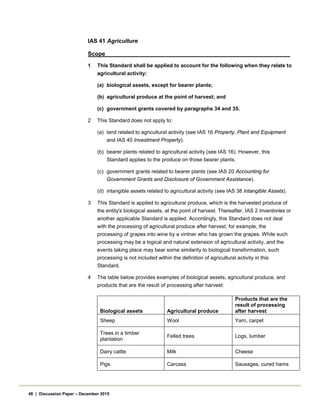
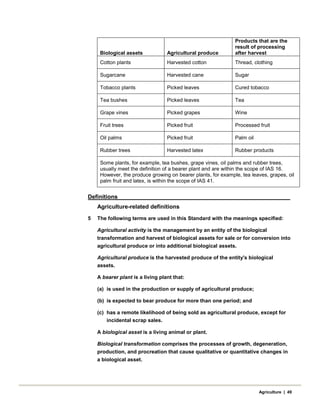
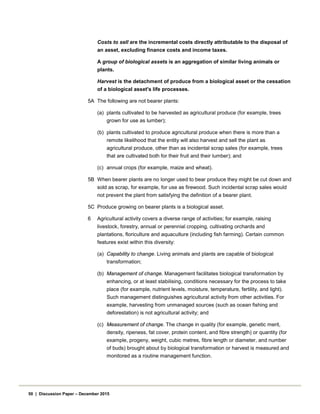
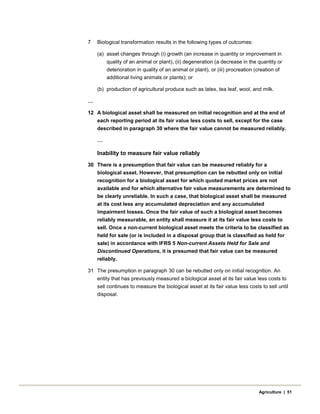
COMMENTS TO THE AcSB MUST BE RECEIVED BY
MAY 19, 2016
A PDF response form has been posted with this document to assist you in submitting your comments to the
AcSB. Alternatively, you may send comments via email (in Word format), to:ed.accounting@cpacanada.ca
addressed to:
Rebecca Villmann, CPA, CA,
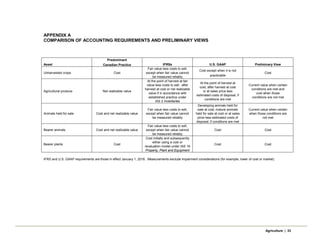
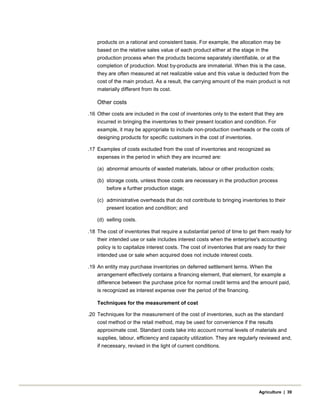
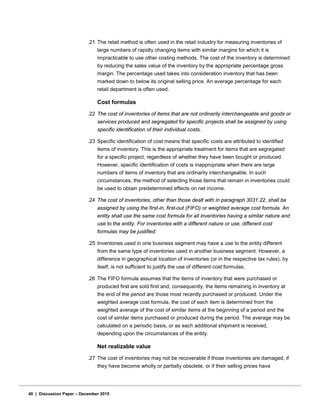
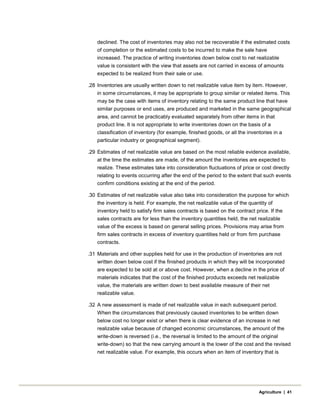
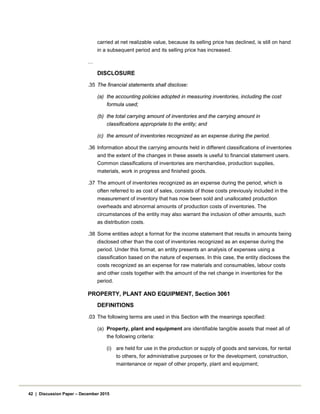
CPA (Illinois)
Director, Accounting Standards
Accounting Standards Board
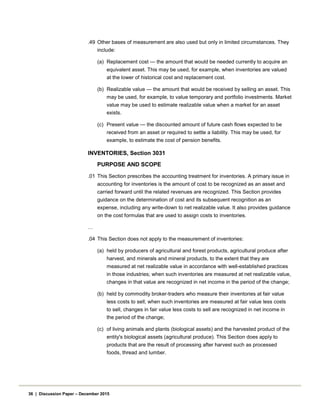
277 Wellington Street West
Toronto, Ontario M5V 3H2
This Discussion Paper is issued by the Accounting Standards Board (AcSB). The AcSB is composed of
persons knowledgeable in the preparation and use of financial statements with backgrounds in business,
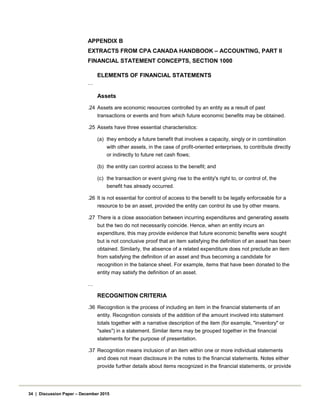
public practice and academe. All members serve as individuals and not as representatives of their employers
or organizations.
Individuals and organizations are invited to send written comments on the Discussion Paper.
Comments are most helpful if they clearly explain the issues they raise and suggest a specific course of action
supported by reasoning. All comments received by the AcSB will be available on the website shortly after the
comment deadline, unless confidentiality is requested. The request for confidentiality must be stated explicitly
within the response.
Overview
Why is the AcSB undertaking this project?
The Accounting Standards Board (AcSB) has been informed that, as a result of a lack of
specific authoritative guidance, there is diversity in accounting by private enterprises for
biological assets (i.e., living animals or plants) and agricultural produce (i.e., the
harvested product of the enterprise's biological assets). This diversity is causing
difficulties for stakeholders in the agricultural sector.
During the development of accounting standards for private enterprises, the AcSB
considered developing authoritative guidance on agriculture. The AcSB concluded that
given the length of time needed to develop such guidance and the more pressing need
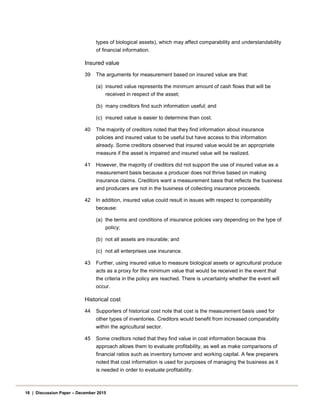
for accounting standards for private enterprises in the short term, a project on this topic
would be deferred until accounting standards for private enterprises in Part II of the CPA
Canada Handbook – Accounting were issued and in use for a period of time.
The agricultural sector is an important part of the Canadian economy and spans a wide
range of activities. Statistics Canada reported in 2011 that the agricultural and agri-food
sectors accounted for 8 percent of Canadian GDP, at $101.1 billion, and that there were
205,730 farm businesses.
1
What is the purpose of this Discussion Paper?
This Discussion Paper aims to obtain broad input from stakeholders, in particular, those
involved in the agricultural sector. This input will assist the AcSB in deciding whether to
develop authoritative guidance, either by developing a new standard or amending
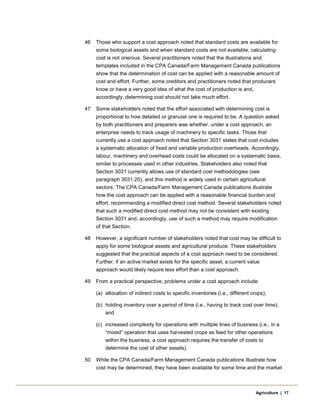
existing standards, on accounting for biological assets and agricultural produce by
private enterprises and, if so, the issues to be addressed and how they could be
addressed.
What are the next steps in this project?
The AcSB will consider the input received in response to this Discussion Paper and
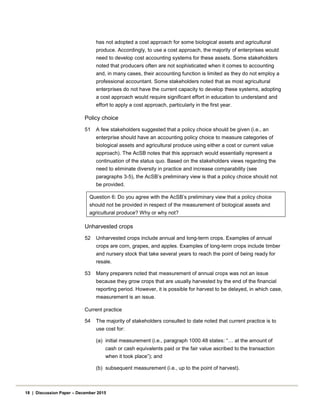
decide whether to continue this project to develop authoritative guidance. If the AcSB
decides to proceed, then it will develop an exposure draft of proposed changes to
accounting standards for private enterprises for public comment, in accordance with its
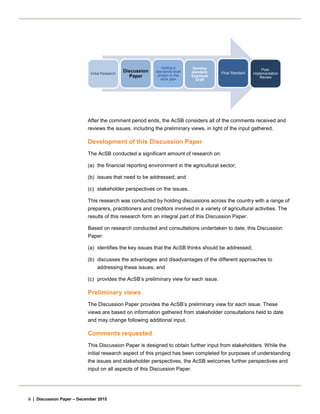
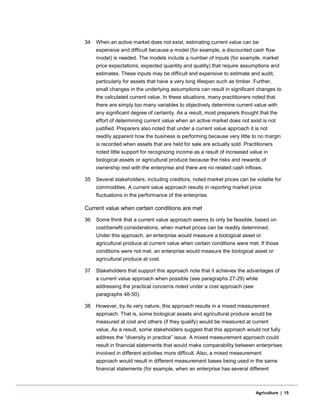
due process. The following illustrates where a Discussion Paper fits within the stages of
due process with consultation occurring at each stage:
1
2011 Statistics Canada data was the latest data available at the time of development of this Discussion
Paper. Note that these figures include business activity conducted by both public and private enterprises.
However, the AcSB understands that the vast majority of agricultural enterprises in Canada are privately
held.
Agriculture | i
After the comment period ends, the AcSB considers all of the comments received and
reviews the issues, including the preliminary views, in light of the input gathered.
Development of this Discussion Paper
The AcSB conducted a significant amount of research on:
(a) the financial reporting environment in the agricultural sector;
(b) issues that need to be addressed; and
(c) stakeholder perspectives on the issues.
This research was conducted by holding discussions across the country with a range of
preparers, practitioners and creditors involved in a variety of agricultural activities. The
results of this research form an integral part of this Discussion Paper.
Based on research conducted and consultations undertaken to date, this Discussion
Paper:
(a) identifies the key issues that the AcSB thinks should be addressed;
(b) discusses the advantages and disadvantages of the different approaches to
addressing these issues; and
(c) provides the AcSB’s preliminary view for each issue.
Preliminary views
The Discussion Paper provides the AcSB’s preliminary view for each issue. These
views are based on information gathered from stakeholder consultations held to date
and may change following additional input.
Comments requested
This Discussion Paper is designed to obtain further input from stakeholders. While the
initial research aspect of this project has been completed for purposes of understanding
the issues and stakeholder perspectives, the AcSB welcomes further perspectives and
input on all aspects of this Discussion Paper.
Initial Research
Discussion
Paper
Adding a
standards-level
project to the
work plan
Develop
standard:
Exposure
Draft
Final Standard
Post-
implementation
Review
ii | Discussion Paper – December 2015
Comments are most helpful if they are related to a specific paragraph or group of
paragraphs. Any comments that express disagreement with the preliminary views in the
Discussion Paper should clearly explain the issue and include a suggested alternative,
supported by specific reasoning.
While the AcSB welcomes comments on all aspects of this Discussion Paper, it
particularly welcomes comments on the following:
1. Do you agree that authoritative guidance with respect to accounting for biological
assets and agricultural produce by private enterprises should be developed (see
Overview and paragraphs 1-5)? Why or why not?
2. Do you agree with the discussion noted in paragraph 3(c) (i.e., lenders are the
predominant external users of financial statements in the agricultural sector)? Why
or why not? Are there other significant users of financial statements in this sector
and do their financial reporting needs differ from those of lenders?
3. Do you agree with the proposed scope (for example, what is included and excluded)
and definitions (see paragraphs 11-14)? Why or why not? If not, what changes
would you suggest and why?
4. Do you agree that the issues noted in paragraph 15 should not be addressed in this
project? Why or why not? If you think that these issues should be addressed, how
would you recommend doing so?
5. Do you agree with the AcSB’s preliminary view that a biological asset should be
recognized when the definition of an asset and recognition criteria in FINANCIAL
STATEMENT CONCEPTS, Section 1000, are met (see paragraphs 17-22)? Why or
why not?
6. Do you agree with the AcSB’s preliminary view that a policy choice should not be
provided in respect of the measurement of biological assets and agricultural
produce (see paragraph 51)? Why or why not?
7. Do you agree with the AcSB’s preliminary view that unharvested crops should be
measured at cost (see paragraphs 52-60)? Why or why not? How would you
determine cost?
8. (a) Do you agree with the AcSB’s preliminary view that agricultural produce should
be measured at current value when certain conditions are met and at cost when
those conditions are not met (see paragraphs 61-70)? Why or why not?
(b) What conditions should be met to measure agricultural produce at current
value?
(c) How would you determine current value?
Agriculture | iii
9. (a) Do you agree with the AcSB’s preliminary view that animals held for sale should
be measured at current value when certain conditions are met and at cost when
those conditions are not met (see paragraphs 71-78)? Why or why not?
(b) What conditions should be met to measure animals held for sale at current
value?
(c) How would you determine current value?
10. (a) Do you agree with the AcSB’s preliminary view that bearer animals should be
measured at cost (see paragraphs 79-92)? Why or why not?
(b) How would you determine cost?
(c) In what circumstances should amortization be recognized and over what period
of time?
11. What challenges arise in accounting for biological assets should the use of the
animal change over its life (for example, when animals shift from being bearer to
held for sale)?
12. Do you agree with the AcSB’s preliminary view that bearer plants should be
measured at cost (see paragraphs 93-99)? Why or why not? How would you
determine cost?
13. Do you agree with the AcSB’s preliminary view that impairment should be assessed
under the models used for current and long-lived assets depending on the type of
asset (see paragraphs 100-106)? Why or why not?
14. Do you agree with the AcSB’s preliminary view that presentation should be
determined by the guidance in CURRENT ASSETS AND CURRENT LIABILITIES,
Section 1510 (see paragraphs 107-111)? Why or why not? Should specific
guidance on this issue be developed?
15. Do you agree with the proposed disclosure requirements set out in paragraph 115?
Why or why not? Are there any additional disclosures, including those noted in
paragraph 116, that should be considered?
16. Are there any other issues that are not addressed in this Discussion Paper? If so,
what are they and how should they be addressed?
17. Do you agree with the effects noted in paragraphs 120-121? Why or why not? If not,
what other effects should be identified and why?
For your convenience, a PDF response form has been posted with this document. You
can save the form both during and after its completion for future reference. Alternatively,
written comments may be submitted by email (Word format preferred) to:
ed.accounting@cpacanada.ca
iv | Discussion Paper – December 2015
Agriculture
Table of contents
Paragraph
Summary of research findings.................................................. 1-5
Current accounting requirements ............................................ 6-10
Canadian requirements ........................................................ 6-9
International requirements.................................................... 10
Scope and definitions ................................................................ 11-15
Issues outside the scope of the project ................................ 15
Analysis of issues ...................................................................... 16-118
Recognition of a biological asset.......................................... 17-22
Measurement........................................................................ 23-99
Current value ................................................................... 27-35
Current value when certain conditions are met............... 36-38
Insured value ................................................................... 39-43
Historical cost .................................................................. 44-50
Policy choice.................................................................... 51
Unharvested crops .......................................................... 52-60
Agricultural produce......................................................... 61-70
Animals held for sale ....................................................... 71-78
Bearer animals ................................................................ 79-92
Bearer plants ................................................................... 93-99
Impairment............................................................................ 100-106
Presentation.......................................................................... 107-111
Disclosure ............................................................................. 112-118
Effects analysis .......................................................................... 119-122
Comparison of accounting requirements and
preliminary views .......................................................................... Appendix A
Extracts from CPA Canada Handbook – Accounting,
Part II  Sections 1000, 3031 and 3061 ..................................... Appendix B
Extracts from CPA Canada Handbook – Accounting,
Part I  IAS 2 and IAS 41............................................................ Appendix C
Extracts from FASB Accounting Standards
Codification  Topic 905 ............................................................. Appendix D
Agriculture | 1
SUMMARY OF RESEARCH FINDINGS
1 Prior to commencing deliberations on this topic, the AcSB undertook research
to:
(a) confirm that there is a need for authoritative guidance;
(b) obtain initial input in terms of how the guidance should be developed;
(c) learn what the issues are and about existing accounting practice; and
(d) seek stakeholder views in terms of how the issues could be addressed.
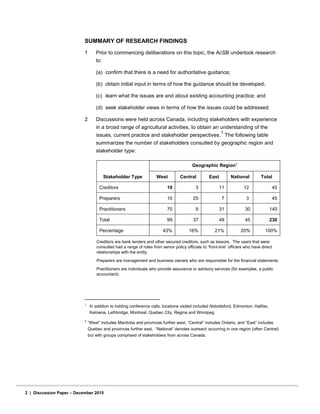
2 Discussions were held across Canada, including stakeholders with experience
in a broad range of agricultural activities, to obtain an understanding of the
issues, current practice and stakeholder perspectives.
1
The following table
summarizes the number of stakeholders consulted by geographic region and
stakeholder type:
Stakeholder Type
Geographic Region2
West Central East National Total
Creditors 19 3 11 12 45
Preparers 10 25 7 3 45
Practitioners 70 9 31 30 140
Total 99 37 49 45 230
Percentage 43% 16% 21% 20% 100%
Creditors are bank lenders and other secured creditors, such as lessors. The users that were
consulted had a range of roles from senior policy officials to “front-line” officers who have direct
relationships with the entity.
Preparers are management and business owners who are responsible for the financial statements.
Practitioners are individuals who provide assurance or advisory services (for examples, a public
accountant).
1
In addition to holding conference calls, locations visited included Abbottsford, Edmonton, Halifax,
Kelowna, Lethbridge, Montreal, Quebec City, Regina and Winnipeg.
2
“West” includes Manitoba and provinces further west, “Central” includes Ontario, and “East” includes
Quebec and provinces further east. “National” denotes outreach occurring in one region (often Central)
but with groups comprised of stakeholders from across Canada.
2 | Discussion Paper – December 2015
3 As a result of discussions with stakeholders, the AcSB’s general observations
are as follows:
(a) Need for guidance — In conducting research on this topic, stakeholders
were asked for input on the need for authoritative guidance. The response
was nearly unanimous support for the development of authoritative
guidance. Demand for guidance is based on a need for financial statements
that provide relevant information that is reliable and comparable between
enterprises. The current lack of authoritative guidance is resulting in
diversity in practice, which is causing difficulty for many stakeholders.
Creditors noted that diversity causes issues with inter-entity comparability
and creditors need to specialize in order to understand and conduct
business in the agricultural sector. Some preparers noted that diversity
makes inter-entity comparisons, such as industry benchmarks, difficult.
Public practitioners noted that a lack of authoritative guidance requires them
to make judgments with respect to how to account for different biological
assets. The few stakeholders who thought that authoritative guidance is not
needed noted that they did not see any diversity in practice that was causing
significant issues.
(b) Changing environment — Three major changes were noted by
stakeholders:
(i) Consolidation of operations — Many stakeholders noted that there is a
substantial amount of consolidation going on in many agricultural
sectors, resulting in some enterprises becoming very large. The 2011
Census of Agriculture notes that the number of farms has been
declining steadily since 1941 and the average size of Canadian farms is
increasing, reflecting a trend towards consolidation. Discussions with
creditors indicate that consolidation of agricultural businesses is
resulting in increased demand for external capital, which in turn is
leading to increased demand for GAAP financial statements.
(ii) Enterprises entering into more complex transactions — Many
stakeholders also noted a trend towards enterprises entering into more
complex arrangements. For example, producers are increasingly buying
futures contracts and other derivatives.
(iii) Advances in technology — Several stakeholders noted that advances in
technology are allowing many producers to easily capture information,
such as the quantity of seed or fertilizer spread, or the quantity of grain
harvested.
(c) Financial statement users — Based on stakeholder consultations held to
date, the AcSB understands that creditors (for example, bank lenders and
Agriculture | 3
lessors) are the predominant external users of financial statements in the
agricultural sector. Some stakeholders noted that government agencies
review financial statements for various purposes. The AcSB notes that, like
the Canada Revenue Agency, these government agencies are in a position
to demand whatever financial information they wish. Accordingly, other than
when providing resources to the enterprise, they would not be considered to
be external users for purposes of general purpose financial reporting. Input
from stakeholders consulted to date indicates that venture capital or private
equity investors are extremely rare in this sector, and seem to be primarily
involved in post-harvest activities (i.e., when the asset ceases to be a
biological asset).
(d) Reliance on financial statements — As is the case with private enterprises in
other sectors, creditors in the agricultural sector do not rely on financial
statements in making lending decisions until the amount of credit extended
passes a certain dollar threshold. The specific credit threshold varies by
lending institution. However, in the agricultural sector, in general, the
thresholds can be significantly higher in comparison to private enterprises in
other sectors. For example, for a private enterprise not in the agricultural
sector, a lender might require GAAP financial statements when a loan
exceeds $1-2 million. For an enterprise in the agricultural sector, that
threshold can be $5 million and in some cases was noted by stakeholders to
be significantly higher, with a threshold of $10 million. Based on input from
creditors, the AcSB understands that this difference in lending practice is, in
part, due to many agricultural enterprises having significant underlying
capital in their business. The result of these lending thresholds is that a
smaller number of agricultural enterprises are applying GAAP, as compared
to other private enterprises. However, the AcSB recognizes the merits of
consistent measurement methodology regardless of whether a lender
requests a notice to reader, review or audit.
(e) Current use of financial statements — Creditors’ analysis of the financial
statements typically includes assessing an enterprise’s cash flow, working
capital and debt to equity. Creditors perform comparative analysis between
enterprises undertaking similar activities and also between enterprises in the
broader agricultural sector. Creditors are also interested in information in
respect of risk (for example, acreage under cultivation, expected yield,
historical yield, and qualitative characteristics in respect of biological
assets). Some practitioners noted that lending covenants are often based on
current value of biological assets.
4 | Discussion Paper – December 2015
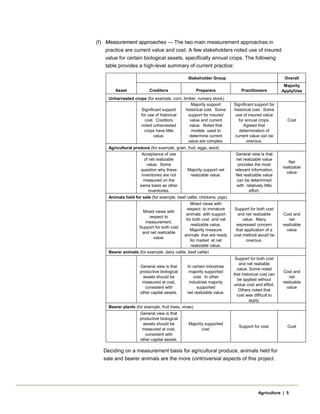
(f) Measurement approaches — The two main measurement approaches in
practice are current value and cost. A few stakeholders noted use of insured
value for certain biological assets, specifically annual crops. The following
table provides a high-level summary of current practice:
Asset
Stakeholder Group Overall
Creditors Preparers Practitioners
Majority
Apply/Use
Unharvested crops (for example, corn, timber, nursery stock)
Significant support
for use of historical
cost. Creditors
noted unharvested
crops have little
value.
Majority support
historical cost. Some
support for insured
value and current
value. Noted that
models used to
determine current
value are complex.
Significant support for
historical cost. Some
use of insured value
for annual crops.
Agreed that
determination of
current value can be
onerous.
Cost
Agricultural produce (for example, grain, fruit, eggs, wool)
Acceptance of use
of net realizable
value. Some
question why these
inventories are not
measured on the
same basis as other
inventories.
Majority support net
realizable value.
General view is that
net realizable value
provides the most
relevant information.
Net realizable value
can be determined
with relatively little
effort.
Net
realizable
value
Animals held for sale (for example, beef cattle, chickens, pigs)
Mixed views with
respect to
measurement.
Support for both cost
and net realizable
value.
Mixed views with
respect to immature
animals with support
for both cost and net
realizable value.
Majority measure
animals that are ready
for market at net
realizable value.
Support for both cost
and net realizable
value. Many
expressed concern
that application of a
cost method would be
onerous.
Cost and
net
realizable
value
Bearer animals (for example, dairy cattle, beef cattle)
General view is that
productive biological
assets should be
measured at cost,
consistent with
other capital assets.
In certain industries
majority supported
cost. In other
industries majority
supported
net realizable value.
Support for both cost
and net realiable
value. Some noted
that historical cost can
be applied without
undue cost and effort.
Others noted that
cost was difficult to
apply.
Cost and
net
realizable
value
Bearer plants (for example, fruit trees, vines)
General view is that
productive biological
assets should be
measured at cost,
consistent with
other capital assets.
Majority supported
cost.
Support for cost. Cost
Deciding on a measurement basis for agricultural produce, animals held for
sale and bearer animals are the more controversial aspects of this project.
Agriculture | 5
4 The diversity in practice noted in paragraph 3(a) has existed for some time.
Since 1986, four U.S. and Canadian study groups have examined financial
reporting and accounting issues with respect to the agricultural sector. The most
recent effort in Canada resulted in a series of eight booklets, each tailored to a
specific industry. These booklets set out non-authoritative guidance on how to
determine cost by type of asset and were published by CPA Canada (formerly
CICA)
3
and the Farm Management Canada (formerly Canadian Farm Business
Management Council) beginning in 1998. They note diversity in practice as a
significant issue; one of the goals of these publications was to help reduce this
diversity and increase comparability across enterprises. The research
undertaken during this current project suggests that the CPA Canada/Farm
Management Canada
4
guidance has not been used in many parts of the
country.
5 In general, changes to accounting standards for private enterprises are
considered when there is a significant benefit associated with doing so. The
AcSB thinks that the diversity in practice noted in paragraph 3(a) demonstrates
that authoritative guidance on the accounting for biological assets and
agricultural produce is needed. However, the AcSB would like to confirm that
there is a need for authoritative guidance.
Question 1: Do you agree that authoritative guidance with respect to accounting for
biological assets and agricultural produce by private enterprises should be
developed? Why or why not?
Question 2: Do you agree with the discussion noted in paragraph 3(c) (i.e., lenders
are the predominant external users of financial statements in the agricultural
sector)? Why or why not? Are there other significant users of financial statements in
this sector and do their financial reporting needs differ from those of lenders?
CURRENT ACCOUNTING REQUIREMENTS
Canadian requirements
6 INVENTORIES, Section 3031, and PROPERTY, PLANT AND EQUIPMENT,
Section 3061, use cost as the basis of measurement. However, Section 3031,
includes the following exception for agricultural inventories:
.04 This Section does not apply to the measurement of inventories:
(a) held by producers of agricultural and forest products, agricultural
produce after harvest, and minerals and mineral products, to the
3
This publication was originally issued by a CPA Canada legacy body.
4
Copies of the CPA Canada/Farm Management Canada publications can be found on the project page
under Related Documents & Information.
6 | Discussion Paper – December 2015
extent that they are measured at net realizable value in accordance
with well-established practices in those industries; when such
inventories are measured at net realizable value, changes in that
value are recognized in net income in the period of the change;
…
(c) of living animals and plants (biological assets) and the harvested
product of the entity's biological assets (agricultural produce). This
Section does apply to products that are the result of processing
after harvest such as processed foods, thread and lumber.
.05 The inventories referred to in paragraph 3031.04(a) are measured at net
realizable value at certain stages of production. For example, this
occurs when agricultural crops have been harvested or minerals have
been extracted and sale is assured under a forward contract or a
government guarantee, or when an active market exists and there is a
negligible risk of failure to sell. These inventories are excluded from only
the measurement requirements of this Section.
7 The exception in Section 3031 is consistent with the related standard in
International Financial Reporting Standards (IFRSs) in Part I of the CPA
Handbook – Accounting, specifically IAS 2 Inventories. This exception was
brought into Canadian GAAP in 2004, under the pre-changeover standards,
when Section 3031 was adopted to converge with IAS 2.
5
In developing
Section 3031, the AcSB investigated which industries currently measure their
inventories on a basis other than cost, noting that some agricultural inventories
are currently measured at fair value or a related measure such as net realizable
value. That is, the exception in Section 3031 is a codification of existing industry
practice rather than the result of a past examination of stakeholder needs.
Appendix B contains extracts from Sections 3031 and 3061.
8 A cost approach to accounting for inventories results in historical cost being
presented on the balance sheet and information in respect of profitability being
presented in the income statement (by recognition of cost of goods sold in the
same period as the revenue related to the sale of the inventory). A current value
approach to accounting for inventories results in current value being presented
on the balance sheet and changes in value being recorded in the income
statement. To contrast the two approaches (assuming no impairment), a cost
approach would result in no profit margin on a particular item of inventory being
recorded until such time as the risks and rewards of ownership are transferred
(i.e., at the time that revenue is recognized). A current value approach results in
5
The convergence of Section 3031 and IAS 2 was under the previous AcSB strategy for publicly
accountable enterprises of convergence with a single set of globally accepted, high-quality international
accounting standards.
Agriculture | 7
increases or decreases in income as the value changes throughout the
production cycle and until the point of sale, with little to no income at the time of
sale.
9 A cost approach to accounting for property, plant and equipment results in
historical cost being presented on the balance sheet and the recognition of
amortization over the useful life of the asset. Amortization is a process of
allocation as opposed to valuation, and generally results in a consistent effect on
income over the useful life of the asset. The result of applying a current value
approach to property, plant and equipment depends on the future value of the
asset. If the value of the asset declines as it is utilized, the result, as compared
to a cost approach, would ultimately be the same; however, period-to-period
differences would occur depending on how the asset’s value changes over time
relative to the amount of amortization under a cost approach. On the other hand,
if the value of the asset is appreciating, increases in value would be reflected in
income over time, prior to any realization of cash flows associated with these
increases (i.e., sale of the asset). As noted above, a current value approach
results in current value on the balance sheet with increases and decreases in
value being reported in income.
International requirements
10 The AcSB considered the requirements in IFRSs and U.S. GAAP. Appendix C
and Appendix D contain relevant extracts from these requirements in effect on
January 1, 2016. The following table provides a high-level summary, by major
category of asset, of the requirements:
Asset IFRSs U.S. GAAP
Unharvested crops
Fair value less costs to sell, except
when fair value cannot be
measured reliably
Cost except when it is
not practicable
Agricultural produce
At the point of harvest at fair value
less costs to sell; after harvest at
cost or net realizable value if in
accordance with established
practice under IAS 2 Inventories
At the point of harvest at cost;
after harvest at cost or at sales
price less estimated costs of
disposal, if conditions are met
Animals held for sale
Fair value less costs to sell, except
when fair value cannot be
measured reliably
Developing animals held for sale
at cost; mature animals held for
sale at cost or at sales price less
estimated costs of disposal, if
conditions are met
Bearer animals
Fair value less costs to sell, except
when fair value cannot be
measured reliably
Cost
Bearer plants
Cost initially and subsequently
either using a cost or revaluation
model under IAS 16 Property,
Plant and Equipment
Cost
Measurements exclude impairment considerations (for example, lower of cost or market).
8 | Discussion Paper – December 2015
SCOPE AND DEFINITIONS
11 The AcSB examined the scope and definitions of International Accounting
Standard (IAS) 41 Agriculture and U.S. FASB Accounting Standards
Codification Topic 905, Agriculture. The AcSB agreed that IAS 41 provides a
useful starting point for the consideration of the issues. The agricultural activities
addressed by this project are similar to those addressed by IAS 41.
12 The scope and definitions were discussed with stakeholders as part of the
research discussions. Stakeholders did not express any issues with, and
supported, using the scope and definitions in IAS 41. Many stakeholders,
particularly practitioners, observed that having a similar scope and definitions
would reduce confusion among stakeholders.
13 The scope of IAS 41 includes agricultural produce at the point of harvest
whereas the AcSB has proposed to include all agricultural produce in the scope
of this project. Bearer plants, included in IAS 16 Property, Plant and Equipment,
are also within the scope of this project. Accordingly, the proposed scope and
definitions for purposes of considering the issues set out in this Discussion
Paper are as follows:
Scope
The guidance would be applied to account for:
(a) biological assets involved in agricultural activities; and
(b) agricultural produce that is the output of an enterprise’s agricultural activity.
Definitions
Agricultural activity is the management by an enterprise of the biological
transformation and harvest of biological assets for sale or for conversion into
agricultural produce or into additional biological assets.
Agricultural produce is the harvested product of the enterprise's biological
assets.
A bearer animal is a living animal that:
(a) is held for use in the production or supply of biological assets or agricultural
produce;
(b) is expected to bear biological assets or produce for more than one period;
and
(c) is not held for sale.
A bearer plant is a living plant that:
(a) is used in the production or supply of agricultural produce;
Agriculture | 9
(b) is expected to bear produce for more than one period; and
(c) has a remote likelihood of being sold as agricultural produce, except for
incidental scrap sales.
A biological asset is a living animal or plant.
Biological transformation comprises the processes of growth, degeneration,
production, and procreation that cause qualitative or quantitative changes in a
biological asset.
Harvest is the detachment of agricultural produce from a biological asset or the
cessation of a biological asset’s life processes.
14 To be within the scope of the project, the biological asset must be involved in
agricultural activities and agricultural produce must be the output of an
enterprise’s agricultural activity. As a result, purchased agricultural produce
would not be within the scope of the project but would remain within the scope of
Section 3031. For example, purchases by a farm, flour mill or a pet shop would
be outside the scope. Also, products that are the result of processing after
harvest are currently within the scope of Section 3031 and would not be in the
scope of the project. The following table (from paragraph 4 of IAS 41)
demonstrates the distinction with only the first two columns in the scope of the
project:
Biological assets Agricultural produce
Products that are the
result of processing
after harvest
Sheep Wool Yarn, carpet
Trees in a timber
l t ti
Felled trees Logs, lumber
Dairy cattle Milk Cheese
Pigs Carcass Sausages, cured hams
Cotton plants Harvested cotton Thread, clothing
Sugarcane Harvested cane Sugar
Tobacco plants Picked leaves Cured tobacco
Tea bushes Picked leaves Tea
Grape vines Picked grapes Wine
Fruit trees Picked fruit Processed fruit
Oil palms Picked fruit Palm oil
Rubber trees Harvested latex Rubber products
10 | Discussion Paper – December 2015
Question 3: Do you agree with the proposed scope (for example, what is included
and excluded) and definitions? Why or why not? If not, what changes would you
suggest and why?
Issues outside the scope of the project
15 Discussions with stakeholders also noted two other issues that the AcSB does
not plan on addressing in this project. Stakeholders are asked to provide input
on the need to address these issues. When developing its future work plan for
Part II, the AcSB will consider this feedback in the context of other potential new
projects. Should the AcSB decide to commence a project to address either or
both of these issues further research would be required.
(a) Government grants — The issue is that government assistance related to
capital expenditures are accounted for in different ways (i.e., deducted from
the related capital asset or deferred and amortized on the same basis as the
related depreciable assets), which can negatively affect comparability.
GOVERNMENT ASSISTANCE, Section 3800, permits an accounting policy
choice for grants related to the acquisition of capital assets. The AcSB has
not heard of any unique issues regarding government assistance in the
agricultural sector or issues that are not addressed by Section 3800.
(b) Land and quotas — A number of stakeholders expressed a view that land
and quotas (such as production quotas that exist in the poultry and dairy
industries) should be measured at current value. The argument is that cost
does not provide useful information to financial statement users. In many
cases, cost reflects information that is not indicative of current value. With
respect to land, most creditors noted that they have internal assessment
processes to arrive at a value for lending purposes. Current values for
quotas are readily available as they are traded on provincial exchanges.
Creditors noted that they generally adjust the financial statements for land
and quotas to reflect current value, and would do so regardless of whether
the financial statements reflected current value as they would rather make
their own determinations of value. The issue of measuring land and other
intangible assets is not restricted to the agricultural sector; some
stakeholders in other industries have expressed a need for a current value
approach.
Question 4: Do you agree that the issues noted in paragraph 15 should not be
addressed in this project? Why or why not? If you think that these issues should be
addressed, how would you recommend doing so?
Agriculture | 11
ANALYSIS OF ISSUES
16 This section addresses the recognition, measurement, presentation and
disclosure issues that were raised as a result of discussions with stakeholders.
Recognition of a biological asset
17 Recognition is the process of including an item in the financial statements of an
enterprise. FINANCIAL STATEMENT CONCEPTS, paragraph 1000.24 defines
assets as “economic resources controlled by an entity as a result of past
transactions and from which future economic benefits may be obtained.”
Paragraph 1000.39 states that assets are recognized when “the item has an
appropriate basis of measurement and a reasonable estimate can be made of
the amount involved; and for items involving obtaining or giving up future
economic benefits, it is probable that such benefits will be obtained or given up.”
These criteria are similar to those in both IFRSs and U.S. GAAP.
18 Stakeholders generally agreed that an asset should be recognized when it is
purchased or created (for example, when a fruit tree is purchased or when a
cow is born).
19 Discussions with stakeholders to date noted that, in almost all cases, there is no
diversity in practice in terms of how to apply the recognition criteria in
Section 1000. However, a few stakeholders noted that some enterprises are not
recognizing planted crops as an asset. These stakeholders noted that these
enterprises are generally smaller operations.
20 The vast majority of stakeholders consulted to date agreed that a planted crop
meets the definition of a biological asset when the seeds (or seedlings) are
planted. Creditors generally noted that if they see a client has expensed planted
crops, they will attempt to adjust the statements to recognize an asset.
21 Some stakeholders think that a planted crop should not be recognized as an
asset (i.e., the costs should be expensed) on the basis of consistency with
taxation rules and the fact that some preparers currently do not prepare accrual
based financial statements. Some stakeholders think that users of financial
statements may find expensing costs incurred in a period to be more useful and
support this approach by cost/benefit considerations.
22 The AcSB’s preliminary view is that a biological asset should be recognized
when the asset definition and recognition criteria are met. In the case of an
annual crop, the AcSB’s preliminary view is that a planted crop should be
recognized as a biological asset because it meets the definition of an asset and
the recognition criteria (set out in paragraphs 1000.24 and 1000.39,
respectively). For an annual crop, an asset could exist prior to planting (for
example, at the time the seed and other inputs are purchased).
12 | Discussion Paper – December 2015
Question 5: Do you agree with the AcSB’s preliminary view that a biological
asset should be recognized when the definition of an asset and recognition
criteria in Section 1000 are met? Why or why not?
Measurement
23 Input gathered to date indicates that there are two main measurement bases
used in practice, cost and current value, with some noting use of insured value
for certain biological assets (specifically unharvested crops).
24 Except when discussing current practice, this Discussion Paper uses the term
“current value” to include all market-based measurements, including fair value
and net realizable value. Should authoritative guidance be developed regarding
accounting for biological assets and agricultural produce, and current value be
used as a measurement basis, the AcSB will deliberate what specific type of
current value measure should be used as part of the next phase of the project.
Respondents are asked to comment on what specific type of current value
measure should be used.
25 The AcSB has identified four alternative approaches to measurement:
(a) current value;
(b) current value when certain conditions are met or cost when those conditions
are not met;
(c) insured value; and
(d) historical cost.
26 The advantages and disadvantages under each approach are often similar
regardless of the type of asset. This section first summarizes the advantages
and disadvantages that the AcSB heard from stakeholders during the research
phase of this project and then discusses the more specific feedback received
about each type of asset (unharvested crops, agricultural produce, animals held
for sale, bearer animals and bearer plants).
Current value
27 A current value measurement is useful to creditors because it provides an
indication of the future cash inflows that could be realized from sale of the asset.
Current value reflects the biological transformation that the assets undergo.
Several stakeholders think that current value provides the most relevant
information. Creditors noted that if there is an active market, there is benefit in
knowing the current value of the assets.
Agriculture | 13
28 Public practitioners that support current value do so based on difficulties with
respect to determining cost (see paragraphs 48-50) and a view that the use of
current value appears to be meeting lender needs.
29 For many biological assets and agricultural produce, current value is readily
determinable without significant cost and effort because there are active
markets. The producer generally intends to sell these assets into highly liquid
markets and can sell them at any time (i.e., there is little risk of not selling). The
current value can be determined without significant cost or effort because the
producer:
(a) has a wide range of sources to look to for determining the current value;
(b) is able to estimate losses due to shrinkage;
(c) is able to determine the quality because there are natural indicators of
differing quality; and
(d) can look to sales information that has occurred subsequent to the fiscal
period to confirm the quality.
30 When there is no active market, some practitioners have developed models to
determine the current value. These practitioners noted that they have not heard
any negative feedback from creditors as a result of measuring certain assets at
current value.
31 However, some creditors expressed concern over the lack of consistency in
determining current value and the quality of those values. These creditors noted
that they do not wish to rely on current values determined by the enterprise.
Some creditors stated that in the absence of an active market, current value
would need to be determined by a reliable third party valuator to be of significant
value.
32 Some creditors noted that when they see biological assets measured at current
value, they attempt to adjust the financial statements to reflect cost using
industry benchmarks and guidelines. These creditors were opposed to any
current value measurement on the basis that it is inconsistent with how
inventories are measured in other (non-agricultural) industries. However, some
stakeholders have noted that biological assets undergo a transformation that is
different from a traditional manufacturing process.
33 Some stakeholders noted that determining current value can result in significant
cost and effort. When an active market exists, determining current value is not
necessarily simple because information on quantity and quality is needed and
there can be variation in the characteristics and value of individual assets.
Obtaining this information is possible (for example, the herd could be graded)
but at an expense.
14 | Discussion Paper – December 2015
34 When an active market does not exist, estimating current value can be
expensive and difficult because a model (for example, a discounted cash flow
model) is needed. The models include a number of inputs (for example, market
price expectations, expected quantity and quality) that require assumptions and
estimates. These inputs may be difficult and expensive to estimate and audit,
particularly for assets that have a very long lifespan such as timber. Further,
small changes in the underlying assumptions can result in significant changes to
the calculated current value. In these situations, many practitioners noted that
there are simply too many variables to objectively determine current value with
any significant degree of certainty. As a result, most preparers thought that the
effort of determining current value when an active market does not exist is not
justified. Preparers also noted that under a current value approach it is not
readily apparent how the business is performing because very little to no margin
is recorded when assets that are held for sale are actually sold. Practitioners
noted little support for recognizing income as a result of increased value in
biological assets or agricultural produce because the risks and rewards of
ownership rest with the enterprise and there are no related cash inflows.
35 Several stakeholders, including creditors, noted market prices can be volatile for
commodities. A current value approach results in reporting market price
fluctuations in the performance of the enterprise.
Current value when certain conditions are met
36 Some think that a current value approach seems to only be feasible, based on
cost/benefit considerations, when market prices can be readily determined.
Under this approach, an enterprise would measure a biological asset or
agricultural produce at current value when certain conditions were met. If those
conditions were not met, an enterprise would measure the biological asset or
agricultural produce at cost.
37 Stakeholders that support this approach note that it achieves the advantages of
a current value approach when possible (see paragraphs 27-29) while
addressing the practical concerns noted under a cost approach (see
paragraphs 48-50).
38 However, by its very nature, this approach results in a mixed measurement
approach. That is, some biological assets and agricultural produce would be
measured at cost and others (if they qualify) would be measured at current
value. As a result, some stakeholders suggest that this approach would not fully
address the “diversity in practice” issue. A mixed measurement approach could
result in financial statements that would make comparability between enterprises
involved in different activities more difficult. Also, a mixed measurement
approach would result in different measurement bases being used in the same
financial statements (for example, when an enterprise has several different
Agriculture | 15
types of biological assets), which may affect comparability and understandability
of financial information.
Insured value
39 The arguments for measurement based on insured value are that:
(a) insured value represents the minimum amount of cash flows that will be
received in respect of the asset;
(b) many creditors find such information useful; and
(c) insured value is easier to determine than cost.
40 The majority of creditors noted that they find information about insurance
policies and insured value to be useful but have access to this information
already. Some creditors observed that insured value would be an appropriate
measure if the asset is impaired and insured value will be realized.
41 However, the majority of creditors did not support the use of insured value as a
measurement basis because a producer does not thrive based on making
insurance claims. Creditors want a measurement basis that reflects the business
and producers are not in the business of collecting insurance proceeds.
42 In addition, insured value could result in issues with respect to comparability
because:
(a) the terms and conditions of insurance policies vary depending on the type of
policy;
(b) not all assets are insurable; and
(c) not all enterprises use insurance.
43 Further, using insured value to measure biological assets or agricultural produce
acts as a proxy for the minimum value that would be received in the event that
the criteria in the policy are reached. There is uncertainty whether the event will
occur.
Historical cost
44 Supporters of historical cost note that cost is the measurement basis used for
other types of inventories. Creditors would benefit from increased comparability
within the agricultural sector.
45 Some creditors noted that they find value in cost information because this
approach allows them to evaluate profitability, as well as make comparisons of
financial ratios such as inventory turnover and working capital. A few preparers
noted that cost information is used for purposes of managing the business as it
is needed in order to evaluate profitability.
16 | Discussion Paper – December 2015
46 Those who support a cost approach noted that standard costs are available for
some biological assets and when standard costs are not available, calculating
cost is not onerous. Several practitioners noted that the illustrations and
templates included in the CPA Canada/Farm Management Canada publications
show that the determination of cost can be applied with a reasonable amount of
cost and effort. Further, some creditors and practitioners noted that producers
know or have a very good idea of what the cost of production is and,
accordingly, determining cost should not take much effort.
47 Some stakeholders noted that the effort associated with determining cost is
proportional to how detailed or granular one is required to be. A question asked
by both practitioners and preparers was whether, under a cost approach, an
enterprise needs to track usage of machinery to specific tasks. Those that
currently use a cost approach noted that Section 3031 states that cost includes
a systematic allocation of fixed and variable production overheads. Accordingly,
labour, machinery and overhead costs could be allocated on a systematic basis,
similar to processes used in other industries. Stakeholders also noted that
Section 3031 currently allows use of standard cost methodologies (see
paragraph 3031.20), and this method is widely used in certain agricultural
sectors. The CPA Canada/Farm Management Canada publications illustrate
how the cost approach can be applied with a reasonable financial burden and
effort, recommending a modified direct cost method. Several stakeholders noted
that such a modified direct cost method may not be consistent with existing
Section 3031 and, accordingly, use of such a method may require modification
of that Section.
48 However, a significant number of stakeholders noted that cost may be difficult to
apply for some biological assets and agricultural produce. These stakeholders
suggested that the practical aspects of a cost approach need to be considered.
Further, if an active market exists for the specific asset, a current value
approach would likely require less effort than a cost approach.
49 From a practical perspective, problems under a cost approach include:
(a) allocation of indirect costs to specific inventories (i.e., different crops);
(b) holding inventory over a period of time (i.e., having to track cost over time);
and
(c) increased complexity for operations with multiple lines of business (i.e., in a
“mixed” operation that uses harvested crops as feed for other operations
within the business, a cost approach requires the transfer of costs to
determine the cost of other assets).
50 While the CPA Canada/Farm Management Canada publications illustrate how
cost may be determined, they have been available for some time and the market
Agriculture | 17
has not adopted a cost approach for some biological assets and agricultural
produce. Accordingly, to use a cost approach, the majority of enterprises would
need to develop cost accounting systems for these assets. Some stakeholders
noted that producers often are not sophisticated when it comes to accounting
and, in many cases, their accounting function is limited as they do not employ a
professional accountant. Some stakeholders noted that as most agricultural
enterprises do not have the current capacity to develop these systems, adopting
a cost approach would require significant effort in education to understand and
effort to apply a cost approach, particularly in the first year.
Policy choice
51 A few stakeholders suggested that a policy choice should be given (i.e., an
enterprise should have an accounting policy choice to measure categories of
biological assets and agricultural produce using either a cost or current value
approach). The AcSB notes that this approach would essentially represent a
continuation of the status quo. Based on the stakeholders views regarding the
need to eliminate diversity in practice and increase comparability (see
paragraphs 3-5), the AcSB’s preliminary view is that a policy choice should not
be provided.
Question 6: Do you agree with the AcSB’s preliminary view that a policy choice
should not be provided in respect of the measurement of biological assets and
agricultural produce? Why or why not?
Unharvested crops
52 Unharvested crops include annual and long-term crops. Examples of annual
crops are corn, grapes, and apples. Examples of long-term crops include timber
and nursery stock that take several years to reach the point of being ready for
resale.
53 Many preparers noted that measurement of annual crops was not an issue
because they grow crops that are usually harvested by the end of the financial
reporting period. However, it is possible for harvest to be delayed, in which case,
measurement is an issue.
Current practice
54 The majority of stakeholders consulted to date noted that current practice is to
use cost for:
(a) initial measurement (i.e., paragraph 1000.48 states: “… at the amount of
cash or cash equivalents paid or the fair value ascribed to the transaction
when it took place”); and
(b) subsequent measurement (i.e., up to the point of harvest).
18 | Discussion Paper – December 2015
55 However, some noted that they record unharvested crops at a current or insured
value. Practice varies in terms of how current value is calculated. Some use
models that incorporate a number of variables; others use the sales price for the
harvested crop after the balance sheet date and prorate a value for the
unharvested crops.
Discussion
56 There is no active market for unharvested crops. Some practitioners have
developed models to determine the current value of unharvested crops and
noted that they have not heard any negative feedback from creditors as a result
of measuring unharvested crops at current value.
57 Some practitioners noted that as maturity and harvest approaches a better idea
of the quantity and quality is possible and, accordingly, a basis of measurement
other than cost seems to provide better information.
58 However, creditors consulted supported a cost approach noting that they do not
find current value information for unharvested crops to be of significant benefit
due to the high degree of uncertainty regarding the ultimate yield. Many
creditors noted that they focus on input costs and when they receive financial
statements showing unharvested crops measured at current value they adjust
the financial statements back to an estimate of cost.
59 In addition, the majority of practitioners and many preparers supported the use
of cost as a measurement basis for unharvested crops. Many preparers noted
that cost can be determined with some financial burden and effort while current
value cannot be readily determined without incurring significant financial burden
or effort because there are no active markets for unharvested crops.
Preliminary view
60 The AcSB’s preliminary view is that unharvested crops should be measured at
cost. This view is based on the following considerations:
(a) Cost provides creditors with better information because this measurement
basis reflects profit earned when these assets are sold and provides a link
to cash flows for these assets compared to the alternatives.
(b) Most stakeholders noted that this approach can be applied with a
reasonable financial burden and effort.
(c) There is no active market for unharvested crops.
Question 7: Do you agree with the AcSB’s preliminary view that unharvested
crops should be measured at cost? Why or why not? How would you determine
cost?
Agriculture | 19
Agricultural produce
61 Agricultural produce includes grain held for sale or use by the enterprise, fruit,
eggs and wool.
Current practice
62 The majority of preparers, practitioners and creditors noted that the current
exception in Section 3031, allowing agricultural producers to value certain
agricultural produce at a net realizable value at certain stages of production is
widely used and should continue.
63 Several enterprises in the fruit and vegetable production business noted that to
establish cost they usually start with a selling price and work backwards to
estimate cost based on historical experience.
Discussion
64 A current value approach has been widely used for some time with little user
objection. Many creditors noted acceptance of the measurement of agricultural
produce at current value. A few creditors noted that while this measurement is
not what they would necessarily prefer, they have become accustomed to
seeing qualifying inventories carried at current value.
65 The majority of preparers, practitioners and creditors noted that current value is
generally readily determinable without significant effort because there are active
markets for most agricultural produce. The producer has a wide range of
sources to look to for determining the current prices (for example, local grain
elevators, the radio, trade papers, the Chicago Board of Trade).
66 Some note that harvested crops are analogous to equity instruments traded in
an active market. In making this analogy, several practitioners noted that
agricultural producers in this sector are “price takers” and are similar to an
individual investor that holds equity instruments. Some noted that the market for
crops is so deep that it is possible to price damaged commodities. Further, for
crops that do not have an active market (for example, corn silage), it is possible
to look to sources such as the AgriStability program, or comparable sales prices
from third parties such as a feedlot, to determine current value.
67 A minority of preparers, practitioners and creditors preferred the use of cost for
agricultural produce noting that these assets are no different than any other
types of inventories and determining cost is not onerous. For perishable
agricultural produce, the difference between cost and current value is generally
not material because a low quantity is held at the reporting date (i.e., most
agricultural produce will have been sold by year-end).
68 Stakeholders also noted that if cost is used prior to the point of harvest, it is not
clear why the measurement basis should change on harvest. However, while
20 | Discussion Paper – December 2015
cost may be able to be determined as an extension of determining the cost of
unharvested crops, as some entities do not account for crops until they are
harvested, determining cost will require more effort than determining current
value. These stakeholders noted that any additional work caused by a change in
standards (i.e., adoption of a cost approach) may be considered onerous.
Preliminary view
69 The AcSB’s preliminary view is that agricultural produce should be measured at
current value when certain conditions are met and at cost when those conditions
are not met. This view is based on the following considerations:
(a) Current value, when readily available, provides creditors with better
information about these assets because this measurement basis provides
more relevant information as it better reflects the biological transformation
that the agricultural produce has undergone and has more predictive value
of expected future cash flows.
(b) Current value, when readily available, can be applied with less financial
burden than a cost approach.
(c) Comparability would be achieved because similar assets would be
measured on the same basis.
70 The specific conditions required to use current value will be deliberated during
the next phase of the project, assuming that:
(a) the project moves forward; and
(b) this approach is used to measure agricultural produce.
Question 8:
(a) Do you agree with the AcSB’s preliminary view that agricultural produce
should be measured at current value when certain conditions are met and at
cost when those conditions are not met? Why or why not?
(b) What conditions should be met to measure agricultural produce at current
value?
(c) How would you determine current value?
Animals held for sale
71 Animals held for sale include developing and mature animals that are expected
to be sold.
Agriculture | 21
Current practice
72 The majority of enterprises measure mature animals that are held for sale at net
realizable value based on the exception contained in Section 3031. However,
practice is mixed with respect to developing animals with some measuring these
animals at cost and others at net realizable value.
Discussion
73 A current value approach has been widely used for some time with little user
objection. Some creditors stated that they find current value information of
interest when an animal or group of animals is ready for sale (i.e., at the point
when the enterprise generally sells the animal). Prior to such time they would
prefer a cost approach because the asset is not ready for sale (i.e., while the
animals develop). Others noted that they find current value of interest for all
animals held for sale.
74 The majority of preparers, practitioners and creditors noted that current value is
generally readily determinable without significant effort because there are active
markets for animals held for sale. The producer has a wide range of sources to
look to for determining the current value (for example, prices from daily auctions
can be accessed through organizations such as Agricultural Financial Services
Corporation and Canfax).
75 Quality can be estimated because regular cattle (i.e., cattle that are not of show
quality or do not have special genetic attributes) are fairly homogeneous in
terms of quality and value, although there can be variation of price in comparing
purebred and non-purebred animals. Quantity (i.e., weight) can be estimated in
a feedlot based on average weight gain per day as calculated by comparing the
average weight when the animal is purchased and the average weight when
sold. Also, in some cases, animals are weighed on a test basis at year-end.
76 A minority of preparers, practitioners and creditors preferred the use of cost for
animals held for sale because these assets are no different than any other types
of inventories and determining cost is not onerous. A few practitioners noted that
the amount of effort depends on the methodology used. For example, a
standard cost method requires significantly less effort than allocating specific
costs to individual animals. However, a significant number of stakeholders noted
that cost may be difficult to apply, specifically for animals born on the farm.
22 | Discussion Paper – December 2015
Preliminary view
77 The AcSB’s preliminary view is that animals held for sale should be measured at
current value when certain conditions are met and at cost when those conditions
are not met. This view is based on the following considerations:
(a) Current value, when readily available, provides creditors better information
about these assets because this measurement basis provides more relevant
information as it better reflects the biological transformation that the animal
has undergone and has more predictive value of expected future cash flows.
(b) Current value, when readily available, can be applied with less financial
burden than a cost approach.
(c) Comparability would be achieved because similar assets would be
measured on the same basis.
78 The specific conditions required to use current value will be deliberated during
the next phase of the project, assuming:
(a) the project moves forward; and
(b) this approach is used to measure animals held for sale.
Question 9:
(a) Do you agree with the AcSB’s preliminary view that animals held for sale
should be measured at current value when certain conditions are met and at
cost when those conditions are not met? Why or why not?
(b) What conditions should be met to measure animals held for sale at current
value?
(c) How would you determine current value?
Bearer animals
79 Bearer animals include animals used to produce milk and animals that are being
developed to become “bearer” (i.e., an immature cow prior to being productive in
nature or becoming part of the reproductive herd).
Current practice
80 There is significant diversity in practice regarding measurement of bearer
animals:
(a) In the dairy industry, the majority use “cost” as derived from standard cost
information published by industry groups. However, some measure these
assets at current value.
(b) In the beef industry, the majority use current value approach (i.e., the
exception noted in Section 3031).
Agriculture | 23
81 A few practitioners noted a practice of treating cattle on a similar basis as an
indefinite lived intangible (i.e., keep the book value constant). This approach is
based on the assumption that the overall group of animals regenerates itself and
continues to have the same fundamental characteristics over time.
82 Some practitioners noted that enterprises do not wish to report the period-to-
period change in value associated with measuring breeding herds at current
value in income because this approach would distort operating income. These
practitioners noted a practice of recording the periodic adjustments directly in
retained earnings.
Discussion
83 Many stakeholders, including creditors, noted that current value is not relevant
because the enterprise does not have any intention of disposing of the assets.
The enterprise could not immediately realize the cash flows implied by current
value while staying in the business of producing assets with the bearer animals.
84 The majority of creditors noted that they treat bearer animals (such as a milking
herd) as property, plant and equipment. Most practitioners consulted also noted
that these assets are conceptually similar to property, plant and equipment, and
current value only makes sense in a liquidation scenario.
85 Creditors stated that they focus on the value of the output as opposed to the
value of the underlying productive assets. As a result, creditors noted that when
they encounter these types of assets reported as inventory and measured at
current value, they adjust the value and classification using standard cost
information as developed by industry associations.
86 Standard cost information is published for certain industries; for example,
several provincial dairy boards publish the standard cost to bring a calf to the
point of production. Others noted that determining a standard cost for an
individual enterprise is not difficult and the examples in the CPA Canada/Farm
Management Canada publications (specifically, the dairy and beef guidelines)
illustrate how this can be done.
87 However, stakeholders who supported use of a current value approach for
bearer animals noted that the alternative, a cost approach, is complex. Issues
with using cost include allocation of costs to self-generated assets (for example,
replacement cows that will become bearer animals), as well as the amount of
calculations and allocations that are needed to determine cost. Granularity
regarding determination of cost was raised as a concern. Some stakeholders
noted that using cost as a measurement basis could be difficult if one were
trying to identify specific costs to individual animals. At the extreme, a cost
approach would presumably require tracking the amount of food eaten by each
24 | Discussion Paper – December 2015
animal. However, Section 3061 does not require this sort of detailed
identification.
88 Some noted that there is variation within the dairy industry in terms of how long
the animals are used for productive purposes as some producers milk an animal
for two years, while others for 20 years. It was noted that this variation in
practice could affect the amount of effort that is required to use a cost approach.
89 A cost approach is further complicated by the need to record amortization.
However, some note that amortization would not be relevant because the
salvage value of the animals exceeds the cost.
90 Supporters of a current value approach think a current value measurement is
appropriate since there generally is a market for bearer animals. Further, it is not
clear when born, whether the animal will become part of the productive herd or
held for sale. Some animals, such as cattle, are “harvestable” at any given point
of time. Many practitioners noted that information in respect of cost of beef cattle
does not provide significant information to a lender.
Preliminary view
91 The AcSB’s preliminary view is that bearer animals should be measured at cost.
This view is based on the following considerations:
(a) Creditors generally agreed that a cost approach provides better information
in respect of cash flows, both from a capital expenditure perspective and
understanding the operating income of an enterprise.
(b) Stakeholders noted that existing illustrative materials in respect of how cost
might be applied to bearer animals can be applied with a reasonable
amount of cost and effort.
92 The AcSB acknowledges that any preliminary view will be controversial because
this area has the greatest diversity in practice. The AcSB encourages
respondents to provide additional detail on the issues discussed above and
issues faced in practice in accounting for bearer animals so that the AcSB can
better understand the complexities involved.
Question 10:
(a) Do you agree with the AcSB’s preliminary view that bearer animals should
be measured at cost? Why or why not?
(b) How would you determine cost?
(c) In what circumstances should amortization be recognized and over what
period of time?
Agriculture | 25
Question 11: What challenges arise in accounting for biological assets should
the use of the animal change over its life (for example, when animals shift from
being bearer to held for sale)?
Bearer plants
93 Bearer plants include grape vines and fruit trees.
Current practice
94 Stakeholders consulted to date noted cost is used to measure bearer plants.
Discussion
95 Many bearer plants are unlikely to have an observable market price on their own
because they can only be sold while attached to the land. Many stakeholders
noted that a current value approach would be onerous for many types of long-
lived assets.
96 Even when market prices are readily available, some stakeholders noted that
determining current value is not necessarily simple, can result in a financial
burden and require significant effort because information on quantity and quality
is needed. A number of practitioners noted that hay provides a good illustration
of the issues with a current value approach for bearer plants. As a perennial
plant, a hay field is productive for a number of years. In most years, a field can
yield several cuts of hay; however, there are some years when the number of
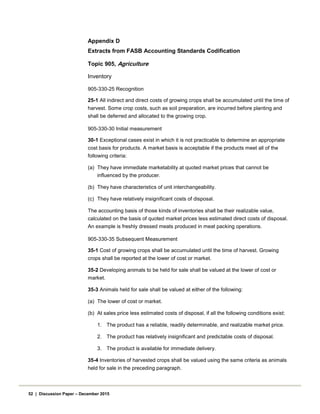
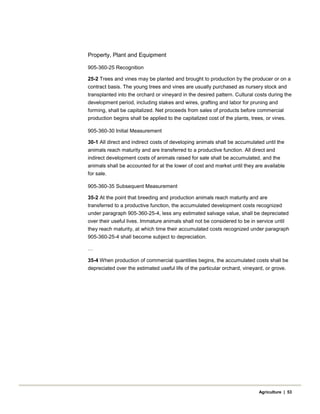
harvests is lower or higher. In any year, each harvest can, and often does, have
different quality characteristics. The market price for hay can vary from year to
year depending on how the harvest was in other areas and in some cases the
market is illiquid. A current value approach would need to incorporate all these
variables. While various assumptions could be made, computing current value
would take significant effort. Similar valuation issues would arise for an orchard
of fruit trees or a vineyard.
97 The majority of creditors noted that they treat bearer plants as property, plant
and equipment. Most practitioners consulted also noted that these assets are
conceptually similar to property, plant and equipment, and that current value
only makes sense in a liquidation scenario. Many stakeholders, including
creditors, noted that current value is not relevant because the enterprise does
not have any intention of disposing of the assets. The enterprise could not
immediately realize the cash flows implied by current value while staying in the
business of producing assets with the bearer plants.
98 Creditors stated that they focus on the value of the output as opposed to the
value of the underlying productive assets. As a result, creditors noted that when
they encounter these types of assets reported as inventory and measured at
current value they adjust the value and classification.
26 | Discussion Paper – December 2015
Preliminary view
99 The AcSB’s preliminary view is that bearer plants should be measured at cost.
This view is based on the following considerations:
(a) Creditors generally agreed that a cost approach provides better information
in respect of cash flows, both from a capital expenditure perspective and
understanding the operating income of an enterprise.
(b) Stakeholders noted that existing illustrative materials in respect of how cost
might be applied to bearer plants can be applied with a reasonable financial
burden and effort.
Question 12: Do you agree with the AcSB’s preliminary view that bearer plants
should be measured at cost? Why or why not? How would you determine cost?
Impairment
100 This section addresses which impairment model should be used in accounting
for biological assets and agricultural produce measured at cost. For assets
measured at current value (under the preliminary view set out in this Discussion
Paper for agricultural produce and animals held for sale) no separate
impairment test would be required.
101 Accounting standards for private enterprises contain several different
impairment models, each applying to a different category of assets (i.e., current
or long lived as discussed in paragraphs 107-111).
102 The primary differences between the impairment models that could be applied
are:
(a) the type of current value that the carrying amount is compared to (i.e., net
realizable value for inventories and fair value for long-lived assets); and
(b) a one-step impairment process (for inventories) versus a two-step
impairment process (for long-lived assets) is applied.
103 The AcSB notes that the consultations to date have not identified any issues
with respect to applying the different impairment models for biological assets
and agricultural produce since these same models are already used for other
assets. The AcSB notes that the impairment models for inventories and long-
lived assets have been in use for some time and are working appropriately.
104 The AcSB understands that some preparers, specifically those currently
measuring these assets at cost, are currently applying the impairment models in
Part II. Stakeholders consulted that have been applying this guidance did not
raise impairment as an issue of concern.
Agriculture | 27
105 The AcSB notes that some who support measuring all biological assets and
agricultural produce using a current value approach think it seems contradictory
to prefer a cost approach over current value and then test for impairment using
current value information. However, IMPAIRMENT OF LONG-LIVED ASSETS,
Section 3063, generally results in testing for impairment on an infrequent basis,
because impairment testing is only required when there is an indication of
impairment.
106 The AcSB’s preliminary view is that the impairment model (including disclosure
requirements) applicable to long-lived assets would be used for bearer assets
and other long-term assets (for example, timber) and the impairment model
applicable to inventories would be used for current assets (see paragraphs 107-
111). This view is based on the following considerations:
(a) These impairment models have been in place for some time and are
providing timely and relevant input based on when and how an enterprise
expects to realize cash flows.
(b) Issues have not been identified on applying these models.
Question 13: Do you agree with the AcSB’s preliminary view that impairment
should be assessed under the models used for current and long-lived assets
depending on the type of asset? Why or why not?
Presentation
107 The issue is classification of long-lived biological assets (for example, dairy
cattle, timber, and vines) as current or long term. A few stakeholders noted a
practice of presenting long-lived bearer assets as current.
108 The AcSB notes the following requirement in CURRENT ASSETS AND CURRENT
LIABILITIES, Section 1510:
.03 As a balance sheet classification, current assets shall include those assets
ordinarily realizable within one year from the date of the balance sheet or
within the normal operating cycle, when that is longer than a year. The
current asset classification shall also include the current portion of future
income tax assets (see INCOME TAXES, paragraphs 3465.80-.84).
109 The AcSB understands that the rationale for current classification is that the
word “realizable” in paragraph 1510.03 is being interpreted as “being able to
dispose of the asset in the current period” (i.e., that the asset might or could be
sold in the current period). This interpretation is inconsistent with practice in
other industries. For example, a trucking company does not classify trucks as
current assets, although they could be sold in the current year. The AcSB notes
that the term “ordinarily realizable” is intended to result in current classification
when the asset will be, or is expected to be, realized in the current period.
28 | Discussion Paper – December 2015
110 Creditors consulted during the research phase stated that classification of
biological assets such as milking cattle or breeding cattle as current assets is
not useful, and is potentially confusing. The current/non-current distinction is an
attempt at incorporating liquidity expectations into the structure of the balance
sheet. Classification as a current asset usually implies that the asset is expected
to be sold in the short term. This would not be the case for a dairy operation that
is a going concern. An enterprise that is in the milk production business cannot
sell its producing herd and remain in the milk-producing business, at least not
without immediately purchasing replacement animals.
111 The AcSB’s preliminary view is that presentation should be determined by the
guidance set out in Section 1510. Milking cattle or dairy cattle would be
classified as long-term assets. For other biological assets and agricultural
produce, the AcSB thinks that Section 1510 provides sufficient guidance with
respect to presentation.
Question 14: Do you agree with the AcSB’s preliminary view that presentation
should be determined by the guidance in Section 1510? Why or why not?
Should specific guidance on this issue be developed?
Disclosure
112 The disclosure requirements in accounting standards for private enterprises
were developed on the basis that financial statement users can ask for, and
generally receive, additional information from an enterprise when needed. On
this basis, the goal of the disclosure requirements in these standards is to
provide enough information for users to understand the financial statements and
be able to make informed inquiries regarding financial statement items or
transactions when they require further details.
113 The AcSB develops disclosure requirements in standard-setting projects in the
same manner as that used to develop accounting standards for private
enterprises.
114 The AcSB currently follows the process outlined below in developing disclosure
requirements:
(a) Step 1 — A list of disclosures is compiled from similar standards.
(b) Step 2 — Financial statement users are asked what information, in addition
to that provided under (a) that they would find useful.
(c) Step 3 — The list developed in (a) and (b) will then be sorted into “critical”
and “non-critical” categories. Information about accounting policies, risks
and uncertainties, and unusual events are considered to be critical.
Disclosures that are deemed to be non-critical will not be pursued unless the
Agriculture | 29
financial statement users think that there is significant benefit to be had from
the information or they would routinely ask for this information.
(d) Step 4 — The AcSB will then consider the cost of these potential
disclosures (i.e., preparation costs, communication costs, specialized
expertise costs and related assurance costs) to determine if any should be
eliminated on cost/benefit grounds.
115 The application of this process has resulted in the AcSB’s preliminary view that
the following disclosures should be required:
(a) a description of each major category of biological asset and agricultural
produce including the nature of activities relating to each category;
(b) for biological assets and agricultural produce measured at current value:
(i) a description of the methodology used to determine current value;
(ii) the total current value for each major category of asset; and
(iii) the aggregate gain or loss arising during the current period from the
change in current value;
(c) for biological assets and agricultural produce measured at cost:
(i) a description of the methodology used to determine cost;
(ii) the total cost for each major category of asset and for those categories
that are amortized, the accumulated amortization and basis for
amortization; and
(iii) the amount of inventories recognized as an expense for biological
assets and agricultural produce classified as inventory;
(d) for biological assets classified as property, plant and equipment, the amount
of amortization charged to income for the period;
(e) an estimate of the expected harvest date for long-term crops (for example,
timber, nursery stock); and
(f) financial risk management strategies related to biological assets and
agricultural produce.
116 The objective of these disclosures is to require an enterprise to provide
information that enables creditors to understand the nature of, and risks
associated with, its biological assets and agricultural produce. In carrying out the
process noted above, the AcSB’s preliminary view is that the following
disclosures should not be included because this information is beyond what is
required under Sections 3031 and 3061:
30 | Discussion Paper – December 2015
(a) a quantitative description of bearer assets (for example, size of milking or
breeding herds);
(b) a quantitative description of unharvested assets (for example, the number of
acres of unharvested crops); and
(c) a quantitative description of harvested assets, distinguishing between
assets held for sale and assets held for use in operations.
117 The goal of this quantitative information would be to provide creditors with
physical quantities of biological assets or agricultural produce. While creditors
may wish to have this type of volumetric information, this level of detail is not
required elsewhere in accounting standards for private enterprises.
118 Other disclosures in Part II may also be applicable (for example, disclosures in
respect of impairment).
Question 15: Do you agree with the proposed disclosure requirements set out in
paragraph 115? Why or why not? Are there any additional disclosures, including
those noted in paragraph 116, that should be considered?
Question 16: Are there any other issues that are not addressed in this
Discussion Paper? If so, what are they and how should they be addressed?
EFFECTS ANALYSIS
119 The AcSB is committed, as part of its due process, to evaluating the effects of
proposed changes to accounting standards at each major stage in the standard
setting process. Any authoritative guidance will be developed based on the
needs of users of financial statements and, accordingly, it is expected that the
guidance will provide useful information to these individuals. The following
general effects have been noted in respect of this Discussion Paper.
120 Addressing the diversity in practice would result in increased comparability
between agricultural enterprises. This benefits users of financial statements by
making the financial statements of different agricultural enterprises easier to
understand and would make benchmarking between agricultural enterprises
easier. Providing authoritative guidance also benefits practitioners and
businesses as the guidance assists them in developing suitable accounting
policies. This Discussion Paper proposes some disclosures about biological
assets and agricultural produce that are not required under existing accounting
standards for private enterprises. Based on the disclosure objective, this
information is intended to provide decision-useful information to users of
financial statements on a cost effective basis.
Agriculture | 31
121 Negative effects would be that, as with all accounting changes, to the extent that
an enterprise changes its current accounting and reporting processes, it would
have to incur the financial burden and effort of doing so. Financial costs include
preparation costs, communication costs, specialized expertise costs and related
assurance costs.
122 The AcSB thinks that it would not be appropriate to present a detailed effects
analysis at this stage because this Discussion Paper expresses preliminary
views that are subject to change. A more detailed analysis of the effects of
proposed changes will be completed at a later stage of the standard-setting
process, assuming the project proceeds.
Question 17: Do you agree with the effects noted in paragraphs 120-121? Why or
why not? If not, what other effects should be identified and why?
32 | Discussion Paper – December 2015
APPENDIX A
COMPARISON OF ACCOUNTING REQUIREMENTS AND PRELIMINARY VIEWS
Asset
Predominant
Canadian Practice IFRSs U.S. GAAP Preliminary View
Unharvested crops Cost
Fair value less costs to sell,
except when fair value cannot
be measured reliably
Cost except when it is not
practicable
Cost
Agricultural produce Net realizable value
At the point of harvest at fair
value less costs to sell; after
harvest at cost or net realizable
value if in accordance with
established practice under
IAS 2 Inventories
At the point of harvest at
cost; after harvest at cost
or at sales price less
estimated costs of disposal, if
conditions are met
Current value when certain
conditions are met and
cost when those
conditions are not met
Animals held for sale Cost and net realizable value
Fair value less costs to sell,
except when fair value cannot
be measured reliably
Developing animals held for
sale at cost; mature animals
held for sale at cost or at sales
price less estimated costs of
disposal, if conditions are met
Current value when certain
when those conditions are
not met
Bearer animals Cost and net realizable value
Fair value less costs to sell,
except when fair value cannot
be measured reliably
Cost Cost
Bearer plants Cost
Cost initially and subsequently
either using a cost or
revaluation model under IAS 16
Property, Plant and Equipment
Cost Cost
IFRS and U.S. GAAP requirements are those in effect January 1, 2016. Measurements exclude impairment considerations (for example, lower of cost or market).
Agriculture | 33
APPENDIX B
EXTRACTS FROM CPA CANADA HANDBOOK – ACCOUNTING, PART II
FINANCIAL STATEMENT CONCEPTS, SECTION 1000
ELEMENTS OF FINANCIAL STATEMENTS
…
Assets
.24 Assets are economic resources controlled by an entity as a result of past
transactions or events and from which future economic benefits may be obtained.
.25 Assets have three essential characteristics:
(a) they embody a future benefit that involves a capacity, singly or in combination
with other assets, in the case of profit-oriented enterprises, to contribute directly
or indirectly to future net cash flows;
(b) the entity can control access to the benefit; and
(c) the transaction or event giving rise to the entity's right to, or control of, the
benefit has already occurred.
.26 It is not essential for control of access to the benefit to be legally enforceable for a
resource to be an asset, provided the entity can control its use by other means.
.27 There is a close association between incurring expenditures and generating assets
but the two do not necessarily coincide. Hence, when an entity incurs an
expenditure, this may provide evidence that future economic benefits were sought
but is not conclusive proof that an item satisfying the definition of an asset has been
obtained. Similarly, the absence of a related expenditure does not preclude an item
from satisfying the definition of an asset and thus becoming a candidate for
recognition in the balance sheet. For example, items that have been donated to the
entity may satisfy the definition of an asset.
…
RECOGNITION CRITERIA
.36 Recognition is the process of including an item in the financial statements of an
entity. Recognition consists of the addition of the amount involved into statement
totals together with a narrative description of the item (for example, "inventory" or
"sales") in a statement. Similar items may be grouped together in the financial
statements for the purpose of presentation.
.37 Recognition means inclusion of an item within one or more individual statements
and does not mean disclosure in the notes to the financial statements. Notes either
provide further details about items recognized in the financial statements, or provide
34 | Discussion Paper – December 2015
information about items that do not meet the criteria for recognition and thus are not
recognized in the financial statements.
.38 The recognition criteria below provide general guidance on when an item is
recognized in the financial statements. Whether any particular item is recognized or
not will require the application of professional judgment in considering whether the
specific circumstances meet the recognition criteria.
.39 The recognition criteria are as follows:
(a) the item has an appropriate basis of measurement and a reasonable estimate
can be made of the amount involved; and
(b) for items involving obtaining or giving up future economic benefits, it is probable
that such benefits will be obtained or given up.
.40 It is possible that an item will meet the definition of an element but still not be
recognized in the financial statements because it is not probable that future
economic benefits will be obtained or given up or because a reasonable estimate
cannot be made of the amount involved. It may be appropriate to provide
information about items that do not meet the recognition criteria in notes to the
financial statements. Not recognizing an expenditure as an asset does not imply
either that the intention of management in incurring the expenditure was other than
to generate future economic benefits for the entity or that management was
misguided. The only implication is that the degree of certainty that economic
benefits will flow to the entity beyond the current accounting period is insufficient to
warrant the recognition of an asset.
.41 Items recognized in financial statements are accounted for in accordance with the
accrual basis of accounting. The accrual basis of accounting recognizes the effect
of transactions and events in the period in which the transactions and events occur,
regardless of whether there has been a receipt or payment of cash or its equivalent.
…
MEASUREMENT
.48 Measurement is the process of determining the amount at which an item is
recognized in the financial statements. There are a number of bases on which an
amount can be measured. However, financial statements are prepared primarily
using the historical cost basis of measurement whereby transactions and events are
recognized in financial statements at the amount of cash or cash equivalents paid or
received or the fair value ascribed to them when they took place.
Agriculture | 35
.49 Other bases of measurement are also used but only in limited circumstances. They
include:
(a) Replacement cost — the amount that would be needed currently to acquire an
equivalent asset. This may be used, for example, when inventories are valued
at the lower of historical cost and replacement cost.
(b) Realizable value — the amount that would be received by selling an asset. This
may be used, for example, to value temporary and portfolio investments. Market
value may be used to estimate realizable value when a market for an asset
exists.
(c) Present value — the discounted amount of future cash flows expected to be
received from an asset or required to settle a liability. This may be used, for
example, to estimate the cost of pension benefits.
INVENTORIES, Section 3031
PURPOSE AND SCOPE
.01 This Section prescribes the accounting treatment for inventories. A primary issue in
accounting for inventories is the amount of cost to be recognized as an asset and
carried forward until the related revenues are recognized. This Section provides
guidance on the determination of cost and its subsequent recognition as an
expense, including any write-down to net realizable value. It also provides guidance
on the cost formulas that are used to assign costs to inventories.
…
.04 This Section does not apply to the measurement of inventories:
(a) held by producers of agricultural and forest products, agricultural produce after
harvest, and minerals and mineral products, to the extent that they are
measured at net realizable value in accordance with well-established practices
in those industries; when such inventories are measured at net realizable value,
changes in that value are recognized in net income in the period of the change;
(b) held by commodity broker-traders who measure their inventories at fair value
less costs to sell; when such inventories are measured at fair value less costs
to sell, changes in fair value less costs to sell are recognized in net income in
the period of the change;
(c) of living animals and plants (biological assets) and the harvested product of the
entity's biological assets (agricultural produce). This Section does apply to
products that are the result of processing after harvest such as processed
foods, thread and lumber.
36 | Discussion Paper – December 2015
.05 The inventories referred to in paragraph 3031.04(a) are measured at net realizable
value at certain stages of production. For example, this occurs when agricultural
crops have been harvested or minerals have been extracted and sale is assured
under a forward contract or a government guarantee, or when an active market
exists and there is a negligible risk of failure to sell. These inventories are excluded
from only the measurement requirements of this Section.
.06 Broker-traders are those who buy or sell commodities for others or on their own
account. The inventories referred to in paragraph 3031.04(b) are principally
acquired with the purpose of selling in the near future and generating a profit from
fluctuations in price or broker-traders' margin. When these inventories are
measured at fair value less costs to sell, they are excluded from only the
measurement requirements of this Section.
DEFINITIONS
.07 The following terms are used in this Section with the meanings specified:
(a) Inventories are assets:
(i) held for sale in the ordinary course of business;
(ii) in the process of production for such sale; or
(iii) in the form of materials or supplies to be consumed in the production
process or in the rendering of services.
(b) Net realizable value is the estimated selling price in the ordinary course of
business less the estimated costs of completion and the estimated costs
necessary to make the sale.
(c) Fair value is the amount of the consideration that would be agreed upon in an
arm's length transaction between knowledgeable, willing parties who are under
no compulsion to act.
.08 Net realizable value refers to the net amount that an entity expects to realize from
the sale of inventory in the ordinary course of business. Fair value reflects the
amount for which the same inventory could be exchanged between knowledgeable
and willing buyers and sellers in the marketplace. The former is an entity-specific
value; the latter is not. Net realizable value for inventories may not equal fair value
less costs to sell.
.09 Inventories encompass goods purchased and held for resale (for example,
merchandise purchased by a retailer and held for resale, or land and other property
held for resale). Inventories also encompass finished goods produced, or work in
progress being produced, by the entity and include materials and supplies awaiting
use in the production process.
Agriculture | 37
MEASUREMENT OF INVENTORIES
.10 Inventories shall be measured at the lower of cost and net realizable value.
Cost of inventories
.11 The cost of inventories shall comprise all costs of purchase, costs of conversion and
other costs incurred in bringing the inventories to their present location and
condition.
Costs of purchase
.12 The costs of purchase of inventories comprise the purchase price, import duties and
other taxes (other than those subsequently recoverable by the entity from the taxing
authorities), and transport, handling and other costs directly attributable to the
acquisition of finished goods, materials and services. Trade discounts, rebates and
other similar items are deducted in determining the costs of purchase.
Costs of conversion
.13 The costs of conversion of inventories include costs directly related to the units of
production, such as direct labour. They also include a systematic allocation of fixed
and variable production overheads that are incurred in converting materials into
finished goods. Fixed production overheads are those indirect costs of production
that remain relatively constant regardless of the volume of production, such as
depreciation and maintenance of factory buildings and equipment, and the cost of
factory management and administration. Variable production overheads are those
indirect costs of production that vary directly, or nearly directly, with the volume of
production, such as indirect materials and indirect labour.
.14 The allocation of fixed production overheads to the costs of conversion is based on
the normal capacity of the production facilities. Normal capacity is the production
expected to be achieved on average over a number of periods or seasons under
normal circumstances, taking into account the loss of capacity resulting from
planned maintenance. The actual level of production may be used if it approximates
normal capacity. The amount of fixed overhead allocated to each unit of production
is not increased as a consequence of low production or idle plant. Unallocated
overheads are recognized as an expense in the period in which they are incurred. In
periods of abnormally high production, the amount of fixed overhead allocated to
each unit of production is decreased so that inventories are not measured above
cost. Variable production overheads are allocated to each unit of production on the
basis of the actual use of the production facilities.
.15 A production process may result in more than one product being produced
simultaneously. For example, this is the case when joint products are produced or
when there is a main product and a by-product. When the costs of conversion of
each product are not separately identifiable, they are allocated between the
38 | Discussion Paper – December 2015
products on a rational and consistent basis. For example, the allocation may be
based on the relative sales value of each product either at the stage in the
production process when the products become separately identifiable, or at the
completion of production. Most by-products are immaterial. When this is the case,
they are often measured at net realizable value and this value is deducted from the
cost of the main product. As a result, the carrying amount of the main product is not
materially different from its cost.
Other costs
.16 Other costs are included in the cost of inventories only to the extent that they are
incurred in bringing the inventories to their present location and condition. For
example, it may be appropriate to include non-production overheads or the costs of
designing products for specific customers in the cost of inventories.
.17 Examples of costs excluded from the cost of inventories and recognized as
expenses in the period in which they are incurred are:
(a) abnormal amounts of wasted materials, labour or other production costs;
(b) storage costs, unless those costs are necessary in the production process
before a further production stage;
(c) administrative overheads that do not contribute to bringing inventories to their
present location and condition; and
(d) selling costs.
.18 The cost of inventories that require a substantial period of time to get them ready for
their intended use or sale includes interest costs when the enterprise's accounting
policy is to capitalize interest costs. The cost of inventories that are ready for their
intended use or sale when acquired does not include interest costs.
.19 An entity may purchase inventories on deferred settlement terms. When the
arrangement effectively contains a financing element, that element, for example a
difference between the purchase price for normal credit terms and the amount paid,
is recognized as interest expense over the period of the financing.
Techniques for the measurement of cost
.20 Techniques for the measurement of the cost of inventories, such as the standard
cost method or the retail method, may be used for convenience if the results
approximate cost. Standard costs take into account normal levels of materials and
supplies, labour, efficiency and capacity utilization. They are regularly reviewed and,
if necessary, revised in the light of current conditions.
Agriculture | 39
.21 The retail method is often used in the retail industry for measuring inventories of
large numbers of rapidly changing items with similar margins for which it is
impracticable to use other costing methods. The cost of the inventory is determined
by reducing the sales value of the inventory by the appropriate percentage gross
margin. The percentage used takes into consideration inventory that has been
marked down to below its original selling price. An average percentage for each
retail department is often used.
Cost formulas
.22 The cost of inventories of items that are not ordinarily interchangeable and goods or
services produced and segregated for specific projects shall be assigned by using
specific identification of their individual costs.
.23 Specific identification of cost means that specific costs are attributed to identified
items of inventory. This is the appropriate treatment for items that are segregated
for a specific project, regardless of whether they have been bought or produced.
However, specific identification of costs is inappropriate when there are large
numbers of items of inventory that are ordinarily interchangeable. In such
circumstances, the method of selecting those items that remain in inventories could
be used to obtain predetermined effects on net income.
.24 The cost of inventories, other than those dealt with in paragraph 3031.22, shall be
assigned by using the first-in, first-out (FIFO) or weighted average cost formula. An
entity shall use the same cost formula for all inventories having a similar nature and
use to the entity. For inventories with a different nature or use, different cost
formulas may be justified.
.25 Inventories used in one business segment may have a use to the entity different
from the same type of inventories used in another business segment. However, a
difference in geographical location of inventories (or in the respective tax rules), by
itself, is not sufficient to justify the use of different cost formulas.
.26 The FIFO formula assumes that the items of inventory that were purchased or
produced first are sold first and, consequently, the items remaining in inventory at
the end of the period are those most recently purchased or produced. Under the
weighted average cost formula, the cost of each item is determined from the
weighted average of the cost of similar items at the beginning of a period and the
cost of similar items purchased or produced during the period. The average may be
calculated on a periodic basis, or as each additional shipment is received,
depending upon the circumstances of the entity.
Net realizable value
.27 The cost of inventories may not be recoverable if those inventories are damaged, if
they have become wholly or partially obsolete, or if their selling prices have
40 | Discussion Paper – December 2015
declined. The cost of inventories may also not be recoverable if the estimated costs
of completion or the estimated costs to be incurred to make the sale have
increased. The practice of writing inventories down below cost to net realizable
value is consistent with the view that assets are not carried in excess of amounts
expected to be realized from their sale or use.
.28 Inventories are usually written down to net realizable value item by item. However,
in some circumstances, it may be appropriate to group similar or related items. This
may be the case with items of inventory relating to the same product line that have
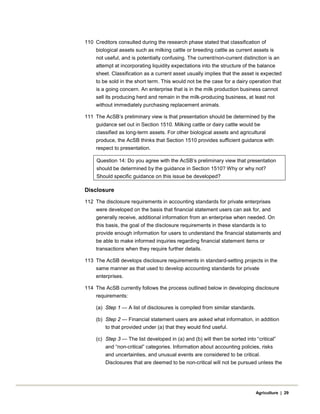
similar purposes or end uses, are produced and marketed in the same geographical
area, and cannot be practicably evaluated separately from other items in that
product line. It is not appropriate to write inventories down on the basis of a
classification of inventory (for example, finished goods, or all the inventories in a
particular industry or geographical segment).
.29 Estimates of net realizable value are based on the most reliable evidence available,
at the time the estimates are made, of the amount the inventories are expected to
realize. These estimates take into consideration fluctuations of price or cost directly
relating to events occurring after the end of the period to the extent that such events
confirm conditions existing at the end of the period.
.30 Estimates of net realizable value also take into consideration the purpose for which
the inventory is held. For example, the net realizable value of the quantity of
inventory held to satisfy firm sales contracts is based on the contract price. If the
sales contracts are for less than the inventory quantities held, the net realizable
value of the excess is based on general selling prices. Provisions may arise from
firm sales contracts in excess of inventory quantities held or from firm purchase
contracts.
.31 Materials and other supplies held for use in the production of inventories are not
written down below cost if the finished products in which they will be incorporated
are expected to be sold at or above cost. However, when a decline in the price of
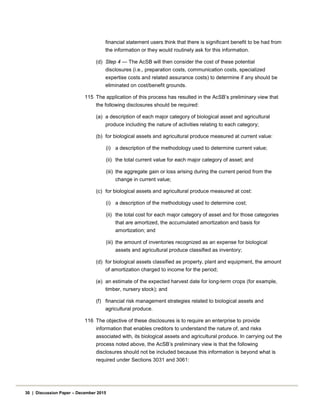
materials indicates that the cost of the finished products exceeds net realizable
value, the materials are written down to best available measure of their net
realizable value.
.32 A new assessment is made of net realizable value in each subsequent period.
When the circumstances that previously caused inventories to be written down
below cost no longer exist or when there is clear evidence of an increase in net
realizable value because of changed economic circumstances, the amount of the
write-down is reversed (i.e., the reversal is limited to the amount of the original
write-down) so that the new carrying amount is the lower of the cost and the revised
net realizable value. For example, this occurs when an item of inventory that is
Agriculture | 41
carried at net realizable value, because its selling price has declined, is still on hand
in a subsequent period and its selling price has increased.
…
DISCLOSURE
.35 The financial statements shall disclose:
(a) the accounting policies adopted in measuring inventories, including the cost
formula used;
(b) the total carrying amount of inventories and the carrying amount in
classifications appropriate to the entity; and
(c) the amount of inventories recognized as an expense during the period.
.36 Information about the carrying amounts held in different classifications of inventories
and the extent of the changes in these assets is useful to financial statement users.
Common classifications of inventories are merchandise, production supplies,
materials, work in progress and finished goods.
.37 The amount of inventories recognized as an expense during the period, which is
often referred to as cost of sales, consists of those costs previously included in the
measurement of inventory that has now been sold and unallocated production
overheads and abnormal amounts of production costs of inventories. The
circumstances of the entity may also warrant the inclusion of other amounts, such
as distribution costs.
.38 Some entities adopt a format for the income statement that results in amounts being
disclosed other than the cost of inventories recognized as an expense during the
period. Under this format, an entity presents an analysis of expenses using a
classification based on the nature of expenses. In this case, the entity discloses the
costs recognized as an expense for raw materials and consumables, labour costs
and other costs together with the amount of the net change in inventories for the
period.
PROPERTY, PLANT AND EQUIPMENT, Section 3061
DEFINITIONS
.03 The following terms are used in this Section with the meanings specified:
(a) Property, plant and equipment are identifiable tangible assets that meet all of
the following criteria:
(i) are held for use in the production or supply of goods and services, for rental
to others, for administrative purposes or for the development, construction,
maintenance or repair of other property, plant and equipment;
42 | Discussion Paper – December 2015
(ii) have been acquired, constructed or developed with the intention of being
used on a continuing basis; and
(iii) are not intended for sale in the ordinary course of business.
Spare parts and servicing equipment are usually carried as inventory and
recognized in net income as consumed. However, major spare parts and standby
equipment qualify as property, plant and equipment when an entity expects to use
them during more than one period. Similarly, if the spare parts and servicing
equipment can be used only in connection with an item of property, plant and
equipment, they are accounted for as property, plant and equipment. Property, plant
and equipment and intangible assets, as defined in GOODWILL AND INTANGIBLE
ASSETS, paragraph 3064.08, are referred to collectively as "capital assets".
…
MEASUREMENT
Cost
.04 Property, plant and equipment shall be recorded at cost.
.05 The cost of an item of property, plant and equipment includes the purchase price
and other acquisition costs such as option costs when an option is exercised,
brokers' commissions, installation costs including architectural, design and
engineering fees, legal fees, survey costs, site preparation costs, freight charges,
transportation insurance costs, duties, testing and preparation charges. In addition,
if the cost of the asset acquired other than through a business combination is
different from its tax basis on acquisition, the asset's cost would be adjusted to
reflect the related future income tax consequences (see INCOME TAXES,
Section 3465). It may be appropriate to group together individually insignificant
items of property, plant and equipment.
.06 The cost of each item of property, plant and equipment acquired as part of a basket
purchase (i.e., when a group of assets is acquired for a single amount), is
determined by allocating the price paid for the basket to each item on the basis of
its relative fair value at the time of acquisition.
.07 When, at the time of acquisition, a portion of the acquired item of property, plant and
equipment meets the criteria in DISPOSAL OF LONG-LIVED ASSETS AND
DISCONTINUED OPERATIONS, Section 3475, to be classified as held for sale at the
acquisition date, that portion of the item is measured at fair value less cost to sell.
The remainder of the acquired item is measured at the cost of acquisition of the
entire item less the amount assigned to the portion to be sold. For example, if a
portion of land acquired is to be resold, the cost of the land to be retained would be
the total cost of the purchase minus the fair value less cost to sell of the portion of
land held for sale. When, at the time of acquisition, a portion of the acquired item of
Agriculture | 43
property, plant and equipment is not intended for use because it will be abandoned,
its cost and any costs of disposal, net of any estimated proceeds, are attributed to
that portion of the acquired asset that is intended for use. For example, the cost of
acquired land that includes a building that will be demolished comprises the cost of
the acquired property and the cost of demolishing the building.
Acquisition, construction or development over time
.08 The cost of an item of property, plant and equipment includes direct construction or
development costs (such as materials and labour), and overhead costs directly
attributable to the construction or development activity.
.09 For a mining property, the cost of the asset includes exploration costs if the
enterprise considers that such costs have the characteristics of property, plant and
equipment. An enterprise applies the method of accounting for exploration costs
that it considers to be appropriate to its operations and applies the method
consistently to all its properties.
.10 For an oil and gas property, the cost of the asset comprises acquisition costs,
development costs and certain exploration costs depending on whether the
enterprise accounts for its oil and gas properties using the full cost method or the
successful efforts method. An enterprise applies the method of accounting for
acquisition, exploration and development costs that it considers to be appropriate to
its operations and applies the method consistently to all its properties.
.11 The cost of an item of property, plant and equipment that is acquired, constructed,
or developed over time includes carrying costs directly attributable to the
acquisition, construction, or development activity (such as interest costs when the
enterprise's accounting policy is to capitalize interest costs.) For an item of rate-
regulated property, plant and equipment, the cost includes the directly attributable
allowance for funds used during construction allowed by the regulator.
.12 Capitalization of carrying costs ceases when an item of property, plant and
equipment is substantially complete and ready for productive use. Determining
when an asset, or a portion thereof, is substantially complete and ready for
productive use requires consideration of the circumstances and the industry in
which it is to be operated. Normally, it would be predetermined by management with
reference to such factors as productive capacity, occupancy level, or the passage of
time.
.13 Net revenue or expense derived from an item of property, plant and equipment prior
to substantial completion and readiness for use is included in the cost.
Betterment
.14 The cost incurred to enhance the service potential of an item of property, plant and
equipment is a betterment. Service potential may be enhanced when there is an
44 | Discussion Paper – December 2015
increase in the previously assessed physical output or service capacity, associated
operating costs are lowered, the life or useful life is extended, or the quality of
output is improved. The cost incurred in the maintenance of the service potential of
an item of property, plant and equipment is a repair, not a betterment. If a cost has
the attributes of both a repair and a betterment, the portion considered to be a
betterment is included in the cost of the asset.
.15 A redevelopment project that adds significant economic value to rental real estate is
treated as a betterment. When a building is removed for the purpose of
redevelopment of rental real estate, the net carrying amount of the building is
included in the cost of the redeveloped property, as long as the net amount
considered recoverable from the redevelopment project exceeds its cost.
Amortization
.16 Amortization shall be recognized in a rational and systematic manner appropriate to
the nature of an item of property, plant and equipment with a limited life and its use
by the enterprise. The amount of amortization that shall be charged to income is the
greater of:
(a) the cost less salvage value over the life of the asset; and
(b) the cost less residual value over the useful life of the asset.
.17 Property, plant and equipment is acquired to earn income or supply a service over
its useful life. An item of property, plant and equipment, other than land that
normally has an unlimited life, has a limited life. Its useful life is normally the
shortest of its physical, technological, commercial and legal life. Amortization is the
charge to income that recognizes that life is finite and that the cost less salvage
value or residual value of an item of property, plant and equipment is allocated to
the periods of service provided by the asset. Amortization may also be termed
depreciation or depletion.
.18 The cost of an item of property, plant and equipment made up of significant
separable component parts is allocated to the component parts when practicable
and when estimates can be made of the lives of the separate components. For
example, initial leasing costs may be identifiable as a separable component of the
cost of rental real estate and engines may be a separable component of an aircraft.
.19 Different methods of amortizing an item of property, plant and equipment result in
different patterns of charges to income. The objective is to provide a rational and
systematic basis for allocating the amortizable amount of an item of property, plant
and equipment over its estimated life and useful life. A straight-line method reflects
a constant charge for the service as a function of time. A variable charge method
reflects service as a function of usage. Other methods may be appropriate in certain
situations. For example, an increasing charge method may be used when an
enterprise can price its goods or services so as to obtain a constant rate of return
Agriculture | 45
on the investment in the asset; a decreasing charge method may be appropriate
when the operating efficiency of the asset declines over time.
.20 Factors to be considered in estimating the life and useful life of an item of property,
plant and equipment include expected future usage, effects of technological or
commercial obsolescence, expected wear and tear from use or the passage of time,
the maintenance program, results of studies made regarding the industry, studies of
similar items retired, and the condition of existing comparable items. As the
estimate of the life of an item of property, plant and equipment is extended into the
future, it becomes increasingly difficult to identify a reasonable basis for estimating
the life.
…
DISCLOSURE
.24 For each major category of property, plant and equipment there shall be disclosure
of:
(a) cost;
(b) accumulated amortization, including the amount of any write-downs; and
(c) the amortization method used, including the amortization period or rate.
.25 The net carrying amount of property, plant and equipment not being amortized,
because it is under construction or development, or has been removed from service
for an extended period of time, shall be disclosed. [Former paragraph 3061.25
retained in archived pronouncements.]
.26 The amount of amortization of property, plant and equipment charged to income for
the period shall be disclosed (see INCOME STATEMENT, Section 1520). [Former
paragraph 3061.26 retained in archived pronouncements.]
.27 The presentation and disclosure requirements of IMPAIRMENT OF LONG-LIVED
ASSETS, Section 3063, and DISPOSAL OF LONG-LIVED ASSETS AND
DISCONTINUED OPERATIONS, Section 3475, apply to property, plant and
equipment.
.28 Major categories of property, plant and equipment are determined by reference to
type (for example, land, buildings, machinery, leasehold improvements), operating
segment and/or nature of operations (for example, manufacturing, processing,
distribution, rental real estate).
46 | Discussion Paper – December 2015
APPENDIX C
EXTRACTS FROM CPA CANADA HANDBOOK – ACCOUNTING, PART I
IAS 2 Inventories
Scope
2 This Standard applies to all inventories, except:
…
(c) biological assets related to agricultural activity and agricultural produce
at the point of harvest (see IAS 41 Agriculture).
3 This Standard does not apply to the measurement of inventories held by:
(a) producers of agricultural and forest products, agricultural produce after
harvest, and minerals and mineral products, to the extent that they are
measured at net realisable value in accordance with well-established
practices in those industries. When such inventories are measured at net
realisable value, changes in that value are recognised in profit or loss in
the period of the change.
…
4 The inventories referred to in paragraph 3(a) are measured at net realisable value
at certain stages of production. This occurs, for example, when agricultural crops
have been harvested or minerals have been extracted and sale is assured under a
forward contract or a government guarantee, or when an active market exists and
there is a negligible risk of failure to sell. These inventories are excluded from only
the measurement requirements of this Standard.
Agriculture | 47
IAS 41 Agriculture
Scope
1 This Standard shall be applied to account for the following when they relate to
agricultural activity:
(a) biological assets, except for bearer plants;
(b) agricultural produce at the point of harvest; and
(c) government grants covered by paragraphs 34 and 35.
2 This Standard does not apply to:
(a) land related to agricultural activity (see IAS 16 Property, Plant and Equipment
and IAS 40 Investment Property).
(b) bearer plants related to agricultural activity (see IAS 16). However, this
Standard applies to the produce on those bearer plants.
(c) government grants related to bearer plants (see IAS 20 Accounting for
Government Grants and Disclosure of Government Assistance).
(d) intangible assets related to agricultural activity (see IAS 38 Intangible Assets).
3 This Standard is applied to agricultural produce, which is the harvested produce of
the entity's biological assets, at the point of harvest. Thereafter, IAS 2 Inventories or
another applicable Standard is applied. Accordingly, this Standard does not deal
with the processing of agricultural produce after harvest; for example, the
processing of grapes into wine by a vintner who has grown the grapes. While such
processing may be a logical and natural extension of agricultural activity, and the
events taking place may bear some similarity to biological transformation, such
processing is not included within the definition of agricultural activity in this
Standard.
4 The table below provides examples of biological assets, agricultural produce, and
products that are the result of processing after harvest:
Biological assets Agricultural produce
Products that are the
result of processing
after harvest
Sheep Wool Yarn, carpet
Trees in a timber
plantation
Felled trees Logs, lumber
Dairy cattle Milk Cheese
Pigs Carcass Sausages, cured hams
48 | Discussion Paper – December 2015
Biological assets Agricultural produce
Products that are the
result of processing
after harvest
Cotton plants Harvested cotton Thread, clothing
Sugarcane Harvested cane Sugar
Tobacco plants Picked leaves Cured tobacco
Tea bushes Picked leaves Tea
Grape vines Picked grapes Wine
Fruit trees Picked fruit Processed fruit
Oil palms Picked fruit Palm oil
Rubber trees Harvested latex Rubber products
Some plants, for example, tea bushes, grape vines, oil palms and rubber trees,
usually meet the definition of a bearer plant and are within the scope of IAS 16.
However, the produce growing on bearer plants, for example, tea leaves, grapes, oil
palm fruit and latex, is within the scope of IAS 41.
Definitions
Agriculture-related definitions
5 The following terms are used in this Standard with the meanings specified:
Agricultural activity is the management by an entity of the biological
transformation and harvest of biological assets for sale or for conversion into
agricultural produce or into additional biological assets.
Agricultural produce is the harvested produce of the entity's biological
assets.
A bearer plant is a living plant that:
(a) is used in the production or supply of agricultural produce;
(b) is expected to bear produce for more than one period; and
(c) has a remote likelihood of being sold as agricultural produce, except for
incidental scrap sales.
A biological asset is a living animal or plant.
Biological transformation comprises the processes of growth, degeneration,
production, and procreation that cause qualitative or quantitative changes in
a biological asset.
Agriculture | 49
Costs to sell are the incremental costs directly attributable to the disposal of
an asset, excluding finance costs and income taxes.
A group of biological assets is an aggregation of similar living animals or
plants.
Harvest is the detachment of produce from a biological asset or the cessation
of a biological asset's life processes.
5A The following are not bearer plants:
(a) plants cultivated to be harvested as agricultural produce (for example, trees
grown for use as lumber);
(b) plants cultivated to produce agricultural produce when there is more than a
remote likelihood that the entity will also harvest and sell the plant as
agricultural produce, other than as incidental scrap sales (for example, trees
that are cultivated both for their fruit and their lumber); and
(c) annual crops (for example, maize and wheat).
5B When bearer plants are no longer used to bear produce they might be cut down and
sold as scrap, for example, for use as firewood. Such incidental scrap sales would
not prevent the plant from satisfying the definition of a bearer plant.
5C Produce growing on bearer plants is a biological asset.
6 Agricultural activity covers a diverse range of activities; for example, raising
livestock, forestry, annual or perennial cropping, cultivating orchards and
plantations, floriculture and aquaculture (including fish farming). Certain common
features exist within this diversity:
(a) Capability to change. Living animals and plants are capable of biological
transformation;
(b) Management of change. Management facilitates biological transformation by
enhancing, or at least stabilising, conditions necessary for the process to take
place (for example, nutrient levels, moisture, temperature, fertility, and light).
Such management distinguishes agricultural activity from other activities. For
example, harvesting from unmanaged sources (such as ocean fishing and
deforestation) is not agricultural activity; and
(c) Measurement of change. The change in quality (for example, genetic merit,
density, ripeness, fat cover, protein content, and fibre strength) or quantity (for
example, progeny, weight, cubic metres, fibre length or diameter, and number
of buds) brought about by biological transformation or harvest is measured and
monitored as a routine management function.
50 | Discussion Paper – December 2015
7 Biological transformation results in the following types of outcomes:
(a) asset changes through (i) growth (an increase in quantity or improvement in
quality of an animal or plant), (ii) degeneration (a decrease in the quantity or
deterioration in quality of an animal or plant), or (iii) procreation (creation of
additional living animals or plants); or
(b) production of agricultural produce such as latex, tea leaf, wool, and milk.
…
12 A biological asset shall be measured on initial recognition and at the end of
each reporting period at its fair value less costs to sell, except for the case
described in paragraph 30 where the fair value cannot be measured reliably.
…
Inability to measure fair value reliably
30 There is a presumption that fair value can be measured reliably for a
biological asset. However, that presumption can be rebutted only on initial
recognition for a biological asset for which quoted market prices are not
available and for which alternative fair value measurements are determined to
be clearly unreliable. In such a case, that biological asset shall be measured
at its cost less any accumulated depreciation and any accumulated
impairment losses. Once the fair value of such a biological asset becomes
reliably measurable, an entity shall measure it at its fair value less costs to
sell. Once a non-current biological asset meets the criteria to be classified as
held for sale (or is included in a disposal group that is classified as held for
sale) in accordance with IFRS 5 Non-current Assets Held for Sale and
Discontinued Operations, it is presumed that fair value can be measured
reliably.
31 The presumption in paragraph 30 can be rebutted only on initial recognition. An
entity that has previously measured a biological asset at its fair value less costs to
sell continues to measure the biological asset at its fair value less costs to sell until
disposal.
Agriculture | 51
Appendix D
Extracts from FASB Accounting Standards Codification
Topic 905, Agriculture
Inventory
905-330-25 Recognition
25-1 All indirect and direct costs of growing crops shall be accumulated until the time of
harvest. Some crop costs, such as soil preparation, are incurred before planting and
shall be deferred and allocated to the growing crop.
905-330-30 Initial measurement
30-1 Exceptional cases exist in which it is not practicable to determine an appropriate
cost basis for products. A market basis is acceptable if the products meet all of the
following criteria:
(a) They have immediate marketability at quoted market prices that cannot be
influenced by the producer.
(b) They have characteristics of unit interchangeability.
(c) They have relatively insignificant costs of disposal.
The accounting basis of those kinds of inventories shall be their realizable value,
calculated on the basis of quoted market prices less estimated direct costs of disposal.
An example is freshly dressed meats produced in meat packing operations.
905-330-35 Subsequent Measurement
35-1 Cost of growing crops shall be accumulated until the time of harvest. Growing
crops shall be reported at the lower of cost or market.
35-2 Developing animals to be held for sale shall be valued at the lower of cost or
market.
35-3 Animals held for sale shall be valued at either of the following:
(a) The lower of cost or market.
(b) At sales price less estimated costs of disposal, if all the following conditions exist:
1. The product has a reliable, readily determinable, and realizable market price.
2. The product has relatively insignificant and predictable costs of disposal.
3. The product is available for immediate delivery.
35-4 Inventories of harvested crops shall be valued using the same criteria as animals
held for sale in the preceding paragraph.
52 | Discussion Paper – December 2015
Property, Plant and Equipment
905-360-25 Recognition
25-2 Trees and vines may be planted and brought to production by the producer or on a
contract basis. The young trees and vines are usually purchased as nursery stock and
transplanted into the orchard or vineyard in the desired pattern. Cultural costs during the
development period, including stakes and wires, grafting and labor for pruning and
forming, shall be capitalized. Net proceeds from sales of products before commercial
production begins shall be applied to the capitalized cost of the plants, trees, or vines.
905-360-30 Initial Measurement
30-1 All direct and indirect costs of developing animals shall be accumulated until the
animals reach maturity and are transferred to a productive function. All direct and
indirect development costs of animals raised for sale shall be accumulated, and the
animals shall be accounted for at the lower of cost and market until they are available
for sale.
905-360-35 Subsequent Measurement
35-2 At the point that breeding and production animals reach maturity and are
transferred to a productive function, the accumulated development costs recognized
under paragraph 905-360-25-4, less any estimated salvage value, shall be depreciated
over their useful lives. Immature animals shall not be considered to be in service until
they reach maturity, at which time their accumulated costs recognized under paragraph
905-360-25-4 shall become subject to depreciation.
…
35-4 When production of commercial quantities begins, the accumulated costs shall be
depreciated over the estimated useful life of the particular orchard, vineyard, or grove.
Agriculture | 53
© 2015 Chartered Professional Accountants of Canada
Excerpts from and/or links to this publication may be used, provided that full and clear
credit is given to the appropriate Financial Reporting & Assurance Standards Canada
board, oversight council, committee or individual author, with appropriate and specific
direction to the original content.
For assistance with crediting this publication, please contact fras-nifc-
canada@cpacanada.ca.

Project Management Notes 2

  • 1.
    Discussion Paper Accounting StandardsBoard Agriculture December 2015 COMMENTS TO THE AcSB MUST BE RECEIVED BY MAY 19, 2016 A PDF response form has been posted with this document to assist you in submitting your comments to the AcSB. Alternatively, you may send comments via email (in Word format), to:ed.accounting@cpacanada.ca addressed to: Rebecca Villmann, CPA, CA, CPA (Illinois) Director, Accounting Standards Accounting Standards Board 277 Wellington Street West Toronto, Ontario M5V 3H2 This Discussion Paper is issued by the Accounting Standards Board (AcSB). The AcSB is composed of persons knowledgeable in the preparation and use of financial statements with backgrounds in business, public practice and academe. All members serve as individuals and not as representatives of their employers or organizations. Individuals and organizations are invited to send written comments on the Discussion Paper. Comments are most helpful if they clearly explain the issues they raise and suggest a specific course of action supported by reasoning. All comments received by the AcSB will be available on the website shortly after the comment deadline, unless confidentiality is requested. The request for confidentiality must be stated explicitly within the response.
  • 3.
    Overview Why is theAcSB undertaking this project? The Accounting Standards Board (AcSB) has been informed that, as a result of a lack of specific authoritative guidance, there is diversity in accounting by private enterprises for biological assets (i.e., living animals or plants) and agricultural produce (i.e., the harvested product of the enterprise's biological assets). This diversity is causing difficulties for stakeholders in the agricultural sector. During the development of accounting standards for private enterprises, the AcSB considered developing authoritative guidance on agriculture. The AcSB concluded that given the length of time needed to develop such guidance and the more pressing need for accounting standards for private enterprises in the short term, a project on this topic would be deferred until accounting standards for private enterprises in Part II of the CPA Canada Handbook – Accounting were issued and in use for a period of time. The agricultural sector is an important part of the Canadian economy and spans a wide range of activities. Statistics Canada reported in 2011 that the agricultural and agri-food sectors accounted for 8 percent of Canadian GDP, at $101.1 billion, and that there were 205,730 farm businesses. 1 What is the purpose of this Discussion Paper? This Discussion Paper aims to obtain broad input from stakeholders, in particular, those involved in the agricultural sector. This input will assist the AcSB in deciding whether to develop authoritative guidance, either by developing a new standard or amending existing standards, on accounting for biological assets and agricultural produce by private enterprises and, if so, the issues to be addressed and how they could be addressed. What are the next steps in this project? The AcSB will consider the input received in response to this Discussion Paper and decide whether to continue this project to develop authoritative guidance. If the AcSB decides to proceed, then it will develop an exposure draft of proposed changes to accounting standards for private enterprises for public comment, in accordance with its due process. The following illustrates where a Discussion Paper fits within the stages of due process with consultation occurring at each stage: 1 2011 Statistics Canada data was the latest data available at the time of development of this Discussion Paper. Note that these figures include business activity conducted by both public and private enterprises. However, the AcSB understands that the vast majority of agricultural enterprises in Canada are privately held. Agriculture | i
  • 4.
    After the commentperiod ends, the AcSB considers all of the comments received and reviews the issues, including the preliminary views, in light of the input gathered. Development of this Discussion Paper The AcSB conducted a significant amount of research on: (a) the financial reporting environment in the agricultural sector; (b) issues that need to be addressed; and (c) stakeholder perspectives on the issues. This research was conducted by holding discussions across the country with a range of preparers, practitioners and creditors involved in a variety of agricultural activities. The results of this research form an integral part of this Discussion Paper. Based on research conducted and consultations undertaken to date, this Discussion Paper: (a) identifies the key issues that the AcSB thinks should be addressed; (b) discusses the advantages and disadvantages of the different approaches to addressing these issues; and (c) provides the AcSB’s preliminary view for each issue. Preliminary views The Discussion Paper provides the AcSB’s preliminary view for each issue. These views are based on information gathered from stakeholder consultations held to date and may change following additional input. Comments requested This Discussion Paper is designed to obtain further input from stakeholders. While the initial research aspect of this project has been completed for purposes of understanding the issues and stakeholder perspectives, the AcSB welcomes further perspectives and input on all aspects of this Discussion Paper. Initial Research Discussion Paper Adding a standards-level project to the work plan Develop standard: Exposure Draft Final Standard Post- implementation Review ii | Discussion Paper – December 2015
  • 5.
    Comments are mosthelpful if they are related to a specific paragraph or group of paragraphs. Any comments that express disagreement with the preliminary views in the Discussion Paper should clearly explain the issue and include a suggested alternative, supported by specific reasoning. While the AcSB welcomes comments on all aspects of this Discussion Paper, it particularly welcomes comments on the following: 1. Do you agree that authoritative guidance with respect to accounting for biological assets and agricultural produce by private enterprises should be developed (see Overview and paragraphs 1-5)? Why or why not? 2. Do you agree with the discussion noted in paragraph 3(c) (i.e., lenders are the predominant external users of financial statements in the agricultural sector)? Why or why not? Are there other significant users of financial statements in this sector and do their financial reporting needs differ from those of lenders? 3. Do you agree with the proposed scope (for example, what is included and excluded) and definitions (see paragraphs 11-14)? Why or why not? If not, what changes would you suggest and why? 4. Do you agree that the issues noted in paragraph 15 should not be addressed in this project? Why or why not? If you think that these issues should be addressed, how would you recommend doing so? 5. Do you agree with the AcSB’s preliminary view that a biological asset should be recognized when the definition of an asset and recognition criteria in FINANCIAL STATEMENT CONCEPTS, Section 1000, are met (see paragraphs 17-22)? Why or why not? 6. Do you agree with the AcSB’s preliminary view that a policy choice should not be provided in respect of the measurement of biological assets and agricultural produce (see paragraph 51)? Why or why not? 7. Do you agree with the AcSB’s preliminary view that unharvested crops should be measured at cost (see paragraphs 52-60)? Why or why not? How would you determine cost? 8. (a) Do you agree with the AcSB’s preliminary view that agricultural produce should be measured at current value when certain conditions are met and at cost when those conditions are not met (see paragraphs 61-70)? Why or why not? (b) What conditions should be met to measure agricultural produce at current value? (c) How would you determine current value? Agriculture | iii
  • 6.
    9. (a) Doyou agree with the AcSB’s preliminary view that animals held for sale should be measured at current value when certain conditions are met and at cost when those conditions are not met (see paragraphs 71-78)? Why or why not? (b) What conditions should be met to measure animals held for sale at current value? (c) How would you determine current value? 10. (a) Do you agree with the AcSB’s preliminary view that bearer animals should be measured at cost (see paragraphs 79-92)? Why or why not? (b) How would you determine cost? (c) In what circumstances should amortization be recognized and over what period of time? 11. What challenges arise in accounting for biological assets should the use of the animal change over its life (for example, when animals shift from being bearer to held for sale)? 12. Do you agree with the AcSB’s preliminary view that bearer plants should be measured at cost (see paragraphs 93-99)? Why or why not? How would you determine cost? 13. Do you agree with the AcSB’s preliminary view that impairment should be assessed under the models used for current and long-lived assets depending on the type of asset (see paragraphs 100-106)? Why or why not? 14. Do you agree with the AcSB’s preliminary view that presentation should be determined by the guidance in CURRENT ASSETS AND CURRENT LIABILITIES, Section 1510 (see paragraphs 107-111)? Why or why not? Should specific guidance on this issue be developed? 15. Do you agree with the proposed disclosure requirements set out in paragraph 115? Why or why not? Are there any additional disclosures, including those noted in paragraph 116, that should be considered? 16. Are there any other issues that are not addressed in this Discussion Paper? If so, what are they and how should they be addressed? 17. Do you agree with the effects noted in paragraphs 120-121? Why or why not? If not, what other effects should be identified and why? For your convenience, a PDF response form has been posted with this document. You can save the form both during and after its completion for future reference. Alternatively, written comments may be submitted by email (Word format preferred) to: ed.accounting@cpacanada.ca iv | Discussion Paper – December 2015
  • 7.
    Agriculture Table of contents Paragraph Summaryof research findings.................................................. 1-5 Current accounting requirements ............................................ 6-10 Canadian requirements ........................................................ 6-9 International requirements.................................................... 10 Scope and definitions ................................................................ 11-15 Issues outside the scope of the project ................................ 15 Analysis of issues ...................................................................... 16-118 Recognition of a biological asset.......................................... 17-22 Measurement........................................................................ 23-99 Current value ................................................................... 27-35 Current value when certain conditions are met............... 36-38 Insured value ................................................................... 39-43 Historical cost .................................................................. 44-50 Policy choice.................................................................... 51 Unharvested crops .......................................................... 52-60 Agricultural produce......................................................... 61-70 Animals held for sale ....................................................... 71-78 Bearer animals ................................................................ 79-92 Bearer plants ................................................................... 93-99 Impairment............................................................................ 100-106 Presentation.......................................................................... 107-111 Disclosure ............................................................................. 112-118 Effects analysis .......................................................................... 119-122 Comparison of accounting requirements and preliminary views .......................................................................... Appendix A Extracts from CPA Canada Handbook – Accounting, Part II  Sections 1000, 3031 and 3061 ..................................... Appendix B Extracts from CPA Canada Handbook – Accounting, Part I  IAS 2 and IAS 41............................................................ Appendix C Extracts from FASB Accounting Standards Codification  Topic 905 ............................................................. Appendix D Agriculture | 1
  • 8.
    SUMMARY OF RESEARCHFINDINGS 1 Prior to commencing deliberations on this topic, the AcSB undertook research to: (a) confirm that there is a need for authoritative guidance; (b) obtain initial input in terms of how the guidance should be developed; (c) learn what the issues are and about existing accounting practice; and (d) seek stakeholder views in terms of how the issues could be addressed. 2 Discussions were held across Canada, including stakeholders with experience in a broad range of agricultural activities, to obtain an understanding of the issues, current practice and stakeholder perspectives. 1 The following table summarizes the number of stakeholders consulted by geographic region and stakeholder type: Stakeholder Type Geographic Region2 West Central East National Total Creditors 19 3 11 12 45 Preparers 10 25 7 3 45 Practitioners 70 9 31 30 140 Total 99 37 49 45 230 Percentage 43% 16% 21% 20% 100% Creditors are bank lenders and other secured creditors, such as lessors. The users that were consulted had a range of roles from senior policy officials to “front-line” officers who have direct relationships with the entity. Preparers are management and business owners who are responsible for the financial statements. Practitioners are individuals who provide assurance or advisory services (for examples, a public accountant). 1 In addition to holding conference calls, locations visited included Abbottsford, Edmonton, Halifax, Kelowna, Lethbridge, Montreal, Quebec City, Regina and Winnipeg. 2 “West” includes Manitoba and provinces further west, “Central” includes Ontario, and “East” includes Quebec and provinces further east. “National” denotes outreach occurring in one region (often Central) but with groups comprised of stakeholders from across Canada. 2 | Discussion Paper – December 2015
  • 9.
    3 As aresult of discussions with stakeholders, the AcSB’s general observations are as follows: (a) Need for guidance — In conducting research on this topic, stakeholders were asked for input on the need for authoritative guidance. The response was nearly unanimous support for the development of authoritative guidance. Demand for guidance is based on a need for financial statements that provide relevant information that is reliable and comparable between enterprises. The current lack of authoritative guidance is resulting in diversity in practice, which is causing difficulty for many stakeholders. Creditors noted that diversity causes issues with inter-entity comparability and creditors need to specialize in order to understand and conduct business in the agricultural sector. Some preparers noted that diversity makes inter-entity comparisons, such as industry benchmarks, difficult. Public practitioners noted that a lack of authoritative guidance requires them to make judgments with respect to how to account for different biological assets. The few stakeholders who thought that authoritative guidance is not needed noted that they did not see any diversity in practice that was causing significant issues. (b) Changing environment — Three major changes were noted by stakeholders: (i) Consolidation of operations — Many stakeholders noted that there is a substantial amount of consolidation going on in many agricultural sectors, resulting in some enterprises becoming very large. The 2011 Census of Agriculture notes that the number of farms has been declining steadily since 1941 and the average size of Canadian farms is increasing, reflecting a trend towards consolidation. Discussions with creditors indicate that consolidation of agricultural businesses is resulting in increased demand for external capital, which in turn is leading to increased demand for GAAP financial statements. (ii) Enterprises entering into more complex transactions — Many stakeholders also noted a trend towards enterprises entering into more complex arrangements. For example, producers are increasingly buying futures contracts and other derivatives. (iii) Advances in technology — Several stakeholders noted that advances in technology are allowing many producers to easily capture information, such as the quantity of seed or fertilizer spread, or the quantity of grain harvested. (c) Financial statement users — Based on stakeholder consultations held to date, the AcSB understands that creditors (for example, bank lenders and Agriculture | 3
  • 10.
    lessors) are thepredominant external users of financial statements in the agricultural sector. Some stakeholders noted that government agencies review financial statements for various purposes. The AcSB notes that, like the Canada Revenue Agency, these government agencies are in a position to demand whatever financial information they wish. Accordingly, other than when providing resources to the enterprise, they would not be considered to be external users for purposes of general purpose financial reporting. Input from stakeholders consulted to date indicates that venture capital or private equity investors are extremely rare in this sector, and seem to be primarily involved in post-harvest activities (i.e., when the asset ceases to be a biological asset). (d) Reliance on financial statements — As is the case with private enterprises in other sectors, creditors in the agricultural sector do not rely on financial statements in making lending decisions until the amount of credit extended passes a certain dollar threshold. The specific credit threshold varies by lending institution. However, in the agricultural sector, in general, the thresholds can be significantly higher in comparison to private enterprises in other sectors. For example, for a private enterprise not in the agricultural sector, a lender might require GAAP financial statements when a loan exceeds $1-2 million. For an enterprise in the agricultural sector, that threshold can be $5 million and in some cases was noted by stakeholders to be significantly higher, with a threshold of $10 million. Based on input from creditors, the AcSB understands that this difference in lending practice is, in part, due to many agricultural enterprises having significant underlying capital in their business. The result of these lending thresholds is that a smaller number of agricultural enterprises are applying GAAP, as compared to other private enterprises. However, the AcSB recognizes the merits of consistent measurement methodology regardless of whether a lender requests a notice to reader, review or audit. (e) Current use of financial statements — Creditors’ analysis of the financial statements typically includes assessing an enterprise’s cash flow, working capital and debt to equity. Creditors perform comparative analysis between enterprises undertaking similar activities and also between enterprises in the broader agricultural sector. Creditors are also interested in information in respect of risk (for example, acreage under cultivation, expected yield, historical yield, and qualitative characteristics in respect of biological assets). Some practitioners noted that lending covenants are often based on current value of biological assets. 4 | Discussion Paper – December 2015
  • 11.
    (f) Measurement approaches— The two main measurement approaches in practice are current value and cost. A few stakeholders noted use of insured value for certain biological assets, specifically annual crops. The following table provides a high-level summary of current practice: Asset Stakeholder Group Overall Creditors Preparers Practitioners Majority Apply/Use Unharvested crops (for example, corn, timber, nursery stock) Significant support for use of historical cost. Creditors noted unharvested crops have little value. Majority support historical cost. Some support for insured value and current value. Noted that models used to determine current value are complex. Significant support for historical cost. Some use of insured value for annual crops. Agreed that determination of current value can be onerous. Cost Agricultural produce (for example, grain, fruit, eggs, wool) Acceptance of use of net realizable value. Some question why these inventories are not measured on the same basis as other inventories. Majority support net realizable value. General view is that net realizable value provides the most relevant information. Net realizable value can be determined with relatively little effort. Net realizable value Animals held for sale (for example, beef cattle, chickens, pigs) Mixed views with respect to measurement. Support for both cost and net realizable value. Mixed views with respect to immature animals with support for both cost and net realizable value. Majority measure animals that are ready for market at net realizable value. Support for both cost and net realizable value. Many expressed concern that application of a cost method would be onerous. Cost and net realizable value Bearer animals (for example, dairy cattle, beef cattle) General view is that productive biological assets should be measured at cost, consistent with other capital assets. In certain industries majority supported cost. In other industries majority supported net realizable value. Support for both cost and net realiable value. Some noted that historical cost can be applied without undue cost and effort. Others noted that cost was difficult to apply. Cost and net realizable value Bearer plants (for example, fruit trees, vines) General view is that productive biological assets should be measured at cost, consistent with other capital assets. Majority supported cost. Support for cost. Cost Deciding on a measurement basis for agricultural produce, animals held for sale and bearer animals are the more controversial aspects of this project. Agriculture | 5
  • 12.
    4 The diversityin practice noted in paragraph 3(a) has existed for some time. Since 1986, four U.S. and Canadian study groups have examined financial reporting and accounting issues with respect to the agricultural sector. The most recent effort in Canada resulted in a series of eight booklets, each tailored to a specific industry. These booklets set out non-authoritative guidance on how to determine cost by type of asset and were published by CPA Canada (formerly CICA) 3 and the Farm Management Canada (formerly Canadian Farm Business Management Council) beginning in 1998. They note diversity in practice as a significant issue; one of the goals of these publications was to help reduce this diversity and increase comparability across enterprises. The research undertaken during this current project suggests that the CPA Canada/Farm Management Canada 4 guidance has not been used in many parts of the country. 5 In general, changes to accounting standards for private enterprises are considered when there is a significant benefit associated with doing so. The AcSB thinks that the diversity in practice noted in paragraph 3(a) demonstrates that authoritative guidance on the accounting for biological assets and agricultural produce is needed. However, the AcSB would like to confirm that there is a need for authoritative guidance. Question 1: Do you agree that authoritative guidance with respect to accounting for biological assets and agricultural produce by private enterprises should be developed? Why or why not? Question 2: Do you agree with the discussion noted in paragraph 3(c) (i.e., lenders are the predominant external users of financial statements in the agricultural sector)? Why or why not? Are there other significant users of financial statements in this sector and do their financial reporting needs differ from those of lenders? CURRENT ACCOUNTING REQUIREMENTS Canadian requirements 6 INVENTORIES, Section 3031, and PROPERTY, PLANT AND EQUIPMENT, Section 3061, use cost as the basis of measurement. However, Section 3031, includes the following exception for agricultural inventories: .04 This Section does not apply to the measurement of inventories: (a) held by producers of agricultural and forest products, agricultural produce after harvest, and minerals and mineral products, to the 3 This publication was originally issued by a CPA Canada legacy body. 4 Copies of the CPA Canada/Farm Management Canada publications can be found on the project page under Related Documents & Information. 6 | Discussion Paper – December 2015
  • 13.
    extent that theyare measured at net realizable value in accordance with well-established practices in those industries; when such inventories are measured at net realizable value, changes in that value are recognized in net income in the period of the change; … (c) of living animals and plants (biological assets) and the harvested product of the entity's biological assets (agricultural produce). This Section does apply to products that are the result of processing after harvest such as processed foods, thread and lumber. .05 The inventories referred to in paragraph 3031.04(a) are measured at net realizable value at certain stages of production. For example, this occurs when agricultural crops have been harvested or minerals have been extracted and sale is assured under a forward contract or a government guarantee, or when an active market exists and there is a negligible risk of failure to sell. These inventories are excluded from only the measurement requirements of this Section. 7 The exception in Section 3031 is consistent with the related standard in International Financial Reporting Standards (IFRSs) in Part I of the CPA Handbook – Accounting, specifically IAS 2 Inventories. This exception was brought into Canadian GAAP in 2004, under the pre-changeover standards, when Section 3031 was adopted to converge with IAS 2. 5 In developing Section 3031, the AcSB investigated which industries currently measure their inventories on a basis other than cost, noting that some agricultural inventories are currently measured at fair value or a related measure such as net realizable value. That is, the exception in Section 3031 is a codification of existing industry practice rather than the result of a past examination of stakeholder needs. Appendix B contains extracts from Sections 3031 and 3061. 8 A cost approach to accounting for inventories results in historical cost being presented on the balance sheet and information in respect of profitability being presented in the income statement (by recognition of cost of goods sold in the same period as the revenue related to the sale of the inventory). A current value approach to accounting for inventories results in current value being presented on the balance sheet and changes in value being recorded in the income statement. To contrast the two approaches (assuming no impairment), a cost approach would result in no profit margin on a particular item of inventory being recorded until such time as the risks and rewards of ownership are transferred (i.e., at the time that revenue is recognized). A current value approach results in 5 The convergence of Section 3031 and IAS 2 was under the previous AcSB strategy for publicly accountable enterprises of convergence with a single set of globally accepted, high-quality international accounting standards. Agriculture | 7
  • 14.
    increases or decreasesin income as the value changes throughout the production cycle and until the point of sale, with little to no income at the time of sale. 9 A cost approach to accounting for property, plant and equipment results in historical cost being presented on the balance sheet and the recognition of amortization over the useful life of the asset. Amortization is a process of allocation as opposed to valuation, and generally results in a consistent effect on income over the useful life of the asset. The result of applying a current value approach to property, plant and equipment depends on the future value of the asset. If the value of the asset declines as it is utilized, the result, as compared to a cost approach, would ultimately be the same; however, period-to-period differences would occur depending on how the asset’s value changes over time relative to the amount of amortization under a cost approach. On the other hand, if the value of the asset is appreciating, increases in value would be reflected in income over time, prior to any realization of cash flows associated with these increases (i.e., sale of the asset). As noted above, a current value approach results in current value on the balance sheet with increases and decreases in value being reported in income. International requirements 10 The AcSB considered the requirements in IFRSs and U.S. GAAP. Appendix C and Appendix D contain relevant extracts from these requirements in effect on January 1, 2016. The following table provides a high-level summary, by major category of asset, of the requirements: Asset IFRSs U.S. GAAP Unharvested crops Fair value less costs to sell, except when fair value cannot be measured reliably Cost except when it is not practicable Agricultural produce At the point of harvest at fair value less costs to sell; after harvest at cost or net realizable value if in accordance with established practice under IAS 2 Inventories At the point of harvest at cost; after harvest at cost or at sales price less estimated costs of disposal, if conditions are met Animals held for sale Fair value less costs to sell, except when fair value cannot be measured reliably Developing animals held for sale at cost; mature animals held for sale at cost or at sales price less estimated costs of disposal, if conditions are met Bearer animals Fair value less costs to sell, except when fair value cannot be measured reliably Cost Bearer plants Cost initially and subsequently either using a cost or revaluation model under IAS 16 Property, Plant and Equipment Cost Measurements exclude impairment considerations (for example, lower of cost or market). 8 | Discussion Paper – December 2015
  • 15.
    SCOPE AND DEFINITIONS 11The AcSB examined the scope and definitions of International Accounting Standard (IAS) 41 Agriculture and U.S. FASB Accounting Standards Codification Topic 905, Agriculture. The AcSB agreed that IAS 41 provides a useful starting point for the consideration of the issues. The agricultural activities addressed by this project are similar to those addressed by IAS 41. 12 The scope and definitions were discussed with stakeholders as part of the research discussions. Stakeholders did not express any issues with, and supported, using the scope and definitions in IAS 41. Many stakeholders, particularly practitioners, observed that having a similar scope and definitions would reduce confusion among stakeholders. 13 The scope of IAS 41 includes agricultural produce at the point of harvest whereas the AcSB has proposed to include all agricultural produce in the scope of this project. Bearer plants, included in IAS 16 Property, Plant and Equipment, are also within the scope of this project. Accordingly, the proposed scope and definitions for purposes of considering the issues set out in this Discussion Paper are as follows: Scope The guidance would be applied to account for: (a) biological assets involved in agricultural activities; and (b) agricultural produce that is the output of an enterprise’s agricultural activity. Definitions Agricultural activity is the management by an enterprise of the biological transformation and harvest of biological assets for sale or for conversion into agricultural produce or into additional biological assets. Agricultural produce is the harvested product of the enterprise's biological assets. A bearer animal is a living animal that: (a) is held for use in the production or supply of biological assets or agricultural produce; (b) is expected to bear biological assets or produce for more than one period; and (c) is not held for sale. A bearer plant is a living plant that: (a) is used in the production or supply of agricultural produce; Agriculture | 9
  • 16.
    (b) is expectedto bear produce for more than one period; and (c) has a remote likelihood of being sold as agricultural produce, except for incidental scrap sales. A biological asset is a living animal or plant. Biological transformation comprises the processes of growth, degeneration, production, and procreation that cause qualitative or quantitative changes in a biological asset. Harvest is the detachment of agricultural produce from a biological asset or the cessation of a biological asset’s life processes. 14 To be within the scope of the project, the biological asset must be involved in agricultural activities and agricultural produce must be the output of an enterprise’s agricultural activity. As a result, purchased agricultural produce would not be within the scope of the project but would remain within the scope of Section 3031. For example, purchases by a farm, flour mill or a pet shop would be outside the scope. Also, products that are the result of processing after harvest are currently within the scope of Section 3031 and would not be in the scope of the project. The following table (from paragraph 4 of IAS 41) demonstrates the distinction with only the first two columns in the scope of the project: Biological assets Agricultural produce Products that are the result of processing after harvest Sheep Wool Yarn, carpet Trees in a timber l t ti Felled trees Logs, lumber Dairy cattle Milk Cheese Pigs Carcass Sausages, cured hams Cotton plants Harvested cotton Thread, clothing Sugarcane Harvested cane Sugar Tobacco plants Picked leaves Cured tobacco Tea bushes Picked leaves Tea Grape vines Picked grapes Wine Fruit trees Picked fruit Processed fruit Oil palms Picked fruit Palm oil Rubber trees Harvested latex Rubber products 10 | Discussion Paper – December 2015
  • 17.
    Question 3: Doyou agree with the proposed scope (for example, what is included and excluded) and definitions? Why or why not? If not, what changes would you suggest and why? Issues outside the scope of the project 15 Discussions with stakeholders also noted two other issues that the AcSB does not plan on addressing in this project. Stakeholders are asked to provide input on the need to address these issues. When developing its future work plan for Part II, the AcSB will consider this feedback in the context of other potential new projects. Should the AcSB decide to commence a project to address either or both of these issues further research would be required. (a) Government grants — The issue is that government assistance related to capital expenditures are accounted for in different ways (i.e., deducted from the related capital asset or deferred and amortized on the same basis as the related depreciable assets), which can negatively affect comparability. GOVERNMENT ASSISTANCE, Section 3800, permits an accounting policy choice for grants related to the acquisition of capital assets. The AcSB has not heard of any unique issues regarding government assistance in the agricultural sector or issues that are not addressed by Section 3800. (b) Land and quotas — A number of stakeholders expressed a view that land and quotas (such as production quotas that exist in the poultry and dairy industries) should be measured at current value. The argument is that cost does not provide useful information to financial statement users. In many cases, cost reflects information that is not indicative of current value. With respect to land, most creditors noted that they have internal assessment processes to arrive at a value for lending purposes. Current values for quotas are readily available as they are traded on provincial exchanges. Creditors noted that they generally adjust the financial statements for land and quotas to reflect current value, and would do so regardless of whether the financial statements reflected current value as they would rather make their own determinations of value. The issue of measuring land and other intangible assets is not restricted to the agricultural sector; some stakeholders in other industries have expressed a need for a current value approach. Question 4: Do you agree that the issues noted in paragraph 15 should not be addressed in this project? Why or why not? If you think that these issues should be addressed, how would you recommend doing so? Agriculture | 11
  • 18.
    ANALYSIS OF ISSUES 16This section addresses the recognition, measurement, presentation and disclosure issues that were raised as a result of discussions with stakeholders. Recognition of a biological asset 17 Recognition is the process of including an item in the financial statements of an enterprise. FINANCIAL STATEMENT CONCEPTS, paragraph 1000.24 defines assets as “economic resources controlled by an entity as a result of past transactions and from which future economic benefits may be obtained.” Paragraph 1000.39 states that assets are recognized when “the item has an appropriate basis of measurement and a reasonable estimate can be made of the amount involved; and for items involving obtaining or giving up future economic benefits, it is probable that such benefits will be obtained or given up.” These criteria are similar to those in both IFRSs and U.S. GAAP. 18 Stakeholders generally agreed that an asset should be recognized when it is purchased or created (for example, when a fruit tree is purchased or when a cow is born). 19 Discussions with stakeholders to date noted that, in almost all cases, there is no diversity in practice in terms of how to apply the recognition criteria in Section 1000. However, a few stakeholders noted that some enterprises are not recognizing planted crops as an asset. These stakeholders noted that these enterprises are generally smaller operations. 20 The vast majority of stakeholders consulted to date agreed that a planted crop meets the definition of a biological asset when the seeds (or seedlings) are planted. Creditors generally noted that if they see a client has expensed planted crops, they will attempt to adjust the statements to recognize an asset. 21 Some stakeholders think that a planted crop should not be recognized as an asset (i.e., the costs should be expensed) on the basis of consistency with taxation rules and the fact that some preparers currently do not prepare accrual based financial statements. Some stakeholders think that users of financial statements may find expensing costs incurred in a period to be more useful and support this approach by cost/benefit considerations. 22 The AcSB’s preliminary view is that a biological asset should be recognized when the asset definition and recognition criteria are met. In the case of an annual crop, the AcSB’s preliminary view is that a planted crop should be recognized as a biological asset because it meets the definition of an asset and the recognition criteria (set out in paragraphs 1000.24 and 1000.39, respectively). For an annual crop, an asset could exist prior to planting (for example, at the time the seed and other inputs are purchased). 12 | Discussion Paper – December 2015
  • 19.
    Question 5: Doyou agree with the AcSB’s preliminary view that a biological asset should be recognized when the definition of an asset and recognition criteria in Section 1000 are met? Why or why not? Measurement 23 Input gathered to date indicates that there are two main measurement bases used in practice, cost and current value, with some noting use of insured value for certain biological assets (specifically unharvested crops). 24 Except when discussing current practice, this Discussion Paper uses the term “current value” to include all market-based measurements, including fair value and net realizable value. Should authoritative guidance be developed regarding accounting for biological assets and agricultural produce, and current value be used as a measurement basis, the AcSB will deliberate what specific type of current value measure should be used as part of the next phase of the project. Respondents are asked to comment on what specific type of current value measure should be used. 25 The AcSB has identified four alternative approaches to measurement: (a) current value; (b) current value when certain conditions are met or cost when those conditions are not met; (c) insured value; and (d) historical cost. 26 The advantages and disadvantages under each approach are often similar regardless of the type of asset. This section first summarizes the advantages and disadvantages that the AcSB heard from stakeholders during the research phase of this project and then discusses the more specific feedback received about each type of asset (unharvested crops, agricultural produce, animals held for sale, bearer animals and bearer plants). Current value 27 A current value measurement is useful to creditors because it provides an indication of the future cash inflows that could be realized from sale of the asset. Current value reflects the biological transformation that the assets undergo. Several stakeholders think that current value provides the most relevant information. Creditors noted that if there is an active market, there is benefit in knowing the current value of the assets. Agriculture | 13
  • 20.
    28 Public practitionersthat support current value do so based on difficulties with respect to determining cost (see paragraphs 48-50) and a view that the use of current value appears to be meeting lender needs. 29 For many biological assets and agricultural produce, current value is readily determinable without significant cost and effort because there are active markets. The producer generally intends to sell these assets into highly liquid markets and can sell them at any time (i.e., there is little risk of not selling). The current value can be determined without significant cost or effort because the producer: (a) has a wide range of sources to look to for determining the current value; (b) is able to estimate losses due to shrinkage; (c) is able to determine the quality because there are natural indicators of differing quality; and (d) can look to sales information that has occurred subsequent to the fiscal period to confirm the quality. 30 When there is no active market, some practitioners have developed models to determine the current value. These practitioners noted that they have not heard any negative feedback from creditors as a result of measuring certain assets at current value. 31 However, some creditors expressed concern over the lack of consistency in determining current value and the quality of those values. These creditors noted that they do not wish to rely on current values determined by the enterprise. Some creditors stated that in the absence of an active market, current value would need to be determined by a reliable third party valuator to be of significant value. 32 Some creditors noted that when they see biological assets measured at current value, they attempt to adjust the financial statements to reflect cost using industry benchmarks and guidelines. These creditors were opposed to any current value measurement on the basis that it is inconsistent with how inventories are measured in other (non-agricultural) industries. However, some stakeholders have noted that biological assets undergo a transformation that is different from a traditional manufacturing process. 33 Some stakeholders noted that determining current value can result in significant cost and effort. When an active market exists, determining current value is not necessarily simple because information on quantity and quality is needed and there can be variation in the characteristics and value of individual assets. Obtaining this information is possible (for example, the herd could be graded) but at an expense. 14 | Discussion Paper – December 2015
  • 21.
    34 When anactive market does not exist, estimating current value can be expensive and difficult because a model (for example, a discounted cash flow model) is needed. The models include a number of inputs (for example, market price expectations, expected quantity and quality) that require assumptions and estimates. These inputs may be difficult and expensive to estimate and audit, particularly for assets that have a very long lifespan such as timber. Further, small changes in the underlying assumptions can result in significant changes to the calculated current value. In these situations, many practitioners noted that there are simply too many variables to objectively determine current value with any significant degree of certainty. As a result, most preparers thought that the effort of determining current value when an active market does not exist is not justified. Preparers also noted that under a current value approach it is not readily apparent how the business is performing because very little to no margin is recorded when assets that are held for sale are actually sold. Practitioners noted little support for recognizing income as a result of increased value in biological assets or agricultural produce because the risks and rewards of ownership rest with the enterprise and there are no related cash inflows. 35 Several stakeholders, including creditors, noted market prices can be volatile for commodities. A current value approach results in reporting market price fluctuations in the performance of the enterprise. Current value when certain conditions are met 36 Some think that a current value approach seems to only be feasible, based on cost/benefit considerations, when market prices can be readily determined. Under this approach, an enterprise would measure a biological asset or agricultural produce at current value when certain conditions were met. If those conditions were not met, an enterprise would measure the biological asset or agricultural produce at cost. 37 Stakeholders that support this approach note that it achieves the advantages of a current value approach when possible (see paragraphs 27-29) while addressing the practical concerns noted under a cost approach (see paragraphs 48-50). 38 However, by its very nature, this approach results in a mixed measurement approach. That is, some biological assets and agricultural produce would be measured at cost and others (if they qualify) would be measured at current value. As a result, some stakeholders suggest that this approach would not fully address the “diversity in practice” issue. A mixed measurement approach could result in financial statements that would make comparability between enterprises involved in different activities more difficult. Also, a mixed measurement approach would result in different measurement bases being used in the same financial statements (for example, when an enterprise has several different Agriculture | 15
  • 22.
    types of biologicalassets), which may affect comparability and understandability of financial information. Insured value 39 The arguments for measurement based on insured value are that: (a) insured value represents the minimum amount of cash flows that will be received in respect of the asset; (b) many creditors find such information useful; and (c) insured value is easier to determine than cost. 40 The majority of creditors noted that they find information about insurance policies and insured value to be useful but have access to this information already. Some creditors observed that insured value would be an appropriate measure if the asset is impaired and insured value will be realized. 41 However, the majority of creditors did not support the use of insured value as a measurement basis because a producer does not thrive based on making insurance claims. Creditors want a measurement basis that reflects the business and producers are not in the business of collecting insurance proceeds. 42 In addition, insured value could result in issues with respect to comparability because: (a) the terms and conditions of insurance policies vary depending on the type of policy; (b) not all assets are insurable; and (c) not all enterprises use insurance. 43 Further, using insured value to measure biological assets or agricultural produce acts as a proxy for the minimum value that would be received in the event that the criteria in the policy are reached. There is uncertainty whether the event will occur. Historical cost 44 Supporters of historical cost note that cost is the measurement basis used for other types of inventories. Creditors would benefit from increased comparability within the agricultural sector. 45 Some creditors noted that they find value in cost information because this approach allows them to evaluate profitability, as well as make comparisons of financial ratios such as inventory turnover and working capital. A few preparers noted that cost information is used for purposes of managing the business as it is needed in order to evaluate profitability. 16 | Discussion Paper – December 2015
  • 23.
    46 Those whosupport a cost approach noted that standard costs are available for some biological assets and when standard costs are not available, calculating cost is not onerous. Several practitioners noted that the illustrations and templates included in the CPA Canada/Farm Management Canada publications show that the determination of cost can be applied with a reasonable amount of cost and effort. Further, some creditors and practitioners noted that producers know or have a very good idea of what the cost of production is and, accordingly, determining cost should not take much effort. 47 Some stakeholders noted that the effort associated with determining cost is proportional to how detailed or granular one is required to be. A question asked by both practitioners and preparers was whether, under a cost approach, an enterprise needs to track usage of machinery to specific tasks. Those that currently use a cost approach noted that Section 3031 states that cost includes a systematic allocation of fixed and variable production overheads. Accordingly, labour, machinery and overhead costs could be allocated on a systematic basis, similar to processes used in other industries. Stakeholders also noted that Section 3031 currently allows use of standard cost methodologies (see paragraph 3031.20), and this method is widely used in certain agricultural sectors. The CPA Canada/Farm Management Canada publications illustrate how the cost approach can be applied with a reasonable financial burden and effort, recommending a modified direct cost method. Several stakeholders noted that such a modified direct cost method may not be consistent with existing Section 3031 and, accordingly, use of such a method may require modification of that Section. 48 However, a significant number of stakeholders noted that cost may be difficult to apply for some biological assets and agricultural produce. These stakeholders suggested that the practical aspects of a cost approach need to be considered. Further, if an active market exists for the specific asset, a current value approach would likely require less effort than a cost approach. 49 From a practical perspective, problems under a cost approach include: (a) allocation of indirect costs to specific inventories (i.e., different crops); (b) holding inventory over a period of time (i.e., having to track cost over time); and (c) increased complexity for operations with multiple lines of business (i.e., in a “mixed” operation that uses harvested crops as feed for other operations within the business, a cost approach requires the transfer of costs to determine the cost of other assets). 50 While the CPA Canada/Farm Management Canada publications illustrate how cost may be determined, they have been available for some time and the market Agriculture | 17
  • 24.
    has not adopteda cost approach for some biological assets and agricultural produce. Accordingly, to use a cost approach, the majority of enterprises would need to develop cost accounting systems for these assets. Some stakeholders noted that producers often are not sophisticated when it comes to accounting and, in many cases, their accounting function is limited as they do not employ a professional accountant. Some stakeholders noted that as most agricultural enterprises do not have the current capacity to develop these systems, adopting a cost approach would require significant effort in education to understand and effort to apply a cost approach, particularly in the first year. Policy choice 51 A few stakeholders suggested that a policy choice should be given (i.e., an enterprise should have an accounting policy choice to measure categories of biological assets and agricultural produce using either a cost or current value approach). The AcSB notes that this approach would essentially represent a continuation of the status quo. Based on the stakeholders views regarding the need to eliminate diversity in practice and increase comparability (see paragraphs 3-5), the AcSB’s preliminary view is that a policy choice should not be provided. Question 6: Do you agree with the AcSB’s preliminary view that a policy choice should not be provided in respect of the measurement of biological assets and agricultural produce? Why or why not? Unharvested crops 52 Unharvested crops include annual and long-term crops. Examples of annual crops are corn, grapes, and apples. Examples of long-term crops include timber and nursery stock that take several years to reach the point of being ready for resale. 53 Many preparers noted that measurement of annual crops was not an issue because they grow crops that are usually harvested by the end of the financial reporting period. However, it is possible for harvest to be delayed, in which case, measurement is an issue. Current practice 54 The majority of stakeholders consulted to date noted that current practice is to use cost for: (a) initial measurement (i.e., paragraph 1000.48 states: “… at the amount of cash or cash equivalents paid or the fair value ascribed to the transaction when it took place”); and (b) subsequent measurement (i.e., up to the point of harvest). 18 | Discussion Paper – December 2015
  • 25.
    55 However, somenoted that they record unharvested crops at a current or insured value. Practice varies in terms of how current value is calculated. Some use models that incorporate a number of variables; others use the sales price for the harvested crop after the balance sheet date and prorate a value for the unharvested crops. Discussion 56 There is no active market for unharvested crops. Some practitioners have developed models to determine the current value of unharvested crops and noted that they have not heard any negative feedback from creditors as a result of measuring unharvested crops at current value. 57 Some practitioners noted that as maturity and harvest approaches a better idea of the quantity and quality is possible and, accordingly, a basis of measurement other than cost seems to provide better information. 58 However, creditors consulted supported a cost approach noting that they do not find current value information for unharvested crops to be of significant benefit due to the high degree of uncertainty regarding the ultimate yield. Many creditors noted that they focus on input costs and when they receive financial statements showing unharvested crops measured at current value they adjust the financial statements back to an estimate of cost. 59 In addition, the majority of practitioners and many preparers supported the use of cost as a measurement basis for unharvested crops. Many preparers noted that cost can be determined with some financial burden and effort while current value cannot be readily determined without incurring significant financial burden or effort because there are no active markets for unharvested crops. Preliminary view 60 The AcSB’s preliminary view is that unharvested crops should be measured at cost. This view is based on the following considerations: (a) Cost provides creditors with better information because this measurement basis reflects profit earned when these assets are sold and provides a link to cash flows for these assets compared to the alternatives. (b) Most stakeholders noted that this approach can be applied with a reasonable financial burden and effort. (c) There is no active market for unharvested crops. Question 7: Do you agree with the AcSB’s preliminary view that unharvested crops should be measured at cost? Why or why not? How would you determine cost? Agriculture | 19
  • 26.
    Agricultural produce 61 Agriculturalproduce includes grain held for sale or use by the enterprise, fruit, eggs and wool. Current practice 62 The majority of preparers, practitioners and creditors noted that the current exception in Section 3031, allowing agricultural producers to value certain agricultural produce at a net realizable value at certain stages of production is widely used and should continue. 63 Several enterprises in the fruit and vegetable production business noted that to establish cost they usually start with a selling price and work backwards to estimate cost based on historical experience. Discussion 64 A current value approach has been widely used for some time with little user objection. Many creditors noted acceptance of the measurement of agricultural produce at current value. A few creditors noted that while this measurement is not what they would necessarily prefer, they have become accustomed to seeing qualifying inventories carried at current value. 65 The majority of preparers, practitioners and creditors noted that current value is generally readily determinable without significant effort because there are active markets for most agricultural produce. The producer has a wide range of sources to look to for determining the current prices (for example, local grain elevators, the radio, trade papers, the Chicago Board of Trade). 66 Some note that harvested crops are analogous to equity instruments traded in an active market. In making this analogy, several practitioners noted that agricultural producers in this sector are “price takers” and are similar to an individual investor that holds equity instruments. Some noted that the market for crops is so deep that it is possible to price damaged commodities. Further, for crops that do not have an active market (for example, corn silage), it is possible to look to sources such as the AgriStability program, or comparable sales prices from third parties such as a feedlot, to determine current value. 67 A minority of preparers, practitioners and creditors preferred the use of cost for agricultural produce noting that these assets are no different than any other types of inventories and determining cost is not onerous. For perishable agricultural produce, the difference between cost and current value is generally not material because a low quantity is held at the reporting date (i.e., most agricultural produce will have been sold by year-end). 68 Stakeholders also noted that if cost is used prior to the point of harvest, it is not clear why the measurement basis should change on harvest. However, while 20 | Discussion Paper – December 2015
  • 27.
    cost may beable to be determined as an extension of determining the cost of unharvested crops, as some entities do not account for crops until they are harvested, determining cost will require more effort than determining current value. These stakeholders noted that any additional work caused by a change in standards (i.e., adoption of a cost approach) may be considered onerous. Preliminary view 69 The AcSB’s preliminary view is that agricultural produce should be measured at current value when certain conditions are met and at cost when those conditions are not met. This view is based on the following considerations: (a) Current value, when readily available, provides creditors with better information about these assets because this measurement basis provides more relevant information as it better reflects the biological transformation that the agricultural produce has undergone and has more predictive value of expected future cash flows. (b) Current value, when readily available, can be applied with less financial burden than a cost approach. (c) Comparability would be achieved because similar assets would be measured on the same basis. 70 The specific conditions required to use current value will be deliberated during the next phase of the project, assuming that: (a) the project moves forward; and (b) this approach is used to measure agricultural produce. Question 8: (a) Do you agree with the AcSB’s preliminary view that agricultural produce should be measured at current value when certain conditions are met and at cost when those conditions are not met? Why or why not? (b) What conditions should be met to measure agricultural produce at current value? (c) How would you determine current value? Animals held for sale 71 Animals held for sale include developing and mature animals that are expected to be sold. Agriculture | 21
  • 28.
    Current practice 72 Themajority of enterprises measure mature animals that are held for sale at net realizable value based on the exception contained in Section 3031. However, practice is mixed with respect to developing animals with some measuring these animals at cost and others at net realizable value. Discussion 73 A current value approach has been widely used for some time with little user objection. Some creditors stated that they find current value information of interest when an animal or group of animals is ready for sale (i.e., at the point when the enterprise generally sells the animal). Prior to such time they would prefer a cost approach because the asset is not ready for sale (i.e., while the animals develop). Others noted that they find current value of interest for all animals held for sale. 74 The majority of preparers, practitioners and creditors noted that current value is generally readily determinable without significant effort because there are active markets for animals held for sale. The producer has a wide range of sources to look to for determining the current value (for example, prices from daily auctions can be accessed through organizations such as Agricultural Financial Services Corporation and Canfax). 75 Quality can be estimated because regular cattle (i.e., cattle that are not of show quality or do not have special genetic attributes) are fairly homogeneous in terms of quality and value, although there can be variation of price in comparing purebred and non-purebred animals. Quantity (i.e., weight) can be estimated in a feedlot based on average weight gain per day as calculated by comparing the average weight when the animal is purchased and the average weight when sold. Also, in some cases, animals are weighed on a test basis at year-end. 76 A minority of preparers, practitioners and creditors preferred the use of cost for animals held for sale because these assets are no different than any other types of inventories and determining cost is not onerous. A few practitioners noted that the amount of effort depends on the methodology used. For example, a standard cost method requires significantly less effort than allocating specific costs to individual animals. However, a significant number of stakeholders noted that cost may be difficult to apply, specifically for animals born on the farm. 22 | Discussion Paper – December 2015
  • 29.
    Preliminary view 77 TheAcSB’s preliminary view is that animals held for sale should be measured at current value when certain conditions are met and at cost when those conditions are not met. This view is based on the following considerations: (a) Current value, when readily available, provides creditors better information about these assets because this measurement basis provides more relevant information as it better reflects the biological transformation that the animal has undergone and has more predictive value of expected future cash flows. (b) Current value, when readily available, can be applied with less financial burden than a cost approach. (c) Comparability would be achieved because similar assets would be measured on the same basis. 78 The specific conditions required to use current value will be deliberated during the next phase of the project, assuming: (a) the project moves forward; and (b) this approach is used to measure animals held for sale. Question 9: (a) Do you agree with the AcSB’s preliminary view that animals held for sale should be measured at current value when certain conditions are met and at cost when those conditions are not met? Why or why not? (b) What conditions should be met to measure animals held for sale at current value? (c) How would you determine current value? Bearer animals 79 Bearer animals include animals used to produce milk and animals that are being developed to become “bearer” (i.e., an immature cow prior to being productive in nature or becoming part of the reproductive herd). Current practice 80 There is significant diversity in practice regarding measurement of bearer animals: (a) In the dairy industry, the majority use “cost” as derived from standard cost information published by industry groups. However, some measure these assets at current value. (b) In the beef industry, the majority use current value approach (i.e., the exception noted in Section 3031). Agriculture | 23
  • 30.
    81 A fewpractitioners noted a practice of treating cattle on a similar basis as an indefinite lived intangible (i.e., keep the book value constant). This approach is based on the assumption that the overall group of animals regenerates itself and continues to have the same fundamental characteristics over time. 82 Some practitioners noted that enterprises do not wish to report the period-to- period change in value associated with measuring breeding herds at current value in income because this approach would distort operating income. These practitioners noted a practice of recording the periodic adjustments directly in retained earnings. Discussion 83 Many stakeholders, including creditors, noted that current value is not relevant because the enterprise does not have any intention of disposing of the assets. The enterprise could not immediately realize the cash flows implied by current value while staying in the business of producing assets with the bearer animals. 84 The majority of creditors noted that they treat bearer animals (such as a milking herd) as property, plant and equipment. Most practitioners consulted also noted that these assets are conceptually similar to property, plant and equipment, and current value only makes sense in a liquidation scenario. 85 Creditors stated that they focus on the value of the output as opposed to the value of the underlying productive assets. As a result, creditors noted that when they encounter these types of assets reported as inventory and measured at current value, they adjust the value and classification using standard cost information as developed by industry associations. 86 Standard cost information is published for certain industries; for example, several provincial dairy boards publish the standard cost to bring a calf to the point of production. Others noted that determining a standard cost for an individual enterprise is not difficult and the examples in the CPA Canada/Farm Management Canada publications (specifically, the dairy and beef guidelines) illustrate how this can be done. 87 However, stakeholders who supported use of a current value approach for bearer animals noted that the alternative, a cost approach, is complex. Issues with using cost include allocation of costs to self-generated assets (for example, replacement cows that will become bearer animals), as well as the amount of calculations and allocations that are needed to determine cost. Granularity regarding determination of cost was raised as a concern. Some stakeholders noted that using cost as a measurement basis could be difficult if one were trying to identify specific costs to individual animals. At the extreme, a cost approach would presumably require tracking the amount of food eaten by each 24 | Discussion Paper – December 2015
  • 31.
    animal. However, Section3061 does not require this sort of detailed identification. 88 Some noted that there is variation within the dairy industry in terms of how long the animals are used for productive purposes as some producers milk an animal for two years, while others for 20 years. It was noted that this variation in practice could affect the amount of effort that is required to use a cost approach. 89 A cost approach is further complicated by the need to record amortization. However, some note that amortization would not be relevant because the salvage value of the animals exceeds the cost. 90 Supporters of a current value approach think a current value measurement is appropriate since there generally is a market for bearer animals. Further, it is not clear when born, whether the animal will become part of the productive herd or held for sale. Some animals, such as cattle, are “harvestable” at any given point of time. Many practitioners noted that information in respect of cost of beef cattle does not provide significant information to a lender. Preliminary view 91 The AcSB’s preliminary view is that bearer animals should be measured at cost. This view is based on the following considerations: (a) Creditors generally agreed that a cost approach provides better information in respect of cash flows, both from a capital expenditure perspective and understanding the operating income of an enterprise. (b) Stakeholders noted that existing illustrative materials in respect of how cost might be applied to bearer animals can be applied with a reasonable amount of cost and effort. 92 The AcSB acknowledges that any preliminary view will be controversial because this area has the greatest diversity in practice. The AcSB encourages respondents to provide additional detail on the issues discussed above and issues faced in practice in accounting for bearer animals so that the AcSB can better understand the complexities involved. Question 10: (a) Do you agree with the AcSB’s preliminary view that bearer animals should be measured at cost? Why or why not? (b) How would you determine cost? (c) In what circumstances should amortization be recognized and over what period of time? Agriculture | 25
  • 32.
    Question 11: Whatchallenges arise in accounting for biological assets should the use of the animal change over its life (for example, when animals shift from being bearer to held for sale)? Bearer plants 93 Bearer plants include grape vines and fruit trees. Current practice 94 Stakeholders consulted to date noted cost is used to measure bearer plants. Discussion 95 Many bearer plants are unlikely to have an observable market price on their own because they can only be sold while attached to the land. Many stakeholders noted that a current value approach would be onerous for many types of long- lived assets. 96 Even when market prices are readily available, some stakeholders noted that determining current value is not necessarily simple, can result in a financial burden and require significant effort because information on quantity and quality is needed. A number of practitioners noted that hay provides a good illustration of the issues with a current value approach for bearer plants. As a perennial plant, a hay field is productive for a number of years. In most years, a field can yield several cuts of hay; however, there are some years when the number of harvests is lower or higher. In any year, each harvest can, and often does, have different quality characteristics. The market price for hay can vary from year to year depending on how the harvest was in other areas and in some cases the market is illiquid. A current value approach would need to incorporate all these variables. While various assumptions could be made, computing current value would take significant effort. Similar valuation issues would arise for an orchard of fruit trees or a vineyard. 97 The majority of creditors noted that they treat bearer plants as property, plant and equipment. Most practitioners consulted also noted that these assets are conceptually similar to property, plant and equipment, and that current value only makes sense in a liquidation scenario. Many stakeholders, including creditors, noted that current value is not relevant because the enterprise does not have any intention of disposing of the assets. The enterprise could not immediately realize the cash flows implied by current value while staying in the business of producing assets with the bearer plants. 98 Creditors stated that they focus on the value of the output as opposed to the value of the underlying productive assets. As a result, creditors noted that when they encounter these types of assets reported as inventory and measured at current value they adjust the value and classification. 26 | Discussion Paper – December 2015
  • 33.
    Preliminary view 99 TheAcSB’s preliminary view is that bearer plants should be measured at cost. This view is based on the following considerations: (a) Creditors generally agreed that a cost approach provides better information in respect of cash flows, both from a capital expenditure perspective and understanding the operating income of an enterprise. (b) Stakeholders noted that existing illustrative materials in respect of how cost might be applied to bearer plants can be applied with a reasonable financial burden and effort. Question 12: Do you agree with the AcSB’s preliminary view that bearer plants should be measured at cost? Why or why not? How would you determine cost? Impairment 100 This section addresses which impairment model should be used in accounting for biological assets and agricultural produce measured at cost. For assets measured at current value (under the preliminary view set out in this Discussion Paper for agricultural produce and animals held for sale) no separate impairment test would be required. 101 Accounting standards for private enterprises contain several different impairment models, each applying to a different category of assets (i.e., current or long lived as discussed in paragraphs 107-111). 102 The primary differences between the impairment models that could be applied are: (a) the type of current value that the carrying amount is compared to (i.e., net realizable value for inventories and fair value for long-lived assets); and (b) a one-step impairment process (for inventories) versus a two-step impairment process (for long-lived assets) is applied. 103 The AcSB notes that the consultations to date have not identified any issues with respect to applying the different impairment models for biological assets and agricultural produce since these same models are already used for other assets. The AcSB notes that the impairment models for inventories and long- lived assets have been in use for some time and are working appropriately. 104 The AcSB understands that some preparers, specifically those currently measuring these assets at cost, are currently applying the impairment models in Part II. Stakeholders consulted that have been applying this guidance did not raise impairment as an issue of concern. Agriculture | 27
  • 34.
    105 The AcSBnotes that some who support measuring all biological assets and agricultural produce using a current value approach think it seems contradictory to prefer a cost approach over current value and then test for impairment using current value information. However, IMPAIRMENT OF LONG-LIVED ASSETS, Section 3063, generally results in testing for impairment on an infrequent basis, because impairment testing is only required when there is an indication of impairment. 106 The AcSB’s preliminary view is that the impairment model (including disclosure requirements) applicable to long-lived assets would be used for bearer assets and other long-term assets (for example, timber) and the impairment model applicable to inventories would be used for current assets (see paragraphs 107- 111). This view is based on the following considerations: (a) These impairment models have been in place for some time and are providing timely and relevant input based on when and how an enterprise expects to realize cash flows. (b) Issues have not been identified on applying these models. Question 13: Do you agree with the AcSB’s preliminary view that impairment should be assessed under the models used for current and long-lived assets depending on the type of asset? Why or why not? Presentation 107 The issue is classification of long-lived biological assets (for example, dairy cattle, timber, and vines) as current or long term. A few stakeholders noted a practice of presenting long-lived bearer assets as current. 108 The AcSB notes the following requirement in CURRENT ASSETS AND CURRENT LIABILITIES, Section 1510: .03 As a balance sheet classification, current assets shall include those assets ordinarily realizable within one year from the date of the balance sheet or within the normal operating cycle, when that is longer than a year. The current asset classification shall also include the current portion of future income tax assets (see INCOME TAXES, paragraphs 3465.80-.84). 109 The AcSB understands that the rationale for current classification is that the word “realizable” in paragraph 1510.03 is being interpreted as “being able to dispose of the asset in the current period” (i.e., that the asset might or could be sold in the current period). This interpretation is inconsistent with practice in other industries. For example, a trucking company does not classify trucks as current assets, although they could be sold in the current year. The AcSB notes that the term “ordinarily realizable” is intended to result in current classification when the asset will be, or is expected to be, realized in the current period. 28 | Discussion Paper – December 2015
  • 35.
    110 Creditors consultedduring the research phase stated that classification of biological assets such as milking cattle or breeding cattle as current assets is not useful, and is potentially confusing. The current/non-current distinction is an attempt at incorporating liquidity expectations into the structure of the balance sheet. Classification as a current asset usually implies that the asset is expected to be sold in the short term. This would not be the case for a dairy operation that is a going concern. An enterprise that is in the milk production business cannot sell its producing herd and remain in the milk-producing business, at least not without immediately purchasing replacement animals. 111 The AcSB’s preliminary view is that presentation should be determined by the guidance set out in Section 1510. Milking cattle or dairy cattle would be classified as long-term assets. For other biological assets and agricultural produce, the AcSB thinks that Section 1510 provides sufficient guidance with respect to presentation. Question 14: Do you agree with the AcSB’s preliminary view that presentation should be determined by the guidance in Section 1510? Why or why not? Should specific guidance on this issue be developed? Disclosure 112 The disclosure requirements in accounting standards for private enterprises were developed on the basis that financial statement users can ask for, and generally receive, additional information from an enterprise when needed. On this basis, the goal of the disclosure requirements in these standards is to provide enough information for users to understand the financial statements and be able to make informed inquiries regarding financial statement items or transactions when they require further details. 113 The AcSB develops disclosure requirements in standard-setting projects in the same manner as that used to develop accounting standards for private enterprises. 114 The AcSB currently follows the process outlined below in developing disclosure requirements: (a) Step 1 — A list of disclosures is compiled from similar standards. (b) Step 2 — Financial statement users are asked what information, in addition to that provided under (a) that they would find useful. (c) Step 3 — The list developed in (a) and (b) will then be sorted into “critical” and “non-critical” categories. Information about accounting policies, risks and uncertainties, and unusual events are considered to be critical. Disclosures that are deemed to be non-critical will not be pursued unless the Agriculture | 29
  • 36.
    financial statement usersthink that there is significant benefit to be had from the information or they would routinely ask for this information. (d) Step 4 — The AcSB will then consider the cost of these potential disclosures (i.e., preparation costs, communication costs, specialized expertise costs and related assurance costs) to determine if any should be eliminated on cost/benefit grounds. 115 The application of this process has resulted in the AcSB’s preliminary view that the following disclosures should be required: (a) a description of each major category of biological asset and agricultural produce including the nature of activities relating to each category; (b) for biological assets and agricultural produce measured at current value: (i) a description of the methodology used to determine current value; (ii) the total current value for each major category of asset; and (iii) the aggregate gain or loss arising during the current period from the change in current value; (c) for biological assets and agricultural produce measured at cost: (i) a description of the methodology used to determine cost; (ii) the total cost for each major category of asset and for those categories that are amortized, the accumulated amortization and basis for amortization; and (iii) the amount of inventories recognized as an expense for biological assets and agricultural produce classified as inventory; (d) for biological assets classified as property, plant and equipment, the amount of amortization charged to income for the period; (e) an estimate of the expected harvest date for long-term crops (for example, timber, nursery stock); and (f) financial risk management strategies related to biological assets and agricultural produce. 116 The objective of these disclosures is to require an enterprise to provide information that enables creditors to understand the nature of, and risks associated with, its biological assets and agricultural produce. In carrying out the process noted above, the AcSB’s preliminary view is that the following disclosures should not be included because this information is beyond what is required under Sections 3031 and 3061: 30 | Discussion Paper – December 2015
  • 37.
    (a) a quantitativedescription of bearer assets (for example, size of milking or breeding herds); (b) a quantitative description of unharvested assets (for example, the number of acres of unharvested crops); and (c) a quantitative description of harvested assets, distinguishing between assets held for sale and assets held for use in operations. 117 The goal of this quantitative information would be to provide creditors with physical quantities of biological assets or agricultural produce. While creditors may wish to have this type of volumetric information, this level of detail is not required elsewhere in accounting standards for private enterprises. 118 Other disclosures in Part II may also be applicable (for example, disclosures in respect of impairment). Question 15: Do you agree with the proposed disclosure requirements set out in paragraph 115? Why or why not? Are there any additional disclosures, including those noted in paragraph 116, that should be considered? Question 16: Are there any other issues that are not addressed in this Discussion Paper? If so, what are they and how should they be addressed? EFFECTS ANALYSIS 119 The AcSB is committed, as part of its due process, to evaluating the effects of proposed changes to accounting standards at each major stage in the standard setting process. Any authoritative guidance will be developed based on the needs of users of financial statements and, accordingly, it is expected that the guidance will provide useful information to these individuals. The following general effects have been noted in respect of this Discussion Paper. 120 Addressing the diversity in practice would result in increased comparability between agricultural enterprises. This benefits users of financial statements by making the financial statements of different agricultural enterprises easier to understand and would make benchmarking between agricultural enterprises easier. Providing authoritative guidance also benefits practitioners and businesses as the guidance assists them in developing suitable accounting policies. This Discussion Paper proposes some disclosures about biological assets and agricultural produce that are not required under existing accounting standards for private enterprises. Based on the disclosure objective, this information is intended to provide decision-useful information to users of financial statements on a cost effective basis. Agriculture | 31
  • 38.
    121 Negative effectswould be that, as with all accounting changes, to the extent that an enterprise changes its current accounting and reporting processes, it would have to incur the financial burden and effort of doing so. Financial costs include preparation costs, communication costs, specialized expertise costs and related assurance costs. 122 The AcSB thinks that it would not be appropriate to present a detailed effects analysis at this stage because this Discussion Paper expresses preliminary views that are subject to change. A more detailed analysis of the effects of proposed changes will be completed at a later stage of the standard-setting process, assuming the project proceeds. Question 17: Do you agree with the effects noted in paragraphs 120-121? Why or why not? If not, what other effects should be identified and why? 32 | Discussion Paper – December 2015
  • 39.
    APPENDIX A COMPARISON OFACCOUNTING REQUIREMENTS AND PRELIMINARY VIEWS Asset Predominant Canadian Practice IFRSs U.S. GAAP Preliminary View Unharvested crops Cost Fair value less costs to sell, except when fair value cannot be measured reliably Cost except when it is not practicable Cost Agricultural produce Net realizable value At the point of harvest at fair value less costs to sell; after harvest at cost or net realizable value if in accordance with established practice under IAS 2 Inventories At the point of harvest at cost; after harvest at cost or at sales price less estimated costs of disposal, if conditions are met Current value when certain conditions are met and cost when those conditions are not met Animals held for sale Cost and net realizable value Fair value less costs to sell, except when fair value cannot be measured reliably Developing animals held for sale at cost; mature animals held for sale at cost or at sales price less estimated costs of disposal, if conditions are met Current value when certain when those conditions are not met Bearer animals Cost and net realizable value Fair value less costs to sell, except when fair value cannot be measured reliably Cost Cost Bearer plants Cost Cost initially and subsequently either using a cost or revaluation model under IAS 16 Property, Plant and Equipment Cost Cost IFRS and U.S. GAAP requirements are those in effect January 1, 2016. Measurements exclude impairment considerations (for example, lower of cost or market). Agriculture | 33
  • 40.
    APPENDIX B EXTRACTS FROMCPA CANADA HANDBOOK – ACCOUNTING, PART II FINANCIAL STATEMENT CONCEPTS, SECTION 1000 ELEMENTS OF FINANCIAL STATEMENTS … Assets .24 Assets are economic resources controlled by an entity as a result of past transactions or events and from which future economic benefits may be obtained. .25 Assets have three essential characteristics: (a) they embody a future benefit that involves a capacity, singly or in combination with other assets, in the case of profit-oriented enterprises, to contribute directly or indirectly to future net cash flows; (b) the entity can control access to the benefit; and (c) the transaction or event giving rise to the entity's right to, or control of, the benefit has already occurred. .26 It is not essential for control of access to the benefit to be legally enforceable for a resource to be an asset, provided the entity can control its use by other means. .27 There is a close association between incurring expenditures and generating assets but the two do not necessarily coincide. Hence, when an entity incurs an expenditure, this may provide evidence that future economic benefits were sought but is not conclusive proof that an item satisfying the definition of an asset has been obtained. Similarly, the absence of a related expenditure does not preclude an item from satisfying the definition of an asset and thus becoming a candidate for recognition in the balance sheet. For example, items that have been donated to the entity may satisfy the definition of an asset. … RECOGNITION CRITERIA .36 Recognition is the process of including an item in the financial statements of an entity. Recognition consists of the addition of the amount involved into statement totals together with a narrative description of the item (for example, "inventory" or "sales") in a statement. Similar items may be grouped together in the financial statements for the purpose of presentation. .37 Recognition means inclusion of an item within one or more individual statements and does not mean disclosure in the notes to the financial statements. Notes either provide further details about items recognized in the financial statements, or provide 34 | Discussion Paper – December 2015
  • 41.
    information about itemsthat do not meet the criteria for recognition and thus are not recognized in the financial statements. .38 The recognition criteria below provide general guidance on when an item is recognized in the financial statements. Whether any particular item is recognized or not will require the application of professional judgment in considering whether the specific circumstances meet the recognition criteria. .39 The recognition criteria are as follows: (a) the item has an appropriate basis of measurement and a reasonable estimate can be made of the amount involved; and (b) for items involving obtaining or giving up future economic benefits, it is probable that such benefits will be obtained or given up. .40 It is possible that an item will meet the definition of an element but still not be recognized in the financial statements because it is not probable that future economic benefits will be obtained or given up or because a reasonable estimate cannot be made of the amount involved. It may be appropriate to provide information about items that do not meet the recognition criteria in notes to the financial statements. Not recognizing an expenditure as an asset does not imply either that the intention of management in incurring the expenditure was other than to generate future economic benefits for the entity or that management was misguided. The only implication is that the degree of certainty that economic benefits will flow to the entity beyond the current accounting period is insufficient to warrant the recognition of an asset. .41 Items recognized in financial statements are accounted for in accordance with the accrual basis of accounting. The accrual basis of accounting recognizes the effect of transactions and events in the period in which the transactions and events occur, regardless of whether there has been a receipt or payment of cash or its equivalent. … MEASUREMENT .48 Measurement is the process of determining the amount at which an item is recognized in the financial statements. There are a number of bases on which an amount can be measured. However, financial statements are prepared primarily using the historical cost basis of measurement whereby transactions and events are recognized in financial statements at the amount of cash or cash equivalents paid or received or the fair value ascribed to them when they took place. Agriculture | 35
  • 42.
    .49 Other basesof measurement are also used but only in limited circumstances. They include: (a) Replacement cost — the amount that would be needed currently to acquire an equivalent asset. This may be used, for example, when inventories are valued at the lower of historical cost and replacement cost. (b) Realizable value — the amount that would be received by selling an asset. This may be used, for example, to value temporary and portfolio investments. Market value may be used to estimate realizable value when a market for an asset exists. (c) Present value — the discounted amount of future cash flows expected to be received from an asset or required to settle a liability. This may be used, for example, to estimate the cost of pension benefits. INVENTORIES, Section 3031 PURPOSE AND SCOPE .01 This Section prescribes the accounting treatment for inventories. A primary issue in accounting for inventories is the amount of cost to be recognized as an asset and carried forward until the related revenues are recognized. This Section provides guidance on the determination of cost and its subsequent recognition as an expense, including any write-down to net realizable value. It also provides guidance on the cost formulas that are used to assign costs to inventories. … .04 This Section does not apply to the measurement of inventories: (a) held by producers of agricultural and forest products, agricultural produce after harvest, and minerals and mineral products, to the extent that they are measured at net realizable value in accordance with well-established practices in those industries; when such inventories are measured at net realizable value, changes in that value are recognized in net income in the period of the change; (b) held by commodity broker-traders who measure their inventories at fair value less costs to sell; when such inventories are measured at fair value less costs to sell, changes in fair value less costs to sell are recognized in net income in the period of the change; (c) of living animals and plants (biological assets) and the harvested product of the entity's biological assets (agricultural produce). This Section does apply to products that are the result of processing after harvest such as processed foods, thread and lumber. 36 | Discussion Paper – December 2015
  • 43.
    .05 The inventoriesreferred to in paragraph 3031.04(a) are measured at net realizable value at certain stages of production. For example, this occurs when agricultural crops have been harvested or minerals have been extracted and sale is assured under a forward contract or a government guarantee, or when an active market exists and there is a negligible risk of failure to sell. These inventories are excluded from only the measurement requirements of this Section. .06 Broker-traders are those who buy or sell commodities for others or on their own account. The inventories referred to in paragraph 3031.04(b) are principally acquired with the purpose of selling in the near future and generating a profit from fluctuations in price or broker-traders' margin. When these inventories are measured at fair value less costs to sell, they are excluded from only the measurement requirements of this Section. DEFINITIONS .07 The following terms are used in this Section with the meanings specified: (a) Inventories are assets: (i) held for sale in the ordinary course of business; (ii) in the process of production for such sale; or (iii) in the form of materials or supplies to be consumed in the production process or in the rendering of services. (b) Net realizable value is the estimated selling price in the ordinary course of business less the estimated costs of completion and the estimated costs necessary to make the sale. (c) Fair value is the amount of the consideration that would be agreed upon in an arm's length transaction between knowledgeable, willing parties who are under no compulsion to act. .08 Net realizable value refers to the net amount that an entity expects to realize from the sale of inventory in the ordinary course of business. Fair value reflects the amount for which the same inventory could be exchanged between knowledgeable and willing buyers and sellers in the marketplace. The former is an entity-specific value; the latter is not. Net realizable value for inventories may not equal fair value less costs to sell. .09 Inventories encompass goods purchased and held for resale (for example, merchandise purchased by a retailer and held for resale, or land and other property held for resale). Inventories also encompass finished goods produced, or work in progress being produced, by the entity and include materials and supplies awaiting use in the production process. Agriculture | 37
  • 44.
    MEASUREMENT OF INVENTORIES .10Inventories shall be measured at the lower of cost and net realizable value. Cost of inventories .11 The cost of inventories shall comprise all costs of purchase, costs of conversion and other costs incurred in bringing the inventories to their present location and condition. Costs of purchase .12 The costs of purchase of inventories comprise the purchase price, import duties and other taxes (other than those subsequently recoverable by the entity from the taxing authorities), and transport, handling and other costs directly attributable to the acquisition of finished goods, materials and services. Trade discounts, rebates and other similar items are deducted in determining the costs of purchase. Costs of conversion .13 The costs of conversion of inventories include costs directly related to the units of production, such as direct labour. They also include a systematic allocation of fixed and variable production overheads that are incurred in converting materials into finished goods. Fixed production overheads are those indirect costs of production that remain relatively constant regardless of the volume of production, such as depreciation and maintenance of factory buildings and equipment, and the cost of factory management and administration. Variable production overheads are those indirect costs of production that vary directly, or nearly directly, with the volume of production, such as indirect materials and indirect labour. .14 The allocation of fixed production overheads to the costs of conversion is based on the normal capacity of the production facilities. Normal capacity is the production expected to be achieved on average over a number of periods or seasons under normal circumstances, taking into account the loss of capacity resulting from planned maintenance. The actual level of production may be used if it approximates normal capacity. The amount of fixed overhead allocated to each unit of production is not increased as a consequence of low production or idle plant. Unallocated overheads are recognized as an expense in the period in which they are incurred. In periods of abnormally high production, the amount of fixed overhead allocated to each unit of production is decreased so that inventories are not measured above cost. Variable production overheads are allocated to each unit of production on the basis of the actual use of the production facilities. .15 A production process may result in more than one product being produced simultaneously. For example, this is the case when joint products are produced or when there is a main product and a by-product. When the costs of conversion of each product are not separately identifiable, they are allocated between the 38 | Discussion Paper – December 2015
  • 45.
    products on arational and consistent basis. For example, the allocation may be based on the relative sales value of each product either at the stage in the production process when the products become separately identifiable, or at the completion of production. Most by-products are immaterial. When this is the case, they are often measured at net realizable value and this value is deducted from the cost of the main product. As a result, the carrying amount of the main product is not materially different from its cost. Other costs .16 Other costs are included in the cost of inventories only to the extent that they are incurred in bringing the inventories to their present location and condition. For example, it may be appropriate to include non-production overheads or the costs of designing products for specific customers in the cost of inventories. .17 Examples of costs excluded from the cost of inventories and recognized as expenses in the period in which they are incurred are: (a) abnormal amounts of wasted materials, labour or other production costs; (b) storage costs, unless those costs are necessary in the production process before a further production stage; (c) administrative overheads that do not contribute to bringing inventories to their present location and condition; and (d) selling costs. .18 The cost of inventories that require a substantial period of time to get them ready for their intended use or sale includes interest costs when the enterprise's accounting policy is to capitalize interest costs. The cost of inventories that are ready for their intended use or sale when acquired does not include interest costs. .19 An entity may purchase inventories on deferred settlement terms. When the arrangement effectively contains a financing element, that element, for example a difference between the purchase price for normal credit terms and the amount paid, is recognized as interest expense over the period of the financing. Techniques for the measurement of cost .20 Techniques for the measurement of the cost of inventories, such as the standard cost method or the retail method, may be used for convenience if the results approximate cost. Standard costs take into account normal levels of materials and supplies, labour, efficiency and capacity utilization. They are regularly reviewed and, if necessary, revised in the light of current conditions. Agriculture | 39
  • 46.
    .21 The retailmethod is often used in the retail industry for measuring inventories of large numbers of rapidly changing items with similar margins for which it is impracticable to use other costing methods. The cost of the inventory is determined by reducing the sales value of the inventory by the appropriate percentage gross margin. The percentage used takes into consideration inventory that has been marked down to below its original selling price. An average percentage for each retail department is often used. Cost formulas .22 The cost of inventories of items that are not ordinarily interchangeable and goods or services produced and segregated for specific projects shall be assigned by using specific identification of their individual costs. .23 Specific identification of cost means that specific costs are attributed to identified items of inventory. This is the appropriate treatment for items that are segregated for a specific project, regardless of whether they have been bought or produced. However, specific identification of costs is inappropriate when there are large numbers of items of inventory that are ordinarily interchangeable. In such circumstances, the method of selecting those items that remain in inventories could be used to obtain predetermined effects on net income. .24 The cost of inventories, other than those dealt with in paragraph 3031.22, shall be assigned by using the first-in, first-out (FIFO) or weighted average cost formula. An entity shall use the same cost formula for all inventories having a similar nature and use to the entity. For inventories with a different nature or use, different cost formulas may be justified. .25 Inventories used in one business segment may have a use to the entity different from the same type of inventories used in another business segment. However, a difference in geographical location of inventories (or in the respective tax rules), by itself, is not sufficient to justify the use of different cost formulas. .26 The FIFO formula assumes that the items of inventory that were purchased or produced first are sold first and, consequently, the items remaining in inventory at the end of the period are those most recently purchased or produced. Under the weighted average cost formula, the cost of each item is determined from the weighted average of the cost of similar items at the beginning of a period and the cost of similar items purchased or produced during the period. The average may be calculated on a periodic basis, or as each additional shipment is received, depending upon the circumstances of the entity. Net realizable value .27 The cost of inventories may not be recoverable if those inventories are damaged, if they have become wholly or partially obsolete, or if their selling prices have 40 | Discussion Paper – December 2015
  • 47.
    declined. The costof inventories may also not be recoverable if the estimated costs of completion or the estimated costs to be incurred to make the sale have increased. The practice of writing inventories down below cost to net realizable value is consistent with the view that assets are not carried in excess of amounts expected to be realized from their sale or use. .28 Inventories are usually written down to net realizable value item by item. However, in some circumstances, it may be appropriate to group similar or related items. This may be the case with items of inventory relating to the same product line that have similar purposes or end uses, are produced and marketed in the same geographical area, and cannot be practicably evaluated separately from other items in that product line. It is not appropriate to write inventories down on the basis of a classification of inventory (for example, finished goods, or all the inventories in a particular industry or geographical segment). .29 Estimates of net realizable value are based on the most reliable evidence available, at the time the estimates are made, of the amount the inventories are expected to realize. These estimates take into consideration fluctuations of price or cost directly relating to events occurring after the end of the period to the extent that such events confirm conditions existing at the end of the period. .30 Estimates of net realizable value also take into consideration the purpose for which the inventory is held. For example, the net realizable value of the quantity of inventory held to satisfy firm sales contracts is based on the contract price. If the sales contracts are for less than the inventory quantities held, the net realizable value of the excess is based on general selling prices. Provisions may arise from firm sales contracts in excess of inventory quantities held or from firm purchase contracts. .31 Materials and other supplies held for use in the production of inventories are not written down below cost if the finished products in which they will be incorporated are expected to be sold at or above cost. However, when a decline in the price of materials indicates that the cost of the finished products exceeds net realizable value, the materials are written down to best available measure of their net realizable value. .32 A new assessment is made of net realizable value in each subsequent period. When the circumstances that previously caused inventories to be written down below cost no longer exist or when there is clear evidence of an increase in net realizable value because of changed economic circumstances, the amount of the write-down is reversed (i.e., the reversal is limited to the amount of the original write-down) so that the new carrying amount is the lower of the cost and the revised net realizable value. For example, this occurs when an item of inventory that is Agriculture | 41
  • 48.
    carried at netrealizable value, because its selling price has declined, is still on hand in a subsequent period and its selling price has increased. … DISCLOSURE .35 The financial statements shall disclose: (a) the accounting policies adopted in measuring inventories, including the cost formula used; (b) the total carrying amount of inventories and the carrying amount in classifications appropriate to the entity; and (c) the amount of inventories recognized as an expense during the period. .36 Information about the carrying amounts held in different classifications of inventories and the extent of the changes in these assets is useful to financial statement users. Common classifications of inventories are merchandise, production supplies, materials, work in progress and finished goods. .37 The amount of inventories recognized as an expense during the period, which is often referred to as cost of sales, consists of those costs previously included in the measurement of inventory that has now been sold and unallocated production overheads and abnormal amounts of production costs of inventories. The circumstances of the entity may also warrant the inclusion of other amounts, such as distribution costs. .38 Some entities adopt a format for the income statement that results in amounts being disclosed other than the cost of inventories recognized as an expense during the period. Under this format, an entity presents an analysis of expenses using a classification based on the nature of expenses. In this case, the entity discloses the costs recognized as an expense for raw materials and consumables, labour costs and other costs together with the amount of the net change in inventories for the period. PROPERTY, PLANT AND EQUIPMENT, Section 3061 DEFINITIONS .03 The following terms are used in this Section with the meanings specified: (a) Property, plant and equipment are identifiable tangible assets that meet all of the following criteria: (i) are held for use in the production or supply of goods and services, for rental to others, for administrative purposes or for the development, construction, maintenance or repair of other property, plant and equipment; 42 | Discussion Paper – December 2015
  • 49.
    (ii) have beenacquired, constructed or developed with the intention of being used on a continuing basis; and (iii) are not intended for sale in the ordinary course of business. Spare parts and servicing equipment are usually carried as inventory and recognized in net income as consumed. However, major spare parts and standby equipment qualify as property, plant and equipment when an entity expects to use them during more than one period. Similarly, if the spare parts and servicing equipment can be used only in connection with an item of property, plant and equipment, they are accounted for as property, plant and equipment. Property, plant and equipment and intangible assets, as defined in GOODWILL AND INTANGIBLE ASSETS, paragraph 3064.08, are referred to collectively as "capital assets". … MEASUREMENT Cost .04 Property, plant and equipment shall be recorded at cost. .05 The cost of an item of property, plant and equipment includes the purchase price and other acquisition costs such as option costs when an option is exercised, brokers' commissions, installation costs including architectural, design and engineering fees, legal fees, survey costs, site preparation costs, freight charges, transportation insurance costs, duties, testing and preparation charges. In addition, if the cost of the asset acquired other than through a business combination is different from its tax basis on acquisition, the asset's cost would be adjusted to reflect the related future income tax consequences (see INCOME TAXES, Section 3465). It may be appropriate to group together individually insignificant items of property, plant and equipment. .06 The cost of each item of property, plant and equipment acquired as part of a basket purchase (i.e., when a group of assets is acquired for a single amount), is determined by allocating the price paid for the basket to each item on the basis of its relative fair value at the time of acquisition. .07 When, at the time of acquisition, a portion of the acquired item of property, plant and equipment meets the criteria in DISPOSAL OF LONG-LIVED ASSETS AND DISCONTINUED OPERATIONS, Section 3475, to be classified as held for sale at the acquisition date, that portion of the item is measured at fair value less cost to sell. The remainder of the acquired item is measured at the cost of acquisition of the entire item less the amount assigned to the portion to be sold. For example, if a portion of land acquired is to be resold, the cost of the land to be retained would be the total cost of the purchase minus the fair value less cost to sell of the portion of land held for sale. When, at the time of acquisition, a portion of the acquired item of Agriculture | 43
  • 50.
    property, plant andequipment is not intended for use because it will be abandoned, its cost and any costs of disposal, net of any estimated proceeds, are attributed to that portion of the acquired asset that is intended for use. For example, the cost of acquired land that includes a building that will be demolished comprises the cost of the acquired property and the cost of demolishing the building. Acquisition, construction or development over time .08 The cost of an item of property, plant and equipment includes direct construction or development costs (such as materials and labour), and overhead costs directly attributable to the construction or development activity. .09 For a mining property, the cost of the asset includes exploration costs if the enterprise considers that such costs have the characteristics of property, plant and equipment. An enterprise applies the method of accounting for exploration costs that it considers to be appropriate to its operations and applies the method consistently to all its properties. .10 For an oil and gas property, the cost of the asset comprises acquisition costs, development costs and certain exploration costs depending on whether the enterprise accounts for its oil and gas properties using the full cost method or the successful efforts method. An enterprise applies the method of accounting for acquisition, exploration and development costs that it considers to be appropriate to its operations and applies the method consistently to all its properties. .11 The cost of an item of property, plant and equipment that is acquired, constructed, or developed over time includes carrying costs directly attributable to the acquisition, construction, or development activity (such as interest costs when the enterprise's accounting policy is to capitalize interest costs.) For an item of rate- regulated property, plant and equipment, the cost includes the directly attributable allowance for funds used during construction allowed by the regulator. .12 Capitalization of carrying costs ceases when an item of property, plant and equipment is substantially complete and ready for productive use. Determining when an asset, or a portion thereof, is substantially complete and ready for productive use requires consideration of the circumstances and the industry in which it is to be operated. Normally, it would be predetermined by management with reference to such factors as productive capacity, occupancy level, or the passage of time. .13 Net revenue or expense derived from an item of property, plant and equipment prior to substantial completion and readiness for use is included in the cost. Betterment .14 The cost incurred to enhance the service potential of an item of property, plant and equipment is a betterment. Service potential may be enhanced when there is an 44 | Discussion Paper – December 2015
  • 51.
    increase in thepreviously assessed physical output or service capacity, associated operating costs are lowered, the life or useful life is extended, or the quality of output is improved. The cost incurred in the maintenance of the service potential of an item of property, plant and equipment is a repair, not a betterment. If a cost has the attributes of both a repair and a betterment, the portion considered to be a betterment is included in the cost of the asset. .15 A redevelopment project that adds significant economic value to rental real estate is treated as a betterment. When a building is removed for the purpose of redevelopment of rental real estate, the net carrying amount of the building is included in the cost of the redeveloped property, as long as the net amount considered recoverable from the redevelopment project exceeds its cost. Amortization .16 Amortization shall be recognized in a rational and systematic manner appropriate to the nature of an item of property, plant and equipment with a limited life and its use by the enterprise. The amount of amortization that shall be charged to income is the greater of: (a) the cost less salvage value over the life of the asset; and (b) the cost less residual value over the useful life of the asset. .17 Property, plant and equipment is acquired to earn income or supply a service over its useful life. An item of property, plant and equipment, other than land that normally has an unlimited life, has a limited life. Its useful life is normally the shortest of its physical, technological, commercial and legal life. Amortization is the charge to income that recognizes that life is finite and that the cost less salvage value or residual value of an item of property, plant and equipment is allocated to the periods of service provided by the asset. Amortization may also be termed depreciation or depletion. .18 The cost of an item of property, plant and equipment made up of significant separable component parts is allocated to the component parts when practicable and when estimates can be made of the lives of the separate components. For example, initial leasing costs may be identifiable as a separable component of the cost of rental real estate and engines may be a separable component of an aircraft. .19 Different methods of amortizing an item of property, plant and equipment result in different patterns of charges to income. The objective is to provide a rational and systematic basis for allocating the amortizable amount of an item of property, plant and equipment over its estimated life and useful life. A straight-line method reflects a constant charge for the service as a function of time. A variable charge method reflects service as a function of usage. Other methods may be appropriate in certain situations. For example, an increasing charge method may be used when an enterprise can price its goods or services so as to obtain a constant rate of return Agriculture | 45
  • 52.
    on the investmentin the asset; a decreasing charge method may be appropriate when the operating efficiency of the asset declines over time. .20 Factors to be considered in estimating the life and useful life of an item of property, plant and equipment include expected future usage, effects of technological or commercial obsolescence, expected wear and tear from use or the passage of time, the maintenance program, results of studies made regarding the industry, studies of similar items retired, and the condition of existing comparable items. As the estimate of the life of an item of property, plant and equipment is extended into the future, it becomes increasingly difficult to identify a reasonable basis for estimating the life. … DISCLOSURE .24 For each major category of property, plant and equipment there shall be disclosure of: (a) cost; (b) accumulated amortization, including the amount of any write-downs; and (c) the amortization method used, including the amortization period or rate. .25 The net carrying amount of property, plant and equipment not being amortized, because it is under construction or development, or has been removed from service for an extended period of time, shall be disclosed. [Former paragraph 3061.25 retained in archived pronouncements.] .26 The amount of amortization of property, plant and equipment charged to income for the period shall be disclosed (see INCOME STATEMENT, Section 1520). [Former paragraph 3061.26 retained in archived pronouncements.] .27 The presentation and disclosure requirements of IMPAIRMENT OF LONG-LIVED ASSETS, Section 3063, and DISPOSAL OF LONG-LIVED ASSETS AND DISCONTINUED OPERATIONS, Section 3475, apply to property, plant and equipment. .28 Major categories of property, plant and equipment are determined by reference to type (for example, land, buildings, machinery, leasehold improvements), operating segment and/or nature of operations (for example, manufacturing, processing, distribution, rental real estate). 46 | Discussion Paper – December 2015
  • 53.
    APPENDIX C EXTRACTS FROMCPA CANADA HANDBOOK – ACCOUNTING, PART I IAS 2 Inventories Scope 2 This Standard applies to all inventories, except: … (c) biological assets related to agricultural activity and agricultural produce at the point of harvest (see IAS 41 Agriculture). 3 This Standard does not apply to the measurement of inventories held by: (a) producers of agricultural and forest products, agricultural produce after harvest, and minerals and mineral products, to the extent that they are measured at net realisable value in accordance with well-established practices in those industries. When such inventories are measured at net realisable value, changes in that value are recognised in profit or loss in the period of the change. … 4 The inventories referred to in paragraph 3(a) are measured at net realisable value at certain stages of production. This occurs, for example, when agricultural crops have been harvested or minerals have been extracted and sale is assured under a forward contract or a government guarantee, or when an active market exists and there is a negligible risk of failure to sell. These inventories are excluded from only the measurement requirements of this Standard. Agriculture | 47
  • 54.
    IAS 41 Agriculture Scope 1This Standard shall be applied to account for the following when they relate to agricultural activity: (a) biological assets, except for bearer plants; (b) agricultural produce at the point of harvest; and (c) government grants covered by paragraphs 34 and 35. 2 This Standard does not apply to: (a) land related to agricultural activity (see IAS 16 Property, Plant and Equipment and IAS 40 Investment Property). (b) bearer plants related to agricultural activity (see IAS 16). However, this Standard applies to the produce on those bearer plants. (c) government grants related to bearer plants (see IAS 20 Accounting for Government Grants and Disclosure of Government Assistance). (d) intangible assets related to agricultural activity (see IAS 38 Intangible Assets). 3 This Standard is applied to agricultural produce, which is the harvested produce of the entity's biological assets, at the point of harvest. Thereafter, IAS 2 Inventories or another applicable Standard is applied. Accordingly, this Standard does not deal with the processing of agricultural produce after harvest; for example, the processing of grapes into wine by a vintner who has grown the grapes. While such processing may be a logical and natural extension of agricultural activity, and the events taking place may bear some similarity to biological transformation, such processing is not included within the definition of agricultural activity in this Standard. 4 The table below provides examples of biological assets, agricultural produce, and products that are the result of processing after harvest: Biological assets Agricultural produce Products that are the result of processing after harvest Sheep Wool Yarn, carpet Trees in a timber plantation Felled trees Logs, lumber Dairy cattle Milk Cheese Pigs Carcass Sausages, cured hams 48 | Discussion Paper – December 2015
  • 55.
    Biological assets Agriculturalproduce Products that are the result of processing after harvest Cotton plants Harvested cotton Thread, clothing Sugarcane Harvested cane Sugar Tobacco plants Picked leaves Cured tobacco Tea bushes Picked leaves Tea Grape vines Picked grapes Wine Fruit trees Picked fruit Processed fruit Oil palms Picked fruit Palm oil Rubber trees Harvested latex Rubber products Some plants, for example, tea bushes, grape vines, oil palms and rubber trees, usually meet the definition of a bearer plant and are within the scope of IAS 16. However, the produce growing on bearer plants, for example, tea leaves, grapes, oil palm fruit and latex, is within the scope of IAS 41. Definitions Agriculture-related definitions 5 The following terms are used in this Standard with the meanings specified: Agricultural activity is the management by an entity of the biological transformation and harvest of biological assets for sale or for conversion into agricultural produce or into additional biological assets. Agricultural produce is the harvested produce of the entity's biological assets. A bearer plant is a living plant that: (a) is used in the production or supply of agricultural produce; (b) is expected to bear produce for more than one period; and (c) has a remote likelihood of being sold as agricultural produce, except for incidental scrap sales. A biological asset is a living animal or plant. Biological transformation comprises the processes of growth, degeneration, production, and procreation that cause qualitative or quantitative changes in a biological asset. Agriculture | 49
  • 56.
    Costs to sellare the incremental costs directly attributable to the disposal of an asset, excluding finance costs and income taxes. A group of biological assets is an aggregation of similar living animals or plants. Harvest is the detachment of produce from a biological asset or the cessation of a biological asset's life processes. 5A The following are not bearer plants: (a) plants cultivated to be harvested as agricultural produce (for example, trees grown for use as lumber); (b) plants cultivated to produce agricultural produce when there is more than a remote likelihood that the entity will also harvest and sell the plant as agricultural produce, other than as incidental scrap sales (for example, trees that are cultivated both for their fruit and their lumber); and (c) annual crops (for example, maize and wheat). 5B When bearer plants are no longer used to bear produce they might be cut down and sold as scrap, for example, for use as firewood. Such incidental scrap sales would not prevent the plant from satisfying the definition of a bearer plant. 5C Produce growing on bearer plants is a biological asset. 6 Agricultural activity covers a diverse range of activities; for example, raising livestock, forestry, annual or perennial cropping, cultivating orchards and plantations, floriculture and aquaculture (including fish farming). Certain common features exist within this diversity: (a) Capability to change. Living animals and plants are capable of biological transformation; (b) Management of change. Management facilitates biological transformation by enhancing, or at least stabilising, conditions necessary for the process to take place (for example, nutrient levels, moisture, temperature, fertility, and light). Such management distinguishes agricultural activity from other activities. For example, harvesting from unmanaged sources (such as ocean fishing and deforestation) is not agricultural activity; and (c) Measurement of change. The change in quality (for example, genetic merit, density, ripeness, fat cover, protein content, and fibre strength) or quantity (for example, progeny, weight, cubic metres, fibre length or diameter, and number of buds) brought about by biological transformation or harvest is measured and monitored as a routine management function. 50 | Discussion Paper – December 2015
  • 57.
    7 Biological transformationresults in the following types of outcomes: (a) asset changes through (i) growth (an increase in quantity or improvement in quality of an animal or plant), (ii) degeneration (a decrease in the quantity or deterioration in quality of an animal or plant), or (iii) procreation (creation of additional living animals or plants); or (b) production of agricultural produce such as latex, tea leaf, wool, and milk. … 12 A biological asset shall be measured on initial recognition and at the end of each reporting period at its fair value less costs to sell, except for the case described in paragraph 30 where the fair value cannot be measured reliably. … Inability to measure fair value reliably 30 There is a presumption that fair value can be measured reliably for a biological asset. However, that presumption can be rebutted only on initial recognition for a biological asset for which quoted market prices are not available and for which alternative fair value measurements are determined to be clearly unreliable. In such a case, that biological asset shall be measured at its cost less any accumulated depreciation and any accumulated impairment losses. Once the fair value of such a biological asset becomes reliably measurable, an entity shall measure it at its fair value less costs to sell. Once a non-current biological asset meets the criteria to be classified as held for sale (or is included in a disposal group that is classified as held for sale) in accordance with IFRS 5 Non-current Assets Held for Sale and Discontinued Operations, it is presumed that fair value can be measured reliably. 31 The presumption in paragraph 30 can be rebutted only on initial recognition. An entity that has previously measured a biological asset at its fair value less costs to sell continues to measure the biological asset at its fair value less costs to sell until disposal. Agriculture | 51
  • 58.
    Appendix D Extracts fromFASB Accounting Standards Codification Topic 905, Agriculture Inventory 905-330-25 Recognition 25-1 All indirect and direct costs of growing crops shall be accumulated until the time of harvest. Some crop costs, such as soil preparation, are incurred before planting and shall be deferred and allocated to the growing crop. 905-330-30 Initial measurement 30-1 Exceptional cases exist in which it is not practicable to determine an appropriate cost basis for products. A market basis is acceptable if the products meet all of the following criteria: (a) They have immediate marketability at quoted market prices that cannot be influenced by the producer. (b) They have characteristics of unit interchangeability. (c) They have relatively insignificant costs of disposal. The accounting basis of those kinds of inventories shall be their realizable value, calculated on the basis of quoted market prices less estimated direct costs of disposal. An example is freshly dressed meats produced in meat packing operations. 905-330-35 Subsequent Measurement 35-1 Cost of growing crops shall be accumulated until the time of harvest. Growing crops shall be reported at the lower of cost or market. 35-2 Developing animals to be held for sale shall be valued at the lower of cost or market. 35-3 Animals held for sale shall be valued at either of the following: (a) The lower of cost or market. (b) At sales price less estimated costs of disposal, if all the following conditions exist: 1. The product has a reliable, readily determinable, and realizable market price. 2. The product has relatively insignificant and predictable costs of disposal. 3. The product is available for immediate delivery. 35-4 Inventories of harvested crops shall be valued using the same criteria as animals held for sale in the preceding paragraph. 52 | Discussion Paper – December 2015
  • 59.
    Property, Plant andEquipment 905-360-25 Recognition 25-2 Trees and vines may be planted and brought to production by the producer or on a contract basis. The young trees and vines are usually purchased as nursery stock and transplanted into the orchard or vineyard in the desired pattern. Cultural costs during the development period, including stakes and wires, grafting and labor for pruning and forming, shall be capitalized. Net proceeds from sales of products before commercial production begins shall be applied to the capitalized cost of the plants, trees, or vines. 905-360-30 Initial Measurement 30-1 All direct and indirect costs of developing animals shall be accumulated until the animals reach maturity and are transferred to a productive function. All direct and indirect development costs of animals raised for sale shall be accumulated, and the animals shall be accounted for at the lower of cost and market until they are available for sale. 905-360-35 Subsequent Measurement 35-2 At the point that breeding and production animals reach maturity and are transferred to a productive function, the accumulated development costs recognized under paragraph 905-360-25-4, less any estimated salvage value, shall be depreciated over their useful lives. Immature animals shall not be considered to be in service until they reach maturity, at which time their accumulated costs recognized under paragraph 905-360-25-4 shall become subject to depreciation. … 35-4 When production of commercial quantities begins, the accumulated costs shall be depreciated over the estimated useful life of the particular orchard, vineyard, or grove. Agriculture | 53
  • 60.
    © 2015 CharteredProfessional Accountants of Canada Excerpts from and/or links to this publication may be used, provided that full and clear credit is given to the appropriate Financial Reporting & Assurance Standards Canada board, oversight council, committee or individual author, with appropriate and specific direction to the original content. For assistance with crediting this publication, please contact fras-nifc- canada@cpacanada.ca.