Project Management Control Presented by Jeff Harris April 14, 2003 Kennesaw State University BISM 3200
Agenda Project Management Overview Transition steps from project planning to controlling Formal and Informal Control Five-Step Model for Project Control Using Status Reports for Project Control Using Status Review Meetings for Project Control
Project Management Overview Project management is a set of principles, methods, tools, and techniques for the effective management of objective-oriented work.   The project management process involves these tasks: •  Assembling a project team with the expertise to execute the project •  Establishing the technical objectives •  Planning the project •  Managing changes to the scope •  Controlling  the undertaking so that it is completed on schedule and within  budget
Transition from Planning to Controlling Validate the project plans –  Before issuing the final set of plans, ensure that the plans seem to be reasonable. Things to consider include: is there a deliverable for each task, do the tasks relate to project objectives, does every task have a person assigned, has completion criteria been established for each task.
Transition from Planning to Controlling Obtain sign-offs and freeze the project plans –  Signoff procedures are a very important part of the process. There will be fewer problems if you have involved all the parties during the development of the plan, formatted the plan clearly, set up a formalized approval process, and provided adequate time for approval. A baseline project plan is a prerequisite to controlling a project.
Transition from Planning to Controlling Resell the benefits of project management –  At this point in the project, it’s a good idea to resell the benefits of project management and reassure the team that the project plan will help support them during the upcoming project control process.
Transition from Planning to Controlling Create a project notebook – A project notebook should be assembled that includes sections detailing project definition, task descriptions, estimates of each task and its background rationale, and status reports.
Benefits of the Project Plan for Controlling The plan ensures that no major tasks have been forgotten. The plan clearly shows assignments of responsibility,  accountability, and authority. The plan becomes the yardstick to measure status and ultimately judge the success or failure of the project. The plan will be used as a monitoring, tracking, and tracking tool which becomes a mechanism for communication and control.
Informal Project Control Benefits of Informal Control: You learn a lot more than you do by sitting at your desk You meet people in their habitat You are highly visible You learn of brewing problems
Formal Project Control Can be performed by the week, month, or accounting period Primarily involves gathering data to produce status reports Status reports help in dealing with problems
Five-Step Model for Project Control Step 1. Update the status of the project Status information can be collected by conducting interviews with staff, status review meetings, and  team members submitting time reports, time cards, or time logs.
Five-Step Model for Project Control Step 2. Analyze the impact of possible variances This step is divided into three parts. Part 1 - Compare planned to actual results looking for variances. Questions to ask here include: Are we ahead or behind schedule?Are we over or under budget? Are we using the staff’s time wisely? Are we getting the results that we expected? Part 2 - Determine the cause of any problems. Typical causes of problems include poorly defined objectives, poor estimates, changes in scope, and staff problems. Part 3 - Prepare analysis or forecast reports for future completion dates and staff resource usage.
Five-Step Model for Project Control Step 3. Act on the problems discovered in the previous step There are three courses of action here: 1) Do nothing. 2) Look at the plan and make modifications to the schedule  to solve the problem. 3) Start negotiating tradeoffs – like adding time, additional resources, more money, and resizing the scope of the project.
Five-Step Model for Project Control Step 4. Publish the revisions to the plan, if any. Since the plan is the document that the project relies on, it should be updated frequently. Even minor changes create a need to publish a revised project  plan.
Five-Step Model for Project Control Step 5. Inform management During the controlling process, its important that  management be informed of problems being encountered in the project.
Using Status Reports for Project Control Status reports should contain five sections: 1. Where are we today? 2. Where will we be at the next report? 3. What is our budget position? 4. What items jeopardize project completion? 5. Who deserves recognition?
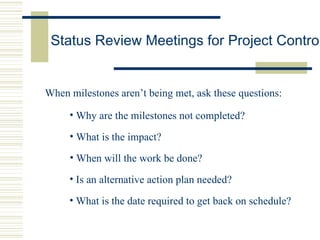
Status Review Meetings for Project Control When milestones aren’t being met, ask these questions: Why are the milestones not completed? What is the impact? When will the work be done? Is an alternative action plan needed? What is the date required to get back on schedule?
Questions ?

Project Management Control

  • 1.
    Project Management ControlPresented by Jeff Harris April 14, 2003 Kennesaw State University BISM 3200
  • 2.
    Agenda Project ManagementOverview Transition steps from project planning to controlling Formal and Informal Control Five-Step Model for Project Control Using Status Reports for Project Control Using Status Review Meetings for Project Control
  • 3.
    Project Management OverviewProject management is a set of principles, methods, tools, and techniques for the effective management of objective-oriented work.   The project management process involves these tasks: • Assembling a project team with the expertise to execute the project • Establishing the technical objectives • Planning the project • Managing changes to the scope • Controlling the undertaking so that it is completed on schedule and within budget
  • 4.
    Transition from Planningto Controlling Validate the project plans – Before issuing the final set of plans, ensure that the plans seem to be reasonable. Things to consider include: is there a deliverable for each task, do the tasks relate to project objectives, does every task have a person assigned, has completion criteria been established for each task.
  • 5.
    Transition from Planningto Controlling Obtain sign-offs and freeze the project plans – Signoff procedures are a very important part of the process. There will be fewer problems if you have involved all the parties during the development of the plan, formatted the plan clearly, set up a formalized approval process, and provided adequate time for approval. A baseline project plan is a prerequisite to controlling a project.
  • 6.
    Transition from Planningto Controlling Resell the benefits of project management – At this point in the project, it’s a good idea to resell the benefits of project management and reassure the team that the project plan will help support them during the upcoming project control process.
  • 7.
    Transition from Planningto Controlling Create a project notebook – A project notebook should be assembled that includes sections detailing project definition, task descriptions, estimates of each task and its background rationale, and status reports.
  • 8.
    Benefits of theProject Plan for Controlling The plan ensures that no major tasks have been forgotten. The plan clearly shows assignments of responsibility, accountability, and authority. The plan becomes the yardstick to measure status and ultimately judge the success or failure of the project. The plan will be used as a monitoring, tracking, and tracking tool which becomes a mechanism for communication and control.
  • 9.
    Informal Project ControlBenefits of Informal Control: You learn a lot more than you do by sitting at your desk You meet people in their habitat You are highly visible You learn of brewing problems
  • 10.
    Formal Project ControlCan be performed by the week, month, or accounting period Primarily involves gathering data to produce status reports Status reports help in dealing with problems
  • 11.
    Five-Step Model forProject Control Step 1. Update the status of the project Status information can be collected by conducting interviews with staff, status review meetings, and team members submitting time reports, time cards, or time logs.
  • 12.
    Five-Step Model forProject Control Step 2. Analyze the impact of possible variances This step is divided into three parts. Part 1 - Compare planned to actual results looking for variances. Questions to ask here include: Are we ahead or behind schedule?Are we over or under budget? Are we using the staff’s time wisely? Are we getting the results that we expected? Part 2 - Determine the cause of any problems. Typical causes of problems include poorly defined objectives, poor estimates, changes in scope, and staff problems. Part 3 - Prepare analysis or forecast reports for future completion dates and staff resource usage.
  • 13.
    Five-Step Model forProject Control Step 3. Act on the problems discovered in the previous step There are three courses of action here: 1) Do nothing. 2) Look at the plan and make modifications to the schedule to solve the problem. 3) Start negotiating tradeoffs – like adding time, additional resources, more money, and resizing the scope of the project.
  • 14.
    Five-Step Model forProject Control Step 4. Publish the revisions to the plan, if any. Since the plan is the document that the project relies on, it should be updated frequently. Even minor changes create a need to publish a revised project plan.
  • 15.
    Five-Step Model forProject Control Step 5. Inform management During the controlling process, its important that management be informed of problems being encountered in the project.
  • 16.
    Using Status Reportsfor Project Control Status reports should contain five sections: 1. Where are we today? 2. Where will we be at the next report? 3. What is our budget position? 4. What items jeopardize project completion? 5. Who deserves recognition?
  • 17.
    Status Review Meetingsfor Project Control When milestones aren’t being met, ask these questions: Why are the milestones not completed? What is the impact? When will the work be done? Is an alternative action plan needed? What is the date required to get back on schedule?
  • 18.