
“PLGA: Biodegradable Polymer”
• Presented By :
Mr. ROHIT GURAV
M. Pharm (1st Sem.)
Roll no. 511
• Guided By:
Prof. V. M. GAMBHIRE
M. Pharm
Department of Pharmaceutics
RohitGurav*
Introduction
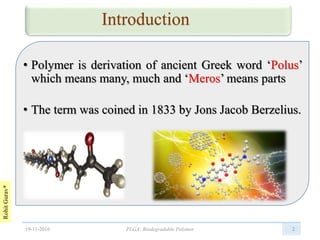
• Polymer is derivation of ancient Greek word ‘Polus’
which means many, much and ‘Meros’ means parts
• The term was coined in 1833 by Jons Jacob Berzelius.
219-11-2016 PLGA: Biodegradable Polymer
RohitGurav*
Biodegradable Polymer
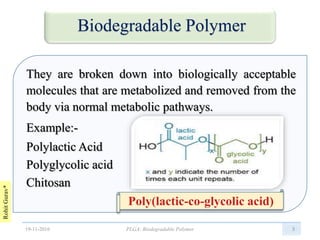
They are broken down into biologically acceptable
molecules that are metabolized and removed from the
body via normal metabolic pathways.
Example:-
Polylactic Acid
Polyglycolic acid
Chitosan
319-11-2016 PLGA: Biodegradable Polymer
RohitGurav*
4
Poly(lactic-co-glycolic-acid))
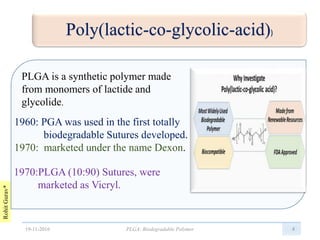
PLGA is a synthetic polymer made
from monomers of lactide and
glycolide.
1960: PGA was used in the first totally
biodegradable Sutures developed.
1970: marketed under the name Dexon.
1970:PLGA (10:90) Sutures, were
marketed as Vicryl.
19-11-2016 PLGA: Biodegradable Polymer
RohitGurav*
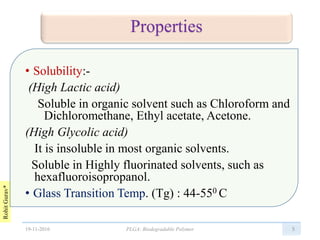
• Solubility:-
(High Lactic acid)
Soluble in organic solvent such as Chloroform and
Dichloromethane, Ethyl acetate, Acetone.
(High Glycolic acid)
It is insoluble in most organic solvents.
Soluble in Highly fluorinated solvents, such as
hexafluoroisopropanol.
• Glass Transition Temp. (Tg) : 44-550 C
5
Properties
19-11-2016 PLGA: Biodegradable Polymer
RohitGurav*
6
tin (II) 2-ethylhexanote,
tin (II) alkoxides
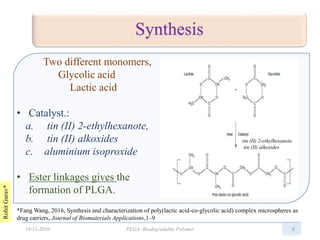
Two different monomers,
Glycolic acid
Lactic acid
• Catalyst.:
a. tin (II) 2-ethylhexanote,
b. tin (II) alkoxides
c. aluminium isoproxide
• Ester linkages gives the
formation of PLGA.
Synthesis
19-11-2016 PLGA: Biodegradable Polymer
*Fang Wang, 2016, Synthesis and characterization of poly(lactic acid-co-glycolic acid) complex microspheres as
drug carriers, Journal of Biomaterials Applications,1–9
RohitGurav*
7
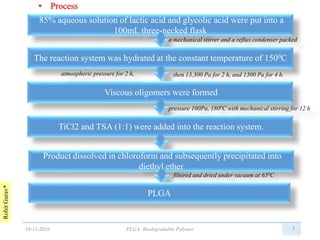
85% aqueous solution of lactic acid and glycolic acid were put into a
100mL three-necked flask
The reaction system was hydrated at the constant temperature of 1500C
Viscous oligomers were formed
a mechanical stirrer and a reflux condenser packed
then 13,300 Pa for 2 h, and 1300 Pa for 4 h.atmospheric pressure for 2 h,
TiCl2 and TSA (1:1) were added into the reaction system.
pressure 100Pa, 1800C with mechanical stirring for 12 h
Product dissolved in chloroform and subsequently precipitated into
diethyl ether
filtered and dried under vacuum at 650C
PLGA
19-11-2016 PLGA: Biodegradable Polymer
• Process
RohitGurav*
8
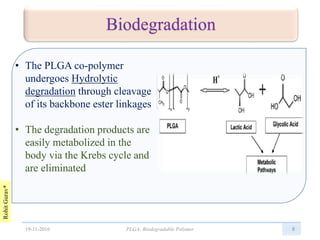
• The PLGA co-polymer
undergoes Hydrolytic
degradation through cleavage
of its backbone ester linkages
• The degradation products are
easily metabolized in the
body via the Krebs cycle and
are eliminated
Biodegradation
19-11-2016 PLGA: Biodegradable Polymer
RohitGurav*
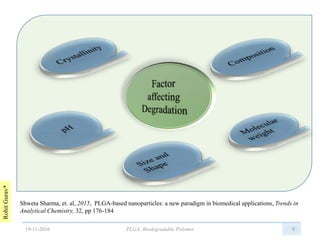
919-11-2016 PLGA: Biodegradable Polymer
Shweta Sharma, et. al, 2015, PLGA-based nanoparticles: a new paradigm in biomedical applications, Trends in
Analytical Chemistry, 32, pp 176-184
RohitGurav*
10
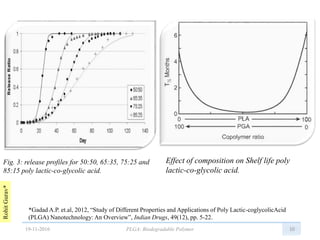
Fig. 3: release profiles for 50:50, 65:35, 75:25 and
85:15 poly lactic-co-glycolic acid.
Effect of composition on Shelf life poly
lactic-co-glycolic acid.
*Gadad A.P. et.al, 2012, “Study of Different Properties and Applications of Poly Lactic-coglycolicAcid
(PLGA) Nanotechnology: An Overview”, Indian Drugs, 49(12), pp. 5-22.
19-11-2016 PLGA: Biodegradable Polymer
RohitGurav*
11
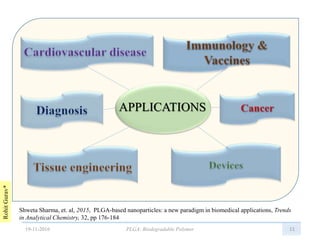
APPLICATIONS
19-11-2016 PLGA: Biodegradable Polymer
Shweta Sharma, et. al, 2015, PLGA-based nanoparticles: a new paradigm in biomedical applications, Trends
in Analytical Chemistry, 32, pp 176-184
RohitGurav*
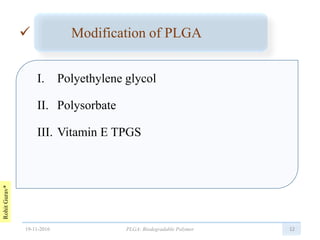
 Modification of PLGA
I. Polyethylene glycol
II. Polysorbate
III. Vitamin E TPGS
1219-11-2016 PLGA: Biodegradable Polymer
RohitGurav*
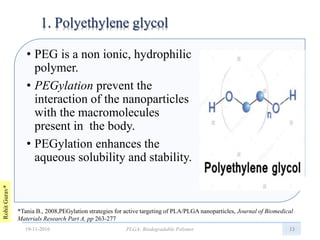
• PEG is a non ionic, hydrophilic
polymer.
• PEGylation prevent the
interaction of the nanoparticles
with the macromolecules
present in the body.
• PEGylation enhances the
aqueous solubility and stability.
13
1. Polyethylene glycol
*Tania B., 2008,PEGylation strategies for active targeting of PLA/PLGA nanoparticles, Journal of Biomedical
Materials Research Part A, pp 263-277
19-11-2016 PLGA: Biodegradable Polymer
RohitGurav*
14
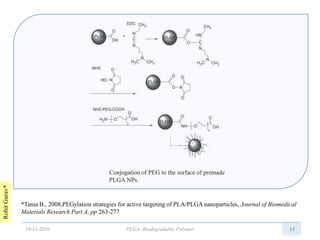
Conjugation of PEG to the surface of premade
PLGA NPs.
*Tania B., 2008,PEGylation strategies for active targeting of PLA/PLGA nanoparticles, Journal of Biomedical
Materials Research Part A, pp 263-277
19-11-2016 PLGA: Biodegradable Polymer
RohitGurav*
2. Polysorbate
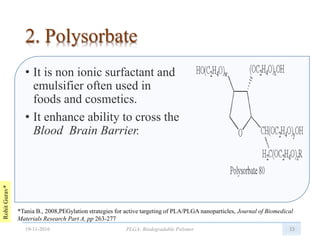
• It is non ionic surfactant and
emulsifier often used in
foods and cosmetics.
• It enhance ability to cross the
Blood Brain Barrier.
15
*Tania B., 2008,PEGylation strategies for active targeting of PLA/PLGA nanoparticles, Journal of Biomedical
Materials Research Part A, pp 263-277
19-11-2016 PLGA: Biodegradable Polymer
RohitGurav*
3. Vitamin E TPGS
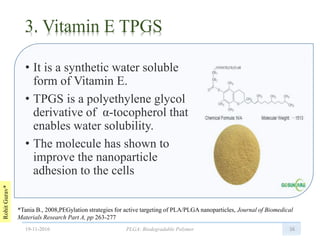
• It is a synthetic water soluble
form of Vitamin E.
• TPGS is a polyethylene glycol
derivative of α-tocopherol that
enables water solubility.
• The molecule has shown to
improve the nanoparticle
adhesion to the cells
16
*Tania B., 2008,PEGylation strategies for active targeting of PLA/PLGA nanoparticles, Journal of Biomedical
Materials Research Part A, pp 263-277
19-11-2016 PLGA: Biodegradable Polymer
RohitGurav*
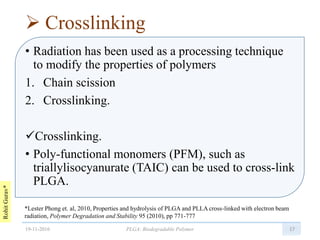
 Crosslinking
• Radiation has been used as a processing technique
to modify the properties of polymers
1. Chain scission
2. Crosslinking.
Crosslinking.
• Poly-functional monomers (PFM), such as
triallylisocyanurate (TAIC) can be used to cross-link
PLGA.
1719-11-2016 PLGA: Biodegradable Polymer
*Lester Phong et. al, 2010, Properties and hydrolysis of PLGA and PLLA cross-linked with electron beam
radiation, Polymer Degradation and Stability 95 (2010), pp 771-777
RohitGurav*
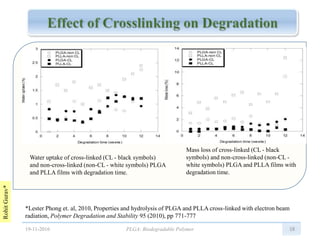
18
Water uptake of cross-linked (CL - black symbols)
and non-cross-linked (non-CL - white symbols) PLGA
and PLLA films with degradation time.
Mass loss of cross-linked (CL - black
symbols) and non-cross-linked (non-CL -
white symbols) PLGA and PLLA films with
degradation time.
*Lester Phong et. al, 2010, Properties and hydrolysis of PLGA and PLLA cross-linked with electron beam
radiation, Polymer Degradation and Stability 95 (2010), pp 771-777
19-11-2016 PLGA: Biodegradable Polymer
RohitGurav*
19
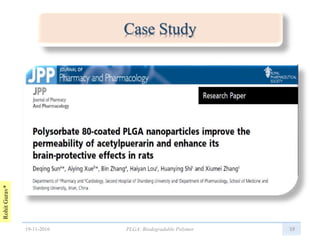
Case Study
19-11-2016 PLGA: Biodegradable Polymer
RohitGurav*
Materials
• Puerarin (NIFDC, Beijing, China).
• Acetylpuerarin (Shandong Academy Jinan,China)
• PLGA 50:50, (JDB Co., Ltd. (Jinan, China).
• Polysorbate 80 (SCR Co., Ltd. ,Shanghai, China).
2019-11-2016 PLGA: Biodegradable Polymer
RohitGurav*
21
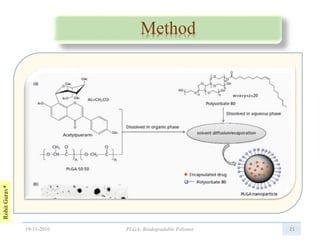
Method
19-11-2016 PLGA: Biodegradable Polymer
RohitGurav*
22
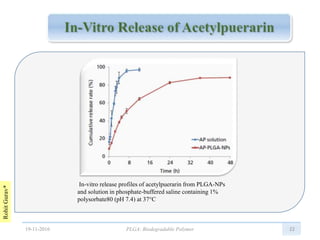
In-vitro release profiles of acetylpuerarin from PLGA-NPs
and solution in phosphate-buffered saline containing 1%
polysorbate80 (pH 7.4) at 37°C
19-11-2016 PLGA: Biodegradable Polymer
RohitGurav*
23
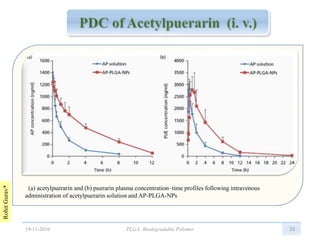
(a) acetylpuerarin and (b) puerarin plasma concentration–time profiles following intravenous
administration of acetylpuerarin solution and AP-PLGA-NPs
19-11-2016 PLGA: Biodegradable Polymer
RohitGurav*
24
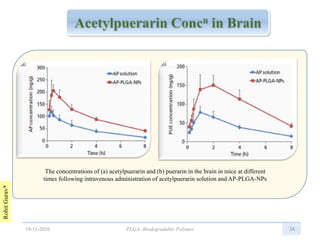
The concentrations of (a) acetylpuerarin and (b) puerarin in the brain in mice at different
times following intravenous administration of acetylpuerarin solution and AP-PLGA-NPs
19-11-2016 PLGA: Biodegradable Polymer
RohitGurav*
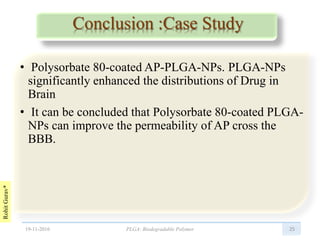
Conclusion :Case Study
• Polysorbate 80-coated AP-PLGA-NPs. PLGA-NPs
significantly enhanced the distributions of Drug in
Brain
• It can be concluded that Polysorbate 80-coated PLGA-
NPs can improve the permeability of AP cross the
BBB.
2519-11-2016 PLGA: Biodegradable Polymer
RohitGurav*
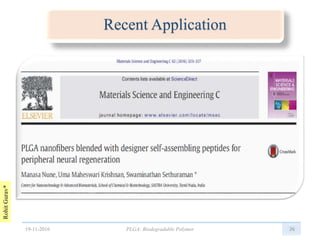
Recent Application
2619-11-2016 PLGA: Biodegradable Polymer
RohitGurav*
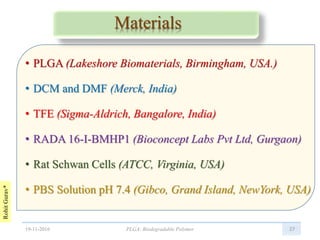
Materials
• PLGA (Lakeshore Biomaterials, Birmingham, USA.)
• DCM and DMF (Merck, India)
• TFE (Sigma-Aldrich, Bangalore, India)
• RADA 16-I-BMHP1 (Bioconcept Labs Pvt Ltd, Gurgaon)
• Rat Schwan Cells (ATCC, Virginia, USA)
• PBS Solution pH 7.4 (Gibco, Grand Island, NewYork, USA)
2719-11-2016 PLGA: Biodegradable Polymer
RohitGurav*
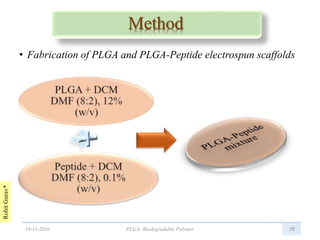
Method
• Fabrication of PLGA and PLGA-Peptide electrospun scaffolds
2819-11-2016 PLGA: Biodegradable Polymer
RohitGurav*
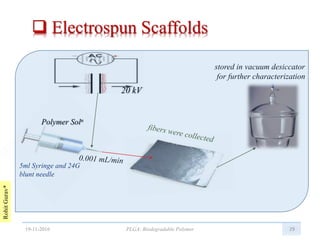
 Electrospun Scaffolds
29
Polymer Soln
20 kV
5ml Syringe and 24G
blunt needle
stored in vacuum desiccator
for further characterization
19-11-2016 PLGA: Biodegradable Polymer
RohitGurav*
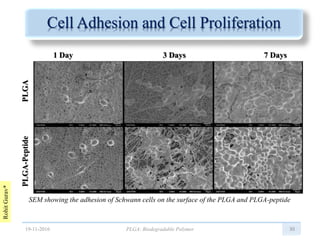
Cell Adhesion and Cell Proliferation
30
SEM showing the adhesion of Schwann cells on the surface of the PLGA and PLGA-peptide
PLGA-PeptidePLGA
1 Day 3 Days 7 Days
19-11-2016 PLGA: Biodegradable Polymer
RohitGurav*
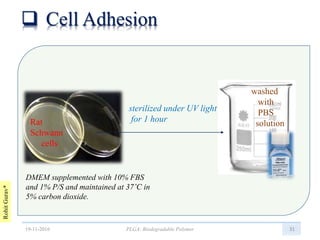
 Cell Adhesion
31
DMEM supplemented with 10% FBS
and 1% P/S and maintained at 37˚C in
5% carbon dioxide.
Rat
Schwann
cells
sterilized under UV light
for 1 hour
washed
with
PBS
solution
19-11-2016 PLGA: Biodegradable Polymer
RohitGurav*
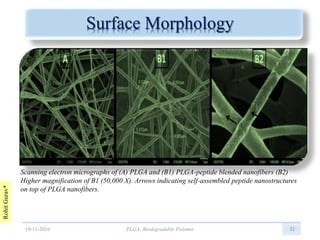
Scanning electron micrographs of (A) PLGA and (B1) PLGA-peptide blended nanofibers (B2)
Higher magnification of B1 (50,000 X). Arrows indicating self-assembled peptide nanostructures
on top of PLGA nanofibers.
32
Surface Morphology
19-11-2016 PLGA: Biodegradable Polymer
RohitGurav*
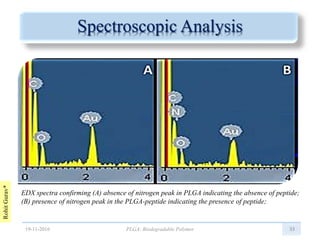
Spectroscopic Analysis
33
EDX spectra confirming (A) absence of nitrogen peak in PLGA indicating the absence of peptide;
(B) presence of nitrogen peak in the PLGA-peptide indicating the presence of peptide;
19-11-2016 PLGA: Biodegradable Polymer
RohitGurav*
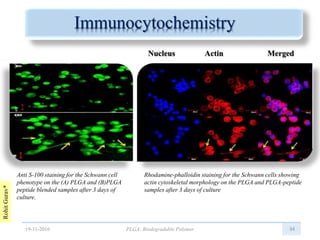
Immunocytochemistry
34
Rhodamine-phalloidin staining for the Schwann cells showing
actin cytoskeletal morphology on the PLGA and PLGA-peptide
samples after 3 days of culture
Anti S-100 staining for the Schwann cell
phenotype on the (A) PLGA and (B)PLGA
peptide blended samples after 3 days of
culture.
Nucleus Actin Merged
19-11-2016 PLGA: Biodegradable Polymer
RohitGurav*
Conclusion
• Novel hybrid scaffolds made up of PLGA and the self-
assembling peptide, RADA16-IBMHP1 were successfully
fabricated by electrospinning.
• Schwann cell extension and spreading was significantly
improved in the peptide blended scaffolds when compared to
the PLGA scaffolds.
• Our results indicate that the designed composite of
PLGA+RADA16-I-BMHP1 blended nanofibrous scaffold
would pave way for successful and functionary recovery in
peripheral nerve tissue engineering applications
3519-11-2016 PLGA: Biodegradable Polymer
RohitGurav*
Conclusion
• PLGA polymers have been shown to be excellent
delivery carriers for controlled administration of drugs,
peptides and proteins due to their biocompatibility and
biodegradability.
• These polymers are increasingly becoming feasible
candidates for drug delivery systems, anticancer agents
and vaccine immunotherapy.
• Modified PLGA helps to enhanced the permeability of
Drugs.
3619-11-2016 PLGA: Biodegradable Polymer
RohitGurav*
References
• Gadad A.P. et.al, 2012, “Study of Different Properties and
Applications of Poly Lactic-coglycolicAcid (PLGA)
Nanotechnology: An Overview”, Indian Drugs, 49(12), pp. 5-22.
• Kumar A et.al, “Biodegradable Polymers and Its Applications”
International Journal of Bioscience, 2011, vol.1, no.3, pp. 173-
176.
• Leja K and Lewandowicz G., 2010, “Polymer Biodegradation and
Biodegradable Polymers – a Review”, Polish J. of Environ. Stud.,
vol. 19, no.2, pp. 255-266.
• Nune M et. Al, 2016, “PLGA nanofibers blended with designer
self-assembling peptides for peripheral neural regeneration”
Materials Science and Engineering C, 62, pp. 329–337.
19-11-2016 PLGA: Biodegradable Polymer
RohitGurav*
• Yanbin Suna,et.al, 2014, Enhanced antitumor efficacy of vitamin E
TPGS-emulsified PLGA nanoparticles for delivery of paclitaxel
Colloids and Surfaces B: Biointerfaces 123 716–723
• Deqing Suna et. al, 2015, Polysorbate 80-coated PLGA
nanoparticles improve the permeability of acetylpuerarin and
enhance its brain-protective effects in rats, Journal of Pharmacy
And Pharmacology, 67, pp. 1650–1662
• Fang Wang, 2016, Synthesis and characterization of poly(lactic
acid-co-glycolic acid) complex microspheres as drug carriers,
Journal of Biomaterials Applications,1–9
• Lester Phong et. al, 2010, Properties and hydrolysis of PLGA and
PLLA cross-linked with electron beam radiation, Polymer
Degradation and Stability 95 , pp 771-777
• Tania Betancourt, 2008,PEGylation strategies for active targeting of
PLA/PLGA nanoparticles, Journal of Biomedical Materials
Research Part A, pp 263-277
3819-11-2016 PLGA: Biodegradable Polymer
RohitGurav*
• Shweta Sharma, et. al, 2015, PLGA-based nanoparticles: a
new paradigm in biomedical applications, Trends in Analytical
Chemistry, 32, pp 176-184
• Zhang K, et. al, 2014, “PEG–PLGA copolymers: Their
structure and structure-influenced drug delivery applications”,
Journal of Controlled Release, vol. 183, pp. 77–86
• Zhiqiang L., 2016, A novel and simple preparative method for
uniform-sized PLGA microspheres: Preliminary application in
antitubercular drug delivery, Colloids and Surfaces B:
Biointerfaces 145, pp 679–687
3919-11-2016 PLGA: Biodegradable Polymer
RohitGurav*
4019-11-2016 PLGA: Biodegradable Polymer

PLGA: an biodegradable polymer

  • 1.
    “PLGA: Biodegradable Polymer” •Presented By : Mr. ROHIT GURAV M. Pharm (1st Sem.) Roll no. 511 • Guided By: Prof. V. M. GAMBHIRE M. Pharm Department of Pharmaceutics
  • 2.
    RohitGurav* Introduction • Polymer isderivation of ancient Greek word ‘Polus’ which means many, much and ‘Meros’ means parts • The term was coined in 1833 by Jons Jacob Berzelius. 219-11-2016 PLGA: Biodegradable Polymer
  • 3.
    RohitGurav* Biodegradable Polymer They arebroken down into biologically acceptable molecules that are metabolized and removed from the body via normal metabolic pathways. Example:- Polylactic Acid Polyglycolic acid Chitosan 319-11-2016 PLGA: Biodegradable Polymer
  • 4.
    RohitGurav* 4 Poly(lactic-co-glycolic-acid)) PLGA is asynthetic polymer made from monomers of lactide and glycolide. 1960: PGA was used in the first totally biodegradable Sutures developed. 1970: marketed under the name Dexon. 1970:PLGA (10:90) Sutures, were marketed as Vicryl. 19-11-2016 PLGA: Biodegradable Polymer
  • 5.
    RohitGurav* • Solubility:- (High Lacticacid) Soluble in organic solvent such as Chloroform and Dichloromethane, Ethyl acetate, Acetone. (High Glycolic acid) It is insoluble in most organic solvents. Soluble in Highly fluorinated solvents, such as hexafluoroisopropanol. • Glass Transition Temp. (Tg) : 44-550 C 5 Properties 19-11-2016 PLGA: Biodegradable Polymer
  • 6.
    RohitGurav* 6 tin (II) 2-ethylhexanote, tin(II) alkoxides Two different monomers, Glycolic acid Lactic acid • Catalyst.: a. tin (II) 2-ethylhexanote, b. tin (II) alkoxides c. aluminium isoproxide • Ester linkages gives the formation of PLGA. Synthesis 19-11-2016 PLGA: Biodegradable Polymer *Fang Wang, 2016, Synthesis and characterization of poly(lactic acid-co-glycolic acid) complex microspheres as drug carriers, Journal of Biomaterials Applications,1–9
  • 7.
    RohitGurav* 7 85% aqueous solutionof lactic acid and glycolic acid were put into a 100mL three-necked flask The reaction system was hydrated at the constant temperature of 1500C Viscous oligomers were formed a mechanical stirrer and a reflux condenser packed then 13,300 Pa for 2 h, and 1300 Pa for 4 h.atmospheric pressure for 2 h, TiCl2 and TSA (1:1) were added into the reaction system. pressure 100Pa, 1800C with mechanical stirring for 12 h Product dissolved in chloroform and subsequently precipitated into diethyl ether filtered and dried under vacuum at 650C PLGA 19-11-2016 PLGA: Biodegradable Polymer • Process
  • 8.
    RohitGurav* 8 • The PLGAco-polymer undergoes Hydrolytic degradation through cleavage of its backbone ester linkages • The degradation products are easily metabolized in the body via the Krebs cycle and are eliminated Biodegradation 19-11-2016 PLGA: Biodegradable Polymer
  • 9.
    RohitGurav* 919-11-2016 PLGA: BiodegradablePolymer Shweta Sharma, et. al, 2015, PLGA-based nanoparticles: a new paradigm in biomedical applications, Trends in Analytical Chemistry, 32, pp 176-184
  • 10.
    RohitGurav* 10 Fig. 3: releaseprofiles for 50:50, 65:35, 75:25 and 85:15 poly lactic-co-glycolic acid. Effect of composition on Shelf life poly lactic-co-glycolic acid. *Gadad A.P. et.al, 2012, “Study of Different Properties and Applications of Poly Lactic-coglycolicAcid (PLGA) Nanotechnology: An Overview”, Indian Drugs, 49(12), pp. 5-22. 19-11-2016 PLGA: Biodegradable Polymer
  • 11.
    RohitGurav* 11 APPLICATIONS 19-11-2016 PLGA: BiodegradablePolymer Shweta Sharma, et. al, 2015, PLGA-based nanoparticles: a new paradigm in biomedical applications, Trends in Analytical Chemistry, 32, pp 176-184
  • 12.
    RohitGurav*  Modification ofPLGA I. Polyethylene glycol II. Polysorbate III. Vitamin E TPGS 1219-11-2016 PLGA: Biodegradable Polymer
  • 13.
    RohitGurav* • PEG isa non ionic, hydrophilic polymer. • PEGylation prevent the interaction of the nanoparticles with the macromolecules present in the body. • PEGylation enhances the aqueous solubility and stability. 13 1. Polyethylene glycol *Tania B., 2008,PEGylation strategies for active targeting of PLA/PLGA nanoparticles, Journal of Biomedical Materials Research Part A, pp 263-277 19-11-2016 PLGA: Biodegradable Polymer
  • 14.
    RohitGurav* 14 Conjugation of PEGto the surface of premade PLGA NPs. *Tania B., 2008,PEGylation strategies for active targeting of PLA/PLGA nanoparticles, Journal of Biomedical Materials Research Part A, pp 263-277 19-11-2016 PLGA: Biodegradable Polymer
  • 15.
    RohitGurav* 2. Polysorbate • Itis non ionic surfactant and emulsifier often used in foods and cosmetics. • It enhance ability to cross the Blood Brain Barrier. 15 *Tania B., 2008,PEGylation strategies for active targeting of PLA/PLGA nanoparticles, Journal of Biomedical Materials Research Part A, pp 263-277 19-11-2016 PLGA: Biodegradable Polymer
  • 16.
    RohitGurav* 3. Vitamin ETPGS • It is a synthetic water soluble form of Vitamin E. • TPGS is a polyethylene glycol derivative of α-tocopherol that enables water solubility. • The molecule has shown to improve the nanoparticle adhesion to the cells 16 *Tania B., 2008,PEGylation strategies for active targeting of PLA/PLGA nanoparticles, Journal of Biomedical Materials Research Part A, pp 263-277 19-11-2016 PLGA: Biodegradable Polymer
  • 17.
    RohitGurav*  Crosslinking • Radiationhas been used as a processing technique to modify the properties of polymers 1. Chain scission 2. Crosslinking. Crosslinking. • Poly-functional monomers (PFM), such as triallylisocyanurate (TAIC) can be used to cross-link PLGA. 1719-11-2016 PLGA: Biodegradable Polymer *Lester Phong et. al, 2010, Properties and hydrolysis of PLGA and PLLA cross-linked with electron beam radiation, Polymer Degradation and Stability 95 (2010), pp 771-777
  • 18.
    RohitGurav* 18 Water uptake ofcross-linked (CL - black symbols) and non-cross-linked (non-CL - white symbols) PLGA and PLLA films with degradation time. Mass loss of cross-linked (CL - black symbols) and non-cross-linked (non-CL - white symbols) PLGA and PLLA films with degradation time. *Lester Phong et. al, 2010, Properties and hydrolysis of PLGA and PLLA cross-linked with electron beam radiation, Polymer Degradation and Stability 95 (2010), pp 771-777 19-11-2016 PLGA: Biodegradable Polymer
  • 19.
  • 20.
    RohitGurav* Materials • Puerarin (NIFDC,Beijing, China). • Acetylpuerarin (Shandong Academy Jinan,China) • PLGA 50:50, (JDB Co., Ltd. (Jinan, China). • Polysorbate 80 (SCR Co., Ltd. ,Shanghai, China). 2019-11-2016 PLGA: Biodegradable Polymer
  • 21.
  • 22.
    RohitGurav* 22 In-vitro release profilesof acetylpuerarin from PLGA-NPs and solution in phosphate-buffered saline containing 1% polysorbate80 (pH 7.4) at 37°C 19-11-2016 PLGA: Biodegradable Polymer
  • 23.
    RohitGurav* 23 (a) acetylpuerarin and(b) puerarin plasma concentration–time profiles following intravenous administration of acetylpuerarin solution and AP-PLGA-NPs 19-11-2016 PLGA: Biodegradable Polymer
  • 24.
    RohitGurav* 24 The concentrations of(a) acetylpuerarin and (b) puerarin in the brain in mice at different times following intravenous administration of acetylpuerarin solution and AP-PLGA-NPs 19-11-2016 PLGA: Biodegradable Polymer
  • 25.
    RohitGurav* Conclusion :Case Study •Polysorbate 80-coated AP-PLGA-NPs. PLGA-NPs significantly enhanced the distributions of Drug in Brain • It can be concluded that Polysorbate 80-coated PLGA- NPs can improve the permeability of AP cross the BBB. 2519-11-2016 PLGA: Biodegradable Polymer
  • 26.
  • 27.
    RohitGurav* Materials • PLGA (LakeshoreBiomaterials, Birmingham, USA.) • DCM and DMF (Merck, India) • TFE (Sigma-Aldrich, Bangalore, India) • RADA 16-I-BMHP1 (Bioconcept Labs Pvt Ltd, Gurgaon) • Rat Schwan Cells (ATCC, Virginia, USA) • PBS Solution pH 7.4 (Gibco, Grand Island, NewYork, USA) 2719-11-2016 PLGA: Biodegradable Polymer
  • 28.
    RohitGurav* Method • Fabrication ofPLGA and PLGA-Peptide electrospun scaffolds 2819-11-2016 PLGA: Biodegradable Polymer
  • 29.
    RohitGurav*  Electrospun Scaffolds 29 PolymerSoln 20 kV 5ml Syringe and 24G blunt needle stored in vacuum desiccator for further characterization 19-11-2016 PLGA: Biodegradable Polymer
  • 30.
    RohitGurav* Cell Adhesion andCell Proliferation 30 SEM showing the adhesion of Schwann cells on the surface of the PLGA and PLGA-peptide PLGA-PeptidePLGA 1 Day 3 Days 7 Days 19-11-2016 PLGA: Biodegradable Polymer
  • 31.
    RohitGurav*  Cell Adhesion 31 DMEMsupplemented with 10% FBS and 1% P/S and maintained at 37˚C in 5% carbon dioxide. Rat Schwann cells sterilized under UV light for 1 hour washed with PBS solution 19-11-2016 PLGA: Biodegradable Polymer
  • 32.
    RohitGurav* Scanning electron micrographsof (A) PLGA and (B1) PLGA-peptide blended nanofibers (B2) Higher magnification of B1 (50,000 X). Arrows indicating self-assembled peptide nanostructures on top of PLGA nanofibers. 32 Surface Morphology 19-11-2016 PLGA: Biodegradable Polymer
  • 33.
    RohitGurav* Spectroscopic Analysis 33 EDX spectraconfirming (A) absence of nitrogen peak in PLGA indicating the absence of peptide; (B) presence of nitrogen peak in the PLGA-peptide indicating the presence of peptide; 19-11-2016 PLGA: Biodegradable Polymer
  • 34.
    RohitGurav* Immunocytochemistry 34 Rhodamine-phalloidin staining forthe Schwann cells showing actin cytoskeletal morphology on the PLGA and PLGA-peptide samples after 3 days of culture Anti S-100 staining for the Schwann cell phenotype on the (A) PLGA and (B)PLGA peptide blended samples after 3 days of culture. Nucleus Actin Merged 19-11-2016 PLGA: Biodegradable Polymer
  • 35.
    RohitGurav* Conclusion • Novel hybridscaffolds made up of PLGA and the self- assembling peptide, RADA16-IBMHP1 were successfully fabricated by electrospinning. • Schwann cell extension and spreading was significantly improved in the peptide blended scaffolds when compared to the PLGA scaffolds. • Our results indicate that the designed composite of PLGA+RADA16-I-BMHP1 blended nanofibrous scaffold would pave way for successful and functionary recovery in peripheral nerve tissue engineering applications 3519-11-2016 PLGA: Biodegradable Polymer
  • 36.
    RohitGurav* Conclusion • PLGA polymershave been shown to be excellent delivery carriers for controlled administration of drugs, peptides and proteins due to their biocompatibility and biodegradability. • These polymers are increasingly becoming feasible candidates for drug delivery systems, anticancer agents and vaccine immunotherapy. • Modified PLGA helps to enhanced the permeability of Drugs. 3619-11-2016 PLGA: Biodegradable Polymer
  • 37.
    RohitGurav* References • Gadad A.P.et.al, 2012, “Study of Different Properties and Applications of Poly Lactic-coglycolicAcid (PLGA) Nanotechnology: An Overview”, Indian Drugs, 49(12), pp. 5-22. • Kumar A et.al, “Biodegradable Polymers and Its Applications” International Journal of Bioscience, 2011, vol.1, no.3, pp. 173- 176. • Leja K and Lewandowicz G., 2010, “Polymer Biodegradation and Biodegradable Polymers – a Review”, Polish J. of Environ. Stud., vol. 19, no.2, pp. 255-266. • Nune M et. Al, 2016, “PLGA nanofibers blended with designer self-assembling peptides for peripheral neural regeneration” Materials Science and Engineering C, 62, pp. 329–337. 19-11-2016 PLGA: Biodegradable Polymer
  • 38.
    RohitGurav* • Yanbin Suna,et.al,2014, Enhanced antitumor efficacy of vitamin E TPGS-emulsified PLGA nanoparticles for delivery of paclitaxel Colloids and Surfaces B: Biointerfaces 123 716–723 • Deqing Suna et. al, 2015, Polysorbate 80-coated PLGA nanoparticles improve the permeability of acetylpuerarin and enhance its brain-protective effects in rats, Journal of Pharmacy And Pharmacology, 67, pp. 1650–1662 • Fang Wang, 2016, Synthesis and characterization of poly(lactic acid-co-glycolic acid) complex microspheres as drug carriers, Journal of Biomaterials Applications,1–9 • Lester Phong et. al, 2010, Properties and hydrolysis of PLGA and PLLA cross-linked with electron beam radiation, Polymer Degradation and Stability 95 , pp 771-777 • Tania Betancourt, 2008,PEGylation strategies for active targeting of PLA/PLGA nanoparticles, Journal of Biomedical Materials Research Part A, pp 263-277 3819-11-2016 PLGA: Biodegradable Polymer
  • 39.
    RohitGurav* • Shweta Sharma,et. al, 2015, PLGA-based nanoparticles: a new paradigm in biomedical applications, Trends in Analytical Chemistry, 32, pp 176-184 • Zhang K, et. al, 2014, “PEG–PLGA copolymers: Their structure and structure-influenced drug delivery applications”, Journal of Controlled Release, vol. 183, pp. 77–86 • Zhiqiang L., 2016, A novel and simple preparative method for uniform-sized PLGA microspheres: Preliminary application in antitubercular drug delivery, Colloids and Surfaces B: Biointerfaces 145, pp 679–687 3919-11-2016 PLGA: Biodegradable Polymer
  • 40.