Biodegradable
carrier
PLGA
Poly Lactic-co-Glycolic Acid
1
2
Biodegradable Polymers
are natural or synthetic
in origin and
are degraded in vivo, either
enzymatically or non-
enzymatically or both .
not an intrinsic
property of a material,
drug-
polymer-tissue interactions
Synthetic biodegradable polymers
Hydroxy acids (a family that includes polylactic-
co-glycolic acid, PLGA), polyanhydrides
Naturally occurring polymers
such as complex sugars (hyaluronan, chitosan)
and inorganics (hydroxyapatite)
3
poly
lactic-co-glycolic acid (PLGA)
FDA-approved
biodegradable polymers
delivery
vehicles drugs proteins
DNA,RNA and peptides
4
PLGA
popular
tune the overall
physical properties
controlling the
relevant parameters to achieve a
desired dosage.
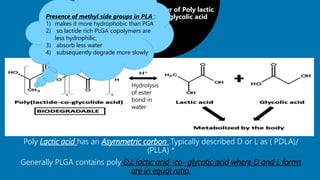
PLGA is a Copolymer of Poly lactic
acid (PLA) + poly glycolic acid
(PGA)
Poly Lactic acid has an Asymmetric carbon .Typically described D or L as ( PDLA)/
(PLLA) *
Generally PLGA contains poly D,L lactic acid -co- glycotic acid where D and L forms
are in equal ratio.
!
Hydrolysis
of ester
bond in
water
Presence of methyl side groups in PLA :
1) makes it more hydrophobic than PGA
2) so lactide rich PLGA copolymers are
less hydrophilic,
3) absorb less water
4) subsequently degrade more slowly
PC Ps
6
PLGA
is soluble in wide range
of common solvents
including chlorinated
solvents,
tetrahydofuran,
acetone or ethyl
acetate
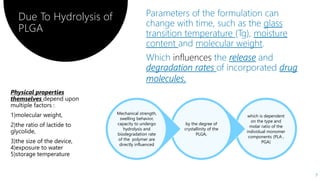
influences
Due To Hydrolysis of
PLGA
which is dependent
on the type and
molar ratio of the
individual monomer
components (PLA ,
PGA)
by the degree of
crystallinity of the
PLGA,
Mechanical strength,
swelling behavior,
capacity to undergo
hydrolysis and
biodegradation rate
of the polymer are
directly influenced
7
Degree of crystallinity and
melting point of the polymers
are directly related to the
molecular weight of the
polymer
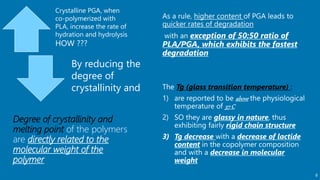
Crystalline PGA, when
co-polymerized with
PLA, increase the rate of
hydration and hydrolysis
HOW ???
By reducing the
degree of
crystallinity and Tg (glass transition temperature) :
8
9
Pharmacokinetics
and Bio-distribution
Profile
Therefore, design
essentials must
incorporate
mechanisms of
degradation and
clearance of the vehicle
as well as active
pharmaceutical
ingredients (API)
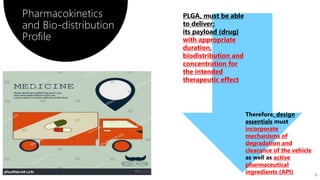
PLGA, must be able
to deliver:
its payload (drug)
with appropriate
duration,
biodistribution and
concentration for
the intended
therapeutic effect
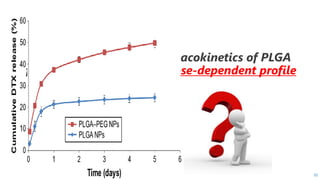
“Biodistribution and pharmacokinetics of PLGA
follows a non-linear and dose-dependent profile
!!!!!!!!
10
FACT
Experiments indicate
that some
formulations of PLGA
accumulate rapidly in
• liver
• Peritoneal
macrophage
• Bone marrow
• Lymph nodes ,
spleen
• spleen
12
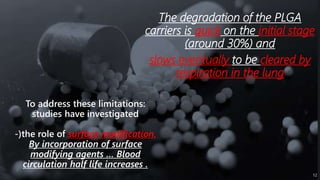
To address these limitations:
studies have investigated
-)the role of surface modification,
By incorporation of surface
modifying agents … Blood
circulation half life increases .
The degradation of the PLGA
carriers is quick on the initial stage
(around 30%) and
slows eventually to be cleared by
respiration in the lung
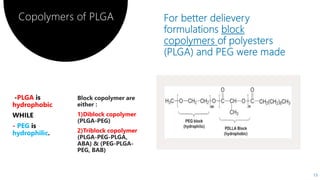
PLGA
hydrophobic
- PEG
hydrophilic
Copolymers of PLGA
Block copolymer are
either :
1)Diblock copolymer
(PLGA-PEG)
2)Triblock copolymer
(PLGA-PEG-PLGA,
ABA) & (PEG-PLGA-
PEG, BAB)
13
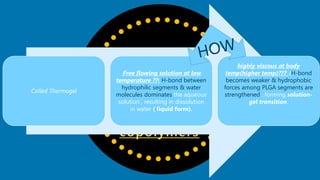
Before continuing
What is
temperature
responsive
copolymers
Called Thermogel
Free flowing solution at low
temperature ??( H-bond between
hydrophilic segments & water
molecules dominates the aqueous
solution , resulting in dissolution
in water ( liquid form).
highly viscous at body
temp(higher temp)??? .(H-bond
becomes weaker & hydrophobic
forces among PLGA segments are
strengthened , forming solution-
gel transition.
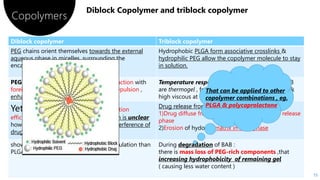
Diblock copolymer Triblock copolymer
PEG chains orient themselves towards the external
aqueous phase in micelles ,surrounding the
encapsulated species
Hydrophobic PLGA form associative crosslinks &
hydrophilic PEG allow the copolymer molecule to stay
in solution.
PEG layer act as barrier , reducing interaction with
foreign molecules by steric & hydrated repulsion ,
enhancing shelf stability
Temperature responsive copolymers . ABA & BAB
are thermogel , free flowing solution at low temp. &
high viscous at body temp .
Yet , addition of PEG reduces encapsulation
efficiency for drugs. The exact mechanism is unclear
however that could be because steric interference of
drug-polymer interaction by PEG chains.
Drug release from both ABA & BAB by 2 mech. :
1)Drug diffuse from hydrogel during the initial release
phase
2)Erosion of hydogel matrix in later phase
shows better release kinetics from formulation than
PLGA alone
During degradation of BAB :
there is mass loss of PEG-rich components ,that
increasing hydrophobicity of remaining gel
( causing less water content )
Copolymers
15
That can be applied to other
copolymer combinations , eg.
PLGA & polycaprolactone
“To Sum up
1) What are the types of polymers
2) What is PLGA
3) What does the methyl grp in PLA Does
4) What happen to the formulation parameters due to hydrolysis of PLGA
5) What do the physical properties depend on
6) higher content of PGA leads to
7) PK And BD of PLGA follows what profile
8) PLGA Accumulate in
9) What is the role of surface modification
10) What are the types of copolymers
11) Compare between bi/triblock copolymers
16
Neal Creative | click & Learn moreNeal Creative ©
THANK YOU

PLGA (poly lactic co glycolic acid )

  • 1.
  • 2.
  • 3.
    Biodegradable Polymers are naturalor synthetic in origin and are degraded in vivo, either enzymatically or non- enzymatically or both . not an intrinsic property of a material, drug- polymer-tissue interactions Synthetic biodegradable polymers Hydroxy acids (a family that includes polylactic- co-glycolic acid, PLGA), polyanhydrides Naturally occurring polymers such as complex sugars (hyaluronan, chitosan) and inorganics (hydroxyapatite) 3
  • 4.
    poly lactic-co-glycolic acid (PLGA) FDA-approved biodegradablepolymers delivery vehicles drugs proteins DNA,RNA and peptides 4 PLGA popular tune the overall physical properties controlling the relevant parameters to achieve a desired dosage.
  • 5.
    PLGA is aCopolymer of Poly lactic acid (PLA) + poly glycolic acid (PGA) Poly Lactic acid has an Asymmetric carbon .Typically described D or L as ( PDLA)/ (PLLA) * Generally PLGA contains poly D,L lactic acid -co- glycotic acid where D and L forms are in equal ratio. ! Hydrolysis of ester bond in water Presence of methyl side groups in PLA : 1) makes it more hydrophobic than PGA 2) so lactide rich PLGA copolymers are less hydrophilic, 3) absorb less water 4) subsequently degrade more slowly
  • 6.
    PC Ps 6 PLGA is solublein wide range of common solvents including chlorinated solvents, tetrahydofuran, acetone or ethyl acetate
  • 7.
    influences Due To Hydrolysisof PLGA which is dependent on the type and molar ratio of the individual monomer components (PLA , PGA) by the degree of crystallinity of the PLGA, Mechanical strength, swelling behavior, capacity to undergo hydrolysis and biodegradation rate of the polymer are directly influenced 7
  • 8.
    Degree of crystallinityand melting point of the polymers are directly related to the molecular weight of the polymer Crystalline PGA, when co-polymerized with PLA, increase the rate of hydration and hydrolysis HOW ??? By reducing the degree of crystallinity and Tg (glass transition temperature) : 8
  • 9.
    9 Pharmacokinetics and Bio-distribution Profile Therefore, design essentialsmust incorporate mechanisms of degradation and clearance of the vehicle as well as active pharmaceutical ingredients (API) PLGA, must be able to deliver: its payload (drug) with appropriate duration, biodistribution and concentration for the intended therapeutic effect
  • 10.
    “Biodistribution and pharmacokineticsof PLGA follows a non-linear and dose-dependent profile !!!!!!!! 10
  • 11.
    FACT Experiments indicate that some formulationsof PLGA accumulate rapidly in • liver • Peritoneal macrophage • Bone marrow • Lymph nodes , spleen • spleen
  • 12.
    12 To address theselimitations: studies have investigated -)the role of surface modification, By incorporation of surface modifying agents … Blood circulation half life increases . The degradation of the PLGA carriers is quick on the initial stage (around 30%) and slows eventually to be cleared by respiration in the lung
  • 13.
    PLGA hydrophobic - PEG hydrophilic Copolymers ofPLGA Block copolymer are either : 1)Diblock copolymer (PLGA-PEG) 2)Triblock copolymer (PLGA-PEG-PLGA, ABA) & (PEG-PLGA- PEG, BAB) 13
  • 14.
    Before continuing What is temperature responsive copolymers CalledThermogel Free flowing solution at low temperature ??( H-bond between hydrophilic segments & water molecules dominates the aqueous solution , resulting in dissolution in water ( liquid form). highly viscous at body temp(higher temp)??? .(H-bond becomes weaker & hydrophobic forces among PLGA segments are strengthened , forming solution- gel transition.
  • 15.
    Diblock copolymer Triblockcopolymer PEG chains orient themselves towards the external aqueous phase in micelles ,surrounding the encapsulated species Hydrophobic PLGA form associative crosslinks & hydrophilic PEG allow the copolymer molecule to stay in solution. PEG layer act as barrier , reducing interaction with foreign molecules by steric & hydrated repulsion , enhancing shelf stability Temperature responsive copolymers . ABA & BAB are thermogel , free flowing solution at low temp. & high viscous at body temp . Yet , addition of PEG reduces encapsulation efficiency for drugs. The exact mechanism is unclear however that could be because steric interference of drug-polymer interaction by PEG chains. Drug release from both ABA & BAB by 2 mech. : 1)Drug diffuse from hydrogel during the initial release phase 2)Erosion of hydogel matrix in later phase shows better release kinetics from formulation than PLGA alone During degradation of BAB : there is mass loss of PEG-rich components ,that increasing hydrophobicity of remaining gel ( causing less water content ) Copolymers 15 That can be applied to other copolymer combinations , eg. PLGA & polycaprolactone
  • 16.
    “To Sum up 1)What are the types of polymers 2) What is PLGA 3) What does the methyl grp in PLA Does 4) What happen to the formulation parameters due to hydrolysis of PLGA 5) What do the physical properties depend on 6) higher content of PGA leads to 7) PK And BD of PLGA follows what profile 8) PLGA Accumulate in 9) What is the role of surface modification 10) What are the types of copolymers 11) Compare between bi/triblock copolymers 16
  • 17.
    Neal Creative |click & Learn moreNeal Creative © THANK YOU

Editor's Notes

  • #2 To use this title animation slide with a new image simply 1) move the top semi-transparent shape to the side, 2) delete placeholder image, 3) click on the picture icon to add a new picture, 4) Move semi-transparent shape back to original position, 5) Update text on slide.
  • #13 Tip: When using complex image as full-bleed background add a transparency (70%-90%) fill layer to give contrast to text.