+
Personal Learning Environments
Alice Bedard-Voorhees, PhD
+
“Learning IS the work.”
—Harold Jarche
+
What is a PLE? Its Purpose?
Identify/Diagram/Map sources for effective
learning about a topic
Develop another metacognitive strategy
+
A Map/Diagram of Identified Sources
 Documents: Books, Articles, Pictures, Maps, Diagrams
 People, Organizations
 Formal Learning: Training and Courses
 Social-Media Networks: LinkedIn Groups, Twitter
 Video/Audio
 Other Tech Resources: Search Engines, Webinars, MOOCs
+
Many Examples
 http://www.edtechpost.ca/ple_diagrams/index.php/
+
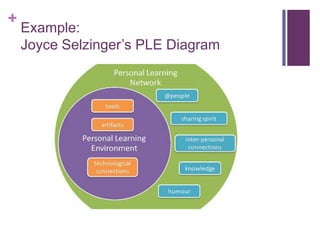
Example:
Joyce Selzinger’s PLE Diagram
+
Example: Alec Couros’ PLE
+
Example: Jordy Jubany I Vila’s PLE
+
My PLE
+
PLE’s in Course Learning
 Have students share his or her PLE’s for course or as part of a
project assignment.
 Questions for Student: How will you use a PLE in your learning
for this course? Or how would you use a PLE for a given
subject?
 Susan Waldenberger’s Rubric:
http://ychumanities.net/hum205/files/2011/12/Personal-
Learning-Environment-Rubric.pdf
 My Rubric:
https://docs.google.com/file/d/0B4XL3HNdjig6d2loY2FfWkV4Y
mM/edit?usp=sharing
+
Your Turn
 Sketch out a PLE for your learning in general
 Create one with a particular, named goal.
+
Bookmarks for this session:
http://delicious.com/constantlearnin
gorg/ple
Email:
alicebedardvoorhees@gmail.com
+
Thank You!
Image Source: Public Art, Carbondale, CO: Rik Sargent. “Free Mind.”

PLE

Editor's Notes

  • #2 This was originally a presentation for the 2013 Elearning Consortium of Colorado.
  • #3 We add value to our own continuous learning. Continuous learning strategies will be of value to our students’ lives in this time of continuous change. PLE’s are a method for identify sources that canServe learning for a subject, course, specific topic.Source: http://www.jarche.com/2012/06/work-is-learning-and-learning-is-the-work/
  • #5 My own categories. http://www.slideshare.net/ibuchem/definitions-of-personal-learning-environment-ple-4029277
  • #7 http://www.flickr.com/photos/catspyjamasnz/3118564555/sizes/m/in/set-72157605723722792/
  • #8 http://www.edtechpost.ca/ple_diagrams/index.php/the-networked-teacher
  • #9 JordyJubany I Vila:http://www.edtechpost.ca/ple_diagrams/index.php/aple#There is a lot going on in this example—the value is the list of resources provided.
  • #10 This diagram was made with Mindnode.
  • #11 This is SusanWaldenberger’s rubric. In making the assignment, this may also be an opportune time to talk about search skills and evaluation of sources and tools.After reading a piece by Dave Cormier, I realized that my rubric had not included a way for students to answer the question, “What learning was supported by the PLE?” Susan’s rubric includes a summary and I think that summary could serve that purpose.
  • #12 You’ve been provided with a worksheet at your table. Give people 10 – 15 minutes to create and share. You don’t need to use these categories necessarily.
  • #14 Image Source: PublicArt, Carbondale, CO: Rik Sargent. “Free Mind.”