201182532@student.uj.ac.za
201182532
Tiyani Chabalala
PROFESSIONAL STUDIES 3A10
LECTURE: Prof G Lautenbach & DR J
Batchelor
PERSONAL LEARNING
ENVIRONMENT
1. Definition of PLE
2. Using PLE
3. Involving learners
4. The important of PLE
5. How do learners collaborate, share information,
connect, and reflect
6. conclusion
CONTENT
PERSONAL
LEARNING
ENVIRONMENT
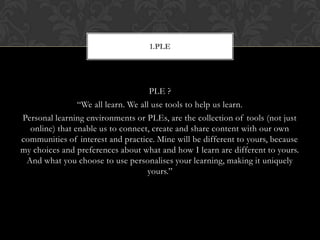
PLE ?
“We all learn. We all use tools to help us learn.
Personal learning environments or PLEs, are the collection of tools (not just
online) that enable us to connect, create and share content with our own
communities of interest and practice. Mine will be different to yours, because
my choices and preferences about what and how I learn are different to yours.
And what you choose to use personalises your learning, making it uniquely
yours.”
1.PLE
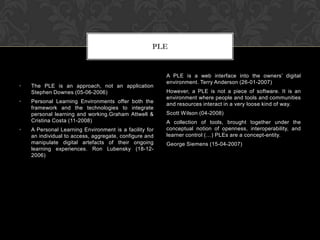
• The PLE is an approach, not an application
Stephen Downes (05-06-2006)
• Personal Learning Environments offer both the
framework and the technologies to integrate
personal learning and working.Graham Attwell &
Cristina Costa (11-2008)
• A Personal Learning Environment is a facility for
an individual to access, aggregate, configure and
manipulate digital artefacts of their ongoing
learning experiences. Ron Lubensky (18-12-
2006)
A PLE is a web interface into the owners’ digital
environment. Terry Anderson (26-01-2007)
However, a PLE is not a piece of software. It is an
environment where people and tools and communities
and resources interact in a very loose kind of way.
Scott Wilson (04-2008)
A collection of tools, brought together under the
conceptual notion of openness, interoperability, and
learner control (…) PLEs are a concept-entity.
George Siemens (15-04-2007)
PLE
• PLEs are not another substantiation of educational technology but a
new approach to learning.
• A response to pedagogic approaches which require that learner’s
e-learning systems need to be under the control of the learners
themselves and recognise the needs of life-long learners for a
system that provides a standard interface to different institutions’
e-learning systems, and that allows portfolio information to be
maintained across institutions.
• PLE are based on the idea that learning will take place in different
contexts and situations and will not be provided by a single
learning provider
• The idea of a Personal Learning Environment recognises that
learning is continuing and seeks to provide tools to support that
learning
PERSONAL LEARNING
ENVIRONMENT
• PLEs can help in the recognition of informal learning
• PLEs can develop on the potential of services oriented
architectures for dispersed and networked forms of learning and
knowledge development.
• “the heart of the concept of the PLE is that it is a tool that allows a
learner (or anyone) to engage in a distributed environment
consisting of a network of people, services and resources. It is not
just Web 2.0, but it is certainly Web 2.0 in the sense that it is (in
the broadest sense possible) a read-write application.”
•
PERSONAL LEARNING
ENVIRONMENT
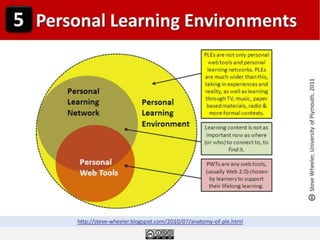
PERSONAL LEARNING
ENVIRONMENT
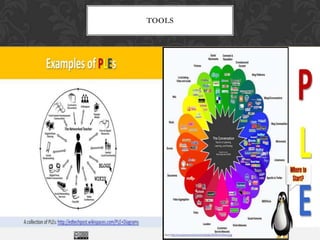
TOOLS
PERSONAL LEARNING ENVIRONMENT
A CONCEPT BASED ON WEB 2 .0 AND SOCIAL
SOFTWARE
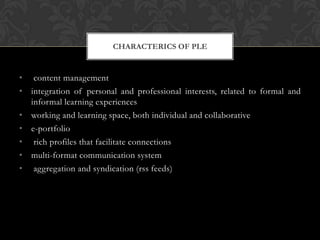
• content management
• integration of personal and professional interests, related to formal and
informal learning experiences
• working and learning space, both individual and collaborative
• e-portfolio
• rich profiles that facilitate connections
• multi-format communication system
• aggregation and syndication (rss feeds)
CHARACTERICS OF PLE
2.USING (PLE)
PERSONAL
LEANING
ENVIRONMENT
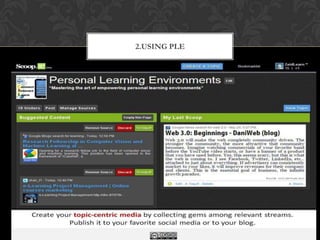
2.USING PLE
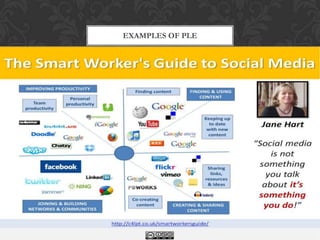
EXAMPLES OF PLE
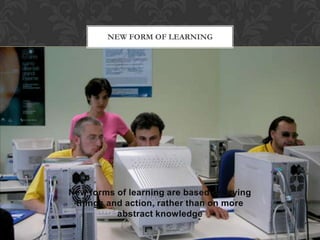
New forms of learning are based on trying
things and action, rather than on more
abstract knowledge
NEW FORM OF LEARNING
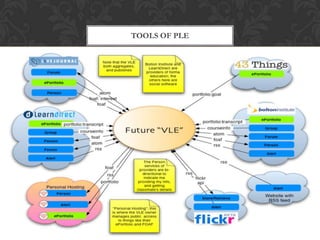
TOOLS OF PLE
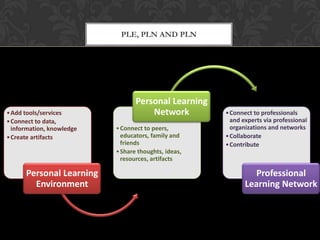
PLE, PLN AND PLN
•Add tools/services
•Connect to data,
information, knowledge
•Create artifacts
Personal Learning
Environment
•Connect to peers,
educators, family and
friends
•Share thoughts, ideas,
resources, artifacts
Personal Learning
Network •Connect to professionals
and experts via professional
organizations and networks
•Collaborate
•Contribute
Professional
Learning Network
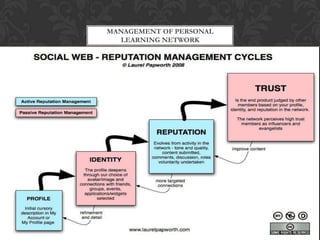
MANAGEMENT OF PERSONAL
LEARNING NETWORK
INVOLVING LEANERS
3.INVOLVING LEANERS
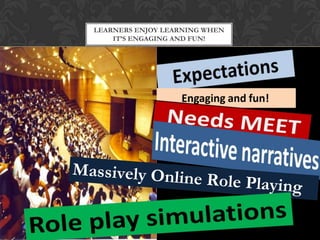
LEARNERS ENJOY LEARNING WHEN
IT’S ENGAGING AND FUN!
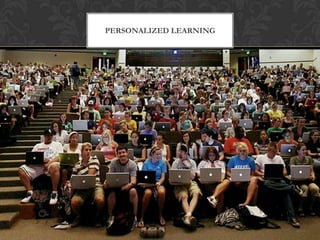
PERSONALIZED LEARNING
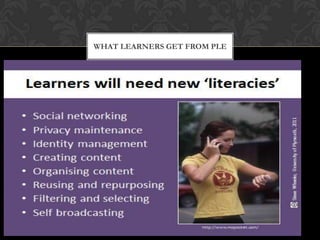
WHAT LEARNERS GET FROM PLE
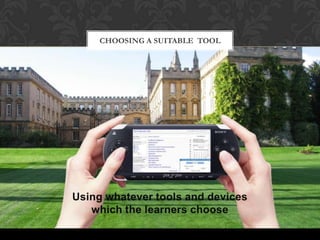
Using whatever tools and devices
which the learners choose
CHOOSING A SUITABLE TOOL
4.IMPORTANT
OF USING PLE
IMPORTANTS
OF PLE
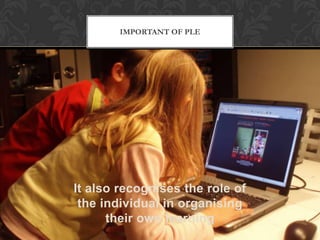
It also recognises the role of
the individual in organising
their own learning
IMPORTANT OF PLE
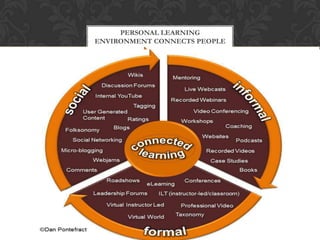
PERSONAL LEARNING
ENVIRONMENT CONNECTS PEOPLE
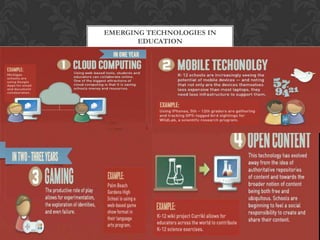
EMERGING TECHNOLOGIES IN
EDUCATION
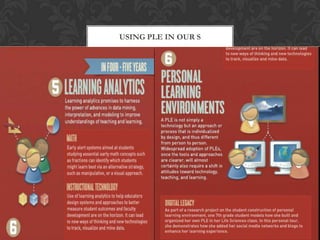
USING PLE IN OUR S
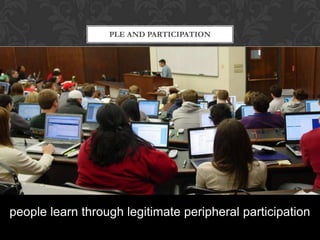
people learn through legitimate peripheral participation
PLE AND PARTICIPATION
activities
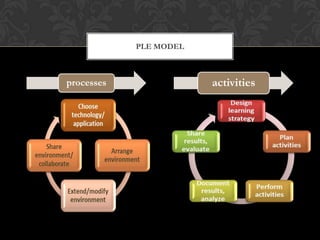
PLE MODEL
processes
Connect with others Manage information Generate content
Search for information Aggregate information and knowledge Manipulate,
rearrange and repurpose knowledge artifacts Analyse information to develop knowledge Reflect,
question,
challenge, seek clarification, form and defend opinions Share by supporting others in
their learning
Network through a collaborative learning environment
Adapted from Graham Attwell (2010) – Working, learning and playing through Personal Learning
Environments [Presentation]
http://www.slideshare.net/GrahamAttwell/working-learning-and-playing-through-personal-learning-
environments
Steve Wheeler
FUNTIONS OF PLE
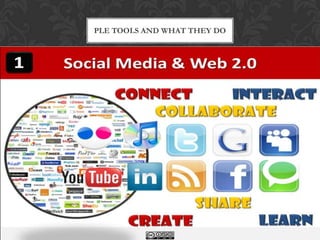
PLE TOOLS AND WHAT THEY DO
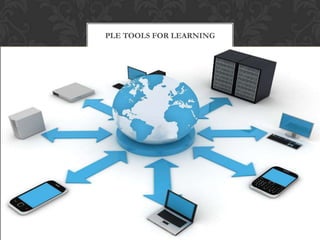
PLE TOOLS FOR LEARNING
5.How do learners
collaborate, share
information,
connect and
reflect
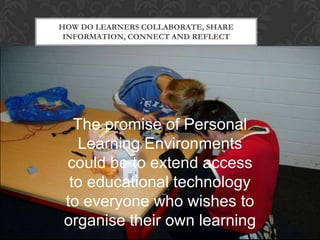
The promise of Personal
Learning Environments
could be to extend access
to educational technology
to everyone who wishes to
organise their own learning
HOW DO LEARNERS COLLABORATE, SHARE
INFORMATION, CONNECT AND REFLECT
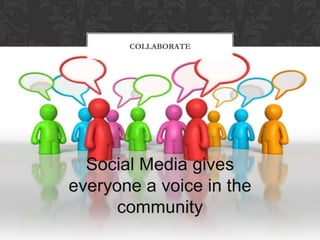
Social Media gives
everyone a voice in the
community
COLLABORATE
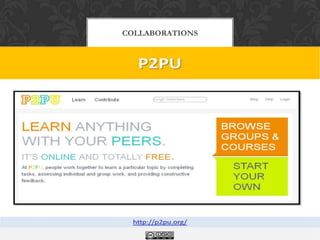
COLLABORATIONS
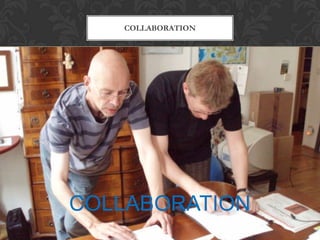
COLLABORATION
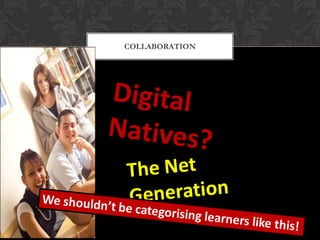
COLLABORATION
COLLABORATION
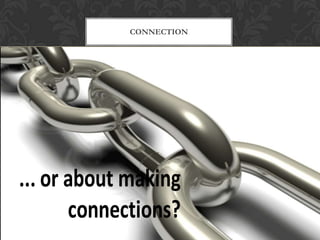
CONNECTION
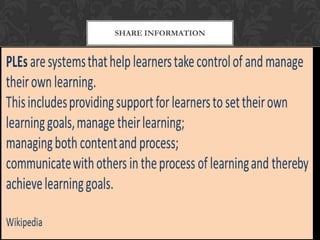
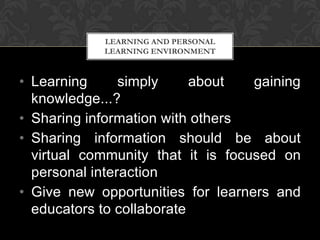
SHARE INFORMATION
• Learning simply about gaining
knowledge...?
• Sharing information with others
• Sharing information should be about
virtual community that it is focused on
personal interaction
• Give new opportunities for learners and
educators to collaborate
LEARNING AND PERSONAL
LEARNING ENVIRONMENT
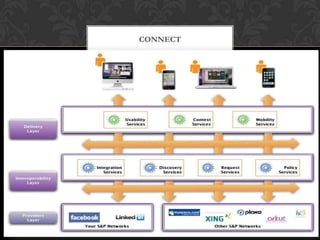
CONNECT
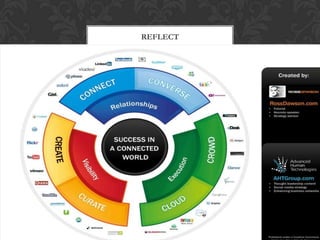
REFLECT
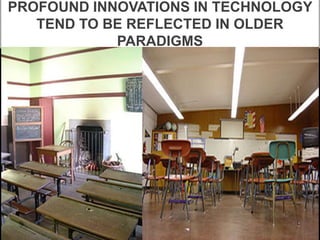
PROFOUND INNOVATIONS IN TECHNOLOGY
TEND TO BE REFLECTED IN OLDER
PARADIGMS
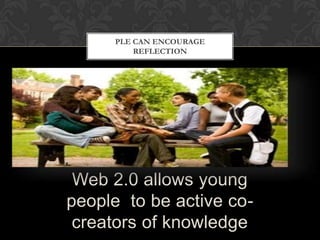
Web 2.0 allows young
people to be active co-
creators of knowledge
PLE CAN ENCOURAGE
REFLECTION
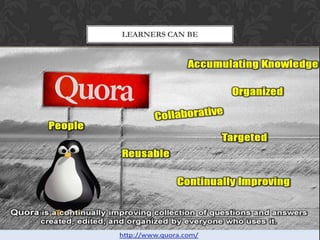
LEARNERS CAN BE
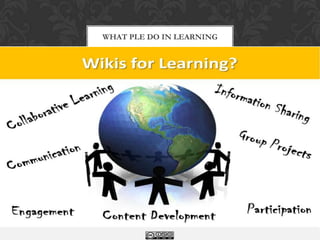
WHAT PLE DO IN LEARNING
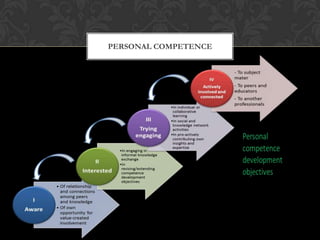
PERSONAL COMPETENCE
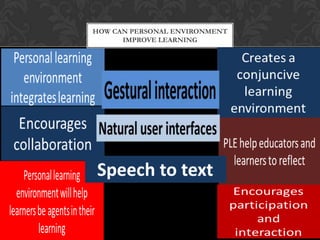
HOW CAN PERSONAL ENVIRONMENT
IMPROVE LEARNING
conclusion
Personal learning
environment
• A Personal Learning Environment is a facility for an individual to access, aggregate, configure and
manipulate digital artefacts of their ongoing learning experiences
• integration of personal and professional interests, related to formal and informal learning experiences
Using PLE
• Personal learning environment will help learners be agents in their learning
• PLE help educators and learners to reflect
• Engage in informal knowledge exchange
INVOLVING
LEARNER
• Encourages collaboration between the teacher and the student
• Learners get the opportunity to be involved in their own learning and create their own knowledge
• Personal learning environment helps with collaboration and getting everyone to be involved in their
learning
CONCLUSION
REFERENCE
Bibliography
Alsagoff, Z. A. (2012, February 09). Empowering personal learning environments:slideshare.net. Retrieved March
11, 2013, from Empowering personal learning environments:slideshare.net:
http://www.slideshare.net/zaid/empowering-personal-learning-environments-v2
Attwell, G. (2007, may 07). personal learning environment:slideshare.net. Retrieved march 11, 2013, from
personal learning environment:slideshare.net: http://www.slideshare.net/GrahamAttwell/personal-learning-
environments-46423
Malinka Ivanova, T. U.–S. (2009, april 10). personal learning environment:slideshare.net. Retrieved march 11,
2013, from personal learning environment:slideshare.net: http://www.slideshare.net/malinkaiva/from-personal-
learning-environment-building-to-professional-learning-network-forming
simoes, P. (2012, may 29). VIII confrerencia international:slideshare.net. Retrieved march 11, 2013, from VIII
confrerencia international:slideshare.net: http://www.slideshare.net/bubka/viii-conferncia-internacional-elearning-
2012
Wheeler, S. (2011, february 02). The future of learning learning: slideshare.net. Retrieved march 11, 2013, from
The future of learning learning: slideshare.net : http://www.slideshare.net/timbuckteeth/the-future-of-learning-
6809148

Personal learning network

  • 1.
    201182532@student.uj.ac.za 201182532 Tiyani Chabalala PROFESSIONAL STUDIES3A10 LECTURE: Prof G Lautenbach & DR J Batchelor PERSONAL LEARNING ENVIRONMENT
  • 2.
    1. Definition ofPLE 2. Using PLE 3. Involving learners 4. The important of PLE 5. How do learners collaborate, share information, connect, and reflect 6. conclusion CONTENT
  • 3.
  • 4.
    PLE ? “We alllearn. We all use tools to help us learn. Personal learning environments or PLEs, are the collection of tools (not just online) that enable us to connect, create and share content with our own communities of interest and practice. Mine will be different to yours, because my choices and preferences about what and how I learn are different to yours. And what you choose to use personalises your learning, making it uniquely yours.” 1.PLE
  • 5.
    • The PLEis an approach, not an application Stephen Downes (05-06-2006) • Personal Learning Environments offer both the framework and the technologies to integrate personal learning and working.Graham Attwell & Cristina Costa (11-2008) • A Personal Learning Environment is a facility for an individual to access, aggregate, configure and manipulate digital artefacts of their ongoing learning experiences. Ron Lubensky (18-12- 2006) A PLE is a web interface into the owners’ digital environment. Terry Anderson (26-01-2007) However, a PLE is not a piece of software. It is an environment where people and tools and communities and resources interact in a very loose kind of way. Scott Wilson (04-2008) A collection of tools, brought together under the conceptual notion of openness, interoperability, and learner control (…) PLEs are a concept-entity. George Siemens (15-04-2007) PLE
  • 6.
    • PLEs arenot another substantiation of educational technology but a new approach to learning. • A response to pedagogic approaches which require that learner’s e-learning systems need to be under the control of the learners themselves and recognise the needs of life-long learners for a system that provides a standard interface to different institutions’ e-learning systems, and that allows portfolio information to be maintained across institutions. • PLE are based on the idea that learning will take place in different contexts and situations and will not be provided by a single learning provider • The idea of a Personal Learning Environment recognises that learning is continuing and seeks to provide tools to support that learning PERSONAL LEARNING ENVIRONMENT
  • 7.
    • PLEs canhelp in the recognition of informal learning • PLEs can develop on the potential of services oriented architectures for dispersed and networked forms of learning and knowledge development. • “the heart of the concept of the PLE is that it is a tool that allows a learner (or anyone) to engage in a distributed environment consisting of a network of people, services and resources. It is not just Web 2.0, but it is certainly Web 2.0 in the sense that it is (in the broadest sense possible) a read-write application.” • PERSONAL LEARNING ENVIRONMENT
  • 8.
  • 9.
  • 10.
    PERSONAL LEARNING ENVIRONMENT ACONCEPT BASED ON WEB 2 .0 AND SOCIAL SOFTWARE
  • 11.
    • content management •integration of personal and professional interests, related to formal and informal learning experiences • working and learning space, both individual and collaborative • e-portfolio • rich profiles that facilitate connections • multi-format communication system • aggregation and syndication (rss feeds) CHARACTERICS OF PLE
  • 12.
  • 13.
  • 14.
  • 15.
    New forms oflearning are based on trying things and action, rather than on more abstract knowledge NEW FORM OF LEARNING
  • 16.
  • 17.
    PLE, PLN ANDPLN •Add tools/services •Connect to data, information, knowledge •Create artifacts Personal Learning Environment •Connect to peers, educators, family and friends •Share thoughts, ideas, resources, artifacts Personal Learning Network •Connect to professionals and experts via professional organizations and networks •Collaborate •Contribute Professional Learning Network
  • 18.
  • 19.
  • 20.
  • 21.
    LEARNERS ENJOY LEARNINGWHEN IT’S ENGAGING AND FUN!
  • 22.
  • 23.
  • 25.
    Using whatever toolsand devices which the learners choose CHOOSING A SUITABLE TOOL
  • 26.
  • 27.
    It also recognisesthe role of the individual in organising their own learning IMPORTANT OF PLE
  • 28.
  • 29.
  • 30.
  • 31.
    people learn throughlegitimate peripheral participation PLE AND PARTICIPATION
  • 32.
  • 33.
    Connect with othersManage information Generate content Search for information Aggregate information and knowledge Manipulate, rearrange and repurpose knowledge artifacts Analyse information to develop knowledge Reflect, question, challenge, seek clarification, form and defend opinions Share by supporting others in their learning Network through a collaborative learning environment Adapted from Graham Attwell (2010) – Working, learning and playing through Personal Learning Environments [Presentation] http://www.slideshare.net/GrahamAttwell/working-learning-and-playing-through-personal-learning- environments Steve Wheeler FUNTIONS OF PLE
  • 34.
    PLE TOOLS ANDWHAT THEY DO
  • 35.
    PLE TOOLS FORLEARNING
  • 36.
    5.How do learners collaborate,share information, connect and reflect
  • 37.
    The promise ofPersonal Learning Environments could be to extend access to educational technology to everyone who wishes to organise their own learning HOW DO LEARNERS COLLABORATE, SHARE INFORMATION, CONNECT AND REFLECT
  • 38.
    Social Media gives everyonea voice in the community COLLABORATE
  • 39.
  • 40.
  • 41.
  • 42.
  • 43.
  • 44.
    • Learning simplyabout gaining knowledge...? • Sharing information with others • Sharing information should be about virtual community that it is focused on personal interaction • Give new opportunities for learners and educators to collaborate LEARNING AND PERSONAL LEARNING ENVIRONMENT
  • 45.
  • 46.
  • 47.
    PROFOUND INNOVATIONS INTECHNOLOGY TEND TO BE REFLECTED IN OLDER PARADIGMS
  • 48.
    Web 2.0 allowsyoung people to be active co- creators of knowledge PLE CAN ENCOURAGE REFLECTION
  • 49.
  • 50.
    WHAT PLE DOIN LEARNING
  • 51.
  • 52.
    HOW CAN PERSONALENVIRONMENT IMPROVE LEARNING
  • 53.
  • 54.
    Personal learning environment • APersonal Learning Environment is a facility for an individual to access, aggregate, configure and manipulate digital artefacts of their ongoing learning experiences • integration of personal and professional interests, related to formal and informal learning experiences Using PLE • Personal learning environment will help learners be agents in their learning • PLE help educators and learners to reflect • Engage in informal knowledge exchange INVOLVING LEARNER • Encourages collaboration between the teacher and the student • Learners get the opportunity to be involved in their own learning and create their own knowledge • Personal learning environment helps with collaboration and getting everyone to be involved in their learning CONCLUSION
  • 55.
    REFERENCE Bibliography Alsagoff, Z. A.(2012, February 09). Empowering personal learning environments:slideshare.net. Retrieved March 11, 2013, from Empowering personal learning environments:slideshare.net: http://www.slideshare.net/zaid/empowering-personal-learning-environments-v2 Attwell, G. (2007, may 07). personal learning environment:slideshare.net. Retrieved march 11, 2013, from personal learning environment:slideshare.net: http://www.slideshare.net/GrahamAttwell/personal-learning- environments-46423 Malinka Ivanova, T. U.–S. (2009, april 10). personal learning environment:slideshare.net. Retrieved march 11, 2013, from personal learning environment:slideshare.net: http://www.slideshare.net/malinkaiva/from-personal- learning-environment-building-to-professional-learning-network-forming simoes, P. (2012, may 29). VIII confrerencia international:slideshare.net. Retrieved march 11, 2013, from VIII confrerencia international:slideshare.net: http://www.slideshare.net/bubka/viii-conferncia-internacional-elearning- 2012 Wheeler, S. (2011, february 02). The future of learning learning: slideshare.net. Retrieved march 11, 2013, from The future of learning learning: slideshare.net : http://www.slideshare.net/timbuckteeth/the-future-of-learning- 6809148