

Play . Analyze . Create
Using Games in Education
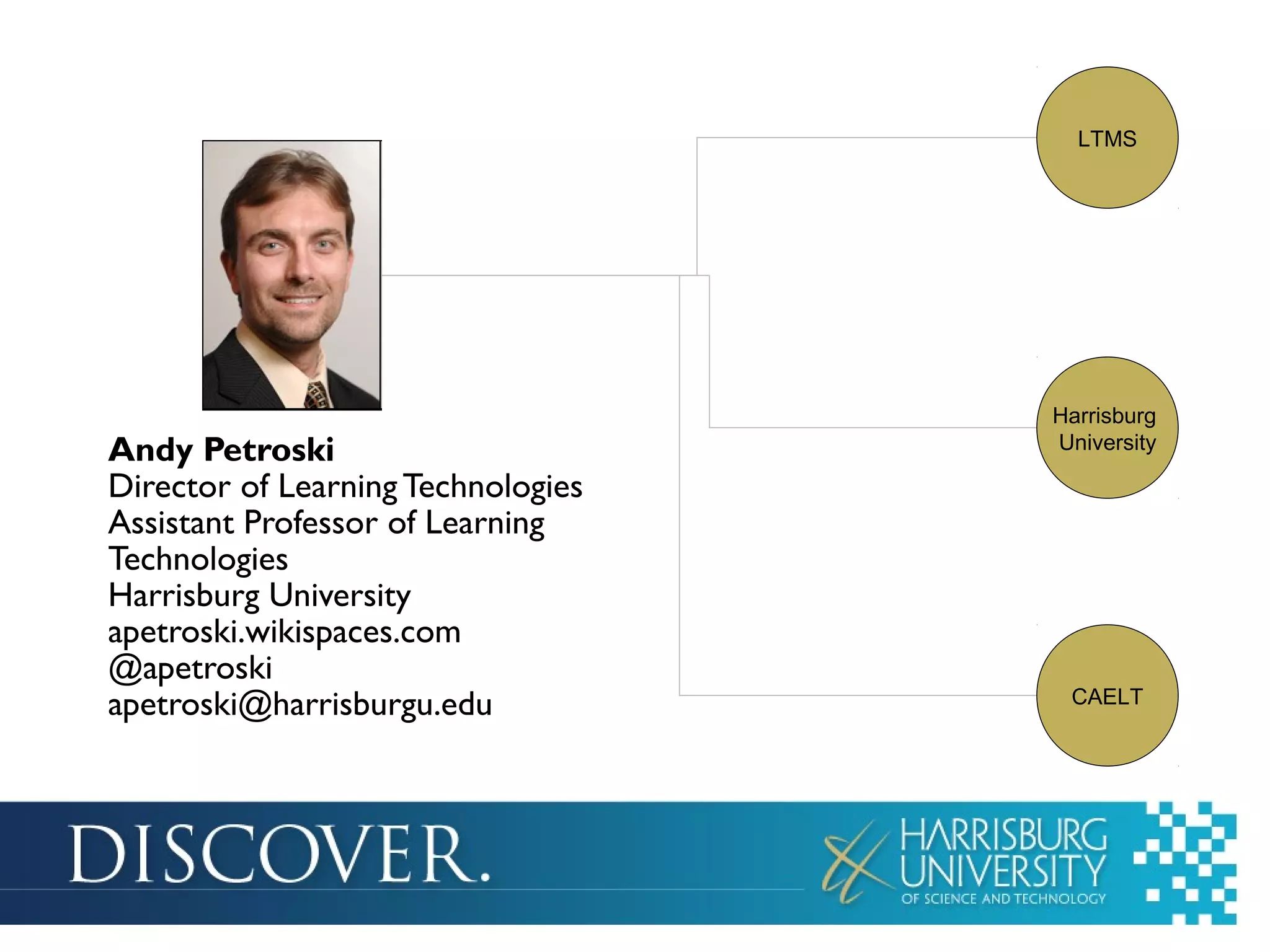
Andy Petroski
Director & Assistant Professor of Learning Technologies
Harrisburg University of Science & Technology
apetroski.wikispaces.com
@apetroski
apetroski@harrisburgu.edu
Andy Petroski
Director of Learning Technologies
Assistant Professor of Learning
Technologies
Harrisburg University
apetroski.wikispaces.com
@apetroski
apetroski@harrisburgu.edu
LTMS
CAELT
Harrisburg
University
play . analyze . create: using games in education
poll
How have you used games in the classroom?
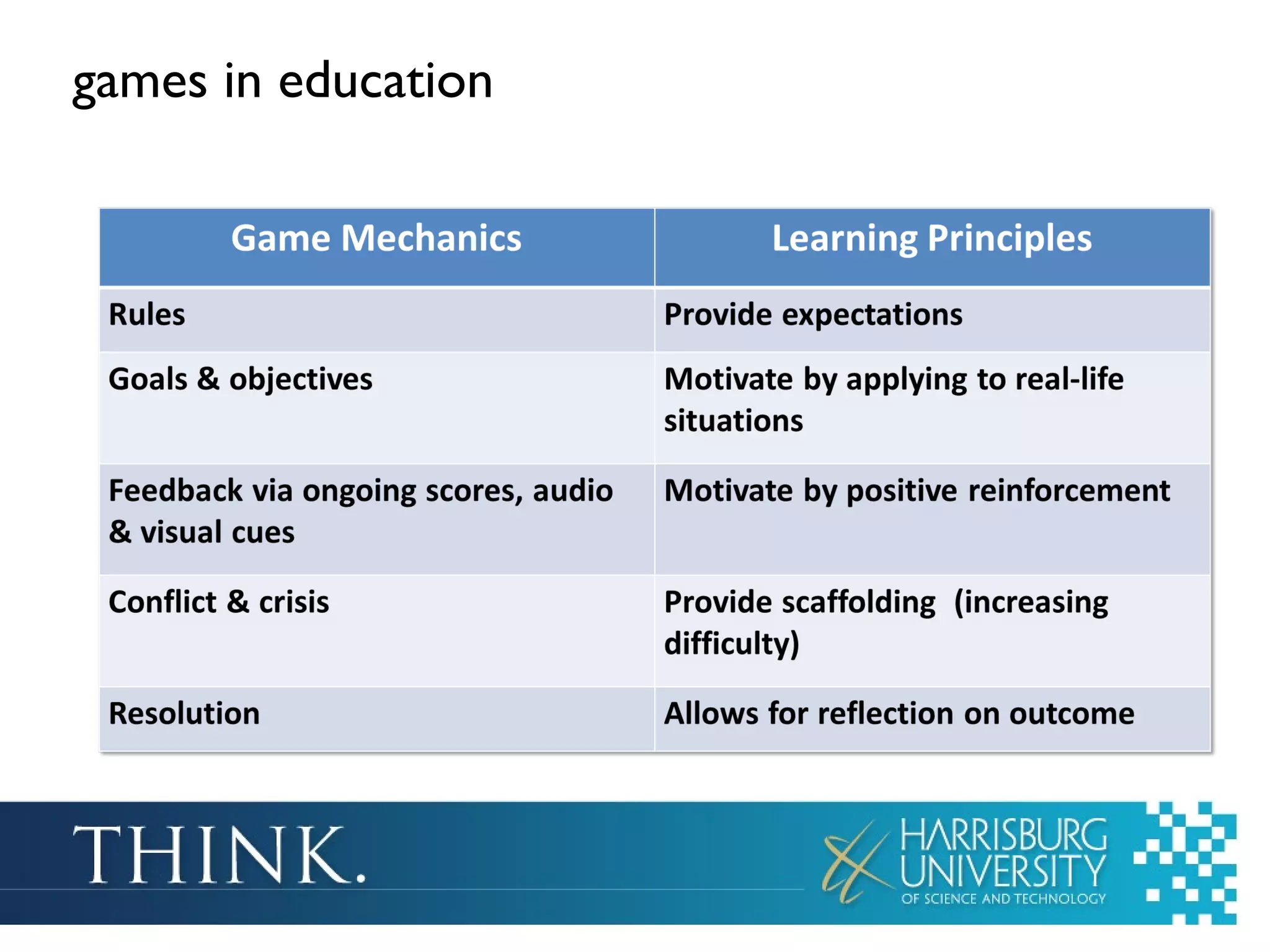
games in education
games in education
(a) contextual bridging, (b) high time-on-task,
(c) motivation and goal orientation, even after failure,
(d) providing learners with cues, hints and partial
solutions to keep them progressing,
(e) personalization of learning, and
(f) infinite patience
game attributes & learning
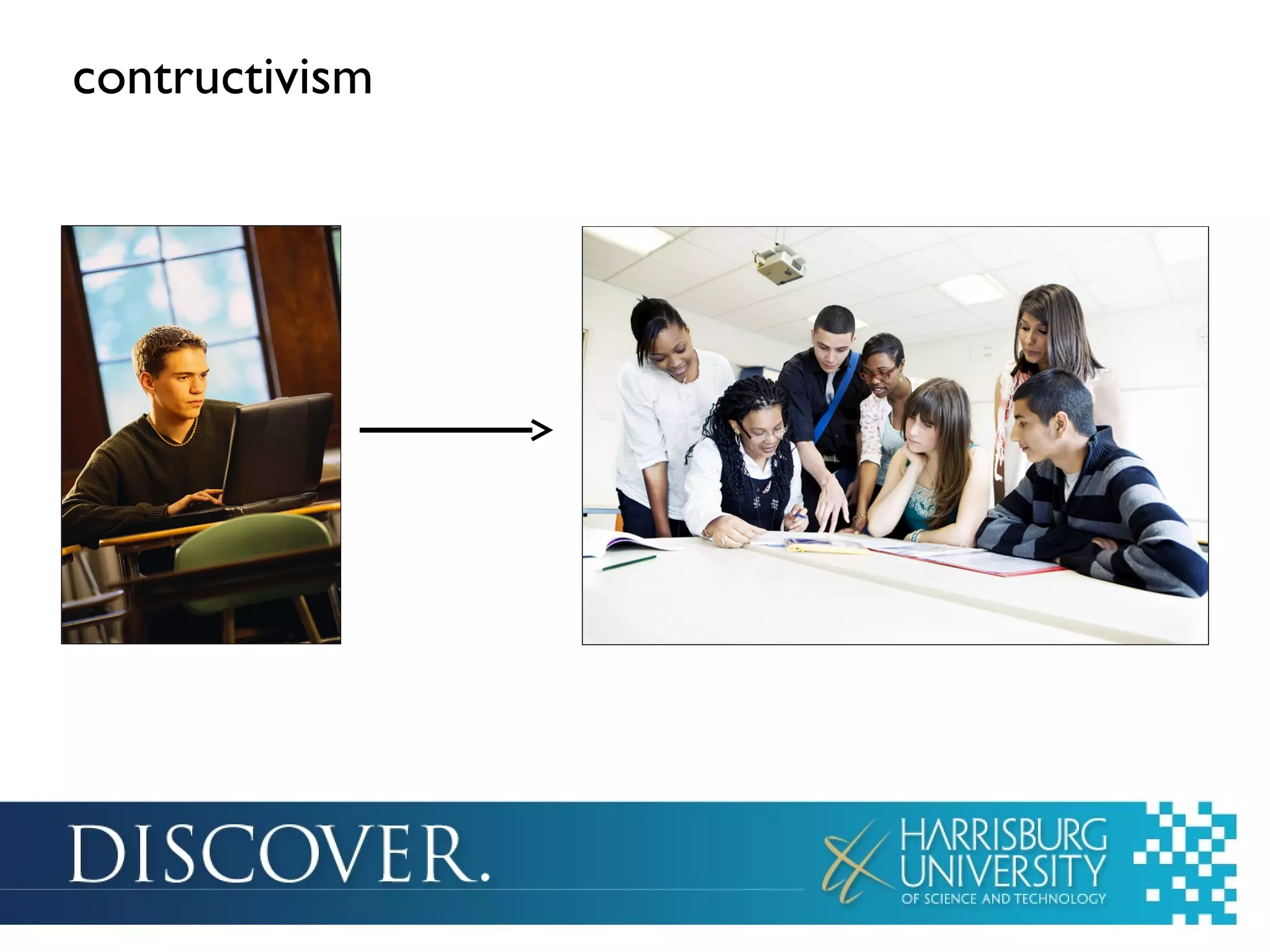
contructivism
multiple intelligences
contructivism
contructivism
contructivism
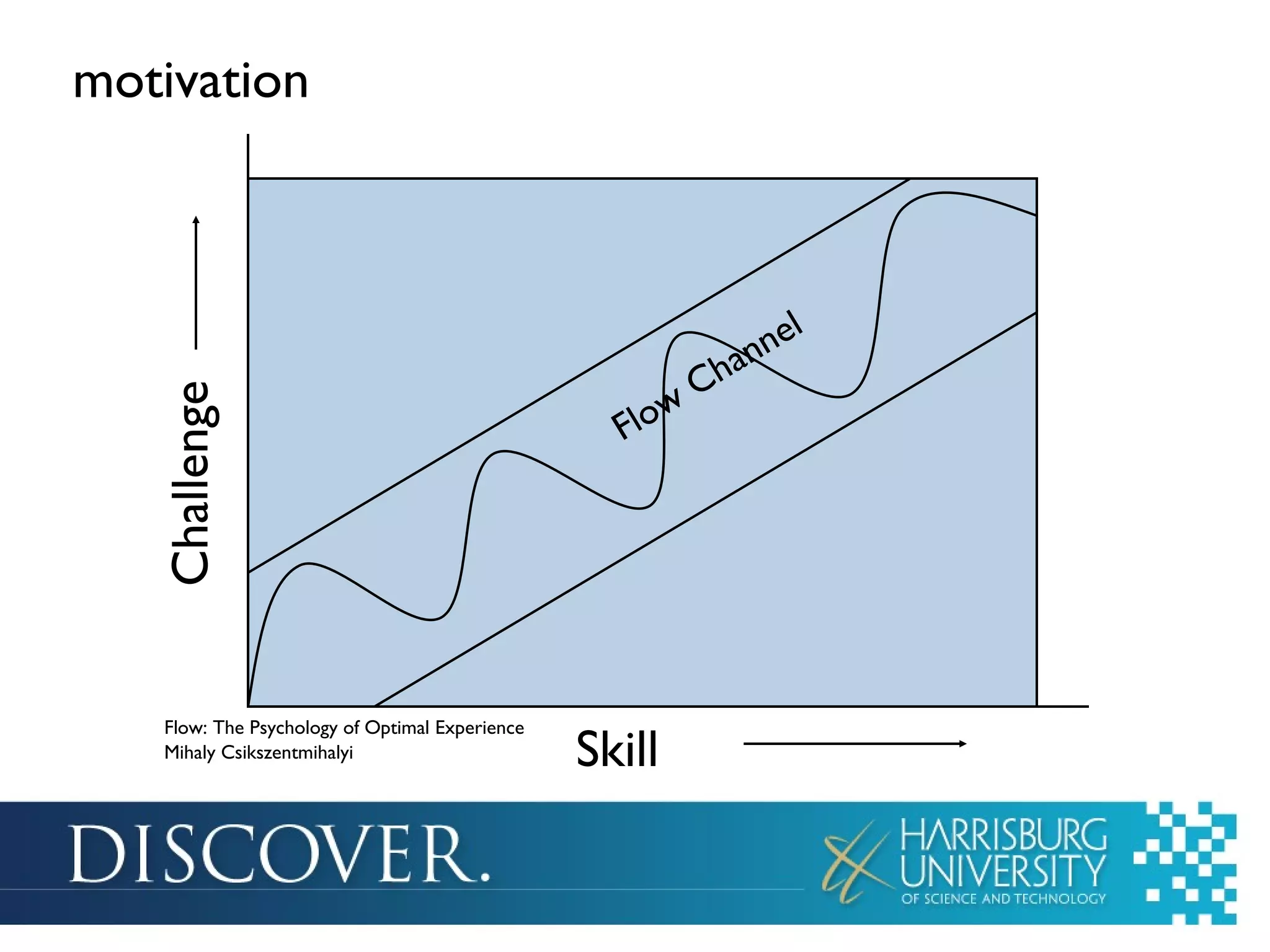
Flow: The Psychology of Optimal Experience
Mihaly Csikszentmihalyi
Challenge
Skill
Flow
Channel
motivation
PLAY
educational games
types of educational games
Simple Games Simulated
Environments
Adventure
Worlds
•Primarily single player
•Drill and Practice
•Game show / TV show
themes
•Content driven
•Limited play time /
sessions
•Primarily single player
•Decision making
•Job / life themes
•Variable driven
•Moderate play time /
sessions
•Multiplayer
•Planning and decisions
•Fantasy themes
•Experience driven
•Expansive play time /
sessions
simple games Simple Games
•Primarily single player
•Drill and Practice
•Game show / TV show
themes
•Content driven
•Limited play time /
sessions
Examples
simple games
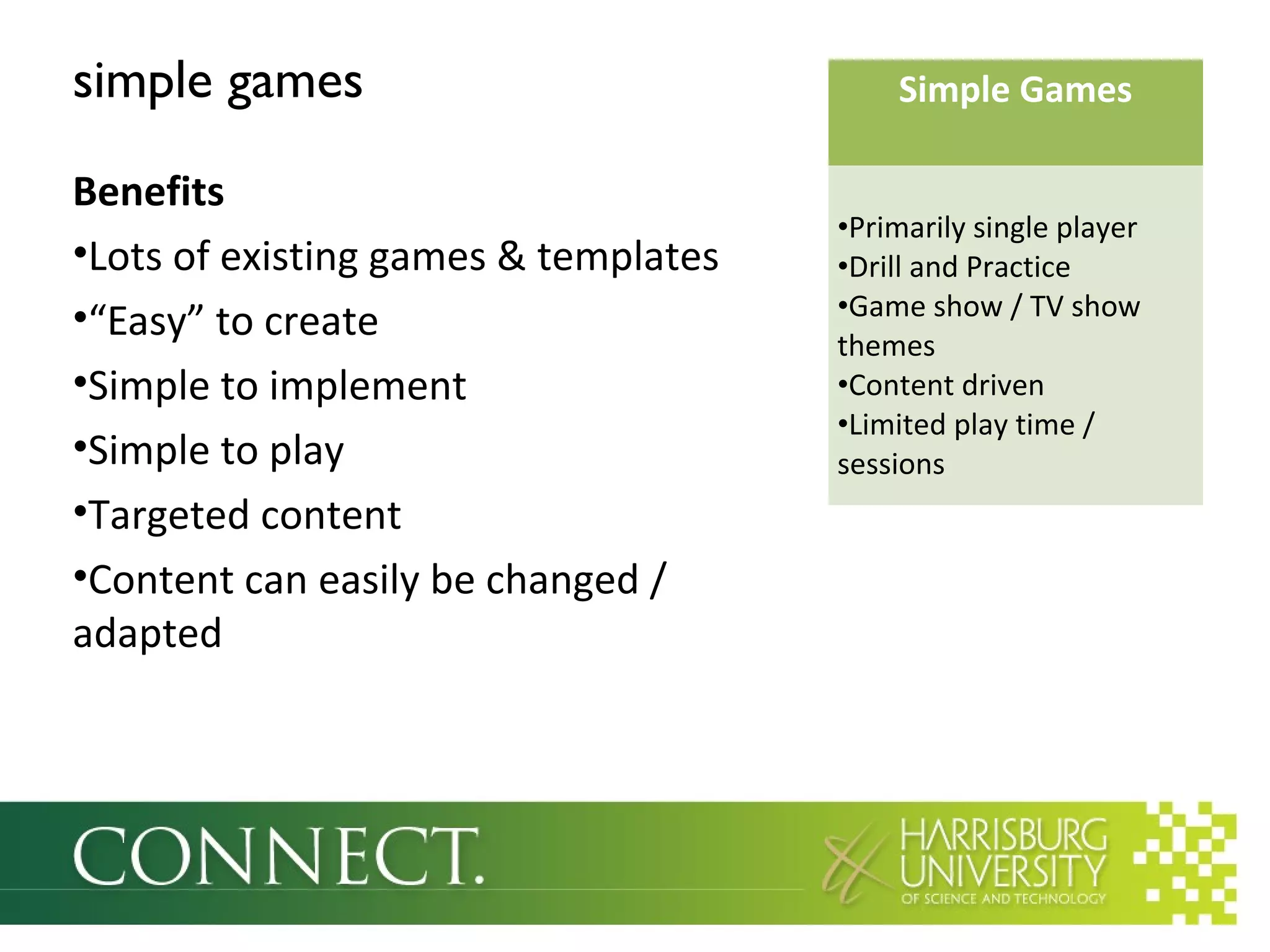
Benefits
•Lots of existing games & templates
•“Easy” to create
•Simple to implement
•Simple to play
•Targeted content
•Content can easily be changed /
adapted
Simple Games
•Primarily single player
•Drill and Practice
•Game show / TV show
themes
•Content driven
•Limited play time /
sessions
simple games Simple Games
•Primarily single player
•Drill and Practice
•Game show / TV show
themes
•Content driven
•Limited play time /
sessions
simple games
Limitations
•Memorization and identification
•Limited feedback
•Story and character is difficult to pull-
off
•Multiplayer is competition only
•Limited motivation over time
•Requires little teacher interaction
Simple Games
•Primarily single player
•Drill and Practice
•Game show / TV show
themes
•Content driven
•Limited play time /
sessions
simulated environments
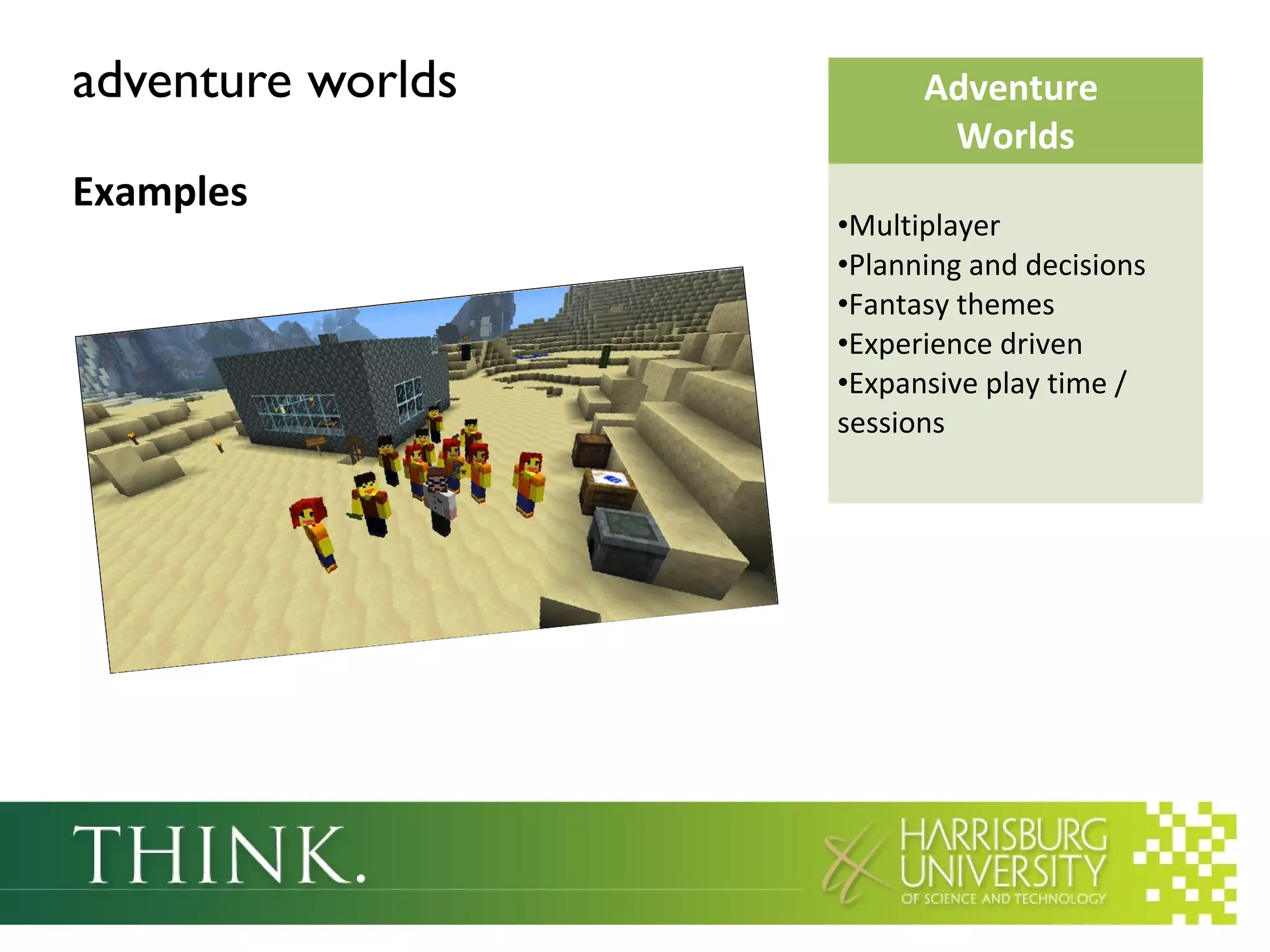
Examples
Simulated
Environments
•Primarily single player
•Decision making
•Job / life themes
•Variable driven
•Moderate play time /
sessions
simulated environments
Benefits
•Targeted content
•Multimodal interaction
•Story / path intensive
•Character driven
•Each play can be a different experience
•Requires teacher interaction
Simulated
Environments
•Primarily single player
•Decision making
•Job / life themes
•Variable driven
•Moderate play time /
sessions
simulated environments Simulated
Environments
•Primarily single player
•Decision making
•Job / life themes
•Variable driven
•Moderate play time /
sessions
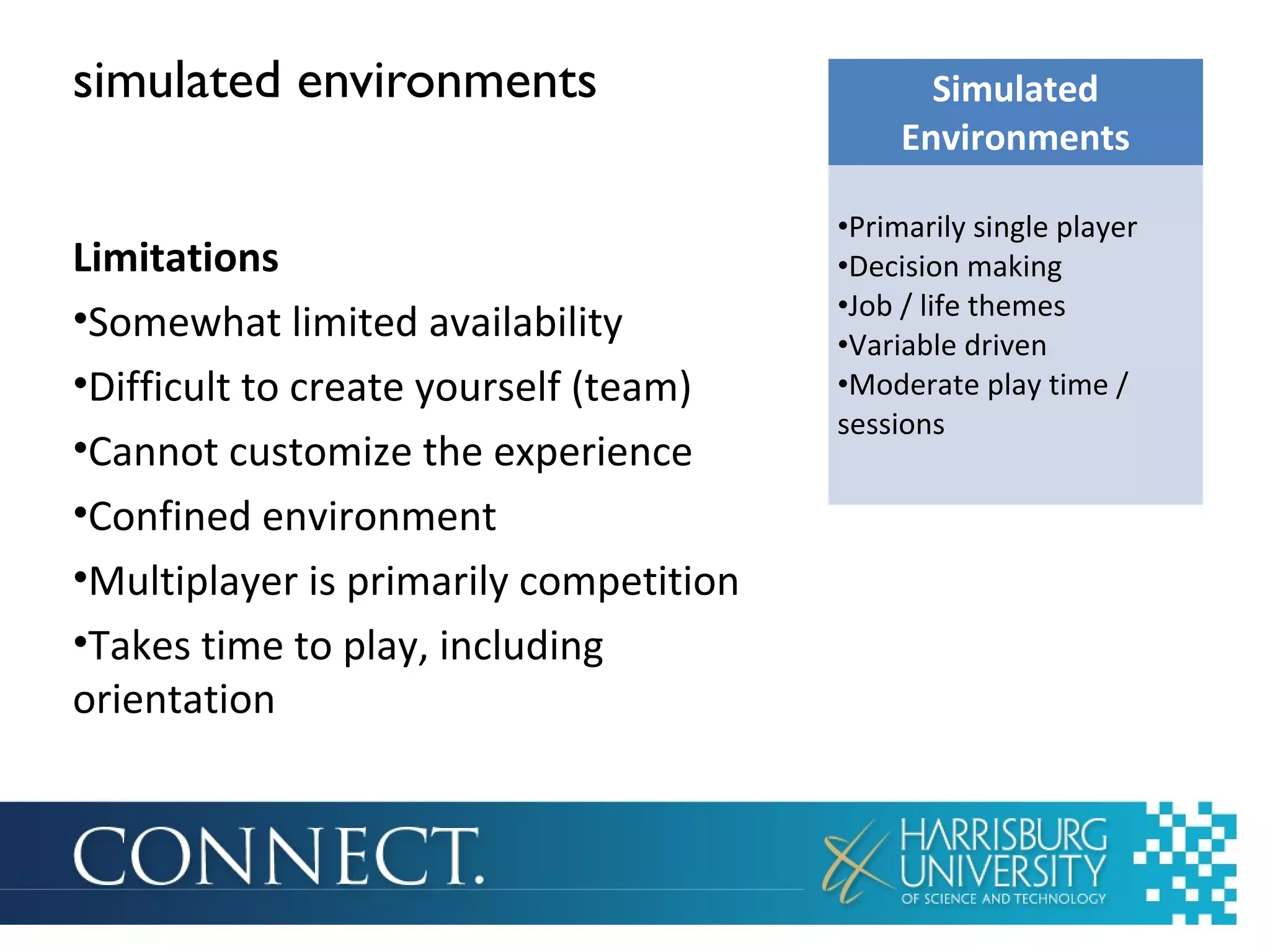
simulated environments
Limitations
•Somewhat limited availability
•Difficult to create yourself (team)
•Cannot customize the experience
•Confined environment
•Multiplayer is primarily competition
•Takes time to play, including
orientation
Simulated
Environments
•Primarily single player
•Decision making
•Job / life themes
•Variable driven
•Moderate play time /
sessions
adventure worlds
Examples
Adventure
Worlds
•Multiplayer
•Planning and decisions
•Fantasy themes
•Experience driven
•Expansive play time /
sessions
adventure worlds
Benefits
•Open experiences
•Environment intensive
•Multimodal interaction
•Customizable through Modding
•Recording (Machinima)
•Customizable avatar
•Collaboration as well as competition
•Requires teacher interaction
Adventure
Worlds
•Multiplayer
•Planning and decisions
•Fantasy themes
•Experience driven
•Expansive play time /
sessions
adventure worlds Adventure
Worlds
•Multiplayer
•Planning and decisions
•Fantasy themes
•Experience driven
•Expansive play time /
sessions
adventure worlds
Limitations
•Somewhat limited availability
•Very difficult to create yourself
•Takes time to play, including
orientation
•Play needs to occur over multiple
sessions
•Requires teacher interaction
•Themes may not relate to every
student
Adventure
Worlds
•Multiplayer
•Planning and decisions
•Fantasy themes
•Experience driven
•Expansive play time /
sessions
story character goal
obstacles feedback levels
  
  
mechanics

ANALYZE GAMES
PLOG | GLOG | MOD
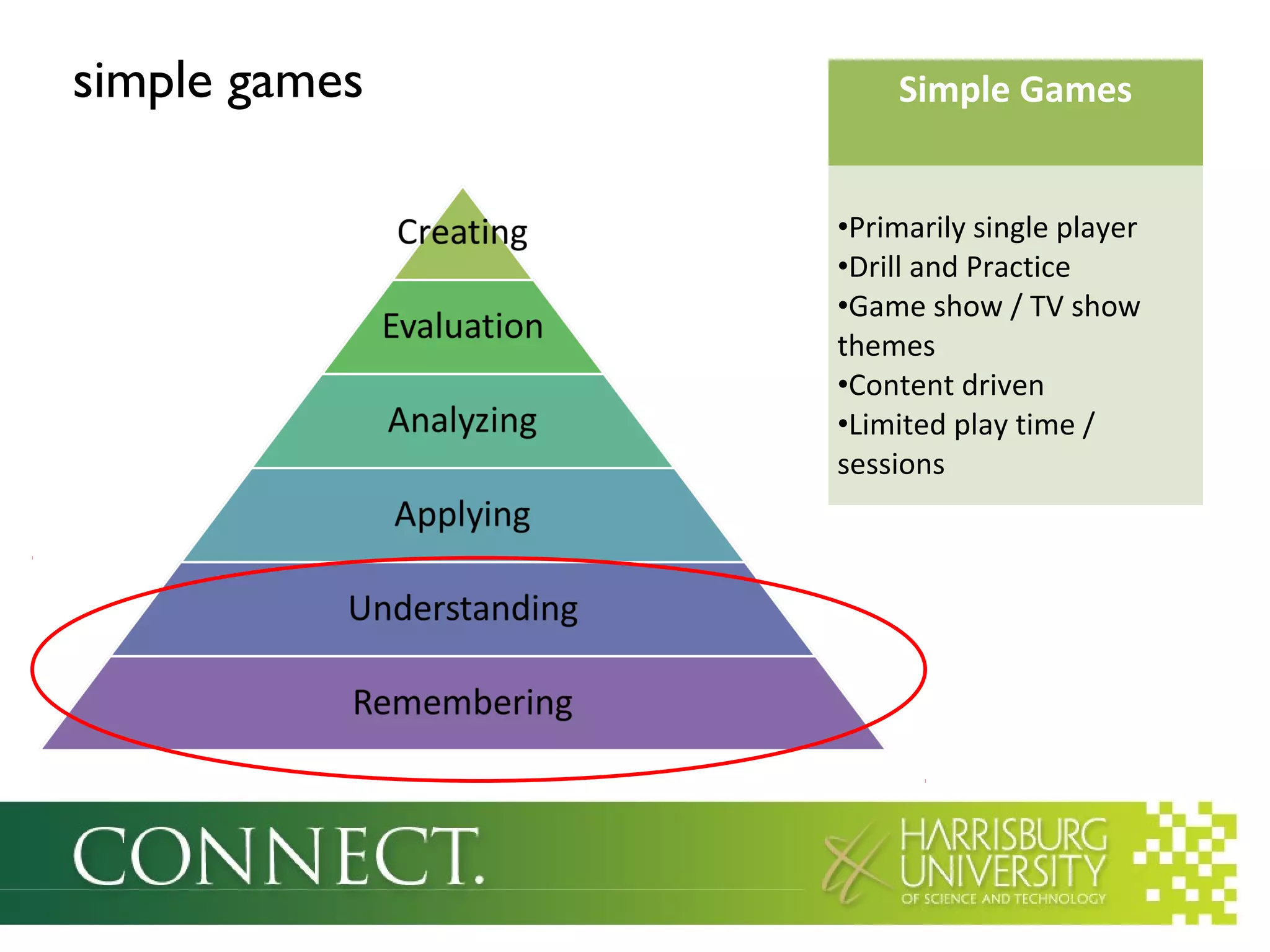
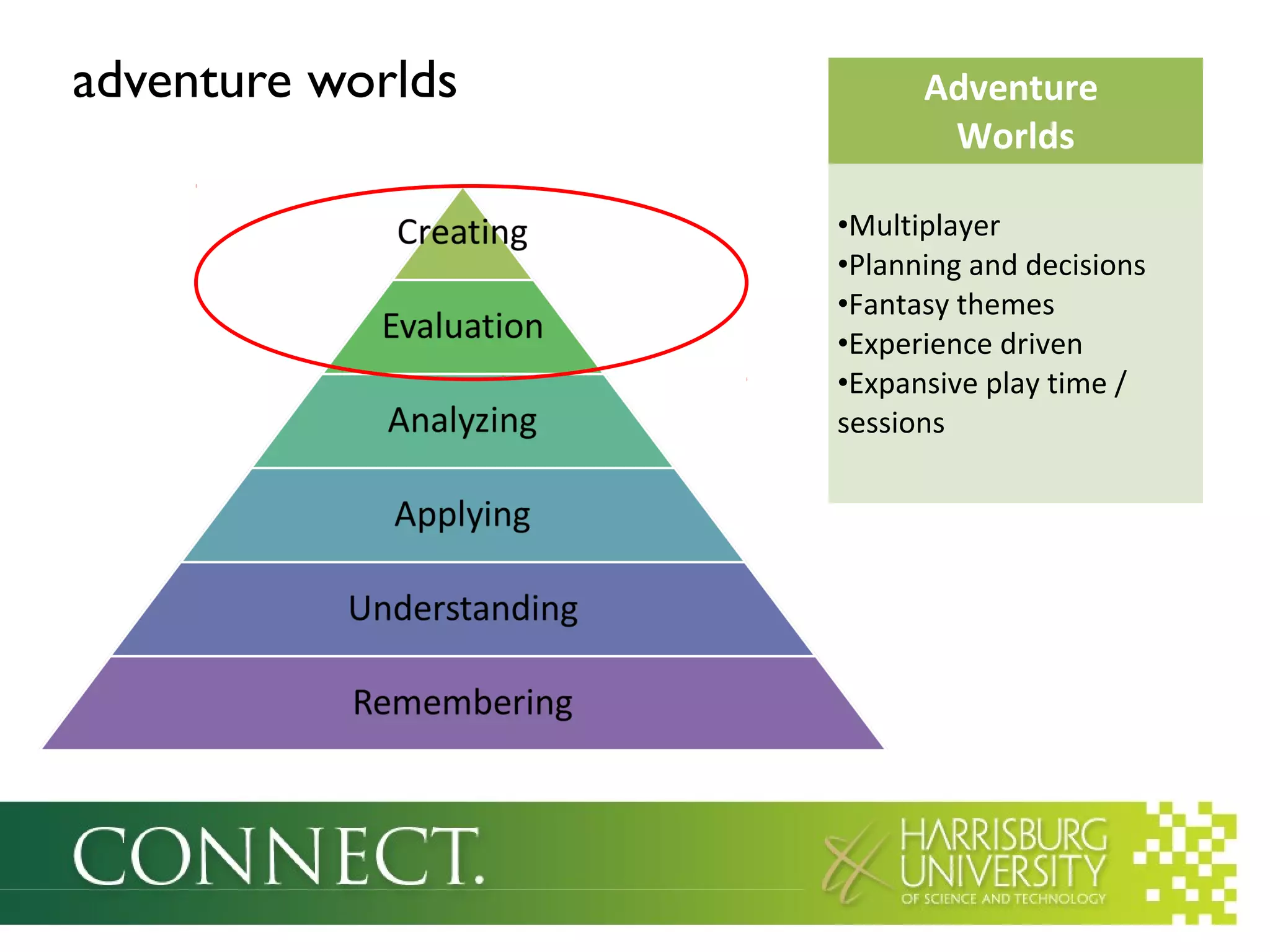
Bloom's Taxonomy
Courtesy of Jeff Mummert: www.linkedin.com/in/jeffmummert
Submrge.org
CREATE GAMES
create games to learn
Students Games
Effective
Teaching &
Learning
Strategies
Improved Learning Outcomes
21st
Century Skills
Educators
games in education
www.edweb.net
Game-Based Learning Community
learn more
https://www.filamentgames.com/
Earth & Space Science
Engineering & Technology
Languages & Music
Language & Literacy
Life Sciences
Physical Sciences
Cognitive Skills
Math and Social Studies
FREE Client Games
Fee-Based Games ($0.99 - $12.00)
PLAY GAMES
Learning Technologies Master of Science (LTMS)
Concentrations
•Instructional Technology Specialist
•Instructional Design
•Instructional Development
•Serious Games & Simulations
www.harrisburgu.edu/learningtechnologies
Questions / Comments
Andy Petroski
Director of Learning Technologies
Assistant Professor of Learning
Technologies
Harrisburg University
@apetroski
apetroski@harrisburgu.edu
LTMS
CAELT
Harrisburg
University

Play.Analyze.Create: Using Game in Education

Editor's Notes

  • #2 June 17 9:10 – 10:30
  • #3 Andy Games and simulations at Harrisburg University
  • #4 Andy How have you used games in your classroom? – pull this poll from the other session. Demonstrating/using a simulation Playing an educational game Discussing a commercial game Using “gamification” techniques Other I have not used games in the classroom
  • #5 Poll Title: How have you used games in the classroom? https://www.polleverywhere.com/multiple_choice_polls/hdGnBU3loaaHSfa
  • #6 Benefits: Play segments of videos: http://video.google.com/videoplay?docid=6117726917684965691# Play 6:32 minutes Engagement = games and sims = active learning Assessment = performance-based training, assessment built-in to training – constant assessment and feedback = games/simulations
  • #7 Andy Educational games can’t just be fun. There has to be a learning outcome. This was put together by a graduate student – Nancy Konopka for a presentation on games and simulations for learning It is a representation of how games support learning principles and educational outcomes and how game mechanics are connected to learning principles.
  • #8 Andy There are several other game attributes that are particularly useful for learning such as (a) contextual bridging, (b) high time-on-task, (c) motivation and goal orientation, even after failure, (d) providing learners with cues, hints and partial solutions to keep them progressing, (e) personalization of learning, and (f) infinite patience.
  • #9 Andy Constructivism (10 minutes) People construct their own understanding and knowledge through experiencing things and reflecting on those experiences. To do this we ask questions, explore, and assess what we know. Do you think that everyone in this classroom picture has the same question? Constructivism is driven by the individual learner, the prior knowledge they bring into the learning situation and how they will assimilate new knowledge with pre-existing. Everyone’s experience will be somewhat unique. Games and simulations provide a great environment for individualized learning
  • #10 Constructivism - Gardner’s Theory of multiple Intelligences Text Chat: Have you heard of multiple intelligences? Human’s have more than just cognitive intelligence and knowledge that can be measured by standard assessments. Logical and linguistic are the two intelligences most often focused on and measured as part of standardized tests and IQ tests. In his theory, Gardner emphasizes that not all students do well in only focusing on two primary intelligences and there should be a broader vision of education, where teachers use different methodologies, exercises and activities to reach all students, not just those who excel at linguistic and logical intelligence Games and simulations provide environments where multiple intelligences can be addressed and those that are weaker in linguistic and logical intelligence can still thrive and learn (and develop their linguistic and logical competencies)
  • #11 Constructivism – social learning People learn and learn about learning by interacting and collaborating. For true learning to happen, it must happen outside one’s own mind. People create their own meaning Test that meaning out in the group Adapt and adjust their interpretation based on the feedback from group (partly observation) Adjust their learning (based on feedback and observation) Social Learning (observation) http://www.apa.org/news/press/releases/2008/08/video-games.aspx In another paper, researchers Constance Steinkuehler, PhD, and Sean Duncan, MA, of the University of Wisconsin at Madison looked at how game-based learning can supplement textbooks and science labs in fostering scientific thinking. They analyzed a random sample of nearly 2,000 discussion posts in November 2006 where participants talked about various game-related topics. Scientific thinking can be learned in virtual worlds, said Duncan. The majority of participants (86 percent) shared their knowledge to solve problems and more than half the participants (58 percent) used systematic and evaluative processes indicative of scientific reasoning. "These forums illustrate how sophisticated intellectual practices to improve game play mimic actual scientific reasoning," said Duncan. "Gamers are openly discussing their strategies and thinking, creating an environment in which informal scientific reasoning practices are being learned by playing these online video games." Cisco (Eriked27pa) https://learningnetwork.cisco.com/community/connections/games Discussion and documents
  • #12 Constructivism – Learning by Teaching I saw someone quote recently on twitter that the person who learns the most from the instructional design process is the instructional designer. Learning by Teaching (SHOW THESE SITES) Game design as instructional strategy Quest2Learn - 6th-12th grade school launched in fall 2009 http://q2l.org/ Harrisburg University – http://www.harrisburgu.edu/theacademy/ (Teach communication, project management, etc. under the umbrella of game design) Gameferences - http://www.innomgmt.com/ Challenges (time, reflection, connection) Learning by teaching = social learning, part of self reflection, part of individualized learning
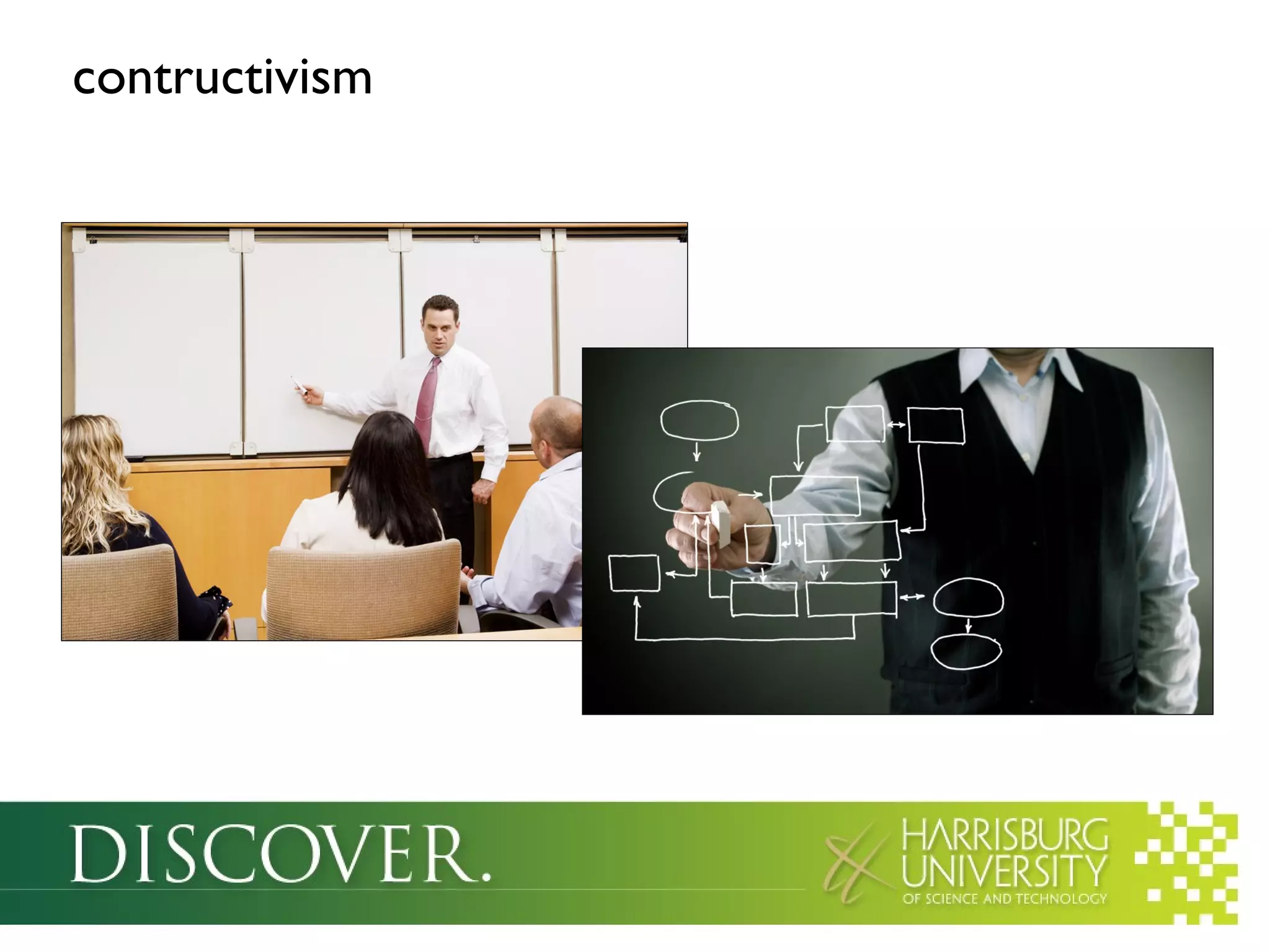
  • #13 Constructivism - Instructor’s Role From sage on stage to guide on side (move from teacher to facilitator) No longer didactic lecture to cover subject matter, but someone to help learners come to their own understanding. Instructors and learners learn from each other in a constructivist environment Facilitators play a major role in game-based learning through the debrief and making connection between playing and learning
  • #14 Andy Text chat: Have you heard of flow theory? Flow and Cycles of Expertise This concept that the brain can get overwhelmed is accounted for in game design by leveling. There are two design concepts related to leveling that we can apply to learning design to improve our learning ROI. Flow: Combination and balance of use of existing skills (ability) with acquiring new skills (challenge) that keeps the person engaged. Otherwise, if something is too challenging it’s frustrating. If it’s too easy, it’s boring. Goal: stay on the line or a little above or a little below. Cycles of Expertise: Learners practicing skills until they are nearly automatic, then having those skills fail that cause the learners to think again and learn new skills. (Pacing) Analogous to riding a bike. When you’re learning or experiencing something new you’re biking up hill. When you’re using something you know you’re biking down hill. An example of these strategies in a game would be: 1st Level = pretty easy (Who Wants to Be a Millionaire?) 2nd Level = knowledge + some new challenges 3rd Level = knowledge, but need to apply it a little faster 4th Level = knowledge + some new challenges Final Level = Cumulative application (really, really hard, but really fun and engaging) How is most learning structured? Module 1: new stuff Module 2: more new stuff Module 3: more new stuff Module 4: more new Module 5: Summary Assessment
  • #16 Andy
  • #17 Andy Games for formative assessment Kahoot https://getkahoot.com/ https://www.youtube.com/watch?v=5mRzrjbM6aw – overview for teachers https://www.youtube.com/watch?v=v2JbY979WUg – How to play Kahoot iPad Games Study Island Immune Attack Dimension M http://www.dimensionu.com/math/
  • #18 Andy
  • #19 Andy
  • #20 Andy
  • #21 Andy Angry Birds Lemonade Stand iCivics http://www.icivics.org/ Virtual Worlds simulations Hot Shot Business http://disney.go.com/hotshot/hsb2/index.html Jason Project Poll: Which simulated environments are you using for education Text chat: Any other games that you use or know of that might fit into this category?
  • #22 Andy
  • #23 Andy
  • #24 Andy
  • #25 Andy Sims Civilization Minecraft http://www.youtube.com/watch?v=RI0BN5AWOe8 http://minecraftedu.com/ World of Warcraft Virtual Worlds Poll: Which adventure worlds are you using for education? Text chat: Any other games that you use or know of that might fit into this category?
  • #26 Andy
  • #27 Andy
  • #28 Andy
  • #29 Andy Game format vs. game design (7 minutes) Games are not inherently fun; fun doesn’t just happen. It is carefully planned, designed, iterated upon and executed. Most games are composed of the following elements: Story (what happened before I started playing, what information do the players need to begin…) Character(s) / Role(s) (who are the cast of characters, what is my role in the world, …) Goal (like movies games follow a structure where the goes on a journey with the purpose of achieving a goal. In some instances the goal is unknown but is revealed to the player during the journey) Obstacle(s) (these are things that players must overcome; a level boss, mastery of a skill, proficiency in a subject area, …) Status / Feedback (reward systems) (what happens when the player overcomes an obstacle, how is advancement expressed [fireworks, gold stars, achievements, pay increase,] most often this feedback is related to what motivates the player Levels: are used to validate performance or break content into smaller chunks. Successful games and experiences are interwoven with these elements. It’s when story, challenges, rewards, and achievements are in balance that we perceive the experience as fun.
  • #31 bit.ly/X4FKJD Plog, glog and mod examples
  • #34 Gamestar Mechanic Quest 2 learn Supports a dynamic curriculum that uses the underlying design principles of games to create academically challenging, immersive, game-like learning experiences for students. Games and other forms of digital media also model the complexity and promise of “systems.” Understanding and accounting for this complexity is a fundamental literacy of the 21st century. 6th-12th grade school launched in fall 2009 http://q2l.org/
  • #35 Andy Update This - Poll: Which type of game(s) would you like to implement in your classroom? (multi select)
  • #38 LTMS slide 2
  • #39 Should be at 243 minutes to start this screen 10 minutes for this screen Andy/Charles
  • #40 Andy Games and simulations at Harrisburg University