Using games with students What are the best games for classroom use? Michelle Aubrecht and Ryan Hale Graduate Research Associates
Definition of game and play  from  Rules of Play  by Katie Salen and Eric Zimmerman Play:  "Play is free movement within a more rigid structure." p. 304 Sources: Rules of Play . Katie Salen and Eric Zimmerman. The instructional Power of digital games, social networking, simulations and how teachers can leverage them . Eric Klopfer, Scot Osterweil, Jennifer Groff, Jason Haas. 2009. The Education Arcade, Massachusetts Institute of Technology . Game:  "A game is a system in which players engage in an artificial conflict, defined by rules, that results in a quantifiable outcome." p. 80
Definition of game and play  Play and games:  The relationship between games and play can be structured in two ways:  Games are a subset of play : Games constitute a formalized part of all activities considered to be play.  And Play is an element of games : Play is one way to frame the complex phenomenon of games." p. 311
What is a simulation? They must be accurate. They demonstrate real-world events. Like a demonstration, but it is user-directed, providing a dynamic and interactive engagement with the subject matter. Potential to demonstrate physical events that cannot be easily created or seen in real life.
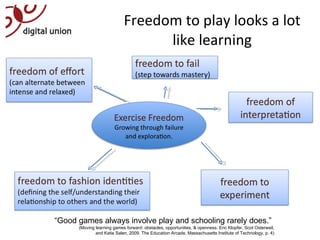
Freedom to play looks a lot like learning “ Good games always involve play and schooling rarely does.” (Moving learning games forward: obstacles, opportunities, & openness. Eric Klopfer, Scot Osterweil, and Katie Salen, 2009. The Education Arcade, Massachusetts Institute of Technology, p. 4)
using games  in the classroom Benefits - games can generate discussion points -games and simulations can demonstrate complicated processes or  systems - develop critical thinking skills and the ability to analyze systems - allow for visual, possibly complicated, comparing and contrasting  - gain procedural experience - games can involve the whole class and be fun  - jeopardy-style games are popular  - theater style games/ role playing - changes the dynamic from sage on the stage or teaching as telling to   interactive, engaging learning, that can be more memorable,  supporting collaboration and freedom to take risks and fail.    
using games  in the classroom Before you assign a game - know your teaching goal -evaluate the game for relevance to your topic - then decide how a game can serve that learning outcome - integrate it into your curriculum - decide how you will evaluate the process group participation writing homework – playing a game instead of reading is a grade necessary?
3 ways to obtain games 1. Students build games using free or a low cost game engine software, or physical materials; 2. Educators and/or developers build educational games from scratch or use free or purchased game engine software; 3. Educators integrate commercial off-the-shelf (COTS) games and free online games into the curriculum.
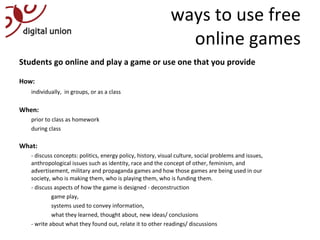
ways to use free online games Students go online and play a game or use one that you provide  How:  individually,  in groups, or as a class When:  prior to class as homework during class What: - discuss concepts: politics, energy policy, history, visual culture, social problems and issues, anthropological issues such as identity, race and the concept of other, feminism, and advertisement, military and propaganda games and how those games are being used in our society, who is making them, who is playing them, who is funding them. - discuss aspects of how the game is designed - deconstruction game play,  systems used to convey information, what they learned, thought about, new ideas/ conclusions - write about what they found out, relate it to other readings/ discussions    
Examples of Games online http://www.gamesforchange.org/
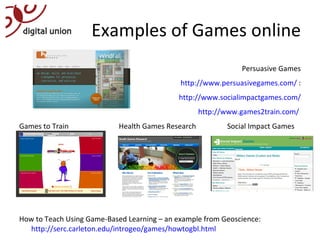
Examples of Games online Persuasive Games http://www.persuasivegames.com/  : http://www.socialimpactgames.com/ http://www.games2train.com/  Games to Train   Health Games Research Social Impact Games How to Teach Using Game-Based Learning – an example from Geoscience:  http://serc.carleton.edu/introgeo/games/howtogbl.html
students can make games   What do students gain? - The process can help students to understand systems, and negotiate play spaces, rules, and structure.  - The process of making a game can change one’s thinking about how to communicate and understand relationships – interpersonal and spatial   Materials  students can make a game without using a computer they can use free software
Examples of Simulations http://phet.colorado.edu/index.php Interactive Science Simulations – biology, chemistry, math, physics, earth science Fun, interactive, research-based simulations of physical phenomena from the PhET project at the University of Colorado.
PhET free Estimation Training

Using Games with students

  • 1.
    Using games withstudents What are the best games for classroom use? Michelle Aubrecht and Ryan Hale Graduate Research Associates
  • 2.
    Definition of gameand play from Rules of Play by Katie Salen and Eric Zimmerman Play: "Play is free movement within a more rigid structure." p. 304 Sources: Rules of Play . Katie Salen and Eric Zimmerman. The instructional Power of digital games, social networking, simulations and how teachers can leverage them . Eric Klopfer, Scot Osterweil, Jennifer Groff, Jason Haas. 2009. The Education Arcade, Massachusetts Institute of Technology . Game: "A game is a system in which players engage in an artificial conflict, defined by rules, that results in a quantifiable outcome." p. 80
  • 3.
    Definition of gameand play Play and games: The relationship between games and play can be structured in two ways: Games are a subset of play : Games constitute a formalized part of all activities considered to be play. And Play is an element of games : Play is one way to frame the complex phenomenon of games." p. 311
  • 4.
    What is asimulation? They must be accurate. They demonstrate real-world events. Like a demonstration, but it is user-directed, providing a dynamic and interactive engagement with the subject matter. Potential to demonstrate physical events that cannot be easily created or seen in real life.
  • 5.
    Freedom to playlooks a lot like learning “ Good games always involve play and schooling rarely does.” (Moving learning games forward: obstacles, opportunities, & openness. Eric Klopfer, Scot Osterweil, and Katie Salen, 2009. The Education Arcade, Massachusetts Institute of Technology, p. 4)
  • 6.
    using games in the classroom Benefits - games can generate discussion points -games and simulations can demonstrate complicated processes or systems - develop critical thinking skills and the ability to analyze systems - allow for visual, possibly complicated, comparing and contrasting - gain procedural experience - games can involve the whole class and be fun - jeopardy-style games are popular - theater style games/ role playing - changes the dynamic from sage on the stage or teaching as telling to interactive, engaging learning, that can be more memorable, supporting collaboration and freedom to take risks and fail.    
  • 7.
    using games in the classroom Before you assign a game - know your teaching goal -evaluate the game for relevance to your topic - then decide how a game can serve that learning outcome - integrate it into your curriculum - decide how you will evaluate the process group participation writing homework – playing a game instead of reading is a grade necessary?
  • 8.
    3 ways toobtain games 1. Students build games using free or a low cost game engine software, or physical materials; 2. Educators and/or developers build educational games from scratch or use free or purchased game engine software; 3. Educators integrate commercial off-the-shelf (COTS) games and free online games into the curriculum.
  • 9.
    ways to usefree online games Students go online and play a game or use one that you provide How: individually, in groups, or as a class When: prior to class as homework during class What: - discuss concepts: politics, energy policy, history, visual culture, social problems and issues, anthropological issues such as identity, race and the concept of other, feminism, and advertisement, military and propaganda games and how those games are being used in our society, who is making them, who is playing them, who is funding them. - discuss aspects of how the game is designed - deconstruction game play, systems used to convey information, what they learned, thought about, new ideas/ conclusions - write about what they found out, relate it to other readings/ discussions    
  • 10.
    Examples of Gamesonline http://www.gamesforchange.org/
  • 11.
    Examples of Gamesonline Persuasive Games http://www.persuasivegames.com/ : http://www.socialimpactgames.com/ http://www.games2train.com/ Games to Train Health Games Research Social Impact Games How to Teach Using Game-Based Learning – an example from Geoscience: http://serc.carleton.edu/introgeo/games/howtogbl.html
  • 12.
    students can makegames   What do students gain? - The process can help students to understand systems, and negotiate play spaces, rules, and structure. - The process of making a game can change one’s thinking about how to communicate and understand relationships – interpersonal and spatial   Materials students can make a game without using a computer they can use free software
  • 13.
    Examples of Simulationshttp://phet.colorado.edu/index.php Interactive Science Simulations – biology, chemistry, math, physics, earth science Fun, interactive, research-based simulations of physical phenomena from the PhET project at the University of Colorado.
  • 14.