TO DESIGN A PLATE FREEZER FOR
LOW TEMPERATURE APPLICATION
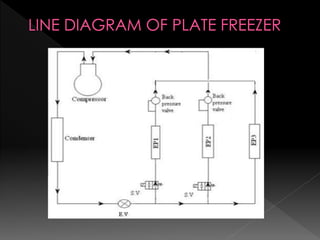
 Line Diagram Plate Freezer
 Design Procedure
 Load Calculation
 Calculation Of Mass Flow Rate
 Specification
1. Compressor
2. Condenser
3. Expansion Valve
4. Evaporators Plate
5. Solenoid Valve
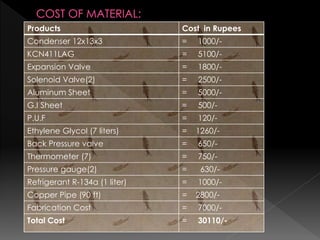
 Cost Analysis
CALCULATION FOR FREEZER REFRIGERATION LOAD :
SPECIFICATION:
50mm thick tray
Capacity = 28 kg per day
Evaporating temperature = -30°C
Fish initial temperature = 10°C
Specific heat of fish above freezing = 3.18 KJ/kgK
Specific heat of fish below freezing = 1.67 KJ/kgK
Latent heat of fish = 276 KJ/kg
Using these values, the above calculation for fish refrigeration load
will be,
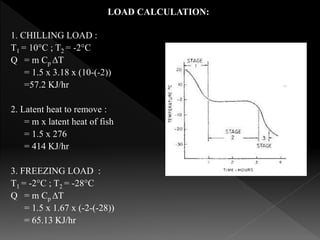
LOAD CALCULATION:
1. CHILLING LOAD :
T1 = 10°C ; T2 = -2°C
Q = m Cp ∆T
= 1.5 x 3.18 x (10-(-2))
=57.2 KJ/hr
2. Latent heat to remove :
= m x latent heat of fish
= 1.5 x 276
= 414 KJ/hr
3. FREEZING LOAD :
T1 = -2°C ; T2 = -28°C
Q = m Cp ∆T
= 1.5 x 1.67 x (-2-(-28))
= 65.13 KJ/hr
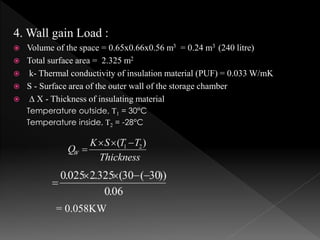
4. Wall gain Load :
 Volume of the space = 0.65x0.66x0.56 m3 = 0.24 m3 (240 litre)
 Total surface area = 2.325 m2
 k- Thermal conductivity of insulation material (PUF) = 0.033 W/mK
 S - Surface area of the outer wall of the storage chamber
 ∆ X - Thickness of insulating material
Temperature outside, T1 = 30°C
Temperature inside, T2 = -28°C
= 0.058KW
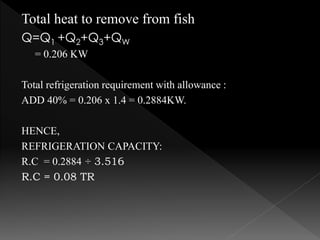
Total heat to remove from fish
Q=Q1 +Q2+Q3+QW
= 0.206 KW
Total refrigeration requirement with allowance :
ADD 40% = 0.206 x 1.4 = 0.2884KW.
HENCE,
REFRIGERATION CAPACITY:
R.C = 0.2884 ÷ 3.516
R.C = 0.08 TR
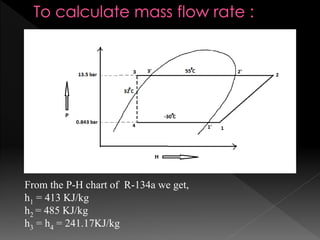
From the P-H chart of R-134a we get,
h1 = 413 KJ/kg
h2 = 485 KJ/kg
h3 = h4 = 241.17KJ/kg
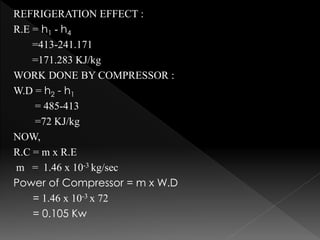
REFRIGERATION EFFECT :
R.E = h1 - h4
=413-241.171
=171.283 KJ/kg
WORK DONE BY COMPRESSOR :
W.D = h2 - h1
= 485-413
=72 KJ/kg
NOW,
R.C = m x R.E
m = 1.46 x 10⁻³ kg/sec
Power of Compressor = m x W.D
= 1.46 x 10-3 x 72
= 0.105 Kw
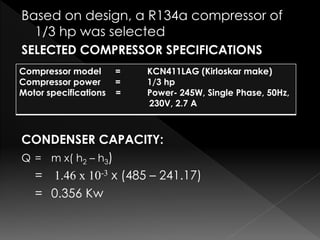
Based on design, a R134a compressor of
1/3 hp was selected
SELECTED COMPRESSOR SPECIFICATIONS
CONDENSER CAPACITY:
Q = m x( h2 – h3)
= 1.46 x 10-3 x (485 – 241.17)
= 0.356 Kw
Compressor model = KCN411LAG (Kirloskar make)
Compressor power = 1/3 hp
Motor specifications = Power- 245W, Single Phase, 50Hz,
230V, 2.7 A
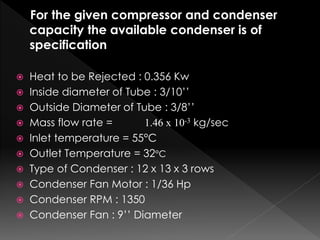
For the given compressor and condenser
capacity the available condenser is of
specification
 Heat to be Rejected : 0.356 Kw
 Inside diameter of Tube : 3/10’’
 Outside Diameter of Tube : 3/8’’
 Mass flow rate = 1.46 x 10⁻³ kg/sec
 Inlet temperature = 55°C
 Outlet Temperature = 32°C
 Type of Condenser : 12 x 13 x 3 rows
 Condenser Fan Motor : 1/36 Hp
 Condenser RPM : 1350
 Condenser Fan : 9’’ Diameter
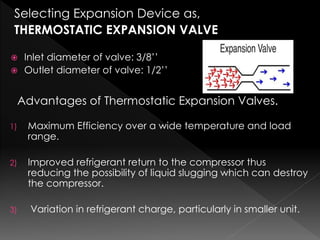
Selecting Expansion Device as,
THERMOSTATIC EXPANSION VALVE
 Inlet diameter of valve: 3/8’’
 Outlet diameter of valve: 1/2’’
Advantages of Thermostatic Expansion Valves.
1) Maximum Efficiency over a wide temperature and load
range.
2) Improved refrigerant return to the compressor thus
reducing the possibility of liquid slugging which can destroy
the compressor.
3) Variation in refrigerant charge, particularly in smaller unit.
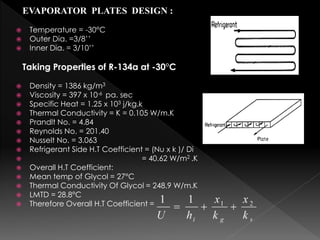
EVAPORATOR PLATES DESIGN :
 Temperature = -30°C
 Outer Dia. =3/8’’
 Inner Dia. = 3/10’’
Taking Properties of R-134a at -30°C
 Density = 1386 kg/m3
 Viscosity = 397 x 10-6 pa. sec
 Specific Heat = 1.25 x 10³ j/kg.k
 Thermal Conductivity = K = 0.105 W/m.K
 Prandlt No. = 4.84
 Reynolds No. = 201.40
 Nusselt No. = 3.063
 Refrigerant Side H.T Coefficient = (Nu x k )/ Di
 = 40.62 W/m2 .K
 Overall H.T Coefficient:
 Mean temp of Glycol = 27°C
 Thermal Conductivity Of Glycol = 248.9 W/m.K
 LMTD = 28.8°C
 Therefore Overall H.T Coefficient =
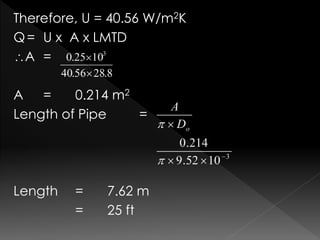
Therefore, U = 40.56 W/m2K
Q= U x A x LMTD
A =
A = 0.214 m2
Length of Pipe =
Length = 7.62 m
= 25 ft
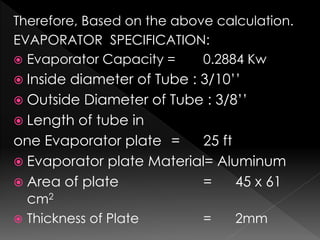
Therefore, Based on the above calculation.
EVAPORATOR SPECIFICATION:
 Evaporator Capacity = 0.2884 Kw
 Inside diameter of Tube : 3/10’’
 Outside Diameter of Tube : 3/8’’
 Length of tube in
one Evaporator plate = 25 ft
 Evaporator plate Material= Aluminum
 Area of plate = 45 x 61
cm2
 Thickness of Plate = 2mm
SOLENOID VALVE
 A solenoid valve is an electromechanical valve used
to control the flow of liquid or gas
 Their function is simply to turn refrigerant flow on and
off.
 Solenoid valves offer fast and safe switching,
reliability, long life and compact design.
 When the solenoid coil is electrically energized, it
produces a magnetic field that attracts iron and
many of its alloys, then the iron armature or plunger is
drawn up into the core of the solenoid.
 When the solenoid valve is de-energized, the plunger
falls, and the poppet closes the valve port.
Products Cost in Rupees
Condenser 12x13x3 = 1000/-
KCN411LAG = 5100/-
Expansion Valve = 1800/-
Solenoid Valve(2) = 2500/-
Aluminum Sheet = 5000/-
G.I Sheet = 500/-
P.U.F = 120/-
Ethylene Glycol (7 liters) = 1260/-
Back Pressure valve = 650/-
Thermometer (7) = 750/-
Pressure gauge(2) = 630/-
Refrigerant R-134a (1 liter) = 1000/-
Copper Pipe (90 ft) = 2800/-
Fabrication Cost = 7000/-
Total Cost = 30110/-
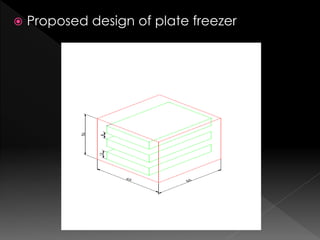
 Proposed design of plate freezer
THANK YOU

PLATE FREEZER

  • 2.
    TO DESIGN APLATE FREEZER FOR LOW TEMPERATURE APPLICATION
  • 3.
     Line DiagramPlate Freezer  Design Procedure  Load Calculation  Calculation Of Mass Flow Rate  Specification 1. Compressor 2. Condenser 3. Expansion Valve 4. Evaporators Plate 5. Solenoid Valve  Cost Analysis
  • 5.
    CALCULATION FOR FREEZERREFRIGERATION LOAD : SPECIFICATION: 50mm thick tray Capacity = 28 kg per day Evaporating temperature = -30°C Fish initial temperature = 10°C Specific heat of fish above freezing = 3.18 KJ/kgK Specific heat of fish below freezing = 1.67 KJ/kgK Latent heat of fish = 276 KJ/kg Using these values, the above calculation for fish refrigeration load will be,
  • 6.
    LOAD CALCULATION: 1. CHILLINGLOAD : T1 = 10°C ; T2 = -2°C Q = m Cp ∆T = 1.5 x 3.18 x (10-(-2)) =57.2 KJ/hr 2. Latent heat to remove : = m x latent heat of fish = 1.5 x 276 = 414 KJ/hr 3. FREEZING LOAD : T1 = -2°C ; T2 = -28°C Q = m Cp ∆T = 1.5 x 1.67 x (-2-(-28)) = 65.13 KJ/hr
  • 7.
    4. Wall gainLoad :  Volume of the space = 0.65x0.66x0.56 m3 = 0.24 m3 (240 litre)  Total surface area = 2.325 m2  k- Thermal conductivity of insulation material (PUF) = 0.033 W/mK  S - Surface area of the outer wall of the storage chamber  ∆ X - Thickness of insulating material Temperature outside, T1 = 30°C Temperature inside, T2 = -28°C = 0.058KW
  • 8.
    Total heat toremove from fish Q=Q1 +Q2+Q3+QW = 0.206 KW Total refrigeration requirement with allowance : ADD 40% = 0.206 x 1.4 = 0.2884KW. HENCE, REFRIGERATION CAPACITY: R.C = 0.2884 ÷ 3.516 R.C = 0.08 TR
  • 9.
    From the P-Hchart of R-134a we get, h1 = 413 KJ/kg h2 = 485 KJ/kg h3 = h4 = 241.17KJ/kg
  • 10.
    REFRIGERATION EFFECT : R.E= h1 - h4 =413-241.171 =171.283 KJ/kg WORK DONE BY COMPRESSOR : W.D = h2 - h1 = 485-413 =72 KJ/kg NOW, R.C = m x R.E m = 1.46 x 10⁻³ kg/sec Power of Compressor = m x W.D = 1.46 x 10-3 x 72 = 0.105 Kw
  • 11.
    Based on design,a R134a compressor of 1/3 hp was selected SELECTED COMPRESSOR SPECIFICATIONS CONDENSER CAPACITY: Q = m x( h2 – h3) = 1.46 x 10-3 x (485 – 241.17) = 0.356 Kw Compressor model = KCN411LAG (Kirloskar make) Compressor power = 1/3 hp Motor specifications = Power- 245W, Single Phase, 50Hz, 230V, 2.7 A
  • 12.
    For the givencompressor and condenser capacity the available condenser is of specification  Heat to be Rejected : 0.356 Kw  Inside diameter of Tube : 3/10’’  Outside Diameter of Tube : 3/8’’  Mass flow rate = 1.46 x 10⁻³ kg/sec  Inlet temperature = 55°C  Outlet Temperature = 32°C  Type of Condenser : 12 x 13 x 3 rows  Condenser Fan Motor : 1/36 Hp  Condenser RPM : 1350  Condenser Fan : 9’’ Diameter
  • 13.
    Selecting Expansion Deviceas, THERMOSTATIC EXPANSION VALVE  Inlet diameter of valve: 3/8’’  Outlet diameter of valve: 1/2’’ Advantages of Thermostatic Expansion Valves. 1) Maximum Efficiency over a wide temperature and load range. 2) Improved refrigerant return to the compressor thus reducing the possibility of liquid slugging which can destroy the compressor. 3) Variation in refrigerant charge, particularly in smaller unit.
  • 14.
    EVAPORATOR PLATES DESIGN:  Temperature = -30°C  Outer Dia. =3/8’’  Inner Dia. = 3/10’’ Taking Properties of R-134a at -30°C  Density = 1386 kg/m3  Viscosity = 397 x 10-6 pa. sec  Specific Heat = 1.25 x 10³ j/kg.k  Thermal Conductivity = K = 0.105 W/m.K  Prandlt No. = 4.84  Reynolds No. = 201.40  Nusselt No. = 3.063  Refrigerant Side H.T Coefficient = (Nu x k )/ Di  = 40.62 W/m2 .K  Overall H.T Coefficient:  Mean temp of Glycol = 27°C  Thermal Conductivity Of Glycol = 248.9 W/m.K  LMTD = 28.8°C  Therefore Overall H.T Coefficient =
  • 15.
    Therefore, U =40.56 W/m2K Q= U x A x LMTD A = A = 0.214 m2 Length of Pipe = Length = 7.62 m = 25 ft
  • 16.
    Therefore, Based onthe above calculation. EVAPORATOR SPECIFICATION:  Evaporator Capacity = 0.2884 Kw  Inside diameter of Tube : 3/10’’  Outside Diameter of Tube : 3/8’’  Length of tube in one Evaporator plate = 25 ft  Evaporator plate Material= Aluminum  Area of plate = 45 x 61 cm2  Thickness of Plate = 2mm
  • 17.
    SOLENOID VALVE  Asolenoid valve is an electromechanical valve used to control the flow of liquid or gas  Their function is simply to turn refrigerant flow on and off.  Solenoid valves offer fast and safe switching, reliability, long life and compact design.  When the solenoid coil is electrically energized, it produces a magnetic field that attracts iron and many of its alloys, then the iron armature or plunger is drawn up into the core of the solenoid.  When the solenoid valve is de-energized, the plunger falls, and the poppet closes the valve port.
  • 18.
    Products Cost inRupees Condenser 12x13x3 = 1000/- KCN411LAG = 5100/- Expansion Valve = 1800/- Solenoid Valve(2) = 2500/- Aluminum Sheet = 5000/- G.I Sheet = 500/- P.U.F = 120/- Ethylene Glycol (7 liters) = 1260/- Back Pressure valve = 650/- Thermometer (7) = 750/- Pressure gauge(2) = 630/- Refrigerant R-134a (1 liter) = 1000/- Copper Pipe (90 ft) = 2800/- Fabrication Cost = 7000/- Total Cost = 30110/-
  • 19.
     Proposed designof plate freezer
  • 20.