International Research Journal of Engineering and Technology (IRJET) e-ISSN: 2395-0056
Volume: 06 Issue: 06 | June 2019 www.irjet.net p-ISSN: 2395-0072
© 2019, IRJET | Impact Factor value: 7.211 | ISO 9001:2008 Certified Journal | Page 506
DESIGN AND FABRICATION OF SIMULTANEOUS HEATING AND COOLING
IN VCR SYSTEM USING R134A REFRIGERENT
K.V.L.Bhuvaneswary1, Sunil Rathod2, Akshay Khamkar3, Subrato Banergee4, Manjit Punia4
1Professor, Dept. of Mechanical Engineering, Dr. D Y Patil Institute of Engg. Management and Research, Akurdi
Pune
2345B.E. Mechanical engineer at Dr. D Y Patil Institute of Engg. Management and Research, Akurdi, Pune
---------------------------------------------------------------------***---------------------------------------------------------------------
Abstract –This researchpaperpresentvapourcompression
refrigeration system for simultaneous heating and cooling. In
normal refrigeration system the heat rejected in condenser is
get wasted, in this paper we have utilized heat rejected in
condenser. This rejected heat used for home purpose, like
heating water, bathing, washing clothes and pots. The main
advantage of simultaneous heating and cooling it carried out
from one VCR system. It doesnotrequiredseparateequipment,
It save the cost. For research purpose water cooled condenser
water cooled evaporator is used. Refrigerant is the substance
that transfer heat in refrigeration system that absorb heat in
evaporator and rejected heat in condenser. In this system
R134a refrigerant is used. ODP and GWP is low for R134a
refrigerant .COP has to be calculated for selected good
refrigerant. Refrigerant should have low boiling temperature,
high critical temperature and higher liquid thermal
conductivity which makes these properties as a good
refrigerant. In this paper R134a environment-friendly
refrigerant that have zero ODP and low GWP is used. We can
use the hot water for cleaning textile, processheating industry,
food industry also in milk industry.
Key Words: VCRS, Heating, Cooling, ODP, GWP, Condenser.
1. INTRODUCTION
Refrigeration is a process of providing and maintaining
temperature below the atmosphere. The medium used for
refrigeration process is called as refrigerant. The basic
element of refrigeration system are compressor, condenser,
capillary tube, andevaporator.Theozonedepletionpotential
and global warming potential have become the most
important criteria for selecting any refrigerant, still lot of
research is ongoing to decide the environmentally friendly
refrigerants.[1]
Refrigerant is the fluid used for heat transfer from the
region of low temperature and pressure and reject the heat
in condenser at a region of high temperature and pressure.
The environment-friendly halocarbon refrigerant that have
zero ODP, non-flammable,non-toxic andlowGWPisselected
in vapour compression refrigeration system. The R134a has
all this properties, so in VCR system R134a mostly used.
Before selecting any refrigerant the following properties are
requires, critical temperature of the refrigerantshouldbe as
high, The specific heat of the liquid should be as small as
possible, The density of the refrigerant should be as large,
ODP of refrigerants should be zero, Refrigerantsshouldhave
as low a GWP[2]
The main aim of this research paper is to utilize the waste
heat rejected in condenser, for this the water cooled
condenser is used. The household refrigerator mostly used
restaurant and in kitchens for the storage of fruits and
vegetable but due to simultaneous heating and cooling This
rejected heat used for home purpose, like heating water,
bathing, washing clothes and pots. The term “refrigeration‟
in a broad sense is used for the process of removing heat
from a substance. It also includes the process of reducing
and maintaining the temperature of a body below the
general temperature of its surroundings. It transfer the heat
from condenser to evaporator. In other words, the
refrigeration means a continued extraction of heat from a
body, whose temperature is already below the temperature
of its surroundings.
The testing consists of a hermetic compressor, water cooled
condenser, a capillary tubeanda watercooledevaporator.In
addition to these the other component are temperature
sensor, pressure gauge, ammeter, and voltmeter. Pressure
gauges are installed to measure the condenser and
evaporator pressures. The household refrigerator works on
vapour compression refrigeration cycle. In compressor the
pressure and temperatureof refrigerantisincrease,thishigh
pressure and high temperature refrigerant enter in
condenser where the heat rejection takes place. The heat
rejection in condenser takes place at constant pressure. In
capillary tube the pressure is get reduce at constant
enthalpy, and in evaporator the heat is get absorbed at
constant pressure, finally from the outlet of evaporator we
will get low pressure, low temperature vapour refrigerant.
Copper tube is mostly used for supply refrigerant. In
evaporator the liquid + vapourrefrigerantabsorblatent heat
of vaporization from the medium which is to be cooled, the
cycle get repeated. The miniature circuit breaker used to
protect from over current. MCB can be easily reset [3]
Nomenclature
COP coefficient of performance
Cp specific heat at constant pressure (kJ/kg K)
h enthalpy (kJ/kg)
ṁ mass flow rate (kg/s)
International Research Journal of Engineering and Technology (IRJET) e-ISSN: 2395-0056
Volume: 06 Issue: 06 | June 2019 www.irjet.net p-ISSN: 2395-0072
© 2019, IRJET | Impact Factor value: 7.211 | ISO 9001:2008 Certified Journal | Page 507
Ẇ compressor electrical power consumption (kW)
P pressure (bar)
Qcool heat absorbed in evaporator (kW)
Qhot heat rejected condenser (kW)
s entropy (kJ/kg K)
T Temperature (˚C HCFCs hydro chlorofluorocarbon
HCs hydrocarbons
CFCs chlorofluorocarbons
HFCs Hydro fluorocarbons
VCR Vapour Compression Refrigeration
1.1 Theoretical analysis
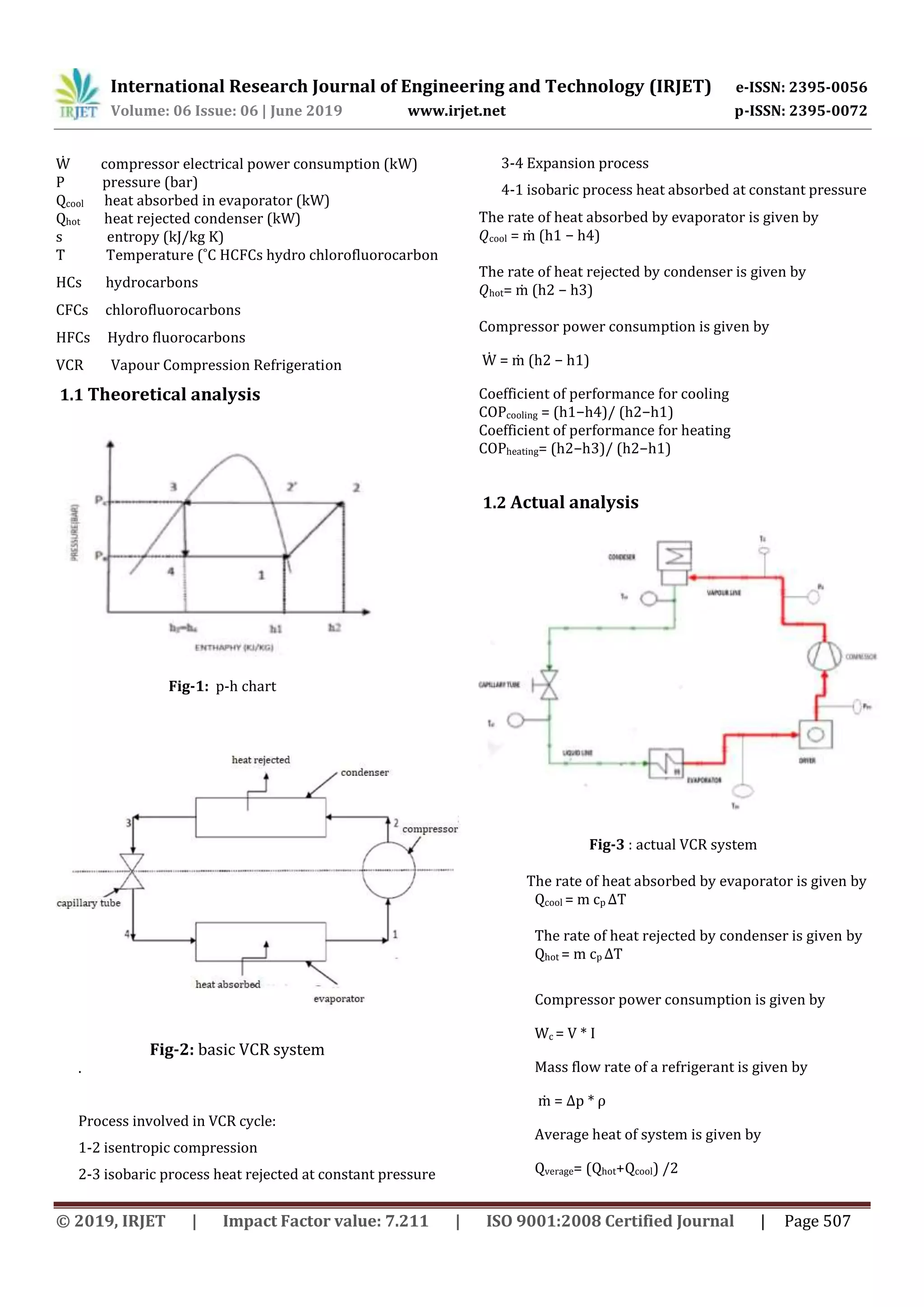
Fig-1: p-h chart
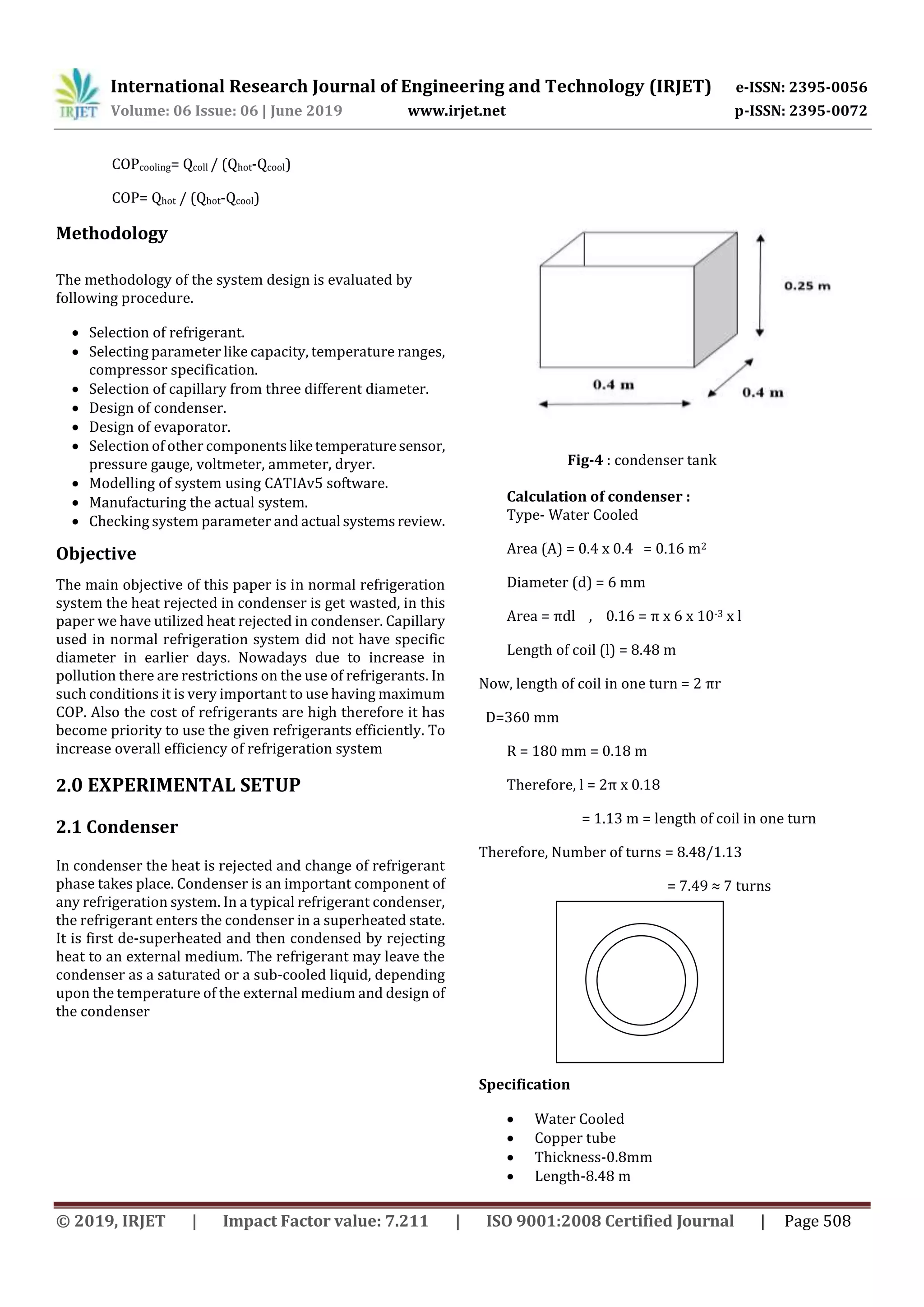
Fig-2: basic VCR system
.
Process involved in VCR cycle:
1-2 isentropic compression
2-3 isobaric process heat rejected at constant pressure
3-4 Expansion process
4-1 isobaric process heat absorbed at constant pressure
The rate of heat absorbed by evaporator is given by
𝑄cool = ṁ (h1 − h4)
The rate of heat rejected by condenser is given by
𝑄hot= ṁ (h2 − h3)
Compressor power consumption is given by
Ẇ = ṁ (h2 − h1)
Coefficient of performance for cooling
COPcooling = (h1−h4)/ (h2−h1)
Coefficient of performance for heating
COPheating= (h2−h3)/ (h2−h1)
1.2 Actual analysis
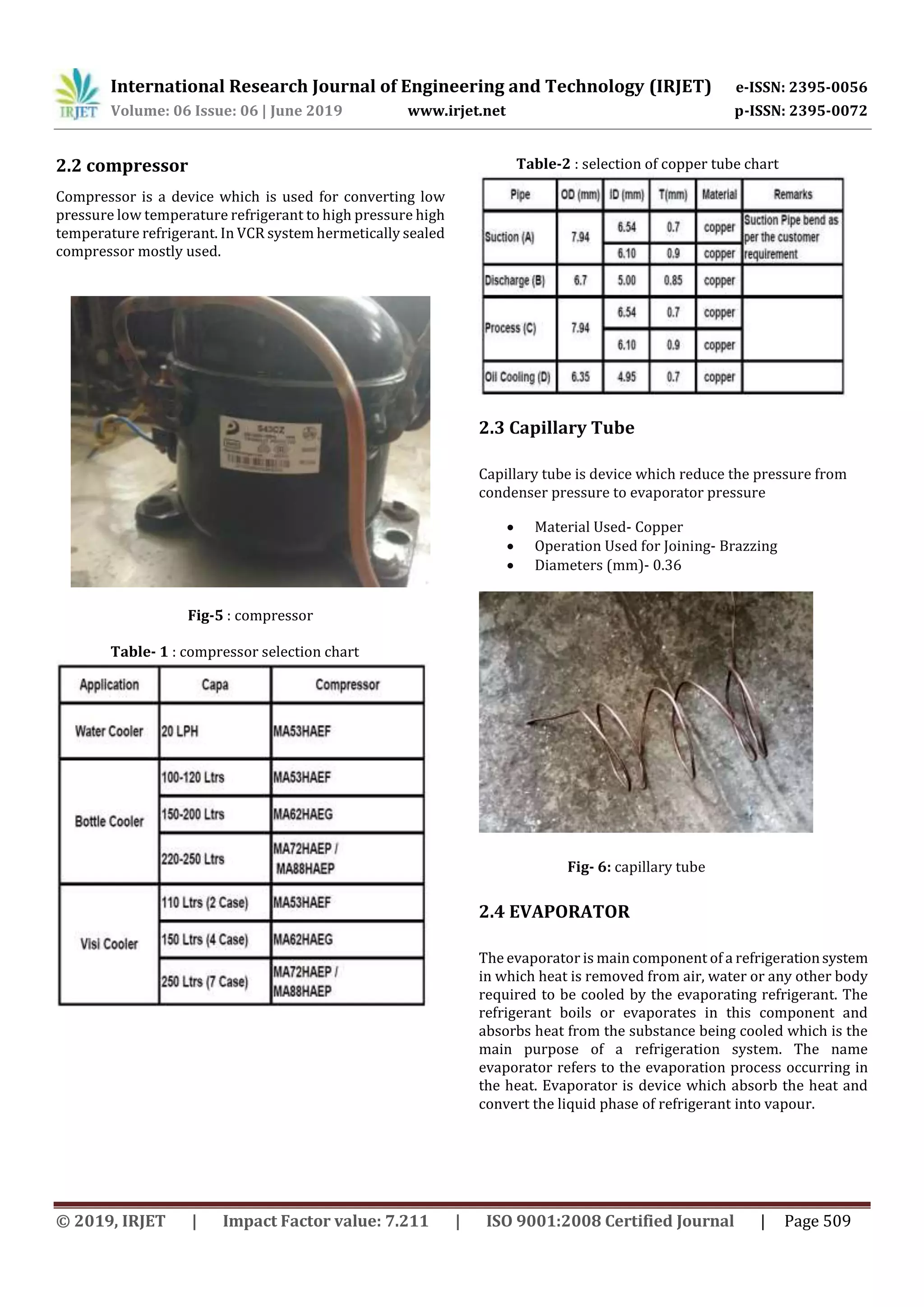
Fig-3 : actual VCR system
The rate of heat absorbed by evaporator is given by
Qcool = m cp ΔT
The rate of heat rejected by condenser is given by
Qhot = m cp ΔT
Compressor power consumption is given by
Wc = V * I
Mass flow rate of a refrigerant is given by
ṁ = Δp * ρ
Average heat of system is given by
Qverage= (Qhot+Qcool) /2
International Research Journal of Engineering and Technology (IRJET) e-ISSN: 2395-0056
Volume: 06 Issue: 06 | June 2019 www.irjet.net p-ISSN: 2395-0072
© 2019, IRJET | Impact Factor value: 7.211 | ISO 9001:2008 Certified Journal | Page 508
COPcooling= Qcoll / (Qhot-Qcool)
COP= Qhot / (Qhot-Qcool)
Methodology
The methodology of the system design is evaluated by
following procedure.
 Selection of refrigerant.
 Selecting parameter like capacity, temperature ranges,
compressor specification.
 Selection of capillary from three different diameter.
 Design of condenser.
 Design of evaporator.
 Selection of other componentsliketemperaturesensor,
pressure gauge, voltmeter, ammeter, dryer.
 Modelling of system using CATIAv5 software.
 Manufacturing the actual system.
 Checking system parameter and actual systemsreview.
Objective
The main objective of this paper is in normal refrigeration
system the heat rejected in condenser is get wasted, in this
paper we have utilized heat rejected in condenser. Capillary
used in normal refrigeration system did not have specific
diameter in earlier days. Nowadays due to increase in
pollution there are restrictions on the use of refrigerants. In
such conditions it is very important to use having maximum
COP. Also the cost of refrigerants are high therefore it has
become priority to use the given refrigerants efficiently. To
increase overall efficiency of refrigeration system
2.0 EXPERIMENTAL SETUP
2.1 Condenser
In condenser the heat is rejected and change of refrigerant
phase takes place. Condenser is an important component of
any refrigeration system. In a typical refrigerant condenser,
the refrigerant enters the condenser in a superheated state.
It is first de-superheated and then condensed by rejecting
heat to an external medium. The refrigerant may leave the
condenser as a saturated or a sub-cooled liquid, depending
upon the temperature of the external medium and design of
the condenser
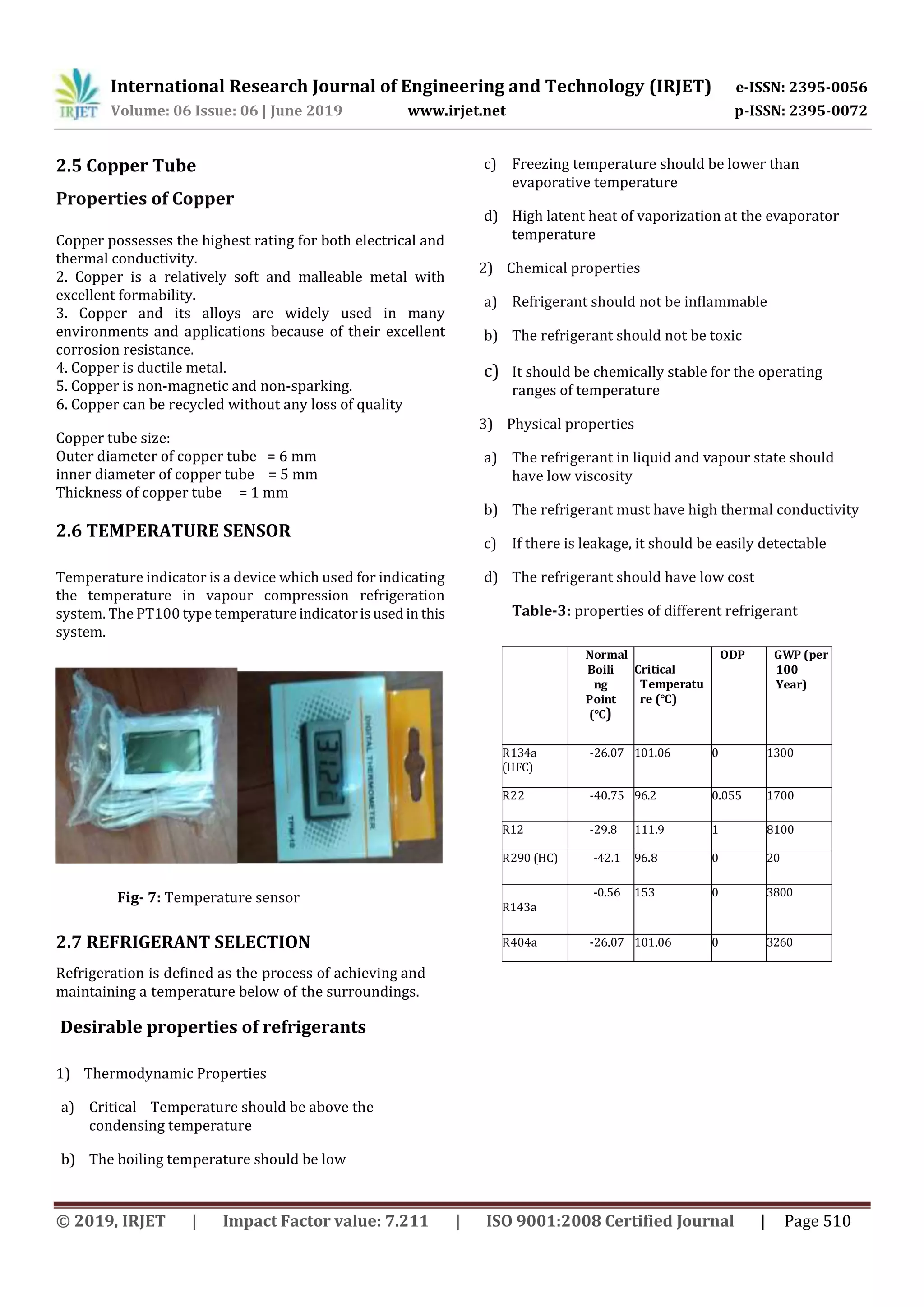
Fig-4 : condenser tank
Calculation of condenser :
Type- Water Cooled
Area (A) = 0.4 x 0.4 = 0.16 m2
Diameter (d) = 6 mm
Area = πdl , 0.16 = π x 6 x 10⁻³ x l
Length of coil (l) = 8.48 m
Now, length of coil in one turn = 2 πr
D=360 mm
R = 180 mm = 0.18 m
Therefore, l = 2π x 0.18
= 1.13 m = length of coil in one turn
Therefore, Number of turns = 8.48/1.13
= 7.49 ≈ 7 turns
Specification
 Water Cooled
 Copper tube
 Thickness-0.8mm
 Length-8.48 m
International Research Journal of Engineering and Technology (IRJET) e-ISSN: 2395-0056
Volume: 06 Issue: 06 | June 2019 www.irjet.net p-ISSN: 2395-0072
© 2019, IRJET | Impact Factor value: 7.211 | ISO 9001:2008 Certified Journal | Page 509
2.2 compressor
Compressor is a device which is used for converting low
pressure low temperature refrigerant to high pressure high
temperature refrigerant. In VCR system hermetically sealed
compressor mostly used.
Fig-5 : compressor
Table- 1 : compressor selection chart
Table-2 : selection of copper tube chart
2.3 Capillary Tube
Capillary tube is device which reduce the pressure from
condenser pressure to evaporator pressure
 Material Used- Copper
 Operation Used for Joining- Brazzing
 Diameters (mm)- 0.36
Fig- 6: capillary tube
2.4 EVAPORATOR
The evaporator is main component of a refrigerationsystem
in which heat is removed from air, water or any other body
required to be cooled by the evaporating refrigerant. The
refrigerant boils or evaporates in this component and
absorbs heat from the substance being cooled which is the
main purpose of a refrigeration system. The name
evaporator refers to the evaporation process occurring in
the heat. Evaporator is device which absorb the heat and
convert the liquid phase of refrigerant into vapour.
International Research Journal of Engineering and Technology (IRJET) e-ISSN: 2395-0056
Volume: 06 Issue: 06 | June 2019 www.irjet.net p-ISSN: 2395-0072
© 2019, IRJET | Impact Factor value: 7.211 | ISO 9001:2008 Certified Journal | Page 510
2.5 Copper Tube
Properties of Copper
Copper possesses the highest rating for both electrical and
thermal conductivity.
2. Copper is a relatively soft and malleable metal with
excellent formability.
3. Copper and its alloys are widely used in many
environments and applications because of their excellent
corrosion resistance.
4. Copper is ductile metal.
5. Copper is non-magnetic and non-sparking.
6. Copper can be recycled without any loss of quality
Copper tube size:
Outer diameter of copper tube = 6 mm
inner diameter of copper tube = 5 mm
Thickness of copper tube = 1 mm
2.6 TEMPERATURE SENSOR
Temperature indicator is a device which used for indicating
the temperature in vapour compression refrigeration
system. The PT100 type temperatureindicatorisusedin this
system.
Fig- 7: Temperature sensor
2.7 REFRIGERANT SELECTION
Refrigeration is defined as the process of achieving and
maintaining a temperature below of the surroundings.
Desirable properties of refrigerants
1) Thermodynamic Properties
a) Critical Temperature should be above the
condensing temperature
b) The boiling temperature should be low
c) Freezing temperature should be lower than
evaporative temperature
d) High latent heat of vaporization at the evaporator
temperature
2) Chemical properties
a) Refrigerant should not be inflammable
b) The refrigerant should not be toxic
c) It should be chemically stable for the operating
ranges of temperature
3) Physical properties
a) The refrigerant in liquid and vapour state should
have low viscosity
b) The refrigerant must have high thermal conductivity
c) If there is leakage, it should be easily detectable
d) The refrigerant should have low cost
Table-3: properties of different refrigerant
Normal
Boili
ng
Point
(°C)
Critical
Temperatu
re (°C)
ODP GWP (per
100
Year)
R134a
(HFC)
-26.07 101.06 0 1300
R22 -40.75 96.2 0.055 1700
R12 -29.8 111.9 1 8100
R290 (HC) -42.1 96.8 0 20
R143a
-0.56 153 0 3800
R404a -26.07 101.06 0 3260
International Research Journal of Engineering and Technology (IRJET) e-ISSN: 2395-0056
Volume: 06 Issue: 06 | June 2019 www.irjet.net p-ISSN: 2395-0072
© 2019, IRJET | Impact Factor value: 7.211 | ISO 9001:2008 Certified Journal | Page 511
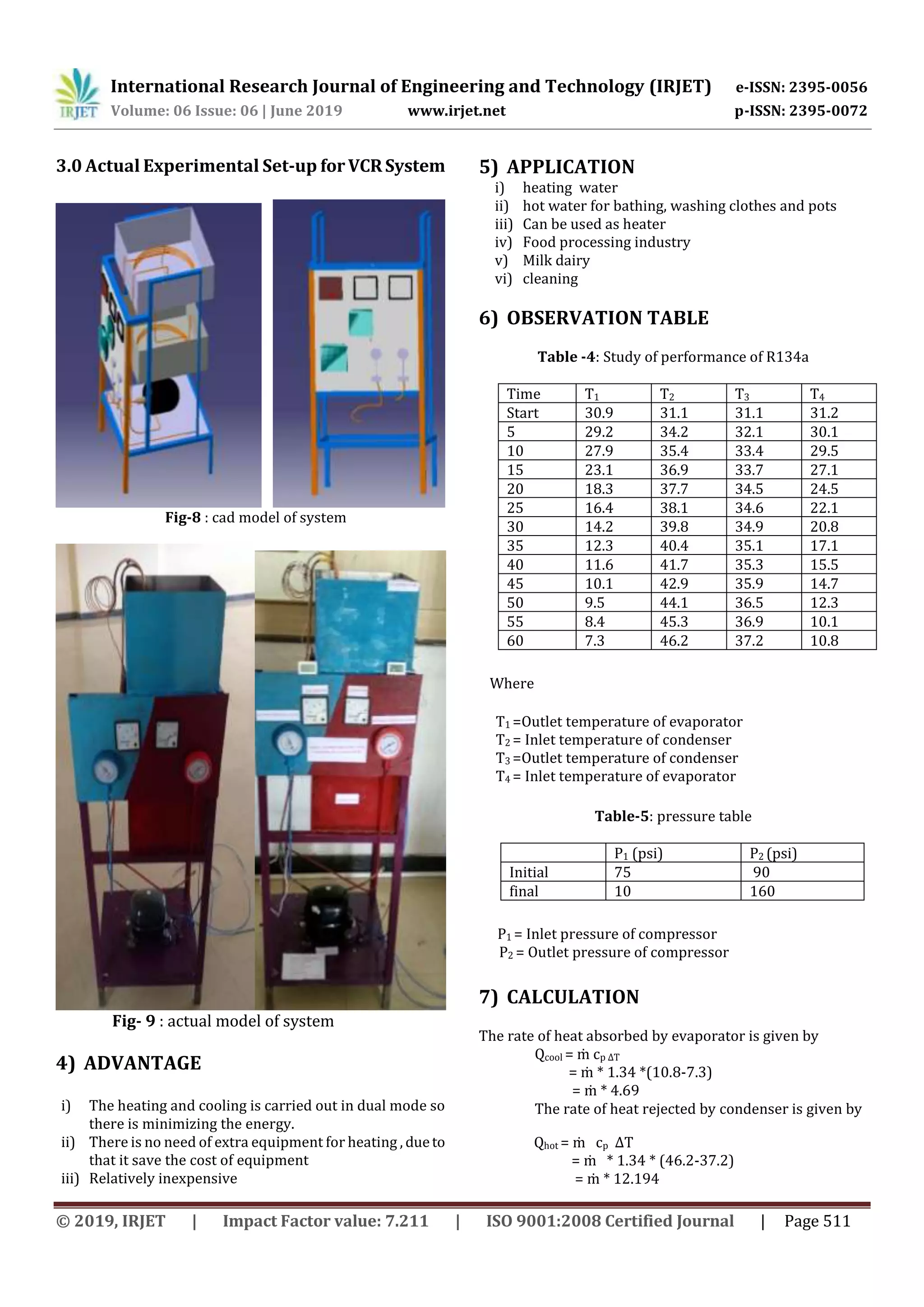
3.0 Actual Experimental Set-up forVCRSystem
Fig-8 : cad model of system
Fig- 9 : actual model of system
4) ADVANTAGE
i) The heating and cooling is carried out in dual mode so
there is minimizing the energy.
ii) There is no need of extra equipment for heating , dueto
that it save the cost of equipment
iii) Relatively inexpensive
5) APPLICATION
i) heating water
ii) hot water for bathing, washing clothes and pots
iii) Can be used as heater
iv) Food processing industry
v) Milk dairy
vi) cleaning
6) OBSERVATION TABLE
Table -4: Study of performance of R134a
Time T1 T2 T3 T4
Start 30.9 31.1 31.1 31.2
5 29.2 34.2 32.1 30.1
10 27.9 35.4 33.4 29.5
15 23.1 36.9 33.7 27.1
20 18.3 37.7 34.5 24.5
25 16.4 38.1 34.6 22.1
30 14.2 39.8 34.9 20.8
35 12.3 40.4 35.1 17.1
40 11.6 41.7 35.3 15.5
45 10.1 42.9 35.9 14.7
50 9.5 44.1 36.5 12.3
55 8.4 45.3 36.9 10.1
60 7.3 46.2 37.2 10.8
Where
T1 =Outlet temperature of evaporator
T2 = Inlet temperature of condenser
T3 =Outlet temperature of condenser
T4 = Inlet temperature of evaporator
Table-5: pressure table
P1 (psi) P2 (psi)
Initial 75 90
final 10 160
P1 = Inlet pressure of compressor
P2 = Outlet pressure of compressor
7) CALCULATION
The rate of heat absorbed by evaporator is given by
Qcool = ṁ cp ΔT
= ṁ * 1.34 *(10.8-7.3)
= ṁ * 4.69
The rate of heat rejected by condenser is given by
Qhot = ṁ cp ΔT
= ṁ * 1.34 * (46.2-37.2)
= ṁ * 12.194
International Research Journal of Engineering and Technology (IRJET) e-ISSN: 2395-0056
Volume: 06 Issue: 06 | June 2019 www.irjet.net p-ISSN: 2395-0072
© 2019, IRJET | Impact Factor value: 7.211 | ISO 9001:2008 Certified Journal | Page 512
Compressor power consumption is given by
Wc = V * I
=230 * 0.45
= 103.5
Coefficient of performance of cooling
COPcooling = Qcoo l / ( Qhot - Qcool)
= 4.69 / (12.194-4.69)
=0.625
Coefficient of performance of heating
COPheating = Qhot / ( Qhot - Qcool)
= 12.194 / (12.194-4.69)
=1.625
EERcool = COPcooling * 3.5
= 0.625 * 3.5
= 2.1875
EERhot = COPheating * 3.5
= 1.625 * 3.5
= 5.6875
Average heat of system is given by
Qverage= (Qhot+Qcool) /2
QAverage = (12.194 + 4.69) / 2
= 8.442
Coefficient of performance
COP = Qverage / Wc
= 8.442 / 103.5 = 0.08156
8) RESULT
1. COPcooling = 0.625
2. COPheating = 1.625
3. COPsystem = 0.08156
3. CONCLUSIONS
Performance evaluation ofsimultaneousheatingandcooling
in vapor compression refrigeration system usingR134a was
studied. By using simultaneous heating and cooling, wesave
the Hugh amount of electricity and save the initial cost of
extra equipment. We achieve hot water in low cost and in
less time. R134a is eco-friendly refrigerant, it has zero ODP
and low GWP. We can use this system in food process
industry, and hot water for bathing, washing cloth and pot
performance of R134a is good, but for further improvement
the. Different refrigerant can be studied. In future, we will
use R600a, R290 and R152 for research to achieve high
coefficient of performance.
REFERENCES
[1] V. Subash, “PERFORMANCE ANALYSIS OF VAPOUR
COMPRESSION REFRIGERATION SYSTEM USING
MIXED REFRIGERANTS OFR134A and R404A,” pp.
17–20, 2016.
[2] S. K. Bandey, “A study on refrigerants,” pp. 4287–
4293, 2018.
[3] B. Talekar, A. Barve, and R. Jangam, “Design &
Fabrication of Vapour Compression Refrigeration
System Test Rig,” vol. 7, no. 6, pp. 1414–1418, 2018.
[4] D. Paliwal and S. P. S. Rajput, “A Review on
Refrigerants , And Effects on Global Warming For
Making Green Environment,” vol. 12, no. 2, pp. 8–11,
2015.
[5] A. C. Tiwari and S. Barode, “Performance Analysis of
Vapour Compression Refrigeration Systems Using
Hydrofluorocarbon Refrigerants,” vol. 3, no. 12, 2012.
[6] S. Khansaheb, “A Review on Domestic Refrigerator
Using Hydrocarbons as Alternative Refrigerants to,”
pp. 536–541, 2015.
[7] R. Kumar, “Performance Analysis of Household,” vol. 3,
no. 4, pp. 11397–11405, 2014.
[8] R. S. Powade, A. A. Rane, A. D. Rane, O. S. Sutar, and V.
S. Bagade, “Performance Investigation of
Refrigerants R290 and R134a as an Alternative to
R22,” vol. 6, no. Iv, pp. 4668–4676, 2018.
[9] K. Nagalakshmi and G. M. Yadav, “The Design and
Performance Analysis of Refrigeration System Using
R12 & R134a Refrigerants,”vol.4,no.2,pp.638–643,
2014.
[10] B. Talekar, A. Barve, and R. Jangam, “Design &
Fabrication of Vapour Compression Refrigeration
System Test Rig,” vol. 7, no. 6, pp. 1414–1418, 2018
[11] V. Subash, “PERFORMANCE ANALYSIS OF VAPOUR
International Research Journal of Engineering and Technology (IRJET) e-ISSN: 2395-0056
Volume: 06 Issue: 06 | June 2019 www.irjet.net p-ISSN: 2395-0072
© 2019, IRJET | Impact Factor value: 7.211 | ISO 9001:2008 Certified Journal | Page 513
COMPRESSION REFRIGERATION SYSTEM USING
MIXED REFRIGERANTS OFR134A and R404A,” pp.
17–20, 2016
[12] R. K. Rajput reference book
[13] P. K. Nag reference book
BIOGRAPHIES
Professor, Dept. of Mechanical
Engineering, Dr. D Y Patil Institute
Of Engg. Management & Research,
Akurdi Pune
B.E. Mechanical engineer at Dr. D Y
Patil Institute Of Engg. Management
& Research, Akurdi Pune

IRJET- Design and Fabrication of Simultaneous Heating and Cooling in VCR System using R134A Refrigerent

  • 1.
    International Research Journalof Engineering and Technology (IRJET) e-ISSN: 2395-0056 Volume: 06 Issue: 06 | June 2019 www.irjet.net p-ISSN: 2395-0072 © 2019, IRJET | Impact Factor value: 7.211 | ISO 9001:2008 Certified Journal | Page 506 DESIGN AND FABRICATION OF SIMULTANEOUS HEATING AND COOLING IN VCR SYSTEM USING R134A REFRIGERENT K.V.L.Bhuvaneswary1, Sunil Rathod2, Akshay Khamkar3, Subrato Banergee4, Manjit Punia4 1Professor, Dept. of Mechanical Engineering, Dr. D Y Patil Institute of Engg. Management and Research, Akurdi Pune 2345B.E. Mechanical engineer at Dr. D Y Patil Institute of Engg. Management and Research, Akurdi, Pune ---------------------------------------------------------------------***--------------------------------------------------------------------- Abstract –This researchpaperpresentvapourcompression refrigeration system for simultaneous heating and cooling. In normal refrigeration system the heat rejected in condenser is get wasted, in this paper we have utilized heat rejected in condenser. This rejected heat used for home purpose, like heating water, bathing, washing clothes and pots. The main advantage of simultaneous heating and cooling it carried out from one VCR system. It doesnotrequiredseparateequipment, It save the cost. For research purpose water cooled condenser water cooled evaporator is used. Refrigerant is the substance that transfer heat in refrigeration system that absorb heat in evaporator and rejected heat in condenser. In this system R134a refrigerant is used. ODP and GWP is low for R134a refrigerant .COP has to be calculated for selected good refrigerant. Refrigerant should have low boiling temperature, high critical temperature and higher liquid thermal conductivity which makes these properties as a good refrigerant. In this paper R134a environment-friendly refrigerant that have zero ODP and low GWP is used. We can use the hot water for cleaning textile, processheating industry, food industry also in milk industry. Key Words: VCRS, Heating, Cooling, ODP, GWP, Condenser. 1. INTRODUCTION Refrigeration is a process of providing and maintaining temperature below the atmosphere. The medium used for refrigeration process is called as refrigerant. The basic element of refrigeration system are compressor, condenser, capillary tube, andevaporator.Theozonedepletionpotential and global warming potential have become the most important criteria for selecting any refrigerant, still lot of research is ongoing to decide the environmentally friendly refrigerants.[1] Refrigerant is the fluid used for heat transfer from the region of low temperature and pressure and reject the heat in condenser at a region of high temperature and pressure. The environment-friendly halocarbon refrigerant that have zero ODP, non-flammable,non-toxic andlowGWPisselected in vapour compression refrigeration system. The R134a has all this properties, so in VCR system R134a mostly used. Before selecting any refrigerant the following properties are requires, critical temperature of the refrigerantshouldbe as high, The specific heat of the liquid should be as small as possible, The density of the refrigerant should be as large, ODP of refrigerants should be zero, Refrigerantsshouldhave as low a GWP[2] The main aim of this research paper is to utilize the waste heat rejected in condenser, for this the water cooled condenser is used. The household refrigerator mostly used restaurant and in kitchens for the storage of fruits and vegetable but due to simultaneous heating and cooling This rejected heat used for home purpose, like heating water, bathing, washing clothes and pots. The term “refrigeration‟ in a broad sense is used for the process of removing heat from a substance. It also includes the process of reducing and maintaining the temperature of a body below the general temperature of its surroundings. It transfer the heat from condenser to evaporator. In other words, the refrigeration means a continued extraction of heat from a body, whose temperature is already below the temperature of its surroundings. The testing consists of a hermetic compressor, water cooled condenser, a capillary tubeanda watercooledevaporator.In addition to these the other component are temperature sensor, pressure gauge, ammeter, and voltmeter. Pressure gauges are installed to measure the condenser and evaporator pressures. The household refrigerator works on vapour compression refrigeration cycle. In compressor the pressure and temperatureof refrigerantisincrease,thishigh pressure and high temperature refrigerant enter in condenser where the heat rejection takes place. The heat rejection in condenser takes place at constant pressure. In capillary tube the pressure is get reduce at constant enthalpy, and in evaporator the heat is get absorbed at constant pressure, finally from the outlet of evaporator we will get low pressure, low temperature vapour refrigerant. Copper tube is mostly used for supply refrigerant. In evaporator the liquid + vapourrefrigerantabsorblatent heat of vaporization from the medium which is to be cooled, the cycle get repeated. The miniature circuit breaker used to protect from over current. MCB can be easily reset [3] Nomenclature COP coefficient of performance Cp specific heat at constant pressure (kJ/kg K) h enthalpy (kJ/kg) ṁ mass flow rate (kg/s)
  • 2.
    International Research Journalof Engineering and Technology (IRJET) e-ISSN: 2395-0056 Volume: 06 Issue: 06 | June 2019 www.irjet.net p-ISSN: 2395-0072 © 2019, IRJET | Impact Factor value: 7.211 | ISO 9001:2008 Certified Journal | Page 507 Ẇ compressor electrical power consumption (kW) P pressure (bar) Qcool heat absorbed in evaporator (kW) Qhot heat rejected condenser (kW) s entropy (kJ/kg K) T Temperature (˚C HCFCs hydro chlorofluorocarbon HCs hydrocarbons CFCs chlorofluorocarbons HFCs Hydro fluorocarbons VCR Vapour Compression Refrigeration 1.1 Theoretical analysis Fig-1: p-h chart Fig-2: basic VCR system . Process involved in VCR cycle: 1-2 isentropic compression 2-3 isobaric process heat rejected at constant pressure 3-4 Expansion process 4-1 isobaric process heat absorbed at constant pressure The rate of heat absorbed by evaporator is given by 𝑄cool = ṁ (h1 − h4) The rate of heat rejected by condenser is given by 𝑄hot= ṁ (h2 − h3) Compressor power consumption is given by Ẇ = ṁ (h2 − h1) Coefficient of performance for cooling COPcooling = (h1−h4)/ (h2−h1) Coefficient of performance for heating COPheating= (h2−h3)/ (h2−h1) 1.2 Actual analysis Fig-3 : actual VCR system The rate of heat absorbed by evaporator is given by Qcool = m cp ΔT The rate of heat rejected by condenser is given by Qhot = m cp ΔT Compressor power consumption is given by Wc = V * I Mass flow rate of a refrigerant is given by ṁ = Δp * ρ Average heat of system is given by Qverage= (Qhot+Qcool) /2
  • 3.
    International Research Journalof Engineering and Technology (IRJET) e-ISSN: 2395-0056 Volume: 06 Issue: 06 | June 2019 www.irjet.net p-ISSN: 2395-0072 © 2019, IRJET | Impact Factor value: 7.211 | ISO 9001:2008 Certified Journal | Page 508 COPcooling= Qcoll / (Qhot-Qcool) COP= Qhot / (Qhot-Qcool) Methodology The methodology of the system design is evaluated by following procedure.  Selection of refrigerant.  Selecting parameter like capacity, temperature ranges, compressor specification.  Selection of capillary from three different diameter.  Design of condenser.  Design of evaporator.  Selection of other componentsliketemperaturesensor, pressure gauge, voltmeter, ammeter, dryer.  Modelling of system using CATIAv5 software.  Manufacturing the actual system.  Checking system parameter and actual systemsreview. Objective The main objective of this paper is in normal refrigeration system the heat rejected in condenser is get wasted, in this paper we have utilized heat rejected in condenser. Capillary used in normal refrigeration system did not have specific diameter in earlier days. Nowadays due to increase in pollution there are restrictions on the use of refrigerants. In such conditions it is very important to use having maximum COP. Also the cost of refrigerants are high therefore it has become priority to use the given refrigerants efficiently. To increase overall efficiency of refrigeration system 2.0 EXPERIMENTAL SETUP 2.1 Condenser In condenser the heat is rejected and change of refrigerant phase takes place. Condenser is an important component of any refrigeration system. In a typical refrigerant condenser, the refrigerant enters the condenser in a superheated state. It is first de-superheated and then condensed by rejecting heat to an external medium. The refrigerant may leave the condenser as a saturated or a sub-cooled liquid, depending upon the temperature of the external medium and design of the condenser Fig-4 : condenser tank Calculation of condenser : Type- Water Cooled Area (A) = 0.4 x 0.4 = 0.16 m2 Diameter (d) = 6 mm Area = πdl , 0.16 = π x 6 x 10⁻³ x l Length of coil (l) = 8.48 m Now, length of coil in one turn = 2 πr D=360 mm R = 180 mm = 0.18 m Therefore, l = 2π x 0.18 = 1.13 m = length of coil in one turn Therefore, Number of turns = 8.48/1.13 = 7.49 ≈ 7 turns Specification  Water Cooled  Copper tube  Thickness-0.8mm  Length-8.48 m
  • 4.
    International Research Journalof Engineering and Technology (IRJET) e-ISSN: 2395-0056 Volume: 06 Issue: 06 | June 2019 www.irjet.net p-ISSN: 2395-0072 © 2019, IRJET | Impact Factor value: 7.211 | ISO 9001:2008 Certified Journal | Page 509 2.2 compressor Compressor is a device which is used for converting low pressure low temperature refrigerant to high pressure high temperature refrigerant. In VCR system hermetically sealed compressor mostly used. Fig-5 : compressor Table- 1 : compressor selection chart Table-2 : selection of copper tube chart 2.3 Capillary Tube Capillary tube is device which reduce the pressure from condenser pressure to evaporator pressure  Material Used- Copper  Operation Used for Joining- Brazzing  Diameters (mm)- 0.36 Fig- 6: capillary tube 2.4 EVAPORATOR The evaporator is main component of a refrigerationsystem in which heat is removed from air, water or any other body required to be cooled by the evaporating refrigerant. The refrigerant boils or evaporates in this component and absorbs heat from the substance being cooled which is the main purpose of a refrigeration system. The name evaporator refers to the evaporation process occurring in the heat. Evaporator is device which absorb the heat and convert the liquid phase of refrigerant into vapour.
  • 5.
    International Research Journalof Engineering and Technology (IRJET) e-ISSN: 2395-0056 Volume: 06 Issue: 06 | June 2019 www.irjet.net p-ISSN: 2395-0072 © 2019, IRJET | Impact Factor value: 7.211 | ISO 9001:2008 Certified Journal | Page 510 2.5 Copper Tube Properties of Copper Copper possesses the highest rating for both electrical and thermal conductivity. 2. Copper is a relatively soft and malleable metal with excellent formability. 3. Copper and its alloys are widely used in many environments and applications because of their excellent corrosion resistance. 4. Copper is ductile metal. 5. Copper is non-magnetic and non-sparking. 6. Copper can be recycled without any loss of quality Copper tube size: Outer diameter of copper tube = 6 mm inner diameter of copper tube = 5 mm Thickness of copper tube = 1 mm 2.6 TEMPERATURE SENSOR Temperature indicator is a device which used for indicating the temperature in vapour compression refrigeration system. The PT100 type temperatureindicatorisusedin this system. Fig- 7: Temperature sensor 2.7 REFRIGERANT SELECTION Refrigeration is defined as the process of achieving and maintaining a temperature below of the surroundings. Desirable properties of refrigerants 1) Thermodynamic Properties a) Critical Temperature should be above the condensing temperature b) The boiling temperature should be low c) Freezing temperature should be lower than evaporative temperature d) High latent heat of vaporization at the evaporator temperature 2) Chemical properties a) Refrigerant should not be inflammable b) The refrigerant should not be toxic c) It should be chemically stable for the operating ranges of temperature 3) Physical properties a) The refrigerant in liquid and vapour state should have low viscosity b) The refrigerant must have high thermal conductivity c) If there is leakage, it should be easily detectable d) The refrigerant should have low cost Table-3: properties of different refrigerant Normal Boili ng Point (°C) Critical Temperatu re (°C) ODP GWP (per 100 Year) R134a (HFC) -26.07 101.06 0 1300 R22 -40.75 96.2 0.055 1700 R12 -29.8 111.9 1 8100 R290 (HC) -42.1 96.8 0 20 R143a -0.56 153 0 3800 R404a -26.07 101.06 0 3260
  • 6.
    International Research Journalof Engineering and Technology (IRJET) e-ISSN: 2395-0056 Volume: 06 Issue: 06 | June 2019 www.irjet.net p-ISSN: 2395-0072 © 2019, IRJET | Impact Factor value: 7.211 | ISO 9001:2008 Certified Journal | Page 511 3.0 Actual Experimental Set-up forVCRSystem Fig-8 : cad model of system Fig- 9 : actual model of system 4) ADVANTAGE i) The heating and cooling is carried out in dual mode so there is minimizing the energy. ii) There is no need of extra equipment for heating , dueto that it save the cost of equipment iii) Relatively inexpensive 5) APPLICATION i) heating water ii) hot water for bathing, washing clothes and pots iii) Can be used as heater iv) Food processing industry v) Milk dairy vi) cleaning 6) OBSERVATION TABLE Table -4: Study of performance of R134a Time T1 T2 T3 T4 Start 30.9 31.1 31.1 31.2 5 29.2 34.2 32.1 30.1 10 27.9 35.4 33.4 29.5 15 23.1 36.9 33.7 27.1 20 18.3 37.7 34.5 24.5 25 16.4 38.1 34.6 22.1 30 14.2 39.8 34.9 20.8 35 12.3 40.4 35.1 17.1 40 11.6 41.7 35.3 15.5 45 10.1 42.9 35.9 14.7 50 9.5 44.1 36.5 12.3 55 8.4 45.3 36.9 10.1 60 7.3 46.2 37.2 10.8 Where T1 =Outlet temperature of evaporator T2 = Inlet temperature of condenser T3 =Outlet temperature of condenser T4 = Inlet temperature of evaporator Table-5: pressure table P1 (psi) P2 (psi) Initial 75 90 final 10 160 P1 = Inlet pressure of compressor P2 = Outlet pressure of compressor 7) CALCULATION The rate of heat absorbed by evaporator is given by Qcool = ṁ cp ΔT = ṁ * 1.34 *(10.8-7.3) = ṁ * 4.69 The rate of heat rejected by condenser is given by Qhot = ṁ cp ΔT = ṁ * 1.34 * (46.2-37.2) = ṁ * 12.194
  • 7.
    International Research Journalof Engineering and Technology (IRJET) e-ISSN: 2395-0056 Volume: 06 Issue: 06 | June 2019 www.irjet.net p-ISSN: 2395-0072 © 2019, IRJET | Impact Factor value: 7.211 | ISO 9001:2008 Certified Journal | Page 512 Compressor power consumption is given by Wc = V * I =230 * 0.45 = 103.5 Coefficient of performance of cooling COPcooling = Qcoo l / ( Qhot - Qcool) = 4.69 / (12.194-4.69) =0.625 Coefficient of performance of heating COPheating = Qhot / ( Qhot - Qcool) = 12.194 / (12.194-4.69) =1.625 EERcool = COPcooling * 3.5 = 0.625 * 3.5 = 2.1875 EERhot = COPheating * 3.5 = 1.625 * 3.5 = 5.6875 Average heat of system is given by Qverage= (Qhot+Qcool) /2 QAverage = (12.194 + 4.69) / 2 = 8.442 Coefficient of performance COP = Qverage / Wc = 8.442 / 103.5 = 0.08156 8) RESULT 1. COPcooling = 0.625 2. COPheating = 1.625 3. COPsystem = 0.08156 3. CONCLUSIONS Performance evaluation ofsimultaneousheatingandcooling in vapor compression refrigeration system usingR134a was studied. By using simultaneous heating and cooling, wesave the Hugh amount of electricity and save the initial cost of extra equipment. We achieve hot water in low cost and in less time. R134a is eco-friendly refrigerant, it has zero ODP and low GWP. We can use this system in food process industry, and hot water for bathing, washing cloth and pot performance of R134a is good, but for further improvement the. Different refrigerant can be studied. In future, we will use R600a, R290 and R152 for research to achieve high coefficient of performance. REFERENCES [1] V. Subash, “PERFORMANCE ANALYSIS OF VAPOUR COMPRESSION REFRIGERATION SYSTEM USING MIXED REFRIGERANTS OFR134A and R404A,” pp. 17–20, 2016. [2] S. K. Bandey, “A study on refrigerants,” pp. 4287– 4293, 2018. [3] B. Talekar, A. Barve, and R. Jangam, “Design & Fabrication of Vapour Compression Refrigeration System Test Rig,” vol. 7, no. 6, pp. 1414–1418, 2018. [4] D. Paliwal and S. P. S. Rajput, “A Review on Refrigerants , And Effects on Global Warming For Making Green Environment,” vol. 12, no. 2, pp. 8–11, 2015. [5] A. C. Tiwari and S. Barode, “Performance Analysis of Vapour Compression Refrigeration Systems Using Hydrofluorocarbon Refrigerants,” vol. 3, no. 12, 2012. [6] S. Khansaheb, “A Review on Domestic Refrigerator Using Hydrocarbons as Alternative Refrigerants to,” pp. 536–541, 2015. [7] R. Kumar, “Performance Analysis of Household,” vol. 3, no. 4, pp. 11397–11405, 2014. [8] R. S. Powade, A. A. Rane, A. D. Rane, O. S. Sutar, and V. S. Bagade, “Performance Investigation of Refrigerants R290 and R134a as an Alternative to R22,” vol. 6, no. Iv, pp. 4668–4676, 2018. [9] K. Nagalakshmi and G. M. Yadav, “The Design and Performance Analysis of Refrigeration System Using R12 & R134a Refrigerants,”vol.4,no.2,pp.638–643, 2014. [10] B. Talekar, A. Barve, and R. Jangam, “Design & Fabrication of Vapour Compression Refrigeration System Test Rig,” vol. 7, no. 6, pp. 1414–1418, 2018 [11] V. Subash, “PERFORMANCE ANALYSIS OF VAPOUR
  • 8.
    International Research Journalof Engineering and Technology (IRJET) e-ISSN: 2395-0056 Volume: 06 Issue: 06 | June 2019 www.irjet.net p-ISSN: 2395-0072 © 2019, IRJET | Impact Factor value: 7.211 | ISO 9001:2008 Certified Journal | Page 513 COMPRESSION REFRIGERATION SYSTEM USING MIXED REFRIGERANTS OFR134A and R404A,” pp. 17–20, 2016 [12] R. K. Rajput reference book [13] P. K. Nag reference book BIOGRAPHIES Professor, Dept. of Mechanical Engineering, Dr. D Y Patil Institute Of Engg. Management & Research, Akurdi Pune B.E. Mechanical engineer at Dr. D Y Patil Institute Of Engg. Management & Research, Akurdi Pune