Plastics and Rubber
Origins of Plastics - synthetic plastics.
• The main source of synthetic plastics is
crude oil.
• Coal and natural gas are also used.
• Petrol, paraffin, lubricating oils and high
petroleum gases are bi-products,
produced during the refining of crude oil.
• These gases are broken down into
monomers. Monomers are chemical
substances consisting of a single molecule.
• A process called Polymerisation occurs
when thousands of monomers are linked
together. The compounds formed as
called polymers.
• Combining the element carbon with one
or more other elements such as oxygen,
hydrogen, chlorine, fluorine and nitrogen
makes most polymers.
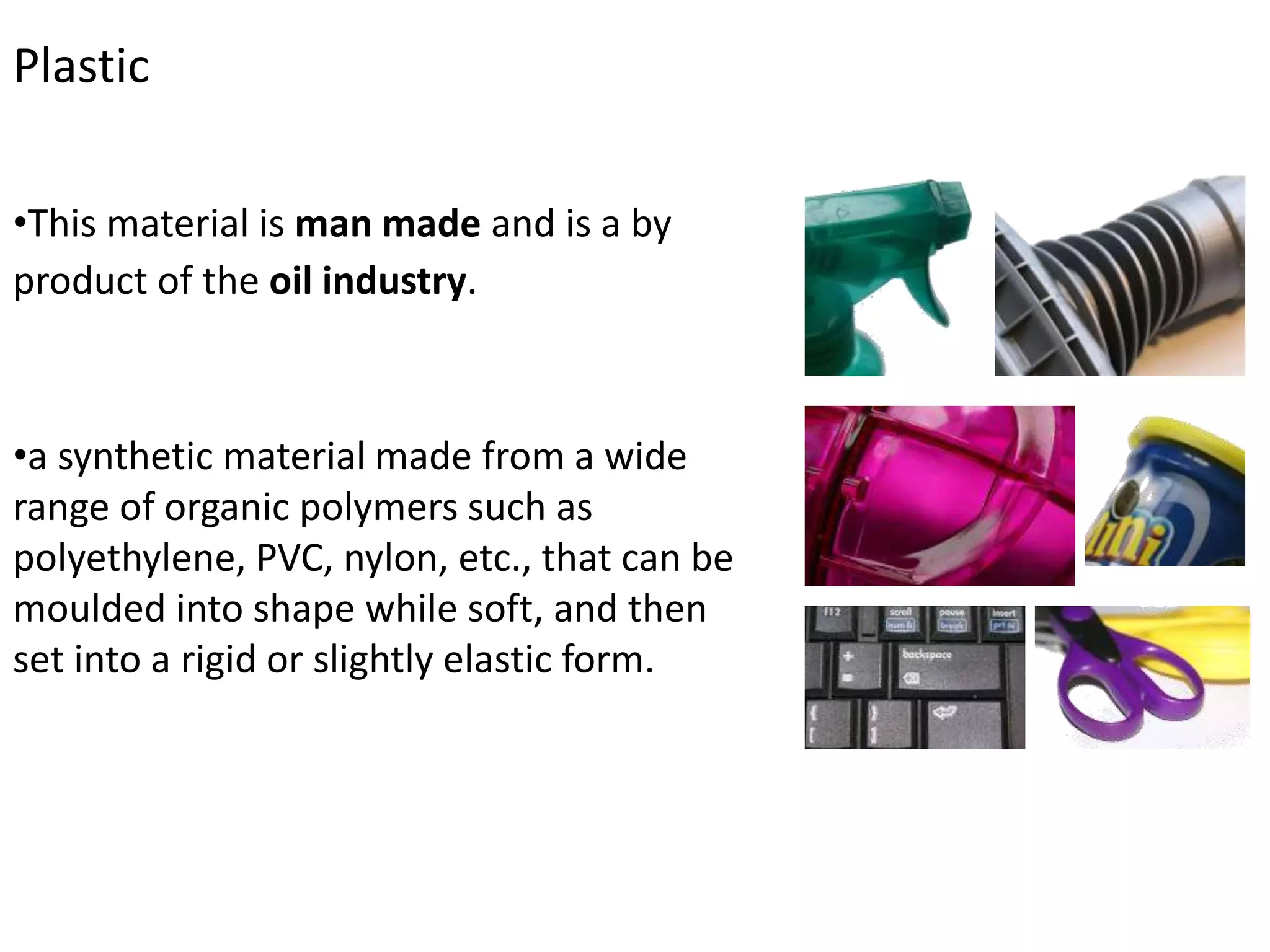
Plastic
•This material is man made and is a by
product of the oil industry.
•a synthetic material made from a wide
range of organic polymers such as
polyethylene, PVC, nylon, etc., that can be
moulded into shape while soft, and then
set into a rigid or slightly elastic form.
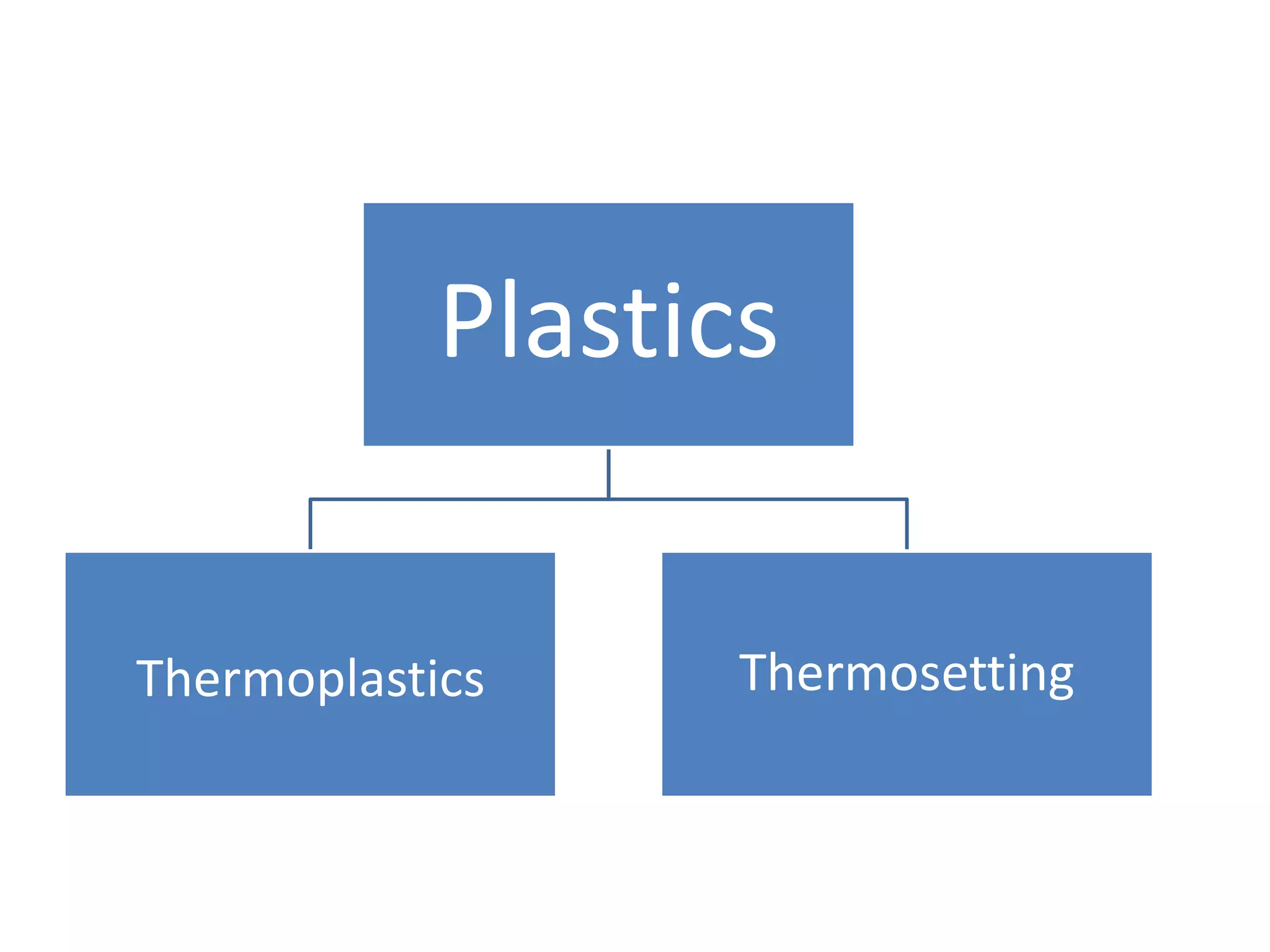
Plastics
Thermoplastics Thermosetting
Thermoplastics
• There are a wide range of thermoplastics,
some that are rigid and some that are
extremely flexible.
• The molecules of thermoplastics are in
lines or long chains with very few
entanglements. When heat is applied the
molecules move apart, which increases
the distance between them, causing them
to become untangled. This allows them to
become soft when heated so that they
can be bent into all sorts of shapes.
• When they are left to cool the chains of
molecules cool, take their former position
and the plastic becomes stiff and hard
again. The process of heating, shaping,
reheating and reforming can be repeated
many times.
Long chain molecules
Thermoplastics- Examples
1. Polythene/polyethylene –
• Most common plastic.
• The annual global production is around 80
million tonnes.
• Its primary use is in packaging (plastic
bags, plastic films, geomembranes, containers
including bottles, etc.).
• Chemical formula- (C2H4)n.
• Low strength, hardness and rigidity, but has a
high ductility and impact strength.
• Good electrical insulator.
2. Polyvinyl chloride(PVC)
• World's third-most widely produced synthetic
plastic polymer, after polyethylene and
polypropylene.
• Can be rigid and flexible.
• rigid form of PVC is used in construction for
pipe and in profile applications such as doors
and windows.
• It can be made softer and more flexible by the
addition of plasticizers.
• Good insulator.
• PVC is chemically resistant to acids, salts, bases,
fats, and alcohols; therefore, it is used in
sewerage piping.
3. Poly-propylene(PP)
• It is a white, mechanically rugged,
and resistant to many chemical
solvents, bases and acids.
• Variety of applications
including packaging and
labeling, textiles, plastic parts and
reusable containers.
• Polypropylene is in many aspects
similar to polyethylene, especially
in electrical properties.
• Lowest Density.
• Economical product.
• Good impact strength.
Bottle caps
chair
4. Polymethyl methacrylate
• Also known as acrylic glass.
• It is a transparent thermoplastic often used in
sheet form as a lightweight or shatter-resistant
alternative to glass.
• Easy handling and processing.
• Low cost
• Laser cutting is used to form sheets.
• Applications are in rear-lights and instrument
clusters for vehicles, appliances, and lenses for
glasses, building windows, skylights, bulletproof
security barriers, signs & displays, sanitary ware
(bathtubs), LCD screens, furniture and many other
applications.
10-meter (33-foot)
deep Monterey Bay
Aquarium tank has acrylic
windows up to 33 centimeters
(13 inches) thick to withstand
the water pressure
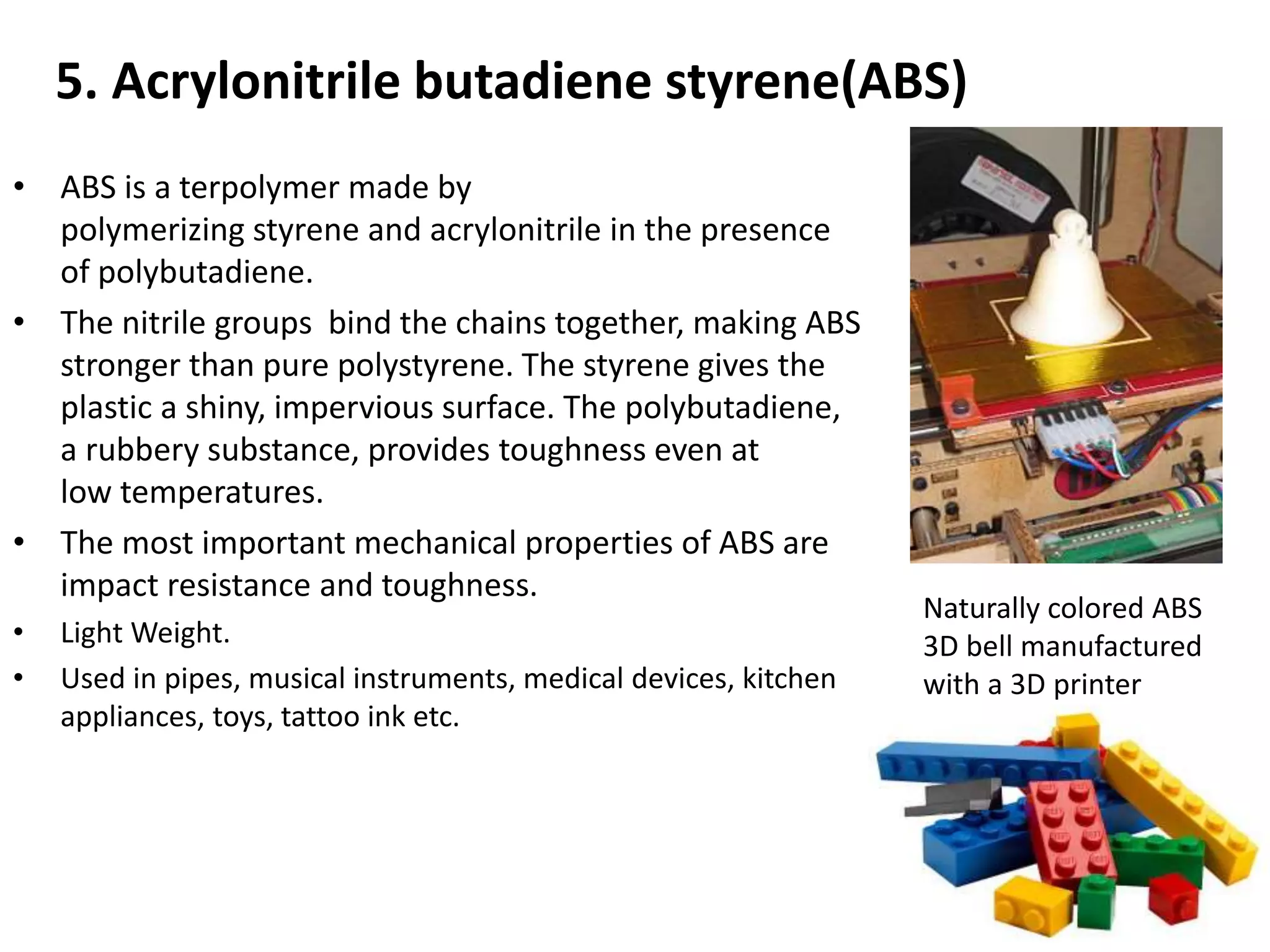
5. Acrylonitrile butadiene styrene(ABS)
• ABS is a terpolymer made by
polymerizing styrene and acrylonitrile in the presence
of polybutadiene.
• The nitrile groups bind the chains together, making ABS
stronger than pure polystyrene. The styrene gives the
plastic a shiny, impervious surface. The polybutadiene,
a rubbery substance, provides toughness even at
low temperatures.
• The most important mechanical properties of ABS are
impact resistance and toughness.
• Light Weight.
• Used in pipes, musical instruments, medical devices, kitchen
appliances, toys, tattoo ink etc.
Naturally colored ABS
3D bell manufactured
with a 3D printer
Thermosetting plastics
• The molecules of thermosetting
plastics are heavily cross-linked. They
form a rigid molecular structure.
• The molecules in thermoplastics sit
end-to-end and side-by-side.
• Although they soften when heated
the first time, which allows them to
be shaped they become permanently
stiff and solid and cannot be
reshaped.
• Thermoplastics remain rigid and non-
flexible even at high temperatures.
Polyester resin and urea
formaldehyde are examples of
thermosetting plastics.
Cross-linked molecules
1. Phenol formaldehyde(PF)
• Also used in making of bakelight.
• They have been widely used for the production of
molded products including billiard balls,
laboratory countertops, and as coatings
and adhesives.
• Also used in industrial products.
• In making of exterior plywoods known as
WBP(Weather and boil proof).
• Phenol-formaldehyde is degraded by the white
rot fungus.
2. Urea-formaldehyde
• Also known as urea-methanal.
• Non- transparent.
• It is produced from urea and formaldehyde.
• Used in adhesives, finishes, particle
board, MDF, and molded objects.
• use include in automobile tires, for improving
tear strength, in molding electrical devices, jar
caps, etc.
• High tensile strength.
• High surface hardness.
• Foams have been used as artificial snow in
movies.
• Urea-formaldehyde foam insulation (UFFI) is a
foam injected in walls.
3. Melamine formaldehyde
• It is a hard, thermosetting plastic material made
from melamine and formaldehyde by polymerization.
• The principal use is as the main constituent of high-
pressure laminates, such as Formica and Arborite, and
of laminate flooring.
• Melamine-resin tile wall panels can also be used
as whiteboards.
• Used in plastic laminate and overlay materials.
• Used in kitchen utensils and plates, but they are not
microwave safe.
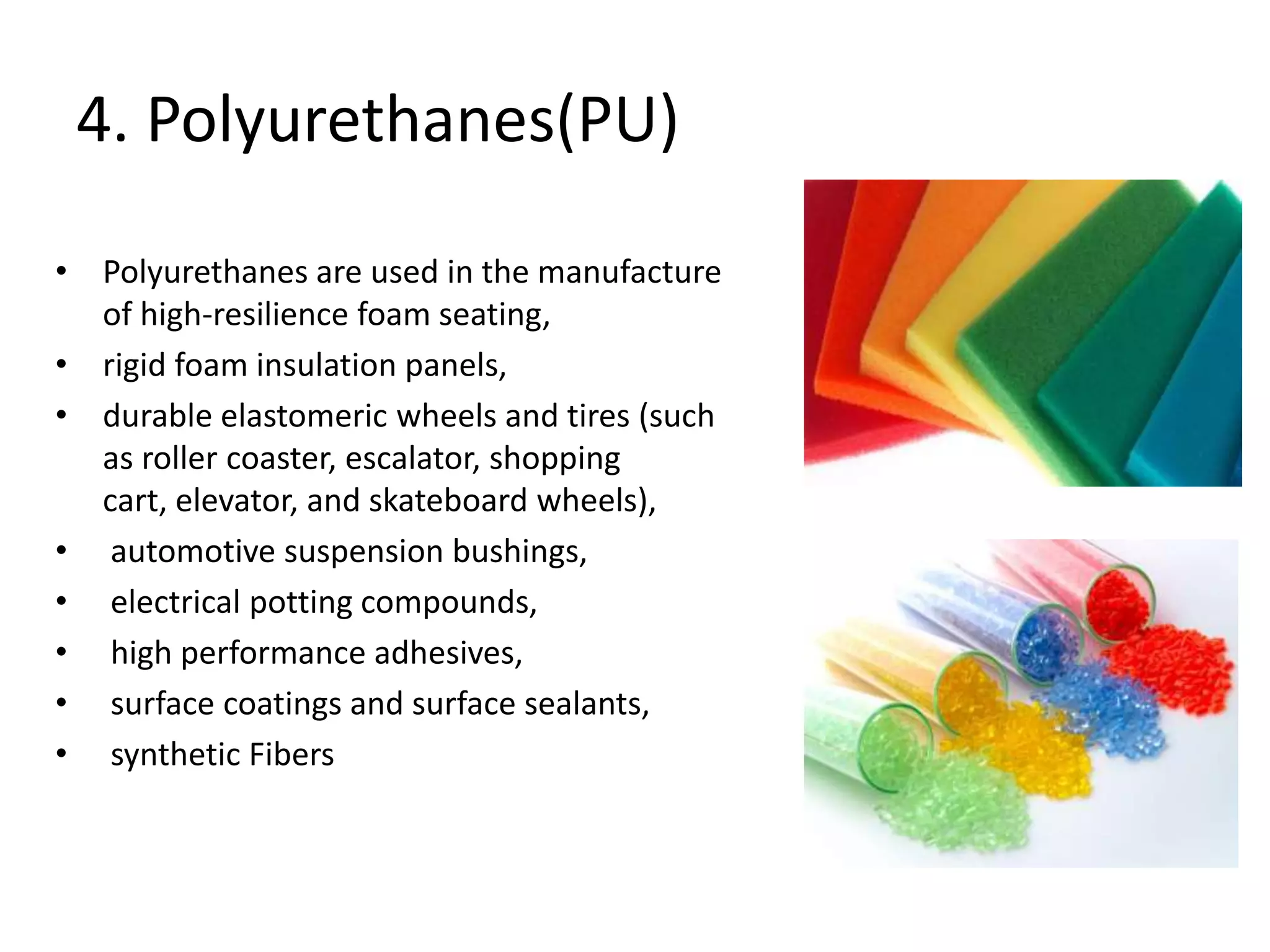
4. Polyurethanes(PU)
• Polyurethanes are used in the manufacture
of high-resilience foam seating,
• rigid foam insulation panels,
• durable elastomeric wheels and tires (such
as roller coaster, escalator, shopping
cart, elevator, and skateboard wheels),
• automotive suspension bushings,
• electrical potting compounds,
• high performance adhesives,
• surface coatings and surface sealants,
• synthetic Fibers
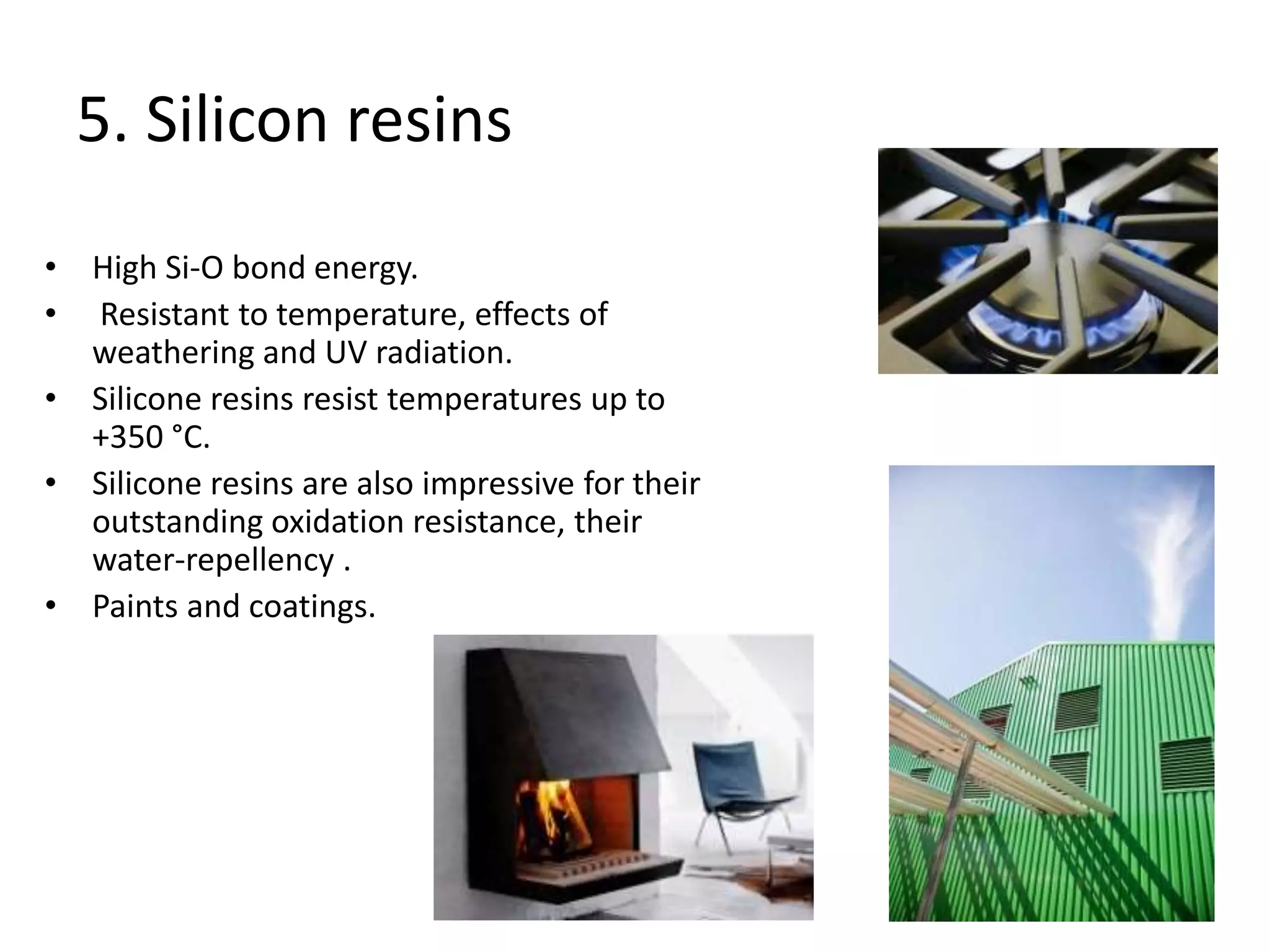
5. Silicon resins
• High Si-O bond energy.
• Resistant to temperature, effects of
weathering and UV radiation.
• Silicone resins resist temperatures up to
+350 °C.
• Silicone resins are also impressive for their
outstanding oxidation resistance, their
water-repellency .
• Paints and coatings.
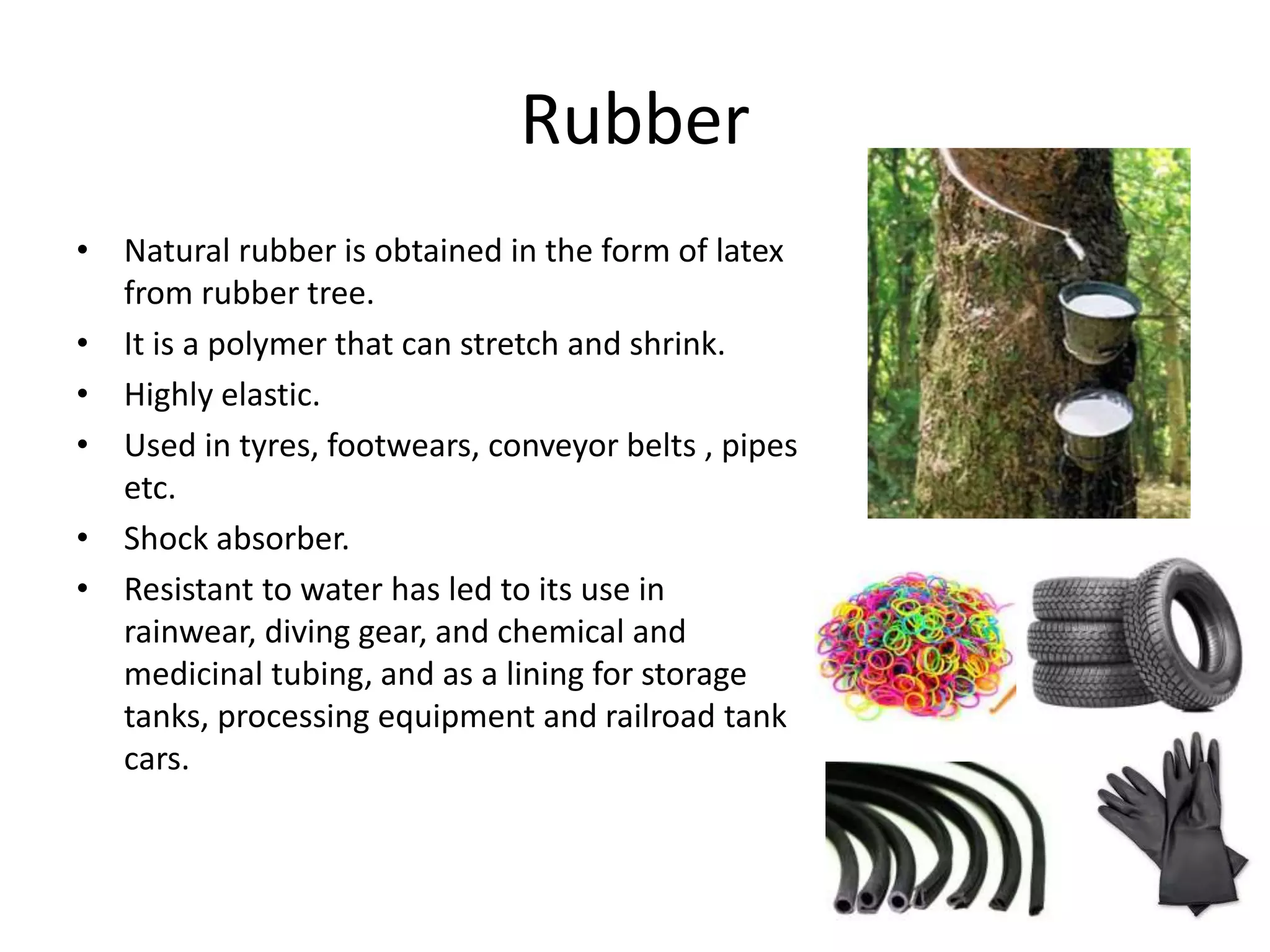
Rubber
• Natural rubber is obtained in the form of latex
from rubber tree.
• It is a polymer that can stretch and shrink.
• Highly elastic.
• Used in tyres, footwears, conveyor belts , pipes
etc.
• Shock absorber.
• Resistant to water has led to its use in
rainwear, diving gear, and chemical and
medicinal tubing, and as a lining for storage
tanks, processing equipment and railroad tank
cars.
Thank You

Plastics and rubber

  • 1.
  • 2.
    Origins of Plastics- synthetic plastics. • The main source of synthetic plastics is crude oil. • Coal and natural gas are also used. • Petrol, paraffin, lubricating oils and high petroleum gases are bi-products, produced during the refining of crude oil. • These gases are broken down into monomers. Monomers are chemical substances consisting of a single molecule. • A process called Polymerisation occurs when thousands of monomers are linked together. The compounds formed as called polymers. • Combining the element carbon with one or more other elements such as oxygen, hydrogen, chlorine, fluorine and nitrogen makes most polymers.
  • 3.
    Plastic •This material isman made and is a by product of the oil industry. •a synthetic material made from a wide range of organic polymers such as polyethylene, PVC, nylon, etc., that can be moulded into shape while soft, and then set into a rigid or slightly elastic form.
  • 4.
  • 5.
    Thermoplastics • There area wide range of thermoplastics, some that are rigid and some that are extremely flexible. • The molecules of thermoplastics are in lines or long chains with very few entanglements. When heat is applied the molecules move apart, which increases the distance between them, causing them to become untangled. This allows them to become soft when heated so that they can be bent into all sorts of shapes. • When they are left to cool the chains of molecules cool, take their former position and the plastic becomes stiff and hard again. The process of heating, shaping, reheating and reforming can be repeated many times. Long chain molecules
  • 6.
    Thermoplastics- Examples 1. Polythene/polyethylene– • Most common plastic. • The annual global production is around 80 million tonnes. • Its primary use is in packaging (plastic bags, plastic films, geomembranes, containers including bottles, etc.). • Chemical formula- (C2H4)n. • Low strength, hardness and rigidity, but has a high ductility and impact strength. • Good electrical insulator.
  • 7.
    2. Polyvinyl chloride(PVC) •World's third-most widely produced synthetic plastic polymer, after polyethylene and polypropylene. • Can be rigid and flexible. • rigid form of PVC is used in construction for pipe and in profile applications such as doors and windows. • It can be made softer and more flexible by the addition of plasticizers. • Good insulator. • PVC is chemically resistant to acids, salts, bases, fats, and alcohols; therefore, it is used in sewerage piping.
  • 8.
    3. Poly-propylene(PP) • Itis a white, mechanically rugged, and resistant to many chemical solvents, bases and acids. • Variety of applications including packaging and labeling, textiles, plastic parts and reusable containers. • Polypropylene is in many aspects similar to polyethylene, especially in electrical properties. • Lowest Density. • Economical product. • Good impact strength. Bottle caps chair
  • 9.
    4. Polymethyl methacrylate •Also known as acrylic glass. • It is a transparent thermoplastic often used in sheet form as a lightweight or shatter-resistant alternative to glass. • Easy handling and processing. • Low cost • Laser cutting is used to form sheets. • Applications are in rear-lights and instrument clusters for vehicles, appliances, and lenses for glasses, building windows, skylights, bulletproof security barriers, signs & displays, sanitary ware (bathtubs), LCD screens, furniture and many other applications. 10-meter (33-foot) deep Monterey Bay Aquarium tank has acrylic windows up to 33 centimeters (13 inches) thick to withstand the water pressure
  • 10.
    5. Acrylonitrile butadienestyrene(ABS) • ABS is a terpolymer made by polymerizing styrene and acrylonitrile in the presence of polybutadiene. • The nitrile groups bind the chains together, making ABS stronger than pure polystyrene. The styrene gives the plastic a shiny, impervious surface. The polybutadiene, a rubbery substance, provides toughness even at low temperatures. • The most important mechanical properties of ABS are impact resistance and toughness. • Light Weight. • Used in pipes, musical instruments, medical devices, kitchen appliances, toys, tattoo ink etc. Naturally colored ABS 3D bell manufactured with a 3D printer
  • 11.
    Thermosetting plastics • Themolecules of thermosetting plastics are heavily cross-linked. They form a rigid molecular structure. • The molecules in thermoplastics sit end-to-end and side-by-side. • Although they soften when heated the first time, which allows them to be shaped they become permanently stiff and solid and cannot be reshaped. • Thermoplastics remain rigid and non- flexible even at high temperatures. Polyester resin and urea formaldehyde are examples of thermosetting plastics. Cross-linked molecules
  • 12.
    1. Phenol formaldehyde(PF) •Also used in making of bakelight. • They have been widely used for the production of molded products including billiard balls, laboratory countertops, and as coatings and adhesives. • Also used in industrial products. • In making of exterior plywoods known as WBP(Weather and boil proof). • Phenol-formaldehyde is degraded by the white rot fungus.
  • 13.
    2. Urea-formaldehyde • Alsoknown as urea-methanal. • Non- transparent. • It is produced from urea and formaldehyde. • Used in adhesives, finishes, particle board, MDF, and molded objects. • use include in automobile tires, for improving tear strength, in molding electrical devices, jar caps, etc. • High tensile strength. • High surface hardness. • Foams have been used as artificial snow in movies. • Urea-formaldehyde foam insulation (UFFI) is a foam injected in walls.
  • 14.
    3. Melamine formaldehyde •It is a hard, thermosetting plastic material made from melamine and formaldehyde by polymerization. • The principal use is as the main constituent of high- pressure laminates, such as Formica and Arborite, and of laminate flooring. • Melamine-resin tile wall panels can also be used as whiteboards. • Used in plastic laminate and overlay materials. • Used in kitchen utensils and plates, but they are not microwave safe.
  • 15.
    4. Polyurethanes(PU) • Polyurethanesare used in the manufacture of high-resilience foam seating, • rigid foam insulation panels, • durable elastomeric wheels and tires (such as roller coaster, escalator, shopping cart, elevator, and skateboard wheels), • automotive suspension bushings, • electrical potting compounds, • high performance adhesives, • surface coatings and surface sealants, • synthetic Fibers
  • 16.
    5. Silicon resins •High Si-O bond energy. • Resistant to temperature, effects of weathering and UV radiation. • Silicone resins resist temperatures up to +350 °C. • Silicone resins are also impressive for their outstanding oxidation resistance, their water-repellency . • Paints and coatings.
  • 17.
    Rubber • Natural rubberis obtained in the form of latex from rubber tree. • It is a polymer that can stretch and shrink. • Highly elastic. • Used in tyres, footwears, conveyor belts , pipes etc. • Shock absorber. • Resistant to water has led to its use in rainwear, diving gear, and chemical and medicinal tubing, and as a lining for storage tanks, processing equipment and railroad tank cars.
  • 18.