COIMBATORE INSTITUTE OF TECHNOLOGY
DEPARTMENT OF CHEMICAL ENGINEERING
THE PLASTICIZERS
.
PRESENTED BY
AKASH R(1606001)
B.Tech (Chemical Engineering) Final Year
15CHE21- SURFACE COATING
TECHNOLOGY
INTRODUCTION
• Plasticizers or dispersants are additives that increase the plasticity or fluidity
of a material. It is a material, usually a plastic, makes it flexible, resilient
and easier to handle.
• Plasticizers are colorless, odorless liquids & relatively low molecular weight
which have a capacity to alter the physical properties of polymer for more
useful as film forming agents.
• It may reduce the melt viscosity, lower temperature of second order
transition.
INTRODUCTION
• The function of plasticizer is to make the polymer more pliable, soft and
enhancing the flexibility, plasticity and the mobility of the polymeric chain.
• There are more than 300 different types of plasticizers available . The most
commonly used plasticizers are ester like phthalates, adipates and
trimellitates.
NEED FOR PLASTICIZER
Almost all the film forming agents or polymers are brittle in nature due to
presence of multiple polymeric strands within a single molecule . Most are
the cellulose derivatives or cellulose related compounds like HPMC, MC,
EC etc.
When such a material is applied as a film coat, a smooth film is not be
obtained.
Plasticizers diffuse within the polymers and cause polymer deformation and
coalescence into homogeneous films.
The effectiveness depends upon polymer compatibility and the permanence
of plasticizer during the course of shelf life.
NEED FOR PLASTICIZER
These polymers are widely used as film forming materials as they:-Produce
transparent & intact films.They have lower values for water vapor
permeability & oxygen transmission rate.
Physicochemical properties of the films mainly the water uptake and
erosion, solid-state crystallinity, thermal behavior and water vapor and drug
permeability are modified to a greater extend.
They can be structurally modified to achieve sustained release,like HPMC
can be converted to HPMCP for enteric coating.
MECHANISM
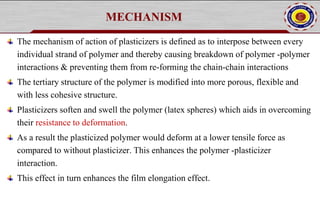
The mechanism of action of plasticizers is defined as to interpose between every
individual strand of polymer and thereby causing breakdown of polymer -polymer
interactions & preventing them from re-forming the chain-chain interactions
The tertiary structure of the polymer is modified into more porous, flexible and
with less cohesive structure.
Plasticizers soften and swell the polymer (latex spheres) which aids in overcoming
their resistance to deformation.
As a result the plasticized polymer would deform at a lower tensile force as
compared to without plasticizer. This enhances the polymer -plasticizer
interaction.
This effect in turn enhances the film elongation effect.
MECHANISM
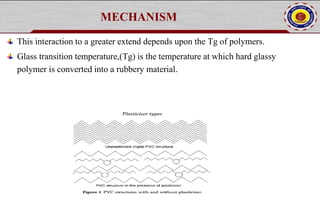
This interaction to a greater extend depends upon the Tg of polymers.
Glass transition temperature,(Tg) is the temperature at which hard glassy
polymer is converted into a rubbery material.
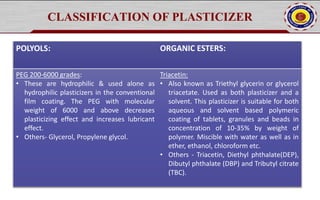
CLASSIFICATION OF PLASTICIZER
POLYOLS: ORGANIC ESTERS:
PEG 200-6000 grades:
• These are hydrophilic & used alone as
hydrophilic plasticizers in the conventional
film coating. The PEG with molecular
weight of 6000 and above decreases
plasticizing effect and increases lubricant
effect.
• Others- Glycerol, Propylene glycol.
Triacetin:
• Also known as Triethyl glycerin or glycerol
triacetate. Used as both plasticizer and a
solvent. This plasticizer is suitable for both
aqueous and solvent based polymeric
coating of tablets, granules and beads in
concentration of 10-35% by weight of
polymer. Miscible with water as well as in
ether, ethanol, chloroform etc.
• Others - Triacetin, Diethyl phthalate(DEP),
Dibutyl phthalate (DBP) and Tributyl citrate
(TBC).
EFFECT ON PERMEABILITY OF FILMS
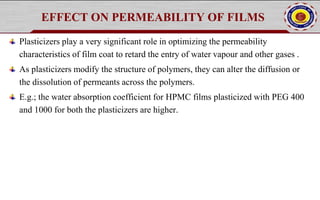
Plasticizers play a very significant role in optimizing the permeability
characteristics of film coat to retard the entry of water vapour and other gases .
As plasticizers modify the structure of polymers, they can alter the diffusion or
the dissolution of permeants across the polymers.
E.g.; the water absorption coefficient for HPMC films plasticized with PEG 400
and 1000 for both the plasticizers are higher.
EFFECT OF PLASTICIZERS ON MECHANICAL
PROPERTIES OF FILMS
Decrease in tensile strength
Decrease in elastic modulus
Increase in film elongation.
E.g. the effect of plasticizers on the mechanical properties of cast film of
HPMC i.e.; Methocel ES was studied and it was foundthat the low
molecular weight PEGs had a better plasticizing effect as compared to
higher molecular weight due to viscoelastic effect of former.
EFFECT ON RESIDUAL INTERNAL STRESS
Plasticizers reduce internal stress within the films.They also decrease the surface
tension at the polymer surface.
When the effect on residual internal stress of plasticizer was evaluated on CAP films
, the triacetin among the triacetin, DEP and Citroflex 2A had the best plasticizing
effect due to lowering of residual internal stress within the films.
EFFECT OF PLASTICIZERS ON RELEASE
RATES OF DRUG .
Effect of plasticizer type and coat level on aqueous coating dispersions of
ethylcellulose.
To optimize the most suitable plasticizer and in its most suitable concentration for
ethylcellulose (EC).
The two commercial formulations, one Surelease/E-7-7050 containing dibutyl
sebacate (DBS) and formulation 2 was Surelease/E- 7-7060 containing glyceryl
tricaprylate/caprate (GTC).
The tablet was coated with 1%, 2%, 3% and 5% coat levels.
The release profile of the drug (Ibuprofen) was a function of coat thickness.
EFFECT OF PLASTICIZERS ON RELEASE
RATES OF DRUG
At a coat of 2% the release of drug from with GTC plasticized formulation
appeared to follow the non-Fickian release mechanism , whereas the
tablets coated with DBS plasticized formulation appeared to follow
apparent zero-order release.
The film plasticized with GTC were intact and more elastic than those of
DBS plasticized films.
Hence it was inferred that GTC was a better plasticizer as compared to
DBS when both used in same concentrations.
The film elongation effect increase , tensile strength decreases and glass
transition temperature decreases in GTC plasticized films.
TEXTURE OF PLASTICIZED FILMS
The texture of Aquacoat films varied with the type of plasticizers used.
Aquacoat films plasticized with DBP appeared to be more flexible,
smoother and homogeneous while those plasticized with DEP and ATEC
had raised spots and undulating surfaces.
LIMITATION
LEACHING EFFECT-
The major trouble encountered during the plasticizing of polymers is the leaching of
the plasticizer from the film.
This leaching effect of Plasticizer is dependent on the type and concentration of
dissolution medium. This eventually results in drastic alteration of drug release
patterns from coated dosage forms.
Thus permanence due to leaching tendency of plasticizers can be controlled by
diffusion control.
This diffusion of plasticizer can be controlled by incorporating a more non volatile
plasticizer.
LIMITATION
The molecular size and shape of the plasticizer are highly important as small
molecules migrate faster than large ones.
Also linear molecules migrate faster than bulky, branched ones.
Permanence is an attribute taken in consideration as loss of plasticizer
during storage of plasticizers which in turn can hamper integrity of coated
tablets.
The highly solvating ones that produce an open gel structure migrate at a
faster rate.
Volatility was found to be one of the major cause.
CONCLUSION
Plasticizers play a very significant role on mechanical properties,
permeability of films and release of drug from the coated products.
They do enhance flexibility and plasticity of films.
Therefore, the selection of a plasticizer for a film-coating formulation is
very important in the process development and optimization of a coated
dosage form.

Plasticizer

  • 1.
    COIMBATORE INSTITUTE OFTECHNOLOGY DEPARTMENT OF CHEMICAL ENGINEERING THE PLASTICIZERS . PRESENTED BY AKASH R(1606001) B.Tech (Chemical Engineering) Final Year 15CHE21- SURFACE COATING TECHNOLOGY
  • 2.
    INTRODUCTION • Plasticizers ordispersants are additives that increase the plasticity or fluidity of a material. It is a material, usually a plastic, makes it flexible, resilient and easier to handle. • Plasticizers are colorless, odorless liquids & relatively low molecular weight which have a capacity to alter the physical properties of polymer for more useful as film forming agents. • It may reduce the melt viscosity, lower temperature of second order transition.
  • 3.
    INTRODUCTION • The functionof plasticizer is to make the polymer more pliable, soft and enhancing the flexibility, plasticity and the mobility of the polymeric chain. • There are more than 300 different types of plasticizers available . The most commonly used plasticizers are ester like phthalates, adipates and trimellitates.
  • 4.
    NEED FOR PLASTICIZER Almostall the film forming agents or polymers are brittle in nature due to presence of multiple polymeric strands within a single molecule . Most are the cellulose derivatives or cellulose related compounds like HPMC, MC, EC etc. When such a material is applied as a film coat, a smooth film is not be obtained. Plasticizers diffuse within the polymers and cause polymer deformation and coalescence into homogeneous films. The effectiveness depends upon polymer compatibility and the permanence of plasticizer during the course of shelf life.
  • 5.
    NEED FOR PLASTICIZER Thesepolymers are widely used as film forming materials as they:-Produce transparent & intact films.They have lower values for water vapor permeability & oxygen transmission rate. Physicochemical properties of the films mainly the water uptake and erosion, solid-state crystallinity, thermal behavior and water vapor and drug permeability are modified to a greater extend. They can be structurally modified to achieve sustained release,like HPMC can be converted to HPMCP for enteric coating.
  • 6.
    MECHANISM The mechanism ofaction of plasticizers is defined as to interpose between every individual strand of polymer and thereby causing breakdown of polymer -polymer interactions & preventing them from re-forming the chain-chain interactions The tertiary structure of the polymer is modified into more porous, flexible and with less cohesive structure. Plasticizers soften and swell the polymer (latex spheres) which aids in overcoming their resistance to deformation. As a result the plasticized polymer would deform at a lower tensile force as compared to without plasticizer. This enhances the polymer -plasticizer interaction. This effect in turn enhances the film elongation effect.
  • 7.
    MECHANISM This interaction toa greater extend depends upon the Tg of polymers. Glass transition temperature,(Tg) is the temperature at which hard glassy polymer is converted into a rubbery material.
  • 8.
    CLASSIFICATION OF PLASTICIZER POLYOLS:ORGANIC ESTERS: PEG 200-6000 grades: • These are hydrophilic & used alone as hydrophilic plasticizers in the conventional film coating. The PEG with molecular weight of 6000 and above decreases plasticizing effect and increases lubricant effect. • Others- Glycerol, Propylene glycol. Triacetin: • Also known as Triethyl glycerin or glycerol triacetate. Used as both plasticizer and a solvent. This plasticizer is suitable for both aqueous and solvent based polymeric coating of tablets, granules and beads in concentration of 10-35% by weight of polymer. Miscible with water as well as in ether, ethanol, chloroform etc. • Others - Triacetin, Diethyl phthalate(DEP), Dibutyl phthalate (DBP) and Tributyl citrate (TBC).
  • 9.
    EFFECT ON PERMEABILITYOF FILMS Plasticizers play a very significant role in optimizing the permeability characteristics of film coat to retard the entry of water vapour and other gases . As plasticizers modify the structure of polymers, they can alter the diffusion or the dissolution of permeants across the polymers. E.g.; the water absorption coefficient for HPMC films plasticized with PEG 400 and 1000 for both the plasticizers are higher.
  • 10.
    EFFECT OF PLASTICIZERSON MECHANICAL PROPERTIES OF FILMS Decrease in tensile strength Decrease in elastic modulus Increase in film elongation. E.g. the effect of plasticizers on the mechanical properties of cast film of HPMC i.e.; Methocel ES was studied and it was foundthat the low molecular weight PEGs had a better plasticizing effect as compared to higher molecular weight due to viscoelastic effect of former.
  • 11.
    EFFECT ON RESIDUALINTERNAL STRESS Plasticizers reduce internal stress within the films.They also decrease the surface tension at the polymer surface. When the effect on residual internal stress of plasticizer was evaluated on CAP films , the triacetin among the triacetin, DEP and Citroflex 2A had the best plasticizing effect due to lowering of residual internal stress within the films.
  • 12.
    EFFECT OF PLASTICIZERSON RELEASE RATES OF DRUG . Effect of plasticizer type and coat level on aqueous coating dispersions of ethylcellulose. To optimize the most suitable plasticizer and in its most suitable concentration for ethylcellulose (EC). The two commercial formulations, one Surelease/E-7-7050 containing dibutyl sebacate (DBS) and formulation 2 was Surelease/E- 7-7060 containing glyceryl tricaprylate/caprate (GTC). The tablet was coated with 1%, 2%, 3% and 5% coat levels. The release profile of the drug (Ibuprofen) was a function of coat thickness.
  • 13.
    EFFECT OF PLASTICIZERSON RELEASE RATES OF DRUG At a coat of 2% the release of drug from with GTC plasticized formulation appeared to follow the non-Fickian release mechanism , whereas the tablets coated with DBS plasticized formulation appeared to follow apparent zero-order release. The film plasticized with GTC were intact and more elastic than those of DBS plasticized films. Hence it was inferred that GTC was a better plasticizer as compared to DBS when both used in same concentrations. The film elongation effect increase , tensile strength decreases and glass transition temperature decreases in GTC plasticized films.
  • 14.
    TEXTURE OF PLASTICIZEDFILMS The texture of Aquacoat films varied with the type of plasticizers used. Aquacoat films plasticized with DBP appeared to be more flexible, smoother and homogeneous while those plasticized with DEP and ATEC had raised spots and undulating surfaces.
  • 15.
    LIMITATION LEACHING EFFECT- The majortrouble encountered during the plasticizing of polymers is the leaching of the plasticizer from the film. This leaching effect of Plasticizer is dependent on the type and concentration of dissolution medium. This eventually results in drastic alteration of drug release patterns from coated dosage forms. Thus permanence due to leaching tendency of plasticizers can be controlled by diffusion control. This diffusion of plasticizer can be controlled by incorporating a more non volatile plasticizer.
  • 16.
    LIMITATION The molecular sizeand shape of the plasticizer are highly important as small molecules migrate faster than large ones. Also linear molecules migrate faster than bulky, branched ones. Permanence is an attribute taken in consideration as loss of plasticizer during storage of plasticizers which in turn can hamper integrity of coated tablets. The highly solvating ones that produce an open gel structure migrate at a faster rate. Volatility was found to be one of the major cause.
  • 17.
    CONCLUSION Plasticizers play avery significant role on mechanical properties, permeability of films and release of drug from the coated products. They do enhance flexibility and plasticity of films. Therefore, the selection of a plasticizer for a film-coating formulation is very important in the process development and optimization of a coated dosage form.