 Introduction
 Advantages and Disadvantages
 Environmental impact
 Polyethylene tetrapthalate (PET)
 Plastic degrading bacteria
 Method
 Conclusion
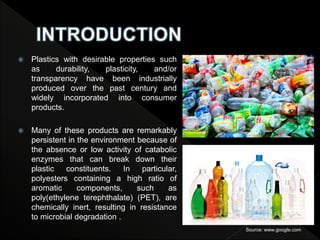
 Plastics with desirable properties such
as durability, plasticity, and/or
transparency have been industrially
produced over the past century and
widely incorporated into consumer
products.
 Many of these products are remarkably
persistent in the environment because of
the absence or low activity of catabolic
enzymes that can break down their
plastic constituents. In particular,
polyesters containing a high ratio of
aromatic components, such as
poly(ethylene terephthalate) (PET), are
chemically inert, resulting in resistance
to microbial degradation .
Source: www.google.com
 Plastic is very useful in the building and
construction, electronics, packaging, transportation
industries etc.
 Very easy to make water-bottles, Plastic bags,
pens, cups etc.
 Plastic is good, strong and cheap to produce.
 It can be recycled.
 It is food grade so very suitable for drinks and food
storage.
 Plastic is usually not breakable.
 it is light weight and odourless.
 It is a compound that is Indestructible, even when it is
melted the compound gas that is gives off is very
harmful to our health and environment.
 It weakens the ozone layer.
 Most plastic is produced from oil.
 It is cheap but it is not easily disposable so it is in a lot
of landfills.
 Plastic bags can kill the marine animals and also
destroy the soil.
 Plastic does break into tiny pieces, dangerous to
animals. It floats in the oceans, where it is eaten by sea
animals and birds which affect the digestive system and
also cause death.
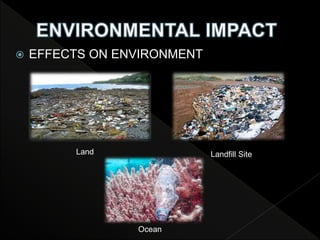
 EFFECTS ON ENVIRONMENT
Land Landfill Site
Ocean
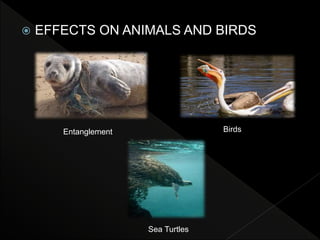
 EFFECTS ON ANIMALS AND BIRDS
Entanglement Birds
Sea Turtles
 Recycle plastic saves twice as much energy as
burning it in an incinerator.
 PET Plastic can be recycled into: clothing, Fiberfil
for sleeping bags, toys, Stuffed animal toys, and
more
 Only around 27% of plastic bottles are recycled.
 Recycling saves 3 to 5 times the energy generated
by waste-to-energy plants, even without counting
the wasted energy in the burned materials.
 Recycling one tone of plastic saves the equivalent
of 1000-2000 gallons of gasoline.
 PET stands for polyethylene terephthalate, a plastic with good
mechanical, barrier, and optical properties. Bottles for water and
soft drinks are just a couple of PET's many, many uses. PET is
a polyester compound with a high aromatic content, which
makes it chemically inert. As a result, it is typically considered
resistant to microbial degradation, although certain fungi grow
on a mineral medium containing PET.
 Roughly 56 million tons of PET are produced each year, and a
lot of that ends up in the environment prompting further
industrial production of its monomers, terephthalic acid (TPA)
and ethylene glycol (EG), both of which are derived from raw
petroleum. Large quantities of PET have been introduced
into the environment through its production and disposal,
resulting in the accumulation of PET in ecosystems across
the globe.
 Poly(ethylene terephthalate) (PET) is used extensively worldwide in
plastic products, and its accumulation in the environment has become
a global concern. Because the ability to enzymatically degrade PET
has been thought to be limited to a few fungal species, biodegradation
is not yet a viable remediation or recycling strategy.
 By screening natural microbial communities exposed to PET in the
environment, isolated a novel bacterium, Ideonella sakaiensis 201-F6,
that is able to use PET as its major energy and carbon source. When
grown on PET, this strain produces two enzymes capable of
hydrolyzing PET and the reaction intermediate, mono(2-hydroxyethyl)
terephthalic acid. Both enzymes are required to enzymatically convert
PET efficiently into its two environmentally benign monomers,
terephthalic acid and ethylene glycol.
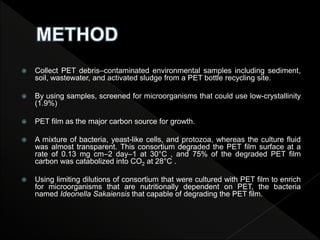
 Collect PET debris–contaminated environmental samples including sediment,
soil, wastewater, and activated sludge from a PET bottle recycling site.
 By using samples, screened for microorganisms that could use low-crystallinity
(1.9%)
 PET film as the major carbon source for growth.
 A mixture of bacteria, yeast-like cells, and protozoa, whereas the culture fluid
was almost transparent. This consortium degraded the PET film surface at a
rate of 0.13 mg cm–2 day–1 at 30°C , and 75% of the degraded PET film
carbon was catabolized into CO2 at 28°C .
 Using limiting dilutions of consortium that were cultured with PET film to enrich
for microorganisms that are nutritionally dependent on PET, the bacteria
named Ideonella Sakaiensis that capable of degrading the PET film.
 In addition to being found in the culture fluid, cells were observed on the film
and appeared to be connected to each other by appendages. Shorter
appendages were observed between the cells and the film; these might assist
in the delivery of secreted enzymes into the film.
 The PET film was damaged extensively and almost completely degraded after
6 weeks at 30°C
 There are currently few known examples of esterases, lipases, or cutinases
that are capable of hydrolyzing PET . To explore the genes involved in PET
hydrolysis in I. sakaiensis 201F6, assembled a draft sequence of its genome.
One identified open reading frame , ISF6_4831, encodes a putative lipase that
shares 51% amino acid sequence identity and catalytic residues with a
hydrolase from Thermobifida fusca that exhibits PET-hydrolyticactivity. then
purified the corresponding recombinant I. sakaiensis proteins and incubated
them with PET film at 30°C for 18 hours. Prominent pitting developed on the
film surface .
 Mono(2-hydroxyethyl) terephthalic acid (MHET) was the major product
released by the recombinant protein, together with minor amounts of TPA and
bis(2-hydroxyethyl) TPA (BHET) . These results suggest that the ISF6_4831
protein hydrolyzes PET. This protein also hydrolyzed BHET to yield MHET with
no further decomposition.
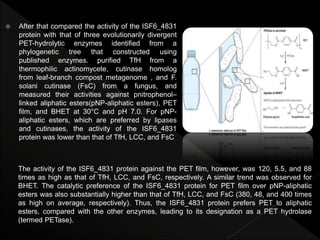
 After that compared the activity of the ISF6_4831
protein with that of three evolutionarily divergent
PET-hydrolytic enzymes identified from a
phylogenetic tree that constructed using
published enzymes. purified TfH from a
thermophilic actinomycete, cutinase homolog
from leaf-branch compost metagenome , and F.
solani cutinase (FsC) from a fungus, and
measured their activities against pnitrophenol–
linked aliphatic esters(pNP-aliphatic esters), PET
film, and BHET at 30°C and pH 7.0. For pNP-
aliphatic esters, which are preferred by lipases
and cutinases, the activity of the ISF6_4831
protein was lower than that of TfH, LCC, and FsC
The activity of the ISF6_4831 protein against the PET film, however, was 120, 5.5, and 88
times as high as that of TfH, LCC, and FsC, respectively. A similar trend was observed for
BHET. The catalytic preference of the ISF6_4831 protein for PET film over pNP-aliphatic
esters was also substantially higher than that of TfH, LCC, and FsC (380, 48, and 400 times
as high on average, respectively). Thus, the ISF6_4831 protein prefers PET to aliphatic
esters, compared with the other enzymes, leading to its designation as a PET hydrolase
(termed PETase).
 PETase was also more active than TfH, LCC, and FsC against commercial
bottle–derived PET, which is highly crystallized , even though the densely
packed structure of highly crystallized.
 PET greatly reduces the enzymatic hydrolysis of its ester linkages. PETase was
somewhat heat-labile, but it was considerably more active against PET film at
low temperatures than were TfH, LCC, and FsC. Enzymatic degradation of
polyesters is controlled mainly by their chain mobility. Flexibility of the polyester
chain decreases as the glass transition temperature increases. The glass
transition temperature of PET is around 75°C, meaning that the polyester chain
of PET is in a glassy state at the moderate temperatures appropriate for
mesophilic enzyme reactions. The substrate specificity of PETase and its
prominent hydrolytic activity for PET in a glassy state would be critical to
sustaining the growth of I. sakaiensis on PET in most environments.
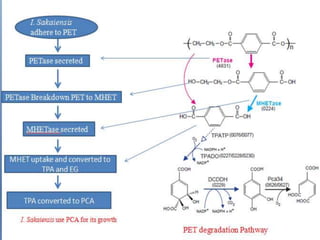
 I. sakaiensis adheres to PET and secretes PETase to target this material.
compared the PET hydrolytic activity of PETase with that of the other three
PET hydrolytic enzymes. The activity ratios of PETase relative to the other
enzymes decreased as the enzyme concentrations increased, indicating that
PETase efficiently hydrolyzed PET with less enzyme diffusion into the aqueous
phase and/or plastic vessels used for the reaction. PETase lacks apparent
substrate binding motifs such as the carbohydrate-binding modules generally
observed in glycoside hydrolases. Therefore, without a three-dimensional
structure determined for PETase, the exact binding mechanism is unknown.
 MHET, the product of PETase-mediated hydrolysis of BHET and PET, was
a very minor component in the supernatant of I. sakaiensis cultured on
PET film, indicating rapid MHET metabolism. Several PET hydrolytic
enzymes have been confirmed to hydrolyze MHET. To identify enzymes
responsible for PET degradation in I. sakaiensis cultures, RNA-sequenced
transcriptomes of I. sakaiensis cells growing on maltose, disodium
terephthalate (TPA-Na), BHET, or PET film. The catabolic genes for TPA
and the metabolite protocatechuic acid (PCA) were up-regulated
dramatically when cells were cultured on TPA-Na, BHET, or PET film.
 This contrasted with genes for the catabolism of maltose, which involves a
pathway distinct from the degradation of TPA and EG, indicating efficient
metabolism of TPA by I. sakaiensis. The transcript level of the PETase
encoding gene during growth on PET film was the highest among all
analyzed coding sequences, and it was 15, 31, and 41 times as high as
when bacteria were grown on maltose, TPA-Na, and BHET, respectively.
This suggests that the expression of PETase is induced by PET film itself
and/or some degradation products other than TPA, EG, MHET, and BHET.
 The expression levels of the PETase gene in the four different
media were similar to those of another ORF, ISF6_0224 , indicating
similar regulation. ISF6_0224 is located adjacent to the TPA
degradation gene cluster. The ISF6_0224 protein sequence
matches those of the tannase family, which is known to hydrolyze
the ester linkage of aromatic compounds such as gallic acid esters,
ferulic saccharides, and chlorogenic acids. The catalytic triad
residues and two cysteine residues found only in this family are
completely conserved in the ISF6_0224 protein. ISF6_0224 is
nonhomologous to six known MHET-hydrolytic enzymes that also
hydrolyze PET and pNP-aliphatic esters.
 These results strongly suggest that the ISF6_0224 protein is
responsible for the conversion of MHET to TPA and EG in I.
sakaiensis. The enzyme was thus designated a MHET hydrolase
(termed MHETase).
 To determine how the metabolism of PET evolved, used the Integr8
fully sequenced genome database to search for other organisms
capable of metabolizing this compound. unable to find other
organisms with a set of gene homologs of signature enzymes for
PET metabolism . However, among the 92 microorganisms with
MHETase homolog, 33 had homologs of both TPA and PCA
dioxygenases. This suggests that a genomic basis to support the
metabolism of MHETanalogs was established much earlier than
when ancestral PETase proteins were incorporated into the
pathway.
 PET enrichment in the sampling site and the enrichment culture
potentially promoted the selection of a bacterium that might have
obtained the necessary set of genes through lateral gene transfer.
A limited number of mutations in a hydrolase, such as PET
hydrolytic cutinase, that inherently targets the natural aliphatic
polymer cutin may have resulted in enhanced selectivity for PET.
 Plastics are everywhere. Once they get into the
environment as trash, they stay there for years, decades,
or even centuries. That's because most plastic is
chemically inert and immune to the enzymatic processes
involved in biodegradation.
 Plastic pollution is increasing day by day and at some
point plastic recycle is not possible. So that biodegradation
of plastic is important
 By screening natural microbial communities exposed to
PET in the environment,
 A new bacteria species I. Sakaiensis which is able to
utilize PET. This method will help us to reduce plastic
pollution.
 Yoshida S. A Bacterium that Degrades and assimilates (poly ethylene
Terepthalate: vol. 351 issue 6278 pp 1196-1199, March 2016
 http://arstechnica.com/science/2016/03/does-newly-discovered-bacteria-
recycle-plastic/
 https://www.google.co.in/search?q=plastic+pollution&biw=1366&bih=651&
source=lnms&tbm=isch&sa=X&sqi=2&ved=0ahUKEwjz8f2njaXPAhVCmZ
QKHfQDD1gQ_AUIBigB#tbm=isch&q=+plastic+PET&imgrc=Cc6Bn5vIquS
4fM%3A
 http://phys.org/news/2016-03-newly-bacteria-plastic-bottles.html
 https://www.chemistryworld.com/news/plastic-eating-bacteria-show-way-to-
recycle-plastic-bottles-sustainably/9556.article
 http://science.sciencemag.org/content/351/6278/1196.full.pdf+html
 http://link.springer.com/article/10.1007/BF00114555
 http://link.springer.com/article/10.1007/s10924-005-4758-2
 http://www.answers.com/Q/What_are_advantages_and_disadvantages_of
_plastics#slide=3
 https://www.google.co.in/?gfe_rd=cr&ei=Q0nlV7LZE7TT8geCi7KQBg#q=e
nvironmental+impact+of+plastic
 http://www.mrcpolymers.com/PlasticRecyclingFacts.php
 http://www.ecocycle.org/plastics-recycling
 https://www.google.co.in/search?q=land+pollution+of+plastic&biw=1366&bi
h=651&source=lnms&tbm=isch&sa=X&ved=0ahUKEwiAjuO4_6XPAhXELY
8KHa9xBvgQ_AUIBigB#tbm=isch&q=plasic+recycle&imgrc=_
 http://www.sciencedirect.com/science/article/pii/096483059500089
5
 https://www.google.co.in/?gfe_rd=cr&ei=o0flV9b_DKTT8gfmw71w#
q=advantages+and+disadvantages+of+polyethylene+terephthalate
Plastic eating bacteria

Plastic eating bacteria

  • 2.
     Introduction  Advantagesand Disadvantages  Environmental impact  Polyethylene tetrapthalate (PET)  Plastic degrading bacteria  Method  Conclusion
  • 3.
     Plastics withdesirable properties such as durability, plasticity, and/or transparency have been industrially produced over the past century and widely incorporated into consumer products.  Many of these products are remarkably persistent in the environment because of the absence or low activity of catabolic enzymes that can break down their plastic constituents. In particular, polyesters containing a high ratio of aromatic components, such as poly(ethylene terephthalate) (PET), are chemically inert, resulting in resistance to microbial degradation . Source: www.google.com
  • 4.
     Plastic isvery useful in the building and construction, electronics, packaging, transportation industries etc.  Very easy to make water-bottles, Plastic bags, pens, cups etc.  Plastic is good, strong and cheap to produce.  It can be recycled.  It is food grade so very suitable for drinks and food storage.  Plastic is usually not breakable.  it is light weight and odourless.
  • 5.
     It isa compound that is Indestructible, even when it is melted the compound gas that is gives off is very harmful to our health and environment.  It weakens the ozone layer.  Most plastic is produced from oil.  It is cheap but it is not easily disposable so it is in a lot of landfills.  Plastic bags can kill the marine animals and also destroy the soil.  Plastic does break into tiny pieces, dangerous to animals. It floats in the oceans, where it is eaten by sea animals and birds which affect the digestive system and also cause death.
  • 6.
     EFFECTS ONENVIRONMENT Land Landfill Site Ocean
  • 7.
     EFFECTS ONANIMALS AND BIRDS Entanglement Birds Sea Turtles
  • 8.
     Recycle plasticsaves twice as much energy as burning it in an incinerator.  PET Plastic can be recycled into: clothing, Fiberfil for sleeping bags, toys, Stuffed animal toys, and more  Only around 27% of plastic bottles are recycled.  Recycling saves 3 to 5 times the energy generated by waste-to-energy plants, even without counting the wasted energy in the burned materials.  Recycling one tone of plastic saves the equivalent of 1000-2000 gallons of gasoline.
  • 9.
     PET standsfor polyethylene terephthalate, a plastic with good mechanical, barrier, and optical properties. Bottles for water and soft drinks are just a couple of PET's many, many uses. PET is a polyester compound with a high aromatic content, which makes it chemically inert. As a result, it is typically considered resistant to microbial degradation, although certain fungi grow on a mineral medium containing PET.  Roughly 56 million tons of PET are produced each year, and a lot of that ends up in the environment prompting further industrial production of its monomers, terephthalic acid (TPA) and ethylene glycol (EG), both of which are derived from raw petroleum. Large quantities of PET have been introduced into the environment through its production and disposal, resulting in the accumulation of PET in ecosystems across the globe.
  • 10.
     Poly(ethylene terephthalate)(PET) is used extensively worldwide in plastic products, and its accumulation in the environment has become a global concern. Because the ability to enzymatically degrade PET has been thought to be limited to a few fungal species, biodegradation is not yet a viable remediation or recycling strategy.  By screening natural microbial communities exposed to PET in the environment, isolated a novel bacterium, Ideonella sakaiensis 201-F6, that is able to use PET as its major energy and carbon source. When grown on PET, this strain produces two enzymes capable of hydrolyzing PET and the reaction intermediate, mono(2-hydroxyethyl) terephthalic acid. Both enzymes are required to enzymatically convert PET efficiently into its two environmentally benign monomers, terephthalic acid and ethylene glycol.
  • 12.
     Collect PETdebris–contaminated environmental samples including sediment, soil, wastewater, and activated sludge from a PET bottle recycling site.  By using samples, screened for microorganisms that could use low-crystallinity (1.9%)  PET film as the major carbon source for growth.  A mixture of bacteria, yeast-like cells, and protozoa, whereas the culture fluid was almost transparent. This consortium degraded the PET film surface at a rate of 0.13 mg cm–2 day–1 at 30°C , and 75% of the degraded PET film carbon was catabolized into CO2 at 28°C .  Using limiting dilutions of consortium that were cultured with PET film to enrich for microorganisms that are nutritionally dependent on PET, the bacteria named Ideonella Sakaiensis that capable of degrading the PET film.
  • 13.
     In additionto being found in the culture fluid, cells were observed on the film and appeared to be connected to each other by appendages. Shorter appendages were observed between the cells and the film; these might assist in the delivery of secreted enzymes into the film.  The PET film was damaged extensively and almost completely degraded after 6 weeks at 30°C  There are currently few known examples of esterases, lipases, or cutinases that are capable of hydrolyzing PET . To explore the genes involved in PET hydrolysis in I. sakaiensis 201F6, assembled a draft sequence of its genome. One identified open reading frame , ISF6_4831, encodes a putative lipase that shares 51% amino acid sequence identity and catalytic residues with a hydrolase from Thermobifida fusca that exhibits PET-hydrolyticactivity. then purified the corresponding recombinant I. sakaiensis proteins and incubated them with PET film at 30°C for 18 hours. Prominent pitting developed on the film surface .  Mono(2-hydroxyethyl) terephthalic acid (MHET) was the major product released by the recombinant protein, together with minor amounts of TPA and bis(2-hydroxyethyl) TPA (BHET) . These results suggest that the ISF6_4831 protein hydrolyzes PET. This protein also hydrolyzed BHET to yield MHET with no further decomposition.
  • 14.
     After thatcompared the activity of the ISF6_4831 protein with that of three evolutionarily divergent PET-hydrolytic enzymes identified from a phylogenetic tree that constructed using published enzymes. purified TfH from a thermophilic actinomycete, cutinase homolog from leaf-branch compost metagenome , and F. solani cutinase (FsC) from a fungus, and measured their activities against pnitrophenol– linked aliphatic esters(pNP-aliphatic esters), PET film, and BHET at 30°C and pH 7.0. For pNP- aliphatic esters, which are preferred by lipases and cutinases, the activity of the ISF6_4831 protein was lower than that of TfH, LCC, and FsC The activity of the ISF6_4831 protein against the PET film, however, was 120, 5.5, and 88 times as high as that of TfH, LCC, and FsC, respectively. A similar trend was observed for BHET. The catalytic preference of the ISF6_4831 protein for PET film over pNP-aliphatic esters was also substantially higher than that of TfH, LCC, and FsC (380, 48, and 400 times as high on average, respectively). Thus, the ISF6_4831 protein prefers PET to aliphatic esters, compared with the other enzymes, leading to its designation as a PET hydrolase (termed PETase).
  • 15.
     PETase wasalso more active than TfH, LCC, and FsC against commercial bottle–derived PET, which is highly crystallized , even though the densely packed structure of highly crystallized.  PET greatly reduces the enzymatic hydrolysis of its ester linkages. PETase was somewhat heat-labile, but it was considerably more active against PET film at low temperatures than were TfH, LCC, and FsC. Enzymatic degradation of polyesters is controlled mainly by their chain mobility. Flexibility of the polyester chain decreases as the glass transition temperature increases. The glass transition temperature of PET is around 75°C, meaning that the polyester chain of PET is in a glassy state at the moderate temperatures appropriate for mesophilic enzyme reactions. The substrate specificity of PETase and its prominent hydrolytic activity for PET in a glassy state would be critical to sustaining the growth of I. sakaiensis on PET in most environments.  I. sakaiensis adheres to PET and secretes PETase to target this material. compared the PET hydrolytic activity of PETase with that of the other three PET hydrolytic enzymes. The activity ratios of PETase relative to the other enzymes decreased as the enzyme concentrations increased, indicating that PETase efficiently hydrolyzed PET with less enzyme diffusion into the aqueous phase and/or plastic vessels used for the reaction. PETase lacks apparent substrate binding motifs such as the carbohydrate-binding modules generally observed in glycoside hydrolases. Therefore, without a three-dimensional structure determined for PETase, the exact binding mechanism is unknown.
  • 16.
     MHET, theproduct of PETase-mediated hydrolysis of BHET and PET, was a very minor component in the supernatant of I. sakaiensis cultured on PET film, indicating rapid MHET metabolism. Several PET hydrolytic enzymes have been confirmed to hydrolyze MHET. To identify enzymes responsible for PET degradation in I. sakaiensis cultures, RNA-sequenced transcriptomes of I. sakaiensis cells growing on maltose, disodium terephthalate (TPA-Na), BHET, or PET film. The catabolic genes for TPA and the metabolite protocatechuic acid (PCA) were up-regulated dramatically when cells were cultured on TPA-Na, BHET, or PET film.  This contrasted with genes for the catabolism of maltose, which involves a pathway distinct from the degradation of TPA and EG, indicating efficient metabolism of TPA by I. sakaiensis. The transcript level of the PETase encoding gene during growth on PET film was the highest among all analyzed coding sequences, and it was 15, 31, and 41 times as high as when bacteria were grown on maltose, TPA-Na, and BHET, respectively. This suggests that the expression of PETase is induced by PET film itself and/or some degradation products other than TPA, EG, MHET, and BHET.
  • 17.
     The expressionlevels of the PETase gene in the four different media were similar to those of another ORF, ISF6_0224 , indicating similar regulation. ISF6_0224 is located adjacent to the TPA degradation gene cluster. The ISF6_0224 protein sequence matches those of the tannase family, which is known to hydrolyze the ester linkage of aromatic compounds such as gallic acid esters, ferulic saccharides, and chlorogenic acids. The catalytic triad residues and two cysteine residues found only in this family are completely conserved in the ISF6_0224 protein. ISF6_0224 is nonhomologous to six known MHET-hydrolytic enzymes that also hydrolyze PET and pNP-aliphatic esters.  These results strongly suggest that the ISF6_0224 protein is responsible for the conversion of MHET to TPA and EG in I. sakaiensis. The enzyme was thus designated a MHET hydrolase (termed MHETase).
  • 18.
     To determinehow the metabolism of PET evolved, used the Integr8 fully sequenced genome database to search for other organisms capable of metabolizing this compound. unable to find other organisms with a set of gene homologs of signature enzymes for PET metabolism . However, among the 92 microorganisms with MHETase homolog, 33 had homologs of both TPA and PCA dioxygenases. This suggests that a genomic basis to support the metabolism of MHETanalogs was established much earlier than when ancestral PETase proteins were incorporated into the pathway.  PET enrichment in the sampling site and the enrichment culture potentially promoted the selection of a bacterium that might have obtained the necessary set of genes through lateral gene transfer. A limited number of mutations in a hydrolase, such as PET hydrolytic cutinase, that inherently targets the natural aliphatic polymer cutin may have resulted in enhanced selectivity for PET.
  • 19.
     Plastics areeverywhere. Once they get into the environment as trash, they stay there for years, decades, or even centuries. That's because most plastic is chemically inert and immune to the enzymatic processes involved in biodegradation.  Plastic pollution is increasing day by day and at some point plastic recycle is not possible. So that biodegradation of plastic is important  By screening natural microbial communities exposed to PET in the environment,  A new bacteria species I. Sakaiensis which is able to utilize PET. This method will help us to reduce plastic pollution.
  • 20.
     Yoshida S.A Bacterium that Degrades and assimilates (poly ethylene Terepthalate: vol. 351 issue 6278 pp 1196-1199, March 2016  http://arstechnica.com/science/2016/03/does-newly-discovered-bacteria- recycle-plastic/  https://www.google.co.in/search?q=plastic+pollution&biw=1366&bih=651& source=lnms&tbm=isch&sa=X&sqi=2&ved=0ahUKEwjz8f2njaXPAhVCmZ QKHfQDD1gQ_AUIBigB#tbm=isch&q=+plastic+PET&imgrc=Cc6Bn5vIquS 4fM%3A  http://phys.org/news/2016-03-newly-bacteria-plastic-bottles.html  https://www.chemistryworld.com/news/plastic-eating-bacteria-show-way-to- recycle-plastic-bottles-sustainably/9556.article  http://science.sciencemag.org/content/351/6278/1196.full.pdf+html  http://link.springer.com/article/10.1007/BF00114555  http://link.springer.com/article/10.1007/s10924-005-4758-2
  • 21.
     http://www.answers.com/Q/What_are_advantages_and_disadvantages_of _plastics#slide=3  https://www.google.co.in/?gfe_rd=cr&ei=Q0nlV7LZE7TT8geCi7KQBg#q=e nvironmental+impact+of+plastic http://www.mrcpolymers.com/PlasticRecyclingFacts.php  http://www.ecocycle.org/plastics-recycling  https://www.google.co.in/search?q=land+pollution+of+plastic&biw=1366&bi h=651&source=lnms&tbm=isch&sa=X&ved=0ahUKEwiAjuO4_6XPAhXELY 8KHa9xBvgQ_AUIBigB#tbm=isch&q=plasic+recycle&imgrc=_  http://www.sciencedirect.com/science/article/pii/096483059500089 5  https://www.google.co.in/?gfe_rd=cr&ei=o0flV9b_DKTT8gfmw71w# q=advantages+and+disadvantages+of+polyethylene+terephthalate