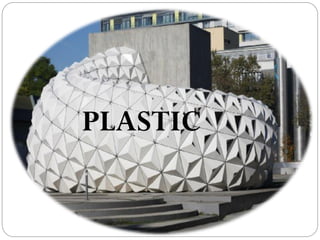
PLASTIC
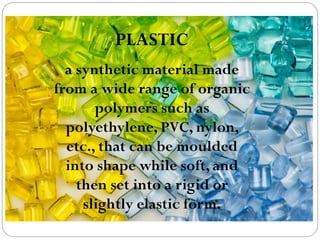
a synthetic material made
from a wide range of organic
polymers such as
polyethylene, PVC, nylon,
etc., that can be moulded
into shape while soft, and
then set into a rigid or
slightly elastic form.
PLASTIC
TYPES
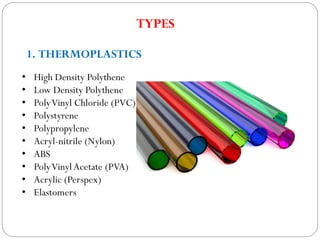
1. THERMOPLASTICS
• High Density Polythene
• Low Density Polythene
• PolyVinyl Chloride (PVC)
• Polystyrene
• Polypropylene
• Acryl-nitrile (Nylon)
• ABS
• PolyVinylAcetate (PVA)
• Acrylic (Perspex)
• Elastomers
2.THERMOSETTING PLASTICS
• Epoxy Resin
• Polyester Resin
• Glass Reinforced Plastic
• Carbon Fiber Plastic
• Melamine Formaldehyde
ADVANTAGES
• Light in weight
• Can be easily molded and have excellent finishing
• Possess very good strength and toughness
• Corrosion resistant and chemically inert
• Low thermal expansion of co efficient and possess good
thermal and electrical insulating property
• Very good water resistant and posses good adhesiveness
• Strong, good and cheap to produces
• Unbreakable
DISADVANTAGES
• Plastic is a non renewable resources
• Causes Cancer
• Embrittlement at low temperature
• Deformation under load
• Low heat resistant and poor ductility
• Combustibility
• Produces toxic fumes when it is burnt
• It is a recycle process, but it is very costly
A) Polyvinyl, also known as poly(vinyl chloride) or PVC, is the
third most widely produced synthetic plastic.
B ) Is a very versatile and cost-efficient thermoplastic of good
dimensional stability and impact strength (when plasticized),
and
excellent weathering properties.
C) It can be easily extruded, calendared and die-cut, and is
printable with conventional screen and offset printing
methods.
D) Depending on the composition, it can be clear or matt,
colored or white, and rigid or flexible.
E) It can also be easily reprocessed using heat.
PVC Polymer Films
Types of films:-
 Flexible vinyl film has good barrier properties
to oil and grease but is oxygen permeable.
 It also has good cling, excellent clarity and
puncture resistant.
 These properties make flexible PVC suitable
for food packaging to keep meat and other
perishable produce fresh (when FDA
approved).
 However, plasticized PVC has a lower melting
point, is less resistant to chemicals, and has a
lower ultimate tensile strength than rigid vinyl.
FlexibleVinyl Film
 Rigid vinyl, also known as plasticized polyvinyl chloride (u
PVC), is a strong and lightweight film.
 It is one of the most durable low-cost films and is
resistant to many chemicals.
 Generally, u PVC can be used at temperatures up to 60°C.
 It has higher tensile strength and modulus than flexible
PVC, but has low impact toughness, and is subject to
stress cracking depending on the environment.
RigidVinyl
APPLICATIONS
 PVC film is used as shrink and stretch wrap for
industrial and consumer goods and as pallet
wrap, however, on a much smaller scale than
polyolefin films.
 Other uses include bags, liners, bottle sleeving,
adhesive tape backing, labels, blood bags and
I.V. bags.
 It is often PVDC coated when improved
moisture barrier properties are required
PROPERTIES
 Easy to work and shape,
 Have a low production cost,
 Possess low density,
 Tend to be waterproof,
 Good electrical insulators,
 Acceptable acoustic insulation,
 Good thermal insulation, but most can not withstand very high
temperatures,
 Resistant to corrosion and many chemical factors;
 Some are not biodegradable or easily recyclable, and if they burn,
are highly polluting.
POLYCARBONATE
POLYCARBONATES
 Polycarbonate is a tough, transparent plastic material with outstanding
strength, stiffness, and impact resistance.
 Polycarbonate’s optical clarity makes it ideal for applications such as
machine guards, signs, architectural glazing, face shields,
skylights, and POP displays.
 SHEET Dimensions:
12 in x 12 in – 72 in x 120 in
 Thickness:
0.030 in – 4 in
 ROD Outside Diameter:
0.125 in – 8 in
 TUBE Outside Diameter:
0.375 in – 6 in
CHARACTERISTICS
OF
POLYCARBONATES
 Outstanding toughness
 Good optical clarity
(non-machine grade or un-filled)
 Strong and stiff
 Good electrical insulation
 Easy to fabricate, machine, and thermoform
 Easy to bond with solvent cements
 Indoor and outdoor signs
 Architectural glazing—medical facilities,
retail and government buildings, and transportation centers at risk
from breakage and vandalism
 POP displays and graphic holders
 Skylights
 Face shields
 Machine guards, sight glasses
 Semiconductor machinery components
 Transparent manifolds
Polycarbonate IsWidely Used For:
ACRYLICS
• Acrylic is a transparent plastic material with outstanding strength, stiffness,
and optical clarity.Acrylic sheet is easy to fabricate, bonds well with
adhesives and solvents, and is easy to thermoform.
• It has superior weathering properties compared to many other transparent
plastics.
• Acrylic sheet exhibits glass-like qualities—clarity, brilliance, and
transparency—but at half the weight and many times the impact resistance
of glass. From durable signs and skylights, to eye-catching retail store
fixtures, displays and shelves, acrylic plastics provide outstanding
versatility, durability, and aesthetic qualities.
FIBRE AND REINFORCED PLASTICS
• Fiber-reinforced plastic (FRP) (also called fiber-reinforced polymer, or fiber-
reinforced plastic) is a composite material made of a polymer matrix reinforced
with fibers.
• The fibers are usually glass (in fiberglass), carbon (in carbon-fiber-reinforced
polymer), aramid, or basalt.
• Rarely, other fibers such as paper, wood, or asbestos have been used.
• The polymer is usually an epoxy, vinyl ester, or polyester thermosetting plastic,
though phenol formaldehyde resins are still in use.
• FRPs are commonly used in the aerospace, automotive, marine, and construction
industries.They are commonly found in ballistic armor as well.
FIBRE AND REINFORCED PLASTICS
• Fiber-reinforced plastics are best suited for any design program that demands weight
savings, precision engineering, finite tolerances, and the simplification of parts in
both production and operation.
• A molded polymer artefact is cheaper, faster, and easier to manufacture than cast
aluminum or steel artefact, and maintains similar and sometimes better tolerances
and material strengths.
• Fire-safe polymers are polymers that are resistant
to degradation at high temperatures.
• There is need for fire-resistant polymers in the
construction of small, enclosed spaces such as skyscrapers,
boats, and airplane cabins.
• In these tight spaces, ability to escape in the event of
a fire is compromised, increasing fire risk.
• In fact, some studies report that about 20% of victims of
airplane crashes are killed not by the crash itself but by
ensuing fires.
• Fire-safe polymers also find application as adhesives in
aerospace materials, insulation for electronics, and in
military materials such as canvas tenting.
FIRE SAFE POLYMERS
THANKYOU
YAMINI K
SAKSHIA SINDGI
SNEHA REDDY
AZAM KHAN
SHOBHITHA
RACHANA
SHIVANI
SHREYA P RAIKAR
RAMYA .S. D
SAI KRISHNA
RUTHVIK
SAKSHEE BANGA
SHEHVAR
THARUN MITHRA
BMSSA

Plastic

  • 1.
  • 2.
    a synthetic materialmade from a wide range of organic polymers such as polyethylene, PVC, nylon, etc., that can be moulded into shape while soft, and then set into a rigid or slightly elastic form. PLASTIC
  • 3.
    TYPES 1. THERMOPLASTICS • HighDensity Polythene • Low Density Polythene • PolyVinyl Chloride (PVC) • Polystyrene • Polypropylene • Acryl-nitrile (Nylon) • ABS • PolyVinylAcetate (PVA) • Acrylic (Perspex) • Elastomers
  • 4.
    2.THERMOSETTING PLASTICS • EpoxyResin • Polyester Resin • Glass Reinforced Plastic • Carbon Fiber Plastic • Melamine Formaldehyde
  • 5.
    ADVANTAGES • Light inweight • Can be easily molded and have excellent finishing • Possess very good strength and toughness • Corrosion resistant and chemically inert • Low thermal expansion of co efficient and possess good thermal and electrical insulating property • Very good water resistant and posses good adhesiveness • Strong, good and cheap to produces • Unbreakable
  • 6.
    DISADVANTAGES • Plastic isa non renewable resources • Causes Cancer • Embrittlement at low temperature • Deformation under load • Low heat resistant and poor ductility • Combustibility • Produces toxic fumes when it is burnt • It is a recycle process, but it is very costly
  • 7.
    A) Polyvinyl, alsoknown as poly(vinyl chloride) or PVC, is the third most widely produced synthetic plastic. B ) Is a very versatile and cost-efficient thermoplastic of good dimensional stability and impact strength (when plasticized), and excellent weathering properties. C) It can be easily extruded, calendared and die-cut, and is printable with conventional screen and offset printing methods. D) Depending on the composition, it can be clear or matt, colored or white, and rigid or flexible. E) It can also be easily reprocessed using heat. PVC Polymer Films
  • 8.
    Types of films:- Flexible vinyl film has good barrier properties to oil and grease but is oxygen permeable.  It also has good cling, excellent clarity and puncture resistant.  These properties make flexible PVC suitable for food packaging to keep meat and other perishable produce fresh (when FDA approved).  However, plasticized PVC has a lower melting point, is less resistant to chemicals, and has a lower ultimate tensile strength than rigid vinyl. FlexibleVinyl Film
  • 9.
     Rigid vinyl,also known as plasticized polyvinyl chloride (u PVC), is a strong and lightweight film.  It is one of the most durable low-cost films and is resistant to many chemicals.  Generally, u PVC can be used at temperatures up to 60°C.  It has higher tensile strength and modulus than flexible PVC, but has low impact toughness, and is subject to stress cracking depending on the environment. RigidVinyl
  • 10.
    APPLICATIONS  PVC filmis used as shrink and stretch wrap for industrial and consumer goods and as pallet wrap, however, on a much smaller scale than polyolefin films.  Other uses include bags, liners, bottle sleeving, adhesive tape backing, labels, blood bags and I.V. bags.  It is often PVDC coated when improved moisture barrier properties are required
  • 12.
    PROPERTIES  Easy towork and shape,  Have a low production cost,  Possess low density,  Tend to be waterproof,  Good electrical insulators,  Acceptable acoustic insulation,  Good thermal insulation, but most can not withstand very high temperatures,  Resistant to corrosion and many chemical factors;  Some are not biodegradable or easily recyclable, and if they burn, are highly polluting.
  • 13.
  • 14.
    POLYCARBONATES  Polycarbonate isa tough, transparent plastic material with outstanding strength, stiffness, and impact resistance.  Polycarbonate’s optical clarity makes it ideal for applications such as machine guards, signs, architectural glazing, face shields, skylights, and POP displays.  SHEET Dimensions: 12 in x 12 in – 72 in x 120 in  Thickness: 0.030 in – 4 in  ROD Outside Diameter: 0.125 in – 8 in  TUBE Outside Diameter: 0.375 in – 6 in
  • 16.
    CHARACTERISTICS OF POLYCARBONATES  Outstanding toughness Good optical clarity (non-machine grade or un-filled)  Strong and stiff  Good electrical insulation  Easy to fabricate, machine, and thermoform  Easy to bond with solvent cements
  • 17.
     Indoor andoutdoor signs  Architectural glazing—medical facilities, retail and government buildings, and transportation centers at risk from breakage and vandalism  POP displays and graphic holders  Skylights  Face shields  Machine guards, sight glasses  Semiconductor machinery components  Transparent manifolds Polycarbonate IsWidely Used For:
  • 18.
    ACRYLICS • Acrylic isa transparent plastic material with outstanding strength, stiffness, and optical clarity.Acrylic sheet is easy to fabricate, bonds well with adhesives and solvents, and is easy to thermoform. • It has superior weathering properties compared to many other transparent plastics. • Acrylic sheet exhibits glass-like qualities—clarity, brilliance, and transparency—but at half the weight and many times the impact resistance of glass. From durable signs and skylights, to eye-catching retail store fixtures, displays and shelves, acrylic plastics provide outstanding versatility, durability, and aesthetic qualities.
  • 19.
    FIBRE AND REINFORCEDPLASTICS • Fiber-reinforced plastic (FRP) (also called fiber-reinforced polymer, or fiber- reinforced plastic) is a composite material made of a polymer matrix reinforced with fibers. • The fibers are usually glass (in fiberglass), carbon (in carbon-fiber-reinforced polymer), aramid, or basalt. • Rarely, other fibers such as paper, wood, or asbestos have been used. • The polymer is usually an epoxy, vinyl ester, or polyester thermosetting plastic, though phenol formaldehyde resins are still in use. • FRPs are commonly used in the aerospace, automotive, marine, and construction industries.They are commonly found in ballistic armor as well.
  • 20.
    FIBRE AND REINFORCEDPLASTICS • Fiber-reinforced plastics are best suited for any design program that demands weight savings, precision engineering, finite tolerances, and the simplification of parts in both production and operation. • A molded polymer artefact is cheaper, faster, and easier to manufacture than cast aluminum or steel artefact, and maintains similar and sometimes better tolerances and material strengths.
  • 21.
    • Fire-safe polymersare polymers that are resistant to degradation at high temperatures. • There is need for fire-resistant polymers in the construction of small, enclosed spaces such as skyscrapers, boats, and airplane cabins. • In these tight spaces, ability to escape in the event of a fire is compromised, increasing fire risk. • In fact, some studies report that about 20% of victims of airplane crashes are killed not by the crash itself but by ensuing fires. • Fire-safe polymers also find application as adhesives in aerospace materials, insulation for electronics, and in military materials such as canvas tenting. FIRE SAFE POLYMERS
  • 22.
    THANKYOU YAMINI K SAKSHIA SINDGI SNEHAREDDY AZAM KHAN SHOBHITHA RACHANA SHIVANI SHREYA P RAIKAR RAMYA .S. D SAI KRISHNA RUTHVIK SAKSHEE BANGA SHEHVAR THARUN MITHRA BMSSA