Autism Awareness Program including Physiotherapy rehab
Autism awareness program with recent advances in Physiotherapy rehabiltation alo ng with out line of course,causes,risk factors,clinical features,physiotherapy Rehabilitation
AUTISM SPECTRUM DISORDER(ASD)
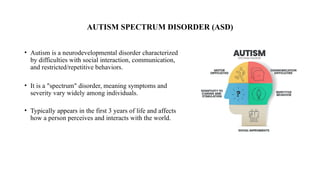
• Autism is a neurodevelopmental disorder characterized
by difficulties with social interaction, communication,
and restricted/repetitive behaviors.
• It is a "spectrum" disorder, meaning symptoms and
severity vary widely among individuals.
• Typically appears in the first 3 years of life and affects
how a person perceives and interacts with the world.
3.
CLINICAL FEATURES OFAUTISM
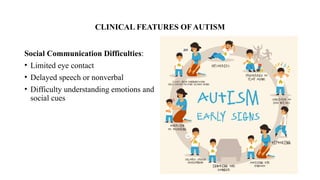
Social Communication Difficulties:
• Limited eye contact
• Delayed speech or nonverbal
• Difficulty understanding emotions and
social cues
4.
CLINICAL FEATURES OFAUTISM
Repetitive Behaviors and Restricted Interests:
• Repetitive movements (hand-flapping, rocking)
• Intense focus on specific topics or objects
5.
CLINICAL FEATURES OFAUTISM
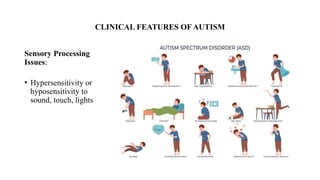
Sensory Processing
Issues:
• Hypersensitivity or
hyposensitivity to
sound, touch, lights
6.
CLINICAL FEATURES OFAUTISM
Motor and Postural Delays:
• Poor coordination and balance
• Delayed motor milestones
7.
DIAGNOSIS OF AUTISM
•No single test; diagnosis is clinical, based on observation and
standardized tools:
• Multidisciplinary evaluation: pediatrician, psychologist, speech therapist,
occupational/physiotherapist
8.
RISK FACTORS FORAUTISM
• Genetic Factors: Family history, certain gene mutations
• Prenatal and Perinatal Factors:
Advanced parental age
Low birth weight
Complications during birth
• Environmental Factors:
Exposure to pollutants, infections during pregnancy
9.
ROLE OF PHYSIOTHERAPYIN AUTISM
• Addresses motor, sensory, and functional difficulties
• Goals:
- Improve gross and fine motor skills
- Enhance posture, balance, and coordination
- Support sensory integration
10.
PHYSIOTHERAPY INTERVENTIONS
1. MotorSkill Training:
- Obstacle courses, ball games, hopping/jumping
2. Balance and Coordination:
- Balance boards, Bosu balls, beam walking
3. Sensory Integration Activities:
- Swing therapy, weighted vests, deep pressure
4. Aquatic Therapy:
- Water play, resistance walking, floatation for sensory comfort
5. Yoga and Relaxation:
- Simple, repetitive postures with visual aids
11.
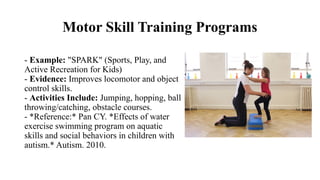
Motor Skill TrainingPrograms
- Example: "SPARK" (Sports, Play, and
Active Recreation for Kids)
- Evidence: Improves locomotor and object
control skills.
- Activities Include: Jumping, hopping, ball
throwing/catching, obstacle courses.
- *Reference:* Pan CY. *Effects of water
exercise swimming program on aquatic
skills and social behaviors in children with
autism.* Autism. 2010.
12.
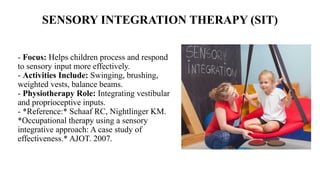
SENSORY INTEGRATION THERAPY(SIT)
- Focus: Helps children process and respond
to sensory input more effectively.
- Activities Include: Swinging, brushing,
weighted vests, balance beams.
- Physiotherapy Role: Integrating vestibular
and proprioceptive inputs.
- *Reference:* Schaaf RC, Nightlinger KM.
*Occupational therapy using a sensory
integrative approach: A case study of
effectiveness.* AJOT. 2007.
13.
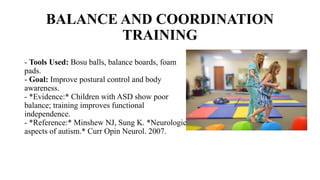
BALANCE AND COORDINATION
TRAINING
-Tools Used: Bosu balls, balance boards, foam
pads.
- Goal: Improve postural control and body
awareness.
- *Evidence:* Children with ASD show poor
balance; training improves functional
independence.
- *Reference:* Minshew NJ, Sung K. *Neurologic
aspects of autism.* Curr Opin Neurol. 2007.
14.
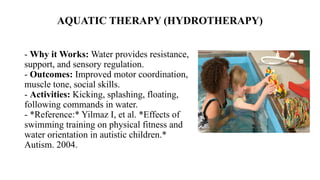
AQUATIC THERAPY (HYDROTHERAPY)
-Why it Works: Water provides resistance,
support, and sensory regulation.
- Outcomes: Improved motor coordination,
muscle tone, social skills.
- Activities: Kicking, splashing, floating,
following commands in water.
- *Reference:* Yilmaz I, et al. *Effects of
swimming training on physical fitness and
water orientation in autistic children.*
Autism. 2004.
15.
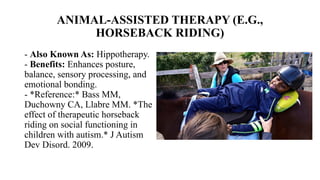
ANIMAL-ASSISTED THERAPY (E.G.,
HORSEBACKRIDING)
- Also Known As: Hippotherapy.
- Benefits: Enhances posture,
balance, sensory processing, and
emotional bonding.
- *Reference:* Bass MM,
Duchowny CA, Llabre MM. *The
effect of therapeutic horseback
riding on social functioning in
children with autism.* J Autism
Dev Disord. 2009.
16.
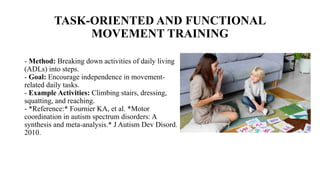
TASK-ORIENTED AND FUNCTIONAL
MOVEMENTTRAINING
- Method: Breaking down activities of daily living
(ADLs) into steps.
- Goal: Encourage independence in movement-
related daily tasks.
- Example Activities: Climbing stairs, dressing,
squatting, and reaching.
- *Reference:* Fournier KA, et al. *Motor
coordination in autism spectrum disorders: A
synthesis and meta-analysis.* J Autism Dev Disord.
2010.